
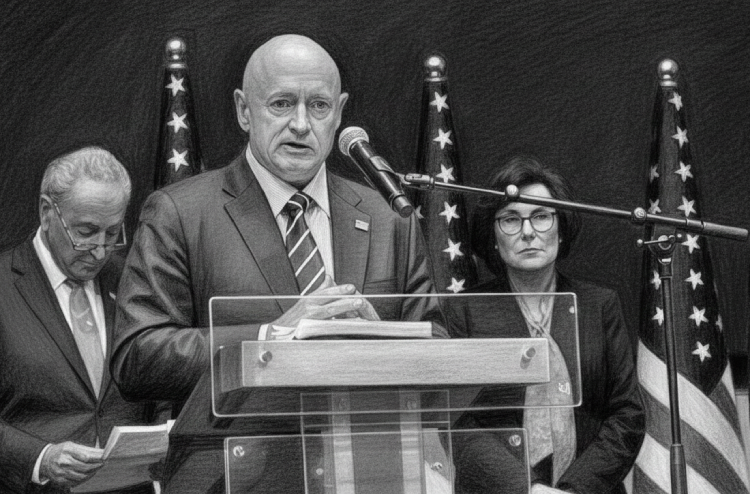
An unprecedented Pentagon investigation tests the boundaries of military authority, constitutional rights, and political warfare
In late November 2025, a 90-second video ignited what may become one of the most consequential civil-military conflicts in modern American history. Senator Mark Kelly (D-AZ), a retired Navy captain, NASA astronaut, and potential 2028 presidential contender, now faces the Pentagon’s unprecedented threat: recall to active duty for possible court-martial proceedings over statements Defense Secretary Pete Hegseth branded as “seditious.”
The stakes transcend one senator’s fate. This case probes fundamental questions about the limits of military jurisdiction over retired officers, the Speech or Debate Clause’s protections for lawmakers, and whether political speech can constitute military misconduct decades after hanging up the uniform.
The Inciting Incident
The controversy erupted when Kelly joined five Democratic colleagues—all military veterans or former intelligence officials—in a video urging service members and intelligence professionals to “refuse illegal orders.” The message, posted to X (formerly Twitter), warned that “this administration is pitting our uniformed military and intelligence community professionals against American citizens.”
The lawmakers never specified which orders they considered illegal, a vagueness that would prove both legally significant and politically incendiary. The context, however, was clear: the Trump administration’s deployment of National Guard troops into American cities and orders to destroy suspected drug-running vessels in the Caribbean had sparked concerns about domestic military overreach.
President Trump responded with characteristic force, posting on Truth Social that the “TRAITORS” should be “IN JAIL RIGHT NOW” for what he characterized as “SEDITION AT THE HIGHEST LEVEL.” He added ominously that “in the old days” such statements were “punishable by DEATH.”
American Thinker: A solution for the infamous Mark Kelly video?
Fiery words have been exchanged between Sen. Mark Kelly (D-Ariz.) and the administration about his “Seditious Six” video, telling the troops they can “refuse” illegal orders. Kelly could be recalled and subjected to military discipline under the Uniform Code of Military Justice.
The American people are unfamiliar with intricacies of military justice. What follows here are information and insights for the public to assist with their own understanding.
Four-tiered Military Justice System
A misconduct charge can be sent to any of four military justice forums, pursuant to the Manual for Courts-Martial (MCM). Each forum has procedural and evidentiary rules, a standard of proof, and sentencing limitations.Nonjudicial Punishment (NJP or “Captain’s Mast” in Navy parlance) is the lowest level in the military justice system (MCM, pp. 468-473). It is not a criminal proceeding, but more analogous to an employment disciplinary hearing. Appeals are administrative only.
The rarely used Summary Court-Martial, also not a formal criminal proceeding, is the odd duck in the system, with the hearing officer acting as judge, prosecutor, and defense counsel.
At a Special Court-Martial (SPCM) and General Court-Martial (GCM), the accused has full criminal defendant rights, rules of procedure and evidence, option for jury “members” before a military judge, and judicial appeals. At an SPCM, the maximum confinement sentence allowed is 12 months.
A General Court-Martial (GCM) is the big daddy of military justice. The maximum punishment allowed by law may be imposed at a GCM, including life or a death sentence (e.g., charge of Article 94, Mutiny or Sedition).
The decision of whether and what charge to send to a forum is within the discretion and inherent rank authority of the commanding officer of the accused.
For a retired captain accused, submitting to an NJP proceeding has advantages. As a personnel matter, Kelly would have a right to an open hearing, punishment is limited (e.g., reprimand, minor pay forfeiture). There can be no criminal conviction. It is prompt. For the government, an Admiral’s Mast has advantages also: If Kelly refused an NJP, he could be blamed for his ultimate fate at court-martial; the lower standard of proof would lessen the government’s needed evidence; a guilty finding would offer a deterrent effect against possible future repeated misconduct; and appeals would be limited to administrative consideration, not a judicial one.
At an SPCM, with the higher standard of proof, the factual elements of the general article 134 offense arguably would be relatively easy to prove. A military judge would likely curtail defense arguments slipping into politics. Members could deliver a guilty or not guilty verdict. However, any courtroom lawyer, military or civilian, will tell you that you never really know what a jury will do.
Diplomacy — a minimum of deference to a retired Navy captain, astronaut, and sitting U.S. senator — may well point toward a wise initial selection of an NJP/Admiral’s Mast forum — if Kelly is recalled. If pragmatism prevails, Admiral’s Mast could leave the political discussions in Congress and put the matter to rest for Kelly, the government, and the American public.
Might there be a win-win in the offing?
The Legal Labyrinth
Kelly’s unique status makes this case a legal Rubik’s Cube. Unlike his five colleagues, Kelly formally retired from the Navy after 25 years of service. This distinction places him under the continuing jurisdiction of the Uniform Code of Military Justice (UCMJ), a fact Hegseth emphasized when he dubbed the group the “Seditious Six,” noting that Kelly was the only one subject to Pentagon authority.
A.C. Lohr, a retired Navy JAG officer, outlined in American Thinker the prosecutorial pathways available to the Defense Department. The government could pursue charges under Articles 94 (Mutiny or Sedition), 133 (Conduct Unbecoming an Officer), or the versatile catch-all Article 134, which criminalizes conduct “prejudicial to good order and discipline” or that “brings discredit to the Armed Forces.”
Yet proving these charges faces substantial hurdles. Article 94’s mutiny provisions require evidence that Kelly intended to overthrow lawful civil authority or create “revolt, violence, or other disturbance”—a high bar for a video urging legal compliance. The vagueness of Kelly’s statements, failing to identify specific “illegal” orders, could make establishing criminal intent difficult.
More fundamentally, constitutional obstacles loom. The Incompatibility Clause (Article I, Section 6) prohibits anyone from simultaneously holding an office “under the United States” and serving in Congress. Recalling Kelly to active duty would force his choice: remain a senator or return to uniform. An involuntary recall might trigger immediate litigation, with Kelly potentially seeking injunctive relief to prevent a constitutional crisis.
Steve Vladeck, a Georgetown law professor, notes that three appellate courts have upheld court-martialing retired service members as constitutional. But those cases involved retirees who weren’t sitting U.S. senators, a distinction that could prove decisive. The Speech or Debate Clause protects congressional speech from executive retaliation—though whether a video on social media constitutes official legislative activity remains untested.
The Diplomatic Solution
Lohr’s analysis suggests a pragmatic off-ramp: Nonjudicial Punishment (NJP), known in Navy parlance as “Admiral’s Mast.” This administrative proceeding would avoid a criminal conviction while allowing the Pentagon to formally reprimand Kelly. Maximum punishments at NJP are limited—perhaps a letter of reprimand and minor pay forfeiture—but the deterrent effect and public record would serve government interests.
Critically, Kelly could refuse NJP and demand a court-martial, gambling that prosecutors couldn’t meet the “beyond a reasonable doubt” standard or that a military judge would dismiss charges on First Amendment grounds. The government, in turn, might view Kelly’s refusal as justifying escalation, effectively placing responsibility for any lengthy, politically charged trial on the senator himself.
This calculus makes NJP attractive to both parties. For Kelly, it ends the matter quickly without criminal consequences. For the Pentagon, it establishes precedent that retired officers cannot use their rank and service to undermine military discipline, even after leaving active duty, while avoiding a constitutional showdown that could restrict future military authority.
Historical Echoes and Modern Implications
The Pentagon invoked a telling precedent: Colonel Billy Mitchell’s 1925 court-martial for insubordination. Mitchell, an Army aviator who became legendary for championing military airpower, faced charges after making “extremely strong statements, very critical of military leadership.”
But retired military lawyer Kevin Carroll notes Mitchell was on active duty—a crucial distinction. The Kelly case, involving a retired officer and sitting senator, is “really a horse of a different kind.”
Indeed, recalling retired officers for post-service statements is exceedingly rare. Former Marine Lieutenant Colonel Mick Wagoner, who served 17 years as a military lawyer, called the Pentagon’s move “very rare” and “politically charged,” noting such recalls “generally applied for events that happened on active duty and were discovered post [active-duty] service.”
The broader implications extend beyond Kelly. Approximately 2.3 million military retirees could theoretically face recall for statements the Pentagon deems harmful to “good order and discipline.” While such sweeping enforcement seems improbable, establishing that controversial political speech by retired officers constitutes prosecutable misconduct could chill veterans’ participation in democratic discourse.
The Political Calculation
Strip away the legal technicalities, and this case represents raw political combat. Trump’s administration sees an opportunity to punish Democratic opposition while establishing that critics cannot hide behind military credentials when challenging executive authority. Kelly’s defenders view it as authoritarian overreach, using the military justice system to intimidate congressional oversight.
Senate Majority Leader Chuck Schumer accused Trump of using the Pentagon “as his personal attack dog,” adding “this is what dictators do.” Fellow Arizona Senator Ruben Gallego defended Kelly’s right to speak, declaring “in America, we swear an oath to the Constitution, not wannabe kings.”
Kelly himself remained defiant, dismissing the investigation as the work of “bullies” and vowing, “If this is meant to intimidate me and other members of Congress from doing our jobs and holding this administration accountable, it won’t work.”
The Likely Resolution
Predicting outcomes in unprecedented cases carries inherent uncertainty, but several factors point toward a negotiated resolution rather than courtroom confrontation.
First, the constitutional obstacles make a successful prosecution far from assured. The Pentagon faces serious questions about whether it can recall a sitting senator, whether Kelly’s speech enjoys First Amendment protection, and whether vague statements about “illegal orders” constitute criminal conduct. A loss in court would embarrass the administration and potentially constrain future military authority over retirees.
Second, the political costs of a lengthy, high-profile trial could exceed any benefits. Kelly would use the proceedings to put the Trump administration’s military policies on trial, calling witnesses about specific orders he considered illegal. The spectacle would dominate news cycles for months, keeping military domestic deployment controversies in public view while making Kelly a martyr for the resistance.
Third, both sides have incentives to claim victory through compromise. The Pentagon can assert it established that retired officers remain accountable to military justice while showing restraint through administrative rather than criminal punishment. Kelly can portray himself as having stood up to intimidation while accepting minor consequences that don’t include a criminal conviction.
The most probable outcome: Kelly accepts an Admiral’s Mast proceeding resulting in a formal letter of reprimand. This satisfies the Pentagon’s need to formally discipline him while avoiding the constitutional minefield of a court-martial. The letter becomes a badge of honor for Kelly among his political base while giving the administration something to point to as accountability.
Alternatively, the investigation could quietly fade after months of review, with the Pentagon announcing it found insufficient evidence to warrant further action. This saves face for both sides—the administration demonstrated it takes military discipline seriously, while Kelly escapes formal punishment.
What seems increasingly unlikely is the nuclear option: involuntary recall and court-martial. The legal, political, and constitutional risks of that path make it the least attractive choice for an administration that prides itself on winning. In Washington, as in military strategy, sometimes the most important victory is knowing which battles not to fight.
The Mark Kelly affair will likely end not with a bang but a carefully choreographed compromise that allows everyone to declare victory while leaving the fundamental questions—about retired officer speech, military jurisdiction, and civil-military boundaries—for another day and another case.
Additional Resources:
- Pentagon Statement on Kelly Investigation: https://www.defense.gov/
- Manual for Courts-Martial: https://jsc.defense.gov/
- Constitutional Incompatibility Clause Analysis: https://constitution.congress.gov/
- Foundation for Individual Rights and Expression Statement: https://www.thefire.org/