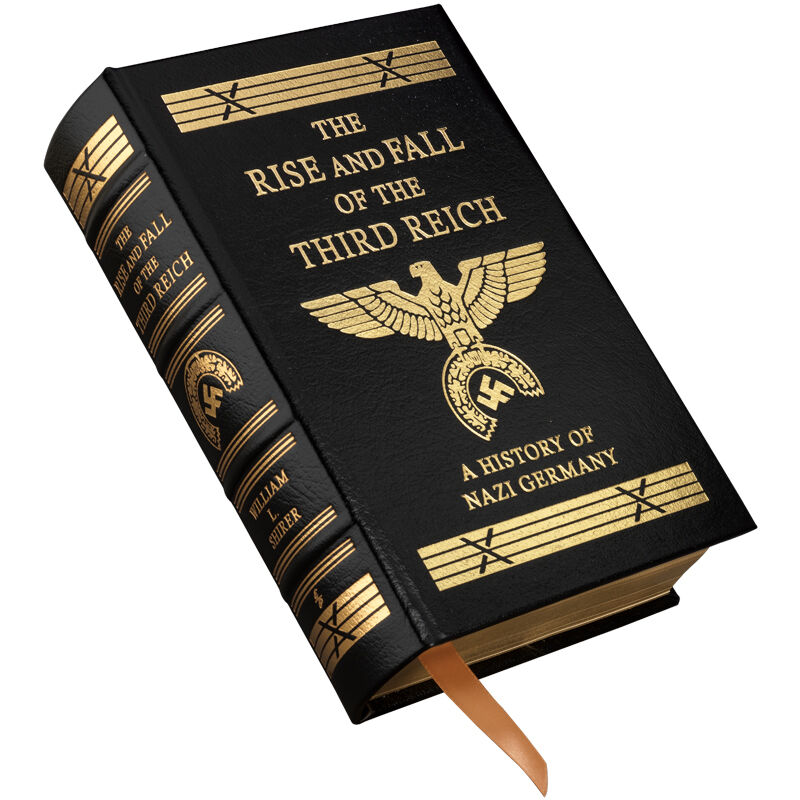
The Rise and Fall of the Third Reich by William L. Shirer is the only book about Nazi Germany that comes near 1,400 pages, including main text, footnotes, and index.
I find myself increasingly disturbed not by political discourse itself, but by the wholesale abuse of historical methodology in our current moment. The invocation of William L. Shirer’s The Rise and Fall of the Third Reich to draw parallels between Donald Trump and Adolf Hitler represents not merely hyperbole, but a fundamental misunderstanding of both historical analysis and the unique circumstances that produced National Socialism.
Let me be direct: such comparisons do a profound disservice to the victims of actual fascism, trivialize one of history’s greatest crimes, and paradoxically blind us to genuine threats by crying wolf with our most serious historical references.
Understanding Shirer’s Context and Limitations
Shirer’s work, published in 1960, was groundbreaking for its time—a sweeping narrative written by a journalist who witnessed many events firsthand. However, modern historians recognize its limitations. Shirer wrote before the opening of crucial archives, before sophisticated analysis of the Holocaust’s administrative machinery, and with the perspective of someone who had lived through the trauma rather than studied it with academic distance. His work excels as primary source testimony but lacks the analytical rigor of subsequent scholarship by historians like Ian Kershaw, Richard Evans, and Saul Friedländer.
When contemporary commentators invoke Shirer to describe Trump, they typically haven’t read the book carefully. They seize upon superficial parallels—populist rhetoric, media manipulation, nationalist appeals—while ignoring the vastly different historical, economic, and political contexts.
The Historical Context That Made Hitler Possible
Hitler’s rise occurred in a Germany that had experienced complete military defeat, the humiliation of Versailles, the loss of 13% of its European territory, hyperinflation that destroyed the middle class, and a democracy that was barely a decade old, with no democratic tradition. The Weimar Republic faced armed communist revolutionaries on one side and monarchist reactionaries on the other, with paramilitary forces numbering in the hundreds of thousands engaged in street battles that killed hundreds.
Germany in 1933 had six million unemployed in a nation of 65 million. The democratic center had completely collapsed. The Nazi Party maintained a private army of 400,000 SA troops who openly terrorized opponents. German democracy had never consolidated; it existed in a state of perpetual emergency governance.
America in 2016, 2020, or 2024 resembles none of this. The United States has the world’s most stable constitutional system, over two centuries of democratic tradition, peaceful transfers of power (including after Trump’s loss in 2020), an independent judiciary, a professional military that has never wavered in its constitutional loyalty, and robust civil society institutions.
Ideological Differences That Matter
Hitler’s ideology was explicitly exterminationist from the beginning. Mein Kampf, written in 1924, openly called for the extermination of Jews and the conquest of Eastern Europe to provide Lebensraum (living space) for the German race. Nazi ideology rested on pseudoscientific racial theory, Social Darwinism, and the explicit goal of overturning the Versailles settlement through warfare.
Trump’s rhetoric, whatever one thinks of its merits or dangers, contains nothing remotely comparable. His nationalism is conventional American political nationalism, not racial imperialism. His immigration policies, however harsh critics may judge them, do not constitute preparation for genocide. The distinction between restrictive immigration policy and industrialized mass murder is not a matter of degree—it is categorical.
The Mechanism of Hitler’s Consolidation of Power
When Hitler became Chancellor in January 1933, he immediately set about destroying democracy through:
- The Reichstag Fire Decree (February 1933), which suspended civil liberties indefinitely
- The Enabling Act (March 1933), which allowed Hitler to pass laws without parliamentary approval
- The abolition of all political parties except the Nazi Party (July 1933)
- The Night of the Long Knives (June 1934), assassinating political opponents
- The Gleichschaltung—the forced coordination of all institutions under Nazi control
- The establishment of concentration camps for political prisoners within weeks of taking power
Trump governed within constitutional constraints, faced an independent Congress that blocked many of his initiatives, was subject to judicial review, confronted a hostile press that operated freely, and ultimately left office when defeated electorally. Whatever constitutional controversies surrounded January 6th, the system held, and Biden was inaugurated on schedule.
Why This Matters Beyond Politics
The problem with facile Trump-Hitler comparisons extends beyond inaccuracy. It creates several dangerous effects:
Conceptual inflation: When we label conventional democratic politicians as Hitler, we lose the vocabulary to describe actual fascism when it emerges. If Trump is Hitler, what do we call someone who actually opens concentration camps, bans opposition parties, and launches wars of conquest?
Historical illiteracy: These comparisons demonstrate that many Americans, even educated ones, lack basic understanding of what National Socialism actually was—not just bad nationalism, but a totalizing ideology that sought to remake humanity through violence.
Partisan weaponization: Once one side compares its opponents to Hitler, the other side feels entitled to do likewise, creating a cycle of escalation that makes reasoned discourse impossible. Indeed, conservatives have made their own absurd Hitler comparisons regarding Democratic politicians.
Diminishing the Holocaust: When we treat Trump’s policies as equivalent to Nazism, we implicitly minimize the Holocaust. The comparison suggests that Nazi Germany was just “really bad politics” rather than a unique crime against humanity.
The Historian’s Responsibility
As historians, we have a duty to precision. We study Hitler and the Third Reich not to win contemporary political arguments but to understand how civilized society can descend into barbarism—to identify the warning signs of genuine authoritarianism and to preserve the memory of victims.
The warning signs of fascism are real and worth studying: the delegitimization of democratic institutions, the scapegoating of minorities, the glorification of violence, the cult of personality, the rejection of objective truth. These can appear in various forms across the political spectrum. But recognizing dangerous trends does not require or justify false historical equivalencies.
Trump may be many things—norm-breaking, polarizing, authoritarian-curious—but he is not Hitler, and America in the 2020s is not Weimar Germany. Those who insist otherwise don’t demonstrate historical sophistication; they reveal they’ve learned nothing from history except how to use it as a rhetorical weapon.
Serious historical scholarship demands better. Our students deserve better. And the memory of those who actually suffered under fascism deserves far better than to have their experience weaponized for partisan advantage.