
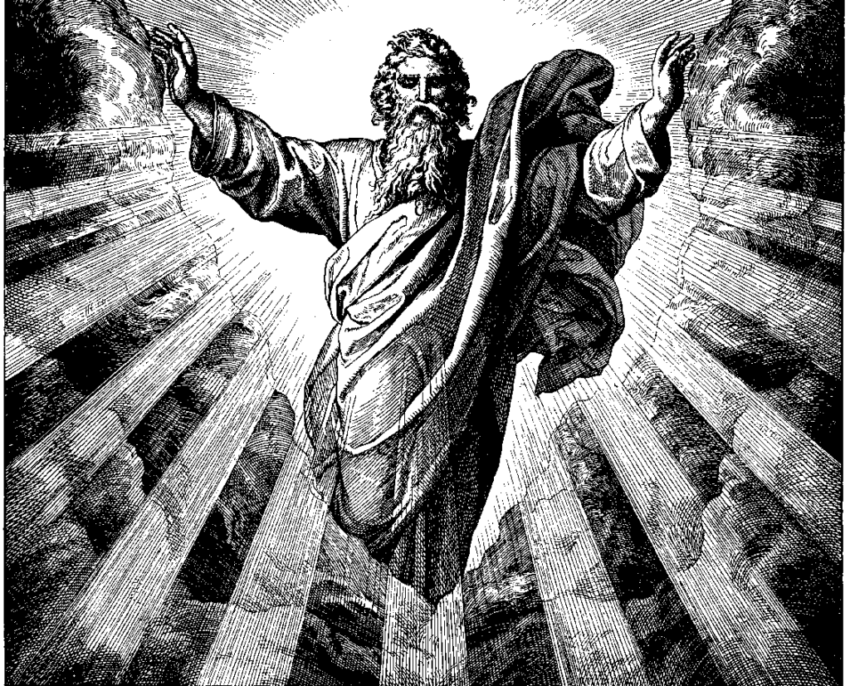
Photo: Julius Schnorr von Carolsfeld – Bibel in Bildern. Woodcut for
“Die Bibel in Bildern”, 1860. Public Domain.
The Infinite Regress of Divine Origins
A Philosophical Inquiry into the Ontological Problems of Latter-day Saint Theology
Questions Worth Asking Series
Introduction: The Question That Cannot Be Avoided
Among the most distinctive claims of Latter-day Saint theology is the assertion that the God worshiped by Christians was once a mortal man who progressed to godhood, and that humans may similarly achieve divine status. This doctrine, famously summarized in Lorenzo Snow’s couplet—“As man now is, God once was; as God now is, man may become”—raises a question that cuts to the very heart of metaphysics and philosophy of religion: If God was once a man who achieved exaltation under another god, where did the first god come from?
This is not a hostile question designed to embarrass LDS believers. It is, rather, the inevitable philosophical inquiry that any thoughtful, devoted Latter-day Saint must eventually confront. The question presses upon the logical coherence of a theological system and asks whether its “official” foundational claims can withstand rational scrutiny. As we shall see, the implications of this inquiry extend far beyond abstract speculation; they touch upon the nature of worship, the meaning of transcendence, the reliability of prophetic revelation, and the internal consistency of Joseph Smith’s theological innovations.
This essay proceeds with the conviction that religious beliefs deserve serious intellectual engagement. Latter-day Saints are thinking people who value truth, and the questions raised here are offered in the spirit of genuine philosophical inquiry rather than rhetorical attack. At the same time, we must follow the argument where it leads, even when the conclusions prove uncomfortable for the theological system under examination.
Section I: The Development of LDS Polytheism
Early Monotheism and Later Evolution
The theological trajectory of Joseph Smith’s teaching presents an immediately puzzling feature: the Book of Mormon itself, published in 1830, contains strongly monotheistic passages that appear incompatible with the polytheism Smith would later teach. Alma 11:26-29 explicitly states that there is only one God, and Mosiah 15:1-5 presents a modalistic understanding of the Godhead that mirrors traditional Christian trinitarian language. These texts make no mention of eternal progression, of God having once been a man, or of the existence of multiple gods.
Yet by April 1844, just months before his death, Joseph Smith delivered the King Follett Discourse at the funeral of a church member, proclaiming: “God himself was once as we are now, and is an exalted man, and sits enthroned in yonder heavens!” He elaborated: “I am going to tell you how God came to be God. We have imagined and supposed that God was God from all eternity. I will refute that idea… He was once a man like us; yea, that God himself, the Father of us all, dwelt on an earth, the same as Jesus Christ Himself did.”
This development raises immediate historical questions. How does a prophet who claims to have restored ancient Christianity arrive at a doctrine that no ancient Christian—indeed, no monotheist of any tradition—ever taught? The doctrine appears not in the Book of Mormon, not in the early sections of the Doctrine and Covenants, but emerges only in the final years of Smith’s life. Did ancient Christians believe this and later lose it? Or is this an innovation rather than a restoration?
Joseph Smith taught the plurality of gods explicitly. “I will preach on the plurality of Gods. I have selected this text for that express purpose. I wish to declare I have always and in all congregations when I have preach on the subject of the Deity, it has been the plurality of Gods.” (Teachings of the Prophet Joseph Smith, pp. 370-372)
He added, “In the beginning, the head of the Gods called a council of the Gods; and they came together and concocted a plan to create the world and people it.” (History of the Church, v. 6, pp. 307-308)
(Note: The Biblical Witness to Divine Singularity will be dealt with below.)
The Metaphysics of Eternal Progression
According to the mature theology of Latter-day Saint teaching, reality consists of the following elements: uncreated intelligence (or intelligences) that have existed eternally, spirit matter that is organized rather than created, and a chain of gods extending backward in time, each of whom achieved godhood under the tutelage and within the system established by a preceding god. The God of our world, Heavenly Father, was once a mortal man on another earth, who progressed through obedience to divine law until he achieved exaltation, at which point he organized intelligences into spirits and eventually provided physical bodies for his spirit children through the creation of earth.
Lorenzo Snow’s couplet summarizes progression: “As man now is, God once was; as God is, man may become.” (June 1840)
Brigham Young affirmed, “He is our Father—the Father of our spirits, and was once a man in mortal flesh as we are, and is now an exalted Being.” (Journal of Discourses, vol. 7, pp. 333)
This system has a certain internal logic if one grants its premises. But it is precisely those premises that philosophical inquiry must examine. For the system immediately generates what philosophers call an infinite regress—a chain of explanation that extends backward without a terminus.
When it’s fourth down and long, you punt.
FairLatterDaySaints.org: Is it true that Mormon doctrine teaches a “genealogy of gods?”
Mormon doctrine on this point is not clear, and mostly speculative. Not all Latter-day Saints accept the ideas which suggest a regression of divine beings. Mormon doctrine on this point is not clear, and mostly speculative. It does not play much of a role, one way or the other, in LDS worship or thought.
Objections based on the infinite regression problem usually rely on a misunderstanding of the properties of infinities, and require that the critic improperly apply finite properties to infinities. These problems are not unique to LDS theism, but must be confronted in some form by all believers in the existence of God.
Section II: The Problem of Infinite Regress
The Logical Structure of the Problem
Consider the explanatory chain that LDS theology proposes. We may call our Heavenly Father “God-1.” According to the doctrine, God-1 achieved his divine status by obeying the laws and ordinances established by his Heavenly Father, whom we may call “God-2.” But God-2 must have achieved his status in precisely the same way, under the authority and within the system of God-3. This chain extends backward: God-3 was exalted by God-4, who was exalted by God-5, and so on without end.
The question that cannot be avoided is this: Where did the first god come from? If every god in the chain achieved divinity by progressing within a system established by a preceding god, then the chain of explanation is genuinely infinite—it has no starting point. But if the chain is infinite, then it has no foundation. The explanatory power of the system becomes illusory because we can never arrive at an ultimate explanation for why there is a system of divine progression at all.
Orson Pratt described a chain of divine parentage. “We were begotten by our Father in Heaven; the person of our Father in Heaven was begotten on a previous heavenly world by His Father; and again, He was begotten by a still more ancient Father; and so on, from generation to generation… until our minds are wearied and lost in the multiplicity of generations and successive worlds.” (The Seer, p. 132)
Brigham Young stated, “How many Gods there are, I do not know. But there never was a time when there were not Gods and worlds, and when men were not passing through the same ordeals that we are now passing through. That course has been from all eternity, and it is and will be to all eternity.” (Journal of Discourses, vol. 7, p. 333)
Why Infinite Regress Is Problematic
Philosophers have long recognized that infinite regresses of certain kinds are deeply problematic. The classic example involves causal explanation: if every event is caused by a preceding event, and that chain extends infinitely into the past, we seem to have explained each link in the chain while explaining nothing about why the chain exists at all. As Thomas Aquinas argued, an infinite series of essentially ordered causes—where each cause depends upon its predecessor for its causal power—cannot ground its own existence.
The LDS chain of gods appears to be precisely such an essentially ordered series. Each god’s divinity depends upon the prior god’s system; remove the prior god, and the subsequent god never achieves exaltation. The chain has no self-supporting link, no point at which divinity is self-grounded rather than derived. This creates what philosophers call an “explanatory vacuum”—the appearance of explanation without its reality.
Compare this with classical theism, which posits a God who is the uncaused cause, the unmoved mover, the necessary being upon whom all contingent beings depend. Such a God terminates the regress by being ontologically fundamental—not another link in the chain, but the ground that makes the chain possible. LDS theology appears to lack any such terminus.
Section III: Possible Responses and Their Difficulties
Response One: The Chain Is Simply Infinite
Some Latter-day Saint thinkers embrace the infinite regress, arguing that the chain of gods extends eternally into the past with no beginning. On this view, there simply is no “first god”—the question assumes a starting point that doesn’t exist.
But this response faces several difficulties. First, it doesn’t so much answer the philosophical problem as decline to answer it. The question “Why is there a system of divine progression?” remains unanswered and unanswerable. Second, an actually infinite past raises deep metaphysical puzzles. If an infinite number of events have already occurred, how did we arrive at the present moment? Traversing an actual infinity seems impossible in principle—there is always “one more” god in the chain that must have achieved exaltation before we arrive at our Heavenly Father.
Third, and most significantly for LDS theology specifically, this response raises the question of eternal law. Latter-day Saint teaching holds that the laws by which gods achieve exaltation are eternal and independent of any particular god. As Brigham Young stated, God “has been working and progressing according to the principles of law.” But if the laws are eternal and no god established them, then the laws themselves become the ultimate reality—more fundamental than any god. The gods become servants of impersonal principles rather than ultimate beings. This is a form of theological determinism that sits uneasily with LDS emphasis on divine agency and personality.
Response Two: There Was a First God Who Self-Deified
Another possible response holds that at some point in the infinite past, there was a first god who achieved divinity without the assistance of a preceding god—a “self-made” deity who somehow bootstrapped himself into existence as a god.
This response faces its own severe difficulties. First, it abandons the very principle that defines LDS soteriology: that exaltation comes through obedience to ordinances administered by divine authority. If the first god achieved divinity without such ordinances, then the ordinances are not essential to exaltation after all. The temple, the priesthood, the covenants—all become contingent rather than necessary. Why should we follow a path that the first god did not need?
Second, how could an unglorified, mortal being achieve divine status by his own efforts? What would that even look like? The explanatory gap here is enormous. Either divine nature is achievable through natural processes alone—in which case it isn’t really divine in any traditional sense—or some transcendent intervention was required, which brings us back to the question of who or what provided it.
Response Three: The Question Is Beyond Our Understanding
A third response, common in pastoral settings, holds that we simply cannot understand these deep mysteries and that faith requires accepting our limitations. The origin of the first god, if there was one, lies beyond mortal comprehension.
While intellectual humility is always appropriate, this response is problematic for LDS theology specifically. The entire claim of the Restoration is that mysteries hidden for ages have been revealed through modern prophets. Joseph Smith claimed to know how God came to be God. If the system of eternal progression is true, then it is part of the revealed knowledge that distinguishes the restored gospel from apostate Christianity. To retreat into mystery at precisely the point where the system faces its greatest logical challenge appears less like humility and more like evasion.
Moreover, this response proves too much. If we cannot understand the origin of gods, why should we believe we understand the process of becoming one? The doctrine of eternal progression is detailed and specific; it seems inconsistent to embrace those specifics while declining to consider their logical implications.
Section IV: Cascading Implications for LDS Theology
The Problem of Worship
The infinite regress problem casts new light on the question of worship within LDS theology. Why should Heavenly Father receive our worship if he is merely one god among an infinite series? He is not the ultimate source of anything—not of existence, not of law, not of the system by which divinity is achieved. He is, in a sense, middle management in an infinite bureaucracy.
In classical theism, God is worthy of worship because he is the unconditioned source of all conditioned reality, the perfect being upon whom all imperfect beings depend. His worship is fitting because of his unique ontological status. But in LDS theology, Heavenly Father’s status is not unique at all—he is merely the most proximate god in an infinite sequence. Worship directed to him rather than to his predecessors seems arbitrary, like worshiping your immediate supervisor while ignoring the CEO (who, in this case, doesn’t exist).
The Reliability of Prophetic Revelation
The philosophical problems with divine origins also raise questions about the prophetic process that produced these doctrines. When Joseph Smith declared that he would “refute” the idea that God was God from all eternity, he was contradicting not only historic Christianity but also the apparent teaching of the Book of Mormon he had translated fourteen years earlier. The God of the Book of Mormon appears to be eternal, uncreated, and singular—precisely the attributes Smith later denied.
How should we understand this development? If the King Follett doctrine is true, why was it not taught in the Book of Mormon—the text that supposedly contained the “fullness of the gospel”? If early LDS scriptures taught monotheism while later teachings proclaimed polytheism, which represents the genuine restoration of ancient truth? The evolution of doctrine suggests, at minimum, that prophetic understanding develops over time, leaving open the question of whether any particular teaching has reached its final form.
The Question of Biblical Compatibility
The Bible presents a God who declares, “Before me there was no God formed, neither shall there be after me” (Isaiah 43:10), and “I am the first, and I am the last; and beside me there is no God” (Isaiah 44:6). These statements appear categorically incompatible with an infinite regress of gods, each achieving divinity under the supervision of predecessors.
LDS interpreters typically understand such passages as referring only to gods relevant to humanity—our Heavenly Father is the only God for us, whatever other gods may exist in the infinite chain. But this reading strains the plain sense of the text, which uses universal language (“before me,” “after me,” “no God”) rather than relational language (“no other god for you”). The prophets of Israel appear to be making metaphysical claims about the nature of ultimate reality, not merely jurisdictional claims about spheres of divine administration.
Section V: What Kind of “Gods” Are These?
Perhaps the most fundamental question raised by this inquiry concerns the nature of divinity within LDS theology itself. If “god” refers to a being who has achieved a certain status through a process of progression—a status that was achieved by the being’s predecessors and may be achieved by the being’s successors—then what exactly does the term mean?
Classical theism defines God in terms of certain metaphysical properties: necessity (God cannot not exist), aseity (God exists in and of Himself, not through another), omniscience, omnipotence, perfect goodness, and eternality. These properties set God apart from all other beings in a qualitative, not merely quantitative, way. God is not the biggest thing in the universe; he is in a different category altogether.
LDS gods, by contrast, appear to differ from humans only quantitatively. They are more powerful, more knowledgeable, more exalted—but they remain beings of the same fundamental kind, subject to the same eternal laws, participants in the same system of progression. The difference between a human and a god is like the difference between a student and a professor: significant in practical terms, but not a difference in basic nature.
This raises the question: Is such a being truly worthy of the title “God” in any philosophically robust sense? Or have we simply redefined the term to mean “very advanced being“? If the latter, then LDS theology is not really about God in the traditional sense at all—it is about a hierarchy of advanced entities, none of whom possesses the attributes that philosophers and theologians have typically associated with divinity.
Conclusion: Questions That Deserve Answers
The inquiry we have pursued is not intended to suggest that Latter-day Saints are unintelligent or that their faith is held in bad faith. Many LDS scholars have wrestled seriously with these questions, and thoughtful members continue to do so. But the problems we have identified are genuine and substantial. The infinite regress of divine origins is not a minor technical difficulty; it strikes at the logical foundation of the entire theological system.
If the chain of gods is infinite, we have no ultimate explanation for why the system exists. If there was a first god who self-deified, the very process of exaltation loses its necessity. If the question is beyond understanding, the claim to restored knowledge becomes suspect. And in any case, the god who emerges from this system bears little resemblance to the God of classical theism, of biblical revelation, or of historic Christianity.
It is perhaps telling that the LDS Church has never issued an official, binding doctrinal statement on the origin of the first god. This silence is convenient, for any concrete answer would expose the system to precisely the criticisms we have outlined. Yet this reticence stands in striking contrast to the meticulous detail with which nearly every other aspect of Latter-day Saint religious life is documented and prescribed. Temple ordinances are scripted word-for-word. Priesthood lines of authority are traced link by link. Organizational structures are diagrammed with corporate precision. The Church’s missionary discussions, youth programs, family home evening manuals, and handbooks of instruction leave little to improvisation. Even the pattern of prayer and the procedure for blessing the sacrament are specified in exact language. In a religious system where so much is spelled out—where the “order of heaven” is invoked to justify detailed protocols for everything from baptismal interviews to the proper wearing of temple garments—the studied vagueness surrounding the origin of divinity itself is conspicuous. One cannot help but wonder whether the silence exists not because the question is too sacred to discuss, but because any answer would prove too damaging to defend.
These are questions worth asking. They deserve serious, thoughtful engagement rather than dismissive responses. For the honest inquirer—whether investigating the LDS faith or already committed to it—the origin of the first god remains a question that cannot be wished away. How one answers it will determine much about how one understands the nature of ultimate reality, the meaning of divine worship, and the coherence of the theological system that Joseph Smith introduced to the world.
Philosophy teaches us that the best gift we can give to any worldview—including our own—is honest, rigorous examination. The questions raised here are offered in that spirit, trusting that truth is robust enough to withstand scrutiny, and that genuine faith is deepened, not threatened, by thinking clearly about what we believe and why.
The Biblical Witness to Divine Singularity
A Supplemental Section: What Scripture Actually Teaches About the Nature of God
Before examining the philosophical problems inherent in LDS polytheism, it is essential to establish what the Bible itself teaches about the nature of God. The question is not merely whether multiple gods exist, but what kind of being God is—and whether the biblical authors understood Him as one deity among many or as the sole, uncreated, self-existent source of all reality. As we shall see, the biblical witness is unambiguous: there is one God, and His singularity is not a matter of jurisdiction or relevance but of ontological fact.
The Shema: Israel’s Foundational Confession
The bedrock of biblical theology is the Shema, the confession that every faithful Israelite recited daily and that Jesus Himself identified as the greatest commandment:
“Hear, O Israel: The LORD our God, the LORD is one. You shall love the LORD your God with all your heart and with all your soul and with all your might.” (Deuteronomy 6:4–5, ESV)
The Hebrew word translated “one” (echad) denotes absolute singularity. This was not a statement of henotheism—the worship of one god while acknowledging others exist—but a declaration of monotheism: there is only one God. The Shema distinguished Israel from every surrounding nation, each of which worshiped pantheons of deities. Yahweh was not merely Israel’s preferred god; He was the only God there is.
Isaiah: The Prophet of Divine Exclusivity
No biblical author articulates divine singularity more forcefully than Isaiah. Writing to a people tempted by the gods of Babylon, Isaiah records God’s own declarations about His unique nature:
“You are my witnesses,” declares the LORD, “and my servant whom I have chosen, that you may know and believe me and understand that I am he. Before me no god was formed, nor shall there be any after me.” (Isaiah 43:10, ESV)
The implications of this statement are devastating to any theology of eternal progression. God declares that no god was formed before Him—eliminating the possibility of a chain of predecessor gods—and that none shall be formed after Him—eliminating the possibility of humans achieving godhood. The language is categorical and admits no exceptions.
Isaiah continues with equal force:
“Thus says the LORD, the King of Israel and his Redeemer, the LORD of hosts: ‘I am the first and I am the last; besides me there is no god.'” (Isaiah 44:6, ESV)
“I am the LORD, and there is no other, besides me there is no God.” (Isaiah 45:5, ESV)
“Remember this and stand firm, recall it to mind, you transgressors, remember the former things of old; for I am God, and there is no other; I am God, and there is none like me.” (Isaiah 46:8–9, ESV)
These are not relational statements about which god Israel should worship. They are metaphysical claims about reality itself. God does not say, “I am the only god for you“ or “I am the only god you need concern yourself with.“ He says there is no other—period. To read these passages as permitting an infinite regress of gods, or as compatible with human deification, requires imposing a meaning the text simply does not bear.
The First Commandment: Priority and Exclusivity
At Sinai, God established the foundational commandment of the covenant:
“You shall have no other gods before me.” (Exodus 20:3, ESV)
Some have attempted to read this as acknowledging the existence of other gods while merely prohibiting their worship. But this interpretation fails for several reasons. First, the Hebrew phrase “before me” (al-panay) can mean “in my presence” or “in opposition to me,” conveying that no rival deity may stand in Yahweh’s presence because no such being exists. Second, the broader context of the Pentateuch consistently denies the reality of other gods. The so-called “gods” of the nations are elsewhere identified as demons (Deuteronomy 32:17), as nothing (Psalm 96:5), and as the work of human hands (Psalm 115:4–8). The commandment prohibits Israel from treating as gods what are, in fact, non-gods.
The Eternal, Unchanging God
Central to biblical theology is the affirmation that God has always been God—that He did not become divine but has existed eternally in His full divine nature. The Psalmist declares:
“Before the mountains were brought forth, or ever you had formed the earth and the world, from everlasting to everlasting you are God.” (Psalm 90:2, ESV)
Note the language carefully: God does not become God; He is God “from everlasting to everlasting.” There was never a time when He was not God, never a moment when He existed as something less than fully divine. This directly contradicts the LDS teaching that God “was once as we are now” and progressed to His current state.
The prophet Malachi records God’s own testimony to His unchanging nature:
“For I the LORD do not change; therefore you, O children of Jacob, are not consumed.” (Malachi 3:6, ESV)
If God does not change, He cannot have changed from a mortal man into an exalted deity. His immutability is not a peripheral doctrine but central to His reliability, His faithfulness, and His very identity as God.
The New Testament Continuation
The New Testament authors, far from introducing polytheism, reinforce and intensify the monotheism of the Hebrew Scriptures. When asked about the greatest commandment, Jesus affirms the Shema:
“The most important is, ‘Hear, O Israel: The Lord our God, the Lord is one.'” (Mark 12:29, ESV)
Paul, writing to the church at Corinth in a context where pagan polytheism was rampant, affirms:
“We know that ‘an idol has no real existence,’ and that ‘there is no God but one.’ For although there may be so-called gods in heaven or on earth—as indeed there are many ‘gods’ and many ‘lords’—yet for us there is one God, the Father, from whom are all things and for whom we exist, and one Lord, Jesus Christ, through whom are all things and through whom we exist.” (1 Corinthians 8:4–6, ESV)
Paul acknowledges that pagans worship “so-called gods,” but he denies their reality. The “many gods and many lords” exist only in the false beliefs of their worshipers. In truth, there is one God. The Father is identified as the source “from whom are all things”—a statement incompatible with an infinite regress of gods, none of whom is the ultimate source.
James adds his own emphatic declaration:
“You believe that God is one; you do well. Even the demons believe—and shudder!” (James 2:19, ESV)
The unity and singularity of God are so foundational that even demons acknowledge it. It is not a matter of interpretation or theological preference but of basic spiritual reality.
The Unbridgeable Gulf: Creator and Creature
Perhaps most fundamentally, Scripture establishes an absolute distinction between God the Creator and everything He has made. This distinction is not a matter of degree but of kind. God exists necessarily; creation exists contingently. God is self-sufficient; creation depends entirely upon Him. God is infinite; creation is finite. These are not quantitative differences that could be overcome through progression but qualitative differences that define the very categories of existence.
“In the beginning, God created the heavens and the earth.” (Genesis 1:1, ESV)
The opening verse of Scripture establishes the fundamental framework: God exists before and apart from creation. He is not part of the created order, not the highest being within it, but its transcendent source. Everything that is not God was made by God. There is no uncreated matter, no co-eternal intelligence, no chain of beings extending back alongside Him.
The apostle John reinforces this:
“All things were made through him, and without him was not any thing made that was made.” (John 1:3, ESV)
The scope is comprehensive: all things were made through the Word, and nothing that exists came into being apart from Him. If the spirits of humans are uncreated, as LDS theology teaches, then John’s statement is false. If other gods exist who achieved their status independent of the one true God, then the claim that “without him was not any thing made” becomes meaningless.
The Testimony Is Clear
The biblical witness to divine singularity is not ambiguous, peripheral, or open to reinterpretation. From the Shema to the prophets, from the Psalms to the apostles, Scripture declares with one voice that there is one God, that He has always been God, that no god preceded Him, that none shall follow, and that the gulf between Creator and creature is absolute and unbridgeable.
This is the theology that the earliest Christians inherited from Judaism, proclaimed in their preaching, defended against pagan polytheism, and enshrined in their creeds. It is the theology that every branch of historic Christianity—Eastern Orthodox, Roman Catholic, and Protestant—has affirmed without exception for two millennia. It is, notably, also the theology that the Book of Mormon appears to teach in its most explicit passages about the nature of God.
When Joseph Smith declared in 1844 that God “was once a man like us” and that the traditional view of God’s eternal deity was an idea he intended to “refute,” he was not restoring ancient Christianity. He was abandoning it. The question every thoughtful person must ask is whether a doctrine that contradicts the unified witness of Scripture, the teaching of the historic church, and even the earlier texts of Smith’s own religious movement can credibly claim to be the restored truth of the ages—or whether it is, in fact, precisely what it appears to be: an innovation without precedent, introduced late, and unsupportable by the very texts it claims as authoritative.
* * *
Although there is no “official” doctrine, there is no shortage of LDS quotes since the time of Joseph Smith that have dealt with the subject of polytheism, genealogy of gods, infinite regress, eternal progression, and other worlds. Check out this extensive list: