
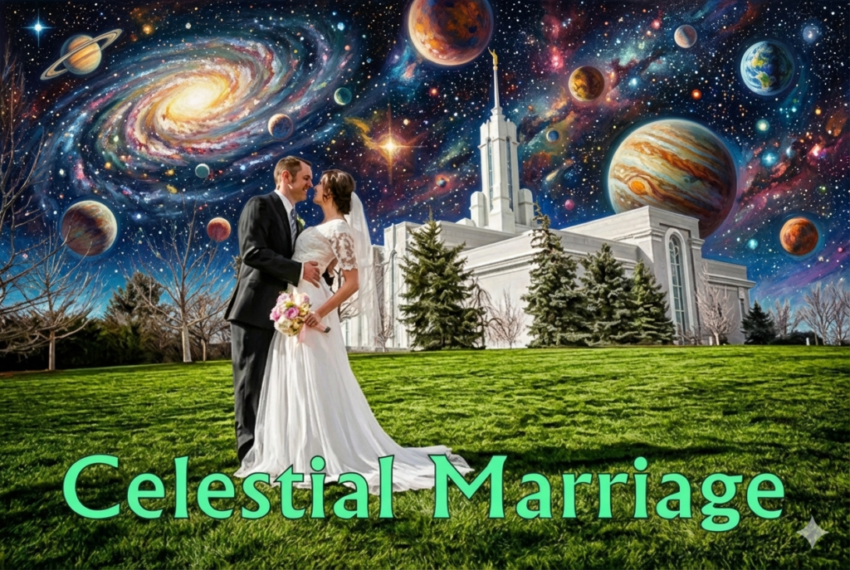
Photo: Let’s listen in as our happy LDS couple browses the real estate market of the cosmos:
Him: “I’m just saying, the one with the rings has great curb appeal.”
Her: “Honey, it’s entirely gas. Where are the kids going to play soccer? We are looking for a nice, terrestrial starter-world with an oxygen atmosphere.”
“Till Death Do Us Part” or
“For Time and All Eternity”?
A Comparative Theological Analysis:
“Are Mormons Christian?” Series
Introduction: The Theological Importance of Marriage and Family
Few doctrines touch the lived experience of believers more intimately than those concerning marriage and family. These institutions shape human identity, community, and the transmission of faith across generations. In both orthodox Christianity and The Church of Jesus Christ of Latter-day Saints (hereafter LDS or Latter-day Saint), marriage and family occupy positions of theological centrality. However, the underlying assumptions, purposes, and eternal implications diverge sharply between these two traditions.
For historic Christianity, marriage is a creational ordinance instituted by God in Eden, designed to reflect the covenantal relationship between Christ and His Church (Ephesians 5:22–33). Marriage is temporal in nature, serving the purposes of companionship, procreation, and sanctification within the present age, yet it does not persist into the resurrection state. Jesus Himself declared that in the resurrection, the redeemed “neither marry nor are given in marriage, but are like angels in heaven” (Matthew 22:30, ESV).
Latter-day Saint (LDS) apologists and theologians reconcile Matthew 22:30—where Jesus states that in the resurrection people “neither marry nor are given in marriage, but are like angels in heaven”—with the doctrine of celestial (eternal) marriage by focusing on the timing of the ordinance, the specific audience of the statement, and the definition of the angels mentioned.
The core argument is that Jesus was not saying that marriage ceases to exist in heaven, but rather that marriages are not performed in heaven.
This is an important interpretive question that gets to the heart of the LDS-Orthodox Christian disagreement on eternal marriage. The following is why the LDS reconciliation of Matthew 22:30 fails exegetically.
The LDS Interpretive Strategy
LDS apologists typically argue that Jesus’ statement “they neither marry nor are given in marriage” refers only to the initiation of new marriages in the resurrection, not to the continuation of marriages sealed on earth. The argument runs: marriages must be performed in mortality by proper priesthood authority; those who failed to receive this ordinance cannot obtain it after death (at least not for themselves directly), hence they “neither marry nor are given in marriage.” But those already sealed continue their marriages eternally.
Why This Interpretation Fails
First, it misreads the grammar and context of Jesus’ statement. The Sadducees posed a hypothetical about a woman married successively to seven brothers, asking “in the resurrection, whose wife will she be?” (Matthew 22:28). Jesus’ answer addresses the state of resurrection existence, not merely the timing of ordinances. He says those who attain the resurrection “neither marry nor are given in marriage, but are like angels in heaven” (v. 30). The present tense indicates an ongoing condition of resurrection life, not a restriction on when ceremonies occur. Jesus describes what resurrected people are like—namely, like angels—not what rituals are unavailable to them.
Second, the comparison to angels is decisive. Jesus doesn’t merely say marriages aren’t performed in heaven; He says the resurrected “are like angels in heaven.” Angels are not married beings. They do not exist in conjugal unions or produce offspring. The comparison indicates that resurrection existence transcends the marital categories that characterize mortal life. If Jesus meant only that new marriages aren’t initiated while existing marriages continue, the angel comparison would be misleading and inapt. Angels aren’t beings who simply stopped getting married at some point—they are non-married by nature.
Third, the argument proves too much for LDS theology. If Jesus merely meant that marriages cannot be performed in the resurrection, this would contradict the LDS practice of vicarious temple sealings for the dead. LDS temples routinely perform proxy marriages for deceased individuals, sealing them to spouses after both parties have died. If the resurrection state precludes the initiation of marriage, why would post-mortal proxy ordinances be efficacious? The LDS interpretation creates internal tension with their own ordinance theology.
Fourth, Jesus’ answer was meant to resolve the Sadducees’ dilemma. The Sadducees posed an intentional puzzle: seven brothers, one woman—whose wife is she in the resurrection? If eternal marriages persist, Jesus’ answer doesn’t actually resolve the dilemma; it merely relocates it. The woman would still be sealed to one of the brothers (presumably the first, per LDS sealing theology), and the puzzle remains. But Jesus’ actual answer dissolves the dilemma entirely: she is no one’s wife in the resurrection because marriage as an institution doesn’t characterize that state. The Sadducees’ question assumed a false premise—that resurrection life mirrors mortal domestic arrangements—and Jesus corrects this assumption categorically.
Fifth, the parallel accounts reinforce the comprehensive reading. Luke’s account is even more explicit: “The sons of this age marry and are given in marriage, but those who are considered worthy to attain to that age and to the resurrection from the dead neither marry nor are given in marriage, for they cannot die anymore, for they are equal to angels and are sons of God, being sons of the resurrection” (Luke 20:34–36). Here Jesus explicitly contrasts “this age” (where marriage occurs) with “that age” (resurrection life, where it does not). Marriage belongs to “this age”—the present mortal order—not to the age to come. The reason given is immortality: marriage serves purposes (including procreation and companionship in the face of death) that the resurrection state transcends.
Sixth, the LDS reading requires importing foreign assumptions into the text. Nothing in Matthew 22, Mark 12, or Luke 20 suggests Jesus is distinguishing between marriages performed on earth versus in heaven, or between sealed and unsealed unions. The LDS interpretation requires the reader to supply a complex background theology of temple ordinances, priesthood authority, and celestial marriage that the text itself neither contains nor implies. Orthodox exegesis reads the text according to its plain meaning within its immediate and canonical context; the LDS reading depends on a theological framework developed eighteen centuries later by Joseph Smith.
The Verdict
The LDS attempt to limit Matthew 22:30 to the timing of marriage ordinances rather than the existence of marriage in the resurrection cannot withstand scrutiny. Jesus’ comparison to angels, His resolution of the Sadducees’ dilemma, and the explicit “this age”/”that age” contrast in Luke all indicate that marriage as an institution belongs to the present mortal order. The resurrection state transcends marriage—not because sealed marriages awkwardly persist while new ones are prohibited, but because glorified existence with God surpasses and fulfills everything earthly marriage could only shadow. The image gives way to the reality it represented: perfect union with Christ and His people forever.
The LDS tradition presents a dramatically different vision. Temple marriage (termed “celestial marriage”) constitutes an eternal covenant necessary for achieving the highest degree of glory in the celestial kingdom. As the LDS manual Doctrines of the Gospel affirms: “In order to obtain the highest degree in the celestial kingdom, a man and a woman must enter into the new and everlasting covenant of marriage.” (D&C 131:2–3). This marriage extends beyond mortality into eternity, forming the basis for continued procreation of spirit children and eventual godhood.
LDS Theology of Marriage and Family
Celestial Marriage as Essential Ordinance
Within LDS theology, celestial marriage is not merely encouraged but required for exaltation. Doctrine and Covenants 131:1–4 teaches: “In the celestial glory there are three heavens or degrees; And to obtain the highest, a man must enter into this order of the priesthood [meaning the new and everlasting covenant of marriage]; And if he does not, he cannot obtain it. He may enter into the other, but that is the end of his kingdom; he cannot have an increase.”
The phrase “cannot have an increase” refers to the doctrine of eternal increase—the capacity for exalted couples to procreate spirit children throughout eternity. This doctrine positions marriage not simply as a social institution but as an eternal mechanism for cosmic expansion. President Spencer W. Kimball stated that temple marriage enables couples to “have the power then of propagating their species in spirit” and eventually to “create worlds and people them.” (The Teachings of Spencer W. Kimball, 386).
Elder Robert D. Hales distinguished between temple marriage and celestial marriage: “Temple marriage describes the place you go to have the marriage performed. Celestial marriage is being true to the sacred covenants you make in that temple marriage ceremony—living celestial principles in the marriage relationship.” (“Celestial Marriage—A Little Heaven on Earth,” BYU Speeches, 1976). The distinction underscores that the ordinance must be accompanied by continued faithfulness to achieve its eternal promises.
Sealing Ordinances and Eternal Families
The temple “sealing” ordinance binds husbands, wives, and children together for eternity. According to LDS teaching, marriages performed outside temples are valid only “until death do you part,” while temple sealings create bonds that persist through resurrection and into the celestial kingdom. As President Harold B. Lee stated: “Only those who enter into the new and everlasting covenant of marriage in the temple for time and eternity, only those will have the exaltation in the celestial kingdom.” (Conference Report, October 1973).
The sealing power is connected to the priesthood authority restored through Joseph Smith, specifically the keys delivered by Elijah. The LDS manual states: “The most important things that any member of The Church of Jesus Christ of Latter-day Saints ever does in this world are: 1. To marry the right person, in the right place, by the right authority; and 2. To keep the covenant made in connection with this holy and perfect order of matrimony.” (Bruce R. McConkie, Mormon Doctrine, 117–18).
Eternal Procreation and Godhood
The doctrine of eternal increase envisions exalted couples producing spirit offspring throughout endless ages. Elder Melvin J. Ballard explained: “Through the righteousness and faithfulness of men and women who keep the commandments of God they will come forth with celestial bodies… and unto them, through their preparation, there will come children, who will be spirit children.” (Three Degrees of Glory, 10).
This procreation parallels how Heavenly Father begat the spirits of humanity. LDS cosmology teaches that human beings existed as spirit children of heavenly parents before mortal birth. Joseph Fielding Smith wrote: “We will become gods and have jurisdiction over worlds, and these worlds will be peopled by our own offspring.” (Doctrines of Salvation 2:48). The 2001 LDS manual Gospel Fundamentals states directly: “They will even be able to have spirit children and make new worlds for them to live on, and do all the things our Father in Heaven has done.” (p. 201).
Those who do not attain celestial marriage face permanent limitations. They remain “separately and singly, without exaltation” (D&C 132:17), serving as “ministering servants” to those who achieved exaltation. Marriage thus functions as the gateway to godhood within the LDS soteriological framework.
Orthodox Christian Theology of Marriage and Family
Marriage as Creational Ordinance
Historic Christianity grounds marriage in the creation account of Genesis 1–2. God created humanity as male and female (Genesis 1:27) and instituted marriage as a covenantal union: “Therefore a man shall leave his father and his mother and hold fast to his wife, and they shall become one flesh.” (Genesis 2:24, ESV). Jesus affirmed this creational design, declaring: “What therefore God has joined together, let not man separate.” (Matthew 19:6).
As Christopher Ash notes, marriage is part of God’s “created order”—“not negotiable within the course of history” but rather “that which neither the terrors of chance nor the ingenuity of art can overthrow.” (“A Biblical View of Marriage,” The Gospel Coalition). Marriage was given by God as an unchangeable foundation for human life in this age.
Purposes of Marriage: Companionship, Procreation, and Typology
Scripture identifies multiple purposes for marriage. First, marriage provides companionship: “It is not good that the man should be alone; I will make him a helper fit for him.” (Genesis 2:18). Second, marriage enables procreation: “Be fruitful and multiply and fill the earth.” (Genesis 1:28). Third, marriage serves as a typological representation of Christ’s relationship with His Church.
This typological dimension receives its fullest exposition in Ephesians 5:22–33, where Paul writes: “Husbands, love your wives, as Christ loved the church and gave himself up for her… ‘Therefore a man shall leave his father and mother and hold fast to his wife, and the two shall become one flesh.’ This mystery is profound, and I am saying that it refers to Christ and the church.” Marriage serves as a living parable of the gospel—Christ’s sacrificial love for His bride.
Marriage and the Resurrection
Crucially, orthodox Christianity teaches that marriage is a temporal institution that does not persist into the resurrection state. When Sadducees posed a question about a woman married successively to seven brothers, Jesus replied: “In the resurrection they neither marry nor are given in marriage, but are like angels in heaven.” (Matthew 22:30). The institution of marriage, while good and honorable, belongs to the present age.
This teaching does not diminish marriage’s value; rather, it points to a greater reality. Marriage images the relationship between Christ and the Church, but in the consummation of all things, the image gives way to the reality it represents. The wedding supper of the Lamb (Revelation 19:7–917 Let us rejoice and exult and give him the glory, for the marriage of the Lamb has come, and his Bride has made herself ready; 8 it was granted her to clothe herself with fine linen, bright and pure”— for the fine linen is the righteous deeds of the saints. 9 And the angel said to me, “Write this: Blessed are those who are invited to the marriage supper of the Lamb.” And he said to me, “These are the true words of God.”) depicts the ultimate union of Christ with His people—a relationship that transcends and fulfills what earthly marriage could only shadow.
Singleness as an Honorable Calling
Orthodox Christianity also honors singleness as a legitimate calling. Paul wrote: “I wish that all were as I myself am… To the unmarried and the widows I say that it is good for them to remain single, as I am.” (1 Corinthians 7:7–8). Jesus commended those who “have made themselves eunuchs for the sake of the kingdom of heaven.” (Matthew 19:12). Singleness allows undivided devotion to the Lord and is no spiritual deficit.
This contrasts sharply with LDS teaching, where President Joseph Fielding Smith declared: “Any young man who carelessly neglects this great commandment to marry… is taking a course which may bar him forever from [exaltation]” (Doctrines of Salvation 2:74). In orthodox Christianity, marriage is good but not salvifically necessary; salvation comes by grace through faith, not marital status (Ephesians 2:8–9).
Comparative Analysis
Doctrinal Foundations: Scripture vs. Continuing Revelation
The divergent views of marriage stem from fundamentally different epistemological commitments. Orthodox Christianity operates under the principle of sola Scriptura—Scripture alone as the final authority for faith and practice. The Bible’s teaching on marriage as a temporal institution (Matthew 22:30) establishes the doctrinal boundary.
LDS theology, by contrast, embraces continuing revelation through living prophets and additional scriptures (Book of Mormon, Doctrine and Covenants, Pearl of Great Price). The doctrine of celestial marriage derives primarily from D&C 131–132, revelations to Joseph Smith that introduce concepts absent from—and contrary to—biblical teaching. Douglas Brinley, a BYU professor, acknowledged that “eternal marriage” is “unique to Latter-day Saint theology” and was “restored” through Joseph Smith (“Joseph Smith’s Contributions to Understanding the Doctrine of Eternal Marriage,” BYU Religious Studies Center).
The critical question becomes: Do later revelations have authority to contradict earlier biblical teaching? Orthodox Christianity answers negatively, holding that God’s revelation in Scripture is complete and sufficient (2 Timothy 3:16–172All Scripture is breathed out by God and profitable for teaching, for reproof, for correction, and for training in righteousness, 17 that the man of God[a] may be complete, equipped for every good work.; Jude 33Jude 3). LDS theology answers affirmatively, viewing Smith’s revelations as restoring truths lost through apostasy.
Nature and Purpose of Marriage: Covenant vs. Eternal Progression
Orthodox Christianity views marriage as a covenantal relationship designed to reflect Christ and the Church, provide companionship, enable procreation, and promote sanctification within the present age. Marriage is a gift of common grace, available to believers and unbelievers alike, serving God’s purposes in creation and redemption.
LDS theology reconceives marriage as a mechanism for eternal progression toward godhood. Marriage becomes a necessary infrastructure for achieving exaltation and perpetuating the cycle of divine procreation. As the LDS manual states: “Without proper and successful marriage, one will never be exalted.” (Spencer W. Kimball, The Teachings of Spencer W. Kimball, 291).
This shifts marriage from a creation ordinance pointing to Christ into a salvation requirement pointing toward personal deification. The focus moves from marriage as a typological witness to marriage as a soteriological mechanism.
Eschatological Vision: Resurrection Relationships vs. Eternal Families
Perhaps nowhere do the traditions diverge more sharply than in eschatology. Orthodox Christianity anticipates a resurrection in which marriage gives way to direct communion with God. Jesus’ teaching in Matthew 22:30 is unambiguous: resurrection existence transcends the marital categories of the present age. The redeemed will be “like angels in heaven”—not married, not procreating, but enjoying perfect fellowship with God and one another in Christ.
LDS eschatology envisions endless marriage and procreation for the exalted. Eternal families continue intact, sealed couples produce spirit offspring, and gods rule worlds populated by their posterity. Lorenzo Snow taught that the faithful “shall sit upon thrones, governing and controlling our posterity from eternity to eternity.” (Millennial Star 56:772, 1894).
How does LDS theology handle Matthew 22:30? Some LDS interpreters argue Jesus was addressing only those who fail to receive celestial marriage—they neither marry nor are given in marriage because they cannot, having missed the opportunity. However, this reading strains the text’s natural meaning. Jesus answered the Sadducees’ question about resurrection existence generally, not about the fate of unmarried individuals specifically. The text indicates that marriage as an institution does not characterize resurrection life.
Soteriological Implications: Grace vs. Ordinance
Orthodox Christianity teaches salvation by grace alone through faith alone in Christ alone. Paul declared: “For by grace you have been saved through faith. And this is not your own doing; it is the gift of God, not a result of works, so that no one may boast” (Ephesians 2:8–9). Marital status has no bearing on one’s standing before God. The thief on the cross received paradise without baptism, temple ordinances, or marriage.
LDS soteriology ties exaltation (the highest salvation) to celestial marriage. Joseph Fielding Smith stated: “No man can be saved and exalted in the kingdom of God without the woman, and no woman can reach the perfection and exaltation in the kingdom of God alone.” (Gospel Doctrine, 272). Exaltation requires not only faith and repentance but specific ordinances, including temple marriage performed by proper priesthood authority.
This introduces a works-based element into the highest salvation. Marriage becomes not merely a blessing but a requirement, not a gift of common grace but a ritual prerequisite for ultimate destiny. This raises troubling implications: What of those who never had the opportunity to marry? What of those martyred before receiving temple ordinances? LDS theology addresses these through proxy ordinances for the dead, but this further removes the system from biblical soteriology.
The LDS system of proxy ordinances illustrates both the scope and the problematic nature of this works-based framework. According to official LDS teaching, living members may perform baptisms, endowments, and sealing ordinances vicariously on behalf of deceased individuals who never received them in mortality. The church’s General Handbook states: “In temples, ordinances can be performed by proxy. This means that a living person receives ordinances on behalf of someone who is deceased.” (Chapter 28). This practice extends to marriage sealings: “Deceased persons may be sealed to spouses to whom they were married in life,” with living proxies standing in for the dead. Joseph Smith taught that “Saints who neglect proxy work for their deceased relatives do it at the peril of their own salvation.” (Times and Seasons, October 3, 1841). The theological difficulties compound rapidly: LDS temples have performed proxy ordinances for figures ranging from the American Founding Fathers to Holocaust victims to Adolf Hitler—raising the question of whether heaven’s population is determined by the genealogical diligence of modern Mormons rather than by divine grace. Moreover, if proxy ordinances can supply what the deceased lacked, the entire urgency of temple marriage in mortality dissolves into bureaucratic procedure. The system creates a salvation dependent not on Christ’s finished work but on an ever-expanding ecclesiastical apparatus of research, ritual, and record-keeping—a soteriological Rube Goldberg machine foreign to the New Testament’s proclamation that “it is finished.” (John 19:30).
Implications for Faith and Practice
Discipleship and Identity
These doctrinal differences profoundly shape how adherents understand their identity and purpose. For orthodox Christians, identity is rooted in Christ: “For in Christ Jesus you are all sons of God, through faith.” (Galatians 3:26). Believers become children of God through adoption (Romans 8:154For you did not receive the spirit of slavery to fall back into fear, but you have received the Spirit of adoption as sons, by whom we cry, “Abba! Father!”; Ephesians 1:55he predestined us for adoption to himself as sons through Jesus Christ, according to the purpose of his will,), not through inherent divine nature. Purpose centers on glorifying God and enjoying Him forever, whether married or single.
For Latter-day Saints, identity includes being literal spirit children of Heavenly Father and Heavenly Mother, with the potential to become gods themselves. Purpose involves progressing toward exaltation through obedience to ordinances, including celestial marriage. This creates different existential orientations: in orthodoxy, the believer rests in completed redemption; in LDS theology, the believer strives toward future deification.
Gender Roles and Relationships
Both traditions affirm complementary roles for husbands and wives, though grounded differently. Orthodox Christianity roots complementarity in creation order and Christ-Church typology: husbands exercise servant leadership as Christ loved the Church; wives submit as the Church submits to Christ (Ephesians 5:22–33).
LDS teaching similarly affirms complementarity but adds eternal dimensions: gender is “an essential characteristic of individual premortal, mortal, and eternal identity and purpose.” (“The Family: A Proclamation to the World,” 1995). Men hold priesthood authority; women bear and nurture children. These roles persist eternally: exalted men preside as gods, exalted women produce spirit offspring.
Eternal Hope
For orthodox Christians, eternal hope centers on perfect communion with the Triune God—seeing Him face to face, being with Christ, participating in the new heavens and new earth where righteousness dwells. The wedding supper of the Lamb celebrates the union of Christ with His Bride, the Church—a corporate reality that transcends individual marriages.
For Latter-day Saints, eternal hope includes continued family relationships, procreation, and progression toward godhood. Heaven involves ruling worlds and peopling them with offspring. While this vision appeals to human desires for family continuity, it is extra-biblical in nature—like the vast volume of LDS doctrine that finds no warrant in Scripture. In this regard, LDS theology bears striking resemblance to the legalism of the Pharisees, who added over 1,500 oral, extra-biblical regulations known as the “traditions of the elders” or the “fence around the Law,” ostensibly designed to prevent violation of Mosaic commands. Jesus condemned this approach, declaring: “You leave the commandment of God and hold to the tradition of men.” (Mark 7:8). Just as the Pharisees layered human traditions upon divine revelation until the original was obscured, LDS theology layers temple ordinances, priesthood requirements, and celestial marriage mandates upon the simple gospel of grace—creating soteriological burdens Scripture never imposed. The result redefines the nature of glorification itself, substituting biblical hope of communion with God for an elaborate system of earned exaltation that Scripture neither teaches nor anticipates.
To our Latter-day Saint friends and neighbors, we offer this appeal with genuine affection and respect: pick up the Bible you have in your home—the King James Version that sits alongside your other scriptures—and read it afresh with open eyes. Ask yourself as you turn its pages: Where does Jesus require temple marriage for entrance into His kingdom? Where do the apostles teach that exaltation depends on priesthood ordinances unavailable to most of humanity throughout history? Where does Paul, who commended his own singleness, suggest that the unmarried cannot inherit eternal life? You will find instead a Savior who declared, “Come to me, all who labor and are heavy laden, and I will give you rest.” (Matthew 11:28)—not additional requirements, but rest. You will find a gospel where the thief on the cross received paradise with no ordinances at all, where salvation is “the gift of God, not a result of works, so that no one may boast.” (Ephesians 2:8–9). We do not ask you to take our word for these things; we ask only that you do as the noble Bereans did, who “received the word with all eagerness, examining the Scriptures daily to see if these things were so.” (Acts 17:11). The God who loves you has not hidden the way of salvation behind temple doors or priestly gatekeepers. He has revealed it plainly in His Word, and His Son stands ready to receive all who come to Him by faith. Will you search and see?
Conclusion: Reaffirming Biblical Marriage
This comparative analysis reveals that LDS and orthodox Christian teachings on marriage and family, while sharing surface similarities, rest on incompatible theological foundations. The differences trace ultimately to divergent views of Scripture, God, humanity, and salvation itself.
LDS celestial marriage doctrine emerges from Joseph Smith’s revelations, introduces requirements absent from Scripture, contradicts Jesus’ explicit teaching about resurrection existence, and ties salvation to ordinances rather than grace alone. It presupposes a theology of divine progression—God as an exalted man, humans as potential gods—foreign to biblical theism.
Orthodox Christianity holds that marriage is an ordinance of creation, reflecting Christ’s union with the Church. It is good, honorable, and to be held in esteem (Hebrews 13:46Let marriage be held in honor among all, and let the marriage bed be undefiled, for God will judge the sexually immoral and adulterous.). Yet marriage serves the present age and points beyond itself to the ultimate union of Christ and His Bride. In the resurrection, marriage will give way to direct fellowship with God—not because marriage was insignificant, but because the reality it imaged will have arrived.
For Christians engaging Latter-day Saints, these differences invite compassionate conversation. Many Latter-day Saints treasure family relationships and desire eternal togetherness. We can affirm these desires while pointing to a better hope: not merely family continuity, but perfect communion with the God who created family in the first place. We can affirm that relationships in eternity will surpass anything known here, even without the specific form of marriage, for we shall know even as we are known (1 Corinthians 13:127For now we see in a mirror dimly, but then face to face. Now I know in part; then I shall know fully, even as I have been fully known.).
The biblical vision of marriage is anchored in creation, points to redemption, and anticipates consummation. Marriage is God’s good gift for this age—not the mechanism for earning exaltation but a signpost directing us to Christ. In Him, and in Him alone, is found the salvation, identity, and eternal fellowship our hearts truly seek.
Key Summary Points:
- LDS Teaching: Celestial marriage is required for exaltation; without it, one “cannot have an increase” (D&C 131:1–4).
- Orthodox Christianity: Marriage is a sacred creation ordinance, but not a requirement for salvation or glorification.
- LDS Teaching: Exalted couples will procreate spirit children throughout eternity, populating worlds as Heavenly Father has done.
- Orthodox Christianity: Glorified existence transcends earthly marriage and reproduction; “in the resurrection they neither marry nor are given in marriage” (Matthew 22:30).
- LDS Teaching: Temple sealing by priesthood authority is necessary for eternal family relationships.
- Orthodox Christianity: Salvation is by grace through faith, not by marital status or ritual ordinances (Ephesians 2:8–9).
- LDS Teaching: Singleness by choice is viewed as “displeasing in the sight of God” and may bar one from exaltation.
- Orthodox Christianity: Singleness is honored as a legitimate calling for devoted service to Christ (1 Corinthians 7:7–8, 32–35).
Bibliography
Primary LDS Sources
“Chapter 28: Celestial Marriage.” Doctrines of the Gospel Student Manual. Salt Lake City: The Church of Jesus Christ of Latter-day Saints, 2000.
Brinley, Douglas E. “Joseph Smith’s Contributions to Understanding the Doctrine of Eternal Marriage.” In Joseph Smith and the Doctrinal Restoration. Provo: BYU Religious Studies Center, 2005.
Hales, Robert D. “Celestial Marriage—A Little Heaven on Earth.” BYU Speeches, November 9, 1976.
McConkie, Bruce R. Mormon Doctrine. 2nd ed. Salt Lake City: Bookcraft, 1966.
Smith, Joseph Fielding. Doctrines of Salvation. 3 vols. Salt Lake City: Bookcraft, 1954–56.
Secondary Evangelical Sources
Ash, Christopher. “A Biblical View of Marriage.” The Gospel Coalition.
“A Biblical Case Against LDS Doctrine of Spirit Children.” God Loves Mormons.
McKeever, Bill. “Eternal Increase: The LDS Doctrine of Celestial Procreation.” Mormonism Research Ministry.
Rogers, Bret. “A Biblical Theology of Marriage.” Redeemer Church Fort Worth, October 16, 2016.
Shafovaloff, Aaron. “Will Exalted Mormons Govern Their Own Spirit Children and Worlds?” Mormonism Research Ministry.
Thuet, Lane. “Celestial Marriage and Eternal Exaltation.” Mormonism Research Ministry.