
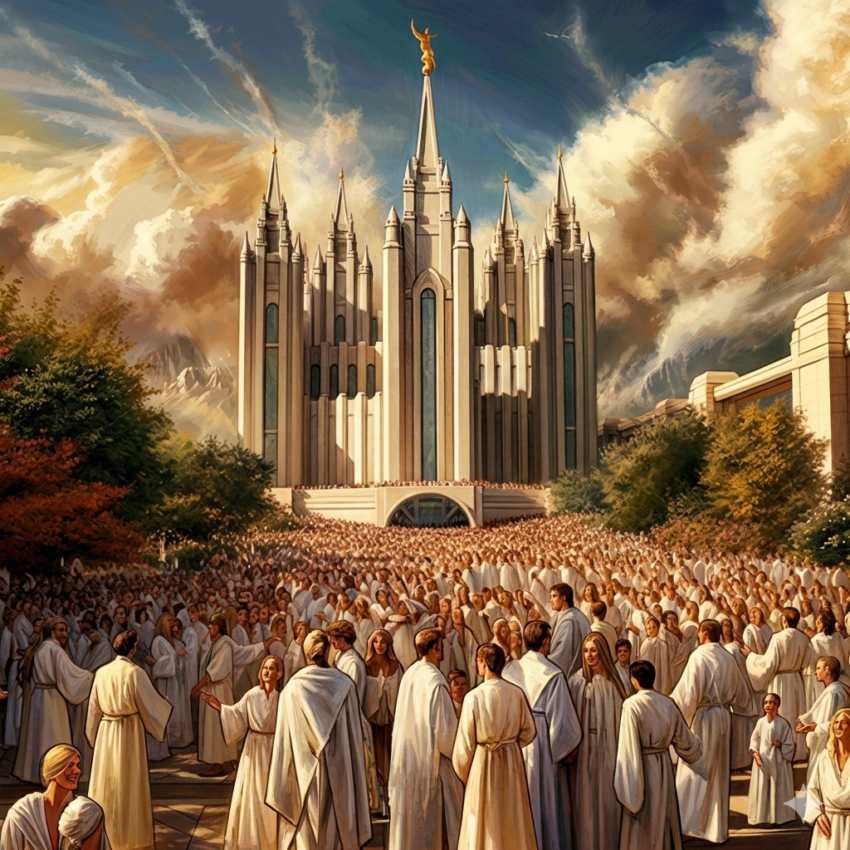
Photo: Lo, the Savior is coming, the prophets declare—
The times are fulfilling; O Zion, prepare!
The Savior is coming: but where shall he come?
Will he find the palace of princes, a home?
No! O no, in his temple he’ll surely attend;
But O where is the “temple,” where Christ shall descend?
The first verse of “The Temple of God, by Eliza R. Snow (1804–1887),
a prominent Latter-day Saint poet who was married
to both Joseph Smith and Brigham Young
and was the second General President of the Relief Society.
Two Eschatologies, Two Hopes:
A Scholarly Examination of Missouri Zion, Multiple Kingdoms of Glory, and Biblical Orthodoxy
A Comparative Theological Analysis:
“Are Mormons Christian?” Series
Introduction: Eschatology and the Shape of Christian Hope
Eschatology, derived from the Greek eschatos (“last”) and logos (“word” or “study”), constitutes the theological discipline concerned with the final things: death, judgment, heaven, hell, Christ’s return, and the consummation of God’s redemptive purposes. For Christians throughout the ages, eschatological hope has been anchored in the confession that Jesus Christ, crucified and risen, will return “in glory to judge the living and the dead,” as the Nicene Creed affirms, and that “His kingdom will have no end.” This hope shapes how believers understand their present sufferings, their moral responsibilities, and their ultimate destiny.
The Church of Jesus Christ of Latter-day Saints (hereafter LDS or Latter-day Saints) shares with historic Christianity an expectation of Christ’s glorious return and a future resurrection and judgment. Yet beneath this surface similarity lie profound structural differences that distinguish LDS eschatology from the classical Christian tradition. This article examines two particularly striking contrasts: first, the LDS teaching that Christ will return to and reign from a New Jerusalem built in Independence, Missouri, rather than the historic city of Jerusalem emphasized in biblical prophecy; and second, the LDS doctrine of multiple post-mortal kingdoms of glory (celestial, terrestrial, and telestial) as opposed to the traditional Christian binary of eternal life versus eternal death.
These differences are not merely geographical or quantitative adjustments to an otherwise shared framework. Rather, they reflect fundamentally divergent understandings of revelation, Scripture, the nature of salvation, and the character of divine judgment. By engaging LDS sources charitably and presenting their eschatological vision as an internally coherent system before offering a critical response, my study aims to facilitate genuine theological dialogue while clarifying why historic, creedal Christianity cannot embrace these distinctives as legitimate developments of biblical faith.
And here’s the thing—I write this as someone who’s had these conversations on street corners in Gilbert, Arizona, not just in footnotes. The questions aren’t abstract. When a missionary knocks and speaks confidently about exaltation and eternal progression, the person answering deserves to understand what’s actually being offered and what’s being quietly set aside. Serious people weighing serious claims deserve serious engagement. That’s what I’m attempting here, and if I’ve failed at charity or accuracy, the fault is mine to own. Feel free to engage and offer your observations.
LDS Eschatology: Missouri Zion and Degrees of Glory
Christ’s Return to Missouri and the New Jerusalem
A distinctive feature of Latter-day Saint eschatology is the identification of Independence, Missouri, specifically Jackson County, as the site where the New Jerusalem (Zion) will be built and where Christ will reign during the millennium. This teaching derives from revelations given to Joseph Smith in 1831, now canonized in the Doctrine and Covenants. Section 57 states: “Hearken, O ye elders of my church, saith the Lord your God, who have assembled yourselves together, according to my commandments, in this land, which is the land of Missouri, which is the land which I have appointed and consecrated for the gathering of the saints. Wherefore, this is the land of promise, and the place for the city of Zion… the place which is now called Independence is the center place; and a spot for the temple is lying westward” (D&C 57:1-3).
The tenth Article of Faith, composed by Joseph Smith in 1842, affirms: “We believe in the literal gathering of Israel and in the restoration of the Ten Tribes; that Zion (the New Jerusalem) will be built upon the American continent; that Christ will reign personally upon the earth; and, that the earth will be renewed and receive its paradisiacal glory.” This formulation has remained authoritative for Latter-day Saints, establishing Missouri’s eschatological significance as a matter of binding doctrine.
The “Lost Ten Tribes” Tradition
The phrase refers to the Ten Lost Tribes of Israel—the northern tribes carried into Assyrian captivity in 722 BC (2 Kings 17:6). After Assyria conquered the Northern Kingdom (Israel), these tribes were deported and, according to tradition, never returned as a recognizable group. The surviving tribes—primarily Judah and Benjamin (plus Levites scattered among them)—constituted the Southern Kingdom and eventually returned from Babylonian exile to rebuild Jerusalem.
So the math works like this:
- 12 original tribes of Israel (sons of Jacob)
- The 10 tribes comprising the Northern Kingdom lost to Assyrian captivity
- 2 tribes (Judah and Benjamin) that maintained identifiable continuity through the Babylonian exile and return
LDS Theological Application
LDS theology inherited and expanded nineteenth-century speculation about where these “lost” tribes went. The Book of Mormon itself claims to follow descendants of the tribe of Joseph (through Manasseh and Ephraim) who migrated to the Americas before Jerusalem’s destruction in 586 BC. LDS teaching anticipates a literal return of the Ten Tribes from a “land of the north” (D&C 133:26-34), sometimes interpreted as a miraculous gathering from an unknown location.
Within LDS theology, this Missouri-centered eschatology integrates with broader narratives of restoration and gathering. The LDS Church understands itself as the restored Church of Jesus Christ, possessing priesthood authority lost during a “Great Apostasy” following the apostolic era. Part of this restoration involves gathering Israel, both literally (physical relocation of covenant peoples) and figuratively (conversion to the restored gospel). Missouri functions as the central gathering place for this ingathering, the heart of the covenant community preparing for Christ’s return.
Importantly, LDS eschatology envisions not one but two capital cities during the millennium: the New Jerusalem in Missouri and the old Jerusalem in the Holy Land. As the LDS Church’s Gospel Principles manual explains, “Near the time of the coming of Jesus Christ, the faithful Saints will build a righteous city, a city of God, called the New Jerusalem. Jesus Christ Himself will rule there.” Bruce R. McConkie, one of the most influential LDS apostles and theologians of the twentieth century, taught that the Jerusalem temple would eventually be built by Latter-day Saints who have converted the Jewish people, not by Jews who remain outside the restored gospel. This dual-capital framework allows LDS theology to incorporate biblical prophecies about Jerusalem while privileging the American Zion as the primary center of millennial activity.
According to LDS teaching, certain events must precede Christ’s return. Robert L. Millet, former dean of Religious Education at Brigham Young University, has enumerated these as including: the gospel preached to every part of the world; congregations of Saints established on all the earth; baptisms for the dead performed in Jerusalem; Church headquarters relocated to Missouri; Christ’s appearance in His temple; a great council at Adam-ondi-Ahman; and celestial signs such as the sun darkened and moon turned to blood. The scope of these prerequisites suggests that, even within LDS expectations, the Second Coming remains a distant event requiring considerable preparatory work.
Multiple Kingdoms of Glory
Perhaps no aspect of LDS eschatology diverges more dramatically from historic Christianity than the doctrine of multiple kingdoms of glory. Rather than the binary outcome of heaven and hell, Latter-day Saints anticipate a graduated post-mortal landscape comprising three primary realms: the celestial kingdom, the terrestrial kingdom, and the telestial kingdom. This teaching finds its fullest expression in Doctrine and Covenants 76, a vision received by Joseph Smith and Sidney Rigdon in February 1832.
The celestial kingdom represents the highest degree of glory, described as surpassing all others “as the sun differs from the moon” (D&C 76:96). This kingdom is reserved for those who have received the testimony of Jesus, been baptized, received the Holy Ghost, overcome by faith, and been sealed by the Holy Spirit of promise (D&C 76:51-53). The LDS Church’s official Gospel Topics entry explains: “To inherit this gift, we must receive the ordinances of salvation, keep the commandments, and repent of our sins.” Within the celestial kingdom itself exist three degrees, the highest of which requires “the new and everlasting covenant of marriage” sealed in an LDS temple (D&C 131:1-4). Only those achieving this highest tier can progress to “exaltation,” becoming gods themselves and continuing eternal family relationships.
The terrestrial kingdom, second in glory, is compared to the moon’s radiance relative to the sun. Its inhabitants include “honorable men of the earth, who were blinded by the craftiness of men” (D&C 76:75), those who died without the law, those who rejected the gospel on earth but later accepted it in the spirit world, and LDS Church members who were “not valiant in the testimony of Jesus” (D&C 76:79). Residents of this kingdom receive the presence of the Son but not the fullness of the Father (D&C 76:77).
The telestial kingdom, lowest of the three but still possessing “glory,” is compared to the stars. It receives “those who received not the gospel of Christ, neither the testimony of Jesus” (D&C 76:82), including liars, sorcerers, adulterers, and whoremongers (D&C 76:103). These individuals must first suffer for their sins in “spirit prison” (sometimes called “hell” in LDS usage) before inheriting telestial glory. As the vision declares, they “shall not be redeemed from the devil until the last resurrection” (D&C 76:85). Even so, the telestial kingdom is described as surpassing all earthly understanding in its glory.
Beyond these three kingdoms lies “outer darkness,” reserved for the “sons of perdition” who, having received a fullness of gospel knowledge and the testimony of the Holy Spirit, utterly deny and defy God’s power (D&C 76:31-35). LDS teaching suggests this fate applies to very few: those who commit the unpardonable sin against the Holy Ghost with full knowledge. Satan and his angels, who rebelled in the premortal existence, along with these rare individuals, inhabit outer darkness eternally. For virtually all of humanity, however, some degree of post-mortal glory awaits.
Summary of LDS Eschatological Distinctives
- Christ’s millennial reign centered in a New Jerusalem built in Independence, Missouri, based on revelations to Joseph Smith.
- Zion theology is tied to the gathering of Israel, restoration of priesthood authority, and the self-understanding of the LDS Church as God’s covenant people.
- A dual-capital millennial structure incorporating both Missouri and the historic Jerusalem.
- A post-mortal landscape of three main kingdoms (celestial, terrestrial, telestial), each with glory, plus outer darkness for the rare sons of perdition.
- Exaltation is the highest form of salvation within the celestial kingdom, requiring temple ordinances and celestial marriage.
Orthodox Christian Eschatology: Return of Christ and Final Judgment
Christ’s Return and the New Jerusalem
Historic Christianity confesses that Jesus Christ will return bodily, visibly, and gloriously to consummate His kingdom. The Nicene-Constantinopolitan Creed (381 AD) affirms that Christ “will come again in glory to judge the living and the dead, and His kingdom will have no end.” The Apostles’ Creed similarly declares He “will come to judge the living and the dead.” These creedal affirmations, accepted across Catholic, Orthodox, and Protestant traditions, establish Christ’s return as a non-negotiable article of Christian faith.
The New Testament describes Christ’s return with vivid imagery. In Matthew 24:30, Jesus declares: “Then will appear in heaven the sign of the Son of Man, and then all the tribes of the earth will mourn, and they will see the Son of Man coming on the clouds of heaven with power and great glory.” (ESV). Acts 1:11 records the angelic promise at Christ’s ascension: “This Jesus, who was taken up from you into heaven, will come in the same way as you saw him go into heaven.” First Thessalonians 4:16-17 describes believers being caught up to meet the Lord in the air. Revelation 19:11-16111 Then I saw heaven opened, and behold, a white horse! The one sitting on it is called Faithful and True, and in righteousness he judges and makes war. 12 His eyes are like a flame of fire, and on his head are many diadems, and he has a name written that no one knows but himself. 13 He is clothed in a robe dipped in[a] blood, and the name by which he is called is The Word of God. 14 And the armies of heaven, arrayed in fine linen, white and pure, were following him on white horses. 15 From his mouth comes a sharp sword with which to strike down the nations, and he will rule[b] them with a rod of iron. He will tread the winepress of the fury of the wrath of God the Almighty. 16 On his robe and on his thigh he has a name written, King of kings and Lord of lords. portrays Christ as the victorious warrior-king, “Faithful and True,” whose name is “King of kings and Lord of lords.”
Concerning the location of Christ’s return and reign, historic Christianity has generally looked to Jerusalem, the historic city, as bearing special eschatological significance. Zechariah 14:4 prophesies: “On that day his feet shall stand on the Mount of Olives that lies before Jerusalem on the east.” While interpretations vary, many Christian traditions, particularly premillennialists, see Jerusalem as the locus of Christ’s earthly kingdom. What no mainstream Christian tradition has affirmed is that North America, much less a specific county in Missouri, holds eschatological centrality based on biblical prophecy.
The “New Jerusalem” of Revelation 21-22 presents not an earthly city to be constructed by human effort but a heavenly city “coming down out of heaven from God” (Rev. 21:2). Its theological significance lies in the fulfillment of God’s dwelling with His people: “Behold, the dwelling place of God is with man. He will dwell with them, and they will be his people, and God himself will be with them as their God.” (Rev. 21:3). This vision emphasizes restoration of the divine-human relationship lost in Eden, not the establishment of a sacred geography tied to any particular nation or continent.
Historic Christianity has accommodated diverse millennial views, including amillennialism (the millennium as the present church age), postmillennialism (Christ returning after a golden age of gospel triumph), and premillennialism (Christ returning before a literal thousand-year reign). Despite their differences, all these positions share certain non-negotiables: Christ’s personal, visible return; the resurrection of the dead; the final judgment; and the eternal states of heaven and hell. None posits multiple heavenly kingdoms, and none relocates the eschatological center from the biblical lands to the American heartland.
Twofold Final Destiny: Eternal Life and Eternal Death
A consistent pattern runs through biblical eschatology: a final, qualitative division between two groups and two destinies. Jesus employs binary imagery throughout His teaching: sheep and goats (Matthew 25:31-46), wheat and tares (Matthew 13:24-30), wise and foolish virgins (Matthew 25:1-13), those who enter the narrow gate and those who take the broad road (Matthew 7:13-14). In each case, the outcome is either-or, not a spectrum of degrees.
Matthew 25:46 stands as a definitive statement: “And these will go away into eternal punishment, but the righteous into eternal life.” The deliberate parallelism, using the same Greek adjective aionios (“eternal”) for both punishment and life, indicates that whatever “eternal” means for the blessed, it means equally for the condemned. If life is endless, so is the punishment; if the sentence is temporary, so is life. Historic Christianity has understood this passage to teach permanent, irreversible destinies.
John 3:16-18 reinforces this binary: “For God so loved the world, that he gave his only Son, that whoever believes in him should not perish but have eternal life…. Whoever believes in him is not condemned, but whoever does not believe is condemned already, because he has not believed in the name of the only Son of God.” The contrast is between perishing and having eternal life, between condemnation and escape from condemnation. There is no middle category, no tertiary kingdom for honorable unbelievers.
Revelation 20:11-15 describes the final judgment: “And I saw the dead, great and small, standing before the throne, and books were opened. Then another book was opened, which is the book of life. And the dead were judged by what was written in the books, according to what they had done…. And if anyone’s name was not found written in the book of life, he was thrown into the lake of fire.” The lake of fire is identified as “the second death” (Revelation 20:14). There are two books and two outcomes: life in God’s presence or the second death in exclusion from His presence.
Historic Christianity has debated the nature of hell, with positions ranging from eternal conscious torment (the majority view throughout church history) to conditional immortality or annihilationism (the view that the lost cease to exist after judgment). What has not been affirmed by any recognized Christian tradition until the rise of Mormonism is a schema of multiple glorious kingdoms with nearly universal salvation. Even universalism, which some Christian thinkers have entertained, envisions all humanity eventually attaining the same blessed state rather than being sorted into hierarchically arranged heavens.
Sacramental and Creedal Anchors
The ecumenical creeds provide a shared eschatological confession across Christian traditions. The Nicene Creed proclaims: “He will come again in glory to judge the living and the dead, and His kingdom will have no end…. We look for the resurrection of the dead, and the life of the world to come.” The Apostles’ Creed affirms Christ’s return “to judge the living and the dead” and concludes with belief in “the resurrection of the body, and the life everlasting.” These formulations articulate the non-negotiable framework within which Christian eschatological speculation must operate.
Notably, the creeds speak of “life everlasting” or “the life of the world to come,” not “kingdoms of glory.” The Christian hope is not placement within a graded cosmic hierarchy but union with Christ and participation in the new creation. As Paul writes in Philippians 3:20-21: “But our citizenship is in heaven, and from it we await a Savior, the Lord Jesus Christ, who will transform our lowly body to be like his glorious body, by the power that enables him even to subject all things to himself.” The glory believers receive is the glory of Christ Himself, shared through resurrection transformation, not a lesser glory appropriate to one’s terrestrial or telestial status.
Comparative Analysis
Doctrinal Foundations: Scripture, Revelation, and Sacred Geography
The most fundamental difference between LDS and historic Christian eschatology lies in their respective doctrines of revelation and scriptural authority. Historic Christianity affirms that the biblical canon, consisting of the Old and New Testaments, constitutes the sufficient and final written revelation of God for faith and practice. The Westminster Confession (1.6) declares: “The whole counsel of God concerning all things necessary for His own glory, man’s salvation, faith and life, is either expressly set down in Scripture, or by good and necessary consequence may be deduced from Scripture: unto which nothing at any time is to be added, whether by new revelations of the Spirit, or traditions of men.”
Latter-day Saints, by contrast, affirm an open canon. The eighth Article of Faith states: “We believe the Bible to be the word of God as far as it is translated correctly; we also believe the Book of Mormon to be the word of God.” Beyond these, the Doctrine and Covenants and Pearl of Great Price possess canonical status, and continuing revelation through living prophets remains operative. This difference is not merely administrative but epistemologically decisive. Claims about Missouri as the New Jerusalem site derive not from biblical exegesis but from alleged nineteenth-century revelations to Joseph Smith that historic Christianity does not recognize as authoritative.
The LDS sacred geography thus represents an expansion rather than an interpretation of biblical prophecy. No text in the Old or New Testament identifies North America, Missouri, or any location in the Western Hemisphere as eschatologically significant. Whatever symbolic meanings attach to “Zion” in Scripture, none point to Jackson County. The move from Jerusalem to Missouri requires accepting revelatory claims external to the Bible. For historic Christianity, which regards the canon as closed, such claims lack authority. Jerusalem’s eschatological significance, by contrast, can be traced through texts from Zechariah to Revelation without recourse to extra-biblical revelation.
The Shape of Final Judgment: Binary Outcome vs. Graded Glory
LDS teaching on multiple kingdoms reframes the traditional Christian understanding of heaven and hell. In classic Christian thought, hell represents exclusion from God’s gracious presence; heaven represents full communion with God. These are qualitatively, not merely quantitatively, different states. The LDS schema, however, treats post-mortal destiny as a spectrum. Even the telestial kingdom, reserved for liars, adulterers, and murderers who never accepted the gospel, possesses glory surpassing mortal comprehension. Only the sons of perdition, an infinitesimally small group, face a fate analogous to traditional hell.
This reframing dramatically reconfigures the problem of divine judgment. In biblical Christianity, the warning about hell is existentially urgent. Jesus speaks more about judgment and hell than about heaven. His parables consistently emphasize that many will face exclusion: “Enter by the narrow gate. For the gate is wide and the way is easy that leads to destruction, and those who enter by it are many. For the gate is narrow and the way is hard that leads to life, and those who find it are few.” (Matt. 7:13-14). The LDS schema softens this urgency. Since nearly everyone attains some kingdom of glory, the stakes shift from avoiding damnation to securing higher-tier exaltation.
The LDS approach also transforms “hell” into a temporary state for many. Spirit prison, where the telestial-bound suffer before resurrection, functions as purgatorial preparation rather than final punishment. Those who rejected the gospel on earth may accept it in the spirit world through proxy ordinances performed by living Latter-day Saints. This mechanism ensures that virtually everyone eventually progresses to some glorious realm. Such a framework is foreign to biblical teaching, where death closes the window for repentance: “It is appointed for man to die once, and after that comes judgment.” (Hebrews 9:27).
LDS apologists sometimes appeal to 1 Corinthians 15:40-42240 There are heavenly bodies and earthly bodies, but the glory of the heavenly is of one kind, and the glory of the earthly is of another. 41 There is one glory of the sun, and another glory of the moon, and another glory of the stars; for star differs from star in glory. 42 So is it with the resurrection of the dead. What is sown is perishable; what is raised is imperishable., which distinguishes celestial and terrestrial bodies and compares the resurrection to the differing glories of the sun, moon, and stars. However, Paul’s point in this passage concerns the transformation of the resurrection body, not a sorting of humanity into separate eternal kingdoms. The context addresses the nature of the resurrection body in contrast to the mortal body, not degrees of salvation. Furthermore, Paul nowhere mentions a “telestial” category; this term appears only in LDS scripture. Reading three (or four) eternal kingdoms into this passage requires importing LDS theological categories into an otherwise straightforward discussion of bodily transformation.
Christ’s Reign and the People of God: Zion vs. New Creation
LDS eschatology situates the climax of history within the narrative of a particular modern institution, the LDS Church. Christ returns to Missouri, to a temple built by Latter-day Saints, to reign over a Zion community gathered under LDS prophetic leadership. The eschatological plot centers on the restored Church’s unique role in preparing the world for Christ’s coming. This ecclesial particularity gives LDS eschatology a distinctive flavor: the end times unfold according to a script in which the LDS Church is the protagonist.
Historic Christian eschatology, by contrast, focuses on Christ’s universal reign over a renewed creation. The New Jerusalem of Revelation 21 descends from heaven; it is not built from the ground up by human communities. Its gates bear the names of the twelve tribes of Israel and its foundations the names of the twelve apostles (Revelation 21:12-14312 It had a great, high wall, with twelve gates, and at the gates twelve angels, and on the gates the names of the twelve tribes of the sons of Israel were inscribed— 13 on the east three gates, on the north three gates, on the south three gates, and on the west three gates. 14 And the wall of the city had twelve foundations, and on them were the twelve names of the twelve apostles of the Lamb.), symbolizing continuity with the whole people of God throughout history, not the distinctive claims of a nineteenth-century restoration movement. The vision is cosmic, not denominational: “Behold, I am making all things new.” (Revelation 21:5).
The identity and location of “Zion” differ correspondingly. In LDS thought, Zion refers to a literal community of the pure in heart gathered to specific covenant lands, including Missouri. The eschatological task is to build Zion, to establish righteous communities that prepare the world for Christ’s return. In historic Christianity, Zion is the people of God drawn from every nation, ultimately dwelling in the consummated presence of God. The new heavens and new earth are not defined by any particular continent or nation-state but by God’s presence filling all reality. The Christian hope is not that America or any earthly polity becomes divine headquarters but that God will be “all in all” (1 Corinthians 15:284When all things are subjected to him, then the Son himself will also be subjected to him who put all things in subjection under him, that God may be all in all.).
Soteriological and Pastoral Implications
The eschatological differences between LDS and historic Christian theology generate distinct pastoral and soteriological frameworks. In LDS thought, the graduated kingdom system correlates salvation with one’s response to LDS ordinances, covenants, and prophetic authority. The highest exaltation, available only in the top tier of the celestial kingdom, requires temple marriage sealed by priesthood authority. This creates a works-intensive soteriology where eternal outcomes depend significantly on compliance with institutional requirements.
From a pastoral standpoint, this system may reduce the existential terror of damnation for most people while intensifying anxiety about achieving celestial exaltation. A Latter-day Saint who struggles with doubt or who leaves the Church need not fear becoming a “son of perdition” (a fate reserved for apostates with perfect knowledge), but may still face the prospect of a lower kingdom, separated eternally from temple-sealed family members who achieved higher glory. The pressure to achieve the highest-tier celestial status through temple worthiness and faithful LDS practice becomes the operative concern.
From a psychological perspective, this belief structure places enormous emotional pressure on the individual LDS member to constantly wonder, “Have I done enough?” Unlike the Protestant assurance grounded in Christ’s finished work—“It is finished.” (John 19:305When Jesus had received the sour wine, he said, “It is finished,” and he bowed his head and gave up his spirit.)—the LDS system offers no definitive moment of settled salvation. Temple recommends must be renewed. Callings must be magnified. Covenants must be kept. The checklist of requirements for exaltation—tithing, observance of the Word of Wisdom, temple attendance, faithful church service, and celestial marriage—creates a perpetual performance anxiety. The question is never fully resolved in this life; one can only hope to have accumulated sufficient righteousness by the time of judgment. “And while we wait, there are a few questions we’d like to ask.”
This “works-righteousness treadmill” can generate profound spiritual exhaustion. Former Latter-day Saints frequently report that leaving the Church, while costly in terms of family relationships and community, brought unexpected relief from the relentless pressure to measure up. The gospel that was supposed to bring peace instead produced chronic uncertainty. When eternal family togetherness depends on every member achieving the same celestial tier, the stakes for personal worthiness extend beyond oneself to encompass spouse, children, and posterity. A parent’s failure to maintain temple worthiness threatens not only their own exaltation but the eternal family unit itself—a burden few religious systems impose with such specificity.
Historic Christian eschatology, with its binary emphasis, generates different pastoral dynamics. The urgency of the gospel arises from the real possibility of eternal loss. Paul’s words ring with eschatological seriousness: “Knowing the fear of the Lord, we persuade others.” (2 Corinthians 5:11). Yet the Christian hope rests not on achieving a particular tier but on being united to Christ. Assurance comes not from temple worthiness but from Christ’s finished work: “There is therefore now no condemnation for those who are in Christ Jesus.” (Romans 8:1). Good works flow from gratitude and union with Christ, not from striving for a superior kingdom assignment.
The Christian view also emphasizes that all believers share the same destiny: the presence of God in the new creation. There are no second-class citizens in heaven, no terrestrial visitors receiving a lesser glory. All the redeemed share fully in the inheritance of the saints. As Paul writes: “The Spirit himself bears witness with our spirit that we are children of God, and if children, then heirs; heirs of God and fellow heirs with Christ.” (Romans 8:16-17). This egalitarian vision stands in tension with the hierarchical post-mortal cosmos of LDS theology.
Implications for Faith and Practice
Discipleship and Mission
LDS eschatology energizes a distinctive missionary impulse. The belief that temple ordinances, including baptism for the dead, can secure glorious post-mortal states for the deceased motivates the Church’s massive genealogical efforts and temple-building program. The goal of missionary work extends beyond earthly conversion; it encompasses populating the kingdoms of glory and preparing Zion for Christ’s millennial reign. Every baptism, every temple sealing, contributes to the eschatological project.
Historic Christian mission carries a different urgency. Evangelism calls people from death to life, from darkness to light, under the shadow of final judgment. The Great Commission (Matthew 28:18-20618 And Jesus came and said to them, “All authority in heaven and on earth has been given to me. 19 Go therefore and make disciples of all nations, baptizing them in the name of the Father and of the Son and of the Holy Spirit, 20 teaching them to observe all that I have commanded you. And behold, I am with you always, to the end of the age.”) commands making disciples of all nations, not to sort them into kingdoms but to rescue them from condemnation through faith in Christ. As Paul declares: “We are ambassadors for Christ, God making his appeal through us. We implore you on behalf of Christ, be reconciled to God” (2 Corinthians 5:20). The missionary task is one of reconciliation and rescue, not hierarchical placement.
Identity and Community
Locating the New Jerusalem in Missouri shapes LDS self-understanding as a covenant people with a unique role in the last days. Latter-day Saints see themselves as the gathering place of Israel, the builders of Zion, the community through which God is preparing the world for Christ’s return. This identity generates strong group cohesion and a sense of historical purpose. Independence, Missouri, becomes not merely a historical footnote but an eschatological destination.
Historic Christianity offers a different vision of the Church’s identity. The Church is catholic (small “c”), “universal,” drawn from every nation, tribe, and tongue. Its identity transcends any particular land, language, or political arrangement. The heavenly Jerusalem awaited by Christians is not an American city but a dwelling place of God that descends from heaven. The Church’s essential character lies not in building an earthly Zion but in being the body of Christ, the community of the redeemed awaiting consummation.
Pastoral Care and the Fear of Judgment
The LDS system of multiple kingdoms may soften the fear of eternal loss for some while creating different pastoral challenges. If nearly everyone achieves some glorious state, what motivates serious discipleship? LDS leaders have addressed this by emphasizing the vast difference between telestial and celestial glory, the loss of eternal family relationships for those who fail to achieve exaltation, and the tragedy of settling for less than one’s potential. Yet the fundamental sting of damnation is removed for all but the rarest apostates.
The biblical emphasis on two final outcomes serves distinct pastoral purposes. It highlights both the seriousness of sin and the magnificence of grace. Hell is not merely a deterrent but a theological marker indicating what sin deserves apart from Christ. Heaven is not merely a reward but the gift of God’s own presence to those who deserve judgment. The gospel becomes not simply good advice for improving one’s eternal tier but good news of rescue from condemnation to life. As John 3:36 declares: “Whoever believes in the Son has eternal life; whoever does not obey the Son shall not see life, but the wrath of God remains on him.”
Conclusion
The eschatological vision of the Church of Jesus Christ of Latter-day Saints represents a creative and internally coherent system, generating profound commitments among its adherents and motivating distinctive practices, including temple worship, genealogical research, and missionary effort. The teaching that Christ will return to and reign from Independence, Missouri, and that humanity will be sorted into three kingdoms of glory (plus outer darkness) provides a comprehensive framework for understanding the end times.
Yet from the perspective of historic, creedal Christianity, this eschatological vision constitutes a significant departure from biblical teaching and classical Christian confession. The Missouri-centered New Jerusalem derives not from biblical prophecy but from nineteenth-century revelations that historic Christianity does not acknowledge as authoritative. The schema of multiple kingdoms contradicts the consistent biblical pattern of a final, qualitative division between two destinies: eternal life with God or eternal judgment apart from Him.
The consistent witness of Scripture and the classical Christian tradition points to Christ’s return in glory, the resurrection of the dead, a universal judgment, and a final division between those who inherit eternal life through faith in Christ and those who face eternal judgment. The Christian hope is not rooted in a particular continent or in ascending a hierarchy of heavens but in the person and work of Jesus Christ, the new creation He brings, and the promise that God will dwell with His people forever. As Revelation 21:3-4 declares: “Behold, the dwelling place of God is with man. He will dwell with them, and they will be his people, and God himself will be with them as their God. He will wipe away every tear from their eyes, and death shall be no more, neither shall there be mourning, nor crying, nor pain anymore, for the former things have passed away.”
Engagement with Latter-day Saints on these matters should remain irenic yet candid. The earnestness and internal coherence of their eschatological vision deserve acknowledgment, as does the sincerity with which many Latter-day Saints pursue their faith. At the same time, genuine dialogue requires honest clarification of differences. The LDS eschatological framework rests on a different doctrine of revelation, a different understanding of judgment, and a different conception of the people of God than that confessed by historic, biblical Christianity. These differences are not peripheral but touch the heart of how we understand our destiny, our hope, and the God who holds both in His sovereign hands.
Brigham Young – “Take up the Bible, compare the religion of the Latter-Day Saints with it and see if it will stand the test.” (Journal of Discourses, vol. 16:46, 1873).
Orson Pratt – “Convince us of our errors of doctrine, if we have any, by reason, by logical arguments, or by the word of God and we will be forever grateful for the information” (The Seer, p.15).
Bibliography
Primary LDS Sources
The Book of Mormon: Another Testament of Jesus Christ. Salt Lake City: The Church of Jesus Christ of Latter-day Saints, 1981.
Doctrine and Covenants. Salt Lake City: The Church of Jesus Christ of Latter-day Saints, 1981.
Pearl of Great Price. Salt Lake City: The Church of Jesus Christ of Latter-day Saints, 1981.
Gospel Principles. Salt Lake City: The Church of Jesus Christ of Latter-day Saints, 2011.
McConkie, Bruce R. The Millennial Messiah: The Second Coming of the Son of Man. Salt Lake City: Deseret Book, 1982.
Millet, Robert L. Living in the Eleventh Hour. Salt Lake City: Deseret Book, 2016.
Smith, Joseph Fielding. The Progress of Man. Salt Lake City: Deseret Book, 1964.
Christian Primary Sources
The Holy Bible, English Standard Version. Wheaton: Crossway, 2001.
“The Nicene Creed.” In Creeds of the Churches, edited by John H. Leith. Louisville: Westminster John Knox, 1982.
“The Westminster Confession of Faith.” In Creeds of the Churches, edited by John H. Leith. Louisville: Westminster John Knox, 1982.
Secondary Sources
Bandy, Alan S. “The Return of Christ.” The Gospel Coalition.
Campbell, Bradley. “Are Mormonism’s Three Heavenly Kingdoms Biblical?” Mormonism Research Ministry.
The Church of Jesus Christ of Latter-day Saints. “Kingdoms of Glory.” Gospel Topics.
The Church of Jesus Christ of Latter-day Saints. “Signs of the Second Coming.” Gospel Principles..
GotQuestions.org. “What is the Second Coming of Jesus Christ?”
GotQuestions.org. “What happens after death?”
“Second Coming in Mormonism.” Wikipedia.