
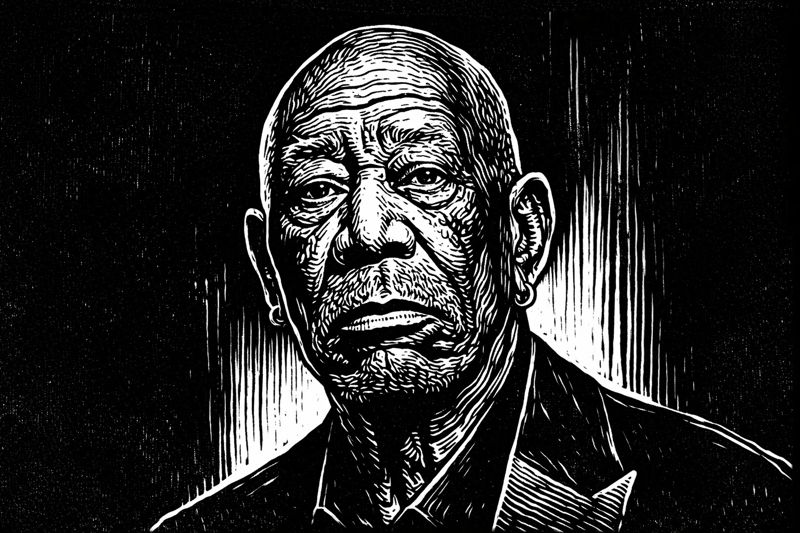
NewsBusters: On MS NOW, Actor Morgan Freeman Compares Modern US to Nazi Germany
As Freeman appeared to promote the series The Gray House about a group of Southern women who spied for the Union during the American Civil War, host Lawrence O’Donnell brought up the time Freeman read the final message of civil rights icon John Lewis for O’Donnell’s show, leading the actor to remark, “The world today is not the world he left.”
The MS NOW host then posed: “With all your life experience, and to say that the world he left is a different world from where we are now, how would you describe where we are now?”
He invoked President Donald Trump’s history of being prosecuted for felonies by Democrats, leading O’Donnell to follow up: “Were you, with your life experience, did it feel like we were going backwards? Did it feel like the country was on, as Martin Luther King would say, you know, the arc of history was turning toward progress all the time, and did this feel different?”
Freeman then jumped into his Nazi Germany comparison:
Very different, very different. I’m constantly reminded of Germany in 1935, what was happening there, the Brownshirts, those people that are marching through particularly Berlin, rounding up people and putting them in box cars and sending them off. Now, this administration wants to build large detention centers and — for what? Question.
Morgan Freeman also declared, “I’m constantly reminded of Germany in 1935 — the brownshirts, those people that are marching through — particularly Berlin — and rounding up people, putting them in boxcars, and sending them off. Now, this administration wants to build large detention centers.” He also compared ICE to Hitler’s Gestapo. As a matter of historical record, this comparison is not only factually imprecise — it is dangerously misleading, and it does Freeman’s legitimate grievances a serious disservice.
The Historical Record of 1935 Germany
By 1935, Nazi Germany had already implemented the Nuremberg Laws, stripping Jewish citizens of citizenship entirely. The Sturmabteilung (SA brownshirts) had functioned as a paramilitary terror force since the early 1920s, murdering political opponents and conducting organized pogroms with state sanction. The regime had abolished all competing political parties, dismantled a free press, and was systematically constructing a bureaucratic apparatus explicitly designed for ethnic extermination. This was not mere policy disagreement — it was a totalitarian police state built on a foundational ideology of racial annihilation.
Where the Comparison Breaks Down
The United States in 2026 retains functioning opposition parties, a free press vigorously criticizing the administration (including the very broadcast on which Freeman appeared), an independent judiciary that has blocked executive actions, and open public dissent — all of which were absent in Nazi Germany by 1933, let alone 1935. As the New Statesman noted, Trump’s America is “not a paramilitary society with massed, uniformed groups controlling the streets,” and the “straightforward fascist parallel remains misleading” until concrete hallmarks of totalitarianism — such as abolishing elections or imprisoning political opponents without trial — materialize.
The Detention Center Comparison
Freeman’s core concern — large-scale immigration detention — reflects a legitimate policy debate. However, immigration enforcement and deportation are legal processes subject to court review, not boxcar deportations to death camps. The contexts are categorically different: one involves civil immigration law with judicial oversight; the other was the industrialized murder of six million people. Conflating the two does not elevate the immigration debate — it trivializes the Holocaust.
Why Precision Matters
Rhetorical hyperbole, however emotionally resonant, corrodes historical literacy. When credible voices casually invoke Nazism, it erodes the term’s gravity and makes it harder to recognize actual authoritarian creep when it occurs. As historians have long argued, the Nazi comparison is most harmful not to its political targets but to the integrity of public discourse itself. Freeman’s moral concern for vulnerable communities is understandable and worth hearing — but it deserved a far more historically rigorous vehicle than this deeply flawed analogy.