

Sally Chase, Joseph Smith, and the Folk-Magic Roots of Early Mormonism
─────────────────────────────
I. Introduction: Two Seekers in Upstate New York
The upstate New York frontier of the early 1820s was a place of remarkable religious ferment. Campfire revivals competed with Methodist circuit riders, Baptist immersionists with Presbyterian schoolmen, and woven through all of it—quietly, insistently—was an older layer of popular practice that the educated classes dismissed as superstition but that thousands of ordinary rural Americans took entirely seriously: the world of the cunning folk, the glass-lookers, the seer-stone seers who claimed to peer into the hidden layers of reality and report back what they found.
Into this world were born, within perhaps a year or two of each other, two figures whose lives would intersect at a moment of decisive spiritual formation: Sally Chase, the village seer of Palmyra-Manchester, and Joseph Smith Jr., the farm boy who would become the founder of one of the most consequential new religious movements of the nineteenth century. Understanding their relationship—and the broader folk-magic culture that surrounded them both—is essential to any honest examination of LDS origins.

This essay approaches history from a Christian apologetics perspective. That does not mean it is a polemic against LDS believers, most of whom are sincere in their faith and many of whom are genuinely unaware of the historical complexities outlined here. Rather, a Christian perspective asks: what does the historical record actually show about the spiritual sources of Joseph Smith’s prophetic claims? And if those sources are rooted not in the Hebrew and Christian scriptures but in the scrying traditions of 19th-century folk magic, what are the theological implications?
The Apostle Paul’s warning in Galatians 1:8 is germane: “But even if we or an angel from heaven should preach a gospel other than the one we preached to you, let them be under God’s curse.” The question of whether the visionary experiences that produced the Book of Mormon were of genuinely divine origin—or whether they emerged from a milieu saturated in occult practice—is not a trivial one. It is, in fact, the central question this essay will explore.
We will trace Sally Chase’s life and practice as a glass-looker; examine her documented influence on the young Joseph Smith; analyze the remarkable catalogue of magical objects that the Smith family accumulated; explore how their occult orientation shaped the narratives Smith told about ancient civilizations and divine revelation; and finally examine how modern LDS apologetics has attempted—with only partial success—to normalize or distance these elements.
───────────────────────────────────────
II. Sally Chase: The Village Glass-Looker of Palmyra
A Portrait of the Neighborhood Seer
Sally Chase was born around 1804, making her approximately the same age as Joseph Smith Jr. She lived with her family on Canandaigua Road near the Palmyra-Manchester township line—“just over the hill from the Smiths” after their 1819 move to Stafford Road. The Chases were active Methodists, a detail worth noting: their folk-magic practices coexisted comfortably with orthodox Protestant church membership in this era, illustrating how thoroughly these two streams of popular religion had intertwined.
Sally Chase was, in D. Michael Quinn’s words, “Palmyra’s most notable seer” until Joseph Smith’s own rise to prominence displaced her. She possessed what was widely regarded as a supernatural gift: the ability to peer into a stone and perceive things hidden from ordinary sight—lost property, stolen goods, buried treasure, and the locations of valuables underground.
Until the Book of Mormon thrust young Smith into prominence, Palmyra’s most notable seer was Sally Chase, who used a greenish-colored stone. William Stafford also had a seer stone, and Joshua Stafford had a “peepstone which looked like white marble and had a hole through the center.” — D. Michael Quinn, Early Mormonism and the Magic World View (Signature Books, 1998), quoted in Brant A. Gardner, “Joseph the Seer—or Why Did He Translate with a Rock in His Hat?” FAIR Conference, August 2009
Source: FAIR LDS (Gardner, 2009)
The neighborhood testimony about Chase’s abilities was extensive and remarkably consistent. Neighbor Benjamin Saunders recalled her practice in vivid terms:
“I have seen Sally (Sarah) Chase peep or look in her seer Stone a many a time. She would look for anything… My oldest Brother had some Cattle stray away. She claimed she could see them but they were found right in the opposite direction from where she said they were.” — Benjamin Saunders, quoted in Mark Ashurst-McGee, “A Pathway to Prophethood” (MA thesis, Utah State University, 2000), p. 218–219
Source: Mormonism Research Ministry: Sally Chase
Lorenzo Saunders similarly consulted her when he lost a piece of farm equipment. Caroline Rockwell Smith stated that “people would go to her to find lost and hidden or stolen things.” John Stafford recalled that neighbors would have “Sally Chase… look through [a] stone she had & find money.”
The B. H. Roberts Foundation, an LDS-affiliated research organization, candidly acknowledges her role on its Church History Cards: “Sally Chase was a treasure hunter and, according to Lucy Mack Smith, she owned a ‘green glass’ or stone that she used as a divination tool to see or locate objects.”
Sally Chase’s Stones and Methods

Chase used two different stones in her practice. Her personal stone was a small green (or bluish-green) glass that was translucent and fitted into a paddle-like holder. Lorenzo Saunders described it: “it was a little bit of a stone & it was green & she would hold it before light.” Benjamin Saunders described “a bluish stone about the Size of my thumb. She had it fit into a paddle, like fit in very nicely.”
Her second, larger stone was found in her father’s well—a “gray smooth stone about the size and shape of an egg”—and it was this stone that would generate the most historically significant consequences, as it became entangled with Joseph Smith’s own stone-seeking. With the larger well stone, Chase employed a different method: “She would place the stone in a hat and hold it to her face, and claimed things would be brought to her view.”
This hat-and-stone technique—placing a stone in a hat, pressing the face into the hat to exclude light, and then “seeing” by the spiritual illumination within the darkness—would become the defining method of Joseph Smith’s own translation of the Book of Mormon. The convergence is not coincidental.
“Sally Chase provided Joseph Junior with his first experience of supernatural vision and also provided him a role model of the village seer.” — Mark Ashurst-McGee, “A Pathway to Prophethood,” Utah State University, MA Thesis, 2000, p. 218–221
Source: Mormonism Research Ministry: Sally Chase
To understand Sally Chase, it is crucial to situate her within the wider “cunning folk” and folk‑magic culture of early nineteenth‑century America, particularly in upstate New York. Cunning‑folk traditions—folk healing, divination, and treasure‑seeking—were far from rare; they were woven into the religious and social fabric of many rural communities in both Europe and America and persisted into the period when the Latter Day Saint movement emerged. These practices were not restricted to the uneducated or irreligious but were found among ordinary frontier Christians of various denominations.

Frontier Americans commonly accepted that certain individuals possessed supernatural “second sight,” often mediated through physical objects such as stones, crystals, minerals, glass, or specially prepared mirrors. Activities like “glass‑looking,” scrying, and the use of “peep‑stones” or “seer stones” to locate lost items or hidden treasure fit squarely within this broader folk‑magic framework. At the same time, other forms of practical divination—such as the use of divining rods to locate underground water—were widely employed in rural districts, while attention to seasonal cycles and celestial signs remained integral to agricultural life.
Contemporary print sources illustrate how pervasive treasure‑seeking beliefs were. A New England newspaper, the Watchman, described money‑digging as “very common” and even “honorable and profitable,” boasting that it could name “at least five hundred respectable men, who do, in the simplicity and sincerity of their hearts, verily believe that immense treasures lie concealed in the Green Mountains, many of whom have been industriously and perseveringly engaged in digging it up.” The Palmyra Reflector similarly characterized such activities as a local “mania,” observing that men and women “without distinction of age and sex” fancied themselves wise in “occult sciences,” dreaming dreams and seeing visions of buried riches “deep in the bowels of the earth.” This was the religious and social atmosphere in which the young Joseph Smith and his associates, including Sally Chase, operated.
The specific practice of scrying—gazing into a reflective or translucent surface to obtain hidden or supernatural knowledge—has a long and multicultural pedigree. Historical surveys of scrying note its presence in ancient Egyptian religion, in medieval and early modern European occultism, and in various indigenous and folk traditions. Famous European examples include the sixteenth‑century French figure Nostradamus, who used a bowl of liquid or other reflective surfaces in divinatory work, and the Elizabethan magus John Dee and his associate Edward Kelley, who claimed to receive angelic communications through crystal‑gazing and similar techniques. These and related practices crossed the Atlantic with European settlers and mingled with local and indigenous traditions, flourishing in the highly charged religious environment of the early American republic and helping to create the social world in which a frontier “seer” like Sally Chase could be taken seriously as a source of supernatural insight.
Clay L. Chandler’s landmark essay “Scrying for the Lord” in the Dialogue Journal (2003) provides perhaps the most thorough academic account of the practice and its connection to Joseph Smith. Chandler notes that the Palmyra Reflector newspaper in 1831 described the local scrying subculture in these terms:
“Men and women without distinction of age or sex became marvelous wise in the occult sciences, many dreamed, others saw visions disclosing to them, deep in the bowels of the earth, rich and shining treasures… Peep stones or pebbles, taken promiscuously from the brook or field, were placed in a hat or other situation excluded from the light, when some wizard or witch applied their eyes, and nearly starting their eyeballs from their sockets, declared they saw all the wonders of nature.” — The Reflector (Palmyra, N.Y.), Feb. 1, 1831, quoted in Clay L. Chandler, “Scrying for the Lord,” Dialogue: A Journal of Mormon Thought 36, no. 4 (2003): 45
Source: Dialogue Journal: Scrying for the Lord
───────────────────────────────────────
III. Sally Chase and Joseph Smith: The Formative Encounter
Joseph Smith Looks into Sally’s Stone
The most historically significant episode connecting Sally Chase and Joseph Smith is the occasion when the teenage Joseph visited her, was permitted to look into her seer stone, and in doing so, received his first visionary experience—a vision that pointed him toward his own first seer stone.
This account comes from multiple independent sources. William D. Purple, the scribe for Joseph Smith’s 1826 court appearance, later recalled the testimony given in that proceeding:
“He said when he was a lad, he heard of a neighboring girl some three miles from him, who could look into a glass and see anything however hidden from others; that he was seized with a strong desire to see her and her glass; that after much effort he induced his parents to let him visit her. He did so, and was permitted to look in the glass, which was placed in a hat to exclude the light. He was greatly surprised to see but one thing, which was a small stone, a great way off. It became luminous, and dazzled his eyes, and after a short time it became as intense as the mid-day sun. He said that the stone was under the roots of a tree or shrub as large as his arm… He borrowed an old ax and a hoe, and repaired to the tree. With some labor and exertion he found the stone.” — William D. Purple, Reminiscence, 28 April 1877 [State of New York v. JS-A], The Joseph Smith Papers
Source: Mormonism Research Ministry: Sally Chase
Joseph Smith Sr. corroborated this account in his 1830 interview with Fayette Lapham, saying his son saw the location of this stone by looking at someone else’s stone. Both Mark Ashurst-McGee and D. Michael Quinn—representing very different scholarly perspectives—identify this neighboring girl as Sally Chase.
Ashurst-McGee’s conclusion is particularly striking, given that his master’s thesis was accepted at Utah State University and has been cited approvingly by LDS-affiliated scholars: Sally Chase “provided Joseph Junior with his first experience of supernatural vision and also provided him a role model of the village seer.”
The LDS apologetics organization FAIR concedes the point explicitly:
“Joseph first used a neighbor’s seer stone (probably that belonging to Palmyra seer Sally Chase, on the balance of historical evidence, though there are other possibilities) to discover the location of a brown, baby’s foot-shaped stone. The vision of this stone likely occurred in about 1819–1820, and he obtained his first seer stone in about 1821–1822.” — FAIR Latter-day Saints, “Joseph Smith/Seer Stones”
Source: FAIR Latter-day Saints: Joseph Smith / Seer Stones
LDS historian and BYU professor Steven C. Harper, writing for a Brigham Young University Religious Studies Center publication, adds:
“There is no reason to reject the basic assertion that Joseph searched for buried treasure using a marvelous stone, even though the claim is made by some of his antagonists. Joseph did not dispute that claim, and people who loved, trusted, and followed him confirmed that he had such a stone. A man who hired Joseph reported that Joseph’s search for a seer stone was inspired by an earlier experience of seeing it through a stone that belonged to a neighbor girl.”
— Steven C. Harper, “The Probation of a Teenage Seer,” in The Coming Forth of the Book of Mormon (BYU Religious Studies Center, 2015), p. 26
From the LDS apologetics side itself, Stan Spencer writes in the Interpreter that “Sally Chase was probably the one who taught Joseph Smith how to use a seer stone.” The conclusion is inescapable: Sally Chase was Joseph Smith’s teacher in the art of scrying.
Joseph Smith likely first looked into Sally Chase’s seer stone in late 1819 or early 1820, shortly after his family moved from their initial Palmyra log home (built around 1818) to a cabin on the Manchester farm along Stafford Road, reducing the distance to the Chase property on Canandaigua Road from over 2½ miles to about ½ mile. This relocation, dated by historians to summer or fall 1819 based on Joseph Smith’s own recollection of “about four years” after arriving in Palmyra in 1816, aligns with neighbor accounts and U.S. Census data listing the Smiths in Farmington (later Manchester). Fayette Lapham’s 1830 interview with Joseph Smith Sr. specifies Joseph was “about fourteen years of age” during the experience—Joseph turned 14 on December 23, 1819—further supporting late 1819 to early 1820, before the traditional LDS date of the First Vision in spring 1820 (often March 26).
This timing places Joseph’s initial supernatural experience—gazing into Sally’s green glass stone placed in a hat, seeing a distant luminous stone he later retrieved—within New York’s “Burned-over District” revivalism blended with folk magic practices like treasure-seeking and scrying. Sally Chase, a Methodist girl born around 1804 and living nearby, was a known “village seer” who used her stone to locate lost items, much like Joseph soon did himself; neighbors like Benjamin and Lorenzo Saunders confirmed her activities. William Purple’s 1826 court reminiscence and Joseph Sr.’s report detail Joseph repeatedly visiting such a “neighboring girl” (identified by scholars as Sally), obtaining his first brown, foot-shaped seer stone around 1821–1822, which he used for treasure quests alongside family members.
Biblical prophets like Isaiah (called amid Judah’s covenant failures, Isaiah 6), Jeremiah (from priestly lineage, Jer. 1), Ezekiel (exiled priest, Ezekiel 1), and Paul (Pharisee schooled in Torah, Acts 9) received visions rooted in Israel’s scriptural tradition, without prior occult tools or money-digging. Joseph’s pattern emerged from a subculture mixing Christianity with ritual magic—evident in his use of Sally’s and his own stones to locate a second white/gray stone in Willard Chase’s 1822 well-digging (sparking ownership disputes) and even the Book of Mormon plates’ precise spot, per Martin Harris. This folk-magic foundation, rather than transcendent biblical revelation, raises questions about consistency with Scripture, especially given failed treasure hunts and ongoing seer reliance.
A Role Model in the Village-Seer Economy
LDS apologist Brant Gardner, writing for the FAIR Conference in 2009, provides an illuminating sociological framing:
“These accounts portray the way Sally Chase functioned in the community. When things were lost, you went to the seer who consulted her seer stone and described how to find the lost item. Joseph Smith, long before golden plates complicated his position as a local seer, appears to have functioned just as Sally Chase did… Sally Chase’s clients sought her out to locate lost property, and Joseph Smith had at least one client who did the same, indicating that Joseph participated in the same village-seer economy prior to his prophetic claims.” — Brant A. Gardner, “Joseph the Seer—or Why Did He Translate with a Rock in His Hat?” FAIR Conference, 2009
Source: FAIR LDS: Joseph the Seer
According to neighbor Sarah F. Anderick, Joseph Smith “often came to inquire of her [Sally Chase] where to dig for treasures,” indicating he consulted her regularly in her capacity as a village seer before his own claims to prophethood. This was not a casual acquaintance. It was an ongoing apprenticeship in the craft of supernatural seeing.
For evangelical Christians approaching this history, the pattern raises profound questions about spiritual formation. Deuteronomy 18:10-12 explicitly prohibits divination and those who “seek omens.” Proverbs 28:26 warns against trusting one’s own heart. The tradition Sally Chase represented—however sincerely practiced, however culturally normalized—was precisely the tradition that the Hebrew prophets condemned as an alternative to seeking God through His revealed Word. That Joseph Smith’s prophetic career grew organically out of this tradition is a matter of documented historical record, not anti-Mormon polemic.
───────────────────────────────────────
IV. A Household of Stones and Charms: The Smith Family’s Occult Inventory
Joseph Smith’s Multiple Seer Stones
Joseph Smith did not possess a single seer stone. The historical record documents an accumulating collection of divination instruments that he acquired over the course of his treasure-seeking years. The LostMormonism.com catalogue of these artifacts provides useful summaries, and the Wikipedia article on “Seer Stones (Latter Day Saints)” offers a scholarly overview.
The principal stones were:
The White Stone (Joseph’s First Seer Stone, c. 1819–1821)
Joseph’s first stone—the one he located by gazing into Sally Chase’s green glass—was a small white stone described by eyewitnesses as resembling a baby’s foot, “wider on one side than the other.” He reportedly located it buried under a tree root, approximately 150 miles away from where he initially saw it in Chase’s stone. According to the LostMormonism.com entry on Joseph’s first seer stone:
“When Joseph put her stone in a hat and gazed into it, he claimed that he was able to see a white stone ‘a hundred and fifty miles away buried under a tree’ and knew that this white stone was his own seer stone. Practitioners of folk magic, such as Joseph and his family, believed that ‘there is a [seer] stone of this quality, somewhere, for every one.'” — LostMormonism.com, “Joseph’s First Seer Stone”
Source: LostMormonism.com: Joseph’s First Seer Stone
This stone appears to have been used in Joseph’s earlier treasure-seeking activities and was later employed in the translation of portions of the Book of Abraham. After completing the Book of Mormon translation with the chocolate-colored stone, Joseph reportedly gave the brown stone to Oliver Cowdery and returned to using the white stone. The LDS Church now holds this stone in its possession but has not publicly released images of it.
The Chocolate-Colored Stone (Found in the Chase Well, c. 1822)
The most historically consequential of Joseph Smith’s seer stones was found while he was helping dig a well on the Chase family property—the very family of Sally Chase. Willard Chase, her brother, recorded the discovery in his 1833 affidavit:
“In the year 1822, I was engaged in digging a well. I employed Alvin and Joseph Smith to assist me… After digging about twenty feet below the surface of the earth, we discovered a singularly appearing stone, which excited my curiosity.” — Willard Chase, Statement, Manchester, New York, 1833, in E. D. Howe, Mormonism Unvailed (Painesville, Ohio, 1834), p. 240
Source: Wikipedia: Willard Chase
A dispute over ownership of the stone immediately arose. Joseph took the stone, and when Chase later asked for its permanent return, Joseph’s father told him the stone “was not mine nor never was” and that “Joseph made use of it in looking for lost articles, and that he intended to keep it.”
Martin Harris, the first scribe for the Book of Mormon, was explicit about this stone’s central role in the production of the LDS scripture:
“Joseph had a stone which was dug from the well of Mason Chase, twenty-four feet from the surface. In this stone he could see many things to my certain knowledge. It was by means of this stone he first discovered these plates.” — Martin Harris, quoted in Ashurst-McGee, “A Pathway to Prophethood,” p. 297
Source: Mormonism Research Ministry: Sally Chase
Harris further clarified: “Joseph… described the manner of his finding the plates. He found them by looking in the stone found in the well of Mason Chase. The family had likewise told me the same thing.” Willard Chase himself recorded that in 1827 Joseph acknowledged: “if it had not been for that stone, (which he acknowledged belonged to me,) he would not have obtained the book.”
This chocolate-colored stone—the stone found on Chase’s property, the stone Chase believed belonged to him—was also the instrument used to translate the Book of Mormon itself. Emma Smith confirmed: after losing the first 116 pages, Joseph “used a small stone, not exactly black, but rather a dark color.” David Whitmer, who witnessed the translation, stated that with the brown, “chocolate-colored stone… all of the present Book of Mormon was translated.”
From a Christian apologetic standpoint, the implications are stark: the scripture that millions of LDS believers regard as “another testament of Jesus Christ” was produced using an instrument of folk magic, specifically a stone found on property belonging to a family of active seers, by a man who had learned his technique from a village glass-looker.
Additional Stones
The historical record documents additional seer stones in Joseph Smith’s possession. The LostMormonism.com site catalogs a mud seer stone and a sandy-colored seer stone, along with a green seer stone possibly acquired during his time in Susquehanna County, Pennsylvania. Brigham Young later told the apostles that Joseph had possessed five seer stones in total.
The Jupiter Talisman: Magic as Personal Protection
Perhaps the most dramatically revealing artifact in the Smith family’s magical inventory is the Jupiter talisman—a silver medallion that Joseph Smith reportedly carried on his person, and that was, according to Emma Smith, among his most intimate possessions at the time of his death at Carthage Jail in 1844.
According to the LostMormonism.com entry:
“Joseph Smith owned this Jupiter talisman which was among his most intimate possessions according to Emma Smith. This talisman demonstrates Joseph’s fascination with magic. The purpose of such a talisman was to help the owner have influence over others, become rich and powerful, and find peace. The inscription on the talisman comes directly from ‘The Magus,’ which was a magical book by Francis Barrett published in 1801.” — LostMormonism.com, “Joseph Smith’s Jupiter Talisman”
Source: LostMormonism.com: Joseph Smith’s Jupiter Talisman
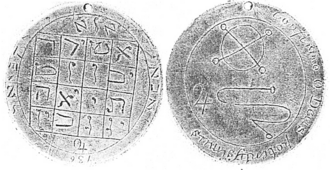
D. Michael Quinn’s research confirmed that the talisman’s design matches exactly those found in Barrett’s 1801 grimoire, The Magus—a book of ceremonial magic. The Wikipedia article on folk magic and the LDS movement states that Joseph possessed this talisman and that “family lore had it that Smith had it on his body the day of his martyrdom.”
The Jupiter talisman was intended to confer on its bearer “decisive victory over enemies, to defend against machinations, and to inspire the wearer thereof with the most remarkable confidence.” The fact that Joseph Smith—at the height of his prophetic career, leading a church of tens of thousands—still carried this occult charm speaks volumes about the persistent role that folk-magic practices played in his worldview.
The Smith Family Magic Parchments
Beyond the stones and talismans, the Smith family possessed three magic parchments that were carried in a bag meant to be worn by the owner. As LostMormonism.com documents:
“The Smith Family owned three magic parchments that were carried in a bag meant to be worn by the owner. The parchments blend a mixture of Christianity and magical occult symbolism and were probably used as lamens; pendants meant to focus magical energies for a variety of purposes. The existence of these parchments suggest that the Smith family had more than a passing interest in magic. Many of the magic symbols are copied directly out of magical texts, including The Magus by Francis Barrett published in 1801, the New and Complete Illustration of Celestial Sciences by Ebenezer Sibly published in 1784, and The Discoverie of Witchcraft by Reginald Scot published in 1584.” — LostMormonism.com, “Smith Family Magic Parchments”
Source: LostMormonism.com: Smith Family Magic Parchments
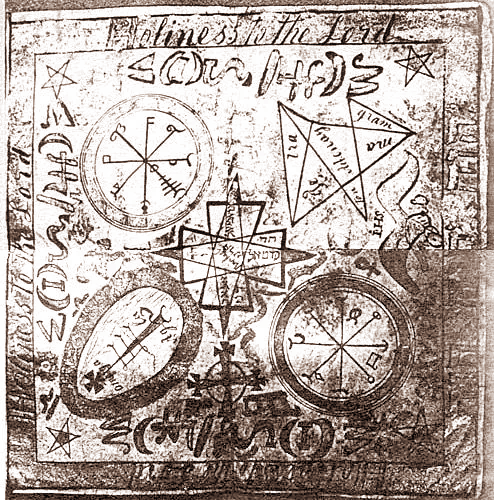
The three parchments—“Jehovah, Jehovah, Jehovah”; “St. Peter Bind Them”; and “Holiness to the Lord”—were likely owned by Joseph Smith Sr. and Joseph Smith Jr. Clay Chandler’s research confirms that the “Holiness to the Lord” parchment drew its symbols from Sibly’s occult sciences handbook, while the “Jehovah, Jehovah, Jehovah” parchment derived from Scot’s Discoverie of Witchcraft. These were not decorative items; they were functional instruments of ceremonial magic.
Also in the family’s possession was a Mars Dagger—a blade inscribed with the astrological symbol for Mars, the occult seal of Mars, and the Hebrew name for God, “Adonay.” Specially consecrated daggers were prescribed in grimoires for drawing magic circles during treasure-digging and spirit-invocation. This was working magical equipment.
The Pattern of Dependence: An Occult Orientation
Taken together—the multiple seer stones, the Jupiter talisman, the three magic parchments, the Mars dagger, the active participation in treasure digging with incantations and ritual circles—a clear picture emerges of a family not casually brushing against the edges of folk magic, but deeply embedded in its practice as a primary framework for engaging with supernatural reality.
The significance of this for Christian apologetics cannot be overstated. The biblical tradition consistently presents the prophetic vocation as rooted in a covenantal relationship with the God of Israel as revealed in Scripture, not in techniques derived from grimoires, divination manuals, and the accumulated wisdom of regional seers. The Old Testament prophets, the New Testament apostles, and the entire history of Christian mysticism operate within a framework in which the Written Word tests and governs spiritual experience.
What the Smith family had was the reverse: a set of inherited magical practices that generated spiritual experiences, and then a post-hoc theological framework constructed to interpret and legitimate those experiences. The Book of Mormon did not produce the seer stones; the seer stones produced the Book of Mormon.
───────────────────────────────────────
V. How Folk-Magic Experience Shaped Joseph Smith’s Narrative World
From Lost Objects to Lost Civilizations
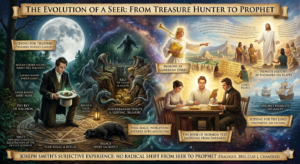
Joseph Smith’s early career as a treasure seer relied on scrying—gazing into a seer stone placed in a hat to exclude light and perceive hidden objects like lost cattle, stolen goods, buried coins, or secret locations—before directing others to dig. Neighbors like William Stafford described Joseph locating “kegs of gold and silver” via his stone, leading digs with magic circles formed by witch hazel rods, incantations, and blood sacrifices (e.g., a black sheep to appease guardian spirits), yet treasures invariably “slipped away” due to enchantments. This 19th-century New York folk magic, drawn from grimoires like Ebenezer Sibly’s New and Complete Illustration of the Occult Sciences and The Key of Solomon, involved ritual purity, black attire, linen garments, and planetary timing (e.g., full moons, equinoxes) to counter subterranean spirits guarding metals.
Expansion from Mundane to Cosmic Visions. Joseph’s mechanism persisted unchanged into his prophetic role: the same brown seer stone (found in Willard Chase’s 1822 well) in a hat produced the Book of Mormon text, with witnesses like Emma Smith and Martin Harris confirming he dictated words emerging in the stone’s darkness, plates often absent. Rather than mundane items, visions scaled to ancient Israelite migrants sailing to America, engraving Nephite history on gold plates, prophesying Christ’s visit post-resurrection, and warring in biblical-style prose—echoing scrying’s “spiritual visions in blackness” but framed theologically. Clay L. Chandler’s 2003 Dialogue essay “Scrying for the Lord” posits no radical shift in Joseph’s subjective experience; the folk-magic worldview—treasures guarded by spirits like Moroni, slippery plates vanishing thrice until rituals aligned—evolved into mysticism, blending with revivalism to birth new doctrine.
Documented Treasure Quests and Parallels. Historical records pinpoint over a dozen Smith-led digs, illustrating the pattern: Manchester hills (e.g., Miner’s Hill cave, 40-ft tunnel for a gold-chaired king); Stafford orchards; Chase’s “Old Sharp” (black sheep sacrifice); and Hill Cumorah’s northeast pit (pre-1827). In Pennsylvania (Harmony, 1825), Josiah Stowell’s crew excavated massive pits on McKune/Skinner land for a Spanish mine, feathers marking spots per Joseph’s visions; Chenango/Broome sites (e.g., Stowell’s flat, Cornell farm, Monument Hill) yielded iron chests or ore traces before “settling.” These mirror Book of Mormon origins: annual equinox visits to Cumorah (astrologically potent), black clothing for plate retrieval, Emma as ritual companion, and “enchantments” thwarting until purity achieved—seamlessly extending folk magic to scripture.
Apologetics and Theological Critique. From a Christian viewpoint, this continuity undermines claims of transcendent revelation; biblical seers like Samuel (1 Sam. 9, lost donkeys via God, no stones) or Daniel (visions sans tools) operated in covenantal contexts, not occult rituals blending Christianity with grimoires. Joseph’s owned Jupiter talisman (from The Magus), family parchments, and dagger sigils confirm immersion, suggesting visions reflected cultural lore—Captain Kidd tales, ancient texts in caves—rather than novel divine history, with “fruit” like failed digs paralleling prophetic critiques (e.g., Helaman 13:18 cursing hiders). Chandler explores theories: pious fraud, true magical believer, or mysticism catalyzing sincere innovation—yet the unchanged method prioritizes mechanism over miraculous departure.
The Occult Imagination and the Narrative of Ancient America
Joseph Smith’s early immersion in 19th-century New York folk magic deeply shaped the Book of Mormon narrative, with multiple elements mirroring treasure-seeking rituals documented in grimoires like The Key of Solomon and contemporaries like D. Michael Quinn and Clay Chandler. These parallels suggest the story’s origins in a worldview blending Christianity, occultism, and divination, rather than solely divine revelation.
Buried Treasure Guarded by Spirits. Folk magic lore held that subterranean treasures were controlled by evil spirits or gnomes who could blast or transport them away if rituals were mishandled, requiring precise procedures like magic circles drawn with inscribed daggers to bind guardians. Joseph described the golden plates in Hill Cumorah as similarly protected: an angel (Moroni) appeared thrice on September 21, 1823 (full moon eve), warning him; on his first attempt, three shocks struck him for reaching prematurely; and subsequent visits failed until 1827 rituals were fulfilled. Neighbor accounts, including Willard Chase and William Stafford, confirm the Smiths’ digs used circles of witch hazel sticks, blood sacrifices (e.g., black sheep for evil spirits), and peep stones to counter such enchantments, with treasures “slipping” like the plates did when Joseph greedily checked the box.
Autumnal Equinox Timing. Treasure quests peaked at full moons and equinoxes for planetary alignment, per The Key of Solomon (midnight to dawn, new/full moon) and Reginald Scot’s Discoverie of Witchcraft (bright moonlight circles); Sibly’s Occult Sciences noted equinoxes for cultural/religious shifts. Joseph’s annual Hill Cumorah visits aligned exactly: first Moroni sighting September 21, 1823 (equinox eve, post-full moon); four equinox-day visits; plates retrieved September 22, 1827 eve—also aligning with Jewish Rosh Hashanah, though Joseph’s prior knowledge is unproven.
Ritual Companions and Attire. Grimoires mandated companions (e.g., Key of Solomon: master plus two or a faithful dog/child for operations), white linen robes over black garments, black horses for night rites, and virgins for purity; black symbolized certain invocations. On retrieval night, Joseph borrowed Joseph Knight’s black horse/carriage, wore black clothes and a linen frock (per Lucy Mack Smith), and required Emma as consort—neighbors noted the angel demanded marriage first, with Emma praying or guarding while he dug, echoing magical “associates” to avert spirits.
Linen and Silk Wrappings. Consecrated magical instruments demanded silk or linen coverings for protection/power retention, as the Key of Solomon instructed: “wrapped in silk and put away.” Lucy Mack Smith handled the plates (hefted, ~60 lbs, wrapped in Joseph’s linen coat), “key”/spectacles (two triangular diamonds in silver bows, through silk handkerchief), and breastplate (thin muslin), never unwrapping them—mirroring ritual handling of talismans like the Smiths’ Jupiter medallion or parchments from The Magus.
These motifs permeated Joseph’s milieu: family-owned magic dagger/parchments (sigils from Sibly/Magus), 1826 trial as “disorderly person” for stone visions, and post-plates translation via hat-stone—positioning the Book of Mormon as an evolution of folk magic into “treasure” scripture, per scholars Quinn and Chandler. From a Christian view, this contrasts with biblical prophets’ direct calls sans occult tools.
The Translation Process as Extended Scrying
The mechanics of the Book of Mormon translation process were, from first to last, the mechanics of folk-magic scrying. Multiple independent witnesses—Emma Smith, David Whitmer, Elizabeth Ann Whitmer Cowdery, and others—consistently described the same process: Joseph placed the seer stone in a hat, pressed his face into the hat to exclude all light, and then dictated the text as words appeared to him in the darkness.
David Whitmer’s famous description, cited in the Wikipedia article on LDS seer stones, is worth quoting in full:
“Joseph Smith put the seer stone into a hat, and put his face in the hat, drawing it closely around his face to exclude the light; and in the darkness the spiritual light would shine. A piece of something resembling parchment would appear, and on that appeared the writing. One character at a time would appear, and under it was the interpretation in English. Brother Joseph would read off the English to Oliver Cowdery, who was his principal scribe, and when it was written down and repeated to Brother Joseph to see if it was correct, then it would disappear, and another character with the interpretation would appear. Thus the Book of Mormon was translated by the gift and power of God, and not by any power of man.” — David Whitmer, “An Address to All Believers in Christ” (1887), p. 12
Source: Wikipedia: Seer Stone (Latter Day Saints)
From a Christian perspective, the theological problems here are profound. The gold plates themselves were not directly consulted during this process. Oliver Cowdery “had seasons of skepticism, in which I did seriously wonder whether the Prophet and I were men in our sober senses, when he would be translating from plates, through ‘the Urim and Thummim,’ and the plates not be in sight at all.” The “translation” was, in technical terms, a spiritual dictation using a folk-magic instrument—a technique directly parallel to the one Joseph had learned from Sally Chase and practiced in her stone.
For evangelicals who hold to the perspicuity and sufficiency of Scripture (2 Timothy 3:16-17), the production of new “scripture” through occult scrying is disqualifying on its face, regardless of the theological content of what was “translated.” The mechanism of revelation matters, not only the message.
The Storytelling Apprenticeship
The Book of Mormon narrative weaves an intricate tapestry, but skeptics rightly question whether its divine claims withstand scrutiny when viewed through the lens of Joseph Smith’s well-documented folk-magic upbringing. While apologists highlight its theological sophistication, the text’s origins align too neatly with 19th-century treasure lore to dismiss as coincidence—golden plates buried under a hill, guarded by spirits, retrieved via ritual timing and seer stones, all mirroring the very practices Joseph plied for pay before his “prophetic” turn.

Joseph’s Storytelling Genius, Skeptically Assessed. Joseph was undeniably a prodigious storyteller, steeped in King James Bible cadences from family scripture readings and revival sermons. He masterfully fused Isaiah’s grandeur, Protestant debates on restoration, and apocalyptic fervor into a 500+ page epic rivaling View of the Hebrews or Ethan Smith’s sermons—works circulating in Palmyra. Yet this “genius” emerged from a teenager with scant formal education (three years of schooling), dictating without manuscripts or revisions to unlettered scribes like Oliver Cowdery, who spelled phonetically. Skeptics note the anachronisms—horses, steel, wheat, silk in pre-Columbian Americas; DNA disconfirming Israelite migration; chiasmus as a common Semitic trope, not unique proof—as red flags undermining claims of ancient provenance.
Confidence Forged in Folk Magic Crucible. That audacious confidence—to claim visions in hats, angelic visitations, and translated scripture—crystallized not in spontaneous revelation but through incremental validation in the occult subculture. Peering into Sally Chase’s green glass stone as a 14-year-old, retrieving his own egg-shaped peepers from fields and wells, divining (and failing) buried pots of coins with family rituals: these built unshakeable self-belief in his “second sight.” The 1826 Bainbridge court record labels him a “glass-looker” and “disorderly person” for defrauding Josiah Stowell—yet clients persisted, convinced despite empty holes. Talismans like the Smiths’ Jupiter talisman (moonstone for prophecy), parchments with sigils from Francis Barrett’s The Magus, and divining rods honed a worldview where hidden treasures yielded to the initiated.
Biblical Contrast and Ultimate Skeptical Verdict. Biblical prophets—Isaiah’s throne vision amid covenant fidelity, Jeremiah’s almond rod from priestly stock, Ezekiel’s wheeled throne in exile, Paul’s Damascus road sans tools—operated within scriptural monotheism, their fruits tested by fulfilled prophecy and transformed lives, not money-digging flops or plagiarized King James passages (e.g., Isaiah 2 in 2 Nephi 12 verbatim, with 17th-century italics). Joseph’s “fruits”—polygamy, failed banks, temple rites echoing Masonic oaths post-1842—veer from New Testament ethics, evoking Jesus’ warning: “By their fruits ye shall know them” (Matt. 7:20).
Sally Chase didn’t author the Book of Mormon. But she ignited the seer’s spark in a restless youth whose “revelation” recycled folk magic into a new scripture—luring millions, yet crumbling under historical, archaeological, and textual scrutiny. True faith rests on evidence aligning with God’s unchanging Word, not a hat’s shadows or equinox apparitions; Joseph’s tale, for all its narrative allure, fails that biblical test, pointing instead to human invention cloaked in the supernatural.
───────────────────────────────────────
VI. Official LDS Responses: Distancing, Normalizing, and the “Reconciled View”
A Long History of Denial
LDS Church’s Historical Minimization of Folk Magic and Seer Stones. For much of its history, the LDS Church downplayed or outright denied Joseph Smith’s use of folk magic and seer stones in its founding events, prioritizing a dignified prophetic image over gritty treasure-digging realities. As late as 1954, Church President and Historian Joseph Fielding Smith asserted in Doctrines of Salvation (vol. 3, p. 225) that no authentic church history confirmed seer stone use in Book of Mormon translation, dismissing eyewitness accounts as “hearsay” and personally rejecting it: “I do not believe that this stone was used for this purpose,” citing Ether 3:22–24’s Urim and Thummim as the sole divinely appointed tool. The Wikipedia entry on folk magic in the LDS movement highlights this pattern, noting official narratives framed translation via “interpreters” (spectacles from the plates), not Joseph’s brown peep stone in a hat—a folk practice he honed in locating lost objects and treasures.
Official Narratives and Visual Suppression. LDS manuals, missionary flipcharts, Ensign articles, and temple murals depicted Joseph reverently poring over visible golden plates with Nephite spectacles and breastplate, evoking biblical Urim and Thummim (Exodus 28:30)—a process befitting “the spiritual gravity of the restored gospel.” Bruce R. McConkie’s Mormon Doctrine (1966) echoed denials, while Sunday School lessons avoided hat visions until the church’s 2015 Gospel Topics essay “Book of Mormon Translation,” which first prominently featured the stone-in-hat method with photos of Joseph’s actual seer stone (now church-held). This shift followed decades of member shock at outsider exposures, like the 1985 Mark Hofmann salamander letter forgery scandal, which forced reckonings with magical origins (e.g., Moroni as toad/salamander spirit).
Quinn’s Revelatory Scholarship and Backlash. Historian D. Michael Quinn’s Early Mormonism and the Magic Worldview (1987, revised 1998) exhaustively cataloged the Smiths’ talismans (Jupiter medallion for prophecy), parchments with sigils from The Magus, divining rods, ritual circles, and Joseph’s 1826 “glass-looking” conviction—drawing from diaries, court records, and artifacts. The book ignited fury: FAIR and BYU scholars contested interpretations as “anti-Mormon,” but core facts (e.g., family-owned magic dagger, seer stones) held via Joseph Smith Papers corroboration. Quinn faced a 1993 stake disciplinary council, resulting in disfellowshipment (later excommunication in 1994 for other writings), which he attributed to “punish[ing] me for being the messenger of unwanted historical evidence.” Despite backlash, no substantive rebuttals overturned his evidence, paving the way for church acknowledgments like the 2017 “Seer Stones” essay.
This evolution—from denial to disclosure—underscores a pattern of narrative control, where inconvenient origins (folk magic fueling “revelation”) were sanitized to sustain faith claims, only surfacing under scholarly pressure and digital transparency.
The 2013-2015 Admissions
LDS Church’s Shift Toward Historical Transparency. In response to growing online scrutiny of Joseph Smith’s folk-magic background, the LDS Church quietly launched its Gospel Topics Essays in 2013 on its website, with the “Book of Mormon Translation” essay (posted July 2013, revised 2015/2016) openly stating Joseph used a seer stone in a hat to block light, dictating words that appeared—often more conveniently than the plates’ “interpreters” (Urim and Thummim spectacles). This marked a departure from 20th-century narratives minimizing or denying the stone, as in Elder George F. Richards’ 1930s claim of “no authentic statement” supporting it.
2015 Seer Stone Photographs and Essays. On August 4, 2015, amid the Joseph Smith Papers Project’s Revelations and Translations Vol. 3 (printer’s manuscript facsimile), the Church unveiled high-resolution photos of its brown-and-white, oval, smoothed seer stone (one of two owned; the other, chocolate-colored jasper-like remains private), held by Elder Steven E. Snow and displayed briefly at the Church History Museum. Geologists identify it as common agate/jasper from Lake Erie beaches or Upstate New York gravels—hardly exotic, used pre-plates for treasure seeking. The essay contextualizes: Joseph, like contemporaries, scryed lost items/buried treasure in the 1820s but repurposed it for “higher” scripture translation.
Scholarly and Apologetic Reactions. John-Charles Duffy, University of Utah writing instructor and Sunstone contributor, hailed the essay in an August 2013 Salt Lake Tribune analysis as a “bombshell” for admitting no plate-gazing occurred, only hat-stone scrying—contradicting correlated manuals and missionaries. FAIR apologist, Brant Gardner, popularized “Joseph the Seer” at his 2009 conference talk, “Joseph the Seer, or Why Joseph Translated with a Rock in His Hat,” framing it biblically (Urim/Thummim as stones).
“Joseph the Seer” Ensign Normalization. The October 2015 Ensign featured “Joseph the Seer” by Church Historian Richard E. Turley Jr., Robin Scott Jensen, and Mark Ashurst-McGee, echoing Gardner’s title while historicizing stones as biblical (Aaron’s rod, brass serpent, Urim/Thummim) and cultural (Palmyra folk practices). It cites witnesses like Emma Smith (plates on table, Joseph face-in-hat hours), Martin Harris (“written” after each sentence), and Oliver Cowdery (spectacles initially), noting Joseph’s maturation beyond instruments by Bible translation. Revelation D&C 21:1 calls him “seer”; Book of Mormon prophecies (Alma 37:23’s “Gazelem” stone shining in darkness) retrofitted to validate.
This pivot, driven by CES Letter critiques and ex-Mormon sites, integrates “weird” history into faith narratives, urging focus on “gift and power of God” over mechanics—yet skeptics see it as belated damage control for treasure-digging origins conflicting with prophetic purity.
The Apologetic Strategy: Normalization
LDS Apologetic Normalization of Seer Stones. Post-2013 LDS apologetics, spurred by church essays like “Book of Mormon Translation” (2013) and the Ensign’s 2015 seer stone photo release, center on “normalization”—portraying Joseph’s stone-in-hat method as culturally normative, biblically paralleled, and divinely repurposed, not occult residue. Defenders equate 19th-century folk seer stones with ancient Urim and Thummim (Exodus 28:30), arguing both channeled God’s word via physical aids amid widespread practices.
FAIR’s Cultural Continuity Argument. FAIR’s “Joseph Smith/Seer Stones” page details Joseph’s youth: acquiring a brown, shoe-shaped stone (via Sally Chase’s green one, ~1819–1822), then a white/gray egg-shaped one from Willard Chase’s 1822 well, plus Nauvoo finds—used interchangeably with Nephite interpreters for translation convenience. It normalizes via Martin Harris’s pin test (seer stone in hat located it), denies “magic” pejorative (citing Jonathan Z. Smith: no scholarly consensus on “magic” vs. religion), and notes Book of Mormon’s condemnation of sorcery (Mormon 1:19). Chase link shows “village seer” continuity, not fraud—e.g., villagers sought Joseph pre-plates; Josiah Stowell defended him in 1826 trial despite family charges.
BYU and Church Translation Documents. BYU’s “Documents of the Book of Mormon Translation Process” (ScholarsArchive) compiles witnesses: Martin Harris on sentences appearing/disappearing in stone; David Whitmer/Emma on the hat method blocking light; John Gilbert (1830 printer) on no plates visible during dictation. Orson Pratt recalled Joseph ditching stones post-1830: “advanced…did not need [Urim/Thummim] assistance,” implying divine progression from folk tools. Church’s 2015 Ensign/Church Newsroom visuals integrate it as “gift and power of God,” akin to biblical aids (e.g., Aaron’s rod, Rev. 2:17 white stone).
Fuller Consideration’s Primary Source Catalog. Fuller Consideration (fullerconsideration.com) aggregates 100+ raw accounts on plates/stones: Lucy Mack on linen-wrapped “key” (silver-bowed diamonds); Martin Harris on oval white stones (~2″ diameter, silver bow); Joseph Sr. (via Fayette Lapham, 1870) on diamond spectacles; William Smith on hefted ~60 lbs. Accessible for researchers, it aids verification without interpretation—e.g., Chase affidavit on lending white stone post-well find.
This strategy reframes “embarrassing” folk origins as preparatory faith aids, but critics counter it conflates divination (failed treasure hunts, 1826 “disorderly” label) with prophetic tools, ignoring biblical prophets’ unmediated calls.
The “Reconciled View” and Its Problems: The Reddit Discussion
Perhaps the most illustrative recent example of apologetic rationalization appears in a Reddit discussion on the r/mormon forum titled “Joseph Smith Treasure Digging from Four Perspectives,” which lays out four interpretive frameworks for understanding Smith’s treasure-seeking activities: the faithful LDS view, the critical secular view, the sympathetic scholarly view, and what the thread calls “the Reconciled View.”
The “Reconciled View” presented in that discussion—which represents the best-case apologetic synthesis—argues roughly as follows: Joseph Smith genuinely engaged in folk-magic practices in his youth, as did many people of his era. These practices were culturally neutral conduits that God could use to prepare Joseph for his actual prophetic calling. The seer stones were transitional instruments—scaffolding, not the building itself. Once his prophetic gift matured, the instruments became less important; what mattered was the divine revelation that came through them.
The elegance of this synthesis should be acknowledged. It is internally coherent, it preserves the authenticity of Joseph’s prophetic calling while honestly acknowledging the folk-magic context, and it avoids the intellectual dishonesty of the older denial strategy. LDS apologist Brant Gardner’s 2009 FAIR paper represents a sophisticated version of this view.
However, the Reconciled View requires what can only be described as a considerable stretch of the imagination—and critics have pointed out several fatal weaknesses:
First, the transition from village seer to prophet of God is presented as an upgrade or graduation, but the evidence suggests continuity of method, not transcendence. Joseph did not stop using seer stones when he became a prophet; he kept using them to receive ongoing revelations. As D. Michael Quinn notes, Smith used “Urim and Thummim” terminology increasingly as a “euphemism” to give biblical respectability to tools that were functionally identical to his earlier peep stones.
Second, the biblical tradition presents no parallel for divine revelation through the instruments of divination. The Urim and Thummim of the Old Testament were priestly instruments within the covenant structure of Levitical religion, not objects obtained from neighborhood glass-lookers and used to find buried treasure. The attempt to create continuity between the Israelite Urim and Thummim and Joseph’s chocolate-colored rock from the Chase well requires a conceptual leap that the biblical text itself does not support.
Third, the folk-magic practices did not simply serve as preparation for something purer—they continued throughout Smith’s life. He still carried the Jupiter talisman to Carthage. He still used seer stones for ongoing revelation. The “transitional instrument” theory would be more plausible if Smith had abandoned his stones and talismans as his prophetic gift matured; the evidence shows he did not.
Fourth—and perhaps most crucially from a Christian apologetics standpoint—the Reconciled View asks us to believe that God chose to work through instruments that He had explicitly prohibited in Scripture (Deuteronomy 18, Leviticus 19:26, Isaiah 8:19). This is not impossible in principle, but it requires extraordinary evidence, and the extraordinary evidence offered—the Book of Mormon itself—is itself a product of the contested process.
Galatians 1:8-9 returns to its force: if the method of a claimed revelation is itself incompatible with the biblical framework within which all revelation must be tested, the novelty of the claimed content does not legitimate it. The angel who appeared to Joseph in his room at night described golden plates in the earth. Angels appear in Scripture frequently. But the means by which Joseph then confirmed the location of the plates—gazing into a stone—was drawn not from any biblical precedent but from the village-seer economy he had entered through Sally Chase.
The LDS Church’s Ongoing Tension
The LDS Church finds itself in a genuine historical dilemma. It cannot simply deny the folk-magic evidence anymore—the documentation is too comprehensive, too multi-sourced, and too thoroughly acknowledged by its own historians and apologists. But embracing the evidence fully means acknowledging that the founding narrative of the Restoration was shaped at every level by practices that the biblical tradition had consistently identified as belonging to the spirit world, the Scriptures condemn.
The church’s 2013-2015 disclosures were a step toward historical honesty, but they were carefully managed disclosures, presented within a framework designed to minimize their theological impact. The folk-magic world that produced Joseph Smith’s prophetic methods is not a theological embarrassment to be normalized; it is, from a Christian perspective, a profound warning about the spiritual sources of a religious movement that now claims 17 million members worldwide.
───────────────────────────────────────
VII. Conclusion: Testing the Spirits
The Apostle John’s instruction in 1 John 4:1 is essential for any Christian engaging with LDS truth claims: “Beloved, do not believe every spirit, but test the spirits to see whether they are from God, for many false prophets have gone out into the world.” Testing the spirits requires examining not only what a purported revelation claims, but where it came from—the conditions of its production, the methods of its reception, the spiritual world it inhabited.
The historical record examined in this essay presents a clear picture. Sally Chase, the village glass-looker of Palmyra, provided Joseph Smith Jr. with his initiation into the world of supernatural seeing. She taught him the technique—stone in hat, face pressed into darkness, spiritual vision in blackness—that he would eventually apply, not to locating lost cattle or buried Spanish coins, but to producing a new scripture claiming to be an ancient record of Israelite migrations to the Americas.
The Smith family’s broader magical inventory—multiple seer stones, a Jupiter talisman, three magic parchments drawn from grimoires, a Mars dagger for drawing ritual circles—reveals a household in which the occult was not a peripheral curiosity but a primary framework for engaging supernatural reality. This framework was not merely the background noise of the era; it was the method by which the Book of Mormon was produced and the theology of the LDS church was initially constructed.
The LDS Church’s own historians and apologists have increasingly acknowledged these facts, while attempting to contextualize them within an apologetic framework that preserves the validity of Joseph’s prophetic calling. The “Reconciled View” is theologically creative but ultimately insufficient: it cannot bridge the gap between the biblical pattern of prophetic revelation and the folk-magic pattern of scryed dictation.
For Christians in ministry to LDS neighbors and friends, the Sally Chase connection is not a weapon but a doorway. Understanding where Joseph Smith’s spiritual formation actually began—in the world of neighborhood glass-lookers, treasure digging, and occult practice—helps explain why the LDS gospel, for all its surface biblical vocabulary, operates according to a fundamentally different epistemology than the historic Christian faith. It is not a faith that begins with the Written Word and tests all spiritual experience against it; it is a faith that begins with spiritual experience—visionary, scryed, received in the darkness of a hat—and then constructs a theology to legitimate that experience.
The contrast with biblical Christianity is not incidental; it is foundational. The prophets of Israel were embedded in the covenant community of God’s people, tested by their alignment with the Torah, and their words were judged by the community of faith over generations. Joseph Smith’s authority was established not by covenant community accountability but by private visions and the production of a text that conveniently validated those visions.
Sally Chase’s green glass may be long gone, but its legacy endures in the theological architecture of a global religion. Understanding that history—charitably, carefully, and honestly—is essential for any Christian who wishes to engage the LDS community with both truth and grace. We commend these souls to the God who is “able to present you before his glorious presence without fault and with great joy” (Jude 24)—the God who has spoken in His Son, and in the Scripture that testifies to Him, and who needs no stones in a hat to make Himself known.
───────────────────────────────────────
Primary Sources and Bibliography
Primary Sources Consulted
• Mormonism Research Ministry: “Sally Chase and Joseph Smith” (February 2026). https://mrm.org/sally-chase
• Wikipedia: “Willard Chase.” https://en.wikipedia.org/wiki/Willard_Chase
• Wikipedia: “Seer Stone (Latter Day Saints).” https://en.wikipedia.org/wiki/Seer_stone_(Latter_Day_Saints)
• Wikipedia: “Scrying.” https://en.wikipedia.org/wiki/Scrying
• Wikipedia: “Folk Magic and the Latter Day Saint Movement.” https://en.wikipedia.org/wiki/Folk_magic_and_the_Latter_Day_Saint_movement
• LostMormonism.com: “Smith Family Magic Parchments.” https://www.lostmormonism.com/smith-family-magic-parchments/
• LostMormonism.com: “Joseph’s Mud Seer Stone.” https://www.lostmormonism.com/josephs-mud-seer-stone/
• LostMormonism.com: “Joseph’s Green Seer Stone.” https://www.lostmormonism.com/josephs-green-seer-stone/
• LostMormonism.com: “Joseph’s Sandy-Colored Seer Stone.” https://www.lostmormonism.com/josephs-sandy-colored-seer-stone/
• LostMormonism.com: “Joseph Smith’s Jupiter Talisman.” https://www.lostmormonism.com/jupiter-talisman/
• LostMormonism.com: “Joseph’s First Seer Stone.” https://www.lostmormonism.com/josephs-first-seer-stone/
• Fuller Consideration: Seer Stones Sources. https://www.fullerconsideration.com/sources.php?cat=GP-SS
• FAIR Latter-day Saints (Brant A. Gardner): “Joseph the Seer—or Why Did He Translate with a Rock in His Hat?” (FAIR Conference, August 2009). https://www.fairlatterdaysaints.org/conference_home/august-2009/joseph-the-seer-or-why-did-he-translate-with-a-rock-in-his-hat
• Chandler, Clay L. “Scrying for the Lord: Magic, Mysticism, and the Origins of the Book of Mormon.” Dialogue: A Journal of Mormon Thought 36, no. 4 (2003). https://www.dialoguejournal.com/articles/scrying-for-the-lord-magic-mysticism-and-the-origins-of-the-book-of-mormon/
• Padro, Manuel W. “Cunning and Disorderly: Early Nineteenth-Century Witch Trials of Joseph Smith.” Dialogue: A Journal of Mormon Thought 54, no. 4 (2021). https://www.dialoguejournal.com/articles/cunning-and-disorderly-early-nineteenth-century-witch-trials-of-joseph-smith/
• Ashurst-McGee, Mark. “A Pathway to Prophethood: Joseph Smith Junior as Rodsman, Village Seer, and Judeo-Christian Prophet.” MA Thesis, Utah State University, 2000. https://digitalcommons.usu.edu/etd/6873/
• Mormon Stories: “Joseph Smith / Treasure.” https://www.mormonstories.org/home/truth-claims/joseph-smith/treasure/
• FairMormon Archive: Joseph Smith’s use of the seer stone as a youth. https://web.archive.org/web/20140820120214/https://en.fairmormon.org/Book_of_Mormon/Translation/Joseph%27s_use_of_the_seer_stone_as_a_youth
• Grunder, Rick. “The Belcher, Smith, and Dibble Accounts.” https://web.archive.org/web/20040206012051/https://www.rickgrunder.com/HistoricalArchive/belchersmithdibble.htm
• BYUI/Satterfield: “Process of Translating the Book of Mormon.” https://web.archive.org/web/20170301051254/https://emp.byui.edu/satterfieldb/Rel121/Process%20of%20Translating%20the%20BofM.pdf
Reddit Discussions Consulted
• r/mormon: “Joseph Smith Treasure Digging from Four Perspectives.” https://www.reddit.com/r/mormon/comments/1bc6lqq/joseph_smith_treasure_digging_from_four/
• r/mormon: “A Young Joseph Smith Discovers His First Seer Stone.” https://www.reddit.com/r/mormon/comments/1ol6wc2/a_young_joseph_smith_discovers_his_first_seer/
• r/ldshistory: “Seers, Seer Stones, Scrying and Folk Magic Timeline.” https://www.reddit.com/r/ldshistory/comments/11p1sv/seers_seerstones_scrying_and_folk_magic_timeline/
• r/latterdaysaints: “List Accounts of How Joseph Smith Found His Seer Stone.” https://www.reddit.com/r/latterdaysaints/comments/ygvdtc/list_accounts_of_how_joseph_smith_found_his_seer/
• r/MormonHistory: “Seers, Seer Stones, Scrying and Folk Magic Timeline.” https://www.reddit.com/r/MormonHistory/comments/15e7lp/seers_seerstones_scrying_and_folk_magic_timeline/
• r/mormon: “How Common Was Folk Magic in the Early 1800s?” https://www.reddit.com/r/mormon/comments/ath40i/how_common_was_folk_magic_in_the_early_1800s/
Key Secondary Sources
• Quinn, D. Michael. Early Mormonism and the Magic World View. Rev. and enl. ed. Salt Lake City: Signature Books, 1998.
• Bushman, Richard Lyman. Joseph Smith: Rough Stone Rolling. New York: Alfred A. Knopf, 2005.
• Howe, E. D. Mormonism Unvailed. Painesville, Ohio: E. D. Howe, 1834.
• Turner, John G. Joseph Smith: The Rise and Fall of an American Prophet. New Haven, CT: Yale University Press, 2025.
• Vogel, Dan, ed. Early Mormon Documents. 5 vols. Salt Lake City: Signature Books, 1996–2003.
• Barrett, Francis. The Magus, or Celestial Intelligencer. London: Lackington, Allen, and Co., 1801.
• Brodie, Fawn M. No Man Knows My History: The Life of Joseph Smith. 2nd ed. New York: Alfred A. Knopf, 1971.
A Note on Research Methods and Accuracy
This work represents a collaboration among the author’s theological and historical research, primary-source documentation, and the emerging capabilities of artificial intelligence research tools. AI assistance was employed throughout the investigative process—not as a ghostwriter or a substitute for scholarship, but as a rigorous research partner: surfacing sources, cross‑referencing claims, identifying scholarly consensus, and flagging potential errors before they could reach the page.
Every factual claim in this work has been subjected to active verification. Where AI‑generated content was used as a starting point, it was tested against primary sources, peer‑reviewed scholarship, official institutional documentation, and established historical records. Where discrepancies were found—and they were found—corrections were made. The author has made every reasonable effort to ensure that quotations are accurately attributed, historical details are precisely rendered, and theological claims fairly represent the positions they describe or critique.
That said, no work of this scope is immune to error, and the author has no interest in perpetuating inaccuracies in the service of an argument. If you are a reader—whether sympathetic, skeptical, or hostile to the conclusions drawn here—and you identify a factual error, a misattributed source, a misrepresented teaching, or a claim that cannot be substantiated, you are warmly and genuinely invited to say so. Reach out. The goal of this work is not to win a debate but to get the history right. Corrections offered in good faith will be received in the same spirit, and verified corrections will be incorporated into future editions without hesitation.
Truth, after all, has nothing to fear from scrutiny—and neither does this work.