
An Investigative Report on the January 5, 2021 Pipe Bombs and the Arrest of Brian Cole
December 5, 2025
Introduction: A Case That Defined an Era
On December 4, 2025, Attorney General Pam Bondi and FBI Director Kash Patel announced what should have been celebrated as a law enforcement triumph: the arrest of Brian Cole Jr., the alleged perpetrator behind one of the most mysterious acts of domestic terrorism in recent American history. But the victory lap was tempered by a damning admission—no new evidence had emerged. The case had been solved, Bondi declared, through “good, diligent police work” applied to evidence that had been “sitting there collecting dust” for nearly five years under the previous administration.
The arrest of the 30-year-old Woodbridge, Virginia resident brings closure to a case that has spawned conspiracy theories, congressional investigations, and fundamental questions about the priorities and competence of federal law enforcement during the Biden presidency. More troubling still, the emerging details reveal a portrait of a suspect whose background and motivations sit uncomfortably with the narrative that dominated public discourse about January 6—and may explain why the investigation languished for so long.
According to recent reporting by The Daily Wire, Brian Cole Jr. comes from a family that actively opposed the Trump administration’s immigration enforcement policies, sued the Department of Homeland Security over illegal immigration issues, and sought intervention from the Biden Justice Department over alleged racism. His father’s bail bonds company specialized in securing the release of illegal immigrants from ICE facilities, and suffered a legal defeat in their lawsuit against Trump’s DHS just weeks before the bombs were planted.
This investigation examines the physical evidence, the timeline of the bomb discoveries, the inexplicable failures that marked the investigation, and the troubling pattern of delay that characterized federal law enforcement’s handling of this case from February 2021 until the Trump administration’s return to power.
The Discovery: January 5-6, 2021
The Placement
On the evening of January 5, 2021, between approximately 7:30 p.m. and 8:30 p.m., a figure dressed in a gray hooded sweatshirt, dark pants, black gloves, Nike Air Max Speed Turf shoes, and a face mask was captured on surveillance footage methodically placing two improvised explosive devices (IEDs) in Washington, D.C.’s Capitol Hill neighborhood.
At approximately 7:54 p.m., the individual placed the first device outside the Democratic National Committee headquarters at 430 South Capitol Street Southeast, positioning it near a park bench. Roughly 22 minutes later, at 8:16 p.m., the same person placed a second device in an alley behind the Republican National Committee headquarters at 310 First Street Southeast.
The bomber then vanished into the night, initiating what would become one of the most extensive and frustrating manhunts in FBI history.
The Bombs Themselves
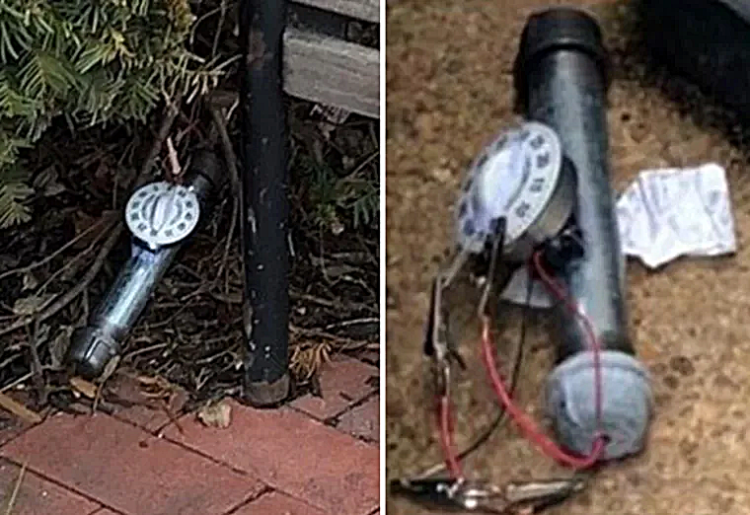
According to the FBI’s technical assessment, each device consisted of:
- A 1-inch by 8-inch galvanized steel pipe
- Threaded end caps (both black and galvanized)
- A main explosive charge composed of homemade black powder
- A 14-gauge red and black electrical wire
- A 9-volt battery and battery connector
- Steel wool
- A white kitchen timer
The FBI’s Quantico laboratory evaluated the devices and determined they were “viable” explosives capable of causing serious injury or death if detonated. Former FBI Washington Field Office Assistant Director Steven D’Antuono stated publicly in 2021: “These pipe bombs were viable devices that could have been detonated, resulting in serious injury or death.”
However, a critical technical detail would later cast doubt on the bomber’s intentions: the kitchen timers used were simple mechanical one-hour timers with no remote detonation capability.
The Timeline Paradox
This mechanical limitation creates an immediate and profound problem for understanding the bomber’s intent. The devices were placed around 8:00 p.m. on January 5. With a maximum one-hour timer, the latest the bombs could have detonated would have been approximately 9:00 p.m. that same evening—more than 15 hours before they were discovered and a full day before the Capitol breach.
In his 2023 testimony before the House Judiciary Committee, D’Antuono himself acknowledged this impossibility. When asked by Representative Thomas Massie whether a one-hour kitchen timer could detonate a bomb 17 hours after being set, D’Antuono replied: “No, I don’t. And I saw the same kitchen timer as you. I agree. I don’t know when they were supposed to go off. Maybe they weren’t supposed to go off. We can’t—we don’t know. We honestly don’t know, and that’s some of the pain…”
This admission is remarkable. Either the bombs were never intended to explode, or the bomber was incompetent to the point of absurdity—spending over a year purchasing components and constructing devices, only to attach timers that would expire long before anyone would be present.
Former Capitol Police Chief Steven Sund advanced an alternative theory: the bombs were meant to serve as a diversion, drawing law enforcement resources away from the Capitol at the critical moment when it would be breached. Capitol Police Inspector General Michael Bolton told Congress in 2021: “If those pipe bombs were intended to be a diversion, plainly speaking, it worked.”
The Delayed Discovery
The bombs sat undetected through the night and into the late morning of January 6. Despite their placement in areas that would see significant foot traffic, and despite multiple law enforcement sweeps (as we shall see), they remained hidden in plain sight.
At approximately 12:38 p.m. on January 6, Karlin Younger, who worked at the Capitol Hill Club adjacent to the RNC headquarters, discovered the first device while retrieving her laundry from an alley. She immediately alerted an RNC security guard, who notified law enforcement.
The discovery triggered a search that led to the second bomb at approximately 1:07 p.m.—though by this time, Vice President-elect Kamala Harris had been inside the DNC headquarters, mere feet from the device, for nearly two hours.
The Harris Proximity: An Unexplained Security Failure
The Morning Arrival
On the morning of January 6, 2021, then-Vice President-elect Kamala Harris traveled from the U.S. Capitol to the DNC headquarters, arriving at approximately 11:25 a.m. Her armored motorcade entered the building via a ramp that brought her within 20 feet of the pipe bomb that had been sitting, undetected, since the previous evening.
Harris remained inside the DNC building until she was evacuated at 1:15 p.m.—approximately one hour and 50 minutes. During this time, the explosive device remained undiscovered despite the presence of Secret Service agents, Capitol Police officers, and multiple law enforcement vehicles in the immediate vicinity.
The Failed Security Sweep
According to a report from the Department of Homeland Security Inspector General Joseph Cuffari, the Secret Service conducted security sweeps of the DNC building prior to Harris’s arrival. However, these sweeps were fundamentally inadequate:
“The pipe bomb had been placed near the building the night before, but… advance security sweeps by the Secret Service at the DNC building did not include the outside area where a pipe bomb had been placed.”
The report further noted that the Secret Service “had not employed all its explosive detection tactics and measures for the security sweep.” Critically, the agency did not deploy:
- A technical security division site coordinator
- An explosive ordnance disposal team
- A comprehensive exterior perimeter sweep
At the time, Secret Service policies required fewer security assets for officials who had been elected but not yet sworn into office. This bureaucratic distinction potentially placed the Vice President-elect at grave risk. The agency has since updated its protocols.
Ten Agents, Two Dogs, Zero Detection
Perhaps most disturbing is the detailed accounting provided in the congressional report released by Representatives Barry Loudermilk and Thomas Massie in January 2025. According to their findings:
“At least ten different USSS agents and two canine units came within feet of the pipe bomb before the Vice President-elect’s arrival yet never discovered the device.”
The bomb was sitting in a relatively visible location near a park bench. Yet multiple trained Secret Service agents and two K-9 units specializing in explosive detection walked past it without notice. How is this possible?
The Perimeter Breakdown
Once the bombs were finally discovered, law enforcement response was marked by additional failures. The congressional report documents that:
“USCP failed to properly secure and maintain a perimeter around the pipe bombs despite multiple orders to do so, allowing pedestrians and vehicular traffic to cross within feet of the explosive devices.”
At the DNC location, more than 40 vehicles and 10 pedestrians breached the security perimeter around the pipe bomb between its discovery and when law enforcement cleared the scene. Surveillance footage shows civilians walking within feet of the device while a Capitol Police bomb disposal robot was actively engaged with it.
The Questions That Remain
The failures surrounding Harris’s security that day raise profound questions:
- Why was the exterior perimeter not swept? Standard Secret Service protocol for protectees should include comprehensive sweeps of all areas near entry and exit points.
- How did trained K-9 units miss the device? Bomb-sniffing dogs are specifically trained to detect the chemical signatures of explosives. The bombs contained black powder—a substance with a distinct odor profile.
- Was the bomb not present during the morning sweep? Some investigators have quietly questioned whether the device could have been placed after the Secret Service sweep but before the Capitol Police discovered it—though this would require a conspiracy of remarkable coordination.
- Why did it take a random Capitol Police officer to find it? The bomb was ultimately discovered not by the Secret Service, not by the FBI, not by sophisticated detection equipment, but by plainclothes Capitol Police officers who were conducting their own search after learning of the RNC bomb.
Representative Loudermilk’s subcommittee has requested transcribed interviews with seven Secret Service agents involved in Harris’s security detail that day. As of late 2025, many of these questions remain unanswered—and many of the relevant Secret Service text messages from January 5-6, 2021, were deleted at the end of January 2021 and never recovered.
The Evidence Trail: How the FBI Could Have Solved This Years Ago
Following the Money
According to the criminal complaint unsealed on December 4, 2025, investigators identified Brian Cole Jr. through a combination of financial records, cellular data, and license plate reader information—all of which were available within months of the bombing.
Purchase History (2019-2020):
Between October 2019 and late 2020, Cole purchased multiple items consistent with the pipe bomb components:
- Six galvanized pipes matching the size and specifications of those used in the devices
- Both black and galvanized threaded end caps (noting that 233,000 black end caps were distributed in 2020 alone)
- 9-volt batteries and battery connectors
- Walmart-brand white kitchen timers (of the same model found on the devices)
- 14-gauge electrical wire
- Steel wool
- Safety glasses
- A wire-stripping tool
- A machinist’s file
U.S. Attorney Jeanine Pirro described the investigative challenge: “It was like finding a needle in a haystack. The FBI had to go through the sale of every one of [the end caps] to try to find commonality with an individual, along with the purchase of the pipe itself, the cap ends, the wires, the steel and the nine-volt batteries.”
Continued Purchasing After Discovery:
Remarkably, Cole allegedly continued purchasing bomb-making materials even after the January 6 discovery of the devices, including additional kitchen timers, 9-volt batteries, and galvanized pipes during January 2021—suggesting either extraordinary recklessness or confidence that he would not be identified.
The Cellular Evidence
On the evening of January 5, 2021, between 7:39 p.m. and 8:24 p.m.—the precise window when the bombs were being placed—Cole’s cell phone communicated with cell towers that provided coverage for the areas around both the RNC and DNC headquarters. The FBI’s Cellular Analysis and Survey Team determined that the location data was consistent with the path of the suspect identified through video surveillance.
According to the affidavit: “Cell phone records further show that Cole’s cell phone communicated with cell towers in the area of the RNC and DNC on January 5, 2021, between 7:39 p.m. and 8:24 p.m.”
The phone conducted seven separate data sessions with these towers during the relevant time period—a digital fingerprint that placed Cole at the scene during the bombings.
The Vehicle Evidence
At approximately 7:10 p.m. on January 5, 2021—just 44 minutes before the first bomb was placed—Cole’s 2017 Nissan Sentra was captured by a license plate reader at the South Capitol Street exit from I-395 South. This location is less than half a mile from where the pipe bomb suspect was first observed on foot in surveillance footage at 7:54 p.m.
The temporal and spatial correlation is striking: the vehicle passes through the area, and within the timeframe required to park and walk to the location, the hooded figure appears on camera.
The Early Investigation: February-May 2021
Congressional documents reveal that the FBI conducted an aggressive investigation in the first several months following January 6:
- Issued multiple geofence warrants to obtain location data from cell towers and technology companies
- Analyzed cell tower records, identifying 186 phone numbers of interest from the areas around the bomb sites
- Assigned 36 of these numbers for immediate interviews
- Flagged 98 numbers for additional investigative work
- Excluded 51 numbers because they belonged to law enforcement personnel
- Interviewed more than 1,000 individuals
- Reviewed approximately 39,000 video files
- Pursued leads on individuals who had purchased the same Nike Air Max Speed Turf shoes seen in the footage
- Subpoenaed credit card data from major retailers to identify purchasers of bomb components
According to multiple sources, the FBI developed several “persons of interest” during this period, including:
- An individual who searched “pipe bomb DC” online between the time the bombs were placed and when they were discovered
- Someone who worked in the Capitol Hill area and owned a pair of the distinctive Nike sneakers
- Two persons of interest designated POI-2 and POI-3 in Falls Church, Virginia
Then Silence
And then, according to congressional reports and FBI whistleblowers, something changed. By late February 2021—less than eight weeks after January 6—the FBI began “diverting resources” away from the pipe bomb investigation.
The promising leads went cold. The persons of interest were dropped without explanation. By May 2021, the investigation had effectively stalled. The regular investigative updates ceased. The case that had been described as a top priority faded from public view.
For nearly four years, despite periodic public appeals for information and the release of new surveillance footage, the investigation produced no arrests, no indictments, and apparently, no progress.
The Corrupted Data Controversy
D’Antuono’s Stunning Admission
In June 2023, former FBI Assistant Director Steven D’Antuono sat for a transcribed interview with the House Judiciary Committee. What he revealed shocked investigators and the public alike.
When questioned by Representative Thomas Massie about the FBI’s use of geofencing technology to identify the suspect, D’Antuono provided an explanation that strained credulity:
“We did a complete geofence. We have complete data. Not complete, because there’s some data that was corrupted by one of the providers, not purposely by them, right. It just – unusual circumstance that we have corrupt data from one of the providers. I’m not sure – I can’t remember right now which one. But for that day, which is awful because we don’t have that information to search. So could it have been that provider? Yeah, with our luck, you know, with this investigation it probably was, right. So maybe if we did have that – that data wasn’t corrupted – and it wasn’t purposely corrupted. I don’t want any conspiracy theories, right. To my knowledge, it wasn’t corrupted, you know, but that could have been good information that we don’t have, right. So that is painful for us not to have that.”
The statement is remarkable for several reasons:
- D’Antuono cannot identify which provider supplied the “corrupted” data
- He oscillates between certainty (“corrupt data”) and uncertainty (“to my knowledge, it wasn’t corrupted”)
- He preemptively warns against “conspiracy theories” while describing circumstances that naturally invite suspicion
- He suggests the data corruption was simply bad luck for an already troubled investigation
The Carriers Contradict the FBI
In response to letters from Chairman Barry Loudermilk’s subcommittee, major cellular carriers provided sworn testimony that directly contradicted D’Antuono’s account. According to the congressional report:
“The major cell carriers confirmed that they did not provide corrupted data to the FBI and that the FBI never notified them of any issues with accessing the cellular data.”
This creates an irreconcilable conflict. Either:
- The FBI received usable data but claimed it was corrupted
- The FBI had internal technical problems accessing data but blamed the carriers
- The FBI simply failed to properly execute the geofence warrants
- D’Antuono’s testimony was inaccurate or incomplete
Representative Massie expressed his frustration on Laura Ingraham’s show: “Unbelievable. Former FBI in charge of Jan 6 investigation tells me phone data that could have been used to identify the person who placed pipe bombs on Jan 5 was CORRUPTED.”
The Missing Geofence
Perhaps more troubling than the “corrupted data” claim is evidence suggesting the FBI’s geofence warrant may not have even covered the relevant time period. Public reporting and court filings indicate the warrant identified three specific time periods on January 6—resulting in the collection of data from more than 5,000 devices—but gave no clear indication that records for January 5 (when the bombs were actually placed) were requested.
Chairman Jim Jordan wrote in June 2023: “Mr. D’Antuono’s testimony raises concerns about the FBI’s handling of the pipe bomb investigation, more than 890 days following the placement of the pipe bombs.”
The Biden Administration’s Inexplicable Delays
Resources Diverted
A congressional report documented that the FBI began “diverting resources” away from the pipe bomb investigation at the end of February 2021—after less than two months of aggressive pursuit. The report stated:
“In the immediate aftermath of January 6, the FBI’s case team worked aggressively to cultivate and pursue leads toward apprehending the pipe bomb suspect.”
But that aggressive posture didn’t last. While the FBI spent four years hunting down hundreds of January 6 protesters—many of whom committed minor trespassing offenses—the search for a suspected domestic terrorist who planted viable explosive devices near the nation’s Capitol languished.
The Contrast in Priorities
The contrast is stark and demands explanation:
January 6 Trespassers:
- More than 1,500 arrests
- Extensive use of geofencing, cell tower data, facial recognition
- Coordination with tech companies to identify social media posts
- Employment of undercover agents and confidential informants
- Aggressive prosecution, including lengthy pretrial detention
- Sentences ranging from probation to 22 years imprisonment
January 5 Pipe Bomber:
- Zero arrests for nearly five years
- Claims of “corrupted” data from cellular providers
- Leads allegedly going cold by May 2021
- Persons of interest inexplicably dropped
- Periodic publicity efforts but no apparent investigative progress
- A reward that eventually reached $500,000
Former FBI special agent Jody Weis expressed public surprise at the delay, noting that “basic detective work, such as analyzing cell phone data and financial records,” ultimately led to Cole’s arrest—techniques that should have produced results years earlier.
Questions of Political Calculation
Attorney General Pam Bondi was blunt in her assessment: “This cold case languished for four years until Director Patel and Deputy Director Bongino came to the FBI. The total lack of movement on this case in our nation’s capital undermined the public trust of our enforcement agencies.”
FBI Deputy Director Dan Bongino, who had publicly speculated about an “inside job” before joining the Bureau, told reporters: “You’re not going to walk into our capital city, put down two explosive devices and walk off in the sunset. Not going to happen—we were going to track this person to the end of the Earth. There was no way he was getting away.”
Yet track him they did not—not for 1,764 days.
The Narrative Problem
The emerging profile of Brian Cole Jr. may provide a clue to the investigation’s torpor. According to The Daily Wire’s reporting:
- Cole’s family operated a bail bonds company that specialized in freeing illegal immigrants from ICE detention
- The company sued Trump’s Department of Homeland Security over immigration enforcement policies
- The lawsuit was unsuccessful, with an appeals court ruling against them on November 10, 2020—just weeks before the bombs were planted
- Cole’s father, Brian Cole Sr., hired prominent civil rights attorney Benjamin Crump in 2021 to accuse a local prosecutor of racial discrimination
- Cole Sr. and Crump held a press conference calling for the Biden DOJ to investigate the prosecutor
This profile—of a family actively opposed to Trump administration policies, allied with progressive causes, and seeking intervention from the Biden Justice Department—sits uncomfortably with the narrative that dominated media coverage of January 6. The event was characterized as an insurrection by Trump supporters, motivated by election denial and loyalty to the outgoing president.
A suspect whose family was suing the Trump administration over immigration and calling on the Biden DOJ to address racism does not fit that story. His arrest would have complicated the political messaging. It would have raised uncomfortable questions about motivations and affiliations.
Did political considerations influence the pace and priority of the investigation? The circumstantial evidence is suggestive but not conclusive. What is beyond dispute is that an investigation armed with cell phone data, purchase records, and video surveillance—the very tools that identified hundreds of January 6 protesters—failed to produce an arrest for nearly five years.
The Congressional Investigation: Unanswered Questions Pile Up
The Loudermilk-Massie Report
In January 2025, Representatives Barry Loudermilk (R-GA) and Thomas Massie (R-KY) released a comprehensive joint report titled “Four Years Later: Examining the State of the Investigation into the RNC and DNC Pipe Bombs.” The 80-page document detailed systematic failures across multiple law enforcement agencies and raised profound questions about the FBI’s handling of the case.
Key findings included:
On the FBI Investigation:
- The Bureau identified multiple promising persons of interest in early 2021 but dropped them without explanation
- FBI claimed cell phone data was “corrupted” despite carriers confirming they provided usable data
- The investigation appeared to lose momentum by May 2021 with no clear justification
- Basic investigative steps, such as interviewing the individuals who discovered the bombs, may not have been completed
On Secret Service Failures:
- At least 10 agents and 2 K-9 units came within feet of the DNC bomb before Harris’s arrival without detecting it
- Security sweeps did not include the exterior area where the bomb was placed
- The agency failed to deploy adequate explosive detection assets
On Capitol Police Response:
- Failed to properly secure and maintain a perimeter around the bombs
- Allowed more than 40 vehicles and 10 pedestrians to pass within feet of the DNC explosive
- Permitted civilians to cross near the device while a bomb disposal robot was engaged
D’Antuono’s Remarkable Testimony
Beyond the “corrupted data” controversy, D’Antuono’s 2023 testimony revealed other troubling gaps:
On the Gender of the Suspect: Despite extensive video footage, D’Antuono testified that investigators did not definitively know the suspect’s gender when he led the investigation.
On Interviewing Key Witnesses: When asked if the FBI had interviewed the person who discovered the DNC bomb, D’Antuono replied: “I don’t know.”
Asked for clarification: “You do not know whether they interviewed the person that discovered the [bomb] at the DNC?”
D’Antuono: “I don’t know.”
He conceded it would be “investigation 101” to interview such individuals but could not confirm whether this basic step had been taken.
On the Bombs’ Viability: D’Antuono acknowledged the logical impossibility of the one-hour timers detonating the bombs 17 hours after placement: “No, I don’t [think it was possible]. And I saw the same kitchen timer as you. I agree. I don’t know when they were supposed to go off. Maybe they weren’t supposed to go off. We can’t—we don’t know.”
The DNC’s Non-Cooperation
Loudermilk’s subcommittee requested all exterior DNC security camera footage from January 5-6, 2021. Despite multiple requests and Loudermilk’s offer to review the footage in camera rather than as a document production, the DNC has refused to provide it.
This stonewalling is particularly significant given that one bomb was placed directly outside DNC headquarters. What might their cameras have captured? Why the resistance to sharing footage with congressional investigators?
FBI Whistleblower Claims
According to Representative Massie, a current FBI employee has provided protected disclosures alleging that:
- Two persons of interest in Falls Church, Virginia (POI-2 and POI-3) represented promising leads that were inexplicably abandoned
- The investigation’s categorization of certain phone numbers as belonging to “law enforcement” may have inappropriately excluded data that should have been analyzed
- Internal FBI documents suggest the investigation was effectively terminated by mid-2021 despite public claims it remained active
The Trump Administration Acts
A New Team, Old Evidence
When Donald Trump returned to the presidency in January 2025, he installed Kash Patel as FBI Director and Dan Bongino—formerly a vocal critic of the Bureau’s handling of the case—as Deputy Director. Both men publicly declared the pipe bomb investigation a top priority.
According to Attorney General Bondi’s December 4 press conference, what followed was not the discovery of new evidence but rather a systematic re-examination of materials that had been available for years:
“What I will tell you is that evidence has been sitting there collecting dust. This wasn’t a new tip. It wasn’t some new evidence. It was the hard work of President Trump’s administration.”
Bondi continued: “The FBI, along with U.S. Attorney Pirro and all of our prosecutors, have worked tirelessly for months sifting through evidence that had been sitting at the FBI with the Biden administration for four long years. Let me be clear, there was no new tip. There was no new witness. Just good, diligent police work and prosecutorial work.”
The Breakthrough Nobody Needed
Director Patel explained that investigators “did not discover any new information” but rather “brought in a new team of investigators and experts, reexamined every piece of evidence, sifted through all the data—something that the prior administration refused and failed to do.”
The implication was clear and damning: the Biden administration’s FBI had possessed all the necessary evidence to solve this case, potentially as early as 2021, but had failed to connect the dots or lacked the will to do so.
According to sources who spoke with media outlets, “the discoveries that led to the arrest did not come from new evidence, but rather from the same trove of material that had mostly been gathered in 2021 and 2022.” One source told MSNBC: “That means the suspect could feasibly have been arrested years earlier—a fact that could cause embarrassment for the FBI.”
The Political Dimension
Bongino addressed his past statements suggesting the bombing was an “inside job” or part of a “massive cover-up.” Speaking to Sean Hannity, he acknowledged: “Listen I was paid in the past, Sean, for my opinions. That’s clear. And one day I will be back in that space, but that’s not what I’m paid for now. I’m paid to be your deputy director, and we base investigations on facts.”
He added: “We evolved as information and new input comes out, we can produce different outputs because that’s what we believe in. We believe in facts and investigations guided by facts.”
Yet the question remains: if the Trump administration’s FBI could solve this case in less than a year using existing evidence, why couldn’t the Biden administration’s FBI solve it in four?
Brian Cole Jr.: Profile of an Alleged Bomber
The Man Behind the Mask
Brian Cole Jr., 30, lived with his mother and other family members in a five-bedroom house on a quiet cul-de-sac in Woodbridge, Virginia, approximately 30 miles south of Washington, D.C. He graduated from C.D. Hylton High School in 2013 and worked for a bail bonds company—apparently the family business.
According to relatives who spoke briefly with the media, Cole was described as “more like a child” by one family member, who insisted “he didn’t do it.” An FBI affidavit notes he worked for a bail bonds office and lived with family members.
The Family Business
The Cole family’s business operations are central to understanding the suspect’s background and potential motivations. Operating under various corporate names, including Free U Bonds and StateWide Bonding, Inc., the company specialized in immigration bonds—specifically helping illegal immigrants secure release from ICE detention facilities.
The company’s website explains: “An Immigration Bond will secure the release of an undocumented alien from an immigration facility with the guarantee the conditions of the Immigration Bond requirements are met.”
Public records list Brian Cole Jr. as StateWide Bonding’s owner in disputes over bonds for illegal immigrants in Colorado. The business operated in multiple states, including Virginia, Tennessee, and Colorado.
Suing the Trump Administration
StateWide Bonding sued the Trump administration’s Department of Homeland Security over policies relating to illegal immigrants. The company’s complaint alleged it was being unfairly harmed when its illegal immigrant clients failed to appear at court dates:
“Statewide have secured the bond for thousands of immigrants… If an immigrant does not appear, that failure to appear is considered a breach of bond… When a bond is breached, at that point, all Plaintiffs are subjected to a steep financial penalty.”
The lawsuit continued: “Hundreds of Plaintiffs’ clients fail to appear because Defendants fail to (1) provide said person with a specified date, time, and location to appear in court. Then, only after the subject immigrant fails to appear, these Defendants expect Plaintiffs to find the person in less than 10 days (many times less than 48 hours), or suffer the penalty of paying the sum total of millions of dollars.”
On November 10, 2020—less than two months before the pipe bombs were planted—the U.S. Court of Appeals in D.C. sided with the Trump administration, ruling that the lower court had properly thrown out all of StateWide’s claims. This represented a significant financial and legal defeat for the Cole family business.
Seeking Biden DOJ Intervention
In November 2021, nearly a year after the pipe bombs were placed, Brian Cole Sr. stood alongside Benjamin Crump—the high-profile civil rights attorney who represented Trayvon Martin’s family—to call for federal intervention against a local Tennessee prosecutor.
Cole Sr. alleged racial discrimination by Rutherford County Assistant District Attorney John Zimmerman, who had raised ethical concerns about the bail bond company’s operations. Nashville’s WPLN reported: “A high-profile civil rights attorney is calling for a federal investigation into a Rutherford County prosecutor accused of discrimination.”
At the press conference, Cole Sr. stated: “He’s defamed me, he’s called my insurance company. … We hope the Department of Justice can come in and do a brief investigation because we’ve seen a lot of questionable acts that Mr. Zimmerman has demonstrated towards minority-owned companies.”
Crump added: “It is appalling and we want these allegations to be investigated to the highest level of government … They called him a punk and a thug, and why? What is it about him? A lot of people believe they know the answer.”
Financial and Legal Troubles
In April 2025, a Tennessee appeals court affirmed sanctions against the Cole family company due to repeated misconduct. According to the court’s findings, Cole Sr. had lied about never having filed for bankruptcy or having financial problems, when he had in fact filed for bankruptcy twice and had tax liens against him.
Early Purchase of Components
According to the criminal complaint, Brian Cole Jr. began purchasing bomb-making components as early as May 2019—during the Trump administration and long before any disputes about the 2020 election results. This timeline is significant: it suggests premeditation and planning that began well before January 6, 2021 was on anyone’s calendar.
The purchases continued through 2020 and, remarkably, even after the bombs were discovered in January 2021, Cole allegedly continued buying materials including kitchen timers, 9-volt batteries, and galvanized pipes—either a sign of incredible recklessness or confidence he would not be caught.
Media Misidentification
In a revealing moment that speaks to assumptions and narratives surrounding January 6, CNN host Jake Tapper misidentified Brian Cole Jr. on air Thursday as “a 30-year-old white man from the D.C. suburbs” just minutes before his own program aired photographs clearly showing Cole is Black. The error—which CNN has not publicly addressed—underscores how media coverage of January 6 has often been filtered through predetermined narratives about who the participants were and what motivated them. The suspect’s actual identity as a Black man from a family that opposed Trump’s immigration policies and sought intervention from the Biden Justice Department contradicts simplistic characterizations of January 6 as exclusively a “white supremacist” or “MAGA extremist” event.
A Question of Motive
The charging documents unsealed on December 4 provide no insight into Cole’s motive. Was this an act of political terrorism? A personal vendetta? A misguided attempt at creating a diversion? Mental illness?
The profile that emerges from available information is complex and contradictory:
- A young man living with family, described by relatives as childlike
- Working for a family business that specialized in securing release of illegal immigrants
- From a family that actively opposed Trump administration policies through litigation
- A family that sought intervention from the Biden DOJ over alleged racial discrimination
- Yet someone who allegedly spent over a year meticulously acquiring bomb-making materials
- Someone who allegedly placed viable explosive devices at the headquarters of both major political parties
This does not fit cleanly into existing narratives about January 6. It does not conform to the profile of a MAGA extremist driven by election denial. Nor does it obviously fit the profile of a left-wing agitator seeking to discredit Trump supporters, given the bombs were placed at both party headquarters.
The very ambiguity of Cole’s apparent motivations may help explain the FBI’s lack of urgency during the Biden administration.
Unanswered Questions and Future Implications
What We Still Don’t Know
Despite the arrest, fundamental questions remain:
About the Bombs:
- Were they actually intended to explode, given the timer limitation?
- If not, what was their purpose—diversion, intimidation, symbolism?
- Why place them at both party headquarters rather than targeting one side?
- Why plant them a full day before January 6?
About the Investigation:
- What specific factors caused the FBI to deprioritize the case after February 2021?
- Which cellular provider allegedly supplied “corrupted” data, and what actually happened?
- Why were promising persons of interest dropped without explanation?
- Did political considerations influence investigative decisions?
- What do the deleted Secret Service text messages from January 5-6, 2021 contain?
- Why has the DNC refused to provide security camera footage to congressional investigators?
About the Suspect:
- What was Brian Cole Jr.’s motive?
- Did he act alone or have assistance?
- Was he aware of plans for the January 6 Capitol breach?
- Did he intend for the bombs to be discovered as diversions?
- What was the significance of the timing—was November 10, 2020 legal defeat relevant?
The Political Fallout
The case has already sparked fierce partisan debate:
Republican Narrative: The Biden administration deliberately slow-walked the investigation because the suspect’s profile didn’t fit the January 6 narrative they wanted to promote. Resources were diverted to prosecuting Trump supporters for minor offenses while a domestic terrorist who planted viable explosives went unpursued for political reasons.
Democratic Response: The investigation was genuinely difficult due to the suspect’s effective disguise, the limitations of available technology, and data complications. The Trump administration is weaponizing the case for political purposes and baselessly claiming the previous administration showed favoritism.
The Evidence: Both narratives contain elements of truth and exaggeration. The investigation was undoubtedly complex—the suspect wore effective concealment, and early identification required painstaking analysis of purchases and cell data. However, the FBI solved far more difficult cases during the same period using the same tools. The fact that the Trump administration’s FBI solved the case in months using evidence available for years raises legitimate questions about priorities and diligence.
Implications for Future Security
The Secret Service’s failure to detect a pipe bomb 20 feet from the Vice President-elect exposed catastrophic vulnerabilities:
- Inadequate Sweep Protocols: The exterior areas near protectee locations must be included in security sweeps
- K-9 Training: Questions about why trained explosive detection dogs missed the device
- Protective Detail Resources: The distinction between “elect” and “sworn” officials should not compromise security
- Communication Systems: The deletion of Secret Service text messages and communications failures on January 6 must be addressed
The Capitol Police’s perimeter failures demonstrated the need for:
- Improved Training: On maintaining secure perimeters around explosive devices
- Better Communication: Between USCP, Secret Service, and other law enforcement agencies
- Enhanced Surveillance: The gaps in CCTV coverage around Capitol Hill headquarters
The FBI’s Institutional Challenge
The pipe bomb case has damaged the Bureau’s credibility regardless of Cole’s ultimate guilt or innocence:
- Claims of “corrupted data” contradicted by cellular providers
- The four-year delay despite available evidence
- The contrast between aggressive January 6 protester prosecution and pipe bomb investigation stasis
- Internal whistleblower allegations of leads inappropriately abandoned
- D’Antuono’s testimony revealing basic investigative steps may not have been completed
FBI Director Patel faces the challenge of restoring public trust while explaining why the previous leadership failed to solve a case with abundant evidence.
Legal Proceedings Ahead
Brian Cole Jr. faces two federal charges:
- Transporting an explosive device in interstate commerce with intent to kill, injure, or intimidate any individual or to unlawfully damage or destroy any building, vehicle, or other property
- Attempted malicious destruction by means of fire and explosive materials
If convicted, he faces up to 10 years in prison on each count. Attorney General Bondi has indicated additional charges may be forthcoming as the investigation continues.
The case will likely hinge on:
- The strength of the cellular location data
- The purchase records and their linkage to the bomb components
- Any physical evidence recovered from Cole’s residence during the December 4 searches
- Potential forensic evidence from the bombs themselves
- Any statements Cole may have made to investigators
Cole’s defense may argue:
- The circumstantial nature of the evidence
- Questions about the reliability of cell tower triangulation
- The FBI’s own questions about whether the bombs were viable or intended to explode
- The four-year delay in bringing charges despite available evidence
- Potential challenges to the validity of search warrants and evidence collection
Broader Implications for January 6 Historiography
The arrest of Brian Cole Jr. complicates the dominant narrative about January 6, 2021 in several ways:
Timing: The bombs were placed on January 5, before the Capitol breach, yet were discovered during the breach—raising questions about their purpose and potential connection.
Profile: The suspect comes from a family that opposed Trump’s immigration policies and sought intervention from the Biden DOJ, contradicting assumptions about January 6 participants’ political alignments.
Investigation: The disparity between aggressive prosecution of Capitol protesters and the stalled pipe bomb investigation raises questions about political prioritization.
Diversion Theory: If the bombs were intended as a diversion to draw law enforcement resources from the Capitol (as former Capitol Police Chief Steven Sund suggested), this implies coordination and planning beyond the “spontaneous mob” narrative.
These complications do not exonerate those who breached the Capitol or absolve Trump of responsibility for his rhetoric. However, they do suggest the events of January 5-6, 2021 were more complex than simplified partisan narratives acknowledge.
Conclusion: Accountability and Reform
The arrest of Brian Cole Jr. on December 4, 2025, marks the end of one mystery but the beginning of another: Why did it take so long?
The evidence that led to his arrest—purchase records, cellular data, license plate readers—was available within months of the bombing. The very techniques used to identify Cole are identical to those that identified hundreds of January 6 protesters, many of whom were arrested within weeks or months of the breach.
The FBI’s claim that cellular data was “corrupted” has been contradicted by the providers themselves. The investigation’s apparent loss of momentum by May 2021 has never been adequately explained. The dropping of promising persons of interest remains mysterious. The failure to properly execute and follow through on investigative leads—potentially including failure to interview key witnesses—suggests either incompetence or something worse.
Attorney General Bondi’s statement that the evidence was “sitting there collecting dust” for four years is an indictment not of the difficulty of the case but of the priorities and diligence of the FBI under previous leadership.
Several scenarios might explain the delay:
Scenario 1: Investigative Complexity The case was genuinely more difficult than it appeared, with dead ends, false leads, and technical challenges that took years to overcome. The Trump administration benefited from advances in analytical techniques and fresh perspectives.
Scenario 2: Resource Constraints The FBI prioritized the broader January 6 investigation, believing that prosecuting hundreds of Capitol protesters served justice and deterrence more effectively than solving the pipe bomb case.
Scenario 3: Political Calculation The suspect’s profile—his family’s opposition to Trump policies, their litigation against his administration, their appeals to the Biden DOJ—made his arrest politically inconvenient. An arrest would complicate the January 6 narrative and invite uncomfortable questions.
Scenario 4: Institutional Failure The FBI’s bureaucracy, data management systems, and investigative protocols failed. Evidence was available but not properly analyzed or connected. This represents organizational incompetence rather than political malice.
The truth likely combines elements of multiple scenarios. But the American people deserve a full accounting.
Congress must:
- Complete its investigation into the FBI’s handling of the case
- Obtain and review all relevant communications, including deleted Secret Service messages
- Interview all key FBI personnel about investigative decisions
- Examine the claim of “corrupted” cellular data and identify what actually occurred
- Determine why promising leads were abandoned
- Assess whether political considerations influenced investigative priorities
The FBI must:
- Conduct an internal review of the investigation
- Explain the four-year delay to the public
- Identify and correct systemic failures that contributed to the delay
- Restore public trust through transparency about what went wrong
- Ensure future high-priority investigations are not subject to political interference or resource diversion
The Secret Service must:
- Explain how multiple agents and K-9 units missed the DNC bomb
- Account for the deleted text messages from January 5-6, 2021
- Implement reforms to prevent similar security failures
- Cooperate fully with congressional investigators
The judicial system must:
- Ensure Brian Cole Jr. receives a fair trial
- Examine any potential defense arguments about the investigation’s delay
- Consider the broader implications for similar cases
The events of January 5-6, 2021 remain a dark chapter in American history. The Capitol breach was a shocking assault on democratic institutions. But the pipe bombs—viable explosive devices placed at the headquarters of both major political parties—represented a potentially lethal threat that deserved the full attention and resources of federal law enforcement.
Instead, for nearly five years, this case languished. The suspect remained free. The American people were left without answers. And the credibility of the FBI was damaged, perhaps irreparably in the eyes of many citizens.
The arrest of Brian Cole Jr. is not a vindication of the system. It is an indictment of a federal law enforcement apparatus that had all the tools it needed to solve this case years ago but failed to do so.
If justice is to be truly served, the prosecution of Brian Cole Jr. must be accompanied by accountability for those whose inaction, incompetence, or political calculation allowed a suspected domestic terrorist to remain free for 1,764 days after planting bombs at the heart of American democracy.
The American people deserve nothing less than the full truth—about the bombs, about the investigation, and about why it took a change in administration to finally bring charges against a suspect who had apparently been identifiable all along.
This article was researched and written on December 5, 2025, one day after the arrest of Brian Cole Jr. The investigation into both the bombing and the FBI’s handling of the case remains ongoing. Additional information will be updated as it becomes available.
Sources:
- U.S. Department of Justice Criminal Complaint, December 4, 2025
- “Four Years Later: Examining the State of the Investigation into the RNC and DNC Pipe Bombs,” House Administration Committee Report, January 2025
- Department of Homeland Security Inspector General Report on Secret Service January 6 Response, August 2024
- FBI Washington Field Office statements and press releases, 2021-2025
- Congressional testimony of Steven D’Antuono, June 2023
- The Daily Wire: “Alleged Pipe Bomber’s Family Sued Trump DHS Over Illegal Immigration,” December 4, 2025
- Multiple news reports from TIME, PBS, CNN, CBS, NBC, Fox News, and other outlets