
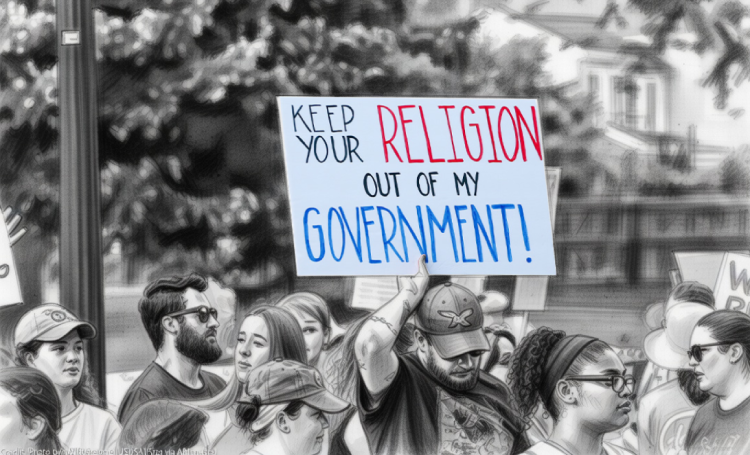
Understanding the True Place of Faith
in America’s Constitutional Framework
Introduction: The Revolutionary Religious Landscape
In the turbulent decades surrounding America’s founding—from the 1760s through the ratification of the Bill of Rights in 1791—the question of religion’s place in the new republic stood at the intersection of revolutionary fervor, Enlightenment philosophy, and deeply held Christian convictions. The period witnessed an unprecedented transformation in church-state relations, as thirteen disparate colonies, each with its own religious establishment and traditions, forged a new constitutional order that would reshape the relationship between civil government and religious institutions. This was not merely a political revolution, but a profound reimagining of how faith and governance could coexist in a pluralistic society.
The American Revolution occurred against a backdrop of remarkable religious diversity and tension. As Frank Lambert documents in his seminal work The Founding Fathers and the Place of Religion in America, the colonial religious landscape was far more complex than popular memory suggests. In the South, the Anglican Church held an established status, its clergy often serving as de facto agents of the Crown. In New England, Congregationalist churches dominated civic life, with tax-supported ministers wielding considerable political influence. Meanwhile, the Middle Atlantic colonies—particularly Pennsylvania, founded by Quakers—had already begun experimenting with greater religious pluralism and toleration.
The Founding Fathers and the Place of Religion in America, by Frank Lambert
Frank Lambert’s scholarly work examines one of America’s most contentious historical questions: What role did the Founding Fathers intend for religion in the new republic? Lambert challenges both secular and religious nationalist narratives by presenting a nuanced portrait of how figures like Washington, Jefferson, Madison, and Adams navigated the complex relationship between faith and governance.
The book traces two competing visions that emerged during the founding era. On one side stood traditional religious establishments—particularly in New England and the South—where state-supported churches had long been the norm. These advocates believed that civic virtue and social order depended upon official recognition of Christianity. On the other stood Enlightenment-influenced founders and religious dissenters (particularly Baptists and other evangelicals) who championed the revolutionary idea of separating church and state.
Lambert demonstrates that the First Amendment’s religion clauses emerged not from hostility toward faith, but from a pragmatic coalition between rationalist founders skeptical of institutional religion and religious minorities who had suffered under established churches. Both groups recognized that religious liberty—including the freedom of conscience—required government neutrality.
The narrative explores how this “sacred ground” of religious freedom became foundational to American identity, even as debates continued about religion’s proper role in public life. Lambert argues that the founders created a framework where religion could flourish precisely because it was protected from governmental interference and favoritism, establishing a uniquely American approach that differed from both European establishment and enforced secularism.
Through careful examination of founding-era documents, speeches, and correspondence, Lambert reveals that the founders’ solution was neither purely secular nor explicitly Christian, but rather a carefully crafted arrangement designed to protect both religious practice and civic pluralism in an increasingly diverse nation.
Yet this diversity masked a fundamental reality: in 1776, eleven of the thirteen colonies maintained some form of established church. Citizens could be compelled to attend services, pay taxes supporting clergy whose doctrines they rejected, and face civil disabilities for their religious dissent. The Revolution would challenge these arrangements, not primarily through the actions of secular rationalists seeking to banish religion from public life, but through the determined advocacy of religious dissenters—Baptists, Presbyterians, and other non-established denominations—who saw in American independence an opportunity to secure genuine religious liberty.
Thesis: This examination argues that America’s constitutional approach to religion represents neither the imposition of secularist ideology nor the establishment of a Christian nation, but rather an innovative federal framework designed to protect religious exercise through governmental restraint at the national level while permitting diverse state-level arrangements. The drive toward religious freedom emerged primarily from Christian groups seeking liberation from established churches, was carried out overwhelmingly at the state level through a gradual process of disestablishment, and rested upon a carefully calibrated First Amendment that restricted federal power rather than mandating uniform secularization. Understanding this history requires examining the theological debates that informed the Revolution, the state-by-state disestablishment process, the limited scope of the First Amendment as originally conceived, and the personal religious convictions of key founders.
The Clergy’s Pivotal Role in Revolutionary America
The American Revolution was, in significant measure, a revolution preached from the pulpit. Far from representing a secularizing moment in American history, the break with Britain was infused with religious meaning by clergy who served as both spiritual shepherds and political catalysts. As historian Thomas S. Kidd observes, “the evangelical tradition supplied spiritual propulsion to the Patriot cause that was unsurpassed by any other element of Patriot ideology.” The language of covenant, providence, and divine judgment that had shaped American religious discourse since the Puritan settlement now found expression in revolutionary politics.
Ministers like John Witherspoon exemplified this fusion of religious and political leadership. The Scottish-born president of the College of New Jersey (later Princeton University) was the only active clergyman to sign the Declaration of Independence. His famous sermon of May 17, 1776, “The Dominion of Providence Over the Passions of Men,” delivered just weeks before independence was declared, articulated a theological framework for revolution. Witherspoon proclaimed: “If your cause is just—you may look with confidence to the Lord and intreat him to plead it as his own… the cause in which America is now in arms, is the cause of justice, of liberty, and of human nature.”
This was no isolated phenomenon. From Congregationalist pulpits in New England to Presbyterian meetinghouses in the Middle Colonies, clergy provided both theological justification for resistance and practical leadership in organizing opposition to British policies. The documents show “the pulpit was a place where religious tradition mixed with political philosophy.” Ministers drew liberally from Scripture, particularly the Hebrew Bible’s accounts of tyranny and deliverance, to frame the conflict with Britain as a cosmic struggle between liberty and oppression.
The phenomenon extended across denominational lines. Peter Muhlenberg, an Anglican minister in Virginia, delivered what became an iconic moment when, after preaching on Ecclesiastes 3 (“a time of war, and a time of peace”), he removed his clerical robes to reveal a Continental Army uniform beneath. “There is a time to preach and a time to pray,” he declared, “but those times have passed away. There is a time to fight, and that time has now come.” Commissioned as a colonel by George Washington, Muhlenberg would rise to the rank of general, serving at Brandywine, Germantown, and Yorktown.
This clerical involvement was not universally welcomed. Loyalist critics charged that ministers had betrayed their sacred calling by involving themselves in political agitation. One disgruntled observer complained that “independent ministers have ever been…the instigators and abettors of every persecution and conspiracy,” while clergy “belch from the pulpits liberty, independence, and a steady perseverance in endeavoring to shake off their allegiance to the mother country.” Yet for patriot clergy, there was no contradiction between spiritual and political leadership. They understood liberty as a divine gift and resistance to tyranny as a religious duty.
Importantly, this religious fervor for independence was not confined to theological liberals or Enlightenment deists. Orthodox believers across the theological spectrum found biblical warrant for revolution. Historian Mark A. Noll notes that “sermons encouraging a defense of political liberty…were by no means restricted to New England. Presbyterians in New Jersey and the South preached a similar message as did representatives of the Baptists and other smaller denominations.” Even the small Catholic community, despite centuries of Protestant hostility, largely supported the revolutionary cause.
The Misunderstood ‘Wall of Separation’: Jefferson’s Letter and the First Amendment
Perhaps no phrase in American constitutional discourse has been more misunderstood—or more abused—than Thomas Jefferson’s metaphor of a “wall of separation between Church and State.” As documented by the Christian Heritage Fellowship, this phrase originates not in any constitutional text but in Jefferson’s January 1, 1802 letter to the Danbury Baptist Association of Connecticut. The Baptists had written Jefferson expressing concern that religious liberty might be viewed as a government-granted privilege rather than an inalienable right. They feared that what they could receive by governmental favor could also be taken away by governmental disfavor.
Jefferson’s response affirmed their concerns, writing: “I contemplate with sovereign reverence that act of the whole American people which declared that their legislature should make no law respecting an establishment of religion, or prohibiting the free exercise thereof, thus building a wall of separation between church and state.” Critical to understanding this passage is recognizing what Jefferson was actually addressing: the proper relationship between the federal government and religious institutions. Jefferson was reassuring the Danbury Baptists that Congress—the national legislature—would not interfere with their religious exercise.
The Alliance Defending Freedom’s analysis notes that Jefferson’s metaphor “was a reassurance that the United States Congress would not impede their free exercise of religion.” The letter’s context makes clear that Jefferson was speaking of protecting religious exercise from federal overreach, not mandating secularization of all governmental functions. In fact, Jefferson himself attended church services held in the U.S. Capitol building and, as president, recommended religious observances—hardly the actions of one seeking to erect an impermeable barrier between all governmental activity and spiritual expression.
Jefferson’s letter remained largely forgotten in American jurisprudence until the Supreme Court’s 1947 decision in Everson v. Board of Education. Writing for the majority, Justice Hugo Black lifted Jefferson’s metaphor from its historical context. He transformed it into constitutional doctrine: “The First Amendment has erected a wall between church and state. That wall must be kept high and impregnable. We could not approve the slightest breach.” This marked a dramatic departure from 160 years of constitutional interpretation. As the Christian Heritage Fellowship observes, “For nearly 160 years, the Supreme Court acted in accordance with the intent of the first session of Congress that drafted the Bill of Rights, the First Amendment of which assured the states that the federal government would not interfere with the states in matters pertaining to the expression of their Christian faith.”
The First Amendment itself is remarkably clear in its original meaning. Its religious clauses state: “Congress shall make no law respecting an establishment of religion, or prohibiting the free exercise thereof.” Three crucial points emerge from this text. First, the prohibition is directed at “Congress”—the federal legislative body—not at state governments or local authorities. Second, the Establishment Clause prevents Congress from making any law “respecting” an establishment of religion, which includes both creating a national church and interfering with existing state religious establishments. Third, the Free Exercise Clause protects the practice of religion from federal interference.
The Library of Congress exhibition on Religion and the Founding documents how the First Amendment emerged from concerns about federal power, not from a desire to create a secular public square. “Many Americans were disappointed that the Constitution did not contain a bill of rights,” the exhibition notes, and the religious clauses were crafted to address fears that the new federal government might interfere with the diverse religious arrangements in the states. Some states had established churches; others did not. Some required religious tests for office; others embraced broader toleration. The First Amendment preserved this diversity by restraining federal power.
State-Level Disestablishment: The Real Story of Religious Freedom
The true revolution in American religious liberty occurred not in Philadelphia in 1791 with the ratification of the Bill of Rights, but in state capitals across the new nation over a period of more than half a century. As the Mises Institute’s analysis makes clear, “disestablishment was entirely a state-by-state affair.” This process of privatizing and decentralizing religious institutions represents one of the most significant yet underappreciated developments in American constitutional history.
Summary of “Disestablishment:”
Disestablishment refers to the state-level process of ending official government support for and legal privileges of established churches—a transformation that unfolded gradually across America from the Revolutionary era into the mid-19th century. Rather than being accomplished through federal action, disestablishment occurred as individual states dismantled their inherited colonial systems where specific denominations (typically Congregationalist in New England or Anglican in the South) received tax funding, controlled public offices, and enjoyed legal monopolies on religious practice. This state-by-state movement transferred religious institutions from the public to the private sphere, eliminating mandatory church taxes, religious tests for office, and governmental enforcement of religious observance. The process was neither swift nor uniform—while states like Virginia disestablished quickly through Madison and Jefferson’s efforts, Connecticut maintained its Congregationalist establishment until 1818 and Massachusetts until 1833. Disestablishment represented a fundamental reimagining of religion’s place in American society, moving from European models of state-church partnership to a uniquely American system where religious communities would survive or fail based on voluntary support rather than coercive governmental backing, thereby creating the competitive religious marketplace that would come to characterize American spiritual life.
At the time of independence, the colonial religious landscape was dominated by established churches. In the South—Virginia, Maryland, North Carolina, South Carolina, and Georgia—the Anglican Church enjoyed official status, financial support through taxation, and legal privileges. In New England—Massachusetts, Connecticut, and New Hampshire—Congregational churches occupied a similarly privileged position. New York’s establishment history was more complex, with Dutch Reformed and Anglican influences. Only Rhode Island, Pennsylvania, Delaware, and New Jersey lacked formal religious establishments, and even these colonies imposed various religious requirements for civil participation.
The disestablishment process began even before the ratification of the Constitution. New York disestablished its preferential system for Anglicans in 1777. North Carolina followed in the same year. Virginia’s journey toward disestablishment, though contested and gradual, culminated in 1786 with Thomas Jefferson’s Statute for Religious Freedom—a triumph that Jefferson ranked alongside authoring the Declaration of Independence and founding the University of Virginia. South Carolina ended its establishment in 1790, the same year the Constitution went into effect.
The Mises Institute analysis emphasizes a crucial point often overlooked: “There was never a national disestablishment. Neither the federal government, instituted in 1789 in New York City, nor the Articles of Confederation…ever had anything resembling an established church. So there was nothing to dismantle. Rather, disestablishment was entirely a state-by-state affair.” This decentralized process reflected the federal structure of the new Constitution, which left religious matters largely to state determination.
What drove this transformation? Contrary to popular narratives emphasizing Enlightenment secularism, the primary advocates for disestablishment were religious believers—specifically, members of dissenting denominations who had suffered under established church systems. Baptists, Presbyterians, Methodists, and other groups that had experienced religious discrimination became the most vocal champions of separating church and state power. As one historian notes, “A majority of the colonists who agitated for disestablishment were religious dissenters who, although in agreement concerning the general tenets of Protestant Christianity, still materially differed from the established Protestant church of their state.”
These religious advocates for disestablishment were motivated by theological conviction, not secular ideology. Baptist minister John Leland, a key figure in Virginia’s disestablishment battle, argued that government involvement in religion inevitably corrupted both. He wrote to James Madison listing his objections to the proposed Constitution, with his final concern being “What is dearest of all—Religious Liberty.” Leland feared that “if a Majority of Congress with the President favour one System more than another, they may oblige all others to pay to the support of their System as much as they please.”
The process of disestablishment involved multiple dimensions. First and most obviously, it ended mandatory taxation for the support of clergy and churches. Citizens would no longer be compelled to financially support religious institutions they did not attend or whose doctrines they rejected. Second, it removed legal disabilities based on religious affiliation, opening public office and full civic participation to members of all (or at least most) religious groups. Third, it eliminated government regulation of religious doctrine, clerical appointments, and church governance. Fourth, it transferred functions like record-keeping for marriages and deaths from the church to civil authorities.
Massachusetts was the last state to complete this process, finally ending its Congregationalist establishment in 1833—more than four decades after the First Amendment’s ratification. This timeline illustrates a crucial point: the First Amendment did not force disestablishment on the states. Massachusetts maintained its religious establishment for 42 years after the Bill of Rights became part of the Constitution. Connecticut retained its establishment until 1818. As the Mises Institute observes, “With government subsidies for the Congregationalist churches persisting into the nineteenth century, the New England states maintained their official establishments of religion longer than anywhere else in the new nation. This arrangement was legally acceptable even under the First Amendment to the U.S. Constitution, which banned only a national establishment of religion.”
The results of disestablishment confounded predictions that religious vitality would decline without government support. Instead, as the Mises Institute notes, “Many who believed privatization would lead to more religious devotion were arguably proven right, at least during the nineteenth century.” The “free market” in religion that emerged from disestablishment spurred competition among denominations, innovative approaches to evangelism and church organization, and robust growth in religious participation. Far from withering without state support, American Christianity flourished, developing the denominational diversity and voluntary engagement that would characterize American religious life for the next two centuries.
The Founders’ Faith: A Spectrum of Belief
The religious convictions of America’s founders have been the subject of intense historical debate, with some claiming them as orthodox Christians and others portraying them as skeptical deists. The truth, as documented by the Lehrman Institute’s comprehensive examination, is more nuanced: “The Founders differed in their attitudes toward religion, but generally they kept their own religious beliefs rather private.” Understanding their beliefs requires examining not only their private correspondence but also their public actions and the broader religious culture in which they lived.
George Washington embodied this complexity. A lifelong Anglican (later Episcopalian), Washington served as a vestryman at Truro Parish and regularly attended church services. Yet he rarely took communion, prompting speculation about his theological convictions. The Lehrman Institute notes that “Washington was a typical eighteenth-century deist—his writings are sprinkled with such catch phrases as ‘Grand Architect,’ ‘Director of Human Events,’ ‘Author of the Universe,’ and ‘Invisible Hand.'” However, this interpretation may be too simplistic.
Washington’s public statements reveal a man who took religion seriously as both a personal matter and a public necessity. In his Farewell Address of 1796, he declared that “religion and morality” were “indispensable supports” of “political prosperity” and warned that “reason and experience both forbid us to expect that national morality can prevail in exclusion of religious principle.” His correspondence during the Revolutionary War is filled with references to Providence guiding American affairs. Writing to the Hebrew Congregation of Newport, Rhode Island, he assured them that the new nation would give “to bigotry no sanction, to persecution no assistance.”
Thomas Jefferson presented a more controversial religious profile. While publicly respectful of religion and a regular churchgoer, Jefferson privately rejected core Christian doctrines, including the Trinity, the divinity of Christ, and biblical miracles. He famously created his own version of the Gospels—the so-called “Jefferson Bible”—by literally cutting and pasting passages he deemed authentic teachings of Jesus while excising supernatural elements. As the Lehrman Institute documents, Jefferson wrote that “the greatest enemies to the doctrines of Jesus are those calling themselves the expositors of them, who have perverted them for the structure of a system of fancy absolutely incomprehensible.”
Yet Jefferson’s critique of institutional Christianity should not be mistaken for atheism or hostility to religion per se. He wrote admiringly of Jesus as a moral teacher: “In the morals, he has given us the most sublime and benevolent code of morals which has ever been offered to man.” Jefferson saw himself not as religion’s enemy but as a reformer seeking to restore what he believed were Jesus’s authentic teachings from layers of theological corruption. His Virginia Statute for Religious Freedom, passed in 1786, began with the assertion that “Almighty God hath created the mind free” and grounded religious liberty in divine intention.
Benjamin Franklin’s religious journey followed a similar pattern from youthful heterodoxy to mature appreciation of religion’s social utility. Raised Presbyterian, Franklin became skeptical of Christian dogma as a young man after reading books against Deism that ironically convinced him Deism was correct. Yet he never became an atheist and retained a belief in God, providence, and afterlife rewards and punishments. The Lehrman Institute quotes Franklin’s summary of belief written near the end of his life: “I believe in one God, creator of the universe. That he governs it by his Providence. That he ought to be worshiped. That the most acceptable service we can render to him is doing good to his other children.”
Franklin’s pragmatism regarding religion was evident in his advocacy for prayer at the Constitutional Convention. When the Convention seemed deadlocked, Franklin moved that “henceforth prayers imploring the assistance of Heaven…be held in this Assembly every morning before we proceed to business.” Though the motion failed (ostensibly due to lack of funds for a chaplain), Franklin’s intervention reveals a founder who, whatever his personal theology, saw religion as essential to the moral order undergirding republican government.
John Adams provides perhaps the most extensive record of founder-era religious thought through his voluminous correspondence, particularly his late-life letters to Jefferson. Adams moved from the Calvinist Congregationalism of his youth toward Unitarianism, rejecting the Trinity while maintaining belief in God, Providence, and moral accountability. The Lehrman Institute documents Adams writing: “Without religion this world would be something not fit to be mentioned in polite society, I mean hell.” Like Washington and Franklin, Adams valued religion primarily for its capacity to instill virtue and restrain vice.
James Madison remains perhaps the most enigmatic of the major founders regarding religion. Educated at Presbyterian Princeton University under John Witherspoon, Madison initially considered entering the ministry and studied Hebrew and theology after graduation. Yet his mature religious views remain largely opaque. As the Lehrman Institute notes, “Once he embarked on his legal and political career, Madison rarely wrote or spoke publicly about religious subjects.” What is clear is Madison’s fierce commitment to religious liberty as a fundamental right preceding all civil government—a position he articulated forcefully in his “Memorial and Remonstrance Against Religious Assessments.”
Not all founders fit the deist or heterodox pattern. John Jay, the first Chief Justice of the United States, was an openly devout Christian who served as president of the American Bible Society. As his biographer notes, Jay “believed that Christians should not be gloomy and melancholy, but that they should be cheerful and spirited,” and he “did not thrust his religious beliefs upon his neighbors” while remaining firm in his convictions. Samuel Adams, the Boston firebrand, was described as “a puritan in his manner always” and maintained orthodox Congregationalist faith throughout his life.
The WallBuilders organization documents extensively how even founders with heterodox theological views maintained public respect for Christianity and saw it as essential to American civic life. George Washington insisted that army chaplains be provided for soldiers. John Adams issued presidential proclamations calling for days of prayer and fasting. Jefferson attended church services held in government buildings. These actions reflected not hypocrisy but a shared conviction among the founders that religion—specifically Christianity in its various forms—provided the moral foundation necessary for republican government.
The Role of Providence: Religious Faith and Revolutionary Success
Despite their theological differences, virtually all the founders shared a belief in Divine Providence actively involved in human affairs, particularly in guiding the American cause. This conviction was not a mere rhetorical flourish but reflected a genuine conviction that their improbable victory over the world’s greatest military power required supernatural assistance. As the Lehrman Institute documents, the founders repeatedly interpreted battlefield victories, narrow escapes, and fortuitous circumstances as evidence of providential intervention.
Benjamin Franklin, despite his theological unorthodoxy, could declare during the Constitutional Convention: “I have lived, Sir, a long time, and the longer I live, the more convincing proofs I see of this truth—that God governs in the affairs of men. And if a sparrow cannot fall to the ground without his notice, is it probable that an empire can rise without his aid?” This was no isolated sentiment. Washington’s correspondence throughout the Revolutionary War attributed American survival and eventual victory to “the Hand of Providence.” After Yorktown, he wrote that American independence could not “be traced to any other Source than that All wise and powerful Being who alone can controul the fate of Nations.”
John Adams wrote to Jefferson in 1813: “The general principles on which the fathers achieved independence, were… the general principles of Christianity… and the general principles of English and American liberty.” For Adams, as for many founders, Christianity provided not merely private comfort but public principles essential to maintaining free government. His letters are replete with references to “Providence” guiding American destiny and protecting the nation through its trials.
This providential interpretation extended beyond the Revolution itself to the founding period generally. Madison, writing to Jefferson about the Constitutional Convention, marveled that “it is impossible to consider the degree of concord which ultimately prevailed as less than a miracle.” The unlikely compromises that produced the Constitution—between large and small states, North and South, federalists and anti-federalists—seemed to many participants inexplicable apart from divine intervention.
The Continental Congress exemplified this fusion of religious faith and revolutionary purpose. From its first session in 1774, Congress opened with prayer and regularly issued proclamations calling for days of fasting, thanksgiving, and prayer. These were not perfunctory gestures but reflected a genuine conviction that the American cause required divine favor. The Library of Congress exhibition notes that these proclamations “expressed the conviction that God watched over the American cause” and that victory would come “through reliance on divine providence rather than human effort alone.”
Conclusion: The Enduring Framework
The relationship between religion and government established during America’s founding represents a carefully calibrated balance between competing principles: protecting religious exercise while preventing governmental establishment of any particular faith; preserving state autonomy in religious matters while preventing federal interference; acknowledging the importance of religion to republican virtue while respecting theological diversity. This framework emerged not from a single philosophical vision but from practical accommodation among diverse interests—established churches seeking to preserve their privileges, dissenting denominations demanding equality, Enlightenment-influenced leaders advocating toleration, and orthodox believers insisting on religion’s public role.
As Frank Lambert’s scholarship demonstrates, the founders created neither a Christian nation with governmental endorsement of orthodox Christianity nor a secular republic hostile to religious expression. Instead, they crafted a federal system that prohibited national religious establishment while leaving states free to maintain or dismantle their own religious arrangements. The First Amendment was designed to protect this diversity by restraining federal power, not to mandate secularization of state and local governments.
The gradual state-level disestablishment that occurred between 1776 and 1833 was driven primarily by religious believers seeking to free their churches from governmental control and competition from rival denominations. Baptists, Presbyterians, Methodists, and other dissenting groups argued on both theological and practical grounds that religion flourished best when freed from state support and regulation. Their predictions proved largely correct: American religious life in the nineteenth century displayed unprecedented vitality and denominational diversity.
Understanding the founders’ own religious convictions complicates simplistic narratives on both sides of contemporary debates. The founders were neither uniformly orthodox Christians nor hostile secularists. They ranged from conventional believers like John Jay and Samuel Adams to theological innovators like Jefferson, who rejected core Christian doctrines while admiring Jesus’s moral teachings. What united them was the conviction that religion—specifically Christianity in its various forms—provided essential moral foundations for republican government, combined with the determination that no single denomination should enjoy governmental preference.
The historical synthesis of the founding era reveals how different time periods grappled with similar tensions between religious conviction and governmental authority. The English Civil Wars of the seventeenth century taught colonists the dangers of state-enforced religious uniformity. The Great Awakening of the 1740s demonstrated religion’s capacity for both social disruption and moral renewal. The American Revolution itself represented a Protestant-inflected campaign for liberty that drew heavily on biblical language and imagery while remaining open to diverse theological perspectives.
Today’s debates over church-state separation too often distort this founding framework. The twentieth-century Supreme Court’s “incorporation” of the Establishment Clause through the Fourteenth Amendment, beginning with Everson v. Board of Education in 1947, transformed the First Amendment from a limitation on federal power into a tool for federal courts to regulate state and local religious expression. This represents not the fulfillment of the founders’ vision but its inversion. Where they sought to prevent federal interference with diverse state arrangements, modern doctrine often mandates uniformity through federal judicial oversight.
Recovering the founding framework requires understanding its essential elements. First, the federal government was prohibited from establishing a national church or preferring one denomination over others—not from all interaction with religion. Second, states retained authority to determine their own church-state arrangements, including maintaining establishments if they chose. Third, religious liberty was understood primarily as freedom from governmental compulsion in matters of faith, not as requiring governmental hostility to religious expression. Fourth, religion—especially Christianity—was widely viewed as providing moral foundations essential to republican government.
The founders would likely be surprised by both contemporary extremes: those who claim America was founded as an explicitly Christian nation requiring governmental endorsement of orthodox theology, and those who insist the Constitution mandates eliminating religious expression from all governmental contexts. The actual founding framework was more modest and more complex: acknowledging religion’s importance while preventing governmental coercion; protecting religious diversity while recognizing shared moral foundations; restraining federal power while respecting state autonomy.
As the United States continues to grapple with questions of religious liberty, governmental authority, and national identity, the founding era offers not simplistic answers but instructive principles. The founders created a system that protected religious exercise not by banishing religion from public life but by preventing governmental coercion in religious matters. They valued religion’s role in forming republican virtue while resisting governmental enforcement of particular doctrines. They established federal limitations that protected state diversity rather than imposing national uniformity.
This framework succeeded not through the dominance of any single vision but through accommodation among competing principles and interests. It reflected both Enlightenment thought and Christian conviction, both concern for minority rights and recognition of majority culture. Its genius lay in creating space for religious diversity to flourish while maintaining sufficient common ground for national unity. Recovering this framework requires moving beyond simplistic invocations of “separation of church and state” to engage the actual history of how Americans negotiated the relationship between faith and government during the founding era.
The evidence demonstrates that America’s constitutional approach to religion emerged from a particular historical moment shaped by Protestant Christianity’s diverse denominational landscape, Enlightenment ideas about natural rights and limited government, revolutionary fervor against British tyranny, and practical need for accommodation among states with different religious traditions. The result was neither a Christian nation in the sense of governmental establishment of orthodox theology nor a secular republic hostile to religious expression, but a federal system designed to protect religious liberty through governmental restraint. This remains the enduring legacy of religion’s place in America’s founding, worthy of both preservation and proper understanding.
References and Resources
Primary Sources and Key Documents:
• Lambert, Frank. The Founding Fathers and the Place of Religion in America. Princeton University Press.
• Gaustad, Edwin S. and Leigh E. Schmidt. The Religious History of America: The Heart of the American Story from Colonial Times to Today. HarperOne, 2004.
• Library of Congress. “Religion and the Federal Government.” Exhibition on Religion and the Founding of the American Republic.
Historical Analysis and Interpretation:
• Christian Heritage Fellowship. “The Truth about Separation of Church and State.”
• Alliance Defending Freedom. “What Does ‘Separation of Church and State’ Really Mean?”
• Mises Institute. “How Religious Freedom in America Was Founded on Privatization and Decentralization.”
Biographical and Theological Studies:
• Lehrman Institute. “The Founders’ Faith: George Washington, John Adams, Benjamin Franklin, John Jay, Thomas Jefferson, James Madison.”
• WallBuilders. “The Founding Fathers on Jesus, Christianity and the Bible.”