
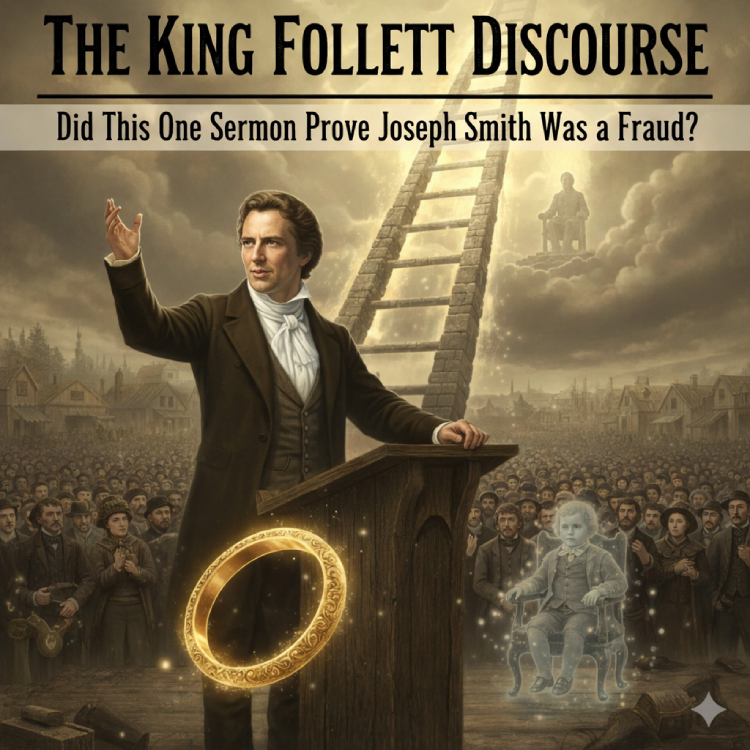
In April 1844, just two months before his assassination, Joseph Smith delivered what would become his most theologically revolutionary address. The King Follett Discourse fundamentally challenged traditional Christian doctrine about the nature of God, the origin of human souls, and humanity’s eternal destiny. This sermon continues to shape Latter-day Saint theology while raising profound questions about the consistency and reliability of Smith’s prophetic claims.
Historical Context and Delivery
On April 7, 1844, during the semi-annual General Conference in Nauvoo, Illinois, Joseph Smith addressed an assembled crowd estimated between 8,000 and 20,000 people. The occasion was ostensibly a funeral sermon for King Follett, a faithful Mormon who had died on March 9th after being crushed in a well collapse. However, Smith transformed this memorial into a comprehensive theological manifesto that would redefine Mormon understanding of deity and human nature.
Smith prefaced his remarks with an extraordinary claim about his prophetic authority: he staked his entire credibility on the doctrines he was about to unveil. According to contemporary accounts, he declared that if he failed to accurately teach the character of God, he deserved to be ranked among the world’s false teachers. This self-imposed standard would become central to later Christian critiques of the discourse.
Revolutionary Claims About God’s Nature
The Doctrine of Divine Progression
The sermon’s most shocking assertion directly contradicted classical Christian theism: “God himself was once as we are now, and is an exalted man, and sits enthroned in yonder heavens!” Smith elaborated that God the Father “once was a man like us” and “dwelt on an earth, the same as Jesus Christ Himself did.”
This teaching introduced what scholars call “theomorphism”—the idea that God possesses a glorified human form and nature. More radically, it suggested God underwent a process of progression from mortality to divinity, fundamentally challenging the Christian doctrine of God’s aseity (self-existence) and eternal, unchanging nature affirmed in passages like Malachi 3:6 (“I the LORD do not change”) and James 1:17 (“with whom there is no variation or shadow due to change”).
The implications were staggering: if God was once mortal, then by definition He had a God above Him, creating an infinite regression of deities—a concept Mormon scholars later termed “the plurality of gods” doctrine.
Challenging Orthodox Monotheism
Smith explicitly rejected the traditional Christian understanding of God as an incorporeal spirit. He taught a form of henotheism—the belief in multiple gods while worshiping one supreme deity. This represented a decisive break from the monotheism affirmed in Deuteronomy 6:4 (“Hear, O Israel: The LORD our God, the LORD is one”) and Isaiah 43:10 (“Before me no god was formed, nor shall there be any after me”).
Redefining Human Nature and Origin
The Eternal Intelligence Doctrine
Smith proposed that the essence of human beings—what he called “intelligence” or the human spirit—has always existed and was never created. Using the illustration of a ring, he argued: “If I cut it in two, it would have a beginning and an end; but join it again and it continues one eternal round. So with the spirit of man.”
This teaching contradicts Genesis 2:7, which describes God forming man from the dust and breathing life into him, clearly indicating a point of creation. It also conflicted with passages like Zechariah 12:1, which states God “forms the spirit of man within him”—suggesting spirits have a beginning point.
The Path to Godhood
Building on these foundations, Smith outlined what would become the doctrine of eternal progression or exaltation. He taught that humans possess the inherent capacity to become gods themselves through a process of learning and advancement: “You have got to learn how to be gods yourselves, and to be kings and priests to God, the same as all gods have done before you.”
This “ladder of progression” theology became enshrined in the famous LDS couplet: “As man now is, God once was; as God now is, man may be”—though this precise formulation came from Lorenzo Snow, a later LDS president.
The Children Controversy
Perhaps the most problematic element for contemporary Latter-day Saints is Smith’s teaching about children who die in infancy. He declared unequivocally: “The child dies in infancy, but it will be all right. A child that was laid away in death would come up in the resurrection as a child… it will never grow; it will still be the child.”
He painted a vivid picture: “Eternity is full of thrones, upon which dwell thousands of children, reigning on thrones of glory, with not one cubit added to their stature.”
This teaching created theological chaos: if children remain eternally as children, they cannot progress to godhood—the very purpose of Mormon soteriology. Later LDS leaders have quietly abandoned or reinterpreted this doctrine, with modern authorities teaching that children will indeed grow and progress in the afterlife. This represents one of many instances where subsequent Mormon prophets have modified or contradicted Smith’s definitive pronouncements.
Historical Reliability of the Text
Critics sometimes suggest the discourse’s radical content reflects scribal error or embellishment rather than Smith’s actual words. However, the historical evidence strongly supports the sermon’s authenticity and accuracy.
Four independent, contemporary transcriptions exist from experienced Mormon scribes:
- Thomas Bullock (official church recorder)
- Willard Richards (church historian)
- Wilford Woodruff (apostle, future church president)
- William Clayton (Smith’s personal secretary)
These accounts demonstrate remarkable consistency in reporting the sermon’s controversial elements. The LDS Church itself has canonized portions of this discourse in its official scripture (Doctrine and Covenants 130, History of the Church Vol. 6). The sermon’s content also aligns with Smith’s other late teachings on plurality of gods and theosis found in his translation work and temple ceremonies.
Theological Implications and Christian Response
Testing Smith’s Prophetic Standard
Smith’s opening challenge—that his prophetic credibility depended on accurately teaching God’s nature—provides an ironic framework for evaluation. Orthodox Christianity, drawing from both the Old and New Testaments, maintains that:
- God is eternal and unchanging (Psalm 90:21Before the mountains were brought forth, or ever you had formed the earth and the world, from everlasting to everlasting you are God., Psalm 102:25-27225 Of old you laid the foundation of the earth, and the heavens are the work of your hands. 26 They will perish, but you will remain; they will all wear out like a garment. You will change them like a robe, and they will pass away, 27 but you are the same, and your years have no end.)
- There is only one God in existence (Isaiah 44:6-836 Thus says the Lord, the King of Israel and his Redeemer, the Lord of hosts: “I am the first and I am the last; besides me there is no god. 7 Who is like me? Let him proclaim it. Let him declare and set it before me, since I appointed an ancient people. Let them declare what is to come, and what will happen. 8 Fear not, nor be afraid; have I not told you from of old and declared it? And you are my witnesses! Is there a God besides me? There is no Rock; I know not any.”, Isaiah 45:5-645 I am the Lord, and there is no other, besides me there is no God; I equip you, though you do not know me, 6 that people may know, from the rising of the sun and from the west, that there is none besides me; I am the Lord, and there is no other.)
- God created all things, including human spirits (Colossians 1:165For by him all things were created, in heaven and on earth, visible and invisible, whether thrones or dominions or rulers or authorities—all things were created through him and for him., Hebrews 12:96Besides this, we have had earthly fathers who disciplined us and we respected them. Shall we not much more be subject to the Father of spirits and live?)
- God is spirit, not an exalted human body (John 4:247God is spirit, and those who worship him must worship in spirit and truth.)
By the very standard Smith established—biblical accuracy about God’s nature—traditional Christians argue he failed his own test, thus validating his self-proclaimed judgment as a false teacher.
The Problem of Progressive Revelation
The King Follett Discourse also highlights the broader issue of doctrinal evolution in Mormonism. Smith’s theology underwent dramatic transformations throughout his career, from the Book of Mormon’s quasi-Trinitarian monotheism to the King Follett Discourse’s henotheistic polytheism. This raises fundamental questions about the nature and reliability of prophetic revelation.
If God is unchanging and truth is eternal, how can successive “prophets“ teach contradictory doctrines? The subsequent modification of Smith’s teachings by later Mormon leaders—particularly regarding children’s resurrection—further undermines claims to continuous prophetic authority.
Conclusion: Legacy and Continuing Relevance
The King Follett Discourse remains the clearest articulation of Joseph Smith’s mature theology and the foundation for distinctive Mormon doctrines that separate Latter-day Saint belief from historic Christianity. Its teachings on divine progression, eternal human intelligences, and the potential for human deification continue to define Mormon religious identity.
For evangelical Christians, the discourse represents compelling evidence that Mormonism constitutes a separate religious system rather than a Christian denomination. It demonstrates how radically Smith departed from biblical Christianity, replacing worship of the eternal Creator with the pursuit of self-exaltation.
Nearly 180 years later, Smith’s final theological statement continues to challenge both defenders and critics. His own words provide the measuring stick: “If any man does not know God… he will realize that he has not called upon the right being.” For those who hold to biblical orthodoxy, the King Follett Discourse reveals precisely such a departure—a call to worship a different god entirely.
Watch this full video from God Loves Mormons for additional information:
For those interested in examining primary source documents of the King Follett Discourse, transcriptions of all four contemporary accounts are available through the Joseph Smith Papers project and various academic resources on early Mormon history.