
Download a PDF to print at home (11 pages): Joseph Smith and the Foundations of Mormonism
A Scholarly Examination of the Origins, Doctrines, and Historical
Controversies of the Church of Jesus Christ of Latter-day Saints
Introduction
The Church of Jesus Christ of Latter-day Saints, commonly known as the Mormon Church or LDS Church, represents one of the most significant American-born religious movements in history. Founded in 1830 by Joseph Smith Jr. in upstate New York, the faith has grown from a small band of followers to a worldwide organization claiming over 17 million members. Yet from its inception, Mormonism has been surrounded by controversy, doctrinal disputes, and historical questions that continue to challenge both believers and scholars alike.
This comprehensive analysis examines the foundational claims, theological doctrines, and historical controversies of the LDS Church. Drawing upon primary sources, scholarly research, and official LDS documentation, we explore the fundamental questions that have defined debates about Mormonism for nearly two centuries: Is Mormonism a restoration of primitive Christianity, as its adherents claim, or does it represent a departure from orthodox Christian teaching so profound as to constitute a separate religion entirely?
The examination that follows addresses thirteen critical subject areas: the founding vision claims of Joseph Smith, the doctrine of the Great Apostasy, the origins and content of the Book of Mormon and golden plates narrative, the controversial Book of Abraham, the practice of polygamy, incidents of violence and conflict in early Mormon history, controversial theological beliefs, temple garments, baptism for the dead, the racial doctrines concerning dark-skinned Lamanites, archaeological evidence, the absence of cross symbolism, and the fundamental doctrinal conflicts with orthodox Christianity.
I. The Founding Vision
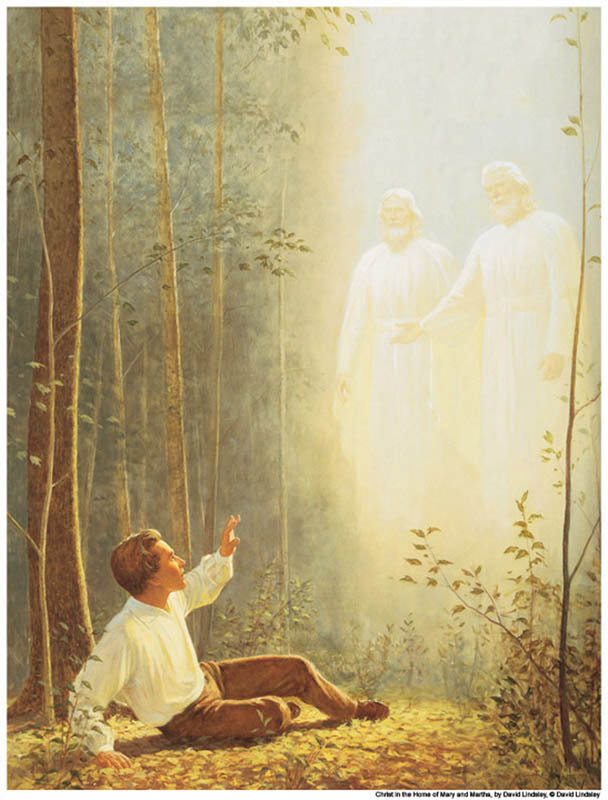
The foundational narrative of the LDS Church rests upon Joseph Smith’s claim of a divine visitation in 1820, known as the First Vision. According to the official LDS account, fourteen-year-old Joseph Smith, troubled by the competing claims of various Christian denominations, retreated to a grove of trees near his Palmyra, New York home to pray for guidance. There, he claimed, God the Father and Jesus Christ appeared to him in bodily form, delivering a message that would define Mormon theology and identity.
The canonical account, recorded in Joseph Smith—History 1:19, states that when Smith asked which church he should join, he was told he “must join none of them, for they were all wrong.” The divine personages allegedly declared that “all their creeds were an abomination” in God’s sight, and that “those professors were all corrupt.” This declaration became the cornerstone of Mormon claims to exclusivity—that all existing Christian churches had fallen into complete apostasy, necessitating a divine restoration through Joseph Smith.
The Book of Mormon reinforces this exclusivist claim in stark terms. In 1 Nephi 14:10, the text presents a dichotomous view of religious truth: “there are save two churches only; the one is the church of the Lamb of God, and the other is the church of the devil.“ This binary classification places all non-Mormon Christian churches, by implication, in the latter category—a theological position that has generated significant controversy and interfaith tension throughout LDS history.
However, historical examination of the First Vision narrative reveals significant complications. Scholars have documented at least ten different accounts of the First Vision given by Joseph Smith at various times, with substantial variations in crucial details. Early accounts from the 1830s mention only one divine personage, not two. Some versions emphasize forgiveness of sins rather than the corruption of all churches. The two-personage version that became canonical was not published until 1842, over two decades after the alleged event, and was not widely taught to early Mormon converts.
Furthermore, Joseph Smith’s character and credibility before his prophetic claims warrant examination. In 1826, Smith was convicted in Bainbridge, New York, as an “imposter” in connection with his practice of “glass looking”—using seer stones to locate buried treasure for paying clients. This documented history of folk magic and treasure-seeking provides important context for evaluating his later claims of divine revelation and the translation of golden plates using similar implements.
II. The Doctrine of the Great Apostasy
Central to Mormon theological claims is the doctrine of the Great Apostasy—the belief that following the death of the original apostles, the Christian church fell into complete apostasy, losing divine authority, corrupting essential doctrines, and necessitating a full restoration of the gospel through Joseph Smith in the nineteenth century. This doctrine serves as the theological justification for Mormonism’s existence as a separate faith tradition and its claims to exclusive divine authority.
According to LDS teaching, the apostasy began shortly after the death of the apostles in the late first century and resulted in the loss of the priesthood authority, the corruption of ordinances, the introduction of false doctrines through Greek philosophy, and the removal of plain and precious truths from the biblical text. The result, Mormons claim, was that Christianity in all its forms—Catholic, Orthodox, and Protestant—represents a corrupted deviation from original Christian truth.
However, this doctrine encounters substantial historical and theological objections. The historical record demonstrates a continuous succession of Christian leadership and teaching from the apostolic period to the present. The Church Fathers—Clement of Rome, Ignatius of Antioch, Polycarp of Smyrna, and others—wrote extensively in the late first and early second centuries, demonstrating continuity with apostolic teaching. These writings, many authored by direct disciples of the apostles themselves, show no evidence of the catastrophic doctrinal corruption that Mormon theology requires.
The early ecumenical councils—Nicaea in 325 AD, Constantinople in 381 AD, Ephesus in 431 AD, and Chalcedon in 451 AD—were convened precisely to defend orthodox Christian doctrine against heretical innovations. Far from corrupting Christianity, these councils articulated and preserved the faith delivered by the apostles, responding to distortions with carefully reasoned theological formulations grounded in Scripture.
Perhaps most significantly, the Great Apostasy doctrine contradicts explicit biblical promises regarding the perpetuity of the Church. In Matthew 16:18, Jesus declares, “I will build my church, and the gates of Hades will not overcome it.” In John 16:13, Jesus promises that the Spirit of truth “will guide you into all the truth.” The doctrine of complete apostasy requires that these divine promises failed—that Satan prevailed over the church and the Spirit of truth abandoned His guiding role for nearly two millennia until Joseph Smith’s birth.
III. The Book of Mormon and Golden Plates
The Book of Mormon stands as the foundational scripture of the LDS Church, purporting to be an ancient record of God’s dealings with the inhabitants of the American continent from approximately 600 BC to 421 AD. According to Joseph Smith, the angel Moroni first appeared to him in 1823, revealing the location of the golden plates buried in Hill Cumorah near Palmyra, New York. Smith claimed to receive the plates in 1827 and subsequently translated them “by the gift and power of God.”
The translation process, as described by witnesses including Emma Smith and Martin Harris, involved Joseph Smith placing a seer stone in a hat, putting his face into the hat to exclude light, and reading words that appeared on the stone. The golden plates themselves were often not present during the translation, sometimes hidden under a cloth or not in the room at all. This method closely paralleled Smith’s earlier treasure-seeking practices with seer stones, raising questions about the claimed divine nature of the process.
The Book of Mormon presents a narrative involving two major civilizations: the Jaredites, who allegedly crossed the ocean at the time of the Tower of Babel, and the Nephites and Lamanites, descended from Israelites who fled Jerusalem around 600 BC. The text describes vast civilizations with populations in the millions, extensive cities, advanced metallurgy, horses, cattle, wheat, barley, silk, and sophisticated systems of writing.
The Kinderhook Plates incident provides a revealing test case for Joseph Smith’s claimed translation abilities. In 1843, six brass plates inscribed with strange characters were “discovered” in an Illinois burial mound and brought to Smith for translation. He reportedly began translating them, declaring they contained the history of a descendant of Ham. The plates were later proven to be a hoax, fabricated by residents specifically to test Smith’s prophetic claims. Smith had “translated” forgeries, calling into serious question his ability to accurately translate ancient records.
Textual analysis of the Book of Mormon reveals numerous anachronisms and problems. The text contains extensive quotations from the King James Version of the Bible, including passages from Isaiah that modern scholars consider post-exilic compositions that would not have been available to Lehi’s family in 600 BC. The book quotes New Testament passages and reflects nineteenth-century Protestant theological concerns such as infant baptism and paid clergy. Perhaps most strikingly, Alma 7:10 states that Jesus would be born “at Jerusalem,” contradicting the well-known biblical prophecy of Bethlehem (Micah 5:2) and the gospel accounts.
IV. The Book of Abraham
The Book of Abraham represents perhaps the most demonstrably problematic of Joseph Smith’s claimed translations. In 1835, the LDS Church purchased a collection of Egyptian mummies and papyri from a traveling exhibition. Joseph Smith examined the papyri and declared that they contained the writings of the biblical patriarch Abraham, written by his own hand while in Egypt. Smith subsequently published his “translation” as the Book of Abraham, which was later canonized as scripture in the Pearl of Great Price.
The Book of Abraham contains doctrines found nowhere in the Bible, including the concept of pre-mortal existence of spirits, the organization of the gods in council, and the unique LDS doctrine of eternal progression. Three facsimiles from the papyri were published with Smith’s interpretations, identifying various figures as Abraham, Pharaoh, and the gods of the Egyptians.
The papyri were long believed lost in the Great Chicago Fire of 1871. However, in 1966, fragments of the Joseph Smith Papyri were rediscovered at the Metropolitan Museum of Art in New York. This discovery allowed the first independent verification of Smith’s translation claims, and the results were devastating to LDS apologetics.
Egyptologists—including LDS scholars—unanimously identified the papyri as common Egyptian funerary texts, specifically portions of the Book of Breathings and the Book of the Dead, dating to the Ptolemaic period (roughly 300-100 BC), thousands of years after Abraham would have lived. The documents contain no mention of Abraham whatsoever and have nothing to do with the biblical patriarch.
The facsimile interpretations proved equally erroneous. Figure 7 in Facsimile 2, which Smith identified as “God sitting upon his throne,” is actually the Egyptian fertility god Min, depicted traditionally with an erect phallus—a fact obscured in LDS publications. Figures identified by Smith as male are female. Objects identified as divine symbols are canopic jars. The errors are not minor or debatable but represent fundamental misidentifications of standard Egyptian religious iconography well understood by Egyptologists.
V. Polygamy
The practice of plural marriage, or polygamy, represents one of the most controversial aspects of early Mormon history. Joseph Smith secretly introduced the practice in the 1830s while publicly denying its existence. He eventually recorded a revelation (now Doctrine and Covenants Section 132) commanding the practice and threatening Emma Smith with destruction if she did not accept her husband’s plural wives.
Historical research indicates that Joseph Smith married between thirty and forty women, with some estimates reaching higher. Among these were teenagers, including Helen Mar Kimball, who was fourteen years old at the time of her marriage to the thirty-seven-year-old prophet. Smith also married women who were already legally wed to other men, in some cases sending the husbands away on missions before establishing the new relationship.
Brigham Young, Smith’s successor, expanded the practice dramatically. He married approximately fifty-five women and fathered fifty-seven children. Heber C. Kimball, a senior apostle, reportedly remarked, “I would think nothing more of taking a wife than of buying a cow.” The casual attitude toward acquiring wives reflected a theological system that tied exaltation in the afterlife to the number of descendants one could produce.
The doctrine as revealed in D&C 132 was explicitly unequal: while men could and should take multiple wives, women were forbidden from having multiple husbands. The revelation threatened women with “destruction” for refusing to comply with the “new and everlasting covenant” of plural marriage. This asymmetry, combined with the coercive dynamics involved in young women being pressured by family and religious authority to become plural wives, raises profound ethical concerns.
The LDS Church officially ended the practice of polygamy in 1890 through the Manifesto issued by President Wilford Woodruff, a decision motivated primarily by the federal government’s threat to seize church property and deny Utah statehood. However, plural marriages continued to be performed secretly for years afterward, and the doctrine remains in LDS scripture. Modern temple sealings still allow men to be sealed to multiple women (in cases of widowhood and remarriage), while women may only be sealed to one husband.
VI. Violence and Conflict
The history of the early LDS Church is marked by episodes of violence and armed conflict that challenge the peaceful image often projected by the modern church. While Mormons were frequently victims of mob violence and persecution, they were also, at times, perpetrators of violence against outsiders and dissenters.
The 1838 Mormon War in Missouri represents a complex period of mutual antagonism and violence. Sidney Rigdon, a counselor in the First Presidency, delivered an incendiary July 4, 1838, address threatening a “war of extermination” against any who opposed the Saints. Mormon militias subsequently burned the towns of Gallatin and Millport and destroyed numerous non-Mormon homes and properties. Governor Lilburn Boggs responded with his infamous extermination order, and Missouri militias perpetrated the Haun’s Mill Massacre, killing eighteen Mormons.
The Danites, a secret society within the church, conducted armed raids and issued threats against dissenters and perceived enemies. The Danite Manifesto of 1838 warned dissenters that they had three days to leave the community or face death. While the exact extent of Danite activities remains debated, their existence and violent methods are well-documented in contemporary sources, including affidavits from former members.
The Mountain Meadows Massacre of September 11, 1857, stands as the darkest episode in Mormon history. A wagon train of Arkansas emigrants, known as the Baker-Fancher party, was attacked while passing through southern Utah. After a five-day siege, Mormon militia leaders approached the emigrants under a flag of truce, promising safe passage. Once the emigrants had surrendered their weapons and begun walking with their Mormon escorts, a coordinated attack killed approximately 120 men, women, and children. Only seventeen children, all under the age of seven, were spared and subsequently placed with Mormon families.
John D. Lee, an adopted son of Brigham Young and a local leader, was the only person ever held legally accountable for the massacre. He was executed by firing squad in 1877 at the massacre site. The question of Brigham Young’s involvement or foreknowledge remains historically contested, though evidence suggests at minimum a broader conspiracy among local church leadership.
The doctrine of blood atonement, taught by Brigham Young and other early leaders, held that certain sins were so serious that the atoning blood of Christ was insufficient—the sinner’s own blood must be shed to achieve salvation. Young specifically identified apostasy, adultery, and interracial marriage as sins requiring blood atonement. Regarding interracial relationships, Young declared in 1863 that “the penalty, under the law of God, is death on the spot. This will always be so.” While the LDS Church has distanced itself from blood atonement teachings, they remain part of the historical record.
VII. Controversial Theological Beliefs
Mormon theology contains numerous beliefs that place it outside the bounds of historic Christianity. These doctrines, while sometimes minimized in contemporary LDS missionary discussions, remain part of official church teaching and distinguish Mormonism as a unique religious system.
The doctrine of plurality of gods represents a fundamental departure from biblical monotheism. In the King Follett Discourse, delivered shortly before he died in 1844, Joseph Smith declared: “I am going to tell you how God came to be God. We have imagined and supposed that God was God from all eternity. I will refute that idea.” Smith taught that God the Father was once a mortal man who progressed to godhood, and that faithful Mormons could follow the same path of eternal progression to become gods themselves.
Brigham Young further elaborated this doctrine: “How many Gods there are, I do not know. But there never was a time when there were not Gods and worlds.” Joseph Fielding Smith, a twentieth-century prophet, stated: “We will become gods and have jurisdiction over worlds, and these worlds will be peopled by our own offspring.” This polytheistic framework contradicts the foundational biblical affirmation of monotheism found in Deuteronomy 6:4 (“Hear, O Israel: The LORD our God, the LORD is one”) and Isaiah 43:10 (“Before me no god was formed, nor will there be one after me”).
LDS doctrine teaches that all humans, including Jesus and Lucifer, are the literal spirit offspring of Heavenly Father and a Heavenly Mother. Jesus and Satan are thus considered spirit brothers, along with all humanity. Early LDS leaders, including Orson Hyde and Joseph F. Smith, taught that Jesus was married, possibly to Mary Magdalene and others, and fathered children during His earthly ministry. These teachings have no basis in Scripture and are rejected by all other Christian traditions.
The LDS view of God’s physical nature further distinguishes Mormon theology. Doctrine and Covenants 130:22 declares: “The Father has a body of flesh and bones as tangible as man’s; the Son also.” This corporeal understanding of God contradicts the biblical teaching that “God is spirit” (John 4:24) and the historic Christian understanding of divine transcendence.
VIII. Temple Garments
Temple garments, sometimes referred to colloquially as “Mormon underwear” or “magic underwear,” are special undergarments worn by members who have received their endowment in LDS temples. These garments are worn day and night and are considered sacred symbols of covenants made with God.
The garments feature symbolic markings over the breast and knee, representing various elements of the temple ceremony. Members are instructed to treat the garments with respect, wearing them at all times except when impractical (such as during swimming or certain athletic activities). The garments serve as a constant reminder of temple covenants and, according to LDS teaching, offer spiritual protection to the wearer.
Various folkloric beliefs have developed around temple garments, including stories of garments providing physical protection from fire, bullets, or other dangers. While the institutional church has generally avoided endorsing such claims, they persist in Mormon popular culture. The practice of wearing special undergarments has no precedent in historic Christianity and adds to the perception of Mormonism as a secretive organization with unusual ritual requirements.
IX. Baptism for the Dead
One of the most distinctive LDS practices is vicarious baptism for the dead—the performance of baptismal ordinances on behalf of deceased individuals who never had the opportunity to receive Mormon baptism during their lifetimes. This practice is performed in LDS temples, with living members being baptized by immersion as proxies for the deceased.
The doctrine is based on a unique LDS interpretation of 1 Corinthians 15:29, which mentions those who are “baptized for the dead.” While scholars debate the meaning of this obscure New Testament reference, there is no evidence that the early Christian church practiced vicarious baptism as a regular ordinance. The LDS practice represents a significant innovation in Christian ritual.
The practice has generated significant controversy, particularly when the LDS Church has performed proxy baptisms for Holocaust victims and other Jewish deceased. Jewish organizations have repeatedly protested these baptisms as offensive and disrespectful to the dead and their families. Despite agreements to cease the practice for Holocaust victims, it has continued in various forms, leading to ongoing tensions between the LDS Church and Jewish communities.
Among those who have been vicariously baptized are notable figures, including Anne Frank, Mahatma Gandhi, and various celebrities and historical figures. The LDS genealogical database, maintained to facilitate these proxy ordinances, has become the world’s largest genealogical repository, reflecting the importance Mormons attach to this distinctive practice.
X. The Dark-Skinned Lamanites and Racial Doctrines
The Book of Mormon contains explicit racial theology, presenting dark skin as a divine curse for wickedness. According to the narrative, the Lamanites, a group who rejected the truth, were cursed with “a skin of blackness” to make them unappealing to the righteous Nephites (2 Nephi 5:21). This skin-curse theology has had profound implications for LDS racial attitudes and policies throughout church history.
Brigham Young expanded on these racial teachings, applying them to people of African descent. He taught that black skin was the result of the “curse of Cain” and that those of African ancestry bore this mark as divine judgment. In 1852, Young officially legalized slavery in the Utah Territory, making it one of the few western territories to permit the institution.
From 1849 to 1978, the LDS Church denied priesthood ordination to men of African descent and prohibited both men and women of African ancestry from receiving temple ordinances. These restrictions were based on theological claims about pre-mortal existence, with church leaders teaching that blacks were less valiant in the war in heaven and therefore born into a cursed lineage on earth.
The priesthood and temple ban was reversed in 1978 through Official Declaration 2, announced by President Spencer W. Kimball. The change came amid increasing social pressure, including threatened protests at the 1978 NCAA championship, concerns about missionary work in Brazil, and the potential loss of the church’s tax-exempt status. Critics note that the reversal was presented as a new revelation rather than an acknowledgment of error.
In 2013, the LDS Church published an essay acknowledging that the racial restrictions were born of nineteenth-century racism and stating that “none of these explanations is accepted today as the official doctrine of the Church.” However, the church has not formally apologized for the ban or its theological justifications, and the Book of Mormon passages linking dark skin to divine curses remain unchanged in LDS scripture.
XI. Archaeological Evidence
The Book of Mormon makes extensive, testable claims about ancient American civilizations. It describes people who brought Old World technologies, languages, animals, and crops to the Americas, establishing sophisticated civilizations that flourished for over two millennia. The absence of archaeological evidence supporting these claims represents one of the most significant challenges to the book’s historicity.
The Smithsonian Institution has repeatedly stated its position: “The Smithsonian Institution has never used the Book of Mormon in any way as a scientific guide. Smithsonian archaeologists see no direct connection between the archaeology of the New World and the subject matter of the book.” The statement continues: “No inscriptions using Old World forms of writing have been shown to have occurred in any part of the Americas before 1492.”
Michael Coe, a distinguished Mesoamerican archaeologist at Yale University, has stated unequivocally: “As far as I know there is not one professionally trained archaeologist, who is not a Mormon, who sees any scientific justification for believing the foregoing to be true.” The consensus of professional archaeology is uniform: no evidence supports the Book of Mormon’s historical claims.
Perhaps most significant is the conclusion reached by Thomas Stuart Ferguson, founder of the New World Archaeological Foundation, which was supported by LDS Church funding specifically to find evidence for the Book of Mormon. After seventeen years of research (1955-1972), Ferguson privately concluded: “What is in the ground will never conform to what is in the book.” In a 1976 letter, he stated that the geography of the Book of Mormon is “fictional.”
The Book of Mormon describes battles involving millions of casualties. Ether 15:2 describes the aftermath of a single battle with approximately two million soldiers killed, including families; conservative estimates suggest six million deaths. The final Nephite battle at Cumorah allegedly involved hundreds of thousands more. Yet no archaeological evidence of these massive conflicts—no weapons, no mass graves, no fortifications, no residual metallurgical evidence—has ever been discovered.
The Book of Mormon references numerous items unknown in pre-Columbian America: horses, cattle, sheep, goats, elephants, wheat, barley, silk, steel, chariots, and scimitars. Archaeological evidence consistently shows that these items were introduced by European colonizers after 1492. The anachronistic presence of these items in a text purporting to be ancient significantly undermines claims of historical authenticity.
Elder B.H. Roberts, one of the church’s most accomplished intellectuals, acknowledged the archaeological problem in private writings not published until after his death. He wrote that the Book of Mormon “proof rests on the power of the Holy Ghost…must ever be the chief source of evidence for the Book of Mormon. All other evidence is secondary.” This retreat to unfalsifiable spiritual witness represents an acknowledgment that empirical evidence does not support historical claims.
XII. The Cross of Jesus Christ
One of the most visually striking differences between Mormonism and other Christian traditions is the absence of the cross. Unlike virtually every other Christian denomination, the LDS Church does not display crosses on its buildings, and members are discouraged from wearing cross jewelry or displaying crosses in their homes.
Gordon B. Hinckley, then president of the LDS Church, explained in 1998: “For us the cross is the symbol of the dying Christ, while our message is a declaration of the living Christ.” Earlier, David O. McKay characterized crosses as “purely Catholic” and stated that “Latter-day Saint girls should not purchase and wear them.” This rejection of Christianity’s central symbol has deep theological implications.
The theological basis for this rejection appears to reflect a diminished emphasis on the atoning work accomplished at the cross. LDS theology emphasizes the atonement as occurring primarily in the Garden of Gethsemane, where Jesus sweated blood, rather than at Calvary. This Gethsemane-centered soteriology differs markedly from historic Christianity’s focus on the cross.
The New Testament, in contrast, elevates the cross as the central symbol of Christian faith. Paul declared, “May I never boast except in the cross of our Lord Jesus Christ” (Galatians 6:14). He preached “Christ crucified“ (1 Corinthians 1:23) and resolved to know nothing “except Jesus Christ and him crucified“ (1 Corinthians 2:2). The early church adopted the cross as its primary symbol precisely because the crucifixion represented the decisive moment of salvation. Archaeological evidence confirms the widespread use of the cross among Christians by the second and third centuries, with cross symbols appearing in the Roman catacombs, on ossuaries, and in early Christian art.
The church fathers consistently emphasized the centrality of the cross: Justin Martyr in the mid-second century described the cross as “the greatest symbol of Christ’s power and authority,” while Tertullian wrote that Christians traced the sign of the cross on their foreheads as a mark of their faith. The Council of Ephesus in 431 AD affirmed the veneration of the cross, and by the time of Constantine, the cross had become the preeminent symbol of Christian identity throughout the Roman world. This universal embrace of the cross across all branches of early Christianity—Eastern and Western, Greek and Latin—stands in marked contrast to the LDS rejection of the symbol.
The irony of Mormon rejection of the cross is illustrated by the fact that the Mormon Tabernacle Choir regularly performs “When I Survey the Wondrous Cross,” a hymn based directly on Galatians 6:14. The 2020 introduction of a new official LDS symbol featuring the Christus statue represented an attempt to adopt a more recognizably Christian visual identity, yet the cross remains absent from Mormon iconography.
XIII. Doctrinal Conflicts with Orthodox Christianity
The fundamental question in evaluating Mormon claims is whether the LDS Church represents a valid expression of Christianity or constitutes a distinct religion using Christian terminology with radically different meanings. Examination of core doctrines reveals departures from historic Christianity so profound that most Christian theologians, both Catholic and Protestant, conclude that Mormonism falls outside the bounds of Christian orthodoxy.
The doctrine of the Trinity represents the most fundamental difference. Historic Christianity, as articulated at Nicaea and Constantinople and affirmed by virtually all Christian traditions, holds that God is one divine being existing eternally in three persons: Father, Son, and Holy Spirit. These three persons share one divine essence and are coequal and coeternal.
LDS theology explicitly rejects this formulation. Joseph Smith declared that Father, Son, and Holy Ghost are “three distinct personages and three Gods.” The LDS Godhead consists of three separate beings, united in purpose but not in essence or substance. God the Father was once a mortal man who achieved exaltation; Jesus is His literal offspring in a pre-mortal existence; the Holy Ghost is a distinct spirit personage who has not yet obtained a physical body.
Soteriology—the doctrine of salvation—represents another fundamental divergence. Historic Christianity, following Paul’s teaching in Ephesians 2:8-9, holds that salvation is by grace through faith, not by works. LDS theology, articulated in 2 Nephi 25:23, teaches that salvation comes “by grace…after all we can do.“ This conditional grace, dependent on human effort and obedience to LDS ordinances, contradicts the Protestant understanding of sola gratia and sola fide.
The nature of God differs fundamentally between traditions. Historic Christianity affirms God’s eternality (“from everlasting to everlasting, you are God”—Psalm 90:2), immutability (“I the LORD do not change”—Malachi 3:6), and uniqueness (“Before me no god was formed, nor will there be one after me”—Isaiah 43:10). LDS theology teaches that God was once a man who progressed to godhood and that faithful Mormons can follow the same path of eternal progression.
Even prayer practices differ significantly. LDS leaders have taught that prayers should be directed only to the Father, not to Jesus. Bruce McConkie, an apostle, characterized praying to Christ as “plain sectarian nonsense.” This teaching contradicts New Testament evidence of prayers directed to Jesus, including Stephen’s dying prayer (Acts 7:59) and Jesus’ own invitation to pray in His name (John 14:14).
The addition of new scriptures—the Book of Mormon, Doctrine and Covenants, and Pearl of Great Price—and the doctrine of continuing revelation through living prophets creates a fundamentally different authority structure. While Christian traditions vary in their understanding of tradition and magisterial authority, all consider the biblical canon closed. LDS claims that modern prophets can add to or supersede biblical teaching, placing Mormonism in a distinct category.
Conclusion
The examination of Joseph Smith and Mormonism across these thirteen subject areas reveals a religious movement that, despite using Christian vocabulary and claiming to restore primitive Christianity, has developed doctrines, practices, and historical patterns that place it decisively outside the mainstream of historic Christian faith. The appropriation of Christian terminology—God, Jesus, salvation, atonement, priesthood, apostles—cannot mask the fundamentally different meanings Mormonism assigns to these terms. A religion that applies a coat of Christian paint over doctrinal errors cannot, by any reasonable measure, claim that the paint validates its Christianity. The substance beneath matters far more than the familiar labels affixed to it. When Mormons speak of God, they mean an exalted man with a physical body; when they speak of salvation, they mean exaltation to godhood contingent upon works and ordinances; when they speak of Jesus, they mean the spirit brother of Lucifer. The words may sound familiar to Christian ears, but they describe an entirely different theological landscape.
The foundational vision claims rest on inconsistent and evolving accounts. The Great Apostasy doctrine contradicts both biblical promises and historical evidence of Christian continuity. The Book of Mormon and the Book of Abraham fail the tests of historical and archaeological scrutiny. The practices of polygamy and blood atonement reveal troubling dimensions of early LDS leadership. The racial doctrines that persisted until 1978 represent a profound moral failure. The absence of the cross symbolizes a theological reorientation away from Christianity’s central message.
The LDS Church has evolved considerably since its nineteenth-century origins. Modern Mormons are, by and large, sincere and devoted religious practitioners who seek to follow God as they understand Him. The contemporary church has softened many of its more controversial positions and emphasizes its commonalities with mainstream Christianity.
Nevertheless, the theological chasm between Mormon doctrine and historic Christianity remains vast. The questions of God’s nature, the source of salvation, the authority of Scripture, and the identity of Jesus Christ receive fundamentally different answers in Salt Lake City than in Rome, Constantinople, Wittenberg, or Geneva. Whether Mormonism should be classified as a Christian denomination, a separate Abrahamic religion, or something else entirely is a question that honest observers—having weighed the theological evidence—will find straightforward to answer: it is not Christianity.
What cannot be disputed is that the movement founded by Joseph Smith in 1830 has proven remarkably durable and influential. The early nineteenth century witnessed a proliferation of many alternative religious movements in America—the Shakers, the Millerites (who would become Seventh-day Adventists), the Oneida Community, the Spiritualist movement, and various utopian societies—yet few have demonstrated the institutional longevity and global reach of Mormonism. For nearly two centuries, it has attracted devoted followers while generating persistent controversy. Despite the LDS Church’s efforts to present itself as a Christian denomination, the weight of theological evidence examined in this analysis explains why most orthodox Christians—Catholic, Eastern Orthodox, and Protestant alike—continue to classify Mormonism as a separate religion rather than a branch of historic Christianity. The fundamental redefinitions of God, Christ, salvation, and scripture place Mormonism outside the boundaries that have defined Christian orthodoxy since the apostolic age.