
PJ Media: More Information About the Suspect Identified in Ihan Omar Assault
A suspect has been identified in the spray liquid assault on Rep. Ilhan Omar of Minnesota on Tuesday night. He’s Anthony Kazmierczak, 55. Additional information on him has not been made available.
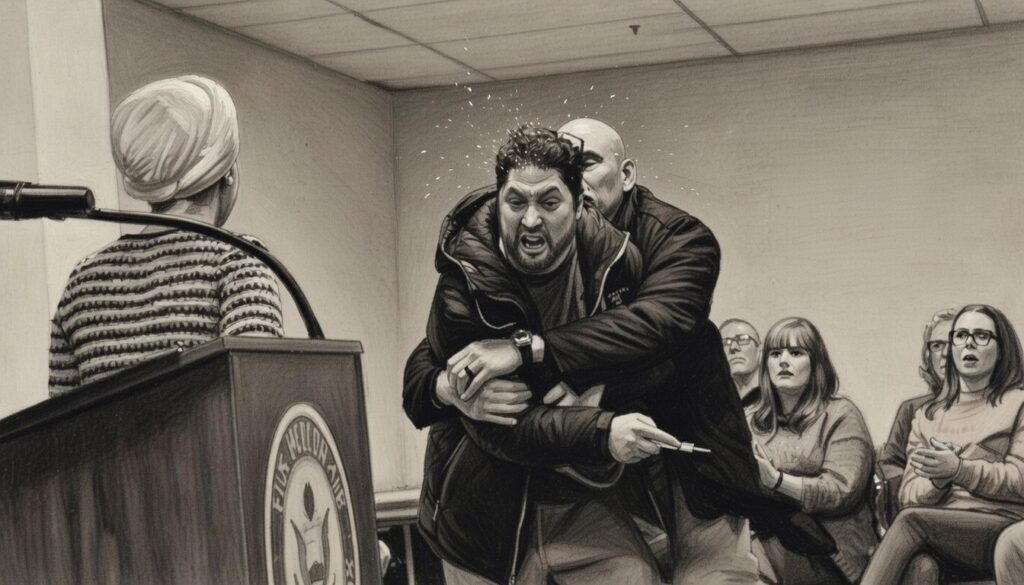
Kazmierczak allegedly charged Omar while she was delivering remarks at a town hall meeting in north Minneapolis.
According to Newsweek, “Kazmierczak does not appear to have ever been charged with a violent crime in Minnesota. He has twice been convicted of driving while under the influence of alcohol, according to court records reviewed by Newsweek.”
As Omar was speaking, Kazmierczak, who was sitting in the front row, stood up approached her with what Minneapolis police have said was a syringe filled with amber liquid. He got close enough to spray the liquid on the congressional representative. He then appeared to stagger to his right, shouting something that on video was unintelligible.
Oddly, instead of listening to her team when they told her to be examined, along with the liquid that landed on her clothing, Omar’s response was, “That is what they want.” She then proceeded to resume her remarks to the audience. She didn’t even appear to be intent on treating the affected clothing.
When speaking to the group, she said, “We will continue. These f—— a–holes are not going to get away with this.”
Ilhan Omar’s language in the aftermath of the assault is emotionally understandable, but rhetorically sloppy in ways that matter in a volatile political climate.
Her first response to staff urging her to get checked out was, “That is what they want.” In that instant, the concrete facts in front of her—a single identified assailant using a syringe with unknown liquid—are blurred into an unnamed, collective adversary. The pronoun “they” functions as a catch‑all container for enemies real and imagined, inviting listeners to fill in the blank with their preferred villains: political opponents, ideological camps, or shadowy conspirators. It leans toward hasty generalization, converting one attacker into an implied network of antagonists without evidence presented to support that leap.
Later, she escalates: “We will continue. These f—— a–holes are not going to get away with this.” Grammatically, “these” should point to a clearly bounded group. In the room, that may have meant the man with the syringe and, perhaps, anyone assisting him. But in public discourse, especially when delivered by a high‑profile elected official, “these” easily widens into a category that can encompass broad swaths of political opposition. Again, one person’s criminal act risks becoming the moral indictment of a loosely defined “them.”
Her follow‑up comment to reporters—“whatever these people think that they can throw at me”—cements the pattern. The phrase “these people” slides from describing a specific offender into a morally charged label for a broader out‑group. It’s classic tribal framing: there is “us” (the embattled, resilient) and “them” (cowardly aggressors), with little precision about who actually belongs in which camp.
None of this excuses the assault; it was dangerous, unlawful behavior, and deserves strong condemnation. But responsible leadership demands sharper distinctions than Omar’s language draws here. When a single attacker becomes “they,” “these,” and “these people,” the line between targeted accountability and sweeping vilification starts to erode—and that is exactly the logic that corrodes our already brittle public square.
Update: Here’s Why Many Say the Ilhan Omar Assault Was Staged