
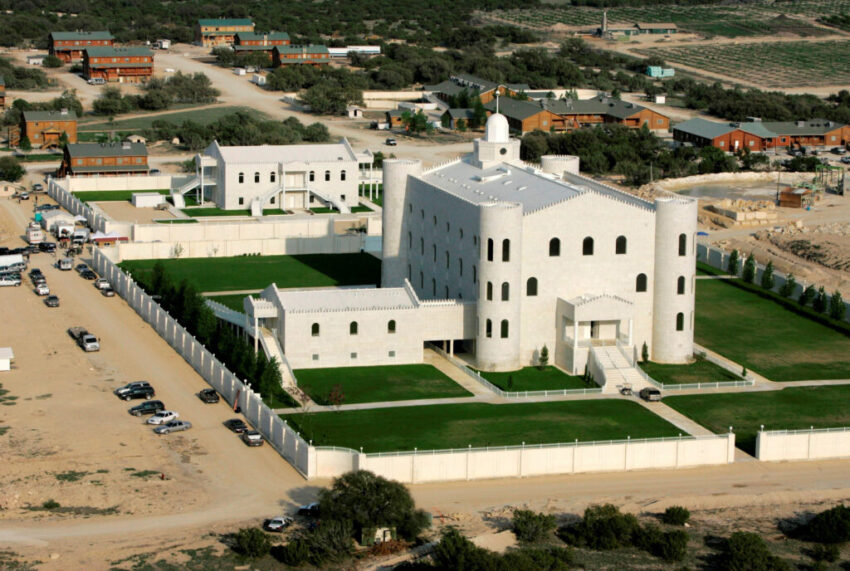
Photo: On an April morning in 2008, law enforcement vehicles encircled the main temple rising from the dusty plains of the Yearning for Zion Ranch near Eldorado, Texas. The sprawling compound served as the heart of the Fundamentalist Church of Jesus Christ of Latter-Day Saints, a secretive sect that had retreated from the outside world to live under its own rigid interpretation of faith. When officers conducted the raid, they uncovered records that painted a portrait of a community marked by austerity and strict devotion — a place where obedience and labor defined daily life, and where the group’s deeply ingrained beliefs sanctioned marriages between older men and underage brides.
A Comparative Analysis of Doctrinal Divergence and Historical Development
Introduction
In the vast, sun-baked landscape of the American Southwest, two religious communities claim spiritual descent from the same prophetic founder. Yet, their paths have diverged so dramatically that their relationship has become one of the most complex and contested in American religious history. The Church of Jesus Christ of Latter-day Saints (LDS), headquartered in Salt Lake City, Utah, boasts approximately seventeen million members worldwide and has achieved remarkable mainstream acceptance in American society. Meanwhile, the Fundamentalist Church of Jesus Christ of Latter-Day Saints (FLDS), centred in the twin communities of Hildale, Utah, and Colorado City, Arizona, numbers fewer than 10,000 adherents and remains a subject of intense public scrutiny, legal controversy, and academic fascination.
The relationship between these two bodies raises profound questions about religious identity, authority, and the nature of doctrinal development. Both groups revere Joseph Smith as a prophet and accept the Book of Mormon as scripture. Both trace their institutional origins to the religious movement Smith founded in 1830. Yet the LDS Church vigorously distances itself from the FLDS, while fundamentalists argue that they, not the mainstream church, have remained faithful to original Mormon teachings.
This article examines the historical origins, doctrinal foundations, and theological distinctives of both groups, seeking to understand whether the FLDS represents a legitimate continuation of early Mormon practice or a deviant aberration from authentic Latter-day Saint teaching. Understanding this relationship illuminates broader questions about how religious traditions evolve, adapt, and sometimes fracture under the pressures of legal, social, and theological change.
Historical Background of the FLDS
The roots of Mormon fundamentalism extend directly to the practice of plural marriage introduced by Joseph Smith in the early 1840s. Though publicly denied during Smith’s lifetime, the practice was privately taught to select followers and became codified in what is now Doctrine and Covenants Section 132. After Smith’s assassination in 1844, Brigham Young led the majority of Latter-day Saints westward to the Great Basin, where polygamy was practised openly for nearly half a century.
Federal opposition to polygamy intensified following the Civil War. The Morrill Anti-Bigamy Act of 1862 outlawed plural marriage in U.S. territories, and the Edmunds-Tucker Act of 1887 imposed severe penalties, including the dissolution of the LDS Church as a legal corporation and the disenfranchisement of women voters in Utah. Under this immense pressure, LDS Church President Wilford Woodruff issued what became known as the 1890 Manifesto, officially declaring an end to the church’s sanction of new plural marriages.
The Manifesto’s text was carefully crafted. Woodruff declared:
We are not teaching polygamy, or plural marriage, nor permitting any person to enter into its practice. Inasmuch as laws have been enacted by Congress forbidding plural marriages, which laws have been pronounced constitutional by the court of last resort, I hereby declare my intention to submit to those laws, and to use my influence with the members of the Church over which I preside to have them do likewise.
However, the practice did not cease immediately. Historical evidence demonstrates that plural marriages continued to be performed with the knowledge of church leaders, particularly in Mormon colonies in Mexico and Canada. The Reed Smoot hearings (1903-1907) brought renewed national attention to continuing polygamy among Latter-day Saints, prompting LDS President Joseph F. Smith to issue a “Second Manifesto” in 1904, after which excommunication became the official consequence for those entering or solemnizing new plural marriages.
A crucial document in fundamentalist history is the purported 1886 Revelation received by John Taylor, the third LDS Church President, while hiding from federal marshals in Centerville, Utah. According to accounts preserved by Lorin C. Woolley, Taylor received a visitation from Jesus Christ and Joseph Smith, commanding that plural marriage never be abandoned. The revelation reportedly stated:
All commandments that I give must be obeyed by those calling themselves by my name unless they are revoked by me or by my authority, and how can I revoke an everlasting covenant, for I the Lord am everlasting and my everlasting covenants cannot be abrogated nor done away with, but they stand forever.
For decades, the LDS Church dismissed this revelation as spurious. However, in June 2025, the LDS Church History Catalog publicly released facsimiles of materials, including the full text of the revelation in John Taylor’s own handwriting, confirming its authenticity while maintaining that it was never officially adopted by the church. This release settled long-standing debates about the document’s provenance while intensifying questions about its theological implications.
Woolley claimed that Taylor ordained five men to ensure plural marriage would continue regardless of official church policy. From this claimed priesthood succession, the organized fundamentalist movement emerged. During the 1920s, a group known as the Council of Friends coalesced under Woolley’s leadership. After he died in 1934, leadership passed through J. Leslie Broadbent and John Y. Barlow, who established the community at Short Creek on the Arizona-Utah border.
The 1953 Arizona raid on Short Creek proved a defining moment. Governor Howard Pyle ordered over 100 armed officers to apprehend the community’s residents, resulting in the arrest of 36 men and the detention of over 190 women and children. The public relations disaster that followed ultimately benefited the fundamentalists, generating sympathy and allowing them to rebuild. Short Creek was renamed Colorado City in 1963, and the community continued to grow.
Leadership passed to Leroy S. Johnson (1954-1986), then to Rulon Jeffs (1986-2002), and finally to Warren Jeffs, who assumed control upon his father’s death in 2002. Under Warren Jeffs, the FLDS Church experienced its most controversial and destructive period, culminating in his 2011 conviction for sexual assault of minors and his sentence of life imprisonment.
I, the Lord God of heaven, call upon the court to cease this open prosecution against my pure, holy way. If the trial continues, I will send a scourge upon the counties of prosecutorial zeal to make humbled by sickness and death.
– Warren Jeffs, during his sexual assault trial
Core Doctrinal Beliefs
Both the FLDS and LDS churches share foundational beliefs that distinguish them from traditional Christianity. Understanding these commonalities is essential before examining their differences.
Shared Scriptural Canon
Both groups accept four books as scripture: the Bible (King James Version), the Book of Mormon, the Doctrine and Covenants, and the Pearl of Great Price. The Book of Mormon, which Joseph Smith claimed to have translated from ancient gold plates, serves as a foundational text for both communities. Both regard Smith as a prophet who restored primitive Christianity and received divine authority to establish God’s kingdom on earth.
The Doctrine and Covenants is particularly significant, as it contains Smith’s revelations on church organization, temple ordinances, and celestial marriage. Section 132, which provides the theological foundation for plural marriage, remains part of both canons. However, the LDS Church has added Official Declarations 1 and 2 to its edition, the first ending plural marriage and the second (1978) extending the priesthood to all worthy male members regardless of race. The FLDS rejects both declarations as unauthorized departures from divine commandments.
The Nature of God and Exaltation
Both traditions teach that God the Father possesses a physical body of flesh and bones, rejecting the traditional Christian doctrine of divine incorporeality. Both affirm the potential for human beings to achieve “exaltation” or godhood in the celestial kingdom through faithfulness to gospel ordinances and covenants. This doctrine, often summarized in the phrase “As man is, God once was; as God is, man may become,” represents one of Mormonism’s most distinctive theological contributions.
However, the FLDS maintains that plural marriage is essential for achieving the highest degree of exaltation. Drawing on Doctrine and Covenants 132, fundamentalists teach that a man requires at least three wives to qualify for the celestial kingdom’s highest glory. The LDS Church, while retaining Section 132 in its canon, now teaches that celestial marriage (sealing in the temple) rather than plural marriage specifically is the requirement for exaltation, and that polygamy is not currently sanctioned.
Prophetic Authority and Continuing Revelation
Both groups affirm that God continues to reveal His will through living prophets. The LDS Church maintains an institutional structure headed by a President (considered a prophet, seer, and revelator), assisted by two counselors and supported by the Quorum of the Twelve Apostles. Decisions typically emerge through collective deliberation and unanimous consensus among these senior leaders.
The FLDS has historically emphasized what they call the “one man“ doctrine, derived from Doctrine and Covenants 132:7, which states “there is never but one on the earth at a time on whom this power and the keys of this priesthood are conferred.” Under this interpretation, the FLDS prophet holds absolute authority, and his word is considered equivalent to divine commandment. This doctrine reached its most extreme expression under Warren Jeffs, who exercised unprecedented control over members’ marriages, employment, and daily activities.
To the narcissistic sociopath, a sexual experience is not about sex; it’s about having complete control over his victims. They satisfy their sick compulsions by preying on vulnerable victims who they feel can most easily be manipulated and are least likely to expose their crimes. Warren needed the FLDS even more than the rebel religion needed a leader. His specialized psychosis was dependent on a unique religious hook that just would not work in the general population. In the outside world, he would never have been able to convince anyone to take him seriously. But with the FLDS predilection for blind religious obedience and submission to authority, he had the willing, captive audience that he needed, like a scientist needs labs rats.
– Sam Brower, Prophet’s Prey: My Seven-Year Investigation into Warren Jeffs and the Fundamentalist Church of Latter-Day Saints
Temple Ordinances
The LDS Church operates over 300 temples worldwide where sacred ordinances, including baptism for the dead, the endowment, and celestial marriage, are performed. These ceremonies have undergone significant modifications since the nineteenth century, particularly in 1990 and subsequent years, adapting to contemporary sensibilities while maintaining their essential purposes.
The FLDS has historically performed temple-like ordinances in their meetinghouses, though Warren Jeffs oversaw the construction of a temple at the YFZ Ranch in Texas (dedicated 2005). Fundamentalist temple ceremonies reportedly preserve earlier forms of Mormon ritual, including elements removed from mainstream LDS practice. The FLDS temple in Texas was seized by authorities following the 2008 raid and has since been demolished.
Theological Differences
Plural Marriage: The Central Divide
The most visible and consequential difference between the FLDS and LDS churches concerns plural marriage. The LDS Church strictly prohibits polygamy and excommunicates members who enter into or solemnize plural marriages. The church’s position is unequivocal: polygamy was discontinued through prophetic authority in 1890, and this discontinuation is as binding as the original commandment to practice it.
For the FLDS and other fundamentalists, the 1890 Manifesto represents an unauthorized capitulation to governmental pressure rather than genuine divine revelation. Fundamentalists point to several arguments: the Manifesto’s language lacks the form typical of revelations in the Doctrine and Covenants; church leaders continued authorizing plural marriages after 1890; and the scriptures themselves declare that “everlasting covenants” cannot be revoked. The 1886 Revelation, now confirmed as authentic, serves as their primary textual warrant for continuing the practice.
Within FLDS practice, the “Law of Placing“ governs marriages. Unlike mainstream LDS courtship, where individuals choose their own spouses (with parental and ecclesiastical counsel), FLDS marriages are arranged by priesthood leadership. Young women are “placed” with husbands selected by the prophet or his delegates. This practice reflects the fundamentalist emphasis on absolute obedience to priesthood authority and the belief that prophetic discernment can identify couples matched in the premortal existence.
The United Order and Communal Living
Early Mormonism included experiments with communal economics known as the United Order or Law of Consecration. Members were to consecrate their property to the church and receive back a “stewardship” according to their needs and circumstances. While the LDS Church retains this principle in temple covenants and applies it metaphorically through tithing and welfare programs, actual communal living ceased in the nineteenth century.
The FLDS implemented a version of this principle through the United Effort Plan (UEP), established in 1942. Under the UEP, members deeded their property to a trust controlled by priesthood leadership. Families lived in houses they did not own and could be expelled from their homes at the prophet’s direction. This arrangement gave FLDS leaders enormous power over members, as dissent could result in immediate homelessness. Following years of litigation, Utah courts eventually placed the UEP under state oversight and have begun transferring property titles to individual residents.
Adam-God Doctrine
Brigham Young taught what has become known as the Adam-God doctrine: that Adam, the first man, was actually God the Father in mortal form, and that he came to earth with one of his celestial wives (Eve) to begin the human family. This teaching, clearly articulated in Young’s sermons and temple liturgy of his era, has been explicitly repudiated by the LDS Church as speculation rather than doctrine.
Many fundamentalists, however, accept Adam-God as authentic prophetic teaching that the mainstream church wrongly abandoned. Some FLDS and AUB groups incorporate versions of this doctrine into their theology, viewing its rejection as evidence of the LDS Church’s apostasy from original Mormon truth.
Priesthood and Race
Until 1978, the LDS Church prohibited men of African descent from holding the priesthood and barred both men and women of African descent from temple ordinances. That year, LDS President Spencer W. Kimball announced a revelation extending all priesthood offices and temple blessings to worthy members regardless of race, now canonized as Official Declaration 2.
The FLDS and most other fundamentalist groups reject this change. They maintain that teachings attributed to Joseph Smith and Brigham Young regarding the “curse of Cain” remain valid and that Black individuals cannot hold the priesthood until some future divine reversal. This position, considered profoundly racist by contemporary standards, reflects fundamentalist commitment to preserving nineteenth-century Mormon teachings in their original form.
FLDS as Aberration or Legitimate Variation
The question of whether the FLDS represents a legitimate continuation of original Mormonism or an aberrant deviation depends largely on one’s criteria for authenticity. Several perspectives illuminate this complex issue.
The Case for Continuity
Fundamentalists argue that they, not the Salt Lake City church, have maintained fidelity to Joseph Smith’s revelations. They point to several factors: plural marriage was explicitly commanded in canonized scripture and described as an “everlasting covenant”; the 1886 Revelation (now confirmed authentic) promised the practice would never be revoked; early church leaders taught that exaltation required plural marriage; and the discontinuation in 1890 came under governmental coercion rather than divine initiative.
From this perspective, the LDS Church departed from authentic Mormonism by abandoning plural marriage, modifying temple ceremonies, reversing the priesthood restriction, and rejecting nineteenth-century prophetic teachings like Adam-God. The fundamentalists see themselves as the faithful remnant preserving truths that the mainstream church surrendered for social respectability.
The Case for Aberration
The LDS Church and many scholars view fundamentalism as a deviation from authentic Mormon faith. Several arguments support this position: Lorin Woolley’s claims about the 1886 meeting lack contemporary corroboration beyond the revelation text itself; the fundamentalist priesthood succession depends on ordinations that may never have occurred as described; Mormon theology emphasizes ongoing revelation that can supersede earlier commandments; and the LDS Church as an institution never accepted the 1886 Revelation as binding.
Moreover, the abuses documented within FLDS communities under Warren Jeffs, including arranged marriages of minor girls, authoritarian control over members’ lives, and systematic welfare fraud, represent what critics view as the inevitable corruption of a movement built on defiance of both civil law and ecclesiastical authority. From this perspective, fundamentalism’s errors are not merely doctrinal but moral and structural.
As I learned more about choice, and looked over the extensive evidence in all of the cases I had testified in, I realized that what was happening in the FLDS was human trafficking-both for labor and for sex. In mainstream society, money and lust are the currency. In the FLDS, salvation and position are the currency, but the forced acts of labor and sex are the same-the very definition of slavery. And whether greed or God is the currency, it is not right to own another’s free agency.
― Rebecca Musser, The Witness Wore Red: The 19th Wife Who Brought Polygamous Cult Leaders to Justice
A Third Perspective
Perhaps neither “continuation” nor “aberration” fully captures the relationship. Religious traditions do change over time, and the question of which changes are legitimate developments versus corruptions is itself contested. However, it bears noting that within traditional Christianity, the core doctrines have remained remarkably intact across nearly two millennia. These essential teachings—often explicitly referred to as the “Fundamentals of the Faith“—include the Trinity, the deity and humanity of Christ, His virgin birth, substitutionary atonement, bodily resurrection, and His promised return. These doctrines have been affirmed across Catholic, Orthodox, and Protestant communions despite significant differences in ecclesiology, liturgy, and secondary theological matters. The ecumenical creeds (Apostles’, Nicene, Chalcedonian) represent not innovations but careful articulations of what the apostolic church always believed, defended against heretical distortions.
The comparison to early Christianity, producing “both the Roman Catholic Church and various groups deemed heretical,” requires nuance. The groups deemed heretical—Gnostics, Arians, Docetists—were not alternative legitimate developments but departures from the apostolic deposit of faith that the church recognized and rejected through conciliar process. Similarly, while Sunni and Shia Islam both claim authentic succession from Muhammad, and Protestant denominations continue to multiply, the relevant question is not merely institutional continuity but fidelity to foundational revelation.
This framework raises pointed questions for evaluating Mormon fundamentalism. If the FLDS claims to preserve Joseph Smith’s teachings while the LDS Church claims authority to modify them, the prior question becomes whether Smith’s teachings themselves represented authentic divine revelation or a departure from biblical Christianity. From an orthodox Christian perspective, both groups build upon a foundation that itself diverged from the Fundamentals of the Faith, making the internal Mormon debate about which group is “more faithful” to Smith somewhat secondary to the more fundamental question of Smith’s own theological legitimacy.
Comparison with Other Mormon Fundamentalist Groups
The FLDS is neither the only nor necessarily the most representative Mormon fundamentalist group. Understanding its relationship to other polygamous communities illuminates both the diversity within fundamentalism and what makes the FLDS distinctive.
The Apostolic United Brethren (AUB)
The AUB, with approximately 5,000-10,000 members, emerged from the same Council of Friends that produced the FLDS. The split occurred in 1954 when Joseph Musser ordained Rulon C. Allred as his successor over the objections of other council members. AUB members are sometimes called the “Allred Group” after their founding leader.
The AUB differs from the FLDS in several significant ways. Leaders do not arrange marriages; individuals choose their own spouses. Members typically dress in contemporary clothing and maintain employment in mainstream society. The group has sought dialogue with government authorities and has publicly disavowed child marriage and abuse. While still practicing plural marriage and maintaining distinctive theological positions, the AUB has pursued a more moderate path than the FLDS.
The Centennial Park Group
The Centennial Park Group split from what would become the FLDS in the 1980s over questions of leadership structure. When Leroy Johnson dismissed council members Marion Hammon and Alma Timpson, those who followed them established a separate community about three miles from Colorado City. The town’s name commemorates the 1886 meeting that fundamentalists consider their founding event.
The Centennial Park Group (about 1,500 members) rejects the “one man rule” that characterized the FLDS, maintaining governance by a priesthood council. They practice a form of arranged marriage but explicitly denounce child marriage and abuse. Members dress modestly but not in the distinctive prairie-style clothing associated with the FLDS. The group has been featured in the media as an example of polygamy practiced without the authoritarian control and abuse that characterized Warren Jeffs’ FLDS.
The Kingston Group
The Latter Day Church of Christ, commonly called the Kingston Group or “The Order,” traces its origin to a 1935 split from the Council of Friends. With an estimated 3,500-5,000 members, the group operates extensive business enterprises throughout Utah. The group is notable for its emphasis on economic communalism (members refer to their organization as “the United Order”) and for controversies involving marriages between close relatives. Paul Kingston has led the group since 1987.
Independent Fundamentalists
A significant number of Mormon fundamentalists belong to no organized group, practicing plural marriage independently while rejecting the authority claims of various sects. Estimates suggest there may be as many as 15,000 independent fundamentalists, many of whom maintain connections to the broader fundamentalist community while avoiding its organizational structures. Notable figures in this tradition include the writer Ogden Kraut and his wife Anne Wilde, who wrote and advocated for plural marriage while critiquing the authoritarian tendencies of organized groups.
What Makes the FLDS Distinctive
Among Mormon fundamentalist groups, the FLDS stands out for several characteristics. Its “one man rule” doctrine concentrates authority in the prophet to a degree unusual even among fundamentalists. The Law of Placing gives leadership control over marriage that other groups explicitly reject. The distinctive prairie-style dress code (which other groups do not require) creates visible separation from outside society. And the documented abuses under Warren Jeffs, including marriages of minor girls, expulsion of young men as “lost boys,” and dictatorial control over every aspect of members’ lives, represent extremes not characteristic of other fundamentalist communities.
If the world knew what I was doing, they would hang me from the highest tree.
– Warren Jeffs
This comparison suggests that the FLDS, while sharing foundational beliefs with other fundamentalists, developed distinctively authoritarian structures that enabled the abuses revealed in recent decades. Other fundamentalist groups, while still practicing plural marriage and maintaining heterodox beliefs, have avoided similar extremes through different governance structures and greater openness to outside society.
Conclusion
The relationship between the FLDS and mainstream LDS churches illuminates fundamental questions about religious authority, doctrinal development, and the nature of authentic tradition. Both groups claim Joseph Smith as their founding prophet and accept the same scriptural canon, yet they have diverged dramatically in practice, governance, and relationship to broader society.
The LDS Church adapted to American society by discontinuing plural marriage, modifying its temple ceremonies, reversing its priesthood restriction, and building a global institutional presence. From the fundamentalist perspective, these changes represent apostasy from original Mormon truth. From the LDS perspective, they represent legitimate prophetic development guided by ongoing divine revelation.
The FLDS sought to preserve nineteenth-century practices but developed authoritarian structures that, under Warren Jeffs, produced documented patterns of abuse. The 2025 release of the 1886 Revelation in John Taylor’s handwriting complicates simple narratives the document fundamentalists cite as their foundational warrant is indeed authentic, even as the LDS Church maintains it was never officially adopted.
For those seeking to understand American religious history, the FLDS-LDS relationship demonstrates how religious movements fragment under social and legal pressure, how claims to prophetic authority can be contested, and how the same founding documents can generate radically different communities. Neither group is simply “right” or “wrong” from a historical perspective; both represent coherent if incompatible ways of appropriating the Mormon inheritance.
For Christians evaluating these movements from outside the Latter Day Saint tradition, both groups raise questions about the nature of prophetic authority, the possibility of new scripture, and the criteria for authentic religious development. Both the mainstream accommodation represented by the LDS Church and the rigid primitivism of the FLDS offer cautionary lessons about the challenges religious communities face in transmitting their founding vision across generations.
The story of the FLDS and LDS churches is ultimately a story about how religious traditions change and what happens when different communities respond differently to the pressures of that change. It reminds us that religious identity is never simply inherited but must be actively constructed, defended, and transmitted and that this process inevitably produces both continuity and divergence.
Sources and Further Reading
Primary Sources and Academic References:
Quinn, D. Michael. “Plural Marriage and Mormon Fundamentalism.” Dialogue: A Journal of Mormon Thought 31, no. 2 (Summer 1998): 1-68.
Bradley, Martha Sonntag. Kidnapped from That Land: The Government Raids on the Short Creek Polygamists. Salt Lake City: University of Utah Press, 1993.
Hales, Brian C. Modern Polygamy and Mormon Fundamentalism: The Generations after the Manifesto. Salt Lake City: Greg Kofford Books, 2006.
Utah Attorney General’s Office and Arizona Attorney General’s Office. The Primer: Helping Victims of Domestic Violence and Child Abuse in Polygamous Communities. Updated June 2006.
Shepherd, R. Gordon, A. Gary Shepherd, and Ryan T. Cragun. The Palgrave Handbook of Global Mormonism. Springer Nature, 2020.
Online Resources:
“Mormon Fundamentalism.” Wikipedia.
“The FLDS and LDS Churches: Origins and Diverging Beliefs.” Universal Life Church.
“Splinter Group: Fundamentalist Church of Jesus Christ of Latter-Day Saints.” Mormonism Research Ministry.
Barney, Kevin. “Some Subtle Differences between Fundamentalist and Mainstream Mormonism.” By Common Consent.
Porter, Christie. “From Manifesto to Murder: A Complete Timeline of the FLDS Church.” Salt Lake Magazine.
“1886 Revelation.” Wikipedia.
“FLDS-The Fundamentalist LDS Church.” Modern Polygamy and Mormon Fundamentalism.
Additional Resources:
• https://www.hopeafterpolygamy.org/news/2018/2/20/sltrib-confusing-flds-and-lds
• https://mormonchurch.com/87/what-does-the-flds-church-or-the-texas-raid-have-to-do-with-the-mormon-church
• https://ldsblogs.com/17462/flds-lds-difference
• https://aboutmormons.org/844/flds-mormons
• https://www.apologeticsindex.org/f/f39a.html
• https://bycommonconsent.com/2008/05/11/some-subtle-differences-between-fundamentalist-and-mainstream-mormonism/
• https://www.libertymagazine.org/article/not-so-spiritual-marriage
• https://www.ukessays.com/essays/religion/analysis-of-the-fundamentalist-church-of-latter-day-saints-flds.php
• https://abcnews.go.com/US/things-didnt-flds-church/story?id=30827256
• https://mormonwiki.com/Fundamentalist_Church_of_Jesus_Christ_of_Latter_Day_Saints_(FLDS)
• https://ils.unc.edu/MSpapers/3082.pdf
• https://apologeticsindex.org/f/f39.html
• https://www.nbcnews.com/id/wbna19833354
• https://grokipedia.com/page/Mormon_fundamentalism
• https://www.hcn.org/articles/mormon-fundamentalists-control-short-creek-polygamy-utah-warren-jeffs/
• https://en.wikipedia.org/wiki/List_of_Mormon_fundamentalist_leaders