
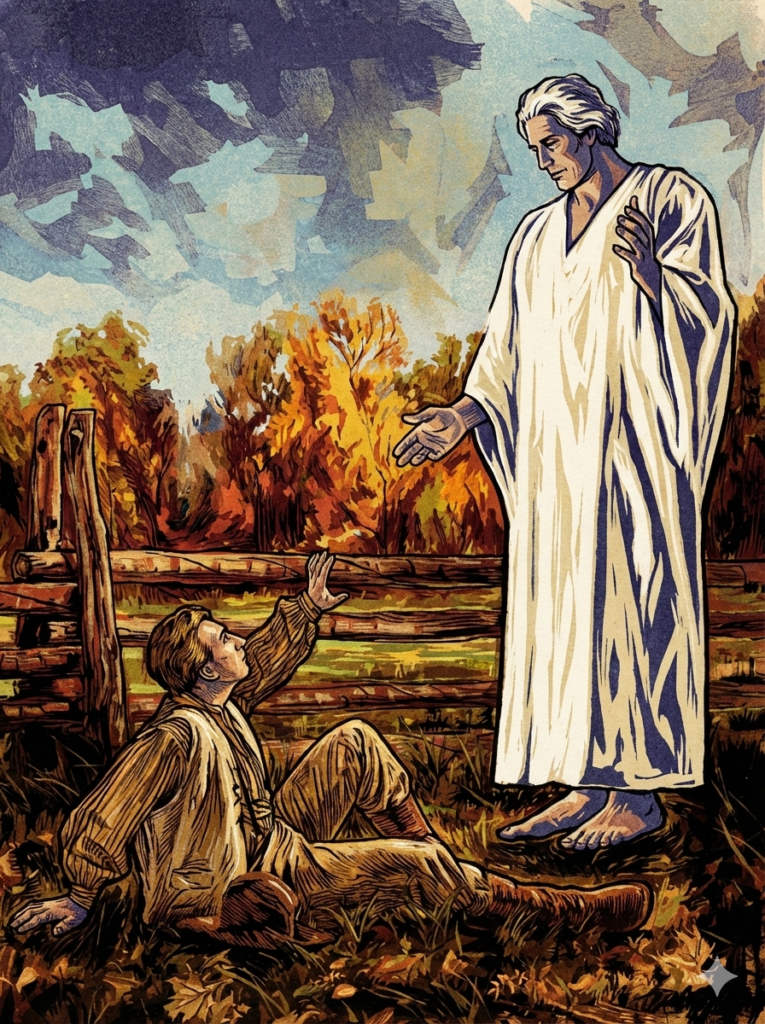
THE ANGEL MORONI AND
CHRISTIAN ANGELOLOGY:
A Scholarly Examination of Divergent Doctrines
Introduction: The Golden Figure on Temple Spires
His likeness adorns the steeples of many Latter-day Saint temples, a gleaming golden figure with a trumpet raised to his lips, symbolizing the restoration of the gospel of Jesus Christ to the earth. He was the son of the prophet Mormon, the last Nephite prophet and military commander in ancient America. According to LDS teaching, after his death around 421 A.D., he became an angel and eventually appeared to Joseph Smith as a resurrected being. He allegedly tutored Joseph Smith in the early 1800s, beginning with the vision account dated to September 21, 1823, when he revealed the location of the golden plates from which the Book of Mormon was translated. Interestingly enough, he is described occasionally as an “angel of light,” a designation that carries profound theological implications when examined through the lens of traditional Christian doctrine. This figure is Moroni—perhaps the most prominent angel in Latter-day Saint theology, yet completely unknown in the broader Christian tradition.
This article provides a comprehensive comparative analysis of angelology from a traditional Christian perspective grounded in biblical revelation and the theology of angels as presented in Latter-day Saint scripture and teaching. By examining the nature, origin, and function of angels in both traditions, with particular attention to the figure of Moroni, we aim to illuminate the significant theological divergences that exist between historic Christianity and the Church of Jesus Christ of Latter-day Saints. This examination will draw upon scriptural references from the English Standard Version (ESV) Bible, LDS canonical texts, statements from LDS general authorities, and the broader scholarly discourse on angelology.
Part One: Traditional Christian Angelology—A Biblical Foundation
The Nature and Origin of Angels in Scripture
Traditional Christian theology, grounded in the authoritative witness of Scripture, presents angels as a distinct order of created beings—ontologically separate from humanity. The English word “angel” derives from the Greek angelos and the Hebrew mal’akh, both meaning “messenger.” While this etymological foundation emphasizes their function, Scripture reveals far more about their essence and place in the created order.
The biblical witness is unambiguous: angels are created beings, brought into existence by God’s sovereign word. The Psalmist declares, “Praise him, all his angels; praise him, all his hosts!… Let them praise the name of the LORD! For he commanded and they were created.” (Psalm 148:2, 5, ESV). This passage establishes a fundamental theological reality: angels were created as angels, not transformed from some prior state of existence. They are not evolved humans, graduated spirits, or beings who achieved angelic status through moral development.
The Apostle Paul provides crucial christological grounding for this doctrine in his letter to the Colossians: “For by him [Christ] all things were created, in heaven and on earth, visible and invisible, whether thrones or dominions or rulers or authorities—all things were created through him and for him.” (Colossians 1:16, ESV). The terms “thrones,” “dominions,” “rulers,” and “authorities” refer to angelic ranks and classifications, establishing that Christ is the creator of all heavenly beings. This has profound implications for any theology that would conflate angelic nature with human nature, as it positions angels within a distinct category of creation.
The temporal priority of angelic creation is attested in Job 38:4-7, where God speaks to Job from the whirlwind: “Where were you when I laid the foundation of the earth?… when the morning stars sang together, and all the sons of God shouted for joy?” The “morning stars” and “sons of God” are widely understood as references to angels, indicating their existence before the creation of the material universe and certainly before the creation of humanity.
Angels as Spirit Beings: The Testimony of Hebrews
The author of Hebrews provides definitive teaching on the nature of angels. In Hebrews 1:14, we read: “Are they not all ministering spirits sent out to serve for the sake of those who are to inherit salvation?” (ESV). The designation “ministering spirits” (leitourgika pneumata) reveals the essential nature of angels: they are pneumata—spirits. This is not a temporary condition or a transitional state; it is their created essence.
This stands in marked contrast to human beings, who are described in Scripture as embodied souls. When God created Adam, He “formed the man of dust from the ground and breathed into his nostrils the breath of life, and the man became a living creature.” (Genesis 2:7, ESV). Human beings possess physical bodies as an essential component of their created nature. While Christians await the resurrection of the body (1 Corinthians 15), and while our intermediate state involves a temporary separation of soul and body, embodiment remains central to what it means to be human. Angels, by contrast, are spiritual beings by nature.
The first two chapters of Hebrews elaborate extensively on the distinction between Christ and the angels, establishing that the Son of God is superior to all angelic beings. This theological argument would be unnecessary and incoherent if angels were deceased or glorified humans. The entire structure of the epistle presupposes that angels constitute a separate order of being from humanity, one that serves and worships the Son rather than sharing in His nature or status.
The Angelic Hierarchy: Biblical Classifications
Scripture reveals various orders and classifications of angelic beings, though it does not provide a systematic hierarchy in the manner later developed by figures such as Pseudo-Dionysius the Areopagite. The following classifications emerge from the biblical text:
Seraphim: Described in Isaiah 6:1-7, the seraphim (Hebrew for “burning ones”) stand in the presence of God, each having six wings. They perpetually proclaim God’s holiness: “Holy, holy, holy is the LORD of hosts; the whole earth is full of his glory!” (Isaiah 6:3, ESV). The seraphim serve a function of worship and purification, as demonstrated when one touches Isaiah’s lips with a burning coal.
Cherubim: First mentioned in Genesis 3:24, where they guard the entrance to Eden after the fall, cherubim appear throughout Scripture in connection with God’s presence and glory. Ezekiel’s vision (Ezekiel 1, 10) describes them as having four faces (lion, ox, human, and eagle) and four wings. They are associated with the Ark of the Covenant (Exodus 25:18-22) and symbolize God’s sovereign presence.
Archangels: The term “archangel” (from the Greek archaggelos, meaning “chief messenger”) appears only twice in the canonical New Testament. In 1 Thessalonians 4:16, Paul writes: “For the Lord himself will descend from heaven with a cry of command, with the voice of an archangel, and with the sound of the trumpet of God.” In Jude 1:9, Michael is specifically identified as “the archangel Michael” who contended with the devil about the body of Moses. Gabriel, though not explicitly called an archangel in canonical Scripture, appears as a prominent angelic messenger in Daniel 8:16, 9:21, and Luke 1:19, 26.
What emerges from this biblical data is a picture of angels as a vast, organized host of spiritual beings created by God to serve His purposes. They are worshippers, messengers, warriors, and servants—but they are never presented as former or future humans.
Key Biblical Passages on Angels
Throughout both Testaments, angels appear as agents of divine revelation and intervention. In the Old Testament, the “angel of the LORD” (sometimes understood as a theophany or preincarnate appearance of Christ) appears to Hagar (Genesis 16:7-11), Abraham (Genesis 22:11-15), Moses (Exodus 3:2), Balaam (Numbers 22:22-35), Gideon (Judges 6:11-22), and many others. Angels deliver messages, pronounce judgments, protect God’s people, and execute divine decrees.
In the New Testament, angels announce the birth of John the Baptist (Luke 1:11-20) and Jesus (Luke 1:26-38; 2:8-14), minister to Christ after His temptation (Matthew 4:11), strengthen Him in Gethsemane (Luke 22:43), announce His resurrection (Matthew 28:2-7), and facilitate the release of apostles from prison (Acts 5:19; 12:7-10). The book of Revelation depicts angels in worship, judgment, and cosmic warfare throughout its apocalyptic visions.
Jesus Himself taught about angels on numerous occasions, speaking of “their angels” who behold the face of the Father (Matthew 18:10), affirming that in the resurrection people “neither marry nor are given in marriage, but are like angels in heaven.” (Matthew 22:30, ESV), and warning of the final judgment when “the Son of Man will send his angels.” (Matthew 13:41). Notably, Jesus’s teaching that resurrected humans will be “like angels” implies a distinction between the two categories rather than an identity.
Part Two: Moroni and LDS Angelology
The LDS Doctrine of Angels: A Fundamental Departure
Latter-day Saint theology presents a fundamentally different understanding of angels than that found in traditional Christianity. According to the official LDS Guide to the Scriptures, “There are two kinds of beings in heaven who are called angels: those who are spirits and those who have bodies of flesh and bone. Angels who are spirits have not yet obtained a body of flesh and bone, or they are spirits who have once had a mortal body and are awaiting resurrection. Angels who have bodies of flesh and bone have either been resurrected from the dead or translated.”
This definition reveals the distinctly anthropocentric nature of LDS angelology. In this framework, angels are not a separate order of created beings but rather humans in various stages of existence. The categories include: premortal spirits awaiting birth, disembodied spirits between death and resurrection, translated beings who have not yet died, and resurrected beings with glorified bodies. The Doctrine and Covenants states: “There are no angels who minister to this earth but those who do belong or have belonged to it.” (D&C 130:5).
This teaching has far-reaching theological implications. If angels are simply humans at different stages of existence, then the biblical distinction between angelic and human nature dissolves. Furthermore, this raises profound questions about the nature of heavenly beings described in Scripture—were the cherubim who guarded Eden once human? Were the seraphim of Isaiah’s vision former mortals? LDS theology must either answer these questions affirmatively (which strains the biblical text) or acknowledge categories of beings that do not fit their angelological framework.
Moroni: Son of Mormon, Last Nephite Prophet
According to the Book of Mormon, Moroni was the son of Mormon, the prophet-historian who abridged the Nephite records. The Nephites, according to LDS teaching, were an ancient American civilization descended from Israelites who fled Jerusalem around 600 B.C. Moroni served as a military commander during the final wars between the Nephites and their enemies, the Lamanites.
Following the destruction of the Nephite nation around 385 A.D., Moroni wandered alone for several decades, completing his father’s record and adding his own writings, including the book of Ether (an abridgment of Jaredite history) and the book of Moroni. According to the narrative, he buried the golden plates in the Hill Cumorah (identified with a location in western New York) around 421 A.D.
The transition from mortal prophet to resurrected angel is central to the Moroni narrative. LDS teaching holds that following his death, Moroni was eventually resurrected and commissioned to appear to Joseph Smith. This appearance allegedly occurred on September 21, 1823, when Moroni visited the young Joseph Smith in his bedroom, appearing “in a loose robe of most exquisite whiteness” with a countenance “truly like lightning” (Joseph Smith—History 1:31-32). Over the course of that night and the following day, Moroni reportedly appeared to Smith multiple times, delivering instructions about the buried golden plates and quoting numerous passages from the Bible.
The Identity Confusion: Moroni or Nephi?
A significant historical complication surrounds the identification of this angelic visitor. Joseph Smith’s 1838 history, as originally written and published in church periodicals including the Times and Seasons (which Smith himself edited), identified the angel as “Nephi,” not Moroni. This identification persisted in several publications, including the first edition of the Pearl of Great Price (1851) and Lucy Mack Smith’s history of her son.
Mary Whitmer, mother to several of the Book of Mormon witnesses, reportedly had a visionary experience with an angel whom she always called “Brother Nephi.” It was not until later editions that “Nephi” was changed to “Moroni” in LDS canonical texts. Most Latter-day Saints today regard this as a transcription error, though the persistence of the “Nephi” identification across multiple documents and witnesses raises questions about the reliability of the foundational narrative.
Moroni and Revelation 14: The Angel with the Everlasting Gospel
A central claim of LDS theology is that Moroni fulfills the prophecy of Revelation 14:6-7: “Then I saw another angel flying directly overhead, with an eternal gospel to proclaim to those who dwell on earth, to every nation and tribe and language and people. And he said with a loud voice, ‘Fear God and give him glory, because the hour of his judgment has come, and worship him who made heaven and earth, the sea and the springs of water.’” (ESV).
President Gordon B. Hinckley declared at a General Conference: “That angel has come. His name is Moroni.” This identification connects the Restoration narrative to biblical prophecy, lending scriptural authority to the claims about Moroni’s mission. The golden figure of Moroni atop LDS temples represents this prophetic fulfillment—the angel flying with the everlasting gospel.
However, several problems attend this identification. First, Revelation 14 describes not one but three angels, each with a distinct message. The second angel announces the fall of Babylon (14:8), and the third warns of judgment against those who worship the beast (14:9-11). If Moroni is the first angel, who are the second and third? LDS teaching provides no identification for these figures, which undermines the interpretive consistency of equating Moroni with the angel of verse 6. Why would one prophetic angel be identified while the other two remain anonymous?
Second, the angel of Revelation 14:6 proclaims the gospel “to every nation and tribe and language and people.” Nearly two centuries after Moroni’s alleged appearance, the Book of Mormon has been translated into fewer than 100 languages—a small fraction of the world’s approximately 7,000 languages. This falls dramatically short of the universal proclamation described in the prophecy.
Third, and most significantly, the traditional Christian interpretation of Revelation 14 understands these events as occurring in connection with the final judgment and the consummation of history. The immediate context speaks of the 144,000 (14:1-5), the fall of Babylon (14:8), judgment on beast-worshippers (14:9-11), the blessedness of the righteous dead (14:13), and the harvest of the earth (14:14-20). To isolate verse 6 as a prophecy fulfilled in 1823 while the surrounding verses await future fulfillment strains the literary and theological coherence of the passage.
Part Three: Critical Comparisons and Theological Tensions
Are Humans and Angels Ontologically Distinct?
The most fundamental difference between traditional Christian and LDS angelology concerns the nature of angels themselves. Traditional Christianity, rooted in biblical teaching, maintains that angels and humans are ontologically distinct categories of being. Humans are created in God’s image (Genesis 1:26-27), embodied souls with a unique place in the created order. Angels are spiritual beings created to serve God and minister to His people (Hebrews 1:14).
LDS theology collapses this distinction. In the LDS framework, angels, humans, and even God the Father are all members of the same species at different stages of eternal progression. Brigham Young stated that “Angels are those beings who have been on an earth like this, and have passed through the same ordeals that we are now passing through.” Elder B.H. Roberts wrote that angels “are intelligences of the human species… men, who have, like Enoch or Elijah, been translated; or, like Jesus Christ, been raised from the dead.”
This creates an entirely different theological universe. In traditional Christianity, the incarnation of Christ is unique and unrepeatable—God taking on human nature without ceasing to be God. In LDS theology, God the Father Himself was once a man who progressed to godhood, and faithful Latter-day Saints may likewise become gods. Angels are simply those who occupy intermediate positions on this continuum.
Why Moroni and Not Michael or Gabriel?
A significant question arises from within the LDS framework itself: Why would Moroni be the angel chosen to initiate the Restoration rather than Michael or Gabriel, who hold superior positions in the LDS angelic hierarchy?
According to Joseph Smith’s teaching, “The Priesthood was first given to Adam; he obtained the First Presidency. He is Michael the Archangel, spoken of in the Scriptures. Then to Noah, who is Gabriel: he stands next in authority to Adam in the Priesthood.” This places Michael (Adam) and Gabriel (Noah) at the apex of the priesthood hierarchy, above all other angelic beings.
If the Restoration was the most significant event since the resurrection of Christ—as LDS leaders have claimed—why would this task be delegated to Moroni rather than Michael or Gabriel? The LDS answer typically involves Moroni’s specific connection to the Book of Mormon: he buried the plates and therefore had stewardship over them. Yet this explanation raises further questions about the nature of angelic authority and the relative importance of different angelic ministrations in LDS thought.
The Orson Pratt Paradox: Angels as Gods
Early LDS apostle Orson Pratt articulated a startling aspect of LDS angelology: “Some angels are Gods, and still possess the lower office called angels. Adam is called an Archangel, yet he is a God. Abraham, Isaac and Jacob, no doubt, have the right to officiate in the capacity of angels if they choose, but still they have ascended to their exaltation, to a higher state than that of angels—namely, to thrones, kingdoms, principalities and powers, to reign over kingdoms and to hold the everlasting Priesthood.”
This statement reveals the radical departure of LDS theology from historic Christianity. In this framework, angelic status is not a fixed ontological category but a “lower office” that can be held even by beings who have attained godhood. Adam is simultaneously an archangel and a god. The implications are staggering: the distinction between Creator and creature, fundamental to biblical theism, dissolves into a spectrum of beings at various levels of “exaltation.”
This also creates internal tensions within LDS theology. If Adam is Michael the Archangel and also a god, what is the relationship between his status and the status of Elohim (God the Father)? The Adam-God doctrine, taught by Brigham Young and later disavowed by the LDS Church, represents one attempt to resolve these tensions—an attempt that created more problems than it solved and that the modern church has explicitly rejected. President Spencer W. Kimball stated in 1976 that the Adam-God doctrine was false doctrine, yet the underlying framework that generated it remains embedded in LDS scripture and teaching.
The Problem of Fallen Angels and Spirit Brothers
LDS theology faces a significant internal contradiction regarding fallen angels. According to LDS teaching, fallen angels are premortal spirits who followed Lucifer in rebellion against God’s plan. The official LDS Guide to the Scriptures states: “The scriptures also speak of the devil’s angels. These are those spirits who followed Lucifer and were thrust out of God’s presence in the premortal life and cast down to the earth.”
This creates an apparent contradiction with the LDS teaching that angels are resurrected or translated humans. Lucifer and his followers never received mortal bodies and will never be resurrected, yet they are called “angels.” This suggests that “angel” in LDS usage is not a consistent category but rather a term applied to different types of beings in different contexts.
Furthermore, LDS theology teaches that Lucifer is the “spirit brother” of Jesus Christ, both being spirit children of Heavenly Father in the premortal existence. This claim is deeply problematic from a traditional Christian perspective, which maintains the eternal deity of Christ (John 1:1-3) and His ontological distinction from all created beings, including Satan. The LDS framework places Jesus and Satan in the same category as spirit siblings, differing only in moral choice rather than in essential nature.
Part Four: The “Angel of Light” Designation
Moroni Described as an Angel of Light
Joseph Smith’s account describes Moroni appearing in a brilliant light. According to the official narrative, when Moroni first appeared, “the room was lighter than at noonday,” and the angel himself appeared “glorious beyond description” with a countenance “truly like lightning” (Joseph Smith—History 1:30-32). These descriptions have led to Moroni being characterized, on some occasions, as an “angel of light.”
This designation carries profound weight in light of the Apostle Paul’s warning in 2 Corinthians 11:13-15: “For such men are false apostles, deceitful workmen, disguising themselves as apostles of Christ. And no wonder, for even Satan disguises himself as an angel of light. So it is no surprise if his servants, also, disguise themselves as servants of righteousness. Their end will correspond to their deeds.” (ESV).
Paul’s warning identifies a key strategy of satanic deception: the presentation of evil as good, darkness as light. The most effective deceptions do not appear overtly demonic; they come wrapped in the appearance of holiness, righteousness, and divine authority. The question of whether Moroni was genuinely an angel from God or a deceptive spirit masquerading as an angel of light is not unfair—it is precisely the kind of spiritual discernment that Scripture commands Christians to exercise.
The FAIR Latter-day Saints Defense
The apologetic organization FAIR Latter-day Saints addresses this concern by arguing that “The angel Moroni testified of Jesus Christ, which is something that Satan would never have done.” They appeal to the test provided in 1 John 4:2-3: “By this you know the Spirit of God: every spirit that confesses that Jesus Christ has come in the flesh is from God, and every spirit that does not confess Jesus is not from God.”
However, this defense contains a significant flaw. Scripture actually records multiple instances where demonic beings acknowledge Jesus as the Christ:
In the wilderness temptation, Satan addressed Jesus as “the Son of God” (Matthew 4:3, 6). In Luke 4:41, “demons also came out of many, crying, ‘You are the Son of God!’ But he rebuked them and would not allow them to speak, because they knew that he was the Christ.” (ESV). In the Gadarene demoniac account, the demons cried out, “What have you to do with us, O Son of God?” (Matthew 8:29, ESV) and “What have you to do with me, Jesus, Son of the Most High God?” (Mark 5:7, ESV).
Demonic beings clearly know and can articulate the identity of Jesus Christ. Their verbal acknowledgment of His identity is not evidence of their righteousness but of their awareness. The test of 1 John 4 must be understood in its context—it addresses the docetic heresy that denied Christ’s true incarnation, not the question of whether any spirit that says “Jesus” must therefore be good. James 2:19 observes that “even the demons believe—and shudder!”
The Galatians 1:8 Test
Perhaps more relevant to evaluating Moroni’s message is Paul’s warning in Galatians 1:8-9: “But even if we or an angel from heaven should preach to you a gospel contrary to the one we preached to you, let him be accursed. As we have said before, so now I say again: If anyone is preaching to you a gospel contrary to the one you received, let him be accursed” (ESV).
The critical question is whether the message delivered by Moroni—and the theological system built upon that message—constitutes “another gospel” in the Pauline sense. Traditional Christianity, in its various expressions, has consistently answered this question affirmatively. The LDS gospel differs from historic Christianity on fundamental issues including the nature of God (three separate beings versus one God in three persons), the nature of humanity (eternal intelligences versus created souls), the means of salvation (exaltation through ordinances and progression versus justification by grace through faith), and the sufficiency of Scripture (addition of Book of Mormon, Doctrine and Covenants, and Pearl of Great Price versus sola scriptura).
If LDS theology represents “another gospel,” then Moroni—regardless of his appearance in light—falls under the apostolic anathema of Galatians 1:8. The appearance of light is no guarantee of divine origin; the content of the message determines its authenticity.
Part Five: Additional Theological Questions
Why Only Moroni as a Resurrected Angel-Human?
While LDS theology theoretically allows for any resurrected individual to serve in an angelic capacity, Moroni occupies a uniquely prominent position in the Restoration narrative. Other angelic visitors identified in LDS accounts include John the Baptist (who restored the Aaronic Priesthood), Peter, James, and John (who restored the Melchizedek Priesthood), Moses, Elijah, and Elias (who committed various keys), and Michael and Raphael (mentioned in D&C 128:21).
Yet Moroni alone appears on temple spires. His statue has become the most visible symbol of the LDS Church worldwide. This raises the question: Why the disproportionate emphasis on a Book of Mormon prophet rather than biblical figures? One possible answer is that Moroni serves as an implicit validation of the Book of Mormon’s historicity. His prominence keeps the Book of Mormon central to LDS identity in a way that emphasizing biblical figures would not.
The Gospel Given to Adam: Where Did It Go?
Elder Mark E. Petersen of the Quorum of the Twelve Apostles stated in 1980: “In the day that the gospel was given to Adam, the Holy Ghost fell upon him, and the divine voice of Jesus Christ—the Jehovah of that time—said to him by the power of the Holy Ghost: ‘I am the Only Begotten of the Father from the Beginning’ (Moses 5:9).”
This raises a critical historical question: If Adam received the “gospel” in its fullness, including knowledge of Christ, priesthood authority, and temple ordinances (as LDS theology claims), how did this knowledge disappear? LDS theology posits repeated cycles of apostasy and restoration, with the gospel being lost and restored multiple times throughout history. The final “restoration” through Joseph Smith was necessary because a “great apostasy” had corrupted Christianity following the death of the original apostles.
Traditional Christianity presents a different picture. While acknowledging corruption and error in various periods of church history, historic Christianity maintains that the apostolic faith has been preserved through Scripture and the continuous witness of the church. The gates of hell have not prevailed against Christ’s church (Matthew 16:18). The LDS narrative of total apostasy is essential to justify the need for Joseph Smith’s prophetic mission, but it contradicts the biblical promise of Christ’s continuing presence with His people.
The Logical Fallacy in the Joseph Smith Test
Joseph Smith articulated a test for identifying false prophets: “If I profess to be a witness or teacher, and have not the spirit of prophecy, which is the testimony of Jesus, I must be a false witness… any man who says he is a teacher or preacher of righteousness, and denies the spirit of prophecy, is a liar, and the truth is not in him; and by this key false teachers and impostors may be detected.” (Teachings of the Prophet Joseph Smith, p. 269).
This formulation contains a classic logical fallacy. It assumes that anyone who claims to have “the testimony of Jesus” and “the spirit of prophecy” must therefore be a true prophet. But this is circular reasoning. A false prophet could easily claim to have the testimony of Jesus (as we have seen, even demons acknowledge Christ). The test provides no way to distinguish between genuine prophets and false prophets who make similar claims. It is self-referentially validating—Joseph Smith, by claiming to have the spirit of prophecy, automatically passes his own test.
The biblical test for prophets is more rigorous. Deuteronomy 18:22 states that if a prophet’s predictions do not come true, “that is a message the LORD has not spoken.” Deuteronomy 13:1-3 adds that even if a prophet’s signs come true, if he leads people after other gods, he is a false prophet. The content of the teaching, not merely the claim to inspiration, determines authenticity.
Conclusion: Two Irreconcilable Visions
This comparative analysis has revealed fundamental and irreconcilable differences between traditional Christian angelology and the LDS understanding of angels. These differences extend far beyond matters of detail; they reflect divergent visions of the nature of God, the created order, human destiny, and the means of salvation.
Traditional Christianity, grounded in the authoritative witness of Scripture, maintains that angels are a distinct order of created spiritual beings who serve God and minister to His people. Humans are ontologically separate from angels, created in God’s image with embodied souls. The incarnation of Christ is unique and unrepeatable, and the Creator-creature distinction is fundamental to biblical theism.
LDS theology presents a radically different picture. Angels are humans in various stages of eternal progression. The Creator-creature distinction dissolves into a spectrum of beings at different levels of advancement. God the Father was once a man; faithful humans may become gods. This is not an alternative interpretation of the Bible but an entirely different theological framework imported into biblical language.
Moroni serves as the preeminent symbol of this LDS angelology. A golden figure atop temple spires, he represents the claim that an ancient American prophet-warrior became a resurrected angel and appeared to Joseph Smith to inaugurate the Restoration. For traditional Christians, this claim must be evaluated against Paul’s warning about angels of light who preach “another gospel.”
The stakes of this evaluation are eternal. Both traditions claim to offer a way of salvation. Both claim divine authority for their teachings. They cannot both be right on matters where they fundamentally disagree. The task of the sincere seeker is to examine the evidence, test the spirits, and discern which message accords with the apostolic faith once delivered to the saints. May that examination be conducted with rigor, honesty, and dependence upon the illumination of the Holy Spirit through the inscripturated Word of God.
Selected Resources for Further Study
LDS Sources:
Church of Jesus Christ of Latter-day Saints, “Angels,” Guide to the Scriptures:
Holland, Jeffrey R., “The Ministry of Angels,” General Conference, October 2008
Petersen, Mark E., “Adam, the Archangel,” General Conference, October 1980
FAIR Latter-day Saints, “Moroni’s visit/Angel of Satan“:
Ask Gramps, “Do Latter-day Saints Believe That Guardian Angels Are Assigned to Them?“:
Traditional Christian Sources:
Bible.org, “Angelology: The Doctrine of Angels”
Got Questions, “What Are Angels in the Bible?”
Got Questions, “What Does It Mean That Satan Masquerades as an Angel of Light?”
Crossway, “What Are Angels and How Should Christians Think About Them?”
Ligonier Ministries, “Angels and Demons”
The Gospel Coalition, “The Spirit World: Angels”
Critical and Comparative Sources:
Mormonism Research Ministry, “Revelation 14:6-7: Moroni Delivering the Book of Mormon?”
Mormonism Research Ministry, “Angels and Humans”
Dialogue Journal, “The Adam-God Doctrine”
Miscellaneous Resources:
• https://askgramps.org/how-do-people-become-angels-and-not-gods/
• https://www.churchofjesuschrist.org/study/scriptures/gs/angels?lang=eng
• https://www.churchofjesuschrist.org/study/general-conference/2008/10/the-ministry-of-angels?lang=eng
• https://eom.byu.edu/index.php/Angels
• https://rsc.byu.edu/gospel-jesus-christ-old-testament/path-angels
• https://www.churchofjesuschrist.org/study/ensign/2014/12/angels-we-have-heard?lang=eng
• https://mormonwiki.com/Angels
• https://davidjeremiah.blog/angels-and-demons-in-the-bible-part-one/
• https://biblehub.com/library/evans/the_great_doctrines_of_the_bible/the_doctrine_of_angels.htm
• https://www.greattruthsglobal.org/the-spiritual-creatures/