
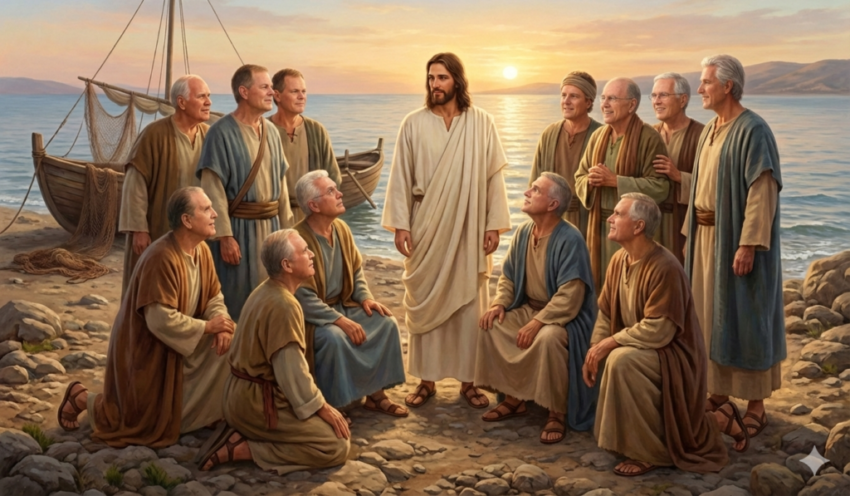
Photo: Google Gemini’s Nano Banana imagines the Quorum of the
Twelve Apostles meeting with Jesus for some prophetic updates.
A Comprehensive Biblical and Theological Analysis
Examining LDS Prophetic Claims Against Traditional Biblical Standards
1. Introduction
The Church of Jesus Christ of Latter-day Saints (LDS Church) rests upon a foundational claim that distinguishes it from the traditional Christian tradition: the assertion that God continues to speak through living prophets and apostles who possess the same authority, power, and divine mandate as their ancient biblical counterparts. This claim is not peripheral to Mormon theology but stands at its very center, forming the bedrock upon which the entire edifice of LDS doctrine, practice, and authority is constructed.
According to official LDS teaching, prophets serve as God’s authorized spokespersons to the entire world. The official Church website states:
A prophet is someone who has been called by God to give guidance to the entire world. From Abraham and Moses to living prophets today, God follows a pattern of guiding His children through prophets.
— The Church of Jesus Christ of Latter-day Saints (https://www.churchofjesuschrist.org/comeuntochrist)
This comprehensive examination tests whether the LDS understanding of prophets and apostles aligns with biblical precedent and traditional Christian theology. Through rigorous examination of both biblical texts and LDS historical records, we will explore whether the prophetic and apostolic offices as currently constituted in the LDS Church bear genuine resemblance to their New Testament antecedents, or whether they represent a fundamental departure from the biblical pattern.
The significance of this inquiry cannot be overstated. If the LDS claim to prophetic and apostolic authority proves valid, then their assertion to be ‘the only true and living church upon the face of the whole earth’ (Doctrine and Covenants 1:30) demands serious consideration. Conversely, if these claims fail to withstand biblical scrutiny, then the entire foundation of LDS distinctive claims to divine authority collapses, regardless of the sincerity of its adherents or the moral quality of its teachings.
This analysis proceeds with respect for sincere Latter-day Saint believers while maintaining rigorous theological and historical standards. We will examine:
• The biblical distinctions between the roles of prophets and apostles
• The historical development of these offices within Mormonism
• The differences between the current LDS administration and biblical mandates
• The administrative nature of LDS succession and its lack of biblical qualifications
• A critical examination of the “general apostasy” narrative
• Current activities of the Quorum of the Twelve Apostles
• Issues surrounding modern revelations and the closed versus open canon debate
Our methodology combines careful exegesis of biblical texts with historical analysis of LDS practice and doctrine. We will allow both Scripture and LDS sources to speak for themselves, drawing conclusions based on the weight of evidence rather than predetermined assumptions.
2. Biblical Distinctions Between Prophets and Apostles
The Role of Prophets in Biblical Theology
In the Hebrew Scriptures, the prophet (Hebrew: nabi’) served as God’s covenant messenger to Israel. The prophetic office was not self-appointed but divinely commissioned, as evidenced in the callings of Moses (Exodus 3), Samuel (1 Samuel 3), Isaiah (Isaiah 6), Jeremiah (Jeremiah 1), and Ezekiel (Ezekiel 1-3). These men did not volunteer for prophetic ministry; rather, God’s call often came as an interruption to their normal lives, sometimes against their will (Jeremiah 20:7-917 O Lord, thou hast deceived me, and I was deceived; thou art stronger than I, and hast prevailed: I am in derision daily, every one mocketh me. 8 For since I spake, I cried out, I cried violence and spoil; because the word of the Lord was made a reproach unto me, and a derision, daily. 9 Then I said, I will not make mention of him, nor speak any more in his name. But his word was in mine heart as a burning fire shut up in my bones, and I was weary with forbearing, and I could not stay.; Jonah 1:1-321 Now the word of the Lord came unto Jonah the son of Amittai, saying, 2 Arise, go to Nineveh, that great city, and cry against it; for their wickedness is come up before me. 3 But Jonah rose up to flee unto Tarshish from the presence of the Lord, and went down to Joppa; and he found a ship going to Tarshish: so he paid the fare thereof, and went down into it, to go with them unto Tarshish from the presence of the Lord.).
The biblical prophets operated within clearly defined parameters:
First, prophets received direct divine revelation through dreams, visions, or the ‘word of the Lord.’ Numbers 12:6 records God’s own description: ‘If there be a prophet among you, I the Lord will make myself known unto him in a vision, and will speak unto him in a dream.’ This immediacy and clarity of divine communication distinguished true prophets from false ones who ‘prophesy out of their own hearts’ (Ezekiel 13:2).
Second, Old Testament prophets functioned as covenant mediators, calling Israel back to faithfulness to the Mosaic covenant. They did not introduce fundamentally new covenants or requirements beyond what God had already revealed at Sinai. Their message was consistently one of return and restoration. Jeremiah 6:16 captures this conservative function: ‘Thus says the Lord: Stand in the ways and see, and ask for the old paths, where the good way is, and walk in it; then you will find rest for your souls.’
Third, prophets demonstrated remarkable moral courage, often confronting kings and religious leaders at great personal risk. Nathan rebuked David for adultery and murder (2 Samuel 12). Elijah challenged Ahab and the prophets of Baal (1 Kings 18). Jeremiah endured imprisonment for his unwavering message (Jeremiah 37-38). True prophets did not adjust their message to please their audience or preserve their social standing.
Fourth, nearly 300 Old Testament prophecies anticipated Jesus’ advent with stunning precision. Isaiah prophesied the virgin birth (Isaiah 7:143Therefore the Lord himself will give you a sign. Behold, the virgin shall conceive and bear a son, and shall call his name Immanuel.), the suffering servant (Isaiah 53), and the coming of the anointed one. Micah predicted Bethlehem as the birthplace (Micah 5:24 But you, O Bethlehem Ephrathah, who are too little to be among the clans of Judah, from you shall come forth for me one who is to be ruler in Israel, whose coming forth is from of old, from ancient days.). Daniel outlined the timeline leading to the Messiah’s arrival (Daniel 9:24-27524 “Seventy weeks are decreed about your people and your holy city, to finish the transgression, to put an end to sin, and to atone for iniquity, to bring in everlasting righteousness, to seal both vision and prophet, and to anoint a most holy place. 25 Know therefore and understand that from the going out of the word to restore and build Jerusalem to the coming of an anointed one, a prince, there shall be seven weeks. And for sixty-two weeks it shall be built again with squares and moat, but in a troubled time. 26 And after the sixty-two weeks, an anointed one shall be cut off and shall have nothing. And the people of the prince who is to come shall destroy the city and the sanctuary. Its end shall come with a flood, and to the end there shall be war. Desolations are decreed. 27 And he shall make a strong covenant with many for one week, and for half of the week he shall put an end to sacrifice and offering. And on the wing of abominations shall come one who makes desolate, until the decreed end is poured out on the desolator.”). The prophetic office existed fundamentally to prepare God’s people for Christ.
The great and compelling triad of responsibility laid upon the Church is to, first, carry the gospel of Jesus Christ to the people of the earth; second, to implement that gospel in the lives of the membership of the Church; and, third, to extend through vicarious work its blessings to those who have passed beyond the veil of death.
— President Gordon B. Hinckley (https://www.churchofjesuschrist.org/study/liahona/2020/03/the-lord-leads-his-church-through-prophets-and-apostles)
The Role of Apostles in the New Testament
The apostolic office represents a distinct New Testament development, though with roots in Jesus’ own ministry. The Greek word apostolos means ‘one sent forth’ and carries the weight of authorized representation. When Jesus called the Twelve Apostles, He was establishing foundational witnesses to His resurrection and authoritative teachers of His gospel.
The New Testament establishes several non-negotiable qualifications for apostleship:
First, apostles were personally chosen by Christ Himself. Jesus declared: ‘Ye have not chosen me, but I have chosen you, and ordained you, that ye should go and bring forth fruit’ (John 15:16). This direct, personal commissioning by Christ distinguished apostles from other church officers.
Second, apostles served as eyewitnesses to Christ’s resurrection. Acts 1:21-22621 So one of the men who have accompanied us during all the time that the Lord Jesus went in and out among us, 22 beginning from the baptism of John until the day when he was taken up from us—one of these men must become with us a witness to his resurrection. establishes this criterion when choosing Matthias to replace Judas: ‘one of these must become a witness with us of His resurrection.’ Paul, though called after Christ’s ascension, emphasized his direct encounter with the risen Lord (1 Corinthians 9:17Am I not free? Am I not an apostle? Have I not seen Jesus our Lord? Are not you my workmanship in the Lord?; 15:88Last of all, as to one untimely born, he appeared also to me.).
Third, apostles demonstrated supernatural validation of their ministry through ‘signs of an apostle’ (2 Corinthians 12:129The signs of a true apostle were performed among you with utmost patience, with signs and wonders and mighty works.). The book of Acts records the apostles performing miraculous healings, raising the dead, and exercising authority over demonic powers. Hebrews 2:3-4103 how shall we escape if we neglect such a great salvation? It was declared at first by the Lord, and it was attested to us by those who heard, 4 while God also bore witness by signs and wonders and various miracles and by gifts of the Holy Spirit distributed according to his will. confirms that the gospel was ‘confirmed unto us by them that heard Him; God also bearing them witness, both with signs and wonders, and with divers miracles, and gifts of the Holy Ghost.’
Fourth, the New Testament presents the apostolic office as foundational rather than perpetual. Ephesians 2:20 describes the church as ‘built upon the foundation of the apostles and prophets, Jesus Christ himself being the chief corner stone.’ Foundations are laid once; they are not rebuilt with each generation. Revelation 21:1411And the wall of the city had twelve foundations, and on them were the twelve names of the twelve apostles of the Lamb. envisions the New Jerusalem with ‘twelve foundations, and in them the names of the twelve apostles of the Lamb’—a fixed number commemorating a completed work.
The Prophetic Office Fulfilled in Christ
Understanding prophets and apostles within the broader framework of biblical theology illuminates their function and limitations. The prophetic office emerged because Israel needed mediators between themselves and God. At Sinai, the people begged Moses to speak to God on their behalf (Exodus 20:1912and said to Moses, “You speak to us, and we will listen; but do not let God speak to us, lest we die.”). Prophets served this mediatorial role, bringing God’s word to the people and interceding on behalf of the people before God.
However, the prophetic office always pointed beyond itself to a greater prophet to come. Moses himself prophesied: ‘The Lord thy God will raise up unto thee a Prophet from the midst of thee, of thy brethren, like unto me; unto him ye shall hearken’ (Deuteronomy 18:15). The New Testament identifies this prophet as Jesus Christ (Acts 3:22-231322 Moses said, ‘The Lord God will raise up for you a prophet like me from your brothers. You shall listen to him in whatever he tells you. 23 And it shall be that every soul who does not listen to that prophet shall be destroyed from the people.’). In Christ, the prophetic office finds its ultimate fulfillment.
The author of Hebrews articulates this fulfillment clearly:
God, who at sundry times and in divers manners spake in time past unto the fathers by the prophets, hath in these last days spoken unto us by his Son, whom he hath appointed heir of all things, by whom also he made the worlds.
— Hebrews 1:1-2
The shift from ‘prophets’ to ‘Son’ indicates a qualitative change in God’s mode of communication. The fragmentary, progressive revelation through various prophets has given way to the complete, final revelation in Jesus Christ. He is not merely another prophet in a succession of prophets but the final, perfect revelation of God—‘the radiance of the glory of God and the exact imprint of his nature’ (Hebrews 1:3).
With Christ’s arrival and the completion of His work, the need for ongoing prophetic offices fundamentally changes. The New Testament does not envision a perpetual succession of prophets and apostles directing the church from the top down. Instead, it presents a model where the apostolic teaching, once delivered and preserved in Scripture, provides the authoritative standard by which all subsequent teaching must be measured.
3. Historical Development of Prophetic and Apostolic Roles in Mormonism
The Early Pattern Under Joseph Smith
The development of prophetic and apostolic offices in Mormonism reveals a pattern markedly different from biblical precedent. Church founder Joseph Smith’s earliest revelations reflected what historians call a ‘primitivist impulse’—an attempt to recreate the church structure of Jesus Christ’s time. However, this reconstruction took nearly five years from the church’s organization on April 6, 1830, until February 14, 1835, when the first Quorum of the Twelve Apostles was assembled.
Historian Benjamin Park, author of ‘American Zion: A New History of Mormonism,’ explains:
Church founder Joseph Smith’s earliest revelations saw calling apostles as part of the ‘primitivist impulse,’ trying to re-create what was happening in Jesus Christ’s time. Jesus Christ called 12 apostles. But it actually took Joseph five years [from when the church was organized] until Feb. 14, 1835 [to assemble a Quorum of the Twelve Apostles]. That initial quorum was ordered by age. They were the ‘traveling quorum,’ and their primary duties were outside of church headquarters.
— Benjamin Park (https://www.sltrib.com/religion/2026/02/01/lds-apostles-deeper-look-history/)
This initial configuration—apostles as the ‘traveling quorum’ responsible for missions outside headquarters—differs significantly from the current LDS structure, where apostles constitute the highest administrative body of the global church. The transformation from itinerant missionaries to corporate administrators represents a fundamental shift in the apostolic role.
The Succession Crisis and Brigham Young
The succession crisis following Joseph Smith’s death in 1844 proved pivotal in establishing the pattern that continues today. Brigham Young secured leadership not through any clear prophetic designation but by appealing to his position as senior member of the Quorum of the Twelve Apostles. This established the principle of seniority-based succession that has governed LDS presidential transitions ever since.
After the original apostles died, seniority became determined by ordination date rather than age. This system created predictable, orderly transitions but departed from any biblical pattern of prophetic calling. Where biblical prophets were often surprisingly chosen by God—David, the youngest son; Amos, a herdsman with no prophetic pedigree; Saul of Tarsus, a persecutor of the church—LDS prophetic succession follows an entirely institutional and predictable pathway.
The Era of Mormon Royalty
For much of LDS history, church leadership positions were dominated by what Benjamin Park calls ‘Mormon royalty’—descendants of the founding families, particularly the Smiths and other pioneer dynasties. J. Golden Kimball, a church leader famous for his colorful statements, once remarked that there were two primary drivers for calling church authorities: ‘revelation and relation.’
The extent of this nepotistic pattern is remarkable. Park notes:
Between 1835 and 2023, there were only 25 years in which there was not a descendant of Joseph Smith Sr. in the quorum. Between 1890 and 1910, we have the following second- and third-generation apostles serving in the Quorum of the Twelve: Joseph F. Smith, Brigham Young Jr., Francis Lyman, John Henry Smith, John W. Taylor, Abraham Cannon, Abraham Woodruff, Hyrum Mack Smith, George Albert Smith, George F. Richards, Orson F. Whitney and Joseph Fielding Smith. All of them had either an apostolic father or grandfather.
— Benjamin Park (https://www.sltrib.com/religion/2026/02/01/lds-apostles-deeper-look-history/)
This pattern of dynastic succession bears no resemblance to biblical prophetic calling. God’s selection of prophets consistently confounded human expectations and familial privilege. The concentration of ecclesiastical power within specific family lines suggests institutional self-perpetuation rather than divine selection based on spiritual qualifications.
Modern Selection Patterns
Contemporary apostolic selections have diversified somewhat, with recent appointments including international representatives and individuals from varied professional backgrounds. However, the fundamental pattern remains: apostles are selected by the sitting president, typically from among proven administrators within the church hierarchy, based on demonstrated loyalty to institutional priorities.
Benjamin Park observes:
They are often thinking about how to preserve the types of practices and ideas they believe should continue in the future. They probably are looking for apostles who have particular skills and backgrounds that might meet certain needs. It’s not a surprise that when it becomes public that the church has these massive financial reserves, they call Elder Gary Stevenson. He has a very successful business background and knows how to work with massive accrual of wealth.
— Benjamin Park (https://www.sltrib.com/religion/2026/02/01/lds-apostles-deeper-look-history/)
This utilitarian approach to apostolic selection—choosing men for their administrative skills, business acumen, or demographic representation—fundamentally differs from the biblical pattern where God chose prophets for their spiritual sensitivity and willingness to speak uncomfortable truths, regardless of their practical qualifications or social acceptability.
4. Current Administration of Apostles versus Biblical Mandates
The Claim of Divine Responsibility
The LDS Church asserts that its modern apostles possess ‘the same divine responsibility’ as the New Testament apostles. President Dallin H. Oaks, in an official Church publication, declared:
Apostles who hold the keys of the priesthood have the right and responsibility to preside over and direct the activities of the priesthood of God and the Church of Jesus Christ upon the earth. This includes the performance and supervision of the essential ordinances of the gospel.
— President Dallin H. Oaks (https://www.churchofjesuschrist.org/study/liahona/2020/03/the-lord-leads-his-church-through-prophets-and-apostles)
This claim deserves scrutiny when compared against the biblical record of apostolic ministry. The New Testament apostles demonstrated their divine commissioning through specific, verifiable means that are conspicuously absent from modern LDS apostolic ministry. See also, Do the LDS Prophets Speak for God?
The Test of Miraculous Signs
The apostle Paul identified ‘the signs of an apostle’ as distinguishing marks of authentic apostolic authority: ‘Truly the signs of an apostle were wrought among you in all patience, in signs, and wonders, and mighty deeds’ (2 Corinthians 12:12). The book of Acts provides extensive documentation of these apostolic signs:
• Peter’s shadow healed the sick (Acts 5:1514so that they even carried out the sick into the streets and laid them on cots and mats, that as Peter came by at least his shadow might fall on some of them.)
• Peter raised Dorcas from the dead (Acts 9:4015 But Peter put them all outside, and knelt down and prayed; and turning to the body he said, “Tabitha, arise.” And she opened her eyes, and when she saw Peter she sat up.)
• Paul was bitten by a viper without harm (Acts 28:3-6163 When Paul had gathered a bundle of sticks and put them on the fire, a viper came out because of the heat and fastened on his hand. 4 When the native people saw the creature hanging from his hand, they said to one another, “No doubt this man is a murderer. Though he has escaped from the sea, Justice[a] has not allowed him to live.” 5 He, however, shook off the creature into the fire and suffered no harm. 6 They were waiting for him to swell up or suddenly fall down dead. But when they had waited a long time and saw no misfortune come to him, they changed their minds and said that he was a god.)
• Paul raised Eutychus from the dead (Acts 20:9-12179 And a young man named Eutychus, sitting at the window, sank into a deep sleep as Paul talked still longer. And being overcome by sleep, he fell down from the third story and was taken up dead. 10 But Paul went down and bent over him, and taking him in his arms, said, “Do not be alarmed, for his life is in him.” 11 And when Paul had gone up and had broken bread and eaten, he conversed with them a long while, until daybreak, and so departed. 12 And they took the youth away alive, and were not a little comforted.)
• Unusual miracles occurred through Paul’s handkerchiefs (Acts 19:11-121811 And God was doing extraordinary miracles by the hands of Paul, 12 so that even handkerchiefs or aprons that had touched his skin were carried away to the sick, and their diseases left them and the evil spirits came out of them.)
These were not isolated incidents but consistent patterns validating apostolic authority. The writer of Hebrews confirms this pattern: ‘God also bearing them witness, both with signs and wonders, and with divers miracles, and gifts of the Holy Ghost, according to his own will’ (Hebrews 2:4).
Modern LDS apostles claim the same authority but demonstrate none of these validating signs. No verifiable healings, no resurrections of the dead, no supernatural protection from harm. The absence of these ‘signs of an apostle’ represents a fundamental discontinuity with the biblical pattern.
Full-Time Service and Retirement
The LDS Church promotes the narrative that its apostles make a profound sacrifice by “leaving behind their careers for full-time service,” a claim often invoked to evoke spiritual devotion akin to biblical discipleship. However, this portrayal crumbles under scrutiny, revealing a pattern far removed from genuine relinquishment and starkly divergent from New Testament precedent.
In reality, virtually every man called to the LDS Quorum of the Twelve Apostles has long since wrapped up his professional life by the time of his elevation. Consider the data: since the modern Quorum’s formation, appointees have averaged 64–68 years old at calling, with many in their seventies. Russell M. Nelson was 68 when called as an apostle in 1984, having already retired from a distinguished career as a world-renowned heart surgeon. Dallin H. Oaks was 66, transitioning from the Utah Supreme Court after decades in law and academia. Jeffrey R. Holland was 66, post his tenure as BYU president. More recently, Patrick Kearon was 58—a relative outlier—but still after 30+ years leading BBC World Service and church administration.
These men do not abandon thriving enterprises or mid-career momentum. They step from retirement lounges, emeritus professorships, or cushioned board positions into apostleship. Their “sacrifice” involves trading golf rounds or consulting gigs for boardroom-style meetings in Temple Square—hardly the stuff of existential risk. The Church’s own biographies trumpet these pre-call resumes as qualifications, underscoring that careers are not merely left behind but fully exhausted beforehand. This gerontological selection ensures minimal disruption: no uprooted families midstream, no forfeited promotions, no scramble for health insurance. Apostleship arrives as a capstone, not a crucible.
Modern LDS Apostles: Corporate Climbers, Not Shepherds
The professional pedigrees of contemporary LDS apostles underscore a seismic departure from biblical apostolic origins. Far from fishermen mending nets or tax collectors tallying receipts, these men ascend from corner suites and ivory towers—business moguls, jurists, physicians, and academicians whose résumés scream executive polish, not prophetic grit. This pattern cements the LDS Quorum as an elite gerontocracy, handpicked for administrative acumen over spiritual spontaneity.
Business Tycoons and Fitness Empires
Elder Gary E. Stevenson exemplifies the corporate track: before his 2013 apostleship call at age 56, he helmed ICON Health & Fitness as president/CEO, catapulting it to North America’s largest fitness equipment manufacturer (Reebok, NordicTrack). He parlayed entrepreneurial ventures—starting in lawn care, scaling to multimillion-dollar import deals—into a fortune, funding family ski chalets and church contributions. No flocks tended here; just profit margins and product lines.
Elder Quentin L. Cook, called at 76 (2007), logged decades as vice chairman of Sutter Health (California’s second-largest hospital system) and managing partner at Carrick & Codina law firm, blending healthcare exec with Silicon Valley dealmaking. Elder Ronald A. Rasband, elevated at 64 (2015), rose through corporate ranks as Xerox regional manager, Huntsman Chemical executive VP, and Deseret Management Corporation CEO—overseeing media empires like KSL-TV amid chemical conglomerates.
Elder D. Todd Christofferson (66 at 2008 calling) cut teeth at a Budapest law firm post-Harvard JD, negotiating international contracts—not casting nets.
Medical Mandarins
Physicians dominate: President Russell M. Nelson, ordained apostle in 1984 at 59, pioneered heart surgery worldwide—first quadruple bypass (1955), first heart transplant valve (1960s), Japanese medalist (1980s)—retiring as LDS Hospital surgeon-in-chief and University of Utah professor emeritus. Elder Dale G. Renlund (62 at 2015), Swedish transplant cardiologist at the University of Utah, specialized in heart failure, publishing in top journals before Intermountain Healthcare directorship. Elder Ulisses Soares (59 in 2018), Brazilian physician-turned-lawyer, practiced medicine amid stake presidencies.
Elder Patrick Kearon (58 at 2023), British media exec (BBC World Service managing director), lacks MD but fits the upscale mold.
Judicial and Academic Heavyweights
President Dallin H. Oaks, apostle at 66 (1984), peaked as Utah Supreme Court justice (1980–84), BYU president (1971–80, quadrupling enrollment), and University of Chicago Law professor. Elder Neal L. Andersen (57 in 2009) helmed Deseret News Publishing Company as executive VP. Elder David A. Bednar (52 at 2004), youngest recent call, served as BYU-Idaho president (1997–2004), transforming it post-merger.
Elder Gerrit W. Gong (65 at 2018) chaired BYU Asian/Pacific Studies; Elder Dieter F. Uchtdorf (63 at 2004) flew as a Lufthansa pilot/captain (first non-American in Q12), VP airline operations.
Biblical Disconnect
Contrast Peter’s boat-hauling (Matthew 4:18–221918 While walking by the Sea of Galilee, he saw two brothers, Simon (who is called Peter) and Andrew his brother, casting a net into the sea, for they were fishermen. 19 And he said to them, “Follow me, and I will make you fishers of men.”[a] 20 Immediately they left their nets and followed him. 21 And going on from there he saw two other brothers, James the son of Zebedee and John his brother, in the boat with Zebedee their father, mending their nets, and he called them. 22 Immediately they left the boat and their father and followed him.), Matthew’s tollbooth (Matthew 9:920 As Jesus passed on from there, he saw a man called Matthew sitting at the tax booth, and he said to him, “Follow me.” And he rose and followed him.), Paul’s tentmaking (Acts 18:321and because he was of the same trade he stayed with them and worked, for they were tentmakers by trade.). No CVs of caesars or clerics; Jesus plucked laborers, not laureates. Amos? “No prophet… I was an herdsman” (Amos 7:1422Then Amos answered and said to Amaziah, “I was no prophet, nor a prophet’s son, but I was a herdsman and a dresser of sycamore figs.). This C-suite quorum prioritizes BYU MBAs over Galilee calluses, equipping them for boardrooms over back alleys—administering a $100B+ conglomerate, not igniting apostolic fire.
These professional credentials suit them well for corporate management but differ markedly from biblical prophetic preparation. Moses was a shepherd. Amos tended sycamore trees. Elisha was plowing. Peter, James, and John were fishermen. Biblical prophets and apostles came from ordinary occupations, called by God for spiritual sensitivity rather than administrative competence.
The LDS pattern reveals a church that values proven institutional loyalty, administrative skill, and theological conservatism over prophetic boldness or spiritual charisma. Apostles are selected from among men who have demonstrated their willingness to work within the system, advance institutional priorities, and avoid controversial positions. This ensures institutional stability but prevents the kind of prophetic disruption that characterized biblical prophets.
Biblical Contrast: Prime-of-Life Abandonment
This stands in thunderous contrast to the New Testament model. Jesus summoned fishermen Peter, Andrew, James, and John—strapping men in their twenties or thirties, nets in hand, boats half-loaded—from active trades (Matthew 4:18–222318 While walking by the Sea of Galilee, he saw two brothers, Simon (who is called Peter) and Andrew his brother, casting a net into the sea, for they were fishermen. 19 And he said to them, “Follow me, and I will make you fishers of men.” 20 Immediately they left their nets and followed him. 21 And going on from there he saw two other brothers, James the son of Zebedee and John his brother, in the boat with Zebedee their father, mending their nets, and he called them. 22 Immediately they left the boat and their father and followed him.; Mark 1:16–20). Matthew Levi abandoned his lucrative tax booth on the spot (Matthew 9:924As Jesus passed on from there, he saw a man called Matthew sitting at the tax booth, and he said to him, “Follow me.” And he rose and followed him.), forfeiting a despised but steady income amid social scorn. These were not retirees winding down; they were breadwinners in their prime, instantly severing livelihoods without severance packages or pensions.
Peter’s testimony captures the raw stakes: “Lo, we have left all, and followed thee” (Luke 18:2825And Peter said, “See, we have left our homes and followed you.”; Mark 10:2826Peter began to say to him, “See, we have left everything and followed you.”). Paul ditched his Pharisee status and tentmaking (Acts 18:327and because he was of the same trade he stayed with them and worked, for they were tentmakers by trade.; Philippians 3:7–8287 But whatever gain I had, I counted as loss for the sake of Christ. 8 Indeed, I count everything as loss because of the surpassing worth of knowing Christ Jesus my Lord. For his sake I have suffered the loss of all things and count them as rubbish, in order that I may gain Christ), counting all gain as loss. These apostles plunged into penury, wandering penniless, housed by hospitality, sustained by sporadic gifts—facing hunger, shipwreck, scourging, and martyrdom (2 Corinthians 11:23–272923 Are they servants of Christ? I am a better one—I am talking like a madman—with far greater labors, far more imprisonments, with countless beatings, and often near death. 24 Five times I received at the hands of the Jews the forty lashes less one. 25 Three times I was beaten with rods. Once I was stoned. Three times I was shipwrecked; a night and a day I was adrift at sea; 26 on frequent journeys, in danger from rivers, danger from robbers, danger from my own people, danger from Gentiles, danger in the city, danger in the wilderness, danger at sea, danger from false brothers; 27 in toil and hardship, through many a sleepless night, in hunger and thirst, often without food,[a] in cold and exposure.). Their obedience demanded total, tangible forfeiture, modeling Christ’s call: “Take up the cross, and follow me” (Matthew 16:243024 Then Jesus told his disciples, “If anyone would come after me, let him deny himself and take up his cross and follow me.).
LDS Security: No Cross to Bear
LDS apostles, by contrast, inherit a gilded existence. They receive stipends estimated at $120,000+ annually (tax-free, per whistleblower accounts), plus perquisites: spacious offices, private jets for global jaunts, executive healthcare, spousal travel allowances, and adoring deference from millions. The Church’s vast portfolio—$100+ billion in investments—underwrites this, ensuring not sacrifice but elevation. Families remain intact in affluent wards; social capital soars. Where biblical apostles begged and bivouacked, modern LDS ones banquet in boardrooms.
This sleight-of-hand perpetuates a myth of mimicry while inverting the gospel’s economics. Jesus warned riches choke discipleship (Matthew 19:23–243123 And Jesus said to his disciples, “Truly, I say to you, only with difficulty will a rich person enter the kingdom of heaven. 24 Again I tell you, it is easier for a camel to go through the eye of a needle than for a rich person to enter the kingdom of God.”); yet here, late-career laureates gain more. The result? A leadership cadre detached from the rank-and-file’s struggles, presiding over a correlation-tightened empire that prizes stability over surrender. True apostolic witness demands leaving everything—not merely polishing the mantel with a final plaque.
Administrative Focus versus Apostolic Mission
The LDS Church portrays its Quorum of the Twelve Apostles as modern successors to Peter and Paul, “special witnesses” of Christ tasked with global oversight. Yet their documented duties reveal a CEO-like immersion in bureaucracy—overseeing departments, tithe disposition, missionary logistics, temple committees, and executive councils—far eclipsing any spiritual mandate. This corporate churn inverts the New Testament priority, where apostles jettisoned administration to prioritize prayer, doctrine, and resurrection witness.
Documented Executive Workload
Official Church sources and insider accounts paint a relentless calendar of meetings and management:
-
Departmental Oversight: Each apostle supervises a rotating portfolio of Church operations—missionary work (Ronald A. Rasband chairs the Missionary Executive Council), temple/family history (Neil L. Andersen chairs that council), priesthood/family (Dale G. Renlund vice-chairs), correlation (David A. Bednar chairs), scriptures/hymns (Renlund chairs both). They dive into “details” via frequent meetings, per former members and Reddit-sourced observations from Q12-adjacent circles.
-
Weekly Governance Sessions: Every Thursday, the Quorum convenes with the First Presidency (Q15) for council meetings doubling as sacrament—handling “matters of church government,” logistics, and policy. Sundays often involve stake conferences, not pulpit preaching.
-
Global Bureaucracy: Apostles negotiate with governments for missionary access, organize stakes, and direct 70 area presidents managing 100,000+ missionaries and $100B+ assets. Gerrit W. Gong oversees Asia/North areas; Ulisses Soares, Caribbean/Pacific. Travel—private jets to 190 countries—centers on diplomacy and dedication, not evangelism.
-
Conference and Training Cadence: Semi-annual General Conferences (e.g., October 4–5, 2025) demand talk prep for 15–17 million viewers, plus quarterly leadership broadcasts and youth events (e.g., Worldwide Youth Event October 26, 2025, led by Jeffrey R. Holland).
Their days mirror Fortune 500 execs: boardrooms, budgets, briefings—not bedside baptisms or street preaching.
Biblical Apostles: Delegation and Devotion
Scripture flips this script. Early apostles declared: “It is not reason that we should leave the word of God, and serve tables… But we will give ourselves continually to prayer, and to the ministry of the word” (Acts 6:2–4). They ordained deacons for widows’ aid, freeing them for apostolic core: teaching sound doctrine, miracles, and “witnesses… of his resurrection” (Acts 1:2232beginning from the baptism of John until the day when he was taken up from us—one of these men must become with us a witness to his resurrection.”; 4:3333And with great power the apostles were giving their testimony to the resurrection of the Lord Jesus, and great grace was upon them all.).
Paul epitomized this: “I determined not to know any thing among you, save Jesus Christ, and him crucified” (1 Corinthians 2:2). His epistles brim with theology, not spreadsheets; travels spread gospel, not governance. Administration? Delegated to elders, deacons, Timothy, Titus (1 Timothy 3; Titus 1). No quarterly quotas, no tithe audits—just bold proclamation amid persecution.
The Fatal Inversion
Today’s LDS apostles embody the delegated drudgery biblical leaders offloaded, while claiming a title whose essence they cannot fulfill: eyewitnesses to the risen Christ (Acts 1:21–223421 So one of the men who have accompanied us during all the time that the Lord Jesus went in and out among us, 22 beginning from the baptism of John until the day when he was taken up from us—one of these men must become with us a witness to his resurrection.). None saw Calvary or the empty tomb; their “testimony” rests on subjective visions or Joseph Smith’s—secondhand at best. They micromanage what Peter pawned off, neglecting the irreplaceable: firsthand resurrection witness that authenticated the Twelve (1 Corinthians 15:3–8353 For I delivered to you as of first importance what I also received: that Christ died for our sins in accordance with the Scriptures, 4 that he was buried, that he was raised on the third day in accordance with the Scriptures, 5 and that he appeared to Cephas, then to the twelve. 6 Then he appeared to more than five hundred brothers at one time, most of whom are still alive, though some have fallen asleep. 7 Then he appeared to James, then to all the apostles. 8 Last of all, as to one untimely born, he appeared also to me.).
This role-reversal yields a top-heavy hierarchy prioritizing institutional perpetuity over gospel fire. Where apostles once ignited churches, LDS ones calibrate corporations—trading Peter’s Pentecost for PowerPoints.
The Eyewitness Qualification
Scripture unequivocally anchors apostleship to direct, physical eyewitness encounter with the resurrected Christ—a non-negotiable validation of authority and message. Without it, no one qualifies as an apostle in the biblical sense. LDS claims to apostolic succession founder fatally here, as modern Quorum members proffer subjective convictions but zero firsthand sightings of the risen Lord.
Matthias: The Replacement Standard
Peter, channeling the Twelve’s consensus, codified this criterion post-ascension: “Wherefore of these men which have companied with us all the time that the Lord Jesus went in and out among us, Beginning from the baptism of John, unto that same day that he was taken up from us, must one be ordained to be a witness with us of his resurrection” (Acts 1:21–22). This triple filter—full ministry companionship, from Jordan baptism to Olivet ascension, climaxing in resurrection sighting—narrowed candidates to Joseph Barsabbas and Matthias. Prayer and lots selected Matthias, restoring the Twelve as unimpeachable attestors (Acts 1:23–263623 And they put forward two, Joseph called Barsabbas, who was also called Justus, and Matthias. 24 And they prayed and said, “You, Lord, who know the hearts of all, show which one of these two you have chosen 25 to take the place in this ministry and apostleship from which Judas turned aside to go to his own place.” 26 And they cast lots for them, and the lot fell on Matthias, and he was numbered with the eleven apostles.; Ephesians 2:2037built on the foundation of the apostles and prophets, Christ Jesus himself being the cornerstone,).
This wasn’t optional optics; it ensured the gospel’s factual bedrock. Apostles weren’t theorists but “witnesses of everything [Jesus] did… They killed him… but God raised him… and caused him to be seen” (Acts 10:39–40). Their testimony hinged on senses: seeing scars (John 20:2738Then he said to Thomas, “Put your finger here, and see my hands; and put out your hand, and place it in my side. Do not disbelieve, but believe.”), hearing a voice (John 20:1639 Jesus said to her, “Mary.” She turned and said to him in Aramaic,[a] “Rabboni!” (which means Teacher).), touching flesh (Luke 24:3940See my hands and my feet, that it is I myself. Touch me, and see. For a spirit does not have flesh and bones as you see that I have.”; 1 John 1:141That which was from the beginning, which we have heard, which we have seen with our eyes, which we looked upon and have touched with our hands, concerning the word[a] of life—).
Paul’s Exceptional Validation
Saul/Paul, the “abnormally born” outlier (1 Corinthians 15:842Last of all, as to one untimely born, he appeared also to me.), bypassed earthly tenure via Damascus blaze: “Am I not an apostle? am I not free? have I not seen Jesus Christ our Lord?” (1 Corinthians 9:143Am I not free? Am I not an apostle? Have I not seen Jesus our Lord? Are not you my workmanship in the Lord?). Blinded by glory, he heard the voice (Acts 9:4–6444 And falling to the ground, he heard a voice saying to him, “Saul, Saul, why are you persecuting me?” 5 And he said, “Who are you, Lord?” And he said, “I am Jesus, whom you are persecuting. 6 But rise and enter the city, and you will be told what you are to do.”; 22:6–11456 “As I was on my way and drew near to Damascus, about noon a great light from heaven suddenly shone around me. 7 And I fell to the ground and heard a voice saying to me, ‘Saul, Saul, why are you persecuting me?’ 8 And I answered, ‘Who are you, Lord?’ And he said to me, ‘I am Jesus of Nazareth, whom you are persecuting.’ 9 Now those who were with me saw the light but did not understand[a] the voice of the one who was speaking to me. 10 And I said, ‘What shall I do, Lord?’ And the Lord said to me, ‘Rise, and go into Damascus, and there you will be told all that is appointed for you to do.’ 11 And since I could not see because of the brightness of that light, I was led by the hand by those who were with me, and came into Damascus.), beheld the risen One—same Greek horaō (“seen”) as prior appearances to Cephas, the Twelve, 500 brethren, James (1 Corinthians 15:5–8465 and that he appeared to Cephas, then to the twelve. 6 Then he appeared to more than five hundred brothers at one time, most of whom are still alive, though some have fallen asleep. 7 Then he appeared to James, then to all the apostles. 8 Last of all, as to one untimely born, he appeared also to me.). This post-ascension epiphany, corroborated communally, equipped Paul as “least… yet called… apostle” (1 Corinthians 15:947For I am the least of the apostles, unworthy to be called an apostle, because I persecuted the church of God.), wielding signs authenticating his witness (2 Corinthians 12:1248The signs of a true apostle were performed among you with utmost patience, with signs and wonders and mighty works.).
LDS Void: No Sightings Claimed
No LDS apostle—past or present—meets this bar. Brigham Young saw Joseph Smith shot, not Christ resurrected. Ezra Taft Benson spoke of visions, but none a bodily Jesus post-Calvary. Moderns like Nelson or Oaks testify as “special witnesses” via Spirit-burn or temple vibes, not Mount-of-Olives-style manifestations (contra Acts 1:349He presented himself alive to them after his suffering by many proofs, appearing to them during forty days and speaking about the kingdom of God.,9–11509 And when he had said these things, as they were looking on, he was lifted up, and a cloud took him out of their sight. 10 And while they were gazing into heaven as he went, behold, two men stood by them in white robes, 11 and said, “Men of Galilee, why do you stand looking into heaven? This Jesus, who was taken up from you into heaven, will come in the same way as you saw him go into heaven.”). Even sympathetic LDS sources list historical witnesses (Mary, disciples, Thomas—John 20:24–295124 Now Thomas, one of the twelve, called the Twin,[a] was not with them when Jesus came. 25 So the other disciples told him, “We have seen the Lord.” But he said to them, “Unless I see in his hands the mark of the nails, and place my finger into the mark of the nails, and place my hand into his side, I will never believe.” 26 Eight days later, his disciples were inside again, and Thomas was with them. Although the doors were locked, Jesus came and stood among them and said, “Peace be with you.” 27 Then he said to Thomas, “Put your finger here, and see my hands; and put out your hand, and place it in my side. Do not disbelieve, but believe.” 28 Thomas answered him, “My Lord and my God!” 29 Jesus said to him, “Have you believed because you have seen me? Blessed are those who have not seen and yet have believed.”) without Q12 inclusion.
LDS, New Era Staff: They Saw Him
These individuals actually saw the resurrected Savior, but you, too, can be a witness of Christ in your own way.
This disqualifies them outright. Biblical apostles’ cornerstone was empirical: “That which… we have seen with our eyes… handled with our hands” (1 John 1:152That which was from the beginning, which we have heard, which we have seen with our eyes, which we looked upon and have touched with our hands, concerning the word[a] of life—). Feelings confirm faith for believers (John 20:2953Jesus said to him, “Have you believed because you have seen me? Blessed are those who have not seen and yet have believed.”), but apostleship demands sight-commissioned certification. Absent this, LDS “apostles” peddle delegated doctrine atop a foundationless claim—echoing false claimants Paul excoriated (2 Corinthians 11:1354 For such men are false apostles, deceitful workmen, disguising themselves as apostles of Christ.).
5. Administrative Succession and the Lack of Biblical Qualifications
Mechanical Seniority: LDS Presidential Succession
The LDS Church enshrines a rigid, algorithmic succession: upon a prophet-president’s death, the First Presidency dissolves; the Quorum of the Twelve Apostles assumes presiding authority under its senior-most member (by ordination date, not age); that man—invariably—becomes the new president after a pro forma meeting, unanimous vote, and solemn assembly sustaining. This lockstep protocol, codified since 1900, guarantees “orderly transitions” but eradicates divine spontaneity, mirroring corporate bylaws more than prophetic anointings.
Official Documentation of the Formula
LDS scriptures and manuals spell it out explicitly:
-
Doctrine & Covenants 107:21–24, 33: Establishes Quorum equality to the First Presidency; upon presidential death, “the Twelve… become[s] the presiding… authority” with the senior apostle as president pro tempore. D&C 107:22 mandates “the Twelve… travel… among all nations,” but succession pivots on tenure math.
-
Church Manuals: “Teachings of the Living Prophets Teacher Manual” (Chapter 3): “Seniority has been determined according to the date of each member’s ordination to the Quorum of the Twelve… This seniority… determines who presides.” Upon death, “the President of the Twelve… leads the quorum… [and] becomes President of the Church.”
-
Historical Precedents: Post-Joseph Smith (1844), Brigham Young (ordained 1835) presided as #1. Wilford Woodruff (1835) followed; Lorenzo Snow clarified continuous service over ordination (1900, elevating Joseph F. Smith over Brigham Young Jr.). Modern era: David O. McKay (1951), Spencer W. Kimball (1973), all via seniority clock. Post-Monson (2018): Russell M. Nelson (1984 ordination); post-Nelson hypothetical: Dallin H. Oaks (1984).
-
Newsroom Protocols: Death triggers “apostolic interregnum”; Quorum meets (often funeral Sunday); senior apostle sustained unanimously, sets apart counselors. E.g., “The Quorum of the Twelve unanimously selects the new President… the longest-serving Apostle has always become the President” (LDS365, 2025).
Public trackers like Threestory Studio visualize it: ordination dates dictate destiny, with members charting Nelson → Oaks → Bednar queues years ahead.
Theological Void: No Divine Fingerprint
Biblically, leaders emerged via sovereign surprises: Moses’ burning bush (Exodus 3); Saul’s anointing (1 Samuel 10); David’s shepherd summons (1 Samuel 16); disciples’ seaside call (Mark 1:16–205516 Passing alongside the Sea of Galilee, he saw Simon and Andrew the brother of Simon casting a net into the sea, for they were fishermen. 17 And Jesus said to them, “Follow me, and I will make you become fishers of men.” 18 And immediately they left their nets and followed him. 19 And going on a little farther, he saw James the son of Zebedee and John his brother, who were in their boat mending the nets. 20 And immediately he called them, and they left their father Zebedee in the boat with the hired servants and followed him.). Succession? Joshua via imposition of hands (Numbers 27:18–235618 So the Lord said to Moses, “Take Joshua the son of Nun, a man in whom is the Spirit, and lay your hand on him. 19 Make him stand before Eleazar the priest and all the congregation, and you shall commission him in their sight. 20 You shall invest him with some of your authority, that all the congregation of the people of Israel may obey. 21 And he shall stand before Eleazar the priest, who shall inquire for him by the judgment of the Urim before the Lord. At his word they shall go out, and at his word they shall come in, both he and all the people of Israel with him, the whole congregation.” 22 And Moses did as the Lord commanded him. He took Joshua and made him stand before Eleazar the priest and the whole congregation, 23 and he laid his hands on him and commissioned him as the Lord directed through Moses.; Deuteronomy 34:957And Joshua the son of Nun was full of the spirit of wisdom, for Moses had laid his hands on him. So the people of Israel obeyed him and did as the Lord had commanded Moses.), but confirmed by miracles. Apostles filled by Spirit-guided lots (Acts 1:24–265824 And they prayed and said, “You, Lord, who know the hearts of all, show which one of these two you have chosen 25 to take the place in this ministry and apostleship from which Judas turned aside to go to his own place.” 26 And they cast lots for them, and the lot fell on Matthias, and he was numbered with the eleven apostles.), not rosters. Paul via vision (Acts 9). No “waiting lists”; God upended expectations (Gideon, youngest shepherd; Amos, herdsman).
LDS math mocks this: Members crunch dates—“If Oaks outlives Nelson, he’s next”—reducing “thus saith the Lord” to actuarial tables. Where’s Elijah’s mantle quest (2 Kings 2)? Or divine veto, as Saul rejected (1 Samuel 15)? Predictability signals institution, not inspiration; a “prophetic queue” where longevity trumps gifting. This gerontocratic conveyor belt yields presidents averaging 80+ at ascension—detached deciders, not dynamic deliverers—betraying the biblical God who “sets up kings… and removes them” (Daniel 2:2159He changes times and seasons; he removes kings and sets up kings; he gives wisdom to the wise and knowledge to those who have understanding;) sans spreadsheets.
Why Not a Random Member from Gilbert, Arizona?
This question exposes the fundamental discontinuity between LDS succession and biblical prophetic calling. In Scripture, God’s choice of prophets consistently surprised and disrupted human expectations:
• God chose David, the youngest and most overlooked of Jesse’s sons (1 Samuel 16:11-136011 Then Samuel said to Jesse, “Are all your sons here?” And he said, “There remains yet the youngest,[a] but behold, he is keeping the sheep.” And Samuel said to Jesse, “Send and get him, for we will not sit down till he comes here.” 12 And he sent and brought him in. Now he was ruddy and had beautiful eyes and was handsome. And the Lord said, “Arise, anoint him, for this is he.” 13 Then Samuel took the horn of oil and anointed him in the midst of his brothers. And the Spirit of the Lord rushed upon David from that day forward. And Samuel rose up and went to Ramah.)
• God called Amos, a herdsman and dresser of sycamore trees, with no prophetic pedigree (Amos 7:14-156114 Then Amos answered and said to Amaziah, “I was[a] no prophet, nor a prophet’s son, but I was a herdsman and a dresser of sycamore figs. 15 But the Lord took me from following the flock, and the Lord said to me, ‘Go, prophesy to my people Israel.’)
• God selected Saul of Tarsus, a violent persecutor of the church, to become the apostle to the Gentiles (Acts 9:1-16)
In each case, God’s choice confounded human wisdom and institutional logic. Yet in the LDS system, a random member from Gilbert, Arizona—no matter how spiritually sensitive, morally exemplary, or divinely called—has zero possibility of becoming church president unless he first spends decades advancing through institutional ranks, receives appointment to the Quorum of the Twelve, and then outlives all senior apostles.
This institutional constraint on divine selection reveals the fundamental nature of LDS prophetic succession: it is a human administrative system, not a pattern of divine calling. The Spirit may guide the selection of new apostles, church leaders claim, but only from among a very narrow pool of proven institutional administrators, and only the most senior survivor can become president.
6. Rebuttal of the General Apostasy Narrative
The LDS Apostasy Claim
The LDS Church’s claim to unique divine authority rests fundamentally on the narrative of a ‘Great Apostasy’—a total corruption of Christ’s church that necessitated a complete restoration through Joseph Smith. This narrative appears in official church teaching:
We explained briefly the Apostasy and the Restoration: that there is vast evidence and history of an apostasy from the doctrine taught by Jesus and his Apostles, that the organization of the original Church became corrupted, and sacred ordinances were changed to suit the convenience of men.
— David B. Haight (https://www.churchofjesuschrist.org/study/general-conference/1979/10/joseph-smith-the-prophet)
This claim requires careful examination because it fundamentally misrepresents both biblical teaching and historical reality.
What the New Testament Actually Teaches
The New Testament epistles written toward the end of the apostolic era make no provision for a total apostasy requiring complete restoration. Instead, they warn of partial apostasy—some falling away—while confidently affirming the church’s continuance until Christ’s return.
Robert M. Bowman, Jr., in his analysis ‘LDS Apostles and Prophets: What Did the New Testament Apostles Say?’ observes:
The New Testament speaks of the apostles as a first-generation, foundational ministry only (Eph. 2:20; 3:5; Heb. 2:3-4; 2 Pet. 3:2; Jude 17). The danger that the church was going to face after the apostles died was not a lack of apostles or prophets, but the teachings of false apostles and prophets. For that reason, both Jesus and his apostles warned repeatedly about false apostles and prophets (Matt. 7:15; 24:11, 24; Mark 13:22; 2 Cor. 11:13-15; 2 Pet. 2:1; 1 John 4:1-6; Rev. 2:2; 16:13; 19:20; 20:10), but never once expressed concern about the church losing its way with a lack of apostles or prophets.
— Robert M. Bowman, Jr. (https://www.namb.net/apologetics/resource/lds-apostles-and-prophets-what-did-the-new-testament-apostles-say/)
This observation is crucial. Jesus warned about false prophets (Matthew 7:1562Beware of false prophets, who come to you in sheep’s clothing but inwardly are ravenous wolves.; 24:1163And many false prophets will arise and lead many astray., 2464 For false christs and false prophets will arise and perform great signs and wonders, so as to lead astray, if possible, even the elect.), false christs (Matthew 24:565 For many will come in my name, saying, ‘I am the Christ,’ and they will lead many astray., 2466For false christs and false prophets will arise and perform great signs and wonders, so as to lead astray, if possible, even the elect.), and false teachers (2 Peter 2:167But false prophets also arose among the people, just as there will be false teachers among you, who will secretly bring in destructive heresies, even denying the Master who bought them, bringing upon themselves swift destruction.). Paul warned that ‘some shall depart from the faith’ (1 Timothy 4:1). But nowhere do the apostles warn about a lack of apostles or prophets, nor do they express concern that the church would completely disappear.
Peter’s Vision for the Post-Apostolic Church
Peter’s parting exhortation in 2 Peter6814 Therefore, beloved, since you are waiting for these, be diligent to be found by him without spot or blemish, and at peace. 15 And count the patience of our Lord as salvation, just as our beloved brother Paul also wrote to you according to the wisdom given him, 16 as he does in all his letters when he speaks in them of these matters. There are some things in them that are hard to understand, which the ignorant and unstable twist to their own destruction, as they do the other Scriptures. 17 You therefore, beloved, knowing this beforehand, take care that you are not carried away with the error of lawless people and lose your own stability. 18 But grow in the grace and knowledge of our Lord and Savior Jesus Christ. To him be the glory both now and to the day of eternity. Amen. demolishes the cornerstone of LDS theology: the notion of a “Great Apostasy” that supposedly extinguished “precious truths,” necessitating Joseph Smith’s prophetic reboot with new apostles and scripture. This claim—that vital doctrines vanished post-apostolic era, leaving a biblical wasteland—crumbles under Peter’s own words, preserved on every LDS member’s bookshelf right next to their Book of Mormon. The New Testament, far from forecasting blackout, equips believers to thrive indefinitely sans replacements.
Peter’s Post-Apostolic Roadmap: Remembrance, Not Restoration
In his final epistle, Peter confronts the church’s future after “the apostles had died” (implied in context of scoffers and false teachers, 2 Peter 3:1–469This is now the second letter that I am writing to you, beloved. In both of them I am stirring up your sincere mind by way of reminder, 2 that you should remember the predictions of the holy prophets and the commandment of the Lord and Savior through your apostles, 3 knowing this first of all, that scoffers will come in the last days with scoffing, following their own sinful desires. 4 They will say, “Where is the promise of his coming? For ever since the fathers fell asleep, all things are continuing as they were from the beginning of creation.”). No frantic call for apostolic sequels; no prophecy of lost keys or doctrinal amnesia. Instead:
“This second epistle, beloved, I now write unto you; in both which I stir up your pure minds by way of remembrance: That ye may be mindful of the words which were spoken before by the holy prophets, and of the commandment of us the apostles of the Lord and Saviour” (2 Peter 3:1–2).
“Remembrance” (hypomimnēskō in Greek: to recall, reawaken)—not restoration. Peter assumes apostolic teaching endures accessibly, sufficient to combat error. No need for new prophets; the old ones’ words suffice. This blueprint—prophets (Old Testament) plus apostles (New)—mirrors the church’s foundation (Ephesians 2:2070built on the foundation of the apostles and prophets, Christ Jesus himself being the cornerstone,), preserved verbatim for posterity.
He reinforces: “Ye therefore, beloved… account that the longsuffering of our Lord is salvation; even as our beloved brother Paul also according to the wisdom given unto him hath written unto you; As also in all his epistles… are some things hard to be understood, which they that are unlearned and unstable wrest, as they do also the other scriptures” (2 Peter 3:15–167115 And count the patience of our Lord as salvation, just as our beloved brother Paul also wrote to you according to the wisdom given him, 16 as he does in all his letters when he speaks in them of these matters. There are some things in them that are hard to understand, which the ignorant and unstable twist to their own destruction, as they do the other Scriptures.). Paul’s letters? Already “scriptures.” Peter welds them to the prophetic canon, ensuring post-mortem continuity.
Growth in Existing Grace, No New Revelators Needed
Peter crescendos without succession anxiety: “But grow in grace, and in the knowledge of our Lord and Saviour Jesus Christ. To him be glory both now and for ever. Amen” (2 Peter 3:1872But grow in the grace and knowledge of our Lord and Savior Jesus Christ. To him be the glory both now and to the day of eternity. Amen.). Solution to deception? Maturation in Christ’s person via apostolic deposit—not fresh apostles unlocking sealed truths.
This obliterates the LDS apostasy narrative. If “precious truths” evaporated, why no warning from Peter, Paul, or John? Paul charges Timothy: “Hold fast the form of sound words… the things that thou hast heard of me among many witnesses… Commit thou to faithful men, who shall be able to teach others also” (2 Timothy 1:1373Follow the pattern of the sound[a] words that you have heard from me, in the faith and love that are in Christ Jesus.; 2:2)—four generations deep, no endgame. Jude urges: “Contend earnestly for the faith which was once for all delivered unto the saints” (Jude 374Beloved, although I was very eager to write to you about our common salvation, I found it necessary to write appealing to you to contend for the faith that was once for all delivered to the saints.)—complete, final (hapax, once-delivered).
Jesus’ Great Commission binds disciples perpetually: “Teaching them to observe all things whatsoever I have commanded you: and, lo, I am with you alway, even unto the end of the world” (Matthew 28:2075teaching them to observe all that I have commanded you. And behold, I am with you always, to the end of the age.). No interim vacuum; the Word endures. LDS shelves groan with this inconvenient truth: Bibles attesting self-sufficiency, mocking restoration myths. Peter’s voice echoes across centuries: remember us—don’t replace us.
Jude’s Exhortation
The apostle Jude, writing concurrently with Peter amid surging heresies, delivers a dagger to the LDS “Great Apostasy” myth. His clarion call presupposes a complete, self-sustaining revelation—delivered once—needing vigilant defense, not prophetic resuscitation.
“Beloved, when I gave all diligence to write unto you of the common salvation, it was needful for me to write unto you, and exhort you that ye should earnestly contend for the faith which was once delivered unto the saints“ (Jude 3).
Once Delivered: Completed, Closed, Final
That phrase—”once delivered” (hapax paradotheisē, Greek: hapax = once-for-all, definitive, never-to-be-repeated)—torpedoes restorationist reverie. No incremental downloads; no lost keys awaiting Smithian locksmiths. The faith—doctrine, gospel core, apostolic deposit, arrived complete via Christ and eyewitnesses (Hebrews 2:3–4763 how shall we escape if we neglect such a great salvation? It was declared at first by the Lord, and it was attested to us by those who heard, 4 while God also bore witness by signs and wonders and various miracles and by gifts of the Holy Spirit distributed according to his will.). Jude urges contention (epagōnizomai: agonize in defense, like athletes inan arena), not supplementation. If apostasy loomed, why arm believers with a “once-only” arsenal?
This once-ness echoes Jesus’ finality: “I have yet many things to say unto you, but ye cannot bear them now… Howbeit when he, the Spirit of truth, is come, he will guide you into all truth” (John 16:12–13, emphasis added). Apostles received it full; we’re stewards, not sequels.
Remember Apostles, Don’t Replace Them
Jude pivots seamlessly: “But, beloved, remember ye the words which were spoken before of the apostles of our Lord Jesus Christ“ (Jude 1777But you must remember, beloved, the predictions of the apostles of our Lord Jesus Christ.). Echoing Peter’s “remembrance” (2 Peter 3:1–2783 This is now the second letter that I am writing to you, beloved. In both of them I am stirring up your sincere mind by way of reminder, 2 that you should remember the predictions of the holy prophets and the commandment of the Lord and Savior through), instruction is retention, not renovation. Scoffers infiltrate—solution? Apostolic archives, etched in epistles now Scripture. No vacancy for Volume II; the playbook suffices eternally.
Paul concurs: “If any man preach any other gospel… let him be accursed” (Galatians 1:8–9798 But even if we or an angel from heaven should preach to you a gospel contrary to the one we preached to you, let him be accursed. 9 As we have said before, so now I say again: If anyone is preaching to you a gospel contrary to the one you received, let him be accursed.)—sealed circa AD 50s. Apostasy fable demands biblical blackout post-100 AD, yet Jude (post-Peter) and John (Revelation 22:18–198018 I warn everyone who hears the words of the prophecy of this book: if anyone adds to them, God will add to him the plagues described in this book, 19 and if anyone takes away from the words of the book of this prophecy, God will take away his share in the tree of life and in the holy city, which are described in this book., canon capstone: “If any man shall add…”) prophesy endurance, not evaporation. Every LDS Bible—shelved beside Mormon 9:9—proclaims this inconvenient permanence: once delivered, forever defended. No Great Apostasy; just Great Accountability to contend for it.
Paul’s Instructions to Timothy and Titus
Paul’s final letters to Timothy and Titus, written as the apostolic era was closing, make no provision for apostolic succession or hierarchical church government continuing after the apostles. Instead, Paul instructs Timothy to entrust the gospel to ‘faithful men, who shall be able to teach others also’ (2 Timothy 2:281and what you have heard from me in the presence of many witnesses entrust to faithful men,[a] who will be able to teach others also.).
This verse describes a horizontal pattern of transmission—older believers teaching younger ones who would teach the next generation—not a vertical, hierarchical, top-down system requiring apostolic authority. The focus is entirely on doctrinal fidelity to the apostolic teaching already delivered, not on maintaining apostolic offices.
When difficult times come, Paul instructs Timothy not to wait for new apostles or prophets but to ‘continue thou in the things which thou hast learned and hast been assured of’ and to rely on the Scriptures, which are ‘able to make thee wise unto salvation’ and are ‘profitable for doctrine, for reproof, for correction, for instruction in righteousness’ (2 Timothy 3:14-168214 But as for you, continue in what you have learned and have firmly believed, knowing from whom[a] you learned it 15 and how from childhood you have been acquainted with the sacred writings, which are able to make you wise for salvation through faith in Christ Jesus. 16 All Scripture is breathed out by God and profitable for teaching, for reproof, for correction, and for training in righteousness,).
The Historical Reality
The historical record contradicts the LDS narrative of total apostasy. While the post-apostolic church certainly faced challenges—doctrinal controversies, moral lapses, and institutional corruptions—it never experienced the complete disappearance that LDS theology requires.
The church councils (Nicaea in 325, Constantinople in 381, Chalcedon in 451) wrestled with and defined core Christian doctrines about the Trinity and Christ’s nature. While LDS theology rejects these definitions, the councils demonstrate continued theological engagement with Scripture, not total apostasy from it.
The preservation and transmission of Scripture itself refutes the total apostasy claim. If the church completely apostatized, how did the Bible survive intact? The same communities that allegedly lost all truth somehow faithfully preserved the very Scriptures that Mormonism now uses to judge them apostate.
The Righteous Cause: A Critical Examination of Latter-day Saint Theology in Light of Orthodox Christian Doctrine
Yet this narrative flies directly in the face of nearly two thousand years of historical evidence. The claim requires believing that distinctive LDS doctrines—God as an exalted man, human progression to godhood, celestial marriage, temple endowments, proxy baptism for the dead, the three degrees of glory—were taught by Christ and His apostles, then vanished without a trace. But the historical record preserves no such disappearance. The Apostolic Fathers writing within decades of the apostles (Clement, Ignatius, Polycarp), the second-century apologists (Justin Martyr, Irenaeus), and subsequent theologians across centuries and continents make no mention of these doctrines—not to teach them, not to defend them, not to condemn their removal. The ecumenical councils debated Arianism, Nestorianism, and Pelagianism, but never whether God was once a man or whether humans become gods in the LDS sense. Creeds, liturgies, catechisms, and monastic rules preserve no fragment of these teachings. To accept the Great Apostasy requires believing in a conspiracy of silence so total, so perfectly coordinated across every branch of Christianity for eighteen centuries, that it left not a single dissenting voice, not one manuscript, not one archaeological artifact. Such an erasure defies all historical plausibility. The very absence of evidence becomes its own testimony: these doctrines were not lost—they were never there to lose.
7. Current Activities of the Quorum of the Twelve Apostles
The Administrative Reality
Contemporary LDS apostles spend the vast majority of their time on administrative functions that bear little resemblance to New Testament apostolic ministry. Their schedules include:
• Overseeing church departments and programs
• Managing correlation of curriculum and materials
• Conducting quarterly training meetings for area authorities
• Participating in temple dedications and other ceremonial functions
• Delivering semi-annual General Conference addresses
• Occasional area visits and member meetings
These activities, while perhaps necessary for managing a large global organization, differ fundamentally from the apostolic mission described in Acts. The New Testament apostles devoted themselves to “prayer, and to the ministry of the word” (Acts 6:483But we will devote ourselves to prayer and to the ministry of the word.”). When administrative needs arose, they appointed deacons to handle them so they could focus on spiritual ministry.
Better suited to professional managers. These managerial tasks—budget oversight, curriculum standardization, leadership trainings, event coordination—scream for a staff of skilled church administrators, executive directors, or operations teams, not “special witnesses” of Christ. A competent bureaucracy of lay leaders, area executives, or hired specialists could execute this efficiently, freeing any spiritual leaders for prayer, preaching, and gospel witness. Biblical precedent supports this: deacons (Acts 6:1–6846 Now in these days when the disciples were increasing in number, a complaint by the Hellenists[a] arose against the Hebrews because their widows were being neglected in the daily distribution. 2 And the twelve summoned the full number of the disciples and said, “It is not right that we should give up preaching the word of God to serve tables. 3 Therefore, brothers,[b] pick out from among you seven men of good repute, full of the Spirit and of wisdom, whom we will appoint to this duty. 4 But we will devote ourselves to prayer and to the ministry of the word.” 5 And what they said pleased the whole gathering, and they chose Stephen, a man full of faith and of the Holy Spirit, and Philip, and Prochorus, and Nicanor, and Timon, and Parmenas, and Nicolaus, a proselyte of Antioch. 6 These they set before the apostles, and they prayed and laid their hands on them.), elders (Titus 1:585This is why I left you in Crete, so that you might put what remained into order, and appoint elders in every town as I directed you—), and Timothy/Titus as delegates handled logistics, while apostles ignited revival (Acts 2:4286And they devoted themselves to the apostles’ teaching and the fellowship, to the breaking of bread and the prayers.). LDS inversion crowns managers as “apostles,” diluting the title with drudgery better delegated.
The inversion in modern Mormonism is striking: today’s apostles focus primarily on administrative matters that biblical apostles delegated to others, while the core apostolic functions—bearing eyewitness testimony to Christ’s resurrection and performing authenticating miracles—are absent.
General Conference Addresses
The semi-annual General Conference represents the most visible aspect of modern LDS apostolic ministry. Apostles and General Authorities deliver carefully prepared addresses, typically 10-15 minutes long, covering topics like faith, obedience, family, service, and sustaining church leaders.
These speeches strikingly resemble motivational seminars from secular icons like Tony Robbins (unleashing personal power), Les Brown (believing bigger), David Goggins (embracing discomfort for growth), and—dare we say—Joel Osteen, whose feel-good positivity and “best life now” ethos mirror LDS uplift while remarkably confessing he views Mormons as fellow Christians. Echoing Robbins’ “awaken the giant within,” LDS talks urge tapping inner potential through covenant-keeping; like Brown’s “you’ve got greatness within,” they promise divine destiny via temple worthiness; akin to Goggins’ “stay hard” mental toughness or Osteen’s “you’re a victor,” they extol enduring “to the end” amid trials with unshakeable optimism. Uplift abounds—”you can do hard things!”—but specifics stay vague: no dated prophecies (Amos 3:787For the Lord God does nothing without revealing his secret to his servants the prophets.), no judgment calls (Jonah 3), no doctrinal downloads (contra Joseph’s visions).
While offering helpful moral instruction and spiritual encouragement, these addresses rarely—if ever—contain specific prophetic content: predictions of future events, warnings of impending judgment, or revelations of new doctrine. They function more as pastoral pep rallies than biblical prophetic declarations, prioritizing feel-good platitudes over “thus saith the Lord” thunder (Jeremiah 23:16–178816 Thus says the Lord of hosts: “Do not listen to the words of the prophets who prophesy to you, filling you with vain hopes. They speak visions of their own minds, not from the mouth of the Lord. 17 They say continually to those who despise the word of the Lord, ‘It shall be well with you’; and to everyone who stubbornly follows his own heart, they say, ‘No disaster shall come upon you.’”). True prophets like Elijah (1 Kings 17–18) or Paul (Acts 13:9–11) confronted kings and cultures with supernatural specifics; modern LDS equivalents calibrate crowds with correlated comfort—motivation minus miracles, inspiration sans illumination.
Compare this to biblical prophetic declarations. Isaiah proclaimed specific judgments against nations (Isaiah 13-23). Jeremiah predicted the seventy-year Babylonian captivity (Jeremiah 25:1189This whole land shall become a ruin and a waste, and these nations shall serve the king of Babylon seventy years.). Daniel revealed the succession of world empires (Daniel 2, Daniel 7). Agabus predicted a famine (Acts 11:2890And one of them named Agabus stood up and foretold by the Spirit that there would be a great famine over all the world (this took place in the days of Claudius).) and Paul’s arrest (Acts 21:10-119110 While we were staying for many days, a prophet named Agabus came down from Judea. 11 And coming to us, he took Paul’s belt and bound his own feet and hands and said, “Thus says the Holy Spirit, ‘This is how the Jews[a] at Jerusalem will bind the man who owns this belt and deliver him into the hands of the Gentiles.’”).
Modern LDS apostles make no such specific, testable predictions. Their ‘prophetic’ role has been redefined from forth-telling God’s specific will to offering general spiritual counsel—a function any experienced pastor or teacher might fulfill.
Absence of New Revelation
Perhaps most tellingly, no new revelation has been canonized in the LDS Church in over 100 years. The last addition to the Doctrine and Covenants was Section 138 (Joseph F. Smith’s vision of the spirit world), received in 1918 and canonized in 1976—yielding a drought spanning multiple presidencies.
This century-long silence contrasts sharply with Joseph Smith’s torrent: 138+ sections mostly 1830–1844, dictating doctrine (plural marriage, temple rites), polity (stakes, quorums), and minutiae (land purchases). Post-Joseph, scarcity reigns—Official Declarations 1 (1890) and 2 (1978) report policy pivots sans verbatim “thus saith the Lord.”
LDS apologists scramble to explain. FAIR and Ask Gramps argue revelations persist but target “narrow scope” (mission calls) or redundancy—echoing Joseph’s uncanonized 40+ visions, deemed unnecessary for “all men.” Modern “revelation” allegedly flows via General Conference talks, proclamations (e.g., Family Proclamation, 1995), or magazines, treated as binding sans vote. Rational Faiths notes canonization risks permanence; better vague “inspiration” shielding leaders from error. Gospel Tangents cites open-canon policy but a church vote barrier. Yet none match D&C’s “saith the Lord” format—revealing a shift from prophetic pyrotechnics to procedural patter, undermining “continuing revelation” claims.
Mormon apostle Spencer W. Kimball acknowledged this dramatic shift:
The great volume of revelation … come[s] to today’s prophets in the less spectacular way—that of deep impressions, but without spectacle or glamour or dramatic events accompanying. Expecting the spectacular, one may not be fully alerted to the constant flow of revealed communication.
— Spencer W. Kimball (Instructor, Aug. 1960)
This statement essentially concedes that modern LDS ‘revelation’ consists of ‘deep impressions’ rather than the dramatic, specific divine communications that characterized the founding era. Kimball attempts to portray this shift as showing mature faith rather than the absence of genuine revelation, but the contrast remains jarring.
8. The Revelation Problem in the 21st Century
Ten Models of Prophetic Revelation
The confusion surrounding how prophetic revelation actually functions in the LDS Church has prompted even faithful Mormon scholars to grapple with this question. Benjamin Knoll, in his analysis ‘Ten Models of Prophetic Revelation in an LDS Context,’ outlines a spectrum ranging from Model 10 (everything the prophet says is literal divine revelation) to Model 1 (the prophet has no divine inspiration but believes he does).
Knoll’s analysis, published on the Mormon website Rational Faiths, asks profound questions:
• Which model best matches scriptural teachings from the Bible, Book of Mormon, and Doctrine and Covenants?
• Which model best matches historical data from LDS Church history?
• Which model best matches contemporary examples of church governance?
• How would our answer affect what it means to ‘sustain and support’ the prophet?
The very existence of such analysis among faithful members reveals deep uncertainty about how revelation actually works in contemporary Mormonism. If prophets truly speak for God with the clarity Joseph Smith claimed, such confusion should not exist.
The Russell M. Nelson ‘Name Change’ Revelation
Recent LDS history unmasks “revelation” as repackaged preference, orchestrated via the Church’s sprawling public relations machinery—a global behemoth with headquarters in Salt Lake, satellite offices in New York/Washington D.C., 3,500+ volunteer directors worldwide, and millions in tithing-fueled ad blitzes. In August 2018, President Russell M. Nelson proclaimed the Lord “impressed upon [his] mind the importance of the name He decreed for His Church,” dubbing “Mormon” a “victory for Satan.” Style guides mandated full nomenclature; nicknames verboten.
Yet Nelson peddled this verbatim 28 years prior. In April 1990’s “Thus Shall My Church Be Called,” he railed against abbreviations, citing D&C 115:4. Rejected then—six months later, Gordon B. Hinckley countered with “Mormon Should Mean ‘More Good,'” embracing the moniker as evangelistic asset. Hinckley, prophet by 1995, greenlit massive Mormon-boosting campaigns:
-
“I’m a Mormon” (2010–2018): Multi-million-dollar juggernaut ($20–100M+ estimates; $6.1M confirmed NYT chunk), billboards/TV/superbowl spots in 12+ languages, 400+ videos, website garnering millions of views—tithing transmuted to taglines.
-
“Meet the Mormons” (2014): Theatrical docu-film, global screenings, PR blitz—promoting the “Satanic” brand at scale.
The Church Communication Department (overseen by Q12-chaired committee) executed these U-turns, pivoting from demonization to dollars. Nelson’s 2018 “revelation”? Same script, now authoritative—sans new canon, just policy flip. This PR-propelled pivot—tithing as ad war chest—exposes “impressions” as institutional inertia, not heavenly download. Where prophets once parted seas, LDS ones polish brands.
This 143-page confidential internal Church Communication Guide—approved by the First Presidency and Quorum of the Twelve—paints a meticulously engineered “marketing” portrait of the Church as a global brand, dictating precise attributes (welcoming, compassionate, global, straightforward, honest/true, hopeful, humble, inspiring), audience research via the Correlation Research Division (personas, life stages, digital habits), voice planning (who/why/what/where matrices), naming protocols (full title mandatory), and visual standards (light motifs, grids, typography, colors from the Global Visual Style Guide) to evoke “God’s love through Jesus Christ” universally.
It emphasizes market-tested messaging—”meet people where they are,” tailor doctrines to perspectives (e.g., apathy vs. tradition)—revealing apostleship fused with Madison Avenue sophistication, where prophecy yields to psychographics and A/B-tested platitudes.
This pattern reveals that ‘revelation’ often reflects the personal preferences of whoever currently holds the office of president. Nelson’s wife, Wendy, candidly acknowledged this reality:
It is as though he’s been unleashed. He’s free to finally do what he came to earth to do. … And also, he’s free to follow through with things he’s been concerned about but could never do. Now that he’s president of [the Church], he can do those things.
— Wendy Nelson (LDS Newsroom)
This statement inadvertently reveals the mechanism behind modern LDS ‘revelation’: leaders implement personal preferences once they gain sufficient institutional authority to do so, then frame these preferences as divine revelation.
The November 2015 LGBT Policy Reversal
In November 2015, the LDS Church implemented a policy excluding children of same-sex couples from baby blessings and baptism until age 18. Russell M. Nelson, then senior apostle, described the origin of this policy:
Filled with compassion for all, and especially for the children, we wrestled at length to understand the Lord’s will in this matter. Ever mindful of God’s plan of salvation and of His hope for eternal life for each of His children, we considered countless permutations and combinations of possible scenarios that could arise. We met repeatedly in the temple in fasting and prayer and sought further direction and inspiration. And then, when the Lord inspired His prophet, President Thomas S. Monson, to declare the mind of the Lord and the will of the Lord, each of us during that sacred moment felt a spiritual confirmation.
— Russell M. Nelson (January 10, 2016)
Just 3.5 years later, in April 2019, Nelson reversed this policy, again claiming divine revelation:
These policy changes come after an extended period of counseling with our brethren in the Quorum of the Twelve Apostles and after fervent, united prayer to understand the will of the Lord on these matters.
— Russell M. Nelson (April 4, 2019)
This reversal—from revealed truth to reversed truth in less than four years—raises profound questions about the nature of Mormon revelation. If God clearly revealed the necessity of the November 2015 policy (with leaders feeling ‘spiritual confirmation’), why did He reverse it so quickly? Or did social pressure, not divine communication, drive both the implementation and reversal?
Prophetic Fallibility: A Theological Trainwreck
LDS apologetics now openly concedes prophetic flops—from Brigham Young’s Adam-God lunacy (taught as doctrine in Bowery sermons, Journal of Discourses vol. 1) to the race-based priesthood ban (Official Declaration 2, 1978, after “revelation” reversed it)—yet clings desperately to “authority” claims. This births an epistemological nightmare: if “prophets, seers, and revelators” peddle error on salvation-barrier doctrines, how does anyone discern divine download from dementia?
Apologists’ Feeble Fig Leaf
FAIR and faithful defenders whimper: “Prophets speak for God only ‘as moved upon by the Holy Ghost’ (D&C 68:4); pulpit rants or policy pivots are ‘personal views.'” Ask Gramps echoes: “Not every word is revelation.” Rational Faiths admits Young’s Adam-God was “speculation,” not canon—retroactive reframe. But this dodge dissolves in history’s acid bath. Brigham thundered Adam-as-God from prophet’s perch (1865, “this will be taught in all Israel,” per Heber C. Kimball corroboration), no disclaimers flashed. McConkie cursed doubters (Mormon Doctrine); membership toed line or faced discipline. No “thus saith the Lord” asterisk—just prophetic poison peddled as pearl.
Biblical Binary vs. Mormon Maybe
Scripture’s scalpel slices clean: “When a prophet speaketh in the name of the Lord, if the thing follow not, nor come to pass, that is the thing which the Lord hath not spoken, but the prophet hath spoken it presumptuously“ (Deuteronomy 18:2292when a prophet speaks in the name of the Lord, if the word does not come to pass or come true, that is a word that the Lord has not spoken; the prophet has spoken it presumptuously. You need not be afraid of him.)—false prophet, kill the vibe (v. 2093 But the prophet who presumes to speak a word in my name that I have not commanded him to speak, or who speaks in the name of other gods, that same prophet shall die.’). Jonah’s Nineveh ticked; Hananiah’s yoke-bar snapped (Jeremiah 28). Testable. Falsifiable. Binary.
LDS limbo? Subjective sludge. “Pray and see if it feels right” (Moroni 10:4–5)—vibes over verification. Errors evaporate as “not official”; successes stamped “revelation.” Nelson’s name diktat? Divine yesterday’s rejecta. Priesthood pivot? “Inspired.” This pick-your-prophet parade mocks Moses, empowering a gerontocracy to gaslight generations—trust us, but verify nothing. Biblical faith stood on fulfilled words; Mormonism wobbles on wishful wiggle-room, dooming devotees to doubt’s treadmill.
9. Questions and Contradictory Ideas
The examination of LDS prophetic and apostolic claims raises numerous profound questions that deserve honest consideration:
Questions About Prophetic Authority
• If modern apostles hold ‘the same divine responsibility’ as New Testament apostles, why do they demonstrate none of the ‘signs of an apostle’ that validated biblical apostolic ministry?
• If Wilford Woodruff promised that the Lord would ‘never permit me or any other man who stands as President of this Church to lead you astray,’ how do we account for Brigham Young’s Adam-God doctrine, now rejected as false?
• If prophets cannot lead the church astray, why have major prophetic teachings been reversed: polygamy (essential for exaltation, then prohibited), the priesthood ban (from God, then from racism), November 2015 LGBT policy (revelation, then reversed)?
• How can members distinguish between a prophet speaking as a prophet versus sharing personal opinion when prophets give no indication which category applies?
Questions About Succession and Selection
• If God selects prophets, why does succession follow an entirely predictable seniority system based on ordination dates?
• Why would a spiritually sensitive member in Gilbert, Arizona, never be considered for church president, regardless of divine calling, while institutional longevity guarantees prophetic succession?
• How does seniority-based succession align with biblical examples where God’s choice of prophets consistently surprised and disrupted human expectations?
• If apostolic selection requires divine inspiration, why do selections so consistently match institutional needs (business expertise when finances are questioned, international representatives when growth stalls)?
Questions About Revelation
• Why has no new revelation been canonized in over 100 years if we have living prophets receiving ‘constant revelation’?
• Why did Joseph Smith’s ‘deep impressions’ produce specific revelations recorded in God’s voice, while modern prophets’ ‘deep impressions’ produce only general spiritual counsel?
• How can the same revelation process produce the November 2015 policy and its 2019 reversal, both claimed as God’s will?
• Why did Russell M. Nelson’s ‘revelation’ about the church’s name match his 28-year personal campaign but contradict his two predecessors?
Questions About Discernment
• If prophets possess spiritual discernment, why were they completely deceived by the Kinderhook Plates, defending them as genuine until science proved them fraudulent?
• Why did none of the prophets, seers, and revelators discern Mark Hofmann’s forgeries or his murderous intentions during multiple personal meetings?
• If the Holy Ghost protects against deception (as Dallin Oaks taught), what were all the prophets doing wrong that allowed such thorough deception?
• How does claimed divine discernment square with documented inability to distinguish truth from fraud in high-profile cases?
Questions About Biblical Continuity
• If the church needed restoration due to total apostasy, why did the New Testament apostles never predict or warn about such apostasy?
• Why did Peter and Jude instruct believers to ‘remember’ what the apostles taught rather than wait for new apostles?
• If apostolic succession was essential, why did Paul instruct Timothy to entrust the gospel to ‘faithful men’ rather than to ordained apostles?
• How could the allegedly apostate church faithfully preserve the Bible that Mormonism uses to judge them apostate?
Contradictory Ideas
• The church claims ongoing revelation but hasn’t canonized a new revelation in a century.
• The church claims prophets cannot lead astray but acknowledges past prophets taught now-rejected doctrines.
• The church claims apostolic authority but demonstrates none of the biblical signs validating that authority.
• The church claims divine selection of leaders but follows a purely administrative succession pattern.
• The church claims spiritual discernment but shows consistent vulnerability to fraud and deception.
• The church claims to restore biblical Christianity but operates with a corporate administrative structure completely foreign to the New Testament.
• The church teaches that changing ordinances for ‘convenience of men’ characterized the apostasy, yet it has repeatedly changed temple ordinances, the priesthood ban, and major policies.
• The church claims prophetic infallibility is essential, yet increasingly acknowledges prophetic fallibility when confronted with prophetic errors.
10. Conclusion
This comprehensive examination of prophets and apostles within the Latter-day Saint tradition reveals fundamental discontinuities between LDS claims and both biblical precedent and historical reality. The evidence compels difficult conclusions that sincere Latter-day Saints must grapple with honestly.
Summary of Key Findings
Biblical Distinctions: The biblical offices of prophet and apostle carried specific, testable characteristics. Prophets received direct divine revelation, performed authenticating miracles, demonstrated moral courage in confronting power, and pointed toward Christ’s coming. Apostles were personally chosen by Christ, served as eyewitnesses to His resurrection, demonstrated supernatural signs validating their authority, and laid a once-for-all foundation for the church.
LDS Departure: Modern LDS apostles and prophets demonstrate none of these biblical characteristics. They perform no verifiable miracles, bear no eyewitness testimony to Christ’s resurrection, receive no specific predictive revelations, and operate within a corporate administrative structure completely foreign to the New Testament pattern.
Succession Problems: The seniority-based succession system guarantees that institutional longevity, not divine calling, determines prophetic leadership. This contrasts sharply with biblical examples where God’s choice of prophets consistently confounded human expectations and bypassed institutional hierarchies.
The Apostasy Myth: The claim of total apostasy requiring complete restoration contradicts explicit New Testament teaching. The apostles warned of partial apostasy and false teachers but never predicted total apostasy or the church’s disappearance. They instructed believers to remember apostolic teaching, not await new apostles.
Revelation Drought: The absence of canonized revelation for over a century, combined with the watering down of ‘revelation’ from specific divine communications to ‘deep impressions,’ reveals a fundamental shift from Joseph Smith’s founding era.
Discernment Failures: Repeated, documented failures of spiritual discernment—from the Kinderhook Plates to Mark Hofmann’s forgeries—demonstrate that claimed prophetic powers do not function as advertised.
The Mechanism of Mormon ‘Revelation’
The pattern that emerges from careful analysis suggests that Mormon ‘revelation’ functions as Wendy Nelson candidly described: leaders implement long-held personal preferences once they gain sufficient institutional authority, then frame these preferences as divine revelation. This explains:
• Why Nelson’s ‘revelation’ about the church’s name matched his 28-year personal campaign
• Why revelations often reverse when new prophets take office
• Why revelations consistently align with social pressures and institutional needs
• Why specific, testable predictions are conspicuously absent
Joseph Smith himself revealed this pattern in his ‘Happiness Letter’ to Nancy Rigdon:
This is the principle on which the government of Heaven is conducted, by revelation adapted to the circumstances in which the children of the kingdom are placed. Whatever God requires is right, no matter what it is, although we may not see the reason thereof till long after the events transpire.
— Joseph Smith (Happiness Letter)
This statement, intended to justify Smith’s proposal of plural marriage to the teenage daughter of his counselor, inadvertently reveals the underlying principle: ‘revelation’ serves the desires and needs of the one claiming to receive it.
The Sufficiency of Christ and Scripture
Traditional Christianity affirms the sufficiency of Jesus Christ and the Scriptures that testify of Him. The author of Hebrews declares that in these last days, God has spoken to us ‘by His Son’ (Hebrews 1:294but in these last days he has spoken to us by his Son, whom he appointed the heir of all things, through whom also he created the world.). Jesus is not merely another prophet in a succession of prophets but the final, complete, and perfect revelation of God—’the radiance of the glory of God and the exact imprint of his nature’ (Hebrews 1:395He is the radiance of the glory of God and the exact imprint of his nature, and he upholds the universe by the word of his power. After making purification for sins, he sat down at the right hand of the Majesty on high,).
The apostle Paul wrote that the Scriptures are ‘able to make you wise for salvation through faith in Christ Jesus’ and are ‘profitable for teaching, for reproof, for correction, and for training in righteousness, that the man of God may be complete, equipped for every good work’ (2 Timothy 3:15-179615 and how from childhood you have been acquainted with the sacred writings, which are able to make you wise for salvation through faith in Christ Jesus. 16 All Scripture is breathed out by God and profitable for teaching, for reproof, for correction, and for training in righteousness, 17 that the man of God[a] may be complete, equipped for every good work.). If Scripture makes believers complete and equipped for every good work, what could additional scriptures or prophetic revelations add?
Peter testified that God’s ‘divine power has granted to us all things that pertain to life and godliness, through the knowledge of him who called us to his own glory and excellence’ (2 Peter 1:397His divine power has granted to us all things that pertain to life and godliness, through the knowledge of him who called us to his own glory and excellence,). The ‘all things’ needed for life and godliness have already been granted through knowledge of Christ as revealed in Scripture.
The LDS claim that additional ordinances, additional scriptures, and additional prophetic guidance are necessary for salvation implicitly denies the sufficiency of what God has already revealed in Christ and Scripture.
A Call to Honest Examination
In love for Latter-day Saint neighbors and with respect for their sincere faith, traditional Christians must nonetheless conclude that the claims of LDS prophets and apostles do not meet biblical standards for prophetic authentication. The failed prophecies, the doctrinal innovations, the ongoing revisions of supposedly revealed truth, the absence of biblical signs validating apostolic authority, and the fundamentally administrative rather than prophetic nature of LDS church leadership all point away from authentic prophetic and apostolic office as the Bible defines it.
The question facing every person is ultimately the same question Jesus posed to His disciples: ‘Whom say ye that I am?’ (Matthew 16:1598He said to them, “But who do you say that I am?”). The invitation to all people remains what it has always been: to trust in the finished work of Christ as revealed in Scripture, to test all teaching by that Scripture, and to find in Jesus alone the Way, the Truth, and the Life.
The test established in Deuteronomy 18:20-22 remains valid:
When a prophet speaketh in the name of the Lord, if the thing follow not, nor come to pass, that is the thing which the Lord hath not spoken, but the prophet hath spoken it presumptuously: thou shalt not be afraid of him.
— Deuteronomy 18:22
By this standard, and by the comprehensive biblical criteria examined in this paper, the prophetic and apostolic claims of the LDS Church fail to demonstrate divine origin or authority. This conclusion, while difficult for many, honors both the biblical text and intellectual honesty more than comfortable evasions or special pleading.
The hope of traditional Christianity is not in human prophets—however sincere—but in the Prophet who has come, the Apostle and High Priest of our confession (Hebrews 3:1), Jesus Christ, who is ‘the same yesterday, and to day, and for ever’ (Hebrews 13:899Jesus Christ is the same yesterday and today and forever.).
Works Cited and Recommended Resources
The following sources were consulted in the preparation of this research paper. URLs are provided for online resources to facilitate further investigation.
Primary LDS Sources
• The Church of Jesus Christ of Latter-day Saints. ‘The Lord Leads His Church through Prophets and Apostles.’ Liahona, March 2020.
• The Church of Jesus Christ of Latter-day Saints. ‘The Lord Calls His Prophets.’
• The Church of Jesus Christ of Latter-day Saints. ‘Quorum of the Twelve Apostles.’
Historical and Analytical Sources
• Benjamin Park. Interview in ‘Mormon Land Podcast: The History of Naming New Apostles.’ Salt Lake Tribune, January 7, 2026.
• The Righteous Cause ‘Do the LDS Prophets Speak for God?‘, February 1, 2026.
• LDS Discussions. ‘Revelation Overview, Part 3: Revelations After Joseph Smith.’
• Benjamin Knoll. ‘Ten Models of Prophetic Revelation in an LDS Context.’ Rational Faiths, January 20, 2019.
• The Righteous Cause, ‘Failure of LDS Apostolic Claims: Analysis of the Absence of NT Apostolic Powers in Modern Mormon Leadership‘
Traditional Christian Perspectives
• Robert M. Bowman, Jr.’s LDS Apostles and Prophets: What Did the New Testament Apostles Say?‘ North American Mission Board, March 30, 2016.
• Segolily Foundation. ‘Is the Church Incomplete Without Prophets and Apostles?‘
• 4Mormon.org. ‘Are Prophets and Apostles for the Christian Church Today?‘
• Ligonier Ministries. ‘Prophets and Apostles.’
• Midwest Christian Outreach. ‘Prophets Today: Prophets in Bible and in LDS Church.’
Wikipedia and Reference Sources
• Wikipedia. ‘List of Book of Mormon Prophets.’
• Wikipedia. ‘Quorum of the Twelve Apostles (LDS Church).’
• Wikipedia. ‘Apostles in the New Testament.’
• Wikipedia. ‘Apostle (Latter Day Saints).’
• Wikipedia. ‘List of Non-Canonical Revelations in the Church of Jesus Christ of Latter-day Saints.’
Scripture References
All biblical citations are from the King James Version unless otherwise noted. Scripture references are provided in parenthetical citations throughout the text.
This is another article in our continuing series, “Questions Worth Asking.”

This article was developed with the assistance of artificial intelligence tools, which have proven to be valuable research assets across numerous academic disciplines. While AI-generated insights informed much of this work, all content has been carefully reviewed, supplemented with additional research and pertinent sources, and edited by the author to ensure accuracy, theological fidelity, and relevance to the reader.