A Scholarly Examination of the “Translation” of Ancient Egyptian Papyri
Introduction: A Text Under Siege
Have you ever wondered about the authenticity of the Book of Abraham, a foundational text in the Church of Jesus Christ of Latter-day Saints (LDS Church)? Believed by some to be a direct translation of ancient Egyptian papyri by Joseph Smith, the Church’s founder, the Book of Abraham has been a source of controversy for decades — and the volume of scholarship it continues to generate is itself a testament to the stakes involved. In the last ten years alone, scholars, apologists, historians, and former members have produced a conservative estimate of more than 500 books, peer-reviewed articles, institutional essays, and long-form documentary analyses bearing directly on the Book of Abraham’s origins, translation claims, and doctrinal implications. That figure likely understates the true count when online academic journals, graduate theses, and the vast output of organizations like FAIR Latter-day Saints and the Interpreter Foundation are included alongside the critical literature. With near-endless sources to choose from, this article presents mere highlights.
As scholars and experts meticulously scrutinize this sacred text, a troubling revelation emerges: the Book of Abraham appears to be not a divine revelation but a clever work of fiction. In this essay, we’ll examine why many authoritative voices overwhelmingly consider the Book of Abraham a fabrication and why the Church of Jesus Christ of Latter-day Saints continues to believe it as revealed truth. We’ll explore the actual content of the papyri Smith claimed to translate, the stark contrast revealed in the Book of Abraham itself, and the mountain of evidence from Egyptologists and others that definitively debunks its historical accuracy.
Was Michael Chandler’s arrival in Kirtland a divinely orchestrated encounter, as Mormon faithful might ponder in light of God’s omniscience, or merely a random twist of fate?
The controversy ignited almost immediately when Chandler, a traveling exhibitor of Egyptian relics, arrived with mummies and fragments of ancient papyri. What transpired next would fuel one of the most intensely debated chapters in American religious history, growing only more contentious with time and scholarly scrutiny.
Original Antique Postcard: Kirtland Temple, Kirtland, Ohio.
July 4, 1835, was an unusually eventful day in Kirtland. The talk all over town was about the Irishman who had arrived in the village the day before, and had now set up an exhibit of, of all things, four Egyptian mummies. It was spectacular! For a small price you could actually see and touch mysterious carvings, fragments of ancient writings, and even mummified human corpses, all of which had been on the earth since Bible times! The exhibit was extremely popular, and Mr. Chandler, the Irishman, did everything he could to accommodate the Saints during his stay.
The four mummies were probably the most colorful objects displayed, but several of the prominent brethren of the Church were even more intrigued by the scraps of ancient writings. In the Book of Mormon, they recalled, Mosiah had described a seer as “a man that can translate all records that are of ancient date” (Mosiah 8:13). Joseph, they knew, had been called of God as “Prophet, Seer, and Revelator” back when the Church was first organized. Joseph should be able to read and understand this writing! What a wonderful way of silencing his critics for good! Having been told of the Mormon leader’s reputation of deciphering the ancient text of the Book of Mormon, Chandler was invited to show some of his Egyptian writings to Joseph, if he would care to learn their meaning. To this the Irishman happily consented.
Some of the writings were taken to Joseph Smith, who told Chandler that he could indeed translate them, though to do so properly would take some time. Joseph explained that a few of the figures were more immediately recognizable to him than the rest, possibly because of their similarity to the engravings on the gold plates. These he proceeded to interpret for Chandler, who thanked him profusely and even wrote down on a piece of paper for Joseph the following:
KIRTLAND, July 6, 1835 This is to make known to all who may be desirous, concerning the knowledge of Mr. Joseph Smith, Jun., in deciphering the ancient Egyptian hieroglyphic characters in my possession, which I have, in many eminent cities, showed to the most learned; and, from the information that I could ever learn, or meet with, I find that of Mr. Joseph Smith, Jun., to correspond in the most minute matters. MICHAEL H. CHANDLER Traveling with, and proprietor of, Egyptian mummies
Restored home of Joseph and Emma Smith, Kirtland, Ohio.
This was just the sort of thing the brethren had been hoping for, and they were confident that this certificate would help to strengthen the Prophet’s reputation and undo some of the harm that had occurred. On further reflection, however, it occurred to them to go a step farther. Pooling their resources, they raised $2,400 to actually purchase Chandler’s exhibit — the writings, the mummies, everything — which they then presented to Joseph. Now, surely, any who ventured to question the Prophet’s God-given ability to translate ancient records would be able to see for themselves.
But even their wildest hopes could not have prepared these faithful brethren for what the newly acquired Egyptian writings turned out to be, as identified by their prophet. The astonishing discovery is best described by Joseph Smith himself, who later wrote of the incident:
“. . . with W. W. Phelps and Oliver Cowdery as scribes, I commenced the translation of some of the characters or hieroglyphics, and much to our joy found that one of the rolls contained the writings of Abraham, another the writings of Joseph of Egypt, etc. — a more full account of which will appear in its place, as I proceed to examine or unfold them. Truly we can say, the Lord is beginning to reveal the abundance of peace and truth.”
The news sped like an electric shock through the community. All the Saints were beside themselves with joy over the fact that God should so preserve and direct these things unto them through his holy Prophet. The Church’s local periodical printed a letter by Oliver Cowdery, one of Joseph’s scribes in the work, in which he reported:
“Upon the subject of the Egyptian records, or rather the writings of Abraham and Joseph, I may say a few words. This record is beautifully written on papyrus with black, and a small part red ink, or paint, in perfect preservation.”
Unlike the Book of Mormon—its golden plates reportedly reclaimed by heaven, beyond physical verification—the Book of Abraham arrived with tangible evidence: the Egyptian papyri and facsimiles Joseph Smith personally copied and claimed to translate accurately. This bold move created an inherent testability, a vulnerability he embraced long before Egyptology could challenge his work. Smith seemed confident the truth would endure unexposed.
He was wrong. Today, Egyptologists — including those with no particular axe to grind against Mormonism — are unanimous: the Book of Abraham has no connection whatsoever to the papyri it purports to translate. The text is fiction. The facsimile interpretations are wrong in every detail. The source material is a common Egyptian funerary document that has nothing to do with the biblical patriarch Abraham. This is not a fringe view or an anti-Mormon polemic; it is the settled consensus of modern Egyptological scholarship, and it is now even acknowledged, in carefully hedged language, by the LDS Church itself.
What follows is a thorough examination of the evidence — historical, linguistic, archaeological, and theological — that leads to this conclusion, along with a fair presentation of the arguments made by LDS apologists and a critical assessment of those arguments. We also ask the uncomfortable question: if the Book of Abraham is demonstrably not what Joseph Smith claimed it to be, what does that mean for his prophetic identity, for the religion he founded, and for the millions of faithful Latter-day Saints who stake their eternal hopes on his witness?
These are not questions to be asked with contempt or cruelty. They are questions that matter — to scholars, to Christians engaged in evangelism, and, most importantly, to truth-seeking Latter-day Saints themselves.
Historical Context — The Mummies Come to Kirtland
Michael Chandler and the Egyptian Sensation
To understand the Book of Abraham, one must first understand the cultural climate of 1830s America. Napoleon Bonaparte’s Egyptian campaigns (1798-1801) had ignited a Western fascination with all things ancient Egyptian. The discovery of the Rosetta Stone in 1799 by French soldiers had opened the door — slowly — to the decipherment of hieroglyphics, a process that was completed by Jean-François Champollion in 1822. By the 1830s, Egyptian mummies and artifacts were touring the United States as popular spectacles, drawing large crowds and enormous public interest. Ancient Egypt was, in the vernacular of the era, an irresistible sensation.
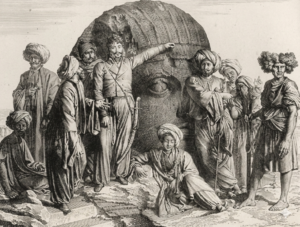
Antonio Lebolo (standing, far left), the Italian antiquities dealer who plundered Egyptian catacombs under contract for Muhammad Ali Pasha of Egypt, appears here alongside Bernardino Drovetti (standing, center), the French consular agent and notorious artifact collector, both posing with the imposing Drovetti Colossal Head. Engraving by Auguste de Forbin, 1819, from Voyage dans le Levant.
Into this ferment stepped Michael Chandler, an Irish-born entrepreneur who had come into possession of four Egyptian mummies and several papyrus scrolls that had originally been excavated from a tomb near the ancient city of Thebes by Antonio Lebolo, a former Italian cavalryman who had worked archaeological excavations for the French consul general in Egypt. After Lebolo’s death, the artifacts passed through various intermediaries, eventually arriving in the United States, where Chandler put them on commercial display, charging admission to gawk at the ancient dead.
The precise details of how the artifacts changed hands remain murky — no surviving records document the transaction directly — but the prevailing account holds that Chandler acquired the mummies from the dealer handling Lebolo’s estate and arranged for their shipment to New York in April 1833. Chandler would later claim a more personal connection, asserting that Lebolo had been a distant relative who bequeathed him the collection. Lebolo’s two-hundred page will, however, tells a different story: it mentions neither Chandler by name nor the mummies among its provisions, casting considerable doubt on the inheritance narrative Chandler found it convenient to promote.
The irony is difficult to overlook. Here was a man who fabricated a personal connection to ancient artifacts in order to enhance their value and his own credibility as their custodian — a showman who embellished the provenance of his merchandise because a better story was worth more than an accurate one. Within two years, those same artifacts would land in Kirtland, Ohio, where another man with a remarkable gift for compelling narratives would examine the same papyri and produce an even grander fabricated connection: not a distant family relation, but a direct link to the biblical patriarch Abraham himself, purportedly written in the patriarch’s own hand. Chandler invented a relative. Joseph Smith invented a scripture. In a story saturated with ironies, the parallel between the two men — each constructing an authoritative personal connection to the same ancient objects for the benefit of a credulous audience — stands as one of its most pointed.
When Chandler broke the seals on the eleven coffins, he discovered that the dry Egyptian climate had done its preserving work well — fragile but largely intact papyrus scrolls lay tucked alongside the wrapped bodies. Recognizing a commercial opportunity, he wasted little time. Philadelphia was his first stop, where he put the mummies on public display for the modest admission price of twenty-five cents. The U.S. Gazette reported the arrival of what it called the largest Egyptian mummy exhibition the city had ever hosted, now installed in the Masonic Hall on Chestnut Street. The announcement identified Lebolo as the excavator and noted that papyrus writings had been found alongside the remains.
The exhibition landed in fertile cultural soil. Public museums were still a rarity in early 19th-century America — Charles Willson Peale’s pioneering Philadelphia institution, which had thrilled visitors with a reconstructed mastodon skeleton since 1786, remained an exception rather than a model. Most Americans satisfied their curiosity about the exotic and the ancient through traveling exhibitions precisely like Chandler’s. Egyptian mummies carried particular novelty; the first specimens had arrived on American shores in Boston only a decade earlier, meaning that for the vast majority of Chandler’s paying customers, these linen-wrapped figures represented their first — and possibly only — encounter with the ancient world made tangible.
In the summer of 1835, Chandler’s traveling exhibition arrived in Kirtland, Ohio, at that time the headquarters of the Church of Jesus Christ of Latter-day Saints, led by the thirty-year-old founder Joseph Smith. The encounter was immediately electric. As the LDS Church’s own Gospel Topics Essay acknowledges:
In the summer of 1835, an entrepreneur named Michael Chandler arrived at Church headquarters in Kirtland, Ohio, with four mummies and multiple scrolls of papyrus. Chandler found a ready audience. Due partly to the exploits of the French emperor Napoleon, the antiquities unearthed in the catacombs of Egypt had created a fascination across the Western world. Chandler capitalized on this interest by touring with ancient Egyptian artifacts and charging visitors a fee to see them.
Chandler’s exhibition was perfectly timed and perfectly placed. Joseph Smith had built his religious movement on the claim that he possessed a divine gift to translate ancient records — specifically, the Book of Mormon, which he said he had translated from golden plates inscribed in ‘Reformed Egyptian.’ The arrival of actual Egyptian papyri in the very city where Smith lived was understood by his followers as divine confirmation of his prophetic gifts. Here, at last, was a test case — an actual ancient Egyptian text for the prophet to translate.
Smith’s Certificate of Translation and the Purchase
Chandler was so impressed — or at minimum, so willing to play along — that he reportedly issued Smith a written certificate attesting to his abilities. As recorded in the Documentary History of the Church (DHC 2:235), Chandler wrote:
This is to make known to all who may be desirous, concerning the knowledge of Mr. Joseph Smith, Jun., in deciphering the ancient Egyptian hieroglyphic characters in my possession, which I have, in many eminent cities, showed to the most learned; and, from the information that I could ever learn, or meet with, I find that of Mr. Joseph Smith, Jun., to correspond in the most minute matters.
As Bill McKeever of the Mormonism Research Ministry aptly observes, ‘How Chandler could make such a statement is a mystery since he was not an expert in this field. The fact is, there was nobody in the United States who at this time could claim to have expertise in the translation of Egyptian hieroglyphics.’ The Rosetta Stone had only been recently deciphered, and whatever Egyptian experts existed were in Europe. Smith was operating in a linguistic vacuum — a fact he was apparently astute enough to exploit.
A group of Latter-day Saints in Kirtland swiftly launched a subscription drive, pooling around $2,400—a substantial amount in 1835—to buy the mummies and papyri outright from Chandler. This lucrative offer proved irresistible to Chandler, who abandoned plans to continue his traveling exhibition for profit in other towns, opting instead for the immediate windfall.
The historical record on this point is somewhat nuanced. It does not appear that Joseph Smith personally initiated or organized the subscription drive in the way a modern fundraising campaign might be launched. The more accurate picture, drawn from the Documentary History of the Church and contemporary accounts, is that the enthusiasm came organically from the Saints in Kirtland who were excited by Smith’s initial examination of the papyri and his declaration that they contained the writings of Abraham. The purchase was a community effort driven by collective zeal rather than a top-down directive from Smith.
That said, Smith was clearly the catalyst. His pronouncement that the scrolls contained scripture — made almost immediately upon examining them — was the spark that motivated the community to raise the funds. Without his declaration, there would have been no subscription drive. So while the record does not show Smith saying “go raise money to buy these,” his prophetic identification of the papyri’s content made the purchase feel not merely desirable but spiritually urgent to his followers.
Some accounts also suggest that a specific group of Kirtland Saints — rather than the broader congregation — pooled the funds, and that the purchase was completed relatively quickly once Smith had examined the material.
With the proceeds secured, Chandler settled in Ohio, purchasing land in Geauga County (later Parkman Township) to farm until he died in 1866.
The purchase allowed Smith to begin what his history calls “the translation of some of the characters or hieroglyphics.” His journal soon noted a thrilling breakthrough: “much to our joy [we] found that one of the rolls contained the writings of Abraham, another the writings of Joseph of Egypt.”
Tack this to your mental bulletin board, because it will matter enormously later in this essay: Joseph Smith did not claim to receive inspired impressions while meditating near some Egyptian objects. He did not claim that the papyri served as a spiritual springboard for independent revelation. He claimed to be translating a specific physical document, written by a specific person, in a specific ancient language. He was explicit, confident, and unambiguous on this point. That precision — prophet as linguist, papyrus as source — is precisely what makes the LDS apologist theories you will encounter in later sections so strained.When the Egyptological evidence eventually demolished the translation claim, the institutional response was to quietly redefine what “translation” had meant all along. But Smith himself left no such wiggle room. The man said what he meant, and he meant what the words plainly say.
LDS Apologetic Explanation
Official LDS apologists argue the phrase “by his own hand upon papyrus” is a modern editorial addition by Joseph Smith or scribes, not claiming literal autograph handwriting by Abraham, but denoting authorship akin to biblical expressions (e.g., Paul’s epistles “written by my own hand” via scribes). They propose that it mirrors ancient Egyptian/Hebrew idioms where copies retain the original author’s attribution indefinitely, or that missing papyrus fragments held the Abraham text, resolving timeline discrepancies. This interpretation frames the claim as symbolic of prophetic authorship rather than a historical error.
The papyri date to ~150 BC, ~2,000 years after Abraham (~2000 BC), making even copies implausibly ancient for Egyptian norms; no evidence supports indefinite author attribution on such distant replicas. Contemporary witnesses, including Smith, explicitly described the surviving papyri as Abraham’s own handwriting and direct source, contradicting later “catalyst” or “missing scroll” shifts. Linguistic analysis shows no Semitic/Abrahamic markers on the vignettes or text, undermining symbolic or idiomatic defenses.
The Translation Process and the Kirtland Egyptian Papers
Smith worked on the translation of the Book of Abraham during the summer and fall of 1835, completing at least the first chapter and part of the second chapter. Translation work resumed in Nauvoo, Illinois, in the spring of 1842, and the completed text — five chapters plus three illustrated facsimiles — was published in the Times and Seasons, the Church’s newspaper, between March and May of 1842.
Among the artifacts associated with the translation project were a series of documents now called the ‘Kirtland Egyptian Papers,’ which include a Grammar and Alphabet of the Egyptian Language (GAEL). These documents appear to show Joseph Smith and his associates attempting to construct a system for ‘translating’ Egyptian hieroglyphics — a system that bears no resemblance to actual Egyptian grammar or to any method recognized by Egyptologists. As the LDS Church’s own essay admits: ‘Neither the rules nor the translations in the grammar book correspond to those recognized by Egyptologists today.’
The Kirtland Egyptian Papers are significant for another reason: they establish a direct connection between the surviving fragments of the Joseph Smith Papyri and the text of the Book of Abraham. The hieroglyphic characters on the papyri appear in the left margins of the GAEL documents, with Smith’s ‘translations’ in corresponding columns — meaning we can demonstrate with certainty which papyrus Smith was working from when he produced the Book of Abraham.
After Smith’s murder at the Carthage, Illinois jail on June 27, 1844, the papyri passed into the possession of his mother, Lucy Mack Smith, who retained them along with the mummies as part of the family’s estate. Following Lucy’s death in 1856, the collection was acquired by a man named Abel Combs, whose motivations for the purchase remain unclear. Combs did not keep the collection intact. He sold the mummies — apparently without the papyri — to a St. Louis museum, where they subsequently vanished from the historical record, their ultimate fate unknown. The papyri themselves Combs retained, and upon his death they passed to his housekeeper, a woman named Charlotte Haven Weaver Huntsman, who inherited them as part of his personal effects.
From Huntsman the fragments passed to her daughter, who eventually sold them — the precise date and circumstances are not fully documented — to the New-York Historical Society, from which they were later transferred to the Metropolitan Museum of Art in New York, where they were catalogued, filed, and effectively forgotten. For decades the LDS Church, along with virtually everyone else, operated under the assumption that the papyri had perished in the catastrophic Great Chicago Fire of 1871 — a reasonable conclusion given how thoroughly that disaster consumed institutional and private collections throughout the region.
Then, in 1966, University of Utah scholar Aziz S. Atiya recognized the fragments during a visit to the Metropolitan Museum, identifying them against the published facsimiles in the Pearl of Great Price. In November 1967, the eleven surviving fragments were formally transferred to the LDS Church — setting the stage for the Egyptological reckoning that Smith’s confident translation claims had long been deferring. The moment of reckoning had arrived.
The Egyptological Verdict — A Common Funerary Text
The Papyri Rediscovered and Identified
After Smith’s death, the papyri passed through several hands and thought to have ultimately been destroyed in the Great Chicago Fire.
The rediscovery of the Joseph Smith Papyri in 1966 stands as a pivotal watershed — and arguably the single most consequential event — in the history of Mormon studies, thrusting the church’s foundational claims into the crucible of empirical verification. After nearly a century of presumption that the papyri had perished in the 1871 Great Chicago Fire, fragments resurfaced in the vaults of New York City’s Metropolitan Museum of Art, where curator Henry George Fischer contacted Utah scholar Aziz S. Atiya — a University of Utah professor of Middle Eastern history visiting the museum — as an intermediary to the LDS Church. Atiya recognized the fragments immediately upon examining them against known facsimile images from the Pearl of Great Price, reportedly experiencing a visceral shock of recognition that the long-presumed-lost artifacts were sitting in a Manhattan storage room, catalogued under an unremarkable accession number and entirely unknown to the museum’s curatorial staff as objects of religious controversy.
Acquired by the Church in November 1967 through a formal transfer negotiated with museum officials, the surviving fragments — representing approximately one-third of the scroll material Joseph Smith originally possessed — were authenticated through a remarkable confluence of physical evidence. The papyrus fragments had been mounted on paper backing before Smith’s death, and those backing sheets bore pencil drawings of the Kirtland temple floor plan and maps of the Kirtland, Ohio area, placing the artifacts unmistakably within Smith’s immediate environment. Emma Smith’s signed affidavit further confirmed the chain of custody. Most critically, the specific sequence of hieroglyphic characters on the surviving fragments matched in precise chronological order the characters copied into the margins of Smith’s Kirtland Egyptian Papers — the same documents in which he and his associates had constructed their ill-fated Grammar and Alphabet of the Egyptian Language. There was no reasonable evidentiary basis for doubt: these were the papyri from which Joseph Smith had produced the Book of Abraham.
The return of the fragments to the Church was met with cautious optimism by some LDS scholars who hoped the originals might yet vindicate Smith’s translation. Those hopes were extinguished with remarkable speed. Within months of the transfer, multiple independent Egyptologists had examined the fragments and reached conclusions that were uniform in their verdict. The findings were swift, definitive, and devastating to Joseph Smith’s translation claims.
As the CES Letter — a widely circulated critical examination of LDS truth claims — explains the situation clearly:
Egyptologists have also since translated the source material for the Book of Abraham and have found it to be nothing more than a common pagan Egyptian funerary text for a deceased man named ‘Hor’ around first century C.E. In other words, it was a common Breathing Permit that the Egyptians buried with their dead. It has nothing to do with Abraham or anything Joseph claimed in his translation for the Book of Abraham.
The LDS Church, to its credit, acknowledged this conclusion in its 2014 Gospel Topics Essay on the subject, stating with remarkable candor:
None of the characters on the papyrus fragments mentioned Abraham’s name or any of the events recorded in the book of Abraham. Mormon and non-Mormon Egyptologists agree that the characters on the fragments do not match the translation given in the Book of Abraham, though there is not unanimity, even among non-Mormon scholars, about the proper interpretation of the vignettes on these fragments. Scholars have identified the papyrus fragments as parts of standard funerary texts that were deposited with mummified bodies. These fragments date to between the third century B.C.E. and the first century C.E., long after Abraham lived.
Read this carefully: the Church itself now admits that (1) none of the characters mention Abraham, (2) the papyri don’t match the text of the Book of Abraham, and (3) the papyri date to between 300 B.C.E. and 100 C.E. — roughly 1,700 to 2,100 years after Abraham would have lived. The document Joseph Smith claimed was ‘written by his own hand upon papyrus’ could not, by any reckoning, have been written by the biblical patriarch Abraham.
To summarize the position charitably: the papyri are wrong, the facsimile interpretations are wrong, the grammar documents are wrong — but the book itself is right, because God was apparently working around the translation rather than through it. The reader may assess the explanatory elegance of this framework independently.
And yet, this is precisely where numerous LDS apologists have planted their flag. Upon reviewing the evidence, many now concede that the surviving papyri represent the full set Joseph Smith used for the Book of Abraham. Even acknowledging that his interpretations of the hieroglyphs bear no relation to genuine Egyptological readings, they pivot to argue that Smith received the book’s content via direct divine revelation rather than literal translation — that the papyri functioned merely as a catalyst or inspirational prop, with God’s words conveyed independently to Smith while the actual documents sitting before him meant something else entirely in Egyptian.
What makes this argument particularly difficult to take seriously is not that divine revelation is inherently implausible within a faith framework — believers are entitled to that premise. The problem is that it requires the simultaneous abandonment of everything Smith himself said about what he was doing. He was not meditating near Egyptian objects and receiving impressions. He was translating. He said so repeatedly, specifically, and in writing that survives to this day. The catalyst theory does not rescue Joseph Smith’s prophetic credibility — it quietly replaces the Joseph Smith of the historical record with a more defensible fictional version, then hopes no one checks the footnotes.
The Breathing Permit of Hôr
The Books of Breathing (Arabic: كتاب التنفس Kitāb al-Tanafus) are several ancient Egyptian funerary texts, intended to enable deceased people to continue existing in the afterlife. The earliest known copy dates to circa 350 BC.
The specific papyrus fragment from which Smith produced the Book of Abraham has been identified by Egyptologists as a document known as a ‘Breathing Permit’ (Egyptian: sȝ n snsnw) — a type of funerary text that was placed in the wrappings of a mummy to ensure the deceased’s ability to breathe and speak in the afterlife. This particular specimen is the ‘Breathing Permit of Hôr,’ written for a deceased man named Hôr, a priest at the temple of Amun.
University of Chicago Egyptologist Dr. Robert K. Ritner, one of the foremost experts on Egyptian funerary documents, has been unequivocal in his assessment. After exhaustive analysis, he concluded that the source of the Book of Abraham is the ‘Breathing Permit of Hôr,’ which was ‘misunderstood and mistranslated by Joseph Smith.’ In a later statement, Ritner declared that the Book of Abraham is ‘confirmed as a perhaps well-meaning, but erroneous invention by Joseph Smith,’ adding that ‘despite its inauthenticity as a genuine historical narrative, the Book of Abraham remains a valuable witness to early American religious history and to the recourse to ancient texts as sources of modern religious faith and speculation.’
The implications of this identification are stark. The text Smith ‘translated’ as describing Abraham’s near-sacrifice by idolatrous priests in Egypt is, in fact, a text about ensuring the continued breath and life of a deceased Egyptian priest in the afterlife. There is no Abraham. There is no sacrifice. No Pharaoh is receiving cosmic instruction. There is only Hôr, a dead priest, and the religious technology his family employed to help him navigate the Egyptian underworld.
The Fatal Testimony of the Facsimiles
Facsimile 1 supposedly depicts the scene of Abraham nearly being sacrificed by the Egyptian priest Elkenah. Since Joseph Smith knew virtually nothing about Egyptian religion, he misidentified everything in the scene.
If the textual identification is damning, the facsimile analysis is catastrophic. The Book of Abraham includes three illustrated vignettes — copies of drawings from the original papyri — which Joseph Smith provided detailed interpretive captions for. These captions form a line-by-line, figure-by-figure commentary on what Smith claimed the Egyptian images depicted. And because these captions exist alongside the recoverable originals, they can be tested with precision against actual Egyptological knowledge.
The results, as documented by the CES Letter and confirmed by multiple independent scholars, reveal that Smith’s interpretations are wrong in virtually every particular. For Facsimile 1, where Smith identified the standing figure as the ‘idolatrous priest of Elkenah,’ Egyptology identifies the figure as Anubis, the jackal-headed god of mummification — a figure that appears consistently in nearly identical funerary scenes throughout Egyptian art. Smith’s version notably lacks the jackal head because the original papyrus was torn at that point, and Smith (or an associate) drew in a human head to fill the gap.
As Dr. Robert K. Ritter of the University of Chicago stated on the documentary The Lost Book of Abraham:
I want to be absolutely clear on this. There simply is no justification for the kind of interpretations that appear in facsimile one or facsimile three. They are wrong with regard to the hieroglyphs, they are wrong with regard to the gender, they are wrong with regard to the understanding of what the scene actually represents and where they are used in the body of the text. They are wrong there as well. In short there is no historical validity for the interpretations in that book. None whatsoever.
— Dr. Robert K. Ritter, University of Chicago, The Lost Book of Abraham | Mormonism Research Ministry
Dr. Richard Parker, Professor of Egyptology at Brown University, was equally direct in his assessment of Facsimile 1: the scene depicts Anubis, the jackal-headed god, ministering to the dead Osiris on a funeral bier — a well-known scene from the Osiris mysteries that appears throughout Egyptian art. The figure Smith identified as Abraham on an altar was actually the god Osiris on a funeral couch. The figure Smith identified as a sacrificial priest was actually Anubis, the divine embalmer. The ‘angel of the Lord’ above was actually the soul (ba) of the deceased.
The comparison table from the CES Letter is worth presenting in full for Facsimile 1, as it demonstrates the systematic divergence between Smith’s claimed interpretation and established Egyptological knowledge:
Facsimile 1 — Joseph Smith’s Interpretation vs. Modern Egyptological Interpretation:
Figure 1: Smith said ‘The Angel of the Lord.’ Egyptology says: The spirit or ‘ba’ of Hôr (the deceased man). Figure 2: Smith said ‘Abraham fastened upon an altar.’ Egyptology says: The deceased man Hôr. Figure 3: Smith said ‘The idolatrous priest of Elkenah.’ Egyptology says: Anubis, the jackal-headed god of mummification. Figure 4: Smith said ‘The altar for sacrifice.’ Egyptology says: A common funeral bier or ‘lion couch.’ Figures 5-8: Smith identified these as idolatrous gods of Elkenah, Libnah, Mahmackrah, and Korash. Egyptology says: These are canopic jars containing the deceased’s internal organs, representing the four sons of the god Horus.
For Facsimile 2, a circular hypocephalus (a disc placed under the head of the mummy), Smith’s interpretations fare no better. Where Smith identified Figure 1 as ‘Kolob, the residence of God,’ Egyptologists identify the figure as the god Khnumu. Where Smith identified Figure 7 as ‘God sitting on his throne, revealing through the heavens the grand Keywords of the priesthood,’ Egyptologists identify the figure as Min, an ithyphallic (sexually aroused) deity — a description so embarrassing that LDS commentators have struggled to explain why a sexually explicit deity would figure prominently in Abraham’s cosmological diagram.
Smith’s caption for several figures in Facsimile 2 states they ‘ought not to be revealed at present’ — a convenient non-answer. Modern Egyptological translation of those same figures reveals actual text: ‘grant that the souls of Osiris Shechonk may live,’ ‘the netherworld and his great waters,’ ‘Oh mighty god, lord of heaven and earth.’ Nothing esoteric. Nothing doctrinally sensitive. Simply standard funerary invocations.
The pattern visible across both facsimiles points toward a conclusion that is difficult to avoid: Smith was not struggling honestly with a difficult translation and arriving at imperfect results. He was inventing. Where the images were straightforward, he invented theology. Where the text was readable, he invented mystery. And where a genuine translation would have produced something embarrassing or mundane, he invented sacred reticence. These are not the errors of an untrained but sincere translator reaching beyond his competence — they are the calculated moves of a man who understood, with some sophistication, how to make the unknowable serve the useful.
The 1912 and 1968 Expert Panels
The scholarly evisceration of the Book of Abraham did not begin with the papyri’s rediscovery in 1966. As early as 1912, Episcopal Bishop F.S. Spaulding published a booklet entitled ‘Joseph Smith, Jun., As a Translator,’ in which he included assessments from eight prominent scholars who had examined the facsimiles. All eight concluded that Smith’s translations were erroneous.
Among those scholars was Dr. A.H. Sayce, Professor of Assyriology at Oxford University, who stated: ‘It is difficult to deal seriously with Joseph Smith’s impudent fraud.’ Dr. W.M. Flinders Petrie, Professor of Egyptology at University College London, was similarly dismissive of the translation’s accuracy: “To any one with knowledge of the large class of [Egyptian] funeral documents to which these belong, the attempts to guess a meaning are too absurd to be noticed. It may be safely said that there is not one single word that is true in these [i.e., Smith’s] explanations.”
When the papyri were rediscovered in 1966, the LDS Church invited a team of scholars to examine them. The results were again uniformly negative. Klaus Baer of the University of Chicago and John A. Wilson, one of America’s foremost Egyptologists at the time, both published analyses concluding that the recovered papyri were standard Egyptian funerary documents with no connection to the Book of Abraham narrative.
The LDS response to the 1912 critique had been to hire a writer named J.C. Homans, who published rebuttals under the pseudonym ‘Dr. Robert C. Webb, Ph.D.’ Homans held no doctorate and had no training in Egyptology. His arguments, as the Mormonism Research Ministry notes, ‘failed to convince the learned’ while managing to ‘appease the faithful Latter-day Saint, so testimony once again reigned over fact.’
Anachronisms and Historical Impossibilities
The Dating Problem
A Claim Written in Sand — and Time
Anachronism:A chronological inconsistency in some arrangement, especially a juxtaposition of people, events, objects, language terms and customs from different time periods. Here it is illustrated by a fake photo of Abraham Lincoln checking his smartphone.
Before the ink of any textual analysis can dry, before the first anachronism is catalogued or the first facsimile compared against its Egyptological counterpart, the Book of Abraham stumbles over a problem so fundamental, so stubbornly concrete, that it renders the more sophisticated arguments almost beside the point. It is a problem not of theology or linguistics or cultural interpretation — it is a problem of arithmetic. The numbers simply do not work. They have never worked. And no amount of apologetic ingenuity has ever made them work.
The problem is this: Joseph Smith claimed to have translated the Book of Abraham from Egyptian papyri written by the patriarch Abraham himself — the same Abraham of Genesis, the father of the Hebrew people, the man whom God called out of Ur of the Chaldees and with whom he established the foundational covenant of Israel. Abraham is traditionally dated by biblical scholars and historians to the Middle Bronze Age, roughly 2000 to 1800 B.C.E. — that is, somewhere between three thousand eight hundred and four thousand years ago. Smith was not shy about this claim. The heading of the Book of Abraham, in the form he authorized and which still appears in current editions of the Pearl of Great Price, states with crisp declarative confidence that the text is a translation of ‘ancient records… purporting to be the writings of Abraham, while he was in Egypt, called the Book of Abraham, written by his own hand, upon papyrus.’
Written by his own hand. Upon papyrus.Those six words constitute one of the most specific, testable, and ultimately fatal claims in the entire history of American religious literature.
What the Papyri Actually Say About Their Own Age
When the fragments of the Joseph Smith Papyri were recovered from the Metropolitan Museum of Art in New York in 1966 and returned to the LDS Church in 1967, Egyptologists wasted little time in establishing their date. The determination was not difficult — paleographic analysis (the study of handwriting styles across historical periods), the type of papyrus, the specific genre of the document, the names and theological conventions employed within it, and the style of the associated vignettes all pointed to the same conclusion: the papyri dated to somewhere between the third century B.C.E. and the first century C.E.
The Ptolemaic rulers reigned for nearly three centuries before the end of the empire marked by the death of Cleopatra VII in 30 BC.
To translate that range into plain terms: the earliest these documents could have been produced is approximately 300 B.C.E. — the beginning of the Ptolemaic period in Egypt, when the Greek-speaking descendants of Alexander the Great’s general Ptolemy ruled the Nile Valley. The latest is approximately 100 C.E. — the early Roman Imperial period, when Augustus Caesar’s successors governed Egypt as a province of Rome. The LDS Church’s own Gospel Topics Essay, released in 2014, confirmed this assessment without equivocation:
Scholars have identified the papyrus fragments as parts of standard funerary texts that were deposited with mummified bodies. These fragments date to between the third century B.C.E. and the first century C.E., long after Abraham lived.
‘Long after Abraham lived.’ Four words of ecclesiastical understatement that represent, in scholarly terms, a gap of roughly seventeen hundred to twenty-one hundred years. To put that gap in perspective: seventeen centuries separates us today from the fall of the Western Roman Empire. Twenty-one centuries takes us back past the birth of Jesus Christ to the height of the Roman Republic. The distance between Abraham and the papyri Joseph Smith claimed he wrote is not a rounding error or a margin of scholarly uncertainty. It is an unbridgeable chasm.
The Bronze Age World Abraham Actually Inhabited
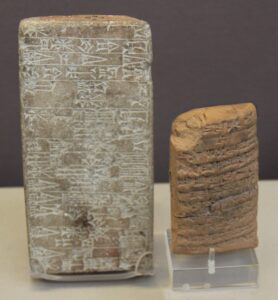
Babylonian tablet (time of Hammurabi, circa 1800 BCE). Via Wikimedia under Creative Commons CCO 1.0, Universal Public Domain.
To fully appreciate the absurdity of the claim that Abraham wrote the Joseph Smith Papyri, it is worth pausing to consider the world in which the historical Abraham — existing as an historical figure — would actually have lived. The period from 2000 to 1800 B.C.E. corresponds to what archaeologists designate the Middle Bronze Age IIA in the ancient Near East. It was a world of mud-brick cities, itinerant pastoralism, cuneiform clay tablets, and nascent temple economies. Writing existed, but it was in its comparative infancy as a widespread technology, and it looked nothing like the hieroglyphic Egyptian script that appears on the Joseph Smith Papyri.
The dominant writing systems of Abraham’s world were Sumerian and Akkadian cuneiform — wedge-shaped impressions pressed into clay tablets with a stylus. In Egypt during this same period, hieroglyphics were in use, primarily for monumental inscriptions, religious texts, and administrative records. The cursive script known as hieratic — an ink-on-papyrus simplification of hieroglyphics used for less formal documents — existed but was employed almost exclusively by trained scribal professionals within an institutional context, typically temple or palace administration.
The idea that a nomadic Semitic patriarch from Mesopotamia, wandering through Canaan and Egypt with flocks and family, would have produced a sophisticated multi-chapter theological autobiography in Egyptian hieratic script on papyrus is not merely improbable — it is culturally incoherent. It is roughly equivalent to claiming that a Bronze Age cattle herder from the Anatolian steppe wrote his memoirs in Latin on vellum. The materials, the skills, the institutional context, and the literary genre simply did not exist in the combination Smith described.
Papyrus Itself: A Technology with a History
It is worth dwelling for a moment on papyrus as a material, because Smith’s specific claim — ‘written by his own hand, upon papyrus’ — requires Abraham to have used a writing medium that was, in his era and cultural context, not merely uncommon but essentially inaccessible to a Semitic wanderer.
Papyrus (Cyperus papyrus) grows abundantly in the Nile Delta and was processed into writing sheets by the ancient Egyptians in a labor-intensive manufacturing process: the stalks were cut into thin strips, laid in overlapping layers at right angles, pressed, dried, and smoothed. The earliest known papyrus documents date to approximately 2900 B.C.E. — the First Dynasty of ancient Egypt — and they were administrative records associated with royal and temple institutions. The manufacture and trade of papyrus were largely controlled by Egyptian institutions throughout the Old Kingdom, Middle Kingdom, and New Kingdom periods.
By the time of Abraham’s supposed era (Middle Bronze Age, circa 2000-1800 B.C.E.), papyrus was in use in Egypt but was primarily a product of the Egyptian scribal establishment. It was not a commodity that traveled freely across cultural boundaries into the hands of Semitic pastoralists making their way through Canaan. The dominant writing medium for the Semitic world in Abraham’s era was clay — and the Semitic alphabetic scripts that would eventually produce Hebrew were still centuries away from their development at Serabit el-Khadim in the Sinai around 1800-1500 B.C.E.
Papyrus as a writing material was in use in Egypt by the 3rd millennium BCE (c. 3000–2001 BCE). Once the technology of papyrus making was developed, its method of production was a closely guarded secret. This allowed the Egyptians to retain a monopoly and it became the lifeblood for ancient Egypt. Evidence for export outside of Egypt is clear by at least the 6th century BCE (c. 600–501 BCE), when Greek sources indicate Egyptian papyrus was already being imported into Greece, though it was expensive and relatively rare at first. By the late Classical (c. 400–301 BCE) and Hellenistic periods (c. 300 BCE–30 BCE), especially under the Ptolemies, papyrus was one of Egypt’s chief exports, shipped in large quantities throughout the Mediterranean—into the Greek world and then the Roman Empire (c. 30 BCE–476 CE), where papyrus scrolls became the dominant writing medium.
Dr. Klaus Baer of the Oriental Institute at the University of Chicago, one of the Egyptologists who examined the recovered papyri in the late 1960s, was categorical in his assessment of what the documents actually were. They were not patriarchal autobiography. They were not ancient Abrahamic record. They were standard Egyptian funerary documents of the Ptolemaic period, produced by Egyptian temple scribes for Egyptian religious purposes within the Egyptian mortuary tradition.
Abraham’s Home Base
Abraham, the Old Testament patriarch from Genesis, hailed from the ancient Near East, specifically Mesopotamia in modern-day southern Iraq, where he was born in Ur of the Chaldeans—a Sumerian city near Nasiriyah, about 200 miles southeast of Baghdad. His family migrated northwest to Haran on the modern Turkey-Syria border, where his father Terah died, before Abraham journeyed south to Canaan, encompassing today’s Israel, Palestine, and parts of Lebanon, settling in sites like Shechem, Bethel, and Hebron. While scholars occasionally debate Ur’s precise location (southern vs. a northern site near Urfa, Turkey), the consensus situates Abraham’s origins in southern Mesopotamia and his primary life in the eastern Mediterranean Levant.
Seventeen Centuries: The Unbridgeable Gap
Let us be precise about the mathematics of the problem, because precision matters here. Conservative dating places Abraham around 2000 BCE and the Joseph Smith Papyri (early estimate) at ~300 BCE, creating a 1,700-year gap. The more probable dating for Hôr’s Breathing Permit—roughly the 1st century CE—widens it to ~2,000 years. Abraham is also outside the region of papyrus invention and production, residing in papyrus-scarce Mesopotamia and Canaan far from the Nile Delta.
To claim that Abraham wrote the Joseph Smith Papyri is, in terms of sheer chronological impossibility, equivalent to claiming that King David wrote the Magna Carta, that Moses composed the Declaration of Independence, or that Julius Caesar authored the King James Bible. In each case, the named author died centuries or millennia before the document in question was produced. The document cannot have been written by the person claimed.
In the world of textual scholarship, the anachronistic dating of a document’s claimed authorship is among the most reliable indicators of pseudepigraphy — the practice of attributing a text to a famous ancient figure in order to lend it authority and credibility. Most ancient pseudepigrapha were at least produced in an era within a few centuries of their claimed authors. The Book of Abraham’s authorship claim misses by nearly two millennia.
Why This Matters More Than the Facsimile Analysis
The facsimile analysis — the demonstration that Smith’s figure-by-figure interpretations of the Egyptian illustrations bear no relationship to what Egyptologists know the images to depict — is perhaps the most visually striking and accessible evidence against the Book of Abraham. The comparison tables are arresting: Smith says ‘Abraham on an altar’; Egyptology says ‘the deceased man Hôr.’Smith says ‘the idolatrous priest of Elkenah’; Egyptology says ‘Anubis, the jackal-headed god of mummification.’
But the dating problem is, in many respects, more fundamental than the facsimile analysis. The facsimile analysis requires some familiarity with Egyptian religious iconography to fully appreciate. The dating problem requires only arithmetic and a basic grasp of historical chronology. A document cannot be written by someone who died nearly two thousand years before the document was produced. This is not a linguistic judgment or an interpretive conclusion — it is a logical impossibility, as absolute in its own domain as a mathematical proof.
Dr. James H. Charlesworth, a Princeton scholar of Jewish and Christian origins and one of the world’s authorities on ancient pseudepigrapha, has noted that the pseudepigraphical attribution of texts to ancient figures was a common literary device in the ancient world, widely understood as such by sophisticated readers of the era. What distinguishes the Book of Abraham from acknowledged ancient pseudepigrapha is that its claimed author — Joseph Smith — appears to have genuinely believed, or at minimum claimed to believe, that he was producing an accurate translation of an authentic ancient document. The ancient pseudepigraphers were participating in a recognized literary convention; Smith was making a historical and prophetic claim that could be, and has been, definitively refuted.
The Church’s Quiet Concession
It is worth noting, again, that the LDS Church itself has now conceded the chronological problem — at least in its Gospel Topics Essay, which acknowledges that the papyri ‘date to between the third century B.C.E. and the first century C.E., long after Abraham lived.’ This is a remarkable admission from an institution that for over a century and a half taught its members that the papyri were ancient Abrahamic autographs.
The Church’s response to this concession has been to advance the ‘catalyst theory’: the idea that the papyri served as a spiritual prompt rather than a linguistic source, and that the Book of Abraham represents inspired revelation received in connection with the study of the papyri rather than a conventional translation from them. As the Gospel Topics Essay puts it:
The relationship of these documents to the book of Abraham is not fully understood. Neither the rules nor the translations in the grammar book correspond to those recognized by Egyptologists today. Whatever the role of the grammar book, it appears that Joseph Smith began translating portions of the book of Abraham almost immediately after the purchase of the papyri.
‘Not fully understood.’This is the ecclesiastical language of damage control — a carefully worded retreat from positions that can no longer be maintained. What was once declared to be Abraham’s own writing, translated by prophetic gift, is now a relationship that is ‘not fully understood.’ The institution has, quietly and without fanfare, moved the goalposts.
But moving the goalposts does not resolve the chronological problem. If the papyri are not what Smith said they were — if they are Ptolemaic-era Egyptian funerary documents rather than Bronze Age Abrahamic autobiography — then Smith’s foundational claim about the Book of Abraham is false. He did not translate Abraham’s writings. He could not have. Abraham did not write the Joseph Smith Papyri. The numbers make it impossible. And the numbers, unlike prophetic claims, do not require faith to evaluate.
The Chaldean Anachronism: A Telltale Timestamp
One of the most revealing anachronisms embedded in the Book of Abraham is hiding in plain sight — in the very first verse. Abraham 1:1 opens with the patriarch describing himself as a resident of “the land of the Chaldeans,” presenting this as his ancestral homeland in the ancient Near East. To a 19th-century American reader steeped in the King James Bible, the phrase would have sounded authentically ancient and appropriately exotic. To a historian of the ancient world, it is an immediate red flag.
The Chaldeans were a Semitic tribal people who first appear in the historical record around the 9th century B.C.E., when Assyrian annals begin documenting their presence in the marshy lowlands of southern Mesopotamia, near the head of the Persian Gulf. Fierce, independent, and fiercely resistant to Assyrian domination, they gradually consolidated power over the region before seizing control of Babylon itself. Under Nabopolassar and his famous son Nebuchadnezzar II, the Chaldeans established the Neo-Babylonian Empire in the late 7th century B.C.E. — the same empire that would ultimately destroy Jerusalem and carry the Israelites into captivity.
This is the historical Chaldea. It is not Abrahamic. It postdates the patriarch’s supposed era by more than a thousand years.
Abraham, according to both biblical chronology and scholarly estimates, lived around 2000–1800 BCE—the Middle Bronze Age—when the territory later called Chaldean was home to Sumerian and Old Babylonian peoples under city-states like Ur and Hammurabi’s dynasty. The term “Chaldean” would have been meaningless then, as that ethnic-political group emerged centuries later (~9th century BCE). While critical biblical scholars widely regard “Ur of the Chaldeans” (Genesis 11:28) as an anachronistic gloss added by exilic editors (~6th century BCE) for audience clarity, conservative Christian apologists reject any notion of scribal error, proposing instead early “Kasdim” precursors, northern Ur locations, or legitimate historical updates akin to ancient name substitutions.
Joseph Smith overlooked this issue entirely. Rather than address it, he amplified the anachronism—crafting an elaborate opening scene of Abraham as a Chaldean defying “priests of Pharaoh” in Chaldea itself. This not only echoes the KJV’s phrasing but fabricates unsupported Chaldean rulers, geography, and rites with zero archaeological backing.
As Wikipedia’s article on “Criticism of the Book of Abraham” summarizes, “various anachronisms and 19th-century themes lead many scholars to conclude that the Book of Abraham is a 19th-century creation.” The Chaldean anachronism alone doesn’t prove that conclusion — but it points there with uncomfortable precision.
Kolob and the Celestial Hierarchy: A 19th-Century Cosmos Dressed in Ancient Clothing
Among the most theologically distinctive — and historically problematic — elements of the Book of Abraham is its elaborate cosmological system, centered on a mysterious celestial body called “Kolob.” Introduced in Abraham 3:2-3, Kolob is described as the star or planet “nearest unto the throne of God,” the grand governing body around which all other celestial creations orbit in descending orders of importance. Below Kolob stands “Oliblish,” described as holding “the key of power” over other governing stars. Further down the hierarchy appear additional bodies bearing names like “Enish-go-on-dosh,” “Kae-e-vanrash,” and “Flos-is-es” — each assigned cosmic governing authority over lesser celestial spheres.
The system is vivid, internally consistent, and theologically purposeful within Mormonism — the hymn “If You Could Hie to Kolob“ (1843) remains a beloved fixture of LDS worship to this day. But when examined against the backdrop of genuine ancient cosmology, the framework collapses as anachronism.
Kolob. We sing about it in one of our favorite hymns. We’ve named canyons and mountains and wards and stakes after it. But do we really know what Kolob is and what it’s like?
Generally defined as “the place nearest where God dwells,” most of what we know about this briefly-mentioned governing star comes from a heavenly astronomy lesson found in the book of Abraham.
And while it’s not a part of core Church doctrine, learning about Kolob is a wonderful way to begin to understand each of our places in the universe and comprehend the significance of the Creation.
As the first creation and the star nearest to the source of all light, God, it makes sense that Kolob gives its light in a similar way. The explanation for figure 5 in Facsimile 2 in Abraham explains that the planet Enish-go-on-dosh “borrows its light from Kolob through the medium of Kae-e-vanrash, which is the … governing power. …” It also later says that two other stars, Kli-flos-is-es and Hah-ko-kau-beam, also receive “light from the revolutions of Kolob.”
Even if none of the physical ideas about Kolob are interesting or logical to you, the analogy it teaches about the Savior and our own place in the universe is profound. Because, as Alma reminds us, “ … all things denote there is a God; yea, even the earth, and all things that are upon the face of it, yea, and its motion, yea, and also all the planets which move in their regular form do witness that there is a Supreme Creator” (Alma 30:44).
Just as Kolob is described as the governing star nearest to God, the one that was created first, and the star that gives light to all others, so Christ is on the right hand of God, the Firstborn of the Father, and a Light unto all of us. And if we, like the other stars and planets described in the scriptures, draw closer to Kolob, or Christ, so our greatness, glory, knowledge, and happiness will increase. That’s what I look forward to thinking about the next time I sing the beloved words of “If You Could Hie to Kolob.” Because, hopefully, one day we all will.
The LDS Living article on Kolob peddles feel-good speculation dressed as doctrine, but crumbles under scrutiny. Kolob emerges from Joseph Smith’s “translation” of an Egyptian hypocephalus (Facsimile 2)—a Ptolemaic-era (c. 200 BC) funerary amulet for the deceased priest Hôr, meant to warm his mummy in the afterlife, not teach cosmic hierarchies. Egyptologists universally identify it as such; Smith’s labels like “Oliblish” and “Enish-go-on-dosh” are gibberish, not revelation.
Claims of Kolob as God’s throne-side “governing star” with a 1,000-Earth-year day contradict astronomy—no star rotates that slowly, and “governing” planets via light-borrowing defies physics (planets reflect sunlight; stars fuse hydrogen). The piece’s Eden-Kolob time link and Brigham Young’s “falling Earth” cite extrabiblical folklore, not core canon.
Worse, the church admits the papyri don’t match Smith’s renderings, shifting to “revelation” sans translation—yet Abraham 3 and Fac. 2 purport literal astronomy from hieroglyphs. Analogies to Christ via stars feel forced; Alma 30:44 invokes natural order, not pseudoscience. Kolob isn’t doctrine worth hymning—it’s 19th-century fancy from debunked papyri, highlighting the Book of Abraham’s fatal flaws.
Joseph Smith was working in the intellectual atmosphere of the 1830s, a decade when popular astronomy was undergoing a dramatic transformation. Sir William Herschel’s discovery of Uranus (1781) and ongoing debates about the structure of the Milky Way had captured public imagination. Astronomical societies were proliferating, popular lecture series on celestial mechanics drew large audiences, and publications like Thomas Dick’s The Philosophy of a Future State (1828) — which Smith almost certainly encountered (and admitted by FAIR) — proposed elaborate hierarchies of inhabited worlds governed by progressively exalted intelligences. Dick’s work, which sold widely in America, discussed governing celestial systems in language strikingly parallel to the Book of Abraham’s cosmological architecture.
The ancient Egyptians and Mesopotamians, by contrast, conceived of astronomy in fundamentally religious-mythological terms — tracking stars for calendrical, agricultural, and omen-reading purposes, and organizing the heavens according to the movements of specific deities. Nowhere in the Egyptian corpus, the Akkadian astronomical tablets, the Sumerian star catalogues, or any other authenticated ancient Near Eastern document does a cosmological system resembling the Book of Abraham’s hierarchy of governing stars appear. No ancient text speaks of a “Kolob,” an “Oliblish,” or governing celestial intelligences arranged in the precise bureaucratic manner Joseph Smith described.
Crucially, these are not contested transliterations of obscure ancient terms that scholars are still working to decode. Egyptologists and Assyriologists are emphatic: these names exist nowhere in the ancient record. They are neologisms — invented words with no linguistic ancestry in any known ancient language. FAIR Latter-day Saints has worked diligently to identify ancient parallels, citing vague structural similarities in certain Egyptian astronomical texts, but mainstream scholars have found these comparisons unpersuasive. Structural resemblance is not linguistic or historical equivalence.
In the Book of Abraham’s cosmos, we find not the ancient sky of Abraham but the expansive, hierarchical universe that a curious, intellectually ambitious American prophet constructed from the cosmological conversations of his own era.
The King James Ghost in Abraham’s Text
Among the many anachronisms embedded in the Book of Abraham, none is more textually jarring — or more intellectually damning — than its unmistakable fingerprints from the King James Bible of 1611.
To appreciate the problem, a brief historical detour is necessary. The King James Version was commissioned by King James I of England and completed by a team of approximately 47 scholars over seven years, published in 1611 A.D. It was an English translation of Hebrew and Greek source texts, shaped by the theological and linguistic conventions of early 17th-century Britain. It was not, by any definition, an ancient document. It was a Renaissance-era English rendering of ancient source material — beautiful, influential, and unmistakably of its time.
Joseph Smith claimed the Book of Abraham was written by the patriarch Abraham himself, somewhere around 2000-1800 B.C.E. — roughly 3,600 years before King James’s scholars put quill to parchment. And yet, when Smith produced his “translation” in 1842, the resulting text reproduced the distinctive cadences, phrasing, and vocabulary of the KJV with a fidelity that defies coincidence.
The problem surfaces sharply in Abraham chapters 4 and 5, which present an extended creation account. Side-by-side comparison with Genesis 1-2 in the King James Bible reveals not merely thematic similarity — which might be expected, given that both texts ostensibly concern the same creation events — but specific verbal and syntactic parallels that track the KJV rendering rather than the Hebrew original. Where the Hebrew and the KJV diverge in nuance or word choice, the Book of Abraham follows the KJV.
Even more telling, the Book of Abraham contains translation artifacts — interpretive decisions made by the KJV translators in 1611 that are not present in the underlying Hebrew text. When those same interpretive choices appear in a document allegedly written by Abraham in approximately 2000 B.C.E., the conclusion is inescapable: the author of the Book of Abraham was working from a King James Bible, not from an ancient original.
This was not Joseph Smith’s first offense of this kind. The Book of Mormon, published in 1830, had already drawn sharp criticism for reproducing entire passages from the KJV — including sections of Isaiah that most scholars identify as belonging to a later author writing centuries after the Nephites supposedly left Jerusalem. The pattern of KJV dependence was, by 1842, well established.
LDS apologists have offered a response: God, in his providence, “inspired” the KJV translators to produce language that mirrored the original ancient texts so precisely that when Smith later translated those ancient texts, the results naturally matched the KJV. As an explanation, it has a certain theological elegance. As an argument, it requires one to believe that divine providence operated with extraordinary specificity to validate Joseph Smith’s translations — while somehow failing to prevent his “Abraham papyri” from being an entirely unrelated Egyptian funerary document.
But the deeper problem with this argument is that it fundamentally misunderstands — or deliberately misrepresents — the nature of biblical inspiration itself. The orthodox Christian doctrine of Scripture holds that God’s Word was “God-breathed” (2 Timothy 3:16), meaning the Holy Spirit supernaturally superintended specific human authors, working through their individual personalities, vocabularies, and literary styles, to produce the exact words He intended. This process was singular, unrepeatable, and closed with the completion of the apostolic canon. The KJV translators were gifted scholars engaged in careful linguistic work — but they were translators, not inspired authors. They were rendering into English a text that had already been breathed out by God through its original human writers. To claim that God separately inspired the KJV translators to produce language that would later authenticate Joseph Smith elevates a translation committee to a prophetic office the Scriptures themselves nowhere authorize.
More critically, this argument effectively proposes an open-ended inspirational pipeline that bypasses the closed canon entirely — precisely the move orthodox Christianity has always recognized as the gateway to theological chaos. There are no “inspired” texts beyond the original canon. The moment one grants that God may have been quietly superintending 17th-century English translators to pre-validate a 19th-century American prophet, the logical guardrails protecting Scripture’s uniqueness and sufficiency dissolve completely. This is not a minor apologetic concession. It is a theological category error dressed in the language of providence — and it is, not coincidentally, standard operating procedure for a tradition that has always needed its innovations to appear ancient.
The simpler explanation remains the more credible one: a 19th-century author, steeped in the KJV, wrote the Book of Abraham.
The Curse of Ham: Racism Embedded in Revelation
Among the most troubling passages in the Book of Abraham is a sequence found in chapter one, verses 21 through 27, that weaves racial hierarchy directly into the patriarchal narrative. The text traces Pharaoh’s lineage through Ham — one of Noah’s three sons — and states that Ham’s descendants “preserved the curse in the land.” From this genealogical claim, the passage concludes that Pharaoh, though a righteous man, “partook not of the priesthood” because he descended from a lineage marked by divine disfavor.
Did you just read, “Pharaoh’s Lineage”
The use of “Pharaoh” is correct — and it’s worth understanding precisely what the Book of Abraham is claiming, because it’s an unusual construction.
The Book of Abraham introduces a figure it calls “Pharaoh” not as a title (as in the Bible) but essentially as a proper name for the first king of Egypt, described as a descendant of Ham through his daughter Egyptus. Abraham 1:25 states: “Now the first government of Egypt was established by Pharaoh, the eldest son of Egyptus, the daughter of Ham.”
So in this passage, “Pharaoh” functions as the personal name of a founding ancestor, while the familiar biblical usage of “Pharaoh” as a royal title for Egyptian kings is a separate matter entirely. The Book of Abraham is constructing a genealogical origin story — this primordial “Pharaoh” is the progenitor of the Egyptian royal line, and because he descends from Ham, the curse travels with the lineage forward through history.
This is actually one of the details critics point to as a 19th-century invention rather than authentic ancient content. No Egyptian, Hebrew, or other ancient Near Eastern source names the first king of Egypt “Pharaoh” as a personal name or traces Egyptian royal origins to a daughter of Ham named “Egyptus.” These are constructions with no archaeological or textual corroboration outside of Joseph Smith’s text.
The “Curse of Ham” was not merely theological color. For nearly 130 years, these verses provided the LDS Church’s primary scriptural warrant for one of its most consequential and painful institutional policies: the exclusion of Black men from holding the priesthood. Black members could join the Church, pay tithing, and attend services — but they could not be ordained, enter the temple, or receive the full blessings of the faith’s salvation theology. That prohibition remained official policy until June 1978, when Church President Spencer W. Kimball announced what members received as a new revelation extending priesthood eligibility to all worthy male members regardless of race.
The irony cuts deep. Joseph Smith produced the Book of Abraham in 1835, during the most volatile decade of antebellum America’s slavery debate. The Missouri Compromise had failed to settle the question of slavery’s westward expansion. Abolitionist movements were gaining momentum in the North while Southern apologists were constructing elaborate theological defenses of racial slavery. The primary biblical text deployed in those defenses was Genesis 9:20-27 — the so-called Curse of Ham — in which Noah curses Canaan, Ham’s son, to be “a servant of servants.” 19th-century American theologians, particularly those sympathetic to slaveholding interests, transformed this obscure genealogical curse into a sweeping divine mandate for racial subjugation. By the 1830s, the “Curse of Ham” was arguably the most politically weaponized passage in American biblical discourse.
Joseph Smith’s Book of Abraham did not merely echo this tradition — it codified and canonized it.By embedding the Curse of Ham into a text presented as ancient scripture written by Abraham himself, Smith gave the racial theology of his era the imprimatur of divine antiquity. What was a contested interpretive tradition in American Christianity became, for Latter-day Saints, a revealed fact.
The Genesis account, read carefully and in context, does not support the theological weight that centuries of racially motivated interpreters — and ultimately Joseph Smith — placed upon it. In Genesis 9:20-27, Noah awakens from a drunken stupor, discovers that Ham has seen his nakedness, and pronounces a curse — not upon Ham, but upon Canaan, Ham’s son. The text is explicit: “Cursed be Canaan; a servant of servants shall he be unto his brethren.” Canaan, in the ancient Israelite geographical imagination, was the ancestor of the Canaanite peoples of the Levant — the nations Israel would later displace in the conquest narratives of Joshua. The curse, whatever its original function, was a theological explanation for Israelite dominance over Canaanite peoples in a specific historical and geographical context. It had nothing to do with African peoples, nothing to do with skin color, and nothing to do with priestly eligibility.The leap from “cursed be Canaan” to “Black Africans are divinely excluded from the priesthood”requires multiple layers of interpretive violence against the text — each layer added by readers who needed the Bible to authorize what they had already decided to believe.
The broader biblical witness makes the distortion even clearer. Ham appears throughout the Table of Nations in Genesis 10 as the ancestor of a range of peoples including Egyptians, Cushites, and Canaanites — a genealogical mapping that reflects ancient Near Eastern ethnic geography, not divine hierarchy. Nowhere in the Hebrew Bible, the Greek Septuagint, the New Testament, or any authenticated ancient Semitic religious literature is Ham’s lineage associated with spiritual inferiority, priestly disqualification, or inherited divine disfavor extending across generations of an entire race. The Apostle Paul, writing under the genuine inspiration of the Holy Spirit, declared unambiguously in Galatians 3:28 that “there is neither Jew nor Greek, there is neither bond nor free, there is neither male nor female: for ye are all one in Christ Jesus” — a statement that obliterates the entire theological architecture of racial priesthood exclusion in a single sentence. The curse-of-Ham doctrine was not recovered from Scripture; it was imported into Scripture by those with interests to protect, then handed to Joseph Smith ready-made and ideologically loaded, whereupon he embedded it into a text he presented as older than Moses himself.
That the Book of Abraham reproduces the precise racial anxieties and theological maneuvers of 1830s America — rather than anything traceable to genuine ancient Near Eastern religion — is not coincidental. It is diagnostic. The text did not emerge from Egyptian papyri. It emerged from its own historical moment.
The Book of Abraham and the Egyptian Book of the Dead
Two Texts, Two Worlds
One of the most instructive exercises in Book of Abraham scholarship is a side-by-side comparison of the text with known Egyptian funerary literature — particularly the Book of the Dead and the related Breathing Permits. What emerges from this comparison is a stark divergence in both content and theological perspective that underscores the impossibility of a genuine connection.
The Book of the Dead (more accurately rendered ‘The Book of Coming Forth by Day’) is a collection of spells, hymns, and ritual instructions intended to guide the deceased through the dangers of the afterlife and ensure their successful resurrection. It is fundamentally a religious technology designed to protect and empower the dead. The Breathing Permits are abbreviated versions of this genre, focused specifically on ensuring the deceased’s ability to breathe, speak, and act in the afterlife.
The Book of Abraham, by contrast, presents itself as an autobiographical narrative — the story of a living man’s theological education, his encounter with idolatry, his covenantal relationship with Jehovah, and his reception of cosmic revelation. These are entirely different literary genres, purposes, and contexts. There is no ancient precedent for a Breathing Permit doubling as a patriarchal autobiography.
The Facsimiles as Egyptian Religious Art
The three facsimiles that accompany the Book of Abraham are, as Egyptologists have conclusively demonstrated, standard images from the Egyptian funerary tradition. Facsimile 1 depicts the Osirian resurrection scene, a vignette that appears in hundreds of funerary contexts throughout Egyptian history. Facsimile 2 is a hypocephalus — a magical object placed under the mummy’s head to generate warmth and divine power for the deceased. Facsimile 3 depicts a scene from the Osiris mysteries, showing the deceased being presented to Osiris in the judgment hall of the dead.
None of these images depicts Abraham. None depicts a sacrifice at the altar of idolatrous priests. None depicts the cosmos as Abraham understood it. They are images from the polytheistic Egyptian religious universe — a universe that the biblical Abraham explicitly rejected in favor of monotheistic worship of the God of Israel.
It is worth pausing on this irony: Joseph Smith took images from what the Book of Abraham itself calls the ‘idolatrous’ religion of Egypt and placed them within his supposedly divinely inspired text as illustrations of Abraham’s theology. The images he chose to authenticate his translation were images from the very religious system his Abraham was said to be fleeing.
Theological Inversions
The theological content of the Book of Abraham stands in sharp contrast not only to Egyptian religious literature but also to the biblical narrative it purports to supplement. Where the Bible presents Abraham as a man called out of idolatry into pure monotheism, the Book of Abraham introduces doctrines that would have been utterly alien to the biblical tradition: the preexistence of souls as ‘intelligences,’ the plurality of gods (‘the Gods’ create the world in Abraham 4-5), the gradation of spirits according to pre-mortal valiance, and the concept of ‘Kolob’ as a divine celestial anchor.
These doctrines are not attested anywhere in the ancient Near Eastern religious literature that predates or is contemporary with Abraham. They are, however, consistent with the theological developments within the Nauvoo period of early Mormonism — the period when Joseph Smith, in the final years before his death, was developing increasingly radical theological innovations, including plural gods, plural marriage, and the doctrine of human deification.
The Book of Abraham reads, in short, as a theological manifesto of Nauvoo-era Mormonism—complete with eternal progression, multiple gods, and celestial hierarchies—retroactively attributed to the ancient patriarch Abraham. This pattern, familiar to historians of religion, exemplifies pseudepigraphy, where new writings are ascribed to venerable ancient authorities to lend unearned credibility.
Classic examples abound: the Book of Enoch (1 Enoch), a 2nd-century BCE Jewish apocalyptic text retroactively framed as the antediluvian Enoch’s visions to promote angelology and eschatology amid Hellenistic influences. Similarly, the Ascension of Isaiah, a 1st–2nd century CE Christian work, pseudepigraphically credits the prophet Isaiah with detailed accounts of Christ’s descent/ascent, blending Jewish prophecy with emerging Christology. In each case, as with Abraham’s “autobiography,” the ruse cloaks innovation as antiquity.
Witness Testimonies and the Method of ‘Translation’
The Seer Stone & Urim/Thummin Precedent
To evaluate Joseph Smith’s claims about translating the Book of Abraham, it is essential to understand the method by which he claimed to have translated the Book of Mormon, because the method reveals the nature of his prophetic process and raises serious questions about the Book of Abraham’s origins.
For most of Mormon history, official artwork and teaching portrayed Joseph Smith translating the Book of Mormon by examining the golden plates, studying the text with the help of the Urim and Thummim (special interpreting stones housed in spectacles). This image — the scholarly prophet, plates before him, decoding an ancient record — gave the translation claim an air of orderly, document-based scholarship.
Multiple eyewitness accounts describe Smith placing a dark-colored ‘seer stone’ into a hat, burying his face in the hat to exclude light, and ‘reading off’ a dictated text as it appeared luminously on the stone — with the golden plates often not even present in the room. The plates, by this account, were simply props.
Emma Smith, Joseph’s wife and a key scribal witness, described the process: Smith would put the seer stone into his hat and bury his face in it. Words would appear, and he would dictate them to the scribe. The same words would remain visible until the scribe had written them correctly. Emma later stated that this method required no scholarly expertise whatsoever.
Joseph Smith used both a seer stone and the Urim and Thummim—spectacle-like Nephite interpreters found with the golden plates—for translating the Book of Mormon, employing them at different stages without contradiction. Early on, particularly for the lost 116 pages with Martin Harris, he relied on the Urim and Thummim, as confirmed by witnesses like Emma Smith and Oliver Cowdery. Later, for convenience after misplacing the interpreters or alongside them, Smith placed his personal brown or white seer stone (from prior treasure-seeking) into a hat to block light, with words appearing on it, per accounts from David Whitmer, Martin Harris, and Emma. In LDS usage, Urim and Thummim broadly encompassed any revelatory seer stone, making the tools sequential and complementary in one divine process, as the church essay affirms.
This method — revelatory dictation from Urim and Thummim and then a seer stone — has profound implications for the Book of Abraham. If Smith translated the Book of Mormon not by scholarly engagement with the text but by visionary dictation, then his ‘translation’ of the Book of Abraham almost certainly followed the same pattern. He was not decoding Egyptian hieroglyphics through linguistic knowledge; he was producing text that he believed came to him through supernatural impression. The Egyptian papyri may have functioned merely as a focus point — objects that triggered or authorized his revelatory output — rather than actual source documents in any linguistically meaningful sense.
The Grammar and Alphabet of the Egyptian Language
The Kirtland Egyptian Papers, including Smith’s Grammar and Alphabet of the Egyptian Language (GAEL), reveal something fascinating and damning: Smith and his associates appear to have genuinely attempted to construct a linguistic system for ‘Egyptian,’ assigning elaborate English meanings to individual hieroglyphic characters.
The GAEL assigns to a single Egyptian character meanings that run for paragraphs in English — an approach that has no parallel in any language on earth and that directly contradicts how Egyptian actually works. In actual Egyptian hieroglyphics, individual characters function as phonograms, logograms, or determinatives within a structured grammatical system. A single character does not contain paragraphs of narrative meaning.
Studies of the Kirtland Egyptian Papers suggest that the GAEL was likely produced after the Book of Abraham was translated (or contemporaneously) as an attempt by Joseph Smith and his scribes to reverse-engineer the text and create an “Egyptian grammar”.
This suggests that Smith understood his ‘translation’ to operate by a principle of what might be called ‘spiritual compression’ — the idea that ancient sacred writings encoded vast quantities of meaning in minimal written form, accessible only through prophetic insight. But this is not translation in any linguistically recognizable sense; it is a creative composition with ancient documents as a mystical pretext.
Oliver Cowdery’s Enthusiastic Witness
When the papyri arrived, and Smith began his work, his associates were enthusiastic witnesses to the emerging text. Oliver Cowdery wrote to William Frye in December 1835:
The language in which this record is written is very comprehensive, and many of the hieroglyphics are extremely curious. The meaning of many of them have been unfolded to our understanding during the past summer… These records were obtained from one of the catacombs of Egypt… We have… the record of Abraham… written by his own hand upon papyrus.
— Oliver Cowdery,Letter to William Frye, December 1835, as cited in multiple LDS historical sources
Cowdery’s excitement is understandable given the theological context. But his enthusiasm also reveals the complete absence of any critical evaluation. No one in Smith’s circle had the linguistic tools to evaluate his translation. The community accepted the text based on Smith’s prophetic authority alone — the same epistemological framework that had been used to validate the Book of Mormon.
The Question of Divine Method
The LDS Church’s current position, as reflected in the Gospel Topics Essay, concedes that Smith’s translation method was not conventional scholarship but argues that this is irrelevant: ‘Joseph Smith claimed no expertise in any language. He readily acknowledged that he was one of the weak things of the world, called to speak words sent from heaven.’ The essay argues that ‘by the gift and power of God, Joseph received knowledge about the life and teachings of Abraham’ — meaning that even if the papyri are Egyptian funerary documents, God could still have used the encounter with those documents to inspire Smith to produce a genuinely revelatory text.
This is the ‘catalyst theory’ of the Book of Abraham (discussed below as “The Catalyst Theory: The Church’s Current Apologetic Position“)— the argument that the papyri served as a spiritual springboard, not a linguistic source.
Why the Book of Abraham Remains Canonized — and What Could Change It
The Doctrinal Load-Bearing Wall
Despite the overwhelming evidence against its authenticity as a genuine translation of Egyptian papyri, the Book of Abraham remains canonized scripture in the LDS Church. To understand why, one must appreciate the extraordinary doctrinal work the text performs within LDS theology.
The Book of Abraham is not peripheral to Mormon theology; it is load-bearing. It provides the doctrinal foundation for some of the most distinctive and essential teachings of the LDS Church, including the preexistence of spirits as ‘intelligences,’ the concept of ‘noble and great ones’ selected before birth for special missions on earth, the idea that God the Father was himself once a mortal being who progressed to divinity, the plurality of gods involved in creation, the Abrahamic covenant as a cosmic and eternal rather than merely historical reality, and the basis for LDS temple priesthood cosmology.
Remove the Book of Abraham, and you remove the scriptural foundation of doctrines that are central to the LDS plan of salvation. This is not a text that can simply be quietly shelved. It is structurally integrated into the LDS theological architecture in ways that make any formal repudiation profoundly destabilizing.
The Catalyst Theory: The Church’s Current Apologetic Position
Faced with the Egyptological verdict, LDS apologists and the Church itself have advanced what is known as the ‘catalyst theory’ or ‘inspired translation’ model. This position holds that the Book of Abraham is inspired scripture, but that its inspiration was not dependent on accurate linguistic decoding of the papyri. Rather, the papyri triggered Smith’s prophetic gift, and the resulting text — whatever its relationship to the papyri — represents authentic revelation from God about Abraham’s life and teachings.
The Church’s Gospel Topics Essay articulates this view carefully:
Joseph’s translation of the Book of Abraham, like his other translations, may not have been a literal rendering of the papyri as much as a record of actual events that Joseph saw in vision when he studied the papyri… The Lord did not require Joseph Smith to have knowledge of Egyptian. By the gift and power of God, Joseph received knowledge about the life and teachings of Abraham.
LDS apologist organization FAIR, Latter-day Saints, has assembled a substantial body of scholarship attempting to support this position, including arguments that the Book of Abraham contains authentic ancient details that Smith could not have known in 1835. The FAIR blog cites scholars like John Gee, Kerry Muhlestein, and others from BYU who argue that the text reflects genuine ancient Near Eastern background material:
Those who wish to hear a representative opinion on the skeptical side of the debate need simply listen to a series of recent podcasts with Dr. Robert Ritner of the University of Chicago… To help them easily access the Latter-day Saint side of the argument, the following resources have been collected for readers’ convenience.
While the catalyst theory represents a sophisticated attempt to preserve the Book of Abraham’s theological value in the face of Egyptological evidence, it faces several serious objections.
First, the catalyst theory is fundamentally revisionist. Joseph Smith never claimed to be receiving inspired impressions triggered by the papyri; he claimed to be translating the papyri. His heading for the Book of Abraham explicitly states it is ‘a translation of some ancient records.’ The Grammar and Alphabet of the Egyptian Language documents show him and his associates constructing a system for decoding Egyptian, not writing down inspired impressions triggered by Egyptian objects. The catalyst theory retroactively reinterprets what Smith said he was doing into something he never claimed.
Second, the catalyst theory effectively decouples the Book of Abraham from any connection to historical falsifiability. If the papyri were merely a trigger for inspired composition, then the text can no longer be tested against any external standard — it is simply what Smith said it was because God said so. This position renders the Book of Abraham epistemically equivalent to any text that could be produced by anyone claiming divine inspiration; it provides no basis for distinguishing between authentic revelation and creative fiction.
Third, the catalyst theory is not consistent with the LDS Church’s own Scriptures. The heading of the Book of Abraham, still present in current editions of the Pearl of Great Price, states that the book is ‘a translation of some ancient records that have fallen into our hands from the catacombs of Egypt.’ This language, which Smith himself authorized, claims a direct translational relationship between the papyri and the text, not a loose inspirational connection.
Fourth, as the LDS Discussions website notes, the Church has been implicitly aware of this problem and began quietly altering the description of the Book of Abraham — because nothing signals confidence in your scriptures quite like rewording them when no one is looking. The 2013 edition of the Pearl of Great Price changed the introductory note from describing the Book of Abraham as “a translation from the Egyptian papyri” to “an inspired translation”— a subtle but significant revision that acknowledges the impossibility of defending the original description while stopping well short of honest disclosure to the membership.
Notice what did not happen: there was no General Conference announcement, no open letter to the Saints, no frank acknowledgment that the previous description had become academically indefensible. Instead, two words were quietly swapped, the change was left for members to discover on their own, and the institutional machinery moved on. For those familiar with LDS apologetics, this kind of theological backfill — retroactively redefining terms to accommodate inconvenient evidence while preserving the appearance of continuity — is less a crisis response than standard operating procedure. When the facts won’t bend to the doctrine, redefine the doctrine just enough to survive the facts, then present the revision as though it had always been the position. FAIR Latter-day Saints has elevated this approach to an art form, and the 2013 revision suggests the institutional Church has been paying attention.
The Scenario of Repudiation: Could the Church Ever Abandon the Book of Abraham?
Given the weight of evidence against the Book of Abraham and the Church’s history of doctrinal adaptation (the 1978 priesthood revelation extending full participation to Black members, the ongoing revisionism around polygamy, the quiet shelving of blood atonement and Adam-God theories), one is entitled to ask: Is there a scenario in which the LDS Church formally repudiates the Book of Abraham?
The answer is almost certainly yes — but the mechanism by which it would happen reveals much about how the LDS Church handles inconvenient truths. Rather than acknowledging fraud or error, the LDS prophetic model allows for what might be called ‘progressive revelation’ — the idea that God continues to reveal new truths to his living prophet, which may supersede or reinterpret previous revelations.
One plausible scenario involves a new revelation that reframes the Book of Abraham as a spiritually valid but historically non-literal record — essentially canonizing the catalyst theory as official doctrine. This has partial precedent in how the Church has handled the Book of Mormon’s anachronisms: not by removing the text but by shifting from a literal historical reading to a more ‘inspired narrative’ interpretation.
A more dramatic scenario — one that would strain the Church’s credibility to the breaking point — would be a claim that the Chandler papyri were themselves fraudulent documents planted by enemies of the Church, and that Joseph Smith, innocent and trusting, was deceived into working from forged or misrepresented artifacts. This would require either ignoring the established Egyptological provenance of the papyri (which are genuine ancient Egyptian documents, not forgeries) or claiming that a genuine ancient document was misrepresented to Smith as something it was not.
The absurdity of this scenario is worth noting: God, who allegedly guided Smith in translating the Book of Mormon by supernatural means, would have been unable to protect his prophet from being deceived by fraudulent papyri. The omniscient God of Mormonism, who reportedly engaged in direct dialogue with Smith on numerous occasions, would have allowed his chosen seer to produce an entirely false text without warning or correction.
What is most likely is that the Book of Abraham will continue to be slowly reinterpreted rather than repudiated — its historical claims quietly de-emphasized while its doctrinal content is preserved through increasingly spiritualized readings. The institutional cost of formal repudiation is simply too high, and the prophetic model too flexible, for the more honest path.
Scholarly Consensus and the Weight of Evidence
Non-LDS Scholarship: A Unified Verdict
The scholarly consensus regarding the Book of Abraham is, by any objective measure, overwhelming. Outside of institutions associated with the LDS Church, there is no credentialed Egyptologist, Near Eastern scholar, or historian of religion who accepts the Book of Abraham as a genuine ancient document written by or about the biblical Abraham. The Wikipedia article on ‘Criticism of the Book of Abraham’ summarizes the situation accurately:
Many non-LDS Egyptologists, beginning in the mid-19th century, have criticized Joseph Smith’s translation and explanations of the facsimiles, unanimously concluding that his interpretations are inaccurate. University of Chicago Egyptologist Robert K. Ritner concluded in 2014 that the source of the Book of Abraham is the ‘Breathing Permit of Hôr,’ misunderstood and mistranslated by Joseph Smith. He later said the Book of Abraham is now ‘confirmed as a perhaps well-meaning, but erroneous invention by Joseph Smith.’
This verdict comes not from hostile atheist critics but from a leading Egyptologist at one of America’s premier research universities, writing after exhaustive engagement with both the LDS apologetic literature and the primary Egyptological evidence. That Dr. Ritner chose the diplomatic phrase “well-meaning” is a courtesy the evidence does not strictly require.
The historical record suggests something considerably less charitable: a man who had already demonstrated a pattern of producing “translations” from artifacts no one around him could verify, who understood exactly how to exploit the linguistic ignorance of his era, and who needed the Book of Abraham’s doctrinal content to undergird theological innovations he was simultaneously developing in Nauvoo. The papyri did not inspire Joseph Smith toward accidental error — they provided him with the ancient-looking raw material his prophetic brand required. Calling this well-meaning is a little like calling a confidence man well-meaning because he genuinely enjoyed the company of his marks. The more precise verdict is this: the Book of Abraham was a calculated fabrication, produced by a man who had strong institutional, theological, and personal incentives to maintain his image as a divinely appointed translator of ancient records — and who had every reason to believe, given the state of Egyptian scholarship in 1835 America, that he would never be caught.
The Admission of LDS Scholar Richard Bushman
Even within LDS scholarship, the evidence has proven difficult to contain. Richard Bushman, perhaps the most respected LDS historian of his generation and author of the sympathetic biography Joseph Smith: Rough Stone Rolling (PDF download), made a remarkable admission that was quoted by LDS Discussions:
I think that for the Church to remain strong it has to reconstruct its narrative. The dominant narrative is not true; it can’t be sustained. The Church has to absorb all this new information or it will be on very shaky grounds and that’s what it is trying to do and it will be a strain for a lot of people, older people especially.
Bushman’s words are a striking admission from within the faith tradition: the dominant narrative is not true. The dominant narrative includes the claim that Joseph Smith produced an accurate translation of ancient Egyptian papyri written by the patriarch Abraham. If that narrative cannot be sustained — and Bushman acknowledges it cannot — then the implications for the Book of Abraham are severe.
LDS Apologetic Responses and Their Limitations
LDS apologists, centered primarily at Brigham Young University and the FAIR organization, have offered several responses to the Egyptological critique. It is fair to present a few of these arguments before assessing their merits.
LDS Apologetic Claim 1: The Book of Abraham May Have Come from a Lost, Longer Scroll
Some apologists argue that the surviving fragments represent only a portion of what Smith had access to, and that a longer, now-lost scroll may have contained the actual Abraham material. This ‘missing scroll theory’ attempts to explain why the surviving fragments don’t match the Book of Abraham text.
Rebuttal: This hypothesis is speculative and unfalsifiable by design. Moreover, the Kirtland Egyptian Papers demonstrate a specific line-by-line correspondence between the surviving fragments (specifically the Breathing Permit of Hôr) and the Book of Abraham text — meaning the match between papyrus and translation can be precisely traced, and it is demonstrably wrong. Additionally, Egyptian papyrus rolls of the relevant period were not of unlimited length; the proposed missing scroll would have needed to be extraordinarily long to contain the Book of Abraham narrative.
LDS Apologetic Claim 2: The Book of Abraham Contains Authentic Ancient Details Unknown in 1835
BYU scholars John Gee and Kerry Muhlestein have argued that the Book of Abraham contains accurate details about ancient Egyptian culture and the world of Abraham that Joseph Smith could not have known through 19th-century scholarship. These include alleged parallels with the Apocalypse of Abraham (a later Jewish text), astronomical concepts with ancient Near Eastern parallels, and details about human sacrifice in ancient Egypt.
Rebuttal: The parallels cited are typically general, speculative, or involve features widely discussed in 19th-century scholarly and popular literature. The Apocalypse of Abraham was not available in English in 1835, but it is a late Jewish pseudepigraphical text with no claim to antiquity comparable to Abraham’s era. As for human sacrifice in Egypt, this is a contested and complex topic that does not validate Smith’s specific claims about Facsimile 1. The specificity and accuracy required to constitute genuine ancient knowledge simply are not present in the Book of Abraham in forms that exceed what a well-read 19th-century American could have assembled.
Some apologists invoke a margin of scholarly uncertainty about Egyptian interpretation, suggesting that the confident assertions of Egyptologists may be overreaching.
Rebuttal: While healthy scholarly humility is always appropriate, the interpretation of standard Egyptian funerary documents of the Ptolemaic and Roman periods — the precise type represented by the Joseph Smith Papyri — is among the best-understood areas of Egyptology. The Breathing Permit of Hôr is not an obscure or ambiguous document. It belongs to a well-attested genre with thousands of comparanda. The margin of interpretive uncertainty invoked by LDS apologists does not come close to bridging the gap between ‘funerary text for a deceased Egyptian priest’ and ‘autobiography of the biblical patriarch Abraham.’
The Binary Question
The American Scholar’s profile of Joseph Smith, quoting historian Robert Remini, describes him as ‘unquestionably the most important reformer and innovator in American religious history.’ Historian Fawn Brodie’s landmark 1945 biography No Man Knows My History (PDF download) argued that Smith was ‘an inspired, sophisticated deceiver’ and called the Book of Mormon ‘a highly original and imaginative fiction.’ The LDS Church excommunicated her for this assessment.
Brodie’s binary framing — prophet or deceiver — remains the unavoidable choice. As the American Scholar notes:
Joseph Smith, known to his Latter-day Saint followers as ‘the prophet,’ more or less invented the Mormon religion during the early 19th century. He founded a religion based on bizarre claims and scandalous doctrines… Smith’s wild teachings would be laughable if they did not undergird one of the country’s most enduring religions.
The Book of Abraham sharpens this binary considerably. Unlike the Book of Mormon, which cannot be tested against a physical artifact, the Book of Abraham came with verifiable evidence — the papyri, the facsimiles, and the Kirtland Egyptian Papers. That evidence, subjected to rigorous scholarly analysis, consistently and uniformly contradicts Smith’s claims. The text he produced bears no relationship to the documents he claimed to translate.
Conclusion: The Widening Divide and the Binary Question
The discourse surrounding the Book of Abraham continues to spark fervent debates into the 21st century across various religious and academic disciplines. Egyptologists, textual critics, documentary editors, and scholars of 19th-century American and Mormon history contribute their insights to this multifaceted issue. However, the complexity inherent in these discussions often leads to confusion, particularly in online forums. Social media platforms, lacking the filtering mechanisms of academic rigor, can easily become breeding grounds for misinformation and heavily biased narratives.
The story of Joseph Smith presents a binary question: was he a divinely chosen prophet, experiencing revelations and translating ancient scripture, or not? The answer dramatically shapes his legacy. If he were not a prophet, the titles often associated with him would be drastically different. He would not be a revered figure in American religious history, a well-meaning youth, or a skilled writer of spiritually uplifting stories. His contributions as a teacher, a key figure in American religion, and the author of inspiring religious texts would all be questioned. If the Book of Mormon or the Book of Abraham’s origins are demonstrably false, his reputation cannot include any of these accolades without profound qualification.
History indicates an ongoing trend toward polarization, where there appears to be a widening gap between Latter-day Saint adherents and those who challenge every aspect of the religion, leaving little room for middle-ground options. Both sides cannot be right. Either Joseph Smith received genuine revelations from God, including authentic knowledge about the life and teachings of the biblical patriarch Abraham encoded in Egyptian papyri, or he did not. The physical evidence, the linguistic evidence, the historical evidence, and the internal evidence of the texts themselves all point conclusively in one direction.
It’s either true or false. If it’s false, we’re engaged in a great fraud. If it’s true, it’s the most important thing in the world. Now, that’s the whole picture. It is either right or wrong, true or false, fraudulent or true.
– Gordon B. Hinckley,interview “The Mormons”; PBS, April 2007
The Book of Abraham is not a mystery wrapped in ambiguity. The papyri are real, genuine ancient Egyptian documents. The translation is not real — it is a fabrication that has no meaningful relationship to what is actually written on those ancient pages.
For the faithful Latter-day Saint, this conclusion is deeply painful — and that pain deserves to be acknowledged. Faith communities represent far more than doctrinal propositions; they are communities of meaning, belonging, service, and love. The disruption of a faith tradition is not to be undertaken lightly or with contempt. The goal of honest historical and theological inquiry is not to destroy but to illuminate — to ensure that whatever beliefs one holds are held with clear eyes and full information.
What the evidence demands of any honest inquirer, Latter-day Saint or otherwise, is this: look at the papyri. Read what Egyptologists say about them. Read what the LDS Church now admits about them in its own Gospel Topics Essay. Compare Smith’s facsimile interpretations against the Egyptological consensus. And then ask, with intellectual honesty, whether the claims of divine translation can survive this scrutiny.
The answer, for the vast majority of scholars who have engaged this evidence, is no. The Book of Abraham is not what Joseph Smith claimed it to be. And that conclusion, however uncomfortable, must be reckoned with seriously — by the Church, by its members, and by all who care about the intersection of faith, history, and truth.
Further Reading and Primary Sources
For those wishing to explore this topic more deeply, the following resources provide a range of perspectives — critical, apologetic, and scholarly:
— Written in the service of honest inquiry and the Gospel of Jesus Christ —
A Note on Research Methods and Accuracy
In recent years, some have voiced concern that artificial intelligence may distort facts or introduce inaccuracies into serious research. That criticism deserves acknowledgment. However, AI has now evolved into the most powerful research instrument available to any dedicated scholar—capable of analyzing vast datasets, cross‑referencing historical records, and surfacing overlooked connections across sources. This work represents a collaboration between the author’s investigative inquiry, verified primary documentation, and the advanced analytic capabilities of AI research tools. Here, AI was not used as a ghostwriter or a shortcut for scholarship, but as a disciplined research partner devoted to rigor, accuracy, and transparency.
Every factual claim in this work has been subjected to active verification. Where AI‑generated content was used as a starting point, it was tested against primary sources, peer‑reviewed scholarship, official institutional documentation, and established historical records. Where discrepancies were found—and they were found—corrections were made. The author has made every reasonable effort to ensure that quotations are accurately attributed, historical details are precisely rendered, and theological claims fairly represent the positions they describe or critique.
That said, no work of this scope is immune to error, and the author has no interest in perpetuating inaccuracies in the service of an argument. If you are a reader—whether sympathetic, skeptical, or hostile to the conclusions drawn here—and you identify a factual error, a misattributed source, a misrepresented teaching, or a claim that cannot be substantiated, you are warmly and genuinely invited to say so. Reach out. The goal of this work is not to win a debate but to get the history right. Corrections offered in good faith will be received in the same spirit, and verified corrections will be incorporated into future editions without hesitation.
Truth, after all, has nothing to fear from scrutiny—and neither does this work.