
What Scripture, History, and Archaeology Reveal
About the Church Christ Never Lost
The Church of Jesus Christ of Latter-day Saints, commonly known as the Mormon church, was founded on several fundamental claims about the state of Christianity in the early 19th century. Central to Mormon theology is the assertion that Joseph Smith was called by God to restore the “only true and living church” after a period of complete apostasy that allegedly began shortly after the death of the apostles. This restoration narrative forms the very foundation of Mormon identity and legitimacy.
Core LDS Claims About Apostasy
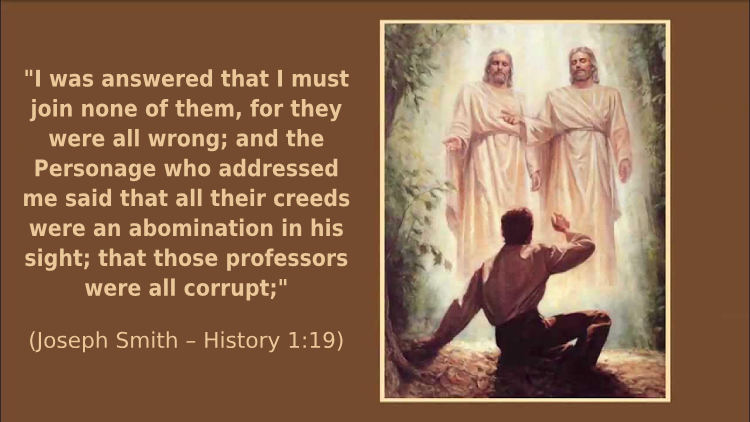
The official LDS position on apostasy is articulated clearly in their foundational texts and modern teachings. The Pearl of Great Price records Joseph Smith’s account of his First Vision, in which Jesus Christ allegedly told him that all existing churches were “an abomination in his sight” and that “their creeds were an abomination in his sight; that those professors were all corrupt; that they draw near to me with their lips, but their hearts are far from me, they teach for doctrines the commandments of men, having a form of godliness, but they deny the power thereof” (Joseph Smith—History 1:19).
The Doctrine and Covenants further establishes this narrative, declaring the LDS church as “the only true and living church upon the face of the whole earth, with which I, the Lord, am well pleased” (D&C 1:30). LDS Apostle Bruce R. McConkie articulated the traditional Mormon position emphatically: “There are no Christians other than the members of The Church of Jesus Christ of Latter-day Saints… Christianity died with the early apostles, and it was not restored again until the Lord called the Prophet Joseph Smith in the early part of the 19th century.”
Contemporary LDS teaching continues to affirm this doctrine of total apostasy. Jeffrey R. Holland stated in 2007: “The fundamental premise of The Church of Jesus Christ of Latter-day Saints is that following the death of Christ’s apostles there was a falling away from the truth, a loss of priesthood authority to administer in the things of God, and a corruption of Christian doctrine.”
According to LDS theology, this apostasy was not merely a decline in spiritual fervor or doctrinal precision, but a complete loss of priesthood authority, essential ordinances, and the very gospel itself. The Book of Mormon warns of this apostasy, stating that “because of pride, and because of false teachers, and false doctrine, their churches have become corrupted, and their churches are lifted up; because of pride they are puffed up” (2 Nephi 28:12).
The Scope and Implications of LDS Apostasy Claims
The Mormon doctrine of apostasy is comprehensive and absolute. LDS sources teach that:
- Complete Loss of Authority: The priesthood authority necessary for valid ordinances was entirely removed from the earth
- Doctrinal Corruption: Essential Christian doctrines were corrupted beyond recognition
- Institutional Failure: All existing Christian churches became “abominations.”
- Universal Scope: No true Christians existed anywhere on earth from approximately 100 AD until 1830
President Gordon B. Hinckley explained the necessity of this belief: “Our whole strength rests on the validity of that [First] vision. It either occurred or it did not occur. If it did not, then this work is a fraud… Upon that unique and wonderful experience stands the validity of this church.”
The LDS manual “Gospel Principles“ states unequivocally: “After the deaths of the Savior and His Apostles, men corrupted the principles of the gospel and made unauthorized changes in Church organization and priesthood ordinances. Because of this Great Apostasy, the Lord withdrew the priesthood authority to act in His name.”
The Historical and Biblical Challenge
However, these claims stand in stark contradiction to both biblical testimony and the overwhelming historical evidence of continuous Christian faith and practice from the apostolic era to the present day. Christ Himself promised that “the gates of hell shall not prevail against” His church (Matthew 16:18), and that He would be with His disciples “always, even unto the end of the world” (Matthew 28:20).
BibleRef.com: Matthew 28:20
The word translated “always” in this verse comes from a special Greek phrase only used here in the New Testament: pasas tas hēmeras. It literally means “the whole of every day.” This is then extended to all eternity with the expression h󠅍eōs tēs synteleias tou aiōnos: “even to the end of the age.” Jesus’ promise is to be with His followers—in Spirit and in Truth (John 4:24) every minute of every day, until the very end of the present age, and into the eternal life beyond (John 3:16–18).
The historical record reveals an unbroken chain of Christian witness, documented through:
- Patristic writings from the immediate post-apostolic period
- Archaeological evidence of continuous Christian worship and practice
- Manuscript traditions preserving apostolic teachings
- Succession of Christian leadership and institutional continuity
- Martyrological accounts demonstrating unwavering faith
Early Christian leaders such as Clement of Rome (writing around 96 AD), Ignatius of Antioch (martyred around 108 AD), and Polycarp (a direct disciple of the Apostle John) provide clear evidence of doctrinal continuity and ecclesiastical authority extending directly from the apostolic period.
The Stakes of This Examination
The implications of this examination extend far beyond mere academic interest. If the Mormon claims of total apostasy are false, then the entire foundation upon which the LDS church rests—including the necessity of Joseph Smith’s restoration, the authority of modern Mormon leadership, and the exclusive truth claims of LDS doctrine—crumbles.
As LDS historian Richard Bushman acknowledged, “The [apostasy] doctrine is necessary to justify the Restoration. Why restore something that was never lost?” This admission highlights the critical importance of the apostasy doctrine to Mormon theology. Without it, there is no logical basis for the existence of the LDS church as a distinct religious movement.
Furthermore, if authentic Christian authority, doctrine, and practice continued uninterrupted from the apostolic era, then the Mormon claim to exclusive truth becomes not merely erroneous but demonstrably false. The stakes, therefore, could not be higher for both Mormon believers and those investigating LDS truth claims.
The Path Forward
This essay will demonstrate through careful examination of Scripture, early Christian writings, and contemporary scholarship that the Mormon claims of total apostasy and exclusive restoration are not only historically unfounded but theologically incompatible with Christ’s own promises about His church. We will examine:
- Biblical promises regarding the permanence and continuity of Christ’s church
- Historical documentation of continuous Christian faith from the apostolic period onward
- Archaeological and manuscript evidence supporting institutional and doctrinal continuity
- The testimony of early Christian martyrs and apologists
- Comparative analysis of early Christian and modern LDS doctrines and practices
As we shall see, the evidence powerfully supports the continuous presence of authentic Christian faith, doctrine, and authority from the time of Christ to the present. Rather than supporting the LDS narrative of apostasy and restoration, the historical record testifies to the fulfillment of Christ’s promise that His church would endure throughout all generations, preserved by the Holy Spirit and sustained by the faithful witness of countless believers who maintained the apostolic faith even unto death.
The Biblical Foundation for Church Continuity
Christ’s Promise of Perpetual Presence
The most fundamental challenge to Mormon claims of total apostasy comes from Christ Himself. In Matthew 16:18, Jesus declared: “And I tell you, you are Peter, and on this rock I will build my church, and the gates of hell shall not prevail against it” (ESV). This promise is not merely about the church’s ultimate victory in the eschaton, but about its continuous existence and strength throughout history.
The Greek word translated “prevail” (κατισχύσουσιν) means to overpower, overcome, or be stronger than. Christ’s promise indicates that the forces of evil—represented by “the gates of hell”—will never be able to overpower or completely overcome His church. A total apostasy lasting over 1,700 years would constitute precisely such an overwhelming defeat, making Christ’s promise false.
Notably, the imagery of “gates of hell” (πύλαι ᾅδου, pylai hadou) refers to the gates of Hades—a symbol of death’s domain and power. Gates are defensive structures, not offensive weapons, which means Christ is describing His church as the advancing force against which death and corruption cannot hold. If the church fell into total apostasy, it would be death and corruption that had successfully held their ground, not the church that had prevailed. The entire metaphor is inverted by the LDS apostasy narrative.
Furthermore, Jesus promised in Matthew 28:20: “And behold, I am with you always, to the end of the age.” This promise of perpetual presence was given to the disciples in the context of the Great Commission, indicating that Christ’s presence would remain with His church throughout its mission to all nations. The Mormon claim of total apostasy necessarily implies that Christ abandoned His church for nearly two millennia, contradicting this explicit promise.
This promise is reinforced throughout the New Testament epistles. In Ephesians 3:21, Paul declares that glory belongs to God “in the church and in Christ Jesus throughout all generations, forever and ever.” The phrase “throughout all generations” (εἰς πάσας τὰς γενεάς) does not permit a 1,700-year gap of silence. Paul’s doxology assumes an unbroken chain of God’s glorification within the church across every successive generation—not a restoration project launched by a nineteen-year-old in upstate New York in 1820.
John 14:16–17 adds another layer of difficulty for the total apostasy claim. There, Jesus promises the Father will give His disciples “another Helper, to be with you forever, even the Spirit of truth.” The word “forever” (εἰς τὸν αἰῶνα) is unambiguous. If the Holy Spirit was given to dwell in and guide the church permanently, a total apostasy would require either that the Spirit withdrew—contradicting Christ’s explicit promise—or that the Spirit remained present while the church He indwelt fell into complete corruption. Neither option is theologically coherent on LDS terms.
It is also telling that the New Testament anticipates false teachers and partial corruption within the church (Acts 20:29–30; 2 Timothy 4:3–4; 2 Peter 2:1–2) without ever predicting the church’s total extinction. These warnings address deviation and discipline, not annihilation. The apostles wrote as men guarding something that could be damaged but not destroyed—consistent with Christ’s promise, and wholly inconsistent with the LDS narrative that their work and authority would be entirely lost within a generation of their deaths.
Taken together, these passages form a coherent and mutually reinforcing testimony: Christ promised to build His church, to remain with it, to send His Spirit to indwell it permanently, and that it would be glorified in every generation. The total apostasy doctrine does not merely stretch these promises—it breaks them entirely.
The Apostolic Vision of Continuity
The apostles themselves envisioned and prepared for the continuation of the church beyond their own lifetimes. Paul’s instructions to Timothy reveal a clear plan for generational succession: “and what you have heard from me in the presence of many witnesses entrust to faithful men, who will be able to teach others also” (2 Timothy 2:2, ESV). This passage outlines four generations of leadership: Paul, Timothy, the “faithful men,” and “others also.”
In this passage, Paul refers to four generations of apostolic succession: his own generation, Timothy’s generation, the generation Timothy will teach, and the generation that they in turn will teach. This demonstrates that the apostles not only expected but actively prepared for the continuation of authentic Christian leadership and teaching beyond their own era. Far from leaving the church to improvise, Paul constructed a deliberate chain of transmission — a relay race of doctrinal fidelity across time.
This vision of succession was not unique to Paul’s correspondence with Timothy. When Paul and Barnabas completed their first missionary journey, they “appointed elders for them in each church, and with prayer and fasting, committed them to the Lord in whom they had believed” (Acts 14:23). This pattern of planting structured, elder-led congregations wherever the gospel took root reveals an institutional intentionality that presupposes long-term continuity. The apostles were not founding temporary spiritual movements; they were building durable, governed communities.
The pastoral epistles (1 and 2 Timothy, Titus) are particularly significant as they provide detailed instructions for church organization, leadership qualifications, and doctrinal preservation. These letters would be meaningless if the apostles believed the church would completely apostatize shortly after their deaths. Instead, they reveal careful planning for long-term institutional continuity. Paul’s direction to Titus is especially pointed: “The reason I left you in Crete was to set in order the remaining matters and to appoint elders in every town, as I directed you” (Titus 1:5, ESV). The mandate covered every town — not most, not some — signaling that a fully staffed, qualified leadership structure was apostolically required for every congregation.
The leadership qualifications Paul outlines in 1 Timothy 3:1–7 and Titus 1:5–9 further underscore this long-term planning. Paul does not merely instruct Timothy and Titus to find willing volunteers; he specifies detailed moral, relational, and doctrinal standards — that an elder must be “above reproach,” “able to teach,” “not a drunkard,” and someone who “holds firmly to the trustworthy message as it has been taught, so that he can encourage others by sound doctrine and refute those who oppose it” (Titus 1:9, ESV). These are the qualifications of permanent institutional offices, not provisional stopgaps for a community expecting imminent collapse.
The awareness of succession is also reflected in Paul’s own forward-looking urgency near the end of his life. In 2 Timothy 4:1–2, he charges Timothy to “preach the word; be ready in season and out of season,” and warns that “the time is coming when people will not endure sound teaching” (2 Timothy 4:3, ESV) — precisely because Paul expected the church to persist through periods of doctrinal challenge and require leaders equipped to guard it. This warning only makes sense within a framework of long-term institutional survival, not impending total apostasy.
The early post-apostolic church understood this mandate clearly. Writing around AD 94, Clement of Rome explicitly stated that the apostles, knowing strife would arise over church governance, “appointed the above-mentioned as bishops and deacons: and then gave a rule of succession, in order that, when they had fallen asleep, other men, who had been approved, might succeed to their ministry.” This is not a later Catholic innovation — it is the direct testimony of a man who knew the apostles personally, confirming that structured succession was their explicit intention.
Taken together, these texts — 2 Timothy 2:2, Acts 14:23, Titus 1:5, and the elder-qualification passages — form a coherent apostolic blueprint for a church designed to endure. The apostles were not passive bystanders waiting for Christ’s return; they were active architects of an institution built to carry the faith intact through every generation.
The Nature of the Church in Biblical Theology
Scripture presents the church using three foundational metaphors that together reveal its essential character and relationship to Christ. The church is the body of Christ (1 Corinthians 12:27, Ephesians 1:22-23), indicating a living organism in which every member is organically connected to the head. It is the bride of Christ (Ephesians 5:25-27, Revelation 19:7), signifying a covenantal union of exclusive devotion and sacrificial love. And it is the temple of the Holy Spirit (1 Corinthians 3:16, Ephesians 2:21-22), marking the church as the dwelling place of God himself in the present age. Taken together, these metaphors are not merely poetic decoration — they are theological declarations about the nature of the church’s existence. They indicate an organic, intimate, and permanent relationship between Christ and His church that cannot be severed by apostasy.
The Body Metaphor and Organic Unity: Paul’s body metaphor in 1 Corinthians 12 is especially instructive. He devotes an entire chapter to showing that the body cannot function without its members, and that no member can survive independently of the body. The head — Christ himself — governs, nourishes, and directs the whole (Colossians 2:19). To argue for a total apostasy is to argue that the head lost control of the body, a claim that directly contradicts Paul’s assertion that Christ “fills all in all” (Ephesians 1:23).
This is precisely what LDS teaching requires. The Gospel Principles manual (2009, p. 92) states plainly: “One by one, the Apostles were killed or otherwise taken from the earth. Because of wickedness and apostasy, the apostolic authority and priesthood keys were also taken from the earth. The organization that Jesus Christ had established no longer existed, and confusion resulted… soon pagan beliefs dominated the thinking of those called Christians.” Former LDS President Joseph Fielding Smith similarly taught that “for hundreds of years, following the universal apostasy, the inhabitants of the earth walked in spiritual darkness” and that “the fundamental principles of the gospel ceased to exist among them.” But if Christ is the active, reigning head who “upholds the universe by the word of his power” (Hebrews 1:3), then the body He governs cannot simply cease to exist. A head that loses its body is not a reigning head — it is a defeated one. Such a scenario would reduce Christ’s headship to a fiction for over fourteen centuries, an impossibility for the sovereign Lord described throughout the New Testament.
The Bride Metaphor and Covenantal Fidelity: The bride metaphor carries equally powerful implications. Paul’s letter to the Ephesians frames the husband-wife relationship on the model of Christ and the church, stating that Christ “loved the church and gave himself up for her, that he might sanctify her, having cleansed her by the washing of water with the word, so that he might present the church to himself in splendor, without spot or wrinkle or any such thing” (Ephesians 5:25-27). The preservation and sanctification of the bride is Christ’s own project — not a human responsibility that can be forfeited through institutional failure.
LDS Apostle James E. Talmage argued that “with the passing of the apostolic period the Church drifted into a condition of apostasy, whereby succession in the Holy Priesthood was broken; and that the Church as an earthly organization operating under Divine direction and having authority to officiate in spiritual ordinances ceased to exist among men.” But this claim places the survival of the church in the hands of an unbroken succession of human officeholders rather than in the hands of the bridegroom himself. Scripture does not locate the church’s preservation in the continuity of any human institution — it locates it in the ongoing love and sovereign power of Christ. The Book of Revelation reinforces this when it anticipates “the marriage of the Lamb” and describes the bride as having “made herself ready” (Revelation 19:7). The imagery assumes a continuous existence: a bride who ceases to exist cannot make herself ready. The entire eschatological narrative of Scripture presupposes a living, persisting church that Christ presents to himself at the culmination of history, not a church that vanished and had to be reconstructed from scratch by a nineteenth-century prophet in upstate New York.
The Temple Metaphor and Divine Indwelling: The temple metaphor adds a third critical dimension. In Ephesians 2:21-22, Paul writes that believers are “being built together into a dwelling place for God by the Spirit.” This is a present-tense, ongoing construction. The Spirit of God actively indwells and sustains the church as His temple. To accept the LDS great apostasy would therefore require accepting that the Holy Spirit vacated His own temple — that God, who promises never to leave or forsake His people (Hebrews 13:5), effectively abandoned His church for over a millennium.
This stands in irreconcilable tension with Jesus’ promise that the Father would send “another Helper, to be with you forever” (John 14:16). The word “forever” (eis ton aiona) leaves no room for a prolonged interlude of spiritual vacancy. LDS teaching on the apostasy explicitly denies that this promise was kept in any meaningful institutional sense. Former LDS President Spencer W. Kimball stated: “The laws were changed, the ordinances were changed, and the everlasting covenant was broken… there was a long period of centuries when the gospel was not available to people on this earth, because it had been changed.” But if the gospel was truly unavailable for centuries, then the Helper promised by Christ was also unavailable — a conclusion that makes Christ a liar, not merely an administrator awaiting a future restoration.
Ephesians 4 and the Process of Maturation: Ephesians 4:11-16 describes the church’s growth toward maturity through the ministry of apostles, prophets, evangelists, pastors, and teachers “until we all attain to the unity of the faith and of the knowledge of the Son of God, to mature manhood, to the measure of the stature of the fullness of Christ.” This passage envisions a process of gradual maturation, not sudden total apostasy followed by centuries of spiritual darkness. The trajectory Paul describes is ascending, not descending. The gifted offices he lists are given precisely “to equip the saints for the work of ministry, for building up the body of Christ” (v. 12). The building up is continuous and cumulative, moving toward a goal of unity and maturity reached through faithful transmission, not interrupted by catastrophic institutional collapse.
LDS apologists frequently cite this passage as evidence that apostles were intended to be permanent, governing officers in the church and that their physical absence constituted an ecclesiological emergency requiring restoration. But this misreads Paul’s purpose. Paul does not say that apostles must be present in every generation until the Second Coming; he says the church is to be built up until it reaches maturity. The “until” is teleological — it points to a goal being progressively achieved, not a warning that the entire process would be catastrophically interrupted and reset by a boy prophet in 1820. Furthermore, Paul presents false teaching as the danger the church must guard against through maturation, not as an inevitable destiny it cannot escape (v. 14). The entire pastoral logic of the passage assumes a church that, while threatened by corruption, possesses within itself — through Scripture, the Spirit, and gifted leadership — the resources necessary to resist and overcome that corruption.
Christ’s Own Promise of Preservation: Jesus himself anchored this expectation in His famous declaration to Peter: “I will build my church, and the gates of hell shall not prevail against it” (Matthew 16:18). The Greek word translated “prevail” (katischyō) means to overpower or gain the upper hand. The gates of Hades — representing death, corruption, and the full force of satanic opposition — cannot overcome the church Christ is building. This promise is unconditional and unqualified.
It is striking that LDS theology, to be internally consistent, must effectively argue that the gates of hell did prevail for over fourteen centuries. As LDS Seventy B.H. Roberts himself acknowledged: “Nothing less than a complete apostasy from the Christian religion would warrant the establishment of the Church of Jesus Christ of Latter-day Saints.” That is an admirably candid statement. Roberts correctly recognized that the LDS Church rises or falls with the doctrine of the great apostasy. If the gates of hell did not prevail against Christ’s church — and Jesus says they did not — then there was no need for Joseph Smith’s restoration, no warrant for his First Vision’s claim that “all their creeds were an abomination” (Joseph Smith-History 1:19), and no justification for LDS President Ezra Taft Benson’s assertion that “the rock of revelation on which the church was built ceased” after the apostolic period. Matthew 16:18 does not merely challenge the LDS great apostasy doctrine — it demolishes the theological foundation on which the entire LDS restoration narrative is constructed.
The First Vision’s Sweeping Indictment: The logical stakes deserve to be stated plainly. In Joseph Smith’s canonized account of the First Vision, he reports being told that all existing churches were wrong, that all their creeds were “an abomination,” and that all their professors were corrupt (Joseph Smith-History 1:19). This is not a mild critique of institutional imperfection — it is a total rejection of the entire Christian tradition from the apostolic era to 1820. LDS Apostle Bruce R. McConkie drew the implication even more starkly, teaching that every church except the LDS Church is part of “the church of the devil” — “every false religion, every supposed system of salvation which does not actually save and exalt man in the highest heaven” (Book of Mormon Student Manual, p. 14). Against this sweeping condemnation, the biblical metaphors of body, bride, and temple stand as a direct refutation. A church that Christ is actively governing as its head, sanctifying as its bridegroom, and indwelling as its temple cannot simultaneously be “an abomination” belonging to the devil. The LDS great apostasy claim does not merely contradict certain biblical passages — it requires dismantling the entire biblical theology of the church.
Continuity Through History: Church history, far from being a blank slate of apostasy, records an unbroken succession of believers who held, proclaimed, debated, and died for the core doctrines of the Christian faith. The councils of Nicaea (325 AD), Constantinople (381 AD), Ephesus (431 AD), and Chalcedon (451 AD) were not inventions of corruption — they were the church laboring, however imperfectly, to articulate and preserve the apostolic deposit against heretical innovation. LDS manuals teach that these councils represent exactly the opposite: that “important religious questions were settled by councils” as part of a process whereby “the simple doctrines and ordinances taught by the Savior were debated and changed to conform to worldly philosophies” (Preach My Gospel, 2004, p. 36). But this claim requires the remarkable assumption that the same Spirit Jesus promised would guide his people “into all truth” (John 16:13) either failed or was absent precisely when the church most needed guidance — and that no correction occurred for nearly two millennia until Joseph Smith arrived. Figures such as Athanasius, who stood virtually alone against imperial pressure to compromise the doctrine of Christ’s full divinity, or the countless martyrs who died rather than renounce their faith, testify to a living tradition that was never entirely extinguished. A church that wrestles with error and corrects itself is not an apostate church awaiting restoration; it is a living church doing exactly what its Lord promised it would do.
Historical Evidence Against Total Apostasy
The Apostolic Fathers: Witnesses to Continuity
The historical period in which they worked became known as the Patristic Era and spans approximately from the late 1st to mid-8th centuries, flourishing in particular during the 4th and 5th centuries… The Patristic Period is a vital point in the history of Christianity since it contextualizes the early Christian information from the time of the death of the last Apostle (John) (which runs roughly from 100 A.D. to the Middle Ages, 451 A.D., and the Council of Chalcedon).
The writings of the Apostolic Fathers—those Christian leaders who lived in the late first and early second centuries and had direct contact with the apostles or their immediate disciples—provide compelling evidence against the Mormon claim of immediate apostasy following the death of the apostles.
Clement of Rome (c. 35-99 AD) was a contemporary of the apostles and traditionally identified as the Clement mentioned by Paul in Philippians 4:3. His letter to the Corinthians (c. 96 AD) demonstrates continuity in Christian doctrine, church organization, and authority. “Through countryside and city [the apostles] preached, and they appointed their earliest converts, testing them by the Spirit, to be the bishops and deacons of future believers. Nor was this a novelty, for bishops and deacons had been written about a long time earlier. . . . Our apostles knew through our Lord Jesus Christ that there would be strife for the office of bishop. For this reason, therefore, having received perfect foreknowledge, they appointed those who have already been mentioned and afterwards added the further provision that, if they should die, other approved men should succeed.”
This passage from 1 Clement clearly shows that the apostles themselves established a system of succession and that this was functioning properly as late as 96 AD, well after the death of most apostles.
Ignatius of Antioch (c. 35-108 AD) was a direct disciple of the apostle John. Ignatius of Antioch, whose seven authentic letters are dated no later than A.D. 117 or 118, so he must have known some of the apostles themselves, as Antioch was a center of missionary activity frequented by Paul in Acts 11:26–30 and 13:1–3. His letters, written while en route to martyrdom in Rome, reveal a church with an established hierarchical structure, orthodox Trinitarian theology, and a proper understanding of Christ’s divinity and humanity—all supposedly “lost” doctrines according to Mormon claims.
Polycarp of Smyrna (c. 69-155 AD) was a direct disciple of the apostle John. Irenaeus reports that Polycarp had been a disciple of John the Evangelist. His letter to the Philippians and the account of his martyrdom demonstrate the preservation of apostolic teaching and the continuity of church leadership well into the second century.
The Preservation of Core Christian Doctrines
Contrary to Mormon claims, the essential doctrines of Christianity were not lost after the apostles’ deaths but were consistently maintained and defended by their successors across every generation. The LDS narrative requires that saving truth — including the nature of God, the person of Christ, the means of salvation, and the authoritative scriptures — was so thoroughly corrupted as to be unrecognizable and unretrievable by ordinary believers. Former LDS President Gordon B. Hinckley expressed the standard LDS position plainly when he stated: “There was the great Apostasy, a falling away from the Church established by Jesus.” The True to the Faith handbook (2004, p. 13) goes further, declaring that “the gospel as Christ had established it was no longer on the earth.” But the primary sources from the second and third centuries tell a dramatically different story, demonstrating remarkable theological continuity across precisely the period LDS teaching identifies as one of total spiritual darkness.
The Doctrine of the Trinity. While the term “Trinity” was not formally coined until later, the doctrine itself — one God eternally existing in three distinct persons, Father, Son, and Holy Spirit — is clearly present in post-apostolic writings long before any church council systematized it. The Didache (c. 50–120 AD) includes an explicitly Trinitarian baptismal formula: “Baptize in the name of the Father, and of the Son, and of the Holy Spirit” (Didache 7:1), demonstrating that Trinitarian practice was embedded in the church’s liturgical life from its earliest recorded documents. Justin Martyr’s writings (c. 150 AD) demonstrate a clear Trinitarian understanding, describing the Father, the Son, and the prophetic Spirit as the three persons to whom Christians give honor and worship (First Apology, ch. 13). The baptismal interrogation recorded in the Apostolic Tradition of Hippolytus (c. 215 AD) follows the same Trinitarian pattern established in Matthew 28:19, with candidates being immersed three times in response to questions about belief in each member of the Godhead.
LDS theology denies precisely this doctrine. Joseph Smith taught in the King Follett Discourse (April 1844) that “God himself was once as we are now, and is an exalted man” and that the Father, Son, and Holy Ghost are “three separate Gods.” The LDS Articles of Faith (1:1) affirm belief in “God the Eternal Father, and in His Son, Jesus Christ, and in the Holy Ghost” as three wholly separate beings of the same species, not one God in three persons. LDS apologists sometimes argue that the doctrine of the Trinity as formulated at Nicaea (325 AD) represents an intrusion of Neoplatonic philosophy into biblical faith — a corruption, not a clarification. But Justin Martyr, Irenaeus, Tertullian, and Hippolytus were all writing their Trinitarian theology before Nicaea, drawing directly from the apostolic tradition they received. The Nicene formula did not invent Trinitarianism; it defended the pre-existing apostolic consensus against the fourth-century innovation of Arius, who was himself the theological innovator. If anyone introduced novelty into Christian theology, it was Arius — not the bishops at Nicaea who opposed him.
Christology and the Full Divinity of Christ. The early church consistently maintained both the full divinity and full humanity of Christ as two natures united in one person. Ignatius of Antioch’s letters (c. 107 AD), written while he was being transported to Rome for martyrdom, strongly affirm Christ’s divinity against docetic heretics who denied the reality of His physical body. Writing to the Ephesians, Ignatius calls Christ “our God” (Epistle to the Ephesians, ch. 18) — a straightforward identification of Jesus with God that leaves no room for the LDS teaching that Jesus is a separate and lesser deity who was once a pre-mortal spirit child. The Epistle to Diognetus (c. 130 AD) presents a clear and theologically sophisticated account of the Incarnation: that the very one “who holds all things together, in whom all things subsist,” took on human form to reveal himself to humanity. Polycarp of Smyrna, a direct disciple of the Apostle John himself, martyred around 155 AD, spoke of “our Lord and God Jesus Christ” in terms that leave no ambiguity about the church’s first-century Christology.
These writings predate the major Christological controversies by centuries, demonstrating that orthodox Christology was preserved from apostolic times — not invented by fourth-century councils under political pressure, as LDS literature frequently implies. The Preach My Gospel manual (2004) attributes the theological confusion of post-apostolic Christianity partly to “uninspired church leaders” who permitted “Greek philosophy” to corrupt original Christian teaching. But Ignatius was not a Greek philosopher — he was a bishop who had known the apostles personally, facing lions in a Roman arena for his faith. His Christology was not a philosophical construction; it was the lived faith of the first Christian communities he had received directly from those who walked with Jesus.
Soteriology: Salvation by Grace. The doctrine of salvation by grace through faith, apart from works of human merit, was consistently maintained in the post-apostolic literature. The Epistle of Barnabas (c. 70–130 AD) insists that Christians receive forgiveness and sanctification as God’s gift, not as the product of ritual performance. The Shepherd of Hermas (c. 100–160 AD), while deeply concerned with the moral life of the church and the possibility of post-baptismal repentance, grounds its entire ethical appeal in the mercy and grace of God, not in human achievement. Clement of Rome, writing to the Corinthians around 96 AD, explicitly states: “We are not justified through ourselves, nor through our own wisdom or understanding or godliness or works which we have done in holiness of heart, but through faith” (1 Clement 32:4) — language that would be entirely at home in Paul’s letter to the Romans.
This evidence is particularly significant in light of the LDS soteriology, which introduces ordinances and covenantal works as necessary components of exaltation. LDS teaching requires baptism by proper priesthood authority, the laying on of hands for the gift of the Holy Ghost, temple endowments, celestial marriage, and adherence to covenants as prerequisites for the highest degree of glory. Former LDS Apostle Bruce R. McConkie wrote in Mormon Doctrine (p. 670): “Salvation in the celestial kingdom of God… is available because of the atoning sacrifice of Christ, but it is received only on condition of faith, repentance, baptism, receiving the Holy Ghost, and continuing in righteousness to the end.” Nowhere in the writings of Clement, Barnabas, Polycarp, or Ignatius does such a structure of priesthood-mediated ordinances appear as the necessary framework of salvation. If this were the original apostolic gospel and it was subsequently lost, one would expect some trace of grief at its disappearance, some record of Christians recognizing the loss of the necessary ordinances. Instead, the record shows communities worshiping and receiving salvation through faith in Christ without any awareness that they lacked a necessary priesthood structure.
The Biblical Canon and Institutional Continuity. The process of recognizing the New Testament canon was gradual but principled, following criteria established by the apostles themselves — apostolic origin or endorsement, theological consistency with received doctrine, and widespread acceptance across the church’s geographic spread. The Muratorian Fragment (c. 170–200 AD) lists most of the books we recognize today, including all four Gospels, the Acts of the Apostles, thirteen letters of Paul, Jude, and the two Johannine epistles, with explicit reasoning about why certain disputed works were excluded. Irenaeus (c. 180 AD), writing his massive treatise Against Heresies, quotes from virtually all New Testament books as authoritative Scripture, using them with the same weight and authority as the Old Testament, and explicitly arguing that there must be exactly four Gospels on theological grounds (Against Heresies, III.11.8). Origen (c. 185–254 AD) produced systematic textual and theological scholarship on an extraordinary range of New Testament books, demonstrating that the church not only possessed but was deeply engaged with a recognizable canonical corpus throughout the supposed dark age of apostasy.
LDS teaching raises a different canonical objection: not that the New Testament was lost, but that it was corrupted. The Book of Mormon states that “many plain and precious things” were removed from the Bible by “the great and abominable church” (1 Nephi 13:26-28), an allegation that has become one of the primary justifications for supplementing the Bible with LDS scriptures. But no textual evidence supports such systematic removal. The manuscript tradition for the New Testament is extraordinarily robust — over 5,800 Greek manuscripts, plus thousands more in Latin, Syriac, Coptic, and other languages — and the variations among them are almost entirely minor, involving spelling, word order, and scribal clarifications, not the deletion of “plain and precious” doctrines. If a great and abominable church had systematically removed core salvific teachings from the New Testament, one would expect, at a minimum, some textual echo in earlier manuscripts. No such echo exists. The canon that Irenaeus, Origen, and Eusebius recognized and worked with is, in all theologically essential respects, the same canon that sits on nearly every Christian’s nightstand today. This demonstrates not merely doctrinal continuity but institutional continuity in preserving, copying, transmitting, and recognizing the apostolic writings across the very centuries that LDS theology writes off as an era of total corruption.
The Witness of Martyrdom and Living Faith. Perhaps the most powerful refutation of the LDS great apostasy is not textual but existential: the unbroken chain of martyrs who died rather than recant their faith in Jesus Christ as Lord and God. Polycarp was burned alive at Smyrna around 155 AD. Perpetua and Felicitas were executed in Carthage in 203 AD. The Scillitan Martyrs died in North Africa in 180 AD. Justin Martyr was beheaded in Rome around 165 AD. These were not people who had lost a saving knowledge of Christ, whose gospel had been swept away in a tide of pagan corruption. They were people who knew Jesus Christ as their living Savior and Lord with sufficient conviction to die rather than deny Him. To accept the LDS great apostasy narrative, one must conclude that these men and women who gave their lives for the name of Jesus were, according to Joseph Smith’s First Vision, professors of a corrupt and abominable religion — that their dying confession of faith was, in some sense, spiritually worthless because they lacked the correct LDS priesthood authority to validate it. The moral and theological weight of that conclusion should give any serious student of Christian history significant pause.
Archaeological Evidence of Christian Continuity
Archaeological discoveries continue to confirm the continuous existence of Christian communities throughout the period Mormon theology claims was marked by total apostasy. The physical remains of Christian life — buildings, inscriptions, symbols, burial sites, and liturgical objects — constitute a form of historical testimony that is immune to the charge of later theological editing. Stones do not lie, and the stones of the second and third centuries tell a consistent story: a geographically widespread, doctrinally coherent, institutionally organized Christian movement that shows no sign of the catastrophic collapse LDS teaching requires.
The contrast with LDS archaeological claims is striking. Despite over 170 years of effort by LDS-affiliated scholars and institutions, not a single artifact, inscription, burial site, or physical structure has been recovered that corroborates the Book of Mormon’s account of vast Nephite and Lamanite civilizations inhabiting the American continent. No chariots, no steel, no horses, no Hebrew inscriptions, no coins of the type described in Alma 11 — none of the material culture one would expect from populations numbering in the millions over thousands of years has surfaced in any verified archaeological context. The Smithsonian Institution and the National Geographic Society have both formally stated that the Book of Mormon is not used as a guide to archaeological research and that no archaeological evidence supports its historical claims. This asymmetry is telling: the very tradition that demands the physical disappearance of Christ’s church has left no physical trace of the civilization it claims replaced it, while the church it declares apostate has left an abundant, continent-spanning, and continuously growing archaeological record.
Early Christian Inscriptions. Thousands of Christian inscriptions from the second and third centuries demonstrate the widespread presence of organized Christian communities across the Roman Empire and beyond. The catacombs of Rome contain extensive Christian artwork and inscriptions dating from the second century onward — epitaphs that invoke Christ as Savior, depict scenes from Scripture, and use distinctly Christian theological vocabulary. The Abercius inscription (c. 180 AD), discovered in Phrygia (modern Turkey) and now housed in the Vatican Museums, records the travels of a Christian bishop who encountered recognizable communities of faith from Rome to the Euphrates River, sharing “the pure fish from the spring” — an early Eucharistic reference — across thousands of miles of territory. This single inscription alone demolishes the idea of a localized or fragmentary Christian presence; it documents an international communion of churches with shared practices and shared identity in the supposed dark age of apostasy.
Church Buildings and Organized Communities. Archaeological evidence shows the construction of purpose-built Christian meeting places (domus ecclesiae, or house churches) as early as the second century. The Dura-Europos house church in modern Syria, dated to approximately 235 AD, is among the oldest known purpose-built Christian worship spaces, containing a dedicated baptistery with frescoes depicting scenes from the Gospels — the healing of the paralytic, Jesus walking on water, and the women at the tomb of the Resurrection. Its existence indicates organized, stable Christian communities with sufficient resources, social cohesion, and theological self-consciousness to construct and decorate permanent worship facilities. LDS teaching would require these communities to be spiritually void — possessed of buildings and rituals but lacking the priesthood authority that alone, in LDS theology, makes ordinances valid. Yet nothing in the archaeological record suggests a community in crisis over lost authority; quite the opposite, the material culture reflects communities confident in their identity and their access to God.
Christian Symbols and Geographic Coherence. The consistent use of Christian symbols — the chi-rho (☧), the ichthys (fish), the alpha and omega, the anchor of hope — across diverse and distant geographical regions from Britain to North Africa to Mesopotamia demonstrates the maintenance of a common Christian identity and shared theological framework. These were not regional inventions; they were a shared visual language that presupposes communication, theological consensus, and institutional connection between communities across the known world. The ichthys, for example, encodes a christological confession — Iēsous Christos Theou Huios Sōtēr, “Jesus Christ, Son of God, Savior” — that is entirely inconsistent with the LDS claim that the true identity of Christ had been lost or corrupted. Every fish symbol scratched into a catacomb wall or pressed into a clay lamp was a silent creed, confessing the divine Sonship and saving power of Jesus Christ centuries before Joseph Smith claimed those truths had been restored.
Taken together, the epigraphic, architectural, and symbolic evidence forms a continuous and unbroken thread of Christian communal life stretching across the very centuries LDS theology characterizes as a spiritual wasteland. The great apostasy is not merely a theological claim that can be debated based on Scripture alone — it is a historical claim, and history, written in stone and paint and clay across three continents, refuses to cooperate with it.
Summarizing Specific Mormon Claims
The “Only True and Living Church” Claim
Joseph Smith claimed that his restored church was “the only true and living church upon the face of the whole earth.” This exclusivist claim is problematic on multiple levels:
Biblical Contradiction: Jesus spoke of His church in singular terms (“I will build my church” – Matthew 16:18), indicating one universal church composed of all believers. The New Testament consistently presents the church as the unified body of Christ (1 Corinthians 12:12-27, Ephesians 4:4-6). Multiple “true” churches would contradict the biblical doctrine of church unity.
Historical Implausibility: The claim requires believing that authentic Christianity completely disappeared from the earth for nearly 1,800 years, despite Christ’s promise that “the gates of hell shall not prevail” against His church. This contradicts the historical record of continuous Christian presence and missionary activity throughout this period.
Theological Inconsistency: If God allowed His church to be completely overcome by apostasy for 1,800 years, it calls into question either His power to preserve His people or His faithfulness to His promises. Either conclusion undermines fundamental Christian theology about God’s character and sovereignty.
The “Great Apostasy” Theory
The Mormon doctrine of the Great Apostasy claims that essential Christian doctrines and authority were lost shortly after the apostles’ deaths and remained lost until Joseph Smith’s restoration. This theory faces insurmountable problems:
Contradicts Biblical Prophecy: While Scripture does prophesy end-times apostasy (2 Thessalonians 2:3, 1 Timothy 4:1-3, 2 Timothy 3:1-9), it nowhere predicts a total apostasy of the entire church for an extended period. Instead, biblical prophecies about apostasy consistently refer to partial falling away that will be corrected by Christ’s return, not total institutional failure requiring human restoration.
Ignores the Remnant Principle: Throughout Scripture, God preserves a faithful remnant even during the darkest periods (1 Kings 19:18, Romans 11:1-5). The Mormon theory requires believing that God abandoned this pattern precisely when it was most needed—after the completion of His redemptive work in Christ.
Contradicts Historical Evidence: As demonstrated above, the historical record shows continuous preservation of essential Christian doctrines, practices, and institutions from apostolic times onward. While there were certainly corruptions and controversies, the core of Christian faith was never lost.
Creates Impossible Standards: Mormon apologists often point to corruptions in medieval Christianity as evidence of total apostasy, but they apply standards to historical Christianity that they do not apply to their own tradition. The presence of problems or corruptions does not constitute total apostasy any more than problems in modern Mormonism constitute total apostasy of the LDS church.
The Condemnation of All Existing Churches
Joseph Smith claimed that Jesus told him all existing churches “were all wrong” and that “all their creeds were an abomination in his sight.” This sweeping condemnation faces several problems:
Contradicts Scripture: Jesus praised the churches of Smyrna and Philadelphia in Revelation 2-3, even while noting problems in other churches. The biblical pattern is correction and purification, not wholesale condemnation and replacement.
Historically Inaccurate: Smith’s characterization of early 19th-century Christianity as uniformly corrupt ignores the vibrant evangelical movements of his time. The Second Great Awakening, the missionary movement, and various reform efforts demonstrated genuine Christian vitality and faithfulness to biblical teaching.
Doctrinally Problematic: The early Christian creeds (Apostles’, Nicene, Chalcedonian) are faithful summaries of biblical teaching developed to combat heretical departures from apostolic doctrine. To call these “abominations” is to condemn the very doctrines they preserve, including the Trinity, the Incarnation, and salvation by grace.
Refuting LDS Revisionism
This article from Brigham Young University’s Religious Studies Center attempts to soften the exclusivist claims of early Mormonism, but this revisionism contradicts the clear statements of Joseph Smith and early LDS leaders.
In the first section of the Doctrine and Covenants, a revelation given to Joseph Smith in November 1831, the Lord refers to The Church of Jesus Christ of Latter-day Saints as “the only true and living church upon the face of the whole earth” (D&C 1:30). Admittedly, this is strong language; it is hard doctrine, words that are offensive to people of other faiths. It may be helpful to consider briefly what the phrase “the only true and living church” means and what it does not mean. In what follows, I offer my own views, my own perspective. First, let’s deal with what the phrase does not mean.
1. It does not mean that men and women of other Christian faiths are not sincere believers in truth and genuine followers of the Christ. Latter-day Saints have no difficulty whatsoever accepting a person’s personal affirmation that they are Christian, that they acknowledge Jesus Christ as the divine Son of God, their Savior, the Lord and Master of their life. Nor are Latter-day Saints the only ones entitled to personal illumination and divine guidance for their lives.
2. It does not mean that they are worshiping “a different Jesus,” as many in the Christian world often say of the Latter-day Saints. True Christians worship Jesus of Nazareth, the promised Messiah.
A Brief Rebuttal: The Mormon Jesus Problem. This apologetic sleight of hand cannot obscure the fundamental theological chasm. While Mormons may invoke the name “Jesus of Nazareth,” the entity they worship bears little resemblance to the biblical Christ.
The Mormon Jesus is not the eternal God incarnate, but rather a created spirit being—literally the spirit brother of Lucifer in their cosmology. According to LDS doctrine, both Jesus and Satan were among the spirit children of Heavenly Father and one of his celestial wives, making them siblings who competed for the privilege of becoming Earth’s savior. This Jesus achieved godhood through progression and obedience, rather than possessing it eternally as the second person of the Trinity.
This represents a categorical difference, not a denominational variation. The biblical Jesus declares, “Before Abraham was, I AM” (John 8:58), claiming the divine name and eternal existence. The Mormon Jesus, by contrast, had a beginning as a spirit child and earned his divine status—a fundamental contradiction that creates an entirely different deity.
When the LDS Church’s own apostle Bruce McConkie explicitly taught that Jesus and Lucifer are “spirit brothers,” and when Mormon scripture describes Jesus as one god among many in an endless pantheon, we are clearly dealing with a different religious system altogether. Calling this entity “Jesus of Nazareth” does not make it the biblical Christ any more than calling a counterfeit bill “currency” makes it legal tender.
Names matter less than nature. The Mormon Jesus is fundamentally incompatible with historic Christian orthodoxy—making this precisely the “different Jesus” that Paul warned against in 2 Corinthians 11:4.
3. It does not mean we believe that most of the doctrines in Protestant Christianity are false or that the leaders of the various branches of Christianity have improper motives.
4. It does not mean that the Bible has been so corrupted that it cannot be relied upon to teach us sound doctrine and provide an example of how to live. But what of the Latter-day Saint belief that plain and precious truths and many covenants of the Lord were removed from the Bible before its compilation (see 1 Nephi 13:20–40; Moses 1:40–41)? While we do not subscribe to a doctrine of scriptural inerrancy, we do believe that the hand of God has been over the preservation of the biblical materials.
Indeed, although Latter-day Saints do not believe that the Bible now contains all that it once contained, the Bible is a remarkable book of scripture, one that inspires, motivates, reproves, corrects, and instructs (see 2 Timothy 3:16). It is the word of God.
Our task, according to President George Q. Cannon, is to engender faith in the Bible:
As our duty is to create faith in the word of God in the mind of the young student, we scarcely think that object is best attained by making the mistakes of translators [or transmitters] the more prominent part of our teachings. Even children have their doubts, but it is not our business to encourage those doubts. Doubts never convert; negations seldom convince. . . . The clause in the Articles of Faith regarding mistakes in the translation of the Bible was never inserted to encourage us to spend our time in searching out and studying those errors, but to emphasize the idea that it is the truth and the truth only that the Church of Jesus Christ of Latter-day Saints accepts, no matter where it is found.
President Cannon’s statement, while framed as a call to faith, reveals an uncomfortable tension at the heart of the LDS approach to Scripture. He acknowledges that the Bible contains translational and transmission errors significant enough to warrant an Article of Faith disclaimer, yet simultaneously discourages the very investigation that would allow a believer to distinguish reliable text from corrupted text. This is not a posture of confidence in Scripture — it is a managed ignorance dressed in the language of faith. Genuine faith is not threatened by honest textual inquiry; it is grounded in it.
More importantly, Cannon’s statement inadvertently exposes the logical instability of the LDS position. The LDS Church uses the alleged corruption of the Bible as a primary justification for supplementing it with the Book of Mormon, the Doctrine and Covenants, and the Pearl of Great Price. If Bible errors are significant enough to require additional LDS scriptures to correct them, they are significant enough to study carefully. The LDS leadership cannot simultaneously claim the Bible is too corrupted to be fully trusted and discourage the scholarship that would identify precisely where and how that corruption occurred. One cannot build a restoration theology on the premise of biblical unreliability and then counsel believers not to examine that unreliability too closely.
Finally, Cannon’s appeal rings hollow against the actual manuscript evidence. The textual tradition of the New Testament — over 5,800 Greek manuscripts plus thousands more in Latin, Syriac, Coptic, and other languages — is the most extensively documented of any ancient text in human history. Careful textual criticism has not undermined the reliability of the biblical text; it has confirmed it with remarkable consistency. The “mistakes of translators” that LDS theology requires to be sweeping enough to justify a wholesale restoration turn out, under scholarly scrutiny, to be minor and well-documented variations that affect no core Christian doctrine. The Bible does not need to be sheltered from investigation — it withstands it. It is the LDS restoration narrative, not the biblical text, that depends on believers not looking too closely.
The historical record is crystal clear: Joseph Smith unequivocally declared that all other churches were fundamentally wrong, their creeds were abominations before God, and their religious leaders were utterly corrupt. These weren’t nuanced theological distinctions—they were absolute condemnations that formed the very foundation of Mormon exclusivist claims.
Yet when confronted with the embarrassing implications of such extreme positions, modern LDS apologists have engaged in systematic historical revisionism, desperately attempting to soften these harsh pronouncements into something more palatable to contemporary sensibilities. This intellectual dishonesty represents a fundamental betrayal of their own founding prophet’s explicit teachings.
This habitual pattern of doctrinal manipulation and historical sanitization exposes a devastating flaw in Mormon epistemology. LDS apologists have made a career of moving the goalposts whenever their original claims prove untenable, treating their supposedly divine revelations as rough drafts subject to endless editorial revision. They cannot maintain fidelity to their own doctrinal heritage for even a single generation without abandoning inconvenient truths.
The implications are damning: if the Mormon restoration was genuinely divine and complete, it would not require this constant stream of apologetic damage control and doctrinal retrofitting. The relentless need to reinterpret, qualify, and essentially reverse core foundational claims reveals a religious system built on shifting sand rather than eternal truth. This chronic inconsistency doesn’t merely undermine specific Mormon doctrines—it demolishes any credible claim to divine authority or restored truth altogether.
Biblical Manuscript Evidence and Translation Issues
The Reliability of Biblical Transmission
Joseph Smith claimed that the Bible had been corrupted through careless transmission and deliberate removal of “plain and precious” truths, making new revelation through him a necessity. The eighth Article of Faith encodes this suspicion institutionally, affirming the Bible only “as far as it is translated correctly” — a qualifier applied to no other LDS scripture, including the Book of Mormon, which Smith claimed to have translated by divine power. This asymmetry is itself revealing. But the claim of systemic biblical corruption does not merely conflict with theology — it conflicts with the most thoroughly documented manuscript tradition in the ancient world.
The Dead Sea Scrolls and Old Testament Stability. The discovery of the Dead Sea Scrolls between 1947 and 1956 at Qumran provided manuscript copies of virtually every Old Testament book dating from approximately 150 BC to 70 AD — roughly 1,000 years older than the previously known Masoretic manuscripts. When scholars compared the two traditions, the degree of correspondence was extraordinary. The Isaiah Scroll (1QIsa), for example, is word-for-word identical to the Masoretic text in 95% of its content, with the remaining 5% consisting of minor spelling variations and obvious scribal slips that affect no doctrine. A thousand years of hand-copying, across generations of scribes in different locations, produced a text of breathtaking stability. This is the opposite of what LDS teaching about systemic corruption requires.
New Testament Papyri and Early Witnesses. The New Testament manuscript tradition is even more robust. Papyrus P52, a fragment of John’s Gospel dated to approximately 125 AD, pushes our textual evidence to within a single generation of the apostolic period. Papyri P66 and P75, dating to around 175–225 AD, contain substantial portions of the Gospels and demonstrate that the text circulating in Egypt in the second century is essentially identical to what we read today. With over 5,800 Greek manuscripts, plus thousands more in Latin, Syriac, Coptic, Armenian, and Georgian, the New Testament is attested by more manuscripts, in more languages, from more geographic regions, and from closer to the date of original composition than any other document from the ancient world. No serious secular textual scholar — regardless of theological commitment — argues that the New Testament has been systematically corrupted in the way LDS theology demands.
Textual Criticism as Vindication, Not Indictment. Modern textual criticism, a discipline unknown in Joseph Smith’s time, was developed precisely to identify, classify, and correct scribal variations across the manuscript tradition. Far from exposing a corrupted Bible, it has validated the substantial accuracy of the transmitted text. Scholars such as Bruce Metzger and Bart Ehrman — the latter a prominent critic of traditional Christianity — agree that while thousands of textual variants exist, the overwhelming majority are spelling differences, word-order variations, and accidental duplications. Ehrman himself, in Misquoting Jesus, concedes that “essential Christian beliefs are not affected by textual variants in the manuscript tradition.” When a skeptic of orthodox Christianity is compelled to acknowledge the doctrinal stability of the transmitted text, the LDS claim of sweeping corruption becomes very difficult to sustain.
Multiple Languages and Patristic Quotations. The existence of manuscripts in Hebrew, Greek, Latin, Syriac, Coptic, and other ancient languages provides independent lines of evidence for the original text, allowing scholars to cross-check traditions that developed in geographic isolation from one another. Errors that crept into one tradition can be identified and corrected by comparison with others. Additionally, the extensive quotations of Scripture by early church fathers — Clement, Ignatius, Justin Martyr, Irenaeus, Tertullian, Origen — provide a third independent witness that frequently predates our earliest complete manuscripts. Origen, writing in the third century, quoted the New Testament so extensively that scholars have estimated the entire New Testament could be reconstructed from his citations alone. These patristic quotations consistently align with the received text, confirming that what the church read in 200 AD is what the church reads today. The “plain and precious things” Joseph Smith claimed were removed simply do not appear as missing content in any manuscript, in any language, from any century — because they were never there to be removed.
The Joseph Smith Translation Problems
Smith’s claimed corrections to the Bible — known as the Joseph Smith Translation (JST) or “Inspired Version” — stand as one of the most thoroughly falsifiable elements of his prophetic career. Rather than restoring ancient truth through rigorous engagement with ancient evidence, the JST reveals on nearly every page the theological preoccupations, linguistic habits, and doctrinal innovations of a nineteenth-century American religious entrepreneur. Its problems are not peripheral — they are structural.
No Manuscript Basis. Smith claimed to restore lost biblical content and correct centuries of textual corruption, yet he possessed absolutely no access to ancient manuscripts, early codices, or reliable textual variants that would be essential for any legitimate restoration project. He did not know Hebrew, Greek, or Aramaic — the original languages of Scripture — and worked decades before the discovery of the crucial manuscript evidence that modern scholars depend upon: the Dead Sea Scrolls, the Nag Hammadi library, the Chester Beatty Papyri, and the early New Testament papyri that push textual evidence back to within a generation of the apostles. Without a single ancient manuscript in hand, without any linguistic competence in the biblical languages, and without any exposure to the existing tools of textual scholarship, Smith’s “corrections” were based entirely on his own claimed revelations. He was operating in a complete scholarly vacuum, making authoritative pronouncements about ancient texts while lacking every instrument that actual biblical restoration would require.
This fundamental impossibility renders Smith’s textual restoration claims not merely questionable but demonstrably impossible by any legitimate scholarly standard. Consider the analogy: a physician who claims to diagnose and correct centuries of accumulated medical error, while possessing no medical training, no access to patient records, and no diagnostic instruments, is not practicing medicine — he is practicing imagination. Smith’s JST is the theological equivalent. No genuine restoration of ancient biblical content could occur without the very manuscript evidence and linguistic expertise that Smith completely lacked. His “inspired corrections” are more accurately described as nineteenth-century theological speculation masquerading as divine restoration — a creative rewriting of Scripture to reflect his evolving doctrinal agenda rather than any recoverable original text.
Anachronistic Content. The JST repeatedly introduces theological concepts and language that unmistakably belong to Smith’s nineteenth-century American context rather than the ancient biblical world. His expansions of Genesis, for example — published separately as the Book of Moses in the Pearl of Great Price — introduce references to Satan’s rebellion, the plan of salvation, and the premortal existence of souls in language and conceptual frameworks that bear no resemblance to any known ancient Jewish or early Christian text. Similarly, his revision of Matthew 24 (published as Joseph Smith-Matthew) recasts the Olivet Discourse in terms that closely mirror the theological anxieties of early American restorationism. Genuine restoration of ancient content produces convergence with ancient evidence; the JST consistently produces divergence from it, pointing unmistakably to human composition rather than divine recovery.
Internal Contradictions. The JST contradicts other LDS scriptures at multiple points, raising serious questions about the coherence and reliability of Smith’s revelatory process as a whole. Even the faithful LDS scholar Robert J. Matthews, who produced the most comprehensive academic study of the JST, acknowledged in A Plainer Translation that the text contains numerous instances where it conflicts with doctrines found in the Book of Mormon and the Doctrine and Covenants, particularly regarding the nature of God and biblical chronology. If Smith’s revelatory faculty was sufficiently reliable to restore lost biblical content, it should, at a minimum, have produced internal consistency across his own body of revealed work. The contradictions between JST passages and other LDS canonized scripture are not minor harmonization challenges — they represent fundamental inconsistencies in the theological system Smith was constructing, suggesting a human process of doctrinal evolution rather than a coherent divine disclosure.
The Church’s Own Ambivalence. Significantly, the LDS Church itself has never fully committed to the JST as a reliable restoration of the biblical text. The Utah-based LDS Church uses the King James Bible as its official scriptural text, relegating JST passages to footnotes and an appendix rather than integrating them into the main body of Scripture. The Community of Christ (formerly the RLDS Church), which holds the original JST manuscript, publishes it as the “Inspired Version” but treats it with varying degrees of canonical authority. This institutional ambivalence is telling. If Smith genuinely restored the original biblical text through divine power, the JST should occupy the most authoritative place in LDS scripture — superseding the admittedly imperfect King James translation that the Articles of Faith explicitly qualify. The fact that it does not suggests that even within the LDS tradition, the JST’s claim to represent the original biblical text has never been entirely convincing.
Universal Scholarly Rejection. No recognized biblical scholar — conservative or liberal, Catholic, Protestant, or secular — accepts the JST as representing the original biblical text. Its readings are consistently rejected by textual critics across all denominational and academic lines because they appear in no manuscript tradition, in no ancient language, and in no patristic quotation. When a claimed restoration of ancient text leaves not a single trace in the most extensively documented manuscript tradition in human history, the most parsimonious explanation is not that all the evidence was suppressed — it is that the restoration never occurred. The JST does not recover what was lost; it invents what was never there, and the entire manuscript tradition of the ancient world, in its silence, confirms it.
The Joseph Smith Translation and Scholarly Evidence
No recognized biblical scholar — conservative or liberal, Catholic, Protestant, or secular — treats the Joseph Smith Translation as a legitimate witness to the original biblical text. This is not a matter of theological bias against Mormonism; it is a matter of method. Mainstream textual criticism operates entirely within the manuscript tradition — comparing manuscripts, weighing variant readings, analyzing scribal patterns, and cross-referencing ancient translations and patristic citations. The JST has no standing in that tradition because it appears in no manuscript, in no ancient language, and in no early church citation. It is simply absent from the evidentiary record that every other serious claim about the biblical text must engage.
The most telling confirmation of this comes not from critics of the LDS Church but from within it. Bart Ehrman, whose Misquoting Jesus is frequently cited by LDS apologists as evidence of widespread biblical corruption, has publicly clarified that his work was widely misread — that the textual variants he documents do not undermine the core doctrines of the New Testament. “Essential Christian beliefs,” Ehrman has acknowledged, “are not affected by textual variants in the manuscript tradition.” This concession from one of Christianity’s most prominent scholarly critics directly dismantles the LDS claim that the biblical text has been corrupted beyond reliable use. If Ehrman — who has no stake in defending orthodox Christianity — cannot sustain that claim, the foundation Joseph Smith built the JST upon collapses with it.
The LDS Church’s own institutional treatment of the JST is equally instructive. Despite Smith’s claim to have produced a divinely inspired restoration of the biblical text, the Utah-based LDS Church does not use it as its primary Scripture. The official edition of the Bible remains the King James Version, with JST passages demoted to footnotes and a limited appendix. If Smith genuinely restored the original text of Scripture through divine power, this is an extraordinary institutional failure of nerve — a church sitting on a restored Bible while handing its members a version it has officially qualified as imperfectly translated. The demotion of the JST to footnotes is not a minor editorial decision; it is a tacit institutional acknowledgment that the JST cannot bear the weight Smith claimed for it.
Further undermining Smith’s restoration claims is a remarkable textual detail documented by LDS scholars themselves: in at least one passage, the JST copies wording directly from the 1830 first edition of the Book of Mormon — including its transmission errors. This means Smith’s “restoration” of the ancient biblical text was drawing not from ancient manuscript evidence but from his own recently dictated book, making the JST textually self-referential rather than historically restorative. A restoration that cites itself as its own source is no restoration at all — it is circular revision, and it exposes the JST for what the entire manuscript tradition already confirms: a nineteenth-century theological construction with no anchor in the ancient world it claims to recover.
The Witness of Church History
Continuous Christian Mission and Expansion
If the church truly fell into total apostasy following the deaths of the apostles — losing its authority, its priesthood, its saving ordinances, and its doctrinal integrity — one must account for what actually happened historically during the centuries LDS theology writes off as a spiritual wasteland. The answer is unambiguous: Christianity expanded, organized, sacrificed, evangelized, reformed, and preserved with a vitality that is wholly incompatible with the picture of a spiritually vacated institution stumbling in darkness while awaiting Joseph Smith.
The First Three Centuries. The rapid expansion of Christianity in the first three centuries is documented by both Christian and hostile pagan sources, making it one of the most thoroughly attested social phenomena of the ancient world. The Roman governor Pliny the Younger, writing to Emperor Trajan around 112 AD, complained that the Christian movement had spread so aggressively throughout his province of Bithynia that pagan temples were being abandoned and sacrificial animals were going unsold. Tertullian, writing around 197 AD, could credibly boast that Christians had penetrated “every age, condition, and rank” of Roman society, including the imperial palace itself. This is not the expansion profile of a movement that had lost its animating spiritual force. It is the expansion profile of a living church compelled by genuine conviction — conviction strong enough to sustain its members through ten waves of imperial persecution spanning from Nero to Diocletian.
Medieval Mission and Geographic Reach. Christian missionaries continued to evangelize throughout the medieval period with extraordinary geographic ambition. Patrick brought Christianity to Ireland in the fifth century, and Irish monks subsequently carried it back into a post-Roman Europe fractured by barbarian migrations. Cyril and Methodius evangelized the Slavic peoples in the ninth century, translating Scripture into Old Church Slavonic and establishing a Christian literary culture across Eastern Europe. Nestorian Christians carried the gospel as far as China and India by the seventh century, as confirmed by the famous Xi’an Stele (781 AD), a stone monument in Tang Dynasty China recording the arrival of Christian missionaries. These were not the scattered efforts of a spiritually bankrupt institution — they were the sustained, organized, multilingual, and intercontinental missions of a church that knew who it was, what it believed, and whom it served.
Monastic Preservation of Scripture and Theology. Christian monasticism, which emerged formally in the third and fourth centuries, became one of the most consequential preserving forces in Western history. Monasteries did not merely copy biblical manuscripts — though their scriptoria produced thousands of them with extraordinary care and accuracy — they also preserved and transmitted the theological learning of the early church fathers, maintained schools, trained clergy, and sustained a continuous culture of scriptural meditation and liturgical worship. Benedict of Nursia’s Rule, formalized around 530 AD, established a framework for monastic life centered explicitly on Scripture, daily prayer, and theological formation. Far from representing institutional apostasy, the monasteries represent an unbroken institutional commitment to exactly the kind of biblical fidelity the LDS great apostasy narrative requires to have been absent.
Reform Movements as Evidence of Preserved Standards. Throughout church history, reform movements arose in every century to address corruption and call the church back to biblical standards — and this pattern is itself powerful evidence against the apostasy narrative. Reform presupposes a standard to reform toward. Every reformer from Ambrose to Bernard of Clairvaux to John Wycliffe to Jan Hus to Martin Luther appealed to Scripture as the authoritative measure against which existing practice was found wanting. If the true gospel had been entirely lost and the Scriptures irreparably corrupted, there would have been nothing left to appeal to — no standard, no norm, no measuring rod. The very existence of reform movements demonstrates that the biblical text remained sufficiently intact and sufficiently authoritative to convict the church of its failures and call it back to its foundations. This is not the history of a church in total apostasy; it is the history of a church that, however imperfectly, retained its conscience — precisely because it retained its Scripture.
The Development of Christian Doctrine
LDS teaching frequently points to the doctrinal controversies of the early church as evidence of apostasy — as though theological conflict itself proves that the original gospel had been lost. But this fundamentally misreads what controversy reveals. Controversy does not prove the absence of truth; it proves that truth was present, recognized, and worth fighting over.
Heresy Presupposes Orthodoxy. The major doctrinal controversies of the early centuries — Arianism, Nestorianism, Monophysitism, Pelagianism, Marcionism — arose precisely because the church possessed clear standards of apostolic teaching against which innovations could be judged and found wanting. Arius was not condemned at Nicaea because bishops invented a doctrine of Christ’s full divinity in 325 AD; he was condemned because his teaching contradicted what the church had always received and confessed. Athanasius, who stood virtually alone against imperial pressure to accept the Arian compromise, was not innovating — he was conserving. His famous phrase contra mundum — “against the world” — captures the posture of a man defending an inheritance, not constructing a novelty. The existence of heresy presupposes the existence of orthodoxy, just as the existence of counterfeit currency presupposes the existence of genuine currency. Every heresy in church history is, paradoxically, a witness to the preservation of the truth it was distorting.
The Councils as Clarification, Not Creation. The great ecumenical councils — Nicaea (325 AD), Constantinople (381 AD), Ephesus (431 AD), and Chalcedon (451 AD) — did not create Christian doctrine. They clarified, defined, and defended doctrines that can be demonstrated from sources predating the councils by generations. The Nicene affirmation that the Son is homoousios — of one substance with the Father — did not introduce a new theology; it provided precise philosophical vocabulary for a conviction already expressed by Ignatius of Antioch, Justin Martyr, Irenaeus, and Tertullian long before Arius was born. LDS manuals characterize these councils as moments when pagan Greek philosophy corrupted original Christian simplicity. But the bishops at Nicaea were not importing Greek metaphysics — they were reaching for the most precise available language to protect an apostolic truth against a genuinely Greek philosophical innovation, namely Arius’s subordinationist theology, which owed far more to Middle Platonism than anything in the apostolic tradition.
Patristic Theology as Living Tradition. The writings of the church fathers show remarkable theological continuity with apostolic teaching while simultaneously demonstrating the living, dynamic character of a tradition grappling seriously with new questions and new challenges. Irenaeus writing against Gnosticism, Tertullian defining the Trinity, Athanasius defending the full divinity of Christ, Augustine wrestling with grace and free will — these are not symptoms of apostasy. They are symptoms of a tradition alive enough to be threatened, coherent enough to mount a defense, and rooted enough in apostolic teaching to distinguish what it had received from what was being imposed upon it. Dead orthodoxy does not produce Athanasius. Total apostasy does not produce Augustine. What the patristic period actually demonstrates is a church under pressure doing what Christ promised it would do — holding fast, contending earnestly for the faith once delivered to the saints (Jude 1:3), and refusing, at enormous personal and institutional cost, to surrender what it had been given.
Contemporary Scholarship on Early Christianity
Modern Historical Research
Contemporary scholarship in early Christian history has not been kind to the LDS great apostasy narrative. Far from vindicating Joseph Smith’s claim that the church fell into irreversible corruption shortly after the apostolic age, modern historical research — utilizing more sophisticated methodological tools than any previous generation of scholars possessed — has consistently confirmed the basic reliability of the traditional Christian account of church origins and continuous development. The LDS apostasy thesis was constructed in the nineteenth century without access to the manuscript discoveries, archaeological evidence, and social-scientific frameworks that now define the field. It has not fared well against them.
Archaeological Discoveries. Ongoing archaeological work continues to uncover evidence of early Christian presence, organization, and theological coherence across the period LDS teaching characterizes as spiritually vacant. Recent excavations at Megiddo in Israel uncovered what may be the oldest purpose-built Christian prayer hall yet discovered, dating to the third century, complete with a dedicatory mosaic inscription referring to “the God Jesus Christ.” At Huqoq in Galilee, mosaics depicting biblical narratives confirm the deep scriptural literacy of Christian communities in the land of Israel itself during the supposed dark centuries of apostasy. These discoveries do not merely confirm Christian presence — they confirm Christian communities organized around Scripture, worship, and a coherent theological identity centered on the divine Christ.
Manuscript Discoveries. New manuscript discoveries continue to confirm rather than complicate the accuracy of biblical textual transmission. The ongoing publication of the Dead Sea Scrolls — many fragments of which remained unpublished for decades and were released in full only in the 1990s — has consistently confirmed the stability of the Old Testament text rather than revealing the sweeping corruptions LDS theology requires. In the New Testament field, the digitization and reanalysis of previously unstudied papyrus fragments continues to produce readings that align with the received text, shrinking rather than expanding the range of meaningful textual uncertainty. Each discovery narrows the gap between the autographs and our earliest manuscripts, and each narrowing makes Smith’s claim of systemic biblical corruption harder to sustain. Modern scholarship did not set out to defend orthodox Christianity — but in answering its own questions about Christian origins with rigorous method and fresh evidence, it has consistently arrived at conclusions that the LDS great apostasy narrative cannot accommodate.
The Scholarly Consensus
The overwhelming consensus among scholars of early Christianity—including both Christians and non-Christians—rejects the Mormon theory of total apostasy:
Historical Implausibility: Historians recognize the implausibility of total institutional apostasy given the geographical spread and numerical strength of early Christianity.
Documentary Evidence: The extensive documentary evidence from the early centuries demonstrates a continuous Christian presence and development rather than apostasy and disappearance.
Archaeological Confirmation: Archaeological evidence consistently confirms rather than contradicts the picture of continuous Christian development provided by literary sources.
Theological Implications
The Character of God
The LDS great apostasy doctrine is not merely a historical claim — it is a theological claim, and its theological implications are severe. At its core, the apostasy narrative requires a God who either could not or did not keep His most fundamental promises to His people for nearly two millennia. Before examining what Smith taught, it is worth examining what that teaching requires us to conclude about the nature and character of God himself.
Divine Faithfulness Under Challenge. Scripture is saturated with declarations of God’s covenant faithfulness. The psalmist declares that “the counsel of the Lord stands forever, the plans of his heart to all generations” (Psalm 33:11). Paul assures the Corinthians that “God is faithful, by whom you were called into the fellowship of his Son, Jesus Christ our Lord” (1 Corinthians 1:9). The author of Hebrews anchors Christian hope in the fact that “he who promised is faithful” (Hebrews 10:23). These are not qualified promises — they do not contain escape clauses permitting a 1,800-year interruption in God’s covenantal fidelity. If God allowed His church to completely apostatize — losing its authority, its ordinances, its doctrinal integrity, and its saving power for eighteen centuries — then either He was unfaithful to His explicit promises, or He was unable to keep them. Both conclusions are irreconcilable with the God revealed in Scripture. The LDS apostasy doctrine does not merely challenge Christian history; it challenges the character of the God at the center of it.
Divine Power and the Gates of Hell. Christ’s promise in Matthew 16:18 — that the gates of hell shall not prevail against His church — is one of the most unambiguous declarations of divine sovereign power in the entire New Testament. To accept the LDS great apostasy is to accept that this promise failed. For eighteen centuries, on the LDS account, the gates of hell did prevail: the church lost its priesthood, its ordinances, its true doctrine, and its divine authorization. Every soul born between the death of the last apostle and the First Vision of Joseph Smith was, by LDS logic, born into a world where the true church did not exist and saving ordinances were unavailable. This is not a minor theological concession — it is an attribution of catastrophic failure to the promise of the omnipotent Son of God. A Christ whose church can be overwhelmed by apostasy for nearly two millennia is not the Christ of the New Testament; He is a diminished figure whose sovereign declarations carry an implicit expiration date.
Divine Wisdom and the Efficacy of the Atonement. The LDS apostasy narrative also raises profound questions about divine wisdom and the sufficiency of Christ’s atoning work. If the Incarnation, crucifixion, resurrection, and Pentecost were together insufficient to establish a church that could survive without a nineteenth-century American restoration, one must ask what exactly the Atonement accomplished. Paul declares that Christ “gave himself for our sins to deliver us from the present evil age, according to the will of our God and Father” (Galatians 1:4). The deliverance Paul describes is present-tense and effective — not provisional pending a future prophetic intervention. The idea that God’s redemptive plan required a total apostasy lasting 1,800 years before its institutional expression could be corrected suggests not divine wisdom but divine miscalculation — a plan that failed on its first execution and required revision. This conclusion is not only theologically untenable; it is, at its root, a subtle but devastating diminishment of the finished work of Jesus Christ. The cross does not need Joseph Smith to complete what it accomplished. And a God wise and powerful enough to raise His Son from the dead is more than capable of preserving the community that resurrection established.
The Work of Christ
The LDS great apostasy doctrine does not merely challenge church history or question God’s faithfulness in the abstract — it strikes directly at the sufficiency and finality of Christ’s redemptive work itself. When pressed to its logical conclusions, the apostasy narrative requires a Savior whose victory was temporary, an atonement whose effects could be neutralized, and a mission that ultimately failed on its own terms. These are not peripheral implications that can be quietly set aside; they represent a fundamental collision between LDS restoration theology and the New Testament’s triumphant declaration of what Christ accomplished.
An Incomplete Victory. The New Testament announces Christ’s work in the language of decisive, permanent, and cosmic victory. Paul declares that God “disarmed the rulers and authorities and put them to open shame, by triumphing over them” in Christ (Colossians 2:15). The author of Hebrews states that Christ, “after making purification for sins, sat down at the right hand of the Majesty on high” (Hebrews 1:3) — the posture of completed work, not ongoing negotiation. The Book of Revelation frames the entire sweep of history as the outworking of a victory already won at the cross. If the church Christ purchased with His own blood could be completely overcome by apostasy within a single generation of His resurrection — stripped of its authority, its ordinances, and its saving power for eighteen centuries — then His triumph was not the decisive cosmic victory Scripture proclaims. It was, at best, a temporary foothold that Satan successfully dislodged almost immediately. The LDS narrative requires us to read “It is finished” (John 19:30) as something considerably less than it sounds.
An Insufficient Atonement. The logic of the apostasy doctrine creates a quiet but devastating implication for individual salvation as well. If Christ’s atoning work was insufficient to preserve the institutional expression of His redemptive purposes — His own church, His own body, His own bride — on what grounds can it be declared sufficient for the salvation of individual souls? Paul’s argument in Romans 5 moves in precisely the opposite direction: because Christ’s obedience and sacrifice were infinitely sufficient, their effects overflow and superabound beyond what sin could accomplish. “Where sin increased, grace abounded all the more” (Romans 5:20). A grace that abounds over sin in the individual but cannot protect the corporate body from eighteen centuries of institutional collapse is not the superabounding grace Paul describes. The LDS apostasy doctrine introduces a ceiling on the efficacy of the Atonement that the New Testament nowhere acknowledges and everywhere contradicts.
A Failed Mission. If Christ’s mission resulted in a total apostasy requiring a human restoration seventeen centuries later to correct, then by any straightforward measure, His mission failed on its own terms. Jesus did not commission the apostles to establish a church that would survive for one generation before collapsing into corruption. He commissioned them to make disciples of all nations, “teaching them to observe all that I have commanded you” — and then added the promise: “I am with you always, to the end of the age” (Matthew 28:20). The promise of His presence is not conditional on institutional perfection, but it is incompatible with total abandonment. A Christ who is present with His people “always, to the end of the age” cannot simultaneously have presided over their complete spiritual dissolution for eighteen of those centuries. The mission Christ announced was not a preliminary draft requiring a nineteenth-century American revision. It was the final, sufficient, and irresistible purpose of the eternal Son of God — and the unbroken chain of believers, martyrs, missionaries, reformers, and saints across twenty centuries of history is its vindication, not its embarrassment.
The Holy Spirit’s Work
The LDS great apostasy doctrine does not only require a Christ whose victory was incomplete and a Father whose faithfulness lapsed — it requires a Holy Spirit who abandoned His own work for eighteen centuries. This is perhaps the most underappreciated dimension of the apostasy claim’s theological cost. The New Testament’s teaching on the Spirit’s ongoing ministry in and through the church is so comprehensive, so unconditional, and so explicitly tied to permanence that the apostasy narrative cannot be sustained without effectively nullifying the Third Person of the Trinity’s entire redemptive role in the present age.
The Spirit and Sanctification. The Holy Spirit’s work of sanctifying believers — progressively conforming them to the image of Christ, convicting them of sin, and leading them into holiness — is described throughout the New Testament as an active, continuous, and indefeasible ministry. Peter addresses his readers as those “chosen according to the foreknowledge of God the Father, through the sanctifying work of the Spirit, to be obedient to Jesus Christ” (1 Peter 1:2). Paul reminds the Corinthians: “You were washed, you were sanctified, you were justified in the name of the Lord Jesus Christ and by the Spirit of our God” (1 Corinthians 6:11). The Spirit’s sanctifying work operates in individual believers — and where genuine believers exist, the Spirit is actively at work. To accept a total apostasy, one must accept that the Spirit ceased His sanctifying work in every believer on earth simultaneously, generation after generation, for eighteen consecutive centuries. Scripture provides no mechanism by which this could occur, and no precedent by which it ever did.
The Spirit as Permanent Indweller and Guide. Jesus’ promise in John 14:16-17 is among the most explicit guarantees of the Spirit’s permanent ministry in Scripture: “I will ask the Father, and he will give you another Helper, to be with you forever, even the Spirit of truth, whom the world cannot receive, because it neither sees him nor knows him. You know him, for he dwells with you and will be in you.” The word translated “forever” — eis ton aiona — is unambiguous and unqualified. It does not permit a 1,800-year interruption. It does not contain a clause allowing for institutional withdrawal pending a future restoration. The Spirit was given to the church permanently, and His indwelling presence is precisely what distinguishes the church from every merely human institution. LDS President Brigham Young acknowledged this tension when he conceded that “the Lord could have directed his people” without a restoration if He had chosen to — an admission that the apostasy was, on Young’s own logic, a choice God made rather than a necessity He could not prevent. But a God who chose to withdraw His Spirit for eighteen centuries from billions of souls who sought Him is not the God of John 14, and a Spirit who can be recalled on divine command from His own permanent indwelling is not the Helper Christ promised.
The Spirit as Witness to Truth. Jesus declared explicitly that “when the Spirit of truth comes, he will guide you into all the truth” (John 16:13), and that the Spirit “will bear witness about me” (John 15:26). This witness-bearing and truth-guiding ministry is not restricted to the apostolic generation — it is the Spirit’s ongoing role in every generation of the church’s life. Total doctrinal apostasy lasting for centuries would require the Spirit of truth to have ceased bearing witness to the truth of Christ across those same centuries — a conclusion that makes the Spirit’s title a cruel irony rather than a theological reality. Every hymn sung in a medieval monastery, every martyr who confessed Christ before a Roman magistrate or a pagan king, every theologian who labored to articulate the faith once delivered to the saints, every ordinary believer who prayed to the Father in the name of the Son — all of these were, on the LDS account, operating without the Spirit’s genuine guidance and witness. The sheer implausibility of that conclusion, measured against eighteen centuries of documented Christian devotion, worship, and sacrifice, is its own refutation.
The Biblical View of Church History
Progressive Sanctification
The LDS restoration narrative imposes a dramatic three-act structure onto church history — original purity, catastrophic apostasy, and nineteenth-century restoration — that Scripture simply does not support. The biblical model is not a discontinuous rupture followed by external repair; it is organic, progressive, Spirit-driven growth toward a completion that only God himself will accomplish at the end of the age.
Growth Toward Maturity. Ephesians 4:11-16 describes the church’s trajectory as a continuous upward movement “until we all attain to the unity of the faith and of the knowledge of the Son of God, to mature manhood, to the measure of the stature of the fullness of Christ.” The telos Paul envisions is not a restored institution with correct priesthood credentials — it is a community conformed to Christ in knowledge, character, and unity. This maturation is gradual, cumulative, and uninterrupted. Joseph Smith’s restoration fits nowhere in this framework; Paul’s “until” points to the eschaton, not to a nineteenth-century American prophet.
Ongoing Purification Through Trials. Scripture presents the church’s struggles and imperfections not as evidence of abandonment but as instruments of refinement. Peter writes that trials come “so that the tested genuineness of your faith — more precious than gold that perishes though it is tested by fire — may be found to result in praise and glory and honor at the revelation of Jesus Christ” (1 Peter 1:6-7). The author of Hebrews frames divine discipline as the unmistakable mark of sonship: “The Lord disciplines the one he loves, and chastises every son whom he receives” (Hebrews 12:6). A church being disciplined, tested, and refined is not an apostate church — it is a beloved community whose Father has not abandoned it but is actively perfecting it through pressure and pain.
Eschatological Completion. The church’s ultimate perfection is not the project of any human restoration movement — it is the eschatological gift of the bridegroom himself. Paul declares that Christ will “present the church to himself in splendor, without spot or wrinkle or any such thing” (Ephesians 5:27), and Revelation anticipates the bride who “has made herself ready” at the marriage of the Lamb (Revelation 19:7-8). The completion Scripture promises is not organizational — it is relational, covenantal, and divine. It arrives not through restored priesthood lines but through the returning Christ, who alone can present His bride in the glory He purchased for her at the cross.
The Wheat and Tares
When Jesus gathered His disciples on the shores of Galilee, He spoke a parable that would echo through two millennia of church history. A farmer had sown good seed in his field, but under cover of darkness, an enemy crept in and scattered tares among the wheat. As both plants grew together, the servants discovered the deception and rushed to their master with a solution: “Should we tear out the weeds?”
The farmer’s response reveals a divine patience that contradicts fundamental Mormon assumptions about church history. “No,” he replied, “lest while gathering up the tares you root up the wheat with them. Let both grow together until the harvest” (Matthew 13:29-30).
This agricultural imagery, familiar to His first-century audience, carried profound theological implications that early church fathers like John Chrysostom and Augustine recognized as descriptive of the church’s enduring condition. Rather than predicting total apostasy requiring restoration, Jesus explicitly taught that His church would maintain a mixed state—genuine believers (wheat) coexisting with false professors (tares)—throughout the entire church age.
The historical record validates this prophetic vision. Even during periods that Mormons characterize as complete darkness, faithful believers persevered. The Waldensians maintained biblical Christianity in the Alpine valleys through centuries of persecution. The Hussites in Bohemia, inspired by John Wycliffe’s teachings, preserved evangelical faith decades before the Reformation. Monastic communities like those influenced by Bernard of Clairvaux cultivated genuine spirituality amid institutional corruption.
Jesus’ parable directly contradicts Joseph Smith’s foundational claim that Christianity had become entirely corrupted, requiring divine restoration through a new prophet. According to Christ’s own teaching, such complete apostasy was impossible—the wheat would remain, divinely protected until His return. The final separation awaits the eschaton, not nineteenth-century restoration movements in upstate New York.
This theological reality posed an insurmountable problem for early Mormon apologetics, forcing leaders like Orson Pratt and B.H. Roberts into increasingly convoluted explanations of how a “complete apostasy” could coexist with Christ’s promise of ecclesiastical continuity. Their struggles illuminate a fundamental flaw in Mormon restoration theology: it requires Jesus to have been wrong about His own church’s future.
Conclusion: The Unbroken Chain of Faith
The evidence examined in this article overwhelmingly demonstrates the continuity of authentic Christian faith from apostolic times to the present. The historical record, supported by manuscript evidence, archaeological discoveries, and the writings of early Christian leaders, reveals an unbroken chain of biblical faith and practice.
The Mormon claims of total apostasy and exclusive restoration rest not on historical evidence but on the credibility of Joseph Smith’s private revelations. When tested against Scripture, history, and contemporary scholarship, these claims are found wanting. The supposed “restoration” of Christianity by Joseph Smith was unnecessary because authentic Christianity was never lost.
The church Jesus promised to build has indeed stood against the gates of hell. Through periods of persecution and prosperity, corruption and reform, the essential doctrines of the faith “once for all delivered to the saints” (Jude 3) have been preserved. The Trinitarian faith of the early creeds, the biblical canon recognized by the early church, and the gospel of salvation by grace through faith have continued without interruption from apostolic times.
This does not mean the church has been perfect throughout its history. Christians acknowledge the failures, corruptions, and divisions that have marked church history. However, these problems represent partial corruptions requiring reform, not total apostasy requiring restoration. The Protestant Reformation itself demonstrates the church’s capacity for self-correction based on the preserved Scriptures and the continuous witness of the Holy Spirit.
The implications of this evidence extend beyond academic interest to matters of eternal significance. If the Mormon claims about total apostasy are false—as the evidence clearly demonstrates—then the entire foundation of LDS authority and doctrine crumbles. The church does not need restoration because it was never lost. The gospel does not need correction because it was never corrupted beyond recognition. The priesthood does not need restoration because it was never entirely removed.
Instead, Christians can have confidence that the church Jesus built continues to stand, that His promises remain sure, and that the gospel He entrusted to His apostles has been faithfully transmitted through the generations. The gates of hell have not prevailed, and they never will.
The continuous church stands as a witness to God’s faithfulness, Christ’s victory, and the Holy Spirit’s ongoing work. From the apostolic fathers to contemporary believers, from the catacombs of Rome to the churches of today, the same faith, the same hope, and the same love continue to characterize those who name the name of Christ. This is not a restored church but the original church, not a new revelation but the ancient faith, not a human institution but the divine creation that has weathered every storm and will continue until Christ returns to claim His bride.
Sources and References
Primary Sources Cited:
- Letters to a Mormon Elder
- One True Church
- About the Great Apostasy
- We Never Criticize
- Ten Lies
- Deny Great Apostasy
- The Completely False Rational for Mormonism’s Restoration
- How Joseph Smith Contradicts Jesus
- In Search of the Great Apostasy
- The 10 Ten Myths Part 1
- True Apostles v. False Apostles of Mormonism
- Joseph Smith: The Only True and Living Church
Additional Scholarly Resources:
Church Fathers
- Church Fathers (Wikipedia)
- Christian Classics Ethereal Library (CCEL)
- Patristic Literature (Britannica)
- Patristics (Wikipedia)
- Introduction to the Patristic Period
- Fathers of the Church (New Advent)
- Ancient Christian Commentary on Scripture
- Early Christian Writings – Church Fathers
- Introduction to the Early Church Fathers
- Early Christian Commentary
Apostolic Succession
- Apostolic Succession (Wikipedia)
- The Biblical Evidence for Apostolic Succession
- Early Church Fathers and Apostolic Succession
- Apostolic Succession (Catholic Answers)
- Apostolic Succession (Catholic Encyclopedia)
- Apostolic Succession (Britannica)
- Apostolic Succession
- Early Church History
- Does Christ’s Church Have Apostolic Succession?
- How Apostles Became Bishops
A Note on Research Methods and Accuracy
This work represents a collaboration between the author’s own theological research, primary source documentation, and the emerging capabilities of artificial intelligence research tools. AI assistance was employed throughout the investigative process — not as a ghostwriter or a substitute for scholarship, but as a rigorous research partner: surfacing sources, cross-referencing claims, identifying scholarly consensus, and flagging potential errors before they could reach the page.
Every factual claim in this work has been subjected to active verification. Where AI-generated content was used as a starting point, it was tested against primary sources, peer-reviewed scholarship, official LDS documentation, and established historical records. Where discrepancies were found — and they were found — corrections were made. The author has made every reasonable effort to ensure that quotations are accurately attributed, historical details are precisely rendered, and theological claims fairly represent the positions they describe or critique.
That said, no work of this scope is immune to error, and the author has no interest in perpetuating inaccuracies in the service of an argument. If you are a reader — whether sympathetic, skeptical, or hostile to the conclusions drawn here — and you identify a factual error, a misattributed source, a misrepresented doctrine, or a claim that cannot be substantiated, you are warmly and genuinely invited to say so. Reach out. The goal of this work is not to win a debate but to get the history right. Corrections offered in good faith will be received in the same spirit, and verified corrections will be incorporated into future editions without hesitation.
Truth, after all, has nothing to fear from scrutiny — and neither does this work.