
The Mormon Church’s $293 Billion Empire and
The Question Nobody at Temple Square Wants to Answer
An Investigative Exposé from a Traditional Christian Perspective
Section One: Earthly Arms Hotel
The majesty. The spectacle. The real estate footprint. Everything is over the top.
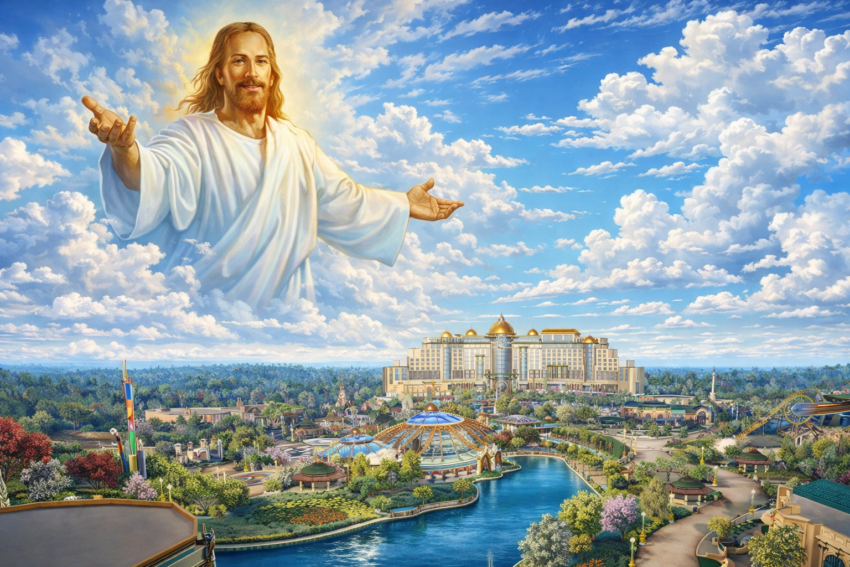
Introducing the Mormon Church — formally known as The Church of Jesus Christ of Latter-day Saints. From grandiose temples gleaming white against city skylines, to the incomparable Tabernacle Choir whose strains of “Come, Thou Fount” can reduce an atheist to tears, to approximately 1.7 million acres of land and nearly 16,000 property parcels with an estimated U.S. property value alone exceeding $16 billion, the Saints appear far more prepared for an extended stay at the Earthly Arms Hotel than for the Celestial Kingdom they preach is waiting in the sky.
Let that sink in. The Church of Jesus Christ of Latter-day Saints — an organization that teaches its members they are literal spirit children of a Heavenly Father, sojourning on earth in preparation for an eternal celestial dwelling — has quietly become one of the most aggressive, opaque, and prolific accumulators of earthly wealth in American history. Estimates of the church’s total financial portfolio, including its investment arm Ensign Peak Advisors, its real estate subsidiary Property Reserve Inc., its agricultural giant Farmland Reserve Inc., and its extensive commercial holdings, now approach $293 billion by some analyst calculations.
That figure is not a typo.
From a traditional Christian vantage point, the question the data forces us to ask is both theological and investigative: What, exactly, is a church — any church — doing accumulating the financial footprint of a mid-sized sovereign nation? And why is it doing so in a manner so opaque that it took a federal Securities and Exchange Commission investigation to pull back even one corner of the curtain?
This exposé examines the LDS Church’s staggering material empire across five dimensions: its historical trajectory from frontier poverty to financial titan; its current real estate and investment portfolio; its impact on local communities and civic life; the growing contradiction between its corporate expansion and its declining engagement metrics; and the theological question that all the acreage, all the temples, and all the choir recordings cannot silence — the question of why.
Section Two: From Nauvoo to Net Worth — A History of LDS Wealth-Building
Frontier Poverty to Prairie Power
It is easy to forget, surveying the gleaming towers of today’s Latter‑day Saint financial empire, that this church was born in poverty, volatility, and repeated displacement. Joseph Smith formally organized what became The Church of Jesus Christ of Latter‑day Saints on April 6, 1830, with six legal members in the Whitmer home at Fayette, New York. Within less than a decade, those early Saints were confined to frontier Missouri counties and then driven from the state under Governor Lilburn Boggs’s 1838 “extermination order,” which directed that they be “exterminated or driven” from Missouri if necessary. They regrouped in Nauvoo, Illinois, only to be expelled again after Joseph Smith’s 1844 murder and escalating conflict with surrounding communities, eventually undertaking a roughly 1,300‑mile overland migration from the Midwest to the Salt Lake Valley beginning in 1846–47—a trek powered by faith, desperation, and a highly disciplined communal mobilization.
That communal discipline was, in retrospect, the seedbed of the financial juggernaut that followed. In the Great Basin, Latter‑day Saint settlers experimented with tightly coordinated economic systems, including church‑directed gathering, communal projects, and later cooperative ventures that pooled capital, channeled tithes, and built up towns, irrigation works, and basic industries at remarkable speed. The Tabernacle Choir at Temple Square—today a globally recognized cultural symbol of the church—traces its origins to a choir organized in the Salt Lake Valley in 1847, only weeks after the first companies arrived, signaling the community’s determination not merely to survive, but to cultivate permanence, prestige, and a public voice. Over time, that choir would sing at multiple United States presidential inaugurations and reach vast international audiences through radio, television, recordings, and now digital platforms, functioning as a soft‑power projection of institutional confidence.
From the beginning of the Utah period, the church’s property interests were tightly interwoven with its governing ambitions. Under Brigham Young, the leadership of the church and the leadership of the provisional State of Deseret and later Utah Territory substantially overlapped, and for a time, the territory operated in practice as a semi‑theocratic commonwealth in which ecclesiastical authorities wielded enormous influence over land distribution, water rights, settlement patterns, and local courts. By the time Utah secured statehood in 1896, the church and its affiliated leaders were already entrenched as major landholders and economic actors, with significant interests in agriculture, livestock, and transportation and with flagship enterprises such as Zion’s Cooperative Mercantile Institution (ZCMI), founded in 1868 in Salt Lake City as a church‑backed wholesale and retail operation that anchored an extensive cooperative network across Latter‑day Saint settlements. The institutional reflexes honed in those formative decades—centralize, accumulate, diversify, and reveal as little as possible—have proven remarkably durable in shaping the modern church’s financial posture.
Tithing: The Infinite Engine
The foundational mechanism of Latter‑day Saint institutional wealth is the tithing system. Members who wish to be in good standing are taught to contribute ten percent of their income as tithing, a practice explicitly tied in LDS discourse to biblical passages such as Malachi 3:10 and framed as a commandment rather than a voluntary guideline. In contemporary practice, access to temple rites—regarded by the church as essential for exaltation—requires holding a current temple recommend, and the standardized recommend interview includes a direct question: “Are you a full‑tithe payer?” thus formally linking full tithing compliance to participation in the highest level of Latter‑day Saint worship.
By the end of 2024, official statistics reported worldwide membership of The Church of Jesus Christ of Latter‑day Saints at roughly 17.5 million on the rolls, a figure that does not distinguish between active and inactive members. Even setting aside the contested questions of retention and activity rates addressed later in this essay, that membership base, combined with a norm of ten‑percent giving, creates a tithing engine capable of generating enormous cash flow. Independent observers and a former insider turned whistleblower have estimated that total annual contributions to the church worldwide are on the order of about $7 billion, with roughly $1 billion per year historically being surplus to current operating needs and funneled into the church’s investment arm, Ensign Peak Advisors.
In the United States—the financial center of the church’s operations—recent Census Bureau data place median household income in the mid‑$80,000 range, meaning that fully compliant households paying on gross income would, in principle, remit thousands of dollars annually in tithing alone. Given several million likely active members concentrated in the U.S. and other relatively wealthy countries, it is not difficult to construct plausible scenarios in which recurring tithing receipts run into the multiple billions per year, even before counting other offerings, bequests, and investment returns. Yet despite the scale of these flows, the church has not issued detailed public financial statements in the United States since the late 1950s, relying instead on a brief, formulaic “audit” statement at general conference; as a result, exact revenues, expenditures, and balance sheets remain opaque, and robust third‑party verification of tithing income is impossible under the current disclosure regime.
What can be seen, however, are some of the downstream effects. Reports and regulatory filings in various jurisdictions have revealed a globally diversified portfolio of assets, including an investment fund once estimated at over $100 billion, extensive real‑estate holdings, and income‑generating projects that substantially augment donation‑based revenues. In this sense, the tithing system functions not only as a spiritual obligation preached from the pulpit, but as the primary intake valve for a highly centralized, modern financial operation whose true dimensions remain known in full only to a small circle of senior church and finance officials.
“The Church of Jesus Christ of Latter-day Saints has leveraged member devotion into a financial structure that rivals or exceeds the GDP of small nations, all while maintaining the reporting obligations of a neighborhood congregation.”
— Johnathan Reeper, “The Most Financially Successful Faith in America: Mormonism,” Writers’ Blokke / Medium (November 28, 2025)
The genius — and from an ethical standpoint, the problem — is that this cash flow has been systematically diverted not into charitable distribution but into a perpetually compounding investment and real estate portfolio managed with sophisticated opacity. The SEC found this out the hard way.
The SEC Reckoning
In 2023, The Church of Jesus Christ of Latter‑day Saints and its investment arm, Ensign Peak Advisors, settled with the U.S. Securities and Exchange Commission (SEC) over charges that the church’s massive equity portfolio had been systematically obscured behind a network of shell entities. The SEC found that, from 1997 to 2019, Ensign Peak failed to file the required Forms 13F disclosing the church’s holdings and instead filed 13F forms for roughly a dozen limited‑liability companies (LLCs) that the SEC described as “shell” entities created to conceal the true size and structure of the portfolio. By 2018, the church’s equity portfolio had grown to about $32 billion, and at its peak, the broader investment enterprise would be reported at over $100 billion, making it one of the largest institutional investors in the country.
To resolve the matter, the church agreed to pay a $1 million penalty, and Ensign Peak agreed to a $4 million penalty—a total of $5 million—without either entity admitting or denying the SEC’s allegations. The SEC’s order characterized the arrangement as a deliberate effort to prevent public awareness of the scope of the portfolio, noting that Ensign Peak retained full investment and voting control over the securities while the shell LLCs formally claimed authority they did not in fact possess. The structure was technically a violation of Section 13(f) of the Securities Exchange Act of 1934 and the associated Rule 13f‑1, which requires certain large equity holders to file standardized, publicly accessible disclosures.
As The Real Deal notes in a 2025 article on the church’s real‑estate acquisitions, “In 2023, the church and its investment manager, Ensign Peak Advisors, settled for $1 million and $4 million, respectively, over the Securities and Exchange Commission’s claims the church’s portfolio was obscured through about a dozen limited liability companies. The church and Ensign neither admitted nor denied wrongdoing in the settlement.” That same article highlights how the case sits alongside the church’s expanding commercial real‑estate footprint—such as the $152.5 million purchase of a 384‑unit Boca Raton apartment complex through Property Reserve, Inc., one of several church‑backed entities investing in retail, hospitality, and multifamily housing.
For an institution that claims divine mandate and prophetic leadership, the episode raises sobering, if not uncomfortable, questions about the compatibility of such institutional secrecy with the New Testament’s demand for transparency and mutual accountability within the body of Christ. In Matthew 6:24, Jesus warns that no one can serve two masters—God and mammon—implying that the allocation of institutional energy, attention, and legal ingenuity should align with stated spiritual priorities. The SEC investigation suggests that, at least in this instance, a significant portion of the church’s institutional energy went into constructing legal labyrinths specifically designed to keep the scale and sophistication of its investment operation out of public view—leaving outsiders to wonder not just how much the church holds, but which “master” is actually being served in practice.
“In 2023, the church and its investment manager, Ensign Peak Advisors, settled for $1 million and $4 million, respectively, over the Securities and Exchange Commission’s claims the church’s portfolio was obscured through about a dozen limited liability companies. The church and Ensign neither admitted nor denied wrongdoing in the settlement.”
— The Real Deal, “Mormon Church Pays $153M for Boca Raton Apartment Complex” (August 21, 2025)
Section Three: The Portfolio — Farms, Apartments, and Industrial Parks
The Agricultural Titan
By most independent tallies, The Church of Jesus Christ of Latter‑day Saints is now one of the largest private agricultural landholders in the United States—a scale that sits with peculiar tension alongside its spiritual self‑presentation as a community of modest, self‑sacrificing disciples. Through its real‑estate investment subsidiary Farmland Reserve Inc., the church owns or controls an estimated 1.7 million acres of farmland, representing roughly $2 billion in agricultural land value and cementing its status as a major institutional player in American agriculture.
That portfolio includes Deseret Ranches, the church‑owned cattle ranch sprawling across nearly 300,000 acres in central Florida’s Osceola, Orange, and Brevard Counties, one of the largest cattle operations in the world when it was first assembled in the mid‑20th century. Beyond Florida, the LDS‑linked holdings stretch into timber‑rich tracts in the Pacific Northwest, sizable nut and orchard farms in California, and a rapidly expanding network of row‑crop operations in the Midwest that now produce corn, soybeans, cotton, rice, peas, and peanuts for global commodity markets. Farmland Reserve leases most of this land to local tenant farmers, and the arrangement is widely described in the agricultural press as a model of stable, long‑term landlord–tenant relationships—but it also consolidates economic power in the hands of a religious institution that is not accountable to the electorate or even to transparency norms typical for secular corporations.
In October 2024, multiple outlets reported that Farmland Reserve had agreed to purchase 46 farms comprising 41,554 acres—about 65 square miles—from the publicly traded real‑estate investment trust Farmland Partners Inc. in a single all‑cash transaction valued at $289 million. The portfolio spans eight states: Arkansas, Florida, Louisiana, Mississippi, Nebraska, Oklahoma, North Carolina, and South Carolina, pushing the church’s already dominant land‑holding into additional swaths of prime row‑crop country and beef‑cattle landscape. Local reporting in Nebraska and the Great Plains has noted that Latter‑day Saint‑affiliated entities were already among the state’s largest landowners, with hundreds of thousands of acres under church control, and this new wave of acquisitions further entrenches the church’s profile as a quiet but pervasive force in rural America.
Given those figures, the obvious questions become uncomfortable but unavoidable:
- How does an institution that frames poverty, service, and material detachment as central Christian virtues reconcile its ownership of a multimillion‑acre, multimillion‑dollar agricultural empire?
- When church leaders liken the church’s finances to a “storehouse” for the poor, yet its largest landholdings flow into the global commodity system and rental‑income streams, whose poverty is actually being relieved, and whose comfort is being structurally preserved?
- If the church’s mission is to prepare souls for the “hereafter,” why does so much of its institutional energy appear devoted to ensuring that Latter‑day Saints are over‑represented in the top tier of land‑and‑capital ownership in the here‑and‑now?
- The sheer scale of this agricultural domain—almost 300,000 acres in one Florida ranch alone, plus a nationwide quilt of millions of tilled acres and timbered tracts—does not inherently disprove the church’s spiritual claims. But it does force anyone taking those claims seriously to ask: Can a church credibly preach detachment from mammon while simultaneously operating one of the most concentrated farmland portfolios in the country?
“Utah-based faith will add 46 farms covering 41,554 acres — or about 65 square miles — in eight states to its vast portfolio, further bolstering its standing as an agricultural “titan.””
— Salt Lake Tribune, “See what the LDS Church is now buying for $289 million” (October 12, 2024)
The rationale offered by church spokespersons for this agricultural acquisitiveness typically invokes preparedness — the church’s long-standing emphasis on food storage and self-sufficiency. There is something almost poignant about this explanation: a church teaching its members to store wheat and rice is simultaneously accumulating the land that produces them on an industrial scale. Whether this constitutes prudent stewardship or a stunning conflation of pastoral mission with hedge-fund instincts is a question the church has shown little interest in answering publicly.
Commercial Real Estate: From Logistics Parks to Luxury Apartments
If the agricultural portfolio suggests a church preparing to feed itself through an apocalypse, the commercial real estate portfolio suggests a church that has decided the apocalypse can wait while it collects rent.
Through Property Reserve Inc. — the church’s commercial real estate investment arm — the LDS Church has in recent years executed a series of acquisitions in South Florida alone that would be notable for any institutional investor, let alone a religious organization:
- $174.3 million for the Beacon Logistics Park industrial campus (75 acres, 1.3 million square feet) in Hialeah, Florida (2023)
- $55.8 million for an additional warehouse at Beacon Logistics (2024)
- $133 million for the Ellsworth apartment building in Plantation, Florida (2024)
- $102.4 million for the Elan Polo Gardens apartment complex near Wellington, Florida (2025)
- $152.5 million for the Del Ola apartment complex in Boca Raton, Florida (August 2025)
“The deal marks the church’s continuing investment in South Florida properties over the past two years. The religious institution has made the purchases through Property Reserve, which invests church reserve funds in commercial real estate.”
— The Real Deal (Miami), August 21, 2025
The Del Ola acquisition — a 384-unit luxury apartment complex with rents ranging from $2,169 to $4,802 per month — was purchased all-cash. No mortgage was recorded. The purchase price of $152.5 million breaks down to over $397,100 per apartment unit. This is a church that does not need a loan.
These South Florida acquisitions alone total over $618 million in two years. Set that figure against the church’s much-publicized humanitarian aid numbers — typically in the range of $1 billion total over the organization’s entire modern history — and the priority signal is difficult to misread. The LDS Church spends more acquiring South Florida luxury apartments in twenty-four months than it has distributed globally in humanitarian aid across multiple decades.
City Creek and the $2 Billion Downtown Makeover
The most visible symbol of LDS commercial ambition is City Creek Center, a $2 billion luxury shopping mall constructed adjacent to Temple Square in Salt Lake City and completed in 2012. Featuring high-end retailers and underground waterways channeling an actual creek, City Creek represents one of the most expensive urban development projects in the history of the American West.
The irony is architectural as well as theological: across the street from Temple Square — where the faithful are told they can receive eternal ordinances necessary for their salvation — stands a mall where they can purchase Tiffany jewelry and dine at the Capital Grille. The juxtaposition has not been lost on thoughtful observers within and outside the LDS community, who have noted that the Salt Lake Temple renovation itself is projected to cost approximately $2 billion — meaning the church is investing roughly equal sums in a building where the faithful worship and a building where the affluent shop.
The Ensign Peak Stockpile
Undergirding all of the above is Ensign Peak Advisors, the church’s investment management arm. Before the SEC reckoning, the fund had quietly accumulated more than $100 billion in stocks, bonds, and other securities — a figure that, had it been disclosed earlier, would have placed it among the largest endowments on the planet. The full portfolio, combined with real estate, agricultural land, and other holdings, is now estimated by various analysts at between $121 billion and $293 billion, with the higher figures gaining credibility as disclosure requirements force greater transparency.
For comparison: Harvard University’s endowment — itself the largest university endowment in the world — stands at approximately $53 billion. The LDS Church, by these estimates, is managing roughly two to five Harvard endowments worth of assets, drawn from the tithes of members who were told their contributions were going toward “the building up of Zion.”
Section Four: The Temple Next Door — Community Impact and Civic Friction
America’s Choir and the Soft Power of Brand
No single asset in The Church of Jesus Christ of Latter‑day Saints’ cultural portfolio is more resonant—or more functionally opaque—than The Tabernacle Choir at Temple Square. Formed in August 1847, just 29 days after the first Mormon pioneers entered the Salt Lake Valley, the choir has existed longer than nearly every major civic, educational, and commercial institution in modern Utah and has become a sonic signature of the church’s public identity. Since July 15, 1929, its weekly program, “Music & the Spoken Word,” has aired without interruption on radio and now extends across television and digital platforms, making it one of the longest‑running continuous broadcasts in human history.
“The Tabernacle Choir at Temple Square is one of the most famous choirs in the world. Its weekly devotional program, Music & the Spoken Word, is one of the longest-running radio programs in the world, having aired on radio every week since July 15, 1929.”
— Wikipedia, “Tabernacle Choir”
Over the decades, the choir has accrued a litany of honors that read like a greatest‑hits reel of American cultural respectability. It has performed at seven U.S. presidential inaugurations for six different presidents, earning a place in the ritual pageantry of American power. Under President Ronald Reagan, the group was dubbed “America’s Choir,” a title widely echoed in the media and on the choir’s own promotional materials and in official records of the National Endowment for the Arts. The ensemble has sung at numerous world fairs and international events, recorded over 150 albums, and toured more than two dozen countries, functioning simultaneously as a devotional body, a chamber‑style “brand choir,” and a soft‑power emissary for the LDS Church. Among its laurels are Grammy, Emmy, and Peabody Awards, induction into the American Classical Music Hall of Fame, and honors from institutions dedicated to patriotism and religious‑civic virtue, such as the Freedom Foundation at Valley Forge.
Yet from a traditional Christian analytical vantage, the sheer beauty and breadth of the Tabernacle Choir’s work cannot be treated merely as neutral artistry. This is not merely “a choir that happens to be affiliated with the LDS Church”; it is a highly curated, institutionally funded, and strategically deployed feature of the church’s public‑relations architecture. The choir’s repertoire—stirring hymns, patriotic chestnuts, and sentimental spirituals—consistently blends Christian language, American nationalism, and a sense of transcendent uplift that is emotionally accessible even to those who have never stepped into an LDS chapel. For many outsiders, the sonic experience of the Tabernacle Choir is their primary encounter with the Latter‑day Saint world, and the result is often a kind of acoustic disarmament: the listener may find themselves emotionally aligned with the music—joy, awe, solemn gratitude—before they ever pause to consider that the institution behind the sound teaches a radically different gospel than the one rooted in the New Testament and early creeds.
The deeper question, then, is not about the choir’s technical excellence but about the purpose and effect of its institutional role:
- What is this choir designed to make people feel: transportation into the presence of the Triune God of Scripture, or a warm, generalized, nondenominational “spirituality” that co‑signs the authority of the LDS ecclesiastical structure by default?
- Does the Tabernacle Choir’s ubiquity in mainstream American religious‑cultural life soften and sanctify an institution that, from a historic Christian standpoint, teaches a revised canon, a redesigned Trinity, and a salvation‑by‑covenant system, simply by wrapping the message in harmonious, polished voices?
- How does a church that claims to teach the “fullness of the gospel” explain why its most universally admired expression is a musical ensemble whose work is so often stripped of any explicit doctrinal text, allowing audiences to experience the aesthetic shell of faith without confronting the theological substance?
From a traditional Christian perspective, the Tabernacle Choir is not an object of mockery; it is, in fact, too effective for that. The problem is not that the voices are untruthful, but that their truthfulness can obscure the more troubling questions about the institution that sponsors them. The music renders the church’s architectural and bureaucratic scale beautiful, its historical wounds noble, and its present‑day influence benign—even as the same institution amasses billions in investment capital, fiercely guards its financial opacity, and maintains a doctrinal system that diverges in fundamental ways from the historic Christian orthodoxy confessed in the creeds.
So one does not critique the Tabernacle Choir as a group of singers, or as a collection of hymns. One inquires instead after the role it plays in the church’s wider project: Is this choir primarily a worshiping community called to glorify the one true God, or is it, at least in part, a sonic halo engineered to make Latter‑day Saint institutional power look pious, inevitable, and above reproach? That question is harder to sing along with—but it is far more urgent than the music itself.
The Temple as Civic Drama: The Fairview, Texas Case
The LDS temple‑building program is, by any fair measure, one of the most ambitious architectural campaigns in modern American religious history—especially when set beside the church’s own slowing growth trajectory. As of early 2026, The Church of Jesus Christ of Latter‑day Saints reports a total of 383 temples worldwide, with 211 dedicated and operating, 55 under construction, and 108 announced for future sites—a global network that now stretches from suburban Utah to the center of the Pacific, the Indian Ocean, and the heart of the American South. The flagship Salt Lake Temple, currently undergoing a massive renovation, alone occupies roughly 253,015 square feet and is being retrofitted with a state‑of‑the‑art seismic isolation system that has drawn engineering‑media coverage not for a place of worship, but for a $2–2.4 billion mega‑project that rivals many large civic‑infrastructure undertakings.
“The LDS Church has 383 temples in various phases, which includes 211 dedicated temples (204 operating, 7 undergoing renovations), 7 with dedications scheduled, 55 under construction, and 108 others announced.”
— Wikipedia, “Comparison of Temples (LDS Church)”
This is not merely a church building temples. It is a territorial theology materialized in stone and steel: each temple is explicitly designated a “house of the Lord,” a space reserved for the highest covenants and rituals in the Latter‑day Saint system, and its location is typically announced from the pulpit, then publicly rendered as a monumental, often spire‑tipped structure visible for miles. The cumulative effect is that, even as global Latter‑day Saint membership flattens or grows at a fraction of its mid‑20th‑century pace, the church’s spatial footprint keeps expanding in the opposite direction—putting gleaming, sculpted houses of the Lord in leafy suburbs, fast‑growing exurbs, and even dense urban cores.
Now consider the timing. The church’s recent revelation‑era “temple‑building boom” dates to the 1990s and 2000s, when President Gordon B. Hinckley announced a rapid expansion to 100 temples by the year 2000, inaugurating standardized, smaller designs that could be rolled out across the globe. In the 2020s, the church has continued to add dozens of new temples per decade, even as internal measures of membership activity, baptisms, and retention suggest that the pipeline of new, committed, long‑term practitioners is not keeping pace with the optics of institutional permanence the temples project. The result is a striking dissonance: ever more houses built for a covenant‑worshiping people whose numbers appear to be thinning even as the architecture swells.
In some places, this dissonance erupts into visible civic conflict. In Fairview, Texas, a small Dallas‑area suburb, residents waged a years‑long campaign against the church’s plan to construct a temple featuring a tall, bright‑lit spire in a residential neighborhood. Residents cited traffic congestion, light‑pollution concerns, the visual impact of a dominating, highly illuminated structure, and the fundamental change such a temple would impose on the character of their community. The church eventually conformed to height restrictions and lighting limits, and the debate became a miniature case study in the collision between an expanding global faith and the quiet, place‑based norms of a small American town. Similar disputes have surfaced in Heber City, Utah; Cody, Wyoming; and Las Vegas, Nevada, where local governments have pushed back on scale, height, and nighttime lighting, underscoring that the church’s “temple‑building imperative” is not universally welcomed as a civic good.
Behind the scenes, the church’s legal and political resources in these contests are often substantial. Local opponents are typically volunteers, while the church can deploy professional planners, lawyers, and public‑relations teams to navigate zoning boards and negotiate concessions. The outcome is predictable: the temple almost always gets built, sometimes with modest aesthetic compromises, and the neighborhood is altered forever—sometimes with economic benefits, sometimes with only a new, permanent landmark whose presence carries unspoken theological freight that many residents do not fully understand.
All of which raises several piercing questions:
- When a church is building hundreds of temples worldwide at the same time its membership‑growth and retention metrics are softening or even contracting, what does this construction program actually signal: confidence in ongoing spiritual momentum, or anxiety about the need to give the impression of permanence before the reality of the institution’s demographic slide becomes undeniable?
- If the temple’s primary purpose is to facilitate sacred covenants and eternal progression, why does the church pour billions into seismic‑grade renovations and architecturally iconic structures whose benefit is largely symbolic to outsiders, even as many Latter‑day Saints never attend a temple or are excluded from it for other reasons?
- In a community like Fairview, Texas, where neighbors argue over height, light, and traffic, is the church truly serving the local “body of Christ” in the New Testament sense, or is it primarily enforcing the presence of a Latter‑day Saint claim to spiritual and spatial dominance in the American landscape?
The LDS temple program is, in its own terms, a declaration: “We are here to stay.” The question for any careful observer is whether that same declaration can be reconciled with the church’s spiritual claims if the underlying community of believers is shrinking just as the marble keeps rising.
Economic Presence and Tax-Exempt Power
The LDS Church’s commercial acquisitions, carried out through for‑profit subsidiaries such as Property Reserve, Inc., do pay property taxes like any other private‑sector landlord or industrial owner. The 384‑unit Boca Raton apartment complex purchased for $152.5–153 million, the Beacon Logistics Park warehouses in Hialeah, Florida, acquired for $174.3 million, and similar revenue‑generating real‑estate holdings are explicitly taxed as commercial property because they are held for investment and profit rather than for purely religious use. From the perspective of local tax assessors and city planners, these transactions look like those of any large real‑estate investor: they generate impact fees, permit fees, and ongoing property‑tax obligations that flow into municipal coffers rather than out of them.
However, the vast bulk of the church’s institutional footprint remains firmly under the umbrella of tax‑exempt status. The thousands of meetinghouses, dozens of administrative and welfare‑related facilities, and hundreds of temples spread across the United States and beyond are typically treated as properties used exclusively for religious purposes, and as such are exempt from local property taxes in most jurisdictions. In Utah, where the church’s presence is densest and its landholdings most extensive, this exemption has a measurable effect on the state and local tax base, especially as the church also operates large-scale commercial farms, timber operations, and other revenue‑generating enterprises that are often held in related entities. Public policy debates in the state have periodically grappled with the implications of allowing such a dominant institution to receive tax breaks on core religious infrastructure while simultaneously engaging in aggressive real‑estate investment, but no comprehensive legislative overhaul has yet emerged to recalibrate the framework.
The practical consequence is that an organization accumulating wealth at the pace described—hundreds of millions of dollars in annual tithing, a multi‑billion‑dollar investment portfolio, and a vast land and building portfolio—simultaneously removes significant portions of that wealth from the local tax base while still relying on the surrounding communities for infrastructure. The roads, water and sewer systems, police and fire services, and emergency response networks that serve temples, meetinghouses, and church‑owned commercial properties are funded by taxpayers who enjoy no direct access to the church’s internal financial records or decision‑making. In some farming regions, local officials have explicitly noted that the LDS‑related entities pay taxes on their farmland only when it is treated as a for‑profit asset, while land held for “religious‑use” or church‑owned residences remains exempt—a distinction that can tilt the local tax burden onto secular property owners.
American tax‑exemption law for religious organizations was never designed around a global, vertically integrated, wealth‑processing machine that looks, in many ways, more like a sovereign corporation than a small congregation meeting in a rented storefront. The current regime treats the church as a charitable and religious entity entitled to the same exemptions as a local parish, a food bank, or a small‑town synagogue, even as its economic footprint rivals or exceeds that of many large secular corporations or public‑sector entities.[web/24][web/98] That is not, strictly speaking, illegal; it is the structural logic of the existing tax‑exemption system applied to an organization that has outpaced the assumptions of the policy by several orders of magnitude.
Which raises several piercing questions that rarely find their way into polite civic discourse:
- If the LDS Church, in both its religious and commercial guises, functions as one of the largest economic actors in regions like Utah and parts of Florida, why should such an entity be allowed to shield so much of its infrastructure from taxation when it demands the same level of public services as a fully taxed corporate citizen?
- Does the fact that the church’s for‑profit arms do pay taxes on some commercial holdings effectively license the rest of the institution to operate as a tax‑exempt fortress, extracting social benefits without contributing proportionally to the public coffers that underwrite those benefits?
- When state‑level welfare systems in places like Utah become entangled with LDS‑run relief programs—such that the state effectively counts church‑provided aid toward its own obligations—is the line between church and state being preserved, or is the state outsourcing its duty to a tax‑favored institution that conditions some of its “charity” on participation in a specific religious community?
None of this, in itself, invalidates the church’s theological claims. But it does expose the quiet dissonance at the heart of the arrangement: a religious body that is doctrinally committed to the idea of a “storehouse” for the poor, yet institutionally constructed in a way that maximizes its capacity to accumulate wealth and minimize its tax obligations, all while remaining embedded in the very public systems it is not fully taxed to support.
Section Five: The Numbers Game — Corporate Growth vs. Empty Pews
The Official Account: Record Growth
The LDS Church’s 2024 Statistical Report, released during the April 2025 General Conference, declares a global membership of 17,509,781—an increase of about 254,000 members from the 17,255,394 reported at the end of 2023. The report also notes that 308,682 converts were baptized in 2024, the highest number of convert baptisms in roughly 25 years, with much of that growth concentrated in sub‑Saharan Africa and other fast‑growing regions. At the same time, the church reported that more than 77,000 missionaries were serving in the field—combining young proselyting missionaries, senior service missionaries, and young service missionaries—while it expanded its global mission network to 450 missions, the largest number in its history. Temple construction remained at a historically high pace, with the church operating 194 dedicated temples by year‑end and continuing to move forward on dozens of additional projects worldwide.
On paper, this indeed looks like a church at or near the peak of its institutional expansion: a membership north of 17.5 million, a multi‑decade high in convert baptisms, a missionary force larger than at any time since at least the early 2020s, and a temple‑building program that now spans every major inhabited region of the globe.
The Independent Audit: A Different Picture
The reality, as independent researchers, sociologists, and former‑member analysts have extensively documented, is considerably more complicated than the church’s public membership figure suggests. The LDS membership figure of 17,509,781, as reported in the 2024 statistical summary released during the April 2025 General Conference, is a gross, undifferentiated count, not a net active figure. That number includes all baptized members who have not formally resigned, unbaptized “children of record” under age eight who have been blessed or otherwise entered into the membership system, and individuals whose actual relationship to the church may be estranged, nominal, or even hostile. The church’s own membership rules allow records to remain open for years after someone has walked away, and resignations are not counted until they are formally processed through the central bureaucracy, which can lag for months or even longer. Deceased members, likewise, are not automatically removed from the rolls for an extended period—effectively padding the membership total well beyond the pool of living, participating Latter‑day Saints.
The practical result is that the 17.5‑million figure functions less as a demographic measurement and more as a billboard statistic: a blunt, easily repeated headline that obscures the church’s true level of engagement. Most independent scholars and data‑driven analysts who attempt to model activity rates—cross‑checking ward‑level reports, census data, and survey work—place the number of active, regularly attending Latter‑day Saints at somewhere between 4 and 6 million globally, roughly 25–35 percent of the reported total membership. That gap is not a minor statistical artifact; it represents a 12‑million‑person chasm between the church’s official self‑description and the cohort of believers who actually show up, tithe, and participate in the temple‑centric economy of LDS life.
The church’s institutional incentives further entrench this disconnect. There is no doctrinal or administrative requirement that individuals who have stopped attending or believing must formally resign, and many drift out of the community while remaining on the rolls, in part because of administrative inertia and in part because of lingering social or family ties. At the same time, the church’s statistical machinery highlights dramatic‑sounding growth—such as the reported addition of hundreds of thousands of new members in 2024 through baptisms and children‑of‑record entries—while the overall membership increase is far smaller, a sign that many people are quietly exiting or lapsing without being systematically removed. In this environment, the 17.5‑million number becomes a kind of institutional advertisement: it projects global reach, resilience, and momentum, even as researchers and local observers increasingly point to flat or declining activity, rising attrition, and a core of dedicated believers that is significantly smaller than the membership total implies.
From a Christian‑analytical standpoint, the question that follows is not merely about record‑keeping, but about honesty and accountability. If the church presents itself to the world as a 17.5‑million‑member global movement, while relying on the labor, tithes, and emotional investment of a much smaller subset of active practitioners, how does that discrepancy shape its public‑relations posture, its internal messaging, and its moral responsibility to its members and critics? And if the gap between “members on the rolls” and “people actually living the faith” continues to widen, does the church’s leadership have a greater obligation to acknowledge the difference—or is the billboard number more important than the pew‑level reality?
“The LDS Church defines membership as those who have been baptized and confirmed, those under age nine who have been blessed but not baptized, and certain other categories. The growth rate has not been greater than 3% per year in the 21st century and has decelerated steadily since 2012. The rate has not been above 2% since 2013.”
— Wikipedia, “Membership History of the Church of Jesus Christ of Latter-day Saints”
The Retention Crisis and Generational Defection
The retention data is, from an institutional‑health standpoint, deeply troubling for the LDS Church’s long‑term trajectory. Data from the General Social Survey, Pew Research Center, and other demographers, updated through late 2025, confirm what researchers have long suspected: American Gen Z and Millennial members are leaving the church at historically elevated rates. In the United States—the church’s historical home base, its wealthiest source of full‑time missionaries, and the origin of much of its most educated and culturally engaged leadership—multiple overlapping studies show that more Latter‑day Saints are disaffiliating in adulthood than at any earlier point in the church’s modern history.
Journalist and sociologist Jana Riess, whose work in The Next Mormons and related public analyses has been widely cited both in academic and popular circles, has documented that retention, religious participation, and doctrinal belief in the United States have been declining steadily since at least 2007. Her analysis, later summarized and echoed by sociologist Phil Zuckerman in Psychology Today, indicates that younger generations—especially Millennials and Gen Z—are exiting at rates that significantly outpace new convert arrivals in the developed world, even as the church’s official membership numbers continue to grow thanks to high‑baptism environments abroad.
Part of the reason the global membership figure still looks robust is the rapid growth in parts of Africa, where the church has added hundreds of thousands of new members over the past decade. That growth is real, and it has reshaped the church’s demographic profile, yet it is insufficient to offset the structural weakening in the United States and other Western countries. Many African converts are poorer, less likely to have easy access to temples, and more vulnerable to deactivation due to economic instability, distance from meetinghouses, and the limited infrastructure of church leadership in rapidly expanding areas. In other words, the headline “baptism surge” masks a quieter reality: numerous, less‑stable memberships in the Global South are being used to balance what is effectively a bleeding of core, high‑engagement members in the United States and Europe.
The practical implication is that the LDS Church’s long‑term institutional health—measured in steady, committed, tithing‑paying, temple‑worthy adherents—rests less on the booming baptism numbers often cited from Africa and more on whether it can reverse the exodus of its younger, American‑born members. At present, the data suggest it is not doing so. If the current trajectory holds, the church’s global size may continue to grow on paper, even as the percentage of genuinely active, long‑term participants shrinks, raising uncomfortable questions about whether the institution is expanding in breadth while quietly contracting in depth.
Congregational Stagnation
Perhaps the most telling metric is the number of operating congregations—wards, branches, and stakes—relative to the church’s overall membership. As of the 2024 statistical report, the church reported 17.5 million members but only 31,676 congregations, a figure that has grown by just 186 units (about 0.6 percent) over the previous year, far below the rate of nominal membership increase. In many historically strong American regions, including California, the net number of wards has actually declined in recent years, as ward consolidations and chapel closures become necessary to fill increasingly under‑occupied meetinghouses even as the church’s official membership rolls remain stable or grow slowly. This pattern is particularly pronounced in the church’s more educated, affluent, and culturally competitive markets, where both membership and activity have been trending down for over a decade.
That demographic reality quietly contradicts the church’s own building program, which is simultaneously constructing and operating 383 temples worldwide—211 dedicated, 55 under construction, and 108 announced—for a membership base whose active core is shrinking in key Western and North American regions while expanding primarily in the Global South. In other words, the church is adding tens of billions of dollars’ worth of sacred, highly visible infrastructure while, in many of its most influential and high‑status markets, the number of congregations is not growing, and in some places is actually shrinking. This raises a stark question: Is a church that is building 383 temples more for a projected revival that has not yet materialized, or is it redirecting institutional energy into permanent architectural monuments because the reflex to build structures is easier to satisfy than the harder, messier pastoral work of retaining, re‑engaging, and discipling believers who drift away?
From a strategic‑analytical standpoint, the mismatch suggests that the church’s stone‑and‑steeple footprint is being prioritized over the people‑on‑the‑pew reality in many of its most developed markets. The construction of beautiful temples, often in the same metropolitan areas where wards are being merged or closed, speaks less of imminent demographic surge and more of a theological aesthetic that cherishes visible permanence—even as the underlying community of committed practitioners narrows. In that light, the temple‑building program no longer reads simply as a sign of spiritual confidence, but as a kind of institutional hedge against decline: a way to solidify the church’s cultural and spatial presence in the built environment, even as the living body of believers in those same regions thins out.
Section Six: A Traditional Christian Reckoning — The Theology of Accumulation
What Jesus Said About Treasure
Before dismissing the theological dimension as mere editorializing, consider that the evidence assembled in this essay raises questions that any sincere student of Scripture is bound by the text itself to take seriously—regardless of their stance on LDS truth claims. The New Testament does not allow believers to treat wealth, institutional power, and spiritual integrity as separate spheres; instead, it repeatedly confronts both leaders and communities with the same piercing demand: the condition of the heart before God must be reflected in the structure and posture of the community that bears His name.
The Jesus of the New Testament was unflinchingly explicit on the dangers of wealth and institutional entanglement. He warned, “Do not store up for yourselves treasures on earth, where moths and vermin destroy, and where thieves break in and steal. But store up for yourselves treasures in heaven, where neither moth nor vermin destroys, and where thieves do not break in and steal” (Matthew 6:19–20). He declared, “It is easier for a camel to go through the eye of a needle than for someone who is rich to enter the kingdom of God” (Matthew 19:24), and confronted the rich young ruler not with a gentle counsel but with a radical command: “Sell all that you have and distribute to the poor, and you will have treasure in heaven; and come, follow me” (Matthew 19:21). The man went away sorrowful, “for he had great possessions,” revealing that his heart, despite his external piety, was bound to the very wealth that should have been held as a temporary stewardship under heaven (Luke 18:22–23).
The institutional LDS Church, in possession of a financial and real‑estate portfolio now estimated at or near $293 billion, has effectively institutionalized the rich young ruler’s decision—choosing institutional security, architectural permanence, and global economic influence over the Christ‑like alternative of sacrificial, transparent, and meek stewardship. It has developed, in parallel, a theological narrative that frames this accumulation as a sign of divine favor, blessing, and covenant‑keeping, rather than as a spiritual warning that echoes the very passages it invokes in worship. In so doing, the church inverts the New Testament imperative: where Jesus insists that the kingdom of God is advanced through humility, renunciation, and the preferential care of the poor, the modern LDS structure is built on enduring wealth, centralized control, and monumental visibility.
The biblical imperative remains clear: “You cannot serve God and mammon” (Matthew 6:24). When a religious institution attains capacities normally associated with global corporations, and its leaders stewards billions that outpace the wealth of most nations, the question is not whether the church is allowed to be rich, but whether such affluence is consistent with the pattern of Christ, who had no place to lay His head (Matthew 8:20), entrusted no assets to private institutions, and called His followers to take up their crosses, not to acquire towers, mansions, or empires. The LDS Church’s financial and architectural magnitude invites any Scripture‑oriented believer to ask, in blunt terms: If the Jesus of the Gospels walked into the present‑day LDS Church, whose treasure would He pronounce secure, and whose heart would He find ensnared?
The LDS Theological Framework for Wealth
To be fair to the LDS position, the church’s theological framework does provide internal justification for its accumulation. Latter‑day Saint cosmology teaches a form of material continuity between this life and the next: the physical and spiritual are not pitted against one another but deeply integrated. The declaration in the Doctrine and Covenants that “there is no such thing as immaterial matter. All spirit is matter, but it is more fine or pure, and can only be discerned by purer eyes” (D&C 131:7) underwrites a theology in which the material world is not an illusion to be escaped, but a substance to be sanctified. Likewise, LDS teaching holds that the earth itself will be “renewed and receive its paradisiacal glory,” transformed into a celestialized inheritance for the exalted (Articles of Faith 10; D&C 77, 88), and that faithful stewardship of land and resources in this life has eternal significance in the next. In that framework, land, infrastructure, and financial reserves are not merely temporal props; they are elements of a long‑term covenant economy that stretches into eternity.
The LDS tradition of preparedness adds another layer of theological rationale. The church has long urged members to build three‑month and long‑term food supplies, maintain water reserves, and keep modest financial cushions for times of crisis, presenting this as a way of honoring God’s command to prepare rather than panic. Local bishops’ storehouses, home‑storage centers, and global welfare resources are framed as a living expression of the biblical principle that “the righteous care for the needs of their animals” and, by extension, the needs of their neighbors (Proverbs 12:10; James 1:27). The church has, in fact, deployed substantial resources in moments of acute need: its COVID‑19 humanitarian response, major hurricane‑relief operations, and long‑running food‑security and welfare programs have drawn on tens of millions, and in recent years over $1 billion annually, in aid and related projects. These efforts are real, often quietly effective, and genuinely beneficial to the communities they serve.
The problem is not that the church ever spends money on the poor; the problem is proportionality and the underlying posture of stewardship. Independent financial analyses now place the church’s total estimated net worth at or near $293 billion, a figure that combines its investment portfolio (Ensign Peak Advisors), real‑estate holdings, ecclesiastical infrastructure, and operating assets. Over the same period, the church has reported roughly $1 billion per year in humanitarian‑type expenditures—not a fixed total over “multiple decades,” but a recurring annual outlay that, when scaled against the size of the institution’s holdings, produces a ratio of tens of thousands of dollars in accumulated assets for every dollar given in direct humanitarian aid. In this light, the claim that the church’s vast accumulation is itself the primary form of stewardship—rather than a means to far more generous, visible, and transparent giving—begins to look less like a modest safeguard and more like a structural indulgence that would have startled the apostle James, who asked, “If a brother or sister is poorly clothed and lacking in daily food, and one of you says to them, ‘Go in peace, be warmed and filled,’ without giving them the things needed for the body, what good is that?” (James 2:15–16).
The New Testament is clear that stewardship is not measured by how much is held, but by how much is given and for whom (Luke 12:42–48; 1 Timothy 6:17–19). When a church wields wealth in the range of $293 billion yet channels only a tiny fraction of that magnitude into the kinds of aid that the biblical text explicitly associates with true religion—“pure and undefiled religion before our God and Father is this: to visit orphans and widows in their distress” (James 1:27)—the theological claim that “this is all stewardship” demands a creative, and arguably strained, reading of Scripture, one that privileges institutional permanence over the radical, self‑emptying generosity modeled by Christ and commended by the apostles.
The Art of Misdirection: How LDS Institutional Self-Presentation Works
Scholars of LDS cultural history, including those associated with the Mormon Research Ministry and other critical yet informed analysts, have long observed that the institutional LDS self‑presentation operates according to a consistent pattern: uplift over accuracy. The church’s public image is built not simply on what is said, but on how it is framed—on a curated, idealized version of its own history, doctrine, and institutional character that requires careful management of both the visual and narrative record. This inclination is not confined to the handling of Joseph Smith’s First Vision, polygamy, or race‑based priesthood restrictions; it extends, with equal care, to the church’s financial self‑presentation—its architecture, its statistics, and its PR‑friendly storytelling.
“Artistic and narrative representations within Mormonism have sometimes prioritized the inspirational over the accurate, creating a gap between institutional self-image and historical reality that has complicated the faith lives of members who encounter the latter without preparation.”
— Mormon Research Ministry
The Tabernacle Choir at Temple Square is one of the most polished instruments in this project. It is deployed as emotional evidence that “all is well in Zion,” offering listeners—whether Latter‑day Saint, admirer, or merely curious outsider—an experience of transcendence through sound, without requiring them to reckon with the institution behind the hymns. The choir’s performances feel like a universal balm, a kind of civic‑spiritual comfort that can momentarily suspend theological scrutiny, even for those who know that the church teaches a gospel system that diverges in fundamental ways from the historic Christian orthodoxy summarized in the early creeds. The music is real, the artistry is real, but the subtext is curated: the message is less “listen carefully to what this church believes” than “feel the goodness of the people who sing for God.”
The temples are photographed and filmed from angles that emphasize their gleaming spires, ceremonial symmetry, and ethereal beauty, rarely from the vantage point of the neighbor whose property is now overshadowed or whose quiet streetscape has been permanently altered. The images served to the public are devotional, not documentary: they are framed as monuments of faith, not as massive capital‑intensive structures erected in a growth‑saturated religious market. The camera angles obscure the legal battles, zoning disputes, and local resistance that often accompany these projects, subtly reinforcing the idea that the church is a pure, benign, and universally welcomed presence rather than a powerful institution that sometimes reshapes communities against their will.
The membership statistics are announced with fanfare—“17.5 million and growing!”—without the quiet caveat that the count includes children of record, long‑inactive members, and even the recently deceased, while the real question—how many are actually attending, paying tithing, and participating in the temple economy—remains unspoken in the official narrative. The growth numbers look robust on a slide, while the stories of leaving, lapsing, and quiet disaffiliation are absent from the pulpit and the press releases. The conversion statistics are heralded; the retention footnote is withheld; the public picture looks like a story of momentum, while the underlying data tell a more ambiguous tale of a core that is not expanding nearly as fast as the headline membership suggests.
Similarly, the humanitarian aid—food‑storage programs, disaster‑relief efforts, and pandemic‑response operations—are publicized in richly produced videos and press releases that rightly highlight compassion and service. Yet those stories are rarely told alongside the institutional detail that this same church is sitting on, by many estimates, a $293 billion net‑worth portfolio—a magnitude of wealth that would, in a purely biblical frame of reference, invite scrutiny rather than gratitude alone. The church’s charitable work is real and often praiseworthy, but its public presentation leans heavily on the “good‑news” slice of the ledger, without the context that would allow observers to see the full picture of how much is held, how little is visibly redistributed, and how much of the “humanitarian” budget is, in effect, a tiny fraction of a far larger, largely opaque, institutional endowment.
The result is a pattern of presentation that feels, in many cases, like looking at a carefully retouched advertisement rather than an unfiltered snapshot of reality. No single photo, press release, or statistic is a bald lie; each is technically accurate within its narrow frame. The Tabernacle Choir does sound heavenly, the temples are often visually striking, the humanitarian aid is genuine, and the membership numbers are what the church reports. But the images delivered by the official arm of the LDS Church—the polished social‑media posts, the halo‑drenched temple‑spire shots, the neatly arranged families in meetinghouses, the elegantly animated “good‑news” graphics—give the distinct impression of a digitally altered, Photoshop-smoothed version of the institution, airbrushed of tension, strain, contradiction, and opacity.
The cumulative impression—that the church is modest, harmonious, transparently generous, and spiritually flourishing in every respect—is less a record of lived reality than a composite image manufactured by the institution itself, assembled from the most flattering angles, the clearest lighting, and the most carefully curated narratives. It is a portrait that serves the church’s idealized self‑image far more than it serves the public’s ability to ask hard, Scripture‑driven questions about the alignment (or misalignment) between the words of the New Testament and the economic, architectural, and institutional structures of the modern Latter‑day Saint enterprise.
So the question that follows is not about whether the church is allowed to market itself well, but about whether a body that claims to teach the “fullness of the gospel” ought to be so invested in aesthetic and rhetorical smoothing that it obscures the very tensions its own practices create. If the church is serious about stewardship, transparency, and humility, why does its external image so consistently favor the polished, glowing, and untroubled over the honest, complex, and self‑questioning? And if the Jesus of the Gospels confronted the religious leaders of His day for their public appearances of righteousness while their inner lives betrayed the poor, the widow, and the reputation of God, what would He say to an institution that devotes billions to beauty, branding, and benevolence while refusing to let the full dimensions of its wealth and power come into the light?
Section Seven: Why All the Spectacle? — Conclusions and Future Implications
The Edifice Complex
The LDS Church’s compulsion to build—temples, malls, logistics parks, apartment complexes, farms, welfare‑style storehouses, and even massive renovation projects like the accelerated remake of the Salt Lake Temple—is not random ornamentation; it is the built‑form expression of a core salvific imagination. This drive traces back to the church’s founding narrative: a band of the anointed, driven from state to state, finally carving a “civilization in the desert,” where the survival and expansion of the built environment—canals, cities, temples, and cooperative economies—became the material proof that God had not abandoned them. In that origin myth, the physical is not separate from the spiritual; it is its visible corollary. The more enduring the stone, the more certain the covenant. The more visible the city, the more visible the kingdom of God on earth.
In the LDS theological imagination, every new temple is more than a house of worship; it is an ensign to the nations, a deliberate echo of the imagery in Isaiah 11:12 and 18:3, where the standard, or ensign, is raised high so that the dispersed may gather. The temple’s spire, its gleaming façade, its placement in the center of a suburb or near a major highway, is a kind of architectural proclamation: Zion is being built, the latter days are advancing, and the church Joseph Smith launched is not merely surviving, but flourishing, expanding, and permanently inscribing itself on the landscape. The physical structure becomes a substitute for the congregational reality; when attendance in a ward may be soft, the temple is always there, announcing that the institution is not going anywhere. The material is not incidental; it is the primary message of permanence, even where the human commitment is fragile.
This is why the spectacle cannot, and in some sense must not, stop—even as the pews thin in North America and parts of Europe, even as the gap between the 17.5‑million membership figure and the 4–6 million active practitioners widens. The new buildings are not being constructed primarily for the members who are quietly drifting away, nor even for the faithful core who already tithe and attend; they are being built for the members who have not yet come, for the future generations who will be raised in the shadow of that temple, for the curious passerby who will see the spire and mistakenly assume that a 17.5‑million‑member movement is thriving in the same demographic bands where, in fact, attrition is accelerating. The buildings are, in this sense, both evangelistic billboards and eschatological self‑reassurance: they are advertisements to the world and to the church itself that the Latter‑day Saint project is not a fading revival, but an unstoppable, divinely‑ordained progression.
Underneath this logic lies a deeper question about the nature of faith and institutional legitimacy. If the church’s claim to be “the only true church” rests on the idea that God is directing its course, why does that direction appear to be expressed so heavily in real‑estate decisions, zoning approvals, and construction schedules, while the data on active membership, doctrinal coherence with historic Christianity, and spiritual vitality tell a much more contested story? The LDS impulse to keep building, even as its most educated and culturally influential markets contract, suggests that the church is less willing to treat head‑count decline as a reformative signal than it is to treat stone and steel as a self‑confirming prophecy. The physical permanence is meant to speak louder than the demographic fragility, the aesthetic stability louder than the existential uncertainty.
The more one inquires into this pattern, the more it looks like the LDS Church has internalized a kind of theological materialism: the belief that the solidity of the structure is itself evidence of the solidity of the covenant, that the greening of the land, the ranking of the spires, and the stacking of retail and residential units in the name of the church are all signs that “the latter days are upon us,” even as the New Testament might frame the same phenomena as a test of the heart—one that demands, above all, the sacrifice of the permanent self rather than the cementing of the permanent institution. If the Temple is meant to be the church’s ultimate sign to the world, the question for the gospel‑oriented observer is not whether the buildings are beautiful, but whether their breathtaking permanence does not, in fact, risk becoming the church’s idol of empire—a monument not to the humility of the cross, but to the confidence of an institution that believes its own story about its own invincibility, and insists on etching that conviction into the very skyline.
The Hard Question
From the vantage of traditional Christian orthodoxy, the question that cannot be avoided is this: If Jesus Christ is truly the founder and head of the LDS Church, as its leadership claims, what does He make of a $293 billion portfolio amassed behind the shadow of a Securities and Exchange Commission investigation, invested in luxury apartments, industrial parks, and high‑value commercial real estate, while His gospel is described as primarily a vehicle for eternal progression available to all—including, one imagines, the 12 million souls counted on the rolls who cannot be found in any meetinghouse, let alone actively participating in the temple‑centered economy of Latter‑day Saint life?
The New Testament offers a strikingly different image of Christ’s relationship to wealth and institution than the one embodied in that scale of accumulation. The Jesus who walked the ancient roads of Israel had “no place to lay His head” (Matthew 8:20), who commended the widow’s two small coins because she gave “all she had to live on” (Mark 12:44), and who warned that “it is easier for a camel to go through the eye of a needle than for someone who is rich to enter the kingdom of God” (Matthew 19:24) is not the same figure whose prophetic authority is invoked to justify the construction of an empire‑sized investment‑asset base. The apostle Paul, writing to the church in Corinth, could speak of the church as a body animated by the Spirit, yet his exhortations were never to maximize balance sheets, but to “build with gold, silver, precious stones, wood, hay, straw” (1 Corinthians 3:12) in the sense that the quality of the spiritual work—not the material opulence of the structure—would be tested. James, the brother of the Lord, declared that “pure and undefiled religion before God the Father is this: to visit orphans and widows in their affliction, and to keep oneself unstained from the world” (James 1:27), a definition of piety that centers on the defenseless, the persecuted, and the morally uncorrupted rather than the architecturally imposing.
The New Testament church, to which the LDS tradition claims a restored connection, was not characterized by portfolio management, tax‑exempt‑driven real‑estate stratagems, or SEC‑dodging investment vehicles. It was characterized by radical generosity and shared dependence: “All the believers were together and had everything in common. They sold property and possessions to give to anyone who had need” (Acts 2:44–45). The early church was not building a real‑estate empire; it was building a community of persons made in the image of God, bound together by the breaking of bread, the sharing of resources, and the public confession of the crucified and risen Lord, even under the threat of state violence (Acts 4:32–37; 2 Corinthians 8–9). In that biblical frame, wealth is not a sign of divine favor guaranteed to be multiplied, but a temporary stewardship to be shared, scrutinized, and surrendered when the kingdom’s advance demands it.
Set against that scriptural baseline, the LDS Church’s $293‑billion‑scale financial architecture becomes not merely a question of economic strategy, but a theological and Christological one. If the church is genuinely “the Church of Jesus Christ,” and if its leaders are truly His ordained stewards, what does the preservation of such immense wealth—often hidden, rarely disclosed, and only partially directed toward visible, New Testament‑style generosity—say about the church’s conception of Christ’s lordship? Does such a portfolio reflect the humility of the One who took the “form of a servant” (Philippians 2:7), or the confidence of an institution that has so identified itself with the kingdom that it begins to treat the kingdom as its own possession, to be carefully safeguarded and invested rather than sacrificially spent?
The question is not whether the church is allowed to own property or conduct commerce; the question is whether a body that claims to be the restored, “fullness” church of the last days can, in good conscience, amass like a global corporation, hide like a sovereign entity, and distribute like a modest charity, while continuing to claim that the least of these—the lost, the inactive, the poor, the spiritually unmoored—are truly at the heart of its mission. If the Jesus of the Gospels walked into the modern LDS Church’s financial and architectural reality, would He find His own priorities reflected there, or would He instead see the same pattern He once confronted in the temple courts: a system where the exchange of money and the building of structures had become so central that the poor were pushed to the margins, and the “house of prayer” had become a “den of robbers” (Matthew 21:13)?
Potential Future Implications
The trajectory of the LDS financial empire, absent significant course correction, points in several directions simultaneously. The investment portfolio will continue to compound: Ensign Peak, properly managed, could approach $200 billion in the next decade. The real estate acquisitions will continue: Property Reserve shows no sign of decelerating. The temple construction will accelerate: President Russell M. Nelson has made temple building the signature of his administration, announcing dozens of new temples at each General Conference.
At the same time, the membership base in developed countries will continue to erode. Gen Z and Millennial departure rates will leave an increasingly aging, shrinking, but financially compliant American membership whose tithes continue to fund an institutional expansion disconnected from the actual pastoral needs of the people.
The external pressures — from regulators, from journalists, from the growing ex-Mormon research community, from reform-minded active members — will intensify. The SEC settlement of 2023 was not the end of institutional scrutiny; it was the beginning of a new chapter in which the LDS Church’s finances became a legitimate subject of public inquiry in ways they were not before.
A Word for the Seeker
This essay has been written from a traditional Christian perspective—one that takes Scripture as the normative standard against which all religious institutions, including this one, are measured. The critique offered here is not motivated by animus toward individual Latter‑day Saints, many of whom are sincere, generous, and devout people whose faith has brought real meaning, discipline, and goodness into their lives. The target is not their hearts, but the architecture around them.
The critique is institutional. Organizations—even those born of genuine spiritual impulse—can develop habits that serve the institution itself more than the people it was meant to serve. The evidence assembled in this essay suggests that The Church of Jesus Christ of Latter‑day Saints has, in its financial behavior, developed precisely such reflexes: a pattern of accumulation, secrecy, and monumental building that now runs parallel to, and often ahead of, the spiritual realities it claims to represent. That pattern deserves serious scrutiny from anyone who seriously considers the church’s claim to prophetic authority, unbroken priesthood lineages, and divine stewardship of the “fulness of the gospel.”
If the Celestial Kingdom truly lies ahead for the faithful, then why does the most visible, measurable, and aggressively funded expression of this church look so strikingly like a global real‑estate and investment corporation? Why does the institution pour billions into luxury apartments, logistics parks, and gleaming temples, while its public financial transparency remains minimal, its membership‑activity gap spans tens of millions, and its humanitarian giving amounts to a tiny fraction of its total holdings?
And if Jesus Christ is the true head of this church, as its leaders insist, does He nod in approval at a $293 billion portfolio guarded by shell companies and SEC settlements, or would He instead ask the same question He once asked the religious leaders of His day: “Is this really the house of prayer you have built, or have you turned it into a marketplace that serves your own permanence rather than the poor, the widow, and the wandering sheep?”
The Celestial Kingdom may await the faithful. But for the moment, the LDS Church’s most energetic investments appear to be in the Earthly Arms Hotel—and business, by any metric, is booming. The harder question is whether a church that claims to prepare souls for eternity should be so visibly preoccupied with making earth look and function like a kingdom unto itself.
Primary Sources Referenced
• Salt Lake Tribune – “See what the LDS Church is now buying for $289 million” (Oct. 12, 2024): https://www.sltrib.com/religion/2024/10/12/lds-church-already-an-agricultural/
• The Real Deal (Miami) – “Mormon Church Pays $153M for Boca Raton Apartment Complex” (Aug. 21, 2025): https://therealdeal.com/miami/2025/08/21/mormon-church-pays-153m-for-boca-raton-apartment-complex/
• Wikipedia – “Tabernacle Choir”: https://en.wikipedia.org/wiki/Tabernacle_Choir
• Wikipedia – “Membership History of the Church of Jesus Christ of Latter-day Saints”: https://en.wikipedia.org/wiki/Membership_history_of_the_Church_of_Jesus_Christ_of_Latter-day_Saints
• Wikipedia – “Comparison of Temples (LDS Church)”: https://en.wikipedia.org/wiki/Comparison_of_temples_(LDS_Church)
• Johnathan Reeper / Writers’ Blokke / Medium – “The Most Financially Successful Faith in America: Mormonism” (Nov. 28, 2025): https://medium.com/writers-blokke/the-most-financially-successful-faith-in-america-mormonism-6c959fc3a7a8
• Mormon Research Ministry – “Why Mormon Art Sometimes Misrepresents Mormon History”: https://mrm.org/why-mormon-art-sometimes-misrepresents-mormon-history
• Religion News Service – “US Gen Zers and Millennials are leaving the LDS Church, data confirms” (Dec. 10, 2025): https://religionnews.com/2025/12/10/us-gen-zers-and-millennials-are-leaving-the-lds-church-data-confirms/
• Texas Monthly – “Latter-day Saints Fairview Temple Feud”: https://www.texasmonthly.com/news-politics/latter-day-saints-fairview-temple-feud/
• Church of Jesus Christ of Latter-day Saints Newsroom – 2024 Statistical Report: https://newsroom.churchofjesuschrist.org/
A Note on Research Methods and Accuracy
This work represents a collaboration among the author’s theological and historical research, primary-source documentation, and the emerging capabilities of artificial intelligence research tools. AI assistance was employed throughout the investigative process—not as a ghostwriter or a substitute for scholarship, but as a rigorous research partner: surfacing sources, cross‑referencing claims, identifying scholarly consensus, and flagging potential errors before they could reach the page.
Every factual claim in this work has been subjected to active verification. Where AI‑generated content was used as a starting point, it was tested against primary sources, peer‑reviewed scholarship, official institutional documentation, and established historical records. Where discrepancies were found—and they were found—corrections were made. The author has made every reasonable effort to ensure that quotations are accurately attributed, historical details are precisely rendered, and theological claims fairly represent the positions they describe or critique.
That said, no work of this scope is immune to error, and the author has no interest in perpetuating inaccuracies in the service of an argument. If you are a reader—whether sympathetic, skeptical, or hostile to the conclusions drawn here—and you identify a factual error, a misattributed source, a misrepresented teaching, or a claim that cannot be substantiated, you are warmly and genuinely invited to say so. Reach out. The goal of this work is not to win a debate but to get the history right. Corrections offered in good faith will be received in the same spirit, and verified corrections will be incorporated into future editions without hesitation.
Truth, after all, has nothing to fear from scrutiny—and neither does this work.