

A Communication Forensics Framework

Introduction
The videos in question are short-form Facebook reels featuring LDS General Authorities — members of the First Presidency, Quorum of the Twelve, and Quorums of the Seventy — speaking in what appear to be devotional or instructional contexts optimized for social media distribution. The analytical question is whether the striking homogeneity in their communication style represents organic convergence, deliberate institutional formation, or something more structured.
Your “semi-sweet, watered-down syrup” description is actually analytically precise, not merely colorful. It identifies three measurable phenomena: artificial sweetness (emotional affect deployed as a rhetorical strategy), dilution (high hedging-to-content ratio), and uniformity (the same flavor regardless of the speaker). Each is documentable.
This certainly seems beyond coincidence…
Listening to the General Authorities of the LDS Church speak is like pouring semi-sweet, watered-down syrup on my pancakes.
• https://www.facebook.com/reel/1312145580669144
• https://www.facebook.com/reel/1221173586780081
• https://www.facebook.com/reel/338123522093528
• https://www.facebook.com/reel/885451337671737
• https://www.facebook.com/reel/1165479512152490
• https://www.facebook.com/reel/3516935535111825
• https://www.facebook.com/reel/1514801223982411
• https://www.facebook.com/reel/1331433272126890
• https://www.facebook.com/reel/1237339384693328
• https://www.facebook.com/reel/756644140842292
• https://www.facebook.com/reel/25821560114132712
• https://www.facebook.com/reel/1282726614054832
• https://www.facebook.com/reel/2822185888133668
• https://www.facebook.com/reel/1456290999301001
• https://www.facebook.com/reel/1389335732318072
• https://www.facebook.com/reel/2483347475401500
• https://www.facebook.com/reel/1937864343768311
• https://www.facebook.com/reel/1166721818724866
Comparison: Consistent Patterns Across Speakers
1. Prosodic Uniformity — The “Testimony Cadence.”
The most immediately striking feature is what linguists would call a restricted prosodic range — a narrow band of pitch, pace, and rhythm that remains almost constant regardless of:
- The individual speaker’s age, nationality, or native language
- The theological weight of the content being delivered
- Whether the speaker is narrating, exhorting, or testifying
Specific markers:
- Deliberate, slightly below conversational tempo
- Minimal dynamic contrast (loud/soft variation is suppressed)
- Frequent use of descending terminal intonation — sentences end on a falling note that signals finality and authority without raising questions
- Micro-pauses inserted mid-sentence for emphasis, often misaligned with the natural grammatical stress of the sentence
This cadence is so consistent across nationalities and native languages that it functions as a phonological uniformity — speakers from Brazil, Japan, and Utah sound more like each other than they sound like their own cultural speech communities.
2. Lexical Register — The Closed Vocabulary Set
General Authority discourse draws from a remarkably constrained lexicon. Recurring terms include: covenant, witness, testify, invited, feel, know, dear, sacred, precious, bless, consecrate, dedicated, priesthood, restoration. These words appear with such frequency that they function less as semantic units and more as ritual markers — signals of in-group belonging rather than carriers of propositional content.
The “watered-down” quality you identify is partly this: the vocabulary is emotionally loaded but informationally sparse. High affect, low content density.
3. Hedged Certainty — The Epistemic Paradox
A structurally peculiar feature of GA speech is the simultaneous deployment of:
- Absolute certainty claims (“I know with every fiber of my being…”)
- Passive-voice distancing (“…it has been made known to me”)
- Indefinite attribution (“the Spirit witnessed…”)
This creates an epistemic posture that is simultaneously unfalsifiable and emotionally compelling. The speaker claims certainty while outsourcing the evidentiary burden to interior, private experience. It’s rhetorically sophisticated in that it preempts cross-examination while projecting confidence.
4. Non-Verbal Uniformity
- Gaze management: Direct camera eye contact sustained at regular intervals, with downward glances to notes or teleprompter scripted to appear as a reflection rather than reading
- Hand gesture suppression: Minimal gestural range compared to secular public speakers of equivalent training; hands typically clasped, folded, or lightly steepled
- Facial affect: A controlled, warm-but-solemn expression — what you might call performed serenity. Smiling is present but modulated; exuberance is notably absent
- Posture: Upright, slightly forward lean toward the camera, projecting attentiveness without urgency
5. Structural Formulas
Nearly every short-form video will contain most of the following in sequence:
- Salutation with “dear” + audience descriptor
- Personal anecdote or narrative hook
- Doctrinal assertion framed as personal testimony
- Scriptural or prophetic citation (often paraphrased rather than quoted)
- Invitation/imperative (“I invite you to…”)
- Benedictory closing (“…in the name of Jesus Christ, Amen” or equivalent)
The structural consistency is so reliable that it functions as a genre template.
Analysis: Intentional Design or Coincidence?
The evidence points clearly toward institutional formation, not coincidence. Several lines of evidence support this:
The Language Training Hypothesis
The LDS Church operates an extensive internal communication infrastructure. General Authorities receive:
- Media training through the Church’s professional communications department
- Modeling from decades of General Conference exposure before they are called
- Implicit feedback loops through leadership meetings, where they hear each other speak hundreds of times before speaking publicly themselves
- Written and reviewed talk manuscripts that pass through the editorial processes
The homogeneity is therefore partly upstream (selection — men who already speak this way are more likely to be perceived as spiritually in tune) and partly downstream (formation — once called, the environment reinforces the register).
The Socialization-Before-Calling Dynamic
Every GA has spent decades as a local leader, mission president, or area authority, hearing and delivering talks in this exact register. They are not trained speakers who then join the Church — they are formed speakers who then receive formal callings. The cadence is already deeply internalized.
The Audience-Engineering Function
The specific prosodic features are not accidental aesthetically — they are functionally optimized for the intended effect:
- Low tempo reduces cognitive processing speed, increasing susceptibility to emotional absorption
- Descending intonation signals authority and closure, suppressing the impulse to question
- Hedged certainty (“I know, but it came through the Spirit”) models the testimonial epistemology the audience is expected to adopt
- The restricted lexicon creates in-group resonance — members recognize the vocabulary as the language of faith, which itself becomes evidence of authenticity
This is not necessarily cynical manipulation. These speakers likely believe deeply in what they’re saying. But the form of the communication is engineered — whether by institutional design, evolutionary selection within the community, or both.
The International Convergence Problem
Perhaps the most compelling evidence against coincidence is the cross-cultural uniformity. A native Brazilian Portuguese speaker and a native Mandarin speaker, both serving as General Authorities, will produce English speeches that are more prosodically similar to each other than to typical fluent-English speakers from their own countries. This cannot be explained by cultural convergence or coincidental similarity. It requires a common formative environment, which the Church’s training, Conference modeling, and leadership culture provides.
The Stepford Apostles
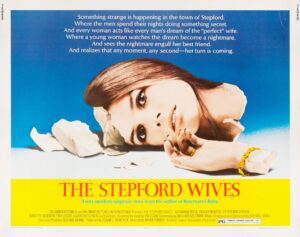
In Bryan Forbes’ chilling 1975 adaptation of Ira Levin’s The Stepford Wives, suburban husbands replace their vibrant, unpredictable wives with eerily perfect robotic replicas—serene, compliant, and uniformly soothing. They smile identically, speak in the same warm register, and never challenge or disturb. The horror lies not in violence, but in the uncanny valley: these figures look and sound real, yet something vital is absent.
Watch enough Facebook Reels of LDS General Authorities, and that same unease creeps in. Across dozens of clips—different men, ages, nationalities—the output converges: measured cadence, soft affect, solemn warmth, ascending testimony arcs, and frictionless benedictions. Tongan expressiveness or Swiss reserve? Extrovert fire or introvert depth? All smoothed into one institutional template.
This isn’t imitation alone; it’s formation. Decades of General Conference model the pace, pauses, and prophetic drop in tone. No coaching manual needed—the specification lives in the repeated performance. Raw personalities glimpsed in unscripted moments vanish, extracted for a product that’s polished, pleasant, and profoundly uniform.
Why? Comfort. Like Stepford husbands craving predictability, this style soothes believers: “All is well. The brethren are steady.” It reassures amid doubt, but at a cost—insulating audiences from inquiry’s friction.
The “semi-sweet, watered-down syrup” nails it: long on pleasantries, short on Biblical substance’s rigor and depth. The sameness screams design, not coincidence—an emergent institutional polish worth dissecting in apologetics.
Conclusion
The homogeneity you’ve identified across these reels is real, documentable, and almost certainly non-accidental — though “design” should be understood broadly. It is unlikely there is a manual titled How General Authorities Must Speak. It is very likely that:
- Selection effects favor men who already speak in this register
- Decades of immersion in the same speech community before calling consolidate the pattern
- Institutional media infrastructure refines and standardizes delivery for public-facing content
- The theological epistemology itself — testimony as the primary mode of knowing — generates the specific prosodic and lexical features you observe
The apologetic implication is significant: when a communication style becomes indistinguishable from the content it delivers, audiences may unconsciously conflate the way something sounds with whether it is true. The cadence itself becomes evidence of spiritual authority. That is a rhetorically powerful and theologically concerning feature of the communication system—worth naming precisely in your apologetics work.
Your syrup metaphor holds up analytically: these speeches are long on pleasantries but short on Biblical substance, offering uniform, artificially sweet assurances that lack the nutritive density of Scripture’s doctrinal depth, ethical rigor, or prophetic confrontation the presentation implies. So your sense that “this certainly seems beyond coincidence” is well-supported at the level of institutional culture and media practice, even if there is no documented, granular script dictating each vocal inflection. The overall effect—what you describe as semi-sweet, watered-down syrup—is best understood as an emergent property of long-standing LDS norms about reverence, centralized message control, and carefully curated social-media editing rather than random overlap.