
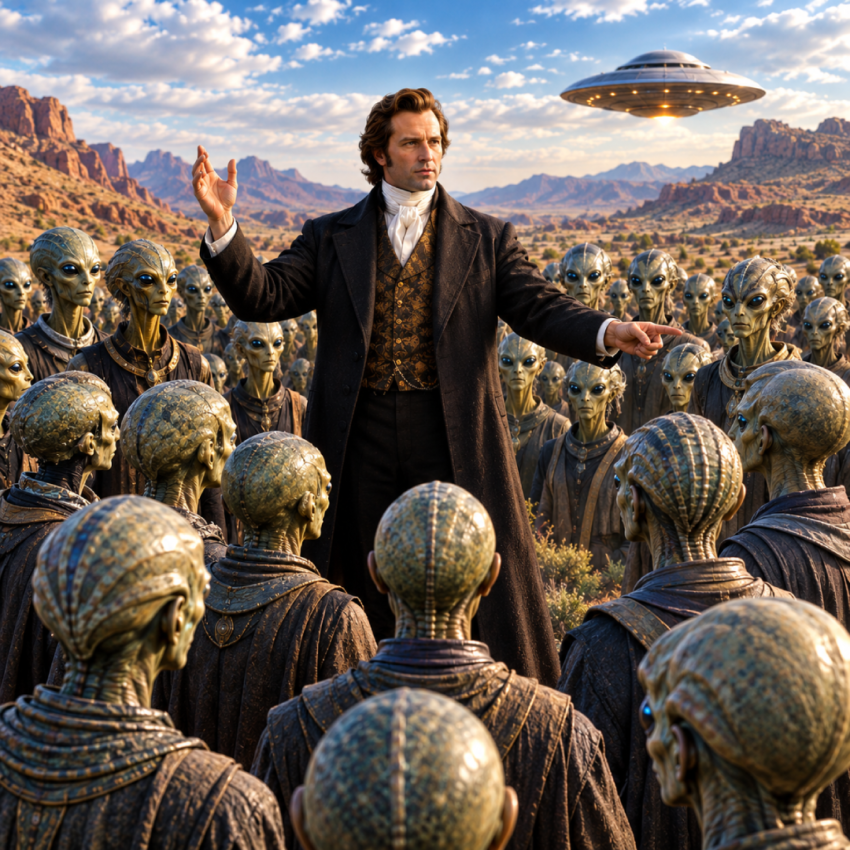
A Scholarly Look at Kolob, Embodiment, and the Latter-day Saint Universe
— ✦ ✦ ✦ —
Introduction: A Promise About the Moon
In March 1892, readers of the Young Woman’s Journal, a magazine for Latter-day Saint young women in Utah, turned to a Sunday reading unlike any other in the issue. Oliver B. Huntington, an aging veteran of the Kirtland and Nauvoo years, reached back more than half a century to a patriarchal blessing he had received as a young man in Ohio. He wanted his readers to know that the blessing had promised him a mission field far wider than the islands of the sea.
In my patriarchal blessing, given by the father of Joseph the Prophet, in Kirtland, 1837, I was told that I should preach the gospel before I was 21 years of age; that I should preach the gospel to the inhabitants upon the islands of the sea, and — to the inhabitants of the moon, even the planet you can now see with your eyes.
— Oliver B. Huntington, “The Inhabitants of the Moon,” Young Woman’s Journal 3:264 (1892), as reproduced by Mormonism Research Ministry
One hundred thirty-four years later, the sky has returned to the headlines. In May 2026, the federal government began releasing declassified records on unidentified anomalous phenomena through a public portal, following congressional hearings, a NASA study team, and years of pressure for disclosure. Within weeks, a Latter-day Saint magazine republished an essay arguing that the discovery of intelligent life elsewhere would not require members of the Church of Jesus Christ of Latter-day Saints to rebuild their theology, because in their view the foundation was laid in 1830.
That claim is worth taking seriously, and so is the distance between Huntington’s recollection and the confident modern essay. Between them lies nearly two centuries of revelation, sermon, recollection, speculation, folklore, apologetics, and criticism. Latter-day Saint scripture is unusually explicit about inhabited worlds; few Christian canons say anything comparable. Yet the tradition has never issued a systematic statement about what those worlds are, where they are, who lives on them, whether their inhabitants visit us, or how Joseph Smith’s most memorable cosmological remarks should be weighed. The result is a cosmology that is at once expansive and unsettled.
This essay examines that cosmology on its own terms. It asks what Joseph Smith actually wrote or was recorded as saying about life beyond Earth; how later leaders developed, qualified, or quietly retired those ideas; how official and semi-official sources respond today; what ordinary members appear to believe; where the genuine philosophical and theological puzzles lie; and, finally, whether a church that claims living prophets ought to be able to settle the matter. The goal is not to mock a faith community for looking up. Every serious religious tradition has had to reckon with the size of the heavens. The goal is to understand how this tradition has done so, and what that reveals about how it distinguishes revelation from opinion.
— ✦ ✦ ✦ —
A Note on Method and Terms
Two clarifications will keep the discussion honest. The first concerns vocabulary. In popular usage, “alien” conjures gray figures and flying saucers. Latter-day Saint writers rarely use the word that way when describing their own beliefs. When they speak of life on other worlds, they usually mean fellow children of God, embodied persons created in the divine image, living on planets that Christ created. When critics or entertainers say “Mormons believe in aliens,” they often mean something closer to the flying-saucer picture. Much of the public confusion on this subject arises from the two groups using one word for two different things.
The second clarification concerns authority. The Latter-day Saint tradition recognizes several tiers of teaching. At the center stand the canonized standard works: the Bible, the Book of Mormon, the Doctrine and Covenants, and the Pearl of Great Price. Around them sit official declarations, general conference addresses, and Church-produced manuals and essays. Further out are sermons of past leaders recorded in collections such as the Journal of Discourses, the books of individual apostles, articles in Church magazines, and faithful scholarship. At the periphery sit private journals, secondhand recollections, and folklore. One Latter-day Saint academic, writing at Times & Seasons, compared this structure to concentric circles while noting that the boundaries between tiers are drawn far less systematically than in Roman Catholicism. That observation will matter a great deal. Nearly every controversy examined below turns on the question of which circle a given statement belongs to.
Where this essay quotes scripture and nineteenth-century sources, it does so at length, because the exact wording matters. Where it draws on modern writers, it quotes briefly and paraphrases the rest, and it gives each source’s location so readers can judge the material for themselves.
— ✦ ✦ ✦ —
The Nineteenth-Century Sky
A Plurality of Worlds
It is tempting to treat Joseph Smith’s cosmology as a bolt from nowhere. It was not. By the time Smith dictated his first revelations, the idea that the universe teemed with inhabited worlds was a commonplace of educated Anglo-American thought. Historians call it the “plurality of worlds” doctrine, and in the early nineteenth century it was defended by astronomers, preachers, and popular writers alike.
Sir William Herschel, the astronomer who discovered Uranus, speculated freely about inhabitants of the Moon and even of a cool region beneath the Sun’s luminous atmosphere. His words, cited in modern discussions of Latter-day Saint cosmology, capture the mood of the era.
Who can say that it is not extremely probable, nay beyond doubt, that there must be inhabitants on the Moon of some kind or another?
— Sir William Herschel, as cited in “Mormon cosmology,” Wikipedia
The Scottish preacher Thomas Chalmers devoted a celebrated series of sermons, the Astronomical Discourses of 1817, to reconciling the vastness of the heavens with Christian redemption. The Scottish writer Thomas Dick went further, weaving astronomy and piety into popular books that imagined the saved exploring other worlds after death; historians of early Mormonism have noted that excerpts from Dick’s Philosophy of a Future State appeared in the Latter-day Saint newspaper Messenger and Advocate in 1836. On the skeptical side, Thomas Paine had argued in The Age of Reason that a universe of many inhabited worlds made the traditional Christian story of one Savior dying on one planet appear, in his phrase, “little and ridiculous.”
Popular culture reflected the same fascination. In August 1835, the New York Sun published its notorious “Great Moon Hoax,” a series of fabricated reports describing winged humanoids, bison, and temples observed on the lunar surface through a giant telescope. Many readers believed it, at least for a while. When Latter-day Saints of the 1830s and 1840s talked about people on the Moon, they were not stepping outside their culture. They were participating in one of its livelier conversations.
The Religious and Political Climate
The social setting mattered as much as the scientific one. Smith grew up in western New York’s “burned-over district,” a region repeatedly swept by revivals during the Second Great Awakening. Competing denominations, restorationist movements, visionary seekers, and folk-magic practitioners all offered answers to the same hunger for certainty. Jacksonian democracy was flattening old hierarchies, and ordinary Americans increasingly assumed that they could read scripture and receive divine communication without the mediation of learned clergy.
Smith’s movement drew on each of these currents. It promised a restoration of primitive Christianity, an open canon, and direct revelation to a living prophet. It also absorbed the Enlightenment conviction that the universe is lawful and knowable. Several Latter-day Saint writers have observed that their tradition historically distrusted theological “mystery,” preferring explanations that could, in principle, be understood. One commenter at the Latter-day Saint blog By Common Consent put it memorably by suggesting that Mormonism has always resisted doctrinal vacuums. A religion that refuses to leave questions unanswered will eventually answer questions about the stars.
Finally, the early Saints lived under pressure. Driven from Ohio and Missouri, the latter under a governor’s order of October 1838, they built Nauvoo on the Mississippi while facing hostility from neighbors, newspapers, and rival churches. It was in Nauvoo, in the last years of Smith’s life, that his most expansive cosmological teachings emerged. Those teachings consoled a persecuted people by enlarging their horizon: the present world of suffering was one small stage in an eternal, cosmic drama in which the faithful would one day become like God.
— ✦ ✦ ✦ —
What Joseph Smith Actually Taught
Any fair examination must begin by sorting Smith’s statements according to the kind of evidence we have for them. Three categories emerge: canonized revelations he dictated, sermons recorded by contemporaries, and recollections set down years or decades after his death.
The Canonized Revelations
The foundational text is the Book of Moses, which Smith produced in June 1830 as part of his revision of the Bible. In its opening chapter, Moses sees a vision of the earth and its inhabitants and asks God how and why these things were made. The answer introduces the phrase that has shaped Latter-day Saint cosmology ever since.
And worlds without number have I created; and I also created them for mine own purpose; and by the Son I created them, which is mine Only Begotten. . . . But only an account of this earth, and the inhabitants thereof, give I unto you. For behold, there are many worlds that have passed away by the word of my power. And there are many that now stand, and innumerable are they unto man; but all things are numbered unto me, for they are mine and I know them.
— Moses 1:33, 35, Pearl of Great Price
Two features of this passage deserve emphasis. First, it affirms a multitude of created worlds but does not, strictly speaking, state that each one is inhabited; the chapter heading in current Latter-day Saint editions, however, summarizes it as Moses seeing “many inhabited worlds,” and earlier verses in the chapter describe many lands “called earth” with inhabitants upon them. Second, and often overlooked, the passage contains its own limitation: God gives Moses “only an account of this earth.” The revelation that opens the cosmos also tells the reader not to expect a detailed report about it. We will return to that limitation in the thought experiment at the end of this essay.
A later chapter of the same book places an even larger number in the mouth of the prophet Enoch.
And were it possible that man could number the particles of the earth, yea, millions of earths like this, it would not be a beginning to the number of thy creations; and thy curtains are stretched out still.
— Moses 7:30, Pearl of Great Price
The most direct statement about inhabitants appears in the vision Smith and Sidney Rigdon recorded on February 16, 1832, now Doctrine and Covenants section 76. Testifying of Christ, they write:
That by him, and through him, and of him, the worlds are and were created, and the inhabitants thereof are begotten sons and daughters unto God.
— Doctrine and Covenants 76:24
Here the essential Latter-day Saint position is stated with unusual clarity. The other worlds have inhabitants; those inhabitants are God’s children; and Christ is the agent of their creation. Subsequent revelations extend the theme. Doctrine and Covenants 88 describes Christ as the light that fills “the immensity of space,” and section 93 affirms that “the worlds were made by him.”
The Book of Abraham, published serially in the Nauvoo newspaper Times and Seasons in 1842, supplied the name that would become the tradition’s most famous astronomical term.
And I saw the stars, that they were very great, and that one of them was nearest unto the throne of God; and there were many great ones which were near unto it; and the Lord said unto me: These are the governing ones; and the name of the great one is Kolob, because it is near unto me.
— Abraham 3:2–3, Pearl of Great Price
It is worth reading this text slowly, because popular summaries often outrun it. The passage says Kolob is near the throne of God and governs other bodies. It does not say that God lives on Kolob. Latter-day Saint commentators have made this correction precisely in public discussions, and some faithful scholars have argued that the Abraham astronomy reflects an ancient geocentric picture of the heavens rather than a modern map of the galaxy.
Finally, a set of instructions Smith gave at Ramus, Illinois, on April 2, 1843, later canonized as Doctrine and Covenants 130, supplies a detail that turns out to be critical for the UFO question.
In answer to the question — Is not the reckoning of God’s time, angel’s time, prophet’s time, and man’s time, according to the planet on which they reside? I answer, Yes. But there are no angels who minister to this earth but those who do belong or have belonged to it.
— Doctrine and Covenants 130:4–5
Taken together, the canonized revelations establish a small set of firm propositions: God created innumerable worlds through Christ; at least some are inhabited by God’s children; a governing star named Kolob stands near God’s throne; beings reckon time according to their planets; and angels ministering to this earth belong or have belonged to it. Beyond those propositions, the canon is silent.
The Recorded Sermons
Smith’s Nauvoo sermons, recorded by clerks and listeners, press further. In an April 1843 discourse on the beasts in the Revelation of John, he offered a striking speculation about the scale of salvation.
John saw curious looking beasts in heaven, he saw every creature that was in heaven, all the beasts, fowls, & fish in heaven, actually there, giving glory to God. I suppose John saw beings there, that had been saved from ten thousand times ten thousand earths like this, strange beasts of which we have no conception.
— Joseph Smith, sermon of April 1843, as quoted by Stephen C., “Latter-day Saints and Extraterrestrials,” Times & Seasons (2022)
Note the grammar: “I suppose.” Smith presents this as inference, not revelation. Yet the inference is theologically weighty, because it implies that salvation operates across countless earths and includes creatures unlike anything known on this one.
The most consequential sermon came a year later. At a conference in April 1844, weeks before his death, Smith delivered the funeral address for a church member named King Follett. In it, he taught that God the Father had once been a man who dwelt on the earth.
God himself was once as we are now, and is an exalted man, and sits enthroned in yonder heavens! . . . If the veil were rent today, and the great God who holds this world in its orbit, and who upholds all worlds and all things by his power, was to make himself visible . . . you would see him like a man in form.
— Joseph Smith, King Follett Discourse (April 7, 1844), as compiled in Teachings of the Prophet Joseph Smith and quoted by LDS Living
The King Follett Discourse was never canonized, but it has been reprinted and taught for generations, and it transformed the meaning of “worlds without number.” If God the Father once lived on an earth, then the plurality of worlds is not merely a feature of creation; it is the arena of divine biography. Lorenzo Snow’s couplet, “As man now is, God once was: as God now is, man may be,” would later compress the idea into a single line.
The Recollections
The third category is the most colorful and the least secure. Several Latter-day Saints recorded, often long after the fact, things they believed Smith had said privately. The best known is the Moon passage preserved in the journal of Oliver B. Huntington.
The inhabitants of the moon are more of a uniform size than the inhabitants of the earth, being about six feet in height. They dress very much like the Quaker style and are quite general in style or the one fashion of dress. They live to be very old; coming generally, near a thousand years.
— History of the Life of Oliver B. Huntington, typescript, University of Utah, as quoted by Mormonism Research Ministry
A second recollection, recorded by Joseph Young, a brother of Brigham Young and a senior leader of the Seventy, concerns the City of Enoch, which Latter-day Saint scripture describes as taken up from the earth.
Joseph Smith said, on another occasion, in the hearing of some of the saints still surviving, that the City of Enoch would again take its place in the identical spot from which it had been detached, now forming that chasm of the earth, filled with water, called the Gulf of Mexico.
— Joseph Young, History of the Organization of the Seventies (1878), p. 12, as quoted by Mormonism Research Ministry
These statements have become staples of both folklore and criticism. Whether they tell us anything reliable about Joseph Smith is the subject of the next section.
— ✦ ✦ ✦ —
The Moonmen Problem
Weighing the Huntington Account
The Huntington material illustrates how difficult it is to recover what Smith privately believed. According to Latter-day Saint researchers Van Hale and John A. Tvedtnes, whose work is summarized in the Wikipedia article on Mormon cosmology, Huntington was still a child when Smith died in 1844. He appears to have heard the description from another early member, Philo Dibble, and recorded it in his journal roughly four decades after Smith’s death. Dibble did not indicate whether the recollection was his own or something he had heard from someone else. The chain of transmission, in other words, is at least secondhand and possibly thirdhand, with a long gap between event and record.
The patriarchal blessing raises a separate problem. Huntington’s 1892 article attributes the blessing to Joseph Smith Sr., the Church’s first patriarch. Hale reported that the Church’s own record of the blessing identifies the patriarch as Huntington’s father, William Huntington. The recorded wording is also more conditional than the popular version. It speaks of power to translate oneself to heaven and preach “to the inhabitants of the moon or planets, if it shall be expedient,” a phrasing that could refer to some future or post-mortal circumstance.
Latter-day Saint historians Tvedtnes and James B. Allen have added a further observation: there is no indication that Smith ever claimed his remarks about lunar inhabitants, if he made them, came by revelation or carried prophetic authority. On this reading, Smith was a man of his time repeating a widely held scientific opinion.
Critics read the same evidence differently. Mormonism Research Ministry, an evangelical organization, treats the Huntington and Young statements as genuine teachings of early leaders and argues that they cannot be dismissed simply as nineteenth-century ignorance. The progressive Latter-day Saint site Rational Faiths, in a lighthearted 2016 series on Mormon myths, concluded that the Moon sentiment was repeated often enough that Smith likely said some version of it, and then posed the harder question directly.
…one must reflect if Joseph was speaking with any kind of prophetic insight…
— Justin Anfinsen, “Mormon Myths: The Secret History of UFOs (Part 1),” Rational Faiths (2016)
That question, rather than the historical minutiae, is what makes the Huntington account significant. If the statement is unreliable, the matter is closed. If it is reliable, the tradition must explain how a prophet could share a scientific error without that error compromising his prophetic claims. Latter-day Saint apologists answer that prophets are not infallible and speak as ordinary people on matters outside revelation. Critics answer that the line between the prophetic and the personal is drawn only after a statement proves embarrassing. Both positions are coherent. Which one a reader finds persuasive depends largely on prior commitments about prophetic authority.
Brigham Young and the Sun
Smith’s successor spoke more openly, and his words are securely documented. On July 24, 1870, in a sermon recorded in the Journal of Discourses, Brigham Young reflected on how little anyone knew about the heavens.
Who can tell us of the inhabitants of this little planet that shines of an evening, called the moon? . . . When you inquire about the inhabitants of that sphere you find that the most learned are as ignorant in regard to them as the most ignorant of their fellows. So it is with regard to the inhabitants of the sun. Do you think it is inhabited? I rather think it is. Do you think there is any life there? No question of it; it was not made in vain.
— Brigham Young, Journal of Discourses 13:271 (July 24, 1870)
Two points of context are important. First, Young framed his remarks as personal thought, conceding in the same sermon that all were ignorant on the subject. Second, as noted above, respected scientists of the era had entertained similar ideas. Latter-day Saint writers today generally treat Young’s statement as opinion without doctrinal standing. LDS Daily, a faithful Latter-day Saint site, puts it plainly: the remarks were offered as opinion, and there is no evidence they were ever treated as doctrine. Critics, again, reply that Young’s contemporaries regarded him as a prophet, seer, and revelator, and that the category of “opinion” is being applied retroactively.
— ✦ ✦ ✦ —
From Pulpit to Pamphlet: The Twentieth-Century Articulation
Naturalism and the Scientist-God
As the Church moved into the twentieth century, a generation of intellectual leaders gave Smith’s cosmology a scientific accent. Apostle John A. Widtsoe, a Harvard-trained chemist, and B. H. Roberts, a prolific theologian and historian of the Seventy, emphasized a lawful universe in which God is supreme precisely because He comprehends and works through natural law. Matthew Bowman, who holds the Howard W. Hunter Chair of Mormon Studies at Claremont Graduate University, has argued in the Salt Lake Tribune that this tradition, reaching back to Brigham Young, effectively denied that anything is “supernatural” in the sense of being outside nature. God, on this view, is the consummate scientist.
That theological disposition made the space age feel less like a threat than a vindication. If God is an embodied being who governs a physical cosmos, and if His children inhabit other worlds, then the prospect of life elsewhere confirms rather than unsettles the faith.
Joseph Fielding Smith
Joseph Fielding Smith, an apostle for six decades and later President of the Church, gave the idea its most direct doctrinal expression in the widely read compilation Doctrines of Salvation.
We have brothers and sisters on other earths. They look like us…
— Joseph Fielding Smith, Doctrines of Salvation 1:62, as cited in “Mormon cosmology,” Wikipedia
Elsewhere, in Answers to Gospel Questions, he reasoned that the vast systems of stars must each be governed by divine law and presided over by Gods. Whatever one makes of the argument, it shows how naturally mid-century leaders moved from “worlds without number” to a populated, governed, multi-divine cosmos.
Spencer W. Kimball and the 1962 Conference
In April 1962, then-Elder Spencer W. Kimball addressed the space race at general conference. His remarks have been quoted in two slightly different forms, and the difference is instructive. Saints Unscripted, a faithful Latter-day Saint video ministry, quotes the conference text using the word “interplanetary.”
Is there association of interplanetary beings? There is no question.
— Spencer W. Kimball, general conference, April 1962, as quoted by Saints Unscripted
LDS Living, quoting the later book version in Faith Precedes the Miracle, renders the same series of questions with “extraterrestrial conversation” and “nonhuman beings.” Both versions conclude with Kimball’s most-quoted line: asked whether planets in space are inhabited by intelligent creatures, he answered, “Without doubt.” Saints Unscripted interprets the passage as referring chiefly to communication with God and heavenly messengers, and the surrounding context supports that reading. Still, the change in wording from “interplanetary” to “nonhuman” is not trivial. Depending on the vocabulary one chooses, the same address can sound like a sermon about prayer or a statement about extraterrestrials.
Kent Nielsen and the New Era, 1971
The most remarkable official-channel treatment appeared in April 1971, less than two years after Apollo 11, in the Church’s youth magazine, the New Era. BYU professor F. Kent Nielsen, a Harvard-trained teacher of physics, mathematics, and religion, wrote an article titled “People on Other Worlds.” He surveyed the distances of space, concluded that science alone could never answer whether others were out there, and then declared that revelation already had. Nielsen described God, in a memorable aside, as humanity’s contact from outer space.
…is our contact from outer space…
— F. Kent Nielsen, “People on Other Worlds,” New Era (April 1971), as reprinted by The Latter-day Liberator
Nielsen argued that inhabitants of other worlds would resemble us because all are of the same divine species, that angelic visitation is a form of travel between worlds, and that the Millennium will bring earth under the government of resurrected beings who visit when they please. He also sketched, as a presumption, a chain of divine generations: God dwelt on a mortal world created by His own Father, one among His brethren was presumably a savior for them, and exalted beings continue the pattern by organizing new worlds. LDS Living later quoted his central claim about appearance.
Obviously, God’s sons and daughters would be of his species, would resemble him.
— F. Kent Nielsen, New Era (1971), as quoted in Katie Lambert, “What Prophets Have Said About Extraterrestrial Beings,” LDS Living (2018)
Rational Faiths notes that this article appeared amid a wave of popular UFO interest following the 1947 Roswell incident, and that a First Presidency member, N. Eldon Tanner, published “Warnings from Outer Space” in the January 1973 Ensign, using the language of the space age to speak of heavenly messengers. Whether leaders were deliberately capitalizing on the cultural moment, as the Rational Faiths author suggests, or simply teaching in the idiom of their audience, the effect was the same: for a time, Latter-day Saint publications spoke of “outer space” with an ease few other churches matched.
Later Apostolic Voices
Subsequent leaders maintained the core affirmation while speaking more cautiously about details. Apostle Neal A. Maxwell wrote in 1990 that no one knows how many inhabited worlds exist or where they are, but that “certainly we are not alone,” a line quoted by Mormonism Research Ministry among others. Russell M. Nelson, then an apostle, taught in October 1996 that the Atonement is infinite in scope, extending to the innumerable worlds Christ created, and in April 2000 that the earth is only one of many creations over which God presides. Dieter F. Uchtdorf, speaking in October 2011, used the vastness of the cosmos to emphasize that each person still matters to God. These are general conference addresses, delivered from the Church’s most authoritative regular pulpit, and they consistently affirm a populated universe.
The Temple and the Hymnal
Two further channels deserve mention because they shape ordinary members’ imaginations more than any article. According to published descriptions summarized in the Wikipedia article on Mormon cosmology, the creation narrative in the temple endowment refers to worlds previously created, and a line in the Garden of Eden sequence alludes to what has been done on other worlds. And the hymn “If You Could Hie to Kolob,” written by W. W. Phelps and first published in 1856, has long carried cosmological speculation into Sunday worship. Its original text asked whether one could ever find “the generation / Where Gods began to be.” The hymn received a new tune in the 1985 hymnal, and one Times & Seasons writer observed that the hymn is now among the few places a typical member encounters Kolob in the ordinary course of Church life.
— ✦ ✦ ✦ —
Official Voices and Their Limits
How, then, does the Church and its orbit of faithful writers speak about extraterrestrials today? Four patterns emerge from the sources examined for this study.
Pattern One: Firm on Worlds, Silent on Saucers
Every faithful source consulted affirms that God has created many inhabited worlds. None claims that the Church has an official position on UFOs, alien visitation, or abduction. The Ask Gramps site, a long-running question-and-answer service run by Latter-day Saint volunteers, summarizes the scriptural teaching and then says that regarding an official Church position on “space aliens,” the author is “unaware of any” beyond the scriptures already cited. LDS Daily goes further in a way that is revealing.
…no church leader, acting under their prophetic call, has made an official statement…
— Aleah Ingram, “What Do Latter-day Saints Believe About Aliens?” LDS Daily (2024)
The claim is defensible if “official statement” means a formal declaration about extraterrestrial visitation. It is harder to sustain if it means any authoritative statement about inhabitants of other worlds, since general conference addresses by Kimball, Nelson, and others have addressed exactly that. The ambiguity is itself a finding: faithful writers are not always sure where the line of official teaching runs.
Pattern Two: Reframing “Aliens” as Family
Faithful sources consistently redefine the question. Saints Unscripted proposes three senses in which Latter-day Saints believe in extraterrestrial life: mortal inhabitants of other worlds, the premortal spirits of all humanity who came from God’s presence, and God Himself, an embodied being who dwells beyond the earth. The video then adds that while God might technically be “alien” to Earth, He is certainly not alien to His children. LDS Living similarly reframes angelic visitation as heavenly messengers who travel “through time and space.” The effect is to domesticate the extraterrestrial: the beings from elsewhere are kin.
Pattern Three: The Angelic Boundary
A third pattern invokes Doctrine and Covenants 130:5 to limit speculation about visitors. If no angels minister to this earth except those who belong or have belonged to it, then the heavenly messengers of scripture are not natives of other planets. Faithful commenters on the Women Seeking Christ site, a long-running Latter-day Saint women’s blog, cited that verse and a related teaching of Joseph F. Smith to argue that visitors from other worlds are restricted to the Creator and the inhabitants of this one. The Millennial Star, a faithful blog, summed up the resulting position concisely after cataloguing some outlandish folklore.
Missing is a theological belief that any have visited.
— Jettboy, “Strange Mormon UFO Alien Stories,” The Millennial Star (2012)
Pattern Four: Correction of Caricature
Finally, official sources have responded when popular culture caricatures Latter-day Saint belief. The best-known example is the Church’s Gospel Topics essay “Becoming Like God,” which addresses the stereotype, popularized by the musical The Book of Mormon, that faithful members expect to receive their own planets. As quoted in a 2022 feature on the Grunge website, the essay observes that few members recognize themselves in that picture.
…few Latter-day Saints would identify with caricatures of having their own planet…
— “Becoming Like God,” Gospel Topics Essays, The Church of Jesus Christ of Latter-day Saints, as quoted by Josh Sippie, Grunge (2022)
The essay goes on to affirm that the awe inspired by creation hints at humanity’s creative potential in eternity. That is a careful balance. It rejects the cartoon without rejecting the doctrine of exaltation, in which faithful Saints may one day share in God’s creative work. Yet the correction also shows how the Church now tends to engage cosmology: reactively, to correct misunderstanding, rather than proactively, to explain the doctrine’s cosmic details.
The Quiet Retreat
Observers from different vantage points agree that the subject has receded from the Church’s official voice. The Times & Seasons author, a faithful academic, notes that since the Church’s messaging became highly correlated, speculative cosmology rarely reaches the pulpit, and that general conference today is, in his words, largely “pretty anodyne stuff about how to be a good Latter-day Saint.” The Rational Faiths author, writing from a progressive angle, observes that as mainstream UFO interest waned, the Church’s willingness to discuss the subject waned with it.
…the subject would almost be taboo now.
— Justin Anfinsen, “Mormon Myths: The Secret History of UFOs (Part 2),” Rational Faiths (2016)
“Taboo” may overstate the case, since faithful writers continue to publish on the topic, as the 2026 Meridian essay shows. But the trajectory is clear. The pulpit that once spoke of “interplanetary beings” now leaves the subject largely to scripture, magazines, and members.
— ✦ ✦ ✦ —
The Rank and File: Belief, Folklore, and Confusion
What the Data Can and Cannot Show
The brief for this study asks whether ordinary Latter-day Saints believe in UFOs and extraterrestrials, and how much confusion exists among them. Honesty requires a caveat at the outset. This study located no rigorous, denomination-specific survey measuring Latter-day Saint belief in UFOs or alien visitation. General polling exists; a 2021 Pew Research Center survey, cited by Meridian Magazine, found that religious Americans were somewhat less likely than the religiously unaffiliated to say intelligent life exists beyond Earth. But claims about what “most Mormons” believe regarding flying saucers rest on anecdote, blog discussion, and impression. The evidence below should be read in that light: it illustrates the range of member opinion and the nature of the confusion, but it does not measure prevalence.
A Revealing Exchange
Perhaps the single most illuminating document in the source set is a 2010 post on the Women Seeking Christ site, originally titled “Ask a Mormon Woman: Do Mormons Believe in Aliens?” The author, a self-described science-fiction enthusiast, answered her own question directly.
Do Mormons believe in aliens? No.
— Brenda, “Ask a Mormon Woman: Do Mormons Believe In Aliens?” Women in the Church of Jesus Christ (2010)
She explained that she meant no visiting spacecraft, while affirming that God created other worlds and that heavenly beings have visited Earth. Within a week, a reader who identified himself as a member of more than thirty years pushed back. Citing Doctrine and Covenants 76:24, he insisted that the Church’s canon plainly teaches populated worlds, that members are free to form personal opinions about UFOs, and that no official position exists beyond the canon. A contributor to the site then clarified that she believes in inhabited worlds but understood visitors to be limited to God and the inhabitants of this earth, citing Joseph F. Smith and the 1971 New Era article.
The exchange then turned to the deeper issue. The reader argued that only the four canonized books constitute official doctrine; statements by Joseph Smith, Joseph F. Smith, or a Church magazine, however respected, reflect personal understanding until formally canonized. The original author replied that she takes a broader view, giving weight to conference talks, Church magazines, and correlated lesson materials, citing Doctrine and Covenants 68:4, which says that what Church leaders speak when moved upon by the Holy Ghost is scripture. Each participant was sincere, informed, and faithful. They agreed on the core doctrine, disagreed on the visitation question, and disagreed more fundamentally on what counts as doctrine at all.
That exchange is a microcosm of the entire subject. The confusion among members is less about the stars than about authority.
Kolob: Literal, Metaphorical, or Theorem?
A 2011 thread on the Mormon Dialogue and Discussion Board, prompted by a segment of the History Channel program Ancient Aliens suggesting that the angel Moroni came from the Pleiades, shows the same pattern. Participants uniformly rejected the television claims. But when one participant asked whether Latter-day Saints believe God lived on a planet near a distant star, the replies diverged. One member said some do, but offered his own view.
I believe that Kolob being near the throne of God is a metaphor…
— “altersteve,” “Joseph Smith On Ancient Aliens,” Mormon Dialogue & Discussion Board (2011)
He added that he thought God does not live in this universe at all. Another participant answered that God the Father came from another earth and is the same species as humanity. A third worried that theorizing about other universes risks the very abstraction that, in Latter-day Saint thought, contributed to the Great Apostasy. Saints Unscripted likewise notes that many members understand Kolob as a symbol for Christ rather than a literal location.
At the other end of the spectrum stands The Kolob Theorem, a book by Lynn M. Hilton that proposes each galaxy is the realm of a God, that our God dwells near the center of the Milky Way, and that the earth will be returned there before the Millennium. Writing at By Common Consent in 2015, a Latter-day Saint historian described encountering educated members who discussed the theory alongside the Big Bang and the multiverse, and he noted that the book was sold by Deseret Book, the Church-owned publisher. He was unsparing in his assessment, yet he also recognized the theological logic that produces such speculation.
If you want Mormon theological exceptionalism, you are going to get Kolob theorems.
— Ronan Head, “Mormon Space Doctrine: A Necessary Embarrassment?” By Common Consent (2015)
Commenters on that post illustrated the spread. One noted that Kolob appears in only a handful of verses in the entire standard works. Another pointed out that Abraham 3 does not say God lives on Kolob. A third cited faithful scholarship reading the Abraham astronomy as ancient geocentric cosmology. A fourth recalled mission companions who circulated photocopied “secret knowledge” about the cosmos. When the Church itself is largely silent, members fill the space with everything from careful exegesis to paperback astrophysics.
Culture, Imagination, and Folklore
Latter-day Saint cosmology has also shaped imagination in ways that outlast doctrinal debate. The Times & Seasons author describes a common childhood experience among members: imagining the worlds they might one day create, and he notes speculation that this helps explain the notable presence of Latter-day Saints among science-fiction and fantasy writers, including Orson Scott Card, Brandon Sanderson, and Stephenie Meyer. Rational Faiths points to Glen A. Larson, creator of Battlestar Galactica, whose series featured a human home world called Kobol, an anagram of Kolob, and a governing Council of Twelve.
Folklore has flourished at the margins. The Millennial Star catalogued, with evident amusement, conspiracy theories linking Church leadership to reptilian aliens, as well as a widely shared tale about missionaries in the Arizona desert who claimed to have taught the gospel to their alien abductors. The same writer cautioned that these stories circulate mainly through unreliable channels. A reader at Times & Seasons recalled that the famous 1975 Travis Walton abduction case in Arizona, dramatized in the film Fire in the Sky, involved men widely reported to be Latter-day Saints. None of these stories has doctrinal standing. They do, however, show that for some members the boundary between cosmology and ufology is porous.
Lore at the Campfire
A 2023 discussion on Reddit’s ex-Mormon forum, started by a non-member researching how different faiths regard UFOs, offers a rare look at how this lore actually travels. One lifelong member recalled that the subject was “not really spoken of in church” but surfaced at scout camps and in informal storytelling. There he heard two competing explanations. In one, aliens were God’s children from worlds more advanced than ours. In the other, drawn from books he had read, they were demons appearing in the last days. The demonic reading adds a third strand to the two scholarly hypotheses discussed at the end of this section, and it has parallels in some evangelical writing on UFOs. The same member recalled reassuring his frightened child that if aliens were real, scripture and the prophets would surely have warned about them.
A former member in the thread remembered believers picturing other-world inhabitants as fully human rather than as the grey figures of popular culture, and judged that this outward-looking outlook was stronger in Neal A. Maxwell’s era than today. A self-identified active Latter-day Saint, by contrast, described himself as a firm believer in the UFO phenomenon who finds deep correspondence with his theology. Another commenter mentioned “theories” that Adam and Eve were brought from another planet, an idea that echoes Brigham Young’s 1852 teaching about Adam in the Journal of Discourses (1:50), which the Church later repudiated. These voices are anonymous and self-selected, and they come mostly from people who have left the Church. They show the range of belief, not how common each view is.
The View from Outside
Outsiders notice the openness. A writer for the Past Lives Project, a site devoted to paranormal topics, discovered the 1971 New Era article and was struck to find it on the Church’s official website and praised its open-minded tone, while adding an important caveat.
I don’t know how much of this filters down to the rank and file…
— “Mormons and Extraterrestrial Contact? Who Knew?” Past Lives Project
That caveat is exactly right. The distance between what the Church’s archives contain and what its members are taught on Sunday is considerable. A second Reddit discussion included in this study’s source list could not be accessed because the platform blocks automated retrieval; judging by its title, it concerns material in a recent government release of UFO documents. Together with the thread described above, it suggests that the subject remains live among former members as well, often as an example of teachings they believe the Church has downplayed.
Two Hypotheses, Two Religions
Matthew Bowman offers the most useful scholarly framework for understanding contemporary member belief. He notes a long-standing division among UFO investigators between the “extraterrestrial hypothesis,” which treats UFOs as physical craft from other planets, and the “interdimensional hypothesis,” which treats them as intrusions from other planes of existence. Bowman argues that Latter-day Saints who gravitate toward each hypothesis are, in effect, expressing different visions of their faith.
…more in common with ghosts than “Star Trek.”
— Matthew Bowman, “Why Some Latter-day Saints Believe in UFOs,” The Salt Lake Tribune (September 5, 2023)
Members drawn to the extraterrestrial hypothesis are heirs of the Widtsoe-Roberts tradition: God is the master of natural law, and other worlds are physical places. Members drawn to the interdimensional hypothesis are closer to a more mystical Latter-day Saint sensibility in which spirit worlds, translated beings, and heavenly messengers move between realms without spacecraft. Bowman’s point is that the UFO question becomes a mirror in which Latter-day Saints see their competing understandings of what their religion is.
— ✦ ✦ ✦ —
Philosophical and Theological Conundrums
Does Latter-day Saint cosmology, as expressed in official sources, raise genuine philosophical or religious puzzles? It does, and many of the most thoughtful discussions of them come from Latter-day Saints themselves. What follows is not a list of “gotchas” but an inventory of questions that the tradition’s own texts raise and have not yet answered.
The Regress of Gods
The King Follett Discourse teaches that God the Father once lived as a man on an earth. Smith went further in the same period, reasoning that if Jesus had a Father, that Father may have had a Father as well. Phelps’s hymn captured the implication: could one ever find the generation where Gods began to be? Kent Nielsen’s 1971 article made the chain explicit, describing an eternal sequence of Fathers and worlds.
This raises a classic philosophical difficulty. If every God was once a mortal on a world created by a prior God, the series either regresses infinitely or terminates in a first God who was never mortal. An infinite regress leaves the ultimate explanation of the whole series unaddressed; a first God undercuts the claim that godhood is always achieved. The canon itself also contains language that sits in tension with a God who became God. Doctrine and Covenants 20:17 speaks of “a God in heaven, who is infinite and eternal, from everlasting to everlasting the same unchangeable God, the framer of heaven and earth.” Latter-day Saint thinkers have offered several harmonizations: that “everlasting” describes God’s relationship to our creation rather than to all reality, or that the eternal element is the self-existent intelligence at the core of every person. The Church’s Gospel Topics essay on becoming like God affirms the doctrine of exaltation while saying little about God’s own past. The question remains open.
One Savior, Many Worlds?
Doctrine and Covenants 76:24 says Christ created the worlds and that their inhabitants are God’s children. Russell M. Nelson taught that Christ’s Atonement is infinite in scope, reaching all the worlds He created. That answers one question and raises another. The King Follett teaching implies that the Father dwelt on an earth before this creation. Was that earth redeemed by Christ? It cannot have been created by Him, since it preceded His creative work under the Father. Nielsen’s answer was that one of the Father’s brethren was “presumably” a savior for that world. If so, then Christ’s role as Savior is not unique in the cosmic sense but unique relative to the worlds of His Father’s creation, with other saviors in other lineages.
Faithful writers have been candid about the limits of what is known here. The 2026 Meridian essay concedes that its framework does not resolve every question about how salvation works on other worlds. For readers from historic Christian traditions, this is one of the sharpest points of divergence, because the New Testament describes Christ’s sacrifice as offered “once for all” (Hebrews 9:26–28; 10:10), in a sense that most Christian theologians have taken to be cosmically singular.
Where Is God?
Latter-day Saint theology teaches that God the Father has a body of flesh and bones (Doctrine and Covenants 130:22). A body occupies space. It therefore seems natural to ask where God is. Abraham 3 places Kolob near God’s throne, and many members have inferred that God dwells in a physical location within our universe. Others, as we saw, regard Kolob as metaphor and locate God’s dwelling outside the observable cosmos. The Wikipedia summary of Mormon cosmology notes that some Latter-day Saint thinkers have explored multiverse models precisely to accommodate a God who created this universe after dwelling as a mortal elsewhere.
Each option carries costs. A God located within this universe seems subject to its physical limits, including the speed of light, unless one posits some mechanism of travel, which is how popular works end up talking about wormholes. A God outside the universe resolves that difficulty but moves toward the transcendent conception of God that Latter-day Saint theology has historically criticized as a product of apostasy. A metaphorical Kolob avoids both horns but invites the question of why a revelation would use astronomical language that is not meant astronomically. These are real dilemmas, and the tradition’s official sources do not choose among them.
Who May Visit?
Doctrine and Covenants 130:5 appears to restrict angelic ministry on earth to beings who belong or have belonged to it. Kimball’s 1962 language about “interplanetary beings,” however, and Nielsen’s description of angels as visitors “from outer space” can be heard as pointing in a different direction. Faithful interpreters generally harmonize the two by saying that heavenly messengers are resurrected or premortal inhabitants of this earth who now dwell in God’s presence. That harmonization works for angels. It leaves open whether mortal inhabitants of other worlds, if they exist and if they possess technology, could visit, which is precisely the question UFO enthusiasts ask. On that question, the canon is silent, and faithful members answer it differently.
What Do They Look Like?
Joseph Fielding Smith and Kent Nielsen taught that people on other worlds look like us because all are of God’s species. The Encyclopedia of Mormonism, published by Macmillan in 1992 with Latter-day Saint contributors, allows that they might differ from Earth’s inhabitants “in unspecified ways,” according to both LDS Living and Saints Unscripted. The Ask Gramps site suggests that the “image of God” is flexible enough to include significant physical variety. A commenter on the 2026 Meridian essay speculated that the children of different exalted beings might not all be of the same species. These positions cannot all be correct, and they rest on different readings of the same scriptural phrase.
The Problem of the Criterion
The deepest conundrum is not astronomical at all. It is epistemological. Latter-day Saints believe that God speaks through living prophets, and Doctrine and Covenants 68:4 says that what leaders speak when moved upon by the Holy Ghost is scripture. Yet Brigham Young’s inhabited sun, the Huntington Moon passage, and much mid-century cosmological teaching are now classified by faithful writers as opinion. What is the criterion for the distinction? If the criterion is canonization, as the reader on Women Seeking Christ argued, then general conference addresses and Gospel Topics essays are also non-binding, which few faithful members would accept. If the criterion is the witness of the Spirit, then two sincere members may receive opposite witnesses. If the criterion is subsequent correction by leaders, then the status of a teaching can change long after it was delivered.
This is not a problem unique to extraterrestrials. It is the general problem of authority in a tradition with an open canon. But the extraterrestrial question makes it unusually visible, because the relevant statements are vivid, specific, and in some cases scientifically falsified.
— ✦ ✦ ✦ —
Controversies Among the Interpreters
The competing interpretations of Smith’s cosmology can be grouped into six broad camps. The categories are heuristic; many people hold views that overlap more than one.
The canonical minimalists hold that the only binding teaching is what the standard works say: many worlds, inhabited by God’s children, created through Christ. Everything else is speculation to be held loosely. The reader on Women Seeking Christ, Ask Gramps, and LDS Daily represents this position in different registers. Its strength is its modesty. Its weakness is that it treats a great deal of authoritative teaching as optional.
The cosmic expansionists embrace the full sweep of the Nauvoo teachings and their twentieth-century elaborations, often with enthusiasm. Kent Nielsen is the classic example; the editor of The Latter-day Liberator, who republished Nielsen’s article in 2021, lamented that many members sidestep these doctrines out of fear of seeming unorthodox. The Kolob Theorem represents a more speculative extension. This camp’s strength is its fidelity to what earlier leaders actually taught. Its weakness is its vulnerability to scientific error and to the charge of mixing revelation with pseudo-science.
The scientific naturalists follow the Widtsoe-Roberts tradition that Bowman describes. They expect other worlds to be physical places governed by natural law and see no conflict between faith and astrobiology. The 2026 Meridian essay stands broadly in this tradition while carefully declining to endorse any particular UFO claim.
The interdimensional or spiritual interpreters read heavenly visitation, translated beings such as the Three Nephites, and the spirit world as evidence that the relevant “elsewhere” is not a distant planet but another order of existence. Bowman notes that this view is gaining ground.
The metaphorical readers regard the astronomy of Abraham 3 as symbolic or as a faithful record of ancient cosmology rather than modern astrophysics. Commenters on By Common Consent and Mormon Dialogue voiced this position, as do several faithful scholars.
The critics fall into three subgroups. Evangelical ministries such as Mormonism Research Ministry argue that the teachings are unbiblical and that their scientific failures undermine prophetic claims; its 2007 article goes so far as to compare the teaching of inhabited worlds with the beliefs of the Heaven’s Gate group, a comparison this essay does not adopt, since it conflates a mainstream doctrinal affirmation with a tragic and unrelated movement. Former members, particularly in online communities, often cite the teachings as evidence that the Church has quietly retreated from its own past. And progressive members, at sites such as Rational Faiths and By Common Consent, criticize the speculative excesses while remaining within the faith.
Two controversies cut across these camps. The first concerns the “own planet” caricature, which the Church has explicitly addressed while retaining the doctrine of exaltation behind it. The second concerns television. The History Channel’s Ancient Aliens suggested that Moroni was a being from the Pleiades and that Smith’s visions were extraterrestrial encounters, and Rational Faiths notes that the Raëlian movement has used Smith’s story in a similar way. Latter-day Saints of every camp reject these readings. Interestingly, some faithful members concede that the comparison is not entirely empty. A participant on Mormon Dialogue argued that a religion teaching an embodied God who dwells in a physical cosmos will inevitably invite such parallels, and that members should acknowledge the similarity rather than deny it, while firmly rejecting the conclusions drawn from it.
— ✦ ✦ ✦ —
A Thought Experiment: If Prophets Speak for God
The brief for this study poses a pointed question: if the Church of Jesus Christ of Latter-day Saints truly has prophets who speak for God, should they not be able to articulate a concise doctrinal explanation that would end confusion and speculation? The question deserves a fair hearing from both directions.
The Case for Silence
Latter-day Saints have several strong responses.
First, the canon itself sets a boundary. The same revelation that announces worlds without number also says that God gave Moses “only an account of this earth.” On this reading, the absence of detail is not a failure of revelation but its content. God has declared that the details are not needed for salvation.
Second, prophetic priority is salvific. A faithful commenter on Women Seeking Christ argued that the very absence of UFOs from scripture and prophetic teaching signals that such questions are not necessary to think about. Prophets focus on what brings people to Christ. A detailed cosmology might satisfy curiosity while distracting from repentance. The same reasoning operates at home: one member in a Reddit discussion recalled telling his frightened child that if aliens were real, the scriptures and prophets would have warned about them. For many families, prophetic silence is not a gap but an answer.
Third, the canon is open. Latter-day Saints believe revelation comes “line upon line.” The fact that God has not yet revealed more does not mean He never will. Meridian’s 2026 essay expresses this confidence well.
The Restoration gives us a capacious cosmos, but it does not require gullibility.
— C. D. Cunningham, “Aliens and Latter-day Saint Theology,” Meridian Magazine (2026), originally published by Public Square Magazine
Fourth, prophets are human. Faithful historians such as Tvedtnes and Allen argue that the Church has never claimed its leaders are infallible and that personal opinions on science do not bind the Church. Asking prophets to rule on every speculative question misunderstands the office.
Fifth, historic Christianity is also silent. The Bible says nothing explicit about extraterrestrial life. A Christian critic who demands that Latter-day Saint prophets settle the question should acknowledge that his own tradition has not settled it either. Moses himself wrote that “the secret things belong unto the LORD our God” (Deuteronomy 29:29).
The Case for Clarification
The critical side of the thought experiment has its own force.
First, the silence is not original. Latter-day Saint leaders did speak, repeatedly and affirmatively, about inhabitants of other worlds, their appearance, their divine parentage, their governance, and in some cases the inhabitants of the Moon and Sun. Much of the confusion among members arises from those statements, not from the canon’s reticence. A church that has produced the confusion is arguably in a position to resolve it.
Second, the institutional means exist. The Church has shown it can issue concise clarifying statements when it chooses to: the Gospel Topics essays of the 2010s addressed contested historical and doctrinal subjects, including the “own planet” caricature, and the Church’s correlation process vets every conference address. The question is therefore not whether prophets could clarify but why they have not.
Third, the problem of criterion is not solved by silence. Without a clear statement about which past teachings bind, members adjudicate authority for themselves. The Women Seeking Christ exchange shows two faithful members, each reasoning carefully, arriving at incompatible conclusions about what counts as doctrine. A concise statement need not add new cosmology; it could simply identify which teachings the Church currently affirms.
Fourth, the comparison with historic Christianity is not exact. Traditional Christian churches do not claim a living prophet with authority to receive new revelation for the whole church. Their silence is the silence of a closed canon. The Latter-day Saint claim to continuing revelation creates a reasonable expectation that questions the tradition itself has raised might receive answers.
What a Concise Statement Might Look Like
To test the thought experiment, imagine what a minimal clarifying statement might contain if it were drawn only from the canon and current official teaching. It might affirm that God, through Jesus Christ, has created worlds without number; that the inhabitants of those worlds are His children; that Christ’s Atonement is infinite; that scripture identifies Kolob as a governing star near God’s throne without specifying its nature or location; that angels who minister on this earth belong or have belonged to it; that the Church takes no position on unidentified aerial phenomena; and that past leaders’ speculations about the Moon, the Sun, and similar matters were personal views and not doctrine.
Such a statement would take perhaps a hundred words. Every clause in it can already be found in faithful Latter-day Saint sources. The thought experiment therefore yields a finding: the obstacle to clarity is not a lack of material. It is the institutional cost of drawing explicit lines between prophetic teaching and personal opinion, lines that would inevitably touch revered figures from Brigham Young to Joseph Fielding Smith. Silence preserves both the canon’s reticence and the dignity of past leaders. It also leaves members, as the Latter-day Liberator’s editor observed from a very different angle, uncertain which doctrines they may safely discuss.
Whether that silence reflects pastoral wisdom or unresolved tension is a judgment readers will make according to their own convictions. What the thought experiment shows is that the extraterrestrial question is really a question about the nature of prophetic authority, and on that question the tradition has chosen, for now, to leave the lines undrawn.
— ✦ ✦ ✦ —
A Christian Theologian’s Coda
Because this study is written from within historic Christianity, a brief word on how that tradition approaches the same question may help readers weigh the comparison fairly.
The Bible’s cosmological vocabulary is modest. Hebrews 1:2 says God made “the worlds” through His Son, and Latter-day Saint writers from Nielsen onward have cited the verse. The Greek word there, however, is aiōnas, “ages,” a term that most commentators understand as referring to the whole created order across time rather than to a multitude of inhabited planets. Colossians 1:16–20 describes Christ as the creator of all things “in heaven, and that are in earth, visible and invisible,” and as the one through whom God reconciles all things. The Psalms marvel at the heavens and ask, “What is man, that thou art mindful of him?” (Psalm 8:4). None of these texts settles the question of extraterrestrial life.
Historic Christian thinkers have therefore held a range of views. Some have argued that intelligent life elsewhere is unlikely or unnecessary; others, from the medieval debates over a “plurality of worlds” to C. S. Lewis and Vatican astronomers in the modern era, have been openly hospitable to the possibility. The decisive difference from Latter-day Saint cosmology is not openness to life elsewhere. It is the underlying doctrine of God. Historic Christianity confesses a God who created all things from nothing, who is not one of a series of exalted beings but the uncreated ground of all being, and whose Son became incarnate once, in history, for the reconciliation of all creation. Within that framework, life on other worlds would be a question of God’s generosity, not of God’s genealogy.
That contrast should be stated without condescension. Latter-day Saints find in their cosmology a God who is near, embodied, and relational, and a destiny for humanity of breathtaking scope. Historic Christians find in theirs a God whose transcendence is the very ground of His nearness. Both traditions look at the same night sky. They differ over who stands behind it.
— ✦ ✦ ✦ —
Conclusion: The Silence Between the Stars
Oliver Huntington never preached on the Moon. By the time his article appeared in 1892, astronomers had long since concluded that the Moon was airless and lifeless, and by the time Neil Armstrong stepped onto its surface, Latter-day Saint writers were using the event as an occasion to celebrate a far larger doctrine: that God’s creations are without number and His children are many.
That movement, from a vivid and fallible particular to a durable and expansive general principle, is the story of Latter-day Saint cosmology in miniature. Joseph Smith’s canonized revelations affirm a populated universe with remarkable economy. His Nauvoo sermons expanded that universe into a stage for divine biography. His followers, working in the idioms of their centuries, filled in the details with nineteenth-century astronomy, twentieth-century science, and at the margins, twenty-first-century ufology. Some of those details have been quietly retired. Others remain in hymns, temple language, and the imaginations of members who grew up dreaming of worlds they might someday organize.
What has not happened is a definitive sorting. Faithful members still disagree about whether their church believes in aliens, whether Kolob is a place or a symbol, whether other worlds’ inhabitants look like us, and whether any have visited. Official sources affirm the core doctrine and decline to go further. Critics read the silence as retreat; defenders read it as reverence. Both see something real.
In the end, the most interesting silence in Latter-day Saint cosmology may not be the one between the stars. It is the one between what past prophets said and what present prophets are willing to affirm. For a tradition founded on the conviction that the heavens are open, that is a silence worth pondering.
Sources and Bibliography
Primary sources supplied in the research brief are listed first, in the order given. Each was fetched during research; access notes are included where a source could not be read in full. Supplementary sources consulted during research follow. Scholarly works known only through the secondary sources above are listed separately and were not independently examined.
Primary Sources Supplied in the Brief
Lambert, Katie. “What Prophets Have Said About Extraterrestrial Beings.” LDS Living, March 21, 2018.
https://www.ldsliving.com/what-prophets-have-said-about-extraterrestrial-beings/s/87722
Saints Unscripted. “Do Latter-day Saints Believe in Aliens?” October 27, 2023.
https://saintsunscripted.com/faith-and-beliefs/the-gospel-of-jesus-christ/do-latter-day-saints-believe-in-aliens/
“Mormon cosmology.” Wikipedia. Accessed September 29, 2026.
https://en.wikipedia.org/wiki/Mormon_cosmology
Anfinsen, Justin. “Mormon Myths: The Secret History of UFOs (Part 1).” Rational Faiths, February 14, 2016.
https://rationalfaiths.com/27379-2/
Anfinsen, Justin. “Mormon Myths: The Secret History of UFOs (Part 2).” Rational Faiths, March 6, 2016.
https://rationalfaiths.com/mormon-myths-the-secret-history-of-ufos-part-2/
r/exmormon discussion thread on UFO document release. Reddit. Access note: Reddit blocks automated retrieval; the thread could not be read and is not quoted or characterized beyond its title.
https://www.reddit.com/r/exmormon/comments/1woho55/part_of_the_recent_dump_of_documents_on_ufos_was/
Stephen C. “Latter-day Saints and Extraterrestrials.” Times & Seasons, October 18, 2022.
https://archive.timesandseasons.org/2022/10/latter-day-saints-and-extraterrestrials/index.html
McKeever, Bill. “Aliens? LDS Leaders Insist ‘We are Not Alone.'” Mormonism Research Ministry, February 6, 2007.
https://mrm.org/aliens
“Joseph Smith On Ancient Aliens.” Mormon Dialogue & Discussion Board, July–August 2011.
https://www.mormondialogue.org/topic/55143-joseph-smith-on-ancient-aliens/
Facebook group post. Access note: Facebook does not permit automated retrieval; the post could not be read and is not quoted.
https://www.facebook.com/groups/250403624988170/posts/27625338767067953/
“‘Mormon Land’: ‘E.T.’ meets Joseph Smith? Why some Latter-day Saints believe aliens really are angels in disguise.” The Salt Lake Tribune, September 6, 2023. Access note: subscriber content; only headline and summary were retrievable.
https://www.sltrib.com/religion/2023/09/06/mormon-land-et-meets-joseph-smith/
Cunningham, C. D. “Aliens and Latter-day Saint Theology.” Meridian Magazine, May 25, 2026. Originally published by Public Square Magazine.
https://latterdaysaintmag.com/aliens-and-latter-day-saint-theology/
Nielsen, F. Kent. “People on Other Worlds.” New Era, April 1971. Republished with commentary by William H. Douglas, The Latter-day Liberator, June 5, 2021.
https://thelatterdayliberator.com/meaning-of-life-and-life-on-other-worlds/
Ingram, Aleah. “What Do Latter-day Saints Believe About Aliens?” LDS Daily, 2024.
https://www.ldsdaily.com/personal-lds-blog/what-do-latter-day-saints-believe-about-aliens/
Brenda. “Ask a Mormon Woman: Do Mormons Believe In Aliens?” Women in the Church of Jesus Christ, March 8, 2010, with reader comments.
https://womenseekingchrist.org/2010/03/08/ask-a-mormon-woman-do-mormons-believe-in-aliens/
“Mormons and Extraterrestrial Contact? Who Knew?” Past Lives Project, Celestial Component blog.
https://pastlivesproject.org/celestial-component-blog/mormons-and-extraterrestrial-contact-who-knew
Bowman, Matthew. “Why Some Latter-day Saints Believe in UFOs and Why These Alien Travelers Fit With Their Religion.” The Salt Lake Tribune, September 5, 2023. Access note: subscriber content; argument reconstructed from publicly indexed excerpts.
https://www.sltrib.com/religion/2023/09/05/matthew-bowman-why-some-latter-day/
r/exmormon, “Aliens and UFOs regarding Mormon teachings.” Reddit, c. 2023. Access note: Reddit blocks automated retrieval; thread text supplied by the author. Posts are anonymous and unverified.
https://www.reddit.com/r/exmormon/comments/1862yx4/aliens_and_ufos_regarding_mormon_teachings/
Gramps (Clay Gorton). “What does the Church say about aliens?” Ask Gramps, September 29, 2016.
https://askgramps.org/church-say-aliens/
Jettboy. “Strange Mormon UFO Alien Stories.” The Millennial Star, October 27, 2012.
https://www.millennialstar.org/strange-mormon-ufo-alien-stories/
Sippie, Josh. “The Untold Truth of the Latter-Day Saints.” Grunge, June 9, 2022.
https://www.grunge.com/888944/the-untold-truth-of-the-latter-day-saints/
“Do Mormons believe in UFOs?” Facebook Answers. Access note: the site disallows automated access; not consulted.
https://www.facebook.com/fb-answers/do-mormons-believe-in-ufos/
Head, Ronan. “Mormon Space Doctrine: A Necessary Embarrassment?” By Common Consent, February 25, 2015, with reader comments.
https://bycommonconsent.com/2015/02/25/mormon-space-doctrine-a-necessary-embarrassment/
Scripture and Official Church Sources
The Pearl of Great Price: Moses 1 and 7; Abraham 3.
https://www.churchofjesuschrist.org/study/scriptures/pgp
The Doctrine and Covenants: sections 20, 68, 76, 88, 93, and 130.
https://www.churchofjesuschrist.org/study/scriptures/dc-testament
“Becoming Like God.” Gospel Topics Essays. The Church of Jesus Christ of Latter-day Saints.
https://www.churchofjesuschrist.org/study/manual/gospel-topics-essays/becoming-like-god
The Holy Bible, King James Version: Deuteronomy 29:29; Psalm 8:4; Colossians 1:16–20; Hebrews 1:2; 9:26–28; 10:10.
Supplementary Sources Consulted
“United States UFO files.” Wikipedia. Accessed September 29, 2026. Used for the May 2026 federal release.
https://en.wikipedia.org/wiki/United_States_UFO_files
“UFOs & Alternative Religion (Matthew Bowman 2 of 5).” Gospel Tangents, October 2023.
https://gospeltangents.com/2023/10/ufos-alternative-religion/
Scholarly Works Cited Through Secondary Sources (Not Independently Examined)
Allen, James B. “But Dick Tracy Landed on the Moon.” Sunstone 7, no. 5 (September–October 1982).
Brooke, John L. The Refiner’s Fire: The Making of Mormon Cosmology, 1644–1844. Cambridge University Press, 1994.
Crowe, Michael J. The Extraterrestrial Life Debate, 1750–1900. Dover, 1999.
Hagen, Kirk D. “Eternal Progression in a Multiverse: An Explorative Mormon Cosmology.” Dialogue 39, no. 2 (Summer 2006).
Hale, Van. “Mormons and Moonmen.” Sunstone 7, no. 5 (September–October 1982).
Johnson, Hollis R. “Worlds.” In Encyclopedia of Mormonism, edited by Daniel H. Ludlow. Macmillan, 1992.
Paul, Erich Robert. Science, Religion, and Mormon Cosmology. University of Illinois Press, 1992.
Tvedtnes, John A. “Nature of Prophets and Prophecy.” Foundation for Apologetic Information & Research.
About This Document
This study was researched and drafted in collaboration with Claude, an AI model made by Anthropic, working as a research assistant under the direction of the author, who retains full editorial authority over its content, conclusions, and publication. All primary sources supplied in the research brief were requested; those that could not be retrieved are identified in the bibliography. Quotations from modern copyrighted works are kept brief; longer quotations are drawn from scripture and public-domain nineteenth-century sources. Readers are encouraged to consult the linked originals.