
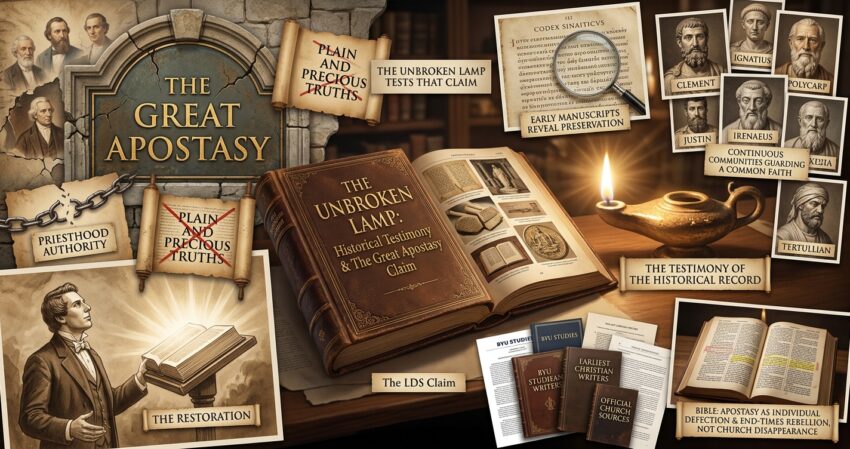
Also: Testing the Claim of Missing Plain and Precious Truths
❧ ✦ ❧
Introduction: A Gap of Seventeen Centuries
In the spring of 1820, according to his canonized account, a fourteen-year-old farm boy in western New York knelt in a grove of trees and asked which of the churches around him he should join. The answer he later recorded has shaped the self-understanding of millions of people ever since. He was told he “must join none of them,” because “they were all wrong,” that “all their creeds were an abomination in his sight,” and that “those professors were all corrupt.”
I was answered that I must join none of them, for they were all wrong; and the Personage who addressed me said that all their creeds were an abomination in his sight; that those professors were all corrupt.
— Joseph Smith—History 1:19, Pearl of Great Price (churchofjesuschrist.org/study/scriptures/pgp/js-h/1)
Behind that sentence stands one of the most consequential historical claims any religious movement has ever made. The Church of Jesus Christ of Latter-day Saints teaches that the church Jesus founded did not survive. After the deaths of the apostles, it says, priesthood authority was withdrawn from the earth, doctrine was corrupted, ordinances were changed, and plain and precious truths were removed from the Bible. The result was a “Great Apostasy” that lasted until God restored the true church through Joseph Smith in 1830. Without that apostasy, there is no need for a restoration, and without a restoration, the Latter-day Saint claim to be the only true and living church has no foundation. As Eric Johnson of Mormonism Research Ministry observes, “This event is integral to the very existence of the LDS Church.”
Because the claim is historical, it can be tested historically. The Great Apostasy is not presented as a private mystical experience. It is presented as something that happened in identifiable centuries, in identifiable cities, to identifiable communities whose letters, sermons, apologies, martyr acts, and manuscripts survive. That makes the period between roughly AD 70 and AD 250 the most important stretch of time in the entire debate. If the church collapsed, this is where the collapse should be visible. If plain and precious truths were stripped from the Bible, this is where the excisions should appear.
This essay examines that period on its own terms. It looks at the apostolic church, the generations that immediately followed it, the way those communities guarded their teaching and their scriptures, and what the New Testament actually says about apostasy. It engages directly with official Latter-day Saint sources and with the best of Latter-day Saint scholarship. The aim is not to ridicule a sincerely held belief. Many Latter-day Saints hold this view with deep devotion, and the scholars who defend it often do so with real learning. The aim is to ask a fair question of the evidence: did the church Jesus founded actually disappear?
❧ ✦ ❧
The Claim Stated Fairly
Any responsible critique begins by stating the opposing position in the terms its own adherents would recognize. Official Latter-day Saint teaching on the apostasy is clear and consistent across several decades of publications.
The Official Narrative
A 2005 article in the Church’s international magazine, written for young readers, summarizes the standard account. It defines apostasy as “turning away from the truth” and explains the central mechanism in a single sentence:
The keys and authority of the holy priesthood were lost with the deaths of the Church leaders.
— Shanna Butler, “What Happened to Christ’s Church?” Liahona, February 2005 (churchofjesuschrist.org/study/liahona/2005/02/what-happened-to-christs-church)
The same article claims that “the Church as Jesus organized it was nowhere to be found in the whole world,” that “teachers within the church began to adopt false religious concepts from Greek philosophy and pagan religions,” and that “the truth that the Father, Son, and Holy Ghost are three distinct beings and that They have separate roles was lost.” A parallel version in the New Era adds a striking corollary: “Without this authority, no new revelation, doctrine, or scripture could come.”
The Church’s institute manual, Doctrines of the Gospel, gathers statements from prominent leaders. James E. Talmage wrote that “the passing of the apostles was followed by the rapid development of a universal apostasy.” Hugh B. Brown spoke of “a great and universal apostasy which was to be followed by a restoration.” Spencer W. Kimball put the matter most sharply:
This is not a continuous church, nor is it one that has been reformed or redeemed.
— Spencer W. Kimball, The Teachings of Spencer W. Kimball, quoted in Doctrines of the Gospel Student Manual, ch. 22 (churchofjesuschrist.org/study/manual/doctrines-of-the-gospel-student-manual/22-apostasy)
Kimball continued: “The laws were changed, the ordinances were changed, and the everlasting covenant was broken.” The Church’s Gospel Principles manual, quoted by Robert M. Bowman Jr., defines the period plainly: “The period of time when the true Church no longer existed on earth is called the Great Apostasy.”
The Scholarly Defense
Latter-day Saint scholars have offered more refined versions. A 2023 Scripture Central study argues that the apostasy was primarily internal rather than the product of persecution, citing James E. Faulconer’s formulation: “To be faithful is to keep covenant; to apostatize is to break covenant.” On this reading, the church was not destroyed from outside but abandoned its covenants from within.
Saints Unscripted, a Latter-day Saint media outreach, softens the edges further. It insists that the decline “happened gradually over hundreds of years,” that “we do not believe that everyone living during the Apostasy was evil and uninspired,” and that “there was still a lot of truth, for which we should all be eternally grateful.” Yet it retains the essential claim: “The line of Priesthood authority was broken.”
Three Distinct Claims
When these sources are read together, the Great Apostasy turns out to rest on three separate claims, each of which can be examined on its own:
- An ecclesial claim. The church as an institution ceased to exist, because priesthood authority ended with the apostles.
- A doctrinal claim. Essential teachings, including the nature of God and the meaning of ordinances, were corrupted by Greek philosophy and pagan influence.
- A textual claim. Plain and precious truths were removed from the Bible, so that the Scriptures handed down to later generations are materially incomplete.
Each claim makes predictions about what the historical record should show. The rest of this essay asks whether the record shows it.
❧ ✦ ❧
The Soil of the Restoration: Nineteenth-Century Context
Before turning to the second century, it helps to see why the apostasy narrative felt so compelling in the nineteenth. The idea did not originate with Joseph Smith. It belonged to the religious atmosphere of the early American republic.
Restorationism in the Burned-Over District
Western New York in the 1820s was so frequently swept by revivals that historians call it the “burned-over district.” The Second Great Awakening had produced not only conversions but also bewildering denominational rivalry. Methodists, Baptists, and Presbyterians competed for the same families, and each claimed the Bible on its side. Joseph Smith’s own account describes this confusion as the immediate occasion of his prayer.
Out of that rivalry grew a powerful longing to get behind denominations altogether and recover “primitive Christianity.” Alexander Campbell and Barton Stone led a movement that sought to restore the New Testament church and abandon creeds. Sidney Rigdon, who became one of Joseph Smith’s closest associates in 1830, had been a Reformed Baptist and Campbellite preacher in Ohio. The vocabulary of restoration, of a church that had drifted and must be rebuilt on apostolic lines, was already in circulation.
An Older Protestant Inheritance
The idea also had older Protestant roots. Reformation polemic against Rome often portrayed the medieval church as a long declension. The Church of England’s Homily against Peril of Idolatry spoke of laity and clergy alike being “drowned in abominable idolatry” for centuries. Roger Williams, the founder of Rhode Island, despaired of finding a true church and wrote that “there can be no recovery out of that apostasy until Christ shall send forth new apostles to plant churches anew.” The AddFaith “Great Apostasy timeline,” a widely circulated Latter-day Saint forum post, quotes both sources approvingly.
Joseph Smith’s distinctive contribution was to take this widespread Protestant mood and turn it into an absolute. Where Protestant reformers spoke of corruption needing correction, Joseph Smith spoke of total loss needing restoration. Where Williams merely wished for new apostles, the Restoration claimed to supply them. The social and political climate of Jacksonian America, with its suspicion of inherited authority, its democratic confidence in the ordinary man, and its appetite for new revelation, made such a claim plausible to many of Smith’s contemporaries.
Why Context Matters
Recognizing this background is not an attempt to explain the Restoration away. It is a reminder that the apostasy narrative grew out of nineteenth-century frustration with nineteenth-century denominations. Its vivid images of corruption were largely drawn from the late medieval church: the sale of indulgences, papal scandals, the Inquisition. The AddFaith timeline illustrates this vividly. Most of its evidence concerns the eighth through sixteenth centuries. Yet the Latter-day Saint claim locates the decisive loss much earlier, at the death of the apostles. The question is whether the evidence from that earlier period supports what was inferred from the later one.
❧ ✦ ❧
The Apostolic Church: What Jesus Actually Founded
A Church Built to Last
The New Testament presents the church not as a temporary arrangement but as a community Christ intended to endure. Britannica’s history of early Christianity begins exactly where the Gospels do:
When the Apostle Peter is represented in the New Testament as confessing that Jesus is “the Christ, the Son of the living God,” he speaks for the Christianity of all ages.
— “History of early Christianity,” Encyclopaedia Britannica (britannica.com/topic/history-of-early-Christianity)
The promises surrounding that founding are explicit. Jesus says, “upon this rock I will build my church; and the gates of hell shall not prevail against it” (Matthew 16:18, KJV). He commissions his disciples to teach all nations and promises, “lo, I am with you alway, even unto the end of the world” (Matthew 28:20). He promises the Comforter, “that he may abide with you for ever” (John 14:16). Paul’s doxology ascribes glory to God “in the church by Christ Jesus throughout all ages, world without end” (Ephesians 3:21). Jude urges believers to “earnestly contend for the faith which was once delivered unto the saints” (Jude 3), a faith delivered once, not one awaiting a second delivery.
The Speed of Expansion
The apostolic church spread with remarkable speed. Luke Timothy Johnson notes that “within 10 years of the death of Jesus, there were Christian communities throughout Palestine and Syria.” The Wikipedia survey of the spread of Christianity records that “over 40 churches were established by 100,” with most in Asia Minor and Upper Mesopotamia. The Britannica traces the movement through Jerusalem, Damascus, and Antioch, through Paul’s missions to Asia Minor, Macedonia, and Achaea, and into Rome and Alexandria.
This geographic breadth matters for the apostasy question. By the time the last apostle died, traditionally John at Ephesus around the end of the first century, the church was not a single congregation that could be captured or corrupted at one stroke. It was a network of dozens of communities across three continents, using different languages, facing different local pressures, and answerable to no central administration. Any account of universal apostasy must explain how all of them lost the same essential truths and authority at roughly the same time, and did so without leaving any record of resistance.
❧ ✦ ❧
The Generation After the Apostles
The most direct way to test the Great Apostasy is to read the people who lived immediately after the apostles. Several of them knew apostles personally. Their writings survive and can be read today.
Clement of Rome (c. AD 95)
Around AD 95, the church at Rome wrote a letter to the church at Corinth, traditionally attributed to Clement. Its subject was a dispute in which some Corinthians had removed their elders from office. Clement’s response shows that the Roman church understood ministry as something the apostles had deliberately arranged to continue:
The apostles have preached the Gospel to us from the Lord Jesus Christ; Jesus Christ [has done so] from God. Christ therefore was sent forth by God, and the apostles by Christ.
— 1 Clement 42, Ante-Nicene Fathers, vol. 1 (ccel.org/ccel/schaff/anf01.ii.ii.xlii.html)
Two chapters later, Clement makes a statement that bears directly on the claim that apostolic authority ended with the apostles’ deaths:
Our apostles also knew, through our Lord Jesus Christ, and there would be strife on account of the office of the episcopate. . . . [T]hey appointed those [ministers] already mentioned, and afterwards gave instructions, that when these should fall asleep, other approved men should succeed them in their ministry.
— 1 Clement 44, Ante-Nicene Fathers, vol. 1 (ccel.org/ccel/schaff/anf01.ii.ii.xliv.html)
This is a remarkable piece of evidence. Writing within living memory of Peter and Paul, the church at Rome understood that the apostles themselves had provided for succession. The Latter-day Saint claim holds that authority ceased because the apostles died. Clement testifies that the apostles anticipated their deaths and arranged for ministry to continue after them.
Clement’s letter also states the faith in triadic terms that align with later Christian confession: “Have we not [all] one God and one Christ? Is there not one Spirit of grace poured out upon us?” (1 Clement 46).
Ignatius of Antioch (c. AD 110)
Ignatius, the third bishop of Antioch, wrote seven letters while being transported to Rome for execution around AD 110. Writing to the church at Ephesus, the very congregation whose elders Paul had warned about “grievous wolves” in Acts 20, Ignatius reports good news:
Onesimus himself greatly commends your good order in God, that ye all live according to the truth, and that no sect has any dwelling-place among you.
— Ignatius, To the Ephesians 6, Ante-Nicene Fathers, vol. 1 (ccel.org/ccel/schaff/anf01.v.ii.vi.html)
This is significant because Scripture Central uses Paul’s warning in Acts 20:29–30 as evidence that the Ephesian church would fall away. Two decades or so after the apostles, Ephesus was being commended for its faithfulness. Revelation 2:2 makes the same point from within the New Testament itself, praising the Ephesians because they “tried them which say they are apostles, and are not, and hast found them liars.” Paul’s warning was heeded, not fulfilled in universal ruin.
Ignatius also wrote, to the church at Smyrna, the earliest surviving use of the phrase “the Catholic Church,” meaning the universal church: “wherever Jesus Christ is, there is the Catholic Church” (To the Smyrnaeans 8). The same letter warns against Docetists who “abstain from the Eucharist and from prayer” because they deny that Christ came in real flesh (Smyrnaeans 7). The orthodox churches Ignatius addressed were guarding the reality of the incarnation, not abandoning it.
Polycarp of Smyrna (d. c. AD 155)
Polycarp is the most important bridge figure of all. Irenaeus, who knew him as a young man, reports that Polycarp had been taught by apostles and appointed bishop by them:
Polycarp also was not only instructed by apostles, and conversed with many who had seen Christ, but was also, by apostles in Asia, appointed bishop of the Church in Smyrna.
— Irenaeus, Against Heresies 3.3.4 (newadvent.org/fathers/0103303.htm)
Polycarp’s martyrdom around AD 155 produced one of the most moving documents of the early church. When the Roman proconsul urged him to curse Christ and save his life, Polycarp replied:
Eighty and six years have I served Him, and He never did me any injury: how then can I blaspheme my King and my Saviour?
— The Martyrdom of Polycarp 9, Ante-Nicene Fathers, vol. 1 (newadvent.org/fathers/0102.htm)
If Polycarp was eighty-six at his death, his Christian life began in the apostolic age and ended in the mid-second century. Here, in a single life, is the continuity the apostasy narrative denies. A man taught by apostles, appointed by apostles, governed a church for decades and died rather than deny Christ. If the church had apostatized at the death of the apostles, Polycarp is the person in whom that apostasy should have occurred. Instead, he is remembered as a martyr for the faith he had received.
The Didache
The Didache, a short church manual most scholars date to the late first or early second century, records how early Christians baptized: “in the name of the Father and of the Son and of the Holy Spirit,” preferably in running water (Didache 7). That is precisely the formula of Matthew 28:19, still in use by the churches the Latter-day Saint narrative regards as apostate. The Ligonier survey of the ancient church notes that the Didache and similar documents “provide detailed description of the teachings and worship of the ancient post-Apostolic church.” Those documents show baptism, the Lord’s Supper, prayer, fasting, and moral instruction. They do not show proxy baptism, temple endowments, eternal sealings, or a teaching of human exaltation to godhood.
❧ ✦ ❧
The Second Century: A Church That Knew Its Own Story
Justin Martyr and Christian Worship (c. AD 150)
Around AD 150, Justin Martyr, a philosopher converted to Christianity, wrote a defense of the faith addressed to Emperor Antoninus Pius. In it, he described what Christians did every week:
On the day called Sunday, all who live in cities or in the country gather together to one place, and the memoirs of the apostles or the writings of the prophets are read, as long as time permits.
— Justin Martyr, First Apology 67, Ante-Nicene Fathers, vol. 1 (ccel.org/ccel/schaff/anf01.viii.ii.lxvii.html)
Justin goes on to describe prayer, the presider’s exhortation, the Eucharist, and the collection for orphans, widows, the sick, prisoners, and strangers. This is a recognizable Christian service, and it is centered on the apostolic writings. Those writings were being read publicly, in many cities, every week, in the middle of the second century. That fact bears heavily on the textual claim, as we shall see.
Irenaeus of Lyons (c. AD 180)
No single writer is more important for the apostasy question than Irenaeus, bishop of Lyons in Gaul. He had been a hearer of Polycarp in Asia Minor and later served a church in the far western empire. Around AD 180, he wrote Against Heresies to refute the Gnostic movements of his day. Those movements claimed, much as the apostasy narrative does, that the true teaching of Jesus had been hidden from the ordinary churches and preserved only by a privileged few. The Ligonier guide notes that “Gnostics believed that they were guardians of a secret knowledge of God from the Apostles.”
Irenaeus’s response was to appeal to what was public, checkable, and continuous:
It is within the power of all, therefore, in every Church, who may wish to see the truth, to contemplate clearly the tradition of the apostles manifested throughout the whole world.
— Irenaeus, Against Heresies 3.3.1 (newadvent.org/fathers/0103303.htm)
He continues by saying that the churches can name “those who were by the apostles instituted bishops in the Churches,” and can demonstrate “the succession of these men to our own times; those who neither taught nor knew of anything like what these [heretics] rave about.” He then lists the bishops of Rome from the apostles to his own day, concluding that “Eleutherius does now, in the twelfth place from the apostles, hold the inheritance of the episcopate.” From that list he draws a conclusion that runs directly opposite to the Latter-day Saint reading of the same centuries:
This is most abundant proof that there is one and the same vivifying faith, which has been preserved in the Church from the apostles until now, and handed down in truth.
— Irenaeus, Against Heresies 3.3.3 (newadvent.org/fathers/0103303.htm)
Irenaeus also states what this faith contained. His summary, often called the “rule of faith,” confesses one God the Father, Maker of all things; one Christ Jesus, the Son of God, incarnate for our salvation; and the Holy Spirit, who spoke through the prophets. It confesses the virgin birth, the passion, the resurrection, the ascension, and Christ’s future return to raise the dead and judge the world. He then makes a claim about its geographic reach:
The Church, having received this preaching and this faith, although scattered throughout the whole world, yet, as if occupying but one house, carefully preserves it.
— Irenaeus, Against Heresies 1.10.2 (newadvent.org/fathers/0103110.htm)
He names churches in Germany, Spain, Gaul, the East, Egypt, and Libya as teaching the same faith. He even notes that “many nations of those barbarians who believe in Christ do assent, having salvation written in their hearts by the Spirit, without paper or ink” (Against Heresies 3.4.2).
The Britannica summarizes Irenaeus’s argument as a “threefold cord” of “apostolic scripture, apostolic rule of faith, and apostolic succession by which the continuity of the church is preserved.” Mark Edwards, writing in the Cambridge Ancient History, calls Irenaeus “the first to appeal to the ecumenical consensus of the bishoprics as a test of orthodoxy.” Whatever one makes of the later development of episcopal authority, the point here is simpler. In AD 180, the churches knew their own story. They could name their founders and their leaders. They confessed a common faith across the empire. And they were explicitly resisting people who claimed that the real teaching of Jesus had been lost or hidden.
Tertullian of Carthage (c. AD 200)
Tertullian, writing in North Africa around AD 200, made the same appeal in even more vivid terms. He challenged the heretics of his day to produce the records of their churches, as the apostolic churches could:
For this is the manner in which the apostolic churches transmit their registers: as the church of Smyrna, which records that Polycarp was placed therein by John; as also the church of Rome, which makes Clement to have been ordained in like manner by Peter.
— Tertullian, The Prescription Against Heretics 32, Ante-Nicene Fathers, vol. 3 (ccel.org/ccel/schaff/anf03.v.iii.xxxii.html)
A few chapters later he invited any inquirer to visit the churches the apostles had founded, “in which the very thrones of the apostles are still pre-eminent in their places, in which their own authentic writings are read, uttering the voice and representing the face of each of them severally” (Prescription 36). He names Corinth, Philippi, Thessalonica, Ephesus, and Rome. These were not legends from a distant past. They were living communities whose members could be visited, questioned, and compared with one another.
Hegesippus and the “Pure Virgin”
Fairness requires examining a text that Latter-day Saint writers sometimes cite in support of the apostasy. Eusebius preserves a passage from the second-century chronicler Hegesippus stating that “the Church up to that time had remained a pure and uncorrupted virgin.” After the apostles died, Hegesippus says, “then the league of godless error took its rise as a result of the folly of heretical teachers” (Eusebius, Church History 3.32.7–8).
Read in isolation, this might seem to confirm the Latter-day Saint narrative. Read in context, it does the opposite. Hegesippus is describing the rise of heresies outside the church, not the apostasy of the church itself. The same Hegesippus traveled from the East to Rome visiting churches precisely to confirm that they held the apostolic faith, and Eusebius records his conclusion:
In every succession, and in every city that is held which is preached by the law and the prophets and the Lord.
— Hegesippus, quoted in Eusebius, Church History 4.22.3 (newadvent.org/fathers/250104.htm)
He also reports that “the church of Corinth continued in the true faith” (Church History 4.22.2). Hegesippus, in other words, is a witness for continuity, not collapse. He saw heresy arising after the apostles and found the churches resisting it.
Honest Complications
A scholarly account must acknowledge that the second century was not tidy. Bart Ehrman emphasizes “a dizzying diversity of Christian beliefs and practices.” Mark Edwards cautions that “it would be difficult, and almost disingenuous, to undertake a history of ‘the church’ within this period” as though it were a single uniform body. He also judges that some early succession lists, particularly at Antioch and Jerusalem, contain names that are little more than ciphers. The Britannica agrees that how and when the single “monarchical” bishop emerged from the earlier pattern of elders “remains uncertain.”
These cautions are real, and they should be respected. But they don’t support the apostasy narrative. Diversity and development are not the same thing as disappearance. The existence of competing groups, which the New Testament itself already describes, shows a church contending for its faith, not a church that had lost it. Edwards himself concludes that “wherever the episcopate was lacking in resolution or authority, there is no continuous story to be told,” which implies that where it was resolute, there is a continuous story. Uncertainty about the precise shape of church offices in AD 120 is a very different thing from the claim that the church “was nowhere to be found in the whole world.”
❧ ✦ ❧
Persecution, Growth, and the Seed of the Church
The Pattern of Persecution
The Liahona article lists persecution as one cause of the apostasy. Persecution was real and often terrible. The Christian History Institute timeline records Nero’s persecution in 64, the martyrdoms of Peter and Paul around 65, Ignatius around 110, Polycarp around 155, the Decian persecution of 250, and the “Great Persecution” that began under Diocletian in 303.
Yet the historical consensus is that persecution failed to destroy the church. Britannica’s verdict on the Decian persecution is succinct: “persecution was extensive and many apostatized, but the church was not destroyed.” Of Valerian’s later attack on the clergy, it says, “the church held firm.” Of Diocletian’s campaign, it concludes that “they entirely missed their objective,” adding that “through nearly three centuries the martyrs had been the seed of the church.”
Notably, the Romans themselves did not think the church had ceased to exist. Edwards observes that by the third century “the bishop was now the primary, and sometimes the only, object of attack.” The Roman state targeted church leaders because it recognized them as the organizing center of a living, continuous institution. A church without authority or structure would hardly have required such attention.
The Numbers
The church also grew. Roderic Mullen’s gazetteer of the first three centuries, building on the classic work of Adolf von Harnack, catalogs documentable Christian communities across Asia, Europe, and Africa before Nicaea. Applying Rodney Stark’s growth model, Mullen notes that a modest annual rate “would easily put Christians at just over half the population of the Roman Empire by ca. 350.” Wikipedia’s survey cites estimates that Christians made up roughly ten percent of the Roman population by 300.
Graeme Clarke’s chapter in the Cambridge Ancient History preserves a vivid snapshot from Rome in the mid-third century. Bishop Cornelius reported that his church had “forty-six presbyters, seven deacons, seven subdeacons, forty-two acolytes,” together with exorcists, readers, and doorkeepers, and more than fifteen hundred widows and needy persons supported by the congregation. This was a large, organized, charitable community that knew who its ministers were and how they had been appointed.
The Latter-day Saint narrative asks us to believe that the church lost divine authority precisely during the centuries in which it was multiplying across the empire, enduring persecution, caring for the poor, and producing martyrs. Persecution may explain individual apostasies, and the Britannica acknowledges that “many apostatized” under Decius. It cannot explain a universal apostasy of the very communities that survived persecution because they refused to deny Christ.
❧ ✦ ❧
The Preservation of the Scriptures Through Two Centuries
The textual claim is perhaps the most testable part of the apostasy narrative. The Book of Mormon teaches that after the Bible went forth from the Jews “in purity,” a great and abominable church took away “many parts which are plain and most precious; and also many covenants of the Lord” (1 Nephi 13:26–28). If that occurred, the manuscript record should show it.
The Old Testament Before Christ
The Old Testament text was already fixed long before the Christian era. The discovery of the Dead Sea Scrolls at Qumran in 1947 pushed the manuscript history of the Hebrew Bible back roughly a thousand years. Of about 800 manuscripts found there, around 220 are biblical, and they date generally from 150 BC to AD 70. The Christian Publishing House study of Old Testament transmission concludes that these discoveries show “the content of the Hebrew Scriptures was already substantially fixed” centuries before the medieval Masoretic codices. The complete Great Isaiah Scroll is often cited as the leading example:
[The Isaiah scrolls are] word for word identical with our standard Hebrew Bible in more than 95 percent of the text.
— Norman Geisler and Ronald Brooks, When Skeptics Ask, quoted in “Has the Bible Been Preserved Accurately?” Tomorrow’s World (tomorrowsworld.in)
The remaining variation consists mostly of spelling differences and obvious slips of the pen. This matters because the Old Testament is the portion of the Bible that the Book of Mormon claims was carried to the Americas on the brass plates. If the Hebrew Scriptures were corrupted, the corruption would have to have taken place after the Dead Sea Scrolls were copied. But the Masoretic tradition that followed confirms the same text.
The New Testament in the First Two Centuries
The New Testament has a far richer manuscript tradition than any other ancient book. Ekkehardt Mueller of the Biblical Research Institute notes that “almost six thousand NT manuscripts are currently available” in Greek alone, along with early translations and quotations by church fathers. The Wikipedia survey of biblical manuscripts lists papyri, uncials, minuscules, and lectionaries that together number in the thousands.
More important than the total is how early the earliest witnesses are:
- Papyrus 52, a fragment of John 18, is commonly dated to the first half of the second century, though some scholars prefer a somewhat later date.
- Papyrus 46 preserves most of Paul’s letters and is dated around AD 175–225. It is the earliest nearly complete collection of Paul’s epistles.
- Papyri 66 and 75 preserve substantial portions of John and Luke from roughly the late second to early third century.
- Codex Sinaiticus and Codex Vaticanus, from the fourth century, preserve almost the whole Bible. Sinaiticus “contains the oldest complete copy of the New Testament.”
The relationships among these witnesses tell their own story. Textual scholars have long observed that Vaticanus, copied in the fourth century, agrees remarkably closely with Papyrus 75, copied perhaps 150 years earlier. Fenton Hort argued that “Sinaiticus and Vaticanus were derived from a much older common source,” reaching back to the early second century or earlier. The text was not drifting. It was being copied faithfully enough that fourth-century manuscripts preserve second-century readings.
The Fathers as Witnesses to the Text
The early Christian writers also preserve the text by quoting it. Clement of Rome quotes and alludes to Paul’s letters around AD 95. Ignatius and Polycarp cite the Gospels and Paul in the early second century. Irenaeus cites nearly every book of the New Testament. Mueller notes that the church fathers’ quotations are so extensive that they serve as an independent check on the manuscripts.
This creates an important chronological problem for the Latter-day Saint textual claim. Nephi’s vision places the removal of plain and precious things early, after the record “had gone forth in purity” but before it reached the Gentile world at large. Yet the Fathers of AD 95 to 180 were quoting the same New Testament text that the later manuscripts preserve. If plain and precious truths were excised, they must have been excised before Clement wrote, in every copy in every city simultaneously, without a single dissenting church noticing or objecting. As the site Not What You Heard puts it:
A deliberate removal of doctrine from every line of copies would be visible too, and it does not appear.
— “Did the Bible Lose Plain and Precious Truths?” Not What You Heard (notwhatyouheard.com/bible-lost-plain-and-precious-truths)
The Canon Takes Shape
The early church also recognized which writings carried apostolic authority. Marcion’s attempt around 150 to cut down the canon to an edited Luke and ten letters of Paul provoked a response that clarified, rather than corrupted, the church’s scriptures. Irenaeus insisted that “it is not possible that the Gospels can be either more or fewer in number than they are” (Against Heresies 3.11.8). Mark Edwards notes that the Muratorian Fragment, often dated to the late second century, reflects a canon close to the one Christians use today. Melito of Sardis recorded an early list of Old Testament books.
Irenaeus also explained how he understood the relationship between apostolic preaching and apostolic writing:
We have learned from none others the plan of our salvation, than from those through whom the Gospel has come down to us, which they did at one time proclaim in public, and, at a later period, by the will of God, handed down to us in the Scriptures, to be the ground and pillar of our faith.
— Irenaeus, Against Heresies 3.1.1 (newadvent.org/fathers/0103301.htm)
What the Variants Actually Show
None of this means the manuscripts are identical. They are not. Scribes made errors, harmonized parallel passages, and occasionally added clarifying words. A few well-known passages, such as the longer ending of Mark and the account of the woman taken in adultery in John 8, are absent from the earliest manuscripts. Responsible Christian scholarship acknowledges this openly.
But the character of the variants is precisely the point. Mueller concludes that “in the vast majority of cases, variant readings are inconsequential,” and that “no biblical doctrine is changed because of variants in the manuscripts.” Even Bart Ehrman, whose book Misquoting Jesus popularized public awareness of textual variants, conceded in a later interview that he agreed with his teacher Bruce Metzger “that the essential Christian beliefs are not affected by textual variants in the manuscript tradition of the New Testament.”
Most strikingly, the leading Latter-day Saint treatment of the subject reaches the same conclusion. Lori Driggs, writing for the BYU Religious Studies Center, catalogs the ways manuscripts changed over time. Yet she acknowledges, citing Ehrman, that “most changes were not motivated by theology but were instead the result of human error.” The most famous variants, as Not What You Heard observes, “are words added to the text, not truths taken out.” The manuscript evidence shows a text that grew slightly through scribal additions, not one that shrank through doctrinal excisions.
❧ ✦ ❧
Apostasy in the Bible: An End-Times Event
What the Key Texts Say
Latter-day Saint sources cite several New Testament passages as prophecies of a total apostasy. Read in context, these passages describe something quite different: individual defection in every age and a climactic rebellion at the end of history.
The most important text is 2 Thessalonians 2:3: “Let no man deceive you by any means: for that day shall not come, except there come a falling away first, and that man of sin be revealed, the son of perdition.” Scripture Central rightly notes that the Greek word apostasia means rebellion. But Paul places this rebellion immediately before “that day,” the day of Christ’s return (2:2), and ties it to the revelation of the “man of sin.” Paul then says what will happen to that figure: “whom the Lord shall consume with the spirit of his mouth, and shall destroy with the brightness of his coming” (2:8).
This is the decisive point. In Paul’s sequence, the apostasy, the revelation of the man of lawlessness, and Christ’s return belong to a single eschatological cluster. If the apostasia occurred in the second century, then the man of sin should have been revealed in the second century and destroyed by Christ’s coming in the second century. Paul Carter of The Gospel Coalition Canada argues that the apostasy of 2 Thessalonians and the falling away of Matthew 24 most likely describe “the same event,” which he identifies as an end-times trigger. He quotes Anthony Hoekema: “The apostasy will occur within the ranks of the members of the visible church.” The rebellion is a crisis within a church that still exists, not the extinction of the church.
Jesus’ own teaching in Matthew 24 follows the same pattern. “Many shall be offended, and shall betray one another. . . . And many false prophets shall rise, and shall deceive many” (24:10–11). But “he that shall endure unto the end, the same shall be saved,” and “this gospel of the kingdom shall be preached in all the world for a witness unto all nations; and then shall the end come” (24:13–14). Many fall away; some endure; the gospel keeps going out; then the end arrives. Nothing suggests a gap of seventeen centuries in which the gospel is nowhere to be found.
The Other Proof Texts
Other passages, read carefully, describe partial and individual apostasy:
- 1 Timothy 4:1 says that “in the latter times some shall depart from the faith.” Some, not all.
- 2 Timothy 4:3–4 warns that people “will not endure sound doctrine” and will “turn away their ears from the truth.” Paul’s remedy, in the preceding verses, is for Timothy to “preach the word” and to “endure afflictions” (4:2, 5). He assumes the church will continue to need faithful preaching, not that it will vanish.
- 2 Timothy 1:15 reports that “all they which are in Asia be turned away from me.” Scripture Central reads this as the apostasy already underway. Yet within a generation the churches of Asia, including Ephesus and Smyrna, were being commended by Ignatius and led by Polycarp.
- Acts 20:29–30 warns the Ephesian elders of wolves. As we have seen, Ignatius later commends that very church because “no sect has any dwelling-place among you.”
- Amos 8:11, which speaks of a famine “of hearing the words of the LORD,” is cited in some Latter-day Saint teaching but addresses the northern kingdom of Israel under coming Assyrian judgment. It does not mention the church at all.
Robert Bowman’s summary of the New Testament evidence is accurate:
In the New Testament, apostasy is something that people do, never something that was to happen to the whole church.
— Robert M. Bowman Jr., “The Great Apostasy: Did the Church Disappear?” Institute for Religious Research (mit.irr.org/great-apostasy-did-church-disappear)
The Gates of Hades
Scripture Central argues that “the gates of hell” in Matthew 16:18 refers to the realm of the dead rather than Satan’s power, so the passage does not guarantee that the church could not apostatize. It is true that “Hades” in Jewish and Greek usage often meant the realm of the dead. But that reading does not weaken the promise; it strengthens it. Jesus would be saying that death itself will not hold his church captive. A church that died with its apostles and lay dead for seventeen centuries is exactly what such a promise excludes.
Moreover, Matthew 16:18 does not stand alone. Matthew 28:20, John 14:16, and Ephesians 3:21 all speak of Christ’s presence with his church, the Spirit’s abiding with his people, and God’s glory in the church “throughout all ages.” Uncorrelated Mormonism, an independent site written from within a Latter-day Saint framework, puts it bluntly: “the very idea of this Great Apostasy is against the teachings of Christ himself.”
What About Cyril of Jerusalem?
Scripture Central notes that fourth-century writers such as Cyril of Jerusalem applied 2 Thessalonians 2:3 to their own time, quoting Cyril’s lament that “the Church is filled with heretics in disguise.” This is accurate, but it illustrates the traditional Christian reading rather than the Latter-day Saint one. Cyril was a bishop instructing new converts in a functioning church. He applied Paul’s warning to the heresies of his day because he believed the end might be near and wanted his hearers to be ready. He did not believe the church had ceased to exist. He was, after all, preparing catechumens for baptism into it.
The Pattern of Israel
Uncorrelated Mormonism raises one further biblical point that deserves attention. Israel apostatized repeatedly in the Old Testament, yet God never responded by removing his covenant people from the earth and starting over centuries later. Instead, prophets called Israel back to the Scriptures it already possessed. “There is a [sic] not a single case, in all of Scripture, when Israel repented that God didn’t accept them back,” the site argues. “They never needed to wait for a prophet to give them a new law to follow.” The biblical pattern is reform and renewal within a continuing covenant people, not extinction followed by restoration.
❧ ✦ ❧
The Claim of Lost Plain and Precious Truths
What Was Lost, According to Latter-day Saint Sources?
The Book of Mormon claims that plain and precious truths were removed from the Bible. A natural question follows: which truths? Latter-day Saint sources answer in different ways.
Clyde J. Williams, writing in the October 2006 Ensign, identifies truths the Book of Mormon restores: premortal existence and the plan of redemption, the purpose of Adam’s fall, the light of Christ, the scope of the atonement, the first principles and ordinances of the gospel, church organization, personal revelation, and the identity of Satan. Monte S. Nyman, writing in the Church News, emphasizes lost covenants and the writings of the prophet Zenos, adding that “Nephi said the Bible was a smaller book than the plates of brass.” Lori Driggs lists doctrines including the Fall, the Atonement, the Resurrection, the gathering of Israel, agency, justice, mercy, and baptism for the dead, while acknowledging that “some of these may survive in the Bible but are not clear without latter-day revelation.”
Most of the “Lost” Truths Are Still in the Bible
The difficulty is apparent as soon as the lists are examined. Most of the truths named are not missing from the Bible at all. Faith, repentance, baptism, and the gift of the Holy Spirit are preached in Acts 2:38. The fall of Adam and the redemption through Christ are the subject of Romans 5 and 1 Corinthians 15. Grace is the theme of Ephesians 2. Personal guidance by the Spirit runs through John 14–16 and Romans 8. The identity and methods of Satan are described in Genesis 3, Job 1–2, Matthew 4, 2 Corinthians 11, and Revelation 12. Church offices appear in Acts, the Pastoral Epistles, and Ephesians 4.
Not What You Heard makes this point with respect to 1 Nephi 13:40, which calls “the gospel” the plain and precious thing being restored. The gospel there described, including faith in Christ, repentance, baptism, and the Holy Ghost, “appears in the Bible.” If these are the plain and precious truths, they were never lost.
The Distinctive Doctrines Are Missing Everywhere
There is a second, more serious difficulty. The doctrines that most clearly distinguish Latter-day Saint teaching from historic Christianity are not found in the Bible, but they are also not found in the Book of Mormon, which the Church describes as the instrument of restoration. Not What You Heard observes that the Restoration’s most distinctive teachings “rest on later revelation alone, and whether that revelation came from God is a different question.”
The point was made forcefully in the r/mormon discussion “The LDS ‘missing Bible parts’ claim doesn’t hold up by using simple logic.” One participant noted that the Book of Mormon contains “no temple ordinances, no three degrees of glory, no eternal families, no polygamy/polyandry, no word of wisdom.” The thread observed that the Joseph Smith Translation of the Bible, which was intended as a restoration of the biblical text, “doesn’t add back temple ordinances, sealing, the Word of Wisdom, garments, or anything uniquely LDS,” and that no official publication has ever said, in effect, “This doctrine was lost from the Bible, and here is where it has been restored.”
Consider the doctrines that, in Latter-day Saint teaching, matter most for exaltation:
- that God the Father has “a body of flesh and bones as tangible as man’s” (Doctrine and Covenants 130:22);
- that faithful humans may become gods and enjoy eternal increase;
- that marriages sealed in temples endure into eternity;
- that temple endowment ordinances are necessary for exaltation;
- that the Aaronic and Melchizedek priesthoods are conferred on worthy male members by ordination;
- that ordinances may be performed by proxy for the dead.
None of these appear in the Book of Mormon. None appear in the Joseph Smith Translation. And, crucially for the historical question, none appear in the surviving records of the earliest Christian centuries.
Testing the Silence of History
This is the heart of the matter. If these teachings were part of the original gospel and were later suppressed, we would expect some trace of them in the first generations after the apostles: a teaching preserved by a minority, a ritual remembered and later abandoned, a dispute in which one side defended them and the other rejected them. Early Christian history is full of such disputes. The church argued vigorously about the date of Easter, the readmission of those who lapsed under persecution, the rebaptism of heretics, the role of prophecy, and the canon. These debates left extensive records.
Yet there is no record of a debate over eternal marriage, temple endowments, the corporeality of God the Father, or human exaltation to godhood. The silence is not the silence of a lost library. It is the silence of a record that is otherwise loud.
Fairness requires noting the handful of possible parallels that Latter-day Saint scholars sometimes cite, and observing how they differ:
- Baptism for the dead. Paul mentions those “baptized for the dead” in 1 Corinthians 15:29, but he does not endorse the practice or connect it to any temple; he uses it as an argument for the resurrection. Later writers associated it with fringe groups such as the Marcionites, not with the apostolic churches.
- Premortal existence. The third-century theologian Origen speculated about the preexistence of souls. But his view differed sharply from Latter-day Saint teaching, belonged to a broader Platonic framework, and was eventually rejected by the wider church. It was a philosophical speculation, not a remembered apostolic doctrine.
- Degrees of glory. Irenaeus and others interpreted Jesus’ saying about “many mansions” (John 14:2) as indicating gradations of reward among the redeemed. But this concerns degrees of blessing among the saved, not a three-kingdom cosmology with exaltation to godhood at its summit.
These are the closest analogies the historical record offers, and each turns out, on inspection, to be something other than the doctrine it is said to anticipate. The plain historical conclusion is that the distinctive teachings of the Restoration first appear in the revelations and sermons of Joseph Smith and his successors in the nineteenth century. Latter-day Saints explain that by appealing to divine revelation. That is a theological claim the historian cannot verify or falsify. What the historian can say is that the claim of restoration is not supported by evidence that these teachings were ever present and then lost. The record contains no trace of them before 1830.
The Problem of the Brass Plates and the Unfinished Translation
The r/mormon thread raised two further questions that deserve a respectful hearing. First, the Book of Mormon says the brass plates should “go forth unto all nations, kindreds, tongues, and people” (1 Nephi 5:18). Nyman emphasizes that the brass plates were a larger record than the Bible. If the brass plates contained the lost covenants and prophecies, their contents have not gone forth. Second, if the Bible is incomplete because of lost truths, a living prophet could restore the missing passages. Yet the Church continues to use the King James Version as its official English Bible, with the Joseph Smith Translation included as selected footnotes and an appendix. As the forum post observed, “To claim something is missing but not tell you what it is? That’s an issue.”
❧ ✦ ❧
The Doctrinal Claim: Greek Philosophy and the Nature of God
Did Greek Philosophy Corrupt the Church?
The Liahona article argues that teachers “began to adopt false religious concepts from Greek philosophy and pagan religions,” and Talmage spoke of “the corrupting of the simple doctrines of the gospel of Christ by admixture with so-called philosophic systems.” There is a grain of historical truth here. Christian theologians from Justin onward did use Greek philosophical vocabulary, and the Britannica notes that early doctrine was “much helped to articulation by Greek thought.” The concept of the Logos had “roots both in the Bible and in Greek philosophy.”
But Britannica also emphasizes the other side of that story. Christian doctrine “had to maintain its biblical character against other elements in its Hellenistic environment.” The most Hellenistic movement of the second century was not orthodoxy but Gnosticism, which treated matter as evil and denied the real incarnation. The churches that Latter-day Saints regard as apostate were the ones resisting that Greek dualism by insisting that God created the material world, that Christ had real flesh, and that the body would be raised. Ignatius’s warnings against those who denied Christ’s flesh are an early example.
The Godhead
The Liahona article states that “the truth that the Father, Son, and Holy Ghost are three distinct beings” was lost. Historic Christianity has always confessed that the Father, Son, and Holy Spirit are distinct. The Didache baptizes in the threefold name. Clement speaks of “one God and one Christ” and “one Spirit of grace.” Irenaeus confesses the Father, the Son, and the Holy Spirit as distinct in his rule of faith. Tertullian, around AD 213, stated the doctrine “almost in the later terminology,” in the Britannica’s words: “three co-equal and co-eternal personae in one substantia.”
What the early church did not teach was that the Father, Son, and Spirit are three separate gods, or that the Father was once a man who became God. Early Christians rejected Modalism, which collapsed the three into one, and also insisted on the unity of God inherited from Israel’s Shema. The doctrine of the Trinity was articulated more precisely at Nicaea in 325 and Constantinople in 381, but its essential pattern, three distinct persons and one God, was present in the second century. The Latter-day Saint view differs from both early Christian teaching and later creedal formulations, and nothing in the records of the second and third centuries suggests it was ever the teaching of the churches.
❧ ✦ ❧
The Problem of Authority
No Priesthood to Lose
The heart of the Latter-day Saint claim is that priesthood authority was lost. The New Era article states it plainly: “With the death of the Apostles, priesthood keys (the presiding priesthood authority) were taken from the earth.” The Gospel Principles manual adds that “the ordinances and principles of the gospel cannot be administered and taught without the priesthood.”
Robert Bowman offers a significant biblical response. The New Testament never describes a Christian priesthood of ordained officers in the Latter-day Saint sense. The Epistle to the Hebrews teaches that Christ holds an unchangeable priesthood “after the order of Melchisedec,” and that “this man, because he continueth ever, hath an unchangeable priesthood” (Hebrews 7:24). The Greek word translated “unchangeable” (aparabatos) carries the sense of non-transferable. Christ’s priesthood does not pass to successors because Christ himself lives forever to intercede (7:25). Peter describes the whole church as “a royal priesthood” (1 Peter 2:9). Church officers in the New Testament are called elders, overseers, and deacons, not priests holding Melchizedek or Aaronic orders.
If the church’s authority rests on the living Christ, who promised to be with it to the end of the age, then the death of the apostles could not remove that authority. Bowman concludes that “the church, however, has never ceased to exist.”
The Apostles Provided for Succession
Even on the more limited question of continuity in leadership, the evidence points away from rupture. Clement records that the apostles appointed successors and instructed that “other approved men should succeed them.” Irenaeus lists twelve bishops of Rome from the apostles to Eleutherius. Tertullian challenges heretics to show records of succession as the apostolic churches could. One may debate what such succession means theologically, and Protestant, Catholic, and Orthodox Christians differ significantly on that question. But all agree on the historical point that matters here: the church did not lose track of who its leaders were or where its teaching came from.
The Evidential Burden
Spencer W. Kimball insisted that the true church “is not a continuous church.” That is a historical claim, and historical claims require historical evidence. The burden of proof rests on the one who claims that a living, growing, well-documented institution died without leaving any record of its death. The early Christian sources do not show the church losing authority or forgetting its faith. They show the opposite: communities consciously guarding what they had received, naming their leaders, reading the apostolic writings aloud every week, confessing a common faith across the empire, and dying rather than deny it.
❧ ✦ ❧
Conclusion: The Lamp Was Never Extinguished
The doctrine of a Great Apostasy was born in a particular historical moment: the confusion of the burned-over district, the restorationist longing of the early republic, and inherited Protestant images of medieval corruption. It answered a real question in Joseph Smith’s world. But when it is carried back to the centuries where it locates the decisive break, it meets a body of evidence that points the other way.
In the generation after the apostles, Clement of Rome testified that the apostles had arranged for ministry to continue. Ignatius commended the church at Ephesus because no sect had taken root among them. Polycarp, appointed by the apostles, served Christ for eighty-six years and died rather than deny him. Justin described Christians gathering every Sunday to hear the memoirs of the apostles. Irenaeus could list the bishops of Rome to the twelfth generation and found the same faith confessed from Gaul to Libya. Tertullian invited inquirers to visit the apostolic churches and read the authentic writings there. Hegesippus traveled from city to city and found the same faith in every succession.
In the same centuries, the Scriptures were copied, read, quoted, and guarded. The earliest papyri and the earliest Fathers preserve the text that later codices confirm. Variants exist, but even scholars on opposite ends of the debate, from Bart Ehrman to the BYU Religious Studies Center, acknowledge that they are overwhelmingly accidental rather than theological. The truths that the Restoration identifies as most distinctive appear nowhere in that record, nor in the Book of Mormon, nor in the Joseph Smith Translation.
The New Testament, for its part, describes apostasy as something individuals do in every generation and as a climactic rebellion at the very end of history, immediately before the return of Christ. It nowhere describes the extinction of the church. Instead, it records the promises of Christ that his church would endure, that his Spirit would abide with it forever, and that he would be with it “alway, even unto the end of the world.”
Latter-day Saints who hold to the Restoration often do so out of deep love for Christ and a sincere desire to belong to the church he founded. That desire is worthy of respect, and it is shared by Christians of every tradition. The historical record offers good news to anyone who holds it: the church Christ founded did not need to be restored, because it was never lost. Through persecution and controversy, through faithful bishops and imperfect believers, through martyrs and scribes, the lamp was handed from generation to generation. It was never extinguished. It still burns.
❧ ✦ ❧
BIBLIOGRAPHY AND SOURCES
Official and Latter-day Saint Sources
Butler, Shanna. “What Happened to Christ’s Church?” Liahona, February 2005. https://www.churchofjesuschrist.org/study/liahona/2005/02/what-happened-to-christs-church?lang=eng
“What Happened to Christ’s Church?” New Era, February 2005. https://www.churchofjesuschrist.org/study/new-era/2005/02/what-happened-to-christs-church?lang=eng
Doctrines of the Gospel Student Manual, chapter 22, “Apostasy.” Salt Lake City: The Church of Jesus Christ of Latter-day Saints. https://www.churchofjesuschrist.org/study/manual/doctrines-of-the-gospel-student-manual/22-apostasy?lang=eng
Joseph Smith—History 1. Pearl of Great Price. https://www.churchofjesuschrist.org/study/scriptures/pgp/js-h/1?lang=eng
Williams, Clyde J. “Plain and Precious Truths Restored.” Ensign, October 2006. https://www.churchofjesuschrist.org/study/ensign/2006/10/plain-and-precious-truths-restored?lang=eng
Driggs, Lori. “Nephi’s Vision and the Loss and Restoration of Plain and Precious Truths.” In The Things Which My Father Saw (2011 Sperry Symposium). Provo: BYU Religious Studies Center. https://rsc.byu.edu/things-which-my-father-saw/nephis-vision-loss-restoration-plain-precious-truths
Nyman, Monte S. “Many Plain, Precious Truths Lost.” Church News, January 1, 1994. https://www.thechurchnews.com/1994/1/1/23257592/many-plain-precious-truths-lost/
“What Does the New Testament Teach about the Great Apostasy?” KnoWhy #695. Scripture Central, October 17, 2023. https://scripturecentral.org/knowhy/what-does-the-new-testament-teach-about-the-great-apostasy
“Was There Actually a Great Apostasy?” Saints Unscripted. https://saintsunscripted.com/faith-and-beliefs/the-gospel-of-jesus-christ/was-there-actually-a-great-apostasy/
spamlds. “The Great Apostasy: A Timeline.” AddFaith LDS Gospel Discussion forum, August 4, 2014. https://addfaith.org/forums/topic/54822-the-great-apostasy-a-timeline/
Critiques of the Apostasy Claim
Bowman, Robert M., Jr. “The Great Apostasy: Did the Church Disappear?” Institute for Religious Research. https://mit.irr.org/great-apostasy-did-church-disappear
Carter, Paul. “10 Things You Should Know about the Great Apostasy.” The Gospel Coalition Canada, July 13, 2021. https://ca.thegospelcoalition.org/article/10-things-you-should-know-about-the-great-apostasy/
Johnson, Eric. “Deny the Great Apostasy.” Mormonism Research Ministry, July 9, 2021. https://mrm.org/deny-great-apostasy
Patrick. “The Great Apostasy Never Happened.” Uncorrelated Mormonism, May 2, 2025. https://uncorrelatedmormonism.com/the-great-apostasy-never-happened/
“Did the Bible Lose Plain and Precious Truths?” Not What You Heard. https://notwhatyouheard.com/bible-lost-plain-and-precious-truths/
u/Resident-Bear4053 and respondents. “The LDS ‘missing Bible parts’ claim doesn’t hold up by using simple logic.” r/mormon, Reddit. https://www.reddit.com/r/mormon/comments/1mtq87l/the_lds_missing_bible_parts_claim_doesnt_hold_up/
Early Church History
“History of early Christianity.” Encyclopaedia Britannica. https://www.britannica.com/topic/history-of-early-Christianity
Edwards, Mark, and Graeme Clarke. “Christianity, A.D. 70–192” and “Third-century Christianity.” In The Cambridge Ancient History, vol. 12. Cambridge: Cambridge University Press, 2005. https://dn760005.eu.archive.org/0/items/cah-12-2005-christianity-2nd-3rd-centuries/CAH12_2005_Christianity_2nd-3rd_centuries.pdf
Mullen, Roderic L. The Expansion of Christianity: A Gazetteer of Its First Three Centuries. Leiden: Brill, 2004. https://banatulsarbesc1.wordpress.com/wp-content/uploads/2018/02/the-expansion-of-christianity.pdf
Johnson, Luke Timothy. The History of Christianity: From the Disciples to the Dawn of the Reformation. The Great Courses, 2012. https://www.library.pima.gov/wp-content/uploads/sites/6/2021/08/History-of-Christianity-6610.pdf
“The Ancient Church.” Ligonier Ministries. https://learn.ligonier.org/guides/the-ancient-church
Ehrman, Bart D. “History of Christianity.” https://www.bartehrman.com/history-of-christianity/
“Important Events in Church History: Timeline.” Christian History Institute. https://christianhistoryinstitute.org/magazine/article/important-events-timeline
“What Is the History of Christianity?” Got Questions. https://www.gotquestions.org/history-Christianity.html
“The Eras of Christianity: A Timeline.” Mission Save Montana. https://www.missionsavemontana.com/the-eras-of-christianity-a-timeline/
“Spread of Christianity.” Wikipedia. https://en.wikipedia.org/wiki/Spread_of_Christianity
“Early Christianity.” Wikipedia. https://en.wikipedia.org/wiki/Early_Christianity
Preservation of the Scriptures
Mueller, Ekkehardt. “Transmission and Preservation of the Biblical Text.” Biblical Research Institute. https://adventistbiblicalresearch.org/articles/transmission-and-preservation-of-the-biblical-text
Hammond, Ben. “Preservation of the Scriptures.” January 9, 2023. https://benhammond.org/preservation-of-the-scriptures/
Christian Publishing House. “Preservation and Restoration: The Journey of Old Testament Texts Through History.” February 18, 2026. https://uasvbible.org/2026/02/18/preservation-and-restoration-the-journey-of-old-testament-texts-through-history/
“Has the Bible Been Preserved Accurately?” Tomorrow’s World. https://www.tomorrowsworld.in/en/booklets/the-bible-fact-or-fiction/has-the-bible-been-preserved-accurately/
“Codex Sinaiticus.” Wikipedia. https://en.wikipedia.org/wiki/Codex_Sinaiticus
“Biblical manuscript.” Wikipedia. https://en.wikipedia.org/wiki/Biblical_manuscript
“Misquoting Jesus.” Wikipedia (citing Ehrman, Misquoting Jesus, paperback ed., 2005, pp. 252–253). https://en.wikipedia.org/wiki/Misquoting_Jesus
Primary Sources: Early Christian Writings
Clement of Rome. First Epistle to the Corinthians, chs. 42, 44, 46. Ante-Nicene Fathers, vol. 1. https://ccel.org/ccel/schaff/anf01.ii.ii.xlii.html
Ignatius of Antioch. Epistle to the Ephesians 6; Epistle to the Smyrnaeans 7–8. Ante-Nicene Fathers, vol. 1. https://ccel.org/ccel/schaff/anf01.v.ii.vi.html; https://www.newadvent.org/fathers/0109.htm
The Martyrdom of Polycarp 9. Ante-Nicene Fathers, vol. 1. https://www.newadvent.org/fathers/0102.htm
The Didache 7. In Early Christian Fathers, ed. Cyril C. Richardson. https://ccel.org/ccel/richardson/fathers.viii.i.iii.html
Justin Martyr. First Apology 67. Ante-Nicene Fathers, vol. 1. https://ccel.org/ccel/schaff/anf01.viii.ii.lxvii.html
Irenaeus of Lyons. Against Heresies 1.10; 3.1; 3.3; 3.4; 3.11. Ante-Nicene Fathers, vol. 1. https://www.newadvent.org/fathers/0103.htm
Tertullian. The Prescription Against Heretics 32, 36. Ante-Nicene Fathers, vol. 3. https://ccel.org/ccel/schaff/anf03.v.iii.xxxii.html
Eusebius. Church History 3.32; 4.22. Nicene and Post-Nicene Fathers, Series 2, vol. 1. https://ccel.org/ccel/schaff/npnf201/npnf201.iii.viii.xxxii.html; https://www.newadvent.org/fathers/250104.htm
❧ ✦ ❧
Scripture quotations are from the King James Version, the translation used by The Church of Jesus Christ of Latter-day Saints. Research and drafting assistance provided by Claude (Anthropic) as a scholarly research collaborator; all editorial decisions remain the author’s.