
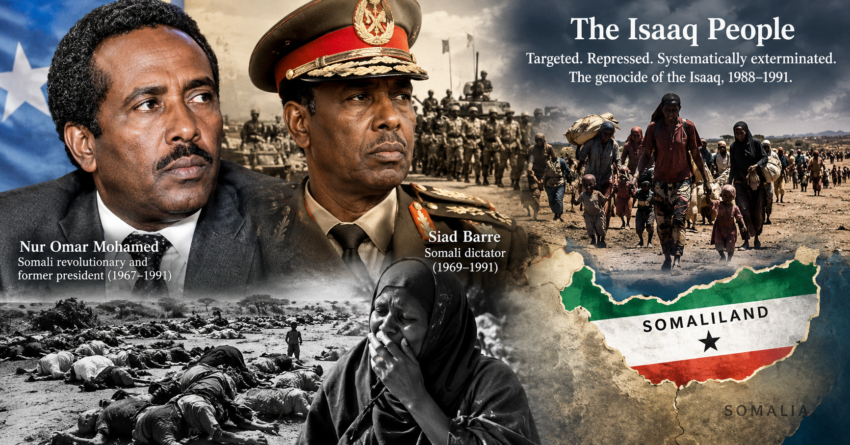
The Colonel’s File: Nur Omar Mohamed, the Barre Regime,
and the Limits of What the Record Can Prove
❧ ✦ ❧
Introduction: A Dead Man’s Paperwork
At about six o’clock on the morning of October 12, 2026, agents of Homeland Security Investigations arrived at the Washington, D.C., residence of Representative Ilhan Omar of Minnesota. According to The Wall Street Journal, as summarized by the BBC, they left with her mobile phone, notebooks, personal computers, and passport. The Justice Department said only that the search was “part of an ongoing federal criminal investigation.” Within a day, The Washington Post reported that the investigation turned on paperwork filed more than thirty years earlier, and on the man who filed it.
That man, Nur Omar Mohamed, had been dead for six years. He died of complications from COVID-19 at Hennepin County Medical Center in June 2020, at the age of 67. In Minneapolis, he had been a cab driver and a postal worker. In the Somali diaspora, he was remembered as a gentle, smiling elder. In his daughter’s 2020 memoir, he was “an educator.” Yet the obituary written by his own community described something else entirely: a colonel in the Somali National Army who led a regiment in the 1977–78 war against Ethiopia and whose military career “ended in 1991,” when the regime of the dictator Mohamed Siad Barre collapsed.
The gap between those two portraits now sits at the center of a federal criminal inquiry, a denaturalization debate, and a fierce partisan contest. The premise examined here is a serious one: that Nur, also known as Nur Said Elmi Mohamed, entered the United States in 1995 by presenting himself as a civilian fleeing war, when in fact he was a senior officer of a regime that waged a genocidal campaign against the Isaaq clan and terrorized its own citizens; and that the truth, had it been disclosed, would have barred him and his family from American citizenship.
This essay tests each element of that premise against the record. Some parts hold up well. Some are contradicted by the best available reporting. And one part, the question of whether Nur personally took part in atrocities, remains exactly where Snopes left it in 2025: unproven, and not disproven.
❧ ✦ ❧
The Man Behind Two Names
What His Own Community Recorded
The most important single document about Nur’s life is not a hostile one. It is an affectionate obituary written by Ibrahim Hirsi for Sahan Journal, a nonprofit Minneapolis newsroom serving immigrant communities, published on June 20, 2020. According to Hirsi, Nur was born in Bandarbeyla, a coastal town in northeastern Somalia (today part of Puntland), and grew up in Mogadishu, where he completed middle and high school. He then received military training in Russia through a Soviet scholarship program, joined the Somali National Army, and rose to the rank of colonel. He led a regiment in the Ogaden War. His career ended with the regime’s fall in 1991, after which the family fled to the Utange refugee camp in Kenya. They reached the United States in 1995, lived two years in Arlington, Virginia, and then settled in the Cedar-Riverside neighborhood of Minneapolis.
A fellow former officer, Yusuf Ismail Faraton, supplied the obituary’s title:
He was loved by everyone.
— Yusuf Ismail Faraton, quoted by Ibrahim Hirsi, Sahan Journal, June 20, 2020
Faraton also told Sahan Journal that Nur played a “significant role” in the Ethiopian war. The obituary closes by noting that in later years Nur was involved in efforts “to rebuild and strengthen the security forces of Puntland.” Taken together, this is a portrait of a career soldier whose professional identity remained military well into his American years.
Educator, Teacher Trainer, or Colonel?
Against this stands the description in Ilhan Omar’s memoir, This Is What America Looks Like (2020), which calls her father “an educator.” Secondary profiles, such as those in the Hindustan Times and on the MJK Industries website, blend the two accounts, describing him as a “teacher trainer” who also served in the army. None of those profiles cite a document for the teaching career.
There is one possible bridge between the accounts, and it comes, ironically, from the most hostile source. The historian Mohamed Haji Ingiriis, an Oxford University doctoral researcher, told the New York Post that Nur stayed loyal to Barre to the end, “having run the Daynuunaay military school.” The Daily Mail, citing unnamed veterans, likewise reported that he ended his career “running a military school in Baidoa.” If those accounts are accurate, Nur may in some sense have been an instructor in his final posting. But a commandant of a military academy is not a civilian schoolteacher, and describing such a man simply as “an educator” omits what most readers would consider the essential fact.
The Question of His Name
The premise uses the name “Nur Said Elmi Mohamed.” Snopes reported in 2025 that “there is some evidence to support” the view that Omar’s father’s full name was Nur Said Mohamed Elmi, and Ingiriis told the Post that he served under his “real name” Nur Said. Somali naming conventions, which are patronymic, routinely produce several legitimate forms of a single person’s name. Multiple names are not, by themselves, evidence of concealment. They do, however, complicate any search of archival records, and they have fed long-running online theories about the family that Snopes has separately judged unfounded.
❧ ✦ ❧
Testing the Premise Against the Record
A careful reader should separate the premise into its component claims, because they do not stand or fall together.
Claim One: He Was a Colonel Under Barre
This claim is well supported. It rests not on partisan reporting but on the Sahan Journal obituary, on the testimony of a fellow officer, and on Snopes’s own summary. Even Omar’s defenders do not seriously dispute it. The only open questions concern what he did with that rank, and where.
Claim Two: His Naturalization Is Unconfirmed
Here the premise runs into contrary reporting. The Washington Post (republished by the Anchorage Daily News on October 13, 2026), drawing on three people familiar with the investigation, reports that investigators are examining whether Omar or her father misstated her birth date “so she could be eligible to derive citizenship through him as a minor when he was naturalized in 2000.” The BBC likewise reports that Omar became a naturalized citizen in 2000, and the theory of the current investigation depends on his naturalization: Omar’s citizenship is said to derive from his. Unless the investigation produces contrary evidence, the better-supported position is that Nur was naturalized in 2000. The essay proceeds on that basis.
Claim Three: He Presented Himself as an Educator to Gain Entry
This is the claim most often stated as fact and least documented. The “educator” description appears in Omar’s 2020 memoir, written twenty-five years after the family arrived. What Nur actually wrote on his refugee, asylum, permanent residency, or naturalization forms has never been made public. Ingiriis asserts that he “must have lied to US authorities about his military experience,” but that is an inference from the outcome, not a reading of the file.
The Washington Post‘s Trump administration source said investigators “have also scrutinized whether Omar’s father may have purposefully lied or omitted information on his past military service.” That confirms the question is being asked. It does not confirm the answer. Meanwhile, three former immigration officials told the Post about an earlier review in 2019, requested by a political appointee in the first Trump administration. According to La Voce di New York‘s account of that reporting, the review addressed both Omar’s birth date and her father’s military past, and Homeland Security Investigations judged the evidence too thin to open a full investigation.
I think her citizenship is solid and there wasn’t any fraud there.
— A former immigration official, as reported by Alessandra Quattrocchi, La Voce di New York, October 16, 2026 (citing The Washington Post)
The same account reports that, according to a former official, the father’s file “raised no issues.” That review does not end the matter, since the current investigation may possess evidence the 2019 reviewers lacked. But it is a significant fact that any honest treatment of the premise must confront.
Claim Four: He Took Part in the Isaaq Genocide
This claim, which the premise properly labels as “not documented, but possible,” is examined at length below. Note one correction of spelling: the clan targeted in the northern campaign was the Isaaq (also written Issaq or Isaak), not the Iraaq.
❧ ✦ ❧
The Regime He Served
Barre’s Somalia, 1969–1991
No assessment of Nur’s career makes sense without an understanding of the institution he served. Mohamed Siad Barre seized power on October 21, 1969, leading, in the words of The Independent‘s obituary, “20 army officers and five police officers in a bloodless coup d’etat.” The constitution was suspended, the National Assembly closed, political parties banned, and the Supreme Court abolished. Within a year Barre had proclaimed “Scientific Socialism” the national creed, and potential rivals had been detained or executed.
The complex security paraphernalia and the paramilitary organisations so typical of all repressive states, whether of the right or the left (and Somalia was a confused mixture of both), were installed. The new National Security Service (NSS) began to run its own interrogation and detention centres and even courts.
— Obituary: Mohamed Said Barre, The Independent, January 1995
The United Nations Development Programme later described the regime as having “one of the worst human rights records in Africa,” as Wikipedia’s article on Barre records. Under National Security Law No. 54 of 1970, the NSS could detain people indefinitely without trial. Jerome Neapolitan’s EBSCO profile describes “widespread jailing, torture, and execution of dissidents,” and James Dahl, writing at History in the Horn of Africa, notes that Barre built an elite force answerable only to himself that “terrorized his opponents and stamped out any opposition.”
The Turning Point: 1977–1978
The Ogaden War, in which Nur commanded a regiment, was the hinge of the regime’s history. Somali forces entered the Ogaden on July 23, 1977, and overran it, only to be driven back by what The Independent called “a Russian-directed Ethio-Cuban army.” Aweys Omar Mohamoud, writing in WardheerNews, called the invasion “one of Siad Barre’s most grossly negligent historical miscalculations.” The defeat broke the officer corps’s confidence, triggered a failed coup in 1978, and pushed Barre toward ever narrower, clan-based rule.
Siad came to rely more and more on his wider family, including his in-laws, and those of his clansmen who were military men rather than politicians or skilled bureaucrats. Their subsequent accelerated promotions wrecked army morale.
— Obituary: Mohamed Said Barre, The Independent, January 1995
The Majeerteen Paradox
This history introduces a complication that the most aggressive accounts of Nur’s career ignore. According to Omar’s memoir, as quoted by Snopes, her father belonged to the Majeerteen clan. The failed 1978 coup was led by Majeerteen officers, and Barre’s reprisals against the clan were savage. According to the Library of Congress study cited by Wikipedia, the Red Berets destroyed water reservoirs in Majeerteen territory and more than 2,000 Majeerteen died of thirst. The Independent observed that “among the first to suffer were the Majeerteen.”
Snopes candidly states that “it’s unknown whether Nur faced persecution after the Majeerteen coup attempt.” What is known is that he remained in the army and reached the rank of colonel. This cuts in two directions. On one hand, a Majeerteen officer who stayed and prospered after 1978 may have had to prove his loyalty unusually clearly. On the other hand, Barre’s most sensitive instruments of repression, above all the Red Berets presidential guard, which The Independent described as “drawn to a man from Siad’s own Marehan clan,” were staffed precisely to exclude officers from clans the regime distrusted. Clan identity does not settle the question, but it makes sweeping assumptions about his role less secure.
The Isaaq Genocide
The atrocity at the heart of the premise is not in doubt. During the 1980s, Barre’s government systematically disenfranchised the Isaaq of the northwest. After the Isaaq-based Somali National Movement (SNM) was founded in 1981, the regime increasingly treated every Isaaq civilian as a rebel. By 1987, according to Snopes’s summary of the Human Rights Watch record, Barre’s son-in-law, Gen. Mohamed Said Hirsi “Morgan,” had written to the president describing plans for a “final solution” to the “Isaaq problem.”
When the SNM captured Hargeisa and Burao in May 1988, the regime answered with aerial bombardment and ground assault. Hargeisa became known as the “Dresden of Africa.” The State Department–commissioned Gersony report estimated that at least 5,000 unarmed Isaaq civilians were murdered between May 1988 and March 1989. Broader estimates of the campaign’s death toll range from 50,000 to as many as 200,000. A 1989 State Department report estimated that 300,000 to 500,000 people fled to Ethiopia, and the U.S. General Accounting Office described Hargeisa as a “ghost town.” A UN-commissioned investigation led by Chris Mburu concluded, as quoted by The Gateway Pundit, that “the crime of genocide was conceived, planned and perpetrated by the Somalia Government.”
Siad reacted without any restraint: Hargeisa, the nation’s second city, and former capital of British Somaliland, and other cities of the north were strafed, rocketed and bombed. In 1988 and 1989 columns of refugees were not spared.
— Obituary: Mohamed Said Barre, The Independent, January 1995
The Somali National Army, in which Nur held senior rank, was an instrument of these crimes. That fact is the strongest foundation for the suspicion against him. Whether it reaches him personally is a different question.
❧ ✦ ❧
The Case Against Nur Omar Mohamed
Mohamed Haji Ingiriis and the New York Post
The most significant accuser is not an anonymous internet poster but a credentialed scholar. Mohamed Haji Ingiriis is a historian of Somalia and an Oxford University doctoral researcher, and the author of The Suicidal State in Somalia: The Rise and Fall of the Siad Barre Regime, 1969–1991. His claims to the New York Post on October 13, 2026, therefore deserve serious attention.
He was a full colonel in Siad Barre’s military regime. Ilhan’s father was never an educator.
— Mohamed Haji Ingiriis, quoted in the New York Post, October 13, 2026
Nur Said was a military officer who was loyal to the regime until the end. He was part and parcel of those who caused and created the mayhem they ‘fled’ to live comfortably in the United States.
— Mohamed Haji Ingiriis, quoted in the New York Post, October 13, 2026
According to the New York Post, Ingiriis places Nur in postings at Mogadishu, Hargeisa, and Garbahaarrey, a key military base in Barre’s home district. Yet the substance of Ingiriis’s charge of complicity is notably specific in what it does not allege. He argues that Nur was complicit because he “assisted the dictator to remain in power for so long” and was “protecting his career and his colonel position.” That is a moral and historical argument about sustaining a criminal regime. It is not an allegation that Nur ordered or committed any particular act.
The Daily Mail’s Veterans
A Daily Mail report, reproduced at a mirror site, adds texture. Unnamed former officers, who requested anonymity out of fear of reprisal, said Nur was transferred to Hargeisa in 1984 and that “his specialty was air defense.” The report also describes archival footage, uncovered by the Somaliland academic Hussein Bulhan, said to show “an officer resembling him” in a meeting discussing the destruction of northern towns. Crucially, the same article concedes that there is no conclusive proof that he personally ordered or carried out atrocities, and that no document directly links him to specific crimes. Ingiriis is quoted there in a more measured register, arguing that the real issue is honesty rather than guilt by association.
The Somaliland Chronicle
The most categorical accusation appears in a July 2025 Somaliland Chronicle article, which asserts that “it is virtually certain that he had intimate knowledge of and involvement in the planning, conception, direction and execution of the genocide.” Its supporting evidence, however, consists of general human rights reports that do not name him, unnamed “eyewitness testimonies,” and inference from rank and timing. The article even states that he joined the army “as a cadet in 1981,” a date flatly irreconcilable with the Sahan Journal account of his commanding a regiment in 1977. To its credit, the article concedes that there is no “evidence of him refusing to carry out or resisting the military orders,” an admission that, read plainly, also acknowledges the absence of evidence of what orders he did carry out.
A Pattern in the Sourcing
The Gateway Pundit reports that in March 2026 the Somaliland government publicly accused Nur of participating in the Isaaq genocide, citing BizPac Review, while noting that no court or official body has made such a finding. The Western Journal’s headline, “Expert: Ilhan Omar’s Dad Was Never Refugee, Was Actually Commander in Military That Killed 200k People,” rests entirely on the Ingiriis interview and the 2020 Faraton quote. The Daily Wire, though sharply critical of Omar, acknowledges that her father “has never been personally linked to war-crime accusations” in any formal proceeding.
The pattern is clear. Claims that Nur was involved in the Isaaq atrocities come almost entirely from partisan or advocacy outlets, or from a single scholar whose specific allegation is complicity through service. None presents a named victim, a dated order, a unit roster, or a court finding. The accusation that he served a criminal regime is documented. The accusation that he personally committed crimes within it is, at present, unproven.
❧ ✦ ❧
The Thirteen-Year Gap
Snopes’s 2025 review, written by Jack Izzo, identifies the decisive weakness in both the case against Nur and the case for him.
There are no definitive sources detailing Nur Omar Mohamed’s activities between 1978 and 1991. As such, there’s no evidence proving or disproving that he participated in war crimes or genocidal acts.
— Jack Izzo, “Still no evidence Ilhan Omar’s father committed war crimes while serving in Somali military,” Snopes, April 2, 2025
Those thirteen years correspond almost exactly to the regime’s descent from failed war to genocide. An officer’s whereabouts during that period are therefore the whole question. The veterans’ claim of a 1984 Hargeisa transfer, if true, would place him in the northern theater during the escalation that preceded 1988. But even that account does not say where he was in May 1988, what unit he served in, or what he did there.
It is essential to read this uncertainty correctly. The gap is not proof of wrongdoing, and it is not proof that wrongdoing was impossible. It is simply a gap, and the honest response to a gap is to describe it rather than fill it with the conclusion one prefers.
❧ ✦ ❧
Could a Colonel Have Kept His Hands Clean?
The premise asks a fair historical question: given his rank and the regime’s conduct, how likely is it that Nur’s position required him to participate in some of the atrocities? Evidence cannot answer this with certainty, but the structure of the regime allows a reasoned assessment.
Factors That Raise the Likelihood
First, rank and longevity. A colonel who served from the Ogaden War to the regime’s collapse was not a conscript caught in a single campaign. He belonged to the senior officer class on which Barre depended, and Ingiriis’s account of loyalty “until the end” fits the Sahan Journal record of a career that ended only in 1991.
Second, the army’s purpose. Wikipedia’s account of the regime notes that a 120,000-strong army was built in significant part for “internal repression of the public.” In Barre’s Somalia, the line between external defense and internal terror was thin by design. Collective punishment of clans was official practice, inflicted on the Majeerteen, the Isaaq, and later the Hawiye.
Third, geography. If the veterans are right about a 1984 posting to Hargeisa, Nur served in the region where, by 1987, arbitrary arrests, extrajudicial killings, and the destruction of livestock and water reservoirs had become routine. Officers posted there during those years could hardly have been unaware of what the regime was doing.
Factors That Lower or Complicate It
First, branch and specialty. The veterans describe his specialty as air defense. Many of the documented atrocities were committed by specific formations: the Red Berets, the NSS, the paramilitary Victory Pioneers, armed refugee militias, the air force’s bombing missions, and ground units under General Morgan’s northern command. A specialist officer may sit inside the apparatus without directing the units that conducted massacres.
Second, clan. As noted above, a Majeerteen officer belonged to a clan Barre punished and distrusted after 1978. The regime’s most trusted instruments of terror were staffed from Barre’s own Marehan and allied clans.
Third, the absence of accusers. For more than three decades, Isaaq survivors, the Center for Justice and Accountability, and the Somaliland government have pursued Barre-era officers with determination. Those efforts produced a $21 million federal judgment against Barre’s defense minister, Mohamed Ali Samantar, in 2012. They also produced the case of Yusuf Abdi Ali, commander of the Fifth Brigade in the northwest from 1987 to 1988, whom a Virginia jury found responsible for torture in 2019, who was arrested by HSI in 2022, and who was removed to Somalia in December 2024. Those cases rested on named victims and specific acts. Nur lived openly in Minneapolis, among a large Somali diaspora, for twenty-five years, and his daughter has been one of the most scrutinized public figures in America since 2016. Yet no comparable victim testimony has surfaced. That silence is not exoneration, but it is evidence of a kind that a fair-minded analyst must weigh.
A Reasoned Assessment
On balance, it is probable that a senior officer in Barre’s army served an institution that committed atrocities, and plausible that he had knowledge of them. In the moral sense Ingiriis intends, sustaining such a regime is a grave matter. Whether Nur personally ordered, committed, or directly assisted specific acts of persecution, which is the question that matters both historically and legally, cannot be established on the present record. Probability arguments built on rank and timing can justify an investigation. They cannot substitute for its findings.
❧ ✦ ❧
The Legal Stakes: Would the Truth Have Barred Him?
The Persecutor Bar
The New York Post correctly notes that U.S. immigration law bars refugee status for “any person who ordered, incited, assisted or otherwise participated in the persecution of any person on account of race, religion, nationality, membership in a particular social group, or political opinion.” The operative words are ordered, incited, assisted, and participated. American courts and immigration authorities have generally applied this bar to conduct, not to mere membership in an army or service to a government. Military service under a dictatorship, standing alone, does not trigger it. The premise’s statement that Nur’s facts “would have barred him” is therefore true only if he in fact participated in persecution, which is the very thing that remains unproven.
Misrepresentation: The Narrower and Stronger Question
There is, however, a second and more practical legal exposure. Separate from the persecutor bar, a material misrepresentation or omission on immigration forms can independently support fraud charges or denaturalization. If the forms Nur completed asked about military service and he concealed a colonelcy, that omission could matter whether or not he committed any atrocity. This appears to be precisely what investigators are now examining. The Washington Post reports that the search warrant listed potential charges of “conspiracy, immigration fraud and false statements.”
The Family Question
The premise also suggests the facts would have barred his family. Omar’s citizenship reportedly derived from his 2000 naturalization when she was a minor. If his status was obtained by material fraud, derivative status may be vulnerable. But the investigation’s other focus, her birth date, is a separate matter. Refugees from Somalia often lack reliable birth records. The Washington Post notes that only 6 percent of Somali births were registered with the government, according to a 2020 Somali government report. That fact helps explain why age discrepancies arise among refugees, though it neither proves nor disproves deliberate falsification in this case.
❧ ✦ ❧
From Rumor to Raid: The 2026 Investigation
The current inquiry did not arise in a vacuum. According to the Washington Post, it grew out of a renewed review of Omar’s immigration history launched by HSI earlier in 2026; the agency had declined to pursue similar allegations years before. Several elements of the inquiry are now public:
- Agents executed a court-approved search warrant on October 12, 2026, seizing devices, notebooks, and her passport.
- Investigators are focused on whether Omar’s birth date was misstated so that she could derive citizenship as a minor, and on whether her father lied about or omitted his military service.
- More than a dozen grand jury subpoenas have reportedly been issued, some to members of her family.
- U.S. Attorney Jeanine Pirro has separately opened an inquiry into Omar’s financial disclosures, which a House watchdog had voted to dismiss.
- Criminal denaturalization carries a ten-year statute of limitations; civil denaturalization has none.
The political context is impossible to ignore. The search came weeks before the November midterm elections, contrary to longstanding Justice Department practice. President Trump has repeatedly said Omar should “go back” to Somalia, while also saying the investigation has “nothing to do with me.” Omar has responded defiantly:
For ten years, Trump has targeted me with baseless lies and smear campaigns. I will not be silenced.
— Rep. Ilhan Omar, on X, October 12, 2026, as quoted by Brandon Drenon, BBC News
The Justice Department under Trump has filed at least 163 denaturalization cases since January 2025, according to the Washington Post, compared with an historical average of about 11 per year between 1990 and 2017. Such cases, the Washington Post adds, have rarely reached back decades “except in cases tied to serious transnational crimes, including war crimes or genocide.” That observation explains why the question of Nur’s military past matters so much to the case, and why both sides have every incentive to overstate what is known about it.
❧ ✦ ❧
Conclusion: What Can Be Said, and What Cannot
The evidence supports several firm conclusions. Nur Omar Mohamed was a career officer of the Somali National Army who rose to colonel, commanded a regiment in the Ogaden War, and served until the Barre regime fell in 1991. The regime he served committed atrocities on a vast scale, including a campaign against the Isaaq that a UN-commissioned inquiry called genocide. The description of him as simply “an educator” is, at best, a severe incompleteness and, at worst, a deliberate softening of an inconvenient history.
Other conclusions are not supported. The best current reporting indicates that he was naturalized in 2000. What he disclosed on his immigration forms is not public, and a 2019 review reportedly found no problem with his file. Above all, there is no documentary evidence, no named victim, and no judicial finding connecting him personally to the Isaaq atrocities or other war crimes. The accusations to that effect come overwhelmingly from partisan and advocacy outlets and rest on inference from rank, timing, and loyalty.
Between those poles lies an honest middle position. It was likely, given his rank and longevity, that Nur was implicated in the regime’s apparatus in ways that ought to have been disclosed to American authorities. Whether they were disclosed, and whether he crossed from service into participation, are questions that only the documents now in federal hands, and perhaps the testimony of those who served beside him, can answer. Until they do, the responsible course for any writer is to hold both truths at once: that a man’s silence about a dictator’s army is a legitimate subject of inquiry, and that rank is not a verdict.
❧ ✦ ❧
Sources and Citations
Drenon, Brandon. “What we know about the criminal investigation into US congresswoman Ilhan Omar.” BBC News, October 2026. https://www.bbc.com/news/articles/cq98zpk30pd5o
Duster, Chandelis. “Rep. Ilhan Omar’s father dies from coronavirus complications.” CNN Politics, June 16, 2020. https://www.cnn.com/2020/06/16/politics/ilhan-omar-father-nur-omar-mohamed-covid19-trnd
Dahl, James. “The Dictatorship of Maxamed Siyaad Barre.” History in the Horn of Africa, August 31, 2011. https://historyinthehorn.wordpress.com/2011/08/31/the-dictatorship-of-maxamed-siyaad-barre/
“Chilling accounts of Somali veterans reveal just how close Ilhan Omar’s family was to the Hargeisa Holocaust.” Daily Mail report, reproduced at https://retrui.duckdns.org/en/news/chilling-accounts-of-somali-veterans-reveal-just-how-close-ilhan-omars-family-was-to-the-hargeisa-holocaust-asn5c
Gilkes, Patrick. “Architect of Misery.” The Guardian, January 1995. Reproduced with commentary by Faisal Ali, Somali Archive (Substack), March 17, 2025. https://somaliarchive77.substack.com/p/siad-barre-obituary-architect-of
Golden, C. Douglas. “Expert: Ilhan Omar’s Dad Was Never Refugee, Was Actually Commander in Military That Killed 200k People.” The Western Journal, October 14, 2026. https://www.westernjournal.com/expert-ilhan-omars-dad-never-refugee-actually-commander-military-killed-200k-people/
Graceffo, Antonio. “Siad Barre, the Somali Dictator Ilhan Omar’s Father Served.” The Gateway Pundit, October 14, 2026. https://www.thegatewaypundit.com/2026/10/siad-barre-somali-dictator-ilhan-omars-father-served/
Hesson, Ted, and Jeremy Roebuck. “Federal probe of Rep. Ilhan Omar focuses on birth date and citizenship papers, people familiar say.” The Washington Post, via Anchorage Daily News, October 13, 2026. https://www.adn.com/nation-world/2026/10/13/federal-probe-of-rep-ilhan-omar-focuses-on-birth-date-and-citizenship-papers-people-familiar-say/
Hirsi, Ibrahim. “‘He was loved by everyone’: Somali community remembers Nur Omar Mohamed, who died of COVID-19.” Sahan Journal, June 20, 2020. https://sahanjournal.com/remembering-minnesotans-lost-to-covid-19/he-was-loved-by-everyone-the-somali-community-remembers-nur-omar-mohamed-who-died-of-covid-19/ (see also https://sahanjournal.com/tags/nur-omar-mohamed)
Izzo, Jack. “Still no evidence Ilhan Omar’s father committed war crimes while serving in Somali military.” Snopes, April 2, 2025. https://www.snopes.com/news/2025/04/02/father-ilhan-omar-war-crimes/
Kruta, Virginia. “Ilhan Omar Welcomed Investigations. Now She’s Getting What She Asked For.” The Daily Wire, October 12, 2026. https://www.dailywire.com/news/ilhan-omar-welcomed-investigations-now-shes-getting-what-she-asked-for
MJK Industries. “Who Were Nur Omar Mohamed and Fadhuma Hussein, and What Is Their Family History?” https://mjkindustries.com.au/ilhan-omar-parents/
Mohamoud, Aweys Omar. “Somalia at Sixty-Part II: Brief Historical Reflections Siyad Barre’s Rise to Power, 1969-91.” WardheerNews, July 12, 2020. https://wardheernews.com/somalia-at-sixty-part-ii-brief-historical-reflections-siyad-barres-rise-to-power-1969-91/
Neapolitan, Jerome L. “Muhammad Siad Barre.” EBSCO Research Starters, 2024. https://www.ebsco.com/research-starters/history/muhammad-siad-barre/
“Ilhan Omar’s dad ‘misrepresented himself as a refugee’ and was ‘loyal’ to brutal Somali dictator: source.” New York Post, October 13, 2026. https://nypost.com/2026/10/13/us-news/ilhan-omars-father-was-loyal-to-somali-dictator-misrepresented-himself-as-a-refugee-source/
“Obituary: Mohamed Said Barre.” The Independent, January 1995. https://www.the-independent.com/news/people/obituary-mohamed-said-barre-1566452.html
Omar, Ilhan. This Is What America Looks Like: My Journey from Refugee to Congresswoman. 2020. (As quoted by Snopes and other sources.)
Quattrocchi, Alessandra. “Ilhan Omar under investigation, but a 2019 Trump review found no fraud.” La Voce di New York, October 16, 2026. https://lavocedinewyork.com/en/news/2026/10/16/ilhan-omar-under-investigation-but-a-2019-trump-review-found-no-fraud/
“Siad Barre.” Wikipedia. https://en.wikipedia.org/wiki/Siad_Barre
Staff (Dr. Adali Warsame). “Ilhan Omar’s Father and the Isaaq Genocide: The Truth Revealed.” Somaliland Chronicle, July 25, 2025. https://www.somalilandchronicle.com/2025/07/25/ilhan-omars-father-and-the-isaaq-genocide-the-truth-revealed/
Things You Don’t Know. Facebook post on Mohamed Siad Barre. https://www.facebook.com/ThingsYouDontKnowOfficial/posts/mohamed-siad-barre-took-somalia-in-a-coup-in-1969-and-held-it-for-21-years-up-to/1512737454227844/
Vaidyanathan, Vaishnavi. “Ilhan Omar’s family: All about her father Nur Omar Mohamed, mother, husband Tim Mynett, and children.” Hindustan Times, October 2026. https://www.hindustantimes.com/world-news/us-news/ilhan-omars-family-all-about-her-father-nur-omar-mohamed-mother-husband-tim-mynett-and-children-101791821465277.html
“Yusuf Abdi Ali.” Wikipedia. https://en.wikipedia.org/wiki/Yusuf_Abdi_Ali
Ingiriis, Mohamed Haji. The Suicidal State in Somalia: The Rise and Fall of the Siad Barre Regime, 1969–1991. University Press of America, 2016.
❧ ✦ ❧
Research and drafting assistance provided by Claude (Anthropic),
working as a research collaborator under the author’s full editorial direction.