
A Theological and Exegetical Response to
Brad East’s “Jesus Did Not Serve Grape Juice”
In the February 2026 edition of Christianity Today, theologian Brad East mounts a spirited case that evangelical churches should abandon grape juice in the Lord’s Supper and return to wine. His argument, built on the premise that Christians ought to “use what [Jesus] used,” initially possesses persuasive appeal. After all, who among us wishes to deviate from our Lord’s express commands? Yet upon closer examination, East’s thesis collapses under the weight of its own selective literalism—a hermeneutical inconsistency so pronounced that it renders the entire argument reductio ad absurdum.
Christianity Today: Jesus Did Not Serve Grape Juice
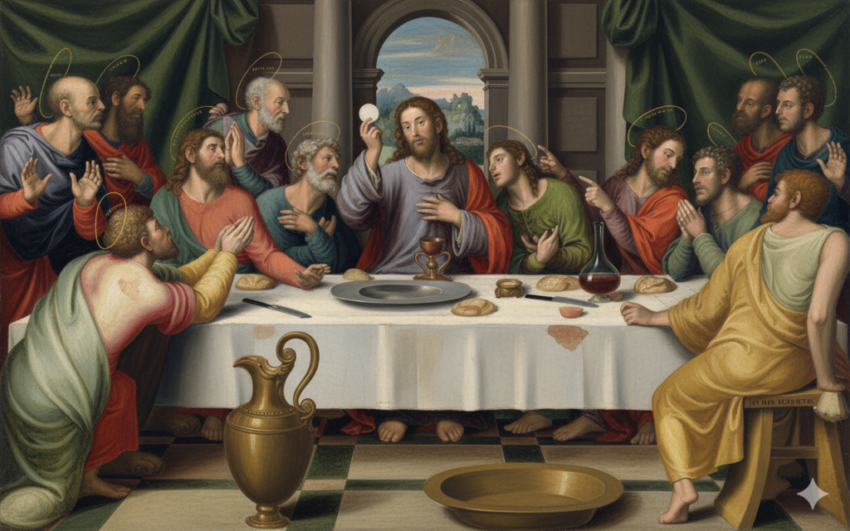
When I teach evangelical college students about the practicalities of Communion, I’ll often begin with the Last Supper, with Jesus and the disciples, because it raises some straightforward questions. I’ll ask them: Should we obey Jesus? Should we celebrate the meal as he instituted it? Should we do what he said? Should we use what he used, eating what he ate and drinking what he drank?
Obviously, they respond—but then they catch themselves. On second thought, their churches don’t do that. And it occurs to them that they can’t quite offer an explanation why.
Some of their churches have taught them that the Communion elements don’t matter at all: Cheez-Its and Minute Maid will work in a pinch. Whatever’s on hand can do the job. Why be such a legalist? God doesn’t care. It’s about the intention of your heart.
…
To use wine in the Supper would bring our churches into alignment both with the rest of the global church and with Christian tradition prior to Welch’s grape juice. It would bring them into alignment, too, with Scripture’s rich symbolism of the fruit of the vine. And finally, it would bring them into alignment with—I want to say, obedience to—the teaching and practice of the apostles and of the Lord Jesus himself.
There is no better reason than that.
East correctly observes that Jesus employed wine (oinos) at the Last Supper, that the Passover meal required unleavened bread (azumos), and that symbols carry theological freight. These observations are unassailable. However, East then performs a remarkable feat of theological sleight-of-hand: he insists upon rigid adherence to one element of the Supper while ignoring dozens of others that possess equal or greater attestation in the biblical text. If we are truly committed to replicating the Lord’s Supper as Jesus instituted it, we must ask a series of questions that East’s article conspicuously avoids.
The Problem of Selective Replication
Consider what we actually know about the Upper Room on that fateful Thursday evening. The disciples gathered with Jesus to observe Passover, which carried specific ceremonial requirements far beyond merely bread and wine. If East’s hermeneutical principle—that we must replicate the elements Jesus used—holds water (or wine, as it were), then we face a cascade of uncomfortable questions:
What elements were actually present at the Lord’s Supper? The Passover Seder included bitter herbs (maror), the roasted lamb (korban pesach), charoset (a mixture of apples, nuts, and wine), a vegetable dipped in salt water (karpas), and four cups of wine—not merely one. The unleavened bread was matzah, specifically prepared according to rabbinic regulations. If symbolic precision matters as much as East contends, why does he not advocate for the full Passover meal? Why wine but not lamb? Why unleavened bread but not bitter herbs?
How “oft” should the Supper be celebrated, if at all? Paul’s instruction to do this “as often as you drink it” (1 Corinthians 11:25) provides remarkable latitude. The phrase ὁσάκις ἐὰν πίνητε (hosakis ean pinēte) suggests frequency is a matter of Christian liberty, not prescription. If Jesus intended rigid replication of form, would the apostle not have specified weekly, monthly, or annual observance? The early church appears to have practiced communion with considerable variation—some daily (Acts 2:46), some weekly (Acts 20:7), some at varying intervals. East’s argument for wine-as-necessary oddly coexists with evangelical indifference to frequency.
Must the bread be “broken”? Jesus “took bread, and blessed, and brake it” (Matthew 26:26, KJV). The Greek κλάσας (klasas) indicates a deliberate breaking. Many churches now use pre-cut wafers or individual communion cups with pre-sealed bread. Has not the symbolism of the one loaf broken for the many been equally compromised? Paul explicitly connects this imagery to ecclesiology: “For we being many are one bread, and one body: for we are all partakers of that one bread” (1 Corinthians 10:17). If symbolic integrity demands wine over grape juice, does it not also demand a single loaf broken before the congregation over individual servings?
Should the wine be served in “New Testament cups”? Jesus “took the cup” (τὸ ποτήριον, to potērion)—singular. The early church shared from a common cup, an image pregnant with meaning about unity, shared life, and mutual acceptance. The individual communion cups that populate most evangelical (and many non-evangelical) churches represent a departure from apostolic practice driven by late 19th and early 20th century concerns about hygiene. This innovation emerged during precisely the same period as Welch’s grape juice. If one accommodation to modernity invalidates authentic communion, why not the other?
Must we sit at a wooden table? Jesus reclined at the table (ἀνέκειτο, anekeito) in the Greco-Roman fashion. The triclinium arrangement placed diners on cushions around a low table. Shall we install such furniture in our sanctuaries? Must we recline rather than sit in pews?
Is an “Upper Room” a necessary venue? Luke 22:12 specifies an ἀνάγαιον (anagaion)—a large upper room. If location bore no theological significance, why did the Holy Spirit preserve this detail? Perhaps churches meeting in gymnasiums, storefronts, or single-story buildings conduct invalid communion services?
The absurdity compounds with each question. Yet East’s argument, taken to its logical conclusion, demands we take each seriously. If the fermentation of the grape juice matters—if the chemical composition of the cup’s contents bears theological weight—then surely the shape of the cup, the posture of the participants, the architecture of the venue, the full menu of the meal, and the frequency of observance matter equally.
The Hermeneutical Inconsistency
East’s argument suffers from what we might call “symbolism selectivity”—the tendency to invest certain elements with irreducible theological significance while casually dismissing others. He writes that “symbols work because of what they are—and because of what they are not,” then proceeds to argue that wine’s symbolic resonance (maturity, celebration, festivity) renders grape juice (associated with children and cheapness) categorically inferior.
But this analysis mistakes cultural association for a theological mandate. Wine’s symbolic meaning in contemporary American culture is not identical to its meaning in first-century Palestine, in medieval Europe, in modern Saudi Arabia, or in recovering alcoholic communities. East himself acknowledges that wine appears throughout Scripture—but so does water, oil, milk, honey, and blood. The wedding at Cana featured wine; the woman at the well received living water. Do we therefore conclude that water is theologically inferior for baptism because it lacks wine’s “festivity”?
Moreover, East’s cultural analysis is tendentious. He claims grape juice “signifies children” and “preadolescence.” This represents a peculiarly contemporary and American reading. In cultures where wine is ubiquitous (France, Italy, Argentina), grape juice carries no such connotation—it is simply unfermented wine, a stage in the same agricultural process. The notion that grape juice is inherently childish or cheap is a cultural construct, not a biblical one.
What the Text Actually Requires
When we examine the New Testament’s treatment of the Lord’s Supper, we find remarkable restraint regarding material specifications. Paul’s most extended discussion (1 Corinthians 11:17-34) focuses almost entirely on the manner of observance rather than the materials. His concern is that the Corinthians are treating the meal as an occasion for division, gluttony, and drunkenness—not that they have procured insufficiently aged wine.
The Greek phrase τὸ ποτήριον (the cup) and the reference to “the fruit of the vine” (γένημα τῆς ἀμπέλου, genēma tēs ampelou in Mark 14:25) specify grape-derived liquid but make no chemical requirements. The Hebrew equivalent פְּרִי הַגֶּפֶן (p’ri hagafen) appears in the Passover liturgy for the blessing over wine, but the blessing concerns the grape’s fruit, not its fermentation state.
We possess no apostolic instruction mandating fermented wine. We possess no patristic consensus that unfermented grape juice invalidates the sacrament. The question simply did not arise in the ancient world because preservation technology did not exist to prevent fermentation. To argue from this silence that fermentation is theologically essential commits the logical fallacy of assuming that technological limitations reflect divine preference.
The Pastoral Dimension
East dismisses pastoral concerns almost parenthetically: “There may be local, person-specific, or missionary situations that raise reasonable questions about exceptions to the rule.” This cavalier treatment ignores the profound pastoral complexities surrounding alcohol:
- Recovering alcoholics for whom the smell and taste of wine may trigger relapse, endangering their health, families, and lives
- Children and youth who participate in communion in many traditions
- Cultures where alcohol consumption is forbidden or severely stigmatized
- Medical conditions requiring alcohol avoidance
- Pregnancy and nursing
To suggest that these represent mere “exceptions” requiring individual accommodation misunderstands the evangelical landscape. In many congregations, these situations describe a significant percentage of communicants. Are they to receive communion “under one kind” (bread only), like medieval laity denied the cup? Are they to abstain while others partake? Are they to be marked publicly as somehow different?
The pastoral question is not peripheral—it is central to whether the Lord’s Supper functions as a meal of unity or an occasion for division.
The Irony East Identifies—And Misses
East notes the irony that contemporary evangelicals “drink wine at home but not in the Lord’s Supper,” calling this “the worst of all possible worlds.” He has a point—but the irony cuts both ways.
Consider: East argues for wine because of its rich biblical symbolism, its theological resonance, and its connection to celebration and maturity. Yet he makes this argument while presumably worshiping in a building with electric lights (not oil lamps), sitting in pews (not reclining), reading from a printed Bible (not scrolls), singing songs unknown to the apostles, accompanying worship with instruments absent from New Testament evidence, and preaching in English (not Aramaic, Greek, or Hebrew). Every element of modern worship represents accommodation to changed circumstances. Why should the cup alone be frozen in first-century form?
The deeper irony is this: East’s argument, intended to promote unity with “most of the world’s Christians” who use wine, actually promotes a new form of division—between those who accept his selective literalism and those who recognize its internal contradictions.
Conclusion: Matters of Conscience and Unity
The Apostle Paul, faced with disputes over food and drink in the Roman church, counseled charity: “For the kingdom of God is not meat and drink; but righteousness, and peace, and joy in the Holy Ghost” (Romans 14:17). This does not render the elements of communion irrelevant—but it does suggest that secondary matters should not become primary obstacles.
What makes communion the Lord’s Supper? The New Testament answer emphasizes: doing it in remembrance of Christ (1 Corinthians 11:24-25), proclaiming his death until he comes (v. 26), examining oneself (v. 28), discerning the body (v. 29), and maintaining unity (1 Corinthians 10:17). Nowhere does Paul suggest that the Corinthians’ manifold problems—drunkenness, divisions, gluttony—would be solved by ensuring proper fermentation of their wine.
Churches that use wine do so in good conscience. Churches that use grape juice do so in good conscience. Both employ the fruit of the vine. Both use unleavened bread (or, in many cases, leavened bread—another accommodation East does not address). Both remember Christ’s sacrifice. Both proclaim his death. Both anticipate his return.
If East’s argument is correct—that we must replicate the precise materials Jesus used—then we must also replicate the precise setting, posture, frequency, and full menu of the Passover meal. We must investigate whether our matzah meets rabbinic standards, whether our upper rooms are sufficiently elevated, and whether our tables are sufficiently wooden. The argument proves too much, and in proving too much, proves nothing.
The fruit of the vine, whether fresh or fermented, symbolizes Christ’s blood poured out for many. The church’s task is not to police fermentation levels but to “do this in remembrance of me”—examining our hearts, confessing our sins, communing with our Lord and one another, and proclaiming his death until he comes.
That is what Jesus commanded. Everything else is adiaphora—matters of Christian liberty upon which believers may reasonably differ without compromising the gospel or severing fellowship.