

Photo: A remarkable photo-realistic visualization of history, generated by Google Gemini. This detailed image vividly captures the introduction to the essay: a stout and earnest farmer, Martin Harris (left), having braved the bitter winter, presents mysterious ancient characters on a slip of paper to the esteemed classical scholar Professor Charles Anthon (right) at Columbia College in 1828. A stunning AI interpretation of historical text!
An Investigative Historical Narrative Examining the Claim of
“Reformed Egyptian” in the Book of Mormon
Introduction: A Professor’s Jaw Drops in New York City
In the winter of 1828, a stout and earnest farmer named Martin Harris arrived unannounced at the office of Professor Charles Anthon at Columbia College in New York City. Harris had traveled hundreds of miles through bitter cold, carrying a small piece of paper on which a young acquaintance from upstate New York — a man named Joseph Smith — had reportedly transcribed characters from a set of ancient golden plates. Harris believed these plates, discovered buried on a hillside near Palmyra, New York, contained a sacred record of ancient peoples. He had come to one of America’s leading classical scholars seeking authentication.
Anthon examined the paper. What he saw, he would later write, was something remarkable in its confusion: a medley of Greek letters, Hebrew characters, Roman letters placed sideways, assorted flourishes, and a crude diagram that bore a suspicious resemblance to a Mexican calendar he recognized from the works of the explorer Alexander von Humboldt. What it was not, Anthon concluded immediately, was anything recognizable as an ancient language.
The characters, Anthon wrote to Eber Howe in 1834, had “evidently been prepared by some person who had before him at the time a book containing various alphabets.” He declined to certify anything. He believed the farmer was the victim of fraud.
Some years ago, a plain, and apparently simple-hearted farmer, called upon me with a note from Dr. Mitchell of our city, now deceased, requesting me to decypher, if possible, a paper, which the farmer would hand me, and which Dr. M. confessed he had been unable to understand. Upon examining the paper in question, I soon came to the conclusion that it was all a trick, perhaps a hoax.
— Professor Charles Anthon, letter to Eber Howe, 1834. Cited in Jonathan Ellis, “Fact-checking Mormon History: Did Charles Anthon Authenticate Joseph’s Translation of Reformed Egyptian Characters?” Medium, July 1, 2016.
The encounter between Harris and Anthon — contested, multi-layered, and historically murky — would become one of the foundational moments in LDS historical narrative, cited by Joseph Smith himself as a fulfillment of Isaiah’s prophecy about a sealed book. But the deeper question the encounter raises has never been resolved: Was there ever actually such a thing as “Reformed Egyptian”? And if there was, how would a family of Hebrew exiles have known about it, preserved it across a thousand years on a separate continent, and used it to engrave a sacred record on thin sheets of goldish metal?
This investigative narrative examines those questions from the standpoint of historical linguistics, ancient Near Eastern scholarship, archaeology, and documentary evidence. It surveys the best arguments offered by LDS apologists — including scholars at FAIR, Latter-day Saints, Scripture Central, BYU, and independent researchers such as Jeff Lindsay — and assesses them against the weight of the available evidence. It does so not with contempt for sincere religious belief, but with the same honest rigor that any extraordinary historical claim demands.
Part One: What the Book of Mormon Actually Claims
The Scriptural Foundation
Before examining the evidence, we must be precise about what is actually being claimed. The Book of Mormon references to Egyptian writing appear in two distinct passages with quite different emphases, and LDS apologists are careful to distinguish between them — a distinction that is actually quite important to the historical analysis.
The first reference appears at the very opening of the Book of Mormon, in 1 Nephi 1:2, where Nephi states that he writes “in the language of my father, which consists of the learning of the Jews and the language of the Egyptians.” Nephi is writing circa 600 BC, shortly after his family had fled Jerusalem. This passage establishes that Nephi was literate in Egyptian — or at least in an Egyptian-influenced scribal tradition — from the beginning.
The second, more doctrinally significant passage comes nearly a thousand years later. In Mormon 9:32–34, Moroni — the last surviving Nephite — explains the script in which the great abridgment of Nephite history was written:
“And now, behold, we have written this record according to our knowledge, in the characters which are called among us the reformed Egyptian, being handed down and altered by us, according to our manner of speech. And if our plates had been sufficiently large we should have written in Hebrew; but the Hebrew hath been altered by us also; and if we could have written in Hebrew, behold, ye would have had no imperfection in our record. But the Lord knoweth the things which we have written, and also that none other people knoweth our language; therefore he hath prepared means for the interpretation thereof.”
— Mormon 9:32–34, Book of Mormon
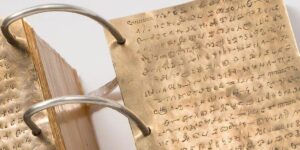 This is the complete scriptural basis for the “Reformed Egyptian“ claim. From this passage, LDS theology derives the following historical propositions: (1) A group of Israelite exiles carried an Egyptian scribal tradition to the New World around 600 BC; (2) That tradition was maintained and modified across a thousand-plus years in complete isolation from Egypt; (3) The resulting script became so unique that “none other people knoweth our language”; and (4) Divine intervention was necessary to translate it.
What makes Moroni’s admission particularly significant — and particularly damaging to the historical plausibility of the narrative — is the implicit concession it contains. Moroni himself acknowledges that Hebrew would have been the preferred language, that it was only abandoned due to space constraints on the plates, and that the resulting record contains “imperfections” attributable to the script. These concessions invite the very questions this article will pursue.
The Translation Story and Its Complications
Joseph Smith’s account of how he translated the Reformed Egyptian characters from the golden plates underwent significant evolution over time, and the later version — which became canonized — differs materially from the earlier, less embellished account.
The most detailed and historically important secondary account concerns Joseph’s 1838 narration of Martin Harris’s visit to Professor Anthon. In this version, Anthon allegedly certified that the translation was “correct, more so than any he had before seen translated from the Egyptian,” and that the characters were “Egyptian, Chaldaic, Assyriac, and Arabic.” He reportedly gave Harris a written certificate of authenticity, then tore it up upon learning the plates came from an angel.
Jonathan Ellis, in his careful examination of the historical record published in Medium, identifies several critical problems with this account. First, Anthon simply did not have the ability in 1828 to read Egyptian; Champollion’s decipherment of the Rosetta Stone was only just beginning to penetrate academic circles, and he could at that point barely translate royal titles. As LDS scholar Stanley Kimball acknowledged, Anthon could not have certified a translation from Egyptian “even if he wanted to do so.”
Second, the claim that the characters included Arabic script is historically absurd. Arabic script bears no resemblance whatsoever to Egyptian hieroglyphic forms. A scholar of Anthon’s caliber would have recognized immediately that no ancient document would contain such a medley of unrelated writing systems.
Joseph’s 1838 claim that Charles Anthon certified Joseph’s translation as correct is not credible. Anthon did not have the ability in 1828 to read Egyptian, so he could not have certified a translation from Egyptian or an Egyptian-derived language even if he wanted to do so.
— Jonathan Ellis, Medium, July 1, 2016.
Third — and perhaps most telling — is what Joseph Smith’s own earlier account says. In the 1832 version, Joseph recorded only that Martin took “some of the characters” and that the learned man (Anthon) said “I cannot” read it — a far more credible account that matches what Anthon himself reported. The elaborate certification story appears only in the 1838 telling, years after Harris had left the church. Most significantly, detailed manuscript analysis of the 1838 Joseph Smith History reveals that the famous “I cannot read a sealed book” dialogue was inserted during editing and was not part of the original narration.
Part Two: The Historical Problem — Would Lehi’s Family Have Known Egyptian?
The World of Jerusalem in 600 BC
To evaluate the plausibility of the “Reformed Egyptian” claim, we must place ourselves in the world of Lehi’s Jerusalem — a specific, historically documented context that modern archaeology has illuminated considerably. The date is approximately 600 BC, during the reign of King Zedekiah, when Nebuchadnezzar’s Babylonian armies are encroaching from the east, and Egypt remains a significant regional power to the southwest.
In this context, what do we actually know about Egyptian literacy among Israelites? The answer, as LDS apologists correctly point out, is that there was genuine Egyptian linguistic influence in pre-exilic Judah. This is not disputed. Egyptian numerals appear in several Hebrew inscriptions from the seventh and eighth centuries BC. A fascinating inscription discovered at Arad in 1967, dating to near 600 BC, contains text written in a combination of Egyptian hieratic and Hebrew characters.
Apologists at FAIR Latter-day Saints make much of the work of Stefan Wimmer of the University of Munich, who has documented what he terms “Palestinian Hieratic” — the use of Egyptian hieratic signs for numerals, weights, and measures in Hebrew texts. FAIR summarizes his research:
The fourth presentation at BYU’s Willes Center for Book of Mormon Studies conference on 31 August 2012 was on “Writing in 7th Century BC Levant,” by Stefan Wimmer of the University of Munich. He examined an interesting phenomenon in Hebrew inscriptions, the use of Egyptian hieratic (cursive hieroglyphic) signs. Basically Hebrew scribes used Egyptian signs for various numerals, weights and measures.
— FAIR Latter-day Saints, “Reformed Egyptian and the Book of Mormon,” fairlatterdaysaints.org
This is genuine and interesting scholarship. But let us be precise about what it demonstrates and what it does not. Palestinian Hieratic, as documented by Wimmer and his predecessors, involves the borrowing of specific Egyptian numerical signs by Hebrew scribes — a limited, specialized, scribal convention for accounting and administrative purposes. It does not demonstrate that Israelite merchants or ordinary families were literate in Egyptian as a complete writing system. The difference between knowing that a certain hieratic sign means “ten shekels” and being able to write extended literary or religious prose in a modified Egyptian script is enormous.
Lehi, as presented in the Book of Mormon, is a prosperous merchant — not a temple scribe, not a royal administrator, not a trained Egyptologist. His family would have spoken Hebrew as their daily language. That some Hebrew scribes in Jerusalem used Egyptian numerical signs in administrative documents tells us very little about whether a merchant family would have possessed full Egyptian scribal literacy of the kind needed to engrave long religious texts in that script on metal plates.
The Babylonian Tablets: Evidence That Cuts Both Ways
In 2015, the Bible Lands Museum in Jerusalem mounted an exhibition of more than 100 clay tablets discovered in modern-day Iraq that sent ripples through the archaeological world. The tablets, acquired by a London-based Israeli collector and dating precisely to the 500–600 BC window of Lehi’s Jerusalem, documented the daily lives of Judean exiles in Babylon with stunning specificity — trade transactions, debt contracts, tax records, and four generations of one family’s history, all bearing unmistakably Hebrew names. Curator Filip Vukosavovic, an expert in ancient Babylonia, Sumeria, and Assyria, described the discovery in almost breathless terms:
“We started reading the tablets and within minutes we were absolutely stunned. It fills in a critical gap in understanding of what was going on in the life of Judeans in Babylonia more than 2,500 years ago.”
— Filip Vukosavovic, curator, Bible Lands Museum Jerusalem. Ynet News, February 4, 2015.
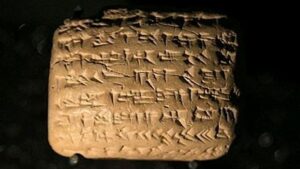
For the LDS apologist, these tablets are welcome evidence. They demonstrate beyond dispute that Judean exiles in precisely Lehi’s era did adopt foreign scribal systems for practical daily use — exactly the kind of cultural flexibility the Book of Mormon requires. This is a genuine and fair point, and the tablets deserve acknowledgment as corroborating that Israelites were not scribal purists who refused all contact with foreign writing traditions.
But the tablets simultaneously deliver a significant blow to the specific “Reformed Egyptian” hypothesis, and the reason is plain once the details are examined. The script these Judean exiles used was not Egyptian. It was Akkadian cuneiform — the dominant administrative language of Babylon, the civilization in whose midst they were actually living. When displaced Judeans needed a working scribal tradition, they adopted the language of the culture that surrounded them, supported them economically, and whose scribal schools were available to them. They did not preserve a scribal tradition imported from a third culture hundreds of miles away. They used what was immediately at hand.
This is, in fact, precisely what the Book of Mormon scenario cannot account for. The Babylonian tablets confirm a principle of historical linguistics that the Reformed Egyptian claim violates: functional literacy in a foreign script requires continuous immersion in a living scribal culture. The Judean exiles in Babylon could write in Akkadian cuneiform because they were in Babylon, surrounded by Akkadian scribes, Akkadian schools, and a functioning Akkadian administrative apparatus. Lehi’s family, within a generation of leaving Jerusalem, would have been on a different continent, utterly removed from any Egyptian cultural context whatsoever. The tablets show us what exiled Judeans actually did with foreign scripts. What they did looks nothing like what the Book of Mormon describes.
The Papyrus Amherst 63: The Apologists’ Best Evidence
The most substantive piece of evidence cited by LDS apologists for the plausibility of “Reformed Egyptian” is the Papyrus Amherst 63, a remarkable ancient document deserving serious attention. Scripture Central’s KnoWhy article on the subject describes it:
The most enticing of these is the text known today as Papyrus Amherst 63. Discovered on the island of Elephantine in southern Egypt in the late nineteenth century, this papyrus, which post-dates Lehi’s time by about four centuries, “contain[s] three psalms that originated in the Kingdom of Israel before the fall of Samaria (722 BCE).” What makes this text so remarkable is that “the scribes of the scroll used Egyptian Demotic script to write texts in the Aramaic language,” a Semitic language closely related to Hebrew.
— Scripture Central, KnoWhy #513, “Why Did Mormon and Moroni Write in Reformed Egyptian?” January 23, 2021. scripturecentral.org
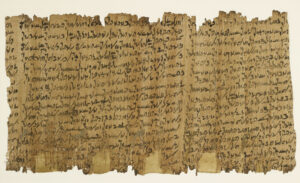
This is genuinely interesting evidence. A document containing Israelite psalm-texts written in Egyptian Demotic script and Aramaic language does exist. It demonstrates that in the ancient world, the phenomenon of writing one language in the script of another was not unknown. Jeff Lindsay, one of the most industrious LDS apologists and a Ph.D.-holding researcher who has written extensively for the Interpreter journal, cites this and similar evidence in arguing that “the practice indicated in the Book of Mormon of using a foreign script (and a modified Egyptian script in particular) for writing in another language is entirely consistent with other ancient writings.”
This argument is not without merit as far as it goes. But here is where historical rigor requires us to look carefully at what the evidence actually shows versus what the Book of Mormon actually claims. The Papyrus Amherst 63 dates to approximately the second to fourth century BC — meaning it post-dates the departure of Lehi’s family by at least three centuries. It was produced by a settled community of Jewish mercenaries at Elephantine, Egypt — a community with continuous, direct access to Egyptian scribal culture, Egyptian scribal schools, and Egyptian writing materials. This is not remotely comparable to the Book of Mormon scenario, in which a single family carries an Egyptian scribal tradition to an entirely different continent and then maintains it for over a thousand years in complete isolation from Egypt, Egyptian scribes, Egyptian schools, and any living context that would allow the tradition to remain viable.
The analogy that Palestinian Hieratic and Papyrus Amherst 63 provide is thus a bridging one — it suggests that the general idea of cross-script writing was not impossible in the ancient Near East. It does not address the primary objection, which is the thousand-year isolation problem. That problem stands unrebutted by any of the apologetic literature reviewed for this essay.
Part Three: The Thousand-Year Isolation Problem
Languages and Scripts in Isolation
Historians of ancient languages will flag what is perhaps the single most underappreciated problem with the “Reformed Egyptian” hypothesis: the impossibility of maintaining a coherent scribal tradition across a millennium of near-total geographic and cultural isolation.
Languages change. Scripts change. When a community is cut off from the living tradition that sustains a writing system — from scribal schools, from literary exemplars, from any native speakers or writers — that writing system does not simply “evolve.” It disintegrates. History provides no compelling example of a specialized scribal tradition being maintained in complete isolation for a thousand years by what was, according to the Book of Mormon’s own account, a relatively small group of people engaged in near-constant warfare.
Consider what a thousand years means in the life of a script. The Hebrew square script used in the Dead Sea Scrolls was itself dramatically different from the paleo-Hebrew script in use during Lehi’s time. The transformation from hieroglyphics to hieratic to demotic in Egypt unfolded over hundreds of years, driven by continuous use by millions of people across an unbroken culture. Classical Latin evolved into French, Spanish, Italian, and Portuguese over roughly a thousand years — but there was never a break in use, never a period of isolation. In every documented case, script evolution requires sustained communal use. Isolation does not preserve a writing system; it orphans it.
Moroni’s own statement in Mormon 9:32–34 is actually a confession of this problem. He writes that the characters “called among us the reformed Egyptian” had been “handed down and altered by us, according to our manner of speech,” and that “none other people knoweth our language.” He is describing a script so idiosyncratic that it had become universally illegible outside the tiny community of Nephite record-keepers who used it. This is not evidence that the script was faithfully preserved. It is evidence that something which began as an Egyptian-derived system diverged so completely — through alteration, isolation, and the passage of centuries — that it became a unique artifact known to “none other people.”
BYU Egyptologist John Gee, one of the more careful LDS scholars on this question, offers an observation that cuts to the heart of the problem. Writing specifically about the Anthon Transcript — the primary surviving specimen of purported Reformed Egyptian characters — Gee notes that “a major obstacle faces those attempting a translation of the Anthon transcript — the corpus is not large enough to render decipherment feasible.” Gee frames this as a methodological limitation rather than a concession, and goes on to propose candidate Egyptian scripts the characters might derive from. But the observation stands on its own terms: the Anthon Transcript, the closest thing we have to a physical sample of the script, cannot be meaningfully analyzed. And independent Egyptologists who have examined it — including Sir Alan Gardiner — found no recognizable relationship to any known form of Egyptian writing. Whether one accepts Gee’s optimistic framing or not, the evidentiary situation is the same: there is no identifiable, verifiable link between “Reformed Egyptian” and any script in the historical record.
Three Egyptologists Examine the Evidence
In 1956, three of the world’s leading Egyptologists were presented with the “Caractors” document — the primary surviving sample of what was claimed to be Book of Mormon characters — and asked to assess it. Their conclusions were clear and consistent.
Sir Alan Gardiner, author of the definitive Egyptian Grammar that remains a standard reference work, found no resemblance to “any form of Egyptian writing.” William C. Hayes of the Metropolitan Museum of Art suggested the document might be “an inaccurate copy of something in hieratic script” while acknowledging it might equally resemble “other scripts, both ancient and modern, of which I have no knowledge.” John A. Wilson of the University of Chicago gave the most detailed assessment:
“This is not Egyptian writing, as known to the Egyptologist. It obviously is not hieroglyphic, nor the ‘cursive hieroglyphic’ as used in the Book of the Dead. It is not Coptic, which took over Greek characters to write Egyptian. Nor does it belong to one of the cursive stages of ancient Egyptian writing: hieratic, abnormal hieratic, or demotic.”
— Professor John A. Wilson, University of Chicago Egyptology Department, 1956. Cited in Wikipedia, “Reformed Egyptian.”
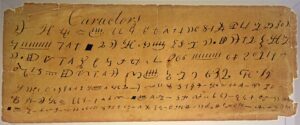
Via Wikipedia. This work is in the public domain in the United States.
Wilson added that the document “does not conform to the normal pattern of cursive” and that, because it was purported to be “altered,” this might “remove this context from the professional analysis by the Egyptologist.” This final observation is telling: the apologetic move of describing the script as specially “reformed” or “altered” by the Nephites functions as a rhetorical escape hatch — any discrepancy between the characters and actual Egyptian can be attributed to the alteration process, making the claim unfalsifiable in principle.
In 1966, Professor Wilson was asked again about Reformed Egyptian and gave perhaps his most direct assessment: “From time to time there are allegations that picture writing has been found in America… In no case has a professional Egyptologist been able to recognize these characters as Egyptian hieroglyphs. From our standpoint there is no such language as ‘reformed Egyptian.'”
Richard A. Parker, of the Egyptology department at Brown University, was equally direct: “No Egyptian writing has been found in this [Western] hemisphere to my knowledge… I do not know of any language such as Reformed Egyptian.”
Part Four: The Apologists’ Case — A Fair Assessment
Jeff Lindsay and the Principle of “Plausible Consistency”
Jeff Lindsay, a former chemical engineering professor with a Ph.D. who has maintained one of the most prolific LDS apologetics websites (jefflindsay.com) since 1994 and contributed extensively to the Interpreter: A Journal of Latter-day Saint Faith and Scholarship, is among the most energetic defenders of the Reformed Egyptian claim. His approach is characteristic of sophisticated LDS apologetics: he does not claim to prove that Reformed Egyptian existed, but rather to demonstrate that the concept is historically “plausible” and “consistent” with what we know about ancient writing practices.
Drawing on the research of LDS scholars John Tvedtnes, Stephen Ricks, and William Hamblin — particularly their work on Jewish and Semitic texts written in Egyptian characters — Lindsay argues that critics who claim no self-respecting Israelite would ever use Egyptian to write sacred scripture are demonstrably wrong. The evidence he marshals includes Palestinian Hieratic, a distinctly Judahite adaptation of Egyptian hieratic script attested in more than 200 inscriptions found in Israel and Judah dating to the eighth through early sixth centuries BC, precisely the era of Lehi. He also cites Papyrus Amherst 63, a third-century BC document in which an Aramaic composition closely paralleling Psalm 20 — a text of clear Semitic religious content — was written entirely in Egyptian demotic script. This is a genuine and scholarly significant case of Semitic sacred material recorded in an Egyptian writing system.
Lindsay writes:
Critics charge that there is no such language as “reformed Egyptian,” but the charge is quite incorrect. The once-laughable Book of Mormon reference to “reformed Egyptian” is right on the money in ways that Joseph Smith could not possibly have anticipated if he were the author and the book were a fraud.
— Jeff Lindsay, “Questions about Book of Mormon Problems,” jefflindsay.com
Lindsay’s broader argument — that the evidence of cross-script writing in the ancient Near East “confirms the plausibility” of the Book of Mormon claim — represents the most responsible version of the LDS apologetic position. It does not overreach. It does not claim that Egyptologists have validated “Reformed Egyptian.” It claims only that the concept is not inherently absurd, given what we know about ancient scribal practices.
This is a defensible but ultimately insufficient argument for several reasons. First, the evidence Lindsay and others cite establishes plausibility for the general concept of cross-script writing while leaving entirely unanswered the specific problems: the thousand-year isolation period, the complete absence of archaeological evidence, the absence of corroboration from any non-LDS Egyptologist, and the internal textual problems (such as the use of the Greek-derived word “Christ” in a pre-Greek context, as discussed below).
Second, Lindsay’s argument employs a common apologetic technique of dissolving a specific claim into a general one. The Book of Mormon does not claim that Israelites sometimes used Egyptian scripts for limited scribal purposes, which the evidence of Palestinian Hieratic and Papyrus Amherst 63 does support. It claims a single family carried a complete Egyptian scribal tradition to the New World, maintained it in isolation for roughly a thousand years, modified it beyond recognition, and engraved lengthy sacred texts in it on metal plates. The evidence for the general phenomenon of cross-script writing does not begin to substantiate that specific, compounding chain of claims. The gap between “Semitic peoples sometimes wrote in Egyptian scripts” and “a small isolated group preserved and transformed such a script for a millennium in the New World” is not a gap that Lindsay’s cited evidence — however real and relevant — comes close to bridging.
FAIR Latter-day Saints and the Demotic Parallel
The FAIR Latter-day Saints organization maintains a thorough defense of the Reformed Egyptian concept that draws on a wide range of ancient Near Eastern scholarship. Their analysis correctly notes that the evolution from hieroglyphics to hieratic to demotic represents exactly the kind of “reforming” of an Egyptian script that the Book of Mormon describes:
There are, however, several variant Egyptian scripts which are “reformed” or altered from their earlier form. Hugh Nibley and others have pointed out that the change from Egyptian hieroglyphics, to hieratic, to demotic is a good description of Egyptian being “reformed.” By 600 BC, hieratic was used primarily for religious texts, while demotic was used for daily use.
— FAIR Latter-day Saints, “Reformed Egyptian and the Book of Mormon,” fairlatterdaysaints.org
This observation is accurate in historical linguistics. Demotic is indeed a “reformed” form of hieratic, which is itself a cursive development of hieroglyphics — a genealogical chain that Egyptologists confirm ran from roughly 3150 BC (the emergence of hieratic) through approximately 700 BC (the emergence of demotic during the 26th Dynasty). The term “reformed Egyptian” could accurately describe any of these developmental stages within the Egyptian writing tradition. But there are significant logical problems with this parallel.
FAIR’s argument, developed in part through the work of LDS scholar William Hamblin, actually extends beyond the hieroglyphics-to-demotic progression. Hamblin cites additional examples of Egyptian-derived or Egyptian-influenced scripts that underwent their own transformation: Byblos Syllabic texts, Proto-Sinaitic script, Meroitic, and others. These are real and scholarly recognized examples of writing systems that derived from or were influenced by Egyptian scripts and subsequently developed in new directions. The evidence is genuine, and the breadth of the list is not trivial.
The problem is that every example on that list shares the same disqualifying characteristic: each developed within a functioning, populated, institutionally supported civilization. Proto-Sinaitic emerged among Semitic workers in continuous contact with Egyptian scribal culture in the Sinai. Meroitic developed in the Kingdom of Kush, a large and literate state with its own administrative apparatus, over several centuries of sustained use. Byblos maintained active trade and cultural contact with Egypt for millennia. None of these scripts was invented, maintained, and transformed by a small, isolated community on a different continent, cut off from the parent culture and devastated by recurring warfare.
The specific transition most directly analogous to the Book of Mormon’s claim — the emergence of demotic from hieratic — is also the most instructive counterexample. That transition occurred over roughly two to three centuries within one of the most administratively dense and institutionally sustained civilizations in human history, driven by daily use across Egypt’s entire population. It was not a slow drift in isolation; it was a rapid, society-wide scribal reform supported by state institutions and scribal schools.
The Book of Mormon scenario asks us to imagine not merely that an Egyptian-derived script was “reformed” — which the historical record shows is possible — but that a complete scribal tradition was carried to the New World by a single family, maintained in total isolation for roughly a thousand years, modified beyond recognition by a community that by its own account was repeatedly devastated by war, famine, and social dissolution, and ultimately used to engrave lengthy sacred texts on metal plates. The evidence that FAIR and Hamblin assemble establishes that Egyptian-derived scripts have been transformed in various cultural contexts. It does not — and cannot — address the specific, compounding conditions the Book of Mormon’s account actually requires. The gap between “scripts derived from Egyptian have evolved in multiple cultures” and “a tiny isolated New World community preserved and transformed one for a millennium” is not a gap this evidence bridges.
Scripture Central and the “Scribal Language” Argument
Scripture Central’s KnoWhy article on Reformed Egyptian offers a more nuanced apologetic argument: that “reformed Egyptian” may have been comparable to a specialized liturgical or scribal language — like Latin, Sanskrit, or Classical Hebrew — used only by a small priestly or scholarly class, not by the general population.
The reformed Egyptian used by Mormon and Moroni in the fourth century AD may have been comparable to several scribal, literary, liturgical, or religious languages that even today are studied and used in certain traditional or academic settings but are not actively used in any day-to-day oral communication, such as Old Church Slavonic, Coptic, Biblical Hebrew, Syriac, Pali, Sanskrit, Avestan, and Latin.
— Scripture Central, KnoWhy #513, May 2, 2019. scripturecentral.org
This is the most historically sophisticated version of the LDS apologetic argument, and it deserves a careful response. Specialized scribal languages have indeed been maintained across long periods by small, dedicated communities. Latin was preserved by the Roman Catholic Church for over a thousand years after it ceased to be a living spoken language. Sanskrit was preserved within the Hindu priestly tradition. Coptic is still used liturgically by the Egyptian Coptic Church.
But in every case cited, the preservation happened within a living institutional framework: a church, a priesthood, a university, a scribal school. These institutions provided the training, the exemplars, the written materials, and the social structures that allowed the language or script to be transmitted. The Book of Mormon describes a community that experienced repeated catastrophic warfare, whose record-keepers were specifically killed off, whose civilization ultimately collapsed entirely — and yet the script somehow survived. The comparison to Latin-in-the-Church requires a preservation mechanism, and the Book of Mormon provides none.
Dr. Einar Erickson and the Phoenician Connection
Among the more speculative LDS apologetic arguments is that advanced by Einar C. Erickson, an independent Mormon document scholar who maintains an extensive research website (einarerickson.com) drawing on decades of personal study of the Dead Sea Scrolls, Nag Hammadi texts, and other ancient documents. Erickson’s credentials are self-developed rather than credentialed in linguistics or Egyptology, but his bibliographic range is considerable. His “Phoenician Connection” argument attempts to establish a specific thesis: that the characters on the Anthon Transcript bear closer resemblance to a Phoenician-Egyptian blended script than to standard Egyptian forms — what he terms, in effect, a “Phoenicianized” or “Semitized” Egyptian. To frame this argument, he draws on the role of Aramaic as an ancient lingua franca across the Near East:
“Of all the Semitic languages Aramaic has the longest history and this fact alone makes it particularly interesting and rich from the lexical point of view…Throughout this long history Aramaic has been pre-eminently a language in contact with other languages — Akkadian, Hebrew, Phoenician, Iranian languages, Egyptian, Greek, Arabic, Kurdish and Turkish.”
— Einar C. Erickson, “Reformed Egyptian — The Phoenician Connection,” einarerickson.com
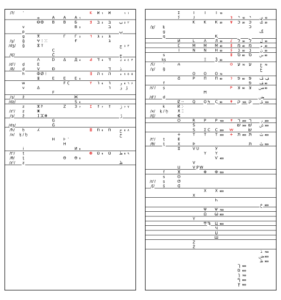
Image: Wikimedia Commons / Public Domain
The factual claim within the quote deserves a brief correction. Aramaic’s role as the dominant lingua franca of the ancient Near East from at least the seventh century BC through the Achaemenid Empire is well-documented and accurate. However, the assertion that Aramaic has the “longest history” of all Semitic languages is linguistically questionable. Akkadian is generally considered the earliest attested Semitic language, with written records dating to approximately 2800 BC, while early Aramaic inscriptions date only to the eleventh century BC. The claim appears to overstate Aramaic’s antiquity relative to the Semitic language family as a whole.
That said, the substantive historical point Erickson is building toward — that Phoenician and Egyptian writing systems genuinely influenced one another across the ancient Near East, and that a “Phoenicianized Egyptian” script is not inherently implausible in that context — is not without historical grounding. Phoenician traders and scribes were in sustained contact with Egypt for centuries, and the cross-pollination of writing conventions across the ancient Levant is documented.
The problem is that Erickson’s argument, like the broader FAIR/Hamblin approach it resembles, establishes a general phenomenon and then gestures toward the Book of Mormon’s specific claim without bridging the distance between them. Demonstrating that Phoenician and Egyptian writing systems influenced each other in the ancient Near East does not demonstrate that any specific blended script was carried to the New World by a single family, maintained in isolation for a thousand years, and modified beyond recognition by a community engaged in near-constant warfare. The proposed Phoenician-Egyptian identification of the Anthon Transcript characters, while creative, has not been validated by any mainstream Egyptologist or Semitic linguist outside the LDS apologetic tradition. The evidential web being woven is, once again, not anchored to the specific and compounding conditions that the Book of Mormon’s account actually requires.
Part Five: The Internal Evidence Problems
The “Christ” Anachronism
Among the most pointed internal textual critiques of the Book of Mormon’s historical claims is the one raised by Lenny Esposito of Come Reason Ministries, examining a passage in which the prophet Nephi uses a word that makes no historical sense in a 600 BC context:
“For according to the words of the prophets, the Messiah cometh in six hundred years from the time that my father left Jerusalem; and according to the words of the prophets, and also the word of the angel of God, his name shall be Jesus Christ, the Son of God.”
— The Book of Mormon, 2 Nephi 25:19
Esposito identifies the historical problem precisely:
How in the world would Nephi use a word like “Christ”, which is a transliteration of the Greek word Χριστός, the language of the New Testament? Hebrew prophets before Nephi would have called Jesus “anointed one” or “Messiah” (מָשִׁיח), but not “Christ”. Greece was a series of fragmented city-states at that time that fought among themselves as much as fighting any others. It wasn’t until after Alexander the Great conquered the known world by 323 BC that the spread of Greek as a common lingua franca across the Near East began to take hold — a process that unfolded over the decades of the Hellenistic period that followed, not a development settled at any single moment.
— Lenny Esposito, “The Book of Mormon’s Slip is Showing,” Come Reason’s Apologetics Notes, January 25, 2012

The standard LDS response to this anachronism is that Joseph Smith translated the underlying Hebrew or Egyptian term into the English of his day, rendering it as “Christ” because that is the word his audience would understand. It is worth noting that LDS textual scholar Royal Skousen, in his critical text analysis of the Book of Mormon, has argued that the translation language reflects Early Modern English patterns closer to the 16th and 17th centuries than to Joseph Smith’s own 19th-century idiom — a finding that complicates the simple “contemporary translation” defense without resolving the anachronism itself. Whether the translation idiom is dated to the 1820s or the 1620s, a Greek-derived Christological title in a 600 BC Hebrew document remains historically anomalous.
But the translation response cuts against another major pillar of LDS historical claims. If the translation was free enough to render ancient Semitic concepts with post-Greek English vocabulary, then the claim that Joseph Smith was faithfully translating a specific “Reformed Egyptian” script becomes difficult to sustain. Either the script contained specific characters that were being precisely rendered, or the translation was a loose paraphrase into a later idiom. It cannot logically be both.
This problem is sharpened by the weight of testimony surrounding the translation process. Joseph Smith described the Book of Mormon as “the most correct of any book on earth” — a statement recorded in his History of the Church (Vol. 4, p. 461). His scribes and close associates, including Emma Smith, Martin Harris, and David Whitmer, consistently described a tightly controlled process in which words appeared and would not change until correctly transcribed. And Joseph Smith’s own statements described a divinely enabled translation of specific characters on the plates, which he identified as “reformed Egyptian.” If the translation were operating under that kind of divine precision, the appearance of the Greek-derived “Christ” in a document purportedly written in 600 BC by a Hebrew prophet who had never encountered Greek culture remains an anomaly that neither the tight-control nor the loose-control theory of translation fully resolves.
Deutero-Isaiah and the Textual Problem
A closely related internal problem involves the extensive quotation of Isaiah in the Book of Mormon, including substantial passages from what most critical biblical scholars identify as “Deutero-Isaiah” — chapters 40–55 of Isaiah, generally attributed to a different, later author writing during or after the Babylonian exile, approximately 550–540 BC. The problem is compounded by the Book of Mormon’s additional quotation of material from chapters 56–66, which a significant portion of critical scholarship attributes to yet a third author, conventionally called “Trito-Isaiah,” writing even later than Deutero-Isaiah. Both sets of chapters post-date the Book of Mormon’s claimed timeline by decades.
The historical scenario the Book of Mormon requires is straightforward: Lehi’s family left Jerusalem around 600 BC, taking with them the Brass Plates, which contained the writings of Isaiah. If Deutero-Isaiah was written during or after the Babylonian exile — which did not begin until 597–586 BC — then the Brass Plates Lehi’s family carried could not have contained those chapters. They had not yet been written. David P. Wright, a Hebrew Bible scholar and former BYU professor who was excommunicated from the LDS Church in 1994 in part because of his published conclusions on this very issue, described the problem as a “double anachronism”: not only do the chapters post-date the departure from Jerusalem, but the entire critical framework identifying them as exilic compositions post-dates the Book of Mormon’s claimed writing period as well. The fact that Wright’s scholarship cost him his church membership is itself an instructive data point — it illustrates the degree to which the Deutero-Isaiah problem is not a peripheral academic curiosity but a conclusion the institutional LDS Church has treated as incompatible with faithful membership. LDS apologists typically respond by arguing that Isaiah was a single author writing prophetically — that chapters 40–55 represent genuine predictive prophecy written in the eighth century BC, not a later author writing after the fact. This is a theologically coherent response for those who accept prophetic prediction, but it remains a minority position in mainstream critical biblical scholarship and requires rejecting over two centuries of accumulated textual, linguistic, and historical analysis.
The Isaiah problem is further compounded by the question of the King James Version. Of the 478 Isaiah verses quoted in the Book of Mormon, exactly 201 agree closely with the KJV reading, while 207 show variations from the KJV — sometimes aligning more closely with the Masoretic Text or the Septuagint. One documented example where the Book of Mormon diverges from the KJV toward an older textual tradition: Isaiah 51:15 / 2 Nephi 8:15, where the Book of Mormon reads “my name” against the KJV’s “his name,” aligning with the Septuagint. LDS apologists have used these variants to argue that the Book of Mormon reflects access to a more ancient textual tradition than the KJV alone. This is not a frivolous argument and deserves to be stated fairly.
However, the variants do not resolve the core problem for two reasons. First, the Book of Mormon demonstrably reproduces at least some identifiable KJV translation errors — choices that reflect not the underlying Hebrew but the KJV translators’ specific rendering decisions, which modern scholarship has shown to be mistaken. Two documented examples:
-
The Hebrew word succah in Isaiah 5:25 means “filth” or “dung,” but was mistranslated in the KJV as “torn.” The Book of Mormon (2 Nephi 15:25) follows the KJV error rather than the correct Hebrew. Even LDS apologist Daniel Peterson has acknowledged that “‘refuse’ is a better translation of suchah than is ‘torn.'”
-
The Hebrew word chuppah in Isaiah 4:5 means “canopy” or “covering” but was rendered in the KJV as “defence.” The Book of Mormon (2 Nephi 14:5) follows the KJV’s mistranslation rather than the correct Hebrew meaning.
A genuinely ancient document, translated from a Reformed Egyptian script that preserved a pre-exilic Hebrew source text, would have no mechanism for reproducing 17th-century English translation errors.
Second, the overall structural and phraseological dependency of the Book of Mormon’s Isaiah passages on KJV English — even where specific word choices vary — reflects a baseline literary relationship to the KJV that is difficult to explain on the hypothesis of an independent ancient translation. Royal Skousen, the foremost LDS textual scholar on this question, states explicitly as his “First Finding” in his analysis of Isaiah textual variants that “the base text for the Isaiah quotations in the Book of Mormon is indeed the King James Version.” This is not a conclusion drawn by critics — it is the conclusion of the most thorough LDS textual analysis of the Book of Mormon ever undertaken.
Skousen’s broader critical text analysis further argues that the Book of Mormon’s language reflects Early Modern English patterns dating primarily from the 1530s through the 1730s, with syntax best matching the second half of the 1500s — predating Joseph Smith’s era by two centuries. LDS apologists present this as evidence of a supernaturally mediated translation idiom. Crucially, Skousen’s own evidence also supports a “tight control” or word-for-word translation model, in which the text was dictated precisely rather than loosely paraphrased. This finding, intended to strengthen the Book of Mormon’s claims, actually sharpens the dilemma: if the translation was word-for-word under divine direction, the reproduction of 17th-century KJV translation errors — including errors that diverge from the correct Hebrew — becomes harder to explain, not easier. A divinely precise translation of an authentic ancient text should have reproduced the correct Hebrew, not the KJV’s mistakes.
Whether the translation idiom is assigned to the 1530s or the 1820s, the presence of post-exilic Isaiah chapters, reproduced KJV translation errors, and Early Modern English syntactic structures in a document purportedly engraved in Reformed Egyptian by 600 BC Hebrews constitutes a layered anachronism that the apologetic responses, taken individually or together, do not fully resolve.
The Isaiah problem is, in this sense, the Reformed Egyptian problem restated in textual form. Both point toward the same conclusion: the Book of Mormon’s internal claims about its own origins — the language it was written in, the time it was written, the people who wrote it, and the process by which it was transmitted — are not mutually consistent, and they are not consistent with the external historical and linguistic record.
The Seer Stone Contradiction
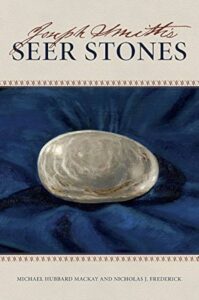
Perhaps the most internally destabilizing evidence for the “Reformed Egyptian” claim comes from the LDS Church’s own Gospel Topics Essays, which now officially acknowledge that Joseph Smith’s primary method of translation involved placing a seer stone in a hat, burying his face in the hat, and reading luminous English text that appeared to him supernaturally. The official essay states: “Joseph placed either the interpreters or the seer stone in a hat, pressed his face into the hat to block out extraneous light, and read aloud the English words that appeared on the instrument.” This is not a fringe critical claim — it is the institutional church’s own current description of how the Book of Mormon was produced.
The role of the physical plates during this process is more complex than critics and apologists sometimes allow. The plates were not routinely removed from the scene — Emma Smith reported that they “often lay on the table without any attempt at concealment, wrapped in a small linen table cloth,” and other witnesses recalled them kept in a nearby box under the bed or in the barn. But they were covered, never directly consulted, and in at least some documented instances, absent from the premises. Isaac Hale, Joseph Smith’s father-in-law and a careful if skeptical observer of the translation process, stated in his 1834 affidavit that during translation sessions the plates were “said to be hid in the woods.” David Whitmer corroborated the basic framework, describing a process in which English words appeared on the seer stone and would not change until correctly transcribed — a description consistent with a revelation-driven rather than a text-driven translation process.
The LDS Discussions website draws the relevant conclusion from this evidence:
Since we don’t have the Book of Mormon plates to look at nor do we have any facsimiles of their contents, the only examples of both Book of Mormon text and ‘Reformed Egyptian’ is from the group of “caractors” that Joseph Smith claimed to copy from the gold plates. The problem here is that no one at the time could read Egyptian as the Rosetta Stone was only being discovered, and ‘Reformed Egyptian’ was not considered a language then nor is it considered one now.
— LDS Discussions, “Overview of Joseph Smith’s Translations,” ldsdiscussions.com
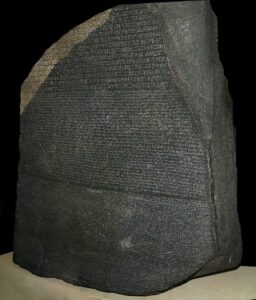
The Rosetta Stone point is historically accurate. Jean-François Champollion only completed his decipherment of Egyptian hieroglyphics in 1822, and Joseph Smith began his translation work in the late 1820s. No one in Joseph Smith’s environment had the tools to read, verify, or challenge any claim about what an Egyptian-derived script said or meant.
The seer stone method creates a significant logical problem for the Reformed Egyptian hypothesis, specifically. The standard apologetic argument for Reformed Egyptian runs as follows: the Nephites used a real, historically grounded writing system; Joseph Smith faithfully translated that system by divine gift; the resulting English text therefore reflects an authentic ancient document. This chain of reasoning depends on a meaningful connection between the characters on the plates and the English words produced in translation. If the English text appeared directly on a seer stone — without the plates being consulted, and sometimes without them being present at all — then that chain is broken. The specific linguistic properties of the script, whether it was genuinely Egyptian-derived or any other system, would be entirely irrelevant to the translation process. The plates could have contained any script whatsoever, and the “translation” would have been identical.
LDS apologists have a response to this argument: the plates, they suggest, served a symbolic or revelatory-triggering function — their physical existence authenticated the process and provided the divine occasion for revelation, even if they were not read character by character. This is a theologically coherent position, but it comes at a high cost. It effectively concedes that the translation was not a linguistic decoding of Reformed Egyptian at all, but a direct supernatural revelation of English text that used the plates as a prop or catalyst. If that is the case, then Joseph Smith’s own statements about translating specific “reformed Egyptian” characters, and the entire apologetic project of identifying the script with known ancient writing systems, are beside the point. The text’s content would reflect whatever God chose to reveal in English, not whatever was engraved on the plates.
This places the Reformed Egyptian argument in an uncomfortable position from within LDS theology itself. Either the plates were meaningfully translated — in which case the linguistic, archaeological, and textual problems catalogued throughout this analysis apply with full force — or the plates were not meaningfully translated, and the “Reformed Egyptian” claim is a description of a physical object whose contents were never actually read. The apologetic literature has not resolved this tension, because it cannot: the two positions are mutually exclusive, and the church’s own Gospel Topics Essays have now confirmed the evidentiary basis for the second.
Part Six: The Archaeological Silence
A Literate Civilization Leaves No Trace

Of all the evidentiary problems with the “Reformed Egyptian” hypothesis, none is more devastating than the complete and total absence of archaeological corroboration. The Book of Mormon describes a literate civilization — by its own account, a civilization that produced extensive written records on metal plates, maintained scribal traditions, built large cities, engaged in complex military campaigns, and left behind a written heritage spanning roughly a thousand years. The claim is not that a few scribes scratched a few lines in the dirt. The claim is that an entire literate culture existed and flourished on the American continent for a millennium, producing records in a specific script derived from Egyptian. That claim has a falsifiable archaeological implication: such a civilization would leave physical evidence of its writing system. None has been found.
The principle at work here is not speculative. Literate civilizations always leave written records. Without exception. The archaeological record of the ancient Americas confirms this pattern wherever genuine literacy existed. The Maya left glyphs on stone stelae, on pottery, on walls, on jade, and on bark-paper codices. The Zapotec of Oaxaca left inscribed monuments dating to approximately 500 BC, making their script among the oldest in the Americas. The Aztecs left extensive pictographic manuscripts. The Epi-Olmec or Isthmian script, attested on the Cascajal Block and a small number of other objects, represents another distinct writing tradition, though scholars continue to debate whether it constitutes a fully developed system. The Mixtec produced detailed genealogical and historical manuscripts. In every case where a literate pre-Columbian culture existed, it left physical traces of its writing — in stone, clay, bark, bone, and ceramic.
Michael D. Coe of Yale University, one of the world’s foremost authorities on pre-Columbian Mesoamerican cultures and the author of Breaking the Maya Code (1992), has consistently argued across his career that Maya was the only fully logosyllabic — that is, fully developed — writing system in pre-Columbian Mesoamerica. This position is widely influential in the field, though it should be noted that some researchers argue the Zapotec system also qualifies as relatively complete. Whether the number of full writing systems is one or several, the critical point stands: the scholarly literature on pre-Columbian writing systems — a literature now spanning well over a century of serious archaeological and epigraphic work — contains no identification of any New World script as Egyptian-derived or Egyptian-influenced. Every identified pre-Columbian writing system traces its origins to indigenous development, with no demonstrable connection to Old World writing traditions of any kind.
The standard linguistic reference works confirm this silence by omission. Peter Daniels and William Bright’s The World’s Writing Systems (Oxford University Press, 1996), the most comprehensive academic survey of world writing systems ever published, contains no reference to “Reformed Egyptian.” David Crystal’s Cambridge Encyclopedia of Language and Roger Woodard’s Cambridge Encyclopedia of the World’s Ancient Languages — two further standard references covering the full range of attested ancient scripts — likewise contain no entry for the term. This is not an oversight. These volumes document writing systems for which there is archaeological and textual evidence. The absence of “Reformed Egyptian” from all of them is the scholarly community’s collective answer to the question of whether it exists.
The silence is equally complete at the archaeological level. No inscription, no potsherd, no metal plate, no carved stone, no funerary object, and no architectural element bearing anything resembling Egyptian-derived script has ever been recovered from any pre-Columbian New World site. This is not a matter of insufficient excavation or inadequate technology. Mesoamerica is one of the most extensively surveyed regions in the world, and in recent years, the tools available to archaeologists have undergone a revolution. LiDAR — Light Detection and Ranging — is an aerial laser-scanning technology that pulses millions of light beams through dense jungle canopies and maps the ground surface beneath them with extraordinary precision, revealing the outlines of buried cities, roads, causeways, agricultural terraces, and monumental architecture that ground-level survey could never detect. LiDAR surveys conducted across the Maya lowlands since 2010, and most dramatically since the landmark 2018 PACUNAM LiDAR Initiative survey covering over 2,100 square kilometers of northern Guatemala, have fundamentally transformed our understanding of the scale and complexity of pre-Columbian civilization — revealing densely interconnected urban networks, sophisticated infrastructure, and populations far larger than previously estimated. These surveys have found cities. They have found roads. They have found evidence of intensive agriculture and large-scale warfare. They have not found a single inscription, artifact, or architectural element bearing any relationship to Egyptian-derived writing of any kind. The absence of Egyptian-derived script from this record is therefore not a gap waiting to be filled by the next field season or the next LiDAR pass. It is a conclusion that the most powerful archaeological discovery technology ever deployed in the Americas has now had the opportunity to challenge — and has not. The ground has been read from the air, and it has returned nothing that the Reformed Egyptian hypothesis requires.
Grant Hardy, one of the most respected and intellectually honest LDS scholars writing today, exemplifies the careful acknowledgment of this problem that characterizes the best work within the tradition. His The Annotated Book of Mormon, published by Oxford University Press in 2019 — the fact of its Oxford imprint itself a mark of Hardy’s standing in the broader academic community — reflects a consistently evidence-respecting approach to the text’s historical claims. Hardy has acknowledged in various scholarly contexts that no non-Mormon linguists have identified any demonstrable linguistic contact between New World and Old World language families — a concession that, coming from within the LDS scholarly community and published under an Oxford imprint, carries considerable weight.
The absence of corroboration from non-LDS scholarship is total and consistent. No professional Egyptologist, no Mesoamerican archaeologist, no epigrapher, and no historical linguist outside the LDS apologetic tradition has identified any writing system, inscription, or artifact in the pre-Columbian Americas that shows a relationship to Egyptian script — hieroglyphic, hieratic, demotic, or any modified or “reformed” form thereof. This is not a matter of anti-Mormon bias in the academy. Scholars have no institutional incentive to suppress evidence of Egyptian-derived New World writing. If such evidence existed, it would be among the most significant archaeological discoveries in human history, transforming our understanding of ancient trans-oceanic contact. The fact that no such evidence has emerged after more than a century of intensive archaeological work in the Americas is not a silence that apologetic arguments about Palestinian Hieratic, Papyrus Amherst 63, or the Phoenician Connection can fill. Those arguments establish that Egyptian-derived scribal practices existed in the ancient Near East. They say nothing about the Americas. And in the Americas, the ground has been searched, and it has returned nothing.
The “Lost Script” Defense and Its Problems
LDS apologists sometimes respond to the archaeological silence with what might be called the “lost script” defense: perhaps the Reformed Egyptian script simply did not survive the destruction of the Nephite civilization. Scripture Central and other apologetic sources have invoked the general observation that writing systems and records from the ancient world frequently perish — that perishable materials decay, that conquering peoples destroy the records of the conquered, and that the absence of a script from the archaeological record does not prove it never existed.
This response has surface plausibility but collapses under scrutiny for several compounding reasons.
First, the general observation that ancient writing systems sometimes perish without a trace applies most forcefully to early-stage, limited, or perishable-medium writing traditions — systems scratched on bark, painted on hide, or used by small communities over short periods. It does not apply well to the civilization the Book of Mormon describes. The Book of Mormon claims a literate culture that existed for roughly a thousand years, built with stone, worked with metals, fielded armies of hundreds of thousands, and — crucially — engraved its sacred records on golden plates specifically for the purpose of preservation across time. A civilization that goes to the extraordinary length of inscribing texts in an imperishable medium, and that does so over the course of centuries, would not leave a script that vanished without a single surviving trace. The very detail of the golden plates, offered by LDS tradition as evidence of historical intentionality, makes the total absence of corroborating physical evidence more damaging, not less.
Second, the “lost script” defense, when applied to a civilization of the scale and duration the Book of Mormon describes, cannot account for the full range of what should survive. Scripts do not exist in isolation. They appear on pottery, on walls, on weapons, on jewelry, on architecture, on trade goods, and on grave goods — across the entire material culture of the civilization that uses them. When a writing system is genuinely used by a large and complex society over centuries, traces of it appear throughout the archaeological record even when dedicated scriptural or administrative documents do not survive. The Maya script survived not primarily in its codices — most of which were destroyed by the Spanish — but in stone inscriptions, ceramic vessels, jade objects, and architectural elements distributed across hundreds of sites. The Nephite script, if it existed, should have left this kind of distributed material trace. It has left none.
Third, the LiDAR revolution in Mesoamerican archaeology has made the “lost civilization” version of this defense increasingly difficult to sustain. As discussed in the previous section, LiDAR surveys — most dramatically the 2018 PACUNAM Initiative covering over 2,100 square kilometers of the Maya lowlands — have revealed densely interconnected urban networks and populations far larger than previously estimated. These technologies have shown that large pre-Columbian civilizations do not hide from the archaeological record. They leave enormous footprints. The claim that a thousand-year literate civilization in the Americas left no detectable trace is a claim that now has to reckon not only with a century of ground-level excavation but with the most powerful remote-sensing technology ever deployed in the field.
Fourth, and most fundamentally, the “lost script” defense is precisely what philosophers of science call an unfalsifiable claim — and it is far from the only one in the LDS apologetic arsenal. A pattern runs through the entire body of responses examined in this article: when archaeological evidence fails to appear, the evidence “did not survive.” When Egyptologists find no relationship between the Caractors document and any known script, the script was too modified to recognize. When the Book of Abraham translation bears no relationship to the papyri, the relevant plates were not among those recovered. When the seer stone method renders the plates’ contents irrelevant, the plates served a symbolic function. When internal textual anachronisms appear, the translation was divinely adapted to contemporary idiom. Each individual response has a surface coherence. But taken together, they reveal a consistent structural feature of the apologetic enterprise: every uncomfortable fact, without exception, retreats to the same final redoubt — the claim that God’s purposes and methods are not subject to ordinary evidential standards. This is not an argument. It is a description of faith, and faith is precisely what it should be called.
LDS scholar Terryl Givens argues that for faith to be meaningful,
“There must be grounds for doubt as well as belief, in order to render the choice more truly a choice, and therefore the more deliberate, and laden with personal vulnerability and investment. An overwhelming preponderance of evidence on either side would make our choice as meaningless as would a loaded gun pointed at our heads.”
LDS faith, at its most philosophically sophisticated, is defended not as blind belief but as a deliberate moral choice made in conditions of genuine uncertainty. Givens argues that God calibrates the evidential landscape intentionally — ensuring that neither belief nor disbelief is compelled by overwhelming evidence — so that faith remains a meaningful act of personal commitment and spiritual investment. It is a dignified position. But it carries a cost: a framework designed to preserve uncertainty can absorb any disconfirming evidence by reclassifying it as divinely intended ambiguity — making the faith claim permanently insulated from the very evidence it invites us to weigh.
The “lost script” defense exemplifies this pattern in its purest form. It proposes that the absence of evidence is compatible with the existence of the thing being claimed — and, critically, that no conceivable future evidence could ever refute it. If every new LiDAR survey that fails to find Nephite cities, every excavation that recovers no Egyptian-derived inscription, and every laboratory analysis that identifies no Old World script influence can be absorbed by the response “it simply didn’t survive,” then the claim is insulated from all possible disconfirmation. An argument structured so that it cannot be challenged by any conceivable evidence is not a historical or scientific argument. When the evidence runs out, the faith claim steps in — and in LDS apologetics, the faith claim is always available, always sufficient, and never falsifiable. That is its function. It is also, for anyone operating outside the framework of prior belief, its fatal flaw.
LDS apologists sometimes respond to this unfalsifiability charge with the standard logical observation that “absence of evidence is not evidence of absence” — a valid principle in some contexts. When a single artifact is sought in a poorly excavated region over a short period, that principle applies. But it does not apply uniformly regardless of scale. When the absence is total, consistent, and produced by over a century of intensive excavation across one of the most systematically surveyed regions on earth, augmented by aerial LiDAR technology that can read the ground through jungle canopies, the cumulative weight of that absence crosses a threshold. It is no longer merely an absence of evidence. It is a body of evidence — gathered through thousands of field seasons, dozens of LiDAR surveys, and the analysis of millions of artifacts — that has consistently and without exception failed to return what the hypothesis requires. At that scale, the absence is the finding.
Part Seven: Joseph Smith’s Track Record as an Egyptian Translator
The Book of Abraham and What It Reveals
 Perhaps the most direct empirical test of Joseph Smith’s claimed ability to work with Egyptian-derived materials comes not from the Book of Mormon — where we lack the original plates — but from the Book of Abraham, where we have both the source papyri and Joseph Smith’s translation, allowing direct comparison. We have examined the Book of Abraham problem in extensive detail in our previous essay, “Exposing Joseph Smith’s Deception: The Book of Abraham’s Fictional Genesis,“ and readers seeking a full treatment of the papyri evidence, the Egyptological scholarship, and the institutional LDS response are directed there. What follows is a summary of the findings most directly relevant to the Reformed Egyptian question — specifically, what the Book of Abraham episode reveals about Joseph Smith’s actual capacity to translate Egyptian-derived materials and the credibility of the translation mechanism he claimed to exercise.
The papyri were located in the collection of the Metropolitan Museum of Art in New York in 1966 and formally transferred to the LDS Church in November 1967. Their identification was swift and unambiguous. Multiple independent Egyptologists, most definitively Klaus Baer and Robert K. Ritner — whose study “‘The Breathing Permit of Hôr’ Among The Joseph Smith Papyri” was published in the Journal of Near Eastern Studies in 2003 — identified the source material as portions of the Breathing Permit of Hor, also known as the Book of Breathings: a standard ancient Egyptian funerary document containing conventional prayers for the deceased. Joseph Smith’s “translation” renders this funerary material as an elaborate narrative of Abraham’s experiences in Egypt, including an extended vision of astronomical cosmology, the nature of God, and the doctrine of pre-mortal existence. The content of the source document and the content of the “translation” have no relationship to each other.
The Egyptian Alphabet and Grammar that Smith produced while working on the Book of Abraham compounds the problem. This document, in which Smith attempted to systematize his understanding of Egyptian, demonstrates no understanding of actual Egyptian grammar, syntax, or vocabulary. A BYU Religious Studies Center publication has acknowledged that if any of the Egyptian documents were examined by a modern Egyptologist, “they would more than likely be deemed gibberish.” This is not a concession extracted under pressure from critics — it is the assessment of LDS scholars working within the tradition.
The Kinderhook Plates add a further, if more contested, data point. The plates are confirmed to be 19th-century forgeries — modern metallurgical and chemical analysis has established this beyond dispute, and the LDS Church acknowledges it. A statement recorded in Joseph Smith’s History of the Church (Vol. 5, p. 372) claims that he “translated a portion of them,” identifying the person buried with them as “a descendant of Ham, through the loins of Pharaoh, king of Egypt.” LDS apologists dispute whether this constitutes a formal translation exercise in the same sense as the Book of Abraham, arguing that Smith gave the plates only a brief and casual inspection before setting them aside. This dispute is worth acknowledging. What is not in dispute is that the documented statement claims specific ancestral content from objects that contained no real ancient language, whatever the nature of the exercise that produced it.
The LDS Discussions website frames the cumulative picture accurately:
Take these translation accounts in totality and not in isolation, because there are a lot of similarities to their production and authenticity. As you read below, please evaluate the translations of Joseph Smith that we have source material or accounts for as you would any other religious or spiritual leader that claimed to have the power of translation via the gift and power of God.
— LDS Discussions, “Overview of Joseph Smith’s Translations,” ldsdiscussions.com
When we take Smith’s translation work in totality, the pattern is consistent: in every case where we can compare his claimed “translation” against verifiable source material, the translation does not correspond to the source. The Book of Abraham papyri say one thing; his translation says another. The Egyptian Alphabet and grammar bear no relationship to the actual Egyptian. The Kinderhook statement, whatever its formal status, claims content from confirmed forgeries.
This documented pattern is not a peripheral issue for the “Reformed Egyptian” claim. It is directly and structurally relevant. The claim that Joseph Smith could translate an unknown, modified Egyptian script by divine power rests on precisely the same foundation as his claim to translate the Book of Abraham papyri by divine power. The mechanism is identical: divine revelation of meaning from an Egyptian-derived source through the gift and power of God. When that mechanism can be empirically tested — as it can with the Book of Abraham — and is found to produce content that bears no relationship to the source material, the credibility of the untestable claim is proportionally and seriously diminished. The absence of the original plates means the Book of Mormon translation cannot be directly falsified in the way the Book of Abraham translation has been. But the man and the method are the same. And where the method has been tested, it has failed.
Part Eight: The Most Extraordinary Apologetic Arguments
The Japanese Writing System Analogy
Among the more creative apologetic arguments for the plausibility of Reformed Egyptian is one occasionally circulated in LDS discussion communities: the analogy of the Japanese writing system. The argument notes that Japanese uses Chinese characters (kanji) alongside two phonetic syllabic scripts (hiragana and katakana) to write a language that is linguistically unrelated to Chinese — Japanese belongs to the Japonic language family, while Chinese belongs to the Sino-Tibetan family, and the two share no common ancestry. The analogy is intended to demonstrate that a language can be written using the script of an entirely different language family, and that there is therefore nothing inherently implausible about a group of Hebrew speakers writing in an Egyptian-derived script.
The analogy is superficially clever. It correctly identifies a real phenomenon: the borrowing of a writing system across a linguistic boundary. And it correctly identifies the Book of Mormon’s claim as an instance of that general phenomenon. To that extent, it is making a legitimate point — one that overlaps with the Lindsay/Hamblin evidence of Palestinian Hieratic and Papyrus Amherst 63 discussed earlier. The concept of cross-linguistic script borrowing is real, documented, and not inherently absurd.

But the analogy, examined carefully, does not support the LDS position. It refutes it. The Japanese adoption of Chinese characters is one of the most thoroughly documented cases of script borrowing in linguistic history, and every feature of that borrowing stands in direct contrast to the Book of Mormon scenario.
The adoption of Chinese writing into Japan was a gradual process spanning centuries, driven by sustained, institutionally supported cultural contact. Buddhist monks brought Chinese texts to Japan beginning in the 4th and 5th centuries AD. Diplomatic missions traveled regularly between the Japanese court and the Chinese mainland. Korean and Chinese scholars resided at the Japanese court and served as scribal instructors. Trade missions maintained continuous commercial and cultural exchange. There was no isolation — there was, in fact, one of the most intensive cross-cultural literary transfers in Asian history, sustained by large populations on both sides and supported by monastic institutions, state bureaucracies, and formal scribal schools. The writing system was not carried to Japan by a single family. It was transmitted by generations of scholars across a living, active cultural bridge.
The critical distinction is one of sequence and scale. Japanese script borrowing followed the pattern that all documented cross-linguistic script adoptions follow: sustained contact first, domestication second, and only then — centuries later — the possibility of reduced contact without script collapse. Japan’s later periods of restricted foreign contact, most notably the Edo period sakoku policy of roughly 1635–1853, came more than a thousand years after kanji was fully established in Japanese civilization. By the time Japan restricted foreign contact, the writing system had been natively institutionalized for over a millennium, supported by domestic Buddhist monasteries, imperial bureaucracies, and a large literate population that no longer needed China to sustain it. The script survived reduced contact not because isolation is compatible with script maintenance — but because it was no longer isolated from its own domesticated tradition. It had become Japanese.
The Book of Mormon scenario inverts this sequence entirely. It does not ask us to accept that a writing system was borrowed under sustained contact and later survived reduced contact after full domestication. It asks us to accept that a script was borrowed and then immediately placed in complete isolation — carried by a single family to a different continent, before any process of domestication could occur, before scribal schools could be established, before a literate population could develop, and before any of the institutional infrastructure that makes a writing system self-sustaining could be built. The Japanese analogy does not demonstrate that this is possible. It demonstrates precisely the conditions under which it is not.
There is one further point the analogy inadvertently makes. When Japanese did experience the extended reduced contact of the Edo period, it did not lose its writing system. It maintained kanji across two centuries of restriction because the script was already embedded in every layer of Japanese civilization — in literature, law, religion, commerce, and daily life. This robustness was a product of a thousand years of mass use by a large, literate population. The Nephites, by the Book of Mormon’s own account, were a small group engaged in near-constant warfare, repeatedly devastated by internal conflict and social dissolution, and operating without any of the institutional supports that made Japanese script survival possible. The Japanese writing system’s resilience under the sakoku policy is evidence of what a large, institutionally supported civilization can sustain. It is not evidence of what a small, isolated, war-ravaged community could maintain from the moment of departure. The analogy, in the end, does not illustrate the plausibility of Reformed Egyptian. It illustrates, in unusually precise historical detail, exactly why the claim is implausible.
The “Nobody Called It Hieroglyphs Either” Defense
One apologetic argument that deserves examination for its cleverness is the observation that the ancient Egyptians did not call their own script “hieroglyphs” — that was a Greek term imposed from outside — and that cuneiform was similarly named by modern scholars, not by the ancient Babylonians or Assyrians who used it. Therefore, Scripture Central argues, the absence of any outside recognition of a script called “Reformed Egyptian” is no more damning than the absence of ancient self-reference to “hieroglyphs” or “cuneiform.”
Scripture Central states the argument this way:
The ancient Egyptians, for example, did not call their own script “hieroglyphs,” but rather mdw nṯr (“words of god,” “divine words”). The ancient Greeks were the ones who called the script they encountered in Egypt hieroglyphs, meaning “sacred writing.” The same goes for the script that Egyptologists today call Demotic… but which the ancient Egyptians themselves called sẖā šʾ.t (“language of letters”).
— Scripture Central, KnoWhy #513, January 23, 2021, scripturecentral.org
The historical linguistics here are accurate. Mdw nṯr is the correct Egyptian self-referential term for hieroglyphic script, and sẖā šʾ.t is the correct Egyptian self-referential term for demotic. The broader point — that writing systems are frequently named by outside observers rather than by their users — is a genuine and well-documented linguistic phenomenon. Cuneiform, from the Latin cuneus (“wedge”), was coined entirely by modern Western scholars; the ancient Mesopotamian scribes who used it for three thousand years had no equivalent self-referential label.
But the argument, though historically accurate in its premises, is a non sequitur. It addresses the wrong problem entirely.
Nobody disputes that writing systems are often named by outsiders rather than by their users. The problem is not the name “Reformed Egyptian.” The problem is the complete absence of any evidence — named or unnamed, self-referential or externally labeled — that such a script ever existed. This distinction is crucial and the argument obscures it. Hieroglyphs were unnamed by the Egyptians themselves, but they left millions of inscriptions across thousands of sites — on temple walls, obelisks, sarcophagi, papyri, amulets, pottery, jewelry, and funerary objects distributed across Egypt and the entire ancient Near East. Cuneiform was unnamed by the Babylonians and Assyrians, but it left hundreds of thousands of clay tablets in archives across Mesopotamia, Anatolia, and the Levant — so many that scholars are still cataloguing and translating them today. The absence of a self-referential name did not prevent either script from leaving an enormous, inescapable physical record.
There is, moreover, something deeper worth noting about the Egyptian case specifically. The Egyptian term mdw nṯr — “words of god” — is itself evidence of a highly self-aware scribal tradition: a civilization that not only used its writing system but theorized it, named it, theologized it, and embedded it in institutional religious and administrative structures that produced and preserved the record we now possess. The Egyptian scribal tradition generated not only inscriptions but an entire professional class of scribes trained in formal schools, a body of scribal literature theorizing the nature and sacred status of writing, and millennia of continuous institutional investment in the preservation of the written word. This is what a real, historically grounded writing tradition looks like from the outside — and from the inside.
“Reformed Egyptian” has none of this. It has no self-referential name from its supposed users. It has no externally imposed name from contemporary observers. It has no inscriptions, no papyri, no clay tablets, no carved stones, no funerary objects, no trade goods, no architectural elements, and no material trace of any kind. It has no scribal literature theorizing its nature. It has no identified relationship to any known writing system in the entire corpus of world epigraphy. Its only attestation is in the Book of Mormon itself and in the Anthon Transcript — a document that independent Egyptologists have examined and found to bear no recognizable relationship to any known script.
The naming argument, in the end, asks us to treat the absence of a self-referential label as equivalent to the absence of all physical evidence. These are not the same thing. The Egyptians did not name their own hieroglyphs — but they left us the Rosetta Stone, the temples of Karnak and Luxor, the Book of the Dead, and millions of inscriptions. The Nephites allegedly maintained a script for a thousand years — and left us nothing. The gap between those two situations is not a matter of nomenclature. It is a matter of existence.
The Stubbs Uto-Aztecan Language Gambit

One of the more ambitious recent apologetic arguments involves the work of linguist Brian Stubbs, championed by Jeff Lindsay in his 2017 Interpreter article “The Next Big Thing in LDS Apologetics: Strong Semitic and Egyptian Elements in Uto-Aztecan Languages.” Stubbs claims to have identified extensive Semitic and Egyptian elements in the Uto-Aztecan family of Native American languages — a family spoken across a broad swath of the American Southwest and Mexico, including Nahuatl, Hopi, Comanche, and numerous other languages. If genuine, this would represent extraordinary linguistic evidence for contact between ancient Near Eastern peoples and pre-Columbian America, and would have implications far beyond LDS apologetics for the entire field of historical linguistics.
Stubbs’s argument is more technically sophisticated than most popular treatments of it — either positive or negative — suggest. He does not merely collect loose lexical similarities between Semitic and Uto-Aztecan words. He presents over 1,500 proposed cognate sets organized into systematic sound correspondence tables, divides the proposed Semitic influence into two distinct historical layers (“Semitic-kw” and “Semitic-p”), and argues that the Egyptian and Semitic-p elements represent a single identifiable contact event. This technical architecture distinguishes his work from amateur attempts to find Hebrew in Native American languages — attempts that litter the history of both LDS apologetics and fringe linguistics more broadly. Lindsay describes what Stubbs has uncovered as “among the most impressive scholarly finds related to the Book of Mormon,” and the breadth and internal organization of the proposed correspondence set place it in a different category from the amateur linguistic speculation that has historically plagued this field.
The critical response from independent academic linguists, however, identifies problems that the technical sophistication of Stubbs’s presentation does not resolve. The fundamental methodological issue is one of expected probability. A Nahuatl specialist reviewing Stubbs’s work demonstrated that when the full comparison set is properly accounted for — thirty Uto-Aztecan languages compared against multiple Semitic varieties and Egyptian across a large potential lexical pool — the expected number of chance similarities generated by random phonological overlap “far exceeds” Stubbs’s 1,528 proposed cognates. This is the core problem with large-scale cross-family cognate hunting: the larger the comparison set, the more false positives accumulate as a mathematical consequence, regardless of methodology. Stubbs’s critics have also noted inadequate accounting for non-matching segments — cases where his proposed cognates require unexplained sound changes or selective data use that would not be accepted in mainstream comparative linguistics.
The peer review situation is important to characterize accurately. Stubbs’s main work was published through Grover Publishing, not through a mainstream academic press, and has not appeared in peer-reviewed linguistics journals such as Language, Linguistic Inquiry, or the Journal of the American Oriental Society — the venues where a claim of this magnitude would need to be validated to enter the scholarly mainstream. It has been reviewed in BYU Studies Quarterly, an LDS academic journal, where linguist Dirk Elzinga engaged with it seriously and found the sound correspondence tables to represent genuine technical effort, even while the broader claim remained unestablished. The distinction matters: the work has received serious engagement within LDS academic circles, but it has not been submitted to — let alone validated by — the mainstream linguistics community whose consensus it would need to overturn.
The mainstream consensus position remains unchanged: the Uto-Aztecan language family has no demonstrated connection to Semitic or Egyptian languages, and the standard historical linguistic reconstruction of the family treats it as fully indigenous to the Americas with no Old World substrate. This is the position reflected in every standard linguistic reference work, every academic survey of Native American languages, and every relevant entry in the major handbooks of historical linguistics.
Even granting Stubbs’s proposed connections every possible benefit of the doubt, a further problem remains. The Book of Mormon’s specific claim is not that some linguistic residue of Near Eastern contact persisted in a Native American language family. It is that a specific writing system — Reformed Egyptian — was carried to the New World, maintained in isolation, and used to engrave sacred texts on metal plates. Linguistic substrate influence, if it were genuine, would be evidence of contact and population mixture, not of a preserved scribal tradition. The two claims are not the same. A word borrowed from a Semitic language into a Native American language is evidence of speakers in contact — not evidence of scribes maintaining an Egyptian-derived writing system across a thousand years of isolation. The Stubbs argument, even if it were validated tomorrow by mainstream linguistics, would not bridge the evidentiary gap that the Reformed Egyptian hypothesis requires.
Part Nine: A Cumulative Assessment
The Strength of the Apologetic Case
Academic fairness requires a candid acknowledgment of what the LDS apologetic case for “Reformed Egyptian” accomplishes and does not accomplish. At its best, the apologetic literature successfully demonstrates that:
(1) Egyptian scribal influence existed in pre-exilic Israelite culture, as evidenced by Palestinian Hieratic. This is a genuine historical fact.
(2) Ancient peoples did sometimes write one language in the script of another, as evidenced by the Papyrus Amherst 63. This too is real.
(3) The term “reformed Egyptian” could be an accurate description of the evolutionary development from hieroglyphics to hieratic to demotic within Egyptian scribal tradition. This is linguistically defensible.
(4) The absence of a script from scholarly reference works does not by itself prove the script never existed. This is a logical point.
These are not trivial contributions. They mean that the “Reformed Egyptian” concept is not self-evidently absurd as a historical claim. A Judahite family in 600 BC might plausibly have had some degree of familiarity with Egyptian scribal conventions.
The Cumulative Weight of the Problems
The apologetic case, at its strongest, establishes only that the general premise was possible — not that it is probable, and not that it is supported by evidence. Against this slim foundation of plausibility, the cumulative weight of the problems is substantial:
The thousand-year isolation problem remains entirely unanswered. No apologetic source reviewed for this article provides a plausible mechanism for maintaining a coherent scribal tradition across a millennium of geographic isolation from any Egyptian cultural context. The arguments from Lindsay, Hamblin, FAIR, and Erickson establish that cross-script writing occurred in the ancient Near East under conditions of sustained contact. None of them address what happens to a borrowed script when contact is severed from the first moment of departure.
The archaeological corroboration problem is devastating. A thousand-year literate civilization has left no inscriptions, no artifacts, and no validated linguistic traces recognizable to any professional Egyptologist or pre-Columbian archaeologist. LiDAR surveys covering thousands of square kilometers of Mesoamerica have revealed the physical footprints of genuine pre-Columbian civilizations in extraordinary detail — and have returned nothing that the Reformed Egyptian hypothesis requires.
The internal textual problems are consistent with 19th-century composition and inconsistent with a genuinely ancient document. The use of the Greek-derived “Christ” in a purported 600 BC Hebrew context, the substantial dependency of the Isaiah quotations on KJV English phrasing and structure, and the reproduction of identifiable KJV translation errors — including the succah mistranslation in Isaiah 5:25 / 2 Nephi 15:25 and the chuppah mistranslation in Isaiah 4:5 / 2 Nephi 14:5 — are precisely what one would expect from a 19th-century English composition and precisely what one would not expect from a genuine ancient document translated from a pre-exilic Hebrew source text.
The seer stone translation method, now acknowledged by the LDS Church itself in its Gospel Topics Essays, renders the specific linguistic properties of “Reformed Egyptian” irrelevant to the translation process. If English text appeared supernaturally on a seer stone without the plates being consulted, the script engraved on those plates — whatever its nature — had no functional role in producing the English text. The plates could have contained any script whatsoever, or none at all, and the translation would have been identical.
Joseph Smith’s documented track record with Egyptian-related materials provides powerful evidence that his claimed ability to translate such materials was not genuine. The Book of Abraham papyri — identified by multiple independent Egyptologists as the Breathing Permit of Hor, a standard funerary document — bear no relationship to Smith’s “translation” of them. The Egyptian Alphabet and Grammar demonstrates no understanding of actual Egyptian linguistic structure, a conclusion acknowledged by LDS scholars themselves. The Kinderhook Plates, confirmed 19th-century forgeries, generated a documented statement claiming specific ancestral content from objects containing no real ancient language.
Professional Egyptologists, without exception, have found no evidence for “Reformed Egyptian” as a real writing system. The Caractors document — the primary surviving specimen of the purported script — has been examined by independent experts, including Sir Alan Gardiner, and found to have no identifiable relationship to any known form of Egyptian script. John Gee, the most careful LDS Egyptologist on this question, has stated that the corpus is “not large enough to render decipherment feasible” — an acknowledgment that whatever the document represents, it cannot be meaningfully analyzed against the known Egyptian scribal tradition.
The most ambitious positive evidence offered — Brian Stubbs’s proposed Semitic and Egyptian elements in Uto-Aztecan languages — remains unvalidated by mainstream linguistics. Stubbs’s work is more technically sophisticated than popular treatments suggest, and it has received serious engagement in LDS academic venues. But it has not been reviewed or endorsed in mainstream linguistics journals, its proposed cognate sets face a fundamental probability objection from the size of the comparison set, and even if validated it would constitute evidence of linguistic contact rather than evidence of a preserved scribal tradition.
When these problems are assessed together, the rational conclusion is not that Reformed Egyptian has been definitively disproven — scientific disproof of unfalsifiable claims is impossible by definition, and the “lost script” defense can always absorb the absence of evidence by asserting that the evidence did not survive. The rational conclusion is that the evidence, across every domain in which it can be examined, consistently and strongly points against the historical reality of the claim, while no validated positive evidence supports it beyond the text of the Book of Mormon itself. That is not a neutral evidentiary situation. It is the situation that obtains when a claim is false.
Conclusion: The Cumulative Weight of the Problems
The apologetic case, at its strongest, draws on genuine historical evidence — Palestinian Hieratic, Papyrus Amherst 63, the documented cross-script writing practices of the ancient Near East — and establishes that the general premise was possible. But possibility is not probability, and the foundation, however real, is slim against the cumulative weight of what follows:
The thousand-year isolation problem remains entirely unanswered. No apologetic source reviewed for this article provides a plausible mechanism for maintaining a coherent scribal tradition across a millennium of geographic isolation from any Egyptian cultural context. The arguments from Lindsay, Hamblin, FAIR, and Erickson establish that cross-script writing occurred in the ancient Near East under conditions of sustained contact. None of them address what happens to a borrowed script when contact is severed from the first moment of departure.
The archaeological corroboration problem is devastating. A thousand-year literate civilization has left no inscriptions, no artifacts, and no validated linguistic traces recognizable to any professional Egyptologist or pre-Columbian archaeologist. LiDAR surveys covering thousands of square kilometers of Mesoamerica have revealed the physical footprints of genuine pre-Columbian civilizations in extraordinary detail — and have returned nothing that the Reformed Egyptian hypothesis requires.
The internal textual problems are consistent with 19th-century composition and inconsistent with a genuinely ancient document. The use of the Greek-derived “Christ” in a purported 600 BC Hebrew context, the substantial dependency of the Isaiah quotations on KJV English phrasing and structure, and the reproduction of identifiable KJV translation errors — including the succah mistranslation in Isaiah 5:25 / 2 Nephi 15:25 and the chuppah mistranslation in Isaiah 4:5 / 2 Nephi 14:5 — are precisely what one would expect from a 19th-century English composition and precisely what one would not expect from a genuine ancient document translated from a pre-exilic Hebrew source text. That these problems were serious enough that David P. Wright’s published conclusions about Deutero-Isaiah cost him his LDS Church membership in 1994 is itself evidence of how severely the institutional church regards the threat they pose.
The seer stone translation method, now acknowledged by the LDS Church itself in its Gospel Topics Essays, renders the specific linguistic properties of “Reformed Egyptian” irrelevant to the translation process. If English text appeared supernaturally on a seer stone without the plates being consulted, the script engraved on those plates — whatever its nature — had no functional role in producing the English text. The plates could have contained any script whatsoever, or none at all, and the translation would have been identical.
Joseph Smith’s documented track record with Egyptian-related materials provides powerful evidence that his claimed ability to translate such materials was not genuine. The Book of Abraham papyri — identified by multiple independent Egyptologists as the Breathing Permit of Hor, a standard funerary document — bear no relationship to Smith’s “translation” of them. The Egyptian Alphabet and Grammar demonstrates no understanding of actual Egyptian linguistic structure, a conclusion acknowledged by LDS scholars themselves. The Kinderhook Plates, confirmed 19th-century forgeries, generated a documented statement claiming specific ancestral content from objects containing no real ancient language.
Professional Egyptologists, without exception, have found no evidence for “Reformed Egyptian” as a real writing system. The Caractors document — the primary surviving specimen of the purported script — has been examined by independent experts, including Sir Alan Gardiner, and found to have no identifiable relationship to any known form of Egyptian script. John Gee, the most careful LDS Egyptologist on this question, has stated that the corpus is “not large enough to render decipherment feasible” — an acknowledgment that whatever the document represents, it cannot be meaningfully analyzed against the known Egyptian scribal tradition.
The most ambitious positive evidence offered — Brian Stubbs’s proposed Semitic and Egyptian elements in Uto-Aztecan languages — remains unvalidated by mainstream linguistics. Stubbs’s work is more technically sophisticated than popular treatments suggest, and it has received serious engagement in LDS academic venues. But it has not been reviewed or endorsed in mainstream linguistics journals, its proposed cognate sets face a fundamental probability objection from the size of the comparison set, and even if validated it would constitute evidence of linguistic contact rather than evidence of a preserved scribal tradition.
When these problems are assessed together, the rational conclusion is not that Reformed Egyptian has been definitively disproven — scientific disproof of unfalsifiable claims is impossible by definition, and the “lost script” defense can always absorb the absence of evidence by asserting that the evidence did not survive. The rational conclusion is that the evidence, across every domain in which it can be examined, consistently and strongly points against the historical reality of the claim, while no validated positive evidence supports it beyond the text of the Book of Mormon itself. That is not a neutral evidentiary situation. It is the situation that prevails when a claim has exhausted the available evidence and found nothing — and when the honest intellectual response is to say so.
Primary Sources and References
The following sources were consulted in the preparation of this article. Readers are encouraged to consult them directly.
LDS and Apologist Sources
FAIR Latter-day Saints. “Reformed Egyptian and the Book of Mormon.”
Scripture Central. “Why Did Mormon and Moroni Write in Reformed Egyptian?” KnoWhy #513, January 23, 2021. scripturecentral.org
Hamblin, William J. “Reformed Egyptian.” FARMS Review 19, no. 1 (2007): 31–35. scholarsarchive.byu.edu
Lindsay, Jeff. “Questions about Book of Mormon Problems.”
Lindsay, Jeff. “The Next Big Thing in LDS Apologetics: Strong Semitic and Egyptian Elements in Uto-Aztecan Languages.” Interpreter: A Journal of Mormon Scripture 26 (2017): 227–267.
Erickson, Dr. Einar C. “Reformed Egyptian — The Phoenician Connection.” einarerickson.com
Tvedtnes, John A., and Stephen D. Ricks. “Jewish and Other Semitic Texts Written in Egyptian Characters.” Journal of Book of Mormon Studies 5, no. 2 (1996): 156–163.
Critical and Scholarly Sources
Wikipedia. “Reformed Egyptian.”
Ellis, Jonathan. “Fact-checking Mormon History: Did Charles Anthon Authenticate Joseph’s Translation of Reformed Egyptian Characters?” Medium, July 1, 2016.
Esposito, Lenny. “The Book of Mormon’s Slip is Showing.” Come Reason’s Apologetics Notes, January 25, 2012.
LDS Discussions. “Overview of Joseph Smith’s Translations.”
Wilson, John A. March 16, 1966. Cited in Tanner, Jerald, and Sandra. The Changing World of Mormonism. Chicago: Moody Press, 1979.
Coe, Michael D. Breaking the Maya Code. London: Thames and Hudson, 1999.
Daniels, Peter T., and William Bright, eds. The World’s Writing Systems. New York: Oxford University Press, 1996.
Hardy, Grant. The Annotated Book of Mormon. Oxford University Press, 2023.
A Note on Research Methods and Accuracy
This work represents a collaboration between the author’s own theological research, primary source documentation, and the emerging capabilities of artificial intelligence research tools. AI assistance was employed throughout the investigative process — not as a ghostwriter or a substitute for scholarship, but as a rigorous research partner: surfacing sources, cross-referencing claims, identifying scholarly consensus, and flagging potential errors before they could reach the page.
Every factual claim in this work has been subjected to active verification. Where AI-generated content was used as a starting point, it was tested against primary sources, peer-reviewed scholarship, official LDS documentation, and established historical records. Where discrepancies were found — and they were found — corrections were made. The author has made every reasonable effort to ensure that quotations are accurately attributed, historical details are precisely rendered, and theological claims fairly represent the positions they describe or critique.
That said, no work of this scope is immune to error, and the author has no interest in perpetuating inaccuracies in the service of an argument. If you are a reader — whether sympathetic, skeptical, or hostile to the conclusions drawn here — and you identify a factual error, a misattributed source, a misrepresented doctrine, or a claim that cannot be substantiated, you are warmly and genuinely invited to say so. Reach out. The goal of this work is not to win a debate but to get the history right. Corrections offered in good faith will be received in the same spirit, and verified corrections will be incorporated into future editions without hesitation.
Truth, after all, has nothing to fear from scrutiny — and neither does this work.