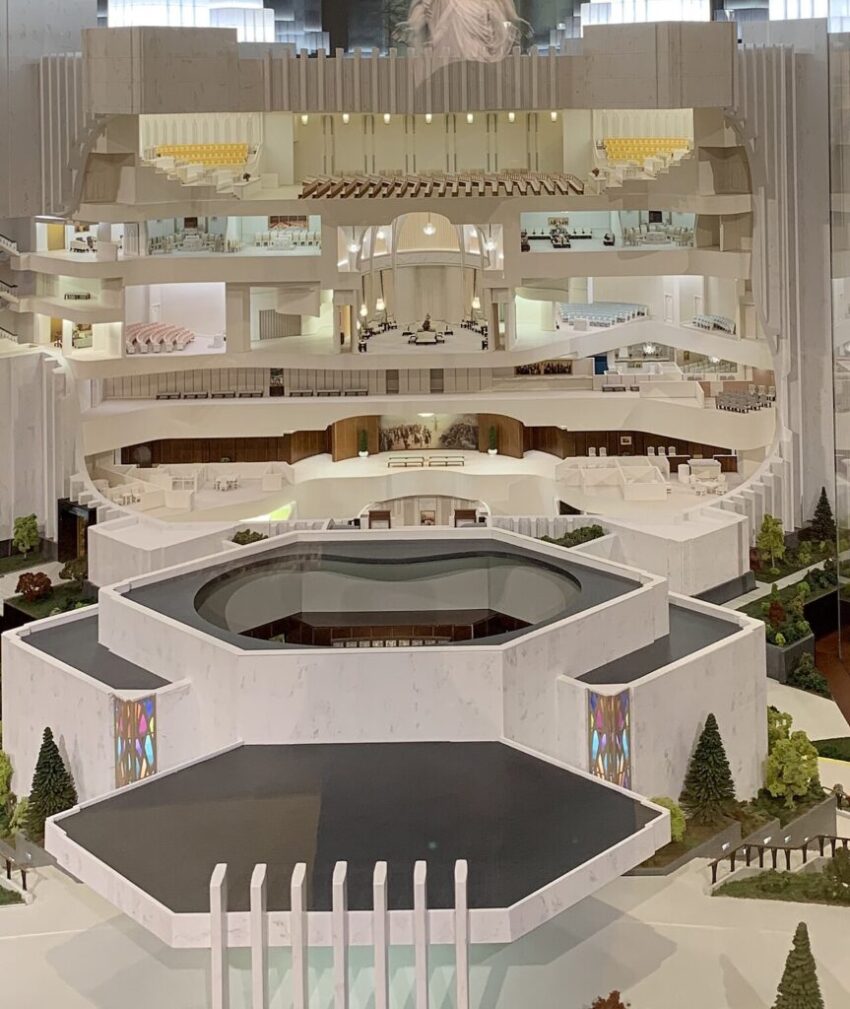
Photo: Via Wikipedia Commons. Model of the interior of the Washington D. C. Latter Day Saint Temple. Taken on January 30, 2020, at the visitor center at the temple. This file is made available under the Creative Commons CC0 1.0 Universal Public Domain Dedication.
Temples Without Biblical Foundation:
A Theological Analysis of the Absence of Scriptural Precedent for Latter-day Saint Temple Practices
Introduction
The Church of Jesus Christ of Latter-day Saints places extraordinary emphasis on temples and the rituals performed within them. These magnificent structures, numbering over 200 currently dedicated worldwide, serve as the locus of Mormonism’s most sacred ceremonies—ceremonies that the LDS Church claims are essential for eternal salvation and exaltation. According to Joseph Smith, the founding prophet of Mormonism, “the main object” of the gathering of God’s people in every age has been “to build unto the Lord a house whereby He could reveal unto His people the ordinances of His house and the glories of His kingdom.”
This essay undertakes a comprehensive theological examination of LDS temple practices, arguing that they lack any authentic biblical mandate. While the LDS Church claims its temples represent a restoration of ancient religious practices—particularly those associated with Solomon’s Temple—careful historical and scriptural analysis reveals fundamental disconnections between the biblical temple and its modern LDS counterparts. Moreover, the historical evidence demonstrates that many distinctive elements of LDS temple ceremonies derive not from ancient Israelite or early Christian practice, but from nineteenth-century Freemasonry.
The thesis of this study is straightforward: LDS temples and their associated rituals represent a novel religious innovation without scriptural warrant, drawing upon Masonic influences while claiming divine restoration. This analysis will proceed through several stages: examining the historical context of temples in biblical tradition; analyzing the Masonic parallels in LDS ceremonies; evaluating specific scriptural texts often cited in support of LDS practices; and critically assessing the Restoration claim itself.
The Gilbert LDS Temple near my home, located at “Discovery Park” in Gilbert, Arizona, is part of a broader trend within The Church of Jesus Christ of Latter-day Saints to construct temples across the globe. With temples planned or already present in 39 states and over 70 countries spanning six continents, some observers perceive these grand structures as an attempt to compensate for the perceived lack of substantive “proof of legitimacy” for the religion below ground. The Gilbert Temple, despite its grandeur, has disrupted the natural beauty of Discovery Park, which was established in 2006, a full eight years before the temple’s dedication. For many, the temple’s imposing presence almost seems like an affront to the surrounding natural landscape.
Adding a layer of irony to the situation, Discovery Park derives its name from the discovery of “actual” archaeological remnants. During construction, fossils of a Columbian Mammoth were unearthed near the site, underscoring the irony of a temple being built atop land that was once home to tangible evidence of prehistoric life. This juxtaposition highlights the clash between the church’s efforts to assert its presence through monumental architecture and the natural history of the land on which these structures are erected.
I. Historical Context: The Biblical Temple Tradition
A. The Singular Nature of the Biblical Temple
Any serious examination of LDS temple claims must begin with what the Bible actually teaches about temples. The most fundamental observation is that Scripture authorizes only one legitimate temple—the temple in Jerusalem.Three successive structures stood on Temple Mount: Solomon’s Temple (dedicated c. 960 BC), Zerubbabel’s Temple (completed c. 516 BC following the Babylonian exile), and Herod’s Temple (begun c. 20 BC, destroyed AD 70). Throughout this millennium of temple history, there was never divine authorization for multiple temples.
The biblical narrative is explicit about this exclusivity. When rival sanctuaries were established at Dan and Bethel by Jeroboam I, the biblical writers consistently condemned them as illegitimate. The Samaritan temple at Mount Gerizim likewise received no divine sanction. When Jesus spoke with the Samaritan woman at Jacob’s Well (John 4:19-26), He acknowledged this distinction: “You worship what you do not know; we worship what we know, for salvation is from the Jews.” Jesus did not validate the Samaritan temple as an acceptable alternative.
The LDS Church’s construction of multiple temples—currently exceeding 160 structures worldwide—therefore represents a departure from biblical precedent before any other consideration is examined. The multiplication of temples has no biblical warrant whatsoever.
B. The Purpose of the Jerusalem Temple
The Jerusalem temple served a specific purpose: it was the uniquely authorized place for sacrificial worship. Solomon himself articulated this at the temple’s dedication: “Behold, I am about to build a house for the name of the LORD my God and dedicate it to him for the burning of incense of sweet spices before him, and for the regular arrangement of the showbread, and for burnt offerings morning and evening, on the Sabbaths and the new moons and the appointed feasts of the LORD our God” (2 Chronicles 2:4). The temple was not a generic symbol of “God’s presence,” but the divinely mandated center of a particular sacrificial regime.
If, therefore, one claims a divine mandate to “restore” the ancient temple and its worship, consistency would require restoring the whole system as God actually prescribed it—blood sacrifices, burnt offerings, and the full sacrificial calendar—not merely a modernized, spiritualized subset of ordinances that bear the temple label. Under the Mosaic economy, the temple was fundamentally about animal sacrifice as a temporary, typological provision for sin, and these sacrifices pointed forward to Christ as the full, final, and sufficient sacrifice. As Hebrews emphasizes, “under the law almost everything is purified with blood, and without the shedding of blood there is no forgiveness of sins” (Hebrews 9:22). The very fact that the New Testament presents the sacrificial system as temporary and fulfilled in Christ underscores that the original ordinances cannot be selectively “restored” without either reintroducing animal sacrifice or implicitly denying that Christ’s once-for-all offering has truly and definitively brought that entire system to its intended end.
C. The Temple and the New Covenant
Jesus’ prophetic predictions of the temple’s destruction (Matthew 24:1-2; Mark 13:1-2) fit into a larger narrative concerning the passing of the old Mosaic covenant and the inauguration of the new covenant. This theological transition is central to New Testament teaching. The author of Hebrews explains that Christ is simultaneously the final sacrifice, the eternal high priest, and the ultimate temple (Hebrews 7-10). The old covenant, “with its sacrifices, priests, and temple,” was passing away because “what is becoming obsolete and growing old is ready to vanish away” (Hebrews 8:13).
The New Testament consistently presents the Christian community itself as God’s temple. Paul writes to the Corinthians: “Do you not know that you are God’s temple and that God’s Spirit dwells in you?” (1 Corinthians 3:16). Peter describes believers as “living stones” being “built up as a spiritual house” (1 Peter 2:5). Individual believers are also described as temples: “Or do you not know that your body is a temple of the Holy Spirit within you?” (1 Corinthians 6:19).
This transition from physical temple to spiritual temple is not incidental to Christian theology—it is essential. When the temple veil was torn from top to bottom at Christ’s crucifixion (Matthew 27:51), it signified that there is now free access to God through the blood of Christ. The need for a physical temple had been superseded.
II. The LDS Temple System: Claims and Realities
A. LDS Claims of Biblical Continuity
The LDS Church claims its temples are patterned after the biblical temple and represent a restoration of ancient practices. As Kent R. Richards, director of the LDS Church’s Temple Department, stated: “Temples are patterned after Solomon’s temple and honor the Lord and express our gratitude.” The official church website describes temples as places where sacred ordinances are performed, asserting that this follows “the pattern of Biblical days.”
The church’s publication “Why Latter-day Saints Build Temples” elaborates on this claim:
“In Biblical times sacred ordinances were administered in holy edifices for the spiritual salvation of ancient Israel. The buildings thus used were not synagogues, nor any other ordinary places of worship. They were specially constructed for this particular purpose… Following the pattern of Biblical days, the Lord again in our day has provided these ordinances for all who will believe, and directs that temples be built in which to perform those sacred rites.”
—Mark E. Petersen, Why Mormons Build Temples
B. The Reality of Fundamental Differences
Despite these claims, careful examination reveals that LDS temples bear virtually no resemblance to the biblical temple in either structure or function. The Jerusalem temple had specific, well-documented features: the Holy of Holies, the Holy Place with its altar of incense, table of showbread, and seven-branched lampstand; the Court of Priests; the bronze altar for burnt offerings; and the bronze laver for ritual washings. None of these features appear in LDS temples.
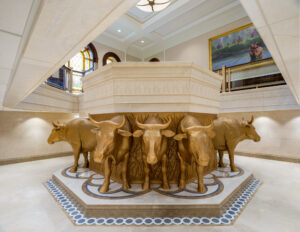
The baptistry inside the Deseret Peak Utah Temple (Photo: Intellectual Reserve, Inc)
TOOELE, Utah (KUTV) — Ahead of public tours for the newest temple of The Church of Jesus Christ of Latter-day Saints, church officials hosted media at the Deseret Peak Temple in Tooele.
The faith’s Primary General President Susan Porter, General Authority Seventy member Elder Steven Bangerter, and Utah Area President Elder Kevin Pearson spoke to reporters Monday morning.
Following the remarks, reporters were invited inside to tour what will be the Latter-day Saints’ 200th working temple.
The temple was announced in April 2019 as the Tooele Valley Utah Temple, and was later changed to the Deseret Peak Temple following an outcry to its originally-planned location in an unincorporated area of the Tooele Valley.
After a signature-gathering campaign to put it to the voters started, the church released a statement saying it was willingly withdrawing its plans for a temple — and residential community — from that area.
LDS temples instead contain features with no biblical precedent whatsoever: baptismal fonts for proxy baptisms for the dead, endowment rooms where secret ceremonies are performed, sealing rooms for eternal marriages, and celestial rooms representing the highest degree of heaven. The floor plans of LDS temples and Solomon’s Temple share nothing in common beyond the fact that both are called “temples.”
More significantly, the activities performed in these respective structures have nothing in common. The Jerusalem temple was devoted to animal sacrifice—a loud, bloody, visceral form of worship. LDS temples, by contrast, are places of quietude where no sacrifices occur. The main ordinances in LDS temples—baptism for the dead, the endowment ceremony, and celestial marriage—were never performed in the biblical temple.
C. The Temple Endowment Ceremony
The centerpiece of LDS temple worship is the endowment ceremony. According to LDS teaching, this ceremony instructs participants in the knowledge necessary to return to God’s presence and provides essential covenants that must be made to achieve exaltation. Wikipedia describes it thus:
“The endowment usually refers to the first endowment, which is a two-part ordinance (ceremony) designed for participants to become kings, queens, priests, and priestesses in the afterlife. In the first part, participants take part in a scripted reenactment of the Biblical creation and fall of Adam and Eve. The ceremony includes a symbolic washing and anointing, and receipt of a ‘new name’ which they are not to reveal to others except at a certain part in the ceremony, and the receipt of the temple garment, which Mormons then are expected to wear under their clothing day and night throughout their life. In the second part, participants are taught symbolic gestures and passwords considered necessary to pass by angels guarding the way to heaven.”
—Wikipedia, “Endowment (Mormonism)“
Nothing remotely similar to this ceremony appears anywhere in Scripture. There is no biblical record of early Christians or Jews receiving secret names, learning handshakes (“tokens”), memorizing passwords, wearing special garments, or being taught gestures necessary to pass by heavenly sentinels. These elements are completely foreign to biblical religion.
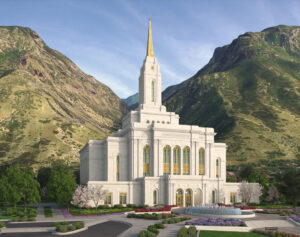
Renderings of what the rebuild of the Provo Utah Temple will look like. Photo via Intellectual Reserve.
It was 50 years ago Wednesday that Joseph Fielding Smith, then president of The Church of Jesus Christ of Latter-day Saints dedicated the Provo Utah Temple — the 15th in the church.
The church announced the new temple on Aug. 14, 1967, and held a special groundbreaking on Sept. 15, 1969. It was completed in early 1972. At the time, the temple serviced more than 100,000 members in central and eastern Utah.
After the Missionary Training Center was built just west of the temple, the Provo Utah Temple became the busiest temple in the church, as it also serviced students at nearby Brigham Young University, according to Richard O. Cowan, retired professor of Religious Studies, Church History and Doctrine at Brigham Young University and author of “Provo’s Two Temples” published in 2014 in cooperation with the Religious Studies Center and Deseret Book.
It wasn’t until the 2016 dedication of the Provo City Center Temple that some of the workload in Provo was lightened. The Mt. Timpanogos Temple in American Fork, dedicated some years earlier, also helped as the church membership continues to grow in Utah County.
While members of the church revere the temples as the House of the Lord, the modern architecture of the temple often prompted other nicknames such as the wedding cake, flying saucer and much, much, more.
III. The Masonic Connection: Historical Evidence
A. Joseph Smith and Freemasonry
The historical record provides a compelling explanation for the origin of LDS temple ceremonies: they derive substantially from Freemasonry. Joseph Smith became a Mason on March 15, 1842, when Illinois Grand Master Abraham Jonas formally organized the Nauvoo Lodge and initiated Smith and Sidney Rigdon as Entered Apprentice Masons in the upper room of Smith’s Red Brick Store; the following day Jonas advanced them to the degrees of Fellow Craft and Master Mason. Just seven weeks later, on May 4, 1842, Smith introduced the endowment ceremony to nine associates in that same upper room in Nauvoo, Illinois.
The timing is significant. The documentary record preserves no detailed account of a temple endowment ceremony before Smith’s Masonic initiation, and even LDS scholars acknowledge the close chronological and structural relationship between the two. Latter-day Saint historian Richard Bushman has noted that Smith “had a green thumb for growing ideas from tiny seeds,” a characterization that fits the way Masonic ritual elements appear to have been adapted, expanded, and recast within a new theological framework.
“There is absolutely no question in my mind that the Mormon ceremony which came to be known as the Endowment, introduced by Joseph Smith to Mormon Masons initially, just a little over one month after he became a Mason, had an immediate inspiration from Masonry. It is also obvious that the Nauvoo Temple architecture was in part, at least Masonically influenced. Indeed, it appears that there was an intentional attempt to utilize Masonic symbols and motifs. The sun stones, and the moon and star stones, were examples. An additional example was the angel used on the weather vane on the top of the Temple. [Above the angel] is a beautiful compass and square, in the typical Masonic fashion.”
~ Dr. Reed C. Durham, Jr., as printed in “Joseph Smith and Masonry: No Help for the Widow’s Son,” Martin Pub. Co., Nauvoo, Ill., 1980, p. 17.)
Equally significant is who received this first Nauvoo endowment. All nine of the initial participants were Freemasons or closely tied to the emerging Nauvoo lodge network. James Adams, for example, served as Deputy Grand Master of the Grand Lodge of Illinois and was “instrumental in establishing Freemasonry among the Mormons,” later becoming one of the select group who received the endowment when it was first introduced. Other early recipients—including leaders such as George Miller and Heber C. Kimball—had Masonic backgrounds and were active in the Nauvoo Lodge, further underscoring that the earliest LDS temple endowment emerged within, and cannot be cleanly separated from, a distinctly Masonic milieu.
George Miller’s Masonic Involvement
George Millerwas a prominent Freemason in Nauvoo. In December 1841, he became the Worshipful Master (president) of the newly organized Nauvoo Masonic Lodge, serving in that role from December 1841 to November 1842. Illinois Grand Master Abraham Jonas authorized the lodge’s creation on October 15, 1841, explicitly appointing Miller as the first Master. Miller’s leadership extended to facilitating early lodge meetings and operations, as documented in Nauvoo Lodge minutes.
Heber C. Kimball’s Masonic Involvement
Heber C. Kimball had an established Masonic background predating Nauvoo. He received the three craft degrees of Freemasonry in 1823 at Victor Flats Lodge in Ontario County, New York, and petitioned for York Rite degrees (Royal Arch Masonry) in 1824 at Canandaigua, New York. In Nauvoo, Kimball was among the original petitioners to establish the lodge and served as its first Junior Deacon upon formal organization on March 15, 1842. He remained active in Nauvoo Freemasonry throughout his time there.
Some LDS apologists attempt to minimize or distance the religion from Freemasonry’s influence on its temple rites, as seen in the following MasonicFind.com article, which acknowledges merely a “brief” but “interesting” history between the two while attributing tensions primarily to discrimination against Mormons, plural marriage, and “misconceptions” about Joseph Smith’s alleged plagiarism of Masonic rituals.
The piece details Nauvoo Lodge’s rapid growth to over 1,500 Masons (half of all U.S. Masons at the time), irregularities like mass balloting, and its 1843 revocation amid complaints—yet it downplays the endowment’s May 1842 debut just weeks after Smith’s initiation, claiming instead that Smith merely “adopted the Masonic teaching model” (theatrical gestures, symbols) to convey preexisting doctrines without substantial plagiarism.
Freemasonry uses the construction of King Solomon’s Temple as an allegory for moral self-improvement and service to others; the Church’s Temple Endowment Ceremony uses the Biblical account of the Creation as an allegory to illustrate our relationship with God the Father.
In Freemasonry, we take obligations upon ourselves to be good men and serviceable to our community; in the Church’s temple endowment ceremony, we make covenants with our Lord Jesus Christ to keep His commandments.
Some people try to draw parallels between the Church’s Temple Endowment Ceremony and the degree ceremonies of some appendant/concordant bodies (most notably Royal Arch Masonry); it should be noted that neither Joseph Smith, Jr, nor any one who succeeded him as president of the Church is recorded to have joined any appendant/concordant bodies to Masonry.
But such efforts to sanitize the connection falter against the facts: Smith’s expedited degrees on March 15–16, 1842; the endowment’s introduction seven weeks later in the same room to an all-Masonic cohort; and the absence of prior revelation or ceremony documentation. Whether framed as inspiration, adaptation, or borrowing, the persistent structural parallels—tokens, penalties, oaths, regalia—reveal Freemasonry as the proximate source of LDS temple liturgy, regardless of apologists’ temporary or “innocent”rationalizations. In practice, Joseph Smith appears to have selectively lifted those Masonic elements most useful for shrouding his new movement in an aura of sacred mystery—secret handshakes, guarded passwords, ritual penalties, and esoteric symbolism—thereby clothing a nineteenth-century American sect in the borrowed gravitas of an older, oath-bound fraternity.
FAIR apologist Scott Gordon claims Joseph Smith pursued Freemasonry primarily to shield Nauvoo Saints from hostile non-Mormon neighbors via Masonry’s fraternal oaths of mutual protection, citing Apostle John Widtsoe’s later interpretation and portraying it as a strategic response to Missouri mob trauma. Yet this narrative weaves Smith’s explicit “motives” from speculative whole cloth, as no primary historical documentation—Joseph Smith Papers, Nauvoo Lodge minutes, Times and Seasons editorials, or Smith’s own discourses—records any such protective intent.
That brings us to the connection with the story of the Mormons. The Saints had suffered much at the hands of the mobs of Far West, Missouri. They escaped back east across the Mississippi river to Illinois where they built the city of Nauvoo. Joseph Smith was looking for a way to protect the members of the Church from their antagonistic non-Mormon neighbors, and he became interested in Freemasonry. As part of their ceremony, the Masons take an oath to protect and care for each other. It seemed the perfect solution. The Saints would become Freemasons and fall under the protection of their Masonic non-Mormon neighbors, while at the same time learning the ancient rituals of Masonry, which at the time were believed to date back to the time of Solomon. Apostle John Widtsoe later wrote that Joseph Smith was initiated into the Masons to foster “the spirit of brotherhood” and to “lessen the mob persecutions to which the Church had been subjected in Ohio and Missouri.”
Sources emphasize temple preparation, doctrinal restoration, and perceived ancient Masonic echoes; the lodge’s explosive growth and irregularities fueled Illinois Grand Lodge complaints, while Smith’s March 1842 initiation preceded the endowment’s debut without protective rhetoric, suggesting apologetic revisionism to recast evident ritual borrowing as pragmatic defense.
And yet…
“Masons who visit the Temple Block in Salt Lake City are impressed by what they call the Masonic emblems displayed on the outside of the Mormon Temple. Yes, the ‘Masonic emblems’ are displayed on the walls of the Temple—the sun, moon and stars, ‘Holiness to the Lord,’ the two right hands clasped in fellowship, the All-seeing eye, Alpha and Omega, and the beehive. Masonic writers tell us that the Mormon Temple ritual and their own are slightly similar in some respects. Without any apologies we frankly admit that there may be some truth in these statements.”
~ Introduction, Mormonism and Masonry, 1956, by E. Cecil McGavin)
B. Documented Parallels
The parallels between Masonic ritual and the LDS endowment are extensive and well-documented. Note another quote from LDS historian Reed C. Durham, Jr., who served as president of the Mormon History Association:
“There is absolutely no question in my mind that the Mormon ceremony which came to be known as the Endowment, introduced by Joseph Smith to Mormon Masons initially, just a little over one month after he became a Mason, had an immediate inspiration from Masonry. This is not to suggest that no other source of inspiration could have been involved, but the similarities between the two ceremonies are so apparent and overwhelming that some dependent relationship cannot be denied.”
—Reed C. Durham, Jr., No Help for the Widow’s Son (1980)
Mormon Apostle Heber C. Kimball, himself a Mason, wrote to Parley P. Pratt in 1842 (spelling original): “Thare is a similarity of preast Hood in masonary. Br Joseph ses masonry was taken from preasthood but has become degenerated, but menny things are perfect.” This admission from an LDS apostle acknowledges the obvious connection while attempting to explain it through the lens of restoration.
C. Specific Ceremonial Elements
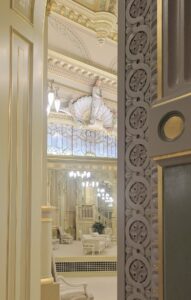
The celestial room in temples like the Salt Lake Temple shown here represents the highest level of heaven in LDS theology, and is reached after passing the testing portion of the endowment ceremony.Via Wikipedia. Creative Commons License CC BY 4.0.
Multiple independent sources document that several distinctive features of the LDS endowment closely parallel standard elements of Masonic ritual. Both systems employ graded handshakes—“grips” in Freemasonry and “tokens”in Mormonism—conveyed with specific names and passwords that initiates covenant never to reveal outside the rite. Pre‑1990 LDS penalties for divulging these secrets (throat cut, heart and vitals torn out, body cut asunder) track almost verbatim the Entered Apprentice, Fellow Craft, and Master Mason oaths, including their accompanying cutting gestures.
Ritual aprons and the symbols of the square and compasses likewise appear in both traditions, with LDS garments and temple veils marked by adapted square‑and‑compass motifs even as later apologists insist on reinterpreted meanings. The endowment formerly incorporated the five points of fellowship—“inside of right foot by the side of right foot, knee to knee, breast to breast, hand to back, and mouth to ear”—at the veil, language preserved in transcripted temple texts and matching classic Masonic descriptions of the same rite. Finally, both ceremonies move candidates progressively through symbolic spaces or rooms representing stages of moral or spiritual advancement (from creation/fall to celestial glory in the LDS case), a structural parallel noted by critical and believing commentators alike.
Church’s Official Excuse for Removing Penalty Oaths
The LDS Church removed the explicit penalty oaths and accompanying gestures from the endowment ceremony in April 1990 as part of routine periodic revisions to enhance clarity, reduce discomfort, and ensure the ordinance effectively teaches doctrine without confusion. Apologists like FAIR explain these penalties symbolized personal resolve to keep covenants—“I’d rather die than reveal sacred things”—akin to “cross my heart and hope to die,” never literal threats or violence, and their removal addressed modern sensitivities since they “confused people more than helped.” Earlier changes (1921–1927 under George F. Richards) softened graphic descriptions to “suffer my life to be taken.”
Why the Excuse Falls Short
This rationale falters historically and logically: if penalties were divinely revealed as essential to the “restored” endowment (introduced by Smith in 1842), their excision—without revelation or prophetic announcement—admits ongoing human tinkering with sacred ordinances, contradicting claims of unchanging ancient purity. Their close mimicry of Masonic oaths (throat-slitting, disembowelment) underscores derivative origins, and removal amid growing ex-Mormon exposés (e.g., 1980s Temple ceremonies videos) suggests damage control for PR, not refinement—especially as other “uncomfortable” elements like patriarchal covenants were later adjusted. No primary source ties penalties to Old Testament symbolism exclusively; they evaporate as cultural baggage from Freemasonry, exposing the endowment’s mutable, non-eternal nature.
Even LDS Apostle John A. Widtsoe acknowledged the similarities, though he attempted to minimize their significance: “They do not deal with the basic matters [of the endowment] but rather with the mechanism of the ritual.” LDS Church historian B.H. Roberts said that the Masonic ritual was “analogous, perhaps, in some of its features” to the temple endowment. More recently, Apostle Jeffrey R. Holland acknowledged in a BBC interview that temple vows to secrecy are “similar to a Masonic relationship.”
D. The Absence of Ancient Precedent
The LDS apologetic response to these parallels is to claim that both Masonry and the temple endowment derive from ancient temple rites that were practiced in Solomon’s Temple. Heber C. Kimball articulated this view: “We have the true Masonry. The Masonry of today is received from the apostasy which took place in the days of Solomon and David. They have now and then a thing that is correct, but we have the real thing.”
This claim faces insurmountable historical problems.Masonry cannot be reliably traced earlier than medieval Europe, and its speculative rituals developed primarily in the seventeenth and eighteenth centuries. As LDS author Greg Kearney acknowledges: “Unfortunately there is no historical evidence to support a continuous functioning line from Solomon’s temple to present. We know what went on in Solomon’s temple; it’s the ritualistic slaughter of animals.”
The Bible provides detailed descriptions of what occurred in Solomon’s Temple—and none of it resembles either Masonic or LDS ritual. There were no secret handshakes, no password rituals, no penalty oaths, no sacred garments beyond the priestly vestments, and no ceremonial progression through symbolic rooms. The claim that these elements represent “restored”practices contradicts both biblical and historical evidence.
IV. Scriptural Analysis: Examining LDS Proof Texts
A. Baptism for the Dead: 1 Corinthians 15:29
The LDS practice of baptism for the dead constitutes the majority of temple work, with millions of proxy baptisms performed annually. The primary scriptural support offered for this practice is 1 Corinthians 15:29: “Otherwise, what do people mean by being baptized on behalf of the dead? If the dead are not raised at all, why are people baptized on their behalf?”
Speaking of baptism, you asked my opinion of 1 Corinthians 15:29: “Else what shall they do which are baptized for the dead, if the dead rise not at all? why are they then baptized for the dead?” Here it is in a nutshell: The Christian church has never practiced baptism for the dead in the sense that the LDS Church wants us to believe. They are forced to take 1 Corinthians 15:29 out of its context and force their own peculiar meaning on it.
First, the Bible does not teach that baptism saves anyone (even 1 Peter 3:21, upon close examination, does not do so), hence it certainly would not be needed to “redeem the dead” as Mormons put it. 1 Corinthians 15:29 is found in the “resurrection chapter.” The needed clue to its meaning is found in the language in which it was originally written, that being Greek. The word “for” is the Greek term huper. It refers to the taking of someone’s place, or to substitution. Baptism “for” the dead is not baptism of a living person in behalf of or for the benefit of a dead person, but rather the immersion of a living person in the place of or into the former position of a now deceased person. It is the baptism of a new convert who takes the place in the church of one who has died. The baptism of a young child, for example, the day after an elderly saint of the Lord has passed away could be viewed as the younger person coming to “fill” the position of the person who has gone home to be with the Lord.
This vein of thinking is carried on in the context when Paul says in the next verse, “And why stand we in jeopardy every hour?” Being a Christian in those days was a dangerous business. Paul’s whole point in the entire passage has to do with the fact that if the dead are not raised (v. 12) there is absolutely no point in bringing new converts into this dangerous position through baptism when there is no future life to promise them, no reward in the future for their faithfulness. Why not just let everyone die off without filling their positions in the church, since, if there is no resurrection, “we are of all men most to be pitied” (v. 19). Belief in baptizing the living to somehow help in saving the dead demonstrates a complete misunderstanding of the New Testament teaching concerning the nature, extent, and purpose of salvation.
Several observations undermine the LDS interpretation of this verse. First, Paul uses the third person (“they”) rather than the first person (“we”). If baptism for the dead were a normative Christian practice, Paul would naturally have included himself. His grammatical distancing suggests he is describing a practice of others, not endorsing it.
Second, this verse constitutes the sole mention of baptism for the dead in all of Scripture.If this practice were essential for salvation—the LDS position—its near-total absence from biblical teaching is inexplicable. Doctrine and Covenants 128:17 describes baptism for the dead as “the most glorious of all subjects belonging to the everlasting gospel.” How could the most glorious subject of the gospel merit only a single oblique reference?
Third, the historical context provides no support for the LDS interpretation. There is no evidence that the early Christians practiced baptism for the dead. Later, certain heretical groups such as the Cerinthians and Marcionites adopted such practices, but these groups postdate Paul’s letter and were explicitly condemned by the church.
Fourth, and most fundamentally,even if some Corinthians were practicing proxy baptism, this would not establish its legitimacy. Paul’s argument in 1 Corinthians 15 concerns the reality of resurrection, not the validity of baptismal practices. He employs the Corinthians’ own practice as an ad hominem argument: “If you deny the resurrection, your own practice of baptizing for the dead makes no sense.” This rhetorical strategy does not endorse the practice.
In contemporary Mormon practice, living persons are baptized for deceased, unbaptized persons. This verse is often cited as witness to their practice. This is based on the assumption, among others, that ‘the dead’ to whom St. Paul here refers are deceased non-Christians who are in some way made Christians by virtue of a currently living person being baptized. There are any number of problems with this. First and foremost, it is unclear at best how a dead person receiving the mystery of baptism would benefit them, any more than a deceased person receiving any other mystery of the church. A deceased person receiving the Eucharist, or monastic tonsure, or being married makes no more sense than a deceased person receiving the Holy Spirit.
St. Paul goes to great pains in 1 Corinthians 10 to argue that baptism does not necessarily entail salvation (1 Cor 10:1-6). Further, 1 Corinthians was written to the church in Corinth, at the latest, in 57 AD. This means that there were only 24 years between the writing of this epistle and the first Christian baptisms. This would mean that, hypothetically, the baptism of people on behalf of the people who died during those 24 years would have had to become a practice widespread enough in the early Christian communities that St. Paul could reference it during that window. This suggestion therefore makes neither theological nor historical sense.
B. Luke 24:49 and the “Endowment of Power”
LDS sources often cite Luke 24:49, where Jesus tells His disciples to “stay in the city until you are clothed with power from on high,” as precedent for the temple endowment. The term “endowment” derives from this passage, where the Greek word enduo means “to clothe” or “to be clothed with.”
The context, however, makes clear that Jesus is referring to the coming of the Holy Spirit at Pentecost (Acts 2), not to a temple ceremony. The “power from on high” was fulfilled when the Spirit descended upon the disciples, enabling them to proclaim the gospel in multiple languages. There is no temple ceremony in view—the disciples were to wait “in the city,” not “in the temple.” The fulfillment occurred in an “upper room” (Acts 1:13), not a temple.
In this pivotal moment, Jesus instructs His disciples to remain in Jerusalem until they receive a transformative empowerment from on high. This directive serves as a crucial preparation for their mission, underscoring the importance of divine assistance in spreading the Gospel. The promise He refers to, which is the Holy Spirit, is fundamentally linked to Old Testament prophecies about God’s commitment to His people, emphasizing that this outpouring will enable them to fulfill their calling as witnesses of Christ.
C. Eternal Marriage and Matthew 22:30
The LDS doctrine of celestial marriage—also termed eternal or temple marriage—purports to seal a man and woman “for time and all eternity,” enabling them to procreate spirit children as exalted gods in the celestial kingdom. Introduced by Joseph Smith in the 1840s and canonized in Doctrine and Covenants 132, it requires a temple ordinance performed by priesthood authority, distinguishing it from civil marriage, which ends at death.
Jesus, however, directly refuted this concept in responding to the Sadducees’ hypothetical about a woman sequentially married to seven brothers (Matthew 22:23–30; Mark 12:18–25; Luke 20:27–38). He declared, “For in the resurrection they neither marry nor are given in marriage, but are like angels in heaven” (Matthew 22:30), emphasizing that resurrected beings transcend earthly marital states.
LDS defenders counter that Jesus addressed only new marriages contracted post-resurrection (“marry” and “given in marriage” as present passive verbs in Greek), not pre-sealed unions that persist eternally; they cite D&C 132:15–17, which reinterprets “angels”as unexalted singles who rejected celestial marriage, remaining “separately and singly” as ministering servants. Yet this strains the text’s plain sense: Jesus equates all resurrected persons with angels, who in LDS theology (per D&C 132 and Joseph Fielding Smith) lack marital or procreative roles, serving exalted families instead. The Sadducees’ question targeted eternal marriage’s logic, and Jesus’ unqualified denial—framed as rebuke for their scriptural ignorance—admits no exception for prior sealings, aligning with broader New Testament silence on posthumous unions.
The entire LDS temple system rests upon the claim that it represents a restoration of practices lost during a “Great Apostasy.” According to this narrative, the true church established by Jesus Christ fell into complete apostasy shortly after the death of the apostles. Priesthood authority was lost, essential ordinances were corrupted or abandoned, and the fullness of the gospel disappeared from the earth until Joseph Smith’s prophetic calling in the nineteenth century.
Wikipedia summarizes the LDS understanding:
“In Mormonism, the restoration refers to a return of the authentic priesthood power, spiritual gifts, ordinances, living prophets and revelation of the primitive Church of Christ after a long period of apostasy… According to the LDS Church, the Great Apostasy in Christianity began not long after the ascension of Jesus Christ. It was marked with the corruption of Christian doctrine by Greek and other philosophies, with followers dividing into different ideological groups, and the martyrdom of the apostles which led to a loss of priesthood authority to administer the church and its ordinances.”
—Wikipedia, “Restoration (Mormonism)“
B. Historical and Theological Problems
The Restoration narrative faces several critical problems. First, if temple ordinances were essential for salvation and were practiced by the early church, we should expect some historical evidence of their existence.Yet there is none. No first-century Christian document describes anything resembling LDS temple ceremonies. The elaborate rituals of the endowment—with their tokens, passwords, and progressive stages—appear nowhere in early Christian literature.
Second, the timing and source of LDS temple ceremonies contradict the restoration claim.The ceremonies were introduced in 1842, immediately following Joseph Smith’s initiation into Freemasonry. If these ceremonies represented ancient Christian practice, why did they not appear until seven weeks after Smith learned Masonic ritual? Why did the Kirtland Temple (dedicated in 1836) not include endowment ceremonies? The historical sequence strongly suggests that the Masonic ceremonies provided the template for the LDS endowment, not any ancient source.
Third, the New Testament explicitly teaches that physical temples are obsolete under the new covenant.If temples and their ordinances had been central to Jesus’ teaching and the apostolic church, the New Testament would say so. Instead, it teaches the opposite: that the temple has been fulfilled in Christ and that believers themselves constitute God’s temple.
If Joseph Smith’s “Restoration Gospel” had truly been the original message of Christ and His apostles, history itself would bear the scars of its loss. Yet nowhere in the record do we find even a whisper of such a disappearance. This gospel teaches the exaltation of man to godhood, worlds ruled by resurrected deities, an embodied Father, pre-mortal existence, tiered kingdoms of glory, sacred temple rites, and vicarious baptisms for the dead—administered through angelically restored Aaronic and Melchizedek priesthoods.
But the trail of history is silent. The fathers of the faith—Ignatius, Justin Martyr, Irenaeus, Athanasius—make no mention of such things. The councils of Nicaea and Chalcedon ignore them completely; creeds, liturgies, and monasteries preserve no fragments of them. No debates, no heresies, no schisms, nor decrees even suggest their removal. The notion that God was once a mortal man, or that humans are His literal spirit-children destined for personal divinity, never surfaces for nearly two thousand years.
C. The Evolution of LDS Temple Ceremonies
If LDS temple ceremonies represent divinely revealed, primordial practices “instituted in the heavens before the foundation of the world,” their repeated, substantive alterations undermine that foundational claim. LDS Seventy Royden G. Derrick wrote in Temples in the Last Days (1988): “Temple ordinances instituted in the heavens before the foundation of the world are for the salvation and exaltation of God’s children. It is important that the saving ordinances not be altered or changed, because all of those who will be exalted, from the first man, Adam, to the last, must be saved on the same principles” (p. 36). Yet since Joseph Smith’s 1842 Nauvoo debut, leaders have revised the endowment multiple times without public revelation or explanation.
The watershed 1990 overhaul—under Gordon B. Hinckley—excised the penalty oaths/gestures, the five points of fellowship at the veil, and the Protestant preacher (portrayed as Lucifer’s hireling demanding payment for salvation), alongside softening Eve’s blame for the Fall. Earlier, 1927 revisions (under Heber J. Grant) eliminated the “Oath of Vengeance,”which invoked God’s retribution on Joseph Smith’s Missouri murderers—“pour out thy wrath upon the United States”—a holdover from 1870s Brigham Young-era ceremonies documented in Reed Smoot hearings and apostate accounts. The 2019 changes (under Russell M. Nelson) equalized women’s covenants (removing direct obedience to husbands, aligning with men’s to God), added Eve dialogue, and streamlined presentation via live actors and video. These ad hoc tweaks—totaling over 20 major shifts—reveal pragmatic adaptation to cultural pressures, not immutable heavenly forms.
These modifications present a dilemma: either the ceremonies can be changed (undermining claims of divine, unchangeable revelation) or the earlier versions were defective (raising questions about the salvation of those who participated in them). Neither option supports the LDS position that these ceremonies represent restored, essential, divine ordinances.
VI. Theological Implications: The Gospel and the Temple
A. Salvation by Ordinance versus Salvation by Grace
The fundamental theological issue at stake is the nature of salvation itself. The LDS temple system presupposes that salvation (particularly exaltation in the highest degree of the celestial kingdom) requires participation in specific ceremonial ordinances. Without a temple endowment and celestial marriage, the highest levels of eternal life are unattainable.
This understanding contradicts the New Testament teaching that salvation is by grace through faith, apart from ceremonial works. Paul writes: “For by grace you have been saved through faith. And this is not your own doing; it is the gift of God, not a result of works, so that no one may boast” (Ephesians 2:8-9). The gospel message is that Christ’s sacrificial death and resurrection accomplished everything necessary for salvation. Nothing needs to be added.
The LDS temple system effectively denies the sufficiency of Christ’s atonement by requiring additional ordinances for salvation. This is not a minor theological disagreement but strikes at the heart of the Christian gospel.
The traditional Christian understanding of salvation as an unmerited gift finds its clearest expression in the apostle Paul’s letter to the Romans. Romans 6:23 declares, “For the wages of sin is death, but the gift of God is eternal life in Christ Jesus our Lord.” This verse establishes a fundamental distinction that has shaped Christian soteriology for nearly two millennia: wages are earned through work, while gifts are freely given without regard to merit or reciprocal obligation.
Paul’s theological framework in Romans builds systematically toward this declaration. In Romans 3:23, he establishes universal human sinfulness: “All have sinned and fall short of the glory of God.” This universal condition creates an insurmountable barrier between humanity and God’s holiness. Romans 3:24 then presents the solution: humanity is “justified freely by his grace through the redemption that is in Christ Jesus.” The Greek word translated “freely”(δωρεάν, dorean) carries the meaning of “without payment” or “gratis”—emphasizing that justification comes without any contribution from the recipient.
Ephesians 2:8-9 provides perhaps the most explicit statement of this doctrine: “For by grace you have been saved through faith. And this is not your own doing; it is the gift of God, not a result of works, so that no one may boast.”Here, Paul (or a close associate writing in his name) removes any ambiguity about the role of human works in salvation. Not only is salvation by grace, but even the faith through which one receives this grace is itself characterized as God’s gift rather than human achievement.
B. Access to God
The LDS temple system also contradicts the New Testament teaching about believers’ access to God. Under the old covenant, only the high priest could enter the Holy of Holies, and only once per year. But when Christ died, “the curtain of the temple was torn in two, from top to bottom” (Matthew 27:51), signifying that access to God was now open to all believers.
The author of Hebrews elaborates: “Therefore, brothers, since we have confidence to enter the holy places by the blood of Jesus, by the new and living way that he opened for us through the curtain, that is, through his flesh, and since we have a great priest over the house of God, let us draw near with a true heart in full assurance of faith” (Hebrews 10:19-22). Every believer now has direct access to God through Christ.
The LDS temple system reinstates barriers. Access to its sacred spaces requires a “temple recommend,” obtainable only by demonstrating worthiness through a series of interviews and meeting specific behavioral and financial requirements (including payment of a full tithe). This system contradicts the New Testament teaching that all believers have free access to God through Christ.
Prior to the time of our Lord’s earthly manifestation man had attempted in vain to approach to God. Altars, sacrifices, cleansings, gifts, were in themselves all unavailing, for man could not merit God’s favour or enter by his own efforts into fellowship with the Most High. The futility and hopelessness of all mere human attempts to come back to God were proved again and again in history, among both Jews and Gentiles, and man’s return to his Father in heaven was made possible only when “God so loved the world that he gave his only begotten Son.” The Lord Jesus Christ, God’s Son and our Saviour, became the Way, the Truth, and the Life; and now because of what happened on that first Good Friday, a new and living way has been consecrated for us by the blood of Jesus. Now there is unhindered approach to God, the way is made clear, all obstacles are removed, and the soul is free to traverse that way until it reaches the very heart of God.
Conclusion
This examination has demonstrated that LDS temples and their associated rituals lack any authentic biblical mandate. The evidence leads to several inescapable conclusions:
First, LDS temples bear no structural or functional resemblance to the biblical temple in Jerusalem.The Bible authorized one temple for the specific purpose of animal sacrifice. LDS temples are multiple structures where no sacrifices occur, devoted instead to ceremonies unknown to Scripture.
Second, the distinctive elements of LDS temple ceremonies—secret handshakes, passwords, penalty oaths, progressive ritual stages, and sacred garments—derive not from ancient Israelite or early Christian practice but from nineteenth-century Freemasonry. The timing of Joseph Smith’s introduction of these ceremonies (seven weeks after his Masonic initiation) and their documented similarities to Masonic ritual establish this connection beyond a reasonable doubt.
Third, the scriptural texts cited in support of LDS temple practices fail to provide the claimed support when examined in context. Baptism for the dead finds no genuine warrant in 1 Corinthians 15:29; the “endowment of power” in Luke 24:49 refers to Pentecost, not a temple ceremony; and Jesus’ teaching about marriage in the resurrection directly contradicts the LDS doctrine of celestial marriage.
Fourth, the Restoration claim cannot be sustained historically or theologically. There is no evidence that early Christians practiced anything resembling LDS temple ceremonies, and the New Testament explicitly teaches that the temple system has been fulfilled and superseded in Christ.
Fifth, the LDS temple system fundamentally contradicts the New Testament gospelby making salvation dependent upon ceremonial ordinances rather than upon grace through faith in Christ. It reinstates barriers between believers and God that Christ’s death removed.
In light of these findings, the LDS claim to have restored ancient temple worship must be rejected. What Latter-day Saints possess is not a restoration of biblical religion but an innovative nineteenth-century religious synthesis incorporating elements from Freemasonry and presented under the guise of divine revelation. However sincere the devotion of individual Latter-day Saints may be, their temple worship rests upon a foundation that cannot withstand historical and scriptural scrutiny.
The Christian gospel offers something far better than temple ordinances: direct access to God through the finished work of Jesus Christ, salvation as a gift received by faith, and the indwelling presence of the Holy Spirit, making every believer a temple of the living God. This is the authentic biblical faith that requires no restoration because it has never been lost.
This is another article in our continuing series, “Questions Worth Asking.”
This article was developed with the assistance of artificial intelligence tools, which have proven to be valuable research assets across numerous academic disciplines. While AI-generated insights informed much of this work, all content has been carefully reviewed, supplemented with additional research and pertinent sources, and edited by the author to ensure accuracy, theological fidelity, and relevance to the reader.