
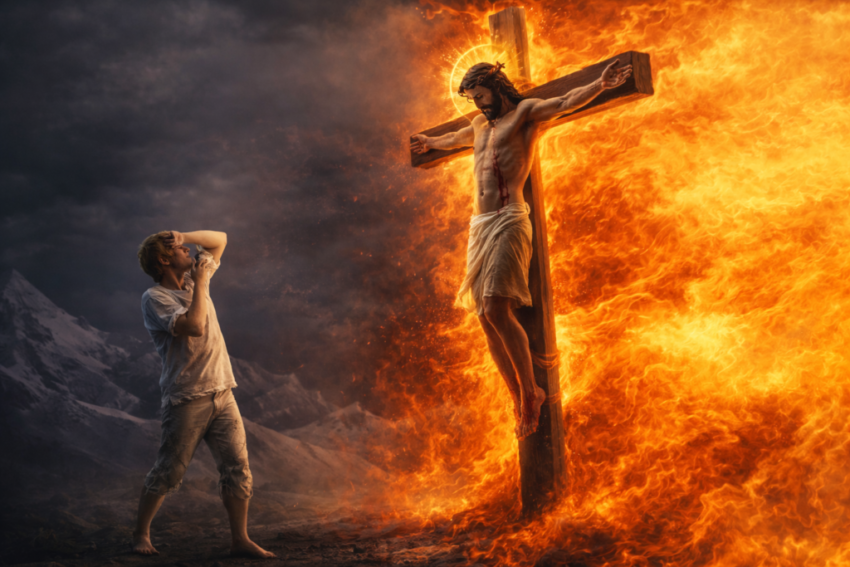
There is a moment in every conversation about faith when words run out. Not because we lack information, but because information was never going to be enough. The story of William—a young man preparing for his Mormon mission, armed with arguments and fortified by years of religious training—illustrates this truth with striking clarity. Here was someone who could parry every theological thrust, deflect every doctrinal correction, and retreat behind walls of pre-packaged responses. He didn’t need another debate partner. He needed to see something that arguments alone could never show him.
This encounter invites us to reconsider what we’re actually doing when we share the gospel. Are we trying to win arguments, or are we inviting spiritually dead people to encounter the only One who can give them life?
The Limitation of Apologetics Alone
Please understand: I am not dismissing apologetics. Rigorous thinking, careful scholarship, and the ability to give a reasoned defense of our faith all have their place (1 Peter 3:15). But we must recognize that apologetics serves the gospel—it is not the gospel itself. When we mistake the scaffolding for the building, we end up constructing elaborate frameworks around a space where Christ should stand.
William knew his talking points. He could explain temple ordinances, missionary requirements, covenant-keeping, and commandment-following. What he couldn’t see—what no amount of debate would reveal—was that all his religious activity was an attempt to build his own shelter against divine judgment. He was constructing a house of human effort while the fire of God’s holiness blazed ever closer.
The turning point came not through a more clever argument but through a picture—the painting Propitiation by Chris Powers, depicting Christ on the cross with the fire of God’s wrath behind Him and a man completely hidden in His protection. This visual proclamation accomplished what hours of discussion could not. It showed William what the gospel actually offers: not a system to follow, but a Savior to hide behind.
The Fire and the Shelter
Scripture consistently presents God’s holiness as consuming fire. “For our God is a consuming fire,” declares Hebrews 12:29, echoing the revelation at Sinai where the mountain blazed, and the people trembled. The fire represents not divine cruelty but divine purity—the absolute inability of a holy God to coexist with sin. This is the reality every human being faces, whether they acknowledge it or not.
The question posed to William cuts to the heart of the matter: What would happen if that man stepped out from behind Jesus and faced that fire on his own? His whispered answer—“He’d be destroyed”—revealed that somewhere beneath his confident exterior, William understood his true predicament. Strip away the temple recommend, the mission papers, the accumulated merit of religious performance, and what remains? A sinner standing exposed before infinite holiness.
This is precisely where the gospel shines with breathtaking beauty. Jesus does not merely give us instructions for surviving the fire; He becomes our shelter from it. The cross was not simply an example of love or a demonstration of commitment—it was the place where the consuming fire of divine wrath met its proper object. Christ absorbed what we deserved. He faced the flames so that all who hide in Him would never feel their heat.
Proclamation Over Persuasion
The lesson for those of us who share our faith is both humbling and liberating. We are not called to argue people into the kingdom. We are called to proclaim the One who can raise them from death.
Consider the implications for how we approach gospel conversations. Rather than viewing every interaction as a debate to be won, we might instead ask ourselves several clarifying questions. What would it look like to stop trying to demolish someone’s arguments and start showing them their Savior? How can I move this conversation from religion to Christ Himself? Am I trusting in my own persuasive abilities, or am I trusting in the power of the gospel message?
This shift does not mean we abandon our minds at the door. We still study, still prepare, still engage thoughtfully with objections and questions. But we hold all of this loosely, recognizing that our sophisticated arguments are not what gives life to the dead. Only the Spirit of God, working through the proclaimed word of Christ, has that power.
The Gospel’s Unique Authority
Paul understood this when he wrote to the Corinthians: “I decided to know nothing among you except Jesus Christ and him crucified” (1 Corinthians 2:2). This was not intellectual laziness from a man who could match wits with the finest philosophers of his age. It was strategic clarity. Paul recognized that the message of the cross—foolishness to Greeks and a stumbling block to Jews—carried its own divine power that human wisdom could never replicate.
When William’s eyes filled with tears, something had penetrated defenses that arguments could not breach. The image of a man completely hidden in Christ’s protection spoke to a need deeper than any theological system could address. For the first time all evening, he stopped arguing—not because he had been defeated in debate, but because he had glimpsed something that made debate irrelevant.
This is what we are after in evangelism. Not the satisfaction of winning an argument, but the joy of watching someone see Jesus—really see Him—perhaps for the first time.
Practical Application for Gospel Witness
How do we cultivate this posture in our own witness? Consider these approaches as you engage in spiritual conversations.
Lead with the person and work of Christ rather than peripheral doctrinal disputes. While theological differences matter, they are best addressed within the framework of who Jesus is and what He has accomplished. When we establish the centrality of Christ first, other questions find their proper context.
Use imagery and narrative alongside propositional truth. Human beings are not merely reasoning machines; we are creatures of imagination and story. A picture, a parable, a carefully told testimony can sometimes illuminate what a syllogism obscures. Jesus Himself taught constantly through stories, knowing that truth wrapped in narrative has a way of slipping past our defenses.
Trust the message more than your delivery of it. This is perhaps the most difficult discipline for those of us who care deeply about effective communication. We must come to terms with our own limitations and cast ourselves on the power of the gospel itself. Our job is to be faithful in proclamation; the Spirit’s job is to give life to dead hearts.
Pray for resurrection, not just agreement. When we approach conversations asking God to raise the spiritually dead, we orient ourselves properly. We acknowledge that we are not dealing with a problem of insufficient information, but a problem of spiritual death, and only God can solve that.
The Hope We Carry
William did not make a profession of faith that evening. His story, as far as we know, remains unfinished. But something happened in that moment when his arguments ceased and his eyes filled with tears. He heard the gospel—really heard it. The seed was planted in ground that had, until then, been packed hard with religious self-assurance.
This is our calling and our hope. We do not convert anyone; we proclaim the One who can. We do not argue that people are alive; we announce the resurrection life available in Christ. And we trust that the same gospel that stopped a confident young man mid-argument still carries the power to raise the dead.
In Christ, we are hidden. In Christ, we are safe. In Christ, we have everything.
May our witness always point to that sheltering cross, where the fire of judgment was satisfied, and the way to life was opened forever.
“For I am not ashamed of the gospel, for it is the power of God for salvation to everyone who believes.” — Romans 1:16
Disclaimer
This devotional was inspired by an article in the February 2026 newsletter of Truth in Love Ministry (TILM), a Christian organization dedicated to proclaiming Christ to members of the Church of Jesus Christ of Latter-day Saints and empowering Christians to witness effectively. Founded by Pastor Mark Cares in Nampa, Idaho, TILM has spent more than 35 years developing a relational, gospel-centered approach to outreach that emphasizes grace rather than debate. The ministry equips believers through training programs, mission trips, online resources, and publications—all designed to share the biblical message that salvation comes through faith in Jesus Christ alone.
The illustration accompanying this devotional was digitally recreated by ChatGPT, based on the original artwork Propitiation by Chris Powers.
For more information about Truth in Love Ministry, their witnessing approach, and available resources, visit tilm.org.