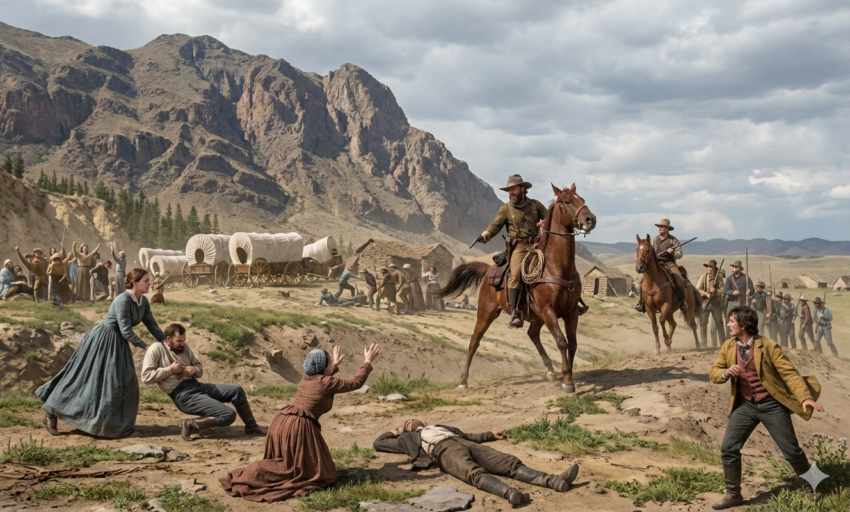
Photo: A lifelike image by Google Gemini depicts the Mountain Meadows Massacre — the September 11, 1857, slaughter in which a militia force composed entirely of Latter-day Saint settlers and allied Paiute Indians murdered approximately 120 emigrant men, women, and children of the Baker-Fancher wagon train at Mountain Meadows in what is now southern Utah.
Redrawn in a photo-realistic style from a wood engraving in the “Grandest Century in The World’s History,” by Henry Davenport Northrop, 1900.
“If It Be Possible, Live Peaceably with All Men”
Romans 12:18 and the Divergence of Peace in Early Mormonism
A Scholarly Essay in Christian Apologetics and Historical Theology
Introduction: A Prophet Who Claimed Peace
On June 16, 1844, just eleven days before a mob would storm Carthage Jail and take his life, Joseph Smith, the founder of the Church of Jesus Christ of Latter-day Saints, delivered what would become one of his most poignant public addresses. Standing before a crowd in Nauvoo, Illinois, and fully aware of the escalating crisis surrounding him, he declared:
You don’t know me; you never knew my heart. No man knows my history. I cannot tell it: I shall never undertake it. I don’t blame anyone for not believing my history. If I had not experienced what I have, I would not have believed it myself. I never did harm any man since I was born in the world. My voice is always for peace.
— Joseph Smith | History of the Church, 6:317
The claim is arresting in its sincerity. Here is a man who would soon face the end of his life, insisting that his voice had “always been for peace.” For the Latter-day Saint faithful, these words ring with prophetic dignity—the testimony of a man who, like the Apostle Paul before him, could say, “I have fought the good fight, I have finished the race, I have kept the faith,” 2 Timothy 4:7. For the historian and the Christian theologian, however, the claim invites rigorous scrutiny. Because the documentary record of Joseph Smith’s leadership—and the formative culture of the movement he founded—tells a considerably more complex story.
In the Epistle of Romans, Paul cautions his readers that righteousness is not a license to sin. The letter also contains several specific exhortations, such as to repay evil with good, to support and love one another, and to be obedient to civil rulers.
The irony is not merely biographical. It is theological. The Apostle Paul, writing to the church in Rome, articulated one of the most demanding standards of Christian conduct ever committed to paper: “If it be possible, as much as lieth in you, live peaceably with all men” (Romans 12:18, KJV). That injunction—nuanced, honest about difficulty, yet unequivocal in its aspiration—stands as one of the foundational texts for Christian ethics of non-retaliation, enemy-love, and peacemaking. It frames a gospel community that absorbs hostility rather than returns it, that “overcomes evil with good” (Romans 12:21).
This essay is not intended to wound the modern Latter-day Saint, most of whom will confess a genuine faith, admirable family devotion, and remarkable community commitment — even if the author does not share that faith or its foundational claims. The LDS tradition has produced extraordinary missionary programs, scholars, humanitarians, and neighbors. The family-centered piety of the Latter-day Saint community, the commitment to service, the remarkable genealogical and welfare programs — these are genuine goods that deserve honest acknowledgment, and this essay offers that acknowledgment without reservation, even as it parts ways with the theology that animates them.
That acknowledgment, however, requires an honest companion. The modern LDS church has unequivocally denounced the violence of its founding era — the blood atonement rhetoric, the Danite organization, the Mountain Meadows Massacre — and that repudiation is genuine and should be credited. But repudiation is not the same as reckoning. What the standard narrative of “persecuted pioneers” does not fully capture is that violence once functioned not as an aberration within early Mormon culture but as something closer to a theological reflex — woven into the institutional structures, the militia organizations, the disciplinary theology, and the prophetic rhetoric of the movement’s formative decades with a consistency that cannot be explained by circumstance alone. It was, in a real sense, part of the tradition’s original DNA.
The story of Mormonism’s genesis is therefore not simply a story of innocent sufferers. It is a story in which real persecution and real provocation were intertwined — in which a new religious movement generated hostility partly because of its genuinely divergent theological claims, but also because of actions, rhetoric, and institutional structures that systematically undermined the possibilities for peaceful coexistence. Critically, this pattern of development bears little resemblance to the Biblical model of the early church — a community that absorbed violence rather than organized it, that appealed to Caesar rather than arming against him, and that understood suffering as the expected cost of faithful witness rather than an injustice to be rectified by force. The early Mormon movement, by contrast, raised militias, codified retaliatory theology, consolidated political and military power in prophetic authority, and, in at least one instance, directed the massacre of civilians. The modern church that condemns Mountain Meadows and repudiates blood atonement is, in those condemnations, implicitly acknowledging a distance between its present self and its founding culture that is historically significant and theologically unresolved. This essay takes that distance seriously — and examines what produced it.
One observation is historically significant and deserves to stand at the outset:other minority religious movements of the 19th century—the Shakers, the Adventists, various immigrant Catholic communities, the Quakers, the Swedenborgians—faced occasional ridicule, social marginalization, and prejudice. But they were not the subject of gubernatorial extermination orders. They did not generate organized military responses from the federal government. They were not involved in the massacre of emigrant wagon trains. The singular intensity of the conflict that surrounded early Mormonism is difficult to explain by religious bigotry alone. A more honest historical accounting — one that this essay attempts to provide — must weigh the full record on both sides.
I. Traditional Biblical Study: “Live Peaceably with All Men”
The Text and Its Meaning
Romans 12:18 sits within one of the most sustained ethical passages in the entire Pauline corpus. The twelfth chapter of Romans begins with the call to offer oneself as a “living sacrifice” (v. 1) and proceeds through an extended meditation on communal virtue: genuine love, sincere hospitality, blessing persecutors, weeping with those who weep. Two remarkable commands flank the peace imperative in verse 18: “Repay no one evil for evil” (v. 17) and “Do not take revenge, my dear friends, but leave room for God’s wrath” (v. 19).
The conditional phrasing of verse 18 is theologically important: “If it be possible, as much as lieth in you.” The Greek text reads, ei dynaton, to ex hymōn, meta pantōn anthrōpōn eirēneuontes — “if possible, so far as it depends on you, be at peace with all people.” Paul is not naive, nor is he writing from merely human pastoral wisdom. He is writing under the theopneustos — the “God-breathed” inspiration that 2 Timothy 3:16 ascribes to all Scripture, which means the conditional he employs is not a rhetorical hedge but a theologically precise acknowledgment of fallen human reality. A God who is omniscient enough to inspire Scripture is omniscient enough to know that some parties will refuse peace; the conditional is built into the text because it is built into the human condition. What the text demands is the total elimination of self-generated hostility, deliberate provocation, and retaliatory violence as options for the Christian community. The phrase “as much as lieth in you” (to ex hymōn, literally “that which is from you”) places the locus of responsibility squarely on the believer. It cannot be outsourced to circumstance.
A modern example of the exception Paul’s conditional allows may be found in the law and ethics of personal self-defense — the one category of violence that both legal tradition and moral philosophy have most consistently defended as legitimate. Even here, the permission is narrow and precisely bounded: force is justifiable only when it is immediate, reasonable, and proportionate to the prevention of imminent death or great bodily harm. It cannot be preemptive, retaliatory, or disproportionate. The law does not permit a man to arm a private militia because his neighbor once threatened him; it permits him to defend his life when his life is threatened. That boundary — immediacy, proportionality, necessity — is precisely the boundary Paul’s conditional interjection implies. What falls outside it, in both legal and Pauline terms, is not defense. It is aggression wearing the vocabulary of defense.
New Testament scholar Douglas Moo, in his landmark commentary on Romans, notes that Paul’s peace ethic is grounded in the eschatological conviction that God himself is the avenger—the believer need not avenge because God will. The believer’s role is to create the conditions for possible reconciliation, not to accelerate conflict.“The Christian community,” Moo writes, “is called to absorb hostility rather than return it, trusting that God’s sovereign governance of history will ultimately address injustice.”
The Model of Jesus
The Pauline peace ethic is explicitly rooted in the person and work of Jesus Christ. In Romans 5:10, Paul describes believers as having been “reconciled to God through the death of his Son” while they were still enemies. The cross is thus the paradigmatic act of peacemaking—God absorbing hostility, returning blessing for enmity, dying for those who killed him. The Sermon on the Mount (Matthew 5:9, 43-48) establishes Jesus’ own framework: “Blessed are the peacemakers, for they shall be called sons of God… Love your enemies, bless those who curse you, do good to those who hate you.”
Jesus’s conduct during his arrest and trial is equally instructive. When Peter drew his sword in Gethsemane, Jesus rebuked him directly: “Put your sword back in its place, for all who draw the sword will die by the sword” (Matthew 26:52). This is not pacifism rooted in weakness—Jesus acknowledged that he could call “more than twelve legions of angels” (v. 53)—but rather a principled refusal to allow the kingdom of God to be advanced by violence. The early church remembered and transmitted this pattern as normative for the Christian community.
The Early Church in Acts
The book of Acts depicts a community that faced violent opposition from its earliest days and consistently chose non-retaliatory responses. Stephen, the first martyr, dies praying for those who stone him: “Lord, do not hold this sin against them” (Acts 7:60). Paul and Silas, beaten and imprisoned in Philippi, use their miraculous release not as an opportunity for vengeance but for evangelism (Acts 16:25-34). The apostles repeatedly “rejoiced that they were counted worthy to suffer shame for his name” (Acts 5:41), but they did not organize militias in response.
This does not mean the early church was entirely passive. Paul defended his Roman citizenship rights (Acts 22:25), appealed to Caesar (Acts 25:11), and challenged corrupt legal proceedings (Acts 16:37). But the defense was always legal, verbal, and principled — never violent, retaliatory, or conducted by the sword.
Other Scriptural References on Peace
The peace motif runs throughout the New Testament not as a peripheral suggestion but as a defining mark of Christian identity. Jesus himself declared, “Blessed are the peacemakers, for they will be called children of God” (Matthew 5:9) — and the designation is striking. Peacemakers are not merely admired; they are identified as bearing the family resemblance of God himself. The Beatitude of the peacemaker is one of only eight, placing it at the very summit of the character Christ commends, and the title it confers — children of God — is the highest relational category the New Testament offers.
Paul develops this theology with systematic force. In Romans 5:1, justification itself is defined in terms of peace: “Therefore, since we have been justified through faith, we have peace with God through our Lord Jesus Christ.” The reconciled relationship between the believer and God becomes the pattern and the power for reconciliation between human beings. Ephesians 2:14–15 presses further, declaring that Christ “himself is our peace, who has made the two groups one and has destroyed the barrier, the dividing wall of hostility.”Peace, in Pauline theology, is not a strategy — it is a person. To pursue it is to reflect the very nature and mission of Christ. Colossians 3:15 then issues the practical imperative: “Let the peace of Christ rule in your hearts, since as members of one body you were called to peace.”
The letter of James identifies the root cause of conflict with diagnostic precision: “What causes fights and quarrels among you? Don’t they come from your desires that battle within you?” (James 4:1). The argument is that external conflict is always downstream of internal disorder — that violence and hostility are symptoms of disordered desire, not legitimate responses to genuine grievance. Peter reinforces the behavioral demand: “Do not repay evil with evil or insult with insult. On the contrary, repay evil with blessing” (1 Peter 3:9). The logic is not merely strategic forbearance; it is covenantal — believers are “heirs of the blessing” (1 Peter 3:9), and the inheritance is forfeited when they adopt the retaliatory patterns of those who do not share that inheritance. Hebrews 12:14 frames peace as an active pursuit requiring sustained effort: “Make every effort to live in peace with everyone.”
The Old Testament background deepens and sharpens this trajectory. Proverbs 20:22 strikes at the very instinct that makes retaliation feel justified: “Do not say, ‘I’ll pay you back for this wrong!’ Wait for the Lord, and he will avenge you.” The command is not simply to delay retaliation — it is to transfer the entire category of vengeance to God, removing it permanently from the believer’s repertoire. Psalm 34:14 does not merely permit peace; it commands its active pursuit: “Seek peace and pursue it.” The Hebrew verb rādap — translated “pursue” — is a hunting term, suggesting that peace does not come to those who merely wish for it but to those who chase it with the same relentless energy that others devote to conflict. Psalm 37:37 reinforces this: “Consider the blameless, observe the upright; a future awaits those who seek peace.”
The dominant theme of Romans 12 is sacrificial love—how believers express it and how we prove it by the way we live. The apostle Paul submits that a true Christian strives to love others sacrificially and authentically, including one’s enemies, but especially members of Christ’s body, the church. He closes the passage with a quick pep talk, listing several practical exhortations on demonstrating love to all people in every circumstance (see Romans 12:9–21). In this context, Paul states, “If it be possible, as much as lieth in you, live peaceably with all men.” (Romans 12:18).
.
We know from the Beatitudes that “God blesses those who work for peace, for they will be called the children of God” (Matthew 5:9). Kingdom people are called to be peacemakers who sow “...in peace of them that make peace.” (James 3:18).
Achieving peace requires active effort, not passive acceptance. While many fight for their rights and freedoms, Jesus demonstrated an alternative path by sacrificing his own. This sacrifice led to our reconciliation with God, and through the Holy Spirit, believers can experience God’s peace within themselves. It is only by first experiencing this inner peace that we can then extend it to those around us.
We demonstrate genuine Christian love by doing everything within our power to live at peace with everyone. This is a tall order, particularly if we’ve been mistreated, but this is precisely what Paul has in mind, for he says, “Do not repay anyone evil for evil” (Romans 12:17) and“Do not take revenge” (verse 19). As the old saying goes, “It takes two to argue.” If we don’t fight back or repay “wrong for wrong, but always strive to do what is good for each other and for everyone else” (1 Thessalonians 5:15), then the fighting stops with us. In a parallel encouragement, Peter teaches, “Do not repay evil with evil or insult with insult. On the contrary, repay evil with blessing, because to this you were called so that you may inherit a blessing” (1 Peter 3:9).
Reminiscent of Jesus’ command to “love your enemies and pray for those who persecute you” (Matthew 5:44), Paul urges, “Bless those who persecute you; bless and do not curse”(Romans 12:14). The best way to deal with an enemy is to treat him with goodness and kindness in the hopes of winning him over for Christ (see Proverbs 25:21–22). We must leave the work of vengeance and punishing sin to God (Deuteronomy 32:35, 41; Ecclesiastes 12:14). Believers are called to “peaceful and quiet” living so as not to hinder or harm the work of the gospel (1 Timothy 2:1–4).
In Romans 14:19, Paul encourages, “Let us therefore make every effort to do what leads to peace and to mutual edification.”(see also 1 Thessalonians 5:13). The writer of Hebrews affirms, “Make every effort to live in peace with everyone.” (Hebrews 12:14). The psalmist echoes, “Turn from evil and do good; seek peace and pursue it.” (Psalm 34:14).
The prophetic tradition ultimately frames peacemaking as eschatologically charged. Isaiah’s vision of swords beaten into plowshares and spears into pruning hooks (Isaiah 2:4) is not merely poetic optimism — it is a declaration that the direction of redemptive history runs toward peace, and that God’s people are called to embody that direction now, in advance of its final fulfillment. Micah 4:3 repeats the vision almost verbatim, underscoring its centrality to prophetic hope, “He shall judge between many peoples, and shall decide disputes for strong nations far away; and they shall beat their swords into plowshares, and their spears into pruning hooks; nation shall not lift up sword against nation, neither shall they learn war anymore.”The community that organizes itself around hostility, retaliation, and violence is not only disobeying a command — it is moving in precisely the opposite direction from the arc of God’s redemptive purposes.
With this biblical framework established, we turn to examine how this ethic was—and was not—embodied in the formative culture of early Mormonism.
II. Early LDS Cultural Values and the Doctrine of Vengeance
Blood Atonement
Among the most theologically disturbing doctrines to emerge from early Mormonism is the concept of “blood atonement”—the teaching that certain sins place a person beyond the redemptive reach of Christ’s atoning blood, and that the only path to forgiveness for such sins requires the literal shedding of the sinner’s own blood. As documented by the Wikipedia article on blood atonement:
Blood atonement was a practice in the history of Mormonism… under which the atonement of Jesus does not redeem an eternal sin. To atone for an eternal sin, the sinner should be killed in a way that allows their blood to be shed upon the ground as a sacrificial offering.
The doctrine was promoted vigorously by Brigham Young during the Mormon Reformation of 1856-1857. Young’s sermons, published in the official church newspaper, the Deseret News, are remarkable in their explicitness. In a September 1856 sermon, Young declared:
There are sins that men commit for which they cannot receive forgiveness in this world, or in that which is to come, and if they had their eyes open to see their true condition, they would be perfectly willing to have their blood spilt upon the ground, that the smoke thereof might ascend to heaven as an offering for their sins.
In a February 18, 1857, sermon, delivered in the Mormon Tabernacle and published in the Deseret News, Young pressed the logic even further, asking his congregation whether they would love a sinning brother enough to kill him for his own salvific benefit. This rhetoric was not merely theoretical. As documented by historian Will Bagley in Blood of the Prophets and corroborated by John D. Lee’s own Confessions (1877), cases of actual throat-cutting under the rubric of blood atonement occurred in early Utah Territory.
Lee’s account of Rosmos Anderson — a Danish convert taken by church council members at midnight, told his throat would be cut to atone for his sins, and buried in a field near Cedar City, with his wife instructed to tell inquirers he had gone to California — is among the most documented of these cases. This is not the culture of Romans 12. This is an ancient culture of ritual violence dressed in theological language.
The famous-trials.com analysis of Lee’s Confessions observes pointedly that Brigham Young’s sermons undoubtedly inspired followers to commit murder, however unfair the popular press may have been in attributing every violent act in the territory to blood atonement. This is a secondary source assessment, but it reflects the weight of the primary record. The modern LDS church formally repudiated blood atonement in a First Presidency declaration on December 4, 1889, stating that the church “views the shedding of human blood with the utmost abhorrence,” and has repeatedly distanced itself from the doctrine since. Elder Henry B. Eyring described the Mountain Meadows Massacre as “a terrible and inexcusable departure from Christian teaching and conduct.” But the repudiation cannot erase the historical reality: a dominant cultural current in early Utah Mormonism normalized lethal violence as a religious act.
The Oath of Vengeance
Following the deaths of Joseph and Hyrum Smith at Carthage Jail on June 27, 1844, a disturbing ritual was formalized and intensified within the endowment ceremony conducted in LDS temples. Known as the “Oath of Vengeance,” initiates were required to swear before God that they would pray — and teach their children and grandchildren to pray — for divine retribution against the United States government for the deaths of the prophets. The oath’s existence was confirmed under oath during the U.S. Senate’s Reed Smoot hearings in 1903–1906, when the recorded language was entered into the congressional record. The oath, as recorded by multiple temple endowment participants of the 19th century, included language such as:
You and each of you do covenant and promise that you will pray and never cease to importune high heaven to avenge the blood of the prophets on this nation, and that you will teach the same to your children and to your children’s children unto the third and fourth generation.
This oath was formally removed from the temple ceremony in 1927, following both external political pressure and an internal revision process begun in 1919 under Church President Heber J. Grant. But for more than eighty years, devout Latter-day Saints attending their most sacred religious rites were swearing a covenantal oath of vengeance against the nation in which they lived. The contrast with Paul’s counsel to pray for civil authorities (Romans 13:1-7), to “bless and curse not” (Romans 12:14), and to overcome evil with good (Romans 12:21) could not be more stark.
The Danites
In 1838, at the Mormon settlement of Far West, Missouri, a paramilitary organization known as the Danites was organized among LDS members. The Wikipedia article on Mormonism and violence documents this episode clearly:
The Danites, a vigilante group briefly sanctioned by Mormon leaders, conducted armed raids in Missouri during the 1838 Mormon War. In the western United States, Mormon settlers were involved in prolonged conflicts with Native American tribes.
Historian D. Michael Quinn — a BYU-trained scholar and lifelong believing Latter-day Saint who was excommunicated in 1993 for his historical work, though he retained his faith until his death — documented the Danite organization extensively in The Mormon Hierarchy: Origins of Power. The Danites were organized by Sampson Avard with the approval of Joseph Smith, whose own Missouri journal for July 27, 1838, records his awareness that the Danites existed “to put to rights physically that which is not right” where “teachings and persuasions” had failed. In practice, the Danites terrorized internal dissenters and conducted raids that burned non-Mormon settlements throughout Daviess County, Missouri.
The official LDS Gospel Topics Essay acknowledges: “Historians generally concur that Joseph Smith approved of the Danites but that he probably was not briefed on all their plans and likely did not sanction the full range of their activities.” The concession that Joseph Smith “approved” of the Danites is significant. The essay’s qualification—that he may not have known “all their plans”—is an argument about degrees of culpability, not about whether the organization was sanctioned. The Danites existed, were briefly officially sanctioned, and were functionally integrated into the militia structures that perpetrated violence in Missouri.
The Mormonism Research Ministry’s analysis of early LDS violence notes that LDS historian Stephen C. LeSueur believes much of the plundering and burning committed by Mormon soldiers in Daviess County “can be laid at the feet of Joseph Smith himself.” LeSueur writes:
Although Mormon military action was generally initiated in response to reports of violence, the Mormons tended to overreact and, in some instances, retaliated against innocent citizens. Their perception of themselves as the chosen people, their absolute confidence in their leaders, and their determination not to be driven out led Mormon soldiers to commit numerous crimes.
The cultural soil in which Mormon violence grew was prepared by a sustained tradition of apocalyptic, militant rhetoric from the movement’s own leadership. Sidney Rigdon’s infamous “Fourth of July Oration,” delivered at Far West, Missouri, on July 4, 1838, issued a direct and explicit threat:
“And that mob that comes on us to disturb us; it shall be between us and them a war of extermination, for we will follow them, till the last drop of their blood is spilled, or else they will have to exterminate us: for we will carry the seat of war to their own houses, and their own families, and one party or the other shall be utterly destroyed.”
Rigdon framed this as a conditional defensive pledge rather than an unprovoked declaration of war — but the rhetoric was incendiary regardless of framing, and Missouri Governor Boggs would later cite the speech as partial justification for his own extermination order against the Mormons. One detail that official LDS sources conspicuously avoid is that Sidney Rigdon — First Counselor in the LDS First Presidency — first used the word “exterminate” in his June 17, 1838 Salt Day sermon, warning Missourians that any further attacks would be met with “a war of extermination.” Governor Boggs’s extermination order, four months later, used the same language. The standard LDS narrative presents Boggs’s order as unprovoked state aggression; it does not acknowledge that Rigdon’s sermon gave Boggs his vocabulary.
Joseph Smith’s role was not merely passive tolerance. He appeared at the event, participated in raising a liberty pole, and his editorial in the Elders’ Journal — the church’s official publication at the time — gave a wholehearted endorsement of the sermon. The speech was then printed and distributed as a pamphlet across the Mormon counties of Missouri. The Elders’ Journal editorial, signed by Smith, declared: “To be mobbed any more without taking vengeance, we will not.” This was not the private sentiment of an overwrought subordinate. It was the official published position of the movement’s founding prophet.
Brigham Young’s sermons in Utah Territory extended this tradition of militant rhetoric into a new and more settled phase of Mormon history. Young’s blood atonement sermons have already been cited above, but his broader rhetoric consistently framed the Saints as instruments of divine vengeance against their enemies. In President James Buchanan’s “Proclamation–Rebellion in the Territory of Utah,” Federal officials sent to govern Utah Territory reported from the pulpit that Young made “the most treasonable hostilities against the United States,” and several fled the territory in documented fear for their lives. Young’s enforcers in the late 1850s Mormon Reformation prevented apostates from leaving Utah by confiscating property, and contemporary witnesses described conditions in which “the enforcers of this policy terrorized people and made them believe” they had no recourse. The New York Times documented Young’s public rhetoric directly as late as 1863.
Taken together, this rhetorical tradition — running from Rigdon’s extermination pledge in 1838 through Young’s blood atonement sermons and anti-apostate enforcement culture in the 1850s — constitutes a sustained pattern, not a series of isolated incidents. This was not the language of Romans 12. It was the language of holy war, and it produced predictable results.
III. Historical Context: Violence in Practice
The Nauvoo Legion and Theocratic Militarism
The last public address of the Prophet Joseph Smith was delivered to the Nauvoo Legion on June 23rd, 1844, just four days before he was martyred at Carthage. Photo: After John Hafen (1856-1910), Last Public Address of Lieut. Gen. Joseph Smith, no date, original 1888. Albumen silver print of a lithograph. Graphic Arts Collection, 2012.
Following the expulsion from Missouri, the Saints settled in Nauvoo, Illinois, where they were granted an extraordinarily liberal city charter — passed by the Illinois legislature on December 16, 1840 — that effectively created what one contemporary scholar called “a government within a government.” The charter gave the mayor both executive and judicial authority, empowered the city council to pass ordinances that could supersede state law, and granted the municipal court the power to issue writs of habeas corpus — a power Smith used repeatedly to nullify Missouri and Illinois arrest warrants against himself and other church members. Illinois Governor Thomas Ford later marveled that the charter passed unanimously through both legislative chambers, concluding that each political party had been afraid to oppose it for fear of losing the Mormon vote.
Central to Nauvoo’s civic structure was the Nauvoo Legion — a state-sanctioned militia that by 1844 numbered between 2,500 and 3,000 men, making it the largest city militia in Illinois and second in size only to the U.S. Army itself. Joseph Smith served as its Lieutenant General and regularly reviewed its troops in full uniform. He simultaneously held the offices of Prophet, Mayor, Chief Justice of the Nauvoo Municipal Court, and military commander — a consolidation of religious, political, judicial, and military authority in a single person that had few parallels in American history and none in the mainstream Protestant religious experience of the era. In early 1844, he added a fifth role, announcing his candidacy for President of the United States.
The political dimensions of the Nauvoo Legion alarmed observers across the United States. When the Nauvoo Expositor — a newspaper founded by excommunicated members exposing Smith’s secret polygamy doctrine and his consolidation of power — published its first and only issue on June 7, 1844, Smith ordered the city marshal to destroy the press, directing acting Major General Jonathan Dunham to “assist the Marshal with the Legion, if called upon so to do.” The destruction was carried out on June 10. Smith and the city council were charged with inciting a riot; an arrest warrant was issued against him; and on June 18, he declared martial law in Nauvoo and mobilized the Legion. He was deploying the Legion not against an external military threat but as an instrument of suppressing internal dissent — and doing so under color of civil authority he himself controlled.
The Mormon War of 1838
The Missouri Mormon War of 1838 was a genuine military conflict, not merely a rhetorical confrontation. On the morning of October 25, 1838, a Mormon rescue party led by LDS Apostle David W. Patten — who simultaneously commanded the Caldwell County militia — attacked a Missouri state militia unit under Captain Samuel Bogart encamped along the banks of Crooked River. Bogart’s men had entered Caldwell County, disarmed Mormon settlers, and taken three Mormon captives; the rescue party was dispatched to free them. The engagement left one Missourian dead and two Missourians wounded, but also killed three Mormons, including Patten himself, who died of his wounds the following day. It was the bloodiest single exchange of the war to that point, and it was initiated by Mormon forces.
The Mormonism Research Ministry documents what happened:
Upon receiving news of the injuries and death of state troops at Crooked River, Governor Boggs immediately drafted his extermination order on 27 October 1838 because the Mormons ‘have made war upon the people of this state.’ Worse, the killing of one Missourian and mutilation of another while he was defenseless at Crooked River led to the mad-dog revenge by Missourians in the slaughter at Haun’s Mill.
This sequence is critical for an honest accounting of what followed. Governor Boggs issued his extermination order on October 27 — two days after Crooked River and three days before Hawn’s Mill — citing open Mormon insurrection against state authority as his justification. The massacre of seventeen Mormon men and boys at Hawn’s Mill on October 30, 1838 — in which attackers fired into a blacksmith shop where civilians had taken refuge, then executed wounded survivors and children hiding under the bellows — was a genuine atrocity and should be condemned without qualification. But the standard LDS narrative presents it as unprovoked sectarian violence against innocent settlers, eliding the fact that Missouri state militia troops had been attacked and killed five days earlier by Mormon forces. FAIR’s analysis of the Battle of Crooked River characterizes it as a rescue mission for Mormon captives rather than an aggressive military attack, while acknowledging that Missourians had been attacking outlying farms, “molesting women, whipping men, and killing animals.” Both facts are true. Both are necessary for historical understanding.
The Mountain Meadows Massacre
On September 11, 1857 — a date whose historical resonance would eventually acquire entirely different associations — a militia force composed entirely of Latter-day Saint settlers and allied Paiute Indians murdered approximately 120 emigrant men, women, and children of the Baker-Fancher wagon train at Mountain Meadows in what is now southern Utah.
The History Channel’s documentation of this event notes:
On September 11, 1857, a militia force composed of Mormon settlers and allied Paiute Indians murdered approximately 120 emigrant men, women, and children of the Baker-Fancher wagon train at Mountain Meadows in what is now southern Utah.
The massacre took place against the backdrop of the Utah War — a confrontation between the Mormon-controlled territorial government and the United States federal government over authority and governance. Brigham Young had issued sweeping “war orders” and was preparing to resist federal troops, and a spirit of intense, siege-like militancy pervaded Mormon settlements throughout the territory. The wagon train, originating primarily from Arkansas with some members from Missouri, was perceived as potentially hostile by local militia leaders — in part because of rumors, subsequently unsubstantiated, that they had poisoned water sources and bragged about participating in the killing of Joseph Smith. The historical antagonism between the Mormon community and Missourians — whose state had issued an extermination order against the Saints less than twenty years earlier — added a layer of grievance to an already volatile situation.
What makes Mountain Meadows uniquely horrifying is not merely its scale but its mechanics. After a four-day siege beginning September 7, local militia commander John D. Lee approached the wagon train under a white flag and offered safe conduct to the emigrants if they would surrender their weapons. The emigrants agreed. Once disarmed, they were marched out of their encampment, and the men were separated from the women and children. At a signal, the militia turned and shot their unarmed male charges. The women and older children were killed by men who emerged from the brush. Seventeen small children deemed too young to carry memories were spared and distributed among local Mormon families.
The massacre was subsequently blamed on the Paiute Indians alone. The cover-up lasted years. John D. Lee — by his own confession, responsible for personally killing at least five or six emigrants and for leading the white flag deception — was tried twice, convicted at his second trial, and executed by firing squad at the massacre site itself on March 23, 1877. He was the only participant ever brought to justice. Historian Juanita Brooks, in her landmark study John D. Lee: Zealot, Pioneer Builder, Scapegoat (1962), established the most defensible scholarly framing: Lee was both a genuine perpetrator and a scapegoat in the sense that equally culpable commanders — including militia leaders Isaac C. Haight and William H. Dame — escaped prosecution entirely.
The LDS Church’s 2007 statement of “profound regret” was carefully crafted to avoid the word “apology.” Church spokesman Mark Tuttle explicitly clarified that the church does not use the word “apology” — it used “profound regret.” The linguistic precision was not accidental. The modern LDS church has repeatedly distanced itself from the massacre, and the official Gospel Topics Essay acknowledges it as “a deplorable episode,” but the gap between institutional regret and institutional accountability has never been closed.
Conflicts with Native American Populations
The relationship between Mormon settlers and the Native American peoples of the Intermountain West was one of the most complex and tragic dimensions of early Mormon history. The Wikipedia article on Native American People and Mormonism provides essential documentation:
Young and followers began moving west as Mormon pioneers to the Intermountain West frontier in 1847, where they both formed alliances with and warred with the 20,000 existing Native American people there. These violent confrontations included massacres (Battle Creek, Provo River, Skull Valley, Nephi, Grass Valley, Circleville, Fountain Green, and Salt Creek) and wars (Black Hawk, Ute, Wakara’s, and Posey). Young officially legalized Native American slavery in the Utah Territory in 1852, and within a decade over 400 Native American children were purchased and used as a vital source of labor in Mormon homes until slavery was banned by the federal government in 1865.
The Battle Creek Massacre of March 1849 offers a stark case study. Utah Territorial Militia forces, acting under orders from Brigham Young to “chastise” a band of Ute people accused of stealing cattle, attacked a sleeping camp and killed as many as forty Native Americans, including women and children. The “battle” was largely a massacre of non-combatants. The Wikipedia article on the Battle Creek Massacre documents that militiamen took scalps, and the action was celebrated in Mormon settlements as a victory.
The Circleville Massacre of April 1866, occurring during the Black Hawk War, was equally disturbing. A group of Paiute people who had surrendered to the Mormon militia and were being held as prisoners was massacred by settlers. Wikipedia’s article on the Circleville Massacre documents that prisoners, including women and children, were killed after surrendering, and that the children among them were subsequently distributed to local settler families as laborers or servants.
The dynamics driving these conflicts were multiple and must be acknowledged with nuance. Competition for scarce water and grazing resources was real and often led to genuine provocation from both sides. Cultural misunderstandings about land ownership—a concept that differed fundamentally between the Mormon settlers’ Anglo-European framework and the indigenous peoples’ relational view of land—generated conflicts that were not always attributable to bad faith on either side. The Mormon theological framework, which originally identified Native Americans as “Lamanites“—fallen descendants of the House of Israel—created a complex posture that combined genuine missionary concern with racial condescension.
The Introduction to the Book of Mormon — as official a statement of the text’s historical claims as the LDS Church produces — originally declared the Lamanites to be the “principal ancestors of the American Indians.” The word “principal” was quietly removed in 2007, without announcement or explanation, in editions published after population geneticists found no detectable Near Eastern DNA signature in Native American populations consistent with a 600 B.C. migration from Jerusalem. The revision is itself a form of evidence: authoritative texts do not silently edit their historical claims unless those claims have become empirically untenable.
The Walker War (1853-1854) and the Black Hawk War (1865-1872) were extended conflicts that caused enormous loss of life and displacement among Utah’s Native peoples. Within fifty years of Mormon settlement under Brigham Young and his successors, the Wikipedia documentation records that the Native American population of what is now Utah was decimated by 86%, and made up only 1.6% of the state’s population by 1890.
IV. Toward Fairness: A Necessary Disclaimer
Not All Mormon-Native Relations Were Hostile
An honest account must acknowledge that Mormon-Native relations were not uniformly adversarial. Joseph Smith’s earliest missionary efforts, beginning within six months of the church’s founding in 1830, specifically targeted Native American communities based on the theological conviction that they were “Lamanites” with a special place in God’s redemptive purposes. This conviction generated genuine missionary concern and, in some cases, respectful relationships.
Brigham Young himself articulated a practical philosophy in many instances: “It is cheaper to feed the Indians than to fight them.” Some Mormon communities negotiated peaceful coexistence with Native tribes, shared resources, and formed alliances. The complexity of the historical record means that any single narrative—either of uniform benevolence or uniform brutality—misrepresents the reality on the ground.
Violence Against Early Mormon Communities
The violence perpetrated against Mormon communities in Missouri and Illinois was genuine, severe, and morally indefensible. The Haun’s Mill Massacre of October 30, 1838, in which at least seventeen men and boys were murdered by a Missouri state militia force attacking a peaceful mill settlement, was an atrocity. The murder of Joseph and Hyrum Smith in Carthage Jail on June 27, 1844, by a mob of approximately 200 men, occurred despite a governor’s promise of protection and represented a failure of state responsibility to protect citizens in lawful custody.
The expulsion of 8,000 Latter-day Saints from Missouri in the winter of 1838-1839—effectively a refugee crisis in which an estimated 1 in 12 Saints died in subsequent camps from disease and exposure—was among the most serious violations of religious liberty in American history. The Wikipedia article on Anti-Mormonism documents extensive mob violence, church burnings, and targeted murders throughout the 19th century. These atrocities deserve acknowledgment and condemnation, and they are real parts of the Mormon historical experience.
The Threat of Political and Economic Power
A significant—and often underappreciated—driver of anti-Mormon hostility was not theological difference but political and economic threat. The Mormons’ practice of gathering created rapid demographic concentration that could and did control local elections and dominate local economies. LDS historian D. Michael Quinn’s analysis, cited in the Mormonism Research Ministry article, identifies this as the primary driver of Missouri anti-Mormonism:
Fear of being overwhelmed politically, socially, culturally, and economically by Mormon immigration was what fueled anti-Mormonism wherever the Latter-day Saints settled during Joseph Smith’s lifetime. Religious belief, as non-Mormons understood it, had little to do with anti-Mormonism.
In Nauvoo, Illinois, the situation was even more extreme: Joseph Smith simultaneously held the offices of prophet, mayor, and military general of a 5,000-man force. This was not merely a religious movement; it was a theocratic political entity of the kind that American democratic culture had specific and legitimate reasons to regard with concern. When Smith destroyed the Nauvoo Expositor press in 1844—an act that modern legal scholars universally regard as unconstitutional—he was using civic and military power to suppress journalistic criticism of his religious leadership. The resulting crisis was not simply the product of bigotry.
V. Scholarly Review: D. Michael Quinn and the Culture of Violence
No scholarly account of violence in early Mormonism can avoid the formidable work of D. Michael Quinn, the independent historian whose rigorous documentation of LDS institutional history has been both celebrated and condemned. Quinn was himself a Latter-day Saint, indeed a BYU professor and significant Mormon intellectual figure, before his 1993 excommunication. His analysis of early Mormon violence carries the weight of both insider knowledge and scholarly independence.
The Sunstone article “The Culture of Violence in Joseph Smith’s Mormonism” represents Quinn’s most comprehensive treatment of the subject. What makes Quinn’s approach particularly significant is his insistence on contextualizing Mormon violence within the broader culture of violence in early 19th-century America. The Sunstone essay begins:
It is extremely difficult for most of us today to comprehend the violence that was pervasive, often normative, in early American culture. Much of this normative violence had its roots in the national culture while regions (such as the South and West) had their own traditions of sanctioned violence in daily life.
The oath of vengeance was an addition made to the Nauvoo endowment under the direction of Brigham Young by 1845 in the Nauvoo Temple, soon after the 1844 death of Joseph Smith.
This contextualization is important and fair-minded. Quinn is not arguing that Mormonism was uniquely violent in an era when Andrew Jackson had killed men in duels, when frontier settlers regularly engaged in extralegal violence, and when both state-sponsored and vigilante violence were common features of American life. He is arguing that early Mormonism absorbed and intensified the surrounding culture of violence rather than challenging or subverting it,and that specific theological developments within Mormonism—blood atonement, the Oath of Vengeance, the Danites—created institutional structures that normalized and sacralized violence in ways that the surrounding culture did not.
Quinn documents how Joseph Smith’s own experiences with violence—including the tarring and feathering at Hiram, Ohio, in 1832, the multiple Missouri persecutions, and the ongoing legal harassment—shaped a siege mentality that increasingly rationalized preemptive and retaliatory violence. Quinn traces the trajectory from the relatively restrained responses to persecution in the early 1830s to the increasingly militant posture of the Nauvoo period, culminating in the militia activities of early Utah.
Quinn’s documentation of specific violent incidents attributed to Joseph Smith personally is meticulous and disturbing. He records Smith’s direct orders for the destruction of the Nauvoo Expositor press, his declaration of martial law, and his arming with a pistol at Carthage Jail. He documents the burning and plundering of non-Mormon settlements in Missouri during the fall of 1838, in which Joseph Smith’s direct command responsibility is difficult to dismiss.
Quinn is careful not to reduce early Mormonism to a culture of violence, and he acknowledges the genuine persecution that motivated much of the Saints’ defensive posture. But his essential conclusion is clear and well-documented: the culture of early Mormonism did not embody the Pauline peace ethic. It embodied a complex, sometimes admirable resilience alongside a troubling institutionalization of violence-as-religious-instrument that had no parallel among contemporary American religious movements.
The significance of Quinn’s work is amplified by the circumstances of his scholarship. He was not an anti-Mormon polemicist writing from outside the tradition. He was a Latter-day Saint who loved his community and whose honest documentation of its history cost him his church membership. His findings cannot be dismissed as the bias of an outside critic.
VI. Rebuttal: The Official Narrative and Its Limits
Evaluating the LDS Gospel Topics Essay
In 2014, the Church of Jesus Christ of Latter-day Saints published a Gospel Topics Essay titled “Peace and Violence among 19th-Century Latter-day Saints.” Its existence is itself significant: the church’s willingness to address difficult historical episodes publicly and officially is a genuine step toward historical accountability that deserves acknowledgment. The essay opens with an admirable statement:
The Church of Jesus Christ of Latter-day Saints is founded on the teachings of Jesus Christ. The virtues of peace, love, and forgiveness are at the center of Church doctrine and practice… Despite these ideals, early Latter-day Saints did not obtain peace easily. They were persecuted, often violently, for their beliefs. And, tragically, at some points in the 19th century, most notably in the Mountain Meadows Massacre, some Church members participated in deplorable violence against people they perceived to be their enemies.
This acknowledgment is genuine and should not be minimized. The essay represents a significant departure from the near-total silence on these subjects that characterized official LDS historical communication for most of the 20th century. It acknowledges the Mountain Meadows Massacre, the Danites, blood atonement, and several other difficult episodes. It is a start.
However, several significant problems with the essay’s framing warrant critical examination.
First, the essay consistently deploys a contextualizing strategy that has the effect—whether or not this is the intent—of diminishing specific LDS responsibility. The extensive discussion of 19th-century American vigilantism and frontier violence is accurate as far as it goes, but it functions rhetorically to normalize LDS violence as merely typical of its era. This overlooks the theological dimensions that distinguished Mormon violence from generic frontier violence: the blood atonement doctrine, the oath of vengeance, the Danites, the theocratic military organization—these were not generic frontier phenomena. They were specifically LDS institutional creations that embedded violence into the religious structure of the community in ways that have no parallel among contemporary Protestant, Catholic, or other religious movements.
Second, the essay’s treatment of Joseph Smith’s role in the Danites reveals a persistent pattern of qualified exculpation.The essay states that “Joseph Smith approved of the Danites,” but argues he “probably was not briefed on all their plans.” This is the historical equivalent of arguing that a CEO who approved the creation of a paramilitary unit cannot be held responsible for what that unit actually did. The essay’s language throughout tends toward minimizing Smith’s direct command responsibility for violent actions while maximizing the contextual factors that explain or excuse them.
Third, the essay’s treatment of the Mountain Meadows Massacre, while acknowledging it as “deplorable,” carefully avoids addressing the question of Brigham Young’s knowledge and potential direction of the event.The historical evidence that local militia commanders were acting on their understanding of Young’s general intentions—if not specific orders—is substantial. The essay acknowledges only local leadership responsibility, a framing that both Will Bagley’s Blood of the Prophets and other independent historical analyses have questioned.
Fourth, and perhaps most significantly: the essay does not grapple with the theological roots of Mormon violence.Blood atonement, the oath of vengeance, and the specific claims to theocratic authority that generated the Nauvoo Legion—these are not merely contextual factors. They represent specific doctrinal developments within early Mormonism that created the religious legitimation for violence. An essay genuinely committed to historical reckoning would need to address how these doctrines arose, what their scriptural and theological basis was claimed to be, and how they deviated from orthodox Christian teaching. The essay does none of this. The essay’s commentary observes the pattern candidly, noting, “a need for caution in outright condemning the early Saints as a violent people.”
Rebuttal of Jeff Lindsay’s Argument
A common apologetic response to critiques of Mormon violence is articulated by LDS apologist Jeff Lindsay, who argues: “There have been violent Mormons, of course, as there have been violent people of all faiths. But it is usually wrong to blame the religion for the abuses of a few evil people.”
This argument has intuitive appeal but fails under historical scrutiny for several reasons.
First, the “few evil people” framing is empirically inadequate. The Mountain Meadows Massacre involved a militia force of approximately fifty to sixty men, operating under the command structure of the Utah Territorial Militia, acting during a period of church-declared martial law, in the context of explicit sermons by church leadership about divine vengeance against the Saints’ enemies. This was not a few bad actors. It was a systematic institutional action.
Second, the comparison to violence in other faiths, while valid in principle, ignores a crucial distinction: in no other American religious tradition of the 19th century did official theological doctrine—not isolated individual abuse, but official doctrine taught from pulpits and printed in official church newspapers—explicitly legitimize violence as a means of religious purification. No Methodist bishop preached blood atonement. No Baptist denomination required an oath of vengeance in its most sacred rites. The doctrinal embedding of violence is not comparable to individual misconduct.
Third, the argument’s logic, if consistently applied, would make it impossible ever to hold any religious movement accountable for systemic violence that emerges from its doctrines.But history demands more than this. We hold the Inquisition accountable to Catholic institutional authority. We hold the theology of divine right of conquest accountable for colonial violence. We should be equally willing to hold specific Mormon doctrinal developments accountable for the violence they generated.
The fair point in Lindsay’s argument is that modern Latter-day Saints should not be held personally responsible for historical actions committed by their forebears. This is genuinely true and important. The millions of faithful LDS members today are not the Danites. They are not the Mountain Meadows perpetrators. They inherit a tradition that has moved significantly away from these formative pathologies. That inheritance deserves acknowledgment, as does the courage it takes for any community to confront its difficult history honestly.
But acknowledging that modern Saints are not personally culpable is entirely different from claiming that the violence was incidental to the religion rather than structurally embedded within it. The historical evidence strongly supports the latter conclusion.
The Tu Quoque Deflection: “Christians Did It Too”
One of the most frequently deployed arguments in LDS apologetic literature is not a defense of early Mormon violence on its own terms but a deflection: that critics who raise the Danites, blood atonement, or Mountain Meadows are applying a standard they would never apply to mainstream Christianity. The argument draws its rhetorical energy from genuine historical facts — the Crusades, the Inquisition, Protestant pogroms, Catholic coercion — and uses them to reframe LDS violence as nothing more than the ordinary behavior of a frontier religious movement operating in a violent national culture. FAIR LDS scholar Craig L. Foster made this case explicitly at the 2024 FAIR conference, citing Baptists, Methodists, Presbyterians, and Catholics as evidence that Mormon violence was not exceptional, and arguing that Utah Territory actually exhibited significantly lower levels of vigilante justice than comparable western territories. Academic apologist Patrick Mason, in his Gospel Tangents interview on Mormon violence and peace, similarly frames early LDS militancy within the broader context of American frontier violence rather than as a product of distinctive Mormon theology.
Jan 12, 2025, YouTube: “Of Murder, Mayhem, and Mormons: Was the Church of Jesus Christ of Latter-day Saints Really a Violent Faith?” by Craig Foster from the 2024 FAIR Virtual Conference.
A Response to Foster’s “Murder, Mayhem and Mormons”
Craig L. Foster’s 2024 FAIR conference paper is a work of considerable historical industry — and its central empirical claim, that Utah Territory exhibited lower rates of vigilante violence than comparable western jurisdictions, is supported by legitimate scholarship, including the work of Thomas G. Alexander. The paper deserves to be engaged seriously rather than dismissed. But its central argument — that the early LDS church “was not more violent than their religious counterparts” — rests on a logical structure that, on examination, does not hold.
The argument conflates category with comparison. Foster’s method is to compile examples of Baptist preachers brawling, Methodist circuit riders threatening to lynch Mormons, Presbyterian Paxton Boys massacring Native Americans, and Catholic mobs attacking lecture halls — and to conclude from this catalog that Mormon violence was simply normal frontier religion behaving normally. But the examples he cites are episodic, individual, and largely unauthorized by any denominational confession or scripture. No Baptist creed endorses a preacher leading a mob. No Methodist discipline codifies throat-cutting as a path to salvation. No Presbyterian confession authorizes the massacre of civilians under a white flag of truce. What Foster documents, among other things, is the chronic human failure of individuals and mobs to live up to their confessed standards. What critics of early Mormonism document is something categorically different: a theologically codified culture of violence, preached from the pulpit by the sitting prophet, published in the Deseret News, institutionalized in the Danite oath, and sufficiently real that the LDS First Presidency required formal repudiation of it in 1889.
The argument inadvertently concedes the strongest evidence against itself.Foster quotes D. Michael Quinn at length, including Quinn’s conclusion that “Joseph Smith’s personality and his theocratic teachings were the joint basis for early Mormonism’s norms for violent behavior” and that “violent norms were officially approved and published by the LDS Church in pioneer Utah.” Foster introduces these quotations as the position he intends to refute — and then never actually refutes them. He pivots instead to the comparative catalog of other denominations’ violence. The Quinn citations stand unrebutted at the center of the paper.
The argument proves less than it claims.Even if one accepts Foster’s data in full — that Utah was one of the least violent jurisdictions in the western United States by vigilante incident count — this says nothing about the specific theological claims at issue. The Mountain Meadows Massacre is not defended by the fact that Montana had more vigilante lynchings. Blood atonement is not exonerated because a Baptist preacher in Nebraska was tarred and feathered by his own congregation. The comparative method is appropriate for evaluating overall levels of social violence. It is inadequate for evaluating whether specific theological doctrines normalized lethal violence as a religious category, which is the claim under examination. Foster himself acknowledges that it “would be bad history to pretend that there were no holy murders in Utah.” That concession, buried near the end of the paper, is more significant than the 10,000 words preceding it.
The argument does not engage the structural distinctives.No other 19th-century American religious denomination simultaneously placed prophetic authority, civic executive authority, judicial authority, and military command in a single person. No other denomination’s prophet ran for the presidency of the United States while commanding a private army of 2,500 to 3,000 men. No other denomination’s theological journal published sermons asking whether a man would love his sinning brother enough to kill him. The structural consolidation of religious and military power that characterized Nauvoo and early Utah Territory has no meaningful parallel in Baptist brawling or Methodist circuit-rider combativeness. Foster’s paper, for all its historical breadth, never addresses this distinction — because addressing it would undermine the comparison it depends upon.
The Comparison to the Crusades
This analogy appears most explicitly in Jeremy Hadfield’s scholarly article “The Ideology of Anti-Heretical Crusade in the 1838 Mormon War,” which argues that the Missouri militiamen who attacked Mormon settlements were themselves operating within a crusader ideological framework — drawing on the same imitatio Christi rhetoric, religious purification language, and persecution-of-heretics logic that animated medieval Catholic violence against the Cathars. On this reading, Missouri was not a unique Mormon provocation producing predictable frontier resistance; it was mainstream Christianity doing to Mormons what Christianity had always done to outsiders. LDS rhetoricians of the period made this comparison explicit, with one satirist describing Missouri militiamen as “worthy scions of the old crusader stock.”
The argument is not without historical merit as a description of what was done to the Latter-day Saints. Where it fails — and fails seriously — is as a justification or contextual excuse for what the Latter-day Saints did in response.
Four Reasons the Comparison Fails
First, the argument confuses the victim and perpetrator.The Crusades and the Inquisition were organized, top-down campaigns of institutional violence directed by state and church authority against dissenting or non-Christian populations. The victims of the Crusades did not respond by organizing their own militias, codifying their own retaliatory theology, and massacring wagon trains of civilians. The comparison flatters early Mormonism by treating it as analogous to the victims of Christian violence when the specific episodes under examination — the Danite raids in Daviess County, the blood atonement theology, the Mountain Meadows Massacre — place Mormons in the role of perpetrators.
Addressing the Question of Violence:
Such pronouncements and accusations demand an answer to the question: Were the early members of The Church of Jesus Christ of Latter-day Saints really a violent religious subculture within a violent national culture, and were they more violent than their religious counterparts?
This paper will attempt to answer this important question, looking specifically at indications of a culture of violence among other religious denominations of nineteenth-century United States.
Second, the New Testament canon communicates no endorsement to justify the Crusades.The tu quoque argument would carry genuine theological weight if critics were defending the Crusades as consistent with Christian Scripture. They are not. The Crusades, the Inquisition, and Protestant coercion are universally acknowledged by serious Christian theologians — and by the Catholic Church itself — as departures from the New Testament standard, not expressions of it.When this essay argues that early Mormon violence stands in tension with the Pauline vision of peace in Romans 12, it is not holding Mormonism to a standard that Christianity itself met. It is holding both traditions to the standard the New Testament actually teaches — a standard that condemns the Crusades just as plainly as it condemns blood atonement.
Third, the argument proves too much.If the prevalence of violence in the surrounding culture exonerates early Mormon militancy, it equally exonerates every violent religious movement that has ever operated in a violent society. The argument removes moral accountability as a category entirely. D. Michael Quinn — himself a believing Latter-day Saint and the most meticulous internal critic of early Mormon violence — explicitly rejected this framing, arguing that “Joseph Smith’s personality and his theocratic teachings were the joint basis for early Mormonism’s norms for violent behavior” — not merely the violent national culture in which Mormonism emerged. The theological distinctives of the movement, not merely its frontier context, produced the specific forms its violence took.
Fourth, the comparison ignores the theological codification of violence.The Crusades were a medieval institutional aberration that the church has since repudiated and that had no direct textual grounding in the New Testament. Blood atonement, by contrast, was preached from the pulpit by the sitting prophet of the church, published in the Deseret News, and later acknowledged by the LDS church itself as sufficiently real to require formal repudiation in 1889. The Danite oath and the temple oath of vengeance were institutionally codified practices — not frontier excesses. The difference between a medieval pope misappropriating Christian vocabulary to launch a military campaign and a sitting LDS prophet incorporating lethal retaliatory theology into the institutional structure of his church is not a difference of degree. It is a difference of kind.
VII. Conclusion: The Incomplete Narrative and the Biblical Standard
Paul the Apostle, writing from the heart of the Roman Empire to a small, embattled, persecuted community of Christians, did not tell them to form militias. He did not teach them blood atonement. He did not require them to take oaths of vengeance against their persecutors. He told them to “live peaceably with all men,” to “bless and curse not,” to “overcome evil with good.”
He did this knowing that they faced genuine danger. The Roman Christians to whom Paul wrote would face Nero’s persecutions within a decade. Peter and Paul themselves would die by Roman execution. The early church’s commitment to non-retaliation was not the luxury of the comfortable. It was the costly, countercultural response of people who genuinely believed that God—not they—was the ultimate avenger, and that their role was to embody the peace that Christ had made possible.
The standard narrative of early Mormon history presents a tale of persecuted pioneers—faithful, family-centered, spiritually motivated people driven from their homes by religious bigotry, walking across frozen plains to find religious freedom in the West. This narrative contains genuine truth. The persecution was real. The suffering was real. The faith was real. The pioneer commitment was remarkable. The LDS community’s emphasis on family, service, and mutual care represents some of the most genuinely admirable features of American religious culture.
But a closer, honest inspection of the church’s foundational history reveals that this narrative is systematically incomplete in ways that matter both historically and theologically.
It does not adequately account for the role that Mormon rhetoric, political consolidation, theocratic military organization, and specific violent actions played in generating the hostility they faced. It does not grapple with the blood atonement doctrine, the oath of vengeance, the Danites, or the Mountain Meadows Massacre as theological problems—as evidence of a significant deviation from the Pauline peace ethic—rather than merely historical embarrassments to be contextualized and minimized.
It does not explain why other minority religious movements of the same era—facing genuine social marginalization—did not generate the same level of organized, sustained, violent response from the surrounding culture. The difference was not simply a theological divergence. It was the specific combination of theocratic political consolidation, apocalyptic rhetoric, paramilitary organization, and doctrinal legitimation of violence that distinguished early Mormonism from its contemporaries.
The most important question this essay raises is not historiographical. It is theological. If Jesus called his followers to be peacemakers — if Paul grounded the entire ethic of Romans 12 in the peace that God had made with his enemies through the cross — what does it mean when a religious community develops doctrines and institutional structures that systematically undermine the possibility of peace? What does it mean when the most sacred religious rites of a community require an oath of vengeance? What does it mean when official sermons from the pulpit teach that cutting a brother’s throat in his sleep is an act of love?
It means, at minimum, that the community has moved away from the Jesus of the Gospels and toward something else. But this essay contends that the departure is not incidental — not merely the predictable human failure of a community under pressure, not simply the residue of frontier violence absorbed into an otherwise Biblical faith. The pattern is too consistent, too theologically codified, and too structurally embedded to be explained as a deviation from a Biblical foundation. It is better explained as the consequence of building on a different foundation altogether.The Sermon on the Mount was not Joseph Smith’s template. The Pauline letters were not his governing ethic. What he constructed — with genuine creative force and remarkable institutional energy — was a theological system that drew selectively on Biblical language while replacing its gravitational center with something new: a prophet-king whose authority superseded Scripture, a restoration narrative that required continuous new revelation to override inconvenient prior revelation, and a community identity forged not in the crucible of cross-bearing suffering but in the crucible of covenant militancy. The violence that emerged from that system was not a corruption of Smith’s vision. In significant measure, it was an expression of it.
The movement away from the New Testament standard may be partially explained by the genuine traumas of persecution and displacement — the human tendency to respond to violence with violence, to justify retaliation in the language of divine mandate, is neither new nor unique to Mormonism. But explanation is not exoneration. And the explanation that carries the most historical weight is not persecution alone. It is that a community cannot consistently produce the peaceable fruit of a tree it never fully planted.The Jesus of the Sermon on the Mount, the Paul of Romans 12, the Stephen who prayed for his executioners — these figures demand a theological foundation that early Mormonism, by its own documented record, did not provide.
The modern LDS church has moved substantially closer to the peaceable ethic of the New Testament than its founding culture ever was — and that movement deserves honest acknowledgment. But proximity is not arrival. The doctrinal distance between contemporary Mormonism and the traditional Christian faith as recorded in Scripture remains measurable, significant, and unresolved: a canon that closes with Revelation still stands in judgment over any claimed restoration that requires additional scripture to supplement or supersede it; a Christ who declared “It is finished” from the cross does not easily accommodate a prophet whose continuing revelations revised, expanded, and at times contradicted that finished work. The distance the modern LDS church has traveled away from blood atonement and covenant militancy is real and commendable. The distance it has yet to travel toward the Christ of the Gospels, the justification of Paul, and the once-for-all atonement of Hebrews remains the deeper and more consequential question — one that no institutional repudiation of 19th-century violence, however sincere, can by itself resolve.
The good news—in the most literal, gospel sense—is that neither individuals nor communities are permanently defined by their worst moments. The modern LDS Church has formally repudiated blood atonement, removed the oath of vengeance from temple rites, expressed regret (if not formal apology) for the Mountain Meadows Massacre, and moved significantly toward the kind of peaceful civic engagement that Paul envisioned. The millions of faithful Latter-day Saints who live as good neighbors, devoted parents, and generous community members are genuine witnesses to what is best in human religious aspiration.
But historical honesty requires acknowledging the gap—the significant, sometimes disturbing gap—between the Pauline peace ethic and the culture of early Mormonism. Not to wound. Not to condemn the living for the sins of the dead. But because, as Paul himself understood, the truth is what sets us free. And no community, including those who claim the name of Christ, can be free from a past they have not honestly faced.
Joseph Smith’s voice may have been “always for peace.” But the institutions he built, the doctrines he permitted to develop, and the culture he presided over told a more complicated story—one that the historical record preserves with uncomfortable clarity, and one that a genuine commitment to Romans 12:18 requires us all to acknowledge.
Primary Sources and Works Cited
The following sources were consulted and cited throughout this essay. Readers are encouraged to engage these primary documents directly.
LDS Official and Semi-Official Sources:
• Church of Jesus Christ of Latter-day Saints. ‘Peace and Violence among 19th-Century Latter-day Saints.‘ Gospel Topics Essays, 2014/2016.
• Smith, Joseph. History of the Church of Jesus Christ of Latter-day Saints. Vol. 6. Salt Lake City: Deseret News, 1912.
Historical and Scholarly Works
• Quinn, D. Michael. The Mormon Hierarchy: Origins of Power. Salt Lake City: Signature Books, 1994.
• Quinn, D. Michael. ‘The Culture of Violence in Joseph Smith’s Mormonism—Part I.’ Sunstone, October 2011.
• LeSueur, Stephen C. The 1838 Mormon War in Missouri. Columbia: University of Missouri Press, 1987.
• Bagley, Will. Blood of the Prophets: Brigham Young and the Massacre at Mountain Meadows. Norman: University of Oklahoma Press, 2002.
• Allen, James B. and Glen M. Leonard. The Story of the Latter-day Saints. Salt Lake City: Deseret Book, 1976.
• Brooks, Juanita. The Mountain Meadows Massacre. Stanford: Stanford University Press, 1950.
• Moo, Douglas J. The Epistle to the Romans. New International Commentary on the New Testament. Grand Rapids: Eerdmans, 1996.
• Dunn, James D.G. Romans 9-16. Word Biblical Commentary. Dallas: Word, 1988.
A Note on Research Methods and Accuracy
This work represents a collaboration between the author’s own theological research, primary source documentation, and the emerging capabilities of artificial intelligence research tools. AI assistance was employed throughout the investigative process — not as a ghostwriter or a substitute for scholarship, but as a rigorous research partner: surfacing sources, cross-referencing claims, identifying scholarly consensus, and flagging potential errors before they could reach the page.
Every factual claim in this work has been subjected to active verification. Where AI-generated content was used as a starting point, it was tested against primary sources, peer-reviewed scholarship, official LDS documentation, and established historical records. Where discrepancies were found — and they were found — corrections were made. The author has made every reasonable effort to ensure that quotations are accurately attributed, historical details are precisely rendered, and theological claims fairly represent the positions they describe or critique.
That said, no work of this scope is immune to error, and the author has no interest in perpetuating inaccuracies in the service of an argument. If you are a reader — whether sympathetic, skeptical, or hostile to the conclusions drawn here — and you identify a factual error, a misattributed source, a misrepresented doctrine, or a claim that cannot be substantiated, you are warmly and genuinely invited to say so. Reach out. The goal of this work is not to win a debate but to get the history right. Corrections offered in good faith will be received in the same spirit, and verified corrections will be incorporated into future editions without hesitation.
Truth, after all, has nothing to fear from scrutiny — and neither does this work.