
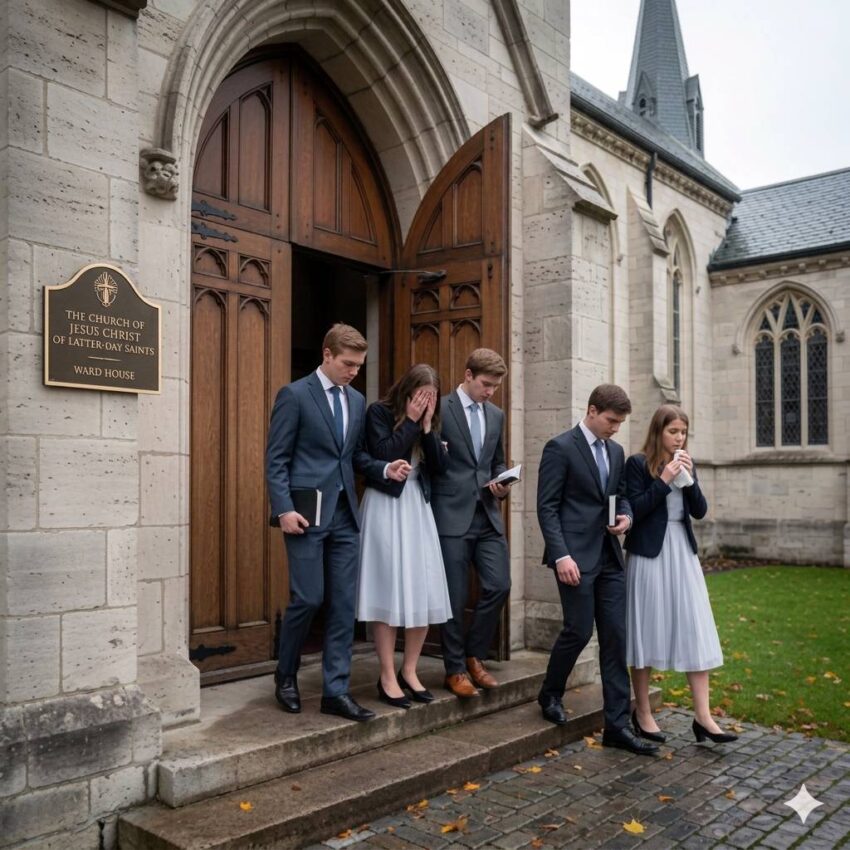
Image: An AI-generated image imagines a group of young people who have encountered a
faith crisis and are discouraged about their Church membership.
A 2026 Analysis of an Unprecedented Generational Exodus — and a Pastoral Invitation Home
Introduction: The Quiet Earthquake
For the first time in its 196-year history, the Church of Jesus Christ of Latter-day Saints lost more members in the United States than it gained. The announcement came quietly, tucked into the annual statistical report released in April 2026, and summarized by The Salt Lake Tribune in a sentence that would have been unthinkable a decade ago: the American membership rolls experienced a net decrease of 186 members, bringing the country’s total to 6,929,770.
That number — 186 — is statistically small. Symbolically, it is seismic. For generations, Latter-day Saints pointed to steady American growth as evidence of divine favor. Seminary enrollments rose, chapels filled, and missionary numbers climbed. The church was the fastest-growing religion in America, exporter of a uniquely confident spirituality, and its leaders frequently reminded members that prophecy itself was unfolding in the numbers. Then the numbers stopped cooperating.
Independent researcher Matt Martinich, writing at ldschurchgrowth.blogspot.com and cited by the Tribune’s David Noyce, attributed the decline to three converging forces: falling birthrates among active members, the removal from church rolls of unbaptized children of record who have reached age eight, and names deleted because of death, formal resignation, or loss of membership through excommunication. Each of these forces has been building for years. In 2025, they finally crossed a threshold.
This essay is a fully revised update of my earlier reflection on that trend. It draws on the latest research — including the December 2025 Salt Lake Tribune analysis by Jana Riess, the 2023–2024 Pew Religious Landscape Survey broken out by the By Common Consent bloggers, the April 2026 Tribune membership report, the testimony of excommunicated members, the voices of therapists who work with faith-transitioning Latter-day Saints, and newly public memoirs from celebrity exiters — and asks a harder set of questions than the numbers alone answer:
❓Why are people leaving?
❓What does it cost them?
❓Why should a church that claims more love, more revelation, and more eternal family than any other tradition inflict so much trauma when a member finally walks away?
❓And what, if anything, can Biblical Christianity offer in place of what they are losing?
This is written not in contempt by a Christian believer, but in sorrow and hope. The goal is not to score points against people I love, but to tell the truth plainly enough that a hurting LDS reader, or a watching friend, might recognize the Savior of the Gospels as someone radically different from the institution they left behind or are currently experiencing a faith crisis.
Part One: The Generational Earthquake
A Retention Collapse Five Decades in the Making
The April 2026 U.S. membership decline did not arrive without warning. It is the culmination of a retention collapse that has been building across five decades, most clearly visible in the comprehensive work of Jana Riess, Alex Bass, and Benjamin Knoll. Drawing on the General Social Survey, which asks Americans both about their childhood religion and their current religion, Riess has documented a trajectory the church’s own leaders initially dismissed but can no longer ignore.
We’ve gone from retaining over three-quarters of childhood LDS members through the 1970s, 1980s and 1990s, to keeping around 40 percent in the 2020s — a statistically significant drop.
— Jana Riess, Religion News Service / Salt Lake Tribune
Broken out by generation, the pattern is stark. Members of the Greatest and Silent Generations left the church at a rate of roughly twenty-nine percent. Baby Boomers left at thirty-three percent. Generation X left at thirty-seven percent. Millennials and members of Generation Z — the two cohorts now moving through the prime decades of adult affiliation — have left at fifty-five percent. More than half of those raised in the faith after 1981 have walked away.
The historical norm of seventy-five percent retention that once made the church the envy of other American religions has fallen to forty-six percent for those born after 1981. The church once celebrated findings from the National Study of Youth and Religion in 2005, 2008, 2009, 2010, and 2013 as evidence of superior youth retention. Those celebrations now read like artifacts from a different era. The sociologist who directed that study, Christian Smith, summarized the reversal with unusual bluntness:
While Mormon retention looked solid in the early 2000s, in the years since, as millennial Mormons moved through emerging adulthood, they began exiting the LDS Church in dramatic, unprecedented numbers.
— Christian Smith, Notre Dame sociologist
In December 2025, responding directly to recent remarks by some church leaders who suggested that the widespread departure of young adults is a mere ‘narrative’ rather than reality, Riess reinforced her findings with new data. Her column for the Tribune was titled with a deliberate parry: ‘Data shows Gen Zers and millennials are leaving Mormonism.’ In the United States, at least, the narrative of youth exit is not propaganda. It is arithmetic.
The Female Exodus: A Reversal of Historic Patterns
The most underappreciated dimension of this story is the specifically female character of the recent exodus. Pew’s 2023–2024 Religious Landscape Survey, analyzed by Jenny Smith at the Latter-day Saint blog By Common Consent, shows that in every birth decade from the 1960s onward, female LDS disaffiliation has steadily increased. Among LDS women born in the 1990s and 2000s, the rate of those who have already disaffiliated by the time of the survey approaches fifty percent — compared with just eighteen percent of women in their seventies.
By contrast, male LDS disaffiliation peaks among those born in the 1980s and then actually decreases for younger cohorts, suggesting that younger men who remain in the church are among its most orthodox adherents, while younger women are leaving at historically unprecedented rates.
For young women, Pew’s data shows an alarming exodus from the faith that does not seem to be stopping. Almost half of young women in their twenties and thirties have already disaffiliated compared with just 18 percent of those in their seventies and older.
— Jenny Smith, By Common Consent, September 10, 2025
This reverses a pattern that has held across most of Christian history, in which women were more religiously engaged than men. A 2024 study by the Survey Center on American Life found that nearly two-thirds of Gen Z women surveyed said churches do not treat men and women equally. For a tradition in which ecclesiastical authority, decision-making power, financial stewardship, and sacramental function rest exclusively with ordained men, that generational expectation of equality creates a tension that is increasingly impossible to paper over.
If current trajectories continue, the demographic composition of an average LDS congregation will shift from what has historically been a majority of middle-aged women and older men to a future majority of older women and middle-aged men. That is not a minor adjustment. It alters the entire texture of ward life.
Part Two: The Architecture of Departure
When researchers ask former Latter-day Saints why they left, the answers are neither simple nor monolithic. Riess and Coates’s 2023 Current and Former Latter-day Saint Survey, based on responses from 2,625 current and 1,183 former members reached through the unusual combination of 80,000 mailed postcards to the Mormon Corridor and targeted Facebook advertising to a Utah audience, identified interlocking clusters of reasons that vary by age, gender, and experience.
Doctrinal and Historical Concerns
For older members, the top three drivers of departure remained the historical record surrounding Joseph Smith, the authenticity of the Book of Mormon, and the church’s record on race. For younger members, doctrinal issues still matter, but experiential concerns have moved to the foreground.
Overall, we were surprised to find that doctrinal issues were not as important for young people who had left the church as they were for older Mormons. But for younger Mormons and for women of all ages, the experiential was more at the forefront.
— Jana Riess, 2023 survey findings
Even popular LDS apologist Jared Halverson, in a May 2025 conversation with Terryl Givens published by Faith Matters, conceded the shift, drawing a telling contrast between the head and the heart:
I think in some ways people used to leave the church because they didn’t think it was true, and now people are leaving the church because they don’t think that it’s good. Whereas now, how can I in good conscience stay in the church and stay friends with my LGBT brothers and sisters? How do I navigate women’s place in the church? It’s much more of a social side of things than a historical doctrinal side of things.
— Jared Halverson, Faith Matters podcast, May 11, 2025
Halverson’s framing is worth taking seriously, though it requires a caveat. The wasmormon.org community has pointed out that apologists like Halverson tend to frame the modern exit as driven primarily by ‘social’ rather than ‘truth’ concerns, when in fact a great many departures begin with truth and end with goodness — or conversely, begin with goodness and become truth questions once the questioner starts pulling threads. The two are inseparable.
Christi Keller, a former BYU-Idaho employee of thirty years and lifelong member who posted her exit story at wasmormon.org in 2025, illustrates how the two streams converge. After an honorable mission to Uruguay, a temple marriage, and three decades of church callings, she began researching her growing questions — not to leave but, initially, to prove the church true.
But the questions were growing. What about Joseph Smith and polygamy? Thirty-plus wives? Did he really marry children as young as fourteen? Did he marry married women? What were the plates for if Joseph just needed a rock in a hat? Wait — a rock in a hat? What in the world does Masonry have to do with the temple ceremony? The Book of Abraham doesn’t have anything to do with Abraham? … I wanted it all to be true. Like so many others, I began researching and chasing footnotes not to prove the church false but to prove it true. I felt sick. I felt angry. I felt deceived.
— Christi Keller, wasmormon.org, August 2025
Keller’s testimony is especially telling because her sources of information — including the church’s own Gospel Topics Essays, the Joseph Smith Papers, Fawn Brodie, Richard Bushman, Dan Vogel, Todd Compton, Linda King Newell and Valeen Tippetts Avery, Grant Palmer, Robert Ritner, and Sandra Tanner of Utah Lighthouse Ministry — are now broadly accepted by LDS scholars themselves. The material is no longer controversial in any meaningful historical sense. What is controversial is that it had never been taught to her in sixty years of faithful participation.
The LGBTQ+ Flashpoint
No single issue has driven more young people from the LDS Church than its posture toward LGBTQ+ individuals. Coates and Riess’s data is unambiguous: only four percent of current members identified as LGBT, compared with eighteen percent of former members — a more than fourfold ratio. Josh Coates, one of the survey’s architects, offered the straightforward explanation:
If you’re LGBT and you’re in the church, it’s not one hundred percent compatible, and you’re going to leave. And so obviously that means there’s going to be a lot more former Latter-day Saints.
— Josh Coates, 2023 Latter-day Saint Survey
The November 2015 policy that classified members in same-sex marriages as ‘apostates’ and barred their children from baptism — later revised in 2019 — was, for many, the moment of rupture. A 2024 Public Religion Research Institute study found that approximately sixty percent of Americans under thirty who left religion cited their faith’s negative teachings about LGBTQ+ people as a primary reason, a rate significantly higher than among older generations.
Nowhere is the human cost of that rupture more visible than in the story of David Archuleta, the American Idol runner-up and lifelong Latter-day Saint who left the church in 2023 and published the memoir Devout: Losing My Faith to Find Myself in February 2026. In an interview with Variety’s Steven J. Horowitz, Archuleta described the moment in 2020 — during his third engagement to a woman — when he considered ending his life rather than face what his sexuality meant for his faith.
I just had to take a step away, take a break from religion — because for my own sanity, I did not want to weigh out whether it was better for me to live and exist, or if it was better for me not to exist.
— David Archuleta, People magazine
Archuleta is careful, in his memoir and in subsequent interviews, to avoid speaking with bitterness about the church that raised him. He describes it as his world, his community, his safe place for many years. Yet he is also unflinching about what the system cost him personally and what it continues to cost queer Latter-day Saints who have not yet left. ‘There are queer children of God always being made every day in the world,’ he told Variety. ‘Whether they accept it or not, they are here. I’m hoping that this sets a fire for change and burns down unnecessary walls, and builds bridges in place of that.’
For additional insights on this issue, see my post, “The Celestial Divide: LDS Theology, LGBTQ Identity, and the Search for Belonging,” which examines the LDS Church’s turbulent engagement with LGBTQ individuals.
The Role of Women
Riess’s research identifies three primary reasons millennials have left: they stopped believing the LDS Church was the one true church; they could no longer reconcile their personal values with those of the institution; and they came to oppose its emphasis on conformity and its treatment of women. For women themselves, the third factor often becomes the first.
The 2025 decision by Dr. Julie Hanks — a nationally known LDS-background family therapist, author, and cultural commentator with a substantial Latter-day Saint audience — to publicly step away from the church was widely seen as emblematic. Hanks spent years trying to remain a faithful voice for women inside the institution, but she concluded, as many others have, that the structural subordination of women to male priesthood authority could not be reformed from within.
The Pew data confirms that this is not a marginal concern. Female disaffiliation now exceeds male disaffiliation in every birth decade from the 1990s onward. The church’s attempts to moderate this trend — including a 2026 initiative permitting women to serve as Sunday School presidents in some wards — drew immediate backlash from conservative members who labeled the move ‘woke’ and ‘feminist,’ while faring less well among younger women who viewed it as insufficient.
Values Misalignment and the Crisis of Authenticity
The single most frequently cited reason for leaving in the comprehensive 2023 study was not a doctrine or a policy but a personal ethical observation: ‘I could no longer reconcile my personal values and priorities with those of the Church’ (38%). Closely behind it came ‘I stopped believing there was one true church’ (36.5%), ‘I did not trust the Church leadership to tell the truth surrounding controversial or historical issues’ (31%), ‘I felt judged or misunderstood’ (30%), the Church’s positions on LGBT issues (23%), emphasis on conformity and obedience (21%), lack of historical evidence for the Book of Mormon and Book of Abraham (21%), and the role of women (18%).
What these responses share is not hostility but an appeal to integrity. Generations of Latter-day Saints were taught that the Spirit would confirm truth to them and that conscience was a gift from God. When conscience increasingly pointed in a direction the institution forbade, many members concluded that honoring conscience was the more faithful path, even if it led out the chapel door.
The Information Age
Every generation of critics has pointed to the internet as an accelerant in faith transitions, and every generation of apologists has minimized its role. The truth is somewhere in between. The church’s own Gospel Topics Essays — quietly published beginning in 2013 and officially acknowledging, for the first time, the seer-stone method of Book of Mormon translation, the existence of multiple First Vision accounts, Joseph Smith’s plural marriages to women as young as fourteen and to women already married to other living men, the papyri of the Book of Abraham, and the historic priesthood and temple ban on Black members — would never have been written without the prior circulation of these facts online. Travis McKie-Voerste, director of the Secular Therapy Project, points to a pattern:
They might pop things into YouTube and explore ‘what’s the evidence that God exists?’ If someone has parents that say, ‘As Christians, it’s important to love everybody,’ and then they see very different behaviors acted out, I think they start that questioning and say, ‘This doesn’t feel right.’
— Travis McKie-Voerste, Secular Therapy Project
The question is no longer whether young Latter-day Saints will encounter information their local leaders do not share with them. They will. The question is whether they will encounter it from a hostile source at twenty-two after a decade of feeling deceived, or from a loving ward family at sixteen who modeled how to sit with hard truths without losing faith. For most of the exiters in Riess’s survey, the first scenario prevailed.
Part Three: Those Who Did Not Choose to Leave
Any honest account of the LDS exodus must acknowledge that a significant portion of former members did not leave voluntarily. They were excommunicated — removed from the rolls through the church’s own disciplinary councils for the offense of public disagreement.
Under the modern General Handbook (2020–present), apostasy is defined in part as ‘repeatedly acting in clear and deliberate public opposition to the Church, its doctrine, its policies, or its leaders.’ The Strengthening Church Members Committee has historically monitored public statements by members and referred cases to local ecclesiastical authorities. What this means in practice is that dissent — the kind of public disagreement that in any secular context would be protected speech — has frequently carried the penalty of the severance of one’s standing in the only community many members have ever known.
The list of excommunicated Latter-day Saints includes some of the church’s most thoughtful internal critics. Maxine Hanks was excommunicated for editing the scholarly volume Women and Authority. Sonia Johnson was expelled for leading Mormons for the Equal Rights Amendment. John Dehlin, host of the widely listened-to Mormon Stories podcast, was excommunicated in 2015 for publicly questioning church positions on women’s ordination and LGBTQ+ inclusion. Sam Young was excommunicated for publicly advocating that bishops stop conducting private one-on-one ‘worthiness interviews’ with minors — a position the church has now quietly adopted as its own policy.
Francis Nelson Henderson, a 1942-born physicist, BYU graduate, returned missionary, and sixth-generation Latter-day Saint descended from the third church president, John Taylor, published his 217-page ‘Full Exit Statement’ on April 20, 2026. Henderson explicitly frames his exit not as rebellion but as moral responsibility:
This statement is not primarily about whether the historical claims of the LDS Church are true or false. It addresses a deeper issue: the ethical system that flows from those claims, and the effect that system has on the individual. When a religion elevates obedience above conscience, moral authority is transferred from the individual to the institution. Once that transfer occurs, the individual no longer determines what is right; he determines what is permitted. … Leaving the LDS Church is not an act of rebellion. It is an act of moral responsibility.
— Francis Nelson Henderson, Full Exit Statement, April 20, 2026
Henderson’s statement, like many written by excommunicated or resigning members, is painstakingly documented and explicitly pastoral. He does not condemn current believers. ‘I do not assume that those who remain in the Church are insincere or unintelligent,’ he writes. ‘On the contrary, many are thoughtful, ethical individuals whose lives are deeply intertwined with their faith. Family, community, identity, and meaning are powerful forces, and it is entirely understandable that individuals approach difficult questions cautiously, or not at all.’ The tone is grief, not contempt. That tone is characteristic of a large portion of the thoughtful departure literature.
The Case of Nemo the Mormon: Excommunication Without Explanation
Among the more troubling recent church disciplinary cases was that of the blogger and YouTuber known as “Nemo the Mormon,” whose experience illustrates how LDS discipline can feel opaque rather than pastoral. Nemo, whose real name is Douglas Stilgoe, began publishing content as a believing member who was trying to think through difficult questions about church history and doctrine in public. His tone was often careful and analytical rather than combative, and his work appealed to members who were still trying to reconcile faith with troubling evidence.
The exact grounds for his disciplinary council were not made especially clear in the public reporting. Mormon Stories reported that Stilgoe received a membership council letter in Oxford, England, but described the reasons as vague. That same coverage noted that he had been active in public criticism of the church, including appearances on LADBible and comments at the McKinney, Texas City Council. Other reporting framed the issue more specifically as Stilgoe’s public refusal to sustain LDS leaders after what he regarded as demonstrable dishonesty. What is clear is that the church treated his public dissent as serious enough to trigger formal discipline.
Some of the more specific claims in the original draft should be softened. The available sources do not clearly establish that the hearing was less than an hour, that he was denied any meaningful response, or that the case was explicitly coordinated with Salt Lake City in a way that prevented appeal. Likewise, while the public record suggests the process was vague and distressing, it is safer to say that the reasons were not fully explained in the materials available to him or to outside observers. The broader pattern remains the same: a thoughtful critic was disciplined, and the public explanation was limited.
For many observers, that is the real issue. Whatever one thinks of Stilgoe’s conclusions, his case raises the question of whether the church is more comfortable disciplining public dissent than answering it. For an institution that presents itself as committed to truth-seeking and spiritual care, that is a revealing contrast.
Part Four: Public Exits, Private Journeys
Celebrity is a double-edged instrument for a religious tradition. When famous adherents speak well of the faith, the church benefits from reflected glamour. When they leave, the spotlight that once drew converts becomes a floodlight on reasons to doubt. In recent years, that floodlight has intensified considerably.
David Archuleta
The most discussed celebrity exit of the past several years is David Archuleta’s. Raised Mormon, famous at seventeen as the runner-up on the seventh season of American Idol, Archuleta served a two-year LDS mission to Chile from 2012 to 2014 and was, as Variety’s Steven Horowitz described him, the ‘picture-perfect Mormon poster boy’ for his generation. His 2021 Instagram post coming out as queer and his subsequent decision to leave the church in 2023 represent one of the highest-profile LDS departures in the modern era. His February 2026 memoir Devout became an instant bestseller.
I’ve tried for almost 20 years to try and change myself until I realized God made me how I am for a purpose. And instead of hating what I have considered wrong I need to see why God loved me for who I am and that it’s not just sexuality. So many other traits of who I am come from how I’ve been created.
— David Archuleta, Instagram coming-out post, 2021
Paul Walker, Ryan Gosling, Amy Adams, Katherine Heigl
A Wonderwall feature published in March 2026 by Isabella Torregiani catalogued several other well-known actors whose departures from the LDS Church have been reported. The late Paul Walker of the Fast and the Furious franchise told GQ in December 2013 that the traditional Mormon ‘ideas about parenting [of] structure and sacrifice’ he was raised with no longer fit his life. Though he ultimately described himself in later years as simply ‘a Christian,’ his departure from the specific institutional form of Mormonism he grew up in was complete.
Ryan Gosling was raised by devout Mormon parents in Canada. He told The Guardian in 2007 that his mother herself described her earlier self as a ‘religious zealot,’ and in a 2002 Village Voice interview he characterized his own posture as ‘religious but nondenominational,’ adding, ‘Maybe I’m too selfish, or I’m jealous of their humility — that somebody can say, yeah, it doesn’t make sense but I’m going to believe it anyway.’ Gosling’s departure was less dramatic than Archuleta’s, but no less definitive.
Amy Adams, raised Mormon as one of seven children in a devout family, told The Sun in 2013 that her family left the church after her parents’ divorce when she was eleven, and that the residual shame of the tradition still shapes her inner life decades later. ‘I grew up as a Mormon,’ she said, ‘and that had more of an impact on my values than my beliefs. I’m afraid I will always feel the weight of a lie.’ Katherine Heigl’s family joined the LDS Church after the death of her brother Jason in a car accident, found comfort there during acute grief, and eventually drifted away. She describes the church with evident affection, but has not been a practicing member for years.
Taylor Frankie Paul and the MomTok Exit
A newer genre of celebrity exit has emerged from the social-media phenomenon known as ‘MomTok’ — the highly monetized Utah-based community of young Latter-day Saint mothers on TikTok. Taylor Frankie Paul, whose 2022 ‘soft-swinging’ scandal made national news and whose family featured in Hulu’s reality series The Secret Lives of Mormon Wives, publicly left the church in 2025. Her departure, chronicled at length in Vulture, illustrates a specific dynamic: young LDS women whose social-media platforms were built on performance of idealized Mormon family life have, in increasing numbers, used those same platforms to document the unraveling of their faith. A 2024 Wall Street Journal feature on ‘ex-Mormon TikTok creators’ catalogued a subculture now large enough to support full-time content careers.
The cumulative effect of these public exits is difficult to measure but impossible to ignore. When a church’s most visible cultural ambassadors leave in quick succession and leave articulately, the remaining members must construct explanations for what is happening, and those explanations — whether the church’s official framing that such people were ‘deceived,’ or the exiters’ own framing that they finally found integrity — compete for the hearts of a watching generation.
Part Five: The Aftermath — Why Leaving Hurts So Much
A tradition that claims to embody more spiritual love and empathy than any other on earth should not inflict as much damage on its departing members as the LDS Church demonstrably does. This is not a polemical flourish, but the consistent testimony of licensed therapists who work with ex-Mormon clients, of spouses whose marriages have been upended, of adult children shunned by their parents, and of former members trying to reconstruct identity after the institutional scaffolding has been removed. The harm is not incidental. It is part of the pattern.
The Gospels describe a Savior who left the ninety-nine to seek the one who had wandered and who welcomed the prodigal with a feast rather than a disciplinary council. That is the Shepherd of the biblical record: patient, pursuing, restorative, and more concerned with rescue than with punishment. By that standard, the church’s treatment of dissenters is revealing. When an organization claiming His name routinely leaves former members in need of religious trauma therapy, the problem is not with the sheep. Something in the system appears not to be following the Shepherd revealed in the scriptures at all.
The Emotional Stages of Exit
Arizona-based therapist Chelsey Liaga, LMSW, who treats ex-Mormon women at Wild Bloom Therapy and Wellness in the greater Phoenix / Mesa area, describes in a January 2026 essay a set of emotional stages that virtually every departing member passes through, though rarely in linear order.
The first stage is cognitive dissonance — the accumulating weight of questions that refuse to resolve, no matter how much the member prays, studies, or applies the counsel to ‘put it on the shelf.’ The shelf eventually breaks, not intellectually but emotionally, often with panic.
The second is what Liaga calls ‘freedom and collapse at the same time.’ The member feels immediate relief from the constant internal pressure, paired with terror:
You may feel like you have jumped off a cliff without knowing whether you are about to crash and die or learn how to fly. … This does not mean you are unstable. It means you have removed a structure that once organized your entire worldview.
— Chelsey Liaga, LMSW, Wild Bloom Therapy & Wellness
The third is disorientation — a sense that every ordinary decision has suddenly become overwhelming because there is no external authority declaring which choice is right. Liaga notes that this manifests in small, almost comical ways: a former member standing confused in a Starbucks, not knowing what a latte is because caffeine was forbidden for a lifetime. These are not really about coffee. They are about the realization of how much of ordinary adult life had been prescribed.
After disorientation comes stabilization, the slow return of equilibrium as the nervous system learns it is not in danger. Then comes the socially difficult work of deciding whom to tell and how much, followed almost invariably by a phase of anger and grief. Liaga is careful to note that this anger, though uncomfortable, is typically a sign of healing rather than bitterness:
Anger does not mean you are bitter. It means you are allowing yourself to name harm. Anger is a natural and normal reaction to injustice.
— Chelsey Liaga, LMSW
Further stages — experimentation, meaning-making, integration, and finally reconstruction — follow over months and years. Liaga’s closing counsel is not triumphal: ‘Healing is not about rushing toward certainty or having the right beliefs. It is about learning how to live from the inside out and developing trust in your own emotions, intuition, and needs.’
Religious Trauma — Five Signs
Kelsey Laulainen, a licensed psychotherapist who practices in both Washington and Arizona, has catalogued what she identifies as the five signs of religious trauma specifically in women who have left Mormonism. Her list is not moralizing or dramatic; it is diagnostic.
First, guilt or shame at the act of setting normal adult boundaries — saying no to Sunday dinner, declining a request to pray, refusing to have an uncomfortable conversation. The body panics even when the mind has long since departed. Second, the inability to trust one’s own thoughts and desires after a lifetime of being told to defer to the Spirit, priesthood leaders, or the institutional voice. Third, grief — often invisible to outsiders — for the life the member was taught to want: the temple sealing, the eternal family, the vision of motherhood, the heaven-bound trajectory. Fourth, disconnection from one’s own body and sexuality, the inheritance of a worthiness framework that treated normal human embodiment as perpetually suspect. Fifth, the intermittent fear of being a ‘bad person’ even years after leaving, because the system made goodness conditional on compliance.
None of these symptoms is exaggerated. They are documented clinical presentations, and the network of therapists who specialize in them has grown large enough to sustain entire practices across the Mormon Corridor.
The Marriage at Risk
Dr. Dominic Schmuck, a licensed psychologist in Utah who works with PSYPACT-participating states, has written extensively about the particular burden of telling one’s spouse that one no longer believes. Writing within the scientific literature on ‘high-demand religions,’ Schmuck notes that in Mormon marriages, there is typically an unspoken assumption that both spouses will participate actively in the church forever. When one spouse loses belief, the other frequently experiences it as betrayal.
In many Mormon families, discovering that your partner is leaving the LDS church can feel like betrayal. Because of this, it is generally best to inform your spouse sooner rather than later. No spouse likes finding out through a third party, a social media post, or only after you have made the decision to no longer attend church.
— Dr. Dominic Schmuck, TruU Psychology
Schmuck’s counsel — tell the spouse early, tell them in person, keep the initial conversation brief, follow the partner’s lead, and make behavioral changes slowly — is pastoral wisdom for a situation the church itself rarely prepares couples to navigate. Every week, bishops and therapists in Utah, Idaho, and Arizona counsel mixed-faith couples trying to salvage marriages that were built on the shared assumption of eternal temple covenants. Not all of those marriages survive. Reliable statistics are hard to come by, but the broader Riess–Coates data show that roughly 30% of former members are married to other former members, while 20% remain married to believing Latter-day Saints, suggesting a quiet crisis reshaping family life across the Mormon Corridor.
The Shunning Problem
The most painful dimension of the post-exit experience, testified to repeatedly in first-person accounts, is the behavior of believing family members toward the one who has left. John O. Andersen, a sixth-generation Latter-day Saint who formally resigned in 2005, wrote in his published resignation letter that immediately after he came out publicly, one close family member told him she was sadder about his leaving the church than about their father’s recent death in an accident. He catalogues the epithets he was called by close family: adulterer, internet porn addict, mentally unstable, a bad influence on his children, possessed by the devil.
So, do I think the Mormon Church is a good family church? Nope. … Contrary to the media image the Mormon Church portrays as the ‘family church,’ I’ve found in many instances personally, and from others, that Mormon families are usually only close when everyone in the family believes in the Mormon Church.
— John O. Andersen, ’33 Reasons Why I Left the Mormon Church,’ 2008
This is the deepest wound, and it is the one most directly at odds with the Gospel of Christ. A church that claims eternal family as its central promise should not routinely produce earthly families in which the doubting daughter is cut off, the gay son is made unwelcome, and the disaffiliated father is whispered about at ward dinners. That this happens as often as it does is not, as apologists sometimes suggest, a failure of individual members who do not live up to their ideals. It is a structural consequence of a worthiness-based ecclesiology in which standing — and with it, full belonging — is conditional.
The Substitute Reinforcement: Icepacks, Rubber Bands, and Why Trauma Therapy Matters
One of the most telling facts about the ex-Mormon therapeutic ecosystem is the quality of care available. Licensed practitioners like Liaga, Laulainen, and Schmuck — along with Dr. Julie Hanks and Natasha Helfer, among many others — have developed genuine clinical expertise in treating religious trauma without pathologizing faith itself. They do not tell their clients that all religion is bad. They help their clients distinguish between healthy and high-control religious environments, between integration and fragmentation, and between shame-based and grace-based formation.
The fact that this subspecialty exists at all, and the fact that it is staffed by former Latter-day Saints themselves, is a quiet indictment. A tradition that produces its own robust religious-trauma therapy sector has some accounting to do with how it treats its members, particularly the ones who stop believing.
Part Six: Where They Go — and Why Too Many Go Nowhere
The most sobering finding of Riess’s research concerns not why members leave but where they land. Forty-four percent of former Latter-day Saints are not affiliated with any other religious tradition. They are spread across categories Pew labels ‘atheist,’ ‘agnostic,’ and ‘nothing in particular.’ Another twenty-one percent call themselves ‘just Christian’ without specifying a denomination, which usually means they retain Christian beliefs but do not regularly attend a church. The remaining thirty-three percent identify with specific traditions: roughly eleven percent joined other religions, ten percent became evangelical Protestants, seven percent became mainline Protestants, and six percent became Roman Catholics.
This means that nearly half of all former Mormons have exchanged ‘the one true church’ for no institutional religion at all.
Why? Part of the answer lies in a saying many members internalized during their years in the church: ‘If the LDS Church isn’t true, then nothing is.’ This binary framing — that there is either Mormonism or nothing — becomes a prison for those whose Mormonism collapses. Having been taught all their lives that every other Christian tradition is at best an apostate remnant and at worst a creation of Satan, departing members often cannot imagine that any other church might hold genuine truth. They leave, and they stop.
Belief in God does not always go with them. Among current Latter-day Saints, more than seven in ten say they ‘know God really exists and have no doubts about it.’ Among former members, that rate of certainty drops to less than one-sixth. Most former members retain some belief in ‘something higher’ — but the certainty is gone, and with it, in many cases, the habit of gathered worship.
The likelihood of return is vanishingly small. More than four out of five former members describe return as ‘very unlikely,’ with another ten percent calling it ‘unlikely.’ Three out of four former members dislike or strongly dislike the church as an institution, though they tend to retain neutral to positive feelings toward individual members. The distinction matters: the problem, for most, is not the people. It is the system.
A Global Counter-Trend
Lest the picture seem unremittingly dark for the church, it is essential to note that growth is genuinely occurring outside the United States. In 2025, a record forty-four countries and territories saw their Latter-day Saint rolls grow by at least ten percent. Nine of the top ten countries by net membership increase are in Africa or Latin America. Brazil added 47,924 members, Mexico 38,229, the Democratic Republic of Congo 25,704, Nigeria 23,702, and the Philippines 22,621. The church is shrinking in its American heartland even as it expands dramatically in the Global South.
This raises a question the church has not yet fully reckoned with publicly: what does it mean for an institution that has always claimed American exceptionalism as part of its self-understanding — Joseph Smith was an American prophet; the Constitution is divinely inspired; Missouri is the future site of the New Jerusalem — to find its American core declining even as its international growth accelerates? Demographic projections suggest that within a generation, the typical Latter-day Saint will be Brazilian, Nigerian, Filipino, or Congolese, not American. How the Salt Lake hierarchy adapts to that reality will shape the church’s twenty-first century more than anything else.
From my post, “Record LDS Baptisms: Impressive Numbers, Harder Questions,” I present the global reach of LDS mission efforts in its rightful context:
The LDS Church does not break down its baptism figures by country and region in its annual statistical report, which is itself a telling omission. What we do know from independent researchers and church leaders is that the engine of this growth is overwhelmingly in the Global South. While Mormonism historically drew most of its converts from Western nations in Britain and Scandinavia, it now has far greater success in Africa, the Pacific Islands, and much of Latin America. Salt Lake Tribune. These are regions where Christian religious identity is culturally normalized, institutional trust runs high, and the social benefits of belonging to an organized, well-resourced church are tangible and immediate — factors that have little to do with informed doctrinal commitment.
The Church highlighted a single-day mass baptism of 120 people in Moriba Town, Sierra Leone, and another event where 107 people stepped into the Bangoho River in Papua New Guinea to be baptized. The Church News. These are striking images of mass religious mobilization — but they are precisely the conditions least likely to produce informed theological converts. The speed and scale of such events make sustained pre-baptism catechesis nearly impossible.
LDS sociologist Armand Mauss observed that for the past fifty years, the church has “tended to focus much more on baptisms than on conversions,” with missionaries seeking commitment to baptismal dates from the earliest contacts, and only weeks typically elapsing between first contact and the actual baptism. Would-be converts are “rarely required to make the kinds of investments and sacrifices for their new religion across a timespan that would really test their commitments.” His assessed dropout rate for new converts: approximately 75 percent within the first year.
This is not incidental — it is structural. In communities where the LDS church arrives with material resources, social solidarity, and a coherent community framework, baptism becomes a socially rational choice long before it becomes a theologically informed one. Converts in rural Sierra Leone or Papua New Guinea are not weighing the claims of Joseph Smith against the historical scholarship of B.H. Roberts. They are responding to community, to the warmth of young missionaries, and to the pull of belonging. That is not a criticism of their sincerity — it is an observation about the conditions under which sincere but uninformed commitments are made.
Part Seven: The Church’s Response — and Its Limits
The LDS Church has not been passive in the face of retention decline. Over the past decade, it has reduced Sunday meetings from three hours to two, allowed missionaries more frequent family contact through phone and video, softened some public rhetoric on social issues, emphasized personal spiritual experience alongside institutional authority, expanded temple construction and worship, and undertaken the Gospel Topics Essays project to provide carefully worded acknowledgments of historical problems. In a statement to the Salt Lake Tribune, the late apostle Jeffrey R. Holland framed the posture thus:
We are continually seeking to understand and meet the spiritual needs of our members, adapting where we can while preserving the core doctrines of our faith.
— Elder Jeffrey R. Holland
These are genuine adjustments, and they are not without valid consideration. For members already grappling with doubts, however, they have largely felt insufficient. Adjusting the meeting schedule does not address concerns about whether the Book of Abraham was translated from papyri that Egyptologists can now read. Expanding temple construction does not answer questions about the 2015 exclusion policy or women’s exclusion from priesthood authority. Softened rhetoric does not address the underlying worthiness framework that generated the rhetoric in the first place.
The church’s most recent General Conference, held in April 2026, illustrated the tension. Apostle Neil L. Andersen acknowledged, in a discussion of eternal marriage, that there are ‘situations where divorce should be considered’ — framing that would have been unthinkable a generation ago but that now reads to many critics as tentative. More telling, perhaps, was the sharp drop in conference citations of the late President Russell M. Nelson from 157 references in October 2025 to 38 in April 2026, while citations of the new president, Dallin H. Oaks, rose to 90. The leadership is transitioning. Whether that transition will yield substantive course corrections or simply a change of voice remains to be seen.
One piece of that context deserves attention. Apostle Hugh Brown proposed in the twentieth century what he called a ‘radical’ solution to the church’s gerontocracy problem — a policy that, had it been adopted, would mean that only three of the current apostles would qualify as church president today. It was not adopted. The historian’s assessment of aging leadership and succession, discussed on the Mormon Land podcast in April 2026, underscores the structural reality: the church is led by men whose lived theological formation predates the internet age. The members they are attempting to retain increasingly do not.
Part Eight: A Different Invitation — Biblical Christianity
If you are reading this as a Latter-day Saint who has begun to ask hard questions, or as a former member carrying grief and freedom in roughly equal measure, or as someone who loves an exiting Latter-day Saint and does not know what to say, this last section is for you. It is written, I hope, in the voice of a friend rather than an adversary.
The Gospel I want to point you toward is not another institution demanding unquestioning loyalty. It is a Person. The Jesus who walks through the Gospels of Matthew, Mark, Luke, and John is not a mascot for any denomination. He is the sinless Son of God — fully God and fully man — who entered human history, who lived the obedient life we could never live, who died the death we deserved, who rose bodily from the grave on the third day, and who now reigns and intercedes for everyone who trusts Him. The good news of Biblical Christianity is that this Jesus saves completely, freely, and forever, not based on our worthiness but based on His finished work.
This is the message the Apostle Paul laid out in the letter to the Romans, a short trail of verses that sum up what the whole New Testament is trying to say:
None is righteous, no, not one. (Romans 3:10) For all have sinned and fall short of the glory of God. (Romans 3:23) But God shows his love for us in that while we were still sinners, Christ died for us. (Romans 5:8) For the wages of sin is death, but the free gift of God is eternal life in Christ Jesus our Lord. (Romans 6:23) Because, if you confess with your mouth that Jesus is Lord and believe in your heart that God raised him from the dead, you will be saved. For with the heart one believes and is justified, and with the mouth one confesses and is saved. (Romans 10:9–10) For ‘everyone who calls on the name of the Lord will be saved.’ (Romans 10:13)
Notice what is not in any of these verses. There is no temple endowment, no priesthood ordinance, no genealogical work for the dead, no tithing requirement, no three-hour block, no worthiness interview, no mission, no temple recommend, no secret ceremony, no hierarchical intermediary between you and your Father in heaven. Paul’s gospel is not a system of works leading to exaltation. It is the announcement that the work has already been done.
That is not a small distinction. That is the entire difference.
For by grace you have been saved through faith. And this is not your own doing; it is the gift of God, not a result of works, so that no one may boast.
— Ephesians 2:8–9
If you have spent your life trying to be worthy — tracking garments, tracking temple attendance, tracking tithing, tracking every thought you thought you shouldn’t have thought — the idea that Jesus has already been worthy on your behalf may sound too good to be true. It is not too good to be true. It is the news the New Testament calls, simply, good news. The Greek word is euangelion. It is the word that gives us ‘evangelical.’ It means ‘glad tidings,’ and it means that the verdict on your life has already been pronounced — guilty in yourself, justified in Christ — if you will only trust the One who pronounced it.
A Jesus Who Welcomes Doubters
The Jesus of the New Testament does not punish doubt. He engages it. When the disciple Thomas refused to believe until he had seen and touched the wounds of the risen Christ, Jesus did not excommunicate him. He appeared specifically to him, held out His hands, and said, gently:
Put your finger here, and see my hands; and put out your hand, and place it in my side. Do not disbelieve, but believe.
— John 20:27
To the crowds of exhausted, burdened, and religiously worn-out people who followed Him, He offered what He called rest rather than a heavier yoke:
Come to me, all who labor and are heavy laden, and I will give you rest. Take my yoke upon you, and learn from me, for I am gentle and lowly in heart, and you will find rest for your souls.
— Matthew 11:28–29
And to everyone who seeks honestly, He gives a standing promise that has been cashed a million times over across twenty centuries of Christian history:
Ask, and it will be given to you; seek, and you will find; knock, and it will be opened to you. For everyone who asks receives, and the one who seeks finds, and to the one who knocks it will be opened.
— Matthew 7:7–8
Biblical Christianity does not require you to suppress your critical thinking or to ignore difficult questions. It invites you into a faith that has withstood two millennia of rigorous examination precisely because it is grounded in historical events, testified to by eyewitnesses who died rather than recant what they had seen, and centered on a Person rather than a system.
What Biblical Christianity Is Not
It may help to name plainly what I am not inviting you to. I am not inviting you to trade the LDS Church for a different institution that will also demand your unexamined loyalty. Not every church that calls itself Christian actually preaches the biblical Gospel. There are controlling, manipulative, and unbiblical expressions of Christianity, and if you leave Mormonism for one of those, you may simply exchange one set of wounds for another.
What I am inviting you to is a Person, and through that Person, to the worldwide family of His disciples — sometimes called the church universal, sometimes called the Body of Christ. That family meets in historic denominations and in storefront congregations, in cathedrals and in living rooms. It is not perfect because it is made of people. But its head is Christ, not an institution, and its charter is grace, not worthiness.
A good local church, should you look for one, will preach the Bible faithfully, celebrate communion in remembrance of what Christ did once for all, welcome you as you are rather than as you ought to be, point you constantly to Jesus rather than to itself, and treat your questions as part of a life of faith rather than as a prelude to discipline. Such churches exist. They are not hard to find if you know what you are looking for. They have been the quiet refuge of thousands of former Latter-day Saints in recent decades, and of tens of millions of seekers from every other background for two thousand years.
Conclusion: The View from Here
The April 2026 announcement of the first-ever U.S. membership decline will, in retrospect, likely be remembered as a pivot. It crystallized trends that had been building for fifty years into a single number. Those trends will not be reversed by better public relations. They will not be reversed by ceremonial adjustments or softer language. They will be reversed, if they are reversed at all, only by a kind of radical honesty that very few large religious institutions have proven capable of in their late middle age.
What the data reveals is not a simple story of apostasy or faithlessness. It is the portrait of a generation seeking authenticity, inclusion, and alignment between professed values and lived reality. Many leave not because they have stopped caring about spirituality, goodness, or community — but precisely because they care deeply about those things and cannot find them within institutional structures that have felt increasingly at odds with their consciences.
Brigham Young himself — the second president of the LDS Church, speaking in the Tabernacle in 1873 — issued an invitation that I believe still deserves to be taken seriously by every Latter-day Saint wrestling with doubt:
Take up the Bible, compare the religion of the Latter-day Saints with it, and see if it will stand the test.
— Brigham Young, Journal of Discourses, Vol. 16, p. 46 (May 18, 1873)
I believe he meant it, and I believe he was right to say it. Take up the Bible. Compare. See what stands. The Jesus of that Book is the same today, yesterday, and forever. He is neither a nineteenth-century frontier prophet nor a twenty-first-century corporate brand. He is the risen Lord who walked out of His own grave, who stands at the door of every life and knocks, and who will not refuse the weary soul who asks Him honestly, ‘Are You who You said You were?’
For a fuller treatment of the specific doctrinal differences between historic Biblical Christianity and LDS theology, see our earlier essay, ‘Are Mormons Christian? The LDS Church Says Yes — Its Own Scriptures Say Otherwise,’ which examines seven doctrinal fault lines that separate the two traditions.
If you are leaving Mormonism, you are not alone. Your questions are valid. Your concerns are shared by hundreds of thousands of others. The journey is difficult, but support communities exist — both online and in person — for those navigating faith transitions. Perhaps more importantly, the risen Christ is not waiting at the end of your journey to judge whether you were worthy enough to reach Him. He is walking with you already, as He walked with the discouraged disciples on the road to Emmaus in Luke 24, patiently explaining Himself to them out of the Scriptures until their hearts, at last, burned within them.
Whatever else you take from this essay, take this: your worth is not contingent on whether you stay or leave the Church of Jesus Christ of Latter-day Saints. It is contingent on whether you belong to the actual Christ. And He has already made the way.
TORN
Why People We Love Are Leaving the Church and What We Can Learn from Them
A Book Summary · Jeff Strong (2026)
Foreword by Steve Young
❦ ————— ❦
The Book at a Glance
Torn (2026) is Jeff Strong’s data-driven, pastoral examination of why committed members of The Church of Jesus Christ of Latter-day Saints are stepping away. Featuring a foreword by NFL Hall of Fame quarterback Steve Young, the book pairs one of the largest studies ever conducted on Latter-day Saint disaffiliation with Strong’s own experience as a father, former bishop, and mission president (2018–2021). A retired senior executive at Procter & Gamble and Johnson & Johnson and a former Brigham Young University faculty member, Strong writes from inside the faith rather than against it—addressing both those who have left and the many believers who remain yet feel increasingly conflicted.
Torn between love for the Church and love for someone who has stepped away.
— Torn
The Central Thesis: A Crisis of Trust, Not Faith
Strong’s core argument is that most people do not leave casually or because they simply “stopped believing.” Departure typically reflects a slow erosion of trust and a sense that one’s church experience is no longer life-giving or whole. The book reframes disaffiliation as the painful endpoint of unmet spiritual needs, strained trust, and experiences of exclusion or what Strong calls spiritual starvation—not as rebellion, laziness, or sin.
The Research Behind the Book
Drawing on surveys of more than 20,000 current and former members, along with hundreds of interviews and national research, Strong and co-researcher Jeffrey P. Dotson assembled a uniquely large dataset. A central finding: roughly 40 percent of Latter-day Saints who were active in 2000 had stepped away within twenty-five years—and the pace is accelerating. Equally sobering, the data show that people wrestle privately for nearly a decade, on average, before leaving—evidence that these are sincere, often agonizing journeys rather than impulsive choices. An appendix details the study’s methodology and situates Latter-day Saint trends alongside other faiths, including international comparisons.
Why People Leave: Patterns and Tensions
From the data Strong identifies four recurring patterns of disaffiliation, and he frames the underlying struggle around four areas of tension that pull sincere members in opposing directions—between deep faith and difficult questions, between cherished tradition and pressures for change, and between belonging and conscience. Rather than reducing those who leave to a single stereotype, this framework helps readers see that very different people depart for very different, and often overlapping, reasons.
From Gatekeepers to Gardeners
The book’s prescriptive heart is cultural. Strong argues that congregations too often behave as gatekeepers—policing who is “in” or “out”—when they should act as gardeners who tend the soil in which faith can grow. Culture, he contends, more often than doctrine determines whether people stay, and wards and families can cultivate genuine belonging without lowering standards.
It isn’t about lower standards; it’s about more love.
— Jeff Strong
A Personal Story
Threaded through the analysis is Strong’s account of his son Cale, who left the Missionary Training Center and then the Church. Strong’s determination to understand rather than condemn—and the family’s eventual reconciliation—anchors the book emotionally and models the posture he commends to every reader.
What the Book Asks of Readers
Torn explicitly refuses to take sides in debates over who is right. Instead it invites members to see more clearly, listen more deeply, and respond more like Jesus Christ. Strong frames this as both a discipleship issue and a practical one: if culture is part of the problem, then ordinary members and leaders hold real power to help. Readers, he notes, commonly come away with three things—validation that they are not alone in feeling torn, understanding of loved ones who have left, and hope for a more Christ-centered community.
Significance
Written with evident love for the Church and its people, Torn is notable for bringing rigorous social-science data to a subject usually handled anecdotally or defensively. Its compassionate, non-polemical tone—and its refusal to dismiss those who leave as having merely been “sifted”—make it a resource for parents, leaders, and conflicted members alike. For Strong, being torn need not mark the end of faith; it can become the beginning of deeper understanding, stronger relationships, and a more Christlike way forward.
❦ ————— ❦
Source
Publisher / preview: https://www.tornbyjeffstrong.com/
Amazon: https://www.amazon.com/Torn-People-Leaving-Church-Learn/dp/B0GWVV4DW9/
A Prayer for the Reader
Lord, thank You that this reader may be genuinely interested in saying ‘Yes’ to You and trusting You as Lord and Savior. Please draw them to Yourself so they will trust in Your promise of grace and forgiveness. Produce the fruit of the Spirit and the fruit of repentance in their life so they can be confident that You are working in them. Open their heart to Your truth, remove doubts and uncertainties, and draw them to a saving knowledge of Christ’s love and grace. For as the Bible instructs: ‘God shows his love for us in that while we were still sinners, Christ died for us.’ (Romans 5:8) ‘God’s kindness leads you to repentance.’ (Romans 2:4) ‘So faith comes from hearing, and hearing through the word of Christ.’ (Romans 10:17) ‘To all who did receive him, who believed in his name, he gave the right to become children of God.’ (John 1:12) In Jesus’ name I pray. Amen.
◆ ◆ ◆
Sources and Further Reading
This essay draws on the following primary sources, each of which will reward direct engagement by the interested reader:
- Jana Riess, ‘Data shows Gen Zers and millennials are leaving Mormonism,’ Salt Lake Tribune / Religion News Service, December 12, 2025. https://www.sltrib.com/religion/2025/12/12/jana-riess-data-shows-gen-zers/
- David Noyce, ‘Latest from Mormon Land: LDS membership drops for first time in U.S.,’ Salt Lake Tribune, April 16, 2026. https://www.sltrib.com/religion/2026/04/16/lds-membership-drops-first-time-us/
- Jenny Smith, ‘Pew Pew: Latter-day Saints Heading For A Galaxy Far, Far Away,’ By Common Consent, September 10, 2025. https://bycommonconsent.com/2025/09/10/pew-pew-latter-day-saints-heading-for-a-galaxy-far-far-away/
- wasmormon.org, ‘Apologists on Why People Leave the Church,’ July 22, 2025. https://wasmormon.org/apologists-on-why-people-leave-the-church/
- wasmormon.org, ‘Christi Was a Mormon, an Ex-Mormon Profile Spotlight,’ August 22, 2025. https://wasmormon.org/christi-was-a-mormon-an-ex-mormon-profile-spotlight/
- Steven J. Horowitz, ‘David Archuleta on How Dealing With the Shame of His Sexuality and Leaving the Mormon Church Led to His Memoir Devout,’ Variety, February 17, 2026. https://variety.com/2026/music/news/david-archuleta-sexuality-leaving-the-church-memoir-devout-1236665876/
- Isabella Torregiani, ‘5 stars who left the Mormon faith,’ Wonderwall, March 13, 2026. https://www.wonderwall.com/celebrity/5-stars-who-left-the-mormon-faith/
- Chelsey Liaga, LMSW, ‘What to Expect Emotionally When You Leave the LDS Church,’ Wild Bloom Therapy & Wellness, January 6, 2026. https://myfriendthetherapist.com/what-to-expect-emotionally-when-you-leave-the-lds-church/
- Kelsey Laulainen, LMHC/LPC, ‘5 Signs You’re Experiencing Religious Trauma After Leaving Mormonism.’ https://www.kelseylaulainenpsychotherapy.com/blog/5-signs-youre-experiencing-religious-trauma-after-leaving-mormonism
- Dominic Schmuck, Ph.D., ABPP, ‘Telling Your Mormon Spouse You’re Leaving the Church — A Psychologist’s Guide,’ TruU Psychology. https://www.truupsychology.com/post/leaving-the-mormon-church-spouse-edition
- Francis Nelson Henderson, ‘Full Exit Statement,’ April 20, 2026. https://www.fnhenderson.us/FullExitStatement.pdf
- John O. Andersen, ’33 Reasons Why I Left the Mormon Church,’ adishakti.org (originally August 3, 2008). https://www.adishakti.org/_/33_reasons_why_I_left_the_Mormon_Church.htm
- Exponent II, ‘The Journey Away from Religion.’ https://exponentii.org/blog/the-journey-away-from-religion-why-people-are-leaving-religi/
- Exponent II, ‘Dr. Julie Hanks Steps Away from the LDS Church.’ https://exponentii.org/blog/dr-julie-hanks-steps-away-from-the-lds-church/
- Esquire, ‘What It Feels Like to Leave the Mormon Church.’ https://www.esquire.com/lifestyle/a65223664/what-it-feels-like-to-leave-the-mormon-church/
- Wall Street Journal, ‘Ex-Mormon TikTok Creators.’ https://www.wsj.com/tech/ex-mormon-tiktok-creators-e9a5b00e
- Vulture, ‘Taylor Frankie Paul Leaves the Mormon Church.’ https://www.vulture.com/article/taylor-frankie-paul-leaves-mormon-church.html
- Sydney Morning Herald, ‘Making Money, Losing Faith: The Mormons in Australia,’ March 30, 2022. https://www.smh.com.au/national/making-money-losing-faith-the-mormons-in-australia-20220330-p5a9c1.html
- Religion News Service, ‘Younger Mormons are highly devout in some ways but less in others, study shows,’ January 15, 2026. https://religionnews.com/2026/01/15/younger-mormons-are-highly-devout-in-some-ways-but-less-in-others-study-shows/
- SUNY New Paltz Oracle, ‘Leaving Mormonism.’ https://oracle.newpaltz.edu/leaving-mormonism/
- Reddit r/exmormon community discussion threads on the experience of leaving. https://www.reddit.com/r/exmormon/comments/1racgfi/what_was_your_experience_when_leaving_mormonism/
- SHATTERED TRUST: When Religion Causes Trauma (Amazon Kindle). https://www.amazon.com/SHATTERED-TRUST-WHEN-RELIGION-CAUSES-ebook/dp/B0FHGFHCZC
- Chumark54, ‘Have we become better people after…,’ Substack. https://chumark54.substack.com/p/have-we-become-better-peopleafter
A Note on Research Methods and Accuracy
In recent years, some have voiced concern that artificial intelligence may distort facts or introduce inaccuracies into serious research. That criticism deserves acknowledgment. However, AI has now evolved into the most powerful research instrument available to any dedicated scholar—capable of analyzing vast datasets, cross‑referencing historical records, and surfacing overlooked connections across sources. This work represents a collaboration between the author’s investigative inquiry, verified primary documentation, and the advanced analytic capabilities of AI research tools. Here, AI was not used as a ghostwriter or a shortcut for scholarship, but as a disciplined research partner devoted to rigor, accuracy, and transparency.
Every factual claim in this work has been subjected to active verification. Where AI‑generated content was used as a starting point, it was tested against primary sources, peer‑reviewed scholarship, official institutional documentation, and established historical records. Where discrepancies were found—and they were found—corrections were made. The author has made every reasonable effort to ensure that quotations are accurately attributed, historical details are precisely rendered, and theological claims fairly represent the positions they describe or critique.
That said, no work of this scope is immune to error, and the author has no interest in perpetuating inaccuracies in the service of an argument. If you are a reader—whether sympathetic, skeptical, or hostile to the conclusions drawn here—and you identify a factual error, a misattributed source, a misrepresented teaching, or a claim that cannot be substantiated, you are warmly and genuinely invited to say so. Reach out. The goal of this work is not to win a debate but to get the history right. Corrections offered in good faith will be received in the same spirit, and verified corrections will be incorporated into future editions without hesitation.
Truth, after all, has nothing to fear from scrutiny—and neither does this work.
I began leaving the church, became inactive, in my 60’s. I had friends who were not LDS or left the church and shared their experiences. My reasons do not center around church history but more present day. I quit attending the temple at about the same time as i never loved it like my husband did. The secrecy was and remains bothersome, upsetting and sad. Now the church’s main emphasis is on the temple during conference, if I listen to meetings broadcast online, and in their writings. I sense a pounding over the head and extreme pressure to go to the temple where we receive our covenants which is the only way we can enter the celestial kingdom. I’ve heard it so many times that I sense the church is using fear to control us. It feels as if I will never be enough, do enough nor will my inactive children be good enough to “make it” to live with God. So many new temples built every year, using tithing money, without considering asking the members how they feel about it. So many people hungry, can’t pay their rent, or go to Sunday meetings in shabby buildings often without walls between classrooms. I do not live in Utah, so we met in an old falling apart building with curtains drawn between classes.
Anxiety developed and it became overwhelming to listen to the bombardment of rules, the only true church, the temple, who can’t join since they are LGBTQ or drink coffee, guilt and more guilt. Who really believes that God loves the LDS church and it’s people more than the rest of the world? I always struggled with that idea since my family were not LDS. I do feel awful for what I expected of my children growing up. I was hard on them and going to confess to the bishop.
I feel lost right now, not sure where I belong. I need to keep searching for a place to be with other older people.
Thanks for listening.
Dear friend,
Your courage in sharing something so deeply personal touches my heart, and I want you to know that your feelings are completely valid and understandable. The anxiety, overwhelm, and sense of never being “enough” that you’ve described are burdens no loving God would want you to carry. Your instincts about feeling controlled through fear are worth trusting—that’s not how genuine faith should feel.
What strikes me most in your words is your tender heart for your children and your recognition that love, not rules and guilt, should define our relationship with God. That compassion you feel—that’s actually pointing you toward something beautiful about God’s true nature.
Here’s what I believe the gospel really offers, and it’s so much simpler and more freeing than what you’ve experienced: God loves you completely, just as you are, right now. Not because of temple attendance, not because of perfect obedience to rules, not because you belong to the “right” church. He loves you because you’re His child, period. Jesus didn’t come to create more religious burdens—He came to lift them off our shoulders.
The gospel message is this: God knew we could never be “good enough” on our own, so He sent Jesus to be good enough for us. When Jesus died on the cross, He wasn’t just dying for some select group—He was dying for every person who has ever felt lost, anxious, or not enough. That includes you, your children, your non-LDS family members, and every person you’ve worried about not “making it.” His love isn’t limited to one organization or building.
You don’t need to earn your way to God through temple ceremonies or perfect church attendance. Romans 8:38-39 promises that nothing—absolutely nothing—can separate you from God’s love. Not your past mistakes with your children, not your questions about church teachings, not your current feelings of being lost.
As you search for community with other older people, know that God is with you in that search too. He’s not angry with you for leaving a place that caused anxiety and fear. Sometimes He leads us away from what’s harmful so we can discover what’s life-giving.
You mentioned feeling awful about how you raised your children—that regret shows a mother’s loving heart. But remember, God’s grace covers our parenting mistakes too. It’s never too late to have honest conversations with your children about your journey and to model for them what it looks like to seek truth and peace.
You’re not lost—you’re on a journey toward freedom and authentic faith. That takes tremendous courage, especially later in life. God sees that courage, and He’s walking with you every step of the way.
With love and prayers for your continued journey.
My neighbors are LDS. Many of their young advocates have approached me. The problems I have are many.
First like so many churches they are as much of a business like many churches. LDS has several BILLION in assets claiming this money will be needed by Jesus when he returns.
These investments include in offshore shell companies that our former government had concern over.
They believe their book is an entry into the Bible.
They believe they, and only they, can bring all people to Christ. This I find is most appalling as anytime someone tells me they have the only way I am out of here.
I have several ideas I would like to present but no one will listen. These involve Native American ideas, Spiritists ideas, miracles, prayer, meditation, high energy physics and faith, etc. No one will listen. Perhaps this is the way It should be.
They see you as someone with no foundation. So, do I. If you believe in Biblical Christianity (they don’t) then you could correct their misinterpretations of the gospels and their distorted views of Jesus’s message that promote an exaltation gospel to godhood — that they will not deny — based on multiple levels of heaven and Jesus earned his way to godhood not eternally begotten with the Father. They see the words “you will be sons and daughters of God” as meaning you will become like gods. Jesus never promoted exaltation by works and earthly temples and keeping Mormon purity laws. He abhorred this stuff. That is exactly what the Jewish leaders were doing — promoting themselves and not humbling themselves and abandoning their practices that God rejects for repentance and forgiveness and believe in the one true God not many.