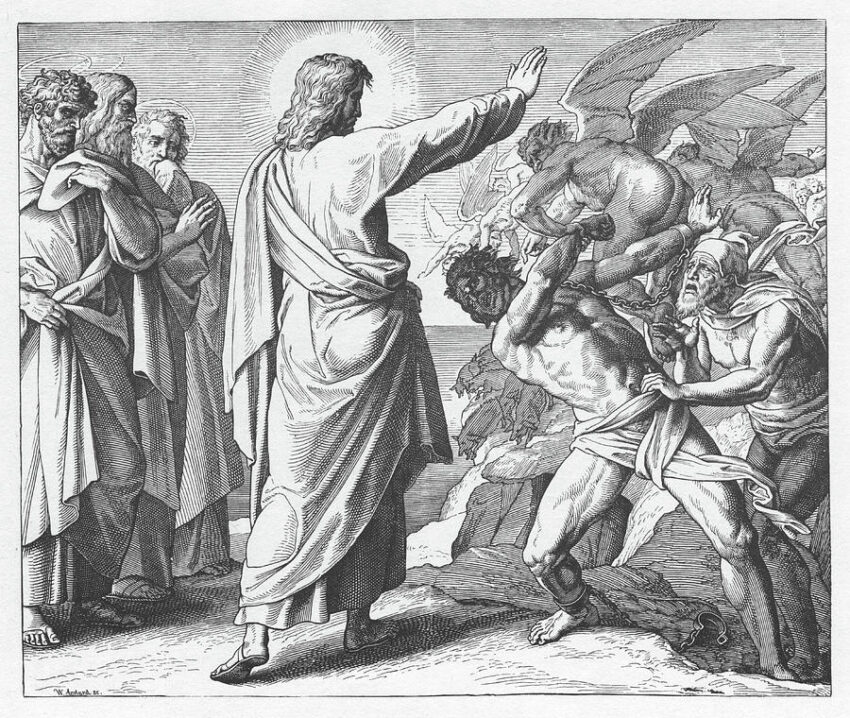
Jesus casts out the devils. Artist: Julius Schnorr von Carolsfeld. Engraver: W. Am[l?]and,
inscribed lower left. Source: Die Bibel in Bildern, Plate 191.
Mormon Apostleship.
In Christian theology and ecclesiology, the apostles, particularly the Twelve Apostles (also known as the Twelve Disciples or simply the Twelve), were the primary disciples of Jesus according to the New Testament. During the life and ministry of Jesus in the 1st century AD, the apostles were his closest followers and became the primary teachers of the gospel message of Jesus.
During his time on Earth, Jesus Christ selected a group of twelve individuals, often referred to as the Twelve Apostles or Disciples, to be his inner circle. They accompanied him, learned from him, and were entrusted with the responsibility of continuing his mission after his crucifixion, resurrection, and ascension into heaven. This group of men played a pivotal role in the growth of early Christianity, as they disseminated Jesus’ teachings and laid the groundwork for the burgeoning Church. Their influence on the development and expansion of Christianity cannot be overstated.
Introduction: The Foundation of the Claim
The Church of Jesus Christ of Latter-day Saints makes an extraordinary assertion at the very heart of its theology: that after centuries of apostasy, God restored the original apostolic authority through Joseph Smith in 1829. According to LDS teaching, the resurrected apostles Peter, James, and John appeared to Smith and Oliver Cowdery, conferring upon them the Melchizedek Priesthood and the keys of apostolic authority. From this restoration event, the Church claims to have reestablished the Quorum of the Twelve Apostles with the same divine responsibility and authority as the original apostles who walked with Jesus Christ.
This claim is not peripheral to Mormon theology—it is foundational. The LDS Church teaches that apostleship is a living office with ongoing authority, divine revelation, and responsibility for witnessing Christ. Today’s Mormon apostles are presented as direct successors to Peter, James, John, and the other apostles, possessing the same priesthood power and apostolic mandate. The Church insists that these men hold “the same divine responsibility as Peter, James, John, and the other early Apostles.”
However, when we examine the New Testament carefully and compare the actual ministry and demonstrated powers of the first-century apostles with the contemporary LDS apostles, a glaring discrepancy emerges. The original apostles possessed and regularly exercised three specific miraculous powers that Jesus explicitly commanded them to demonstrate: healing the sick, casting out demons, and raising the dead. These were not optional abilities or occasional occurrences—they were defining characteristics of apostolic ministry and essential credentials of apostolic authority.
This essay will demonstrate that the modern LDS apostles’ complete failure to manifest these three fundamental apostolic powers reveals that their claim to have restored original apostolic authority is fundamentally flawed. If the apostolic office and authority were genuinely restored, we should expect to see the same demonstrable powers that authenticated the ministry of the first apostles. The absence of these powers is not a minor detail — it strikes at the very heart of the LDS Church’s claim to be the restored church of Jesus Christ. But the failure of apostolic power is only one thread in a much larger unraveling.
Beyond the absence of signs and wonders, we will also examine the LDS claim to apostolic authority from multiple additional vantage points: the biblical case that the apostolic office was by design foundational and non-repeatable; the historical record of the early church’s own founding generation — including Brigham Young — whose supernatural claims faded within a single generation of leadership; the pattern of prophetic pronouncements later reversed or abandoned, exposing the claim of ongoing divine revelation as institutionally unreliable; the intellectual and theological shallowness of modern LDS apostolic discourse when measured against the rigorous standard of genuine biblical teaching; and the deep structural dynamics that have insulated LDS leadership from the honest self-correction that genuine wisdom always requires.
Taken together, these lines of evidence do not merely raise questions about LDS apostolic authority — they converge on a single conclusion: what the LDS Church has restored is not the office of the New Testament apostle, but the organizational scaffolding of that office, dressed in apostolic language while the substance it claimed to restore has long since disappeared.
The Biblical Standard for Apostolic Authority
The Great Commission and Apostolic Powers
When Jesus Christ commissioned His apostles, He did not merely give them a message to preach—He endowed them with supernatural power to authenticate that message. In Matthew 10:1-8, we read one of the most explicit descriptions of apostolic authority: “Jesus called his twelve disciples to him and gave them authority to drive out impure spirits and to heal every disease and sickness… As you go, proclaim this message: ‘The kingdom of heaven has come near.’ Heal the sick, raise the dead, cleanse those who have leprosy, drive out demons. Freely you have received; freely give.”
This passage is critically important because it establishes that miraculous powers were not ancillary to apostolic ministry—they were integral to it. Notice the imperative nature of Christ’s commands: “Heal the sick, raise the dead… drive out demons.”These are not suggestions or possibilities; they are direct commands that presuppose the apostles would have the power to accomplish them. The authority to perform these miracles was given simultaneously with the authority to preach the gospel.
Luke’s gospel records a similar commissioning: “When Jesus had called the Twelve together, he gave them power and authority to drive out all demons and to cure diseases, and he sent them out to proclaim the kingdom of God and to heal the sick” (Luke 9:1-2). Again, we see the inseparable connection between preaching authority and miraculous power. The apostles were not sent merely as teachers or administrators—they were sent as miracle workers whose supernatural abilities would validate their message.
Mark’s gospel emphasizes the same point: “He appointed twelve that they might be with him and that he might send them out to preach and to have authority to drive out demons” (Mark 3:14-15). The authority to cast out demons was part of the essential apostolic commission from the very beginning.
The Purpose of Apostolic Miracles
These miraculous powers served a specific theological and practical purpose. They were the divine credentials that authenticated the apostles’ claim to speak for God. In Hebrews 2:3-4, we read: “This salvation, which was first announced by the Lord, was confirmed to us by those who heard him. God also testified to it by signs, wonders and various miracles, and by gifts of the Holy Spirit distributed according to his will.”The miracles were God’s testimony—His divine signature—confirming that the apostles’ message was genuine.
Paul understood this clearly. When defending his own apostleship against false apostles, he wrote: “I persevered in demonstrating among you the marks of a true apostle, including signs, wonders and miracles”(2 Corinthians 12:12). For Paul, miraculous power was one of the essential “marks” or credentials of a true apostle. It wasn’t enough to claim apostolic authority; that authority had to be demonstrated through supernatural power.
This understanding was shared by the early church. When the disciples needed to replace Judas Iscariot, they looked for someone who had been with Jesus from the beginning and could be “a witness with us of his resurrection” (Acts 1:22). The apostolic office required eyewitness testimony and demonstrable divine empowerment. These were non-negotiable qualifications.
The Three Essential Apostolic Powers
Among all the miraculous abilities demonstrated by the apostles, three stand out as particularly significant and frequently mentioned in Scripture: healing the sick, casting out demons, and raising the dead. These three powers were not random or arbitrary—they represented Christ’s victory over the three great enemies of humanity: disease, demonic oppression, and death itself.
Healing the Sick: This was perhaps the most frequent apostolic miracle. The book of Acts repeatedly emphasizes that “many signs and wonders were regularly done among the people by the hands of the apostles” (Acts 5:12). The healings were so numerous and public that “people brought the sick into the streets and laid them on beds and mats so that at least Peter’s shadow might fall on some of them as he passed by. Crowds gathered also from the towns around Jerusalem, bringing their sick and those tormented by impure spirits, and all of them were healed” (Acts 5:15-16). Note the comprehensive nature: “all of them were healed.” This was not occasional or rare—it was the normal pattern of apostolic ministry.
Casting Out Demons:The apostles regularly demonstrated authority over demonic spirits. Mark 6:13 records that when Jesus sent out the Twelve, “They drove out many demons and anointed many sick people with oil and healed them.”Acts 5:16 notes that crowds brought “those tormented by impure spirits, and all of them were healed.”Philip’s ministry in Samaria included the casting out of demons: “With shrieks, impure spirits came out of many, and many who were paralyzed or lame were healed” (Acts 8:7). Paul’s ministry was characterized by similar power: “God did extraordinary miracles through Paul, so that even handkerchiefs and aprons that had touched him were taken to the sick, and their illnesses were cured and the evil spirits left them” (Acts 19:11-12).
Taking her by the hand he said to her, “Talitha cumi,” which means, “Little girl, I say to you, arise.” And immediately the girl got up and began walking (for she was twelve years of age), and they were immediately overcome with amazement. Mark 5:41-42
Raising the Dead:While less frequent than healing and exorcism, the apostles did demonstrate power over death itself. Peter raised Tabitha (Dorcas) from the dead in Acts 9:36-42: “Peter sent them all out of the room; then he got down on his knees and prayed. Turning toward the dead woman, he said, ‘Tabitha, get up.’ She opened her eyes, and seeing Peter she sat up.” Paul raised Eutychus from the dead in Acts 20:9-12 after the young man fell from a window: “Paul went down, threw himself on the young man and put his arms around him. ‘Don’t be alarmed,’ he said. ‘He’s alive!'” These weren’t resuscitations of people who had just lost consciousness—these were genuine resurrections witnessed by many people.
The Consistency of Apostolic Power
What is striking about the New Testament record is the consistency and public nature of apostolic miracles. These were not rare, private events whispered about in secret or known only through vague, unverifiable testimonies. They were public, witnessed by crowds, and often performed in hostile environments where skeptics could easily expose fraud.
The apostles did not pray for healing and then wait to see what happened. They commanded healing in the name of Jesus, and healing occurred immediately.When Peter encountered the lame beggar at the temple gate, he didn’t offer to pray for him or suggest he seek medical attention. Peter said, “Silver or gold I do not have, but what I do have I give you. In the name of Jesus Christ of Nazareth, walk”(Acts 3:6). The man was healed instantly, “jumping to his feet and beginning to walk” (Acts 3:8).
Similarly, when Paul encountered the demon-possessed slave girl in Philippi, he didn’t engage in a lengthy exorcism ritual or call for a committee of elders. Acts 16:18 records: “Finally, Paul became so annoyed that he turned around and said to the spirit, ‘In the name of Jesus Christ I command you to come out of her!’ At that moment, the spirit left her.” The exorcism was immediate and complete.
This pattern of immediate, public, and verifiable miracles was the norm for apostolic ministry. The miracles were not occasional or hidden—they were regular, public demonstrations of divine authority that no one could deny. Even the enemies of the early church acknowledged the reality of apostolic miracles. After Peter and John healed the lame beggar, the religious authorities “could not decide what to do with them, because all the people were praising God for what had happened. For the man who was miraculously healed was over forty years old” (Acts 4:21-22).
The LDS Claim to Apostolic Authority
The Mormon Doctrine of Apostolic Restoration
The LDS Church’s entire claim to legitimacy rests on the assertion that true apostolic authority was lost from the earth after the death of the original apostles and was then restored through Joseph Smith. The Church teaches that after the death of the original apostles, there occurred what they call “the Great Apostasy”—a complete falling away from true Christianity that resulted in the loss of priesthood authority and apostolic power.
According to LDS theology, this apostasy was so complete that no valid Christian church existed anywhere on earth from approximately the second century until 1829, when Peter, James, and John appeared to Joseph Smith and Oliver Cowdery and conferred upon them the Melchizedek Priesthood. This priesthood, the Church teaches, includes “the keys of all the spiritual blessings of the church” and “holds the right of presidency, and has power and authority over all the offices in the church.”
From this restored priesthood authority, the LDS Church established its own Quorum of the Twelve Apostles. The Church explicitly claims that these modern apostles possess the same authority and responsibility as the original Twelve:“The Quorum of the Twelve Apostles includes twelve everyday men with the same divine responsibility as Peter, James, John, and the other early Apostles.”
The priesthood is the power and authority of God, which He gives to us to help carry out His work of salvation (see Handbook 2: Administering the Church [2010], page 8). The Lord has given His priesthood to chosen servants since the days of Adam.
After Jesus Christ’s crucifixion and the deaths of the Apostles, Latter-day Saints believe that the fulness of Christ’s gospel, including the priesthood, was taken from the earth and that in 1829, the priesthood was restored to the earth when heavenly messengers conferred it upon the Prophet Joseph Smith. This AI image depicting a thoroughly modern rendition of the original meeting in the woods.
Because the priesthood is given to worthy men by the laying on of hands and a record is kept of those ordinations, priesthood holders today can trace their line of authority back to Joseph Smith, who received the Melchizedek Priesthood from Apostles of Jesus Christ.During His mortal ministry, Jesus Christ gave His priesthood authority to His Apostles, including Peter, James, and John (see Matthew 10).On May 15, 1829, John the Baptist appeared to Joseph Smith and Oliver Cowdery to give them the Aaronic Priesthood. A few weeks later, the ancient Apostles Peter, James, and John gave Joseph Smith and Oliver Cowdery the Melchizedek Priesthood (see Doctrine and Covenants 27:12; 128:20; Teachings of the Prophet Joseph Smith, sel. Joseph Fielding Smith [1976], 81, 101).
The Prophet Joseph Smith gave the priesthood to other worthy men, who, under the Prophet’s direction, gave it to other worthy men, and so on, up to the modern day.
Apostle was the title Jesus gave to the Twelve whom He chose and ordained to be His closest followers and supporters. Apostles are chosen to be special witnesses of Jesus Christ. Just as Jesus Christ called and sent His Apostles forth to represent Him, today’s Apostles are given the role to spread the gospel of Jesus Christ throughout the world. The Quorum of the Twelve Apostles is the second-highest leadership body of The Church of Jesus Christ of Latter-day Saints (the First Presidency being the highest).
Jesus Christ calls Apostles to represent Him in our day just as He did in the Bible.
This is an extraordinary claim that demands extraordinary evidence. If modern LDS apostles truly possess “the same divine responsibility” and the same priesthood authority as Peter, James, and John, then they should be able to demonstrate the same miraculous powers that authenticated the ministry of those first-century apostles. The LDS Church cannot have it both ways—claiming full apostolic authority while lacking the demonstrable powers that defined that authority in the New Testament.
Read more about Joseph Smith’s Apostasy claim in a previous essay:
The official LDS position on apostasy is articulated clearly in their foundational texts and modern teachings. The Pearl of Great Price records Joseph Smith’s account of his First Vision, in which Jesus Christ allegedly told him that all existing churches were “an abomination in his sight” and that “their creeds were an abomination in his sight; that those professors were all corrupt; that they draw near to me with their lips, but their hearts are far from me, they teach for doctrines the commandments of men, having a form of godliness, but they deny the power thereof” (Joseph Smith—History 1:19).
The Doctrine and Covenants further establishes this narrative, declaring the LDS church as “the only true and living church upon the face of the whole earth, with which I, the Lord, am well pleased” (D&C 1:30). LDS Apostle Bruce R. McConkie articulated the traditional Mormon position emphatically: “There are no Christians other than the members of The Church of Jesus Christ of Latter-day Saints… Christianity died with the early apostles, and it was not restored again until the Lord called the Prophet Joseph Smith in the early part of the 19th century.”
Contemporary LDS teaching continues to affirm this doctrine of total apostasy. Jeffrey R. Holland stated in 2007: “The fundamental premise of The Church of Jesus Christ of Latter-day Saints is that following the death of Christ’s apostles there was a falling away from the truth, a loss of priesthood authority to administer in the things of God, and a corruption of Christian doctrine.”
According to LDS theology, this apostasy was not merely a decline in spiritual fervor or doctrinal precision, but a complete loss of priesthood authority, essential ordinances, and the very gospel itself. The Book of Mormon warns of this apostasy, stating that “because of pride, and because of false teachers, and false doctrine, their churches have become corrupted, and their churches are lifted up; because of pride they are puffed up”(2 Nephi 28:12).
A point-by-point dismantling of the LDS claim of Apostolic succession by Hal Hougey. Well worth the very long read.
The Jews Asked Jesus and the Apostles This Question – Matt. 21:23-27; Acts 4:7-12
1. Jesus and the Apostles did not need, nor did they produce, credentials from the priesthood to show their authority. So neither will we.
2. LDS have the same misconception that the Jews had: that authority passes from one to another through some ceremony or ordination. The very fact that the priesthood questioned their authority shows that Jesus and the Apostles completely ignored those ceremonies or ordinations. The Jews were wrong, and since the LDS believe as the Jews did, they are wrong, too.
3. When Jesus was questioned about his authority, He examined the questioners to see if they were competent judges. Therefore, we shall do the same: We ask, “The authority of Joseph Smith, whence was it? From heaven, or of men?”
Was There a Total Apostasy, Making a Restoration of Authority Necessary?
LDS believe that there was a total apostasy, and therefore a complete loss of authority to baptize, etc. This, they believe, made necessary the restoration of authority (or priesthood) by a heavenly messenger to Joseph Smith. That there was a general apostasy, we agree. That it was universal, we deny.
The Mormon Priesthood Is an Assumption – Not a Restoration.
The LDS Teaching on Priesthood and Miracles
The LDS Church does teach about miracles and healing, but in ways that are significantly different from New Testament apostolic practice. LDS teachings on healing emphasize faith, personal worthiness, and the will of God in ways that often excuse or explain away the absence of immediate, demonstrable miracles.
In a 2010 General Conference address titled “Healing the Sick,”Elder Dallin H. Oaks of the Quorum of the Twelve Apostles stated: “Righteousness and faith certainly are instrumental in healing the sick, deaf, and lame—if such healing accomplishes God’s purposes and is in accordance with His will. Thus, even if we have strong faith… not all of the sick and infirm will be healed.”
This teaching creates a theological framework that differs markedly from the New Testament pattern. While it is true that not every person Jesus or the apostles encountered was healed (Jesus healed those who came to Him or were brought to Him), the New Testament never presents faith or God’s will as explanations for apostolic failure to heal. When the disciples failed to cast out a demon from a boy, Jesus did not say, “It wasn’t God’s will” or “The boy didn’t have enough faith.”Instead, He rebuked His disciples for their lack of faith and immediately cast out the demon Himself (Matthew 17:14-20).
The LDS Church also teaches that healing power is available to any worthy priesthood holder, not just apostles. According to LDS doctrine, any man who holds the Melchizedek Priesthood can perform healing blessings through the laying on of hands. While this democratization of healing power might seem egalitarian, it actually undermines the LDS claim to apostolic authority. In the New Testament, apostles possessed a unique and superior degree of miraculous power that distinguished them from other believers. The apostles could not only perform miracles themselves but could also confer miraculous abilities on others through the laying on of hands (Acts 8:14-18. “Now when the apostles who were at Jerusalem heard that Samaria had received the word of God, they sent Peter and John to them, who, when they had come down, prayed for them that they might receive the Holy Spirit. For as yet, He had fallen upon none of them. They had only been baptized in the name of the Lord Jesus. Then they laid hands on them, and they received the Holy Spirit. And when Simon saw that through the laying on of the apostles’ hands the Holy Spirit was given, he offered them money.”); (Acts 19:6. “And when Paul had laid hands on them, the Holy Spirit came upon them, and they spoke with tongues and prophesied.”).
The Problem of Apostolic Succession
For nearly two millennia, religious institutions from the Vatican to Salt Lake City have assured their followers that the authority of the original twelve apostles flows uninterrupted through their leadership. The apostles themselves left no instructions for this arrangement — but that has rarely slowed anyone down.
The LDS doctrine of apostolic succession differs fundamentally from the biblical pattern. In the New Testament, apostles were personally chosen by Jesus Christ Himself (except Matthias, who was chosen by lot under divine guidance, and Paul, who was directly called by the risen Christ). Jesus “called his disciples to him and chose twelve of them, whom he also designated apostles” (Luke 6:13).
Even Paul vigorously defended his apostolic credentials by emphasizing his direct commission from Christ: “Paul, an apostle—not from men nor through man, but through Jesus Christ and God the Father” (Galatians 1:1). He asked rhetorically, “Am I not an apostle? Have I not seen Jesus our Lord?” (1 Corinthians 9:1). Seeing the risen Lord was a non-negotiable qualification for apostleship.
In contrast, LDS apostles are chosen through a very human process. According to official LDS teaching, “By inspiration, apostles are chosen by the President of the Church, sustained or ratified by the general membership of the Church and ordained by the First Presidency and the Quorum of the Twelve Apostles by the laying on of hands.”This is selection by committee and popular vote—a far cry from the direct, personal calling of apostles by Jesus Christ Himself.
Modern LDS apostles are designated as “special witnesses of the name of Christ”—a phrase that distinguishes their role from the Acts 1:21-22 requirement of being literal eyewitnesses to the bodily resurrection. While some LDS apostles have made personal statements suggesting visionary or spiritual encounters with Christ, the Church does not officially claim that its apostles have physically seen the risen Christ in the same manner as Peter, James, and John. When asked directly about such experiences, LDS apostles typically decline to answer, citing the sacred nature of such experiences. This evasiveness stands in stark contrast to the biblical apostles, who boldly and publicly proclaimed their eyewitness testimony as the very foundation of their apostolic authority (Acts 1:22; 1 Corinthians 9:1; 1 John 1:1-3).
One of the major questions surrounding the gift of an apostle is its continuance. Are there still apostles functioning in the church today? Do people still hold this particular office or have this gift?
With the sacred commissioning and responsibility that came with the office of an apostle, it is hard to imagine any person today claiming such an authoritative office. Anyone who does make a claim to have this particular office should immediately be looked upon with the greatest of suspicion.
Indeed, it seems audacious, if not almost blasphemous, for someone in our present-day to claim similar authority as the apostles of Jesus Christ. They received direct revelation from God, had seen the risen Christ, were specially commissioned by Him, and were responsible for composing the New Testament. There is nobody today who should be considered as equal with them.
The Missing Powers of the Twelve—A Detailed Analysis
The Absence of Apostolic Healing
LDS Church: “By the late 19th century, new generations of Latter-day Saints began to seek health and healing in different ways than their predecessors. They continued to call for the sick to be anointed with oil, but in many instances, they emphasized the efficacy of fasting and prayer without formal administration.”
If modern LDS apostles truly possess the same authority and power as the New Testament apostles, we should see evidence of the same kind of immediate, public, miraculous healings that characterized apostolic ministry in the book of Acts. Instead, what we find is a striking absence of such demonstrations.
The LDS Church encourages its members to believe in healing through priesthood blessings, but these healings—when they occur—follow patterns more consistent with natural recovery, medical intervention, or psychosomatic improvement than with the immediate, undeniable miracles of the New Testament. There are no documented cases of LDS apostles healing congenital disabilities, giving sight to the blind, or enabling the lame to walk in ways that parallel the healings of Peter, Paul, and the other first-century apostles.
Consider the standard by which New Testament apostolic healing was measured. Acts 5:15-16 tells us that “people brought the sick into the streets and laid them on beds and mats so that at least Peter’s shadow might fall on some of them as he passed by. Crowds gathered also from the towns around Jerusalem, bringing their sick and those tormented by impure spirits, and all of them were healed.”This passage emphasizes several key points:
The healings were so consistent that people believed even Peter’s shadow might convey healing power
Large crowds brought their sick to the apostles
The text explicitly states “all of them were healed”—not some, not those who had enough faith, but all
Where is the modern LDS equivalent of this kind of apostolic healing power? If the current Quorum of the Twelve possesses the same authority as Peter and the other apostles, why don’t crowds gather in Salt Lake City, bringing their sick to be healed by the apostles? Why don’t we see documentation of the LDS apostles healing all who come to them?
The LDS Church would likely respond that such miracles do occur but are not publicized out of respect for the sacred nature of these experiences or the privacy of those involved. However, this explanation fails to account for the public nature of New Testament apostolic miracles. The first-century apostles did not perform their miracles in secret or only for believers. They performed them publicly, often in hostile environments, specifically so that the miracles would serve as credentials authenticating their message.
Moreover, the LDS Church is not shy about publicizing other aspects of its apostles’ ministry. The Church maintains extensive media operations, publishes talks and writings by apostles, and promotes their testimonies worldwide. If modern LDS apostles were performing miracles comparable to those of Peter and Paul, there would be no theological or practical reason to keep such evidence hidden. On the contrary, such miracles would be the most powerful possible evidence for the LDS claim to be the restored church.
The reality is that modern LDS apostles do not heal the sick in the same manner as the New Testament apostles. They do not walk through hospital wards emptying them of patients. They do not command the blind to see or the lame to walk. They do not demonstrate the kind of immediate, undeniable healing power that characterized apostolic ministry in the book of Acts.
The LDS Church has developed elaborate theological explanations for why healings may not occur despite faithful prayers and priesthood blessings. These explanations emphasize the role of individual faith, personal worthiness, and divine timing in ways that effectively excuse the absence of immediate miraculous healing. While these theological concepts may have merit in other contexts, they represent a fundamental departure from the New Testament pattern of apostolic healing.
In the Latter Day Saint tradition, apostles and prophets are believed to be the foundation of the church, Jesus Christ himself being the chief cornerstone. The “Articles of Faith”, written by Joseph Smith, mentions apostles: “We believe in the same organization that existed in the Primitive Church, namely, apostles, prophets, pastors, teachers, evangelists, and so forth.”
When Peter and John encountered the lame beggar at the temple gate, they did not tell him to have more faith, to be more worthy, or to wait on God’s timing. Peter simply commanded: “In the name of Jesus Christ of Nazareth, walk”(Acts 3:6). The healing was immediate, complete, and undeniable. The man “jumped to his feet and began to walk. Then he went with them into the temple courts, walking and jumping, and praising God” (Acts 3:8). This is the standard of apostolic healing established in the New Testament.
The Absence of Authoritative Exorcism
The casting out of demons was another defining characteristic of apostolic ministry in the New Testament. Jesus gave His apostles “authority to drive out impure spirits” (Matthew 10:1), and the book of Acts repeatedly documents their exercise of this authority. The apostles cast out demons immediately, publicly, and with complete authority.
Modern LDS practice regarding demon possession and exorcism reveals the same problematic gap between claimed apostolic authority and demonstrated apostolic power. While the LDS Church does teach about the reality of Satan and evil spirits, and while LDS priesthood holders occasionally perform what might be termed exorcisms, these practices bear little resemblance to the immediate, authoritative exorcisms performed by the New Testament apostles.
Research into LDS exorcism practices reveals several significant differences from the biblical pattern. First, LDS exorcisms are unofficial, uncodified, and often regarded as folk practice rather than official church doctrine. According to discussions among LDS members, “Exorcisms aren’t recorded in the LDS Church; in fact, the ordinance itself isn’t even documented. It’s known unofficially as one of the ‘Unwritten Ordinances’ of the church.”
This unofficial status is itself problematic. If modern LDS apostles possess the same authority as Peter and Paul, and if casting out demons was a regular part of apostolic ministry, why would exorcism be an “unwritten ordinance”rather than a clearly defined apostolic function? The New Testament apostles did not treat exorcism as a secret practice or an unofficial activity—it was a public demonstration of their authority over the spiritual realm.
Second, most reported LDS exorcisms involve missionaries or local priesthood holders rather than apostles. The very fact that ordinary missionaries claim to cast out demons actually undermines the LDS claim to unique apostolic authority. In the New Testament, while other believers could perform miracles, the apostles possessed a superior degree of power and authority. When the sons of Sceva (who were not apostles or even believers) attempted to cast out demons in Jesus’ name, they were attacked by the demon-possessed man, and “they ran out of the house naked and bleeding”(Acts 19:13-16). This incident demonstrates that not everyone who invoked Jesus’ name could exercise authority over demons—such authority required genuine divine empowerment.
Third, reported LDS exorcisms often involve lengthy procedures, special prayers, and multiple attempts—quite unlike the immediate, authoritative exorcisms of the New Testament apostles. When Paul encountered the demon-possessed slave girl in Philippi, he “turned around and said to the spirit, ‘In the name of Jesus Christ I command you to come out of her!’ At that moment the spirit left her” (Acts 16:18). There was no lengthy ritual, no multiple attempts, no uncertainty about the outcome. Paul’s apostolic authority was sufficient to cast out the demon immediately.
Moreover, the most well-documented instances of LDS leaders attempting to deal with demon possession or evil spirits come not from the Quorum of the Twelve Apostles in Salt Lake City but from missionaries serving in various parts of the world, particularly in cultures with strong beliefs in spirits and demons. One is left to wonder whether demons are somehow predisposed to haunting remote villages in West Africa and rural Southeast Asia while studiously avoiding the corporate boardrooms and well-appointed suburbs of the Wasatch Front — or whether the more straightforward explanation is that dramatic spiritual manifestations tend to occur precisely where dramatic spiritual manifestations are culturally expected. This pattern suggests that LDS exorcism practices may owe as much to local folk beliefs and cultural expectations as to authentic apostolic power. If the Quorum of the Twelve genuinely holds the same authority as the apostles who cast out demons in the streets of Jerusalem and the cities of Asia Minor, one might reasonably expect that authority to be most visibly exercised by the men at the top of the priesthood hierarchy — not quietly delegated, in practice, to nineteen-year-old missionaries navigating their first encounters with cultures whose spiritual frameworks they had read about in a three-week training manual.
The LDS Church’s teaching that “you can’t be possessed without letting the evil spirit in” represents a significant departure from New Testament theology. Jesus and the apostles cast demons out of many people who had not willingly invited demonic possession. The Gerasene demoniac (Mark 5:1-20), for example, was not held morally responsible for his possession—Jesus simply freed him from the demons without any suggestion that the man had “let them in” through sin or lack of faith.
Recent tragic cases involving LDS members who became obsessed with demonic possession and committed abuse or murder in attempts to “cast out demons”from family members highlight the dangers of maintaining a doctrine of exorcism without demonstrating genuine apostolic power to perform exorcisms. If modern LDS apostles possessed real authority over demons comparable to that of Peter and Paul, they could demonstrate that authority publicly and provide clear teaching and guidance on this issue. Instead, the Church’s approach to demonic possession and exorcism remains ambiguous, unofficial, and largely relegated to folk practice.
The absence of documented, authoritative exorcisms by modern LDS apostles is another glaring indicator that they do not possess the same power and authority as the New Testament apostles. If the apostolic office was truly restored through Joseph Smith, we should see modern apostles exercising the same immediate, authoritative power over demons that characterized the ministry of the first apostles.
Stephen C. Taysom on Dispossession in Mormonism
Stephen Taysom is a Professor of Philosophy and Comparative Religion at Cleveland State University. He earned his PhD at Indiana University (Bloomington) in 2006. His research focuses on bringing Mormon Studies into conversation with other, better-established, academic disciplines.
Stephen C. Taysom, Associate Professor of Philosophy and Comparative Religion at Cleveland State University, is the foremost academic authority on the history of demon possession and exorcism within the LDS tradition. His peer-reviewed article“Satan Mourns Naked upon the Earth”: Locating Mormon Possession and Exorcism Rituals in the American Religious Landscape, 1830–1977, published in Religion and American Culture, represents the most rigorous scholarly examination of the subject to date.
Taysom’s central argument is that Mormon possession and exorcism beliefs did not emerge from a vacuum of divine restoration but developed in direct conversation with — and heavy borrowing from — the broader Protestant and Catholic traditions surrounding them. Joseph Smith’s earliest encounters with spiritual possession, including the famous 1830 case of Newell Knight — widely cited by early Mormons as evidence of genuine apostolic power — must be understood within the context of existing Protestant folk beliefs about diabolical affliction that were widespread in upstate New York at the time.
One of Taysom’s most significant findings concerns Joseph Smith’s evolving theology of Satan. Smith initially drew on standard Protestant thought — the devil as a personage who could afflict, distract, and obstruct — but gradually developed a more distinctly LDS framework in which Satan, having been denied a physical body as divine punishment, actively seeks to inhabit human bodies as part of his warfare against God’s plan. This theological innovation gave Mormon dispossession rituals a distinctive urgency: casting out a devil was not merely a spiritual intervention but a literal physical displacement of a being desperate for embodiment.
Taysom traces four key historical case studies spanning 1830 to 1977, demonstrating how Mormon exorcism practices shifted considerably across that period in response to broader cultural pressures. In the 19th century, dispossession was relatively common, publicly performed, and treated as straightforward evidence of restored apostolic authority. By the mid-20th century, however, the institutional church had grown uncomfortable with the practice — partly due to its association with Catholic ritual, which LDS leaders like Bruce R. McConkie were eager to distance themselves from. McConkie’s Mormon Doctrine essentially denied that formal exorcism existed in the church at all, even as missionaries in the field continued performing it.
Taysom also observes that the Protestant Reformation’s rejection of formal Catholic exorcism as “popish behavior” left a theological vacuum that was filled by informal folk practices of fasting and prayer — a pattern Mormonism largely replicated, inheriting Protestant folk demonology while simultaneously claiming to have transcended Protestant limitations. This means that what early Mormon leaders presented as uniquely restored apostolic power over evil spirits was, in Taysom’s analysis, largely a reconfiguration of existing Protestant and Catholic frameworks already circulating in the religious culture Joseph Smith inhabited.
Most tellingly for the apostolic claims argument, Taysom’s research confirms that the most vivid and well-documented LDS dispossession accounts consistently occur at the missionary level — among young, culturally inexperienced elders operating in spiritually charged environments — rather than among the senior apostolic leadership in Salt Lake City who theoretically hold the greatest priesthood authority.
The Complete Absence of Raising the Dead
Perhaps the most telling evidence of the failure of LDS apostolic claims is the complete absence of modern LDS apostles raising the dead. This miracle, while less frequent than healing or exorcism in the New Testament, was nevertheless performed by the apostles and served as one of the most powerful confirmations of their divine authority.
The resurrection of Jairus’s daughter — one of ten documented resurrections in the Biblical record — captures the unqualified authority Jesus exercised over death itself. Where mourners laughed at His certainty, He simply took the child’s hand and commanded her to rise. No failed attempts, no insufficient faith in the crowd, no explanations offered afterward. This is the apostolic standard the LDS Church claims to have restored — and the standard against which the complete silence of its modern leadership must be measured. Illustration digitally altered, original by JJ Tissot for his Life of our Saviour Jesus Christ, 1897 (Photo by Universal History Archive/Getty Images)
Peter raised Tabitha (Dorcas) from the dead in Joppa (Acts 9:36-42). The account emphasizes that this was a genuine resurrection, not merely a resuscitation: Peter “got down on his knees and prayed. Turning toward the dead woman, he said, ‘Tabitha, get up.’ She opened her eyes, and seeing Peter, she sat up.”The result was that “this became known all over Joppa, and many people believed in the Lord” (Acts 9:42). The resurrection miracle authenticated Peter’s apostolic authority and message.
Paul raised Eutychus from the dead after the young man fell from a third-story window during Paul’s long sermon (Acts 20:7-12). The text makes clear that Eutychus was actually dead: “he was picked up dead” (Acts 20:9). Paul went down, embraced him, and declared, “Don’t be alarmed… He’s alive!” (Acts 20:10). This was not a near-death experience or a fortunate resuscitation—it was a genuine resurrection witnessed by the entire church gathering.
These resurrection miracles were not performed in secret or known only through secondhand reports. They were public events witnessed by many people, and they had immediate and dramatic effects on the spread of the gospel. They demonstrated apostolic power over death itself—the final and greatest enemy of humanity.
Now consider the modern LDS apostles. Despite their claim to possess the same authority and power as Peter and Paul, there is not a single documented case of any modern LDS apostle raising someone from the dead. Not one. This is not because such opportunities don’t present themselves—LDS apostles, like all humans, undoubtedly encounter death regularly, whether in their own families, among church members, or in their travels. The absence of any resurrection miracles is not due to lack of opportunity but to lack of power.
The LDS Church might respond that God’s will determines whether such miracles occur and that it may not be God’s will for such miracles to happen today. However, this response fails on multiple levels. First, Jesus explicitly commanded His apostles to “raise the dead” (Matthew 10:8), making it clear that resurrection power was part of apostolic authority. Second, the New Testament presents resurrection miracles as deliberate demonstrations of apostolic power, not as rare exceptions that occurred only when God specifically willed them. Third, if it is not God’s will for modern LDS apostles to raise the dead, then by definition, they do not possess the same power and authority as the New Testament apostles who did raise the dead.
Some LDS members might point to historical accounts from early LDS Church history of miraculous healings or even possible resurrections. For example, there are accounts of Joseph Smith performing healings in Nauvoo in 1839. However, even if we accept these nineteenth-century accounts at face value (which is historically problematic given the lack of reliable documentation and medical verification), they still fail to establish that modern LDS apostles possess resurrection power. The question is not what happened in the 1830s or 1840s but what is happening today.
Perhaps no single episode in early Mormon history more vividly exposes the gap between apostolic claim and apostolic reality than the events of June 4, 1831, at a church conference in Kirtland, Ohio. Joseph Smith arrived at the meeting surrounded by considerable anticipation — rumors had circulated throughout the area that genuine miracles would be performed, and a large crowd gathered expecting to witness the power of the restored gospel firsthand .
Smith did not disappoint initially. He claimed to cast out a devil, ordained men to the priesthood, and worked the crowd with the confidence of a man who believed his own claims.
But then the afternoon reportedly took a darker turn. According to Ezra Booth—a former Mormon who left the church and became one of its earliest critics—Smith attempted to heal a man’s crippled hand and failed, attempted to make a lame man walk and failed, and was then brought a dead child whose parents had been told the prophet would raise him from the dead. Booth claims the child had been kept unburied for two to three days in expectation of the miracle. Smith allegedly commanded the child to rise, but nothing happened. When the miracle failed, Booth reports that church leaders denied the attempt had ever occurred and blamed the failure on the insufficient faith of those present. While Booth’s account is the only contemporary eyewitness testimony we possess, his status as a disaffected member raises questions about bias. Nevertheless, his description of failed healing attempts and the subsequent deflection of responsibility aligns with a broader pattern of early Mormon claims to apostolic power that could not be consistently demonstrated under scrutiny.
The New Testament apostles did not blame failed miracles on the crowd. They performed them.
If the Quorum of the Twelve Apostles in Salt Lake City today truly possesses the same authority as Peter and Paul, they should be able to demonstrate the same miraculous powers. The fact that they cannot—that not a single modern LDS apostle has raised anyone from the dead—is powerful evidence that their claim to apostolic authority is false.
The comparison becomes even more striking when we consider that the New Testament apostles performed resurrection miracles in public, in front of skeptics, and that these miracles could not be explained away or attributed to natural causes. In contrast, the most that modern LDS apostles can claim are subjective spiritual experiences, private healings that might be attributed to natural recovery or medical intervention, and vague testimonies of miraculous events that lack verification.
From Pentecost to Silence — The Disappearance of Apostolic Powers in Mormon History
Early Mormonism’s Fascinating Supernatural Claims
When Brigham Young first encountered Mormonism in 1831, one of the chief attractions was precisely what is now conspicuously absent from the modern LDS Church: raw, demonstrable supernatural power. When Mormon elders arrived in Mendon, New York, they preached that those who repented and were baptized would receive the laying on of hands for the gift of the Holy Ghost, whereupon believers would cast out devils in the name of Jesus and should speak with new tongues. This was not peripheral to the LDS pitch — it was the primary evidence that God had truly restored His church. Young himself had spent years in Reformed Methodism and found its charismatic expressions lacking; it was precisely the display of spiritual gifts surpassing anything he had seen that convinced him to cross the ecclesiastical chasm into Mormonism.
Shortly after his April 1832 baptism, Young experienced his first episode of speaking in tongues. While kneeling in prayer at Heber Kimball’s home alongside fellow Mormon elder Alpheus Gifford, who commenced speaking in tongues, Young wrote that the spirit came on me like an electric shock to speak in an unknown tongue.This was no isolated incident. When Young and Kimball visited a branch of the church in Columbia, Pennsylvania, they witnessed members speaking in tongues, interpreting tongues, and prophesying — spiritual manifestations that became the hallmarks of early Mormon identity.
The “Latter-Day Pentecost” in England
The most vivid documentation of these apostolic-era claims comes from the 1840 British mission, which Young led as President of the Quorum of the Twelve. The mission reads almost like a page from the book of Acts — with apostolic healing, speaking in tongues, and signs following the preaching. Biographer John G. Turner documents one remarkable scene at a Herefordshire “love feast” in May 1840: Young and fellow apostle Wilford Woodruff laid hands on Mary Pitt, a woman who had been unable to walk except on crutches for 11 years. Young was “mouth” — meaning he spoke the commanding prayer — and Woodruff later claimed she walked three miles without her crutches the next day.
Young also engineered a deliberate outbreak of spiritual gifts in Manchester. After two weeks without the gift of tongues among converts there, Young expressed disappointment and strategically instructed the people to ask for the blessings of the Lord and get the gifts. The results were dramatic: the following days brought multiple reports of speaking in tongues. One woman, Elizabeth Crooks, began speaking and singing in tongues as she slept, expressing herself in seven languages over two hours. Young reported to his fellow apostle Willard Richards: there was aplenty to rise up in the name of the Lord and speak with other tongues and prophesy in the name of Jesus. Parley Pratt later recalled that Young and Kimball had deliberately turned the key to open the door upon the Gifts of the Spirit, and that just twelve hours later, speaking in tongues was in exercise in a variety of places.Young even reported the incident in a letter as proof of apostolic legitimacy, writing to a contact in Wales that the report went out that we had the same power that the old apostles had — it is true.
Meanwhile, Joseph Smith himself had performed dramatic healings in Nauvoo in 1839. When a malarial plague swept the settlement, Smith arose from his own sickbed and visited Elijah Fordham and Joseph Bates Noble, two church members on the verge of death. Heber Kimball reported that Smith took them the sick by the hand and commanded the fever to depart from them, and they leaped from their beds and were made whole. He then crossed to Montrose, Iowa, and, according to Young, commanded me in the name of Jesus Christ to arise and be made whole. This was the pattern: immediate, commanding, publicly witnessed healing in the New Testament mold.
The Telling Shift: From Power to Prudence
What Turner’s biography reveals — and what apologists rarely address — is that even within Young’s own lifetime, these supernatural manifestations were already in steep decline. Joseph Smith himself had begun pulling back on tongues as early as the late 1830s, teaching that it is not necessary for tongues to be taught to the church particularly, for any man that has the Holy Ghost, can speak of the things of God in his own tongue. Smith increasingly emphasized the order of priesthood hierarchies while distancing the church from the often chaotic spirituality of its early years. Bureaucratic institutionalization was already displacing Pentecostal spontaneity — and the church was barely a decade old.
By the time of the Nauvoo temple period (1845–46), Turner notes bluntly: Young no longer regularly spoke in tongues. The fire had not gone out entirely — in one touching Nauvoo temple scene, Elizabeth Ann Whitney sung one of the most beautiful songs in tongues that ever was heard,and Young interpreted it — but the frequency and intensity of these manifestations was already waning. By the time Young led the Saints to Utah and spent thirty years building a theocratic kingdom on the frontier, the spiritual gifts that had drawn him into Mormonism had largely been replaced by institutional authority, temple ritual, and ecclesiastical governance. While speaking in tongues continued sporadically in temple settings and among some members into the 20th century, the frequency, prominence, and institutional emphasis on such manifestations had dramatically declined. What had once been a defining characteristic of Mormon identity—visible, public displays of spiritual power—became increasingly rare, private, and downplayed by church leadership.
The trajectory is unmistakable and damning: in the 1830s, casting out devils and healing the sick were the credentials that validated the restored church; by the 1870s, when Young lay ailing from rheumatism at the St. George Temple dedication and had to be carried in a sedan chair on rollers, the claims had quietly shifted. The apostolic prophet could no longer heal himself, let alone command fevers to depart from the dying. No apostle spoke in tongues at the podium. No invalid was restored. The power that had once been the very proof of restoration had vanished — replaced by what Young himself had always prioritized above all else: organization, temple ritual, and obedience to ecclesiastical order.
Why Did the Powers Disappear? Three Explanations — and Their Problems
The LDS Church has never formally addressed this disappearance. But the historical record, supplemented by Turner’s account, suggests at least three reasons for the fade — each of which poses serious theological problems for the church’s apostolic claims:
1. Institutionalization Replaced Charisma.As sociologist Max Weber observed, every charismatic religious movement tends to “routinize” its charisma as it matures and seeks stability. Joseph Smith himself began this process, deliberately de-emphasizing tongues and prophetic ecstasy in favor of priesthood hierarchy and temple ordinance. By the time Brigham Young had built Salt Lake City, the LDS Church resembled a well-organized frontier theocracy far more than the spontaneous, sign-working community described in Acts 2–5. The institutional church did not need miracles to control its kingdom — it needed tithing, obedience, and temple attendance.
2. The Miracles Were Never What They Were Claimed to Be. Turner’s careful biographical scholarship reveals that virtually all the healing accounts from this period rest on a single witness — typically Wilford Woodruff — writing years or decades after the fact. The historical record, as Turner himself warns, is a hall of mirrors, full of distorted and incomplete reflections of nearly any event. None of the claimed healings were documented contemporaneously by independent, non-Mormon observers in the way Acts 4:21–22 describes, even the enemies of the apostles being forced to acknowledge miracles they could not deny. When the apostolic power was most loudly proclaimed, it was most carefully insulated from independent scrutiny.
Among the most scrutinized episodes in Wilford Woodruff’s Leaves from My Journal is his account of the death of Alexander Akeman — not in Missouri as sometimes reported, but in Arkansas, at Petty John Creek, on February 14, 1835. Woodruff and his companion Elder Brown had spent twenty-five days in the area preaching despite significant local opposition, with Woodruff insisting they remain until a prophetic dream he had received was fulfilled. On their final encounter, Woodruff recorded that after he bore testimony to Akeman one last time, Akeman followed him out of the house in a rage — and then, within a few feet of the door, “fell dead at my feet, as though he had been struck with lightning; he swelled, and immediately turned black”. Woodruff and Elder Brown then assisted the family in laying him out and burying him.
Critics and even some LDS observers have noted that the dramatic details of this account — the instantaneous death, the immediate swelling and discoloration — bear the hallmarks of a faith-promoting narrative that grew in the retelling over decades. The account appears in a book explicitly published as part of the church’s “Faith Promoting Series,” which openly signals its devotional rather than strictly historical purpose. No independent corroboration of the account exists, and the vivid physical details Woodruff ascribes to Akeman’s death — sudden collapse, swelling, blackening — are the same details found across dozens of folk narrative traditions describing divine judgment on opponents of God’s messengers. As one observer noted plainly, the story reads as though it was “created to exalt Wilford in the eyes of his followers and attempt to prove him to be a prophet and seer” — a reasonable assessment of a narrative that is, by any standard of historical documentation, entirely unverifiable.
3. The Church Quietly Redefined Its Own Standard. Early Mormon converts came to the church because of supernatural signs. Young himself had delayed baptism for a year, specifically waiting to see if the adherents of this new gospel displayed common sense and morality — and whether the spiritual gifts were real. The missionaries who finally convinced him did not offer carefully qualified theology about healing being subject to divine discretion — they promised that those who repented and were baptized would cast out devils in the name of Jesus and speak with new tongues. That was the standard. That was the credential. That was the proof.
Today, the standard has been completely reversed — and the reversal has been accomplished so gradually, and with such institutional confidence, that most active LDS members do not notice that the goalposts have moved an entire continent. The church that once staked its legitimacy on demonstrable supernatural power now implicitly asks its members to accept the absence of that power as spiritually unremarkable. What was once the primary evidence of restoration has been quietly reclassified as an occasional and unpredictable gift rather than the expected hallmark of genuine apostolic authority. LDS apostles now teach, as Elder Dallin H. Oaks stated in 2010, that healings occur only if such healing accomplishes God’s purposes and is in accordance with His will, and that even strong faith does not guarantee healing. This is a thoroughly convenient theology — and a thoroughgoing retreat from the New Testament apostolic standard and from the standard that convinced Brigham Young himself to join the church.
The contrast is worth sitting with. Peter did not tell the lame man at the Beautiful Gate that healing was subject to divine discretion and that strong faith offered no guarantees. He said, “Silver and gold I do not have, but what I do have I give you: In the name of Jesus Christ of Nazareth, walk” (Acts 3:6). The man walked. No qualifications were offered. No caveats were attached. The authority either worked or it didn’t — and in the New Testament, it worked. Elder Oaks’s theology of conditional, unguaranteed healing is not a refinement of the apostolic standard. It is an institutional accommodation to the embarrassing reality that the standard is no longer being met. If the early Mormon missionaries had preached Oaks’s qualified theology of healing to the Young family in Mendon, it is doubtful Brigham would ever have been baptized — because what drew him, what drew all of them, was precisely the unqualified, commanding, demonstrable power that the modern church has spent two centuries quietly walking back.
The Historical Verdict
The evidence from Brigham Young’s own biography makes the failure of LDS apostolic claims more pointed, not less. The early church did demonstrate something — but what it demonstrated was far less unique than its leaders claimed. The spiritual experiences that drew converts like Young into Mormonism — speaking in tongues, accounts of healing, visions, prophetic utterances, and an electrifying sense of supernatural presence — were not the exclusive property of the restored gospel. They were the common currency of the entire Second Great Awakening religious landscape from which Mormonism emerged. The Shakers had been speaking in tongues and reporting miraculous healings since the 1780s. The Methodists, whose camp meetings Young had attended since childhood, were well known for ecstatic spiritual experiences, including glossolalia, falling, jerking, and prophetic utterance. The Irvingites in Britain — the Catholic Apostolic Church founded by Edward Irving in the 1830s — were simultaneously claiming a full restoration of apostolic gifts, including tongues, healing, and prophecy, drawing enormous crowds in London at precisely the same moment Young and Kimball were conducting their British mission.
In this context, the spiritual fireworks of early Mormonism look less like the unique fingerprint of a genuinely restored apostolic church and more like a particularly energetic participation in the broader revivalist enthusiasm of the era — a copycat expression, whether consciously or not, of what was already being experienced, reported, and celebrated across a dozen competing religious movements simultaneously making restoration claims of their own. Converts like Young were moved by fire-like experiences of tongues, by accounts of healings, by a felt sense of supernatural presence that distinguished Mormonism from the cold formalism of mainstream Protestantism. But these experiences — to whatever degree they were genuine — cannot bear the theological weight the LDS Church has placed on them. They were sporadic, they were culturally conditioned by the same frontier revivalism Young had grown up in, they were poorly documented, and they faded within a single generation of church leadership. The Irvingites’ tongues and healings faded, too. The Shaker gifts faded. The Methodist camp meeting ecstasies were eventually domesticated into institutional respectability. What distinguished the others from Mormonism was not that Mormonism’s gifts lasted longer or burned brighter — it was simply that Mormonism built a more durable organizational structure around the memory of gifts that had already departed.
Most critically, they are nowhere to be found today. The Quorum of the Twelve Apostles in Salt Lake City does not empty hospital wards. It does not speak in tongues at General Conference. It does not raise the dead. The standard that the Book of Mormon itself erected — condemning those who deny the revelations of God, and say that they are done away, that there are no revelations, nor prophecies, nor gifts, nor healing, nor speaking with tongues— now serves as an unwitting indictment of the very institution that canonized it.
The silence of the modern LDS apostolate is not a minor pastoral problem. It is, as the historical record of its own founder’s ministry confirms, the silence of an apostolic claim that has outlived its only evidence.
The section above draws on documented accounts from John G. Turner,Brigham Young: Pioneer Prophet(Harvard University Press, 2012), a peer-reviewed biography relying on primary sources, including Young’s journals, letters, and contemporary accounts. All quotations are from Turner’s citations of historical documents.
Theological and Historical Problems with LDS Apostolic Claims
The Biblical Case Against Modern Apostles
The biblical evidence strongly suggests that the apostolic office was temporary and foundational rather than permanent and ongoing. This understanding severely undermines the LDS claim that apostolic authority needed to be “restored” and continues in Salt Lake City today.
The Ephesian Foundation Argument
Paul’s letter to the Ephesians provides crucial insight into the purpose and duration of apostolic ministry. In Ephesians 4:11-13, Paul writes: “So Christ himself gave the apostles, the prophets, the evangelists, the pastors and teachers, to equip his people for works of service, so that the body of Christ may be built up until we all reach unity in the faith and in the knowledge of the Son of God and become mature, attaining to the whole measure of the fullness of Christ.”
This passage indicates that apostles, along with prophets, were given to the church for a specific purpose: to equip God’s people and build up the body of Christ “until” certain conditions were met. The Greek word here is mechri — a temporal conjunction denoting a boundary, a point at which something ceases. Pastors, teachers, and evangelists continue their work within the ongoing life of the church, but the foundational offices of apostles and prophets served their irreplaceable purpose and passed from the scene once that foundation was complete.
Paul makes this architectural metaphor even more explicit in Ephesians 2:19-20: “Consequently, you are no longer foreigners and strangers, but fellow citizens with God’s people and also members of his household, built on the foundation of the apostles and prophets, with Christ Jesus himself as the chief cornerstone.” The church is built on the foundation of the apostles and prophets — it is not perpetually being re-founded in each generation. No builder in history has ever laid the same foundation twice. To claim that apostles must be continuously present in the church is to claim that the foundation of the house must be perpetually re-poured, which is not how foundations work architecturally, grammatically, or theologically.
The Revelation of a Fixed Number
The book of Revelation provides further evidence that the apostolic office was closed and complete. In Revelation 21:14, John sees the New Jerusalem and writes: “The wall of the city had twelve foundations, and on them were the names of the twelve apostles of the Lamb.” Not thirteen. Not a rotating council of fifteen. Not an open-ended succession — twelve. The number is fixed, named, and eternal. The foundations of the New Jerusalem bear the names of specific individuals who occupied a unique, unrepeatable office. To add new apostles to that list is not merely an organizational preference — it is, in the biblical framework, a structural impossibility.
It is also worth noting that when Paul describes himself in 1 Corinthians 15:8, he does so with remarkable humility about his own lateness and anomaly: “Last of all he appeared to me also, as to one abnormally born.” Paul’s language suggests he understood himself as an extraordinary exception among the resurrection witnesses—the final recipient of a direct post-resurrection appearance, appearing “out of due time” (as one “untimely born”). While Paul does not explicitly state that apostleship was permanently closed after him, his self-description as “last of all” in the sequence of resurrection witnesses strongly implies that the window for apostolic qualification as defined in Acts 1:21-22 had effectively closed. No one after Paul could claim to have seen the risen Christ in the same manner required for apostolic credentials.
The Unmet Qualifications
The specific qualifications for apostleship outlined in the New Testament cannot be met by any person living today, and no amount of “inspiration” or ordination can change that. When the disciples chose Matthias to replace Judas, Peter specified the requirements with precision: “Therefore, it is necessary to choose one of the men who have been with us the whole time the Lord Jesus was living among us, beginning from John’s baptism to the time when Jesus was taken up from us. For one of these must become a witness with us of his resurrection” (Acts 1:21-22).
Two qualifications are non-negotiable here. First, the candidate must have accompanied Jesus throughout His earthly ministry — from the baptism of John through the ascension. Second, the candidate must be a personal eyewitness to the resurrection. These are not administrative preferences or general character requirements; they are the definitional criteria of the office itself. An apostle, in the New Testament sense, is first and foremost a witness — someone who can say, “I saw Him.” As Peter stated elsewhere: “We are witnesses of everything he did in the country of the Jews and in Jerusalem. They killed him by hanging him on a cross, but God raised him from the dead on the third day and caused him to be seen. He was not seen by all the people, but by witnesses whom God had already chosen” (Acts 10:39-41, emphasis added). Apostleship was not a title conferred by institutional appointment — it was a status conferred by a sovereign act of God in choosing specific eyewitnesses.
No person today has witnessed the risen Christ in the direct, bodily, pre-ascension manner described in Acts and 1 Corinthians 15. No one today accompanied Jesus from His baptism in the Jordan. No LDS apostle has ever claimed — or could credibly claim — that he personally witnessed the risen Lord in the manner that qualified Peter, James, John, or even Paul. The LDS claim that modern apostles are chosen “by inspiration” and ordained through human hands simply does not meet the biblical standard for apostolic calling and commissioning. Inspiration can produce teachers, elders, bishops, and deacons — all of which the New Testament describes as ongoing offices. But inspiration alone cannot manufacture an eyewitness. Either you were there, or you were not.
The Testimony of the Apostles Themselves
Significantly, the apostles never appointed apostolic successors. They appointed elders (Acts 14:23), deacons (Acts 6:3-6), and overseers (episkopoi — bishops), but no one in the New Testament is ever ordained as an apostle in succession to the Twelve in the manner LDS theology requires.
When James, the brother of John, was killed by Herod in Acts 12:1-2, the church did not replace him—but this was not because apostolic succession was deemed unbiblical. Rather, Acts 1:21-22 had established that a replacement apostle must have accompanied Jesus from John’s baptism through the resurrection. By the time of James’ martyrdom (c. AD 44), that window had closed—there were no longer living candidates who met the eyewitness requirement. The silence over James’ replacement reflects the closing of a historical eligibility window, not a theological rejection of apostolic succession itself. The absence of a replacement was a practical impossibility, not a doctrinal principle.
The contrast with the choice of Matthias (Acts 1) is instructive. Matthias was chosen before Pentecost — before the church had been formally established — and specifically to restore the twelve as a symbolic number representing the twelve tribes of the new Israel at the moment of the church’s founding. Once Pentecost came and the church was born, no further apostles were ever added to the Twelve. Even Paul, despite his unique apostolic commission, explicitly distinguished himself from “the Twelve” (1 Corinthians 15:5-8). The office was closed. The foundation was laid.
The LDS “Restoration” Problem
This biblical analysis exposes a fundamental contradiction at the heart of the LDS restoration narrative. Joseph Smith claimed that the church needed apostolic authority restored because it had been lost through apostasy. But if the apostolic office was, by biblical design, foundational and temporary — completed in the first century by a fixed group of eyewitnesses — then there was nothing to restore. You cannot restore an office that was intended to expire. You can only counterfeit it.
Moreover, the very fact that LDS leaders have quietly abandoned the apostolic powers that supposedly accompanied the restored office — the healings, the tongues, the signs following — while retaining only the apostolic title and authority structure reveals the incoherence of the claim. The New Testament never separates apostolic power from apostolic office. When Jesus commissioned the Twelve in Mark 16:17-18, the signs were inseparable from the sending: “these signs will accompany those who believe: in my name they will drive out demons; they will speak in new tongues; they will pick up snakes with their hands; and when they drink deadly poison, it will not hurt them at all; they will place their hands on sick people, and they will get well.”The modern LDS Quorum of the Twelve retains the organizational scaffolding of apostleship, while the building itself — the demonstrable supernatural power that validated the office — has long since disappeared.
A title without the qualifications, and authority without the power, is not a restoration. It is an institution wearing a biblical costume.
The Quorum of the Seventy: A Bureaucratic Office Without Biblical Foundation
Introduction: A Convenient Expansion of Priestly Authority
LDS Church: When the First Quorum and their Presidency were in place, Joseph Smith spoke of the central role these men now held in the kingdom of God. “If the first Seventy are all employed, and there is a call for more laborers,” Joseph said, “it will be the duty of the seven presidents of the first Seventy to call and ordain other Seventy and send them forth to labor in the vineyard, until, if needs be, they set apart seven times seventy, and even until there are one hundred and forty-four thousand thus set apart for the ministry.”
Among the many ecclesiastical innovations introduced by Joseph Smith, few demonstrate the ad hoc, evolving nature of LDS organizational theology more clearly than the office of the Seventy — and specifically the Quorum of the Seventy. What began as a loosely defined missionary body in 1835 eventually transformed, through a series of doctrinal reversals and structural reorganizations, into a multi-tiered bureaucratic institution now consisting of eight distinct quorums. The LDS Church anchors this office in a single passage from the Gospel of Luke, yet the institutional reality bears no resemblance to anything found in the New Testament. This section examines the biblical text LDS leaders cite, the actual historical development of the office, and the theological problems that emerge when that history is examined honestly.
The Biblical Passage: Luke 10:1–17
The LDS Church’s doctrinal justification for the office of the Seventy rests almost entirely on Luke 10:1–17. In this passage, Jesus appoints seventy (or seventy-two, depending on the manuscript tradition) disciples and sends them out in pairs ahead of Him to prepare towns for His arrival. Their mission is explicitly temporary and geographically specific — they are to announce the coming of the Kingdom and heal the sick in towns Jesus Himself was about to visit. Upon their return, they report with joy that even demons submitted to them in Christ’s name, and Jesus responds with the famous declaration that He saw Satan fall like lightning from heaven.
Several observations about this text are critically important for evaluating the LDS claim:
1. The appointment was temporary, not institutional. There is no commissioning language establishing a permanent ecclesiastical office. Jesus appoints these disciples for a specific, bounded mission. Once they return and report, they disappear entirely from the New Testament narrative. No subsequent epistle mentions them. No early church council references their ongoing authority. No church father describes an institution of “the Seventy” as a continuing office.
2. The number is textually uncertain.
The earliest and most reliable Greek manuscripts are divided between “seventy” and “seventy-two” in Luke 10:1. The United Bible Societies’ Greek New Testament rates “seventy-two” as the more probable original reading for verse 1. However, by Luke 10:17, when the disciples return, the manuscript tradition largely settles on “seventy.” This textual uncertainty is not a minor detail—the entire LDS institutional office is built on the specific symbolic number ‘seventy,’ yet the manuscript tradition does not unambiguously establish that number even within the same passage.
3. Their role was preparatory, not governmental.These disciples were sent ahead as advance messengers to prepare towns for Christ’s own imminent arrival. This is a preparatory, logistical function — not a governing, presiding, or doctrinal function. There is no indication they held council over any church, ordained anyone, or exercised jurisdiction over congregations.
4. They are never called an office or a quorum.The Greek text uses the noun heteros (others) and the verb anedeixen (appointed/designated) — language of task assignment, not ordination to a permanent ecclesiastical order. The word “office” does not appear. The word “quorum” is absent from the New Testament corpus.
The contrast with Joseph Smith’s institutional innovation could not be more stark.
The Historical Development: Confusion from the Beginning
The First Quorum of the Seventy was formally organized on February 28, 1835, just weeks after the organization of the Quorum of the Twelve Apostles. From its inception, the Seventy were designated as a traveling missionary body, distinct from the Twelve but subordinate to them — a distinction that would generate significant institutional confusion for the next 150 years.
Early Doctrine and Covenants formulation (Section 107).D&C 107:25–26 states that the Seventy form a quorum equal in authority to the Quorum of the Twelve — a remarkable claim that immediately raises the question of why two bodies of equal authority are necessary. The text further specifies that the Seventy are to be “especial witnesses unto the Gentiles and in all the world.” This language deliberately echoes the apostolic calling, blurring the theological boundary between the two offices.
The tension with the Twelve.Because D&C 107 declared the Seventy “equal in authority” to the Twelve in certain respects, the relationship between the two quorums was contested almost immediately. Brigham Young and subsequent presidents repeatedly had to clarify the hierarchical subordination of the Seventy to the Twelve — a clarification that would not have been necessary if the original revelation had been unambiguous. This is precisely the kind of institutional confusion one does not find in the New Testament church, where the apostolic authority of the Twelve was never administratively contested by another competing body.
The proliferation of quorums. By the mid-19th century, the LDS Church had organized multiple quorums of the Seventy at the local and stake level, creating a sprawling organizational layer throughout the institution. At various points, there were hundreds of men holding the office of Seventy across dozens of quorums — an arrangement that bore no resemblance whatsoever to the 70 (or 72) disciples Jesus appointed for a single brief journey.
The 1986 dissolution. In one of the most remarkable administrative reversals in LDS institutional history, President Ezra Taft Benson announced in 1986 that all local and stake-level quorums of the Seventy were to be discontinued. Men holding the office of Seventy in local quorums were either released entirely or reclassified as High Priests. This sweeping reorganization eliminated the vast majority of those holding the office. If the Seventy is a divinely revealed and biblically grounded office, the question must be asked: why did revelation require eliminating it wholesale at the local level after 150 years?
The current structure.Today, the LDS Church maintains eight Quorums of the Seventy, all operating at the general church level. The First and Second Quorums consist of General Authorities — full-time, paid officers who serve the institutional church globally. Quorums Three through Eight consist of Area Seventies who serve part-time in regional administrative capacities. This eight-quorum structure employs well over four hundred men in a hierarchical layer between the Twelve Apostles and local stake presidents. This is an elaborate corporate management structure — not an apostolic mission team.
The Theological Problems
1. The office is nowhere established in the epistles. The New Testament letters of Paul, Peter, James, John, and Jude, which provide the most explicit doctrinal instruction for church organization, never mention the office of Seventy. Paul’s letters describe bishops (episkopoi), elders (presbyteroi), and deacons (diakonoi) as the governing offices of the local church. There is no mention of a Seventy, no reference to their authority, no instruction about their qualifications, and no indication that the churches Paul planted were governed or overseen by such an office. If the Seventy were a divinely instituted permanent office essential to proper church governance, one would expect some trace of it in the pastoral epistles — yet there is none.
2. The appointment in Luke 10 was never repeated in Acts. The Book of Acts, which provides the most detailed account of early church expansion and governance, never references the institution of a quorum of Seventy. When the church needed to address the neglect of Hellenistic widows in Acts 6, they appointed seven men (hepta andras) — not seventy. When elders were appointed in every church during Paul’s missionary journeys (Acts 14:23), no reference is made to Seventies. The Jerusalem Council in Acts 15, the most significant governance event in Acts, involves apostles and elders — not a Quorum of the Seventy.
3. The claim to be “especial witnesses” duplicates the apostolic function. D&C 107:25 charges the Seventy to be “especial witnesses unto the Gentiles and in all the world.” This language is nearly identical to the language used to define the apostolic calling. Indeed, when a vacancy arose in the Quorum of the Twelve following Judas’s death (Acts 1:21–22), the qualification was explicit: the replacement must be a witness of the resurrection. The function of bearing special witness of Christ is, in New Testament terms, the defining mark of an apostle, not a subordinate administrative officer. The LDS duplication of this function across two separate quorums reflects institutional borrowing rather than biblical architecture.
4. The repeated reorganizations reveal human institution, not divine revelation. A genuinely revealed ecclesiastical structure, established by God for the governance of His church, does not require the wholesale elimination of an entire organizational tier, followed by reorganization into eight separate quorums, followed by the creation of part-time regional categories unknown in the 19th-century institution. This kind of iterative administrative restructuring is the hallmark of human organizational management — not divine revelation. The traditional Christian church has maintained the same basic three-office structure (bishop/elder, deacon, and congregants) for two thousand years precisely because it is drawn directly from the clear teaching of Scripture, not invented and reinvented to meet institutional needs.
Contrast with Historic Christianity
Historic Christianity, drawing directly from the New Testament, recognizes no office of the Seventy as a permanent ecclesiastical institution. The early church fathers — Ignatius of Antioch, Polycarp, Clement of Rome, and Irenaeus — describe a church governed by bishops, elders, and deacons. Some patristic writers use the term “the Seventy” as a reference to the disciples Jesus appointed in Luke 10, but consistently treat this as a historical narrative about a specific mission event — not a template for a permanent governing office. There is no patristic evidence that any early church considered the Seventy to be a standing quorum with administrative or doctrinal authority.
The Eastern Orthodox, Roman Catholic, Anglican, Lutheran, Reformed, and Baptist traditions — despite their many differences — are united in this: none of them has found it necessary to establish a Quorum of the Seventy as a governing body, because the New Testament provides no mandate for one. The convergence of virtually all of Christian tradition on this point is itself significant testimony that the LDS innovation lacks biblical grounding.
Administration Without Apostolic Precedent
The Quorum of the Seventy, as developed and practiced in The Church of Jesus Christ of Latter-day Saints, is a case study in the gap between LDS claims of biblical restoration and the actual evidence of the New Testament. What makes this gap particularly difficult to excuse is that the biblical record the LDS Church claims to have restored is not locked away in Vatican archives or accessible only to credentialed scholars — it sits on the nightstand of every Latter-day Saint in every language on earth, and it says exactly what it says. No general apostasy, however sweeping, could have erased the words that remain on the page. If the Seventy were truly a permanent, governing, quorum-based office essential to the organization of Christ’s church, one would reasonably expect the New Testament that those same Latter-day Saints read every morning to reflect that importance with some degree of clarity. It does not.
The single text offered to justify the office — Luke 10:1-17 — describes a temporary, mission-specific appointment of unnamed disciples for a geographically bounded preparatory task: to go ahead of Jesus into towns He was about to visit, to heal the sick, and to announce the Kingdom’s arrival. The seventy-two return, report to Jesus, and then vanish entirely from the narrative. They are never named. They are never reorganized into a quorum. They are never referenced in Acts, in any Pauline epistle, in the general epistles, or in Revelation as an institutional model for church governance. The office establishes no permanent structure, confers no ongoing authority, and leaves no organizational blueprint whatsoever. A Latter-day Saint who reads Luke 10 with honest eyes and then reads the LDS Church’s elaborate multi-tiered Quorum of the Seventy structure back into that text is not engaging in restoration — they are engaging in eisegesis of the most ambitious kind.The biblical record that survived every apostasy, every council, and every century of church history does not support the structure being built upon it. And every Latter-day Saint who owns a Bible already has all the evidence they need to see it.
What the LDS Church has built in its place is something unrecognizable to any first-century Christian — a sprawling, multi-tiered administrative apparatus employing hundreds of general and area authorities organized into eight separate quorums. The current structure includes a First and Second Quorum of full-time, compensated General Authorities operating at the global level, followed by six additional quorums of Area Seventies functioning as regional middle managers in a part-time capacity. At present, more than five hundred men hold the office of Seventy across this hierarchy. To put that in perspective, Jesus appointed seventy disciples — possibly seventy-two — for a single journey lasting weeks.
The LDS Church has multiplied that number more than sevenfold and organized them into a permanent professional class of ecclesiastical administrators — a professional class whose salaries, benefits, travel budgets, and administrative support are funded entirely by the faithful tithe-payers sitting in the pews below them, dutifully contributing ten percent of their gross income to an institution that has never disclosed its finances to its own members. It is worth pausing to appreciate the full weight of that arrangement: millions of ordinary Latter-day Saints — schoolteachers, truck drivers, nurses, and retirees on fixed incomes — are asked to trust that God requires their tenth, while the financial machinery that tenth funds remains shielded behind a wall of institutional opacity that would be scandalous in any publicly accountable organization. The seventy disciples Jesus sent out in Luke 10 carried no purse, no bag, and no sandals. The five hundred Seventies, the LDS Church has appointed in their name operate within one of the wealthiest religious institutions on earth — an institution that, by some estimates, manages assets exceeding one hundred billion dollars while its members remain, by deliberate institutional design, entirely in the dark about how their offerings are spent.
This is not restoration. This is institutional empire-building dressed in biblical language.
The sheer scale of this bureaucratic structure raises a question that LDS leaders have never satisfactorily answered: Why does the restored church of Jesus Christ require more organizational layers than most multinational corporations? Between the First Presidency, the Quorum of the Twelve, the Presidency of the Seventy, eight quorums of Seventies, the Presiding Bishopric, stake presidents, and high councils, the LDS Church’s governance architecture rivals the administrative complexity of a Fortune 500 company. The New Testament church, by contrast, was governed with deliberate simplicity — elders, deacons, and congregants — precisely because the Holy Spirit, not institutional hierarchy, was the animating principle of the body of Christ.
The repeated reorganizations of the Seventy across LDS history — the proliferation of local quorums throughout the 19th century, the wholesale dissolution of those quorums in 1986, and the subsequent expansion into eight general-level quorums — reveal not divine revelation but institutional management responding to organizational pressure. One is left to contemplate a version of God who, having established His church’s organizational structure by direct revelation in the 1830s, apparently spent the next century and a half reconsidering His initial design choices, only to dissolve an entire tier of His own organization in 1986 before gradually rebuilding a version of it across the following decades — a divine reorganization process that would be remarkable in its inefficiency even by the standards of a mid-sized corporation.
A genuinely revealed ecclesiastical structure, established by God for the governance of His church, does not require the wholesale elimination of an entire organizational tier, followed by decade after decade of structural revision, punctuated by periodic press releases from Salt Lake City announcing that further revelation has clarified what the previous revelation apparently left ambiguous. This kind of iterative administrative restructuring — indistinguishable in both process and outcome from the organizational chart revisions of any large human institution navigating growth, geography, and budget — is the hallmark of human management consulting, not the voice of a God who is the same yesterday, today, and forever (Hebrews 13:8). If the original structure was revealed, the revisions require explanation. If the revisions were also revealed, the original structure requires explanation. The LDS Church has never offered a satisfying answer to either question — because there is not one.
When the Bereans “examined the Scriptures every day to see if what Paul said was true” (Acts 17:11), they were applying precisely the methodology that honest examination of the Seventy demands. The Scriptures do not support this office as a permanent, governing ecclesiastical institution. What they do reveal is a church designed for Spirit-led simplicity, not administrative complexity. The LDS Quorum of the Seventy, in its current bloated form, stands as a monument not to biblical restoration, but to the very kind of institutional accretion that buries the living work of the Holy Spirit beneath layers of organizational management — a problem the Protestant Reformation itself was ignited to address, and one that the New Testament church was never designed to accommodate.
Does the Dunning-Kruger effect apply to religious beliefs?
The Dunning-Kruger effect — the well-documented cognitive phenomenon in which limited competence produces not humility but disproportionate confidence — deserves serious application to LDS Church leadership precisely because the institution’s own structural design systematically removes the corrective mechanisms that would otherwise expose and check it.
What causes the Dunning-Kruger effect?
Confidence is so highly prized that many people would rather pretend to be smart or skilled than risk looking inadequate and losing face. Even smart people can be affected by the Dunning-Kruger effect because having intelligence isn’t the same thing as learning and developing a specific skill. Many individuals mistakenly believe that their experience and skills in one particular area are transferable to another.
Why do people fail to recognize their own incompetence?
Many people would describe themselves as above average in intelligence, humor, and a variety of skills. They can’t accurately judge their own competence, because they lack metacognition, or the ability to step back and examine oneself objectively. In fact, those who are the least skilled are also the most likely to overestimate their abilities.
In contemporary culture, confidence is frequently mistaken for competence — rewarded in ways that bear little relationship to the actual depth of knowledge behind it. This creates a well-documented paradox: acquiring a small amount of knowledge often produces not humility but a disproportionate surge of certainty. The person who has read one book frequently feels more confident than the person who has read one hundred, because they have not yet encountered enough to grasp how much they do not know. This is the cognitive trap at the heart of the Dunning-Kruger effect — limited knowledge that registers not as a limitation, but as mastery.
David Dunning wrote, “In many cases, incompetence does not leave people disoriented, perplexed, or cautious. Instead, the incompetent are often blessed with an inappropriate confidence, buoyed by something that feels to them like knowledge.” This idea was eloquently captured centuries ago by Shakespeare, who wrote, “The fool doth think he is wise, but the wise man knows himself to be a fool.”This quote encapsulates the essence of the Dunning-Kruger Effect, highlighting the irony of how true wisdom often comes with a recognition of one’s limitations.
The Dunning-Kruger Effect and LDS Leadership
In the context of the LDS Church, some ex-Mormons and religious critics argue that certain institutional leadership patterns bear the hallmarks of what psychologists David Dunning and Justin Kruger identified in their landmark 1999 study: a cognitive bias in which people with limited knowledge or competence in a given domain significantly overestimate their own ability. Crucially, Dunning and Kruger found that the least competent performers were also the least able to recognize their own incompetence — because the same skills required to perform a task well are also the skills required to evaluate one’s performance of it. Applied to religious leadership, this creates a particularly dangerous dynamic: the more insulated a leader is from honest feedback, the more confident — and the more mistaken — he is likely to become.
What makes this especially relevant to the LDS context is structural. The LDS Church operates on a doctrine of prophetic infallibility that effectively insulates its top leaders from the normal corrective mechanisms that would otherwise check overconfidence. When a leader believes his pronouncements carry divine authority, criticism is not just unwelcome — it is spiritually reframed as apostasy or faithlessness. The Dunning-Kruger effect thrives precisely in environments where honest dissent is suppressed and where institutional loyalty is rewarded over intellectual rigor. The LDS culture of “follow the prophet” creates, by design, the conditions under which unchecked overconfidence can flourish at the highest levels of leadership.
1. Resistance to Criticism and Alternative Viewpoints. Perhaps the clearest manifestation of Dunning-Kruger-influenced leadership is a systematic resistance to criticism — not merely personal defensiveness, but the institutionalization of that defensiveness into organizational policy. In the LDS Church, this pattern is well documented. Critics who raise legitimate historical, theological, or ethical concerns are routinely subjected to a phenomenon scholars call “shelf-breaking” — the systematic reframing of honest inquiry as spiritual weakness or satanic influence. Leaders have consistently described those who question church truth claims not as people raising valid concerns, but as individuals who have been deceived, offended, or spiritually compromised.
A leader genuinely confident in the strength of his position welcomes scrutiny — because scrutiny only confirms what he already knows to be true. It is the leader who lacks genuine competence who must suppress criticism, because on some level, he senses that close examination would be dangerous. The Dunning-Kruger framework predicts exactly this: incompetent individuals not only overestimate their own ability, but they also fail to recognize genuine competence in others.This explains the recurring LDS institutional pattern of dismissing credentialed historians, trained theologians, and experienced biblical scholars who raise documented problems with LDS truth claims. The response is rarely engagement with the substance of the critique — it is almost always an ad hominem pivot to the critic’s motives, faithfulness, or spiritual state.
The church’s historical relationship with its own historians is instructive here. When the LDS Church History Department began producing more candid scholarship in the 1970s under Leonard Arrington, the institutional response was to gradually defund, marginalize, and ultimately dismantle the professional history program — not because the scholarship was inaccurate, but because accuracy itself was perceived as threatening. An institution led by genuinely wise and self-aware men would have embraced accurate history as an opportunity for honest engagement. An institution exhibiting Dunning-Kruger dynamics at the leadership level treats accurate history as an enemy to be managed.
2. Oversimplification of Complex Issues. The Dunning-Kruger effect consistently produces a characteristic intellectual signature: the oversimplification of genuinely complex problems. Individuals who lack deep expertise in a subject tend to perceive it as simpler than it is — because they have not yet encountered the complications, exceptions, and competing evidence that make experts humble. Applied to religious leadership, this produces leaders who offer tidy, confident answers to questions that serious scholars have wrestled with for centuries.
This pattern is visible in how LDS leaders have historically addressed the church’s most difficult historical and doctrinal problems. The translation of the Book of Mormon, for example, involves genuinely complex questions about ancient Near Eastern linguistics, archaeology, DNA evidence, and the mechanics of Joseph Smith’s use of a seer stone. The institutional response for most of the church’s history was to offer an almost cartoonishly simplified narrative — gold plates, Urim and Thummim, a curtain, two men — that collapsed an extraordinarily complex set of historical claims into a children’s Sunday school story. When the simplified version proved unsustainable under scholarly scrutiny, the church eventually released Gospel Topics Essays acknowledging facts it had suppressed for generations — but even those essays demonstrate the oversimplification problem, framing deeply contested historical questions with a confidence that the underlying evidence does not support.
Similarly, the church’s responses to the polygamy problem, the Book of Abraham papyri, the multiple First Vision accounts, and the racial priesthood ban have consistently prioritized institutional confidence over intellectual honesty. In each case, leadership offered simple explanations — “we don’t know all the answers,” “God’s ways are higher than our ways,” “faithful members trust the prophet” — for problems that demanded serious, sustained engagement. A leader who truly understood the depth of these issues would not offer pat answers. Only a leader who did not grasp their full complexity could do so with a straight face.
This dynamic also manifests in the church’s approach to mental health, LGBTQ+ issues, and faith crises among members. For decades, complex psychological and spiritual struggles were met with simplistic remedies: pray more, read your scriptures, attend the temple, strengthen your testimony. The implicit message was that the complexity members were experiencing was itself a sign of spiritual failure — because from the leadership’s vantage point, the answers were obvious. The Dunning-Kruger effect predicts exactly this: the person who finds a problem easy to solve is usually the person who doesn’t fully understand the problem.
This same pattern of surface-level confidence masquerading as wisdom is perhaps nowhere more visible than in the public discourse of LDS General Conference addresses. A striking feature of modern apostolic and prophetic speeches is their characteristic reliance on what might fairly be called inspirational oratory without theological substance — addresses heavy on personal anecdote, warm narrative, and emotionally resonant language, but conspicuously thin on rigorous doctrinal exposition, careful biblical exegesis, or serious engagement with the hard questions the church faces. Talks routinely follow a predictable formula: an opening story about a humble pioneer grandmother or a faithful missionary, a string of scriptural proof-texts read in isolation from their context, a series of reassuring declarations about the truthfulness of the gospel, and a closing crescendo of emotional appeal. The packaging is polished. The content, examined critically, is frequently shallow.
This is not accidental — it is structurally produced. When a speaker knows his audience will receive his words as prophetically authoritative, there is no incentive to do the hard intellectual work of actually earning that authority through careful reasoning. The standing ovation is guaranteed before the talk begins. The result is a genre of religious speech that prioritizesfeeling over thinking — a phenomenon that sociologist of religion Robert Bellah might describe as “expressive individualism” dressed in ecclesiastical robes. Members are moved. Questions are not answered. The emotional experience of being moved is then itself offered as evidence that the speaker carries divine authority — a circular epistemological trap that the Dunning-Kruger framework illuminates directly: the speaker who does not grasp the depth of the theological problems facing his church will naturally feel that a warm story and a confident testimony have adequately addressed them.
Contrast this with the intellectual rigor on display in the great theological tradition of Christian preaching. The Apostle Paul’s letter to the Romans is a sustained, logically structured argument spanning sixteen chapters — an intricate theological architecture dealing with sin, justification, election, grace, Israel, and eschatology, every brick carefully mortared to the next. Augustine’s Confessions and City of God grapple unflinchingly with the hardest questions of human nature, time, evil, and redemption. The Protestant Reformers — Luther, Calvin, Zwingli — were trained exegetes who could argue their positions in Hebrew, Greek, and Latin before the most hostile audiences in Europe. Even in the modern evangelical tradition, men like John Stott, D.A. Carson, and R.C. Sproul built entire ministries on the premise that careful, rigorous, biblically grounded exposition was the highest form of respect a preacher could show his congregation.
The contrast with the typical General Conference address is stark. LDS apostles are not trained in biblical languages. They are not required to demonstrate theological competence before pronouncing on doctrinal matters. They are overwhelmingly drawn from backgrounds in law, business, and medicine — professions that reward confident decision-making and institutional loyalty rather than the kind of slow, patient, self-correcting inquiry that serious theology demands. The result is a leadership class that speaks with great confidence on subjects — the nature of God, the authority of scripture, the meaning of salvation, the mechanics of revelation — that they have never been required to study with any rigor. They have been, in many cases, leaders of industry and organization before they became leaders of doctrine, and it shows.
This is not to say that emotional warmth, personal narrative, and accessible language have no place in religious address — they plainly do, and the greatest Christian preachers have always combined intellectual depth with pastoral warmth. The problem is not that LDS conference talks include stories and emotion. The problem is that stories and emotion are frequently all they include — that the floral language and the confident declarations are offered as a substitute for theological substance rather than as the vessel carrying it. When a speaker can move an audience to tears while never once engaging a difficult question, never acknowledging complexity, never demonstrating that he has wrestled honestly with the evidence, the result is not prophetic preaching. It is an inspirational performance — and one of the Dunning-Kruger effect’s most reliable signatures is the inability of the performer to tell the difference.
3. Lack of Self-Reflection and the Accountability Gap. The third and most theologically significant manifestation of Dunning-Kruger dynamics in LDS leadership is the structural absence of meaningful self-reflection and accountability. Genuine self-assessment requires a willingness to entertain the possibility that one is wrong — and in the LDS framework, that possibility is almost entirely foreclosed at the prophetic level. When a man is sustained as a prophet, seer, and revelator before a General Conference congregation — his calling ratified by a show of hands from an audience culturally conditioned to never vote in opposition — and when the doctrine of his church teaches that he will never lead the church astray, the cognitive conditions for honest self-examination are essentially destroyed. The sustaining vote is not a check on leadership; it is a ritual affirmation of leadership, a ceremony in which dissent is not merely discouraged but treated as a spiritual transgression. He cannot be wrong in any fundamental way, because if he were, the entire theological edifice would collapse. This is not humility wearing institutional clothing — it is the perfect structural incubator for unchecked overconfidence.
The Dunning-Kruger research found that one of the most effective remedies for the effect is exposure to genuine expertise and honest feedback — what researchers call “metacognitive insight.” People who learn more about a subject become less confident, not more, as they begin to grasp what they don’t know. The Apostle Paul modeled this in 1 Corinthians 8:2: “Those who think they know something do not yet know as they ought to know.” Genuine wisdom, both psychologically and biblically, is characterized by the humility that comes from deep engagement with a subject’s complexity.
The LDS leadership structure, however, systematically prevents this corrective process from occurring. General Authorities are not selected through competitive intellectual processes that would expose and correct weaknesses. They are not required to demonstrate expertise in theology, church history, biblical languages, or the social sciences before pronouncing on those subjects. They are insulated from sustained critical questioning by layers of institutional deference, loyal staff, and a membership culture that treats their public statements as spiritually authoritative by virtue of their office rather than the quality of their reasoning. The result is a leadership cohort that has, in many cases, spent decades receiving affirmation, deference, and institutional protection — precisely the conditions under which the Dunning-Kruger effect deepens rather than diminishes over time.
Implications for the Church
It is worth noting that these observations come primarily from individuals outside the LDS institution, and that attributing the Dunning-Kruger effect to specific individuals requires careful qualification — direct access to a person’s internal reasoning is impossible, and motivations are always complex. Not all ex-Mormons share this analysis, and some former members maintain considerable respect for individual LDS leaders even while rejecting the institution’s truth claims.
That said, the structural analysis does not require us to make claims about any specific individual’s internal psychology. It only requires us to observe that the LDS Church has built institutional systems that replicate, at an organizational level, all of the conditions the Dunning-Kruger research identifies as generative of unchecked overconfidence: suppression of honest dissent, insulation from outside expertise, systematic conflation of institutional loyalty with spiritual wisdom, and the removal of normal accountability structures. Whether or not any individual LDS leader personally suffers from the Dunning-Kruger effect, the institution has been architecturally designed to produce and protect its symptoms.
The theological stakes are high. A church that claims to be led by living prophets who receive direct revelation from God must be held to a higher evidential standard — not a lower one. If prophetic authority is real, it should produce leaders of extraordinary wisdom, self-awareness, and moral clarity who welcome scrutiny because truth has nothing to fear from examination. What the historical record more consistently reveals is an institution that has protected its authority precisely by avoiding the kind of honest, rigorous self-assessment that genuine wisdom always invites.
LDS leadership is not comprised of religious theologians or apologists.
Before being called to their positions amongst the General Authorities, these brethren worked honorable, yet ordinary professions, and contributed greatly in the communities in which they lived. When being called to serve in the First Quorum of the Seventy and in the Quorum of the Twelve Apostles, the brethren are asked to leave their respected positions and devote 100% of their time and effort to the Church.
• Dieter F. Uchtdorf– Senior pilot and executive at Lufthansa Airlines. Now Acting President of the Quorum of the Twelve as of January 8, 2026. • David A. Bednar– Former university professor and administrator in higher education. • Quentin L. Cook – Practiced law; specialized in corporate law and was a respected attorney. • Neil L. Andersen – Businessman with experience in financial services and real estate. • Ronald A. Rasband – Business executive in the energy and real estate sectors. • Gary E. Stevenson – Served in business management and executive roles in globally operating companies. • Dale G. Renlund– Medical professional; trained as a cardiologist and medical researcher. • Gerrit W. Gong – Educator and diplomat; worked in international relations and academia. • Ulisses Soares– Worked in accounting and public administration before full-time church service. • Patrick Kearon – Businessman and church leader with experience in corporate management. • Gérald Caussé – Strategy consulting and food distribution industry; Managing Director of Pomona, a French food distribution company. Replaced vacancy left by Russell M. Nelson’s passing. • Clark G. Gilbert – (NEW — added February 12, 2026). Education and media executive; CEO of Deseret Digital Media, President of Deseret News, President of BYU-Idaho, and inaugural President of BYU-Pathway Worldwide.
Few scientists of the modern era reshaped humanity’s understanding of the cosmos more profoundly than British theoretical physicist Stephen Hawking, who accomplished his landmark work on black holes and spacetime while living for over fifty years under the progressive paralysis of ALS, eventually communicating entirely through a computer voice synthesizer. His most enduring observation may be his simplest: that the greatest obstacle to genuine knowledge is not ignorance, but the false confidence of believing one already possesses it — a warning as applicable to religious institutions as to scientific ones.
A few points about the Apostles worth noting:
The vast majority of the current Quorum of the Twelve have never known a single day of adult life outside the LDS worldview — cradle members from multi-generational families whose entire intellectual, spiritual, and social formation occurred within the same institution they now govern. This matters enormously for understanding the Dunning-Kruger dynamics at play: men whose theological education consists entirely of Sunday School, seminary, mission service, and progressive ecclesiastical promotion have no external framework from which to evaluate competing truth claims or recognize the boundaries of their own formation. Patrick Kearon is the most notable exception — a British convert baptized at 26 — whose presence on the Quorum Mormon scholar Matthew Bowman noted as genuinely anomalous for a president who typically draws from multi-generational LDS heritage.
Gérald Caussé represents a newer wave of international leadership — raised in the church but from a convert family in France with no pioneer roots, which is a meaningful cultural departure from the historically Utah-centric, pioneer-descended Quorum.
David A. Bednar is the other convert, though he has rarely emphasized that background in public discourse.
The vast majority are cradle Mormons from multi-generational LDS families— meaning their entire formative intellectual and spiritual development occurred entirely within the LDS worldview, with no outside religious framework for comparison. This actually reinforces the Dunning-Kruger argument: men whose entire theological education consists of Sunday School, seminary, a mission, and church leadership have no experiential basis from which to evaluate competing truth claims or recognize the limits of their own theological formation.
It is therefore plausible that the lack of formal theological or apologetic training among LDS Church leadership could contribute to the perception that they might be susceptible to the Dunning-Kruger Effect in certain areas. Here’s how:
Limited Specialized Knowledge:While LDS leaders are well-versed in scripture and Church doctrine, they may not have the same depth of knowledge as those who have dedicated their lives to studying religious history, theology, or apologetics. This lack of specialized knowledge could lead to overconfidence in their understanding of complex theological issues.
Unfamiliarity with Critical Analysis:Formal theological training often involves rigorous critical analysis of religious texts and traditions — the kind of slow, disciplined, self-questioning engagement with evidence that produces genuine intellectual humility. Without this background, leaders may be less equipped to evaluate information objectively, potentially leading to oversimplified or biased interpretations that mistake institutional confidence for theological competence. The LDS Church’s own history offers a telling illustration of how it responds when genuinely trained critical thinkers emerge from within its ranks. Historian D. Michael Quinn, one of the most rigorously credentialed scholars the church ever produced, was excommunicated in 1993 after decades of meticulous archival research that documented aspects of early Mormon history the institutional church preferred to manage rather than examine honestly. Feminist theologian Lavina Fielding Anderson was excommunicated the same year — not for apostasy in any traditional sense, but for documenting cases of ecclesiastical abuse and publishing them in an academic journal. Both were among the so-called “September Six” — a group of intellectuals and scholars disciplined in a single coordinated action that sent an unmistakable institutional message: rigorous critical thinking, when applied to LDS truth claims, is not a gift to be cultivated but a threat to be neutralized. An institution led by men genuinely confident in the strength of their theological position would welcome its most careful scholars. It is the institution that suspects its foundations cannot bear the weight of close examination that excommunicates the people doing the examining.
An echo chamber describes a closed informational environment in which existing beliefs are continuously amplified and reinforced rather than tested or challenged. Within such a system, individuals naturally gravitate toward voices and sources that confirm what they already believe — a dynamic psychologists identify as confirmation bias operating largely below the level of conscious awareness. Over time, this self-reinforcing cycle hardens existing convictions, narrows exposure to legitimate alternative perspectives, and pushes individuals and institutions toward increasingly extreme and unexamined positions.
Insularity of Thought:The hierarchical structure of the LDS Church fosters an environment where dissenting or alternative viewpoints are not merely discouraged but structurally filtered out before they can reach the levels of leadership where they might do corrective work. General Authorities are surrounded by staff, advisors, and institutional gatekeepers whose own advancement depends on deference rather than candor — creating what organizational psychologists call an “echo chamber effect,” in which leaders receive back, in progressively more polished form, only the information that confirms what they already believe. Sociologist Rodney Stark observed that high-demand religious organizations systematically reward conformity and punish independent thought, producing leadership cultures that grow progressively more isolated from outside intellectual challenge over time. The result is precisely what the Dunning-Kruger research predicts: the less exposure a leader has to genuine expertise and honest dissent, the more confident — and the more mistaken — he becomes.
Emphasis on Faith Over Academic Expertise: In the LDS tradition, faith and spiritual experience are consistently prioritized over academic credentials — a posture that, while carrying genuine pastoral warmth, creates a systematic vulnerability to the precise cognitive failure the Dunning-Kruger research identifies. When personal testimony is treated as a more reliable epistemological instrument than rigorous scholarship, the leader who feels certain has no internal mechanism for distinguishing genuine divine confirmation from the ordinary psychological experience of deep personal conviction. Philosopher Dallas Willard observed that untested belief is not faith — it is an assumption wearing faith’s clothing. The New Testament itself commands its readers to “test everything” (1 Thessalonians 5:21) and to be prepared to give a “reason for the hope” they hold (1 Peter 3:15) — a standard that presupposes intellectual engagement, not its suspension. An institution that frames critical examination as spiritually dangerous has not elevated faith. It has simply made overconfidence theologically mandatory.
Perception of Divine Guidance:LDS leaders believe they receive direct guidance from God in their decision-making. While this is a core tenet of their faith, it creates a structural problem that goes far beyond ordinary leadership confidence: when a leader believes his decisions carry divine sanction, he loses access to the most important corrective mechanism available to any human being — the honest acknowledgment that he might be wrong. The historical record of the LDS Church does not merely suggest this dynamic is possible; it demonstrates it repeatedly and at the highest levels of leadership through a pattern critics accurately call “revelation by revision” — doctrines and policies originally proclaimed as divine mandates, later reversed under social or institutional pressure, and then also proclaimed as divine mandates.
Polygamy (1843–1890):Joseph Smith received D&C 132 as a direct revelation commanding plural marriage as an “everlasting covenant” God explicitly declared he would never revoke — yet in 1890, Wilford Woodruff suspended the practice via the Manifesto, also framed as divine revelation, while D&C 132 commanding the practice remains canonized scripture to this day.
The Racial Priesthood Ban (1852–1978): For over 125 years, successive prophets taught the ban on Black men holding the priesthood as permanently and divinely ordained — with apostle John Lund declaring as late as 1967 that it “would always remain” — yet in 1978 President Spencer W. Kimball reversed it entirely, after which apostle Bruce R. McConkie instructed members to simply forget everything previously taught on the subject.
The LGBT “Exclusion Policy” (2015–2019):In 2015, Elder D. Todd Christofferson described the policy barring same-sex couples and their children from full church participation as coming from “the mind of the Lord,” yet just 42 months later President Russell M. Nelson reversed it completely — also claiming divine revelation — leaving the unavoidable conclusion that either the original policy was not from God, or God reversed Himself under public pressure.
The Adam-God Doctrine:Brigham Young taught from the General Conference pulpit that Adam was God the Father — a doctrine so thoroughly at odds with current LDS theology that it was never formally reversed by revelation but simply allowed to fade from institutional memory, with no prophetic explanation of how a teaching delivered by God’s mouthpiece could be silently abandoned.
Blood Atonement: Young also taught that certain sins required the literal shedding of a sinner’s blood by church authority for forgiveness — a doctrine likewise never formally rescinded, simply discontinued, leaving members with no coherent account of when prophetic teaching obligates belief and when it can be quietly discarded.
The cumulative weight of this evidence is damning. These are not minor policy adjustments — they are foundational moral and theological positions, proclaimed from the highest prophetic office, later reversed or abandoned. An institution that has claimed God’s authority both for a position and for its contradiction has not demonstrated divine guidance.It has demonstrated that the perception of divine guidance functions primarily as a mechanism for insulating leadership from the accountability that would otherwise follow from being provably, repeatedly, and consequentially wrong.
It’s important to emphasize that this is not a definitive conclusion, but rather an observation of why some observers perceive the Dunning-Kruger Effect in LDS leadership.It’s also crucial to acknowledge that many LDS leaders are intelligent and capable individuals who have dedicated their lives to serving their faith. However, the lack of formal theological training could be a contributing factor to potential blind spots in their knowledge and understanding.
The Question of Miraculous Gifts
The biblical teaching on miraculous gifts further undermines the LDS position. Paul’s discussion in 1 Corinthians 13:8-10 suggests that certain miraculous gifts, including prophecy and tongues, were temporary: “Love never fails. But where there are prophecies, they will cease; where there are tongues, they will be stilled; where there is knowledge, it will pass away. For we know in part and we prophesy in part, but when completeness comes, what is in part disappears.”
The “completeness” or “perfection”(depending on translation) that Paul refers to has been understood by many scholars to refer to the completion of divine revelation—the full canon of Scripture. Once God’s complete revelation was available in written form, the need for ongoing prophetic revelation and miraculous authentication ceased.
This interpretation is supported by the historical evidence. The miraculous gifts that characterized the apostolic age did gradually cease as the first century ended and the apostolic witnesses died. By the early second century, even within orthodox Christianity, there is scant evidence of the kinds of miraculous healings, exorcisms, and resurrections that were common in the apostolic period.
The purpose of apostolic miracles was to authenticate the message of the gospel and the authority of its messengers during the foundational period of the church. As the writer of Hebrews explained: “This salvation, which was first announced by the Lord, was confirmed to us by those who heard him. God also testified to it by signs, wonders and various miracles, and by gifts of the Holy Spirit distributed according to his will”(Hebrews 2:3-4). Once the message was confirmed and the foundation laid, the need for such miraculous authentication ceased.
Historical Problems with the Great Apostasy Theory
The LDS doctrine of a complete apostasy requiring restoration faces severe historical problems. The Church teaches that after the death of the apostles, the church fell into total apostasy, losing all priesthood authority and apostolic power. According to LDS teaching, no valid Christian church existed anywhere on earth from approximately the second century until Joseph Smith in the nineteenth century.
This theory is historically untenable for several reasons. First, we have extensive historical records from the second, third, and fourth centuries showing vibrant Christian communities scattered throughout the Roman Empire and beyond. These Christians preserved and transmitted the New Testament Scriptures, defended orthodox doctrine against heresies, and maintained a continuous church structure and worship.
Second, Jesus Himself promised that His church would not fail. In Matthew 16:18, He declared: “I will build my church, and the gates of Hades will not overcome it.”If the LDS apostasy theory is correct, then Jesus’ promise failed. For over 1,700 years, according to LDS teaching, the gates of Hades did overcome the church completely. All authority was lost, all ordinances were corrupted, and no valid church existed anywhere on earth. This contradicts Jesus’ explicit promise.
Third, the apostles themselves made no provision for a total apostasy and subsequent restoration. Paul warned about false teachers and urged church leaders to guard the truth (Acts 20:28-31; 2 Timothy 1:13-14), but he never suggested that the church would completely fail and require restoration centuries later. Instead, he expected church leaders to continue faithfully preserving and teaching apostolic doctrine based on the foundation that had been laid.
Fourth, the LDS theory requires us to believe that for 1,700 years, billions of Christians lived and died without access to valid ordinances, true priesthood authority, or genuine apostolic guidance. This portrays God as having abandoned His people for the vast majority of Christian history—a portrayal that contradicts the biblical understanding of God’s faithfulness and His promise to be with His people always (Matthew 28:20. “…teaching them to observe all things that I have commanded you; and lo, I am with you always, even to the end of the age.” Amen.).
4 Reasons the Great Apostasy is a FALSE Doctrine of Mormonism
Joseph Smith said that when he went into the woods to pray in 1820, God the Father and Jesus Christ appeared to him and told him that every church on earth had fallen into total corruption. Every creed was an abomination. Every professor of religion was corrupt. Christianity itself had failed. That’s the First Vision. And it only matters if the Great Apostasy actually happened. Here’s the problem: it didn’t.
God Loves Mormons presents four reasons — from Scripture, from church history, and from honest theology — that the Great Apostasy is a false doctrine. They also tackle the question every thinking person asks when they hear this argument: Does rejecting the Great Apostasy mean Christianity should have stayed Roman Catholic? It’s a short video. The implications are enormous.
Another significant problem with LDS apostolic claims is the selective nature of what was supposedly “restored.”If Joseph Smith truly restored the original apostolic church with the same power and authority as the first-century apostles, why didn’t he restore all the characteristics of apostolic ministry?
The New Testament apostles were characterized by:
Personal selection by Jesus Christ Himself
Eyewitness testimony of Jesus’ earthly ministry and resurrection
Immediate miraculous powers, including healing, exorcism, and raising the dead
The ability to confer miraculous gifts on others through the laying on of hands
Infallible inspiration in teaching and writing Scripture
Willingness to suffer persecution, imprisonment, and martyrdom for the gospel
Modern LDS apostles claim some of these characteristics (teaching authority, willingness to serve) but conspicuously lack others (personal calling by Christ, eyewitness testimony, demonstrable miraculous powers, martyrdom). This selective restoration is itself evidence that what was “restored” through Joseph Smith was not the authentic apostolic office but rather a human institution using apostolic terminology.
The LDS Church has effectively redefined “apostle” to mean something quite different from the biblical meaning. In the New Testament, an apostle had seen the risen Lord and been personally commissioned by Him, who possessed demonstrable miraculous powers and who could speak and write with divine authority. In LDS theology, an apostle is a church administrator chosen by human leaders, who claims to have spiritual experiences (but cannot or will not verify them), and who teaches doctrines that may be revised or rejected by later church leaders.
Early Church Understanding of Apostolic Authority
The early Christian church, in the centuries immediately following the apostolic age, understood that the apostolic office was unique and non-repeatable. The apostolic fathers—Christian leaders who lived in the late first and early second centuries—did not claim to be apostles themselves, nor did they suggest that new apostles needed to be appointed.
Clement of Rome, writing around AD 95-96, spoke of the apostles as a completed group who had appointed bishops and deacons to continue their work, but did not suggest that the apostolic office itself continued. Ignatius of Antioch, writing around AD 110, repeatedly referred to “the apostles”as a specific, historical group to whom he did not claim to belong, even though he was a bishop and church leader.
Irenaeus of Lyon,writing around AD 180, defended apostolic teaching by appealing to the apostolic writings and to the churches founded by apostles, but he never claimed that apostolic authority continued through succession. Instead, he argued that the truth was preserved through faithful bishops who maintained the apostolic teaching, not through individuals who claimed the apostolic office or apostolic powers.
This historical pattern is significant because these early church leaders were much closer to the apostolic age than we are.If the apostolic office was meant to continue through successive generations, these early church fathers would have known it and practiced it. The fact that they did not indicates that the church understood from the beginning that the apostolic office was foundational and temporary, not permanent and continuing.
The Medieval Understanding
Throughout the medieval period, while various church leaders claimed different types of authority, none claimed to be apostles in the New Testament sense. Even the popes of the Roman Catholic Church, who claimed to be successors of Peter, did not claim to be apostles with the same miraculous powers as Peter. They claimed teaching authority and administrative authority, but not the power to perform the kinds of miracles that authenticated apostolic ministry in the book of Acts.
The Orthodox churches maintained the doctrine of apostolic succession, teaching that bishops were successors to the apostles in terms of ecclesiastical authority and the ability to ordain clergy and administer sacraments. However, even in Orthodox theology, this succession was understood to be a succession of teaching authority and sacramental power, not a succession of the apostolic office itself with all its miraculous demonstrations.
Neither Catholic nor Orthodox theology taught that their bishops could perform miracles like healing all the sick brought to them, casting out all demons, or raising the dead. These churches recognized that such powers belonged uniquely to the apostolic age and served the specific purpose of authenticating the gospel message and establishing the church.
The Protestant Reformation and Apostolic Authority
The Protestant Reformers of the sixteenth century uniformly rejected the idea that apostolic succession conveyed any special authority beyond what was available through Scripture. Martin Luther, John Calvin, and other Reformers argued that the apostolic teaching continued through the inspired Scriptures, not through human succession.
The Reformers believed that the church was “built on the foundation of the apostles and prophets” (Ephesians 2:20) in the sense that it was built on apostolic and prophetic Scripture, not in the sense that it required ongoing apostolic officers. They saw no biblical warrant for modern apostles and regarded claims to apostolic authority apart from Scripture as presumptuous and unbiblical.
None of the major Protestant traditions—Lutheran, Reformed, Anglican, or later Baptist and Methodist—taught that new apostles needed to be appointed or that apostolic miraculous powers would continue beyond the apostolic age. This consensus across different theological traditions suggests a common recognition that the biblical evidence points to the temporary and foundational nature of the apostolic office.
Modern Claims to Apostleship
In the modern era, several religious movements besides the LDS Church have claimed to have apostles. Various Pentecostal and charismatic groups, particularly those in the “New Apostolic Reformation” movement, claim to have modern apostles with special authority and revelatory powers. Like the LDS apostles, however, these modern “apostles” fail to demonstrate the same miraculous powers that characterized New Testament apostleship.
The existence of multiple groups claiming to have apostles, each contradicting the others in doctrine and practice, itself suggests that these claims are spurious. If God truly restored apostolic authority in the nineteenth century through Joseph Smith, why would He also give apostolic authority to Pentecostal leaders in the twentieth century who teach doctrines contradicting LDS theology? The multiplication of conflicting apostolic claims actually undermines all such claims, as it demonstrates that calling someone an “apostle”does not make them one.
Answering LDS Objections
“Miracles Occur According to Faith”
One common LDS response to the absence of apostolic miracles is that miracles occur according to faith and that modern society’s lack of faith prevents such miracles from occurring. However, this explanation fails both biblically and logically.
Biblically, the apostles performed miracles precisely to create faith, not merely as a response to existing faith. When Peter healed the lame beggar at the temple gate, the beggar was not exercising great faith—he was simply asking for money (Acts 3:1-10). The miracle created faith in him and in the witnesses. Similarly, Paul’s miracles among the Gentiles were performed to authenticate the gospel to people who had no prior faith in Christ (Acts 14:3); (Romans 15:18-19).
Moreover, if a lack of faith in modern society prevents apostolic miracles, this would mean that modern LDS apostles are actually weaker and less empowered than the New Testament apostles, who performed miracles even in hostile, unbelieving environments. The apostles didn’t require ideal conditions of faith to perform miracles—they commanded healing and casting out of demons by the authority given to them by Christ, regardless of the faith level of the surrounding society.
Logically, if modern LDS apostles truly possessed apostolic power, they could demonstrate it in controlled conditions where faith is not an issue.They could heal their own faithful church members, for example, or perform miracles in LDS communities where faith in the priesthood is strong. The fact that even in these favorable conditions, there are no documented cases of apostolic-level miracles suggests that the absence of such miracles is due to lack of power, not lack of faith.
“We Don’t Publicize Sacred Experiences”
Another LDS response is that miracles do occur but are not publicized out of respect for their sacred nature or the privacy of those involved. However, this explanation contradicts both the biblical pattern and common sense.
In the New Testament, apostolic miracles were deliberately public. Jesus told His disciples, “Let your light shine before others, that they may see your good deeds and glorify your Father in heaven” (Matthew 5:16). The apostles performed miracles “in the sight of all the people” (Acts 3:11-12; 4:16). These miracles were meant to be witnessed and testified to because they authenticated the apostolic message.
If modern LDS apostles were performing miracles comparable to those in Acts, there would be overwhelming practical and theological reasons to publicize them. Such miracles would:
Provide powerful evidence for the LDS claim to be the restored church
Encourage faith among church members and investigators
Demonstrate God’s power and glory to the world
Fulfill Christ’s command to let one’s light shine before others
The LDS Church’s December 2014 “He Is the Gift” Christmas campaign secured prime placement on YouTube’s homepage across seven nations simultaneously — reaching an estimated 220 million potential viewers in a single day. Coordinated by the church’s Missionary Department, the campaign spanned paid digital advertising, social media, billboard advertising, and large-format video screens in Times Square. This is an institution that leaves nothing undocumented that it considers worth sharing, which makes the complete absence of any verified apostolic miracle in all of that output all the more telling. Photo via Wikimedia: This file is licensed under the Creative Commons Attribution-Share Alike 3.0 Unported license.
The LDS Church has no hesitation in publicizing other aspects of its apostles’ ministry, including their testimonies, teachings, and administrative actions. What the church has built in service of its public image is not a modest communications office — it is one of the most sophisticated and well-funded religious media empires on earth.The Church of Jesus Christ of Latter-day Saints owns and operates Deseret News, one of Utah’s largest daily newspapers, alongside the Deseret News National edition targeting a broader American audience. It owns KSL Television and KSL Radio in Salt Lake City, both dominant regional media outlets. It operates BYUtv, a cable and streaming television network broadcasting to millions of homes across the United States and internationally. It maintains LDS.org and ChurchofJesusChrist.org — among the most heavily trafficked religious websites in the world — along with an extensive YouTube presence, a professional podcast network, and a social media operation spanning every major platform. Its General Conference addresses are simultaneously translated into dozens of languages, professionally filmed, archived, and distributed globally within hours of delivery. The church’s public affairs department employs professional journalists, videographers, publicists, and digital media specialists whose explicit mandate is to document and broadcast the work of its apostolic leadership to the widest possible audience.
This is an institution that filmed and globally distributed a video of Elder D. Todd Christofferson explaining a controversial policy change within days of its announcement. It live-streams the moment new apostles are sustained before a Conference Center audience. It produces documentary-quality biographical profiles of its General Authorities and posts them on YouTube for the world to see. Nothing of institutional significance happens within the LDS Church that its formidable media apparatus does not capture, package, and distribute with professional precision.
And yet — in all of this output, across all of these platforms, through all of these cameras and microphones and carefully managed public narratives — there is not a single documented, verified, independently witnessed account of a modern LDS apostle healing the sick, raising the dead, or casting out a demon in the manner the New Testament describes. The claim that apostolic miracles are occurring but being kept secret is simply not credible in an institution that cannot resist filming everything else. If the signs were following, the cameras would be rolling.
A precise headcount for the communications department alone is not publicly available — the church does not disclose internal organizational staffing numbers. However, the combined picture is one of a media and communications operation employing several thousand people across its various platforms, generating hundreds of millions of dollars in annual revenue, with professional leadership drawn from the highest levels of global communications and public affairs. This is not a church with a secretary and a newsletter. It is a media conglomerate — and one that documents everything it considers worth documenting.
Furthermore, even if individual cases were kept private, the cumulative effect of numerous apostolic-level miracles would be impossible to hide. When Peter and the apostles were healing people in Jerusalem, “crowds gathered also from the towns around Jerusalem, bringing their sick and those tormented by impure spirits, and all of them were healed” (Acts 5:16). Such widespread miraculous activity could not have been kept secret even if they had wanted to keep it secret. The absence of any comparable evidence today suggests the absence of comparable power.
“God’s Will Determines When Miracles Occur”
LDS theology often emphasizes that miracles occur according to God’s will, and that not all faithful prayers for healing are answered in the way we hope. While this is certainly true in a general sense, it cannot explain the complete absence of apostolic-level miracles among modern LDS apostles.
In the New Testament, when Jesus commanded His apostles to “heal the sick, raise the dead, cleanse those who have leprosy, drive out demons” (Matthew 10:8), He was not giving them suggestions that might or might not work depending on God’s will in each case. He was commanding them to exercise the power He had given them. The apostles’ miracles were not occasional answers to prayer—they were regular demonstrations of divine authority.
When Peter said to the lame beggar, “In the name of Jesus Christ of Nazareth, walk” (Acts 3:6), he was not hoping the man might be healed if it was God’s will. He was commanding healing by the authority given to him by Christ. The healing was immediate and certain.
If modern LDS apostles truly possessed the same authority and power as Peter, they should be able to exercise that authority in the same way. The fact that they cannot—that they must couch healing in terms of God’s will, individual faith, and divine timing—demonstrates that they do not possess the same power that Peter possessed.
Moreover, the “God’s will” explanation creates an unfalsifiable claim. If healings occur, they are evidence of apostolic power. If healings don’t occur, it’s because of God’s will. This is logically circular and makes the claim impossible to verify or falsify.In contrast, New Testament apostolic power was demonstrable, verifiable, and consistently exercised. It was not dependent on explaining away failures with appeals to God’s mysterious will.
“The Early Church Also Had Failed Healing Attempts”
Some LDS apologists point to Matthew 17:14-20, where the disciples failed to cast out a demon from a boy, as evidence that even apostolic miracles were not always successful. However, this example actually undermines rather than supports the LDS position.
First, this incident occurred before the disciples had received the fullness of apostolic empowerment.Second, Jesus did not excuse their failure—He diagnosed it. He attributed their inability to cast out the demon to their insufficient faith (Matthew 17:20), and in some manuscript traditions, He adds that “this kind does not go out except by prayer and fasting” (Matthew 17:21, NKJV). The failure was a correctable deficiency, not an acceptable norm. After Pentecost, when the apostles received the power of the Holy Spirit, we see no further examples of failed exorcisms or healings.
Second, when the disciples failed, Jesus immediately and successfully cast out the demon, demonstrating that the power was real and effective.Jesus then explained that the disciples’ failure was due to their insufficient faith (Matthew 17:20. So Jesus said to them, “Because of your unbelief; for assuredly, I say to you, if you have faith as a mustard seed, you will say to this mountain, ‘Move from here to there,’ and it will move; and nothing will be impossible for you.). He did not excuse their failure or explain it away—He confronted it and challenged them to greater faith. If modern LDS apostles were to attempt to cast out a demon and fail, they would need to acknowledge that failure as the disciples did, not hide it or excuse it.
Third, after Pentecost, we find no record of the apostles failing in their attempts to heal or cast out demons.Acts 5:16 explicitly states that “all of them were healed.”This suggests that once the apostles received the fullness of apostolic empowerment, their exercise of miraculous power became consistently successful.
The comparison actually highlights the problem with modern LDS apostles: they claim to have received the fullness of apostolic authority through Joseph Smith’s restoration, yet they demonstrate none of the consistent miraculous power that characterized the apostles after Pentecost.
The Implications for LDS Claims
Undermining the Foundation
The absence of apostolic miraculous powers in modern LDS apostles strikes at the very foundation of the church’s claim to authority. The LDS Church does not merely claim to be one Christian denomination among many—it claims to be “the only true and living church upon the face of the whole earth” (Doctrine and Covenants 1:30). This extraordinary claim requires extraordinary evidence.
If the LDS Church is truly the only church with valid priesthood authority, restored through divine intervention in 1829, then its apostles should be able to demonstrate powers that authenticate this claim. The fact that they cannot perform the same miracles as the New Testament apostles suggests that they have not received the same authority and empowerment.
The implications extend beyond just the question of miracles. If modern LDS apostles do not possess true apostolic authority (as evidenced by their lack of apostolic powers), then:
Their claim to receive ongoing revelation for the church is questionable
Their authority to administer ordinances is questionable
Their teachings carry no more authority than those of any other religious teacher
The entire LDS system of priesthood authority is called into question
The LDS Church cannot credibly claim that its apostles possess “the same divine responsibility as Peter, James, John, and the other early Apostles” while simultaneously acknowledging that they cannot do what Peter, James, and John did. Either the apostolic office includes the miraculous powers demonstrated in the New Testament, or it doesn’t. If it does, modern LDS apostles don’t have it. If it doesn’t, then the New Testament apostles weren’t truly apostles in the sense the LDS Church claims to have restored.
The Question of Authority
At the heart of the LDS claims is the question of authority. The Church teaches that other Christian churches lack proper authority because they did not receive it through the proper chain of priesthood ordination going back to Jesus Christ Himself. However, this emphasis on correct procedural authority actually exposes the weakness of the LDS position.
In the New Testament, apostolic authority was not primarily validated through correct ordination procedures—it was validated through demonstrated power. When Paul defended his apostleship, he did not primarily appeal to his ordination ceremony. Instead, he pointed to the miracles he had performed: “The things that mark an apostle—signs, wonders and miracles—were done among you with great perseverance” (2 Corinthians 12:12).
Similarly, Peter authenticated his message at Pentecost not by claiming proper ordination but by pointing to the miraculous events surrounding him: “Fellow Israelites, listen to this: Jesus of Nazareth was a man accredited by God to you by miracles, wonders and signs, which God did among you through him, as you yourselves know”(Acts 2:22). Later, when Peter defended his ministry to the Gentiles, he pointed to the miracle of the Holy Spirit falling on Cornelius’s household as evidence that God had approved his actions (Acts 11:15-17).
The New Testament pattern is clear: true authority is demonstrated through power, not merely claimed through proper procedures. Modern LDS apostles have the procedures—they are ordained through laying on of hands by those who claim authority. But they lack the power—they cannot heal the sick, cast out demons, or raise the dead as the New Testament apostles did.
This suggests that having the correct ordination procedure without demonstrable power is worthless. It’s like having a diploma from a medical school that doesn’t exist—the paper might look official, but it doesn’t make someone a real doctor. Similarly, LDS apostles might have impressive ordination ceremonies and official titles, but without the demonstrable powers that authenticated New Testament apostleship, their claims to apostolic authority are hollow.
The Problem of Continuing Revelation
The LDS Church teaches that its apostles and prophets receive continuing revelation for the church. However, the absence of apostolic miraculous powers raises serious questions about these claims to ongoing revelation.
In the New Testament, new revelation was authenticated by miraculous signs. When God revealed new truth through the apostles, He confirmed that revelation with miracles. Paul wrote: “God also testified to it by signs, wonders and various miracles, and by gifts of the Holy Spirit distributed according to his will” (Hebrews 2:3-4). The miracles were God’s authentication that the message was truly from Him.
If modern LDS apostles are receiving new revelation from God—revelation that contradicts or adds to what is taught in the Bible—we should expect to see the same miraculous authentication. Instead, LDS revelations come without any miraculous confirmation. When LDS doctrine changes (as it has numerous times throughout church history on issues like polygamy, the priesthood ban for Black members, and various temple ordinances), these changes are presented as new revelation but are not accompanied by any miraculous signs to authenticate them.
This pattern suggests that LDS claims to continuing revelation are based on human decision-making and institutional development rather than genuine divine communication. If God were truly revealing new doctrine through LDS apostles as He revealed new doctrine through the New Testament apostles, He would authenticate those revelations in the same way—through undeniable miraculous signs.
Conclusion: The Verdict of History and Scripture
The evidence presented in this analysis leads to an unavoidable conclusion: the modern LDS apostles have failed to demonstrate the essential characteristics of New Testament apostleship, and therefore their claim to have restored the apostolic office is false.
This failure is not merely a matter of minor differences or variations in practice. The inability of modern LDS apostles to heal the sick, cast out demons, and raise the dead represents a fundamental absence of the very powers that defined and authenticated apostolic ministry in the New Testament. These were not optional extras or occasional bonuses—they were central, essential characteristics explicitly commanded by Jesus Christ when He commissioned the apostles.
The New Testament establishes a clear standard for apostolic ministry:
Personal selection and commissioning by Jesus Christ Himself
Eyewitness testimony of Christ’s resurrection
Immediate, demonstrable miraculous powers, including healing, exorcism, and resurrection
The ability to confer miraculous gifts on others
Infallible inspiration in teaching and writing Scripture
Modern LDS apostles meet none of these essential qualifications.They are selected by human processes, not by Christ Himself. They have not seen the risen Lord (and are evasive when asked about such experiences). They cannot perform the miracles that authenticated apostolic ministry. They do not write Scripture with the same authority as Peter, Paul, and John. Their teachings have been contradicted and revised by subsequent church leaders.
The theological implications are profound. If the LDS Church’s claim to restored apostolic authority is false, then the entire foundation of the church’s claim to unique authority collapses. The LDS Church cannot be “the only true and living church” if its apostles are not true apostles. The ordinances, teachings, and structure of the LDS Church cannot claim divine authority if that authority was not genuinely restored through Joseph Smith.
Moreover, the biblical evidence strongly suggests that the apostolic office was never meant to continue beyond the first century. The apostles served a unique, foundational purpose in establishing the church and providing the inspired Scriptures. Once that foundation was laid and the Scriptures were complete, the need for apostolic office and apostolic miraculous powers ceased. The church continues to be built on the foundation laid by the apostles through their writings—the New Testament Scriptures.
The LDS doctrine of apostasy and restoration is not only historically untenable but also theologically unnecessary. Jesus promised that His church would not fail, and it has not failed.The gospel message preserved in Scripture, the faith once for all delivered to the saints, continues to be sufficient for every generation of believers. There is no need for new apostles because the work of the original apostles—establishing the church and providing the inspired Scriptures—is complete.
For Latter-day Saints reading this analysis, the question must be asked honestly and courageously: If the modern LDS apostles cannot do what Jesus explicitly commanded the apostles to do—heal the sick, cast out demons, and raise the dead—how can they legitimately claim to have the same authority and power as Peter, James, and John? If these miraculous powers were essential credentials of apostolic authority in the first century (as the New Testament clearly demonstrates), why would they not be equally essential today?
The absence of apostolic miracles among modern LDS leaders is not a trivial matter that can be explained away with appeals to God’s will, lack of faith, or the sacred nature of miracles. It is evidence of a fundamental absence of apostolic power, which in turn indicates an absence of genuine apostolic authority. This absence calls into question not merely the miraculous claims of the LDS Church but the entire theological framework upon which the church is built.
The restoration that Joseph Smith claimed to have accomplished—if it were genuine—should have resulted in a church whose apostles demonstrate the same immediate, undeniable, public miraculous powers that characterized the ministry of Peter, Paul, and the other first-century apostles. The fact that no such demonstration has ever occurred, not in Joseph Smith’s day and certainly not in our own, strongly suggests that what was “restored”was not the genuine apostolic office but rather a human institution using apostolic terminology without apostolic reality.
For those seeking truth, the biblical standard is clear: “By their fruit you will recognize them” (Matthew 7:20). The fruit of the New Testament apostles included consistent, documented, public miraculous healings, exorcisms, and even resurrections. The absence of such fruit among modern LDS apostles speaks more loudly than any claims to authority or any explanations for why such miracles are absent. The verdict of Scripture and history is that the LDS Church has not restored the apostolic office because it has not restored apostolic power—and without that power, the claim to apostolic authority rings hollow.
The LDS Apostles speak…
The First Presidency and the Quorum of the Twelve Apostles, September 1898. Via Wikipedia. Public Domain; Courtesy Church History Collections, The Church of Jesus Christ of Latter-day Saints, and Intellectual Reserves, Inc.
One of the most revealing ways to evaluate the credibility of any institution’s claim to divine authority is to let its own leaders speak without editorial interference. The LDS Church presents itself today as a warm, inclusive, family-centered faith — a carefully curated public image built on well-funded PR campaigns, polished General Conference addresses, and the soft-spoken reassurances of men in expensive suits. Many of their meetinghouses even display a sign out front that warmly proclaims “All Are Welcome” — a sentiment so broad and generous that one can only assume it was composed by someone who had not recently consulted the Journal of Discourses.
What that carefully maintained image deliberately obscures is the raw, unfiltered contempt in which the founding generation of LDS apostles and prophets held the entire Christian world. These were not occasional rhetorical excesses or off-the-cuff remarks taken out of context — they were formal declarations delivered from pulpits, published in official church journals, and canonized in authoritative doctrinal volumes by men who claimed to speak for God. Apparently, “All Are Welcome” — provided you are not a Methodist minister, a Catholic priest, a Protestant believer headed for damnation, or anyone who received an ordinance from what Apostle Orson Pratt called the “whore of Babylon.”The founding fathers of Mormonism, it turns out, had a rather more selective definition of welcome than the sign on the door suggests.
These were the holders of the “restored” apostolic authority — men who insisted they stood in direct succession to Peter, James, and John, possessing the same priesthood keys, the same divine commission, and the same spiritual gifts as the original Twelve. And yet what poured from their mouths regarding two thousand years of faithful Christian witness was not the measured, compassionate correction of a prophet who loves the souls he addresses — it was scorched-earth contempt: Christianity was a “perfect pack of nonsense,” its ministers were “whoremasters,” its believers were “as ignorant as brute beasts,” its sacraments were vehicles for damnation, and anyone who received an ordinance from a Protestant or Catholic minister would be “sent down to hell.” This is not the voice of apostolic authority. It is the voice of a sect so consumed by the arrogance of its own claims that it could not extend the most basic Christian charity to the billions of men and women who had loved and followed Jesus Christ before Joseph Smith was born.
“Christians—those poor, miserable priests brother Brigham was speaking about—some of them are the biggest whoremasters there are on the earth, and at the same time preaching righteousness to the children of men. The poor devils, they could not get up here and preach an oral discourse, to save themselves from hell; they are preaching their fathers’ sermons —preaching sermons that were written a hundred years before they were born. …You may get a Methodist priest to pour water on you, or sprinkle it on you, and baptize you face foremost, or lay you down the other way, and whatever mode you please, and you will be damned with your priest.
– Apostle Heber C. Kimball (1802 – 1868), Journal of Discourses, v. 5, p. 89
“Christianity…is a perfect pack of nonsense…the devil could not invent a better engine to spread his work than the Christianity of the nineteenth century.”
– Prophet John Taylor (1808 – 1887), Journal of Discourses, v. 6, p. 167
“Where shall we look for the true order or authority of God? It cannot be found in any nation of Christendom.”
– Prophet John Taylor (1808 – 1887), Journal of Discourses, v. 10, p. 127
“What! Are Christians ignorant? Yes, as ignorant of the things of God as the brute beast.”
– Prophet John Taylor (1808 – 1887), Journal of Discourses, v. 13, p. 225
“Both Catholics and Protestants are nothing less than the ‘whore of Babylon’ whom the Lord denounces by the mouth of John the Revelator as having corrupted all the earth by their fornications and wickedness. Any person who shall be so corrupt as to receive a holy ordinance of the Gospel from the ministers of any of these apostate churches will be sent down to hell with them, unless they repent.”
– Apostle Orson Pratt (1811 – 1881), The Seer, p. 255
“After the Church of Christ fled from earth to heaven, what was left? A. A set of wicked Apostates, murderers, and idolaters, who, after having made war with the saints, and overcome them, and destroyed them out of the earth, were left to follow the wicked imaginations of their own corrupt hearts, and to build up churches by human authority, and to follow after the cunning craftiness of uninspired men; having no Apostle, Prophet, or Revelator to inquire of God for them: and thus, because of wickedness, the Church, and Priesthood, and gifts, and ordinances and blessings of the everlasting Gospel, were taken from the earth, and reserved in heaven until the fulness of times, when it was predicted that they should again be restored among men to continue until the end should come.”
– Apostle Orson Pratt (1811 – 1881), The Seer, Chapter 16, p. 205
“The Gospel of modern Christendom shuts up the Lord, and stops all communication with Him. I want nothing to do with such a Gospel, I would rather prefer the Gospel of the dark ages, so called.”
– Prophet Wilford Woodruff (1807 – 1898), Journal of Discourses, v. 2, p. 196
“For hundreds of years the world was wrapped in a veil of spiritual darkness, until there was not one fundamental truth belonging to the place of salvation …Joseph Smith declared that in the year 1820 the Lord revealed to him that all the ‘Christian’ churches were in error, teaching for commandments the doctrines of men.”
– Prophet Joseph Fielding Smith (1876 – 1972), Doctrines of Salvation, v. 3, p. 282
“Believers in the doctrines of modern Christendom will reap damnation to their souls.”
– Apostle Bruce R. McConkie (1915 – 1985), Mormon Doctrine, see pp. 45-46
Shall I tell you the law of God in regard to the African race? If the white man who belongs to the chosen seed mixes his blood with the seed of Cain, the penalty, under the law of God, is death on the spot. This will always be so.
– Brigham Young, Journal of Discourses 10:110
I have known Joseph, hundreds of times, [to] send his handkerchief to the sick, and they have been healed.
– Heber C. Kimball, Journal of Discourses 4:294
We will not end the practice of plural marriage until the coming of the Son of Man.
– Wilford Woodruff, Journal of John Henry Smith, 21 May 1888, LDS Church Archives
Baptism is just as essential to salvation, as Faith and Repentance. Without being immersed in water no man can enter into the fulness of Celestial glory: for baptism is instututed for the remission of sins; and if a person does not take the necessary steps to obtain pardon of sins, of course, he cannot be saved in the kingdom of God.
– Orson Pratt, Apostle Orson Pratt, The Seer, p. 255
For instance, the descendants of Cain cannot cast off their skin of blackness, at once, and immediately, although every should of them should repent…. Cain and his posterity must wear the mark which God put upon them; and his white friends may wash the race of Cain with fuller’s soap every day, they cannot wash away God’s mark.
– John Taylor, Millennial Star, v. 14, p. 418
Within four years from September 1832, there will not be one wicked person left in the United States; that the righteous will be gathered to Zion (Missouri,) and that there will be no President over these United States at that time…. I do hereby assert and declare that in four years from the date thereof [1832], every sectarian and religious denomination in the United States, shall be broken down, and every Christian shall be gathered unto the Mormonites, and the rest of the human race shall perish.
– Martin Harris, Howe, Mormonism Unvailed, 1834, p. 14
Brigham Young made a very strong statement on this matter when he said, ‘… shall I tell you the law of God in regard to the African race? If the white man who belongs to the chosen seed mixes his blood with the seed of Cain, the penalty under the law of God, is death on the spot. This will always be so.’ God has commanded Israel not to intermarry. To go against this commandment of God would be to sin. Those who willfully sin with their eyes open to this wrong will not be surprised to find that they will be separated from the presence of God in the world to come. This is spiritual death…. It does not matter if they are one‑sixth Negro or one‑one hundred and sixth, the curse of no Priesthood is still the same…. To intermarry with a Negro is to forfeit a ‘Nation of Priesthood holders.'”
– John L. Lund, The Church and the Negro, pp. 54‑55, 1967
The reader may be interested in a few more articles…
This work represents a collaboration between the author’s own theological research, primary source documentation, and the emerging capabilities of artificial intelligence research tools. AI assistance was employed throughout the investigative process — not as a ghostwriter or a substitute for scholarship, but as a rigorous research partner: surfacing sources, cross-referencing claims, identifying scholarly consensus, and flagging potential errors before they could reach the page.
Every factual claim in this work has been subjected to active verification. Where AI-generated content was used as a starting point, it was tested against primary sources, peer-reviewed scholarship, official LDS documentation, and established historical records. Where discrepancies were found — and they were found — corrections were made. The author has made every reasonable effort to ensure that quotations are accurately attributed, historical details are precisely rendered, and theological claims fairly represent the positions they describe or critique.
That said, no work of this scope is immune to error, and the author has no interest in perpetuating inaccuracies in the service of an argument. If you are a reader — whether sympathetic, skeptical, or hostile to the conclusions drawn here — and you identify a factual error, a misattributed source, a misrepresented doctrine, or a claim that cannot be substantiated, you are warmly and genuinely invited to say so. Reach out. The goal of this work is not to win a debate but to get the history right. Corrections offered in good faith will be received in the same spirit, and verified corrections will be incorporated into future editions without hesitation.
Truth, after all, has nothing to fear from scrutiny — and neither does this work.