
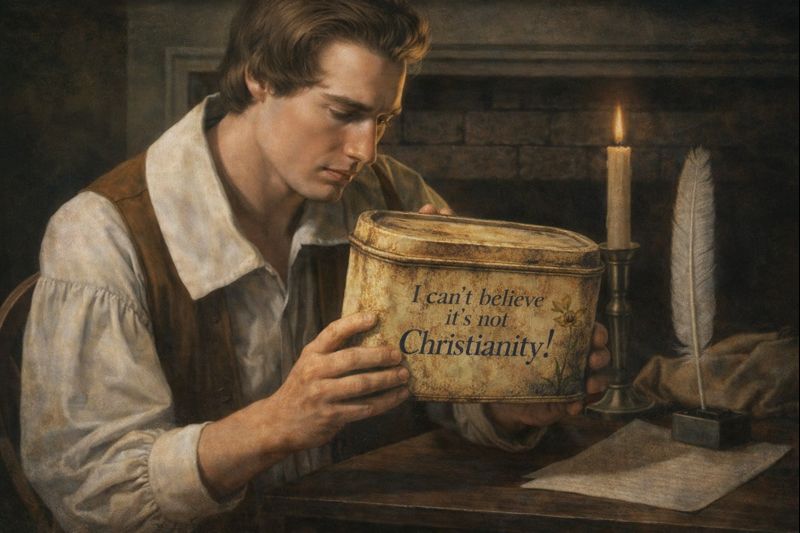
ChatGPT image: That awkward moment for Joseph Smith when the 116 pages of the
lost manuscript come back annotated in red ink from Heaven’s Editorial Department.
Seven Doctrinal Fault Lines That Separate
Mormon Theology from Historic Christian Faith
Are Mormons Christians?
Let us be honest from the first sentence: Mormonism is not Christianity. It is not a branch of Christianity, a denomination of Christianity, a restoration of Christianity, or a fuller expression of Christianity. It is a separate religion — one that appropriates Christian language, venerates a figure named Jesus Christ, and wraps itself in the cultural aesthetics of American Protestant faith, while teaching doctrines about God, humanity, salvation, and eternity that are not merely different from orthodox Christianity but are, in the plainest historical sense, incompatible with it. This is not the conclusion of anti-Mormon bigotry. It is the unavoidable verdict of honest theological comparison — and, as we shall see, it is a conclusion fully supported by the words of Mormonism’s own founders, scriptures, and authoritative leaders.
The Church of Jesus Christ of Latter-day Saints has worked tirelessly and with considerable sophistication to position itself within the Christian mainstream, adopting familiar terminology, softening its more radical doctrines for public consumption, and quietly distancing itself from statements by early leaders that proved too embarrassing to defend. But Joseph Smith cannot be so easily edited. Brigham Young cannot be unpreached. The Journal of Discourses cannot be unwritten. The Book of Mormon’s own declaration that the world contains only two churches — the church of the Lamb of God and the church of the devil, with every institution outside the LDS fold belonging to the latter, described as “the mother of abominations” and “the whore of all the earth” (1 Nephi 14:10, 17) — cannot be footnoted into irrelevance. What follows is a careful, documented, and unambiguous examination of seven doctrinal fault lines that separate the faith of the Latter-day Saints from the faith once delivered to the saints — and why that distinction matters for every Christian willing to face it honestly.
At first glance, the LDS Church presents a convincing case for inclusion in the Christian family. They speak of grace, baptism, atonement, and the Savior. They carry Bibles. They send missionaries. They build chapels that look, from the outside, remarkably like any other Protestant congregation. But the moment one steps past the threshold of surface resemblance and into the actual doctrinal convictions of Mormonism — a God who was once a mortal man, a Jesus who is the spirit brother of Lucifer, a salvation earned through celestial marriage and temple ordinances, a Bible perpetually undermined by prophetic revision — the Christian façade gives way to something the apostles, the church fathers, and every orthodox creed in Christian history would have recognized not as a variant of the faith, but as a deliberate and consequential departure from it.
In the essay that follows, we will examine seven foundational pillars of LDS theology — the nature of God, the Godhead, the doctrine of creation, pre-mortal existence, eternal marriage, scriptural authority, and the promise of human exaltation — measuring each against the consistent witness of Scripture, the early church fathers, and the historic creeds that have defined orthodox Christianity for two thousand years. This is not an exercise in speculation or opinion. The quotes are real, the sources are documented, and the conclusions are drawn directly from what Mormonism’s own founders, apostles, and canonized scriptures have declared in their own words. The question of whether Mormonism qualifies as Christian is not, in the end, a matter of feelings, fellowship, or interfaith courtesy — it is a matter of doctrine, and doctrine, honestly examined, does not leave the question open.
LDS Church responds to the question: Are “Mormons” Christian?
Members of The Church of Jesus Christ of Latter-day Saints unequivocally affirm themselves to be Christians. They worship God the Eternal Father in the name of Jesus Christ. When asked what the Latter-day Saints believe, Joseph Smith put Christ at the center: “The fundamental principles of our religion is the testimony of the apostles and prophets concerning Jesus Christ, ‘that he died, was buried, and rose again the third day, and ascended up into heaven;’ and all other things are only appendages to these, which pertain to our religion.” The modern-day Quorum of the Twelve Apostles reaffirmed that testimony when they proclaimed, “Jesus is the Living Christ, the immortal Son of God. … His way is the path that leads to happiness in this life and eternal life in the world to come.”
Converts across the world continue to join The Church of Jesus Christ of Latter-day Saints in part because of its doctrinal and spiritual distinctiveness. That distinctiveness flows from the knowledge restored to this earth, together with the power of the Holy Ghost present in the Church because of restored priesthood authority, keys, ordinances, and the fulness of the gospel of Jesus Christ. The fruits of the restored gospel are evident in the lives of its faithful members.
While members of The Church of Jesus Christ of Latter-day Saints have no desire to compromise the distinctiveness of the restored Church of Jesus Christ, they wish to work together with other Christians—and people of all faiths—to recognize and remedy many of the moral and family issues faced by society. The Christian conversation is richer for what the Latter-day Saints bring to the table. There is no good reason for Christian faiths to ostracize each other when there has never been more urgent need for unity in proclaiming the divinity and teachings of Jesus Christ.
Challenge accepted, including this one from Brigham Young.
“Take up the Bible, compare the religion of the Latter-day Saints with it and see if it will stand the test,”
(Brigham Young, May 18, 1873,
Journal of Discourses, vol. 16, p. 46).
The Church of Jesus Christ of Latter-day Saints publicly extends a warm hand of fellowship to the broader Christian community, expressing a desire for unity in proclaiming the teachings of Jesus Christ. That gesture deserves to be taken seriously — and it is precisely because we take it seriously that the following examination becomes necessary. For alongside these irenic overtures stands a very different body of testimony: Joseph Smith declaring every Christian creed “an abomination,” Brigham Young’s successor John Taylor condemning Christianity as “corrupt as hell,” the Book of Mormon dividing all humanity into only two churches — the Lamb’s and the Devil’s — and the LDS Church’s own official doctrine of a Great Apostasy, which holds that the gospel Christ established was entirely lost from the earth until Joseph Smith restored it.
One cannot simultaneously affirm that Christianity’s witness is enriched by LDS participation and maintain that Christianity spent nearly two millennia as a corrupted instrument of the adversary. These are not minor theological nuances to be smoothed over at an interfaith table; they are foundational, structural contradictions that define two genuinely different religions. What follows is a careful, respectful, and thoroughly documented examination of seven points of contrast that draw a clear line of demarcation between historic, orthodox Christianity and the faith system of Latter-day Saints — not out of hostility, but out of a conviction that truth, handled honestly, is the most loving gift one can offer.
An examination of seven points of contrast between Mormon and Christian faith.
1. Mormon scripture teaches that all the various Christian denominations, particularly the Presbyterians, Baptists, and Methodists, are all considered by Jesus Christ to be “wrong.”
Regarding Joseph Smith’s alleged first vision, where celestial personages appeared to him…
My object in going to inquire of the Lord was to know which of all the sects was right, that I might know which to join. No sooner, therefore, did I get possession of myself, so as to be able to speak, than I asked the personages who stood above me in the light, which of all the sects was right — and which I should join. I was answered that I must join none of them, for they were all wrong, and the personage who addressed me said that all their creeds were an abomination in His sight: that those professors were all corrupt.
(Joseph Smith, History of the Church, vol. 1, p. 5-6).
Of the devil…
What is it that inspires professors of Christianity generally with a hope of salvation? It is that smooth, sophisticated influence of the devil, by which he deceives the whole world,
(Teachings of the Prophet Joseph Smith, compiled by Joseph Fielding Smith, p. 270).
John Taylor said…
We talk about Christianity, but it is a perfect pack of nonsens . . . Myself and hundreds of the Elders around me have seen its pomp, parade, and glory; and what is it? It is a sounding brass and a tinkling symbol; it is as corrupt as hell; and the Devil could not invent a better engine to spread his work than the Christianity of the nineteenth century,
(Journal of Discourses, vol. 6, 1858, p. 167).
The Book of Mormon says. . .
And he said unto me: Behold there are save two churches only; the one is the church of the Lamb of God, and the other is the church of the devil; wherefore, whoso belongeth not to the church of the Lamb of God belongeth to that great church which is the mother of abominations; and she is the whore of all the earth. (1 Nephi 14:10).
“And when the day cometh that the wrath of God is poured out upon the mother of harlots, which is the great and abominable church of all the earth, whose foundation is the devil, then, at that day, the work of the Father shall commence.
(1 Nephi. 14:17).
LDS Church: The Great Apostasy
Following the death of Jesus Christ, wicked people persecuted and killed many Church members. Other Church members drifted from the principles taught by Jesus Christ and His Apostles. The Apostles were killed, and priesthood authority — including the keys to direct and receive revelation for the Church — was taken from the earth. Because the Church was no longer led by priesthood authority, error crept into Church teachings. Good people and much truth remained, but the gospel as established by Jesus Christ was lost. This period is called the Great Apostasy.
Let us not forget that Joseph Smith was quick to credit himself for this amazing restoration, in spite of it being “revealed to him by God.”
I have more to boast of than ever any man had. I am the only man that has ever been able to keep a whole church together since the days of Adam. A large majority of the whole have stood by me. Neither Paul, John, Peter, nor Jesus ever did it. I boast that no man ever did such a work as I. The followers of Jesus ran away from Him; but the Latter-day Saints never ran away from me yet.
(Joseph Smith, History, 6:19)

The doctrinal origin that allowed Joseph Smith to differentiate Mormonism from orthodox Christianity stems from the belief in the Great Apostasy. This concept posits that the original Christian church, established by Jesus Christ, fell into apostasy shortly after the death of the apostles. This apostasy resulted in the corruption of essential doctrines and ordinances, leading to the fragmentation of Christianity into the competing and corrupted traditions that Mormonism was divinely commissioned to replace.
Mormonism teaches that this apostasy necessitated a restoration of the true gospel, which was initiated through Joseph Smith’s divine revelations. Smith claimed to have received direct communication from God the Father and Jesus Christ, who instructed him to restore the original church and its teachings.
This restorationist theology positions Mormonism as the “one true church,” distinct from and superior to other Christian denominations. It implies that these denominations, despite their good intentions, have deviated from the original teachings of Christ due to the Great Apostasy. This explains why Mormon scripture portrays other Christian groups as being “wrong” in the eyes of Jesus Christ.
It is worth noting that the modern LDS church has increasingly softened this language in public-facing contexts, preferring terms like “the restored church” over explicit claims of exclusivity. Nevertheless, the underlying theology remains unchanged — the First Vision narrative, still canonized scripture, records Jesus Christ telling Joseph Smith that all existing churches were wrong, their creeds an abomination, and their professors corrupt. Institutional diplomacy has moderated the tone; it has not altered the doctrine.
This doctrinal foundation allows Mormonism to assert its unique claims of authority, prophetic leadership, and additional scripture (the Book of Mormon) while simultaneously acknowledging its Christian roots. It also provides a theological justification for its missionary efforts to convert members of other Christian faiths.
This view is not universally accepted among Christians, with many mainstream denominations rejecting the concept of a Great Apostasy and upholding the validity of their own traditions and interpretations of scripture.
Review: Refuting the Mormon Claim of the “Great Apostasy” in Christian History
The concept of the “Great Apostasy,” central to Mormon theology as articulated by Joseph Smith, suggests that after the death of the apostles, the Christian Church fell into such complete disarray and corruption that it necessitated a divine restoration through Smith. However, this claim can be critically examined through historical, theological, and scriptural lenses.
What is significant for this discussion is that the Great Apostasy is not merely a relic of 19th-century Smithian theology — it remains a living and defended doctrine among modern LDS scholars. Writing in BYU’s Religious Educator, Matthew J. Grey states plainly that the entire Restoration “is based on the understanding that Christ established a church with defined leadership, doctrines, and ordinances” whose foundation “soon crumbled as the early church fell into an apostasy, replacing its original doctrines and practices with a variety of concepts from throughout the Roman Empire.” Grey’s argument is not that the apostasy is assumed — it is that the historical record of the apostolic fathers, properly read, actually confirms it.
This is a telling admission. In attempting to demonstrate the apostasy through the writings of Ignatius, Polycarp, and Clement, Grey unwittingly draws on the very sources that historic Christianity regards as witnesses to its continuity, not its collapse. The apostolic fathers warned against false teachers, disunity, and corrupt leadership — but these are precisely the kinds of internal struggles that every institution, including Israel under the Old Testament prophets, experienced without forfeiting divine legitimacy. The presence of problems is not evidence of total institutional collapse; it is evidence of a church still fighting for its doctrine.
Historical Continuity of the Church:
Contrary to the notion of a total apostasy, historical evidence demonstrates a robust and continuous line of Christian tradition and doctrine stretching from the Apostolic Age through the early Church Fathers and beyond. Far from depicting a church in freefall, the historical record reveals communities of believers actively preserving, defending, and transmitting the faith they had received directly from the apostles. For instance, the writings of Clement of Rome, Ignatius of Antioch, and Polycarp of Smyrna — men who were direct disciples of the apostles themselves — demonstrate a remarkable continuity of teaching and practice. Their letters address church governance, the nature of Christ, the Eucharist, resurrection, and the authority of Scripture with a clarity and consistency that directly undermines the LDS claim of wholesale doctrinal collapse. Ignatius, writing around A.D. 107, explicitly affirms the deity of Christ and the structure of church leadership in terms fully recognizable to orthodox Christians today. Polycarp, a disciple of the Apostle John himself, was martyred for a faith that bore no resemblance to a corrupted, devil-influenced institution. Moving further into the second and third centuries, figures such as Justin Martyr, Irenaeus of Lyon, and Tertullian continued to articulate, codify, and vigorously defend the core tenets of Christian orthodoxy against Gnostic and other heretical movements — not because the truth had been lost, but precisely because it had been preserved and was worth protecting. Their writings show no indication of a cataclysmic loss of truth, but rather an ongoing, Spirit-guided development and defense of Christian doctrine. The Great Apostasy, as a historical event, simply has no credible archaeological, literary, or patristic evidence to support it.
Early Church Councils:
The early ecumenical councils — including Nicaea in 325 AD, Constantinople in 381 AD, Ephesus in 431 AD, and Chalcedon in 451 AD — were not convened to introduce new doctrine or recover teachings that had been lost. Rather, they were called to clarify, defend, and formally articulate what the church had already received and consistently believed, standing firm against the rising tide of heresy and theological confusion. Bishops and church leaders gathered from across the known Christian world, representing diverse regions and traditions, yet arriving at unified confessions rooted in the apostolic witness preserved in Scripture and the writings of the early church fathers.
LDS apologists frequently argue that the Council of Nicaea represents the very moment orthodox Christianity was corrupted — a politically motivated power grab engineered by Emperor Constantine that fundamentally altered the church’s original teaching about God. This claim, however, does not survive serious historical scrutiny. Constantine did not author the Nicene Creed, did not vote on its language, and in fact initially dismissed the Arian dispute as, in the words of Christian History Magazine, an “insignificant” theological matter — a minor squabble he wanted resolved only because religious division threatened the stability of the empire he had just united by force. His interest was imperial peace, not doctrinal precision. When diplomatic letters failed to quiet the controversy, he convened roughly 220 bishops and, according to the same account, was pleased when they reached agreement — not because he had engineered the outcome, but because the conflict was finally over.
The driving theological force at Nicaea was not Constantine but Athanasius of Alexandria, who grounded his entire argument not in imperial politics but in the Gospel of John and the letters of Paul. Drawing on John 14:9 and 1 Corinthians 1:24, Athanasius demonstrated that the Son is intrinsically proper to the Father, writing that “just to name the Father ‘the Father’ is to indicate his only-begotten Son” (De Decretis). The council’s landmark term homoousios — “one in essence” — was not a theological invention but a precise scriptural defense against Arianism, the very heresy that sought to reduce Christ to a created, subordinate being. That position, it should be noted, bears a far closer resemblance to LDS theology than to anything Nicaea produced — which raises a pointed question for LDS apologists: if they are searching for the council’s theological heirs, they may be looking in the wrong mirror.
National Geographic: How the Council of Nicaea changed Christianity forever
Constantine himself had a fairly tenuous grasp of the philosophical and theological nuances of the debate. At one point, according to his biographer Eusebius of Caesarea, he complained that the dispute was a fight “over small and quite minute points.” Why, then, did he bother to convene such an expensive and time-consuming meeting? Roman emperors had long maintained that concord and uniform religious practices were essential to the success and stability of the empire. Constantine spent much of his career using force to reunify a divided realm; he could not tolerate discord within the Church. As renowned historian of early Christianity Paula Fredriksen puts it in her recently published book Ancient Christianities, Constantine and church leaders agreed that “proper religion should be unanimous, the identity of and unity of the true church unambiguous.” Division in the church, Constantine said, was worse than war.
Ultimately, the council ruled against Arius and produced a formal theological declaration: the Nicene Creed. The vote was overwhelmingly in favor. Only about 20 bishops initially refrained from supporting the creed, and just three—Arius and his two closest allies—refused to sign it. The remaining dissenters were later compelled to endorse the statement under pressure from Emperor Constantine. Although Constantine did not vote himself, he did intervene in the drafting, insisting on the inclusion of the term homoousios (“of one substance”) in the final creed.
For Christians today, Nicaea remains a symbol of a time when the Church was less divided. Though the attendees were anything but unified and civil at the time, religious leaders now see the Nicene Creed as a symbol of shared agreement and belief among the denominations that make up modern Christianity.
National Geographic’s account confirms what serious historians have long maintained: Constantine himself had, in the words of his biographer Eusebius of Caesarea, a “fairly tenuous grasp” of the theological nuances at stake, privately complaining that the entire dispute was a fight over “small and quite minute points.” His concern was not theology but unity — Paula Fredriksen’s recently published Ancient Christianities captures his position precisely: Constantine and church leaders agreed that “proper religion should be unanimous, the identity and unity of the true church unambiguous.” Division, Constantine said, was worse than war. He did intervene in the drafting to press for the inclusion of homoousios, but this is precisely the point: a man dismissing the debate as trivial and demanding it be settled is not the architect of a theological conspiracy. He was an emperor wanting a room full of arguing bishops to reach a conclusion and go home. The theological weight of homoousios was carried not by Constantine but by Athanasius — and Athanasius grounded it not in imperial preference but in John 14:9 and 1 Corinthians 1:24.
Far from signaling a church in free-fall apostasy, the writings of the pre-Nicene fathers reveal an unbroken chain of Trinitarian conviction stretching back to the apostolic age itself. Ignatius of Antioch — a direct disciple of the Apostle John, writing as early as 107 AD — was already employing clear Trinitarian language over two centuries before Nicaea: “There is but one unbegotten Being, God, even the Father; and one only-begotten Son, God, the Word and man; and one Comforter, the Spirit of truth” (Epistle to the Philadelphians, Chapter IV). Tertullian, writing around 200 AD, coined the very term trinitas and articulated the three-persons-one-substance formula long before Constantine was even born. Augustine of Hippo later affirmed the same with precision: “The three persons of the Trinity are one substance, and there are not three Gods but one God” (On the Trinity). These are not the voices of a corrupted church reinventing its theology — they are the voices of a church consistently and passionately defending what it had received from the apostles.
The LDS Church’s official teaching on the Great Apostasy holds that authentic gospel authority, priesthood power, and saving doctrine were entirely removed from the earth following the deaths of the apostles, awaiting full restoration through Joseph Smith in 1830. If that assertion were historically accurate, then Ignatius, Athanasius, Augustine, and the assembled bishops at each of these councils would have had no legitimate standing before God — their scholarship meaningless, their martyrdoms spiritually void, their creeds empty exercises in corrupted religion. Yet what the record actually shows is a church that suffered intense persecution, wrestled rigorously with Scripture, preserved apostolic doctrine across centuries and continents, and produced confessions of faith that more than two billion Christians worldwide still confess today. The burden of proof falls squarely on those who claim this chain was entirely broken — and neither Joseph Smith’s first vision account nor any LDS scripture provides a single verifiable historical witness to support it.
Scriptural Evidence:
The New Testament itself anticipates the rise of false teachers and internal corruption, but never — not in a single passage — predicts the complete and total collapse of Christ’s church on earth. Paul warns the Ephesian elders that “savage wolves will come in among you, not sparing the flock” and that “from among your own selves men will arise, speaking twisted things, to draw away the disciples after them” (Acts 20:29-30). Peter similarly cautions that “there will be false teachers among you, who will secretly bring in destructive heresies” (2 Peter 2:1). These are warnings of infiltration and corruption from within — the language of a church under threat, not a church destined for total extinction and institutional erasure.
This distinction is critically important when evaluating the LDS doctrine of a Great Apostasy. Mormon theology does not merely claim that the church experienced serious corruption — a claim most orthodox Christians would readily acknowledge as historically true in certain periods. It claims something categorically different and far more radical: that the entire church lost its divine authority, that the priesthood keys were physically removed from the earth, and that no valid baptism, no legitimate communion, and no authoritative teaching existed anywhere on the planet for nearly seventeen centuries. That is an extraordinary claim, and the New Testament simply does not support it. In fact, it directly contradicts it.
Christ’s own words stand as the most direct rebuttal. In Matthew 16:18, Jesus declares to Peter: “Upon this rock I will build my church, and the gates of Hades shall not prevail against it.” This is not a conditional promise. It is not qualified by the faithfulness of future generations, the survival of apostolic succession, or the presence of any particular institutional structure. It is an unconditional declaration by the Son of God that His church would endure. If the Great Apostasy occurred as LDS doctrine describes, then the gates of Hades did in fact prevail — entirely and for an extended period — making Christ’s promise either false or meaningless. Jude reinforces this confidence when he urges believers to “contend earnestly for the faith which was once for all delivered to the saints” (Jude 1:3), using the Greek word hapax — meaning delivered once, completely, and with finality. There is no hint in the apostolic writings of a faith that would need to be re-delivered through a nineteenth-century American prophet.
Christian Research Institute: Lost Books and Latter-Day Revelation: A Response to Mormon Views of the New Testament Canon
The claim of a universal apostasy in the early church defies logic, history, and the Bible, and the claim of “restored truth” from “latter-day prophets” clashes with the unique office and teaching of Jesus’ handpicked apostles.
Christ promised that His church would never fall into total apostasy: “I will build my church, and the gates of hell shall not prevail against it” (Matt. 16:18). According to Mormon teaching, the Christian church, though established and nurtured by Christ Himself and His hand-picked apostles, fell into total apostasy almost immediately. How interesting, then, that the Mormon church’s major instructional manual, Gospel Principles, assures us that such a fate can never befall the “restored” latter-day church: “The Lord will never allow the president of the [Mormon] church to teach us false doctrine.” This assertion raises an obvious question: If God is now able to guarantee the perpetual integrity of this “restored church” by protecting its spiritual leaders from error, why did He not do so in the first century?
The passages that deal with apostasy do so with great seriousness. In no case, however, do they support the Mormon doctrine of a universal apostasy that extinguished the true gospel and the church of Jesus Christ from the earth, necessitating their later restoration.
Christ promised His apostles that their converts’ faith would endure: “I have chosen you, and ordained you, that ye should go forth and bring forth fruit, and that your fruit should remain” (John 15:16, emphasis added). The theory of a universal apostasy in the generation immediately after the apostles is clearly inconsistent with Jesus’ promise here.
The Mormon church’s charge of a universal apostasy immediately after the time of the apostles requires us to believe that despite all the divine promises and safeguards, and with the ink barely dry on the New Testament Scriptures, God allowed the entire ministry of Christ and His apostles to be undermined by apostates, plunging humanity into spiritual darkness for 1800 years. Clearly, there is something wrong with this picture.
Furthermore, Paul’s letter to the Ephesians describes the church as “the pillar and buttress of the truth” (1 Timothy 3:15) — an institution entrusted with the preservation and proclamation of the gospel through all ages. The consistent testimony of the New Testament is not of a fragile institution teetering on the edge of collapse, but of a Spirit-indwelt community promised the permanent presence of Christ himself: “I am with you always, to the end of the age” (Matthew 28:20). These promises, taken together and at face value, form an insurmountable biblical obstacle to the foundational LDS claim that the church Christ founded simply ceased to exist.
Doctrine and Practice:
The LDS claim of wholesale doctrinal corruption following the deaths of the apostles does not merely require us to distrust a few church councils — it requires us to dismiss an extraordinarily rich and consistent body of Christian literature produced within the living memory of the apostles themselves. Documents like the Didache, the Epistles of Clement, the Shepherd of Hermas, and the Epistles of Ignatius collectively paint a picture not of a church spiraling into confusion and error, but of a community faithfully transmitting, practicing, and defending what it had received.
The Conversation: This Christian text you’ve never heard of, The Shepherd of Hermas, barely mentions Jesus − but it was a favorite of early Christians far and wide
Given that the Shepherd is a long, rambling text that doesn’t explicitly mention Jesus, you might assume that it was only read by a small number of early Christian theologians. This, however, isn’t the case.
The Shepherd became one of the most popular texts among Christians for the first five centuries C.E. Even today, there are more surviving manuscripts of the Shepherd from antiquity than of any New Testament text except for the Gospels of Matthew and John.
The visions were translated from Greek into Latin, Coptic, Ethiopic, Arabic and Georgian. Eventually, the text spread as far west as Ireland and as far east as China.
The Shepherd is even included in what scholars consider one of the oldest and most complete Bibles in the world. Canonical Christian Bibles today end with Revelation, a dramatic book of apocalyptic visions. The Codex Sinaiticus, however, a fourth- or fifth-century manuscript now held at the British Library, ends with the Shepherd. The text’s inclusion in such an expensive, deluxe codex highlights how important the text was to many Christians, even as the contents of the New Testament were being solidified.
The Didache, likely composed between 50 and 120 AD and possibly contemporaneous with some New Testament writings, is particularly instructive. It provides detailed guidance on baptism, fasting, prayer, and Eucharistic celebration that aligns strikingly well with New Testament practice. Its baptismal formula — “Baptize in the name of the Father, and of the Son, and of the Holy Spirit” — echoes Matthew 28:19 with unmistakable precision, reflecting a Trinitarian understanding of God that was not invented at Nicaea but was already embedded in the earliest Christian worship and community life. The document even addresses the testing of traveling prophets and the ordering of church leadership, demonstrating that authentic ecclesiastical structure did not evaporate with the apostles but was actively maintained and guarded by those who followed them.
Clement of Rome, writing around 96 AD in his First Epistle to the Corinthians, reinforces this picture of institutional and doctrinal continuity by explicitly appealing to apostolic succession as the basis for legitimate church authority — doing so within a single generation of the Apostle Paul’s death. Ignatius of Antioch, writing his seven letters on the way to his own martyrdom around 107 AD, repeatedly urges Christians to remain united under their bishops as the visible sign of the church’s connection to apostolic authority, declaring, “Wherever the bishop appears, let the congregation be present; just as wherever Jesus Christ is, there is the Catholic Church” (Epistle to the Smyrnaeans, Chapter VIII). These are not the scattered writings of a leaderless, corrupted institution groping in spiritual darkness — they are the confident, structured, theologically coherent expressions of a church that knew who it was, what it believed, and from whom its authority derived.
For the LDS Great Apostasy narrative to hold, every one of these voices must be dismissed as either deceived or deceptive. Yet taken together, they constitute a formidable and unified witness that the gospel entrusted to the apostles was neither lost nor abandoned, but carefully preserved, ardently defended, and faithfully handed down — century by century — long before Joseph Smith ever claimed to receive it anew.
The Role of the Holy Spirit:
One of the most foundational promises in all of Christian Scripture is Christ’s own assurance that the Holy Spirit would remain with His church permanently and actively. In John 14:16, Jesus declares that the Father will give “another Helper, that He may abide with you forever“ — not temporarily, not conditionally, but without interruption or withdrawal. In John 16:13, He extends that promise further: “When He, the Spirit of truth, has come, He will guide you into all truth.” These are not modest reassurances — they are the unconditional pledges of the Son of God regarding the perpetual spiritual custody of His church.
The LDS doctrine of a Great Apostasy strikes directly at the credibility of the most explicit promises Christ ever made about His church. If the church fell into total corruption within decades of the apostles’ deaths — losing its priesthood authority, its doctrinal integrity, and its connection to saving truth — then one of two conclusions becomes unavoidable: either Jesus did not keep His word, or the Holy Spirit proved incapable of fulfilling the very mission for which He was sent. Neither conclusion is theologically acceptable within any framework that takes Scripture seriously, and both constitute a Christology so diminished that it raises the question of whether the Christ of Mormonism is, in any meaningful sense, the Christ of the New Testament.
The logical failure compounds the theological one. Mormonism asks its adherents to simultaneously affirm that Jesus is divine, that His promises are trustworthy, and that those promises catastrophically and completely failed for nearly fourteen centuries — affecting every soul who lived and died during that period without access to the “restored” priesthood, ordinances, or saving authority that Mormonism alone claims to possess. This is not a minor theological tension. It is a contradiction at the load-bearing wall of the entire system. A Christ who promises that the gates of hell shall not prevail against His church (Matthew 16:18), who pledges to be with His disciples always, even to the end of the age (Matthew 28:20), and who sends the Spirit of truth to guide the church into all truth (John 16:13) — this Christ cannot be harmonized with a church that vanished from the earth within a generation and required a nineteenth-century frontier revivalist to restore it.
The scriptural failure is equally decisive. The New Testament nowhere anticipates a total institutional collapse requiring divine re-establishment. Paul warns against false teachers, Peter warns against destructive heresies, and John warns against those who deny Christ — but none of them warn that the church itself will cease to exist, that the priesthood will be withdrawn from the earth, or that God’s people will be left without saving authority for fourteen hundred years. What the New Testament does promise, consistently and without qualification, is preservation — a church against which hell itself will not prevail, a Spirit who will remain with the church forever (John 14:16), and a gospel once delivered to the saints worth earnestly contending for (Jude 1:3). The Great Apostasy does not merely challenge orthodox Christianity. It requires Scripture to mean the opposite of what it plainly says.
The historical record of the early church, moreover, testifies to the Spirit’s active presence in precisely the ways Christ described. The martyrs who died rather than recant their faith in the Triune God, the theologians who labored at great personal cost to articulate orthodox doctrine, the missionaries who carried the gospel to the edges of the known world — all bore witness to a Spirit-empowered community that was manifestly not abandoned.
Diversity vs. Apostasy:
The fragmentation of Christianity into various denominations is frequently cited by LDS apologists as evidence that the church lost its way — that the proliferation of competing traditions proves the original gospel was hopelessly corrupted and in need of total restoration. This argument, however, fundamentally misreads the nature of Christian diversity. Denominational differences, while real and sometimes significant, have largely concerned secondary matters of church governance, worship style, modes of baptism, and the interpretation of prophetic passages — not the foundational convictions that define Christianity itself.
On those foundational convictions, the unity across orthodox Christianity is nothing short of remarkable. The Apostles’ Creed, affirmed across Catholic, Protestant, and Eastern Orthodox traditions alike, has confessed the same core truths for nearly two millennia: that Jesus Christ is the eternal Son of God, born of a virgin, crucified, bodily resurrected, and coming again in glory. The Nicene Creed, likewise embraced across virtually every major branch of Christianity, anchors the full divinity of Christ and the coequal nature of the Holy Spirit with a precision that has never been seriously displaced within orthodox Christianity. These are not the fractured remnants of a lost gospel — they are the enduring pillars of a faith that has proven resilient across cultures, centuries, and continents.
Diversity of expression, in other words, is not the same thing as apostasy. A family may disagree over many things and still share the same bloodline. What the LDS restoration narrative requires is not merely that Christians disagreed — but that every trace of saving truth, priesthood authority, and genuine gospel understanding was entirely extinguished from the earth for nearly 1,800 years. That is an extraordinary claim, and the vibrant, doctrinally consistent, scripturally grounded witness of orthodox Christianity across those same centuries stands as its most powerful refutation.
There is a profound irony embedded in the LDS argument that Christian denominational diversity proves apostasy — one that becomes impossible to ignore when we turn the lens toward Mormonism itself. In the nearly two hundred years since Joseph Smith founded the Church of Jesus Christ of Latter-day Saints in 1830, the movement has fractured into a remarkable number of competing offshoots, splinter groups, and rival restoration claims. The Community of Christ (formerly the Reorganized Church of Jesus Christ of Latter Day Saints), the Fundamentalist Church of Jesus Christ of Latter-Day Saints (FLDS), the Church of Christ (Temple Lot), the Apostolic United Brethren, the Remnant Church of Jesus Christ of Latter Day Saints, and dozens of smaller secessionist bodies all claim authentic Smithian restoration authority — and all disagree with one another on foundational matters of doctrine, priesthood succession, and practice.
Perhaps no case illustrates the absurdity of competing restoration claims more vividly than that of James Jesse Strang. Within months of Joseph Smith’s assassination in 1844, Strang produced a letter he claimed Smith had written designating him as successor — a document most historians regard as a forgery. He gathered a substantial following, received what he described as angelic visitations, translated his own set of plates into a volume called the Book of the Law of the Lord, established a theocratic colony on Beaver Island in Lake Michigan, crowned himself king, instituted his own distinctive doctrines including the mandatory wearing of bloomers for women, and was ultimately assassinated by two of his own followers in 1856. Strang’s movement — the Church of Jesus Christ of Latter Day Saints (Strangite) — still exists today in a small remnant. He is not a footnote. He was a baptized Latter-day Saint who, by the same prophetic and revelatory logic Joseph Smith employed, claimed divine authority and drew thousands after him.
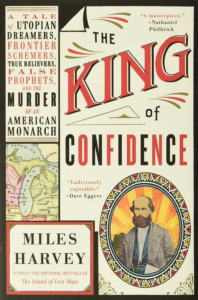
For readers seeking the most thorough and compulsively readable modern account of Strang’s rise and fall, Miles Harvey’s The King of Confidence: A Tale of Utopian Dreamers, Frontier Schemers, True Believers, False Prophets, and the Murder of an American Monarch (Little, Brown and Company, 2020) stands as the definitive narrative treatment. Harvey brings an investigative journalist’s precision and a novelist’s eye to Strang’s turbulent twelve years on Beaver Island, tracing the full arc of a man who transformed personal audacity and religious theater into a genuine kingdom — however briefly. What makes Harvey’s account particularly valuable for the Christian apologist is not merely its storytelling but its documentary rigor: the book draws extensively on primary sources, newspaper archives, and the historical record of the Strangite movement in a way that leaves the reader with no doubt that this episode was not fringe eccentricity but a direct and serious consequence of the restoration logic Joseph Smith himself had unleashed.
If denominational fragmentation is the telltale fingerprint of apostasy and divine abandonment, then by the very standard LDS theology applies to two thousand years of Christianity, Mormonism itself would stand condemned by its own argument after fewer than two centuries — and the Strangite episode alone raises a question the LDS Church has never satisfactorily answered: by what principle did the Saints reject James Strang’s plates, letters, and angelic messengers while accepting Joseph Smith’s? The epistemological criteria are identical. Christianity, by contrast, has maintained an identifiable, creedally unified orthodox core across two millennia and every inhabited continent — a fact that speaks not of a lost gospel, but of a preserved one.
Archaeological and Manuscript Evidence:
The survival and discovery of countless early Christian manuscripts provide one of the most compelling material arguments against the LDS doctrine of a Great Apostasy — for if the gospel had truly been extinguished from the earth, one would reasonably expect the documentary record to reflect a church groping in spiritual darkness, its apostolic foundations buried beyond recovery. What the archaeological record actually reveals is something far more remarkable: a vast, geographically diverse, and theologically consistent body of written witness that spans centuries and continents, collectively affirming the core convictions of apostolic Christianity with extraordinary fidelity.
The Dead Sea Scrolls, discovered at Qumran between 1947 and 1956, while primarily Jewish in origin, have proven enormously significant for establishing the reliability and antiquity of the Old Testament text that the New Testament authors — and Jesus himself — consistently quoted and treated as authoritative Scripture. Their discovery confirmed that the Hebrew Bible had been transmitted with exceptional accuracy across centuries, directly undermining the broader narrative that sacred texts cannot survive intact without continuous prophetic intervention of the kind Joseph Smith claimed to provide.
The Nag Hammadi library, unearthed in Egypt in 1945, offered scholars a window into the Gnostic movements that early orthodox Christianity actively identified and rejected as heretical distortions of the apostolic message. Rather than demonstrating that Gnosticism represented suppressed original Christianity, these texts actually vindicate the early church fathers who warned against precisely such teachings. Irenaeus of Lyon, writing around 180 AD in his monumental work Against Heresies, meticulously documented and refuted Gnostic distortions of the gospel — demonstrating that the church not only possessed a clear standard of apostolic truth but was vigorously and intelligently defending it against corruption from outside, not surrendering to it from within.
Perhaps most significant of all is the manuscript tradition of the New Testament itself. With over 5,800 Greek manuscripts, more than 10,000 Latin manuscripts, and an additional 9,000 manuscripts in other ancient languages, the New Testament is by an overwhelming margin the most well-attested document of the ancient world. Textual scholars have established that the New Testament text we possess today is more than 99% pure, with no doctrinally significant variants affecting any core Christian teaching. This extraordinary manuscript wealth stands as a silent but devastating rebuttal to the claim that the gospel Christ delivered to His apostles was lost, suppressed, or irretrievably corrupted. It was copied, guarded, translated, smuggled across borders under persecution, and ultimately preserved with a fidelity that no honest historian can dismiss — precisely because the communities that treasured it refused to let it die, even at the cost of their lives.
In conclusion, the assertion of a “Great Apostasy” as described by Mormonism does not align with a comprehensive view of Christian history, theology, or scriptural tradition. While there have undeniably been periods of corruption or deviation, the evidence suggests a Church that has, through divine guidance and human effort, maintained and defended its core doctrines from the apostolic era onward. This continuity challenges the necessity of a complete restoration as claimed by Joseph Smith.
Does Mormon theology fall under the definition of Polytheism?
2. Mormon scripture, prophets, and apostles teach that there is more than one god who created this world, that many gods rule over other worlds, and that worthy Mormons may one day become gods themselves. Even though Mormons claim there is only one God for them, they still believe that the Father, Son, and Holy Spirit are separate gods who are only one in their purpose rather than in a personal being that they share eternally.
Joseph Smith…
I will preach on the plurality of Gods. I have selected this text for that express purpose. I wish to declare I have always and in all congregations when I have preached on the subject of the Deity, it has been the plurality of Gods. It has been preached by the Elders for fifteen years.
I have always declared God to be a distinct personage, Jesus Christ a separate and distinct personage from God the Father, and that the Holy Ghost was a distinct personage and a Spirit: and these three constitute three distinct personages and three Gods. If this is in accordance with the New Testament, lo and behold! we have three Gods anyhow, and they are plural: and who can contradict it!…
(Joseph Smith, Sermon, as printed in History of the Church, Vol. 6, p. 473-479).
Bruce R. McConkie…
Plurality of Gods: Three separate personages: Father, Son, and Holy Ghost, comprise the Godhead. As each of these persons is a God, it is evident, from this standpoint alone, that a plurality of Gods exists. To us, speaking in the proper finite sense, these three are the only Gods we worship. But in addition there is an infinite number of holy personages, drawn from worlds without number, who have passed on to exaltation and are thus gods.
Bruce R. McConkie, Mormon Doctrine, pp. 576-577
Brigham Young…
How many Gods there are, I do not know. But there never was a time when there were not Gods and worlds, and when men were not passing through the same ordeals that we are now passing through. That course has been from all eternity, and it is and will be to all eternity.
(Journal of Discourses 7:333)
Orson Pratt…
In the Heaven where our spirits were born, there are many Gods, each one of whom has his own wife or wives which are given to him previous to his redemption; while yet in his mortal state.
(Orson Pratt, The Seer, 135).
Notably, The Seer was officially disavowed by the LDS Church in 1865, with church leadership declaring that it contained “erroneous doctrines” — yet the theological DNA of Pratt’s plurality-of-Gods framework, including the eternal marriage of divine beings and the progressive exaltation of men to godhood, was never genuinely abandoned by the church but simply repackaged in more palatable language for later generations, revealing a pattern not of principled doctrinal correction but of institutional image management, where teachings are quietly retired when they become embarrassing rather than honestly repudiated as false.
Prophet Joseph Fielding Smith…
To become like him we must have all the powers of godhood;…There is no end to this development; it will go on forever. We will become gods and have jurisdiction over worlds, and these worlds will be peopled by our own offspring.
Doctrines of Salvation 2:48, quoted in Achieving a Celestial Marriage Student Manual, 1976, p.132.

This doctrine, which includes the potential for faithful Latter-day Saints to become gods and create their own worlds, has been taught historically and tacitly confirms an assent to a belief in polytheism. However, official Church websites and public statements may not always explicitly address or emphasize this aspect of their beliefs.
While some might interpret this as denial or downplaying, it’s important to understand that the concept of becoming gods and creating worlds is deeply ingrained in the LDS understanding of the afterlife and remains a core belief for many members.
The doctrinal origin that allowed Joseph Smith to differentiate Mormonism from orthodox Christianity on the concept of God is rooted in the doctrine of exaltation and the concept of a plurality of gods. The doctrine of human potential for godhood, if true, implies a cyclical process extending into the distant past. This suggests our God was once a human, his God was also once human, and so on, creating a potentially infinite chain of gods. The sheer number of deities this would entail, populating the universe or perhaps other dimensions, is staggering to contemplate.
Exaltation: Mormonism teaches that human beings possess the potential to become like God — a doctrine formally known as exaltation or eternal progression — and this belief sits at the absolute theological center of LDS faith. It is grounded in the foundational Mormon conviction that God the Father was once a mortal man who, through obedience and progression, advanced to His current state of godhood. Joseph Smith stated this with unmistakable directness in his famous King Follett Discourse of 1844: “God himself was once as we are now, and is an exalted man, and sits enthroned in yonder heavens” (History of the Church, Vol. 6, p. 305). Lorenzo Snow, the fifth President of the LDS Church, crystallized the doctrine in his celebrated couplet: “As man now is, God once was; as God now is, man may be.” Joseph Fielding Smith reinforced the trajectory of this teaching, affirming that the exalted believer will ultimately “become gods and have jurisdiction over worlds” populated by their own spirit offspring (Doctrines of Salvation, 2:48).
This doctrine places Mormonism in irreconcilable conflict with the historic Christian understanding of God as eternal, self-existent, and absolutely unchanging in His divine nature. The God of orthodox Christianity has never been, is not now, and never will be a progressive being working toward greater glory — He is, as the Westminster Confession declares, “most holy, most free, most absolute, working all things according to the counsel of His own immutable and most righteous will.” Isaiah 43:10 states with unambiguous force: “Before me no god was formed, nor shall there be any after me” — a text that forecloses entirely the LDS vision of an ever-expanding population of exalted gods populating an endless cosmos. The contrast is not subtle, and it is not negotiable — it is the difference between the Creator and the creature, a line that orthodox Christianity has never permitted to be dissolved.
Plurality of Gods: Mormonism embraces a robust and unambiguous doctrine of divine plurality that sets it categorically apart from every branch of orthodox Christianity. Brigham Young confirmed that the universe has operated under this plurality eternally, stating,
“There never was a time when there were not Gods and worlds” (Journal of Discourses 7:333).
Central to this framework is the doctrine of human deification — the teaching that righteous Latter-day Saints may themselves progress to godhood. Joseph Fielding Smith articulated this with striking directness:
“We will become gods and have jurisdiction over worlds, and these worlds will be peopled by our own offspring” (Doctrines of Salvation, 2:48). This is not a peripheral or speculative teaching within Mormonism — it is systematically embedded in official LDS curriculum, having been republished in the church’s own
– Achieving a Celestial Marriage Student Manual (1976, p. 132).
This polytheistic framework stands in irreconcilable contrast to the monotheism that has defined orthodox Christianity from its earliest Jewish roots through every major creedal confession. The foundational Christian declaration — “Hear, O Israel: The Lord our God, the Lord is one” (Deuteronomy 6:4), reaffirmed by Jesus himself in Mark 12:29 — admits no plurality of ruling deities, no ladder of divine progression, and no universe populated by exalted human gods. The two systems are not variations on the same theme — they are structurally incompatible visions of ultimate reality.
The Godhead: While Latter-day Saints acknowledge the Father, Son, and Holy Ghost as divine beings, they view them as three entirely separate and distinct individuals — each possessing a discrete body, will, and identity — rather than as three persons subsisting within one eternal, undivided God. Bruce R. McConkie confirmed this as settled LDS doctrine, writing in Mormon Doctrine that beyond the three members of the Godhead,
“there is an infinite number of holy personages, drawn from worlds without number, who have passed on to exaltation and are thus gods” (pp. 576–577).
This understanding diverges fundamentally from the historic Christian doctrine of the Trinity, which holds that the Father, Son, and Holy Spirit are coequal, co-eternal, and co-essential — one God in three persons, not three Gods in cooperative agreement. The Nicene Creed of 325 AD declares the Son to be “of one substance with the Father” — the Greek term homoousios — precisely to foreclose the kind of ontological separation between divine persons that LDS theology not only permits but requires. Athanasius of Alexandria, the council’s chief theologian, argued directly from John 10:30 — “I and the Father are one” — that Christ’s unity with the Father is one of being, not merely of purpose or intention. The LDS Godhead, by contrast, more closely resembles the ancient heresy of tritheism — the belief in three separate Gods — than anything recognized as orthodox Christianity across twenty centuries of creedal confession.
3. Mormon scripture, prophets, and apostles teach that God the Father is an exalted man with flesh and bones.
The doctrinal origin that allowed Joseph Smith to differentiate Mormonism from orthodox Christianity on the nature of God the Father is rooted in the concept of anthropomorphism and the belief in a physical, embodied God.
Joseph Smith, in his landmark “King Follett Discourse” delivered April 6, 1844, made the LDS conception of God unmistakably plain:
“God himself was once as we are now, and is an exalted Man, and sits enthroned in yonder heavens.”
(Journal of Discourses, Vol. 6, p. 3)
This is not an obscure or peripheral statement — it is one of the most deliberate and carefully developed theological declarations Smith ever made, delivered to a congregation of thousands and preserved in the official record of LDS discourse. The broader sermon makes equally clear that Smith envisioned God as a corporeal, progressing being who was once mortal, directly contradicting the historic Christian understanding of God as eternal, self-existent, and without body or passions.
This teaching was later canonized as binding LDS scripture in the Doctrine and Covenants, where Smith recorded:
“The Father has a body of flesh and bones as tangible as man’s; the Son also; but the Holy Ghost has not a body of flesh and bones, but is a personage of Spirit. Were it not so, the Holy Ghost could not dwell in us.”
(Doctrine and Covenants 130:22)
The full verse is worth quoting in its entirety, as it accomplishes more than a truncated reading might suggest. Not only does it assign a physical, material body to God the Father — a direct contradiction of Jesus’ own declaration in John 4:24 that “God is Spirit” — but it further distinguishes the Holy Ghost as a categorically different kind of being from the Father and Son, reinforcing the LDS Godhead as three entirely separate individuals rather than three persons of one divine essence. Orthodox Christianity has never taught that the Father possesses a body of flesh and bones; the incarnation belongs exclusively and uniquely to the Son, who took on human flesh at a specific moment in history, not from eternity.
James E. Talmage, one of the LDS Church’s most respected theologians and apostles, codified this understanding in his authoritative work on LDS belief:
“We know that both the Father and the Son are in form and stature perfect men; each of them possesses a tangible body…of flesh and bones.”
(James E. Talmage, Articles of Faith, emphasis added)
Talmage’s formulation is significant precisely because it is not the fringe speculation of an early pioneer elder — it is the considered, institutionally endorsed doctrinal statement of a trained scholar writing for the express purpose of defining what Latter-day Saints officially believe. The phrase “we know” is particularly telling, presenting the corporeality of God not as theological opinion but as settled certainty. This stands in stark contrast to the consistent witness of Christian theology from Justin Martyr and Irenaeus through Augustine, Aquinas, and the Protestant Reformers, all of whom affirmed without reservation that God the Father is incorporeal, invisible, and not subject to the limitations of physical form — grounding their understanding directly in passages such as John 4:24, Luke 24:39, 1 Timothy 1:17, and Colossians 1:15.

Historic orthodox Christianity, however, has consistently recognized that biblical anthropomorphic language is figurative — a literary device called accommodated language, through which an infinite, incorporeal God condescends to describe Himself in terms finite human minds can grasp. This interpretive principle was not invented by later theologians to evade uncomfortable texts; it was articulated by the earliest Christian writers. Origen of Alexandria, writing in the third century, noted that Scripture frequently speaks of God in human terms “for the instruction of those who cannot otherwise comprehend divine things” (De Principiis, Book I). Augustine similarly cautioned against wooden literalism, writing in On Christian Doctrine that any biblical interpretation which assigns to God the limitations of creaturely existence fundamentally misreads the text’s intent.
The decisive biblical testimony against a physically embodied God is substantial and direct. Jesus himself declared in John 4:24 that “God is Spirit, and those who worship Him must worship in spirit and truth.” Paul describes God in 1 Timothy 1:17 as “immortal, invisible, the only God” — attributes fundamentally incompatible with a tangible body of flesh and bones. Colossians 1:15 calls Christ “the image of the invisible God” — a title rendered meaningless if the Father already possessed a visible, physical form. When LDS theology trades the infinite, invisible, self-existent God of Scripture for a corporeal being who was once mortal, it does not arrive at a deeper or more literal reading of the Bible — it arrives at a fundamentally different God altogether.
Embodied God: Mormonism teaches that God the Father possesses a tangible body of flesh and bones, just as Jesus Christ does following His resurrection. This belief rests on a three-legged foundation: Joseph Smith’s canonized revelation in Doctrine and Covenants 130:22, his personal visionary experiences in which he claimed to have literally seen the Father and Son as two distinct physical beings, and the subsequent theological elaborations of LDS apostles and prophets who transformed that claim into settled institutional doctrine.
What makes this teaching particularly significant is not merely that it differs from orthodox Christianity — it is that it inverts one of Christianity’s most carefully guarded theological boundaries. The resurrection body of Jesus Christ is affirmed across all orthodox traditions as a unique, glorified, eschatological reality belonging to the incarnate Son who took on flesh at a specific moment in human history. To extend that same bodily condition retroactively and eternally to the Father is not a natural extension of Christian theology — it is a wholesale reconstruction of it. As the writer of Numbers 23:19 plainly states, “God is not a man, that He should lie, nor a son of man, that He should repent” — a verse that the LDS embodied God theology must either reinterpret beyond recognition or quietly set aside altogether. Hosea 11:9 reinforces the same truth with equal directness: “I am God, and not a man — the Holy One among you.” These are not anthropomorphic accommodations requiring nuanced interpretation; they are direct, unambiguous declarations of divine transcendence that stand in irreconcilable tension with the LDS claim that God the Father is, in the most literal sense, a perfected, exalted human being.
Divine Pattern for Humanity: The LDS concept of an embodied God connects directly and deliberately to the Mormon doctrine of exaltation. By understanding God as an exalted man who was once mortal, LDS theology reinforces the teaching that humans have the potential to become like God — not merely in spiritual character or moral likeness, but in literal physical form and divine status. Lorenzo Snow, the fifth President of the LDS Church, crystallized this doctrine in his famous couplet: “As man now is, God once was; as God now is, man may become” — a statement that remains one of the most theologically consequential and distinctly un-Christian declarations in all of Mormon thought.
This view of God contrasts sharply with the transcendent, self-existent God of orthodox Christian theology, who does not exist on a continuum with humanity but stands categorically apart from His creation as its eternal, uncreated source. The God of historic Christianity was never man, was never progressing, and can never be replicated through human achievement or celestial advancement. The prophet Isaiah records God’s own unambiguous declaration: “I am the LORD, and there is no other; apart from me there is no God” (Isaiah 45:5) — language that brooks no qualification, no plurality of exalted beings, and no cosmic ladder of progression upon which mortals might one day join the divine ranks.
By embracing a thoroughly anthropomorphic and embodied conception of God, Joseph Smith did not merely offer a fresh interpretation of Christian theology — he constructed an entirely alternative religious system built on a different God, a different salvation, and a different eternal destiny. This doctrine not only differentiated Latter-day Saints from every branch of orthodox Christianity but provided the theological engine driving the LDS promise of exaltation — the prospect that faithful members may one day rule over their own worlds, preside over spirit children, and themselves be worshipped as gods. It is a compelling and uniquely American religious vision, but it is not Christianity by any historically recognized definition of the term.
James White, in his book Letters to a Mormon Elder, addresses the distinct differences between the Mormon and Christian “Doctrine of God.”
Christianity is monotheistic to the core, despite what many of its enemies say. Christians believe that there is only one God who has eternally been God. Over against this, listen to what early Mormon Apostle Orson Pratt said,
This explains the mystery. If we should take a million worlds like this and number their particles, we should find that there are more Gods than there are particles of matter in those worlds.
(Journal of Discourses, 2:345)The same apostle also said,
We were begotten by our Father in Heaven; the person of our Father in Heaven was begotten by a still more ancient Father and so on, from generation to generation, from one heavenly world to another still more ancient, until our minds are wearied and lost in the multiplicity of generations and successive worlds, and as a last resort, we wonder in our minds, how far back the genealogy extends, and how the first world was formed, and the first father was begotten.
(The Seer, p. 132)Some modern LDS writers seem to blush at the openness of the early Mormons. They would much rather say that they believe there is only one God, but, in reality, what they mean is that there is one “Godhead“ in purpose, made up of three gods. Mormon Apostle Bruce R. McConkie wrote,
Three separate personages-Father, Son, and Holy Ghost- comprise the Godhead. As each of these persons is a God, it is evident, from this standpoint alone, that a plurality of Gods exists. To us, speaking in the proper finite sense, these three are the only Gods we worship. But in addition there is an infinite number of holy personages, drawn from worlds without number, who have passed on to exaltation and are thus gods.
(Mormon Doctrine, pp. 576-77)But, at the same time, and in the same book, he can say,
Monotheism is the doctrine or belief that there is but one God. If this is properly interpreted to mean that the Father, the Son, and Holy Ghost-each of whom is a separate and distinct godly personage-are one God, meaning one Godhead, then true saints are monotheists.
I think it is very clear that Apostle McConkie is playing word games with us here, for he clearly believes in a multitude of gods, yet, wishes to be called a monotheist. Such simply will not work. Christians are monotheists in that they believe that there is one God, eternal and unchangeable. There were no gods before Him, none will be gods after Him. He is the only God there is. So we see the first major difference between Mormonism and Christianity-monotheism versus polytheism.

4. Mormon prophets and apostles teach that God the Father has at least one wife by whom we were all literally born as spirit children before coming to this earth. Some of these prophets and apostles have even taught that Jesus had wives and children.
The doctrinal origins of the Mormon beliefs regarding Heavenly Mother and the potential for Jesus to have wives stem from a few key sources:
The King Follett Discourse: Delivered on April 6, 1844, at the funeral of Elder King Follett, Joseph Smith’s final major theological address stands as the most radical doctrinal departure from orthodox Christianity he ever publicly proclaimed. In it, Smith introduced — or more precisely, consolidated — the concept that God the Father was once a mortal man who progressed to godhood through obedience to divine law, and that faithful Latter-day Saints are destined to follow the same eternal trajectory. The sermon’s logic inevitably implies a divine feminine counterpart: if God the Father progressed to exaltation through the laws of celestial marriage, as LDS theology elsewhere requires, then a Heavenly Mother must exist alongside Him — a doctrine the LDS Church has quietly acknowledged but conspicuously refused to develop, leaving it in a peculiar state of semi-official theological limbo.
The implications of the King Follett Discourse extend far beyond a single sermon. Smith was not offering a devotional reflection — he was systematically dismantling every pillar of classical theism that orthodox Christianity had carefully constructed and defended across eighteen centuries. The eternal, self-existent, uncreated God of Augustine, Athanasius, and the Nicene Creed was replaced in a single afternoon with a being who had a biography, a progression, and a predecessor. The discourse effectively declared that the God Christians had been worshipping was not the real God at all — a claim with profound and irreconcilable consequences for any meaningful dialogue between Mormonism and historic Christian faith. When the LDS Church today extends a hand of interfaith fellowship to the broader Christian community, it does so in the shadow of this sermon — and intellectual honesty requires that shadow to be named.
Early Mormon Writings: Some of the most theologically startling claims in early Mormon thought came not from fringe figures but from men who occupied the highest ranks of LDS leadership and scholarship. Orson Pratt, one of the original Twelve Apostles of the LDS Church, wrote with striking candor in The Seer — his official periodical published in Washington D.C. in 1853–1854 — that God the Father exists in a state of celestial plural marriage: “In the Heaven where our spirits were born, there are many Gods, each one of whom has his own wife or wives which were given to him previous to his redemption, while yet in his mortal state” (The Seer, p. 135). Pratt’s logic was internally consistent with the broader LDS framework — if God was once a mortal man who progressed to exaltation through the laws of celestial marriage, and if plural marriage was a required celestial law, then the Father himself must be a polygamist on a cosmic scale.
Brigham Young carried this theological trajectory even further from the pulpit, teaching that Jesus Christ was not born of a virgin conception by the Holy Spirit — as every orthodox Christian creed affirms — but was literally and physically begotten by God the Father in the same manner as mortal men beget children: “When the Virgin Mary conceived the child Jesus, the Father had begotten him in his own likeness. He was not begotten by the Holy Ghost” (Journal of Discourses, Vol. 1, p. 50). Young elaborated elsewhere that Jesus was therefore the natural son of a resurrected, embodied Heavenly Father — a doctrine that strikes at the very heart of the Incarnation as articulated in Matthew 1:20, Luke 1:35, and the Nicene Creed’s affirmation that Christ was “incarnate of the Holy Spirit and the Virgin Mary.”
The possibility of Jesus having been married was likewise advanced by prominent early LDS leaders. Orson Hyde, another member of the original Twelve Apostles, stated in an 1857 address: “Jesus was the bridegroom at the marriage of Cana of Galilee…and he had many wives” (Journal of Discourses, Vol. 4, p. 259). Jedediah M. Grant, Second Counselor in the First Presidency under Brigham Young, similarly declared that Jesus “was no modest, retiring man” and that the marriage feast at Cana was in fact his own wedding (Journal of Discourses, Vol. 1, p. 346). These claims find no support whatsoever in Scripture, in the writings of the early church fathers, or in any strand of historic Christian theology — yet they were proclaimed from official LDS pulpits by men holding the highest priesthood authority the church recognizes. That the institutional LDS Church has since quietly distanced itself from these teachings without formal repudiation follows the same pattern of selective historical revision noted in the disavowal of The Seer — retiring embarrassing doctrines not through honest theological correction, but through the more convenient tool of institutional silence.
The Principle of Eternal Marriage: The Mormon doctrine of eternal marriage — solemnized in LDS temples through an ordinance known as “sealing” — holds that marital and family relationships can endure beyond death and into the celestial kingdom. This doctrine is not peripheral to LDS theology but sits at its very heart, as Doctrine and Covenants 132:19–20 explicitly declares that only those who enter into the “new and everlasting covenant” of eternal marriage will attain the highest degree of celestial glory and, ultimately, exaltation to godhood. The logical architecture of this doctrine inevitably extended upward to the divine beings themselves: if celestial marriage is the indispensable mechanism of exaltation, and if God the Father is himself an exalted man who passed through the same eternal laws, then it follows within LDS theological reasoning that God the Father must also be eternally married.
Brigham Young stated this implication plainly, and Orson Pratt developed it most systematically in The Seer, writing that “in the Heaven where our spirits were born, there are many Gods, each one of whom has his own wife or wives which are given to him previous to his redemption” (The Seer, p. 135). The doctrine of a Heavenly Mother — acknowledged in LDS thought largely through Eliza R. Snow’s 1845 hymn “O My Father,” which contains the line “In the heav’ns are parents single? No, the thought makes reason stare! Truth is reason — truth eternal tells me I’ve a mother there” — flows directly from this same logic. The LDS Church has officially acknowledged the existence of a Heavenly Mother, with the Gospel Topics essay on the subject stating that “Latter-day Saints believe that all human beings, male and female, are beloved spirit children of heavenly parents, a Heavenly Father and a Heavenly Mother.”
This stands in complete contrast to orthodox Christian theology, which has never assigned marital status, gender complementarity, or procreative function to God. The God of Scripture is neither male nor female in any biological or marital sense — He is Spirit, as Jesus declared in John 4:24, and His fatherhood is understood as relational and covenantal rather than literally procreative. The introduction of a divine marriage relationship and a Heavenly Mother into LDS theology represents not a recovery of lost biblical truth but a wholesale innovation — one with no foundation in Scripture, no precedent in the writings of the early church fathers, and no parallel in any branch of historic orthodox Christianity.
It’s important to note that…
Heavenly Mother: The existence of a Heavenly Mother is generally accepted within the Church of Jesus Christ of Latter-day Saints, although little is officially taught about her.
Jesus’ Marital Status: The idea of Jesus being married is not an official doctrine of the Church and is considered speculative by most members.
These beliefs, while not universally accepted or emphasized within Mormonism, demonstrate a departure from traditional Christian views on the nature of God and Jesus, highlighting the unique theological development of the Latter-day Saint movement.
It is worth noting that this pattern of doctrinal embarrassment is not lost on observant Latter-day Saints themselves. Denver Snuffer, a prominent Mormon thinker whose writings drew a substantial following before his excommunication in 2013, argued pointedly that the institutional church had effectively begun its own quiet apostasy by shelving inconvenient Smithian theology — including the robust doctrine of Heavenly Mother and the implications of eternal progression — in favor of a more publicly palatable, Protestant-adjacent presentation. The very doctrines that most sharply distinguish Mormonism from orthodox Christianity, including a Mother in Heaven whose name is not to be spoken and a Jesus whose marital life remains a matter of whispered speculation rather than open theological inquiry, are treated by the modern institutional church not as treasures of restoration theology but as liabilities to be managed. The apologist is entitled to ask: if these teachings came by revelation from God through a prophet, why does the church that claims that prophet’s mantle find them too inconvenient to discuss?
5. The teachings of Joseph Smith…
If Abraham reasoned thus — If Jesus Christ was the Son of God, and John discovered that God the Father of Jesus Christ had a Father, you may suppose that He had a Father also. Where was there ever a son without a father? And where was there ever a father without first being a son? Whenever did a tree or anything spring into existence without a progenitor? And everything comes in this way. Hence if Jesus had a Father, can we not believe that He had a Father also? I despise the idea of being scared to death at such a doctrine, for the Bible is full of it.
I want you to pay particular attention to what I am saying. Jesus said that the Father wrought precisely in the same way as His Father had done before Him. As the Father had done before? He laid down His life, and took it up the same as His Father had done before.
(Teachings of the Prophet Joseph Smith, 373).
The doctrinal origin described in this paragraph is rooted in Joseph Smith’s teachings on the nature of God and the concept of eternal progression. This concept diverges significantly from traditional Christian theology and is one of the key distinguishing factors of Mormonism.
Key Points:
Eternal Progression: Joseph Smith taught that God the Father was once a man who progressed to godhood. This implies a cyclical process where every god was once a man and had a father who was also a god. This doctrine of eternal progression is central to Mormon theology and contrasts with the traditional Christian belief in a single, unchanging God.
The King Follett Discourse: The quote provided is from Joseph Smith’s King Follett Discourse, a pivotal sermon where he elaborated on these ideas. Smith’s reasoning here is that if Jesus had a Father, and John the Baptist recognized that God the Father had a Father, then logically, God the Father must have also had a Father.
Scriptural Interpretation: Smith also cites the Bible to support his argument, interpreting Jesus’ words about His Father doing the same works as Him as evidence of this divine lineage. While this interpretation is unique to Mormonism, it demonstrates Smith’s use of scripture to justify his theological innovations.
Another logical necessity that is explicit in Mormon doctrine is that God is but one of many gods in existence:
“How many Gods there are, I do not know. But there never was a time when there were not Gods and worlds, and when men were not passing through the same ordeals that we are now passing through. That course has been from all eternity, and it is and will be to all eternity.”
(Discourses of Brigham Young, pg. 22).
Distinction from Orthodox Christianity:
Nature of God: Mormonism’s concept of a God who was once a mortal man and progressively advanced to godhood is fundamentally irreconcilable with the historic Christian understanding of a single, eternal, and unchanging God. The God of orthodox Christianity did not become God — He has always been God, without origin, without progression, and without predecessor. The theological term for this is aseity — God’s absolute self-existence and independence from any external cause or process — a concept affirmed throughout Scripture and defended without exception across every branch of historic Christian theology.
The biblical witness on this point is unambiguous and consistent. Malachi 3:6 records God’s own declaration: “I the LORD do not change.” Psalm 90:2 proclaims: “Before the mountains were born or you brought forth the whole world, from everlasting to everlasting you are God.” James 1:17 describes Him as the Father of lights, “who does not change like shifting shadows.” These are not poetic embellishments — they are precise theological affirmations that the God of Scripture exists outside of time, process, and progression in a manner that makes the LDS conception of a once-mortal, eternally advancing deity not a refinement of Christian theology but its direct contradiction.
Eternal Progression: The doctrine of eternal progression — with its sweeping implication of an endless cyclical process of gods begetting spirit children, those children progressing through mortality, and the faithful among them eventually attaining godhood themselves — is among the most theologically distinctive and historically unprecedented teachings in all of Mormonism. Joseph Fielding Smith summarized its trajectory without ambiguity: “There is no end to this development; it will go on forever. We will become gods and have jurisdiction over worlds, and these worlds will be peopled by our own offspring” (Doctrines of Salvation, Vol. 2, p. 48).
This doctrine finds no echo anywhere in orthodox Christian theology, in the writings of the early church fathers, or in any honest reading of the biblical text. Scripture presents God not as the most recently successful graduate of an eternal progression system, but as the uncreated, self-existent, eternally unchanging source of all being — “from everlasting to everlasting” (Psalm 90:2), who declares with finality, “Before me no god was formed, nor will there be one after me” (Isaiah 43:10). That single verse from Isaiah does not merely challenge the doctrine of eternal progression — it categorically forecloses it.
Scriptural Interpretation: While both Mormonism and traditional Christianity appeal to the Bible as a sacred text, their interpretive frameworks are so fundamentally different that the same passage frequently yields contradictory theological conclusions. This divergence is not merely a matter of scholarly nuance — it reflects two incompatible assumptions about the Bible’s sufficiency, reliability, and meaning. Orthodox Christianity approaches Scripture as the complete and final written revelation of God, interpreted through the lens of the apostolic tradition, the early church fathers, and the historic creeds. Mormonism, by contrast, treats the Bible as incomplete and corrupted in transmission — the eighth Article of Faith states plainly that the church believes the Bible to be the word of God only “as far as it is translated correctly” — a qualification that conveniently subordinates biblical authority to whatever Joseph Smith or subsequent LDS prophets chose to declare by new revelation.
This subordination of Scripture to ongoing prophetic declaration is precisely what enabled Smith to reinterpret Jesus’ words in John 10:34 — “Is it not written in your law, I said, ye are gods?” — as confirmation of the doctrine of human deification, a reading no serious biblical scholar within orthodox Christianity accepts as contextually or linguistically defensible. By introducing these concepts, Joseph Smith did not merely offer a fresh reading of familiar texts — he established an entirely distinct theological framework, one that placed a living prophet’s revelations above the written Word, recast the nature of God as corporeal and progressing, and offered the faithful a vision of eternal destiny that orthodox Christianity has never taught, never implied, and never recognized as compatible with the apostolic gospel delivered once for all to the saints.

6. Within Mormon theology, Jesus is not considered the creator of all things. Latter-day Saint leaders teach that Jesus did not create human spirits, Lucifer, or even the planet where he was born in spirit form. This belief stems from the Mormon doctrine of a pre-mortal existence, where all individuals, including Jesus and Lucifer, existed as spirit children of heavenly parents. In this framework, Jesus and Lucifer are seen as spiritual brothers, and humans as their younger siblings, all originating from the same divine parents who were responsible for the creation of their specific world, not the entire universe.
The doctrinal origin described in this paragraph stems from Joseph Smith’s teachings on the pre-mortal existence and the nature of God, both of which diverge significantly from traditional Christian theology.
Key Distinctions:
Pre-Mortal Existence: Joseph Smith introduced the doctrine of pre-mortal existence — the teaching that all human beings lived as spirit children of Heavenly Father and Heavenly Mother in a celestial realm before being born into physical bodies on earth. This doctrine, formalized in LDS theology and affirmed in the Gospel Principles manual, holds that the spirit world was populated by an innumerable family of divine offspring, each progressing through a pre-earth life of learning, choice, and preparation for mortal experience. Within this framework, Jesus Christ — known in the pre-mortal realm as Jehovah — was the firstborn and most exalted of these spirit children, while Lucifer was likewise a spirit brother who rebelled against the Father’s plan of salvation and was cast out. The implications of this are profound and rarely stated plainly in LDS outreach materials: within Mormon theology, Jesus Christ and Lucifer share the same heavenly parentage, making them, in the most literal doctrinal sense, brothers.
This teaching diverges from orthodox Christianity at the most foundational level imaginable. Historic Christian theology, grounded in John 1:1–3, Colossians 1:16–17, and Hebrews 1:2, teaches that Jesus Christ is not a created or begotten spirit being who progressed to divine status — He is the eternal, uncreated Word of God through whom all things were made, existing in the fullness of deity before any created thing came into being. The Nicene Creed is unambiguous: Christ is “begotten, not made, of one substance with the Father.” The idea that He and the adversary share a common origin as coequal spirit offspring of a heavenly couple is not a theological variant of Christianity — it is a contradiction of everything Christianity has confessed about the person of Christ since the apostolic age.
Orthodox Christianity likewise teaches no doctrine of pre-mortal human existence. The consistent biblical witness is that human souls do not preexist their bodies — a conclusion drawn from passages such as Zechariah 12:1, which describes God as the one who “forms the spirit of man within him,” and Hebrews 9:27, which frames human existence as a single earthly life followed by judgment, with no reference to a prior celestial chapter. The early church fathers — including Origen, who flirted with a form of pre-existence — were corrected and ultimately condemned on precisely this point, with the Second Council of Constantinople in 553 AD explicitly rejecting the pre-existence of souls as incompatible with apostolic teaching. The LDS doctrine of pre-mortal existence is therefore not a recovered biblical truth suppressed during the Great Apostasy — it is a thoroughly novel theological construction with no credible foundation in Scripture, church history, or the apostolic tradition.
The Nature of God: Mormon theology posits that God the Father was once a mortal man who progressed to godhood through obedience to eternal law. This progression implies a familial relationship of startling scope: God, Jesus, all of humanity, and even Lucifer himself are understood within LDS theology as spirit children of the same Heavenly Father, making them siblings in the most literal doctrinal sense. God is therefore not categorically distinct from His creation — He is simply further along the same eternal path that faithful Latter-day Saints are themselves traveling.
This stands in irreconcilable contrast to the God revealed in Scripture and confessed by orthodox Christianity across twenty centuries. The God of the Bible is not an advanced version of a human being — He is the uncreated, self-existent, eternal I AM of Exodus 3:14, who declares through Isaiah with absolute finality: “Before me no god was formed, nor will there be one after me” (Isaiah 43:10). He does not share His essence with created beings, does not exist on a continuum with humanity, and most certainly does not occupy the same family tree as the adversary. The LDS conception of God is not a refinement of Christian theology — it is the construction of an entirely different deity, wearing familiar terminology as a borrowed garment.
Creation: While traditional Christianity attributes the creation of all things to God as an act of sovereign will from nothing — the doctrine known as creatio ex nihilo — Mormonism teaches that God did not create matter but rather organized pre-existing, eternal matter into the world we inhabit. This distinction is far more than cosmological housekeeping; it strikes at the very nature of God’s sovereignty and supremacy. A God who works with pre-existing materials He did not create is, by definition, not the omnipotent, self-sufficient Creator of orthodox Christian theology — He is more akin to a master craftsman operating within constraints He did not author and cannot transcend.
Doctrine and Covenants 93:33 reinforces this framework, declaring that “matter or element…cannot be created or destroyed.” Joseph Smith elaborated in the King Follett Discourse, stating that God had never created anything from nothing and that the very idea was philosophically incoherent. This stands in direct opposition to the opening declaration of Scripture — “In the beginning, God created the heavens and the earth” (Genesis 1:1) — which the entire Christian theological tradition, from Irenaeus and Tertullian through Aquinas and the Protestant Reformers, has consistently interpreted as God’s free, sovereign, and absolute origination of all that exists from no prior material whatsoever. Colossians 1:16 leaves no interpretive room for pre-existing matter: “For by Him all things were created, both in the heavens and on earth, visible and invisible…all things have been created through Him and for Him.” The LDS cosmology, by introducing eternal uncreated matter alongside an eternal God, does not merely modify the Christian creation narrative — it replaces the infinite Creator God of Scripture with a finite, constrained divine craftsman operating within a universe He did not originate and does not ultimately own.

7. Latter-day Saint leaders emphasize the practice of praying directly to God the Father, rather than to Jesus Christ. They teach that prayers should be offered only “in the name of Jesus,” recognizing his role as a mediator and advocate between humanity and God the Father.
Apostle Bruce McConkie said concerning the Father, “He is the one to whom we have direct access by prayer, and if there were some need — which there is not — to single out one member of the Godhead, for a special relationship, the Father, not the Son, would be the one to choose. Our relationship with the Son is one of brother or sister in the pre-mortal life.”
Referring to “others who have an excessive zeal,” McConkie went on to say that “they devote themselves to gaining a special, personal relationship with Christ that is both improper and perilous. …Another peril is that those so involved often begin to pray directly to Christ because of some special friendship they feel has been developed. …This is plain sectarian nonsense. Our prayers are addressed to the Father and to Him only.” (BYU Devotional [March 2, 1982], 17, 19 & 20).
The doctrinal origin described in the paragraph is rooted in Joseph Smith’s teachings on the nature of God and the Godhead, which differ significantly from traditional Christian theology. This distinct understanding led to the development of specific prayer practices within Mormonism.
Key Points:
The Godhead: Mormonism views the Godhead as three separate and distinct beings: God the Father, Jesus Christ, and the Holy Ghost. While they are united in purpose, they are not considered a single entity, as in the traditional Christian doctrine of the Trinity.
God the Father as Supreme: In Mormon theology, God the Father is seen as the supreme being and the ultimate object of worship. He is the one to whom prayers are directed, while Jesus Christ acts as a mediator and advocate.
Scriptural Basis: This practice is supported by a misunderstanding of Jesus’ own prayers in the Bible, where he addresses the Father, and by the Lord’s Prayer, which begins with “Our Father.” Mormon leaders interpret these as evidence that prayers should be directed to the Father.
Unique Relationship with Jesus: Mormons believe in a pre-mortal existence where all spirits, including those of humans and Jesus, were children of God the Father. This fosters a sense of kinship with Jesus, but not one that warrants direct prayer.
Distinction from Orthodox Christianity:
The Godhead: The Mormon concept of the Godhead as three separate beings contrasts with the traditional Christian belief in the Trinity, where God is one being in three persons. In Jesus’ words in John 10.30, “The Father and I are one,” John 8:58, “Jesus said unto them, Verily, verily, I say unto you, Before Abraham was, I am.” Luke 4:8, “And Jesus answered and said unto him, Get thee behind me, Satan: for it is written, Thou shalt worship the Lord thy God, and him only shalt thou serve.” John 20:27-28, “Then saith he to Thomas, Reach hither thy finger, and behold my hands; and reach hither thy hand, and thrust it into my side: and be not faithless, but believing. And Thomas answered and said unto him, My Lord and my God.”
Is Jesus God? — His followers declared Him to be God … John reiterates the concept of Jesus’ deity: “The Word [Jesus] was God” and “the Word became flesh” (John 1:1, 14). In Revelation, an angel instructed the apostle John to only worship God (Revelation 19:10). Several times in Scripture, Jesus receives worship (Matthew 2:11; 14:33; 28:9, 17; Luke 24:52; John 9:38). He never rebukes people for worshiping Him.
The paramount reason why Jesus must be divine is that, without His divinity, His death would not suffice to atone for the sins of the world (1 John 2:2). If Jesus were merely a created being, He would not be capable of paying the infinite price demanded by sin against an infinite God. Only God Himself could bear such an infinite penalty. It is only through His divine nature that Jesus could take on the sins of the world (2 Corinthians 5:21), die, and rise again, thereby demonstrating His triumph over sin and death.
Prayer Focus: While Christians often pray to Jesus directly, Mormonism emphasizes praying to the Father in the name of Jesus. This reflects their distinct understanding of the roles and relationships within the Godhead.
Scriptural Interpretation: Both Mormonism and Christianity use the Bible, but their interpretations differ significantly, as seen in the understanding of prayer practices.
A Christian Response:
Some members of the Church of Jesus Christ of Latter-day Saints may argue that certain sources cited are not scriptural and therefore lack binding authority. However, biblical teachings caution against following prophets or apostles who present gods different from the one revealed in scripture:
Deuteronomy 13:1-5:
“If a prophet or a dreamer of dreams arises among you and gives you a sign or a wonder, 2 and the sign or wonder that he tells you comes to pass, and if he says, ‘Let us go after other gods,’ which you have not known, ‘and let us serve them,’ 3 you shall not listen to the words of that prophet or that dreamer of dreams. For the Lord your God is testing you, to know whether you love the Lord your God with all your heart and with all your soul. 4 You shall walk after the Lord your God and fear him and keep his commandments and obey his voice, and you shall serve him and hold fast to him. 5 But that prophet or that dreamer of dreams shall be put to death, because he has taught rebellion against the Lord your God, who brought you out of the land of Egypt and redeemed you out of the house of slavery, to make you leave the way in which the Lord your God commanded you to walk. So you shall purge the evil from your midst.”
2 Corinthians 11:3-4:
“But I am afraid that as the serpent deceived Eve by his cunning, your thoughts will be led astray from a sincere and pure devotion to Christ. 4 For if someone comes and proclaims another Jesus than the one we proclaimed, or if you receive a different spirit from the one you received, or if you accept a different gospel from the one you accepted, you put up with it readily enough.”
2 Corinthians 11 13-15:
“For such men are false apostles, deceitful workmen, disguising themselves as apostles of Christ. 14 And no wonder, for even Satan disguises himself as an angel of light. 15 So it is no surprise if his servants, also, disguise themselves as servants of righteousness. Their end will correspond to their deeds.[/mfn], Galatians 1:6-91I am astonished that you are so quickly deserting him who called you in the grace of Christ and are turning to a different gospel— 7 not that there is another one, but there are some who trouble you and want to distort the gospel of Christ. 8 But even if we or an angel from heaven should preach to you a gospel contrary to the one we preached to you, let him be accursed. 9 As we have said before, so now I say again: If anyone is preaching to you a gospel contrary to the one you received, let him be accursed.”
Whether the sources in question are considered scriptural within the Mormon faith is secondary. Suppose the teachings they contain contradict the biblical understanding of God. In that case, it raises questions about the alignment of these individuals with the God of the Bible and their adherence to Christian principles.
While members of the Church of Jesus Christ of Latter-day Saints may raise concerns about potential errors and omissions in the Bible due to translations, they primarily rely on their church’s teachings and personal spiritual confirmation, referred to as a “burning in the bosom,” to guide their faith. In contrast, Christians generally find the consistency among various ancient manuscripts of the Bible to be compelling evidence against the claim that crucial truths have been removed. They trust in the words of Jesus, who affirmed the enduring nature of scripture, and find guidance in the word of God rather than relying solely on personal feelings.
James White, in his book, Letters To a Mormon Elder, addresses the issue of Bible Translation vs Transmission through the ages, “But it IS Translated Correctly!“
When we speak of the history of the Bible and how it came to us, we are speaking of the transmission of the text over time. For the first fifteen hundred years of the “Christian era,” the text of the Bible was transmitted by hand copying, from one manuscript to another. Over a thousand years, biblical texts were written onto scrolls, copied by scribes, and circulated in various communities that deemed them canonical or not. How Was the Bible Transmitted? Today, we have over 25,000 handwritten manuscripts of the New Testament alone, and over 5,000 of these are written in the original language of the New Testament, Greek. Most of the time, when Mormons speak of the Bible being “mistranslated” in terms of the 6th Article of Faith, they are not referring to its actual translation, but rather, they are alleging that there have been errors made in the transmission of the text. Normally, it is believed that passages, and even whole books, have been “lost” in the process of transmission, not in translation.
Translation is the process whereby one renders a passage in one language into the words of another language. For example, above I gave you my own translation of both 2 Timothy 3:16-17 and 2 Peter 1:20-21. That is, I had before me a text of the New Testament written in Greek, and I translated those passages from Greek into English, and put that translation down on paper for your benefit. Each of the various “versions” of the Bible that are available today — the King James Version, the New American Standard Bible, the New International Version — each is simply a different translation of the one Bible, which was written in Hebrew, Aramaic, and Greek. There is only one Bible, while there are many translations of that Bible into the many languages of mankind, including our own English versions. I enjoy reading the Bible in Greek and Hebrew, as well as in German and French. I am not reading three different Bibles when I read in these different languages — I am reading three different translations of the one Bible, originally written in Greek and Hebrew.
Each of the English versions is based directly upon the original languages, and there is but one step between the original Hebrew and Greek texts to the English translation thereof. So, as you can see, we can know what the Bible originally said with reference to its translation from the original languages into English.
So, in a sense, I can say that I agree that the Bible is the word of God as far as it is translated correctly, in the sense that a purposeful and malicious attempt to mistranslate the Bible would not produce a result that I would feel obliged to call “the word of God.” For example, the Watchtower Bible and Tract Society (Jehovah’s Witnesses) produces what they call The New World Translation. This, I believe, is not truly “the word of God” for it purposefully mistranslates several passages that are relevant to the person of Jesus Christ, in an attempt to “smuggle” the doctrines of Jehovah’s Witnesses into the text of the Bible. I feel no obligation to follow this mistranslation as if it were the Word of God. In the same way, Elder Hahn, I do not follow Joseph Smith’s “translation” of the Bible, for it has no basis in the manuscripts of the Bible that we have, and, in the case of his tremendous addition to the 50th chapter of Genesis, he was obviously attempting to “insert” a prophecy about himself in something that was written a full 3,000 years earlier. Joseph Smith’s Genesis 50 Additions.
I have often had LDS people say, when confronted with a passage that contradicted their own beliefs, “Well, that must be mistranslated.” I ask, “Do you know what the correct translation is, then?” “No,” they reply. “Have you examined this passage in the original Hebrew or Greek?” “No, I have not,” they say. “Then how do you know it is mistranslated?” I ask. “Because it contradicts what the LDS Church teaches,” they reply. Only a handful of times have I met anyone who had done even a small amount of study on a passage that they alleged to be “mistranslated.”
It has been well publicized that there are over 5,000 Greek manuscripts of the NT. The manuscripts we have today were created between AD 125 and AD 1516. Scribes copied by hand the books of the NT. The first copies were made directly from the original manuscripts. Then those copies were copied. (as an example) of the New Testament read exactly like another, this in itself is not a very meaningful fact. That any hand-written document of the length of even one of the Gospels should read exactly like another would be quite remarkable, for the probability of misspelling even one word, or skipping one “and” in a whole book is quite high. But, despite this, it is amazing that at least 75% of the text of the New Testament is without textual variation; that is, 3 out of 4 words in the New Testament are to be found without variation in all the manuscripts we have. 95% of the remaining 25% of the text is easily determined by the process of textual criticism.
Textual criticism is the process whereby, of knowing the propensities of scribes in making errors and utilizing the incredibly rich amount of evidence available to us (the New Testament, for example, has far more manuscript evidence available for study than any other document of antiquity), the most likely original reading is determined from the possibilities presented by the manuscripts. That leaves but a little less than 1 1/2 percent of the entire text — less than two out of every one hundred words — where serious doubt as to the exact wording of the original exists. But note this well, Elder, one thing that is not in doubt is that we do have the original readings available to us in the possibilities given to us by the manuscript tradition. What I mean is this: every reading that has entered into the manuscripts of the New Testament has remained there. While some might think that this is bad, it is not, for what it also means is that since no readings “drop out” of the text, the original reading is still there as well! Our task is not, then, impossible, for the original readings are still there — we just need to recognize which of two or three possibilities it is.
This “tenacity” of the New Testament text (that is, the fact that readings “stick around” even if they look to be obviously in error) also helps us to see why another favorite LDS accusation against the Scriptures is wrong. Many believe that large sections of the Bible have been “removed” or have been “lost” over time. Seemingly, given what the Book of Mormon says as cited above, this “editing” was done by the Roman Catholic Church, which, it is alleged, removed that which was not in harmony with its own beliefs.
Aside from the fact that there remains much in Scripture that is not in harmony with Roman Catholic teaching (which, I guess, would mean they did not do a very good job in their “editing”), what is obvious is the fact that such a task of “editing” would have been simply impossible to do! Why You have thousands of copies of the Scriptures, spread out all across the Roman Empire, from Spain to Egypt. How can any one man, or any one organization, gather up all these copies, including many buried under the sands in Egypt or in a clay pot in Palestine, change all of them, and then replace all of them?
Some may wish that God had not allowed for all these copies of the manuscripts to exist with their minor variations, but, in reality, we can see that this was a wonderful way of protecting the text! Any change in one manuscript shows up like a sore thumb when compared with the others! For example, if one person took a manuscript and attempted to “rewrite it” so as to teach a completely new doctrine, this one manuscript would be vastly different than those manuscripts found a thousand miles away. The change would be obvious to all.
Jesus is God
See to it that no one takes you captive by philosophy and empty deceit, according to human tradition, according to the elemental spirits[a] of the world, and not according to Christ. 9 For in him the whole fullness of deity dwells bodily, 10 and you have been filled in him, who is the head of all rule and authority.
Colossians 2:8-10I and the Father are one.
John 10:30Jesus said to him, “Have I been with you so long, and you still do not know me, Philip? Whoever has seen me has seen the Father. How can you say, ‘Show us the Father’?
John 14:9Jesus said to him, “I am the way, and the truth, and the life. No one comes to the Father except through me. If you had known me, you would have known my Father also. From now on you do know him and have seen him. Philip said to him, “Lord, show us the Father, and it is enough for us.” Jesus said to him, “Have I been with you so long, and you still do not know me, Philip? Whoever has seen me has seen the Father. How can you say, ‘Show us the Father’? Do you not believe that I am in the Father and the Father is in me? The words that I say to you I do not speak on my own authority, but the Father who dwells in me does his works. Believe me that I am in the Father and the Father is in me, or else believe on account of the works themselves.”
John 14:6–11He is the image of the invisible God, the firstborn of all creation. For by him all things were created, in heaven and on earth, visible and invisible, whether thrones or dominions or rulers or authorities—all things were created through him and for him. And he is before all things, and in him all things hold together. And he is the head of the body, the church. He is the beginning, the firstborn from the dead, that in everything he might be preeminent. For in him all the fullness of God was pleased to dwell, and through him to reconcile to himself all things, whether on earth or in heaven, making peace by the blood of his cross.
Colossians 1:15–20
According to the Christian interpretation of the Bible, the creation of all worlds in the universe is attributed to a single being, not a collective of gods (Isaiah 43:10; 44:6, 8, 24; 45:12; 46:9). While other “gods” are mentioned in scripture, they are consistently portrayed as false idols lacking the true nature of divinity (Ps. 96:5; 1 Cor. 8:1-6; Gal. 4:8).
Some members of the Church of Jesus Christ of Latter-day Saints may draw parallels between their belief in the potential for humans to become gods (or become “as” gods … take your pick) and the concept of deification found in early Christian writings and some theological traditions. However, these Christian perspectives maintain a belief in a single, unique God and emphasize that humans cannot attain the fundamental attributes of God, such as omnipotence or eternality. Christian deification refers to a spiritual transformation into the likeness of God, not a literal elevation to godhood.
According to biblical teachings, God’s existence is not confined to a physical body; He transcends such limitations (1 Kings 8:27, John 4:21-24). His nature is unchanging and eternal, distinct from humanity (Malachi 3:6, Psalm 90:2). This fundamental difference distinguishes God from humans, even those who might be exalted.
Furthermore, the Bible attributes the creation of all things, including humans and spiritual beings like Lucifer, to Jesus Christ (John 1:1-3, 14, Colossians 1:15-18). This understanding supports the Christian practice of praying to Jesus, as seen in Stephen’s prayer (Acts 7:59).
Jesus himself encouraged prayer to both the Father and himself (John 14:14). His promise to be with his followers always (Matthew 18:20, 28:20) transcends physical presence. While fully human, Jesus is also fully divine and should be recognized as such (John 1:1, 14; 5:18, 23; Romans 9:5; Philippians 2:5-10; Colossians 2:9; Revelation 1:8, 17-18; 22:6-20). As the unique Son of God, he is identified as God the Son (John 1:18).
Orthodox Christian doctrine emphasizes that salvation is dependent on recognizing and believing in the true nature of God, as revealed through Jesus Christ. Jesus himself declared the importance of this belief, stating, “If you do not believe that I am he, you will die in your sins.” (John 8:24).
The Church of Jesus Christ of Latter-day Saints often appears similar to traditional Christian denominations on the surface, using familiar terminology and engaging in practices like baptism and missionary work. However, their underlying beliefs diverge significantly from biblical Christianity, particularly in their understanding of salvation.
The Bible offers a clear and simple answer to the question of salvation:
Romans 10:9:
“Because, if you confess with your mouth that Jesus is Lord and believe in your heart that God raised him from the dead, you will be saved.”
John 3:16-18:
“For God so loved the world, that he gave his only Son, that whoever believes in him should not perish but have eternal life. For God did not send his Son into the world to condemn the world, but in order that the world might be saved through him. Whoever believes in him is not condemned, but whoever does not believe is condemned already, because he has not believed in the name of the only Son of God.”
Titus 3:5:
“He saved us, not because of works done by us in righteousness, but according to his own mercy, by the washing of regeneration and renewal of the Holy Spirit.”
Romans 10:10:
“For with the heart one believes and is justified, and with the mouth one confesses and is saved.”
Mormonism presents a more complex path. Christian denominations, aligning with the Bible, emphasize salvation as a free gift received through faith in Jesus Christ alone. It is attained through repentance towards God and faith in Jesus, requiring nothing more and nothing less.
This fundamental difference in understanding salvation highlights the divergence between Mormonism and traditional Christian beliefs.
The Bible’s answer to the question of salvation is straightforward: “Believe on the Lord Jesus Christ, and thou shalt be saved.” (Acts 16:31). The traditional Christian tradition emphasizes salvation as a freely given gift accessible through faith in Jesus Christ alone, and it is available to all who embrace Jesus as Lord and Savior. This salvation is achieved through repentance towards God and faith in Jesus, without any additional requirements.
For by grace are ye saved through faith; and that not of yourselves: it is the gift of God: Not of works, lest any man should boast.
Ephesians 2:8-9 (KJV)Knowing that a man is not justified by the works of the law, but by the faith of Jesus Christ, even we have believed in Jesus Christ, that we might be justified by the faith of Christ, and not by the works of the law: for by the works of the law shall no flesh be justified.
Galatians 2:16 (KJV)And if by grace, then is it no more of works: otherwise grace is no more grace. But if it be of works, then it is no more grace: otherwise work is no more work.
Romans 11:6 (KJV)Who hath saved us, and called us with an holy calling, not according to our works, but according to his own purpose and grace, which was given us in Christ Jesus before the world began,
2 Timothy 1:9 (KJV)
In contrast, Mormonism presents a more intricate path to salvation, incorporating additional elements far above simple faith in Christ. This fundamental difference in the understanding of salvation underscores the significant divergence between Mormonism and traditional Christian beliefs.
Romans 6:23 “For the wages of sin is death, but the gift of God is eternal life through Jesus Christ our Lord.” (Gifts aren’t earned – they are freely given.) John 3:16 “For God so loved the world that he gave his only begotten son that whosoever believeth in him should not perish, but have everlasting life.” 1 John 5:13 “These things are written that ye may know that ye have eternal life, and that ye may believe on the name of the son of God.”
The Bible says, “With the heart man believeth unto righteousness; and with the mouth, confession is made unto salvation” (Rom. 10:10).
The following resources will help you better understand God’s plan of salvation and the importance of Bible doctrine.
What are good works: Good works from a biblical standpoint are not as a means to earn or learn a higher place in eternal life or God’s favor, but as the natural expression of faith and salvation secured by God’s grace through Jesus Christ. In the Christian life, good works are not burdensome obligations but a joyful expression of the transformative impact of Christ within us.
What is Faith?: Faith is not merely a series of actions or a strong belief but is a transformative gift from God that enables us to grasp and hold onto the gifts of the forgiveness of sins and eternal life offered through the person and work of Jesus Christ.
What is Grace?: The Bible reveals grace’s true breadth and depth, showing it to be more than just a divine aid or a reward for our deeds. Grace, as presented in the Bible, is the foundation of our redemption and the cornerstone of our relationship with God.
What is Sin?: Sin’s true impact goes beyond mere rule-breaking to the core of our hearts and relationships. It begins in the Garden of Eden and continues throughout history, highlighting the pervasive nature of sin and God’s enduring plan for salvation.
What is the Atonement?: The atonement is more than just an abstract theological concept; it is the heartbeat of redemption, the turning point of history, and the cornerstone of our relationship with God. The concept of atonement centers on the profound act of Jesus’ sacrifice on the cross, eliminating the chasm between man and God created by sin and death.
What is the Gospel?: The biblical narrative is not about what we must do but what God has done through Jesus’ life, death, and resurrection. The Gospel is God’s profound gift of love and redemption, offering forgiveness of sins and the assurance of eternal life independent of our deeds.
What is the Law?: When we turn to the Bible, we find that God’s expectations, as laid out in his law, are vastly different and exceedingly beyond our reach. This difference raises a pivotal question: What is the purpose of God’s law if it presents us with commands that seem impossible to keep? The Law is not a checklist for righteousness but is an indicator of our need for something greater—the grace and redemption found in Jesus Christ.
Who is Jesus?: “Who is Jesus to you?” This question isn’t merely a historical inquiry—it’s a highly personal exploration that touches the core of our existence. The Bible portrays Jesus as God in the flesh, the awaited Messiah, our rescuing Redeemer, and King … a Savior, who calls each of us by name into life-transforming eternal fellowship with him.
Other resources for understanding the history, theology, and doctrines of the LDS Church:
Mapping the Unknown: Exploring the Geographical Enigma of the Book of Mormon: This post examines the accuracy of the Book of Mormon’s historical timeline, geographical studies, and DNA evidence on the origin of Native Americans.
41 Unique Teachings of the LDS Church: by Sandra Tanner
Archaeology and the Book of Mormon: by Jerald and Sandra Tanner
The Bible and Mormon Doctrine: by Sandra Tanner
The Case Against Mormonism, Volume I: by Jerald and Sandra Tanner
The Case Against Mormonism, Volume II: by Jerald and Sandra Tanner
The Case Against Mormonism, Volume III: by Jerald and Sandra Tanner
The Changing World of Mormonism: “A condensation and revision of Mormonism: Shadow or Reality?”: by Jerald and Sandra Tanner
The Mormon Murders, Twenty-Five Years Later: By Sandra Tanner and Rocky Hulse
The Mormon Kingdom, Volume I: by Jerald and Sandra Tanner
The Mormon Kingdom, Volume II: by Jerald and Sandra Tanner
Mormonism, Magic, and Masonry: by Jerald and Sandra Tanner
People of Paradox: A History of Mormon Culture: by Terry L. Givens
Archaeology, Mormonism, and the Claims of History: by Charles W. Nuckolls
The Truth About Mormonism: What You May Not Have Been Told: by Dennis & Rauni Higley
By His Own Hand Upon Papyrus, A New Look at the Joseph Smith Papyri: By Charles M. Larson
Joseph Smith, The Making of a Prophet: by Dan Vogel
Mormonism and the Question of Truth: by Latayne C. Scott
The entheogenic origins of Mormonism: A working hypothesis
by Robert Beckstead, Bryce Blankenagel, Cody Noconi, & Michael Winkelman
Mormonism Unvailed, 1834: by E.D. Howe
Mormonism and The Mormons, A Historical View of the Rise and Progress of the Sect Self-Styled Latter-day Saints, 1856: by Daniel Parish Kidder
Mormonism Exposed, 1842: by La Roy Sunderland
The Mormon Menace, The Confessions of John Doyle Lee and the Mountain Meadows Massacre
Mormon Beliefs Exposed, LDS Teachings vs The Bible: by Witness For Jesus, Inc.
Should We Trust The Bible? A Christian Response to Mormonism’s Attack Upon the Bible’s Accuracy: by Witness For Jesus, Inc.
What doctrines were once central to Mormonism but have since been altered? Despite the relatively young age of the LDS Church, which is just over 200 years old, there have been significant shifts in both doctrine and policy.
As John Dehlin has summarized:
The Awesome and Bewildering Erosion of Core Mormon Doctrine
A few examples:
• Gift of tongues: In the early days of the Mormon church, the Gift of Tongues meant exactly what it means in today’s modern Christian circles – people speaking gibberish during a religious service. Early church leaders were completely cool with this practice until they weren’t.
Likely Reason for the Change? I would tend to blame it on the fact that the practice looks strange, feels somewhat cult-like, and is creepy. Others suggest that Joseph Smith began to feel uncomfortable with people asserting their own spiritual gifts and power, which in turn threatened his authority.• Last Days/Millennium Emphasis: Joseph Smith believed/taught that Christ’s 2nd coming would likely occur during his lifetime. Subsequent Mormon prophets felt the same way, at least through Joseph Fielding Smith (early 1970s). We are named “The Church of Jesus Christ of Latter-day Saints,” for heaven’s sake. Bruce R. McConkie’s Mormon Doctrine had 18 pages dedicated to “Signs of the Times.” — I’m not sure if any other topic received that much coverage by Brother McConkie. When I was a Mormon boy, there was a massive, church-wide fascination with prophecies and predictions about the 2nd coming.
Likely Reason for the Change: Christ simply refuses to come. So….frustrating.• Zion: D&C 57:1-3 states very clearly that the Saints are to gather to Zion in preparation for the second coming again, from the LDS rticles of Faith, “We believe in the literal gathering of Israel…that Zion, the New Jerusalem, will be built upon this, the merican continent.” (Zion meaning Independence, Missouri…because you know….Garden of Eden.
Likely Reason for the Change: We got bi$%#-slapped by Missourians.• Lamanites: The Book of Mormon was explicitly written for Native Americans. From the BOM Title Page:
“Which is to show unto the remnant of the house of Israel what great things the Lord hath done for their fathers; and that they may know the covenants of the Lord, that they are not cast off forever.”
Early Mormon missionaries were sent out to proselytize directly to Native Americans…because that was the main point of the Book of Mormon. For over a century, Native Americans were synonymous with Lamanites (within Mormonism). BYU supported the “Lamanite Generation” (a BYU performance group comprised of Native Americans and Polynesians). Spencer W. Kimball preached and preached about the importance of supporting Native American development, championing the Indian Placement Program, etc., so that the prophecy could be fulfilled that the Lamanites would “Blossom Like a Rose.”
Likely Reason for the Change: In modern times, DNA evidence has shown conclusively that most, if not all, Native Americans descended from Asia, not Israel. The Mormon church conveniently changed the title page of the Book of Mormon from: “After thousands of years, all were destroyed except the Lamanites, and they are the principal ancestors of the American Indians” to “After thousands of years, all were destroyed except the Lamanites, and they are among the ancestors of the American Indians.”• Most or all of the Lamanite programs supported by Spencer W. Kimball have vanished.
• BYU’s “Lamanite Generation” has been quietly and conveniently renamed.
• Native Americans are mostly ignored by the modern Mormon church, with occasional exceptions.• Man becoming God: Joseph Smith once taught, “As man is, God once was. As God is, man may become.” The entire LDS temple ceremony is built around this core teaching.
Likely Reason for the Change: Incessant pressure and mocking from Evangelical Christians — see The Godmakers.• Polygamy: Read it. D&C 132. Part of the “New and Everlasting Covenant.”
Likely Reason for the Change: 19th-century Mormons were bit$%-slapped by the U.S. government.• Law of Common Consent: All in favor? Some in favor? None in favor? Doesn’t matter.
Likely Reason for the Change: Consent is hard. Monarchy and dictatorships are much, much more efficient.• Prophecy: When was the last time Mormon prophets, seers, and revelators actually prophesied about anything meaningful? Flood? Famine? War? Think about it. Prophet is a pretty lofty title.
Likely Reason for the Change: We learned from Joseph Smith that it’s awkward when prophecies don’t actually come to pass. Even more awkward when you have the Internet to remind folks of the errors on a daily basis (http://cesletter.org).• Seership: In 2017, we all know what Joseph meant by “Seer.” It meant that he could “see” things through a peep stone. Are our prophets “see”-ing anything these days? Do they use seer stones at all?
Likely Reason for the Change: Seriously?• Modern-day Revelation: Mormon missionaries and LDS CES instructors teach every day, all over the world, that a core, distinctive characteristic of Mormonism is that our top leaders are “prophets, seers, and revelators” – that we have an “open canon,” and that our prophets receive direct revelation from God. Joseph Smith received and published revelations like weeds. Emma shares an idea or concern, or Joseph feels some inconvenient romantic feelings for someone else….and bam! Time for a revelation.
Likely Reason for the Change: Modern-day “prophets” simply don’t have the cajones to add to what Joseph revealed – unless they are rolling back something by force (e.g., polygamy, blacks’ priesthood ban). Say what you will about Joseph….he had cajones to spare.
Note on Research Methods and Accuracy
This work represents a collaboration between the author’s own theological research, primary source documentation, and the emerging capabilities of artificial intelligence research tools. AI assistance was employed throughout the investigative process — not as a ghostwriter or a substitute for scholarship, but as a rigorous research partner: surfacing sources, cross-referencing claims, identifying scholarly consensus, and flagging potential errors before they could reach the page.
Every factual claim in this work has been subjected to active verification. Where AI-generated content was used as a starting point, it was tested against primary sources, peer-reviewed scholarship, official LDS documentation, and established historical records. Where discrepancies were found — and they were found — corrections were made. The author has made every reasonable effort to ensure that quotations are accurately attributed, historical details are precisely rendered, and theological claims fairly represent the positions they describe or critique.
That said, no work of this scope is immune to error, and the author has no interest in perpetuating inaccuracies in the service of an argument. If you are a reader — whether sympathetic, skeptical, or hostile to the conclusions drawn here — and you identify a factual error, a misattributed source, a misrepresented doctrine, or a claim that cannot be substantiated, you are warmly and genuinely invited to say so. Reach out. The goal of this work is not to win a debate but to get the history right. Corrections offered in good faith will be received in the same spirit, and verified corrections will be incorporated into future editions without hesitation.
Truth, after all, has nothing to fear from scrutiny — and neither does this work.