
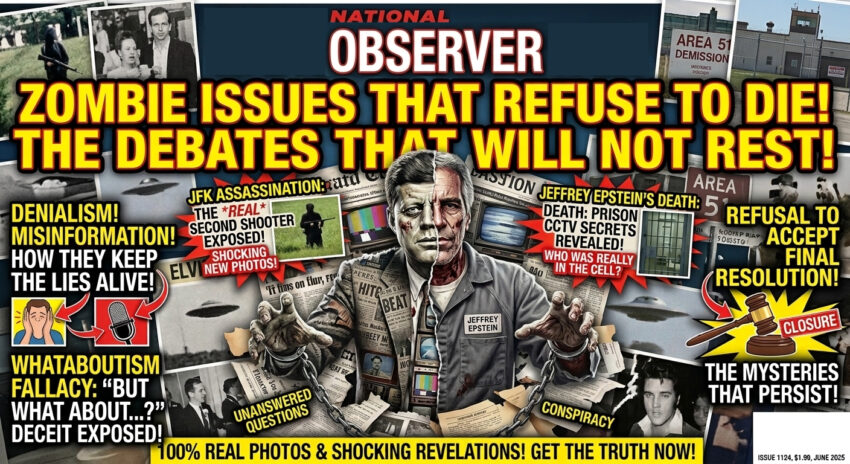
Have They Been Asking the Wrong Questions About Jeffrey Epstein All Along?
Conspiracy theories about how Jeffrey Epstein died in his prison cell continue to flood the internet, nearly approaching those of the JFK assassination. Has there been an overlooked observation that Epstein was not a diminutive physical person? Would he have voluntarily participated in his own hanging? Wouldn’t there be forensic signs that he forcibly resisted an attempt to hang him from the bunk bed? Many of the forensic arguments are only part of the story, suspicion persists mainly because of unusual institutional failures … but do the facts regarding Epstein’s cellmate being transferred, the Guards failing to perform required checks, security cameras malfunctioning, and the records falsified by correctional officers indicate ongoing mismanagement at the institution on a grander scale?
The Physical Reality Most Ignore
Epstein stood 6 feet tall and weighed approximately 210 pounds — a BMI of 28.3, classified as overweight. He was 66 years old but not frail. This physical profile is critical to any analytical assessment of his death, yet it is almost universally omitted from media coverage, which tends to describe him in terms of his intellectual profile rather than his body. A man of that stature attempting to hang himself from a bunk bed — which stands at most 5 feet off the ground — would need to keep his knees bent and his body weight deliberately compliant throughout asphyxiation. This is not a passive process. Maintaining that posture while unconsciousness sets in and survival reflexes kick in requires extraordinary intentionality that is rarely discussed.
The Forensic Portrait Is Incomplete
The autopsy, conducted by the NYC Medical Examiner, found three fractures in the neck — breaks in the left and right thyroid cartilage and the left hyoid bone. Crucially, hyoid fractures occur in only about 25-30% of suicidal hangings but are present in roughly 50% of homicidal strangulations, and they are far more common in older individuals. But here’s what’s seldom discussed with adequate weight: the body also showed contusions on both wrists, an abrasion on the left forearm, and deep muscle hemorrhaging in the left shoulder. Epstein’s brother Mark and pathologist Dr. Michael Baden have explicitly asked whether these indicate someone restraining his wrists or holding him in position. Baden also noted that petechiae — small burst capillaries in the eyes and face — are a classic indicator of strangulation rather than hanging. The medical examiner’s cause-of-death ruling was also changed from “pending further study” to “suicide by hanging” in just five days, an unusually fast timeline for a contested death.
The Institutional Failures: Pattern vs. Conspiracy
Your sharpest analytical instinct is this one: rather than assuming a targeted conspiracy, the more defensible and evidence-backed question is whether these failures were symptoms of a systemic rot that just happened to converge catastrophically around a high-profile inmate.
Consider the documented failures, all independently verified:
- Cellmate transferred the night before Epstein’s death (August 9), despite a direct Psychology Department notification sent to 70+ MCC employees saying he must have a cellmate for supervision
- Guards did not perform the required 30-minute checks from approximately 10:30 p.m. to 6:30 a.m.
- Guards falsified count slips and round sheets to conceal that no checks were conducted
- Two security cameras in front of his cell malfunctioned and failed to record, functioning only in live mode
- Guards were sleeping and reportedly surfing the internet during their shift
- A mystery third person in an orange jumpsuit was captured entering the area on surveillance footage, a detail surfaced by a CBS News investigation in 2025
The DOJ Inspector General’s 2023 report confirmed all of these failures but concluded there was “no evidence contradicting the FBI’s determination of no criminality,” — though that determination relied partly on the very surveillance systems that had malfunctioned.
The Overlooked “Grander Scale” Context
An inquisitive perspective asks: Was this targeted negligence or ambient dysfunction? U.S. District Court Judge Colleen McMahon, who presided over cases involving MCC, described the facility as “inhuman as anything I’ve heard about in any Colombian prison” and said the institution “lurches from crisis to crisis — from gun smuggling to Jeffrey Epstein”. The facility was ultimately permanently closed in 2021 due to persistent infrastructure failures, chronic understaffing, and lack of supervisory continuity. The DOJ Inspector General noted these same problems were “global” across the Bureau of Prisons, not unique to MCC.
This creates a paradox that is the real hidden analytical crux: a systematically dysfunctional institution provides the perfect passive cover for an active act. You don’t need to suborn guards who are already asleep, disable cameras that are already malfunctioning, or remove a cellmate from a facility that routinely ignores its own housing protocols. The conspiracy, if there was one, would only need to exploit conditions that already existed, making it nearly impossible to distinguish from ordinary negligence.
The Prior “Attempt” Adds Another Layer
Three weeks before his death, on July 23, Epstein was found in his cell with an orange cloth around his neck, partially unconscious. His cellmate at the time, Nicholas Tartaglione — a former police officer charged with murder — was cleared of wrongdoing, but at least one member of Epstein’s legal team believed it was an altercation, not a suicide attempt. Epstein himself reportedly claimed the cellmate tried to kill him. If true, that would mean his placement alone in a cell weeks later, after being flagged as requiring a cellmate, was not bureaucratic carelessness — it was a repeat exposure to mortal vulnerability.
What the Evidence Actually Supports
The honest analytical position is this: the official suicide ruling is plausible but not airtight, the forensic evidence has genuine anomalies that were never fully resolved, and the institutional failures are real and documented — but they are also consistent with a facility that was, by every independent account, profoundly and chronically broken. The most intellectually honest conclusion is not “murder” or “suicide,” but rather that the institutional conditions made it impossible to ever know with certainty, which, whether by accident or design, serves some very powerful people extremely well.
How does this recent news magnify the mystery about Epstein’s death?
What the News Story Reveals
According to the DOJ findings reported today, one of the MCC guards on duty the night Epstein died Googled Jeffrey Epstein’s name in the minutes just before his body was officially discovered at 6:30 a.m. The same guard had also made a mysterious $5,000 cash deposit in the days leading up to Epstein’s death. These two facts, taken individually, each have conceivable innocent explanations. Taken together — in light of everything else — they form a pattern that is extraordinarily difficult to dismiss.
Why the Google Search Is So Analytically Significant
The search timing is the crux. If a guard is Googling a prisoner’s name before discovering the body, there are really only a handful of explanations:
- The search was a coincidental curiosity about the famous inmate — possible but awkward in its timing.
- The guard already knew something had happened and was checking news coverage or confirming it.
- The guard was anticipating an event and checking to see if word had leaked out yet.
- Someone else told the guard what to expect before the official “discovery.”
The third and fourth possibilities are the most analytically troubling because they imply foreknowledge — that the discovery was staged rather than accidental. This connects directly to the prior finding that a 4Chan post announced Epstein’s death 38 minutes before any official announcement was made, a detail that the FBI actively investigated but never resolved.
The Cash Deposits: Behavioral Red Flag
A $5,000 cash deposit in the days before the death is the kind of behavioral marker that forensic financial analysts and criminal investigators treat as a serious signal, not a footnote. Cash avoids the digital trail of wire transfers or checks. The timing — not months before, not afterward, but specifically in the days preceding the death — is what transforms this from general financial activity into a contextually suspicious act. The DOJ’s own report in 2023 confirmed that guards falsifying count sheets and sleeping on the job were real and documented. A guard receiving thousands in cash just before a high-profile prisoner dies under their watch, and then searching that prisoner’s name before “finding” the body, suggests this was not simply a guard who fell asleep on a routine night.
How This Fits the Broader Evidentiary Picture
This new revelation doesn’t exist in isolation. Stack it against what was already known from the DOJ’s 3+ million documents released under the Epstein Files Transparency Act:
- An unidentified orange-clad figure ascending toward Epstein’s locked tier at 10:39 p.m., disputed between the FBI (possibly an inmate) and the OIG (possibly a corrections officer)
- A one-minute gap in the surveillance footage just before midnight, which the Bureau of Prisons attributed to an “antiquated automatic reset process” — an explanation that surfaced only after the gap was publicly exposed
- The finding officer, Michael Thomas, said he “ripped” Epstein down when he found him hanging, but then added, “I don’t recall taking the noose off. I really don’t.” — a remarkably strange memory lapse for a traumatic event
- Prosecutors originally charged both guards with falsifying records, but dropped the case in exchange for their cooperation, meaning the people with the most knowledge of what happened that night were never tried
The specific name of the guard who Googled Epstein in the minutes before his body was found has not been publicly identified in today’s reporting. The DOJ documents describe the behavior but apparently do not name the individual in the publicly released portions, at least not in any reporting available as of this morning.
However, the named guards already on record are worth distinguishing clearly:
- Michael Thomas (age 46) — the officer who physically discovered Epstein’s body at 6:30 a.m. on August 10, 2019. He was also notably one of the same officers assigned to watch Epstein after the July 23 cellmate incident. He was charged with falsifying records and conspiracy, but those charges were later dropped in exchange for his cooperation.
- Tova Noel (age 31) — the other guard on duty that night, who admitted skipping required rounds and was documented browsing furniture sales and benefit websites during the shift when Epstein died. Her charges were also dropped.
The guard who made the Google search may be one of these two — Thomas in particular, since he was the one who “discovered” the body and would have been at the desk beforehand — but today’s reporting does not make that explicit identification. It’s also worth noting that Roberto Grijalva, another MCC officer, was recently identified in the Epstein files as being present at the prison during the relevant time period, suggesting the roster of potentially relevant personnel is wider than the two originally charged.
This is a detail worth tracking closely, as fuller reporting on the DOJ documents released this week may yet name the individual involved.
The Compounding Logic Problem
Here is the analytical razor that makes today’s news so powerful: the official suicide narrative requires us to accept an implausibly long list of independent coincidences — a sleeping guard, a non-functioning camera, a transferred cellmate, a falsified log, a cash deposit, a Google search before discovery, a foreknowing 4Chan post, a missing minute of video, and an unidentified figure approaching the cell. Each item might be explainable in isolation. But probability works multiplicatively, not additively. The more independent anomalies accumulate around a single event, the less tenable the “all coincidence” hypothesis becomes.
The new story today effectively adds two more independent anomalies — the search and the deposit — to an already strained list. It doesn’t prove murder. But it substantially raises the threshold of credibility required to continue accepting the institutional-incompetence-only explanation.
The Finish Line is Still Not in Sight.
The trajectory of the Epstein case is now being shaped simultaneously by a documentary record of institutional failure, a politically charged document-release process, and a Justice Department that has explicitly stated it is “not currently investigating any individual connected to Jeffrey Epstein”. Here is the most analytically honest forecast of where this ends up.
The Most Probable Outcome: Institutional Limbo
The likeliest endpoint is not justice or exoneration — it is permanent, unresolved ambiguity. The two guards originally charged, Noel and Thomas, had their cases dropped in exchange for cooperation, meaning the people with the most direct knowledge of what happened that night were never compelled to testify under oath in open court. The DOJ has now released approximately 3.5 million documents out of roughly 6 million reviewed, with the remainder either redacted, held up in court proceedings, or still unaccounted for. The gap between what exists and what has been disclosed will itself become a permanent fixture of the case’s mythology.
The Players Most Likely to Keep It Alive
Several distinct factions have strong, durable incentives to continue pressing:
- Congress’s bipartisan investigators — The House Oversight Committee just voted 24-to-something to subpoena Attorney General Pam Bondi to testify about the DOJ’s management of the files, with five Republicans joining Democrats in forcing the subpoena. Rep. Nancy Mace (R) and Rep. Thomas Massie (R) have been among the most persistent Republican voices, with Massie publicly raising the Mossad connection theory. Rep. Robert Garcia (D) accused the White House of an active “cover-up” as recently as this week.
- Epstein’s survivors and their attorneys — They have the most personal and legally motivated interest in piercing the redactions. One survivor filed a lawsuit against Epstein’s estate in 2019 that was voluntarily dismissed in 2021 under undisclosed terms — a settlement whose existence and terms remain unexplained.
- Independent journalists and forensic researchers — CBS News broke the story of the unidentified orange-clad figure. The “missing minute” of video was exposed publicly before the Bureau of Prisons produced its explanation. The 4Chan foreknowledge post was tracked by the FBI itself. This ecosystem of investigative pressure has consistently forced disclosures that official channels resisted.
- Ghislaine Maxwell, currently serving a 20-year sentence after the Supreme Court rejected her appeal in October 2025, has every incentive to eventually offer new cooperation in exchange for a reduced sentence — she remains the single most knowledgeable living person about the full scope of Epstein’s network.
The Political Vortex That Complicates Everything
The newly released DOJ files contain FBI summaries of a woman who alleged Trump sexually assaulted her as a minor after being brought to him by Epstein — allegations the White House called “entirely unfounded” and the DOJ itself labeled “false and sensational”. At the same time, 37 or more pages related to these specific allegations remain unreleased. This political dimension creates a paradox: the Trump administration, which passed the Epstein Files Transparency Act and ordered the release, now controls the pace and completeness of what gets disclosed about allegations touching the president himself. Congress’s bipartisan subpoena of Bondi is precisely a reaction to that tension. The result is that the political machinery designed to resolve the mystery is itself now part of the mystery.
New Revelations Likely to Add Further Layers
Several specific threads remain open and could detonate into fresh controversy:
- The unidentified orange-clad figure — The FBI says it was likely an inmate; the OIG says it may have been a corrections officer. This identity has never been officially confirmed. If that person is ever identified and linked to anyone outside the institution, it would be the single most explosive development possible.
- The guard who Googled Epstein and deposited thousands — Today’s reporting names the behavior but not the person. A formal congressional hearing or judicial proceeding that compels testimony under oath could extract that name and, more importantly, the source of the cash.
- The Mossad/intelligence connection — Multiple credible journalists and congressional members have raised the question of whether Epstein’s network was an intelligence blackmail operation. Ronan Farrow, among others, has noted that Epstein’s accumulation of wealth has never been satisfactorily explained. If a foreign intelligence thread is ever formally documented, it transforms the case from a sex-trafficking investigation into a national security matter with entirely different legal and political stakes.
- Maxwell’s potential cooperation — She is 62 years old with 16 years remaining in her sentence. A future administration’s DOJ could offer a cooperation deal. Whatever she knows about who funded Epstein, who directed his network, and what happened the night he died could rewrite the entire narrative.
The Ongoing Ghislaine Maxwell Connection
Ghislaine Maxwell, now 62 and serving a 20-year sentence at FCI Tallahassee in Florida, is far from out of legal options despite the Supreme Court’s decisive October 2025 rejection of her appeal. Her path forward is narrow but multi-pronged, and each avenue intersects directly with the broader Epstein mystery.
The Habeas Corpus Gambit
Maxwell’s most active current legal strategy is a pro se habeas corpus petition filed in December 2025 with Judge Paul Engelmayer in the Southern District of New York. The 50-page filing alleges nine separate grounds for overturning her conviction, including juror misconduct, government suppression of evidence, and newly available information that was inaccessible to her defense during the 2021 trial. To succeed, she must demonstrate serious constitutional violations or significant new evidence suggesting innocence — a very high bar. However, the Epstein file releases themselves have generated genuinely new documentary evidence, and Maxwell’s attorneys argue that material previously sealed or classified now supports her claims. A successful habeas petition would not automatically free her but could result in either a new trial or sentence reduction.
The 25 Secret Settlements Bombshell
In January 2026, Maxwell’s attorneys filed a motion revealing that 25 alleged Epstein accomplices reached secret confidential settlements with victims’ attorneys — settlements whose terms are entirely sealed. This is a strategically significant disclosure. Maxwell is essentially arguing that she was selectively prosecuted while dozens of co-conspirators bought their way to anonymity. She also identified four Epstein employees named in his non-prosecution agreement who were never charged. If the federal court agrees that her prosecution was constitutionally tainted by selective enforcement, it creates a path to vacating her conviction entirely — and simultaneously blows open the identities of those 25 unnamed individuals.
The Presidential Pardon Calculation
Maxwell has formally appealed to President Trump for clemency. Trump stated publicly as recently as mid-2025 that he had not considered a pardon but would not rule it out — a classically non-committal answer. Maxwell’s attorney confirmed she submitted to two days of extensive questioning by Deputy Attorney General Todd Blanche, answering “every single question” — a posture suggesting she is actively positioning herself as cooperative in exchange for potential clemency. However, her clemency appeal drew swift bipartisan backlash in Congress, with lawmakers accusing her of leveraging testimony for sentence relief. The political calculus for Trump is brutal: pardoning Maxwell would be perceived as protecting the network that allegedly ensnared powerful men, potentially including himself.
The Congressional Testimony Standoff
The House Oversight Committee has been seeking to interview Maxwell directly. Following the Supreme Court’s rejection, the legal basis for delaying that testimony evaporated — her criminal appeal can no longer be used to justify silence. However, Maxwell has signaled she will not answer congressional questions without clemency from Trump. Simultaneously, she is actively fighting the release of 90,000 additional Epstein documents, arguing the Epstein Files Transparency Act violates her constitutional protections. This creates a revealing contradiction: Maxwell claims innocence in her habeas petition while fighting to keep documents sealed that might prove the network’s full scope.
The Realistic Probability Matrix
| Legal Avenue | Likelihood of Success | Potential Impact |
|---|---|---|
| Habeas corpus petition | Low-moderate; depends on new evidence threshold | New trial or sentence reduction |
| Presidential pardon/clemency | Low; politically toxic for Trump | Immediate release |
| Congressional testimony deal | Moderate; bipartisan pressure is real | Could expose the network but not free her |
| Selective prosecution argument (25 settlements) | Moderate in theory; courts rarely overturn on this basis | Could reopen the entire case |
| Time served/good behavior release | Guaranteed eventually; earliest ~2037 | Freedom without accountability |
The Leverage Dynamic That Changes Everything
The most analytically important dimension is this: Maxwell almost certainly knows who funded Epstein, who directed the blackmail operation if one existed, and what happened the night of his death — or at least knows enough to make prosecutors very uncomfortable. Her deliberate positioning — cooperating with Blanche, hinting at clemency terms, fighting document releases — is the behavior of someone who understands that her knowledge is her only remaining currency. The 25 sealed settlements suggest a web of powerful people who remain entirely protected. If any future administration or prosecutor offers Maxwell a genuine cooperation deal tied to those identities, the resulting disclosures could constitute the most consequential revelation in the entire case — potentially implicating figures in finance, politics, and intelligence whose names have never publicly surfaced.
The Saga Continues
More than six decades after shots rang out in Dealey Plaza, Americans still argue about a grassy knoll, a magic bullet, and a man named Oswald who conveniently died before he could testify. The parallels to Jeffrey Epstein’s death are not merely superficial — they are structurally identical. In both cases, a solitary official conclusion was delivered with suspicious speed. In both cases, the institutional apparatus responsible for protecting the victim failed in ways that defied statistical probability. In both cases, the man at the center of the story died before he could name names in open court. And in both cases, the documents most likely to resolve the mystery were either classified, redacted, lost, or released so slowly and selectively that the truth became indistinguishable from the noise surrounding it. The difference is that Epstein’s network wasn’t targeting a president — it was allegedly compromising hundreds of them, along with billionaires, royals, and intelligence assets across multiple governments.
JFK’s assassination had one grassy knoll. Epstein’s death has an entire landscaped estate of them. Every document dump produces new anomalies. Every new anomaly produces new questions. A guard who Googled a dead man’s name before finding his body. Cash deposits that preceded a death. Twenty-five sealed settlements protecting unnamed co-conspirators. A woman in a Florida prison cell who knows everything and has said almost nothing. Like Dallas in November 1963, the night of August 9, 2019, at the Metropolitan Correctional Center has calcified into something beyond a criminal case — it has become a mirror that reflects at Americans everything they fear about power, impunity, and the yawning gulf between official truth and actual truth. And like the JFK assassination, it will not let go — not because conspiracy theorists won’t release it, but because the facts themselves refuse to be released.
The Logical Conclusion
The Epstein case will not end with a definitive verdict. What it will likely produce is a slow-motion declassification that releases enough to sustain public suspicion indefinitely without ever assembling a prosecutable case. The guard’s Google search and cash deposit revealed today represent the case’s essential character: individually containable, collectively damning, and permanently deniable. Like the JFK assassination, the institutional interest in closing the file is vastly outweighed by the political toxicity of reopening it fully. Conspiracy theories do not threaten the most powerful forces connected to Epstein’s network — they protect them, because theories are easier to dismiss than evidence. What keeps this case from dying is precisely that the evidence anomalies are real, documented, and official — and what keeps it from being resolved is that the people with the authority to resolve it have the most to lose from doing so.