
Overview and Purpose
Published in 2020 by Deseret Book, 175 Temple Symbols and Their Meanings is a 310-page reference guide by Donald W. Parry, a professor of the Hebrew Bible at Brigham Young University and a contributor to the Dead Sea Scrolls translation project. The book draws on President Russell M. Nelson’s teaching that “each temple is a house of learning” where the Lord’s “way is ancient and rich with symbolism” — and that “we can learn much by pondering the reality for which each symbol stands.” Parry’s goal is straightforward: help Latter-day Saints deepen their temple worship by understanding the rich symbolic language embedded in both ancient and modern temples, with every symbol ultimately pointing toward Jesus Christ.
Structure and Organization
The book’s 175 entries are arranged alphabetically for convenient reference, acknowledging that “temple learning is a lifelong endeavor” and that readers will return to this volume repeatedly over time. Categories covered include temple architecture, rituals and ordinances, sacred clothing, sacrificial offerings, geometric symbols, colors, heavenly bodies (sun, moon, and stars), prayer and revelation, sacred names, and religious festivals. The volume is enriched with photographs, illustrations, and explanatory charts that bring the symbols to life visually — fitting for a subject that is inherently experienced through sight.
Parry explicitly acknowledges that his 175 symbols are not an exhaustive list and that his explanations represent his own views, “leaving open the door for other meanings and interpretations by the reader.” This intellectual humility invites personal pondering rather than demanding doctrinal uniformity.
The Introduction: How to Read Temple Symbols
The introduction lays out Parry’s interpretive framework. He makes clear his intent to defer to three authoritative sources when making sense of temple symbolism: the Holy Ghost, the scriptures, and contemporary Church leaders. He cautions readers against relying too heavily on “our cultural understandings” when approaching temple worship, framing the temple as a revealed institution best understood through faith and obedience.
Christ-Centered Symbolism
The dominant theological thread running through every entry is that temple symbols point to Jesus Christ. As Parry states, “The temple, ancient and modern, features many Jesus Christ-focused symbols.” This Christocentric focus is illustrated richly across multiple entries.
Alpha and Omega: Parry explains that these Greek letters — equivalent to A and Z in English — represent Jesus Christ as “the beginning and the end, or the eternal one.” This symbol appears literally inscribed on the Salt Lake Temple: “I am Alpha and Omega.” In Hebrew, the parallel concept is equally significant, running from the first to the last letter of the alphabet.
The Ark of the Covenant and the Mercy Seat: Among the book’s most theologically rich entries, Parry explores how the Ark of the Covenant — housed in the Holy of Holies of the ancient temple — is saturated with symbols of Christ’s Atonement. The Hebrew word for its lid, kappōreṯ, derives from the root kaphar, meaning “atonement,” leading some scholars to translate it as the “Throne of Atonement.” The Ark was made of the finest, purest grade of gold — itself a symbol of “Christ’s excellence and eternality.” Inside the Ark were three objects: Aaron’s rod, the tablets of the Ten Commandments, and a container of manna — “all three of which point to some aspect of Jesus Christ.”
Temple Architecture as Symbolic Language
Parry devotes considerable attention to how physical architecture communicates doctrine. A section spanning pages 45–53 surveys architectural features of individual temples, noting that each building incorporates unique symbolic elements. The Salt Lake Temple receives particular attention: its sun stones, moon stones, earth stones, stars, and cloud-with-rays motifs all carry specific theological meanings. The six spires are intentionally differentiated — “the three higher spires represent the Melchizedek Priesthood presidency, and the three lower are the Aaronic Priesthood,” reflecting the hierarchy of priestly authority.
Regional temples incorporate locally inspired elements as well. The Meridian, Idaho Temple features the Idaho state flower, the Syringa, as a motif, while the Idaho Falls Temple was designed to reflect architect John Fetzer Sr.’s inspired vision of an ancient Nephite temple.
Ancient Israel and the Restored Gospel
A recurring strength of the book is its bridging of Old Testament temple worship with Latter-day Saint practice. Parry traces symbols from the Mosaic tabernacle and Solomon’s temple through to modern LDS temples, showing continuity of purpose and meaning across millennia. The entry on priestly blemishes, for instance, describes how ancient Israel barred individuals with physical imperfections from officiating in ordinances, and draws the modern spiritual application that members should “strive to serve without spiritual blemishes.”
Conclusion of Scope
Parry frames the book as a beginning, not an ending. Like the temple itself, the volume is “nicely constructed to accommodate multiple exploratory visits.” It is best read as a devotional reference — a companion for ongoing temple worship rather than a definitive theological treatise — inviting readers to keep their eyes open for symbols they have long passed without fully seeing.
A critical note for researchers: While Parry presents this material as devotional enrichment for believing Latter-day Saints, the book largely avoids critically engaging with the pre-Christian, Masonic, or Near Eastern cultural antecedents that heavily influenced many of the symbols it describes. Parry treats the temple as an entirely revealed institution, which shapes — and limits — his interpretive conclusions.
The All-Seeing Eye on the Salt Lake Temple: A Rebuttal of FAIR’s Deflection
FAIR’s Argument, Stated Fairly
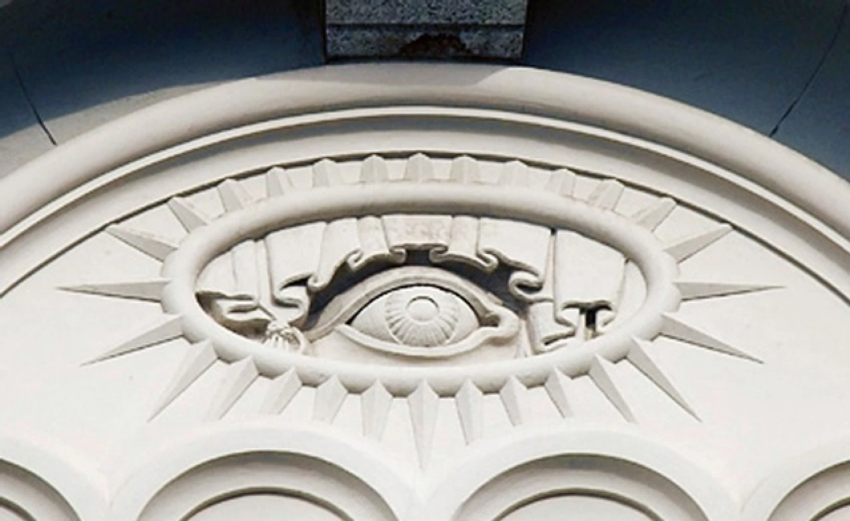
FAIR’s defense rests on a single, straightforward claim: the All-Seeing Eye is not a Masonic invention, and its presence in LDS texts predates Joseph Smith’s Masonic initiation in March 1842. To support this, FAIR assembles an impressive timeline of LDS scriptural and journal references to God’s omniscient gaze, beginning as early as 1828–29 in the Book of Mormon. The implication is clear — if early Latter-day Saints were already referencing a watchful divine eye before any formal Masonic affiliation, then the presence of this motif on the Salt Lake Temple requires no Masonic explanation.
This argument is not without merit as far as it goes. The All-Seeing Eye does appear in pre-Masonic Christian art and iconography, and FAIR is technically correct that Speculative Freemasonry did not create the symbol from nothing. However, the argument functions as a deliberate misdirection, answering a question no serious scholar actually asked while avoiding the question that genuinely matters.
The Category Error at the Heart of FAIR’s Defense
The critical distinction FAIR’s argument systematically elides is the difference between a theological concept and an architectural symbol. Of course, the idea of God’s omniscient gaze is biblical — it runs from Psalm 34:15 to Hebrews 4:13, and no informed critic has ever disputed this. The relevant question is not whether Latter-day Saints believed in a God who sees all things. The question is: why did the builders of the Salt Lake Temple choose to render that belief in the specific visual iconography of the Eye of Providence — an eye enclosed within radiating rays — the precise emblem that had become, by the mid-19th century, the most recognizable visual signature of American Freemasonry?
These are not the same question, and conflating them is apologetically convenient but intellectually dishonest. By flooding the reader with scriptural references to divine watchfulness, FAIR creates the impression of having answered a challenge it has merely sidestepped.
The Historical Context FAIR Omits
Thomas Smith Webb’s Freemason’s Monitor, first published in 1797 and widely circulated throughout early 19th-century America, formally incorporated the All-Seeing Eye into American Masonic third-degree ritual, describing it as the eye that “pervades the inmost recesses of the human heart.” By the time Brigham Young was overseeing the design of the Salt Lake Temple, the Eye of Providence was Freemasonry in the popular American imagination — not merely a shared symbol, but the fraternity’s most publicly recognized emblem. Young was himself a Mason of long standing, and, critically, Sunstone scholar D. Michael Quinn’s research documents that Young made extensive use of the All-Seeing Eye motif on signs for ZCMI stores beginning in 1868 — a commercial application that makes no theological sense but makes abundant cultural sense within the Masonic milieu of 19th-century Utah.
Moreover, the Salt Lake Temple does not display the All-Seeing Eye in isolation. It appears alongside the sun stones, moon stones, clasped hands, beehive, and the Alpha and Omega inscription — all of which are simultaneously Masonic emblems and symbols that appear on the Salt Lake Temple’s exterior. FAIR’s argument, applied consistently, would require us to believe that every single one of these symbols arrived at the same building entirely independently of the Masonic tradition that was actively shaping LDS institutional culture at the time of the temple’s design. The cumulative implausibility of that claim is staggering.
The Fallacy of Independent Origin
FAIR’s timeline argument commits what historians of religion call the genetic fallacy in reverse: the assumption that because a symbol has pre-Masonic origins, its specific deployment in a given context cannot be Masonic in inspiration. This reasoning would be rejected in any other field of historical inquiry. The fact that the Nazi swastika has ancient Hindu and Buddhist roots does not make its 20th-century usage non-Nazi. The fact that the Eye of Providence appears in 15th-century Christian art does not make its placement on a 19th-century building designed by Masons non-Masonic in character. Historical symbols carry the meanings of their immediate cultural context, not merely their most ancient antecedents.
The Salt Lake Temple was designed beginning in 1853 by Truman O. Angell, who worked under the direct supervision of Brigham Young. Young had been intimately involved in the Nauvoo Masonic Lodge alongside Joseph Smith. The architectural environment in which the temple was conceived was saturated with Masonic symbolism. FAIR offers no evidence that Angell or Young consulted ancient Christian iconographic traditions when selecting the All-Seeing Eye motif, and considerable circumstantial evidence suggests they did not need to — that symbolism was already in the air they breathed, learned in the lodge hall rather than the art history lecture.
Conclusion
FAIR’s defense of the All-Seeing Eye on the Salt Lake Temple is a textbook example of apologetic misdirection: technically accurate in its narrowest claim, yet profoundly misleading in its overall effect. Demonstrating that Latter-day Saints used the language of divine omniscience before 1842 does nothing to explain why they chose the specific visual vocabulary of Freemasonry to express that belief in their most sacred building. The honest answer — one that a handful of LDS historians have dared to offer — is that the Masonic fraternal culture of 19th-century America shaped LDS temple architecture in ways that the institutional Church has never fully reckoned with. Parry’s book and FAIR’s defense represent a continuation of that avoidance.
A Theologian’s Rebuttal: The Masonic Genealogy of LDS Temple Symbolism
The Problem of Presupposition
Donald W. Parry’s 175 Temple Symbols and Their Meanings is, in its finest moments, a work of genuine devotional sincerity. Parry’s command of Hebrew and his sensitivity to the typological richness of ancient Israelite worship are evident throughout the volume. Yet the book suffers from a foundational methodological defect that no amount of scholarly enthusiasm can correct: it presupposes the conclusion it is ostensibly demonstrating. Parry treats the LDS temple system as a revealed institution continuous with ancient Israelite practice, and then organizes his symbolic analysis entirely within that frame. What this approach systematically forecloses is the far more parsimonious — and historically defensible — explanation for the origin of many LDS temple symbols, rituals, and architectural motifs: 19th-century Freemasonry.
This is not a polemical charge. It is a historical observation made by some of the most rigorous scholars of Mormon history, including LDS historians themselves. Reed C. Durham Jr., who served as president of the Mormon History Association, stated plainly that the similarities between the Nauvoo temple endowment and Masonic ceremony were “so apparent and overwhelming that some dependent relationship cannot be denied,” adding that the endowment “had an immediate inspiration from Masonry.” Durham’s subsequent censure by Church Education System administrators speaks volumes — not about the inaccuracy of his conclusions, but about their ecclesiastical inconvenience.
The Timeline Is Decisive
No serious engagement with LDS temple symbolism can responsibly ignore the biographical timeline of Joseph Smith. According to Smith’s own History of the Church, he “received the first degree in Free Masonry in the Nauvoo Lodge” on March 15, 1842, and “rose to the sublime degree” the following day. Less than two months later — on May 4, 1842 — Smith introduced the endowment ceremony to a select group of initiates. To assert, as Parry’s framework implicitly does, that this proximity is coincidental requires a suspension of historical judgment that no reputable scholar of religion would apply to any other new religious movement.
It is worth noting that Masonic influence on Smith’s wider religious imagination did not begin in 1842. Smith’s older brother Hyrum had received the first three degrees of Masonry in Mount Moriah Lodge No. 112 of Palmyra, New York, at roughly the same period Joseph was producing the Book of Mormon. John L. Brooke, a historian at Tufts University, has documented how the very narrative structure of the golden plates discovery echoes the Enoch myth of Royal Arch Freemasonry — in which Enoch preserves sacred mysteries by carving them on a golden plate placed in a stone vault on a hilltop, to be rediscovered by Solomon. The artifacts Smith described — the Urim and Thummim, the breastplate, the “sword of Laban,” the “miraculous directors,” and the pillars supporting the plates — all had recognizable Masonic analogues in Smith’s cultural environment.
Ritual Parallels the Endowment Cannot Explain Away
Parry’s book does not engage the endowment ceremony in any candid way — an understandable constraint given LDS norms of temple secrecy, but a serious analytical lacuna nonetheless. A complete accounting of LDS temple symbolism cannot be given without acknowledging the ritual structure of the endowment, in which the parallels to Masonic ceremony are most concentrated and most unmistakable.
The LDS endowment, like Craft Freemasonry, features:
• Washings and anointings with accompanying sacred clothing given to initiates
• A new name conferred in secret upon the initiate.
• Vows of non-disclosure, historically enforced by dramatic penalty oaths (removed from LDS practice only in 1990).
• Handclasps and tokens (called “grips” in Masonic terminology) used to symbolically “pass” through successive stages of initiation.
• The Five Points of Fellowship, a Masonic tradition explicitly acknowledged as having been practiced in LDS temples and removed after 1990 precisely because it had become “meaningless to modern saints.”
• Dramatic presentation of a narrative involving creation, fall, and redemption.
• A question-and-answer catechetical structure between officiators and initiates.
The Church’s own Gospel Topics essay on Masonry concedes that “soon after he became a Mason, Joseph introduced the temple endowment,” and that there are “some similarities between Masonic ceremonies and the endowment.” The essay’s explanatory frame — that “Joseph’s encounter with Masonry evidently served as a catalyst for revelation” — is a theological interpretation, not a historical one. As historians of religion, we are entitled to note that this is precisely the kind of post-hoc sacralization that religious movements routinely apply to borrowed materials.
Architecture as Masonic Text
Parry devotes considerable attention to LDS temple architecture, offering Christological and Israelite interpretations of the sun stones, moon stones, earth stones, and star motifs on the Nauvoo and Salt Lake Temples. This is where the Masonic genealogy of LDS symbolism is perhaps most visually obvious, and most underexplored in his treatment.
Durham observed that “the Nauvoo Temple architecture was in part, at least, Masonically influenced,” and that “there was an intentional attempt to utilize Masonic symbols and motifs” in its design. The sunstone itself — prominently featured on the Nauvoo Temple and widely reproduced in LDS sacred art — is a standard element of Masonic iconography, representing the light dispensed to initiates within the lodge. The moon and stars similarly function in Masonic symbolism as gradations of illumination corresponding to different degrees. Parry reads these as straightforwardly biblical, citing Revelation and the Aaronic/Melchizedek Priesthood hierarchy — an interpretation that is not wrong in isolation, but that is profoundly incomplete without acknowledging the 19th-century Masonic milieu that made these symbols culturally available and architecturally normative to Smith and his associates.
The phrase “Holiness to the Lord” inscribed on LDS temples is also claimed by some apologists to be purely biblical. While the phrase does appear in the Hebrew scriptures in association with the Jerusalem temple, it was equally prominent as a Masonic motto displayed in lodge rooms throughout early 19th-century America. Parry’s failure to acknowledge this dual resonance is a symptom of his broader methodological problem: he presents only the interpretive tradition that supports his thesis.
The Christological Gloss and Its Limits
Parry’s most theologically substantive claim is that every LDS temple symbol ultimately points to Jesus Christ. The entry on the Ark of the Covenant is particularly instructive here, where Parry draws on legitimate Hebrew scholarship — the root kaphar as “atonement,” the kappōreṯ as “Throne of Atonement” — to build a Christological reading of the Mercy Seat. As a Biblical scholar, I find this exegesis defensible within a Christian typological framework. The author of Hebrews makes essentially the same move (Heb. 9:1–14).
The critical question, however, is not whether these symbols can be read christologically, but whether LDS temple practice actually derives them from that biblical tradition — or whether a Christological gloss has been applied retrospectively to symbols and rituals whose immediate genealogy is Masonic. The Masonic three-degree system — Entered Apprentice, Fellow Craft, Master Mason — was itself understood by 19th-century Masons as a narrative of death and resurrection, with the Hiramic legend functioning as a kind of initiatory passion narrative. Smith’s genius, if we may call it that, was in reframing this initiatory drama within an explicitly LDS cosmological narrative. But the underlying ritual grammar — secrecy, degrees of initiation, tokens, penalties, dramatic enactment of sacred narrative — is Masonic, not Mosaic.
The Deeper Theological Problem
From the standpoint of historic Christian theology, what is most troubling about Parry’s interpretive project is not what it says, but what it conceals. By anchoring LDS temple symbolism firmly in ancient Israel and the typology of Christ, Parry obscures the degree to which the LDS temple system represents a departure from — not a recovery of — the theological logic of Scripture.
The New Testament’s treatment of the Jerusalem temple is unambiguous: with the death of Christ, the temple veil is torn, the sacrificial system is fulfilled, and access to God’s presence is no longer mediated through ritual space, sacred garments, or initiatory rites (Heb. 10:19–22; Matt. 27:51). The entire argument of the Letter to the Hebrews is that the Levitical priesthood and its attendant ceremonial apparatus are obsolete — surpassed, not restored. When the LDS endowment reconstitutes washings, anointings, sacred garments, mediating priesthood figures, and graduated access to divine presence, it does not restore ancient Israel. It reconstructs — through a Masonic template — a ritual economy that the New Testament declares to have been conclusively superseded in Christ.
Parry’s book is, in this respect, a monument to a kind of reverse typology: where Christian theology reads the Old Testament forward into Christ as its fulfillment, LDS temple theology reads back through Christ into a reconstructed ritual system — and dresses that reconstruction in the borrowed garments of 19th-century fraternal initiation. The symbols may point, as Parry claims, toward Christ. But the ritual structure through which they are mediated points, with equal or greater historical clarity, toward the lodge hall of the Nauvoo Masonic chapter — not toward the upper room, the empty tomb, or the temple of Solomon.
Note: The scholarly works undergirding this critique include Michael W. Homer’s essay “Similarity of Priesthood in Masonry” (Dialogue: A Journal of Mormon Thought, 1994), D. Michael Quinn’s Early Mormonism and the Magic World View (Signature Books, 1998), John L. Brooke’s The Refiner’s Fire (Cambridge University Press, 1994), and Reed Durham’s presidential address to the Mormon History Association (1974).