
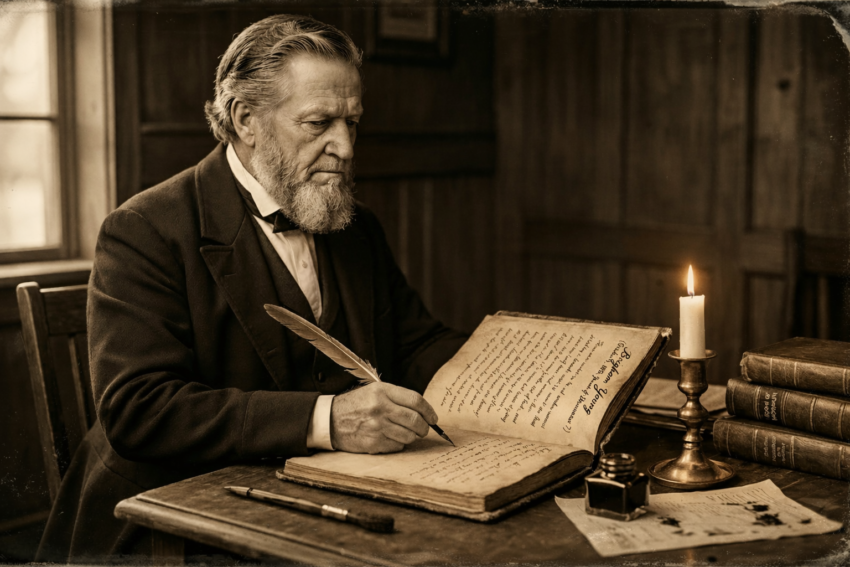
Brigham Young’s Race Theology and the Murder of a Black Mormon
Prologue: A Body on the Hill
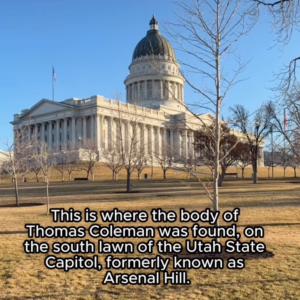
It was the afternoon of December 11, 1866, and a group of boys playing on the rocky bench above Salt Lake City stumbled upon something that would haunt Utah’s history for more than a century and a half. Behind the city’s Arsenal building — on the hill that would one day bear the gleaming dome of the Utah State Capitol — they found the body of a man. He lay on his back, head pointing west, as if arranged. A large, blood-smeared stone rested near his skull. A Bowie knife lay beside him, also bloodied. His throat had been cut so deeply that his neck was nearly severed. He had been stabbed twice in the chest. Whoever killed him had left a message behind — a warning to others who looked like him.
Pinned to his chest was a hand-lettered placard, written in pencil on a large sheet of paper. Its message was direct and purposeful:
NOTICE TO ALL NIGGERS! TAKE WARNING!! LEAVE WHITE WOMEN ALONE!!!
— Placard affixed to Thomas Coleman’s body, December 10–11, 1866
The man was Thomas Coleman, approximately thirty-five years of age. He had been enslaved. He had been baptized into the Church of Jesus Christ of Latter-day Saints. He had marched into Wyoming’s killing blizzards to rescue the ill-fated handcart companies when almost no one else would go. He had stood trial for manslaughter in a theocratic court and been convicted. He had labored under Brigham Young’s shadow in the heart of the Kingdom of God on earth.
He had survived a Mississippi plantation. He had survived an eighteen-hundred-mile overland journey into the desert. He had survived Wyoming blizzards. He had survived a conviction that could have broken him.
He did not survive Zion.
Part I: Origins in Bondage — Mississippi to the Valley of the Great Salt Lake
The World That Made Thomas Coleman
Thomas Coleman entered the world around 1832 or 1833, most likely on a plantation in Monroe County, Mississippi — though the precise coordinates of his birth are beyond certain recovery. American slavery was a machine that erased as efficiently as it exploited, and Thomas Coleman left no record under his own name before bondage defined him. He would appear in documents, yes — but as an entry in a slave schedule, a line in a census, a notation in a court docket — always rendered in relation to those who claimed ownership of his body, never as a man who possessed a story of his own.
His very surname tells a story of inheritance he never chose. Two white enslavers — John Crosby and his wife, Elizabeth Coleman Crosby — had almost certainly inherited Thomas’s mother from the estate of Elizabeth’s father, Joseph Coleman. From that man, a man Thomas never knew as anything but a name attached to his bondage, the boy took his adult identity. Historian W. Paul Reeve and his collaborators at the University of Utah’s Century of Black Mormons project place Thomas’s birth on the Crosby plantation around 1833 — a child born into servitude, named after the dead patriarch of the family that owned his mother.
Then came the transaction that antebellum Mississippi called matrimony. When Nancy Crosby, daughter of John and Elizabeth, wed John Bankhead in 1842, she almost certainly brought nine-year-old Thomas with her into the marriage — not as a guest, not as a witness, but as property, folded into the domestic inheritance of a new household.
This was not exceptional. It was ordinary. It was the invisible architecture of the slaveholding world: children transferred from estate to estate not through any act of their own will, but through the financial and sentimental calculations of white families who had reduced them to ledger entries. Thomas Coleman entered the world already catalogued, already claimed, already assigned a future that was not his to choose.
Conversion and Covenant: The Bankheads Become Latter-day Saints
In 1844, Latter-day Saint missionaries ventured into Monroe County, Mississippi, preaching Joseph Smith’s restored gospel along the cotton roads of the Deep South. Nancy Bankhead heard their message and was moved by it. She joined the Church of Jesus Christ of Latter-day Saints that year; her husband, John, followed in 1845. Their conversion was genuine, their commitment lasting. They would eventually make the long and grueling journey to the Great Basin to join the Saints in their desert Zion.
But the Bankheads did not come to their new faith alone — and their story was more complicated than a simple family conversion. Thomas had been born around 1833 on a Mississippi plantation owned by John and Elizabeth Crosby. When Nancy Crosby — the daughter of the household — wed John Bankhead in 1842, she brought young Thomas, then approximately nine years old, into the marriage. He was hers, a human being transferred with the furniture and the linens. When the missionaries came knocking two years later, Thomas came under their influence as well.
The Century of Black Mormons project records that Thomas — approximately eleven years old at the time of the Bankheads’ conversion — appears to have embraced the Latter-day Saint message alongside his enslavers. The University of Utah exhibition notes:
Thomas was likely baptized a Latter-day Saint in Mississippi around the same time that his enslavers converted, but membership records do not survive to definitively make that determination. Even still, a Salt Lake City newspaper reported that he was a member of the Church of Jesus Christ of Latter-day Saints.
— Century of Black Mormons, University of Utah
The theological implications of this are both profound and troubling. Thomas Coleman, approximately eleven years of age, enslaved and propertyless, received the same ordinances of baptism and confirmation as his enslavers. He entered into the same covenant community. He became, by LDS ecclesiology, a member of the body of Christ’s restored church. Yet no institutional record of his baptism survives — a silence that speaks volumes about the Church’s record-keeping priorities regarding Black members.
He would carry his faith with him through decades of bondage and poverty, through a manslaughter conviction, and across the bleak winter landscape of Wyoming. A Salt Lake City newspaper would eventually confirm his membership in the church, in the same article reporting his murder.
The Journey West: Slavery on the Pioneer Trail
In 1848, one year after the vanguard company of Latter-day Saints arrived in the Salt Lake Valley under Brigham Young’s leadership, John and Nancy Bankhead joined the westward migration. They brought their household with them — and their enslaved people. Whether Thomas Coleman made that particular crossing with the Bankheads in 1848 is uncertain; historians believe he arrived in Salt Lake City around that time, though the exact date and the precise circumstances of his arrival remain unconfirmed. What is not in doubt is that he came into the valley as someone else’s property.
The University of Utah’s Racial Lynching exhibition records that Thomas “is thought to have arrived in Salt Lake City in 1848, possibly enslaved to John and Nancy Crosby Bankhead, converts to the Church of Jesus Christ of Latter-day Saints from Mississippi.” He appears in the historical record twice in the following years: in an 1850 population census and in an 1851 Utah territorial slave schedule, which lists him as approximately eighteen years old, Black, and one of nine people enslaved to John and Nancy Bankhead.
Nine enslaved people. In the territory of Zion. Among the chosen people of a restored gospel that taught the brotherhood of humanity. The cognitive dissonance was immense — and largely unacknowledged.
The broader network of LDS slaveholders in Salt Lake was not small. Historian Connell O’Donovan, in his deeply researched 2008 biographical study of Coleman, describes a tightly woven community of southern-born LDS slave-owners in the Salt Lake Valley:
There was a network of southern-born LDS slave-owners in Salt Lake in the 1850s that seemed periodically to sell each other their slaves and/or live near each other or have joint business ventures. This consisted of Williams Washington Camp, Thomas S. Williams, William Henry Hooper, and J.H. Johnson.
— Connell O’Donovan, “Let This Be a Warning to All Niggers”: The Life and Murder of Thomas Coleman in Theocratic Utah, 2008 Draft
These men were not fringe figures. They were ward members, merchants, and legislators — participants in the LDS theocracy that governed the Utah Territory. Camp was a converted blacksmith and polygamist who brought multiple enslaved people across the plains. Hooper served as territorial secretary of state. Williams operated one of the territory’s prominent general stores. Their slaveholding was not a secret. It was, in fact, legally codified: the Utah territorial legislature passed “An Act in Relation to Service” in 1852, formally sanctioning slavery in the heart of the Kingdom of God on earth.
The Utah Slave Act of 1852 and LDS Slaveholding
In 1852, the Utah Territorial Legislature — controlled entirely by the LDS Church under Brigham Young’s leadership — passed “An Act in Relation to Service,” which legally sanctioned slavery in the territory. Carefully worded to frame bondage as “service” rather than chattel ownership, the act nonetheless gave legal force to the enslavement of Black people in the heart of the American West. It allowed enslaved people to theoretically petition for relief before a probate judge, but in practice offered little meaningful protection.
The same legislative session saw Brigham Young deliver what historians now regard as his most forceful public articulation of a racial theology. On February 5, 1852, Young addressed the legislature and expounded what he presented as divine law. Recorded by his personal secretary Thomas Bullock, Young declared:
“Let me consent today to mingle my seed with the seed of Cain. It would bring the same curse upon me and it would upon any man. And if any man mingles his seed with the seed of Cain the only way he could get rid of it or have salvation would be to come forward and have his head cut off and spill his blood upon the ground.”
— Brigham Young, Address to the Utah Territorial Legislature, February 5, 1852, transcribed by Thomas Bullock
This was not casual racial prejudice. It was a developed theological system that identified Black people as “the seed of Cain” — descendants of the Bible’s first murderer — and therefore cursed, barred from the LDS priesthood, and subject to death for the transgression of racial mixing. Young made no distinction between theology and law; in his theocracy, the two were the same. That this ideology was publicly proclaimed in the same community where Thomas Coleman lived and labored as an enslaved man is not incidental. It is the essential context for understanding what would happen to him fourteen years later.
He did not leave the theology implicit. He preached it from the pulpit, in plain language, to a congregation that believed he spoke for God:
You see some classes of the human family that are black, uncouth, uncomely, disagreeable and low in their habits, wild, and seemingly deprived of nearly all the blessings of the intelligence that is generally bestowed upon mankind. The first man that committed the odious crime of killing one of his brethren will be cursed the longest of any one of the children of Adam. Cain slew his brother. Cain might have been killed, and that would have put a termination to that line of human beings. This was not to be, and the Lord put a mark upon him, which is the flat nose and black skin.
– October 9, 1859, Journal of Discourses 7:290-291
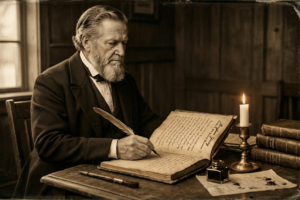
This statement was not made in private. It was not a moment of weakness, a rumor, or an anti-Mormon fabrication. It was delivered from a pulpit, recorded by a stenographer, published in an official church volume, and distributed to Latter-day Saints across the world. Brigham Young — the second prophet of the restored church of Jesus Christ, the man who governed Utah Territory with near-absolute civil and religious authority — looked out at his congregation and described Black human beings as uncouth, uncomely, disagreeable, wild, and cursed with flat noses and dark skin as divine punishment for the sin of their ancestor.
Thomas Coleman was alive when these words were spoken. He was approximately twenty-six years old, enslaved in the same city, likely attending or at minimum living within the community these words were meant to shape. He would be murdered seven years later in a manner his prophet had already declared, from that same pulpit, to be the law of God.
The Church of Jesus Christ of Latter-day Saints has disavowed “theories advanced in the past that black skin is a sign of divine disfavor or curse.” That is the institutional language of 2013. The writing of Brigham Young is the institutional language of 1859. The distance between those two statements is not merely theological. It is measured in blood.
Part II: A Man Between Worlds — The Complexities of Thomas Coleman’s Life in Utah
Handcart Rescue: The Invisible Rescuer
In October 1856, with the Mormon Reformation reaching fever pitch under the hellfire preaching of Jedediah Grant, a humanitarian catastrophe erupted on the high plains of Wyoming. Two companies of LDS immigrants — the Willie and Martin handcart companies — had left the Missouri River far too late in the season. Winter found them unprepared and exposed on the frozen Sweetwater. Hundreds of men, women, and children were stranded in the snow, dying of exposure and starvation. Approximately 210 would not survive.
Brigham Young received word of the disaster on October 4, 1856, while addressing the congregation at the Salt Lake Tabernacle during General Conference. He did not hesitate. Emergency rescue parties were organized on the spot. Among those who responded was Charles Decker, Young’s brother-in-law. Decker formed one of the rescue companies, and among those who rode out with him into the killing cold was Thomas Coleman. The Century of Black Mormons project records what that meant:
Thomas joined Decker’s rescue company and thus became the only known enslaved person among roughly four hundred rescuers. He traveled to Wyoming in severe winter weather and helped bring the stranded migrants back to the Salt Lake Valley.
— W. Paul Reeve, James Tabery, and Kirk Huffaker, Century of Black Mormons, University of Utah
He made that journey not as a free man. He made it as property.
The Martin and Willie handcart rescue is one of the most celebrated events in Latter-day Saint pioneer history. It is commemorated in church curricula, memorialized in artwork, and retold across generations of LDS families. The rescuers are held up as exemplars of sacrifice and Christlike service. Thomas Coleman was among those rescuers — an enslaved man trudging through Wyoming snow to save the lives of people whose church would not grant him full spiritual equality, on behalf of an institution whose prophet had declared that his race was cursed and his blood forfeit for the crime of racial mixing.
His contribution to that rescue has gone almost entirely unacknowledged in official LDS historical narrative. His name does not appear in the Church’s celebratory accounts. He was present in the cold, invisible in the memory. In O’Donovan’s phrase, he was an outcast among the outcasts.
The 1859 Incident: Jealousy, Violence, and a Murder Charge
By 1859, the Bankheads had relocated northward, eventually settling near the Idaho border. Thomas, however, remained in Salt Lake City — his ownership having passed, through circumstances not entirely clear, to a man identified in various sources as “Col. J.H. Johnson.” O’Donovan notes that “the exact identity of this man is in question,” raising the possibility that it was Joel Hills Johnson, a well-known early Mormon pioneer, poet, and LDS hymnwriter.
In the small, tightly compressed world of Black life in territorial Salt Lake, Coleman became entangled in a volatile situation involving two enslaved women identified in sources as belonging to merchant Thomas S. Williams. Described by contemporary sources as the two most beautiful Black women in Utah, their beauty, as O’Donovan observes, “became the cause of deep enmity, jealousy, growing acts of violence, and eventually murder.”
A man known as Shepherd Camp — enslaved to Williams Washington Camp, one of the tight network of southern-born LDS slaveholders in the valley — and Thomas Coleman both competed for the women’s affections. The tension boiled over on the night of April 18, 1859. Coleman, aware of Shep’s earlier threat to kill him, was armed. When the confrontation escalated, Coleman fired three shots. Shep was wounded in the hand and shoulder, the bullet ultimately lodging in his skull. He lingered for weeks before dying from his wounds.
Coleman fled toward Wyoming, was arrested at the mouth of Emigration Canyon, and was charged first with attempted murder, then with murder when Shep died. His defense attorney was Hosea Stout, a prominent LDS lawyer whose diary recorded his assessment of the affair with characteristic bluntness: the men “had got into a row about two wenches belonging to T. S. Williams and love and jealousy was the main cause of the fuss” — adding, with casual racism, that like their masters under such circumstances, “they went to shooting each other.”
The trial was a protracted affair, marked by the disappearance of key witnesses, the sequestering of juries, and the peculiarities of frontier justice in a theocratic territory. An unnamed Black witness testified that Shep had previously drawn a revolver on Coleman and threatened to kill him — establishing the self-defense framework the defense needed. The jury, composed of white Mormon men and including, remarkably, Apostle John Taylor — who would one day become president of the LDS Church — convicted Coleman of manslaughter, not murder. He was sentenced to one year of hard labor and fined one hundred dollars.
After serving his sentence, Coleman emerged from the Sugar House penitentiary and returned to Salt Lake City. He found employment at the Salt Lake House, a hotel at what is now 143 South Main Street, co-owned by Brigham Young and his nephew Feramorz Little. He worked there as an attendant — a visible presence in the heart of the theocratic capital, serving drinks and meals to the Saints, invisible in every way that mattered.
The Question of Freedom: When Did Thomas Coleman Become Free?
On June 19, 1862, President Abraham Lincoln signed “An Act to Secure Freedom to All Persons within the Territories of the United States,” which was intended to free enslaved people in all U.S. territories — including Utah. The Thirteenth Amendment in 1865 made freedom universal and absolute. Yet O’Donovan’s research reveals something deeply troubling about what those laws meant in practice inside the Kingdom of God:
I searched all existing newspapers for news of this and found no such emancipation reported in any Utah papers, so I don’t believe the slaves held in Utah were informed of their early emancipation by Lincoln’s administration. In fact, evidence suggests that slave owners in Utah territory did not free their slaves until the Civil War ended in April 1865.
— Connell O’Donovan, The Life and Murder of Thomas Coleman in Theocratic Utah
Congress had spoken. Lincoln had signed. And in Salt Lake City, nothing changed.
If O’Donovan’s assessment is correct — and the evidence strongly suggests it is — Thomas Coleman may have lived as an enslaved man for nearly three years after federal law declared him free. He would have had at most nineteen or twenty months of legal freedom before his murder in December 1866. A man who had spent his entire adult life in bondage, who had rescued stranded Saints from Wyoming blizzards, who had served his time in a territorial prison and returned to labor in the city’s finest hotel — this man experienced legal liberty for less than two years before someone took everything else from him.
He became nominally free in the same years the nation was tearing itself apart over the question of Black freedom. He lived that brief liberty in an overwhelmingly Mormon city, governed by a prophet who had publicly declared, in print, that the penalty for a white man who “mixes his blood with the seed of Cain” was “death on the spot.” He was policed by men who shared that prophet’s convictions and attended his sermons on Sunday. The law of the United States said he was free. The law of God, as Brigham Young articulated it, said his presence in that city carried its own sentence — one that required only the right provocation to be carried out.
That provocation would come on the afternoon of December 11, 1866.
Part III: The Theology of Death — Brigham Young, Blood Atonement, and Race
The Doctrine of Blood Atonement
To understand the murder of Thomas Coleman, one must understand the theological environment in which it occurred. The LDS doctrine of blood atonement, promulgated during Brigham Young’s presidency and reaching its most virulent expression during the Mormon Reformation of 1856–1857, taught that certain sins were so grievous that the atoning blood of Christ was insufficient to cover them. “Men can commit sins,” Young declared from the pulpit, “which it [the blood of Christ] can never remit.” For such sins, the sinner’s own blood must be shed upon the ground. This was framed not as punishment but as mercy — a loving act that allowed the sinner to cleanse himself and gain salvation. “Will you love that man or woman well enough to shed their blood?” Young asked his congregation in February 1857. “That is what Jesus Christ meant.”
Young preached blood atonement openly and repeatedly. In some of his most inflammatory Reformation-era sermons, he spoke of cutting the throats of adulterers and apostates as acts of divine grace, on one occasion reportedly brandishing the rhetoric of the Bowie knife from the pulpit. Jedediah Grant — Young’s Second Counselor in the First Presidency and the primary architect of the Reformation — was even more graphic in his descriptions, driving camp meetings across the territory with demands for rebaptism, confession, and the threat of worse consequences for the unrepentant.
Blood atonement was never formally canonized as official LDS doctrine, and the Church has consistently distanced itself from it in the modern era. The Church’s Gospel Topics essay “Peace and Violence among 19th-Century Latter-day Saints“ frames the blood atonement sermons as rhetorical excess rather than practiced policy. The historical record, however, suggests that the doctrine provided theological cover for a culture of extrajudicial violence in the Utah Territory that claimed multiple lives — and that in its specific targeting of racial mixing and adultery with the penalty of death, it created an ideological environment in which the murder of Thomas Coleman was not merely possible, but comprehensible to those who carried it out.
Brigham Young’s Theology of Race: “Death on the Spot”
Brigham Young’s racial theology was more than incidental prejudice. It was a structured, publicly proclaimed theological system with specific lethal consequences attached to specific behaviors. The historical record documents him articulating the death penalty for racial mixing on multiple occasions — in 1847, in his 1852 address to the territorial legislature, where he called for decapitation by law, and most explicitly in a sermon delivered from the pulpit of the Salt Lake Tabernacle on March 8, 1863.
That 1863 sermon left no ambiguity. Young declared:
Shall I tell you the law of God in regard to the African race? If the white man who belongs to the chosen seed mixes his blood with the seed of Cain, the penalty, under the law of God, is death on the spot. This will always be so.
— Brigham Young, “The Persecutions of the Saints — Their Loyalty to the Constitution — The Laws of God Relative to the African Race,” March 8, 1863, Journal of Discourses, Vol. 10, p. 110
Three years later, Thomas Coleman was murdered in a manner that bore uncanny correspondence to Young’s stated “law of God.” His throat was cut nearly to decapitation. He was stabbed twice in the chest — wounds that some historians believe mimicked penalties illustrated in the LDS temple ritual of the era. He was castrated. A prepared placard was pinned to his body. His own knife was used against him.
O’Donovan’s analysis traces a crucial theological evolution between Young’s 1852 address and his 1863 sermon:
Note that here, the offender must be willing to ‘come forward’ voluntarily and consent to the act of blood atonement, in order to cleanse himself and his children from the curse of not being allowed to hold priesthood. In 1852 then, this was a consensual act of expiation, to alleviate the priesthood curse. By 1863, being murdered for mixing whites with blacks is simply an eternal penalty ‘under the law of God’ in Young’s theocracy.
— Connell O’Donovan, The Life and Murder of Thomas Coleman in Theocratic Utah
By 1863, Young had gone further still. He told his congregation that the killing of a Black-white interracial couple — and their children — as part of a blood atonement would be “a blessing to them.” The theological framing of murder as mercy, of slaughter as salvation, is one of the most disturbing elements of this history. It was not the raving of a fringe element. It was preached by the prophet of God’s restored church, in the principal house of worship of the territory he governed, to a congregation that believed him.
 And that congregation had already demonstrated what belief looked like in practice. On September 11, 1857 — less than a year after the Mormon Reformation reached its fever pitch under Jedediah Grant’s revival preaching — a company of approximately 140 Arkansas emigrants passing through Utah Territory was systematically slaughtered at Mountain Meadows by a combined force of Mormon militiamen and their allies. Men, women, and older children were killed. The militiamen had attended the same Tabernacle sermons. They had been rebaptized in the Reformation. They had heard the same prophet declare that blood atonement was divine mercy and that certain deaths were acts of God’s grace. The Mountain Meadows Massacre was not an aberration in the culture of theocratic Utah. It was its most devastating expression.
By the time Thomas Coleman was murdered in 1866, every Saint in Salt Lake City had either heard Young’s words from the Tabernacle pulpit directly or lived for years within a community shaped by them — a community that had already proven, nine years earlier on a meadow in southern Utah, that it was capable of organized, theologically justified mass killing. The men who carried Coleman’s body to the hillside behind the Arsenal building that December night did not need to improvise a theology. They already had one. They had had it for years.
Utah’s Anti-Miscegenation Laws: Theology Made Statute
Young’s theological positions were not merely sermonic. They were encoded in law. The same 1852 legislative session that legalized slavery in Utah Territory also criminalized interracial sexual relations within the very same statute — the Act in Relation to Service. Section 4 of the Act imposed fines of no less than five hundred and no more than one thousand dollars, and imprisonment of up to three years, on any white person found guilty of sexual intercourse with “any of the African race.”
The Act went further than mere prohibition. It also addressed, with unusual specificity, the sexual exploitation of enslaved women by their own masters: any slaveholder who had sexual intercourse with an enslaved person was to “forfeit all claim to said servant or servants to the commonwealth.” That the legislature felt compelled to include this provision speaks to what everyone in that territory already knew was happening behind closed doors — and to the particular vulnerability of enslaved Black women in a society that simultaneously criminalized their bodies and commodified them.
Young continued preaching the death penalty for interracial relations as recently as 1865, one year before Thomas Coleman’s murder. When Coleman was accused of involvement with a white woman in 1866, the accusation — pinned in writing to his mutilated body — was not merely a social transgression. It was a theological indictment. It cited him for the precise offense his own prophet had declared, from the pulpit, deserved “death on the spot.” The penalty Young described had been preached, encoded in community consciousness, and rehearsed in sermons for over a decade.
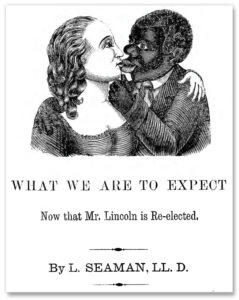
The theology that killed Thomas Coleman was not manufactured in Salt Lake City. It was born in a national culture that had spent decades constructing the same fear into law, literature, and propaganda. In 1864 — two years before Coleman’s murder — a pamphlet titled “What Miscegenation Is!” was circulating across the United States, its frontispiece depicting a Black man alongside a young white woman as a threat requiring national response. The word “miscegenation” itself had been coined that same year as a deliberate political weapon, designed to inflame white voters against Abraham Lincoln’s re-election by conjuring the specter of racial mixing as civilization’s ruin.
Brigham Young did not invent this terror. He consecrated it. Where the secular racist saw a social catastrophe, Young saw a theological one — and where the pamphleteer demanded legal prohibition, Young declared prophetic sanction for something far more absolute. The placard left on Thomas Coleman’s mutilated body in December 1866 — “NOTICE TO ALL NIGGERS! LEAVE WHITE WOMEN ALONE!!!” — was not a uniquely Mormon document. It was a national document written in the language Young had given divine authority. The men who pinned it to his chest believed they were doing what the pamphleteer only dared to imply.
Part IV: The Murder — December 10, 1866
The Lure and the Kill
O’Donovan’s research reconstructs the likely sequence of events leading to Thomas Coleman’s death. On the afternoon of Monday, December 10, 1866 — approximately twenty-eight hours before his body was discovered — Coleman was drawn away from the Salt Lake House. The precise method of luring him is not documented, but he ended up isolated on Arsenal Hill, less than a mile from the city center he had called home for years. There he was set upon. He was beaten on the head with a large stone. His own Bowie knife — engraved “T. Coleman” — was taken from him and turned against him. His throat was cut so deeply that his neck was nearly severed. He was stabbed twice in the chest. He was castrated.
The body was not killed where it was found. There was virtually no blood at the scene despite the catastrophic nature of the wounds — the murder had occurred elsewhere, and the corpse had been transported to Arsenal Hill and arranged on the ground, the bloody implements placed nearby, the prepared placard affixed to his body. This was not a crime of passion. It was a staging.
O’Donovan reads the manner of the killing as deliberately ritualistic — corresponding to elements of LDS blood atonement theology, and in its mutilation, to a grim correspondence with the temple penalties from which Coleman, as a Black man in pre-1978 LDS practice, had been permanently excluded. What followed did little to dispel that interpretation:
In any case, Coleman’s corpse lay behind the old Arsenal until the following afternoon, when a group of boys playing on the hill found him. The boys reported the corpse right away but inexplicably Salt Lake City Police Captain Andrew Burt and his squad did not go looking for it until nighttime. The Vedette reported that Capt. Burt did not find the body until about 9:00 pm on Tuesday – some 28 hours or so after the actual murder.
— Connell O’Donovan, The Life and Murder of Thomas Coleman in Theocratic Utah
Twenty-eight hours. The boys reported it promptly. The police did not arrive until dark. A Black man lay mutilated on a hill in the capital of the Kingdom of God on earth — and the law took its time.
The Placard and Its Message
The Salt Lake Daily Telegraph offered its own account first. It reported that Coleman had been “found in company of a white woman” near the Arsenal. It is speculated that a “rival friend” of that woman had taken vengeance upon learning of their supposed encounter. It was a convenient narrative — one that framed a premeditated racial murder as a crime of passion, rooted in a transgression the community’s own prophet had declared deserved death.
The Daily Union Vedette, the newspaper published by soldiers stationed at nearby Fort Douglas, was having none of it. The paper had already reported the discovery of the body on December 12 and the coroner’s inquest findings on December 13. But its December 15, 1866, edition was something else — a systematic dismantling of the official narrative, editorial argument by editorial argument. The Vedette fixed its attention on the prepared placard:
That the deed, by whomsoever done, was cool, premeditated and planned beforehand, is apparent from this one circumstance alone, namely, the prepared placard of warning left on the body. Men, who, roused to the phrensy of passion by real or supposed outrage to wife, sister or daughter, and in that state commit murder, do not go prepared with warning placards, or stop after the deed to write and affix them.
— Daily Union Vedette, “The Killing of Thos. Coleman Monday Night,” December 15, 1866, p. 2
The Vedette pressed further with a logical argument that the coroner’s jury had carefully avoided: if any witness had seen Coleman with a white woman near the Arsenal that night, that same witness would necessarily have been present at or near the murder scene — yet no one came forward to identify the killers. The paper concluded that “the only fact ascertained by the jury was that Thomas Coleman was found with his throat cut, with his own bowie knife, and a prepared notice affixed to the dead body” — and that the jury’s conclusions about motive were “purely an exercise in imagination.”
No one was ever arrested. No one was ever charged.
The Deseret News — the official organ of the Church of Jesus Christ of Latter-day Saints and the dominant newspaper of the territory — published no coverage of the murder whatsoever. O’Donovan’s research notes the paper appears to have had a gap in its publishing schedule that coincided with the period of the murder, the discovery of the body, and the coroner’s inquest — a silence that, whether coincidental or calculated, stood in striking contrast to the Vedette‘s aggressive scrutiny. The Kingdom of God had no comment.
Coleman’s body was buried in the pauper’s section of the Salt Lake City Cemetery. The Salt Lake County Death Records listed him as:
Coleman, Thomas; also known as ‘N**r Tom’; about 35 years old; found murdered near the arsenal; buried in Pottersfield.
That was his epitaph.
The Coroner’s Inquest: A Study in Institutional Failure
The body of Thomas Coleman was disposed of in less than three hours after it was discovered. There was no waiting for family. There was no preservation of the scene. An enslaved man who had crossed the plains, rescued the stranded Saints, survived a murder trial, and worked in the finest hotel in the Kingdom of God on earth was put in the ground in the pauper’s section of the Salt Lake City Cemetery before the afternoon was out — before most of the city even knew he was dead.
Less than twelve hours later, Judge Elias Smith — first cousin of the LDS Church’s founder Joseph Smith — appointed George Stringham as foreman of the coroner’s jury. The choice was remarkable. O’Donovan’s research identifies Stringham as a Mormon ruffian and vigilante with ties to Porter Rockwell, Jason Luce, and William Hickman — men whose names were synonymous with extrajudicial violence in the Utah Territory. According to O’Donovan, Stringham himself carried an outstanding warrant for his arrest as an accessory in the 1859 murder of Sergeant Ralph Pike — a Fort Douglas soldier gunned down in broad daylight on Main Street with approximately one hundred witnesses present, a killing that had gone, like so many others in theocratic Utah, effectively unprosecuted. This was the man now tasked with determining who had killed Thomas Coleman.
The jury met briefly. Its official finding, reproduced in full in the Salt Lake Daily Telegraph and the Daily Union Vedette, read as follows:
We the jury empaneled and sworn to inquire as it relates to the death of Thomas Coleman, do find from the testimony and apparent circumstances that the said Coleman was found in company with a white woman, at or near the place where he was found dead, by some relative or friend of the woman, and was then and there set upon, and beat on the head with a large stone, which was lying by his head with blood on it. There was a knife lying by him which had Coleman’s name engraved on it; said knife was known to belong to Coleman; said knife was bloody. There were three wounds inflicted on him; one on the neck and two on the body, which we have reason to believe were done with said knife. The person or persons committing said murder to the jury are unknown.
— Coroner’s Jury Finding, Salt Lake City, December 12, 1866
Read that finding carefully. The jury did not say a white woman had been present. It said Coleman had been found in company with one — a claim drawn entirely from the Telegraph‘s original speculative reporting, unsupported by any testimony the Vedette could identify. The jury then concluded that a “relative or friend” of this unidentified, unverified woman had committed the murder, while simultaneously declaring that the identity of the killer or killers was “unknown.” The logic collapsed on itself. The verdict was a fabrication dressed as a finding.
No one was ever charged. No one was ever tried. The case was closed before it was opened, in a room full of men who knew exactly what had happened and had no intention of saying so.
The Probability of LDS Perpetrators
Who murdered Thomas Coleman? The historical evidence, while circumstantial, points with compelling force toward Mormon perpetrators — and almost certainly men with direct connections to the LDS institutional power structure in Salt Lake City.
Consider what circumstantial evidence actually means in a court of law. It is not speculation. It is an inference drawn from facts, and the facts here are substantial. Salt Lake City’s population in 1866 was overwhelmingly white and overwhelmingly Mormon. The murder was organized, premeditated, and ritualistic: a staged scene, a prepared placard, a throat cut nearly to decapitation corresponding precisely to Young’s declared method of blood atonement, a castration, wounds historians have linked to temple ritual penalties. This was not random violence. It was theological violence, carried out by people who had been given, from their own prophet’s pulpit, both the framework and the justification.
O’Donovan identifies the most likely suspect as Captain Andrew Burt of the Salt Lake City Police — a Scottish-born polygamist who had served on the force since the early 1850s, who was personally responsible for the conspicuous delay in retrieving Coleman’s body, and who had both the means and the institutional authority to arrange the murder’s cover-up. In a 2009 published statement, O’Donovan named Burt directly: he believed Coleman was murdered by Burt, “and two or three of his underlings in the police department.” A second figure whose name circulates in the historical record is Porter Rockwell — Brigham Young’s enforcer, the self-described “Destroying Angel,” a man with a long and documented history of extrajudicial killing carried out in Young’s name and never prosecuted.
O’Donovan also raises a darker possibility — that Coleman may have been murdered not merely for racial transgression but because he knew too much. The Salt Lake House sat at the center of the city’s political and ecclesiastical life. In the months before Coleman’s murder, two other men had been killed in Salt Lake City under similarly suspicious circumstances. Newton Brassfield, a non-Mormon who had married a Mormon woman, was shot dead in April 1866. Dr. John King Robinson, a former Army surgeon now in private practice, had been lured from his home by a false call for medical assistance on the night of October 22, 1866, clubbed and shot to death near his cabin by a group of between four and seven men, none of whom were ever identified. He had disputed Mormon control of a Salt Lake City property on which he intended to build a hospital; the police had already torn it down. No one was charged in that murder either.
Coleman worked in the hotel where these men’s killers may have planned, drank, and talked. His social invisibility — the invisibility of the Black servant, the invisible man — may have made him a witness to things he was never supposed to survive knowing.
O’Donovan’s conclusion indicts not just the killers but the prophet who armed them:
Some accountability for the brutal murder of Thomas Coleman also lies at the feet of Brigham Young, who instigated and propounded the blood atonement ‘doctrine’ for miscegenation between whites and blacks. Having made such brutish, hateful, and prejudiced theological statements in a public forum allowed Burt, Rockwell, and/or other similar rogue Mormon vigilantes literally to get away with murder by cloaking it with prophetic authority and public racist sentiments of the era.
— Connell O’Donovan, The Life and Murder of Thomas Coleman in Theocratic Utah
Brigham Young never commented publicly on the murder of Thomas Coleman. His newspaper did not cover it. His police captain delayed retrieving the body. His cousin’s husband appointed the inquest foreman. His theology provided the motive, the method, and the cover.
He did not pull the knife. But the knife was his.
Part V: Aftermath and Erasure — What the Church Said and Didn’t Say
The Church’s Historical Record: Death Without Context
The Church of Jesus Christ of Latter-day Saints maintains a Church History Biographical Database that includes an entry for Thomas Coleman. The biographical narrative on his page acknowledges, with a quiet word of sorrow, that he was murdered: “Sadly, in December 1866, Thomas was murdered in Salt Lake City and was buried in the Salt Lake City Cemetery.”
The word is there. In prose.
But the official record field — the structured database entry, the permanent institutional data that catalogues his life in the same format used for every other pioneer — reads as follows:
“Died in Salt Lake City, Salt Lake, Utah Territory, United States. 1866 December 11 (Age 34).”
Died. Not murdered. Not lynched. Not killed. Died — as if of old age, or illness, or the quiet wearing out of a body that had simply run its course. The same verb is used for every other entry. The same institutional neutrality extended to a man whose throat was cut nearly to decapitation, who was castrated, whose body was staged on a hillside with a placard pinned to it naming the theological crime he was being punished for.
This split — acknowledgment in the narrative, erasure in the record — is its own kind of institutional honesty about institutional dishonesty. Someone wrote the truth in the paragraph. The database filed something else. Which one gets indexed? Which one gets cited? Which one gets passed down?
What neither layer of the Church’s record does is explain why. There is no mention of the placard. No mention of the racial violence. No mention of the blood-soaked stone, the castration, the nearly severed throat. No mention of the theology that made his death, in the minds of his killers, not a crime but a divine correction. The record acknowledges Thomas Coleman existed, participated in the handcart rescue, and was murdered. It treats his death as a tragedy that befell him, not as an act that was done to him, deliberately and theologically, by members of the same institution that now memorializes him.
That is a narrower but no less important erasure. It is the erasure of cause.
The Church’s 2013 Gospel Topics essay “Race and the Priesthood” represents a significant step toward institutional honesty about this history. It explicitly disavows the claim “that mixed-race marriages are a sin” and states that “today the Church disavows the theories advanced in the past that black skin is a sign of divine disfavor or curse.” These are not small concessions. They are formal repudiations of the specific theological framework that surrounded Thomas Coleman’s life and death.
But the essay does not address Brigham Young’s blood atonement theology as applied to interracial relations — the “death on the spot” doctrine articulated from the Tabernacle pulpit in 1863, three years before Coleman died with his throat cut. It does not name Thomas Coleman. It does not connect the theology it disavows to the violence that theology licensed. It offers repudiation without reckoning — absolution without accountability.
Disavowal is not the same as acknowledgment. Condemning a theology in the abstract costs nothing. Naming the man whose body bore its consequences is something else entirely.
The Salt Lake County Death Record: A Final Indignity
The county death record created for Thomas Coleman captures, in bureaucratic shorthand, the contemptuous indifference with which his community disposed of his remains:
Coleman, Thomas; Known as Nigger Tom, abt 35 yrs old. found murdered near the arsenal.
His place of interment: Pottersfield.
— Utah, Salt Lake County Death Records, 1849–1949. Cited in Century of Black Mormons, University of Utah.
Pottersfield — the pauper’s field. A man who had crossed the plains in bondage, who had helped rescue hundreds of handcart pioneers, who had lived as a member of the LDS Church for more than two decades, was buried without ceremony in the section of the cemetery reserved for those whose lives the community deemed unworthy of investment. The body had been disposed of within three hours of its discovery. The inquest followed. The burial came before most of the city even knew he was dead.
That same night, a man named Brigham Young Jr. — son of the prophet — wrote in his journal:
…a nigger was found dead above the Arsenal[;] from his appearance it was surmised he had been dead several days.
That entry sits today in the Church History Library in Salt Lake City. The prophet’s son knew about Thomas Coleman the night the boys found him on the hill. He recorded it with the same casual indifference that the county death record would formalize the next morning. Not a man murdered. Not a Saint killed. A nigger found dead.
He was a Saint. He was buried as though he were nothing. He was recorded as though he were less.
A 2022 Soil Collection Ceremony: Belated Recognition
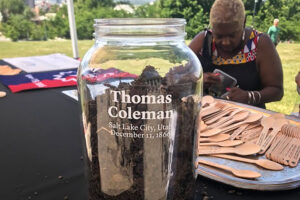
It was not until June 11, 2022 — more than 155 years after Coleman’s murder — that any formal public ceremony acknowledged what had happened to him. On that day, the Sema Hadithi African American Heritage and Culture Foundation and the Salt Lake County Community Remembrance Coalition, in coordination with the Equal Justice Initiative, founded by Bryan Stevenson, hosted a soil gathering ceremony at the lynching sites of both Thomas Coleman and William “Sam Joe” Harvey.
Harvey’s story deserves its own telling, but one detail cannot pass without remark: William “Sam Joe” Harvey was a Black U.S. Army veteran lynched by a white mob of up to 2,000 people outside the Salt Lake City jail on August 25, 1883. The police chief, who was accused of killing the man whose death the mob said justified the lynching, was Andrew Burt. The same Andrew Burt, whom O’Donovan identifies as the most likely murderer of Thomas Coleman, seventeen years earlier. The victims of Utah’s racial terror are bound together across time. So, it appears, are their killers.
The 2022 ceremony began at the steps of the Utah State Capitol — the gleaming dome that now stands on the hill where Coleman’s body was found. The University of Utah’s Century of Black Mormons exhibition records what followed:
Black community leaders, ministers, and a representative from the governor’s office joined a poet, a singer, and students from the BYU Black Menaces to commemorate the lives of Coleman and Harvey and to publicly acknowledge and condemn their murders.
— W. Paul Reeve, James Tabery, and Kirk Huffaker, Century of Black Mormons, University of Utah
Soil collected from the site of Coleman’s murder was placed in a labeled jar and sent to the Equal Justice Initiative’s memorial complex in Montgomery, Alabama, where it now rests alongside soil gathered from lynching sites across the United States. Eight hundred such jars had already been collected from sites across the country before Utah’s soil joined them.
This is fitting. Thomas Coleman belongs in that company — among the more than four thousand Black men and women whose deaths at the hands of white Americans were documented by the Equal Justice Initiative alone, each one justified in its time by theology, law, custom, and silence. He was enslaved. He was baptized. He rescued the Saints. He survived a murder trial. He lived, briefly and terribly, as a free man.
He did not survive Zion.
And for 155 years, the hill where they left him said nothing.
Part VI: Historical and Theological Assessment
Thomas Coleman’s Faith: A Saint Without Standing
One of the most theologically painful dimensions of Thomas Coleman’s story is his apparent genuine religious commitment. According to the Century of Black Mormons research, he was likely baptized and confirmed at approximately eleven years of age in Monroe County, Mississippi — a child in bondage receiving the same covenant ordinances as his enslavers. He was not alone: another enslaved person on the same plantation, a woman named Martha Ann Morris, was likely baptized at the same time. She would later marry Green Flake, one of the most celebrated Black pioneers in LDS history. Thomas and Martha entered the covenant community together, in chains, and their baptismal records did not survive.
A Salt Lake City newspaper, reporting on Coleman’s murder, confirmed that he was a member of the Church of Jesus Christ of Latter-day Saints at the time of his death. Whether that membership was the faith of a child that endured through decades of bondage and imprisonment, or whether it was renewed through some later formal act, is not documented. What is documented is that he died a Latter-day Saint — and that his church buried him in a pauper’s field without ceremony, and his prophet’s son recorded his death in a journal with casual contempt.
Yet the LDS priesthood ban, which excluded all persons of Black African descent from the lay Aaronic and Melchizedek priesthoods and from temple ordinances, meant that Coleman could never hold priesthood authority, could never enter the temple, could never receive endowments or sealings. In LDS soteriology, these are not peripheral rites. Temple ordinances — endowments, sealings — are explicitly required for the highest degree of exaltation in the Celestial Kingdom. To be baptized into the covenant while being permanently barred from its culminating promises created a category of membership that was, by LDS theological logic, structurally incomplete.
Thomas Coleman lived this contradiction every day. He was baptized into the restored church. He rescued its pioneers. He served his sentence. He returned to labor in its capital city. And by the terms of its own theology — the theology articulated by the prophet who also declared his race deserved death for racial mixing — he could never be fully saved in the way that theology defined salvation.
He was simultaneously inside and outside the Kingdom of God. He was a Saint the church could not fully receive, murdered by men whose prophet had told them why.
Was Brigham Young Directly Responsible?
This question deserves careful handling, and it demands intellectual honesty.
There is no documentary evidence that Brigham Young directly ordered the murder of Thomas Coleman. No letter has surfaced. No witness testimony points to an explicit command. The historiography does not support that conclusion, and responsible scholarship — and responsible writing — requires acknowledgment of what cannot be proven.
What is documented is something that does not require a conspiracy to be damning.
Brigham Young publicly taught, on multiple occasions and from the pulpit of the Salt Lake Tabernacle, that interracial mixing between white and Black people was punishable by death under “the law of God.” He did so in a community where he held near-absolute civil, religious, and social authority. He did so in a context where extrajudicial violence was an established feature of territorial governance, where Newton Brassfield lay dead on a Salt Lake City street, where Dr. John King Robinson had been lured from his home and clubbed to death, where 120 men, women, and children had been massacred at Mountain Meadows nine years earlier by men acting in the belief that they served their prophet’s interests. He did so knowing that the men who enforced the community’s moral order, among them Captain Andrew Burt of the city police, Porter Rockwell, and a network of Mormon vigilantes whose names O’Donovan documents in detail, drew their sense of divine authorization from his prophetic office.
O’Donovan’s conclusion is measured but unsparing. Young must bear “some accountability” for creating the theological and cultural environment in which Coleman’s murder became possible, perhaps even inevitable. The prophet’s words, preached from the most prominent pulpit in the territory, were not merely private opinions. They were declarations of divine law by a man whose followers believed he spoke for God. When a man who speaks for God declares that a specific act deserves death on the spot, he does not need to issue individual orders. The orders are already in the sermon.
The silence of the Deseret News in the weeks surrounding the murder — O’Donovan notes that the paper appears to have published no coverage of the killing, the discovery, or the inquest — served, whatever its cause, the interests of those who wished the story forgotten. The Vedette asked its questions. The Mormon paper said nothing. The coroner’s jury met and concluded. The body was in the ground within three hours of discovery.
No direct order has been found. None may ever be found. But the theology was the order. The culture was the command. And the silence was the cover.
LDS Historical Memory and the Ongoing Challenge
The history of Thomas Coleman presents the contemporary LDS Church with an uncomfortable but unavoidable set of questions. His story intersects three of the most difficult dimensions of early LDS history: slavery, the Black priesthood-temple ban, and the doctrine of blood atonement. All three have been subjects of increasing scholarly and institutional attention in recent decades.
The Church’s 2013 “Race and the Priesthood” Gospel Topics essay acknowledged that the historical origins of the priesthood ban remain uncertain, and repudiated the theological rationales that had been offered for it — explicitly disavowing “the theories advanced in the past that black skin is a sign of divine disfavor or curse.” It was a significant statement. It was also incomplete.
Scholars at the University of Utah, led by historian W. Paul Reeve, have done the harder work through the independent Century of Black Mormons digital humanities project — recovering the names, biographies, and experiences of Black Latter-day Saints across the century of the priesthood ban. Thomas Coleman is among them. His biography is there. His baptism is documented. His rescue of the Saints is recorded. His murder is acknowledged.
But the Church History Biographical Database — the institutional record — still lists him as having simply “Died.” A man who was baptized into this faith, who served it on the rescue mission to Wyoming, who labored for decades in its capital city, and who was murdered in a manner that drew directly on its prophetic leader’s publicly declared racial theology deserves more than a passive verb.
The Book of Mormon declares, in 2 Nephi 26:33, that “Black and white, bond and free, male and female… all are alike unto God.” The First Presidency has acknowledged that “in the past, the Church did not always live up to this standard.” That acknowledgment is meaningful. It asks to be believed. Believing it requires more than institutional statements — it requires institutional memory. It requires naming the names.
Thomas Coleman is a name that belongs in that reckoning. He was a Saint. He was baptized in Mississippi in 1844. He crossed the plains in bondage. He rescued the handcart pioneers. He survived a manslaughter trial. He worked in the hotel at the center of the Kingdom of God on earth.
He was murdered on December 11, 1866, on a hill that now bears the Utah State Capitol’s gleaming dome.
His church buried him in a pauper’s field, and his prophet’s son wrote in his journal that a nigger had been found dead above the Arsenal.
He did not survive Zion.
But he deserves to be remembered by it.
Conclusion: The Blood Still Cries Out
The murder of Thomas Coleman on December 10, 1866, was not an anomaly. It was not the random act of an unknown criminal. It was the logical terminus of a specific theological, social, and political system — a system that declared Black people to be cursed, that banned them from the fullness of its own covenants, that enslaved them in the same territory where it proclaimed the restoration of all things, and whose prophetic leader had publicly announced that their transgression of racial boundaries merited death on the spot.
Thomas Coleman navigated that system with remarkable endurance. He was enslaved as a child, baptized into a faith that simultaneously welcomed and marginalized him, carried across a continent in bondage, employed in dangerous rescue missions without credit, tried for murder in a theocratic court, convicted and imprisoned, and released to serve in the hotel at the heart of the Kingdom of God on earth. He was, as O’Donovan writes, “an outcast among the outcasts, and a convenient scapegoat for the fearful.”
His murder was premeditated, ritualistic, and almost certainly carried out by men who considered themselves faithful Latter-day Saints. The placard on his chest — “NOTICE TO ALL NIGGERS! TAKE WARNING!! LEAVE WHITE WOMEN ALONE!!!” — was not the product of individual passion. The Daily Union Vedette recognized this immediately. “Such warnings, placards, notices,” the paper wrote on December 15, 1866, “are never the result of a single hand.” It compared the act to the organized terror of the Carbonari of Italy — the signature of “banded murderers,” not a lone avenger. It was a community communication, a terror statement calculated to enforce a racial order that had the full weight of prophetic authority behind it.
No one was ever charged. No one was ever tried. The Deseret News never ran the story. The Church’s official database record says he “Died.” He was buried within hours of his body’s discovery, in a pauper’s grave, before most of the city knew he was dead. He was, the community seemed to conclude, best forgotten.
But history does not forget so easily, even when institutions try to make it. His Bowie knife — engraved “T. Coleman”, confirmed by the Vedette‘s own December 15 account — entered the evidence record of a coroner’s inquest that never held anyone accountable. His name appears in a slave schedule and a death record, two documents that bracket his life between bondage and violent disposal. And now, in the twenty-first century, a jar of soil taken from the hill where his body was staged rests in Montgomery, Alabama, alongside the soil of thousands of other Black Americans whose deaths American society struggled to acknowledge.
The Daily Union Vedette said it best in December 1866:
We submit that the killing of Thos. Coleman, negro though he was, should be shifted to some other than the lame and impotent conclusion to which the jury arrived.
— Daily Union Vedette, December 15, 1866
The lame and impotent conclusion has held for nearly one hundred and sixty years.
The Church of Jesus Christ of Latter-day Saints has never issued a formal apology for its racial history. A viral statement attributed to President Russell M. Nelson in 2018 — a full, unqualified apology for “the error of racism which was taught from this office and in the tabernacle” — turned out to be a hoax, a fabrication so convincing and so desperately wanted that it spread across the world before it was debunked. That a fake apology could move so many people to tears tells you something about the weight of what has never been officially said.
This essay is a formal request that the Church of Jesus Christ of Latter-day Saints acknowledge, by name, the murder of Thomas Coleman — baptized member, handcart rescuer, manslaughter convict, hotel attendant, enslaved man, and Saint — as a racially motivated killing that occurred within a theological environment its own prophetic leader created and sustained. Not a general disavowal of past racial theories. Not a statement about the priesthood ban. A specific acknowledgment, with a specific name attached, of a specific act of violence against a specific man who believed — or was raised to believe — that this was his church too.
Thomas Coleman is a name that belongs in that reckoning. He was a Saint. He was baptized in Mississippi in 1844. He crossed the plains in bondage. He rescued the handcart pioneers. He survived a manslaughter trial. He worked in the hotel at the center of the Kingdom of God on earth.
He was murdered on December 11, 1866, on a hill that now bears the Utah State Capitol’s gleaming dome.
His church buried him in a pauper’s field. His prophet’s son wrote in his journal that a nigger had been found dead above the Arsenal.
He did not survive Zion.
But he deserves to be remembered by it — and mourned by it — by name.
Primary Sources and Further Reading
• University of Utah, J. Willard Marriott Library, Racial Lynching in Utah: “The Life and Murder of Thomas Coleman.”
• University of Utah, J. Willard Marriott Library, Century of Black Mormons: “Coleman, Thomas.” By W. Paul Reeve, James Tabery, and Kirk Huffaker.
• O’Donovan, Connell. “Let This Be a Warning to All Niggers: The Life and Murder of Thomas Coleman in Theocratic Utah.” June 2008 Draft.
• B.H. Roberts Foundation. “Daily Union Vedette Reports on the Killing of Coleman and the Jury’s Findings in the Case.” December 15, 1866.
• Church of Jesus Christ of Latter-day Saints, Church History Biographical Database. “Thomas Coleman.”
• Wikipedia. “Murder of Thomas Coleman.”
• Young, Brigham. “The Persecutions of the Saints — Their Loyalty to the Constitution — The Mormon Battalion — The Laws of God Relative to the African Race.” Journal of Discourses, Vol. 10, p. 110. March 8, 1863.
• Reeve, W. Paul. Religion of a Different Color: Race and the Mormon Struggle for Whiteness. New York: Oxford University Press, 2015.
• Thiriot, Amy Tanner. Slavery in Zion: A Documentary and Genealogical History of Black Lives and Black Servitude in Utah Territory, 1847–1862. Salt Lake City: University of Utah Press, 2022.
• Harris, Matthew L., and Newell G. Bringhurst. The Mormon Church and Blacks: A Documentary History. Chicago: University of Illinois Press, 2015.
• Salt Lake Daily Telegraph and Commercial Advertiser. “Found Dead.” December 12, 1866, p. 3.
• Daily Union Vedette. “Murder.” December 12, 1866, p. 2.
• Daily Union Vedette. “The Recent Murder.” December 13, 1866, p. 3.
• Utah, Salt Lake County Death Records, 1849–1949, #2897.
• Utah Territory, 1851 Census, Slave Schedule, Salt Lake County. Church History Library, Church of Jesus Christ of Latter-day Saints, Salt Lake City, Utah.
A Note on Research Methods and Accuracy
This work represents a collaboration between the author’s own theological research, primary source documentation, and the emerging capabilities of artificial intelligence research tools. AI assistance was employed throughout the investigative process — not as a ghostwriter or a substitute for scholarship, but as a rigorous research partner: surfacing sources, cross-referencing claims, identifying scholarly consensus, and flagging potential errors before they could reach the page.
Every factual claim in this work has been subjected to active verification. Where AI-generated content was used as a starting point, it was tested against primary sources, peer-reviewed scholarship, official LDS documentation, and established historical records. Where discrepancies were found — and they were found — corrections were made. The author has made every reasonable effort to ensure that quotations are accurately attributed, historical details are precisely rendered, and theological claims fairly represent the positions they describe or critique.
That said, no work of this scope is immune to error, and the author has no interest in perpetuating inaccuracies in the service of an argument. If you are a reader — whether sympathetic, skeptical, or hostile to the conclusions drawn here — and you identify a factual error, a misattributed source, a misrepresented doctrine, or a claim that cannot be substantiated, you are warmly and genuinely invited to say so. Reach out. The goal of this work is not to win a debate but to get the history right. Corrections offered in good faith will be received in the same spirit, and verified corrections will be incorporated into future editions without hesitation.
Truth, after all, has nothing to fear from scrutiny — and neither does this work.