
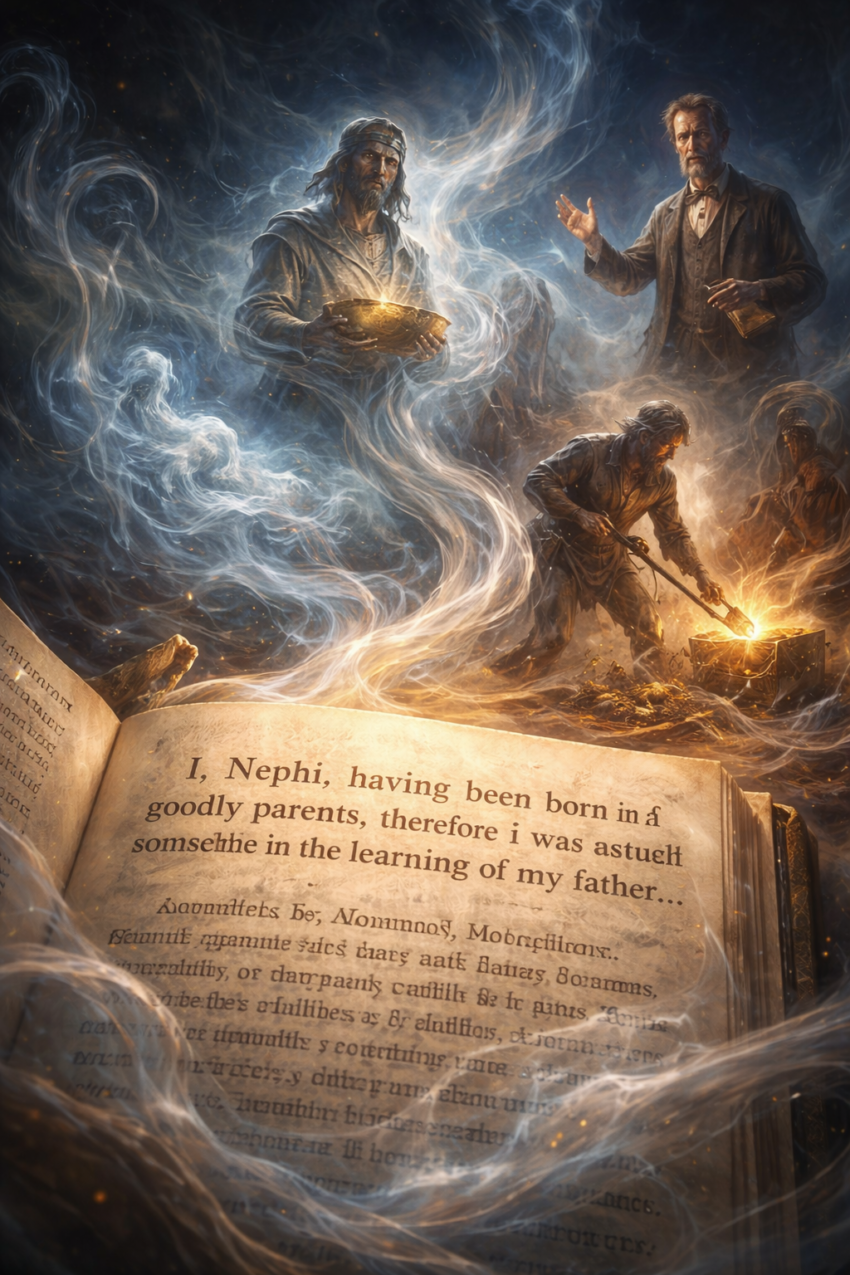
A New Textual Analysis of the Book of Mormon
An Examination of Dr. John Knight Lundwall’s Groundbreaking Research
March 17, 2026 | Mormonish Podcast, Episode E308
Introduction: The Keystone Under the Microscope
There is a passage that every reader of the Book of Mormon encounters within the first few seconds of opening the text. It is deceptively simple, almost disarming in its intimacy: “I, Nephi, having been born of goodly parents, therefore I was taught somewhat in all the learning of my father.” Eight centuries before the printing press, on gold plates carried across an ocean, a man introduces himself — in the first person, in a sustained autobiographical voice, in a style that feels oddly contemporary. To millions of Latter-day Saints, this voice is the voice of antiquity, divine testimony scratched into metal by a prophet of God. To a growing body of critical scholarship, however, that voice sounds less like an ancient scribe and more like a nineteenth-century American revivalist preacher — perhaps one who also happened to dig for buried treasure.
On March 17, 2026, the Mormonish Podcast released what its hosts described as “groundbreaking” research, a characterization that, for once, was not hyperbole. Dr. John Knight Lundwall, a scholar holding a doctorate in comparative myth and religion, presented a multi-layered textual analysis of the Book of Mormon that systematically dismantles one of LDS apologetics’ most cherished arguments — the claim that the book’s literary structure authenticates its ancient origins — while simultaneously offering a sophisticated and coherent explanation for where that structure actually came from. The episode, titled “Sermon Magic: A New Textual Analysis of the Book of Mormon,” runs nearly three hours and covers ground that, in Lundwall’s own estimation, has not previously been traversed in the scholarly literature.
This essay examines Lundwall’s arguments in full. It situates his analysis within the broader historical context of the early Latter-day Saint movement, the religious ferment of the Second Great Awakening, and the largely forgotten world of early American ceremonial magic. It draws on primary sources, LDS apologetic literature, and the critical scholarship of scholars including William L. Davis, Royal Skousen, and Stanford Carmack. And it asks the question that Lundwall’s research makes impossible to avoid: if the literary fingerprint of the Book of Mormon is found nowhere in antiquity but everywhere in Joseph Smith’s cultural world, what does that tell us about the book’s origins?
A word on methodology and tone before proceeding. This essay takes the Book of Mormon seriously as a text, as a literary and cultural artifact of the first order. It does not mock the sincere faith of those who regard it as scripture. It does not dismiss LDS truth claims with derision. What it does insist upon is that faith claims, when advanced as historical or literary arguments, must be subjected to the same rigorous scrutiny applied to any other historical or literary claim. Lundwall’s research meets that standard; this essay aspires to the same.
[Click here] to read the full transcript of this podcast [Click again to close]
Hi, everybody. Welcome to Mormonish Podcast. I’m Rebecca. I am joined by my co-host, Landon. How are you this evening, Landon? I’m doing great. Fantastic. It’s good to see you here. You can’t always be on, but when you are on, it’s amazing. Well, I don’t miss when Dr. John is on. No, and I was going to say, the other person on the screen needs no introduction. Dr. John Lundwall, how are you this evening, John? I’m doing great. It’s great to be back on your show. That’s right. We’re really, really happy because your episodes are not only some of our more groundbreaking ones and the ones that we get the most response to, we also get the most response from apologists, too. They are just, I think, you know, crowd pleasers. So in order to sort of explain what we’re doing tonight, I’m simply going to say when Dr. John calls us and says, you know what, I have something I’d like to cover. Can I come on your podcast? We say the podcast is yours. That’s all we need to say, right? So take it away, Dr. John. Introduce what you’re going to talk about. And I know you have a fantastic slide presentation, too.
I do. And actually, tonight is some I think some really interesting, new, perhaps even groundbreaking stuff. And well, here I am on Mormonish to sort of share it. To be honest, I did most of this research a couple of years ago. And I’ve been sitting on it. And so I’ve decided it’s time to put it out. So I am excited to share it with your audience. I do have to warn everyone. It is a PowerPoint slide. It’s like 42 slides. When I do PowerPoint, I try to have heavy images, light text. The text slows everything down, and that’s what PowerPoint is for. Having said that, tonight is a very… text-heavy presentation. We’re going to be doing a lot of reading of text. There’s no way around it, and so we’re just going to walk through and do it. So I hope everyone brought their reading glasses, because I certainly will need mine. And I hope you two are ready to help read through some of these slides. Always. I’m excited. That’s right. We’re here for you, John. This is it. This is going to be fantastic, everybody. And I would also suggest when Dr. John is on and you’re watching the episode, keep a notebook. I’m not kidding. You’re going to want to take notes on some of this stuff. Like you said, it’s pretty groundbreaking and pretty innovative and pretty what? Can you see my slides? We can. Yep.
All right. I just thought I know that the Middle East is a total mess right now. And I pray for everyone involved. But I did want to share, everyone’s going on cruises, the Exmo, the Promo. I’m actually taking an academic group, a group of graduate students, May of 2027 through Egypt. And it’s priced for academic students. So it’s actually a really good deal, $3,800 plus airfare to Cairo. And we’re hitting all the major sites in Egypt with professional academic guides at each site, five-star hotels, four-day Nile cruise. Me, I’ll be there, and every once in a while I’ll point out the Book of Abraham panels. Thank you. And, you know, it’s Giza, Saqqara, Grand Egyptian Museum, Karnak Valley of the Kings, Edfu, you know, private entrance into the Sphinx enclosure. It’s going to be a fantastic trip. So I’m going to send you the link, and you will put it in your show notes, right? Yep, yep. I will. I see a barcode there or a QR code. Yes, a QR code will send you to the website. If you pay a $450 deposit by May 10th, you get $200 off the tour. The tour is $3,900. You get $200 off $3,700, $3,790. But that covers everything, internal airfare, cruises, boats, planes, everything.
You said it’s an academic. Would Rebecca and I understand what’s going on if we went? Yes. Yes. Speak for yourself. I don’t have a lot of time here, but let me tell you, I don’t know, about four or five years ago, I was in Egypt on a tour and the guide was strange. For this group. And somehow he learned I was from Utah. I didn’t tell him. Someone told him and he goes, oh, you’re from Utah. Are you Mormon? And I’m like, well, no, I’m not. Well, let me tell you about about the temple. This guy pivoted, right? He was going along, and then he stopped, and then he gave the Mormon interpretation. These guides are really good. That’s so frustrating. They know what you want to hear, huh? They tell you what you want to hear. But actually, the tour company we’re using does do professional academic tours, and I’m bringing a group of grad students. I’ve only got… 10, 12 open spots. So, again, it’s a great deal, great trip. It’s going to be a very active, full trip. And, well, there you go. That’s all I have to say about that. Let us start this presentation.
All right, here’s the deal. We’re going to start with some already covered ground. But that starts us on a rabbit trail. And once you start down that rabbit trail, you start finding things. And we’re going to cover things that, in my view, have not been covered. I haven’t seen them covered. And by the end, we’re going to be down a rabbit hole, at the bottom of which is a couple really interesting revelations, or at least potential revelations. So… Tonight’s presentation is entitled I, Nephi, having been born from invocation. I’m going to start with this slide that actually I did on your show a couple of years ago about how the Mormon apologists say there’s so much writing on gold plate that it just authenticates the claims of the Book of Mormon. And I showed this, their top three examples, Darius gold plates, Etruscan gold plates, the Pergi golden tablets, and showed that actually when you look at context, these claims not only do not verify the authenticity of the Book of Mormon, they argue against it. Do you remember this? All these examples that they give are ritual tablets. And whenever we find in a Near Eastern Mediterranean context a sacred writing on gold, it’s a ritual performance. It’s a ritual. And, you know, the Nephites are supposed to be writing history on gold plates. And there’s, again, even gold tablets found in the Americas. and they also are ritual tablets with almost no text on them. They’re pictures of the votive offerings that were probably offered right before warfare, and a ritual was performed. So whenever we find a writing on gold, it’s the wrong paradigm. It’s the wrong medium, and therefore that contradicts the claims of the Book of Mormon, right? Any questions? We’re going to be running into this problem over and over again tonight with the claims of the Book of Mormon versus historical reality.
So we’re going to start with reading the opening of the Book of Mormon, 1 Nephi 1, verses 1 through 3. And can I get, Rebecca or Landon, can you read that? Verses 1 through 3 on the left. I think Landon should read it because he was a seminary teacher. So I feel that you have the weight behind this to read it in the way it is meant to be read. Sure. I’ll read it because I’ve probably read it hundreds of times but never got much past Second Nephi. Okay, here we go. I, Nephi, having been born of goodly parents, therefore I was taught somewhat in all the learning of my father. And having seen many afflictions in the course of my days, nevertheless, having been highly favored of the Lord in all my days, yea, having had a great knowledge of the goodness and the mysteries of God, therefore I make a record of my proceedings in my days. Yea, I make a record in the language of my father, which consists of the learning of the Jews and the language of the Egyptians. And I know that the record which I make is true, and I make it with mine own hand, and I make it according to my knowledge.
Okay. The opening salvo, when you open the first readings of the text, at least chronologically, you meet Nephi speaking, interestingly enough, in first-person dialogue, telling a first-person narrative. Now, this is quite unusual. It’s unusual historically in some aspects. And we’re going to talk a lot about this tonight and the implications of this. However, if you recall, the claim by faithful scholars is that this introduction is a colophon. And again, this is ground that’s been covered, but we’re going to go over a little bit of it. Can you read, Rebecca, these quotes? The top one is Brant Garner and the bottom one is John Tevednes. Okay, yeah, the first one is Brent Gardner, as John said, and he says, verses one through three are a complete literary unit and should be read together. They form a colophon or an indication of the author of the piece. And then John A. Tvetnes, did I say that correctly, close enough? Yeah, I think so. Close enough, I’ll go with yes. In his work, Colophon’s in the Book of Mormon, he says, several of the books in the Book of Mormon begin or end with a statement by the author certifying that he is the author of his work. Often he tells what is to come in the following pages or… explains or marks the end of what have just been said. Statements like this are known in ancient documents as colophones. And as Hugh Nibley pointed out several years ago, they appear in several Egyptian documents.
I have a feeling you’re going to do a colonophoscopy. Oh, dear. That’s exactly what’s going to happen tonight. You know, when I read the Book of Mormon with orality and literacy in mind, you know, that was about 2015-16 was when I did it. There are some features of the text that really stuck out to me that were unusual, and they wouldn’t leave me alone. They bothered me a little bit. And this opening is part of what I consider to be an unusual fingerprint of a literary style in the Book of Mormon that turns out to be only existent in the Book of Mormon. All right, so you’ve heard the colophon argument before, right, that these are colophons. Well, what’s a colophon? A colophon is a brief scribal or publishing note usually at the beginning or end of a text, mostly they’re at the beginning or the end of a text, that records information about its production, such as the author or scribe, date, place, or authority of the work. So most colophones… have date, author, place, patron, who the text is being written for. Sometimes there is some flowery language, acknowledgement of the patron. Sometimes there’s a blessing or curse. If you alter this text, you’re cursed. If you keep the text and honor the patron, you’re blessed. But the important thing is a colophon is a paratext. And again, a paratext is part of the text that contextualize, identifies the text without being part of the text.
So when we open 1 Nephi, we don’t get a paratext. We get a primary text. Nephi introduces himself in first-person narrative as part of the text. This is odd. So they also claim that these are colophones, and I thought we would just read them. This is Jacob 1, 1 through 3, and Enos 1, 1 through 3. And as you read them, maybe, Landon, you can read them, look for, do you have a date, a specific date, an author name? place where the text is written who the king or patron is the text is written for a blessing curse or some other magnification of the text do you find this in what scholars are calling colophones in the book of mormon can you read those jacob one one through three for behold it came to pass that 15 five years had passed away from the time that lehi left jerusalem Wherefore, Nephi gave me, Jacob, a commandment concerning the small plates upon which these things are engraven. And he gave me, Jacob, a commandment that I should write upon these plates a few of the things which I consider to be most precious, that I should not touch, save it were lightly, concerning the history of this people, which are called the people of Nephi. For he said that the history of his people should be engraven upon his other plates, and that I should preserve these plates and hand them down unto my seed from generation to generation.
You want me to read the other one right now too? Sure, go ahead, Enos. Enos 1, 1 through 3. Behold, it came to pass that I, Enos, knowing my father that he was a just man, All right. So… uh do we get place author date patron blessing curse um do we get that we we get the name of the person saying this is me writing it in one case there’s a little bit of a time frame but other than that i don’t see those other elements no yes right you don’t see those other elements All right. Nibley cites in his work the Bremer Rhine papyrus, or at least gives this as an example of an ancient Egyptian colophon identifying Nephi 1, 1 through 3 as a colophon. So I thought, let’s quote it. Here’s the ancient Egyptian colophon. I’ll read it. Written in year 12, fourth month of the inundation season, under the majesty of Alexander, son of Alexander, the count… In Divine Father, Prophet of Amun-Re, King of the Gods, Prophet Harprey, Great and Mighty, Prophet of Osiris, Prophet of Isis and Nephthys, Scribe and God’s Treasurer of Amun, Nesmin Justified, Son of the Priest of Petemestus, and the Lady Chasheret Entet. It’s you. As for anyone who shall remove this book from its place, may the gods judge him.
All right. That is a colophon. We get the author, Nesben the priest, his titles and lineages. This whole paragraph is his titles. We get his lineage, son of and lady of. We get a specific date written in the year 12, fourth month of the inundation season under the majesty of Alexander. It’s a regnal date as well as an agricultural date. This is the formal calendar that is being used. We see a cultic authority. We have a curse. And sure enough, this is I think that’s at the front of the text, though. Now I can’t remember. All right. So here’s what we have in the Egyptian example. We have a regnal date, the date of the king under the fourth month of the inundation. We have royal authority, formally priestly titles, genealogy, protective curse. More importantly, it’s a paratext. What we just read is not part of the text. It’s a signature. And now the text. Okay. Okay. The Book of Mormon is not a paratext. It’s a primary text. I, Nephi, having been born of goodly parents, therefore I will write and tell you the story. He is in the text. He is in the narrative. He is the narrative. That’s not a colophon. Colophons don’t do that. There’s no formal date from an official accounting. The only dating we get In some of these, you said there’s a hint of a date. Do you remember what that was? Yeah. Fifty five years after leaving Jerusalem. Yes. That’s the only date dating frame we get for 500 years in the Book of Mormon. It was so and so years after Lehi left Jerusalem. Not only are these not colophones, but as you follow the threads through the colophones, the different individual elements such as the dating in the Book of Mormon also is hugely problematic. We’ll discuss it.
No formal ruler, no location, no institutional authority, no cursor dedication. Nephi’s introduction is theological autobiography. It is not a colophone. Follow? Yeah, it’s interesting. Nephi can’t even locate the lands of the Book of Mormon. But your point is that apologists tell us this is related to Egypt, related to the writings of Egypt, because of this common element of the colophon. And they’re really stretching to make some of these parts of the Book of Mormon a colophon, the way that you’re explaining it here. It’s a huge stretch. It’s not real. Well, it stretches until it breaks. Yes. Ancient colophons are normally paratextual scribal notes, secondary written elements added by scribes that frame, identify, authenticate, contextualize a text without being part of the text narrative or argument itself. 1 Nephi 1.1-3 is integral narrative prose. Calling this prosa colophon relies on redefining the term prosa. not matching established forms. In other words, the only way that’s a colophon is if we redefine the colophon to include what the Book of Mormon is doing, and what the Book of Mormon is doing is found nowhere else. And so you have to then simply expand the definition. Move the goalposts. Move the goalposts. So you’re saying that this type of writing would not have, what the Book of Mormon is, this statement about a person and it kind of relates to the narrative and furthers the narrative, that doesn’t exist at all in the writings of that era that they’re claiming the Book of Mormon came from. It’s not something they did. We’re going to go over. Because this bothered me. Yeah. And, you know, I have a comparative degree, comparative myth and religion. So, you know, there’s upsides and downsides to that approach. But one of the upsides is I’ve read a lot of texts. And we’re going to go over some of the texts and how unusual and bizarre the Book of Mormon text actually is when you compare them to texts in antiquity.
I mean, the other problem, you know, so look, I want… an author, a specific name that identifies a scribal school, his scribal titles, and his genealogy. I don’t get that in any of those Book of Mormon examples. I want a specific date that can be used to locate the text, both temporally and in the library. And all the Book of Mormon gives me—so this is another problem. It’s not really part of the presentation, but I thought I’d make a slide on it anyway. One of the things that always bothered me in the Book of Mormon is the dating systems. The apologists are so happy to report that there’s three overlapping calendar systems that are internally consistent, and this— proves that the complexity of the text and the authenticity of the Book of Mormon. Well, like the gold plates, once you dig into calendar systems, you realize actually the calendar system of the Book of Mormon only exists in the Book of Mormon. There’s nothing like it outside of the Book of Mormon. the colophons in the Book of Mormon only exist in the Book of Mormon. There’s nothing like it outside of the Book of Mormon. the book of mormon does something no known ancient culture does it begins its history with a migration that migration starts the narrative that same event becomes the total chronological zero point this system persists for centuries the calendar is internal to the narrative and is not external or administrative this is not how ancient time keeping works ancient calendars are regnal based off the king Fourth, 12th year, fourth month of the reign of Alexander. Right. That’s an oregano calendar. Agriculture, 12th year, fourth month of the inundation. That’s a seasonal agricultural calendar. Astronomical, solar, lunar, stellar or mythic cosmological time. The Book of Mormon system is none of these. It is instead narrative-anchored historical time, and that category is essentially absent in the ancient world.
So there’s no counter system that… only exist to drive a narrative. And if you could stop and think, what kind of calendar, how would you practice a calendar of a historical migration event through five centuries, because it’s used until the Reformation of the Judges. You know, during that time, people would start creating alternative ways Narratives, alternative migrations, right? The Lamanites would object to this counter system. The Amlicites, the apostates of Nephite civilization, there’s… This calendar system only exists to propel the narrative forward. There’s really nothing else like it in the ancient world. So this is just, I need a date. I need a specific date to make this a colophon. And even the dating system in the Book of Mormon is problematic. Any questions? I have to say, 20 minutes in, you’ve already blown our mind, John. We may as well stop here. But wait, there’s more. I never thought of that, but you’re absolutely correct. This is just sprinkles. We’re not even to the three-layer cake. My thought is that’s a modern calendar system. It’s just like the birth of Christ became the anchor point for what we do, and instead they anchored it on Lehi leaving Jerusalem as the anchor point. Well, the birth of Christ is a mythic cosmological time. God enters the world, but it’s abstracted. And it’s counted, yeah, sure enough, A.D., B.C. to be used. And so when people use it, they say 300th year, what’s the Latin, A.D.? Yeah, M.N.I. Yeah. So I should get something similar to that. There’s, you know, the Hijri, the Islamic calendar starts with the migration of Muhammad. But again, that’s a lunar calendar. So when they cite that, it’s this faith of the fourth month of this year of this calendar. And so it’s abstracted to day, month, year within the system. The ADBC is abstracted to day, month, year within the system. You don’t get that in the Book of Mormon. It’s a narrative unit that says, it’s been so many years since Lehi left Jerusalem when this person does this. Make sense? Yep. It’s not nitpicking. This is problematic. And it’s just, it goes with the colophones. It’s not nitpicking. We’ve got a problem calling these introductory texts colophones.
So… I thought we would quote William Davis in his book, Visions in a Seer Stone. We’ll return to this text later in the presentation. Perhaps one of you can read that. I can read it. This is a great book, by the way, if you guys have not taken a look at this, Visions in a Seer Stone by William Davis. He says, but the speculative leap from the structures of ancient colophons to the summaries in the Book of Mormon strains for evidentiary support. The transformation requires a scenario in which ancient Nephite authors adapted and modified colophons and perhaps superscripts to create the prefatory outlines that appear in the Book of Mormon. In other words, a scenario in which they created an entirely new and innovative textual apparatus that no longer constituted or functioned as a traditional colophon, but emerged as an entirely different paratextual feature for ancient texts. Such a theory does not provide any evidence to explain this abrupt and historically idiosyncratic transformation. For example, how scribal conventions for copied text transformed into authoritarial notations in original compositions. Nor does it offer explanations as to why the character Nephi, born and raised in Jerusalem and purportedly the only Book of Mormon author to receive a classical Hebrew-Egyptian education, immediately dropped the conventions of his scribal culture to create such radical transformations.
Well, I mean, that’s a very academic and straightforward deconstruction of claiming these introductory texts are colophones. From what scribal tradition? They don’t exist anywhere else. Why would you drop the scribal tradition in which you were educated? And getting educated in writing texts is a very rarefied thing. class of people how Nephi even gets educated to write text is really interesting but one thing’s for sure you would stick to the conventions that you are taught and they immediately are dropped the one complaint I have in this quote is as traditional colophon but emerges an entirely different paratextual feature these are not paratextual features remember paratexts are texts that do not belong the primary text there their signatures outside of the primary text but these texts in the Book of Mormon are the primary text which means they’re not paratexts does that make sense yeah so that’s William Davis’s assessment of the situation my assessment is just blunt there’s not a single colophon in the Book of Mormon because there isn’t all right So we have some problems. What is being called a colophon is not a paratext, but a primary text, and it’s a mismatch. What is being called authentic writing on gold plates? Well, ritual text versus historical text, you don’t find it. It’s a mismatch mismatch calendars ancient calendars are built around kings crops and cosmos the book of mormon calendar is narrative time embedded in the narrative that’s a mismatch there’s nothing here that has a corollary in antiquity it only exists in the book of mormon So what are we left with? I got this AI image. I thought you might like it, Rebecca. It’s the gold plates, the Liahona, and a brass megaphone in which people are composing first-person narrative dialogue as history. And that’s bizarre.
Writers in the Book of Mormon are crafting first-person narratives as primary documents. Indeed, the Book of Mormon is so laden with this rhetorical style that most of its content is first-person dialogue and narrative. Almost all sermons are written in first-person. Curiously, every author who writes on plates also writes in first-person narrative. Third-person narratives, Messiah, Alma, Helaman, constantly convert to first-person dialogues. This makes a thousand-year history with multiple authors across a millennium sharing the same tradition of writing their histories in first person. Well, there is the scribal tradition that the Nephites use. In fact, I’ve written down, you know, the small plates have Nephi, Jacob, Enos, Jerem, Omni, right? Omni has several kings. Everybody in the small plates introduces themselves in the language that we read. I so and so or similar to and they identify themselves as writing on the actual plates. If they’re touching the plates and writing on the plates, they are speaking in first, not only in first person dialogue, but in first person narrative. And then when we get to the edited plates that Mormon and Moroni edit. Zenith, who leaves Jerusalem, leaves their Himla to rediscover the land of inheritance. Nephi, he creates a set of plates and then he tells a story in first person. Alma, the elder, leaves the court of Noah, does the same, records this story in first person. Mormon and Moroni, who are writing as editors on plates, record in first person dialogue and narrative. This is bizarre.
Writing on plate, you know, the real estate of the surface of a plate is very special and limited. And if you’re going to write something, you’re going to write in short, episodic packets of information. This is what we get in Mesoamerica, by the way. When we look at Mayan writing, history is told on the royal stelas. And what do we get? They’re kind of like colophones. We get a date. We get a place, we get the name of the king, an event that’s being commemorated, and that’s it, right? And so you get that on this stela, that on this stela, that on this stela. One king might have three, five, seven, nine stelas, and that’s it. The Book of Mormon is this open, flowing, first-person narrative that leads to open, flowing, first-person sermons. And all of it is orally performative text. And this is really bizarre. It’s as if the people writing on the plates are actually performing the text instead of writing the text. Questions? Questions? You’re saying it’s kind of like a 13 year old teenage girl’s diary where they’re just going on and on and they’re narrating and they’re talking and they’re taking up so much space. And that’s not how it worked. I had a diary like that. I know exactly what we’re talking about. I Rebecca, right? I never wrote like that. I did. I never wrote a diary. I was supposed to keep a journal. One of the many things that I was guilt tripped on growing up as a Mormon. I don’t know when I was supposed to have time to keep a journal. But in any case, what we have is anomalous historiography.
The Book of Mormon is not a single continuous narrative. It is a layered composite consisting of first-person records, Nevi, Jacobinus, Mormon, Moroni, third-person abridgments, Messiah through Helaman, extended embedded first-person discourse, including sermons, prophetic speeches, letters, prayers, autobiographical digressions. Crucially, sermons dominate the text, and sermons in the Book of Mormon are almost always first-person. I say unto you, I would that you should. Scholars explicitly note that the book contains major portions of both first- and third-person narrative, with entire books written in the first-person and others oscillating heavily between narrative modes. And I’ve broken down the small plates, the large plates, the writings in 3 Nephi, the writings of Mormon in Moroni. And I used AI to estimate, but I also kind of overviewed the text to verify. And this is accurate. First-person dialogue and narrative in the small plates consist of about 80, 90% of the text. Masai Helaman, that’s third-person narrative, constantly converting to first-person speech, first-person sermon, with portions of first-person narrative in Zena, Phenelma, etc., 40 to 50% first-person, 3 Nephi 70, 80, Mormon Moroni 80 to 90. The entire book estimate, 60 to 70% first-person dialogue and narrative. Why does this matter? We just identified we’re not dealing with colophonic structures. This is something else. This is a primary narrative text.
Well, it creates two problems. Problem number one, What ancient texts, especially histories, are written in this way? Who writes histories as first-person narrative? Specifically, within the Book of Mormon geography and timelines, where does this scribal practice exist? Now, I know the apologists always go to the old world, biblical texts, Near Eastern texts, to try to prove the authenticity and historicity of the Book of Mormon. This drives me a little batty, because everything we should be citing to verify the Book of Mormon should be in the New World. So where in the New World do we get histories written in first-person narratives? That’s what I want to know. Where in the New World do we get large sermonic elements as part of histories written in first-person dialogue? That’s what I want to know. But, being that we are going to do a colophonoscopy, we are going to look at the Old World and the New World texts, histories and other kinds of texts. If we can’t find this, this presents a second problem. If the Book of Mormon is written by Joseph Smith, if this is actually not happening in antiquity, but Joseph Smith is creating it, what comparative traditions would create this rhetorical and oratory style? In other words, where’s Joseph Smith getting this? Are there contemporary histories in Joseph Smith’s day written in first-person dialogue and narrative? Okay? Two separate problems. Well, let’s go look. Let’s start our clone. Landon invented a new word. I’m going to use it because it’s kind of fun. It’s fantastic. Don’t worry, the church will have that as their word and we won’t be able to use it anymore. They’ll trademark it. They’ll trademark it. Well, look, I started with ancient histories. And we don’t find any in the Americas. We find royal stelae. Which I just talked about. They don’t record history in first person narrative. There is first person dialogue sometimes, but they’re episodic and they do not qualify as any kind of historiography that we find in the Book of Mormon.
I have to look at histories in the old world. In fact, uh, Herodotus is called the father of history, the late fifth century BCE. He goes around to different towns and ask people about the traditions in history of their people in time, writes it down in a book called the histories. And this is where we really get our first history book. It’s a different kind of histiography. It’s not modern histiography. He’s, uh, primarily asking people about their opinion and then recording it, and then he gives editorial asides. So on the left, I have texts that I looked up, and I chose these texts because I have read out of them. In my lifetime, most of these texts I read either in grad school or undergrad school, which is 15 to 30 years ago. So admittedly, some of these I haven’t read in a few years, but I’m familiar with them. And what I did is I took them to A.I. And I asked two different AI models, ChatGPT, Microsoft Copilot, a series of questions to identify first-person speech and narrative in each of these texts, giving them parameters. I should say that when I first started, you know, AI is not perfect. I believe the numbers they’re giving me are accurate, but not precise. So they’re going to be within a couple percentage points. I believe they’re accurate within a couple percentage points. I did have to correct them. So, you know, Microsoft. Copilot told me that Josephus wrote the Jewish War 15 to 20 percent first person speech because Josephus actually is a participant. He’s there and he’s recording. What he sees. And so he would be writing in first person dialogue. The problem is, is I’ve read the Jewish war and I don’t remember anything like 15 to 20 percent first person dialogue in it. So when I told me it was 15 to 20 percent, I went and reread it. And then I went back and said, dear, I, you are totally full of bullshit. There is not 15 to 20 percent. I just reread it. Look for first person verb constructions, first person pronouns. Relook at the text and give me a new estimate. And it came back and said, you are correct. We. So they said we looked at intended. first person dialogue because josephus is in the text and writing about the world that he’s seeing ai assessed that certain sections were being written by josephus but they weren’t being written in first person and so it corrected it and put it back to a three to five percent first person dialogue so I know that’s a lot. I’m just going over my methodology.
But as you see, Herodotus, the history is the highest because Herodotus constantly interjects kind of like Mormon Moroni. But he says, I was at this place. I talked to this priest at this person and he told me this. And then he writes the history in third person. It’s not first person dialogue, not first person narrative, but it is a first person editorial. OK, and he repeatedly does that through the text. So that’s five to 10 percent first person speech, not autobiography. What we get in the Book of Mormon is first person autobiography. OK. Thucydides, same thing. He introduces himself at the beginning of the history of the Peloponnesian War and pretty much tells the entire war in third person. When you tell a history, when you write a history, you are describing people in other places and times and other events. And the brain automatically converts to third-person omniscient. And so all these histories are written that way. Xenophon actually writes in one of his texts about himself, but in third person, right? It’s kind of like Trump. I xenophone went. No, no, no. He doesn’t say I xenophone. He says so and so in xenophone went into the cities writing in third person. But he references himself in the third person. Right. So actually, first person’s about two percent. But there’s indirect third person references. Still not anything we see in the Book of Mormon. Diodorus, 1%. Plutarch, 3% to 5%. Livy, 1%. Josephus, 3% to 5%. Tacitus, 1%. I like Diodorus. Bibliotheca Historica. Yes, the history books. The history, Rebecca’s history, yes. It is Rebecca’s history. It’s her diary. Her diary, yeah. I’m going to write my history in third person because I can’t. It’s quite scandalous. If you read that text, it’s very scandalous. I’m shocked. It comes with pictures. All right. Looking at this list, it looks like everyone except Josephus is either Greek or Roman. Yes. We don’t see Egyptian or Hebrews writing this. At least Josephus is clear up to 700 years after Lehi, since we’re starting from a point, 700 years after Lehi left Jerusalem before you see this kind of writing in Hebrew. Yes. Well, we’re going to talk about the Hebrew Bible. That’s in an upcoming slide. Okay. But these are histories, and they’re not written in first-person. They’re written in third-person. First-person speech is present. There’s no first-person narrative.
All right. Further cross-comparison. I looked at other texts. Just to see, where do I find first-person narrative? Okay. And also first person speech, because I know I’ve read a lot of texts and I know that first person speech is present in antiquity, but almost always in a performance context, almost always. And of course, this is what we find. So I look at the epic of Gilgamesh. You know, that’s what? Eighth century BCE is our largest compilation of that epic library of Escher, Bonaparte. But that, you know, fragments of that epic go back to 2000 BCE. What we get in the epic of Gilgamesh is direct speeches by characters in the epic. And what we’re actually watching is actors performing that. This is a performative text. Right. The Iliad and the Odyssey also performative text. The Iliad has two to five percent first person dialogue, mostly third person narrative. But the Odyssey has a large section, books nine through 12, which is Odysseus’s story. And that is 15, 20 percent first person dialogue. But this is being performed by a bard who is playing the role of Odysseus. Right. This is why we get first person dialogue there. Mahabharata is the Indian national epic, 10 to 15 percent first person species, especially in the Bhagavad Gita spoken within the story. We’re going to talk about that in a sec. Ramayana, another Indian epic, five to 10 percent dialogues, non-narrative. The dialogues are not no first person narrative. The dialogues are not no first person narrative. The Upanishads and Plato’s Dialogues I’m going to come back to. Oedipus the King is a play. It’s a literal play. And I use this text as exemplar of all the Greek dramas because they’re all going to be very similar. And sure enough, the majority of the play is first person dialogue. Why is that? Because it’s a play. It’s a play. Right. The actors are speaking as the people performing a play. Right. Are the historians in Nephite civilization acting the history out in a performance context? Because right now, all of this is in a performance context in some form or another.
Let’s go back to the Upanishads. This is a it’s a moral, philosophical, religious text where you get dialogues of priests and gods giving moral prescriptions very often in first person. When gods speak, they often speak in first person, commanding the people, commanding the city, commanding the culture to do certain things. So that has a high uptick of first-person dialogue. Plato’s dialogues are almost entirely first-person dialogue. And if you’ve read Plato’s dialogues, it’s two people having a dialogue. And what we forget is Plato’s dialogues aren’t text. They were actually performed by two professors or students, people in the school, performing the argument in front of a student audience or at least a audience where these ideas were then debated and discussed. OK, so it is still a form of performance context, though a different form. In any case, you know, that’s 85 percent dialogic philosophical discourse. So high first person dialogue. Finally, I give the American examples. The Popol Vuh is a creation epic, the Mayan creation epic. There’s two to five percent divine speech that has first person dialogue. And every once in a while, the editor of the the right, the Popol Vuh was a play. It was a rich liturgy performed by Mayan priests. So again, a performance context. This is not archival text like the Book of Mormon is supposed to be. They’re writing on plates to make an archival history, but in first-person narrative. So the Popol Vuh doesn’t give us that 2% to 5% first-person speech. The Mayan codices, only four survive. Madrid, Paris, Dresden, the CODIS of Mexico, 0% first-person speech because they’re astronomical tables and texts.
Hey, John, quick question on that. Yes. I noticed since he says he wrote in Hebrew or Egyptian, there’s no Egyptian text and there’s no Hebrew like the Bible comparison there. Why wouldn’t we include those? I’m getting to the Bible. Okay. I’m getting to the Bible. You are anxious for that Bible text, Landon, I can tell. But you’re right. It’s kind of a smoking gun right there. I put the Bible on its own slide because I figured that should have its own slide and its own comparison. And what we discover is actually surprising. What we discover is what you’re seeing on your screen. Except I had you go back. There we go. All right. So we have different genres of texts, epics, dramas, dialogues. They are being performed, character speech through bards or tellers, generally in an oral performatory context, dramas through character embodiment. Even the dialogues such as in the Upanishads or Plato’s dialogues are interlocutors in a sort of pedagogical enactment where you perform it in first person in front of the people of in front of the people of the city, the people of the cult or the people of the school. So I’ve talked a lot. Will someone read the text on the right? I think it’s your turn, Landon. Yeah. OK, you want me to start first person speech is common. First person narration is rare. And we’re talking about the Bible in this case. we’re talking about all examples. We haven’t gotten to the Bible. Okay. So far, all the histories and all the comparative texts. Okay. This is a conclusion of what you said before. Okay. So first person speech is common. First person narration is rare. Even when first person is philosophically or theologically central, that is in, uh, uh, Upanishads or in the Gita, it is not histographical. Uh, The next point is extended first-person narrative blocks. Some texts give us extended first-person narratives, such as in the Odyssey 9 through 12, but these are special performances and not the default mode of how the narrative is told. These narrative blocks were literally performed by bards or actors. This sharply contrasts with the Book of Mormon, where history, theology, and sermon are routinely carried by first-person voices across entire books. And then the last, the Popol Vuh is a ritual performance. Codices are technical charts and texts. The only indigenous American example of religious epic was a religious ritual performed by priests. The codices are astronomical charts. Text genres use first person speech differently. First person is situational. It is voiced and not archival, and it derives its authority from presence and not authorship.
Well, there it is. It’s a first person speech is situational depending on the context of who’s performing it. It’s voiced. It’s performed. It’s not archival. It’s not history. It’s not being recorded as an archival text. And it drives its authority from performance, actually saying it and not narrative authority such as we get in the Book of Mormon. So what we have here then, you know, I have this image in the upper left of a Mayan astronomer priest performing at a Christian altar a sermon in first-person history. This is what the Book of Mormon wants us to believe, but we don’t get that in any text that we looked at so far. Let’s look at the Bible. Here’s your Bible, Landon. Here we go. Let’s do it. All right. I divided the Bible by different genres. We have to remember the Bible, Biblia means books. It’s a library. This is a problem that Mormonism and quite frankly, a lot of evangelical Christians face. protestant christians have made they condensed all the genres in the bible into history when in fact there’s only a few books in the bible that are actually written as histories joshua judges kings chronicles the torah is not It’s a different kind of history. It’s oral. Genesis descends from oral tradition. And what’s the oral tradition? It’s performative. Right. Those stories were performed generally in liturgies. So let’s talk about it. The Torah, we have two books. First off. As far as I know, whenever God speaks in the Hebrew Bible, he speaks in first person. This belongs to the convention of antiquity. When the gods speak, they speak in first person. So when God speaks in Genesis, he speaks in first person. God often interjects through oracles, through prophecies, or talking to certain prophets. So first person dialogue shows up then through the Bible when this happens. We have two large blocks of text, Leviticus and Deuteronomy, that have a lot of first-person speech in it, about 20 to 30 percent. It’s omniscient narrator, extensive quoted divine speech, but there’s no autobiographical historical voice.
Actually, the next slide, we’re going to read out of Leviticus and Deuteronomy so you can see what kind of first-person speech is in those books. While we have first-person speech, do we have first-person narrative? And we only get in the Torah 1% to 2% first-person narrative. This is someone saying, I did this, and then the rest of it converts to third-person. Dominant literary mode is third-person historiography with embedded divine legal speech. This is interesting because you would expect since this is a book of Moses and supposedly Moses wrote it, although we know that’s not the case, but traditionally Moses wrote this, you should have a large percentage of first-person narrative if Moses is in fact writing it. Deuteronomy has a ton of first-person speech, and it’s Moses speaking to the people of Israel in first person. However, it’s third-person narrative with first-person speech. So as you look at the first-person narrative, remember the first-person narrative in the book Mormon is at least 60%. And we’re in single digits. OK, and we’re and there’s a reason why Moses speaks first person in Deuteronomy. We’ll talk about it in the next slide. History is Joshua through Kings, five to 10 percent first person speech. It’s classical omniscient history. Third person, first person narrative, less than one percent wisdom literature. Wisdom literature is poetic, liturgical, and philosophical. And if you remember, philosophical texts often are in first person. Liturgical texts are often in first person speech. Why? Because they’re being performed. Remember, if you’re in a performance context, you’re actually speaking out the words of the text. Very often you speak in first person, right? The Psalms were songs, right? That were sung in the temple, you would go to the priest, pay him a sacrifice and ask for a blessing. And he would sing a psalm and then give you a blessing. So you do get quite a bit of first person speech, but this is performative speech once again. The prophets have a lot of oracular discourse. The Lord said first-person, and I do declare first-person. So a lot of first-person speech, but almost no first-person narrative. Overall estimate in the Bible, 25% to 35% first-person speech, 2% to 3% first-person narrative. First-person speech common, first-person hysterical.
History suppressed or absent. I thought we would just read the kind of first-person speech we get in Leviticus and Deuteronomy. Do you want to tackle that? Sure. Leviticus 21 through 5. And the Lord spake unto Moses, saying, Again, thou shalt say to the children of Israel, Whosoever he be of the children of Israel… or of the strangers that sojourn in Israel that giveth any of his seed unto Molech, he shall surely be put to death. The people of the land shall stone him with stones. And I will set my face against that man and will cut him off from among my people, because he hath given of his seed unto Molech to defile my sanctuary and to profane my holy name. And if the people of the land do any ways hide their eyes from the man when he giveth of his seed unto Moloch and kill him not, then I will set my face against that man and against his family and will cut him off and all that go a-whoring after him to commit whoredom with Moloch from among their people. Okay. Just to point out, verse 1, how does it begin? With a third-person narrator. And the Lord spake unto Moses. So the narrative frame is third person. It’s not first person. But then when the Lord speaks, what happens? He goes to first person. The Lord speaks almost always in first person. And that’s what we get. How about Deuteronomy? Okay, Deuteronomy 5, 1 through 6. And Moses called all Israel and said unto them, Hear, O Israel, the statutes and judgments which I speak in your ears this day, that you may learn them and keep and do them. The Lord our God made a covenant with us in Horeb. The Lord made not this covenant with our fathers, but with us, even us who are all of us here alive this day. The Lord talked with you face to face in the mount out of the midst of the fire. I stood between the Lord and you at the time to shew you the word of the Lord. For ye were afraid by reason of the fire and went not up into the mount, saying, I am the Lord thy God, which brought thee out of the land of Egypt from the house of bondage.
So two first persons there. Yes. Moses speaks in first person. The Lord speaks in first person. It again begins in third person narrative as the frame. So what we get then is third person legal religious instruction containing embedded first person divine declarations. It functions as normative cultic law, not as first person narrative, sermon or historiography. The first person elements serve authority and sanction, not narration. In fact, there’s a great deal of scholarship that says that Deuteronomy, Moses’s first person speech, was actually a liturgical performance of a temple priest performing the covenant to Israel. And so this first person speech of Moses is actually being performed by a priest acting the role of Moses. And so, once again, we are here. Biblical scholarship is unanimous. That third-person omniscient narration dominates biblical historiography, with first-person news largely constrained to speech acts, prayers, laments, and prophetic oracles rather than sustained narrative voice. First-person speech is common in the Bible. First-person narrative history is suppressed or absent. No biblical corpus writes sustained national history in authorial first person or presents itself as a continuous autobiographical record. The Bible behaves exactly like ancient literature should. The Book of Mormon, on the other hand, is historically anomalous. All right. Questions. Remember, we’re trying to solve two problems. Why is all this first person speech and narrative in the Book of Mormon? Problem number one, where do we find and what do we find in ancient texts? Now, I should prefer ancient pre-Columbian American texts. And we find zero. Right? So then I have to go to old world histories, old world epics, old world dramas, and the Bible. And we still are not finding… what we should find, or at least nothing matching the Book of Mormon.
And I’ve created a heat map here. First-person speech, epics, 10%. Hebrew Bible, 30%. Philosophy, 40%. Greek drama, 70%. Book of Mormon, 65%. First-person narrative, well, look, 2%, 3%, 2%, 1%, 60%. This is so damning. Can I just say that? This is so damning. I’m gonna take a picture of this slide. I’m sorry. Yeah, it’s funny because this is kind of the fallback that the church has gone to is the text. There’s no DNA, there’s no geography, there’s no linguistics, everything falls apart. So they’ve had to go to the text itself and the text is what’s supposed to save it. But we can see right here that this text shows it out of, it’s not ancient in source. No, it’s an anomaly out of space and time. It does not exist anywhere with any kind of precursor. This is insane, John. I can’t believe it. It exists only in the Book of Mormon. Yes. And so, look, I’m trying to authenticate it or falsify it. Where can I find this kind of narrative in the ancient world? And again, I again say, you know, maybe the apologists are going to find some obscure text. Maybe. But again, I mean… I need to see this in the Americas. Everybody’s always arguing old world texts. And I always shake my head. A thousand year history of a literate society descending from Jerusalem, whose calendar system descends from Jerusalem. I should be finding texts in the Americas that reproduce first person. The scribal tradition is first person speech and first person narrative. Oh, the Spanish burned them all, John. That’s it. Or they were taken back up to heaven. It’s the only answer. Wow. All right. Will you read my conclusion? Here, I’ll read it. Can I just say one thing first though? I feel like a lot of this magical traditions were in the stories from a long time ago. My parents would share these kinds of stories with me. You know, just the crazy stuff, the punching toad, the monkey in the box. My parents shared those old magical stories that fit right in line with this. Those are gone now from the church narrative. No one knows those stories anymore, unless you really look, they’re really distancing themselves. I think from even a hint of this magical past. And I just wonder, I think that’s by design. I don’t know. I promise you, I’m going to put this center stage in front of everyone this year. Yep. And the church, well, you know, the church will do what the church does, but, um, Again, this rabbit hole goes deep. Go ahead and read this. Yep. Sorry. That’s what I was trying to say.
All right. Refocusing the lens, both believers and critics approach the book of Mormon through, um, Let’s see, sorry, I can’t read that. Competing textual biases. Believers such as Carmack and Skousen interpret early modern English idioms as evidence that Joseph Smith was dictating a preexisting ancient translation. Critics, by contrast, search for earlier or contemporary source texts from which Smith might have copied. Both approaches misidentify the process. Joseph Smith was neither a copyist nor a translating copyist. He was a weaver. He drew upon existing ideas, rhetorical registers, and speech transitions, but wove them into a new textual tapestry generated in real time through oral performance. His language was not borrowed wholesale from a single source, but inherited through repeated ritualized invocations and sermonized performance, allowing archaic first-person forms to surface naturally within the act of dictation itself. Boom. All right. The previous paragraph in this paragraph is my thesis. This is how the Book of Mormon is created. Joseph starts with ceremonial magic. It’s first-person command language. It’s Christianized in its oral dictation. It’s oral performance. It’s early modern English. It’s ritualized performance as first-person narrative, citing biblical stories. He… has that in his life. That’s what he believes in. But he lives in the Second Great Awakening, surrounded by sermon culture, which is first-person exhortation, moral authority through oral performance, and the sermons contain the theological content that are in the Book of Mormon. Right? And that sermon culture… is part of the second great awakening, which exists the primacy of sermons, restorationist theology, folklore of the lost tribes of Israel, millennialism, all of this is in the air and it’s popular and it’s selling. So basically the Book of Mormon is a combination of all these three things. My thesis is Joseph wanted to create a treasure, that would actually make money. He believed in treasure digging, but he never found any treasure. But he believed in the magic of treasure digging. So what if I use part of that magic and create my own treasure? To do that, what treasure could I make? What treasure would make money? Well, he’s surrounded. Weekly, daily sermons. The people talking about it, right? This is happening. And he sees, I can make money selling these sermons. And so he folds it in. But now, how am I going to do this? How am I going to pawn this off as an ancient text from ancient plates because that oh that’s the secret sauce man nobody’s got that people are talking about it people i mean again the indigenous peoples coming from israel that was in the air people were talking about that lost civilizations lost lost scriptures all of this he’s he’s tying into and he says, I’m going to fuse it all together. But now I have to create this text. I have to create this text. He’s using oratory performance that his prime avenue of training is his ceremonial magic. His secondary avenue of training is sermon culture. And he combines them both to create first-person narratives that are designed to deliver first-person sermons, which is what everyone is buying. So that’s sort of the deal.
So the… The picture on the right is Joseph orally performing the Book of Mormon using the picture up the upper left, sermons. But really, the secret sauce is the treasure digs. So this combines in a new way, and Joseph Smith produces this. Very creative. It’s a marvelous text. I agree. I think it’s a marvelous text. I think it’s a creative text. I think it’s very creative how it unfolds. I have a lot of compliments for the audaciousness and creativity of Joseph Smith. This is a true project. But none of this is ancient. Nothing in the Book of Mormon belongs in antiquity. You know, when I did the orality literacy with you guys, everyone’s arguing that the props in the play are anachronistic, steel swords, sheep, goats. And I was arguing, actually, the stage and the scenery is also anachronistic, right? The entire thing. It is every inch, every verse of the Book of Mormon is an anachronism. None of it belongs in antiquity. But when you get into these textual analysis of early modern English and sermon command forms and first-person narrative, first-person speech, you realize you are really dealing with a unique modern, as in Joseph Smith’s creation. This is not happening in antiquity. But, you know, I have some admiration for it. All right, that’s my ending. Final thoughts? I love those pictures. Landon, final thoughts. I just think what you’ve done is so important, John. You have a place in this narrative and the history as we, you know, try to understand really what it is. This is just incredible. Landon, what do you think? I think Joseph cannot escape his magical past. It just permeates everywhere. And every time the answer goes back to that early magical treasure digging that we all were told when asked on our mission, Joseph was a treasure seeker. We were always told, no, he wasn’t. That’s just anti-Mormon propaganda. And yet now we know that he did. And now we see why no one wanted to believe it because it permeates the church. Even today, there’s still those pieces of magic that permeate it. And so to To be part of the creation of the Book of Mormon is a new angle that I don’t think anyone has brought up, that his magic is what allowed him to do this. It’s where he received his oratory training. And so, sure enough, the keystone of Mormonism is permeated by magic. You’re not going to get rid of it. It’s in the DNA of Mormonism. And all I can say is this is just part one of several other parts. I can take this topic much further. and show very specific textual structures that are very interesting that will rewrite, in my view, will rewrite what the Book of Mormon is. So this is forthcoming, announcements forthcoming. What I want to try to do is actually make a video. And so, you know, a semi-professional video. So I’m trying to raise money to try to get my research out. And, you know, I’m not raising that on your show. But I’m just saying more is coming. And so this is one piece. This is the very first piece. Fascinating. Can’t wait for the rest. But wait, there’s more. That’s what we’re saying. If you can even believe that there’s more. This is so revolutionary and so groundbreaking and so innovative. And I hope that everybody that’s watching will start a dialogue about this. I hope other scholars will reach out to John. Maybe we can even include some contact information. I hope that this can become something that’s sort of living and breathing as people can add pieces to this. and it can just become bigger and bigger because this is this is something completely revolutionary just like your other podcast with us a couple years ago.
The Scholar, the Podcast, and the Stakes of the Argument
Who Is John Knight Lundwall?
John Knight Lundwall is not a household name in evangelical apologetics circles, but he should be. He holds a doctorate in comparative myth and religion, a discipline that equips its practitioners to read widely across ancient textual traditions — Egyptian, Mesopotamian, Greek, Hebrew, Mesoamerican, and Indian — and to identify structural, literary, and cultural patterns that cut across civilizations. His academic work has been recognized outside apologetic circles as well. His book Mythos and Cosmos: Mind and Meaning in the Oral Age received a positive review from Kirkus Reviews, which praised his argument that preliterate ancient cultures possessed a high degree of intellectual sophistication and metaphysical complexity. Kirkus noted his refreshingly broad perspective and described the work as
“Recommended reading for classicists (and budding Indiana Joneses) graduating beyond Edith Hamilton.”>
— Kirkus Reviews, reviewing Mythos and Cosmos by John Knight Lundwall (Kirkus Indie, July 2015)
Kirkus summarized his core thesis as follows: Lundwall finds fault with the general scholarly tendency either to condescend to ancient peoples as intellectually primitive or to romanticize them as noble savages. In his reading, the ancients were sophisticated thinkers whose oral traditions encoded cosmological, astronomical, and theological insights of considerable depth — insights that have suffered in later translations and fragmentary preservation. This background in oral versus literary culture is foundational to his analysis of the Book of Mormon, and it explains why his observations carry a weight that purely text-focused critics often miss.
His appearances on the Mormonish Podcast have become events in the post-Mormon and critical scholarship community. Host Rebecca Bibliotheca, who holds a Master’s of Library and Information Science from BYU, and co-host Landon Brophy, a former military officer and LDS seminary teacher, have repeatedly described Lundwall’s episodes as among their most impactful. Their description of the March 17 episode captures the broader reception well:
“Dr. John Knight Lundwall, who holds a PhD. in comparative myth and religion, joins Mormonish to provide a groundbreaking analysis of oral versus literary societies in the pre–Columbian Americas. His extensive scholarly work proves that it’s impossible for a book with the literary complexity of the Book of Mormon to have even existed anywhere in the Americas during the Book of Mormon era. We consider this research to be incontrovertible evidence that the Book of Mormon is not a historical record.”>
— Mormonish Podcast, Episode 57, “New Groundbreaking Research Dismantles Book of Mormon Authenticity with Dr. John Lundwall”
The March 17, 2026, episode, however, goes considerably further than the oral-versus-literary argument. Lundwall disclosed that he had conducted most of the underlying research several years earlier and had been sitting on it, waiting for the right moment. The analysis presented on this occasion represents what he describes as a “rabbit hole” with multiple levels, beginning with the question of colophons and ending with a comprehensive theory of Book of Mormon composition rooted in grimoire magic and Second Great Awakening sermon culture. It is, in every meaningful sense, a new argument.
Why This Research Matters for Christian Apologetics
For Christians engaged in outreach to members of the Church of Jesus Christ of Latter-day Saints, the historicity of the Book of Mormon is not merely an academic question. The book is, in the words of Joseph Smith himself, “the keystone of our religion.” If the keystone crumbles, the entire arch of LDS claims to restored priesthood authority, distinctive temple ordinances, the doctrine of eternal progression, and prophetic succession comes into question. LDS apologists have long understood this, which is why the most sophisticated defenses of the faith increasingly pivot from archaeological and genetic arguments (where the evidence has proven consistently unhelpful) to textual and literary arguments. The claim that the Book of Mormon contains ancient literary structures — colophons, Hebraic poetry, chiasmus, scribal conventions — is one of the last major evidential redoubts.
Lundwall targets this redoubt directly. And what he finds when he examines it is that the fortress has no foundation. The literary features claimed as evidence of antiquity either do not exist in the text as described, do not match the ancient forms they are alleged to parallel, or, most damagingly, represent patterns that are unique to the Book of Mormon — found nowhere in genuine ancient literature, anywhere. The implications for LDS truth claims are significant.
The Colophon Argument — Moving the Goalposts
What Is a Colophon?
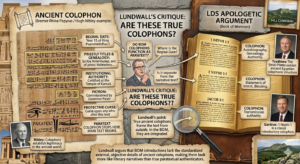
To appreciate the force of Lundwall’s critique, one must understand what a colophon actually is. In the ancient world, a colophon was a brief scribal or publishing note, typically appearing at the beginning or end of a manuscript, that recorded the circumstances of the text’s production. A genuine ancient colophon — such as the Bremer-Rhine Papyrus cited by Hugh Nibley in LDS apologetic literature — contains a regnal date (identifying which year of which king’s reign the text was copied), specific priestly titles and genealogy identifying the scribe, a statement of institutional authority, the name of the patron for whom the text was produced, and often a curse protecting the text’s integrity or a blessing for its preservation. Crucially, a colophon is a paratext: it stands outside the text itself, framing and authenticating it from without. The text begins after the colophon.
LDS apologists, most notably Brant Gardner and John A. Tvedtnes, have argued that the opening verses of 1 Nephi, 2 Nephi, Jacob, Enos, and other books of the small plates constitute colophons in this ancient scribal tradition. Tvedtnes, in his essay “Colophons in the Book of Mormon,” argued that these introductory passages parallel ancient Egyptian colophonic practice, a claim popularized by Hugh Nibley.
“Verses one through three are a complete literary unit and should be read together. They form a colophon or an indication of the author of the piece.”>
— Brant Gardner, as quoted in John K. Lundwall, “Sermon Magic” presentation, Mormonish Podcast, March 17, 2026
…
“Several of the books in the Book of Mormon begin or end with a statement by the author certifying that he is the author of his work. Often, he tells what is to come in the following pages or explains or marks the end of what has just been said. Statements like this are known in ancient documents as colophons, and as Hugh Nibley pointed out several years ago, they appear in several Egyptian documents.”>
— John A. Tvedtnes, “Colophons in the Book of Mormon,” as quoted by Lundwall, Mormonish Podcast, March 17, 2026
The Textual Problem With the Colophon Claim
Lundwall’s response to this apologetic move is methodical and devastating. He reads the actual text of 1 Nephi 1:1-3, Jacob 1:1-3, and Enos 1:1-3 against the formal features of a genuine ancient Egyptian colophon. The contrast is stark. The Book of Mormon passages contain no regnal date, no institutional priestly titles, no genealogical identification in formal scribal terms, no named patron, and no curse or blessing of the kind found in genuine paratextual scribal notes. More fundamentally, they are not paratexts at all. “I, Nephi, having been born of goodly parents, therefore I was taught somewhat in all the learning of my father” is not a scribal note appended to a text from outside. It is the text. Nephi is not signing the manuscript; he is inhabiting it. He is the narrator, the protagonist, the voice of the entire narrative.
Lundwall’s formulation is precise: “Ancient colophons are normally paratextual scribal notes, secondary written elements added by scribes that frame, identify, authenticate, and contextualize a text without being part of the text narrative or argument itself. 1 Nephi 1:1-3 is integral narrative prose.” The only way to call it a colophon, he argues, is to expand the definition of “colophon” until it encompasses something that ancient colophons never were — a primary first-person narrative voice that carries the entire story. In the vocabulary of textual criticism, this is known as moving the goalposts.
William L. Davis, whose 2020 book Visions in a Seer Stone is among the most rigorous critical analyses of Book of Mormon composition, reaches a similar conclusion by a different route:
“The speculative leap from the structures of ancient colophons to the summaries in the Book of Mormon strains for evidentiary support. The transformation requires a scenario in which ancient Nephite authors adapted and modified colophons and perhaps superscripts to create the prefatory outlines that appear in the Book of Mormon — in other words, a scenario in which they created an entirely new and innovative textual apparatus that no longer constituted or functioned as a traditional colophon, but emerged as an entirely different paratextual feature for ancient texts. Such a theory does not provide any evidence to explain this abrupt and historically idiosyncratic transformation.”>
— William L. Davis, Visions in a Seer Stone: Joseph Smith and the Making of the Book of Mormon (University of North Carolina Press, 2020), as quoted by Lundwall, Mormonish Podcast, March 17, 2026
Lundwall’s assessment is blunt: “My assessment is just blunt — there is not a single colophon in the Book of Mormon, because there isn’t.” The word “colophon” has been imported into LDS apologetic vocabulary not because the Book of Mormon actually contains colophons but because the word sounds ancient and scholarly, and the introductory passages superficially resemble — to someone unfamiliar with actual colophonic literature — the kind of thing a colophon might do. Once you have read an actual ancient colophon, the resemblance evaporates entirely.
The Anomalous Calendar Problem
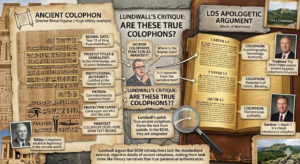
Lundwall extends his critique to another feature of the text that LDS apologists have celebrated as evidence of authentic ancient complexity: the Book of Mormon’s calendar system. The claim is that the book contains three overlapping, internally consistent calendar systems, and that this structural sophistication argues for genuine historical antiquity.
Lundwall’s response is equally systematic. Genuine ancient calendar systems are anchored in three types of time: regnal time (the years of a specific king’s reign), agricultural time (seasons, planting, harvest), and astronomical time (solar, lunar, or stellar cycles). These are external, administrative systems that exist independently of any single narrative. The Book of Mormon’s calendar system, by contrast, is anchored to a single narrative event — Lehi’s departure from Jerusalem — and functions exclusively as a counter within the narrative itself. It has no external referent, no administrative structure, and no existence outside the story it serves. Lundwall observes that this type of “narrative-anchored historical time” is essentially absent from the entire known record of the ancient world. No real civilization has ever kept time by counting years from a single migration event across five centuries of national history. The calendar, like the supposed colophons, only exists in the Book of Mormon.
The First-Person Anomaly — A Textual Fingerprint Found Nowhere Else
The Scale of the Problem
Having established that the Book of Mormon’s supposed ancient features are either absent or illusory, Lundwall turns to what he regards as the most distinctive and most damaging literary characteristic of the text: its overwhelming, historically unprecedented reliance on first-person narrative. This is not merely a stylistic observation. It is a forensic finding.
Lundwall estimates, through a combination of AI-assisted textual analysis and his own review, that approximately 60 to 70 percent of the total text of the Book of Mormon is composed in first-person dialogue and narrative. The small plates (1 Nephi through Omni) run at 80 to 90 percent first-person. The Mosiah-through-Helaman section, nominally a third-person narrative, oscillates heavily between narrative modes and converts to first-person speech and sermon at rates of 40 to 50 percent. Third Nephi runs at 70 to 80 percent. The writings of Mormon and Moroni return to 80 to 90 percent first-person. Every author who writes on the plates writes in the first person. Every sermon is delivered in the first person. Every prophet introduces himself in the first person. This is remarkable because in all of genuine ancient literature, sustained first-person narrative history is essentially absent.
A Survey of Ancient Literature
To demonstrate this, Lundwall conducts a sweeping survey of ancient texts. His methodology involves both direct reading and AI-assisted analysis of texts he has personally read or studied, using multiple AI models (ChatGPT and Microsoft Copilot) with careful verification to avoid overcounting what he calls “intended” versus actual first-person constructions.
The results are arresting. Among the great ancient historians, Herodotus — the most first-person-inflected of the ancient historians, known for his personal editorial asides — runs at approximately five to ten percent first-person speech, and this is editorial commentary, not autobiography. Thucydides introduces himself once at the opening of the Peloponnesian War and tells the entire conflict in the third person, as every ancient historian does. Xenophon, writing about himself, refers to himself in the third person. Diodorus Siculus: one percent. Plutarch: three to five percent. Livy: One percent. Josephus, who was a participant in the events he describes and might be expected to write in the first person, runs at three to five percent after Lundwall corrected an AI overcounting error. Tacitus: one percent.
The epic literature is similarly revealing. The Epic of Gilgamesh, the Iliad, and the Odyssey contain first-person speech primarily in performative contexts — passages sung by bards embodying characters. The famous Odyssey exception (Books 9-12, where Odysseus narrates his own adventures) runs at approximately 15 to 20 percent and represents a special performance device, not a historiographical convention. The Mahabharata and Ramayana contain divine speech in the first person (gods speaking is a universal convention across antiquity), but no sustained first-person historical narration. The Popol Vuh, the closest New World parallel to the Book of Mormon’s cultural milieu, contains two to five percent divine speech and was composed as a ritual performance text, not an archival history.
The Bible — which Lundwall analyzes by genre — is equally unhelpful to the LDS apologetic cause. The Torah averages one to two percent first-person narrative. The historical books (Joshua through Kings) average five to ten percent first-person speech in the form of embedded quotations, with first-person narrative at less than one percent. The Psalms and prophetic literature contain first-person speech because they are liturgical performance and/or oracular proclamation, not historiography. Lundwall’s overall biblical estimate: twenty-five to thirty-five percent first-person speech, two to three percent first-person narrative. He concludes with a statement that is, in the context of apologetic debates about the Book of Mormon’s literary authenticity, nothing short of nuclear:
“No biblical corpus writes sustained national history in authorial first person or presents itself as a continuous autobiographical record. The Bible behaves exactly like ancient literature should. The Book of Mormon, on the other hand, is historically anomalous.”>
— John K. Lundwall, Mormonish Podcast, March 17, 2026
The visual summary Lundwall presents is a comparative heat map. First-person speech in ancient epics: approximately ten percent. In the Hebrew Bible, thirty percent. In philosophical dialogues: forty percent. In Greek drama (where characters speak as themselves on stage): seventy percent. In the Book of Mormon, sixty-five percent. First-person narrative — the measure that matters for historiography — in ancient texts of any kind: two to three percent. In the Book of Mormon, sixty percent. There is no ancient text, in any language, from any civilization, that comes remotely close to the Book of Mormon’s profile.
The Contemporary Text Problem
Faced with this absence of ancient parallels, one might hypothesize that Joseph Smith was simply copying or adapting a contemporary text that happened to use this unusual first-person approach. LDS critics and some apologists have long pointed to three texts as potential source material: Gilbert Hunt’s The Late War (1816), Ethan Smith’s View of the Hebrews (1823), and the Solomon Spalding manuscript. Lundwall examines each of these and discovers that none of them provides a meaningful parallel. The Late War is a third-person narrative with embedded first-person proclamation speech at approximately one percent. View of the Hebrews is expository and argumentative prose with authorial asides at one to two percent first-person speech and zero percent first-person narrative. The Spalding manuscript is third-person omniscient with some embedded first-person speech at one to two percent. None of these texts approaches the Book of Mormon’s profile. None of them writes history in a sustained first-person narrative voice. The conclusion Lundwall draws is significant: if Joseph Smith had been copying or adapting any of these texts, the Book of Mormon would look like them. It does not.
This leads Lundwall to articulate the critical diagnostic question: where, then, does Joseph Smith’s first-person narrative technique come from? His answer unfolds in two stages.
The Second Great Awakening and the Architecture of the Sermon
Sermon Culture as the Beyoncé of Its Era
The first stage of Lundwall’s explanation involves the religious culture of Joseph Smith’s immediate environment. The decades between 1790 and 1830 were, in American religious history, extraordinary. The Second Great Awakening was not merely a series of revivals; it was a cultural phenomenon of the first order. Camp meetings attracted thousands of participants. Itinerant preachers — Charles Finney, Lyman Beecher, Peter Cartwright, and scores of others — moved through the countryside commanding audiences whose emotional intensity, by contemporary account, rivaled or exceeded anything modern popular culture can produce. Landon Brophy’s offhand remark during the podcast — that “you have to understand sermon culture: it was the Beyoncé of its day” — is not as glib as it sounds. These sermons were reported in newspapers. They were the subject of sustained community conversation for days or weeks after the event. They could precipitate what contemporaries described as physical prostration, weeping, conversion experiences, and visionary states. Preaching was performance, and performance was power.
All of these sermons shared a structural signature: they were delivered in the first person, in the present tense, with a rhetoric of moral urgency and direct personal address. “You must repent now,” “God requires it now,” “I know the end of this course,” “If you do not repent, the Lord will not redeem you.” Lundwall identifies this rhetorical style across multiple prominent Second Great Awakening preachers and then demonstrates its structural identity with the sermon content in the Book of Mormon. Alma’s declaration, “This life is the time for men to prepare to meet God,” is formally indistinguishable from Charles Finney’s “You are bound to repent now,” or Lyman Beecher’s “Life and death are now before you.” The vocabulary is different; the rhetorical architecture is identical.
William Davis, in Visions in a Seer Stone, reaches a convergent conclusion through independent analysis of the oral composition strategies embedded in the Book of Mormon’s structure:
“Abundant evidence throughout the work indicates that Smith made use of several techniques that facilitated the process of oral composition, including such methods as the semi-extemporaneous amplification of skeletal narrative outlines, the use of formulaic language in the biblical and pseudo-biblical registers, rhetorical devices common in oral traditions, and various forms of repetition — for example, recycled narrative patterns — among other traditional compositional strategies. Viewing the Book of Mormon within the context of 19th century oratorical training and techniques, therefore, offers a performance-based approach to understanding the text.”
— William L. Davis, Visions in a Seer Stone, as quoted by Lundwall, Mormonish Podcast, March 17, 2026
Laying Down a Head: The Preacher’s Outline
One of Davis’s most illuminating contributions, enthusiastically endorsed by Lundwall, is the identification of the preaching technique known as “laying down a head.” Standard homiletical practice in early nineteenth-century American preaching involved beginning a sermon with a skeleton — a bullet-point outline of the major topics to be covered — before launching into the extended first-person treatment of each point. This technique was standard in sermons, public speeches, essays, narrations, and school lessons. Davis demonstrates that this technique is embedded in the very structure of the Book of Mormon text, and not merely in the sermons themselves, but in the book headings.
Lundwall directs the audience’s attention to the preface of 1 Nephi, the text that appears above 1 Nephi 1:1 in the original manuscripts. It reads:
“An account of Lehi and his wife Sariah and his four sons, being called, beginning at the eldest, Laman, Lemuel, Sam, and Nephi. The Lord warns Lehi to depart out of the land of Jerusalem because he prophesieth unto the people concerning their iniquity, and they seek to destroy his life. He taketh three days’ journey into the wilderness with his family… Nephi taketh his brethren and returneth to the land of Jerusalem after the record of the Jews… They take the daughters of Ishmael to wife… Their sufferings and afflictions in the wilderness. The course of their travels. They come to the large waters… and so forth. This is according to the account of Nephi, or in other words, I, Nephi, wrote this record.”>
— 1 Nephi Preface, original manuscript, as read on Mormonish Podcast, March 17, 2026
This is not a scribal note by a later copyist. This is part of the original manuscript, read out of the hat with the stone. It is a preacher’s skeleton — the three-by-five card laid down before the oral performance begins. It covers every major narrative arc of 1 Nephi in outline form, then launches into the narrative. No ancient text anywhere constructs its opening in this way. No ancient historian begins by providing a bullet-point summary of what he is about to narrate. This is entirely consistent with Second Great Awakening sermon culture, and entirely inconsistent with any known ancient scribal practice.
First-Person Narrative as Enabling Technology
Lundwall synthesizes the sermon culture analysis into a thesis that is both elegant and explanatory: first-person narrative in the Book of Mormon is not a historical convention, not an ancient scribal style, and not an authenticating feature. It is an enabling technology. Joseph Smith needed to deliver first-person sermons because that is what his culture produced, consumed, and paid for. To deliver a first-person sermon with maximum rhetorical power, he needed a first-person narrator to inhabit — a Nephi, a Jacob, an Alma — whose narrative existence would set up, justify, and amplify the sermon that followed. The narrative is scaffolding. The sermon is the payload. And because the entire architecture is first-person, the transition from narrative to sermon is seamless, preserving what Lundwall calls “the immediacy of oral preaching in textual form.”
This explains something that has always puzzled analysts of the Book of Mormon: why would anyone go to the trouble of converting a hypothetical third-person source text into first-person narrative? The answer, in Lundwall’s model, is that there was no source text. There was an oral performance — extemporaneous, first-person, structured by sermon conventions, built around the sermon’s requirements — and the narrative was created to serve the sermon, not the other way around.
Textual Graffiti — The Early Modern English Problem
An Unexpected Linguistic Fingerprint
Having established the sermon culture thesis, Lundwall descends one additional level into what he calls the “rabbit hole” — and it is here that his research achieves its most original and provocative contribution. The Book of Mormon, in its earliest manuscripts (both the original manuscript and the printer’s manuscript), contains a systematic cluster of linguistic forms that scholars identify as Early Modern English, or EME. EME is the stage of the English language spoken and written approximately between 1475 and 1725 CE — the language of Shakespeare, of the King James Bible, and of early modern legal and religious literature. What is puzzling is not the presence of King James English in the Book of Mormon — this is universally expected and easily explained by Joseph Smith’s familiarity with the King James Bible. What is puzzling is the presence of EME forms that are not found in the King James Bible and that do not correspond to early nineteenth-century American English dialects.
The most thorough study of this phenomenon is the Critical Text Project of Royal Skousen and Stanford Carmack. Their conclusions are significant and have been accepted across the critical spectrum:
“The earliest text of the Book of Mormon, the original and printer’s manuscript, exhibits a systematic linguistic profile best identified as early modern English or EME. Many forms long dismissed as “bad grammar” are in fact attested and acceptable constructions in early modern English — “the more part of,” “plural was,” “they was,” “in them days,” “do away” meaning “dismiss.” The density, consistency, and distribution of these features form a linguistic fingerprint that cannot be explained by (1) Joseph Smith’s known dialect, (2) King James Bible imitation, or (3) random archaisms or stylistic affectation. Joseph Smith did not freely compose the wording of the text in his own language; instead, he transmitted or read a pre-existing English form whose language aligned with early modern English rather than early 19th century American speech.”>
— Royal Skousen and Stanford Carmack, The Nature of the Original Language of the Book of Mormon, Critical Text Project, as summarized and quoted by Lundwall, Mormonish Podcast, March 17, 2026
Skousen and Carmack, as LDS-sympathetic scholars, interpret this data to support what they call “tight translation” — the hypothesis that God dictated a pre-existing, early-modern-English text through the seer stone, and Joseph Smith read it off word for word. Lundwall finds this explanation unsatisfying, and not merely for theological reasons. If God composed the Book of Mormon in Early Modern English before Joseph Smith was born, one would be forced to explain why the inspired translation of an ancient Semitic text reads like a period document from Elizabethan England. This is a theological and historical problem that the tight translation hypothesis does not resolve; it merely relocates.
William Davis’s Dialect Inheritance Hypothesis
William Davis, in an article published in Dialogue, offers an alternative explanation. He argues that EME forms could derive from residual dialects in the rural New England and New York communities where the Smith family lived — communities whose speech patterns descended from seventeenth-century English settlement. Just as the Amish preserve elements of Old German in their daily speech, early nineteenth-century frontier communities might have preserved EME idioms as living speech patterns rather than literary archaisms. Davis further suggests that Joseph Smith may have encountered EME forms through reading early modern English texts such as Pilgrim’s Progress, which was, besides the Bible, the most widely read book in early American households.
Lundwall respects Davis’s argument but finds it ultimately insufficient for two reasons. First, if Joseph Smith naturally spoke in EME idioms as part of his regional dialect, one would expect those idioms to be evenly distributed throughout the Book of Mormon text. Rob Terry’s independent wordprint study, however, demonstrates that one key EME construction — the “did plus verb” form (as in “did go,” “did eat,” “did march”) — concentrates disproportionately in the “late voice” of the Book of Mormon (the replacement text of 1 Nephi through Words of Mormon, dictated last after the loss of the 116 pages) and in the narrative voice, while occurring far less frequently in the sermon voice. This uneven distribution argues against natural dialectal speech and suggests instead that the EME forms are tied to specific compositional contexts and performance registers.
Second, and more fundamentally, Lundwall doubts that reading EME texts would cause a speaker to reproduce EME idioms in oral dictation. Oral performance draws on spoken habit, not reading habit. If Joseph Smith was spontaneously dictating the Book of Mormon in an oral performance mode — as both Davis and Lundwall agree he was — the linguistic forms he used would reflect the speech registers he had practiced orally, not the texts he had read silently.
The Grimoire Hypothesis: Ceremonial Magic as Linguistic Register

This brings Lundwall to the centerpiece of his original contribution, the argument that distinguishes this episode from all previous analyses of the Book of Mormon’s linguistic profile. He proposes that the source of Joseph Smith’s Early Modern English competence — and, by extension, of his first-person command speech register — is not sermon culture, not dialect inheritance, and not textual imitation. It is ceremonial magic.
To understand this argument, one must understand that Joseph Smith’s engagement with magical practice was not the marginal, embarrassing footnote that institutional LDS history has long treated it as. It was central, systematic, and highly developed. The Smith family’s treasure-digging activities are abundantly attested in multiple independent sources — friendly, hostile, satirical, and legal. Joseph Smith’s use of a seer stone, his possession of a Jupiter talisman whose imagery can be traced directly to specific European grimoires, his drawing of magic circles with a Mars dagger, and his practice of ceremonial invocations — all of these have been acknowledged in LDS Gospel Topics Essays and are no longer seriously contested in the historical literature. The question Lundwall asks is not whether Joseph practiced ceremonial magic, but what that practice would have sounded like and how it would have shaped his linguistic habits.
The answer, Lundwall argues, is decisive. The grimoires of European ceremonial magic — the tradition from which Joseph Smith’s practices descended through figures like Luman Walters, the itinerant magician who conducted treasure digs with the Smith family in the 1820s — were composed almost exclusively in Early Modern English. The flowering of European grimoire literature occurred precisely during the 1475-to 1725 EME period. The leading European grimoires of that era — the Clavicula Solomonis (Key of Solomon), the Red Dragon, the Goetia, the Ars Notoria — are all written in EME, and all employ a distinctive first-person command rhetoric that is structurally identical to what one finds in the Book of Mormon’s most distinctive passages.
Luman Walters, born in 1789 in Connecticut, is described in multiple independent nineteenth-century sources as a seer who used magical books alongside seer stones to perform ceremonial treasure-seeking magic. He is credited with a formal education in Europe, specifically in Paris, and with knowledge of grimoire traditions that he brought to upstate New York. The Smith family’s documented participation in treasure digs led by Walters in 1822-23 provides the mechanism by which grimoire practice entered Joseph’s world.
The Structure of a Grimoire Invocation
To make the linguistic argument concrete, Lundwall walks his audience through the structure of an actual grimoire invocation. A single ceremonial treasure dig, conducted according to formal grimoire practice, would involve multiple preparatory stages extending across days: purification prayers recited morning, noon, and evening in escalating frequency; the consecration of ritual tools including magic circles and talismans; the conjuration of spirits through extended first-person invocations; the recitation of lists of spirit names; the binding of those spirits through first-person command language; and the commemoration of biblical narratives as part of the invocatory text.
The example Lundwall reads from the Clavicula Solomonis is worth extended attention:
“I, [name], conjure ye by the most potent name of El, Adonai, Zoboath — the God of armies ruling in the heavens — which Joseph invoked, and was found worthy to escape from the hands of his brethren; which Moses invoked, and he was found worthy to deliver the people of Israel from Egypt and from the servitude of Pharaoh; which Moses invoked, and having struck the sea, it divided into two parts in the midst, on the right and on the left…”>
— Clavicula Solomonis (Key of Solomon), grimoire invocation, as quoted by Lundwall, Mormonish Podcast, March 17, 2026
Lundwall’s analysis of this passage is structurally precise. This invocation has three features that are directly relevant to the Book of Mormon. First, it is composed entirely in first-person command speech: “I conjure ye,” “I command thee.” Second, it is written in Early Modern English, including the “did plus verb” construction that Skousen and Carmack identify as a diagnostic EME fingerprint. Third, it employs biblical narrative commemoration as part of the invocatory structure — the magician establishes the authority of his conjuration by reciting episodes of biblical power (the Exodus, the crossing of the Red Sea) in the same first-person performative voice. This is precisely what Lundwall identifies as the narrative scaffolding structure in the Book of Mormon: a first-person narrative that builds toward a first-person sermon-command by establishing the narrator’s identity and authority through reference to sacred history.
Before Joseph Smith dictated a single word of the Book of Mormon, Lundwall argues, he had performed hundreds — perhaps thousands — of ceremonial invocations in this first-person, EME, command-speech register. Each treasure dig could involve scores of ceremonial elements across days or weeks of sustained ritual performance. Thirty known treasure digs, plus uncounted private practice sessions, represent an enormous oral training regimen in precisely the linguistic and rhetorical style that distinguishes the Book of Mormon from every other literary artifact of its era.
The Goetia provides an additional confirming data point. Its description of Solomon’s seal reads: “This is the form of the secret seal of Solomon, wherewith he did bind and seal up the affirmation spirits with their legions in the vessels of brass… By this seal, King Solomon did command all the affirmation spirits in the vessel of brass, and did seal it up with the same seal.” The “did plus verb” construction — identified by Rob Terry as the specific EME diagnostic that concentrates in the narrative sections of the Book of Mormon — runs through this grimoire text. It is not Joseph Smith’s natural American speech. It is the formal register of ceremonial magic performed through a grimoire.
The Synthesis — Two Training Streams, One Oral Performance
Lundwall’s Final Hypothesis
Lundwall’s thesis, stated in its final form in the closing minutes of the podcast, represents one of the most coherent and comprehensive accounts of Book of Mormon composition yet advanced in the critical literature. It deserves quotation at length:
“Joseph Smith’s oratorical formation is best understood as drawing on two distinct but complementary training streams: revival preaching and ceremonial practice. From the sermon culture of the Second Great Awakening, Smith absorbed the dominance of first-person exhortation, immediacy of address, and the expectation that moral authority is enacted through spoken performance. At the same time, his earlier ceremonial activity, especially treasure-seeking practices rooted in grimoire magic, trained him in a different but convergent mode of speech: highly formulaic, situational, and explicitly first-person — “I command, I conjure, I do.” Crucially, these ceremonial texts and recitations preserve Early Modern English idioms and grammatical constructions, functioning as authorized ritual language rather than everyday speech. When Smith later dictated the Book of Mormon, these two streams converged. The sermonic tradition supplied the performative preaching framework, while the ceremonial tradition supplied an archaic first-person register allowing Early Modern English forms to surface naturally within sustained first-person narrative and discourse.”>
— John K. Lundwall, Final Hypothesis, Mormonish Podcast, March 17, 2026
Lundwall then offers what may be the most succinct and analytically precise summary of the entire argument in a single paragraph that distinguishes his model from both the LDS faithful interpretation and the standard critical interpretation:
“Both believers and critics approach the Book of Mormon through competing textual biases. Believers such as Carmack and Skousen interpret Early Modern English idioms as evidence that Joseph Smith was dictating a pre-existing ancient translation. Critics, by contrast, search for earlier or contemporary source texts from which Smith might have copied. Both approaches misidentify the process. Joseph Smith was neither a copyist nor a translating copyist. He was a weaver. He drew upon existing ideas, rhetorical registers, and speech transitions, but wove them into a new textual tapestry generated in real time through oral performance. His language was not borrowed wholesale from a single source, but inherited through repeated ritualized invocations and sermonized performance, allowing archaic first-person forms to surface naturally within the act of dictation itself.”>
— John K. Lundwall, Mormonish Podcast, March 17, 2026
The Hat as Ritual Context

There is one final detail that Lundwall surfaces, almost in passing, but with considerable explanatory power. One of the persistent puzzles of Book of Mormon production — attested in multiple early accounts and now acknowledged in the LDS Gospel Topics Essays — is that Joseph Smith dictated the text by placing his face into a hat and reading words that appeared on a seer stone. Critics have sometimes treated the hat-and-stone as a detail that undermines the translation narrative. Lundwall recontextualizes it entirely.
Ceremonial magic in the grimoire tradition was not performed in open, casual settings. It was performed in specific ritual postures and contexts: magic circles drawn on the ground, ritual tools consecrated and arranged, the magician positioned in formal orientation. The hat-and-stone is a plausible ceremonial magic context — a confined, darkened visual field in which seer-stone vision was traditionally reported to operate. If Joseph had spent years performing ceremonial invocations in precisely this physical and mental configuration, the hat-and-stone context during Book of Mormon dictation would have triggered the same performative register. Every time he put his head in the hat, he was recreating the conditions under which he had trained his oral performance habits. The linguistic and rhetorical defaults of that context — first-person command speech in Early Modern English — would surface automatically, just as a person who reflexively shifts into a formal register the moment they approach a microphone.
Implications for Christian Apologetics and LDS Outreach
The Convergence of Evidence
For Christians engaged in thoughtful, respectful dialogue with Latter-day Saints, Lundwall’s research represents a significant development in the evidential landscape. The historical, archaeological, and genetic arguments against the Book of Mormon’s historicity have been robust for decades. DNA evidence has consistently failed to support any migration of Near Eastern populations to the pre-Columbian Americas on the scale required by the Book of Mormon narrative. Archaeological excavations across North and South America have produced no artifacts corroborating Book of Mormon claims of literacy, metallurgy, horses, chariots, wheat, barley, or the population centers described in the text. The Reformed Egyptian hypothesis, used to explain the absence of Hebrew inscriptions in the Americas, has no corroboration in any known ancient language system.
What has remained, standing as the last major evidential argument for the book’s antiquity, is the claim that its literary features reflect ancient scribal practices — colophons, Hebraic poetic structures, geographical and cultural details consistent with a Near Eastern origin. Lundwall’s analysis does not address all of these claims, but it decisively addresses the most prominent of them. There are no colophons in the Book of Mormon. The first-person narrative structure has no ancient parallel anywhere in the world. The calendar system is narrative-anchored in a way found in no genuine ancient culture. And the Early Modern English linguistic profile, far from suggesting divine transmission of an ancient text, is best explained by Joseph Smith’s own oral performance habits in the context of ceremonial magic and Second Great Awakening preaching.
The cumulative picture is one in which every distinctive feature of the Book of Mormon that has been claimed as evidence of antiquity turns out, under scrutiny, to be evidence of a nineteenth-century American origin. This does not prove that Joseph Smith was dishonest about his experiences — the question of his sincerity and the phenomenology of his revelatory experiences is a separate matter from the question of the book’s origins. But it does make the claim that the Book of Mormon is a historical record of a real civilization, a claim that has been reduced, by the weight of converging evidence across multiple disciplines, to an increasingly narrow and difficult position to defend.
A Note on Pastoral Sensitivity
Christians engaged in outreach to Latter-day Saints would do well to approach this evidence with the care it deserves. The Book of Mormon is not simply a disputed historical document for most of its readers; it is a record of genuine spiritual experience, a text that has mediated encounters with the divine for millions of sincere believers, and a source of community, identity, and moral formation. Dismissing it with contempt, or deploying Lundwall’s analysis as a hammer rather than an invitation, is both pastorally counterproductive and intellectually dishonest about the genuine complexity of religious experience.
What Lundwall’s research does is remove an evidential prop. It does not remove the person standing on it. The appropriate Christian response to this research is not triumphalism but humility — a recognition that the God who is truth welcomes honest inquiry, that the evidence for the historical claims of Christianity is robust precisely because it has been tested, and that the same rigor we apply to the Book of Mormon we should be willing to apply to our own scriptures and traditions. The invitation is not “your book is false, therefore mine is true,” but rather “the evidence points elsewhere — let us look together at where it actually leads.”
Engaging LDS Interlocutors on This Material
A few practical observations for apologists and evangelists who wish to engage with this material in conversation. First, the colophon argument is a good entry point because it is well-known in LDS apologetic circles and because Lundwall’s analysis is technically unassailable. The question “What exactly is a colophon, and can you show me one in the Book of Mormon that has the features of an actual ancient colophon?” is a legitimate scholarly question that invites careful examination rather than defensive reaction.
Second, the first-person narrative argument is perhaps the most powerful because it is statistically grounded and does not require extensive technical knowledge to appreciate. The simple observation that sixty to seventy percent of the Book of Mormon is first-person narrative and speech, while every genuine ancient history runs at less than five percent first-person narrative, is something any thoughtful reader can verify by examining the comparative examples Lundwall provides.
Third, the grimoire connection is the most provocative and should be introduced carefully and only in appropriate contexts. It is not a gotcha; it is a structural and linguistic explanation for a genuine puzzle. The LDS Church’s own Gospel Topics Essays have acknowledged Joseph Smith’s treasure-digging and folk magic practices. The connection between those practices and the linguistic fingerprint of the Book of Mormon is a scholarly hypothesis, clearly labeled as such by Lundwall himself. It should be engaged as such.
Open Questions and Future Research
Lundwall is the first to acknowledge that his hypothesis is not a finished argument but a framework for investigation. He explicitly invites critique, correction, and dialogue from other scholars — including Davis and the Skousen-Carmack team. Several questions remain genuinely open.
The distribution of EME features across the Book of Mormon text requires further systematic study. Lundwall’s analysis of Rob Terry’s wordprint data suggests that EME features are not evenly distributed, concentrating in the narrative and late voices and occurring less frequently in the sermon voice. A full quantitative study of this distribution would significantly advance the argument one way or another. If the uneven distribution correlates with compositional sequence — suggesting that the more extemporaneous dictation (the replacement text) contains more natural dialect speech — this would powerfully support the oral performance model.
The question of which specific grimoire or grimoires Joseph Smith possessed remains unresolved. Lundwall hypothesizes that the Smith family acquired one or more ceremonial magic texts from Luman Walters, and he speculates that such documents may be held in the LDS Church History Library. He mentions the Red Dragon (Le Dragon Rouge), a Solomonic grimoire circulating in early nineteenth-century Paris during Walters’s reported European education, as a plausible candidate. The identification of specific textual parallels between any grimoire Joseph Smith demonstrably used and the Early Modern English constructions identified by Skousen and Carmack would substantially strengthen the hypothesis.
Finally, the broader question of what this analysis means for understanding Joseph Smith himself — his interior life, the phenomenology of his revelatory experiences, the degree to which he understood himself to be composing versus translating — remains open and important. Lundwall concludes that Joseph Smith was a genuinely creative figure, a weaver of extraordinary intellectual and performative gifts, who produced something unprecedented. The question of how he understood what he was doing is not answerable from textual analysis alone, but it is a question that deserves serious attention.
A Text Without a Home in Antiquity
The Book of Mormon is, as Lundwall observes, a marvelous text. It is audacious in its scope, sophisticated in its serial narrative architecture, and genuinely innovative in its deployment of first-person performative voice across a thousand-year fictional history. It does what no other text in the history of human writing has done — and this, it turns out, is not an argument for its authenticity. It is an argument against it. Ancient scribes everywhere, in every culture, wrote as ancient scribes wrote: in short episodic records, in formal paratextual notation, in third-person historiography, in the languages and registers their scribal training dictated. They did not produce sixty percent first-person narrative histories in Early Modern English with sermon heads and oral composition strategies derived from the Second Great Awakening. Joseph Smith did.
What Lundwall has contributed to the study of the Book of Mormon’s origins is not merely another critical argument but a genuinely unified theory — one that accounts for the text’s most anomalous features through a coherent account of Joseph Smith’s formation as an oral performer. He was trained in first-person command speech and Early Modern English through years of ceremonial grimoire practice. He was trained in first-person exhortation, present-tense moral urgency, and sermonic architecture through the dominant religious performance culture of his era. When he put his head in the hat, he did not translate an ancient record. He wove together the two most powerful oral performance registers he knew, and the result was the Book of Mormon.
For Christians who believe in the authority of the Bible and in the sufficiency of the apostolic witness to the historical Jesus Christ, this analysis should come as neither surprise nor occasion for contempt. The evidential case for biblical Christianity does not depend on the Book of Mormon being false. It depends on the evidence for the truth of biblical Christianity. Lundwall’s research simply removes one more barrier to honest inquiry about where the genuine evidence actually leads.
The “colophonoscopy,” as co-host Landon Brophy memorably coined it, has been performed. The results, as Lundwall himself put it, are “so damning.” They are also, properly understood, an invitation to honest investigation, to respectful dialogue, and to the truth that, as the Gospel of John records, “shall make you free.”
Sources and Further Reading
Primary Source for This Essay
• Lundwall, John Knight. “Sermon Magic: A New Textual Analysis of the Book of Mormon.” Mormonish Podcast, Episode (March 17, 2026).
• Sermon_Magic_transcription.docx — Full transcription of the podcast episode (attached), used as primary source document for direct quotations.
About the Researcher
• Lundwall, John Knight. Mythos and Cosmos: Mind and Meaning in the Oral Age. C&L Press. Kirkus Reviews Indie, reviewed April 25, 2015; published July 2015.
• Lundwall personal website:
Critical Scholarship on Book of Mormon Composition
• Davis, William L. Visions in a Seer Stone: Joseph Smith and the Making of the Book of Mormon. University of North Carolina Press, 2020.
• Davis, William L. “The Presence of Early Modern English in the Book of Mormon.” Dialogue: A Journal of Mormon Thought.
• Skousen, Royal, and Stanford Carmack. The Nature of the Original Language of the Book of Mormon. Critical Text Project, Brigham Young University.
LDS Apologetic Sources Examined
• Gardner, Brant A. Second Witness: Analytical and Contextual Commentary on the Book of Mormon. Greg Kofford Books, 2007.
• Tvedtnes, John A. “Colophons in the Book of Mormon.” In Rediscovering the Book of Mormon. FARMS, 1991.
• Nibley, Hugh. Lehi in the Desert / The World of the Jaredites / There Were Jaredites. FARMS, 1988.
Historical and Background Sources
• Quinn, D. Michael. Early Mormonism and the Magic World View. Signature Books, 1998.
• Clavicula Solomonis (Key of Solomon). Various MSS, c. 1400-1700. Translated S. L. MacGregor Mathers.
• Goetia: The Book of Evil Spirits. Translated S. L. MacGregor Mathers, 1904.
Mormonish Podcast
• Rebecca Bibliotheca and Landon Brophy, hosts. Mormonish Podcast. “Living a Joyful Life on the Other Side of Mormonism.”
A Note on Research Methods and Accuracy
This work represents a collaboration between the author’s own theological research, primary source documentation, and the emerging capabilities of artificial intelligence research tools. AI assistance was employed throughout the investigative process — not as a ghostwriter or a substitute for scholarship, but as a rigorous research partner: surfacing sources, cross-referencing claims, identifying scholarly consensus, and flagging potential errors before they could reach the page.
Every factual claim in this work has been subjected to active verification. Where AI-generated content was used as a starting point, it was tested against primary sources, peer-reviewed scholarship, official LDS documentation, and established historical records. Where discrepancies were found — and they were found — corrections were made. The author has made every reasonable effort to ensure that quotations are accurately attributed, historical details are precisely rendered, and theological claims fairly represent the positions they describe or critique.
That said, no work of this scope is immune to error, and the author has no interest in perpetuating inaccuracies in the service of an argument. If you are a reader — whether sympathetic, skeptical, or hostile to the conclusions drawn here — and you identify a factual error, a misattributed source, a misrepresented doctrine, or a claim that cannot be substantiated, you are warmly and genuinely invited to say so. Reach out. The goal of this work is not to win a debate but to get the history right. Corrections offered in good faith will be received in the same spirit, and verified corrections will be incorporated into future editions without hesitation.
Truth, after all, has nothing to fear from scrutiny — and neither does this work.