
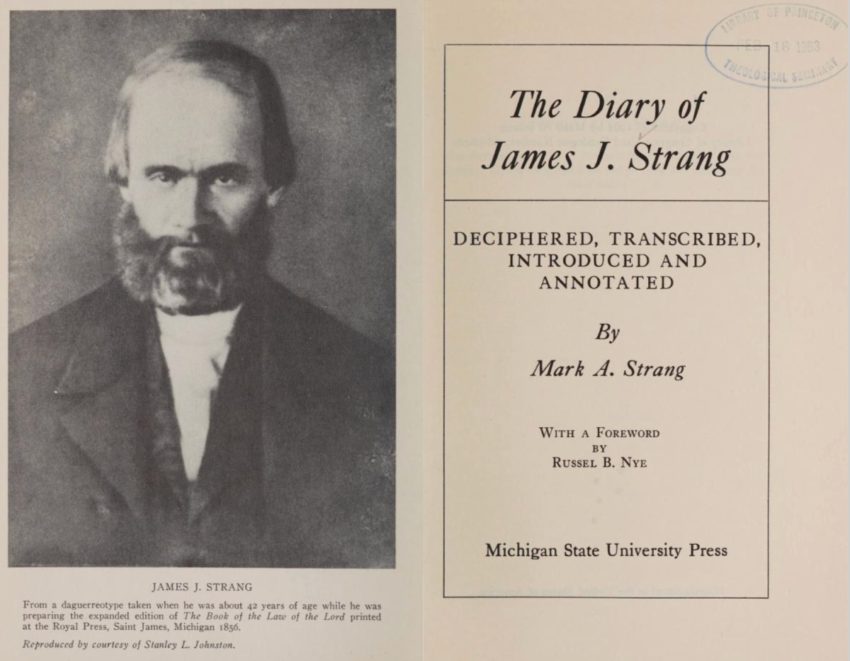
Photo: From the diary of James Strang (see attached PDF). Via Archive.org. Publisher: Michigan State University Press. Copyright review: Public domain according to HathiTrust rights database.
The Mormon King Nobody Remembers:
James Jesse Strang and His Island Empire of Fraud
The Blood of a Prophet and the Ambitions of a Pretender
In the spring of 1844, Nauvoo, Illinois, was a city humming with expectation and dread. Built hard against a great horseshoe bend of the Mississippi, where the river slowed and widened as if pausing to consider what was happening on its eastern bank, the city had risen in the space of five years from a malarial bottomland called Commerce to one of the largest settlements in Illinois — a place that boosters compared, without apparent embarrassment, to Chicago and St. Louis. Brick homes lined the rising slope from the riverfront. A great limestone temple, still under construction, dominated the bluff above the city, its walls climbing toward a roof that would not be finished in time for its prophet to enter beneath it. Steamboats called daily at the Nauvoo wharf, unloading converts from England, Canada, and the eastern states — Welsh coal miners, Yankee farmers, English factory hands, all of them drawn by the promise of gathered Zion and a kingdom not of this world.

The streets ran with the noise of construction, of commerce, of preaching, of rumor. Believers, doubters, merchants, drifters, journalists, dissenters, polygamists living quietly behind closed doors, federal officers watching from a distance, and land speculators alert to the next opportunity all moved through the same dust at the same hour. The city had its own militia — the Nauvoo Legion, several thousand strong — drilling in the streets under the command of Joseph Smith himself, who held the rank of lieutenant general, a rank no American since George Washington had legally claimed. The city had its own municipal court, its own newspaper, its own university charter, its own civic government answering only nominally to the state of Illinois. It had become, in everything but formal declaration, a kingdom inside a republic — a frontier Zion rising fast enough, and arming itself thoroughly enough, to alarm everyone who watched it from the surrounding counties.
And its prophet, in that same spring, had declared himself a candidate for the presidency of the United States. Joseph Smith was running on a platform that called for the abolition of slavery, the reform of the national banking system, the annexation of Texas and Oregon, and the consolidation of executive power in ways that would have unsettled even his sympathizers had they listened carefully. He sent missionary-electors out across the country to campaign on his behalf. He believed, with the certainty that had carried him through every previous improbability, that the office was within his reach.
And around that fragile, feverish experiment in the river bottoms — the temple half-built, the militia drilling in the streets, the prophet running for president, the converts arriving daily from across the Atlantic — the old enemies were tightening their circle.
Then came June 27. At Carthage Jail, a mob surged in, and Joseph Smith was murdered. The shots that ended his life did more than kill a man. They split a movement, shattered a hierarchy, and opened a wound that would not close for years. Out of that rupture came ambition, deceit, revelation, violence, and the desperate scramble to seize a church with no obvious successor.
One of the first men to see the opportunity was James Jesse Strang. He was short, balding, sharp-eyed, and, by most accounts, forgettable at first glance. He had been a Mormon for barely a year. He had held no high office, commanded no great following, and inspired no grand expectations. Yet within weeks of Smith’s death, Strang produced a controversial letter, allegedly postmarked before the murder became known, naming him as the rightful heir. With that paper in hand, and with the dead prophet still warm in memory, Strang stepped into the storm.
To understand why this worked, you have to understand the age that made it possible. The 1840s were not merely restless; they were spiritually combustible. Old certainties had begun to fail. Churches felt distant. Markets were unstable. The republic had promised order and abundance, yet for many people it delivered displacement, anxiety, and hunger. Across the frontier and the backroads, Americans were asking the same question in different words: Has God gone silent?
Into that silence came a flood of voices. Preachers. Visionaries. Prophets. Fraudsters. Men who claimed angels had spoken to them, that buried scripture lay in the American earth, that heaven had chosen this moment and this land for something new. In that world, miracles were not quaint beliefs. They were expectations. Revelation was not a relic of the Bible; it was supposed to be happening now. And because so many were starving for certainty, even the most transparent impostors could, for a time, pass themselves off as chosen.
James Jesse Strang understood that hunger. He entered a world already primed for the next prophet, the next sign, the next kingdom. What followed was one of the most audacious and tragic religious power plays in American history. And as journalist and scholar Miles Harvey writes in his meticulously researched 2020 book, The King of Confidence, Strang’s story is at once a frontier adventure, a religious thriller, and a parable about the peculiar hungers that have always defined American life — the hunger for certainty in uncertain times, for charisma when institutions have failed, for transcendence when the material world has offered only disappointment, and for a king in a republic that was never supposed to have one.
The Burned-Over District and the Making of a Confidence Man
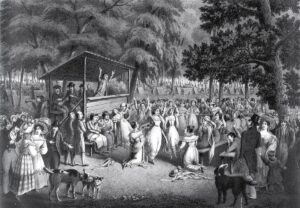
To understand James Jesse Strang, you have to begin with the country that made him. He was born in 1813 in Scipio, Cayuga County, New York, in the broad stretch of upstate country that historians would later call the Burned-Over District—a region so repeatedly swept by revivalism that it seemed, at times, to have been set on fire by religion itself. This was the soil from which Mormonism emerged, where the Fox sisters heard their mysterious rappings, where the Millerites waited for the end of the world, and where Joseph Smith, a long line of prophets, reformers, and millennial dreamers, carried one restless religious experiment after another into the anxious ground of early nineteenth-century America. The landscape itself seemed to invite revelation.
That was no accident. The young United States was a nation in motion, and motion unsettled everything it touched. The Panic of 1837 had shattered savings and confidence. Banks failed. Farms were lost. Men who had done everything the republic asked of them found themselves ruined, while sharper operators somehow seemed to thrive. At the same time, canals, railroads, steam power, and the telegraph were shrinking distance and speeding life into something unfamiliar, almost unreal. The old assurances—about community, about prosperity, about the hidden order of the world—were giving way.
And when the market failed to explain suffering, religion rushed in to do what markets could not: give pain a meaning, chaos a pattern, and desperate people the hope that history had not abandoned them.
As Miles Harvey writes in his vivid account of the life and times of this American sect leader, “The King of Confidence:”
“Confidence was black magic, good fortune and hard cash combined. Confidence could turn worthless paper into glittering gold, cow towns into cities, empty lots into bustling businesses, losers into winners, paupers into millionaires. Confidence was a charm deployed by bankers, merchants, philosophers, politicians, clergymen and card sharps alike. Confidence was the soul of trade in the words of one leading financial publication. Without it, added Herman Melville, commerce between man and man, as between country and country, would, like a watch, run down and stop.”
In an America where confidence itself could be converted into power, James Jesse Strang learned early that certainty often moved men more effectively than force. Before he ever appeared in Nauvoo, he was already improvising a life at the edge of respectability and ambition: a schoolteacher, an editor, a lawyer by training and admitted to the Bar at age 23, a local political hopeful, and a man restless enough to keep remaking himself before any single version could harden into a permanent identity. He was born in 1813 in Scipio, Cayuga County, in the religiously volatile world of upstate New York, a region where revivalism had already trained ordinary people to expect extraordinary things. That landscape did not simply produce Strang; it taught him how to read desire, how to borrow conviction, and how to recognize the power of a well-timed claim.
Even before his Mormon years, Strang seems to have understood that belief was never just a matter of theology. It was rhetoric, timing, posture, and nerve. In the journals that survive from his youth, he emerges as a man of striking duality—idealistic in one register, calculating in another, capable of writing about justice, destiny, and human greatness with real intensity while also showing signs that he knew how to speak the language of faith in ways that moved other people deeply. Whether he believed as strongly as he sounded is harder to say than whether he understood the emotional machinery of belief. The surviving evidence suggests a man who could inhabit conviction even while remaining strangely detached from it.
In western New York, Strang spent his early adult life assembling a self from whatever tools the moment offered. He taught school, studied and practiced law, served as postmaster at Ellington, and edited a weekly paper there, all while trying to convince the world—and perhaps himself—that he was on his way to something larger. He had married Mary Perce by the mid-1830s, and the life that followed was marked by the ordinary pressures that can make ambition curdle into restlessness: debt, strain, disappointment, and the slow accumulation of obligations that never quite went away.
That was the world in which he learned to move. Before he was prophet or claimant or would-be king, he was already a man in motion, always shifting ground, always testing another identity before the last one had fully taken hold. In the language of the age, he was a shuffler—not merely a drifter, but someone suspected of evasion, a man with a talent for staying just ahead of consequence. It was a useful skill in a frontier republic that rewarded confidence and tolerated reinvention, but it also left a shadow behind him. By the time he headed west, Strang had already learned how to disappear into his own becoming.
The Panic of 1837 made that talent more important. As the economy convulsed, land speculation turned ruinous, debts became harder to hide, and the social order that had seemed stable suddenly looked provisional. For men like Strang, the collapse of confidence in the marketplace was also a collapse in the moral vocabulary of success. If ordinary routes to security failed, then reinvention became not just a strategy but a necessity. Strang’s trajectory through those years suggests a man learning, sometimes painfully, that stability belonged to institutions, while survival belonged to adaptability.
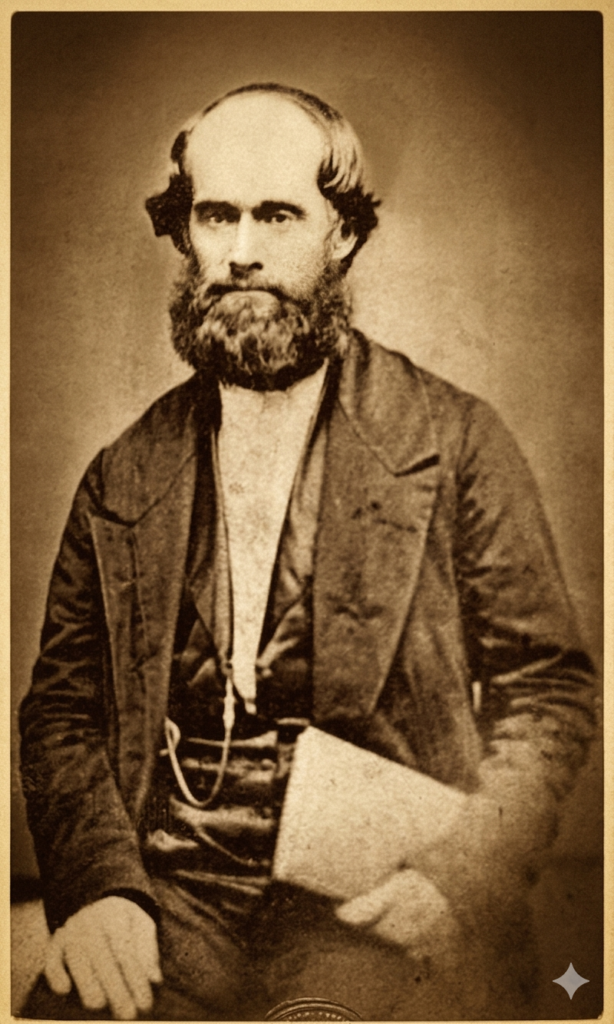
By the time he turned west, Strang was not simply seeking work or refuge. He was leaving behind a life already under strain—debts, professional frustrations, and the pressure of a man who had learned that reinvention was often the fastest way out of trouble. He departed western New York in 1843 with his wife, Mary Perce, and their children, carrying with him the accumulated liabilities of ambition, speculation, and unfinished plans. He was also, by his own account, a skeptic or freethinker, a man who had already moved through religion rather than simply toward it, serving for a time as a Baptist minister before eventually joining the Latter-day Saints. The frontier offered something he could not find at home: a stage large enough for reinvention, where a man could arrive under the weight of old failures and begin again as if the past were only a rumor. Nauvoo would become the most important of those stages, but Strang had already been rehearsing for it for years.
He arrived in Nauvoo, Illinois, in the early 1840s, a declared atheist stepping into the capital city of the most dynamic new religion in America. What happened next remains, even to careful historians, something of a mystery. Strang converted to Mormonism and was baptized by Joseph Smith himself. Whether his conversion was genuine—whether some authentic spiritual crisis accompanied his entry into the faith—or whether it was simply the most spectacular long-game confidence scheme of his career, no one knows for sure.
From there, the story turns into one of the strangest succession struggles in American religious history. When Joseph Smith was killed in June 1844, Strang later produced the controversial letter that would help launch his claim to leadership. Whether he entered Mormonism as a genuine convert, an opportunist, or something more complicated remains part of the enduring mystery that makes his story so compelling.
He’s a guy who was a, you know, an obscure farm boy from western New York who kind of failed at everything he did. He was a self-trained lawyer, a newspaperman, and a postmaster general. And then he left New York in a scandal and moved out to what was then called the West, now the Midwest, and remade himself.
— Miles Harvey, NPR Interview, “The King of Confidence”
What Strang possessed, above all, was presence. Contemporary descriptions and later biographies alike give him the look of a man who could not be dismissed at a glance: short, balding, slight in frame, but marked by a pair of close-set, penetrating eyes that seemed to intensify everything around them. In a nineteenth century that still took phrenology seriously and treated the body as a readable map of character, those eyes mattered. They helped make Strang’s authority visible before it was fully proven, and in a culture primed to trust outward signs, that was no small advantage.
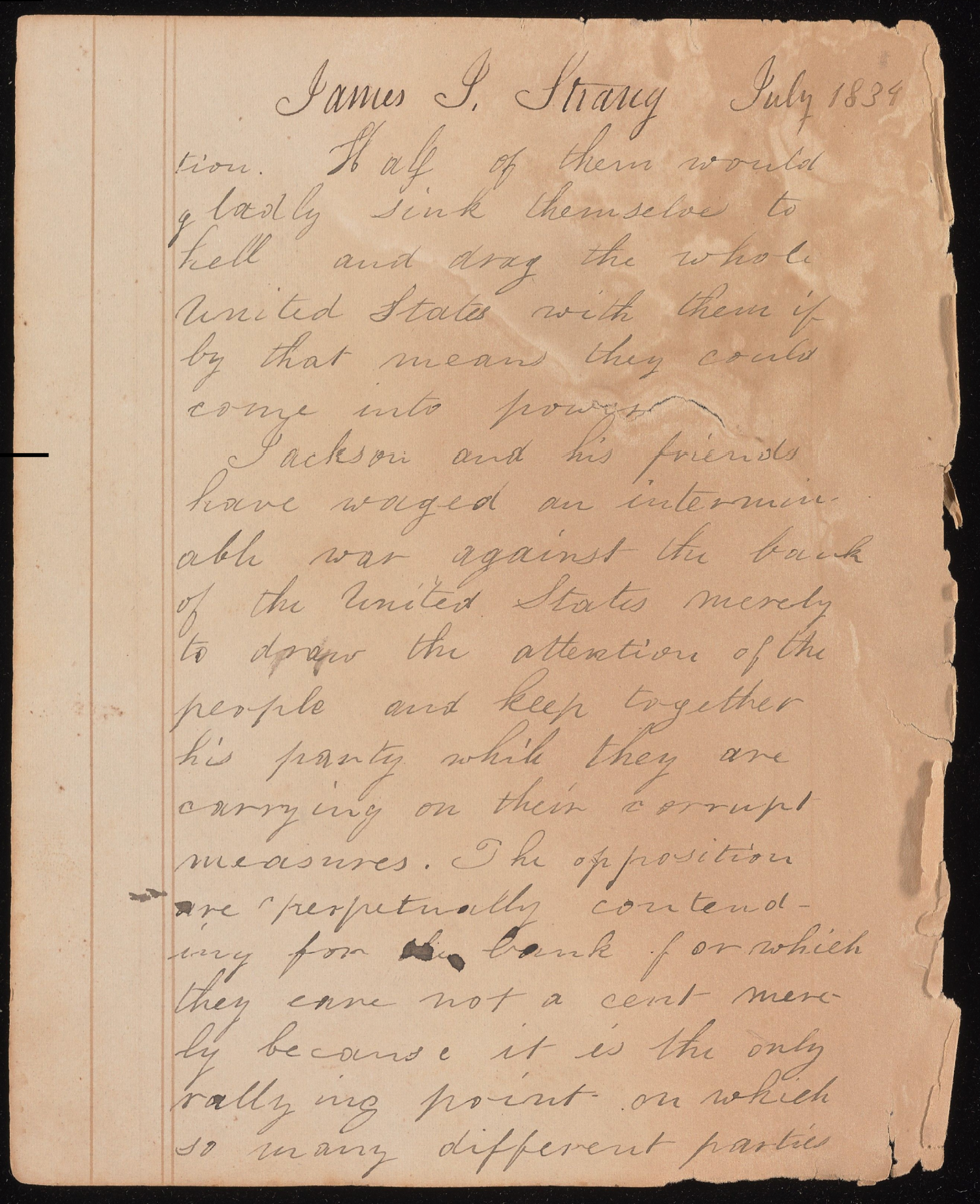
The deeper strangeness lies in the paper trail he left behind. From his early journals, Strang emerges not as a simple believer or a simple fraud, but as a man who understood both the power of conviction and the utility of performance. He wrote with genuine intensity about justice, destiny, and the human capacity for greatness, yet his own papers also suggest a sharp awareness that religious language could move people even when the speaker himself stood at a remove from belief. As he admitted in one revealing line, “I read the Bible sometimes, because if the people saw I did not, they would say I am not religious.” That doubleness—idealistic, self-conscious, calculating—would become one of the governing facts of his life.
It is easy to imagine such a man as a creature of contradiction, but the age that produced him was itself contradictory in the same way. America in the 1830s and 1840s was full of people who had lost faith in old institutions but not in the possibility of revelation. They distrusted established authority and yet remained hungry for voices that sounded certain. They had watched revivals sweep through towns, prophecies fail, banks collapse, fortunes vanish, and then new movements rise from the wreckage as if the ruins themselves were fertile. In that world, a man like Strang did not need to seem saintly. He needed only to seem sure.
That was the real force behind him. Not humility. Not sanctity. Not even consistency. It was the ability to stand in the middle of spiritual instability and project the kind of confidence that made doubt feel like a private weakness. If his eyes were memorable, it was because they seemed to promise what the era wanted most: not just revelation, but certainty.
As Harvey noted in his NPR interview with Scott Simon:
“In those journals, you see this idealism and cynicism side by side. On the one hand, he’s a very idealistic guy. On the other hand, he realizes and talks about how he is able to talk about God to people in a way that really moves them, but that he doesn’t believe in at all. But he’s not going to tell him.”
This was the engine of Strang’s career: an uncanny ability to recognize spiritual appetite and turn it to his own advantage. He did not merely preach to believers; he seemed to study them, measuring their longings the way another man might measure timber or land. What others called faith, he understood as leverage. What others treated as revelation, he knew could also be theater. And whether he believed any of it at the outset or not, he moved through the world as if conviction itself were a tool to be wielded.
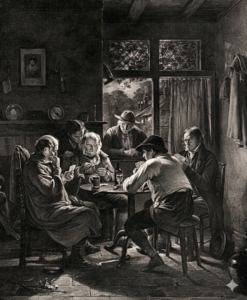
In the language of the time, Strang was a shuffler—a word that suggested more than restlessness. It carried the smell of evasion, of a man who kept one step ahead of his creditors, his critics, and the consequences of his own making. In the mid-nineteenth century, to call someone a shuffler was to accuse him of moral slipperiness as much as movement. The term implied not just motion, but dodging; not just change, but concealment. It fit a frontier culture where identity could be improvised, and reputations could be rebuilt, but it also hinted at a deeper suspicion: that some men did not simply struggle under pressure; they maneuvered under it. Strang belonged to that category. He was always becoming someone else just in time to escape being held to account for the person he had already been.
By the summer of 1843, that restless life had begun to close in on him. Legal trouble and financial pressure made New York less a home than a trap. So Strang did what he would do again and again: he broke with the old ground and moved toward a new one. He headed west, toward the Mississippi, toward Nauvoo, toward the richest spiritual marketplace in America. There, in the booming Mormon capital on the river, James Jesse Strang would begin the most audacious undertaking of his life—one part conversion, one part self-invention, and one part confidence game.
The Letter and the Plates: A Succession Forged in Confidence
Nauvoo in 1843 was extraordinary by any measure. In just a few years, Joseph Smith had turned a mosquito-ridden bend of the Mississippi into a bustling Mormon city of roughly 12,000 to 15,000 people, drawing converts from the American East and from Britain, including England, Wales, and Scandinavia. It had its own municipal government, its own militia, and a religious culture built on continuing revelation, angelic encounter, and the conviction that God was still speaking in the present tense.
Association for Mormon Letters: Evil along the Mississippi: Stories from Nauvoo
Towards the end of his life, Joseph Smith developed a memorable quip. When a critic declared that his people would be damned for their heretical ways, he retorted: “if we go to hell, we will turn the devils out of doors and make a heaven of it.” The Latter-day Saints would exorcise Pandemonium. The Saints had not settled in Hell in 1839 when they settled along the Mississippi River, but the metaphor would not have escaped them. Smith described Commerce, Illinois, where much of the Saints’ purchase was located, as “literally a wilderness. The land was mostly covered with trees and bushes, and much of it so wet that it was with the utmost difficulty a footman could get through, and totally impossible for teams. Commerce was so unhealthful, very few could live there.” Commerce—later renamed Nauvoo [meaning “a beautiful place”]—was chosen as a last resort. This strange group of refugees from Missouri found “no more eligible place presenting itself.”
For a man like James Jesse Strang, Nauvoo would have looked less like a town than like an unlocked vault of opportunity—an astonishing metropolis already four years in the making.
Strang arrived in Nauvoo in early 1844, when the city was already humming like a frontier capital under pressure. He soon came into Joseph Smith’s orbit and, within days, was baptized in the Nauvoo Temple font, entering the church at the very moment the movement stood at its most expansive and its most vulnerable. Whatever passed between the two men in those brief encounters is still partly hidden from view, but the meeting had the feel of a convergence between ambition and revelation: the founder of a new religious world and a restless newcomer who seemed to understand its temperature almost at once.
What makes the episode so compelling is not just the speed of Strang’s acceptance, but the setting. Nauvoo in 1844 was not a small sectarian outpost; it was a rapidly built city with political aspirations, a growing population, and a religious culture that treated divine communication as immediate and ongoing. For Strang, that meant entering a place where belief was not merely private conviction but public power, where baptism was also a kind of credential, and where proximity to Joseph Smith carried enormous symbolic weight.
Whether Strang’s conversion was sincere, strategic, or some difficult blend of the two remains one of the enduring mysteries of his career. But by the time he came up from the baptismal waters, he had placed himself inside the most volatile religious experiment in America just as it was cresting toward crisis. Harvey explored it with characteristic nuance:
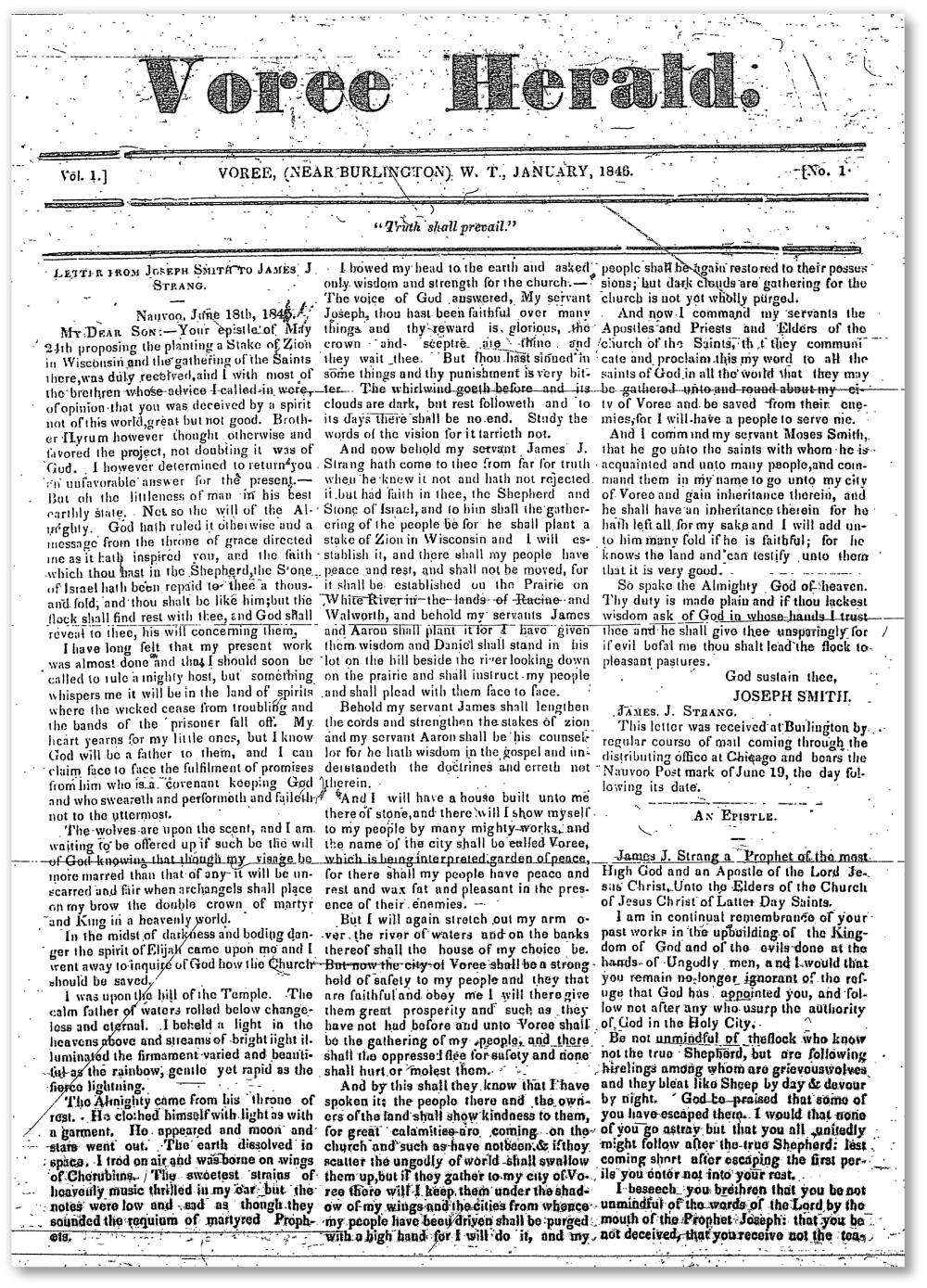
“Whether the conversion was real, I don’t know. But anyway, shortly thereafter, Joseph Smith was murdered by a mob. And this guy, James Jesse Strang, claimed that Smith had sent him a letter just before he died saying, you know, son, the church is yours.”
Harvey’s phrasing carries the weight of the whole story in a single line: shortly thereafter. Strang had been a Mormon for barely four months when the prophet who baptized him was killed. Four months. That is not enough time to learn a theology, let alone to rise within a church hierarchy, let alone to earn a place in the line of succession. And yet four months was all the time the story required — because the door that opened on June 27, 1844, was not opened by years of faithful service. It was opened by violence. It was opened by the sudden, bloody removal of the only man whose authority no one in Nauvoo had ever questioned. And it was opened wide enough for a recent convert from Wisconsin to walk through it with a letter in his hand and claim everything.
To understand what Strang walked into, it is necessary to understand what had just been taken away.
Joseph Smith’s death did not create uncertainty so much as detonate it. For years, succession in Nauvoo had been held in suspension, an ambiguity that served Joseph while he lived and became a crisis the moment he was taken out of the story. By the spring of 1844, he was facing charges in Illinois after ordering the destruction of the Nauvoo Expositor, a dissenting newspaper that had published allegations of polygamy and theocratic overreach within the church. He surrendered to authorities at Carthage on charges of riot and treason and was being held in the jail there, along with his older brother Hyrum, awaiting hearing. On June 27, 1844, a mob with blackened faces stormed the building and shot both men dead, and with the sound of those shots, the Latter-day Saint movement entered a contest over memory, legitimacy, and power.
What followed was not chaos alone, but a race to impose order on it. Brigham Young, as president of the Quorum of the Twelve Apostles, understood that institutions could become armor when personalities failed. He did not simply argue that he should lead; he argued that the church already had a lawful vessel for survival, and that vessel was the Twelve. In the anxious weeks after the martyrdom, while rival claimants pressed their cases and Nauvoo trembled under the weight of grief and rumor, Young turned ecclesiastical structure into a weapon of consolidation.
By August, the struggle came into the open before thousands of Saints gathered in Nauvoo. Young’s claim carried force not because he seemed softer, or holier, or more theatrical than his rivals, but because he made continuity look like revelation. In a city still reeling from the loss of its prophet, that was enough. The majority sustained the Twelve, and from that decision grew the great westward migration that would carry the Mormon people to the edge of the Great Salt Lake.
What happened next was breathtaking in its audacity.
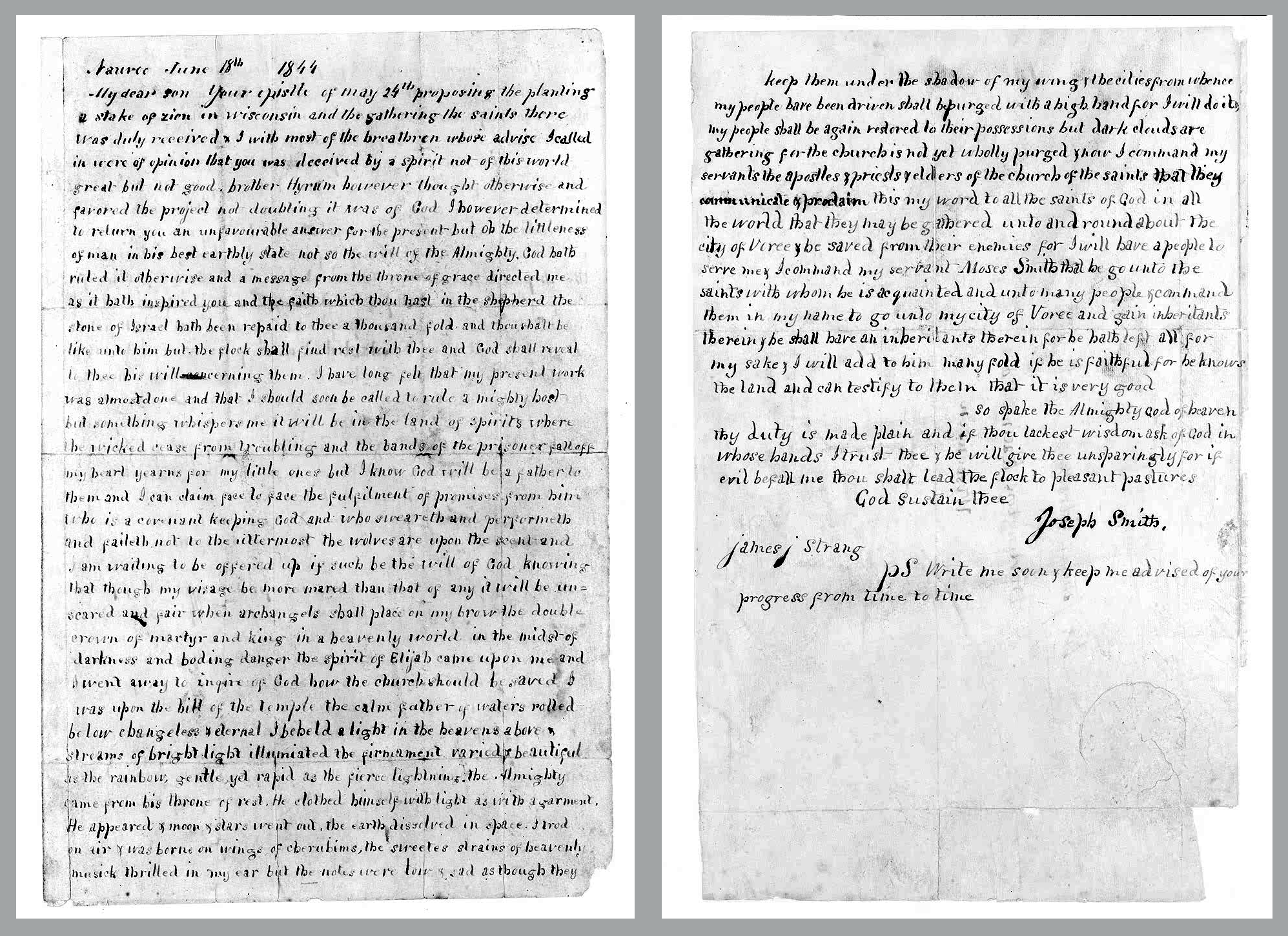
In the wreckage of Joseph Smith’s death, James Jesse Strang produced the piece of paper that would make his career. It was a letter, or what survived of one, said to have been mailed from Nauvoo before the murder and now presented as Smith’s own hand reaching across the grave to name Strang as the Church’s successor. In a movement built on revelation, the claim was not absurd on its face. It was terrifyingly plausible.
Strang had studied the world he meant to enter. He knew that the Saints had already accepted a universe in which God spoke through angels, stones, visions, and prophets; that they had built their lives around the possibility that heaven still intervened in history. To such people, a prophet’s letter was not a curiosity. It was evidence of the kind they had been trained to recognize.
He also knew the grammar of bureaucracy and the theater of authenticity. Years as a postmaster had taught him the authority carried by a postmark, the small technical details that could make a document seem to come alive. And he understood the deeper truth that every forger eventually learns: the most effective deception does not force belief. It simply gives belief something to hold.

The pattern Strang exploited in 1844 would prove to have an extraordinarily long afterlife. Nearly a century and a half later, in the 1980s, a young Latter-day Saint document dealer named Mark Hofmann would run the same play against the modern church — fabricating “discovered” documents designed to rewrite the origins of Mormonism, and selling them to the highest councils of the institution itself. As I argued in Mark Hofmann and the Mormon Murders, what made the Hofmann case theologically devastating was not that a forger deceived historians — forgers deceive historians in every field — but that he deceived the specific men who claimed a divine gift of discernment. The apostles and First Presidency who authenticated Hofmann’s forgeries, purchased them, and quietly locked them in the Church vault were the same men sustained by millions of Saints as prophets, seers, and revelators. They possessed, by their own doctrine, the supernatural capacity to see through exactly the kind of fraud Hofmann was selling them. They did not see through it.
Strang’s success in 1844 and Hofmann’s success in the 1980s are separated by almost one hundred and fifty years, but they rest on the same foundation. A religious tradition built on the premise that documents can fall from heaven, that prophets can recognize the voice of God in writing, and that the institution itself is divinely protected from deception — is a tradition uniquely vulnerable to the forger who understands its grammar. Strang gave the early Saints a letter. Hofmann gave the modern Church the infamous Salamander Letter, which purported to show Joseph Smith receiving the plates not from an angel but from a white salamander that transformed before his eyes — a document senior Church leaders authenticated and acquired before its forgery was exposed. In both cases, the document did exactly what forgeries always do: it gave belief something to hold.
The letter worked, at least at first. It gathered a following, enough believers to give Strang a foothold and a future. In the summer of 1844, that was all he needed. With a dead prophet in the ground and a living church still searching for direction, James Jesse Strang had found the opening he would spend the rest of his career exploiting.
It was not enough for Strang to produce a single miraculous document. He understood that Mormonism had been built not only on revelation, but on things you could point to, touch, and hold in your hands: golden plates pulled from a hillside in Palmyra, seer stones that glowed in the darkness of a hat, a breastplate of ancient design, sacred instruments that gave spirit a physical address. The whole faith rested on the conviction that God had left artifacts behind, and that the right man, at the right hour, could be led to dig them up. If Strang was going to persuade believers, a letter alone would not be enough. He needed relics of his own — something the eye could see and the hand could hold.
So in September of 1845, Strang gathered four of his most trusted followers and led them to a wooded hillside near Burlington, Wisconsin, in the little settlement he had named Voree — a name he said meant “garden of peace.” He told them he had seen the place in vision. An angel, he said, had shown him the tree, the slope, the exact ground where something sacred lay buried. The men came as witnesses, not as diggers, because Strang wanted what Joseph had wanted: not just an artifact, but testimony. Let them see the earth undisturbed before the shovel broke it. Let them watch the object emerge from the ground that no living man had touched.
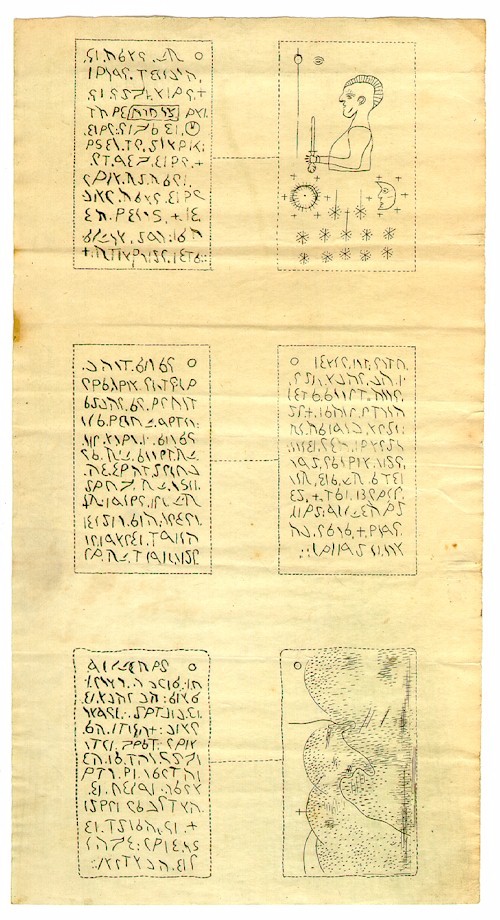
Under an oak tree, at the base of its roots, the spades struck something hard. The men cleared away the soil with their hands. What they lifted out of the Wisconsin dirt was a set of three small brass plates, dark with age, bound together and covered in a script no one present could read. The text, Strang would later announce, belonged to a figure called Rajah Manchou of Vorito — a long-lost ruler of an ancient and vanished civilization whose people had once walked this very ground. It was a story with just enough familiarity to feel plausible to people already primed for buried scripture, already schooled in the idea that America’s soil held the records of forgotten nations waiting for a prophet to call them forth.
The witnesses signed a statement. The plates were real. The ground had been undisturbed. They had seen it with their own eyes.
It was a performance Joseph Smith himself could not have staged better. In fact, Joseph Smith had staged it — twenty years earlier, on a hillside in New York.
The question of whether the Voree Plates are genuinely ancient is, in the end, a matter of faith — the same species of question that surrounds the Book of Mormon itself, and one this essay is not attempting to settle. That larger argument has its own long and unfinished history, and discussed at length in our essay, “Lost in Translation: The Impossible Language at the Heart of Mormonism.”
But set the question of antiquity aside for a moment and look at the object itself. Whatever one concludes about its origin — whether it fell from the hand of an ancient American ruler or was hammered out on a Burlington workbench in the summer of 1845 — the Voree record was, by the standards of nineteenth-century amateur craftsmanship, a remarkable piece of work. Three small brass plates, carefully engraved on both sides. An invented alphabet, consistent enough in its characters that later analysts could identify repeated words. A map of the Voree settlement on one face. Illustrations of the all-seeing eye, a scepter-bearing man, and the sun, moon, and stars on another. Dimensions small enough to fit in a palm, weight sufficient to convey age, patina dark enough to suggest centuries. Someone had thought about this. Someone had sat with the problem of how an ancient record ought to look, and ought to feel, and ought to behave in the hand, and had produced an artifact that answered every one of those questions.
That is why early Latter-day Saints, already schooled by the Book of Mormon to expect buried scripture, looked at the Voree Plates and saw precisely what they had been trained to see: fresh evidence that the heavens had not closed, that God was still speaking through hidden records and chosen prophets, and that the last days were unfolding exactly as Joseph had promised they would. The plates did not need to be ancient to do their work. They only needed to look ancient enough that the people who wanted to believe could believe — and that, whoever made them, is what the plates did.
Strang then claimed to translate the inscription with the aid of seer stones — or, as he phrased it, by the Urim and Thummim, consciously echoing the instrument Joseph Smith had used on the gold plates two decades before. The translation was brief, poetic, and unmistakably scriptural in its cadences. It opened as a lament for a vanished people:
My people are no more. The mighty are fallen and the young, slain in battle. Their bones bleached on the plain by the noonday shadow.
– Doctrine & Covenants
It then moved, as such texts always seem to move, from mourning to prophecy. The lost civilization had fallen through transgression, but a remnant would rise. A chosen people would return to the land. And then, in a passage Strang later circulated but did not include in his first public translation, the voice of Rajah Manchou turned, across the centuries, directly toward nineteenth-century Wisconsin:
It shall come to pass in the latter days, that my people shall hear my voice, and the truth shall speak from the earth, and my people shall hear, and shall come and build the Temple of the Lord. My prophet, unto whom I send my word, shall lead them, and guide them in the ways of peace and salvation. In Voree the name of the Mighty One shall be heard, and the nations shall obey my law, and hear the words of my servant, whom I shall raise up unto them in the latter days.
– Wikipedia
The message was neatly tuned to its purpose. An ancient ruler, dead for centuries, had looked across time and named the place — Voree — where God would raise up a prophet in the last days. Smith, by implication, was the forerunner whose ministry had prepared the soil. Strang was the servant, the prophet whose word the nations would obey. In one stroke, the buried plates turned his claim from argument into prophecy, and from prophecy into scripture. The Saints were not being asked to trust Strang. They were being asked to trust the dead.
And here was the masterstroke — the detail that separated Strang from every other claimant in the succession crisis, and from Joseph Smith himself. Joseph’s golden plates had always lived at a careful distance from ordinary sight. They were wrapped in linen, hidden in a wooden chest, carried from cabin to cabin under the cover of night, and shown at last to only a small and carefully chosen circle of witnesses — men who signed their names to a testimony that was, in the end, about something they had mostly seen through the eye of faith. When the translation was finished, the plates were taken away by an angel. No one could hold them again. No one could check.
Strang’s plates could be held.
They sat on a table in Voree, Wisconsin, where any curious visitor — believer, skeptic, reporter, passing stranger — could pick them up, turn them over in his hand, examine the engraved lines, and set them down again. They were small enough to fit in a palm. They were made of brass, tarnished to the proper antiquity. They were, unmistakably, real objects that existed in the ordinary world. Even C. Latham Sholes, the newspaper editor who would later patent the first typewriter, examined the plates and the site from which they had been taken and confessed himself unable to reach a conclusion. He thought Strang was honest. He thought the witnesses intelligent. He went home baffled.
That bafflement was exactly the point.
In a religious world where hidden scripture and vanished angels and artifacts borne away to heaven were already part of the furniture, Strang offered something that the Saints had never quite been given before: a miracle you could touch. The plates did not merely support his authority. They performed it daily in front of anyone who came to see. Every hand that closed around the cool weight of that brass was, in a small way, a hand that had voted for him. Every visitor who left Voree “staggered,” as Sholes put it, was a witness that Strang had not asked for and did not need to pay. The evidence spoke for itself, because Strang had made it speak.
This was his genius, if that is the word for it. He had taken frontier religion, documentary theater, and the new American appetite for spectacle, and he had fused them into a single act of persuasion that no previous Latter-day Saint claimant had thought to attempt. He knew what his audience would accept because he knew what it had already been trained to expect — buried plates, ancient scripts, prophetic translations, sealed testimony from the dead. Joseph had given the Saints a story about such things. Strang gave them the things themselves.
And in Wisconsin, for a season, it worked. The faithful gathered. Belief spread across the upper Midwest on wagon roads and steamboat routes and the pages of The Voree Herald. Letters came in from Saints who had grown uneasy under Brigham Young and wanted to know whether the true prophet might, after all, be living quietly in a town they had never heard of. And James Jesse Strang — with his lawyer’s instincts, his postmaster’s eye for the authority of paper, and his uncanny sense of when to produce the next piece of evidence — kept building his kingdom one artifact at a time.
And Strang did not work alone. Years later, a disaffected Strangite named Isaac Scott would report a confession from a man named Caleb P. Barnes — Strang’s own law partner in Burlington — that he and Strang had together fabricated both the Letter of Appointment and the Voree Plates. Whether every detail of Scott’s account is reliable is a question historians still debate. But the confession points at something the prosecutorial eye recognizes immediately: Strang had chosen, as his closest confidant in the early months of his prophetic career, not a fellow believer but a fellow attorney. A man trained, as Strang was, in the weight of signatures, the authority of seals, the persuasive power of a document that looked the way a document ought to look. A man who understood, in other words, the exact craft the plates required.
It is a small detail, and the evidence is secondhand, and no responsible historian claims it closes the case. But it fits. It fits the pattern of a prophet whose revelations conveniently arrived on paper, whose angels delivered artifacts rather than instructions, and whose miracles could always be examined, turned over, and set back down on the table. Strang was not just a prophet. With Barnes at his side, he was a practice — two lawyers, working quietly, producing the evidence their age demanded.
Beaver Island: The Kingdom at the Edge of the World
The community Strang built at Voree was never entirely secure. His claims were under attack from within the broader Latter Day Saint world, where many regarded him as an interloper, an opportunist, and, in the harshest assessments, a conscious fraud. Pamphlets circulated against him. Former allies broke away and published their denunciations. Apostles who had accepted his authority began, one by one, to reconsider what they had seen. His non-Mormon neighbors in Wisconsin, meanwhile, had little reason to trust the tightly bound colony he was assembling at the edge of their farmland — a community that spoke of kings and prophecies, collected tithes, and looked inward toward its own prophet rather than outward toward the county courthouse. And far to the east, in the great westward migration already underway, Brigham Young was consolidating an authority that Strang could not match. Young had the numbers. Young had the apostolic quorum. Young had the organizational genius that Joseph himself had depended on in his final years. Every month that passed, more wavering Saints concluded that the true mantle had gone west with the wagons, not north with the prophet of Voree.
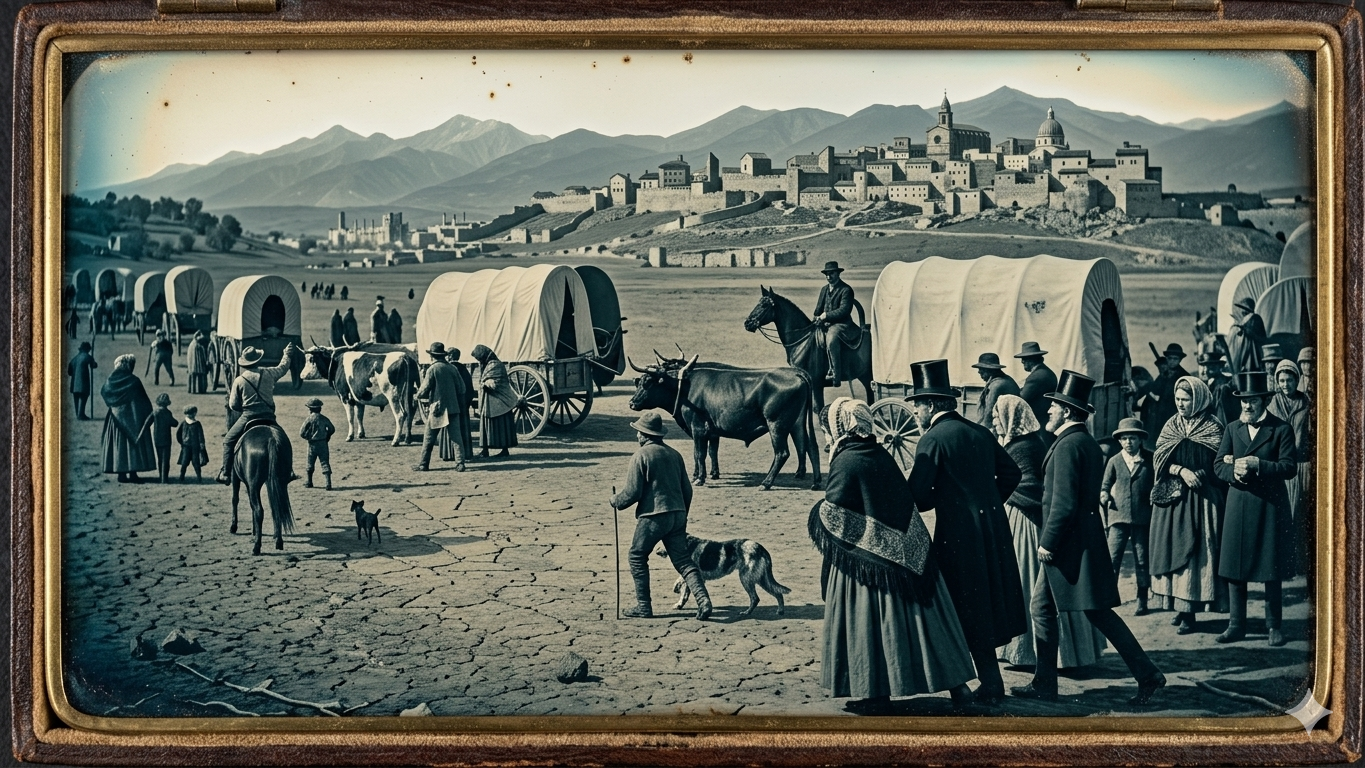
Strang needed a place where distance could become power. He needed ground where his enemies could not easily reach him, where his prophecies could not be cross-examined by neighbors, and where the institutions of ordinary American life — sheriffs, newspapers, grand juries — would arrive, if at all, only in diminished and negotiable form. He needed, in short, a frontier within a frontier. And in the late 1840s, he announced that a revelation had shown him exactly where to go.
The place was Beaver Island, a long, wooded ridge of land rising out of the cold waters of northern Lake Michigan, some thirty miles off the coast of Michigan’s Lower Peninsula. It was the largest island in the Great Lakes. Its shores were lined with sand and timber. Its harbors, especially the deep natural anchorage at the northeast end, were among the best on the inland seas. For centuries, it had been home to Anishinaabe peoples, who knew its fisheries and its sheltered coves long before any European boat appeared on the horizon. By the 1840s a small community of Irish Catholic fishermen had also settled there, making their living off whitefish and lake trout, worshipping at their own chapel, and minding their own quiet business. They were not looking for a prophet. They were certainly not looking for a king.
To Strang, the island’s attractions were almost embarrassingly plain. It was remote enough to be ungovernable. It was commercially valuable enough to sustain a kingdom. It sat astride the steamboat routes between Chicago, Milwaukee, Mackinac, and the Soo — which meant traffic, and traffic meant opportunity — but it lay far enough from any county seat that law arrived, when it arrived at all, in the form of a visiting officer who could be delayed, confused, or rowed back to the mainland on an unfavorable tide. It was, in the language of the confidence man, a perfect mark: rich, exposed, and just out of reach.
Strang arrived in 1848 with a small company of followers and began remaking the island the moment his feet touched its soil. He established a newspaper, The Northern Islander, which served simultaneously as his press organ, his prophetic voice, and his instrument for shaping the outside world’s understanding of what was happening on the island. He laid out streets. He built a log tabernacle. He organized a theocratic order in which revelation functioned as civil law, in which his word carried the binding force of both pulpit and bench, and in which his own authority stood at the physical and spiritual center of every public act. He sent missionaries back to the mainland to bring in new converts and new tithes. He tightened his grip with a combination of administrative energy, scriptural innovation, and cold exclusion. This may have been the breaking point for his wife, Mary.
BYU Studies: King of Beaver Island
Strang’s first wife, Mary, followed him to Beaver Island, bore him children, and longed for him when he was gone. The reason for their eventual separation is not clear, although she greatly disliked island living as well as her husband’s frequent absences. She left the island even before knowing for sure that he had taken another wife, though Van Noord suggests that there was plenty of evidence despite Strang’s vehement denunciation of plural marriage and his constant denials of his own involvement.
Strang took his second wife, Elvira Field, in 1849. In contrast to Mary, she became not only a wife, but also his “intellectual mate” throughout the rest of his life (82). At first she traveled with him disguised as a man and posing as his personal secretary, Charles J. Douglas. She was called “Charlie,” went with him everywhere, and, under her male name, wrote articles for the Gospel Herald. Not until Elvira’s first child was born did Strang finally receive a revelation permitting plural marriage. Eventually he had five wives; all of them except Mary seemed happy with him.
Those who would not submit were pressured, displaced, or driven out. The Irish fishermen, who had been there first, bore the worst of it. Their nets were cut. Their boats were interfered with. Their families were harassed until staying became harder than leaving. Within a few years, most of the original settlers had fled to the mainland or to other islands, and Strang’s people had taken possession of their harbors, their homes, and their trade. The island was not merely settled. It was seized.
And then, on July 8, 1850, in an act that combined biblical theater, political provocation, and outright audacity, Strang had himself crowned king. He wore a red robe, said to have been cut from the stage curtain of a defunct Michigan theater. A paper crown sat on his head, and some accounts say a wooden scepter lay in his hand. Two hundred and thirty-five of his followers watched. The oath was administered. The kingdom was declared. And in the same month that California was being admitted to the Union as the thirty-first American state, a man on a wooded island in Lake Michigan was proclaimed king of an explicitly theocratic realm — one that recognized no authority above his own, and no law beyond what he said God had given him.
The rest of the country watched with a mixture of fascination, ridicule, and alarm. The eastern newspapers turned “King Strang” into a recurring spectacle, a story that was part frontier absurdity and part genuine menace, and Strang did little to ruin the performance. He understood publicity the way other men understood weather: as something to be used when it served him, endured when it did not, and, where possible, turned to his advantage. He gave interviews. He wrote open letters. He fed the press the very details that made him sound most outrageous, because outrage kept his name in print, and print brought converts, and converts brought tithes.
But the joke concealed something harder, and the laughter from the eastern cities was purchased at a price that the people of northern Michigan paid in cash, in property, and sometimes in blood. On Beaver Island in the early 1850s, religious community and predatory enterprise existed side by side, and the line between them grew steadily harder to see. Strang’s followers were accused — credibly, repeatedly, and from multiple independent sources — of raiding along the Lake Michigan shoreline. They took timber from unguarded stands. They lifted boats from harbors where boats had been left for the season. They drove off horses and cattle. They operated what amounted to a protection racket on the fishing and lumber trades of the northern lake, and the tribute flowed, one way or another, back to the king. Miles Harvey, working through court records, newspaper accounts, and the meticulous archival trail left by the raids and the lawsuits they generated, documents what the mainland communities had long suspected: that the island harbored counterfeiters, land pirates, and timber poachers operating, without apparent shame, under the protective umbrella of Strang’s religious authority.
What had emerged on Beaver Island was a contradiction that sat in plain sight for anyone willing to look at it. It was a genuine religious settlement, with genuine believers, who genuinely sang hymns on Sunday mornings and genuinely believed their prophet was the successor of Joseph Smith. And it was, at the same time, a frontier kingdom that fed on coercion, that thrived on opportunism, and that depended on fear to keep its people in and its enemies out. The two realities were not alternatives. They were woven together, supporting each other, each making the other possible. The religious authority sanctified the coercion. The coercion enforced the religious authority. And Strang, at the center of both, had ceased to be merely a prophet.
He had become a regime.
And Then There Were the Headlines!
Atlas Obscura: The Rise and Fall of the Mormon King of Beaver Island
In 1855, newspapers from Michigan to New York began to run stories about “a gang of marauders” or “pirates” plaguing Lake Michigan. The gang burned sawmills and stole goods, which they displayed on their ships. They carried out “their operations with a boldness, coolness and desperation rarely equalled in the records of highwaysmen,” according to an 1855 article from The Hillsdale Standard, published in southern Michigan.
“There seems to be no question as to the identity of robbers, or their hailing place,” the story continued. “They are emissaries from King Strang’s realms.”
More tales followed. Strang and his followers were settled with responsibility for luring ships ashore to board and plunder, stealing horses, and destroying nets in areas where fishing was big business.
Many of these tales of Strangite piracy have been dismissed over the years, and they’re a little part of the lore told on the island today. Cynthia Prior, a historian for the local lighthouses on Beaver Island, says she’s never heard of that side of Strang. “That’s all folklore,” says the Mormon historian Hajicek. He says it was a twisting of real events, when a ship washed ashore and the Mormons salvaged the wheat aboard.
The Coronation: King of Heaven and Earth
On July 8, 1850, on a wooded ridge above the waters of Lake Michigan, James Jesse Strang staged one of the most remarkable spectacles in early American religious history — a ceremony so improbable that no honest account of the event has ever quite succeeded in explaining how it happened, or why, for a brief moment, so many otherwise rational Americans took it seriously.
The setting was a rough-timbered tabernacle on Beaver Island, an isolated pine-covered island in the northern stretch of Lake Michigan, roughly thirty miles from the nearest mainland port. Strang’s followers had built the structure with their own hands from trees felled on the island. Two hundred and thirty-five Strangite Saints assembled inside it on that summer afternoon. They had come by schooner, by fishing boat, by wagon from the island’s scattered settlements. They had come, most of them, in their Sunday clothes. And they had come to witness the coronation of a king.
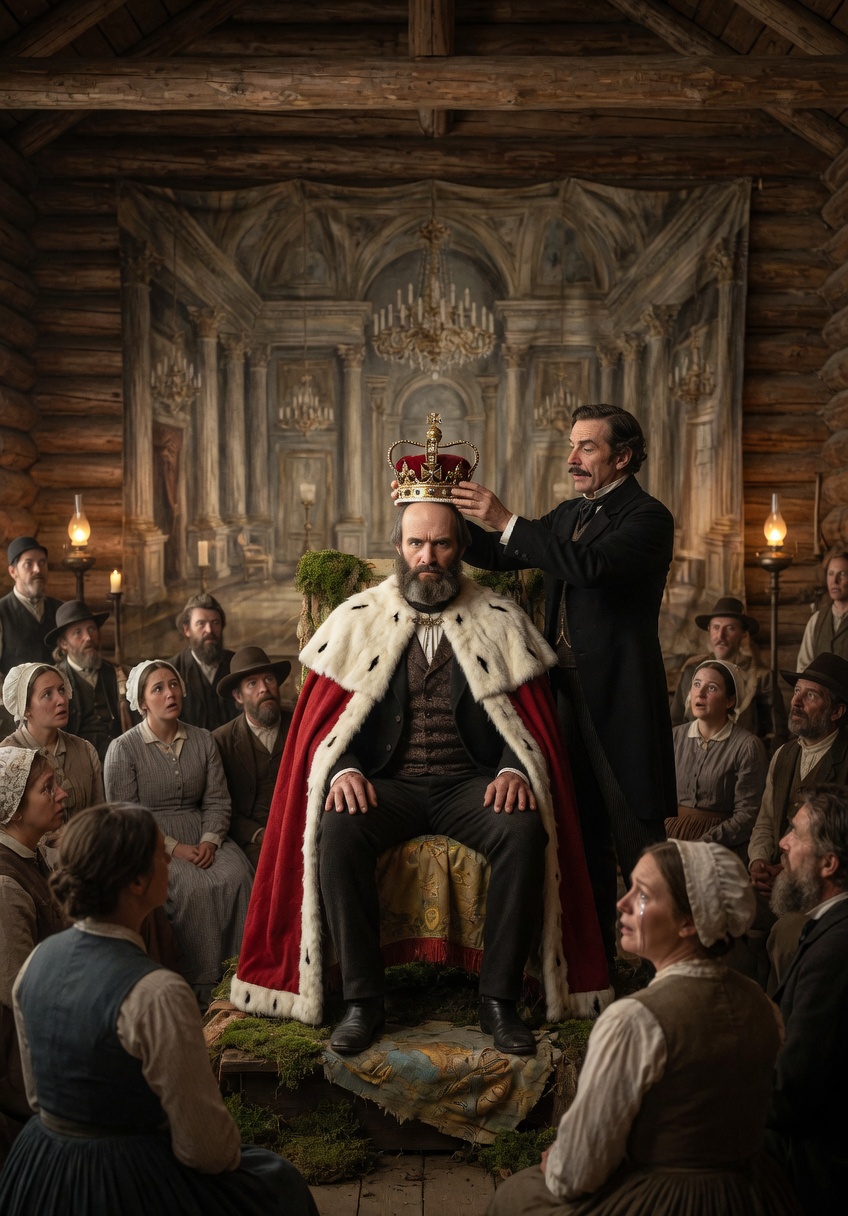
Strang entered wearing a red robe trimmed with white, made, by tradition, from a theatrical costume he had somehow acquired on the mainland. On his head he wore a crown of polished metal — tin, by some accounts, though the Strangites themselves insisted it was something finer. In his hand he carried a wooden scepter. The men surrounding him wore improvised regalia suggestive of a royal court: sashes, robes, the insignia of invented offices. The whole tableau had been assembled from frontier materials and frontier imaginations — homemade costumes, forest timber, the trappings of authority improvised out of whatever the island and its prophet could produce. It was, in every literal sense, theater. And yet it was also, unmistakably, a rite.
A sermon was preached. Prayers were offered. And then, before the assembled witnesses, Strang was anointed with oil and proclaimed King of the Kingdom of God — King, that is, of Heaven and Earth — the vice-regent of Christ on the American continent, the sovereign whose authority, in the Strangite understanding, would one day supersede that of Washington, London, and Rome alike. The kingdom he now ruled was, for the moment, a scatter of log cabins and cedar stumps on an island most Americans could not locate on a map. But it was, in his own theology and in the theology of the two hundred and thirty-five who had traveled to see him crowned, the seed of a kingdom that would eventually encompass the world.
It is easy, at the distance of nearly two centuries, to laugh at the pageant. The throne was rough-hewn. The crown was tin. The kingdom was remote, poor, and improbable. The congregation was a few hundred midwestern Mormons in homespun shirts and bonnets, not the princes and prelates of Christendom. The whole thing has the sound, in the retelling, of comic opera — a frontier absurdity enacted by people who had watched too many Shakespeare plays and read too much of the Book of Revelation and mistaken the one for the other.
Yet the joke did not remain a joke for long.
Strang had created something the American government did not know how to categorize and did not intend to tolerate — a quasi-independent power center on United States soil, wrapped in religious legitimacy, protected by a fiercely loyal following, and ruled by a man who insisted, out loud and in print, that his authority came from a source higher than the federal Constitution. He was collecting tithes. He was convening his own courts. He was enforcing his own laws on the island, including laws that governed marriage, property, and the conduct of non-Strangite visitors — of whom there were, by 1850, increasingly few willing to come. He had his own printing press, his own newspaper, his own apostles, his own armed men. He had, in the fullest sense, seceded — not geographically, because the island remained within the territorial boundaries of the state of Michigan, but theologically, politically, and in every practical sense that mattered to the United States Post Office, the United States Treasury, and the United States Navy.
It’s easy to take this stuff sort of like as a joke, but I’ve got to say, the federal government didn’t take it as a joke. President Millard Fillmore, about a year after Strang crowned himself king, was so worried about this quasi-independent kingdom on U.S. soil that he sent in the U.S. Navy’s first iron-hulled warship to invade the island and bring Strang to justice.
— Miles Harvey, Michigan Radio Interview
What followed showed just how real Strang’s authority had become — and just how thoroughly a confident man with a crown could make the machinery of the United States look small.
In the spring of 1851, the federal government finally moved against him. President Millard Fillmore himself had been persuaded that something lawless was happening on Beaver Island — reports of mail tampering, of counterfeiting, of treason against the Republic, of theft from the United States government — and the U.S.S. Michigan, the first iron-hulled warship in the U.S. Navy, was dispatched to Beaver Island to arrest the self-crowned king and approximately 100 of his followers. Strang was taken into custody along with his followers, placed aboard the warship, and carried across Lake Michigan to Detroit to stand trial in federal court. A less certain man would have arrived in chains and left in irons. Strang arrived, by every account, looking very much like a king.
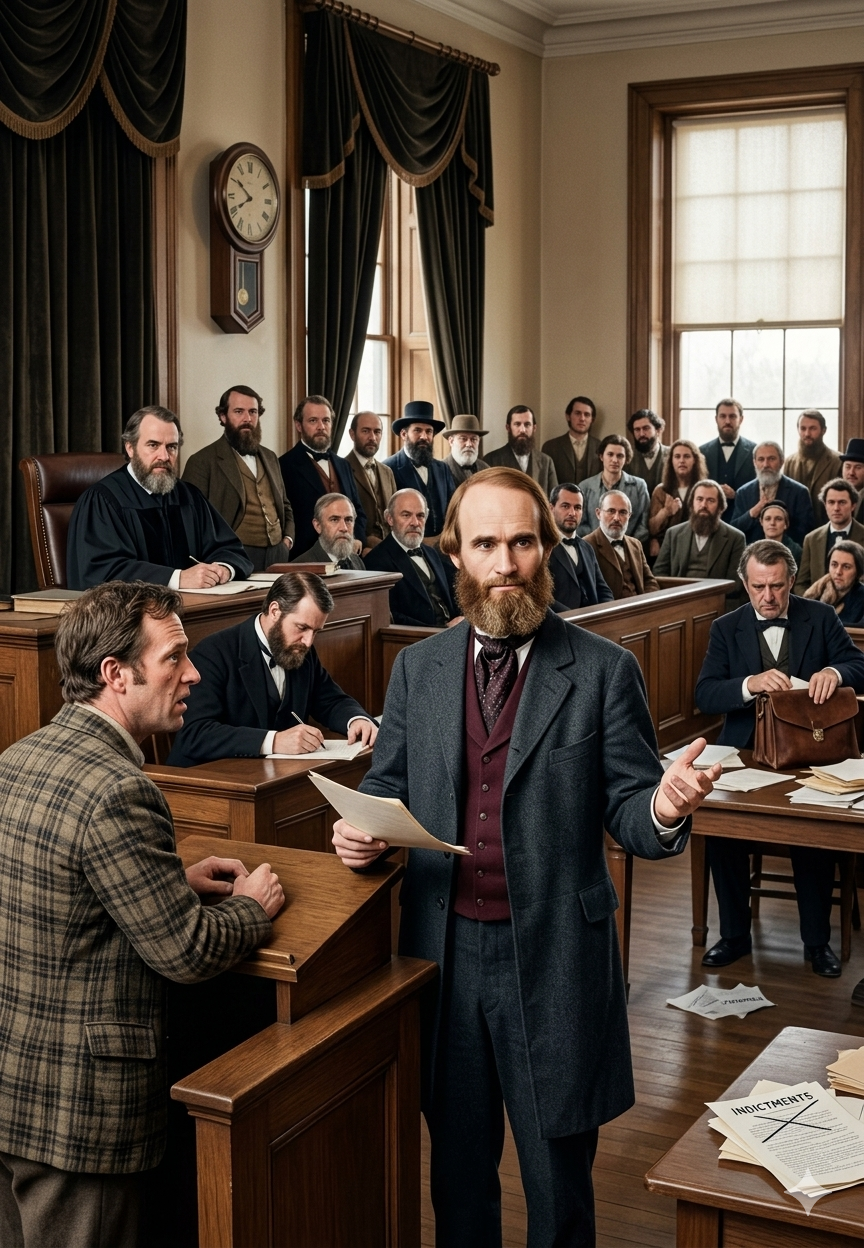
He conducted his own defense. A trained attorney before he was a prophet, he rose each day in the Detroit courtroom and cross-examined federal witnesses with the calm self-possession of a man who believed — because he had persuaded himself to believe, and because he had persuaded others to believe — that the proceedings against him were not a trial of his crimes but a persecution of his faith. When the verdict came in, the jury acquitted him on every count. The charges collapsed. The prosecutors went home. And Strang sailed back to Beaver Island not diminished but magnified, his kingdom vindicated, his enemies humiliated, his standing among the faithful raised by the simple and devastating fact that the United States of America had swung at him and missed.
He came home a more dangerous man than he had left.
From the island, Strang now began to look outward — past the cedar forests and fishing villages, past the Mormon settlements of the Midwest, toward the machinery of the American state itself. He entered Michigan politics with the same instincts he had brought to religion: he recognized an audience and gave it what it wanted. Through a combination of bloc voting by his followers, shrewd cultivation of non-Mormon neighbors, political horse-trading, and — by the testimony of more than one contemporary — outright electoral fraud, he won election to the Michigan state legislature in 1853. He served two terms. He sat, in broadcloth and a politician’s tie rather than in ermine, in the state capitol at Lansing. He voted on bills, delivered speeches, and earned, remarkably, the grudging respect of colleagues who had expected a madman and found a lawyer of uncommon ability instead.
Nor did his ambitions stop at Michigan. He began openly pressing for appointment as governor of the Utah Territory — the very ground his great rival Brigham Young already ruled — writing to federal officials and arguing, with a straight face, that he, James Jesse Strang, was the legitimate Latter-day Saint prophet, and that federal recognition of his kingship on Beaver Island was merely the first installment of a larger restoration. In the pages of his own newspaper, The Northern Islander, he styled himself a figure of continental consequence, not merely a sectarian leader on a northern island but a man with designs on power in the American republic itself.
By the early 1850s, he had become exactly the kind of figure the press could not resist. Editors from New York to St. Louis to San Francisco seized on the absurdity, the menace, and the charisma of the King of Beaver Island — the lawyer-prophet in his crown of tin, the monarch of a pine-board kingdom in the middle of a Great Lake, the convicted nothing who had walked out of federal court a free man and sailed home to his island theocracy as if the verdict had been preordained. Cartoonists drew him. Correspondents traveled to the island to interview him and left unsettled, not because they had believed what he told them but because they could not fully explain, on the ride home, why so many others did. Without that national attention, his story might have faded quietly into the tangled margins of Mormon history, a footnote beside Sidney Rigdon and James Emmett and the other forgotten claimants to Joseph’s mantle. Instead, Strang became, in the most literal sense, famous — an object of fascination, ridicule, and alarm, all at once, in a country that was beginning to understand that it did not quite know what to do with men like him.
And this, finally, is the deeper significance of the coronation — of the crown, the robe, the wooden throne under the Beaver Island pines, the solemn procession of two hundred and thirty-five witnesses on the summer day in 1850 when a man in his late thirties allowed himself to be anointed sovereign before God and his people. It was not the costume drama that mattered. It was the fact that the costume drama worked. The crown was tin. The robe was homespun. The kingdom, by any honest accounting, was a scatter of log cabins and cedar stumps on an island most Americans could not locate on a map. None of that mattered. What mattered was that Strang had grasped, earlier and more thoroughly than most of his contemporaries, that authority in America could be staged — that the forms of power, if performed with sufficient conviction and sustained long enough, would begin to generate the substance of power. That spectacle, given time, hardens into allegiance. That a man who could persuade enough other men to see a throne where only timber stood had discovered a kind of power more durable than decorum, more adaptable than law, and — in the hands of the right kind of man, in the wrong kind of century — more dangerous than either.
The Theology of Power and the Gospel of Confidence
To understand why Strang succeeded—why hundreds of otherwise sensible men and women abandoned their homes, followed him to a remote island, and defended him against the United States Navy—one must understand the peculiar spiritual economy of antebellum America.
The 1840s and 1850s were a period of what Harvey, drawing on Herman Melville, calls the age of confidence. This was not confidence in the modern psychological sense—not optimism or self-assurance—but something more material and more desperate. In an era before the federal government printed standardized paper currency, the entire economy ran on privately issued banknotes: glorified IOUs that were only as good as the trust that backed them. Confidence was, quite literally, the medium of exchange.
Confidence was black magic, good fortune and hard cash combined. Confidence could turn worthless paper into glittering gold, cow towns into cities, empty lots into bustling businesses, losers into winners, paupers into millionaires.
— Miles Harvey, “The King of Confidence” (read on NPR)
In such an economy, the man who could command trust—who could make others believe in the reality of things not yet seen—possessed a form of social power as real as land or gold. Joseph Smith had understood this intuitively. So had P.T. Barnum, who was building his circus empire during the same years Strang was building his island kingdom. So had a dozen lesser figures who populated the carnival of American religious and commercial life in the decades before the Civil War.
What made Strang distinctive was the precision with which he exploited this economy. He gave his followers not merely faith but evidence: the brass plates they could touch, the coronation they could witness, the newspaper they could read, the political victories they could celebrate. He made his community’s investment in his reality an ongoing and participatory act, requiring their continued involvement to sustain. The more they had sacrificed for the kingdom—their homes, their previous communities, their relationships with skeptical family members—the more the kingdom’s reality became a psychological necessity.
He also held genuinely contradictory views that gave him a kind of intellectual credibility among followers who might otherwise have dismissed him as simply a scoundrel. He was an abolitionist who published essays by Frederick Douglass in his Beaver Island newspaper. He held what were, for his era, progressive views on women’s rights—at least in principle. He was capable of sophisticated political analysis and genuine rhetorical brilliance. As Harvey notes, Strang was simultaneously an idealist and a cynic, a visionary and a thief, a prophet and a scoundrel, and it was precisely this contradictory richness that made him so difficult to dismiss and so dangerous to follow.
The World Strang Inhabited: Melville, Barnum, and the Age of the Confidence Man
One of Harvey’s most important achievements in The King of Confidence is his insistence that Strang cannot be understood in isolation. He was a creature of his era — which is to say, he was the logical product of a particular American moment that produced a whole ecosystem of operators like him.
This was the age of P.T. Barnum, who was building his own empire of spectacle and willful deception in New York City at the same time Strang was building his kingdom on Beaver Island. It was the age of the Fox sisters, who convinced millions of Americans that they could communicate with the dead through mysterious rappings in an upstate New York farmhouse. It was the age of utopian communities — Oneida, Amana, New Harmony — in which idealistic Americans pooled their resources and submitted to charismatic leaders in pursuit of perfection.
It was the age in which the phrase “confidence man“ entered the American language.
The term originated in 1849, in a New York newspaper story about a single criminal named William Thompson who had perfected a technique of approaching strangers on the street and asking — with complete self-assurance — whether they had confidence enough in him to lend him their watch. Astonishingly, people said yes. The newspaper coined the term “confidence man” to describe him, and within weeks the phrase had spread across the country with the speed of the new telegraph technology.
The reason it spread so fast was that everyone immediately recognized the type. America was full of them.
Harvey draws explicit connections between Strang’s world and the literary figures who were trying to make sense of it. Herman Melville, Nathaniel Hawthorne, Walt Whitman, and Mark Twain were all wrestling, in their fiction, with the question of confidence and deception — with the peculiar American tendency to reward the bold liar over the cautious truth-teller. Melville’s final novel, published during his lifetime, The Confidence-Man, released in 1857 — just months after Strang’s assassination — depicts a swindler who moves through American society exploiting the religious hunger of people in utopian communities. Some scholars believe Melville drew direct inspiration from the well-publicized saga of Strang and Beaver Island.
As Harvey observed to Scott Simon during their NPR interview:
“Strang comes out of this period where things are just changing really fast. There’s been an economic collapse. Technology was just in a massive change. This is the era of the telegraph, the photograph, and the railroad. Everything is shifting. The United States is suddenly a mobile society. And Strang was able to offer people simple solutions to the complex problems of their time.”
This is the pattern that recurs throughout American history with disturbing regularity. In periods of rapid economic and technological disruption — when the old social structures are dissolving, and people cannot see where they are going — a certain kind of leader emerges. Not always a criminal in the legal sense. Not always dangerous in the physical sense. But always someone who offers certainty in exchange for trust, who turns the hunger for meaning into a mechanism of control.
One reviewer, writing about Harvey’s book, noted the contemporary resonance with unmistakable clarity:
“Despite the frontier setting, there is something eerily contemporary about Harvey’s portrait of a real estate huckster with monarchic ambitions, a creative relationship to debt and a genius for mass media.”
It is a description that fits 1850. But the reader in 2026 cannot help noticing how easily the same sentence could be written about the present moment — an age of influencers building empires on curated self-assurance, of political movements that demand loyalty rather than reason, of men who have mastered the art of turning bankruptcy into branding and suspicion into faith. The names have changed. The platforms have multiplied. But the pattern Harvey describes — the bold performer who thrives in an era of dissolving certainties — is as alive today as it was on Beaver Island.
The Kingdom Crumbles: Tyranny, Rebellion, and Assassination
Power, when it is left to grow without law or restraint, has a way of swelling into something far larger than the man who first held it. In the early years of his Beaver Island regime, Strang still relied on persuasion, revelation, and the careful management of loyalty. But as the 1850s advanced, the boundaries of obedience narrowed, the rhetoric hardened, and the punishments for dissent became more severe.
By then, the community had begun to resemble the kind of closed, high-control movement that history knows too well: internally coherent, intensely satisfying to those inside it, and quietly menacing to those who did not share its premises. Strang’s kingdom did not merely ask for devotion; it demanded submission. He regulated dress, work, worship, and domestic life, drawing the private routines of his followers into the orbit of his authority.
The dress reform is a real and important detail, but it is best stated carefully. Strang did encourage or require women in his circle to adopt bloomers, a reform garment associated with mid-century health and women’s rights movements. The claim about plural marriage also needs precision: Strang practiced polygamy and took multiple wives, but the chronology and the exact count are best handled cautiously, since the historical record is tangled and often partisan. His first marriage did not simply disappear cleanly into the record; it became part of the larger, troubling texture of his rule.
What made Strang especially dangerous was not simply that he commanded obedience, but that he cast obedience as a divine obligation. In that sense, his claim to authority was not entirely unlike Brigham Young’s: both men argued that legitimacy did not depend on personal charm alone, but on continuing revelation and the right use of church order. The difference was that Strang’s world had narrowed until the faith seemed to exist for the king, while Young’s leadership in the larger body of Saints was anchored more firmly in institutional continuity and the need to preserve a church in crisis. Still, in both cases, resistance could be recast as resistance to God himself.
The material basis of the kingdom mattered too. Beaver Island was not only a religious enclave but a strategic asset. Timber, shipping access, and control over Lake Michigan routes gave Strang a way to turn spiritual authority into economic power. His followers and enemies alike accused him of theft, raiding, and fraud, and the island became infamous for the violence and coercion associated with his rule. But “pirate colony” is more colorful than precise; it is better understood as a hybrid of sectarian stronghold, political machine, and criminal enterprise.
Even those who lived there uneasily understood the hierarchy. Men who challenged Strang risked punishment, and the non-Mormon residents who had preceded the Saints—especially Irish fishermen—were pushed aside as the kingdom tightened around them. By the time Beaver Island reached its most authoritarian phase, it was no longer merely a religious settlement. It had become a miniature state governed by revelation, enforced by fear, and sustained by the practical advantages of isolation. A skeptic within the community once wrote, in terms that captured the fundamental absurdity of Strang’s enterprise:
No man can serve two masters. You cannot serve a temporal king and a republican government at the same time. The thing is preposterous.
— Contemporary critic of James Strang, cited in biographies of the period
Strang’s kingdom on Beaver Island lasted six years, a startlingly long run for what had begun as a radical experiment in authority, prophecy, and personal rule. Its end did not come first from federal intervention, nor from the rising power of Brigham Young’s Utah-centered movement, nor even from the contempt of outsiders. It came from within, from the fatigue, anger, and moral recoil of the people who had once made the kingdom possible.
To outsiders, Beaver Island looked like a den of frauds and outlaws: counterfeiters, land thieves, horse thieves, and timber poachers hidden in the cold waters of northern Lake Michigan. To many of Strang’s followers, however, it was something else entirely—a disciplined, tightly ordered community that offered belonging, purpose, and sacred meaning. Both visions were true. That doubleness made Strang at once difficult to pin down and impossible to forget.
By the mid-1850s, Strang had pushed himself into a role so overloaded with contradiction that the whole structure began to crack. He was prophet and king, newspaper editor and state legislator, pirate chief and patriarch of a plural household. Each title widened the distance between the world he claimed to govern and the human limits of the man trying to govern it. The demands on his followers grew heavier. The rules became more exacting. And resentment, once hidden beneath loyalty, began to harden into rebellion.
By the spring of 1856, two followers, Thomas Bedford and Alexander Wentworth, had reached their breaking point. Bedford had been publicly flogged by Strang’s enforcers, though the exact reason varies across accounts: some say adultery, others a domestic dispute, others still his knowledge of Strang’s criminal dealings. Wentworth had grievances of his own. On the evening of June 16, after Strang had been summoned to the dock at St. James by the captain of the USS Michigan, the two men stepped behind him and opened fire. Strang was struck three times and beaten with a pistol as he fell. Bedford and Wentworth then fled to the naval vessel and placed themselves under its protection.
He did not die at once. Strang lingered for weeks, grievously wounded, before being carried back to the mainland while his kingdom came apart around him. The people who had built their lives inside his world suddenly faced the hardest task of all: learning how to live after the story they had believed in had been shattered. His wife, Elvira, one of his plural wives, captured the depth of that collapse when she heard that he might survive.
I just thought he would be raised from the dead. I had that faith.
— Elvira Strang, wife, cited in “The King of Confidence” by Miles Harvey
He was not raised from the dead. James Jesse Strang died on July 9, 1856—twelve years, almost to the day, after the murder of Joseph Smith had first opened the door of succession through which he had so audaciously walked.
After the Prophet: Beaver Island’s Slow Unraveling
After Strang’s death, the world he had built did not collapse all at once. It came apart the way a cracked pane gives way in winter: first a hairline fracture, then a spiderweb of splintering, then the sudden realization that nothing holding the whole thing together had ever been as solid as it looked. On Beaver Island, the believers who had treated Strang’s word as law were left with the most punishing kind of silence—the silence that follows not merely the loss of a leader, but the collapse of an explanation.
For years, Strang had given them a story strong enough to inhabit. He had given them a geography charged with purpose, a hierarchy they could submit to, enemies they could blame, and a future they could imagine with certainty. After his death, those structures remained for a moment like stage scenery after the actors have gone. Houses still stood. Fields still needed tending. Boats still came and went across the lake. But the moral center had vanished. What had once felt like discipline now felt, to many, like exposure.
Some followers tried to hold on to the faith by treating Strang’s death as another trial, another test from God, another temporary darkness before vindication. Others understood immediately that the spell had broken. If he could be shot down like any other man, then the kingdom was not a kingdom at all, only a fragile arrangement of loyalty, fear, and hope. The realization was devastating, not because it was sudden, but because it had been waiting all along beneath the surface of belief.
The aftermath was not only spiritual; it was social and physical. Families that had organized their lives around Strang’s authority now had to decide where to go, whom to trust, and what parts of their identity could survive without the man who had named them. Some left the island altogether. Some stayed but detached themselves from the movement. Others carried the memory forward in smaller, quieter forms, as if preserving a private ember from a fire that had already gone cold. A small remnant of believing Strangites survives today, and its own self-description captures the continuity it claims: “…we are a small remnant of the church that God re-established upon the earth through the Prophet Joseph Smith on April 6, 1830. We follow Joseph Smith’s legal successor, James J. Strang, and possess a true Priesthood.” That living claim makes the movement’s survival feel less like an abstraction than a thread still running out of the past.
In every case, the same hard question remained: what do believers do when the prophet is gone, and the promised world does not arrive? That was the true end of Beaver Island—not the gunfire, not the body, not even the ruin of the kingdom itself, but the long and bitter reckoning that followed. Strang’s followers had believed they were building something that would outlast the man. Instead, they discovered that the man had been the structure all along.
A Christian Apologist’s Reflection: False Prophets and the Test of Succession
For Christian apologists and students of comparative religion, the Strang episode is more than a historical curiosity. It is a diagnostic instrument. The very features that made Strang’s claims plausible to his followers—the forged letter of succession, the buried and subsequently translated ancient plates, the claimed angelic visitations, the theocratic authority claimed over followers’ domestic lives—were not inventions of Strang’s peculiar genius. They were features borrowed directly from the founding narrative of Mormonism itself.
This raises a question that Strang himself, with characteristic cunning, understood perfectly: if one accepts the founding mechanisms of Mormonism as authentic—angelic visits, buried scriptures, divinely authorized succession—on what grounds does one distinguish between Joseph Smith’s claims and James Strang’s? Strang’s followers, who had accepted Smith’s founding miracles on faith, found themselves unable to answer that question convincingly. Strang had reproduced the founding conditions of their faith with sufficient fidelity that their existing epistemological commitments left them defenseless.
The LDS Church’s official response to Strang—that he was a fraud, that his plates were forgeries, that his letter was a fabrication—was almost certainly correct. But it relied on the same standards of evidence—the testimony of authorized witnesses, the authority of institutional succession—that Strang had successfully mimicked. The Strangite episode reveals, with uncomfortable clarity, the epistemological vulnerability of a religious tradition whose founding events are not susceptible to ordinary historical verification.
The New Testament standard for evaluating prophetic claims is unambiguous. In Matthew 7:15–20, Jesus warns his followers against false prophets who come in sheep’s clothing and instructs them to know them by their fruits. By that standard, Strang’s fruits were evident: violence, theft, coercion, broken families, and a community whose members were ultimately shot, dispersed, and left to rebuild their lives in the ruins of his kingdom.
But it is worth asking, soberly, whether the followers who built their lives around Strang’s reality were uniquely gullible. They were not. They were people living through a period of economic catastrophe and institutional collapse, hungry for certainty; they were offered a leader with piercing eyes and a confident claim to divine authority. The historian’s task—and the apologist’s—is to understand them, not merely to judge them.
The King Never Really Dies: Strang and the Eternal American Con
James Jesse Strang was shot on a dock on Beaver Island in June 1856. He died in July. His kingdom dissolved within weeks. His followers dispersed across the Midwest, most of them returning to ordinary life with an experience they rarely discussed in later years. The island was resettled by the Irish fishermen who had preceded the Saints, and the tabernacle rotted quietly into the Michigan forest.
Within a generation, Strang was largely forgotten. His name appeared in footnotes to the history of early Mormonism, in occasional newspaper retrospectives, and in the local memory of Beaver Island’s surviving residents. The vast engine of American publicity that had made him famous moved on to other celebrities, other scandals, other confidence men.
But Miles Harvey’s great point—the point that gives The King of Confidence its genuine urgency—is that Strang’s disappearance from popular memory is itself a kind of illusion. The conditions that produced him never disappeared. The hunger for certainty in uncertain times, the willingness to follow a confident voice when institutions have failed, the particular susceptibility of communities under economic stress to leaders who offer simple answers to complex questions: these are permanent features of the American landscape, not historical curiosities.
Eventually, the facts of his life faded into obscurity. But people like James Strang never really vanish. When the time is right, they reappear, wearing a new guise, exploiting new fears, offering new dreams of salvation. Americans are fixated on such figures, especially in periods of profound social and economic upheaval.
— Miles Harvey, “The King of Confidence”
Harvey’s warning finds an echo in the words of Mark Twain, who observed that “history never repeats itself but does often rhyme.” The specific details of Strang’s kingdom—the brass plates, the moss throne, the Lake Michigan island—belong to the particular strangeness of the 1850s. But the underlying pattern—the charismatic outsider claiming divine succession, the manufactured evidence, the community bound together by its own investment in a shared reality, the gradual slide from spiritual authority to coercion—that pattern is not bounded by any century.
For students of Mormon history, the Strang episode is an essential case study. For Christian apologists, it is a reminder of why the biblical test of prophecy—fruits, not credentials—remains the most reliable instrument available. For historians and general readers, it is simply one of the most extraordinary stories America has produced: the tale of a short, balding, sharp-eyed lawyer who decided, in the chaos following a prophet’s murder, that the easiest thing in the world was to become a king.
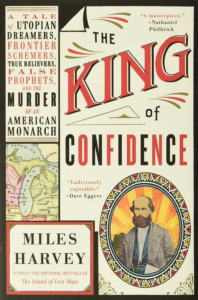
– Molly Odintz, CrimeReads―National Book Review
What is remarkable, in retrospect, is not how many people believed him — but how the mechanics of his deception illuminate the mechanics of religious authority more broadly. The letter, the plates, the angelic visitations: these were not invented from nothing. They were carefully constructed imitations of the authenticating devices that Joseph Smith himself had used to establish Mormon credibility. Strang was running a con, but he was running it with intimate knowledge of his marks’ specific belief architecture. He knew exactly which miracles they were primed to accept, because they had already accepted them once before.
The Book: Miles Harvey’s The King of Confidence
For readers who want to go deeper into this extraordinary story, Miles Harvey’s The King of Confidence is the essential text and is available on Amazon at this link.
Harvey’s The King of Confidence has drawn a strikingly warm response across a wide range of review outlets. Newspapers, magazines, and book critics have praised its narrative drive, deep research, and vivid portrait of James Jesse Strang. Reviewers have called it “akin to the best of thriller fiction,” “deeply researched,” “artfully written,” “splendidly compelling,” and “unputdownable.” Even the most skeptical notices concede the same basic point: Harvey found a subject strange enough to be irresistible and wrote about him with the kind of energy that makes nineteenth-century religious history feel immediate, cinematic, and alive.
“Flip this book open, read page one, and then try to stop. The King of Confidence is mesmerizing all the way through–a quirky, rollicking ride through an America marked by upheaval, tumult, and religious fervor. It feels like one of those dystopian futures that Hollywood keeps warning us we’re hurtling toward, but it’s actually our own forgotten past. What this startling book cleverly illuminates, though, is our own perilous present, where so many of us still yearn for con men and kings.”
– Dave Cullen, New York Times bestselling author of Columbine
Harvey is a professor at DePaul University in Chicago and the author of two previous works of narrative nonfiction — The Island of Lost Maps (2000), a true crime story about cartographic theft that became a bestseller, and Painter in a Savage Land (2008), about the first European artist in North America. Both books established Harvey as what one reviewer called “a remarkable sleuth, a writer with a passion for maps and islands and the patience to tell a complicated story.”
The King of Confidence, published in 2020, brings Harvey’s research skills and narrative instincts to the Strang story with impressive results. He has tracked the story through archives, special collections, and newspaper databases — turning up, as one reviewer noted, “even minuscule traces of a man like Strang.”
The book is not merely a biography of Strang. It is a portrait of an era — one in which Marx and Darwin, Charlotte Brontë and John Brown, Abraham Lincoln and P.T. Barnum, and even a proto-Freudian psychological analysis all have roles to play. Harvey shows how Strang’s story intersects with virtually every major theme of antebellum America: the confidence economy, the religious revivals of the Second Great Awakening, the crisis over slavery, the promise and failure of utopian communities, and the birth of celebrity culture through the penny press.
One reviewer, writing in a literary journal, captured Harvey’s achievement precisely:
“Strang’s nasty story with its thievery, theatricality, and deceptions, lures us into those writers who tried so hard to wrestle with the contradictions of America’s past. Harvey shows us just how Melville, Hawthorne, Whitman, and Twain shared Strang’s imagined world. They turned confidence schemes into art. Maybe we should try to do that again.”
Sources and Further Reading
• Miles Harvey, The King of Confidence: A Tale of Utopian Dreamers, Frontier Schemers, True Believers, False Prophets, and the Murder of an American Monarch (Little, Brown and Company, 2020)
• NPR Weekend Edition interview with Miles Harvey, “The King of Confidence,” Scott Simon, host
• Michigan Radio interview with Miles Harvey on James Strang and Beaver Island
• Wikipedia: James Strang — https://en.wikipedia.org/wiki/James_Strang
• Atlas Obscura, “Dark History of an Island King” — https://www.atlasobscura.com/articles/dark-history-of-an-island-king
• Saints Unscripted, “Who Was James Strang?” — https://saintsunscripted.com/faith-and-beliefs/living-the-gospel/who-was-james-strang/
• FAIR Latter-day Saints, James Strang movement — https://www.fairlatterdaysaints.org/answers/James_Strang_movement
• BYU Studies, “King of Beaver Island” — https://byustudies.byu.edu/article/king-of-beaver-island-the-life-and-assassination-of-james-jesse-strang
• Northern Michigan History, Strang’s Assassination — https://northernmichiganhistory.com/james-strangs-assassination/
A Note on Research Methods and Accuracy
In recent years, some have voiced concern that artificial intelligence may distort facts or introduce inaccuracies into serious research. That criticism deserves acknowledgment. However, AI has now evolved into the most powerful research instrument available to any dedicated scholar—capable of analyzing vast datasets, cross‑referencing historical records, and surfacing overlooked connections across sources. This work represents a collaboration between the author’s investigative inquiry, verified primary documentation, and the advanced analytic capabilities of AI research tools. Here, AI was not used as a ghostwriter or a shortcut for scholarship, but as a disciplined research partner devoted to rigor, accuracy, and transparency.
Every factual claim in this work has been subjected to active verification. Where AI‑generated content was used as a starting point, it was tested against primary sources, peer‑reviewed scholarship, official institutional documentation, and established historical records. Where discrepancies were found—and they were found—corrections were made. The author has made every reasonable effort to ensure that quotations are accurately attributed, historical details are precisely rendered, and claims fairly represent the positions they describe or critique.
That said, no work of this scope is immune to error, and the author has no interest in perpetuating inaccuracies in the service of an argument. If you are a reader—whether sympathetic, skeptical, or hostile to the conclusions drawn here—and you identify a factual error, a misattributed source, a misrepresented teaching, or a claim that cannot be substantiated, you are warmly and genuinely invited to say so. Reach out. The goal of this work is not to win a debate but to get the history right. Corrections offered in good faith will be received in the same spirit, and verified corrections will be incorporated into future editions without hesitation.
Truth, after all, has nothing to fear from scrutiny—and neither does this work.