
A Traditional Christian Response to “Evangelical Holy War: W
hy Some Christians Think Trump Will End the World.”
A Theological Essay in the Tradition of Biblical Orthodoxy
Introduction: When Holy War Rhetoric Meets a Secular Press
Few journalistic cocktails are as potent — or as misleading — as apocalyptic theology mixed with American politics. Matthew Burkholder’s article, “Evangelical Holy War: Why Some Christians Think Trump Will End the World,” published by The Conversation, arrived in early 2026 draped in the language of academic neutrality while advancing a deeply slanted reading of both evangelical Christianity and the prophetic literature of the New Testament. Writing as a PhD candidate in theological studies at the University of Toronto — and a self-declared member of the Liberal Party of Canada — Burkholder frames a set of fringe, militaristic claims about Donald Trump’s divine appointment to “trigger Armageddon” as though they represent something coherent within the broader landscape of evangelical eschatology. They do not.
The article under review demands a structured theological response — not merely a polemical rebuttal, but a careful examination that distinguishes between what responsible evangelical scholarship actually teaches about the end times, what the military complaint reports do and do not claim, what Christian nationalism actually is and is not, and how the perennial temptation to “read between the lines” of Revelation has repeatedly driven sincere believers into prophetic embarrassment and, in extreme cases, dangerous political theology.
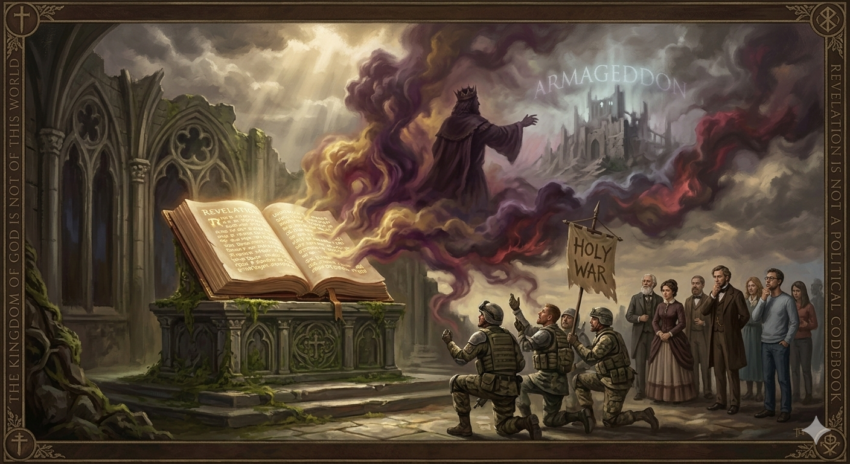
The Book of Revelation is not a political codebook. Donald Trump is not the trigger mechanism for Armageddon. American military campaigns, however morally complex, are not fulfillments of the apocalyptic seals in Revelation 6. And the voices in certain units of the U.S. Armed Forces who have allegedly characterized the war against Iran as a “holy war” anointed by Jesus represent not mainstream evangelical orthodoxy, but a volatile and well-documented subset of charismatic dominionism that has, throughout church history, consistently confused the kingdom of God with the ambitions of particular nations and their leaders.
This essay will examine Burkholder’s article on its own merits, affirm where the author conforms to historically defensible Christian concerns, correct the theological distortions, document the military complaints as accurately as available sources allow, critique the “reading between the lines” hermeneutic that drives sensationalized prophecy culture, present a coherent traditional Christian understanding of the end times as recorded in the Book of Revelation, and conclude with a frank assessment of how ideological bias — from both the political right and the secular left — corrupts our understanding of Scripture and current events.
The Article’s Core Claims: What Burkholder Actually Argues
Burkholder builds his article around several interrelated claims. First, he reports that over one hundred soldiers in the United States Armed Forces have filed complaints with the Military Religious Freedom Foundation (MRFF), alleging that military commanders used extremist religious rhetoric to characterize the U.S.-Israel war against Iran as a holy war. According to Burkholder, some of these complaints assert that commanders told troops Donald Trump was “anointed by Jesus to light the signal fire in Iran to cause Armageddon and mark his return to Earth.”
Second, Burkholder draws on the Bebbington Quadrilateral — the well-known four-point definition of evangelicalism identified by historian David Bebbington — to establish what “evangelical Christianity” entails in broad terms: a strong belief in the Bible, the atoning death of Jesus, conversion experience, and social activism. This is a legitimate and widely accepted framework, and his use of it is historically defensible.
Third, the article touches on the theological underpinning of this militant eschatological posture: a belief that once Israel is restored as a nation and the temple in Jerusalem is rebuilt, Jesus will return and judge humanity — a framework associated with dispensational premillennialism. Burkholder notes that this is connected to beliefs about the “atonement and its relationship to the end times,” referencing his own research specialization.
Fourth, and most critically, the article draws a binary between Christians who interpret Revelation’s warrior-Christ imagery literally to sanction political violence and those who interpret it allegorically to advocate for nonviolent diplomacy. Burkholder cites Reformed Baptist pastor John Piper’s posting of Leviticus 19:34 — “You shall treat the stranger who sojourns with you as the native among you” — as evidence of Christian condemnation of the militant posture. This is fair and accurate.
Where the article begins to falter, however, is in its implicit suggestion that the extremist rhetoric emanating from some military units is somehow an organic outgrowth of evangelical Christianity broadly, rather than a distinct and identifiable theological aberration. Burkholder’s academic credentials notwithstanding, this framing is theologically sloppy, and a PhD candidate in theological studies ought to know the difference between descriptive journalism and theological attribution.
The Military Complaints: What the MRFF Reports Actually Document
The Military Religious Freedom Foundation (MRFF), founded by Mikey Weinstein, is a non-profit organization that receives and documents complaints from military personnel alleging violations of their constitutional right to religious freedom within the armed forces. The MRFF has a documented history of activity stretching back to 2005, and has handled thousands of cases over the years involving proselytizing officers, mandatory chapel attendance, and the marginalization of non-Christian servicemembers.
According to the article under review, more than 100 complaints were filed with the MRFF from soldiers reporting that their commanders characterized the U.S.-Israel operation against Iran as a “holy war” and that President Trump was “anointed by Jesus to light the signal fire in Iran to cause Armageddon and mark his return to Earth.” If these reports are accurate as filed, they represent a genuinely serious and dangerous conflation of military authority with charismatic prophetic fervency. Several observations are critical here.
First, the MRFF’s complaint database is self-reported and adversarial by design. The organization explicitly advocates for the strict separation of religion from military culture, and its founder has described evangelical Christianity within the military as an existential threat to constitutional governance. This advocacy posture does not disqualify the complaints — soldier testimony deserves serious investigation — but it does contextualize the framing. The complaints represent accusations, not adjudicated findings.
Second, if these characterizations of commanding officers’ speech are accurate, they represent a profound violation of Department of Defense Directive 1300.17, which prohibits the use of official government channels to promote personal religious beliefs. They would also represent a violation of the First Amendment’s Establishment Clause. Traditional, orthodox evangelical Christianity condemns such behavior not merely on legal grounds, but on theological ones: no military campaign constitutes a fulfillment of biblical prophecy, and no political leader — not Trump, not Netanyahu, not any other — can legitimately be designated by military commanders as a divinely anointed trigger for the apocalyptic events described in Revelation.
Third, these complaints, even if verified, should not be taken to represent the convictions of the 70 to 80 million Americans who broadly identify as evangelical Christians. They represent a subset of what scholars like Michael Gorman and Matthew Sutton have identified as “apocalyptic nationalism” — the fusion of national identity, military purpose, and prophetic expectation that periodically surfaces in American religious history and finds particularly fertile soil in charismatic and certain Pentecostal streams of Christianity.
Christian Nationalism: The Good, the Bad, and the Dangerous
Defining the Term
Few theological-political terms in contemporary discourse are more imprecisely deployed than “Christian nationalism.” It is used by progressives to describe virtually any Christian engagement with civic life, and it is used by some conservatives to describe a heroic reclamation of America’s Christian founding. Neither extreme serves clarity, and neither serves Scripture.
Christian nationalism is antithetical to the constitutional ideal that belonging in American society is not predicated on what faith one practices or whether someone is religious at all. The political ideology that seeks to merge American and Christian identities is deeply embedded in American society and manifests itself in a number of different ways, some more obviously harmful than others. — Amanda Tyler, Executive Director, Baptist Joint Committee for Religious Liberty — Center for American Progress
Tyler’s concern is legitimate and deserves to be heard by Christians who are tempted to conflate national identity with covenant identity. The New Testament is unambiguous: the people of God are constituted by faith in Jesus Christ across every nation, tribe, and tongue (Revelation 7:9), not by citizenship in any political state. The kingdom of God is not coterminous with the United States of America.
At the same time, the Center for American Progress’s framing — that Christian nationalism is “the single biggest threat to America’s religious freedom” — represents a secular progressive perspective that tends to define “religious freedom” in ways that exclude the public moral witness of orthodox Christianity. There is a meaningful difference between a government that establishes Christianity as the state religion (which no serious evangelical theologian advocates) and a democracy in which Christian citizens advocate for laws consistent with their moral convictions. The former is Christian nationalism; the latter is simply citizenship.
The Gospel Coalition’s More Nuanced Assessment
The Gospel Coalition’s treatment of Christian nationalism offers a more theologically rigorous analysis than either Burkholder’s article or the Center for American Progress piece. Writing from within a Reformed evangelical framework, TGC contributors have distinguished between the “good” impulse — that Christians should care about the common good and bring their convictions to bear on public life — and the “bad,” which substitutes national identity for gospel identity, and the “ugly,” which generates precisely the kind of militaristic theological rhetoric that the MRFF complaints document.
Jesus isn’t an instrument for achieving anyone’s political objectives, whether right-wing versions of nationalism or left-wing versions of pluralism. The only reason his message to love our enemies and do unto others still matters today is because he’s King, and he’s alive. — Trevin Wax, Vice President, North American Mission Board — The Gospel Coalition
Wax’s formulation captures the theological heartbeat of the problem. When Trump — or any political figure — is cast as a divine instrument for fulfilling eschatological prophecy, Jesus is no longer Lord of the church; he becomes a brand amplifier for a political movement. This is not evangelical Christianity. It is a political religion wearing the language of Christianity, and the distinction is not merely academic. It is a matter of faithfulness to the lordship of Christ.
What Scripture Actually Teaches About Christians and Political Authority
The New Testament’s teaching on the relationship between the church and political authority is both clear and consistently misappropriated by Christian nationalists on the right and by secular critics on the left. Romans 13:1–7 calls believers to honor governing authorities as instruments of God’s common grace, not as instruments of prophetic fulfillment. Revelation’s language about “Babylon” and the “beast” was originally written under the shadow of Roman imperial power — a context in which Christians were the persecuted minority, not the wielders of state power. The idea that a sitting American president could be “anointed” to initiate Armageddon represents not just a theological misreading of Revelation, but a category error of significant proportions.
Reading Between the Lines: The Perennial Temptation of Sensationalized Prophecy
One of the most durable features of American Christian culture is the persistent temptation to decode current events through the lens of Revelation’s symbolic imagery. This “reading between the lines” hermeneutic — the practice of mapping specific contemporary figures, nations, and military conflicts onto the imagery of the seals, trumpets, and bowls in Revelation — has a long and inglorious history. It has been wrong every time. It continues to sell books.
A History of Prophetic Misfires
The article from Levaire.com documents seven historic examples of end-times error that serve as sobering correctives to the prophetic overconfidence on display in the rhetoric described by Burkholder:
Understanding biblical prophecy is not always easy, nor is it something that can be done overnight. It requires years of dedicated study and a willingness to dive deep into the Scriptures, history, geography, ancient languages and more. When it comes to interpreting Scripture, context matters — and that’s especially true with biblical prophecy. — Levaire.com, “7 Historic Examples of End-Times Error”
The Levaire piece documents how the Crusades (1095–1291) began with Pope Urban II’s call to arms, in part motivated by eschatological expectations that reclaiming the Holy Land would precipitate the return of Christ. It did not. The Anabaptist revolt at Münster (1534–35) resulted in a self-declared “New Jerusalem” under Jan of Leiden that ended in mass executions. William Miller predicted Christ’s return in 1844; when it failed to materialize, the “Great Disappointment” fractured the movement he had led. Edgar Whisenant published “88 Reasons Why the Rapture Will Be in 1988”; it was not. Harold Camping predicted the rapture for May 21, 2011, then October 21, 2011; his followers spent their life savings in advance, and they had to return to work.
The pattern is consistent: a charismatic interpreter identifies a specific political configuration, military conflict, or astronomical event as the fulfillment of a biblical prophecy; followers reorganize their lives around the prediction; the prediction fails; the interpreter recalibrates or collapses. What is never examined with sufficient rigor is the interpretive methodology that made such predictions seem plausible in the first place.
The Hermeneutical Problem
The “reading between the lines” hermeneutic begins with a presupposition — that the symbols of Revelation map onto specific contemporary events — and then works backward to identify candidates. This is exegesis in reverse. Responsible biblical interpretation begins with the text in its historical, grammatical, and canonical context, and then applies it to the present with appropriate humility.
Revelation was written by the Apostle John, in exile on the island of Patmos, to seven real churches in first-century Asia Minor that were experiencing real persecution under Roman imperial power (Revelation 1:9). Its imagery — the beast, Babylon, the mark, the seals — drew on the rich symbolic vocabulary of Jewish apocalyptic literature, particularly Daniel, Ezekiel, and Zechariah, and was designed to communicate hope and warning to a suffering community, not to provide a geopolitical roadmap for twenty-first century American evangelicals.
When military commanders allegedly tell their troops that Donald Trump is “anointed by Jesus to light the signal fire in Iran to cause Armageddon,” they are not interpreting Revelation. They are retrofitting Revelation’s symbolic language onto a contemporary political narrative that has already been decided by other means. This is a form of prophetic manipulation, and it is spiritually dangerous precisely because it borrows the authority of Scripture to validate what is, in essence, a militaristic and nationalistic agenda.
What the Book of Revelation Actually Teaches: A Traditional Christian Understanding
The Nature and Purpose of Revelation
The Book of Revelation is apocalyptic literature — a genre with specific conventions, symbols, and rhetorical purposes that differ substantially from historical narrative, prophetic oracle, or epistolary instruction. Its opening verse identifies its purpose clearly: “The revelation of Jesus Christ, which God gave him to show to his servants the things that must soon take place” (Revelation 1:1, ESV). The primary subject of Revelation is not the United States, not Israel’s modern state, not Iran, and not Donald Trump. Its primary subject is Jesus Christ — his sovereignty, his judgment, his redemption, and his ultimate victory over sin, death, and satanic power.
In one sense, everything that takes place after the ascension of Christ takes place in the end times. The end times started in the New Testament. We’re still in the end times. — R.C. Sproul, Ligonier Ministries
Sproul’s observation is theologically critical. The “end times” are not a discrete seven-year period that begins when a specific political event triggers a prophetic countdown. They are the entire era between Christ’s first advent and his second — the period in which the church lives, and bears witness while awaiting the consummation of all things. Christians have been living in the end times since Pentecost. This does not mean that there are no future events of eschatological significance; it means that the posture of the church in every generation is one of watchfulness, faithfulness, and hope — not political activism calibrated to prophetic timetables.
The End-Times Timeline: A Pretribulational Framework
While acknowledging that sincere and scholarly Christians hold to different eschatological frameworks — including amillennialism, postmillennialism, historic premillennialism, and dispensational premillennialism — it is useful to present the pretribulational dispensational timeline that has dominated popular evangelical eschatology in America, since it provides the framework within which the rhetoric Burkholder describes most often operates. GotQuestions.org offers a responsible summary of this framework:
The rapture of the church… Christ comes in the clouds to “snatch away” all those who trust in Him (1 Corinthians 15:52). The rise of the Antichrist… a satanically empowered man will gain worldwide control with promises of peace (Revelation 13:1; Daniel 9:27). The tribulation… A period of seven years in which God’s judgment is poured out on sinful humanity (Revelation 6–16). — GotQuestions.org, “What is the End Times Timeline?“
The framework continues through the Battle of Armageddon, the return of Christ, the binding of Satan, the Millennial Kingdom, the Great White Throne Judgment, and the new creation. What is critical to note — and what the rhetoric described in the MRFF complaints ignores entirely — is that within this very framework, human beings do not initiate the events of the tribulation. God does. The Antichrist is a satanically empowered figure, not an American president; the tribulation begins with the rapture of the church, not with a military strike; and Armageddon is not a military campaign ordered by the United States — it is a supernatural event in which Christ himself returns with the armies of heaven (Revelation 19:11–21).
For a military commander to tell troops that their president has been “anointed by Jesus to light the signal fire in Iran to cause Armageddon” is not a statement of pretribulational dispensationalism. It is a profound distortion of it. Within the very theological framework the speaker presumably inhabits, no human being can “cause” Armageddon. Armageddon is God’s event, on God’s timetable, accomplished by God’s agency. To claim otherwise is to strip God of his sovereignty and attribute to a political figure an apocalyptic role that Scripture reserves for the Antichrist and — ultimately — for God himself.
The Four Horsemen and the Problem of Premature Identification
In his sermon series on Revelation 6, Pastor John MacArthur addresses what he calls “the coming of a false peace” — the first seal, represented by a rider on a white horse. His exposition illuminates why the prophetic identification of contemporary political figures with the imagery of Revelation is exegetically irresponsible:
This is not Christ — because He opens the seals, He opens the seals; and because He has a true crown, a diadēma, a royal crown, not a stephanos, a lesser crown; and because He comes at the end, not at the beginning… The horse is false peace. Satan is going to do what he accomplished briefly through Nimrod. He’s going to crown a false king of the world with a false peace, a golden age, a utopia. — John MacArthur, “The Coming of a False Peace” — Grace to You
MacArthur’s exegesis underscores a critical hermeneutical point: even within a literalist reading of Revelation, the identification of any contemporary figure with the imagery of the sealed scroll requires careful, methodical textual analysis, not political enthusiasm. The rider on the white horse is not an American president; the scroll’s seals are opened by the Lamb, not by military commanders; and the “false peace” of the first horseman is not an American-brokered Middle East deal, however significant geopolitically.
What Love Worth Finding Teaches: Prophetic Certainty Without Political Manipulation
The late Pastor Adrian Rogers, through Love Worth Finding Ministries, offers a model of how confident, orthodox eschatology sounds when it is not weaponized for political purposes:
End Times prophecy can be confusing and challenging, but God’s Word is as certain as the sunrise, and we are living just before dawn… God resides outside time and space. He’s already accomplished everything that concerns this world. While we on Earth tend to wring our hands at the headlines and cower in the gathering darkness, He lives in the light of completed prophecy. — Pastor Adrian Rogers, Love Worth Finding Ministries
Rogers’ formulation captures the appropriate posture: confidence in God’s sovereignty over history without the presumptuous claim to know precisely how current events map onto prophetic timetables. God knows the end from the beginning; that does not mean that Christians can decode the end from the beginning.
Modern False Prophets and the Economy of Sensationalism
The Patheos blog “Leadership on Fire” documented the signs of false modern-day end-times prophets, a piece that is particularly relevant to the ecosystem that produces the kind of rhetoric documented by the MRFF complaints. While the specific article was unavailable for full retrieval at the time of this writing, the broader genre of prophetic accountability literature identifies several consistent markers of false prophetic claims in the contemporary evangelical world: specific date-setting, the identification of named political figures with specific prophetic roles, a claim to private revelatory knowledge that supplements Scripture, and an economic incentive structure (book sales, conference fees, online subscriptions) that rewards sensational claims.
The “anointed by Jesus to light the signal fire in Iran” rhetoric, if accurately reported by the MRFF complaints, exhibits several of these markers simultaneously. It names a specific political figure (Trump), assigns him a specific prophetic role (triggering Armageddon), implies a claim to revelatory certainty about the timing of prophetic fulfillment, and operates within a military context where the speaker exercises institutional authority that lends coercive weight to a theological claim.
The Apostle Paul warned Timothy that “the time is coming when people will not endure sound teaching, but having itching ears they will accumulate for themselves teachers to suit their own passions” (2 Timothy 4:3, ESV). The desire to see one’s political preferences validated by prophetic destiny is one of the most powerful forms of itching ears in contemporary Christianity. It is also one of the most dangerous, because it subordinates Scripture to political passion rather than allowing Scripture to judge and correct political passion.
Where Burkholder’s Analysis Conforms to Traditional Christian Concerns — and Where It Does Not
Points of Legitimate Concern
Burkholder is on solid ground in his concern that militant eschatological rhetoric within military institutions represents a serious threat — both to religious freedom and to sound Christian theology. His citation of John Piper’s posting of Leviticus 19:34 is apt: orthodox evangelical voices have consistently rejected the conflation of American military campaigns with divine eschatological purposes. The Bebbington Quadrilateral is a fair and widely accepted framing of evangelical identity. His observation that “these two approaches will also inform political beliefs” — referring to literal versus allegorical readings of Revelation’s violent imagery — is a legitimate theological and sociological observation.
Furthermore, Burkholder’s implicit concern about the dehumanizing potential of eschatological militarism is consistent with traditional Christian moral theology. When soldiers are told that their military mission is a holy war anointed by Jesus, they are being given a theological framework that removes the moral complexity from the act of killing. Just War theory, which has governed mainstream Christian engagement with military ethics since Augustine, requires that military force be proportionate, discriminate, and subject to ongoing moral scrutiny. “This is Armageddon; you are Jesus’s instruments” eliminates that scrutiny.
Where the Analysis Falls Short
Burkholder’s framing has several significant problems from a traditional Christian perspective. First, he treats the extremist rhetoric he describes as though it emerges from something coherent within evangelical Christianity, rather than from a specific and identifiable fringe. His article does not distinguish between premillennial dispensationalism (which does not teach that any human being can trigger Armageddon) and charismatic dominionism (which does) — a distinction that matters enormously for theological accuracy.
Second, his authorial posture — a Liberal Party of Canada member writing for a progressive academic outlet — shapes his selection and framing of evidence in ways that are not ideologically neutral. This does not disqualify his observations; it contextualizes them. The secular progressive concern about “Christian nationalism” often operates with a definition capacious enough to include any orthodox Christian engagement with public life.
Third, the article does not engage with the rich tradition of Christian scholarship on Revelation — from the patristic interpretations of Irenaeus and Tertullian through the Reformed commentary tradition of Hendriksen and Beale to the evangelical premillennialism of Walvoord and Pentecost — that would allow readers to evaluate the deviant character of the rhetoric he describes against the mainstream of Christian hermeneutical tradition.
Conclusion: Scripture Is Not a Political Oracle
The prophetic rhetoric described in Matthew Burkholder’s article — military commanders telling troops that Donald Trump is “anointed by Jesus to light the signal fire in Iran to cause Armageddon” — is not orthodox evangelical Christianity. It is not pretribulational dispensationalism. It is not Reformed eschatology. It is not amillennialism or postmillennialism. It is a charismatic-nationalist hybrid theology that borrows Revelation’s language to sanctify a political agenda, and its lineage runs not through Augustine, Calvin, or Spurgeon, but through the Crusaders, Jan of Leiden, and Harold Camping.
The traditional Christian understanding of the end times is grounded in a coherent, historically tested set of convictions: that God is sovereign over the events of history; that Jesus Christ will return personally, bodily, and visibly at a time known only to the Father (Matthew 24:36); that no political leader, military campaign, or diplomatic configuration can trigger, accelerate, or prevent the return of Christ; that the church’s role in the meantime is proclamation, mercy, and faithful witness — not the identification of prophetic timetables; and that the Book of Revelation, read in its historical and canonical context, is above all a word of comfort and warning to a persecuted church, not a geopolitical decoder ring.
Burkholder’s article reflects a pattern common in secular-progressive journalism on religion: the behavior of the fringe is used to characterize the mainstream; the extreme becomes the representative; the theological aberration is treated as the theological norm. This is as intellectually dishonest as characterizing all progressive politics by its most extreme expressions. Traditional Christians are right to push back — not by defending the indefensible rhetoric documented in the MRFF complaints, but by insisting on theological precision.
The greatest error in Burkholder’s analysis, however, is a methodological one that he shares with the prophetic sensationalists he critiques from the other direction: both are engaged in the project of overlaying current events with a predetermined eschatological template and calling the result “biblical.” The left-progressive critic maps evangelical Christianity onto a template of nationalist threat and calls it analysis. The charismatic nationalist maps American military campaigns onto Revelation’s seals and calls it prophecy. Neither is doing justice to the text.
The Book of Revelation calls the church to patient endurance and faithful witness (Revelation 13:10; 14:12). It does not call military commanders to sanctify their operations with apocalyptic language. It does not call political figures to position themselves as anointed triggers of divine events. And it does not call secular journalists — or Christian apologists — to mistake the map for the territory.
One of the most fascinating aspects of the Bible is its prophetic nature. The prophecies in the Bible astound us and give us insight into who God is and how He operates in our lives. But understanding biblical prophecy is not always easy… It requires years of dedicated study and a willingness to dive deep into the Scriptures, history, geography, ancient languages and more. — Levaire.com
The appropriate response to the eschatological sensationalism described in Burkholder’s article is not secular alarm, nor is it dismissal. It is the patient, rigorous, historically grounded exposition of what the Bible actually teaches about the last things — the work to which the church has been called in every generation, and which remains as urgent in 2026 as it was in 96 AD when John set down his quill on Patmos.
“Blessed is the one who reads aloud the words of this prophecy, and blessed are those who hear, and who keep what is written in it, for the time is near.” (Revelation 1:3, ESV) The blessing is for those who read and keep — not for those who decode and predict.
Works Cited and Source URLs
• Burkholder, Matthew. “Evangelical Holy War: Why Some Christians Think Trump Will End the World.” The Conversation, 2026. https://doi.org/10.64628/AAM.u64pnqcrm
• GotQuestions.org. “What Is the End Times Timeline?” https://www.gotquestions.org/end-times-timeline.html
• Sproul, R.C. “Are We Living in the End Times Described in the Book of Revelation?” Ligonier Ministries. https://learn.ligonier.org/qas/are-we-living-in-the-end-times-described-in-the-book-of-revelation
• Tyler, Amanda. “Christian Nationalism Is ‘Single Biggest Threat’ to America’s Religious Freedom.” Center for American Progress. https://www.americanprogress.org/article/christian-nationalism-is-single-biggest-threat-to-americas-religious-freedom
• Wax, Trevin. “The Good, the Bad, and the Ugly of Christian Nationalism.” The Gospel Coalition. https://www.thegospelcoalition.org/article/good-bad-ugly-christian-nationalism/
• Rogers, Adrian. “End Times Prophecy in God’s Word Is Clear.” Love Worth Finding Ministries. https://www.lwf.org/articles/end-times-prophecy-in-gods-word-is-clear
• “7 Historic Examples of End-Times Error.” Levaire.com. https://levaire.com/7-historic-examples-of-end-times-error/
• MacArthur, John. “The Coming of a False Peace.” Grace to You Ministries. https://www.gty.org/sermons/81-169/the-coming-of-a-false-peace
• “Signs of False Modern-Day End-Times Prophets.” Leadership on Fire, Patheos. https://www.patheos.com/blogs/leadershiponfire/2025/09/signs-of-false-modern-day-end-times-prophets/
A Note on Research Methods and Accuracy
This work represents a collaboration between the author’s own theological research, primary source documentation, and the emerging capabilities of artificial intelligence research tools. AI assistance was employed throughout the investigative process — not as a ghostwriter or a substitute for scholarship, but as a rigorous research partner: surfacing sources, cross-referencing claims, identifying scholarly consensus, and flagging potential errors before they could reach the page.
Every factual claim in this work has been subjected to active verification. Where AI-generated content was used as a starting point, it was tested against primary sources, peer-reviewed scholarship, and established documented records. Where discrepancies were found — and they were found — corrections were made. The author has made every reasonable effort to ensure that quotations are accurately attributed, historical details are precisely rendered, and theological claims fairly represent the positions they describe or critique.
That said, no work of this scope is immune to error, and the author has no interest in perpetuating inaccuracies in the service of an argument. If you are a reader — whether sympathetic, skeptical, or hostile to the conclusions drawn here — and you identify a factual error, a misattributed source, a misrepresented doctrine, or a claim that cannot be substantiated, you are warmly and genuinely invited to say so. Reach out. The goal of this work is not to win a debate but to get the history right. Corrections offered in good faith will be received in the same spirit, and verified corrections will be incorporated into future editions without hesitation.
Truth, after all, has nothing to fear from scrutiny — and neither does this work.