
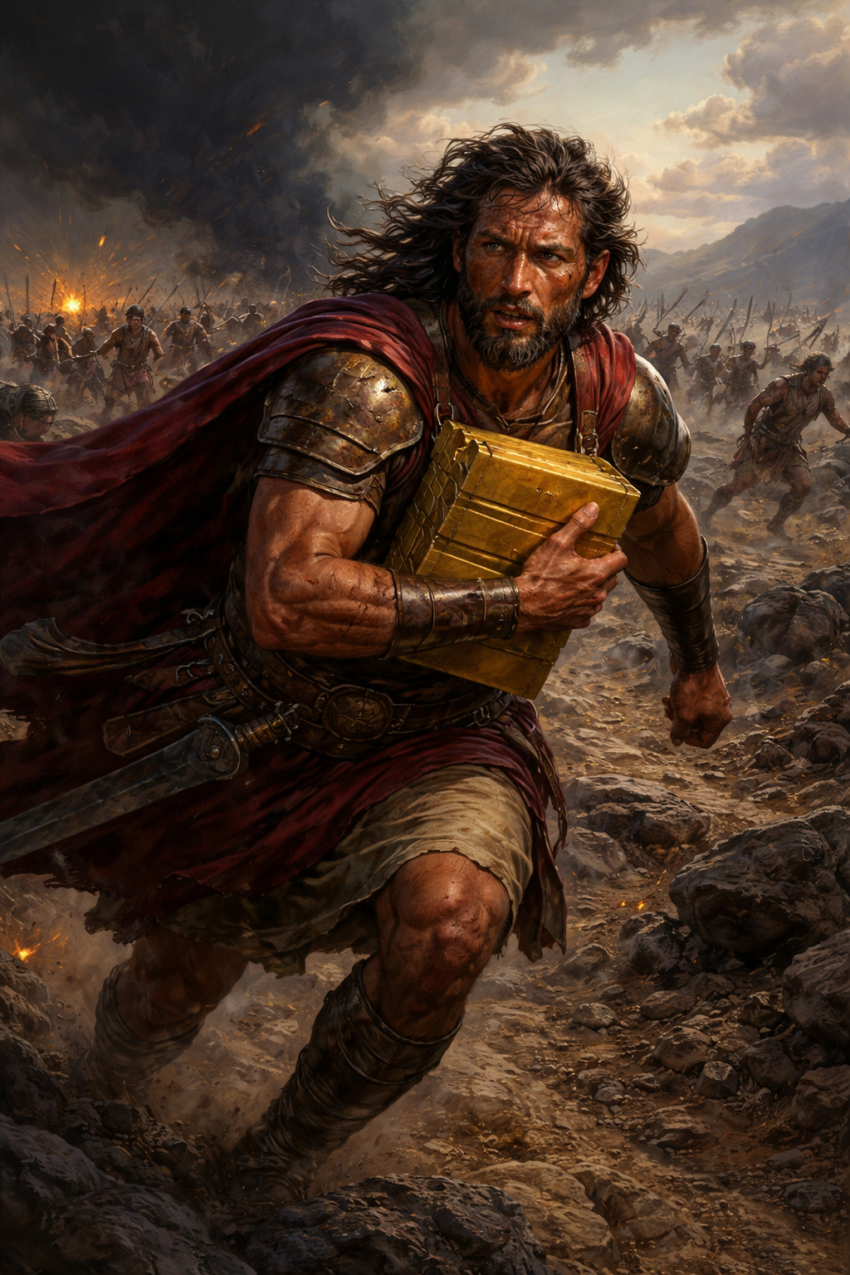
More Questions Than Answers
A Critical Examination from a Traditional Christian Perspective
I. Introduction: The Man Who Became an Angel
Some stories define a religion, moments so pivotal that without them the entire edifice of belief collapses into rubble. For the Church of Jesus Christ of Latter-day Saints — commonly known as the Mormon Church — the visit of the Angel Moroni to a teenage farm boy named Joseph Smith in western New York in 1823 is precisely such a moment. It is the linchpin. Without it, there is no Book of Mormon. Without the Book of Mormon, there is no Restoration. Without the Restoration, there is no LDS Church as the world knows it.
And yet, the more carefully one examines the story of Moroni, the more questions emerge — questions that probe not merely peripheral details but the very core of the narrative. Who, precisely, was this being? Can his existence be confirmed outside the testimony of Joseph Smith and a handful of associates? Does the Bible provide any precedent for a human being to become an angelic messenger after death? Why has the LDS Church, in recent years, been quietly downplaying the very figure who supposedly launched its founding revelation? And what are we to make of the enduring confusion in early Mormon documents over whether the heavenly visitor was named Moroni or Nephi?
This essay does not approach these questions from a posture of contempt. LDS believers are sincere people, and their faith deserves respectful engagement. However, intellectual honesty demands that we follow the evidence wherever it leads — even when that path leads away from cherished assumptions. What follows is a careful, historically grounded, and theologically informed examination of the Angel Moroni: his origins, his identity, his epistemological function, and the growing silence that surrounds him in the modern church that claims to have been founded through his ministry.
The conclusion that emerges is unsettling for the LDS narrative: there are far more questions about Moroni than there are answers.
II. Who Is Moroni? The LDS Account
In the official narrative of the LDS Church, the Angel Moroni is a resurrected being — a former human who lived in the Americas sometime in the fourth and fifth centuries A.D. According to the Book of Mormon, he was the son of the prophet-warrior Mormon, the final compiler of the golden plates. After the destruction of his people, the Nephites, at the battle of Cumorah, Moroni wandered alone for decades, adding final testimony to his father’s record before burying the plates in a hillside.
BYU’s Religious Studies Center describes Moroni’s life this way:
“The Lord chose Moroni to complete the Nephite dispensation of the gospel of Jesus Christ. He finished his father’s inspired abridgment of the Nephite millennial-long history; he commanded 10,000 soldiers at Cumorah in their final battles with the Lamanites; he abridged the writings of Ether, the record of the Jaredites, a once mighty civilization that preceded his own on this western hemisphere.”
— H. Donl Peterson, ‘Moroni, the Last of the Nephite Prophets,’ Religious Studies Center, Brigham Young University
According to Joseph Smith’s official account, Moroni appeared to him on the night of September 21, 1823, as a “messenger sent from the presence of God.” The Wikipedia entry on the Angel Moroni summarizes Smith’s description: Moroni appeared in “a loose robe of most exquisite whiteness… a whiteness beyond anything earthly I had ever seen… his whole person was glorious beyond description.” Over the next four years, Moroni reportedly met Smith annually at the Hill Cumorah, eventually delivering the golden plates in 1827.
Following the translation of the plates — which became the Book of Mormon — Moroni reportedly retrieved the physical plates and took them back to a heavenly repository. He has never been seen since, at least not in any account that can be independently verified.
In LDS theology, Moroni is identified with the angel of Revelation 14:6, described as “another angel flying in the midst of heaven, having the everlasting gospel to preach to those who dwell on the earth.” This identification places Moroni within a prophetic lineage stretching back to the Apostle John. LDS temples in the twentieth century prominently displayed gold-leafed statues of Moroni atop their spires, trumpet in hand, facing east — a visible symbol of the Restoration to the entire world.
That symbol, as we shall see, is now fading.
III. The Nephi Problem: More Than a Clerical Error?
The Historical Record
If the story of Moroni’s visitation were internally consistent from the beginning, critics would have little traction on the question of identity. It is not. One of the most persistent and troubling anomalies in the early LDS historical record is the repeated identification of Smith’s angelic visitor not as Moroni but as Nephi — the first narrator of the Book of Mormon.
The Wikipedia article on the Angel Moroni documents this confusion in detail. In Smith’s 1838 history — the one that became the official account — his scribe recorded the angel’s name as ‘Nephi.’ That text was left unchanged when published in 1842 in the church’s own newspaper, Times and Seasons, which Smith himself edited. It was published again with the name ‘Nephi’ in the Millennial Star in England, and in 1851 in the first edition of the Pearl of Great Price — a volume that would eventually be canonized as LDS scripture. It was also repeated in 1853 by Smith’s own mother, Lucy Mack Smith, in her published history of her son.
The Mormonism Research Ministry (MRM) provides pointed analysis:
“Joseph Smith’s eyewitness testimony of being visited by the angel Nephi stood until the Pearl of Great Price was reprinted in 1878. In that edition, published 34 years after Joseph Smith’s death, someone changed the name of the angel from Nephi to Moroni.”
— Sharon Lindbloom, ‘The LDS Church’s Groundless Celebration of Moroni’s Visitation,’ Mormonism Research Ministry
The MormonThink website, a site run by active and former LDS members concerned with historical accuracy, frames the problem starkly: multiple early documents, written by people close to Joseph Smith, named the angel Nephi. MormonThink’s dedicated page on this subject notes that even Mary Whitmer — mother of one of the Three Witnesses — always referred to the angel who showed her the golden plates as “Brother Nephi,” never Moroni.
The LDS Defense: Clerical Error
LDS apologists have mounted a consistent defense: the name ‘Nephi’ in the 1838 manuscript was a scribal error by clerk James Mulholland. The Keystone LDS website provides the most detailed treatment of this position:
“The first existing instance of the angel being referred to as Nephi appears in mid-1839 in the earliest available manuscript of ‘Joseph Smith — History.’ You’ll notice that it’s written in first-person, as if Joseph himself is writing it, but he’s not. Joseph is overseeing this project, but this is the handwriting of his clerk, James Mulholland.”
— Keystone LDS, ‘Response: The Angel Nephi Was a Clerical Error, Not a Cover-Up’
The Keystone article further notes that Mulholland himself, about fifty pages later in the same manuscript, quoted from Doctrine and Covenants section 52, which uses the name Moroni — suggesting that if Mulholland had invented the name Nephi, he would have been inconsistent with his own document. The FAIR LDS apologist organization similarly argues that the weight of early sources favors Moroni and that the “Nephi” instances represent isolated scribal or editorial errors.
Why the Defense Falls Short
The clerical error explanation, while plausible in a narrow technical sense, leaves several questions unanswered. How does one explain that the erroneous name appeared in print during Smith’s own lifetime, in a newspaper he personally edited, without any published correction? Smith had ample opportunity — across the years between 1842 and his death in 1844 — to correct the record. He never did.
Beyond this, the MRM article raises an important secondary problem: the dating of the visitation itself. When the historical record concerning the Smith family’s movements, property transactions, and church affiliations is examined against contemporary tax and land records, scholars like Marvin W. Cowan have argued that the visit could not have occurred before September 21, 1825 — two full years later than the date the LDS Church officially celebrates.
The Taylor Bible Study, representing a conservative evangelical perspective, notes the significance of these inconsistencies: “Interestingly, early Mormon documents inconsistently referred to the angel as Nephi, another character in the Book of Mormon, but the LDS Church later attributed this to editorial error and affirms that Moroni is the correct name.” The study concludes that both the name confusion and the canonical identification of Moroni with Revelation 14:6 are “not supported by Scripture.”
The cumulative weight of these inconsistencies is significant. When a story’s key protagonist cannot be consistently named by those closest to the events — over a span of years and across multiple published documents — the “clerical error” explanation strains credibility. John Taylor, the third president of the LDS Church, reportedly taught in an 1879 sermon that both Moroni and Nephi had visited Joseph Smith, an account that itself complicates the simple clerical error narrative. (bhroberts.org)
IV. Can Moroni Be Confirmed Outside the Mormon Faith?
One of the most fundamental questions a historian or apologist must confront is this: Can the existence of Moroni be independently verified? Is there any evidence for this being, this ancient Nephite prophet-warrior, outside the testimonial framework of the LDS tradition itself?
The answer, on any honest accounting, is no.
There is no archaeological evidence for the Nephite civilization described in the Book of Mormon. Decades of archaeological research in the Americas have produced no artifacts, no inscriptions, no genetic evidence, and no geographical markers that correspond to the world the Book of Mormon describes. No civilization matching the Nephites — iron-using, horse-riding, wheat-cultivating, Christ-following inhabitants of pre-Columbian America — has ever been discovered.
The Book of Mormon claims to be a historical record of real people who lived in real places. If Moroni was a real person — a warrior-prophet who commanded ten thousand soldiers at the Battle of Cumorah — one would expect some trace of that civilization to exist. None has been found.
This is not merely a Christian critique. The criticism comes from secular archaeologists, DNA researchers, and historians who have examined the claims with rigorous methodology and found them wanting. No Semitic DNA has been found in indigenous American populations that would suggest a migration from the ancient Near East, as the Book of Mormon narrative requires. No “Reformed Egyptian” language — the script said to be inscribed on the golden plates — has ever been identified by independent scholars.
What evidence does exist comes entirely from within the LDS tradition: the testimony of Joseph Smith, the Three Witnesses (who stated their experience was spiritual/visionary rather than physical), and later statements by church leaders. While testimonial evidence is not inherently worthless, its value diminishes significantly when it cannot be corroborated by any external source — and when the testimonial record itself contains internal contradictions of the Nephi/Moroni variety.
Clayton Taylor of Taylor Bible Study makes the pointed observation that the name “Moroni” bears a striking resemblance to the capital city of the Comoro Islands — Moroni — and that the Hill Cumorah closely resembles the island name Camora, locations associated with the era’s pirate and treasure-hunting lore that Smith was steeped in. These are circumstantial observations, not proof of fabrication, but they add to the cumulative picture of a narrative that draws from its environment rather than from ancient revelation.
V. The Biblical Problem: Can Humans Become Angels?
What the Bible Actually Teaches About Angels
One of the most theologically significant objections to the LDS account of Moroni is the claim at its heart: that a human being — Moroni, son of Mormon — died and was subsequently transformed into an angelic messenger. This concept, while emotionally appealing in popular culture, finds no support in biblical theology. In fact, it contradicts the Bible’s consistent portrayal of both humans and angels.
GotQuestions.org, a widely consulted evangelical biblical reference, states the matter directly:
“Angels are spirit beings created by God (Colossians 1:15–17) and are entirely different from humans. They are God’s special agents to carry out His plan and to minister to the followers of Christ (Hebrews 1:13–14). There is no indication that angels were formerly humans or anything else — they were created as angels.”
— GotQuestions.org, ‘Do We Become Angels After We Die?’
The scriptural basis for this distinction is clear. Angels and humans are separate orders of creation. Psalm 8 describes humanity as made “a little lower than the angels,” suggesting a categorical difference, not a progression. Colossians 1:16 lists angels among the created beings God made “through” Christ — a creation distinct from the human creation of Genesis 1-2. Hebrews 1:14 describes angels as “ministering spirits sent to serve those who will inherit salvation” — servants of the redeemed, not the redeemed themselves.
The passage most frequently misapplied to support the idea of humans becoming angels is Matthew 22:30, where Jesus states that at the resurrection, “people will neither marry nor be given in marriage; they will be like the angels in heaven.” GotQuestions.org addresses this:
“Jesus was not teaching that we become angels, only that we will be like the angels in one respect: we will not marry in the eternal state. Angels do not marry, and, after the resurrection, neither will we.”
— GotQuestions.org, ‘Do We Become Angels After We Die?’
The Awakened to Grace ministry provides a helpful taxonomy of biblical angels — fallen angels/demons, seraphim, cherubim, archangels, and ordinary angels — noting that “all of God’s angels possess great strength to perform His Word and are obedient to His command.” Critically, not one of these categories is populated by former humans. The biblical taxonomy has no slot for a deceased Nephite warrior-prophet who graduates to angelic status.
What the LDS Church Actually Teaches
The LDS theological framework radically departs from historic Christian orthodoxy on this point. Brigham Young, the second president of the LDS Church, taught explicitly:
“Angels are those beings who have been on an earth like this, and have passed through the same ordeals that we are now passing through. They are persons who have lived upon an earth, but did not magnify the Priesthood in that high degree that many others have done who have become Gods.”
— Brigham Young, Journal of Discourses, 9:102 — cited in Bill McKeever, ‘Angels and Humans,’ Mormonism Research Ministry
This is a breathtaking departure from biblical theology. In the LDS framework, angels are not a distinct category of divine creation but rather humans at a lower stage of eternal progression — souls who failed to fully “magnify” their calling and thus did not achieve godhood. This has profound implications for how Moroni should be understood: in Brigham Young’s framework, Moroni represents a kind of spiritual underachiever, a being who did not fully attain the highest celestial glory.
Bill McKeever of MRM asks the uncomfortable question this raises: “What if Moroni’s failure to ‘magnify’ his calling was a problem with telling the truth? What if his ‘failure’ was a problem with playing practical jokes on young and gullible teenagers?”
This is not polemic; it is a logical consequence of LDS theology applied consistently. If angels are humans who didn’t make the grade for full deification, the moral authority of their messages is correspondingly diminished. The LDS angel-as-former-human doctrine, while creative, creates as many theological problems as it solves.
The Warning of Galatians 1:8-9
Traditional Christianity is not merely neutral on the question of angelic messengers bearing new scriptures. The Apostle Paul issued an explicit warning:
“But even if we, or an angel from heaven, preach any other gospel to you than what we have preached to you, let him be accursed. As we have said before, so now I say again, if anyone preaches any other gospel to you than what you have received, let him be accursed.”
— Galatians 1:8-9 (NKJV)
Clayton Taylor of Taylor Bible Study applies this directly: “These passages clearly show that even if an angelic being appears, if it brings a message that contradicts the gospel of grace, it is to be rejected. The gospel proclaimed by Joseph Smith and the LDS Church adds to the finished work of Christ and teaches a different Jesus, a different plan of salvation, and a different Scripture. This is false doctrine.”
Additionally, 2 Corinthians 11:14 warns that “Satan himself transforms himself into an angel of light” — a sobering reminder that not every brilliant, white-robed apparition represents a divine messenger. From a traditional evangelical standpoint, the possibility that Smith’s vision was a deception rather than a divine encounter is not mere rhetoric — it is a theological category the Bible itself explicitly provides for.
VI. Moroni’s Epistemological Trap: The Promise That Cannot Fail
What Is Moroni’s Promise?
At the conclusion of the Book of Mormon, in Moroni 10:3-5, the final author — the same being who is said to have appeared to Joseph Smith — addresses future readers with what has become known as “Moroni’s Promise.” The text reads:
“And when ye shall receive these things, I would exhort you that ye would ask God, the Eternal Father, in the name of Christ, if these things are not true; and if ye shall ask with a sincere heart, with real intent, having faith in Christ, he will manifest the truth of it unto you, by the power of the Holy Ghost.”
— Book of Mormon, Moroni 10:4
This promise has been the cornerstone of LDS missionary work for two centuries. Investigators are invited to pray about the Book of Mormon and receive a spiritual witness — typically described as a “burning in the bosom” — confirming its truth. The Church of Jesus Christ of Latter-day Saints has published numerous testimonials of individuals whose lives were transformed by acting on this promise.
From an LDS perspective, this is an invitation to experiential knowledge of God. From a critical perspective, however, it is a masterwork of epistemological closure — a promise engineered in such a way that it can never be falsified.
The Logical Problems
The analysis site “A Careful Examination” has compiled an extensive list of problems with Moroni’s Promise, several of which merit serious engagement. The first concerns the original audience. Moroni 10:1 states explicitly that the author is writing to “my brethren, the Lamanites.” The conditions of verses 3-5 are addressed to this specific group. When contemporary missionaries deploy this promise to investigators of any background, they are applying a text to an audience it was not written for — a hermeneutical overreach the text itself does not warrant.
The second problem is circular reasoning. As the “A Careful Examination” document explains:
“There is a logical fallacy referred to as ‘begging the question.’ If upon reaching the final chapter of the final book of the Harry Potter series you found a passage that claimed that if you prayed about the Harry Potter books, the spirit of Dumbledore would let you know that it’s true, would you do it? Of course not. But why not? Because you do not believe that the Harry Potter series is true. The ‘begging the question’ aspect of the passage is that you would only accept that the promise is real if you already accepted that the context in which it is found is likewise real.”
— A Careful Examination, ‘Laundry List of Issues Regarding Moroni’s Promise’
This is a significant problem. The promise only functions as a truth-verification mechanism if one already grants the premise that Moroni is a real being with real divine authority. It cannot serve as independent confirmation of the Book of Mormon’s truth because its authority is derived entirely from the Book of Mormon itself.
The third problem is unfalsifiability. If a person prays and receives a positive spiritual experience, that confirms the Book of Mormon. If a person prays and receives no experience — or a negative one — LDS teachers typically attribute this to insufficient faith, lack of “real intent,” or spiritual unreadiness. The WasMormon.org site documents this pattern:
“The church sets the expectation that even with no answer, we should simply choose to believe in the truthfulness of the church claims. We should find ways to make these beliefs work for us, even when the promised paths to spiritual confirmation do not work — we should believe, not despite the lack of evidence, but despite the evidence to the contrary.”
— WasMormon.org, ‘When Moroni’s Promise Doesn’t Work’
This creates what critics call a “heads I win, tails you lose” epistemic framework. A positive result confirms the Book of Mormon. A negative result reflects the seeker’s failure, not the promise’s. No outcome can challenge the Book of Mormon’s truth claims within this system. This is not the methodology of honest inquiry; it is the structure of a closed loop.
Competing Truth Claims
A fourth and equally troubling problem is that the same subjective methodology produces mutually contradictory results across religious traditions. Muslims who have prayed about the Quran report the same kind of burning conviction that LDS converts report about the Book of Mormon. Evangelical Christians report the same spiritual witness about the Bible. Jehovah’s Witnesses report it about their New World Translation. If the same experiential method leads to contradictory conclusions — and if those contradictions cannot be adjudicated by any objective standard — then the method itself cannot be a reliable guide to objective truth.
From a traditional Christian standpoint, this is precisely why the Bible calls believers to test doctrines against the objective standard of Scripture (Acts 17:11, 1 John 4:1), not merely against subjective spiritual experience. The Bereans were commended for checking Paul’s teaching against the Old Testament, not for praying about whether Paul “felt true.”
VII. Where Does Moroni Live? The Geography of Heaven
One of the more underappreciated curiosities of LDS theology concerns the celestial geography of Moroni’s present existence. Traditional LDS cosmology divides the afterlife into a complex hierarchy: the Celestial Kingdom (three degrees of glory), the Terrestrial Kingdom, the Telestial Kingdom, and outer darkness. The highest degree of the Celestial Kingdom is reserved for those who have been sealed in the temple and who attain full exaltation — becoming gods themselves.
Within this framework, one is compelled to ask: where precisely does Moroni fit? If Brigham Young’s formulation is accepted — that angels are beings who did not fully magnify their priesthood calling and thus fell short of full godhood — then Moroni occupies a position below the highest celestial glory. He is, in that framework, a being of genuine holiness but incomplete achievement.
Yet LDS discourse rarely frames it that way. Moroni is presented as a glorious messenger of the highest order, luminous and authoritative. The LDS Church’s own Ensign magazine and thechurchnews.com have described him as the fulfillment of Revelation 14:6, the angel with “the everlasting gospel.” He stands atop temples facing east, the direction of Christ’s return. He is, symbolically, a being of great consequence.
And yet: Does Moroni have a planet? Does he have a family? Is he progressing toward godhood, or has his exaltation been finalized? The LDS doctrine of eternal progression implies that exalted beings — those who have achieved godhood — are continuing to create worlds and spirit children. Is Moroni participating in that cosmic project? If not, why not? If yes, when did this transition occur, and why is it not discussed?
These questions are not trivial. They flow directly from LDS metaphysics. The silence around them reveals a theological gap: Moroni is presented as central to the Restoration story, but his current celestial status, dwelling place, ongoing mission, and eternal family are simply not addressed. He appears in 1823, delivers the plates, and vanishes — leaving a theological afterimage but no theological substance.
The bookofmormonevidence.org site identifies Moroni as the “Guardian Angel of America” who holds “the keys to the Stick of Ephraim,” framing him in prophetic and geopolitical terms. Yet even this expansive role begs the question: what is Moroni doing right now, in 2025? The LDS Church has no answer. His current celestial activities are, for all theological purposes, a blank.
VIII. The Fading Trumpet: Moroni’s Diminishing Role in Modern Mormonism
A Symbol in Retreat
For most of the twentieth century, the golden statue of Moroni atop LDS temples was among the most recognizable religious symbols in the American West. His silhouette — robed figure, trumpet raised to heaven — was unmistakable. When a new LDS temple was announced, the question of whether it would bear the Moroni statue was not even asked; of course, it would.
That assumption no longer holds. Since 2018, the Angel Moroni statue has ceased to be a required design feature for new LDS temples. Dozens of newly announced temples are being built without him. The Salt Lake Tribune’s religion reporter Jana Riess investigated this trend in 2020, noting that under President Russell M. Nelson’s leadership, fewer and fewer temples include the statue — a quiet but significant architectural shift.
The Times and Seasons theological journal provides essential historical context for understanding this shift:
“Throughout much of the nineteenth century, it seems that the visit of the Angel Moroni was what came to mind for Latter-day Saints. While the First Vision was spoken of and appeared in some Church publications from the 1840s onwards, the visit of Moroni was more central to Latter-day Saint thought and proselyting efforts. Yet, it was eventually eclipsed by Joseph Smith’s vision of the Father and the Son in importance, taking a secondary role in the story of the Restoration. Today, we seem to be seeing a similar transition take place in the symbolism of the Church, with the formerly dominant image of Moroni taking a backseat to Jesus the Christ.”
— Chad Nielsen, ‘The Rise and Decline of the Angel Moroni,’ Times & Seasons, September 1, 2020
This historical arc is striking. Early Mormonism was practically defined by Moroni. Oliver Cowdery’s first written history of the church, composed in 1834, described the Restoration as beginning with Moroni’s visit — not the First Vision. Even Joseph Smith’s own recounting of the First Vision to a visitor in 1835 framed it merely as background to the coming forth of the Book of Mormon. For the first generation of LDS believers, Moroni was not a secondary figure; he was the founding event.
Why Is the Church Moving On?
The reasons for the contemporary de-emphasis on Moroni are multiple and interrelated. The most prominent, as several analysts have noted, is the church’s deliberate effort under President Nelson to be recognized as a Christian denomination. The “rebranding” effort — which includes discouraging the use of the word “Mormon” — is explicitly designed to shift the public perception of the faith from a unique “new world religion” to a mainstream Christian church.
From a strategic standpoint, Moroni is a problem for this rebranding. He is distinctively LDS in a way that Jesus Christ is not. A temple crowned with a statue of Jesus communicates Christian affinity. A temple crowned with a golden angel-warrior from ancient America communicates something quite different — something that requires explanation, context, and theological elaboration that the average passerby is not prepared to engage with.
Reddit’s r/exmormon community has documented this trend with considerable attention, noting that many of the 140+ new temples announced since 2018 lack the statue. One common response from defenders within the Mormon Dialogue Forum is that the symbolic mission of Moroni continues even if his architectural presence is diminished — the statue is optional, but the figure remains important.
The Moroni Channel website frames the shift this way: the church is not phasing out Moroni per se, but is exercising architectural flexibility, with the statue’s presence now determined by local building codes, cultural context, and design considerations rather than universal policy. The April 2024 reinstallation of the Moroni statue on the renovated Salt Lake Temple was cited as evidence that Moroni has not been abandoned.
Yet the trend is undeniable. When a founding figure’s primary public symbol becomes optional — when his architectural presence is deemed culturally problematic in some contexts and simply inconvenient in others — something significant is happening theologically. A religion does not quietly retire the symbols of its founding revelation unless those symbols have become a liability.
The Misunderstanding Problem
One additional reason the LDS Church has offered for removing Moroni statues is the concern that non-members misunderstand them as objects of worship — seeing the golden figure as an idol in the tradition of pagan temples. This is a legitimate pastoral concern, and it reflects the ongoing challenge Mormonism faces in communicating its distinctive theology to a skeptical public. But it is also somewhat ironic: if Moroni’s story is one of the most important events in human history since the resurrection of Christ — as LDS theology claims — then his symbol should arguably be explained and defended, not quietly retired to avoid misunderstanding.
IX. How Did a Spiritual Being Remove Physical Plates?
The golden plates present one of the more philosophically interesting problems in the Moroni story. According to LDS accounts, the plates were a physical object — heavy, metallic, real enough that witnesses reportedly hefted them, felt their weight through a cloth covering, and observed their rustling pages. Joseph Smith’s family members spoke of the plates as something physically present in their home, wrapped and hidden from antagonistic neighbors.
Yet Moroni, in LDS theology, is a resurrected spiritual being — not a mortal with ordinary physical capacities, but a glorified entity of heavenly origin. How did such a being retrieve a physical object and convey it to a heavenly repository? The LDS Church’s official AI overview acknowledges the problem directly:
“The exact mechanism of how a spirit removes a physical item is not explicitly detailed in the accounts, leaving it as a matter of faith in the power of a resurrected being.”
— AI Overview on Moroni and the Plates (cited from Church sources)
This is an honest acknowledgment, but it raises further questions. Why were the plates physically retrieved at all? If the Book of Mormon’s content was so extraordinarily sacred that it was delivered under divine protection and translated through miraculous means — why was it necessary to remove the physical source document from human reach? If the translation was complete and accurate, the plates had served their purpose. Their retrieval serves only to remove a potential evidential artifact from scrutiny.
One could argue that this is precisely the point: the plates’ removal prevents independent verification. There is no artifact that can be submitted to metallurgical analysis, no papyrus that can be carbon-dated, no inscription that can be studied by Near Eastern linguists. The physical evidence of the Book of Mormon’s origin — the very foundation of Moroni’s mission — was taken away before modern scientific methods could be applied to it.
Critics have noted the convenient epistemological effect: a record of immense importance, supposedly containing the “fullness of the everlasting gospel,” was translated once, by one person, using an instrument (a seer stone in a hat, according to recent LDS acknowledgment) that no one else examined, from plates that no witness ever examined with uncovered eyes, and then removed entirely from the reach of all future inquiry. The message to humanity was: trust the translation. The original is gone.
From a historical perspective, this pattern has no parallel in the transmission of other ancient texts. The Dead Sea Scrolls were examined by hundreds of scholars. The ancient manuscripts underlying the New Testament can be studied, photographed, dated, and cross-referenced. The golden plates of the Book of Mormon — assuming they existed — are uniquely, permanently, and conveniently inaccessible.
X. The Hierarchy Disconnect: Moroni and the Angels of Scripture
One of the most underexamined theological problems with Moroni is his relationship — or rather his non-relationship — to the angels of the Bible. If LDS theology is correct that Moroni is a genuine heavenly messenger, one might expect some theological coherence between his ministry and the angelic beings described in the Old and New Testaments. Instead, there is a categorical disconnect.
The Bible’s angels belong to a defined heavenly order. Michael is an archangel (Jude 1:9). Gabriel is specifically named as a divine messenger (Luke 1:19). The seraphim and cherubim of Isaiah 6 and Ezekiel 1 are beings of awesome, specific character. These beings have names, functions, and theological contexts that connect them to the consistent biblical narrative. They operate within a recognizable divine economy.
Moroni, by contrast, exists in a parallel universe. He has no relationship to Michael. He has no connection to Gabriel. He is not identified within any biblical angelic hierarchy. He is an entirely novel figure, connected to a set of scriptures (the Book of Mormon) and a narrative world (pre-Columbian America) that is nowhere anticipated in the biblical text.
LDS theology attempts to bridge this gap by identifying Moroni with the angel of Revelation 14:6. But this identification is, as the MRM’s Bill McKeever notes, extraordinarily difficult to sustain:
“To say this angel fits the description of Moroni is difficult whether or not one takes a historical or prophetical view of the book of Revelation. The context does not support the idea that this was the angel who is said to have appeared to Smith.”
— Bill McKeever, ‘Angels and Humans,’ Mormonism Research Ministry
The angel of Revelation 14:6 is presented in an apocalyptic context as one of a series of heavenly beings announcing the final judgments of God on a corrupt world. He is a figure of eschatological terror and divine justice, not a custodian of golden plates buried in upstate New York. Reading the Revelation 14 angel as Moroni requires a level of interpretive creativity that the text does not invite.
Moreover, the Book of Mormon itself does not attempt to integrate its angelic beings with the angelic beings of the Old and New Testaments. There is no scene in which Book of Mormon angels interact with Gabriel or Michael. There is no acknowledgment of the Seraphim or Cherubim. The heavenly beings of the Book of Mormon exist in a separate theological ecosystem — one that connects to the biblical world rhetorically and linguistically, but not operationally or hierarchically.
This creates a strange disjunction for LDS believers who also affirm the Bible. The God of the Bible governs his cosmos through a specific, organized hierarchy of spiritual beings. If Moroni is also a being under that God’s authority, one would expect some acknowledgment of how he relates to that hierarchy. The silence on this point is not a peripheral gap; it is a fundamental structural flaw in the coherence of LDS angelology.
XI. Misconceptions Within the Mormon Community
Beyond the external critiques addressed above, there is also a body of evidence suggesting that significant misconceptions about Moroni persist within the LDS community itself. These are not merely matters of theological nuance but of basic factual accuracy — and they illuminate how the Moroni story functions more as a devotional symbol than a historical anchor.
First, many LDS members are unaware of the Nephi/Moroni confusion discussed above, having been presented only the official, corrected version of events. When the original historical record is brought to their attention, the response is often genuine surprise rather than informed engagement.
Second, the LDS Church’s identification of Moroni with Revelation 14:6 is widely accepted within the community as though it were an established scriptural fact, rather than a theological interpretation first proposed in the nineteenth century and not universally held even within LDS scholarship.
Third, many LDS members assume that the Three Witnesses to the Book of Mormon saw the golden plates physically, in full, with their natural eyes. In fact, both the testimony of the witnesses and subsequent historical research indicate that the experience was visionary — spiritual rather than physical. As the MRM and other sources have noted, the witnesses themselves spoke of the experience in terms that suggest it was not an ordinary sensory encounter.
Fourth, many LDS members are unaware that the statue of Moroni has been removed from new temple designs since 2018, or that this represents a deliberate policy shift rather than mere architectural variation. The change has received limited coverage in official church communications.
Fifth, the widespread belief that Moroni’s Promise is a reliable, universally applicable method for determining the Book of Mormon’s truth — that sincere prayer will always produce a definitive spiritual witness — is contradicted by the experiences of many faithful members who prayed sincerely and received no confirmatory experience, as documented at WasMormon.org and the CES Letter.
The CES Letter, a widely circulated document addressed to a CES director, raises the logical trap inherent in the promise’s conditions:
“If you don’t get an answer, it’s because you didn’t have enough faith, or didn’t have ‘real intent,’ or you weren’t humble enough, or you haven’t ‘pondered’ enough. The deck is completely stacked so that Moroni’s promise is not and cannot be falsified.”
— Jeremy Runnells, CES Letter, ‘Debunking FAIR Mormon’
XII. Non-Mormon Writers and the Moroni Question
The skepticism about Moroni is not limited to evangelical Christian apologists or former LDS members. A broader spectrum of critical voices — historians, philosophers, and investigators of religious claims — has engaged with the Moroni story and found it wanting.
Grant H. Palmer, a former LDS Church Education System (CES) instructor who wrote An Insider’s View of Mormon Origins, raised the possibility that Smith drew the name “Moroni” from geographical knowledge of the Comoro Islands, noting that Captain William Kidd’s treasure-hunting voyages and associated maps were popular currency in the culture of Smith’s day. Palmer was not a hostile outsider; he was a lifetime member who spent decades teaching LDS history before his conclusions led to his formal discipline and resignation.
Dan Vogel, one of the foremost independent scholars of early LDS history, has documented the inconsistencies in Smith’s accounts with meticulous care. His multi-volume collection of early Mormon documents provides the raw historical material that makes the clerical error defense difficult to sustain with confidence.
Wesley Walters, a Presbyterian minister and historian, produced archival research in the 1960s and 1970s that challenged the dating of key events in Smith’s history. His work, published in Dialogue: A Journal of Mormon Thought, concluded that the historical record “completely discredits Joseph Smith’s First Vision story” — a conclusion with direct implications for the Moroni narrative that is inseparably linked to it. MRM’s Sharon Lindbloom cites Walters’ work as foundational to understanding the historical problems the LDS Church has never fully resolved.
Mark Twain, though not a theological analyst, famously described the Book of Mormon as “chloroform in print” — a work so repetitive and derivative that it could barely command sustained attention. While Twain’s literary critique is not a theological argument, it reflects the broader cultural difficulty the Book of Mormon has always had in claiming serious scholarly respect outside its own devotional community.
The philosophical critique of Moroni’s Promise has been developed by thinkers across disciplines. The “testimony” model of religious knowledge — believing something to be true because of a subjective spiritual experience — has been examined critically by epistemologists, including Alvin Plantinga (who famously defended Reformed epistemology) and his critics. From the outside, the LDS model of testimony is often seen as a textbook case of what philosophers call “epistemic closure” — a system that immunizes itself against falsification by redefining negative evidence as personal failure.
XIII. The Theological Verdict: More Questions Than Answers
We have now traveled a considerable distance through the terrain of the Angel Moroni, and it is time to take stock of what the evidence does and does not establish.
The story of Moroni is remarkable in its internal ambition. It proposes a figure who was a warrior-prophet in ancient America, the last survivor of a destroyed civilization, the compiler of a sacred record, a loyal servant who buried that record and guarded it for centuries, and finally a resurrected celestial messenger who appeared to a farm boy in 1823 to launch what LDS believers regard as the greatest religious event since the resurrection of Christ.
What does the evidence actually support?
It supports that Joseph Smith claimed to have been visited by an angelic figure. It supports that this claim was made in various forms across multiple years, with inconsistencies in the visitor’s name, the dating of the events, and the nature of the experiences described. It supports that a community of believers formed around Smith’s claims and produced a rich theological tradition. And it supports that the symbol of Moroni — whatever his ultimate nature — has had an undeniable cultural and religious impact on millions of lives.
What the evidence does not support is equally significant. It does not support the existence of a Nephite civilization. It does not support the claim that a human named Moroni transformed into an angelic messenger after death — a claim the Bible’s own testimony refutes. It does not support the identification of Moroni with the angel of Revelation 14:6. It does not establish that Moroni’s Promise is a reliable epistemological method. And it does not explain — to any critical satisfaction — how the founder of a movement claiming divine revelation confused the name of the key figure in that revelation’s delivery for a period stretching across multiple published documents and at least two years of his own editorial oversight.
The LDS Church’s own quiet retreat from Moroni — the disappearing statues, the diminishing emphasis, the rebranding toward a Christ-centered identity — speaks volumes. When an institution begins to de-emphasize its own founding symbol, it is rarely because that symbol has become more theologically compelling. More often, it is because the symbol has become more difficult to defend.
That difficulty is not incidental. It is structural. Moroni, as a theological claim, rests on a series of assertions — about the nature of angels, about the reliability of subjective spiritual experience, about the historicity of the Book of Mormon, about the identity of the messenger himself — each of which is contested by biblical theology, historical evidence, or elementary logic. Remove any one of those foundational assertions and the entire edifice trembles.
Christians engaging with LDS friends and neighbors would do well to engage the Moroni question with both knowledge and compassion. The questions raised here are not weapons; they are invitations. If the God of Abraham, Isaac, and Jacob has truly spoken — through his Son and through the Scriptures that bear witness to his Son — then no additional revelation delivered by a being of uncertain identity and unverifiable existence is necessary. The gospel of Jesus Christ, finished at the cross and confirmed by the empty tomb, needs no golden plates.
The Angel Moroni raises more questions than he answers. That, in itself, is an answer worth hearing.
XIV. Conclusion
The Angel Moroni stands at the intersection of history, theology, epistemology, and human longing — and at that intersection, he reveals himself to be a figure of profound ambiguity. He is celebrated by millions as the herald of a new dispensation and scrutinized by others as the invention of a gifted but untrustworthy religious entrepreneur. He adorns the spires of some of the world’s largest and most architecturally impressive religious buildings — but is quietly disappearing from new ones. He promised truth through a method that cannot be falsified. He delivered plates that cannot be examined. He announced his name in ways that generated decades of confusion.
The traditional Christian evaluation of Moroni is not primarily negative — it is simply biblical. The Bible describes angels as a distinct order of divine creation, not as former humans who have graduated to spiritual messengerhood. It warns explicitly that angelic messengers bearing gospels that contradict the once-delivered faith are to be rejected, not welcomed. And it models epistemological rigor — test what you hear against Scripture, not merely against feeling.
By those biblical standards, the Angel Moroni does not pass muster. His origins are unverifiable. His nature contradicts biblical angelology. His promise is epistemologically closed. His record has been quietly revised. His symbol is fading.
But the questions he raises — about the nature of revelation, the limits of personal experience, the demands of historical honesty, and the difference between sincere faith and verifiable truth — are questions that matter deeply. And answering them honestly, with both charity toward LDS believers and fidelity to biblical theology, is one of the most important tasks facing the church in the American West today.
The Angel Moroni, in the end, is best understood not as a confirmed heavenly messenger but as the most consequential open question in American religious history.
Primary Sources Consulted
- Wikipedia: Angel Moroni — https://en.wikipedia.org/wiki/Angel_Moroni
- Mormonism Research Ministry: ‘The LDS Church’s Groundless Celebration of Moroni’s Visitation’ (Sharon Lindbloom) — https://mrm.org/the-lds-churchs-groundless-celebration-of-moronis-visitation
- Mormonism Research Ministry: ‘Angels and Humans’ (Bill McKeever) — https://mrm.org/angels-and-humans
- GotQuestions.org: ‘Do We Become Angels After We Die?’ — https://www.gotquestions.org/become-angels.html
- Awakened to Grace: ‘The Truth About Angels’ — https://awakenedtograce.com/the-truth-about-angels/
- Taylor Bible Study: ‘Who Is the Angel Moroni?’ (Clayton Taylor) — https://taylorbiblestudy.com/notes/who-is-the-angel-moroni
- Times & Seasons: ‘The Rise and Decline of the Angel Moroni’ (Chad Nielsen, 2020) — https://archive.timesandseasons.org/2020/09/the-rise-and-decline-of-the-angel-moroni/
- Salt Lake Tribune: ‘Statue of Limitations? Under Russell Nelson, Fewer Temples Have Angel Moroni’ (Jana Riess, 2020) — https://www.sltrib.com/religion/2020/10/02/statue-limitations-under/
- A Careful Examination: ‘Laundry List of Issues Regarding Moroni’s Promise’ — https://faenrandir.github.io/a_careful_examination/list-of-issues-regarding-moronis-promise/
- WasMormon.org: ‘When Moroni’s Promise Doesn’t Work’ — https://wasmormon.org/when-moronis-promise-doesnt-work/
- CES Letter / Debunking FAIR Mormon (Jeremy Runnells) — https://cesletter.org/debunking-fairmormon/testimony.html
- Keystone LDS: ‘Response: The Angel Nephi Was a Clerical Error, Not a Cover-Up’ — https://keystonelds.com/about-mormons/history/response-the-angel-nephi-was-a-clerical-error-not-a-cover-up/
- MormonThink.com: ‘Moroni or Nephi?’ — http://www.mormonthink.com/nephiweb.htm
- FAIR Latter-day Saints: “Moroni’s Visit / Nephi or Moroni” — https://www.fairlatterdaysaints.org/answers/Moroni%27s_visit/Nephi_or_Moroni
- BYU Religious Studies Center: ‘Moroni, the Last of the Nephite Prophets’ (H. Donl Peterson) — https://rsc.byu.edu/book-mormon-fourth-nephi-through-moroni-zion-destruction/moroni-last-nephite-prophets
- FAIR Latter-day Saints: Moroni’s Promise — https://www.fairlatterdaysaints.org/
- Book of Mormon Evidence: ‘Moroni — Guardian Angel of America’ — https://bookofmormonevidence.org/moroni-guardian-angel-of-america-holds-the-keys-to-the-stick-of-ephraim/
- BH Roberts Foundation: ‘John Taylor Teaches That Both Moroni and Nephi Visited Joseph Smith’ — https://bhroberts.org/records/HI4Syc-mbfNCb/
- Reddit r/exmormon: Church Steering Away from Angel Moroni on Temples — https://www.reddit.com/r/exmormon/comments/11svy51/
- Mormon Dialogue Forum: ‘Moroni Disappearing from New Temple’ — https://www.mormondialogue.org/topic/74037-moroni-disappearing-from-new-temple/
- Moroni Channel: ‘Is the LDS Church Phasing Out Angel Moroni on Temples?’ — https://www.moronichannel.org/newsroom/temples/is-the-lds-church-phasing-out-angel-moroni-on-temples/
A Note on Research Methods and Accuracy
This work represents a collaboration among the author’s theological and historical research, primary-source documentation, and the emerging capabilities of artificial intelligence research tools. AI assistance was employed throughout the investigative process—not as a ghostwriter or a substitute for scholarship, but as a rigorous research partner: surfacing sources, cross‑referencing claims, identifying scholarly consensus, and flagging potential errors before they could reach the page.
Every factual claim in this work has been subjected to active verification. Where AI‑generated content was used as a starting point, it was tested against primary sources, peer‑reviewed scholarship, official institutional documentation, and established historical records. Where discrepancies were found—and they were found—corrections were made. The author has made every reasonable effort to ensure that quotations are accurately attributed, historical details are precisely rendered, and theological claims fairly represent the positions they describe or critique.
That said, no work of this scope is immune to error, and the author has no interest in perpetuating inaccuracies in the service of an argument. If you are a reader—whether sympathetic, skeptical, or hostile to the conclusions drawn here—and you identify a factual error, a misattributed source, a misrepresented teaching, or a claim that cannot be substantiated, you are warmly and genuinely invited to say so. Reach out. The goal of this work is not to win a debate but to get the history right. Corrections offered in good faith will be received in the same spirit, and verified corrections will be incorporated into future editions without hesitation.
Truth, after all, has nothing to fear from scrutiny—and neither does this work.