
Standing Before Which Bar?
Elder Holland’s ‘Judgment Bar of God,’ the Great White Throne, and the Bema Seat of Christ
A Scholarly Examination from a Traditional Christian Perspective
Introduction: Words That Sound Familiar
In October 2009, Elder Jeffrey R. Holland of the Quorum of the Twelve Apostles of The Church of Jesus Christ of Latter-day Saints delivered what has become one of the most emotionally charged and frequently cited addresses in recent LDS General Conference history. In his talk, ‘Safety for the Soul,’ Holland fixed his gaze upon the camera with undeniable intensity and declared:
I want it absolutely clear when I stand before the judgment bar of God that I declared to the world in the most straightforward language I know that the Book of Mormon is true, that Joseph Smith is a prophet of God, that this is the restored Church of Jesus Christ, and that its leaders today are those empowered to speak in His holy name.
— Elder Jeffrey R. Holland, ‘Safety for the Soul,’ LDS General Conference, October 2009
For a casual listener — particularly one with roots in evangelical Christianity or mainstream Protestantism — Elder Holland’s words carry an immediately recognizable texture. ‘Standing before the judgment bar of God’ is language that resonates. It sounds biblical. It evokes solemn accountability, divine reckoning, and eternal consequence. The phrase lands with the authority of Scripture and the urgency of eternity.
But here is the critical question that any biblically grounded Christian must ask: Is Elder Holland’s ‘judgment bar of God’ the same event that the New Testament describes when it speaks of believers standing before the Lord? Is the LDS concept of divine judgment functionally identical — or even meaningfully compatible — with what the Apostle Paul meant when he wrote of the bema seat of Christ? And does the Book of Mormon belong as an evaluative criterion at any judgment throne the Bible describes?
The answer to all three questions, examined carefully against the canon of Scripture and the full weight of LDS doctrinal literature, is no. The language is similar enough to sound Christian. The theological content, however, diverges in ways that matter profoundly — both for how one understands salvation and for how one understands eternity.
This essay undertakes a sustained, scholarly examination of that divergence. It explores what the Bible teaches about two distinct final judgments — the Bema Seat of Christ (for believers) and the Great White Throne Judgment (for unbelievers) — and then places that teaching alongside the LDS doctrine of the ‘judgment bar of God’ as articulated by Elder Holland, affirmed by other LDS authorities, and codified in official church curriculum. The goal is not to caricature or dismiss the Latter-day Saint tradition. It is, rather, to take both traditions seriously enough to honestly name where they agree, where they differ, and why those differences matter.
Part One: The World That Shaped the LDS Doctrine of Judgment
The Social and Religious Crucible of Early Mormonism
To understand what the LDS concept of final judgment means today, one must understand the world in which it was born. Joseph Smith announced his first vision in 1820, in the midst of what historians call the Second Great Awakening — a period of intense revivalist fervor, competing denominational claims, and widespread anxieties about sin, hellfire, and divine judgment. Western New York, where Smith was raised, was so saturated with competing revival movements that it became known as the ‘Burned-Over District,’ a landscape scorched by the fires of religious enthusiasm.
For the common farmer or laborer of that era, final judgment was not an abstraction. Methodist circuit riders, Baptist itinerants, and Calvinist divines all preached with graphic urgency about the day when the books would be opened and souls would be measured against God’s law. The revivalist tradition emphasized personal accountability, the terror of God’s holiness, and the absolute necessity of conversion before death.
Into this milieu, Joseph Smith introduced a religious system that reframed virtually every inherited theological category — including judgment. Where Protestant revivalism offered a stark binary (heaven or hell, saved or damned), Smith’s revelations introduced a graduated afterlife: three kingdoms of glory (celestial, terrestrial, and telestial), with assignment determined not by grace alone through faith, but by one’s obedience to ordinances, covenants, and the full law of the gospel as defined by the restored church. The judgment bar, in LDS theology, became the great accounting moment at which that comprehensive evaluation would be rendered.
This was, theologically speaking, an enormous innovation. But it was packaged in language borrowed substantially from the existing Protestant lexicon. Words like ‘judgment bar,’ ‘resurrection,’ ‘atonement,’ ‘salvation,’ ‘covenant,’ and ‘works’ were retained — but their meanings were substantially reengineered. Elder Holland’s 2009 address stands squarely within that tradition, using biblically resonant language to articulate a doctrinally distinct understanding of what that final moment before God entails.
Evolution of LDS Judgment Theology
LDS doctrine on judgment did not emerge fully formed from a single source. It evolved across decades through prophetic pronouncements, General Conference addresses, and codified manuals. The foundational frame is what Latter-day Saints call the ‘Plan of Salvation’ or ‘Plan of Happiness,’ a cosmological narrative that extends from pre-mortal existence through mortality, death, spirit world sojourn, resurrection, and finally to a formal judgment that assigns the soul to its eternal kingdom.
The eighth President of the Church, George Albert Smith, taught that Latter-day Saints will be ‘judged according to their opportunities’ — a formulation that explicitly differentiates the LDS faithful from the wider world:
Latter-day Saints will be judged according to their opportunities. A knowledge of pre-existence has been given to the Latter-day Saints… We will not be judged as our brothers and sisters of the world are judged, but according to the greater opportunities placed in our keeping.
— George Albert Smith, Conference Report, October 1906, p. 47; cited in ‘Crash Course Mormonism: Judgment,’ Mormonism Research Ministry
This is significant. The LDS judgment bar is not a generic tribunal. It is specifically calibrated to the LDS framework of ‘greater opportunities’ — which includes access to the restored gospel, the Book of Mormon, priesthood ordinances, and temple covenants. To stand at that bar faithfully, in LDS theology, means having been faithful to all of those elements, not simply to faith in Jesus Christ as biblically defined.
Marion G. Romney, a member of the First Presidency, was even more explicit about the ordinance-centered nature of LDS final judgment:
The verdict will turn on obedience or disobedience to the laws and ordinances of the gospel. If these laws and ordinances have been complied with during mortal life, the candidate will be cleansed from the stain of sin by the atoning blood of Jesus Christ and be saved in the celestial kingdom of God.
— Marion G. Romney, ‘How Men Are Saved,’ Ensign, November 1974; cited at mrm.org/judgment-doctrine
This framing — where the atonement of Christ operates conditionally, dependent on ordinance compliance — stands in sharp contrast to the biblical doctrine of justification by faith and to the specific character of the Bema Seat. Understanding that contrast requires first examining what the New Testament actually teaches about the two distinct judgments it describes.
Part Two: The Bema Seat of Christ — A Tribunal of Reward
The Greek Word and Its Ancient Context
The English phrase ‘judgment seat of Christ’ translates a single Greek word: bema (βῆμα). In the ancient Greco-Roman world, the bema was a raised platform from which judges or civic officials presided. Its most celebrated context, however, was athletic competition. At the Isthmian Games — the ancient precursor to the Olympics, held near Corinth and familiar to every resident of that cosmopolitan city — the bema was the judges’ stand from which victors received their laurel crowns.
The Apostle Paul, who spent considerable time in Corinth (Acts 18), was certainly aware of this athletic imagery. He invoked it explicitly in his correspondence with the Corinthian church:
Do you not know that in a race all the runners run, but only one gets the prize? Run in such a way as to get the prize.
— 1 Corinthians 9:24
The bema, in its athletic context, was never a place of punishment, criminal prosecution, or condemnation. Athletes were not brought before the bema to answer for violations of the law. They were brought before it to be evaluated — and those who had run well, competed honorably, and finished the race were rewarded. The bema was a place of honor, of crown-giving, of recognition for faithful effort. This is precisely the image Paul employs when he describes the judgment seat of Christ awaiting all believers.
As GotQuestions.org helpfully explains:
A bema was a raised platform on which judges sat to view athletic games. Their job was to make sure contestants followed the rules and to present awards to the victors. The bema was never a place to reprimand the athletes or to punish them in any way. It was a place of testing and reward. In the same way, the bema of Christ will not be a place of condemnation or censure.
— GotQuestions.org, ‘What is the Judgment Seat of Christ?’
The Biblical Texts: 2 Corinthians 5:10 and Romans 14:10–12
The two primary passages that establish the Bema Seat as a distinct event for believers are found in Paul’s letters to the Romans and the Corinthians:
For we must all appear before the judgment seat of Christ, so that each of us may receive what is due us for the things done while in the body, whether good or bad.
— 2 Corinthians 5:10For we will all stand before God’s judgment seat… So then, each of us will give an account of himself to God.
— Romans 14:10, 12
Several critical observations must be drawn from these texts. First, the ‘we’ Paul employs is not universal humanity. In both letters, Paul is writing to Christian communities, addressing believers in Christ. The bema is a gathering of the redeemed. Second, ‘what is due’ is tied to deeds done ‘in the body’ — that is, in this earthly life after conversion. Third, and decisively, the mention of ‘good or bad’ does not introduce the possibility of eternal condemnation for believers. As John MacArthur of Grace to You Ministries explains:
The purpose of the bema is an exhaustive evaluation of our lives… Notice that Paul says each man’s praise will come to him from God. God gives rewards to the victors; He does not whip the losers. We know that He won’t condemn us for our sins at that point, because Romans 8:1 says, ‘There is therefore now no condemnation to those who are in Christ Jesus.’
— John MacArthur, ‘What is the Purpose of the Judgment Seat of Christ?’ Grace to You
No Condemnation for Sin — The Decisive Principle
Perhaps the most critical distinction between the Bema Seat and any tribunal at which sins are revisited is the absolute biblical declaration of Romans 8:1: ‘Therefore, there is now no condemnation for those who are in Christ Jesus.’ This is not a contingent promise. It does not read ‘no condemnation for those who kept all the ordinances’ or ‘no condemnation for those who bore faithful testimony to the Book of Mormon.’ It is unconditional for those who are ‘in Christ Jesus’ — those who have been justified by faith.
As Dr. Robert Jeffress, pastor and founder of Pathway to Victory ministry, articulates this with particular clarity:
God’s justification exempts us from God’s condemnation, but it does not exempt us from God’s evaluation. After you become a Christian, you no longer have to worry about God’s condemnation, but you still need to be mindful of His evaluation of your life.
— Dr. Robert Jeffress, ‘The Difference Between The Christian’s Judgment and the Non-Christian’s Judgment,’ Pathway to Victory
The distinction between condemnation and evaluation is the theological hinge on which the entire Bema Seat doctrine turns. Believers are not on trial for their sins at the Bema Seat because those sins were dealt with at Calvary. The cross was not merely a down payment contingent on future covenant performance. It was a finished work — ‘It is finished’ (John 19:30) — that exhausted the penalty for sin for everyone who believes.
BibleQuestions.com captures this unequivocally:
Christians will not face any judgment for their sins. Christ died to take away our sins, once and for all (Hebrews 10:14). As a result, we have passed from judgment into new life in Christ, and there is now no condemnation for us (John 5:24; Romans 8:1).
— BibleQuestions.com, ‘Are Christians Judged for Their Sins?’
What Is Actually Evaluated at the Bema Seat?
If sins are not the subject of evaluation at the Bema Seat, what is? The answer is faithful stewardship — specifically, what the believer did with the resources, time, gifts, and opportunities God entrusted to them after their conversion. Paul’s extended metaphor in 1 Corinthians 3 is the classic text:
Each one should build with care. For no one can lay any foundation other than the one already laid, which is Jesus Christ. If anyone builds on this foundation using gold, silver, costly stones, wood, hay or straw, their work will be shown for what it is, because the Day will bring it to light. It will be revealed with fire, and the fire will test the quality of each person’s work.
— 1 Corinthians 3:10b–14
The foundation is non-negotiable: Jesus Christ. No alternative foundation — not religious zeal, not doctrinal loyalty to an institution, not faithful testimony to a particular scripture — qualifies. What is evaluated is the quality of what has been built upon that foundation. Gold, silver, and precious stones represent works of eternal value — acts of genuine service, sacrificial love, Spirit-driven ministry. Wood, hay, and straw represent works motivated by self-interest, legalism, or human ambition. Both types of workers are saved. The difference lies in whether they receive a reward.
As GotQuestions.org elaborates:
The judgment seat of Christ is also not a time to punish sin. Jesus took our punishment once and for all. The judgment seat of Christ is a time when we will be called on to report, to render an accounting of what we did for Jesus.
— GotQuestions.org, ‘What is the Judgment Seat of Christ?’
The Crowns — Rewards at the Bema Seat
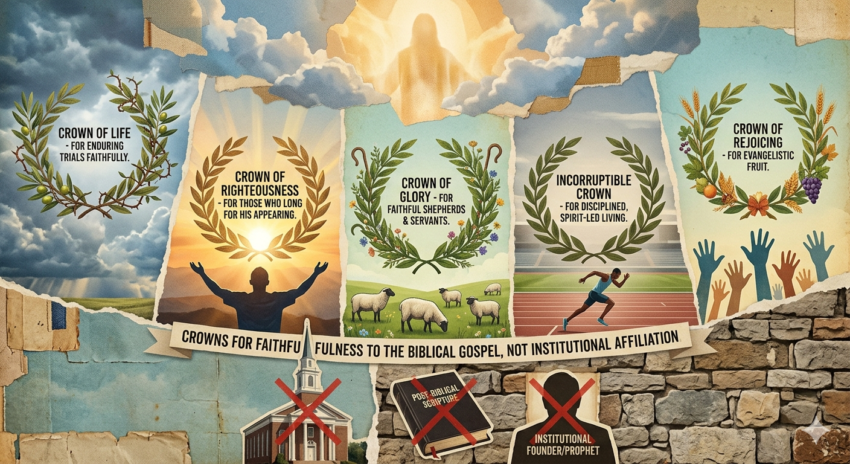
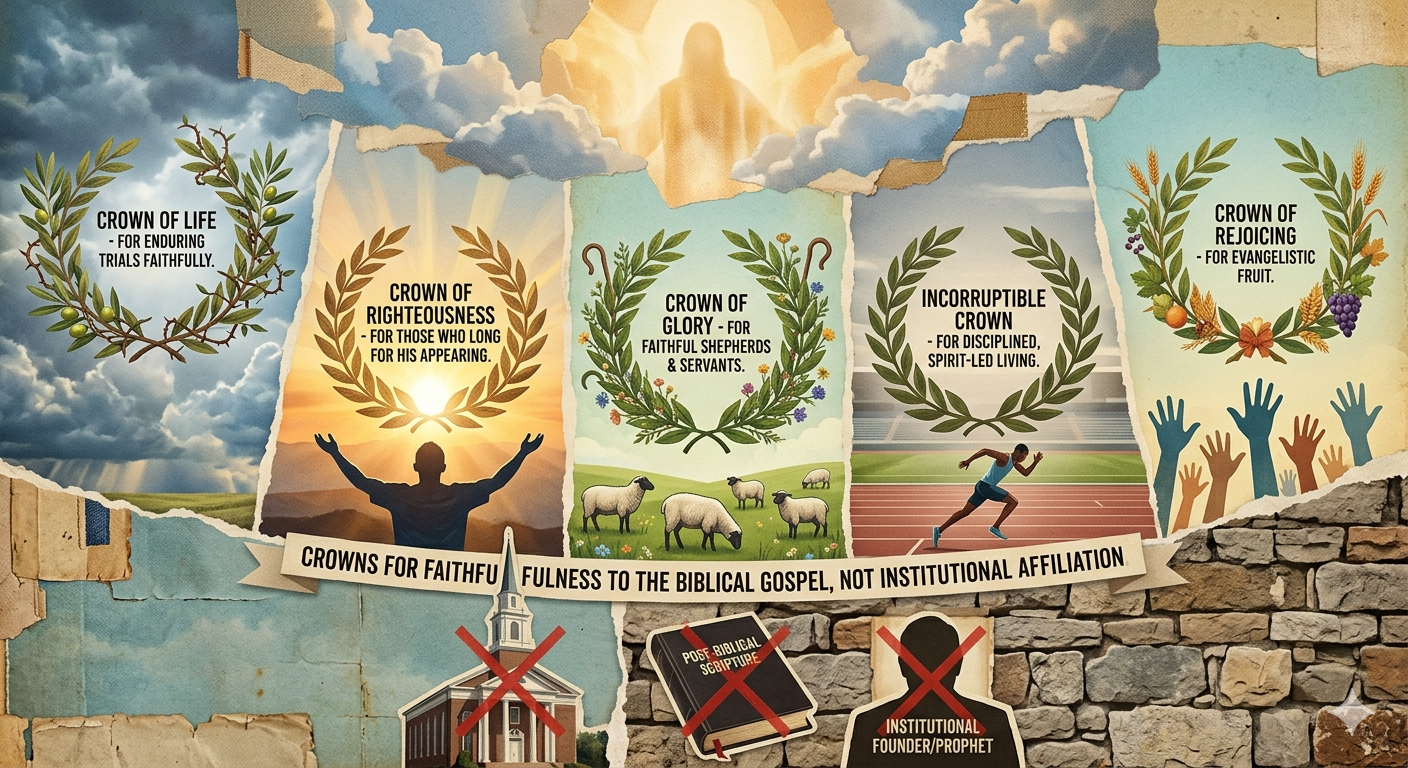
Scripture describes multiple categories of crowns — stephanoi, the victor’s laurel — that will be distributed at the Bema Seat. Each represents a specific dimension of faithful Christian life:
The Crown of Life (James 1:12; Revelation 2:10) — for enduring trials faithfully.
The Crown of Righteousness (2 Timothy 4:8) — for those who long for Christ’s appearing.
The Crown of Glory (1 Peter 5:4) — for faithful shepherds and servants.
The Incorruptible Crown (1 Corinthians 9:25) — for disciplined, Spirit-led living.
The Crown of Rejoicing (1 Thessalonians 2:19) — for evangelistic fruit.
Critically, none of these crowns is awarded for affiliation with a particular institutional church, for loyalty to a post-biblical scripture, or for bearing institutional witness to a founding prophet. They are awarded for faithfulness to the biblical gospel and the calling it produces. This is not a peripheral distinction. It is the heart of the matter when comparing the Bema Seat to the LDS ‘judgment bar of God.’
Part Three: The Great White Throne Judgment — The Final Reckoning for the Unredeemed
The Scene in Revelation 20
If the Bema Seat is a ceremony of reward for the redeemed, the Great White Throne Judgment is an altogether different and more solemn proceeding. John describes it in the Apocalypse:
Then I saw a great white throne and him who was seated on it. The earth and the heavens fled from his presence, and there was no place for them. And I saw the dead, great and small, standing before the throne, and books were opened. Another book was opened, which is the book of life. The dead were judged according to what they had done as recorded in the books.
— Revelation 20:11–12
The imagery is stark. The earth and heavens flee — there is nowhere to hide. Books are opened — comprehensive records of deeds, words, and thoughts. The Book of Life is consulted. Those whose names are not found there are cast into the lake of fire (Revelation 20:15). This is the second death.
GotQuestions.org distinguishes the two judgments with precision:
The judgment seat of Christ is different from the Great White Throne judgment. That will be the final judgment of the wicked prior to their being cast into the lake of fire (Revelation 20:11–15). Appearing before the great white throne will be unbelievers. Believers will appear before the judgment seat of Christ.
— GotQuestions.org, ‘What is the Judgment Seat of Christ?’
Who Stands at the Great White Throne?
The question of who appears before the Great White Throne is answered by the logic of what the judgment accomplishes. Revelation 20:12 says the dead are judged ‘according to what they had done as recorded in the books.’ This is a works-based judgment — not because works can save, but because works reveal the absence of saving faith. Every person at the Great White Throne is there because they have rejected or never received the grace of God in Christ.
As GotQuestions.org explains in its broader treatment of divine judgment:
Everyone at the great white throne is an unbeliever who has rejected Christ in life, and his fate is already sealed. All their thoughts, words, and actions will be measured against God’s perfect standard, and they will be found wanting. There will be no reward for the unbelieving, only eternal condemnation and punishment.
— GotQuestions.org, ‘What Does the Bible Say About When God Will Judge Us?’
Dr. Robert Jeffress frames the fundamental contrast between these two judgments in a sentence that deserves to be engraved on the mind of every student of biblical eschatology:
The Judgment Seat of Christ is for the commendation of believers, while the Great White Throne Judgment is for the condemnation of unbelievers. The result of the Judgment Seat of Christ will be eternal rewards, while the result of the Great White Throne Judgment will be God’s eternal punishment.
— Dr. Robert Jeffress, Pathway to Victory
Two distinct events. Two distinct populations. Two diametrically opposite outcomes. This is the clear, consistent testimony of the New Testament on the subject of final judgment.
Part Four: The LDS ‘Judgment Bar of God’ — Doctrine, Texts, and Implications
What LDS Theology Teaches About Final Judgment
The Church of Jesus Christ of Latter-day Saints does teach a doctrine of final judgment, and it does use language drawn substantially from the biblical tradition. But the content of that teaching diverges from the biblical pattern in significant and systematic ways. Understanding those divergences is essential to evaluating Elder Holland’s dramatic declaration.
The official LDS Church manual Gospel Principles — the doctrinal primer used across the church — devotes an entire chapter to ‘The Final Judgment.’ Its framework begins after the Millennium, a thousand years following Christ’s return, during which the earth is to be transformed. Only after the Millennium concludes does the formal, final judgment occur. This is the judgment at which every soul is assigned to one of the three kingdoms of glory — celestial, terrestrial, or telestial — or to outer darkness.
The LDS-sympathetic website Saints Unscripted describes the framework this way:
God [the Father], through Jesus Christ, will judge each person to determine the eternal glory he will receive. This judgment will be based on each person’s obedience to God’s commands, including his acceptance of the atoning sacrifice of Jesus Christ.
— Saints Unscripted, ‘What Do Latter-day Saints Believe About the Final Judgment?’
The phrase ‘each person’s obedience to God’s commands’ is the load-bearing element of that sentence. In the biblical framework, obedience to the law cannot justify — ‘by the works of the law no one will be justified’ (Galatians 2:16). In the LDS framework, compliance with laws and ordinances is the determinative factor in one’s eternal assignment. The atonement of Christ is present in the system, but it functions as an enabling force — it makes it possible for the diligent covenant-keeper to be exalted, rather than as the sole and sufficient basis of the believer’s standing before God.
The Book of Mormon as an Evaluative Criterion
Elder Holland’s statement makes explicit what LDS theology implies: faithfulness to the Book of Mormon is a criterion by which Latter-day Saints will be judged. Holland did not merely say he hoped to have been faithful to Jesus Christ. He specifically declared that he wanted it on record — at the judgment bar — that he had proclaimed the Book of Mormon to be true, that Joseph Smith was a prophet, and that the restored church is authentic.
This framing is consistent with LDS doctrinal teaching. The Book of Mormon includes a passage — Moroni 10:27 — that directly invokes the judgment bar in the context of accountability for one’s response to the Book of Mormon itself:
And I exhort you to remember these things; for the time speedily cometh that ye shall know that I lie not, for ye shall see me at the bar of God; and the Lord God will say unto you: Did I not declare my words unto you, which were written by this man, like as one crying from the dead, yea, even as one speaking out of the dust?
— Moroni 10:27, Book of Mormon
From a traditional Christian perspective, this is a significant theological claim. It asserts that the judgment bar of God is the venue at which one’s response to the Book of Mormon specifically will be evaluated. There is no parallel claim in the New Testament canon. The Bible does speak of being judged by the Word of God (John 12:48), but the Word referenced is the logos — the eternal revelation of God in Christ and in inspired Scripture as recognized by the historic Christian canon. There is no biblical basis for treating a post-canonical scripture as a criterion of final evaluation at any judgment throne described in the New Testament.
Works, Ordinances, and the Nature of LDS Salvation
The Institute for Religious Research, in its landmark study ‘Judgment, Gospel, and Salvation in Mormonism,’ draws a distinction that is crucial for understanding the structural difference between LDS and biblical frameworks:
What LDS doctrine ends up saying is that we prepare ourselves for the Final Judgment by purifying ourselves spiritually and morally; faith in Christ ‘helps’ us to do this. The biblical gospel, on the other hand, is radically one of mercy and grace in which Christ is our only and our complete hope for salvation at the Final Judgment.
— Robert M. Bowman Jr., ‘Judgment, Gospel, and Salvation in Mormonism,’ Institute for Religious Research
This is not a polemical caricature. It is a precise description of what the LDS doctrinal system, taken on its own terms, actually teaches. The Gospel Principles manual states explicitly, ‘When we are baptized, we are judged worthy to receive this ordinance’ — a formulation that Bowman rightly notes inverts the biblical understanding, in which baptism is an ordinance for the unworthy who have received grace, not a reward for those who have achieved worthiness.
The Mormonism Research Ministry summarizes the multi-kingdom structure of LDS judgment theology:
In Mormonism, final judgment is something that takes place at the end of the millennium. The success in keeping the commandments is what determines one’s final destination: the celestial kingdom, the terrestrial kingdom, the telestial kingdom, or outer darkness.
— Eric Johnson, ‘Crash Course Mormonism: Judgment,’ Mormonism Research Ministry
President Russell M. Nelson articulates the comprehensive scope of this judgment from an LDS perspective:
One day we will meet our Maker and stand before Him at Judgment. We will be judged according to our ordinances, covenants, deeds, and the desires of our hearts.
— President Russell M. Nelson, ‘Personal Preparation for Temple Blessings,’ Ensign, May 2001; cited at mrm.org/judgment-doctrine
‘Ordinances, covenants, deeds, and the desires of our hearts’ — this is a comprehensive list, and its order is revealing. Ordinances (baptism, the endowment, temple marriage) and covenants (including those made in LDS temples) come first. The overall structure differs substantially from the biblical framework in which the believer’s standing before God is secured entirely by Christ’s righteousness imputed through faith (Romans 3:21–26), and any subsequent evaluation at the Bema Seat concerns service and stewardship, not the foundational question of one’s status before God.
Part Five: Close Enough to Sound Christian — Mapping the Divergences
Where the Vocabularies Converge
It is important to acknowledge, fairly and accurately, where LDS and traditional Christian teaching on judgment appear to overlap. Both traditions teach that every person will be accountable to God for their lives. Both traditions teach that Jesus Christ is the central figure in that accountability. Both traditions use the language of ‘judgment’ and ‘works’ and ‘reward’ and ‘condemnation.’ Both traditions draw on some of the same scriptural texts — particularly passages from Revelation and the Pauline letters.
This convergence of vocabulary is not accidental. LDS theology was self-consciously constructed in conversation with the Protestant tradition, retaining much of its surface language while reconfiguring the underlying doctrinal architecture. The result is a theological system that can generate statements — like Elder Holland’s — that sound immediately recognizable to a Christian listener without actually conveying the same theological content.
Where the Theologies Diverge — Seven Critical Points
1. The Basis of Standing Before God
In biblical Christianity, the believer’s standing before God is determined solely by the imputed righteousness of Christ received through faith (Romans 4:5; Philippians 3:9). The believer appears before the Bema Seat already clothed in Christ’s righteousness — their sin has been forgiven, their justification is complete. In LDS theology, one’s standing at the judgment bar is determined by the cumulative record of ordinance compliance, covenant faithfulness, and moral performance throughout mortal life.
2. The Role of the Atonement
In traditional Christianity, Christ’s atonement is the sole and sufficient basis for salvation. It does not merely make salvation possible — it accomplishes salvation for all who believe (Romans 5:10; Hebrews 10:14). In LDS theology, the atonement enables repentance and makes exaltation possible, but it must be appropriated through the full law of the gospel including ordinances and covenants. As Marion Romney stated: ‘the candidate will be cleansed from the stain of sin by the atoning blood of Jesus Christ’ — but only if ‘laws and ordinances have been complied with during mortal life.’
3. The Evaluative Criteria
At the biblical Bema Seat, believers are evaluated on the quality of their service to Christ after conversion — how they built on the foundation of the gospel. At the LDS judgment bar, the evaluation encompasses a much broader set of criteria including temple ordinances, covenant adherence, and — as Holland’s statement makes explicit — faithfulness to specifically LDS truth claims such as the divine authenticity of the Book of Mormon.
4. The Question of Post-Canonical Scripture
The biblical Bema Seat involves no criterion that post-dates the closing of the biblical canon. The LDS judgment bar explicitly includes accountability for one’s response to the Book of Mormon, the Doctrine and Covenants, and the Pearl of Great Price. From a biblical-inerrancy perspective, this introduces an evaluative standard that Scripture itself does not authorize (Galatians 1:8–9; Revelation 22:18–19).
5. The Structure of the Afterlife
Traditional Christianity, drawing on Jesus’ teaching and the Pauline letters, describes a binary eternal destiny: eternal life with God for the redeemed (John 3:16; 1 Thessalonians 4:17), and eternal separation from God for those who reject Christ (Matthew 25:46; Revelation 20:15). LDS theology replaces this binary with a graduated structure of three kingdoms of glory, with assignment determined by the level of law one has lived. This fundamentally changes the character and stakes of the judgment bar.
6. The Timing and Sequence
Traditional evangelical Christianity, particularly in its dispensationalist form, places the Bema Seat in heaven following the rapture of the church, before the Tribulation period. The Great White Throne follows the Millennium. LDS theology places the final judgment after the Millennium, with preliminary ‘mini-judgments’ at death and at resurrection. The sequence is different; the theological implications are different.
7. The Character of the Judgment Moment
The biblical Bema Seat is described as a moment of accountability that does not generate fear for the believer who is secure in Christ (Romans 8:15; 1 John 4:18). It is a ceremony of reward. The LDS judgment bar, while also described as potentially ‘pleasing’ for the faithful, carries a different existential weight — because the question of whether one has been sufficiently compliant with ordinances and covenants is, by definition, never fully settled this side of eternity. As Dieter F. Uchtdorf acknowledged, the outcome is generally reserved for those who have ‘trusted in God and sought to follow His laws and ordinances.’
Part Six: Why This Distinction Matters — Theological and Pastoral Implications
The Gospel at Stake
One might ask: Does any of this really matter? Both systems involve accountability before God. Both affirm the importance of Christ. Both use the language of judgment, reward, and eternity. Why insist on distinguishing between them?
The answer is as clear as the gospel itself. If the basis of one’s standing at the final judgment is — even partly, even supplementarily — one’s performance in keeping a set of ordinances and covenants administered by a particular institution, then the gospel of grace has been fundamentally compromised. Paul’s letter to the Galatians exists precisely to address this issue. The Galatian churches had been told that faith in Christ was necessary but insufficient — that circumcision and Torah observance were also required for full standing before God. Paul’s response was unsparing:
I am astonished that you are so quickly deserting the one who called you to live in the grace of Christ and are turning to a different gospel — which is really no gospel at all.
— Galatians 1:6–7a
The structural parallel between the Galatian situation and the LDS framework is instructive. In both cases, the claim is not that Christ is irrelevant, but that Christ alone is insufficient. In both cases, additional requirements — ritual, ordinance, institutional affiliation — are added as conditions for full standing before God. And in both cases, the Apostle Paul’s canonical response is a resounding and unequivocal no.
The Pastoral Stakes
For the Christian apologist engaging Latter-day Saints in conversation — whether in door-to-door ministry, in street evangelism near LDS communities, or in sustained dialogue with friends and family members — understanding this distinction is not merely academic. It is pastorally urgent.
A Latter-day Saint who hears Elder Holland’s words and takes comfort in the conviction that their faithful testimony to the Book of Mormon will redound to their credit at the judgment bar is not simply mistaken about eschatology. They are operating within a soteriological framework in which the finished work of Christ has been supplemented by institutional requirements that the New Testament does not sanction. Helping them understand the Bema Seat — its true character as a ceremony of grace-secured reward, not an ordinance-compliance audit — is an act of genuine pastoral care.
Robert Bowman at the Institute for Religious Research articulates the contrast that must be communicated:
The biblical gospel… is radically one of mercy and grace in which Christ is our only and our complete hope for salvation at the Final Judgment.
— Robert M. Bowman Jr., Institute for Religious Research
‘Only and complete.’ These two words are the fulcrum of the entire conversation. The Bema Seat is a place for those who have already found their only and complete hope in Christ. The works evaluated there are the fruit of that hope — the overflow of a life transformed by grace — not the grounds of one’s acceptance before God.
The Danger of Near-Christian Language
Elder Holland’s statement is a masterclass in what missiologists sometimes call ‘near-Christian language’ — formulations that inhabit the vocabulary of biblical Christianity while populating that vocabulary with substantially different theological content. The phrase ‘judgment bar of God’ is near-Christian language. It sounds like the Bema Seat. It evokes Romans 14. It carries the weight of eschatological solemnity.
But when examined carefully against the full body of LDS doctrinal teaching about what that bar involves and how one prepares for it, the resemblance to the Bema Seat of Christ as described in the New Testament is largely superficial. The LDS judgment bar is a comprehensive ordinance-and-covenant audit, calibrated to the specific demands of the restored gospel. The biblical Bema Seat is a ceremony of reward for those who are already, by grace through faith, clothed in the righteousness of Christ.
The difference between those two events is the difference between a legal verdict that has not yet been pronounced and one that has already been rendered. For the Christian who is justified by faith, the verdict at the Bema Seat is not in question. The question is only: what will I have done with the extraordinary gift I have already received?
Conclusion: The Verdict Has Already Been Rendered
Elder Jeffrey R. Holland is a man of evident conviction and considerable rhetorical power. His October 2009 General Conference address, whatever one’s theological evaluation of its content, was a striking piece of public testimony — a leader of a major religious institution staking his eternal reputation on the truth claims of his tradition. That kind of conviction deserves respect, even in the context of substantive disagreement.
But the conviction with which a claim is made is not evidence of the claim’s truth. And the biblical framework of final judgment does not accommodate the theological architecture that Holland’s statement inhabits. The ‘judgment bar of God’ as articulated in LDS doctrine is not the Bema Seat of Christ. It is not the Great White Throne Judgment either, precisely. It is a distinctly LDS theological construction — a works-and-ordinance audit at the culmination of the Millennium, determining one’s placement in a graduated afterlife that the New Testament does not describe.
The Bema Seat of Christ, as the New Testament presents it, is for those who have already received the verdict. Romans 8:1 has already spoken: ‘No condemnation.’ John 5:24 has already spoken: ‘Whoever hears my word and believes him who sent me has eternal life and will not be judged but has crossed over from death to life.’ The Bema Seat is not where that verdict is rendered. It is where the faithful stewardship of that verdict’s recipients is celebrated and rewarded.
The Great White Throne Judgment, conversely, is for those who never received — or rejected — that verdict. It is a final reckoning for the unredeemed, measured against the perfect standard of God’s holiness, resulting in the only outcome that is possible when human works, however impressive, are measured against infinite righteousness: condemnation.
These two judgments are not the same event. They are not populated by the same people. They do not evaluate the same criteria. And neither of them is the ‘judgment bar’ that Elder Holland invokes — a tribunal at which faithfulness to the Book of Mormon, to Joseph Smith’s prophetic office, and to the restored church are the relevant exhibits.
For the Christian apologist, this analysis yields a clear and compassionate message to offer to Latter-day Saint friends and neighbors: you do not need to stand at any judgment bar wondering whether your testimony to the Book of Mormon was sufficient. You do not need to accumulate a record of ordinance compliance sufficient to pass an eschatological audit. You need what the New Testament offers: the finished righteousness of Jesus Christ, received by faith, which has already secured your standing before God and transformed the Bema Seat from a place of dread to a place of joyful, grace-soaked accountability.
The verdict, for the one who is in Christ Jesus, has already been rendered. It reads: Not guilty. Come in, good and faithful servant. Let us talk about what you did with what I gave you.
That is the Bema Seat. That is the good news. And that is what is at stake in the difference between two systems that use the same words to mean very different things.
Primary Sources and References
• GotQuestions.org — ‘What is the Judgment Seat of Christ?’ — https://www.gotquestions.org/judgment-seat-Christ.html
• GotQuestions.org — ‘What Does the Bible Say About When God Will Judge Us?’ — https://www.gotquestions.org/judgment.html
• Abundant Life Church — ‘What Is the Bema Seat of Christ?’ — https://abundant-life.com/blog/what-is-the-bema-seat-of-christ/
• John MacArthur / Grace to You — ‘What is the Purpose of the Judgment Seat of Christ?’ — https://shop.gty.org/library/questions/QA97/what-is-the-purpose-of-the-judgement-seat-of-christ
• Shepherd’s Theological Seminary — ‘The Judgment Seat of Christ’ — https://shepherds.edu/the-judgment-seat-of-christ/
• BibleQuestions.com — ‘Are Christians Judged for Their Sins?’ — https://biblequestions.com/answers/are-christians-judged-for-their-sins/
• Dr. Robert Jeffress / Pathway to Victory — ‘The Difference Between The Christian’s Judgment and the Non-Christian’s Judgment’ — https://ptv.org/devotional/the-difference-between-the-christians-judgment-and-the-non-christians-judgment/
• LDS Church — Gospel Principles, Chapter 46: The Final Judgment — https://www.churchofjesuschrist.org/study/manual/gospel-principles/chapter-46-the-final-judgment?lang=ase
• LDS Church — Jesus Christ and His Everlasting Gospel, Lesson 24: Trusting Jesus Christ as Our Judge — https://www.churchofjesuschrist.org/study/manual/jesus-christ-and-his-everlasting-gospel-teacher-material-2023/unit-5/lesson-24-class-prep?lang=eng
• Saints Unscripted — ‘What Do Latter-day Saints Believe About the Final Judgment?’ — https://saintsunscripted.com/faith-and-beliefs/the-gospel-of-jesus-christ/what-do-latter-day-saints-believe-about-the-final-judgment/
• Eric Johnson / Mormonism Research Ministry — ‘Crash Course Mormonism: Judgment’ — https://mrm.org/judgment-doctrine
• Robert M. Bowman Jr. / Institute for Religious Research — ‘Judgment, Gospel, and Salvation in Mormonism’ — https://mit.irr.org/judgment-gospel-and-salvation-in-mormonism
• Elder Jeffrey R. Holland — ‘Safety for the Soul,’ LDS General Conference, October 2009 — https://www.churchofjesuschrist.org/study/general-conference/2009/10/safety-for-the-soul?lang=eng
• LDS Church — ‘Judging Others Study Guide’ (Gospel Topics) — https://www.churchofjesuschrist.org/study/manual/gospel-topics/judging-others-study-guide?lang=eng
A Note on Research Methods and Accuracy
This work represents a collaboration among the author’s theological and historical research, primary-source documentation, and the emerging capabilities of artificial intelligence research tools. AI assistance was employed throughout the investigative process—not as a ghostwriter or a substitute for scholarship, but as a rigorous research partner: surfacing sources, cross‑referencing claims, identifying scholarly consensus, and flagging potential errors before they could reach the page.
Every factual claim in this work has been subjected to active verification. Where AI‑generated content was used as a starting point, it was tested against primary sources, peer‑reviewed scholarship, official institutional documentation, and established historical records. Where discrepancies were found—and they were found—corrections were made. The author has made every reasonable effort to ensure that quotations are accurately attributed, historical details are precisely rendered, and theological claims fairly represent the positions they describe or critique.
That said, no work of this scope is immune to error, and the author has no interest in perpetuating inaccuracies in the service of an argument. If you are a reader—whether sympathetic, skeptical, or hostile to the conclusions drawn here—and you identify a factual error, a misattributed source, a misrepresented teaching, or a claim that cannot be substantiated, you are warmly and genuinely invited to say so. Reach out. The goal of this work is not to win a debate but to get the history right. Corrections offered in good faith will be received in the same spirit, and verified corrections will be incorporated into future editions without hesitation.
Truth, after all, has nothing to fear from scrutiny—and neither does this work.