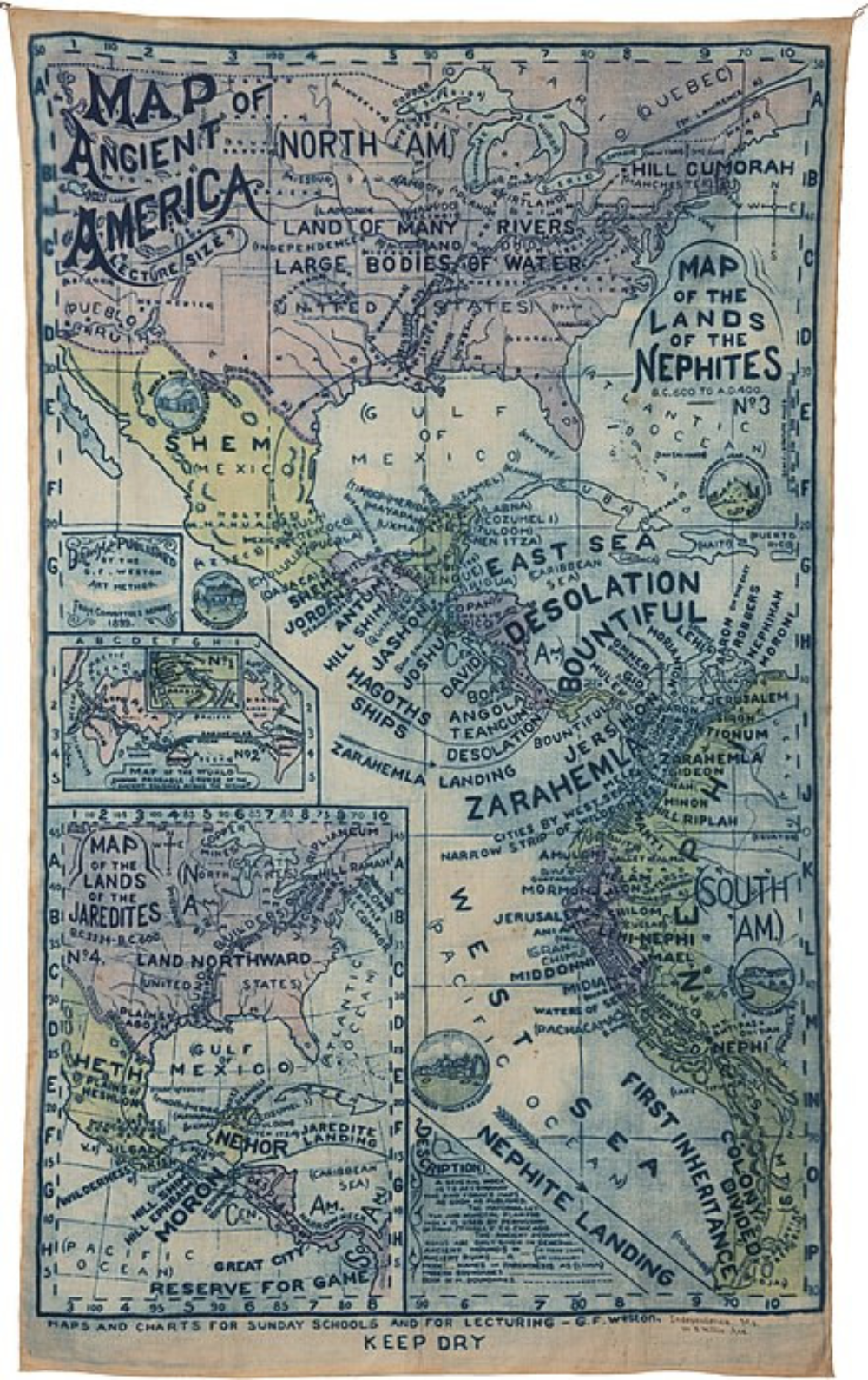
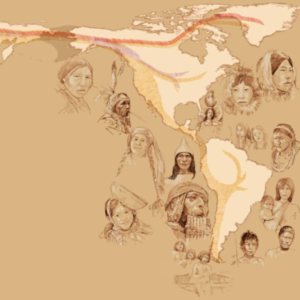
Map of ancient America depicts a hemispheric model of the Book of Mormon lands. Click image for a larger view.
Various locations have been proposed as the geographical setting of the Book of Mormon, or the set of locations where the events described in the Book of Mormon is said to have taken place. There is no universal consensus – even among Mormon scholars – regarding the placement of these locations in the known world, other than somewhere in the Americas.
A popular “traditional” view among many Latter Day Saint faithful covers much of North and South America. However, many Book of Mormon scholars, particularly in recent decades, believe the text itself favors a less expansive (“limited”) geographical setting for most of the Book of Mormon events. The two most notable proposed limited geography models are based in Mesoamerica, and in the Great Lakes area of North America.
The largest of the churches embracing the Book of Mormon—the Church of Jesus Christ of Latter-day Saints (LDS Church)—has not endorsed an official position for the geographical setting the Book of Mormon, although some of its leaders have spoken of various possible locations over the years.
According to Joseph Smith, an angel named Moroni told him, “there was a book deposited, written upon gold plates, giving an account of the former inhabitants of this continent, and the source from whence they sprang.” According to Latter Day Saint scripture, the narrative in the Book of Mormon came to an end in the ancient land called Cumorah, where Moroni, in 421 AD, deposited storied golden plates prior to his death. Many believers claim the Cumorah in the Book of Mormon narrative to be the same land containing the modern “Hill Cumorah” near Joseph Smith’s home in Palmyra, western New York, from whence the gold plates of the Book of Mormon were retrieved. Others view the modern “Hill Cumorah” to be distinct from the original and simply to have been named after it, thus adding no information to the question of the location of the lands described in the Book of Mormon.
Book of Mormon Internal Timeline. The Book of Mormon presents a detailed internal chronology spanning roughly 1,000 years of Nephite/Lamanite history (plus an embedded Jaredite record covering ~1,600 years), anchored primarily to the departure of the prophet Lehi from Jerusalem. While believers view this as historical, non-LDS scholars treat it as a 19th-century construct without external corroboration.
Key phases include:
• Jaredite Era (~2243 BC to ~600 BC): A separate record (Ether) describes the Jaredites, who migrate from the Tower of Babel era to the Americas around 2200 BC, flourish for millennia, and self-destruct in massive wars by ~600 BC, with one survivor (Coriantumr) briefly encountering Lehi’s people. • Lehi’s Departure (~600 BC): The main narrative begins as Lehi flees Jerusalem shortly before it falls to Babylon. LDS editions footnote 1 Nephi 2:4 with “about 600 B.C.,” though scholars debate the precise year, ranging from late 605 BC (after Nebuchadnezzar’s first siege) to 588–587 BC (near the city’s final destruction), based on cross-references to biblical kings Zedekiah and Jeremiah. • Nephite Settlement and Division (~600–200 BC): Lehi’s group arrives in the Americas after ~8 years of wilderness travel. His sons split into Nephites (righteous followers of Nephi) and Lamanites, leading to cycles of wars, prosperity, and prophets over centuries. • Pre-Christ Wars and Signs(~200 BC–33 AD): Increasing conflicts culminate in massive destruction at Christ’s death (33 AD), followed by his post-resurrection ministry among survivors, ushering in a ~200-year golden age of peace. • Final Nephite Decline (~AD 200–421): Peace fractures; massive wars destroy the Nephites by AD 385 (Mormon dies), with survivor Moroni sealing the record ~AD 421.
Total Span: Jaredites ~2243 BC–600 BC; Nephites/Lamanites ~600 BC–421 AD (over 1,000 years).
The Book of Mormon’s timeline is internally coherent, using multiple calendars (lunar, solar, and reign-based) that align precisely across books. However, its historicity remains hotly contested. No archaeological evidence—such as inscriptions, artifacts, or ruins—directly confirms the named peoples (Nephites, Lamanites, Jaredites), cities, or events like Christ’s American ministry.
Critics highlight anachronisms (e.g., horses, steel, wheat before their American introduction) and mismatches with known Mesoamerican or North American timelines, viewing it as Joseph Smith’s 19th-century invention. LDS apologists argue the record is “consistent with” certain pre-Columbian patterns but acknowledge the absence of “smoking gun” proofs, often attributing gaps to limited excavation or translation choices.
This chronological framework fuels geography debates too: proposed settings (e.g., Mesoamerica) must accommodate massive populations and metallurgy within archaeologically attested periods, yet no consensus exists.
Introduction
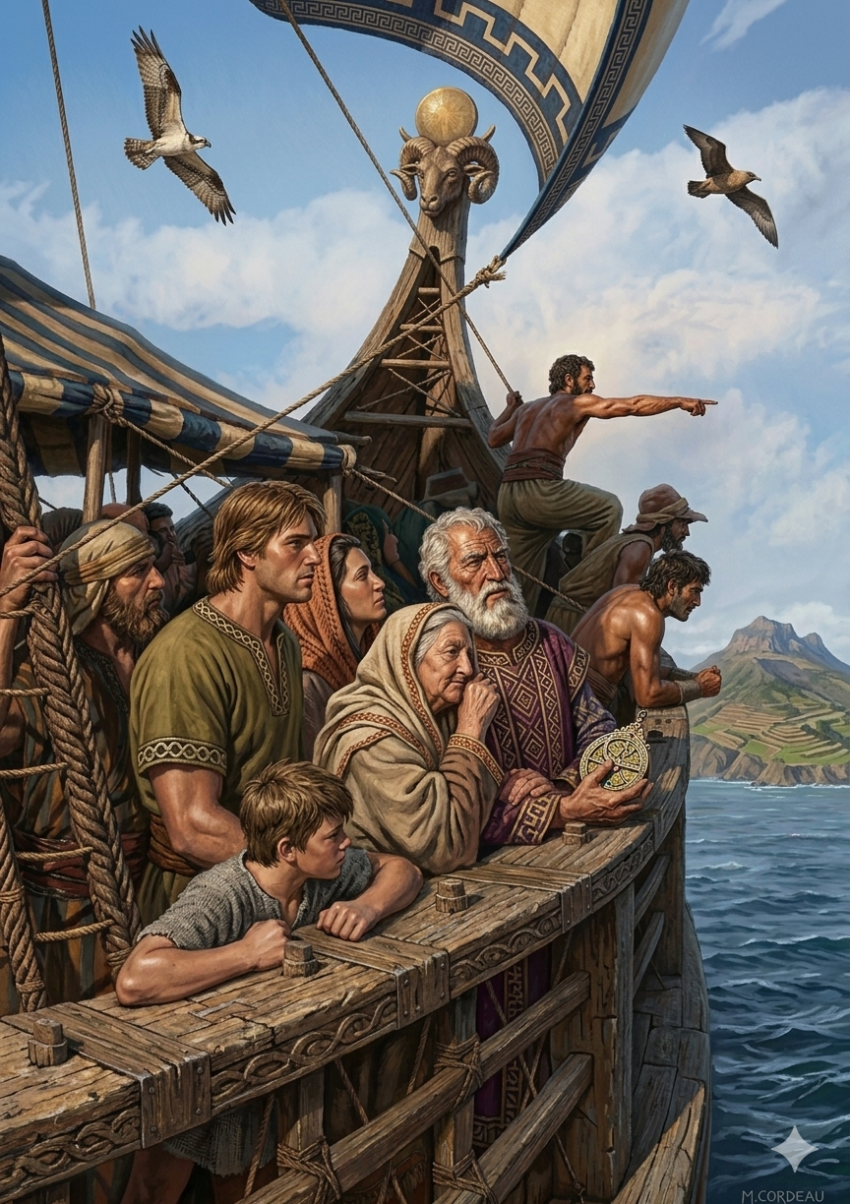
An AI-generated reproduction gives photo-realistic life to one of Arnold Friberg’s sketches for Lehi and His people arriving in the Promised Land. Friberg is arguably the most influential artist on Latter-day Saint scriptural art. His depictions of the people and the landscape of the Book of Mormon are well known to Latter-day Saints. Original copyright, 1951, now in possession of The Church of Jesus Christ of Latter-day Saints.
The Book of Mormon is a sacred text of the Latter-day Saint movement, regarded by members of The Church of Jesus Christ of Latter-day Saints as an ancient record of Israelites and other peoples who migrated to the Americas. While it presents a sweeping religious narrative of prophets, wars, and civilizations, it also implicitly issues a geographical challenge. Its references to lands, seas, and a “narrow neck of land” invite readers to ask where, if anywhere, these events might fit on a real-world map.
Since the 19th century, Latter-day Saint leaders, lay members, and critics alike have tried to correlate this narrative with actual American landscapes. Early proposals tended to read the text hemispherically, spreading Book of Mormon events across much of North and South America. Later models narrowed the focus to specific regions such as Mesoamerica or the North American “heartland.”
A Proliferation of Geography Models. Over time, researchers and enthusiasts have proposed a remarkable range of geography models for the Book of Mormon. Some place its cities and battles in Central or South America, others in the Great Lakes or Mississippi Valley region, and a few even outside the Western Hemisphere, such as the Malay Peninsula. One survey-oriented site notes that over 100 distinct Book of Mormon geography models have been documented, reflecting how fertile—and contested—this interpretive space has become.
The sheer variety of proposals underscores how much interpretive work is required to move from the Book of Mormon text to a concrete map.
Ambiguous Clues in the Text. The Book of Mormon does contain internal geography: it distinguishes a “land northward” from a “land southward,” mentions a “narrow neck of land,” describes seas on multiple sides, and refers to cities, rivers, and wilderness regions in relation to one another. Yet these descriptions are consistently relative and internal to the narrative; the text never names a modern continent, country, or identifiable archaeological culture.
Because of this, the geography is both detailed and ambiguous. The internal relationships between Book of Mormon locations can be modeled with some rigor, but mapping those relationships onto real-world terrain is highly interpretive and depends on assumptions about distances, directions, climate, and population size. This ambiguity leaves ample room for speculation and helps explain why so many competing models have arisen.
The Church of Jesus Christ of Latter-day Saints has no official position on the Book’s geographical setting.
Institutional Neutrality and Shifting LDS Views. Officially, the LDS Church maintains a neutral stance on specific geography models. A current Gospel Topics essay states that although members have proposed locations ranging from North to Central and South America, “the Church’s only position is that the events the Book of Mormon describes took place in the ancient Americas.” A similar statement in the Saints project emphasizes that the Church does not endorse any particular theory, even while acknowledging that many have been advanced.
Historically, however, Latter-day Saint thinking has shifted: • In the 19th and early 20th centuries, many leaders and writers adopted a broad hemispheric view, treating Book of Mormon peoples as ancestors of most or all Indigenous peoples in the Americas, and often linking the “narrow neck” to the Isthmus of Panama.
• In the late 20th century, as linguistic, genetic, and archaeological research complicated these broad claims, LDS scholars increasingly turned toward limited geography models, particularly in Mesoamerica, where complex ancient civilizations are well attested.
Today, most LDS academic writers who argue for Book of Mormon historicity favor some form of limited geography, though lay members and popular apologists remain divided among multiple models, including Heartland and hemispheric proposals.
Major Competing Models. Across the spectrum of proposals, a few broad approaches recur: • Hemispheric interpretations: These models see Book of Mormon lands spread across much of North and South America, often assigning specific cities and events to regions thousands of miles apart. They tend to align with earlier Latter-day Saint assumptions that Book of Mormon peoples populated the bulk of the Western Hemisphere. • Limited Mesoamerican models: These approaches concentrate the narrative primarily in southern Mexico and Guatemala, interpreting the “narrow neck of land” as a regional isthmus and positing that Book of Mormon groups were one among many ancient populations. • Heartland and North American models: These proposals place the core events in the interior of the United States—often in the Great Lakes, Mississippi, and Ohio River regions—and appeal to passages about “this land” and prophecies of a New Jerusalem in Missouri as support.
Other, less mainstream models locate Book of Mormon lands along the west coast of South America, in Baja California, or in far-flung regions such as parts of Asia or Africa. Each framework attempts to harmonize the internal geography of the text with some set of archaeological, linguistic, climatic, and scriptural considerations.
Archaeology, Historicity, and Ongoing Controversy. The quest to anchor Book of Mormon geography in specific real-world locations faces serious challenges. Professional historians and archaeologists outside the Latter-day Saint tradition overwhelmingly reject the Book of Mormon as an authentic ancient record, citing a lack of corroborating evidence for its specific peoples, cities, and events, as well as numerous anachronisms in its narrative. A recent overview notes that relevant archaeological, historical, and scientific data are not consistent with the book functioning as straightforward ancient history.
Even within believing circles, LDS scholars acknowledge that no city named in the Book of Mormon has been securely identified in the archaeological record, and no inscription using Book of Mormon personal or place names has been found. Apologetic organizations argue that certain cultural and material parallels—such as urbanism, complex societies, or specific technologies—are “consistent with” aspects of the text, but they concede that precise identifications remain elusive. This lack of direct, widely accepted archaeological confirmation keeps the geography debate open and contentious.
At the same time, the earth itself has changed. Coastlines shift, rivers alter course, and ancient settlements vanish under later construction or environmental transformation. Proponents of various models sometimes invoke these changes to explain why textual locations might be hard to match to modern topography. Critics respond that, even allowing for landscape change, one would still expect clearer, independent evidence for civilizations of the scale and nature described in the Book of Mormon if they had existed within known archaeological horizons.
Motivations Behind the Mapping. Behind the technical debates lie powerful motivations. For many Latter-day Saints, tying the Book of Mormon to specific locations offers a sense of tangible validation: if one could stand where Zarahemla allegedly stood, or identify the “narrow neck of land,” it might seem to confirm the book’s historicity. Apologists and interested lay members thus devote significant effort to constructing geography models that reconcile the text with known data—or reinterpret the data to fit the text.
For critics, by contrast, the proliferation of mutually incompatible models is itself evidence against the book’s historical claims. The fact that the same internal descriptions can be mapped onto Mesoamerica, the North American heartland, a hemispheric model, or even distant regions outside the Americas is taken as a sign that the text does not actually encode a discernible, real-world geography. Instead, they argue, the narrative reflects 19th‑century American ideas about the ancient New World rather than an ancient record grounded in verifiable locations.
A Contested and Ongoing Debate. The debate over Book of Mormon geography thus sits at the crossroads of faith, scholarship, and identity. Within the Latter-day Saint community, some members feel that precise geography is ultimately secondary to the book’s spiritual message, while others see the question as central to its claim to be an ancient, historical record. Outside the faith, historians and archaeologists generally treat the Book of Mormon as a 19th‑century religious text whose narrative does not align with the established archaeological record of the ancient Americas.
In this essay, we will survey documented viewpoints from believing Latter-day Saint writers and apologists, as well as assessments from non‑LDS scholars and archaeologists. By examining their arguments, evidence, and assumptions, you can weigh the competing claims and reach your own conclusions about whether, and how, the geography of the Book of Mormon can be mapped onto the real world.
The Maya seem to have developed alongside, and traded ideas with, the neighboring Olmec civilization, which some consider one of the most influential societies of ancient times. Researchers believe this is when the Maya adopted the ritual complexes for which they would become famous. Like the Olmec, the Maya soon focused on building cities around their ritual areas. These advancements in agriculture and urban development are now known as the Maya’s Preclassic period between 1500 and 200 B.C. (This massive Mayan ceremonial complex was discovered in “plain sight.”)
LDS Evidence Central: While a wide variety of temple structures were present in ancient Mesoamerica, some of them (including examples that date to Book of Mormon times) correspond generally to the pattern of the temple of Solomon, featuring a building set on a raised structure with an outer and inner room fronted by two free-standing pillars. While these findings do not allow us to identify any of these temples as Nephite temples, they show that the type of temple Nephi claimed his people constructed would not have been out of place in ancient Mesoamerica. Photo: Temple of the Bearded Man at the end of the Great Ball Court for playing pok-ta-pok near Chichen Itza pyramid, Yucatan, Mexico. Mayan civilization temple ruins are an archaeological site. Photo via Adobe Stock. Click image for larger view.
As the Maya built out their society even further, they laid the foundations for complex trade networks, advanced irrigation, water purification and farming techniques, warfare, sports, writing, and a complex calendar.
No Evidence for Israelite Origins of Mesoamerican Civilizations. No credible archaeological, genetic, linguistic, or historical evidence supports the Book of Mormon’s account of Israelite migrants (e.g., Lehi’s family around 600 BC) arriving in the Americas and founding or significantly influencing advanced civilizations there. Mainstream scholars universally regard the Book of Mormon as a 19th-century creation by Joseph Smith, with its narrative clashing against established pre-Columbian records. Claims linking ancient Israelites to the Maya or other Mesoamerican peoples are confined to Latter-day Saint apologetics and lack acceptance in academic circles.
Maya and Olmec: Indigenous Mesoamerican Developments
Archaeologists reconstruct Mesoamerican history through excavations, radiocarbon dating, hieroglyphic decipherment, ceramics analysis, and isotopic studies of human remains. The consensus timeline shows:
• Olmec (~1500–400 BC): Emerges in the Gulf Coast lowlands of Mexico (San Lorenzo, La Venta), often called a “mother culture” for Mesoamerica due to innovations like colossal stone heads, jade work, and early writing/ball courts. Recent digs at Ceibal (Guatemala) reveal parallel developments ~1000 BC, suggesting cultural exchange rather than Olmec dominance. • Maya Preclassic(~2000 BC–AD 250): Builds on Olmec influences in the Yucatan, highlands, and lowlands; early sites like Cuello (~1000 BC) show independent village growth into urban centers like Tikal and Kaminaljuyu by 300 BC. • Maya Classic(~AD 250–900): Peak with massive pyramids, stelae inscriptions, Long Count calendars, and city-states; collapses amid drought, warfare, and overpopulation.
These civilizations arose from local Asian migrations ~15,000+ years ago, with no Old World genetic or cultural influx post-10,000 BC matching Book of Mormon claims.
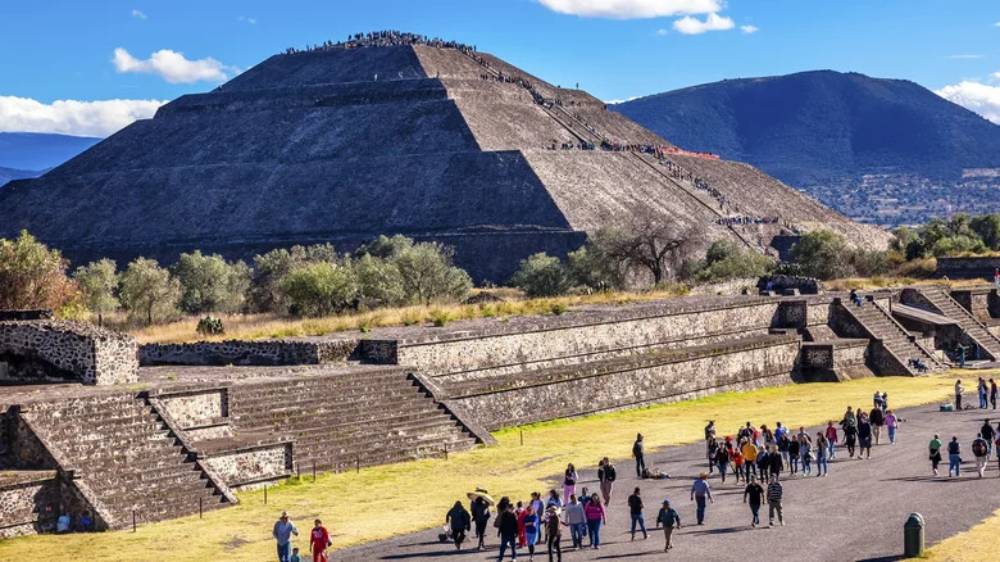
Superficial Parallels vs. Empirical Gaps. LDS Mesoamerican proponents highlight “consistent” features like urbanism (e.g., Teotihuacan pyramids resembling Nephite temples), warfare (fortifications, scalping), calendars, and agriculture (maize, beans). They argue Book of Mormon events fit a “limited geography” in southern Mexico/Guatemala ~600 BC–AD 400.
Yet these are broad, superficial overlaps common to many ancient societies—and riddled with anachronisms:
The Book of Mormon describes advanced metallurgy that clashes sharply with Mesoamerican realities. It speaks of Nephites crafting steel swords and iron tools as early as 600 BC, yet no evidence of iron smelting or steel production exists in the Americas before European contact—only decorative alloys of gold and copper appear in Olmec or Maya sites. This gap underscores how the text projects 19th-century metalworking onto ancient settings.
Equally problematic are the animals mentioned throughout the narrative.Horses pull chariots, elephants roam, and cattle are domesticated, but horses had been extinct in the Americas for over 10,000 years by Lehi’s supposed arrival, only reappearing with Spanish conquistadors in 1492. Elephants and cattle similarly find no archaeological trace in pre-Columbian contexts, leaving these references as clear anachronisms.
Agricultural staples fare no better under scrutiny. The text lists wheat and barley as key crops sustaining massive populations, yet these grains were unknown in ancient Mesoamerica—maize, squash, and beans formed the dietary core, with no wheat pollen or barley remains in excavations.
Writing systems present another mismatch: The Book of Mormon claims records on “reformed Egyptian” engraved on metal plates, but Mesoamerican cultures used bark paper codices or stone monuments inscribed with logosyllabic scripts unrelated to Hebrew or Egyptian. No metal books have ever surfaced.
Finally, the narrative’s scale amplifies the issues. Battles involving millions, complete with Hebrew-derived names and chariots, leave no footprint—no matching inscriptions, population spikes, or wheeled vehicles appear in the record. These elements reflect Joseph Smith’s 1820s worldview far more than verifiable ancient history.
Genetics further debunks: Native American DNA is overwhelmingly East Asian-derived, with no significant Semitic markers. Linguistic isolation (Maya glyphs unrelated to Hebrew/Egyptian) and the absence of Book of Mormon place names in inscriptions seal the case.
LDS Views vs. Mainstream Consensus. Apologists like those at FAIR claim 75% of Book of Mormon items (e.g., cement houses, chiefdoms) find Mesoamerican parallels, urging a “non-disprovable” historicity. But archaeologist Michael Coe notes: “Nothing, absolutely nothing, has ever shown up in any New World excavation which would suggest… the Book of Mormon… is a historical document.”
Speculations tying Maya/Olmec to Israelites echo fringe theories (e.g., African Olmec origins, now retracted as pseudohistory). In sum, while Maya culture fascinates with its astronomy and art, it evolved indigenously—no trace of Lehi’s lost tribes.
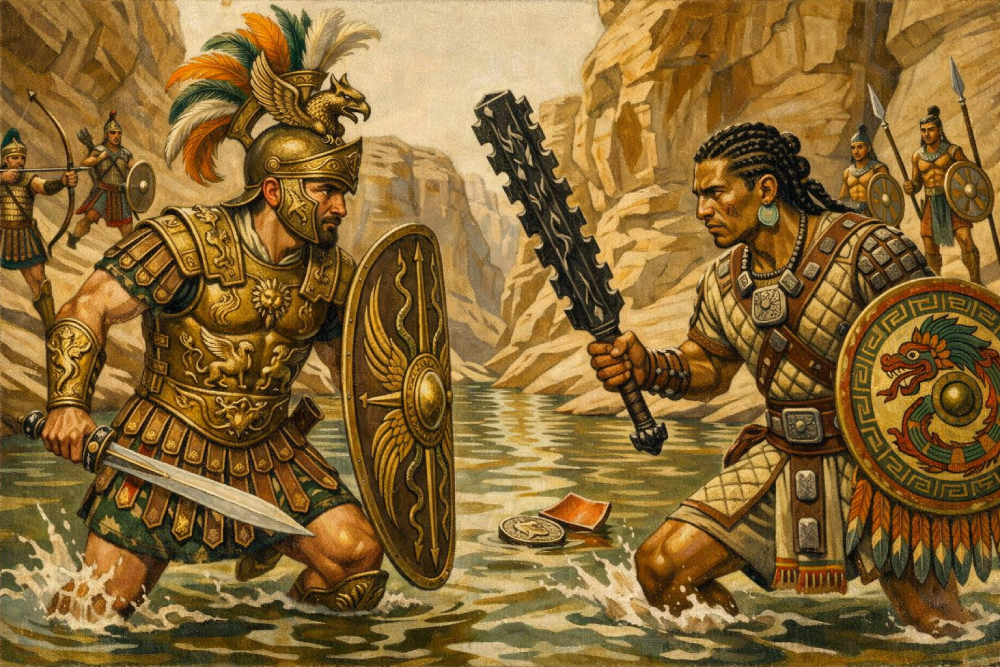
An AI-generated reproduction brings new life to a painting by Jerry Thompson depicting Captain Moroni’s soldiers fighting the Lamanites. The Lamanites are one of the four peoples (along with the Jaredites, the Mulekites, and the Nephites) described as having settled in the ancient Americas in the Book of Mormon. The Lamanites begin as wicked rivals to the more righteous Nephites, but when the Nephite civilization became decadent, it lost divine favor and was destroyed by the Lamanites. Latter Day Saints have historically associated Lamanites with present-day Native American cultures. Click image for larger view.
A common criticism is that LDS associate the Nephites and/or Lamanites with the Maya, and the Jaredite civilization with the Olmec. It is easy, based upon typical artistic representations used by the Church, to see why LDS typically associate the Nephites or Lamanites with the Maya. The assumption by critics that LDS associate the Nephites and the Lamanites with “the Maya” is an oversimplification of the facts. Most Church members view “the Maya” as a single, homogeneous group of people whom they associate with the magnificent ruins of the Classic Mayan civilization found in Mesoamerica. However, the Classic period occurs after Book of Mormon times. LDS research has focused on identifying the characteristics of the Preclassic Mayan culture, which does indeed cover the time period addressed by the Book of Mormon.
It cannot be stated whether a particular group, whether Nephite or Lamanite, inhabited a specific city, although there has certainly been speculation. For example, Joseph Smith once speculated that Palenque was a Nephite city. In most cases, the original names of the cities themselves are not known—they are instead known by the names assigned to them by explorers. Ironically, one of the ancient cities for which the original name is known is the city of Laman’ayin (Mayan for “submerged crocodile”). This city, usually called “Lamani,” is located in Belize and is believed by archaeologists to have been inhabited as early as 1500 B.C. The city would have been inhabited during the period of time described by the Book of Mormon. While the name of this city is an interesting coincidence, there is not sufficient information given in the Book of Mormon to allow one to assume that it correlates with any city mentioned therein.
Latter-day Saint research of the Maya concentrates on the Preclassic period, since this is the time period that correlates with most of the Book of Mormon record. Therefore, the simple argument that the “Maya” do not correlate with the time period covered by the Book of Mormon is an inaccurate statement. The research of the Preclassic Maya becomes complicated, however, since the constructions of the Classic period were built upon the rubble of those constructed during the Preclassic period. In essence, to research the Preclassic Maya, you have to dig through the evidence of the Classic Maya. An example of this is the lowland Mamom culture (700 B.C. to 400 B.C.), Dr. Coe notes,
“The lowland Maya almost always built their temples over older ones, so that in the course of centuries the earliest constructions would eventually come to be deeply buried within the towering accretions of Classic period rubble and plaster. Consequently, to prospect for Mamom temples in one of the large sites would be extremely costly in time and labor.[3]:54”
Needless to say, this complicates the task tremendously if one is attempting to uncover evidence of the earlier cultures. In addition, the hot and humid Mesoamerican climate is not conducive to the preservation of artifacts or human remains.
FAIR’s statement accurately reflects current LDS apologetic strategy—downplaying simple “Nephites = Classic Maya / Jaredites = Olmec” equations and emphasizing the earlier Preclassic period. However, it does not resolve the core problem: there is still no independent archaeological, linguistic, genetic, or epigraphic evidence linking any Book of Mormon peoples to the Maya (Preclassic or Classic) or to any known Mesoamerican civilization. Even Terryl Givens, a sympathetic LDS scholar, has acknowledged that “no connection has been made between the Book of Mormon and cultures or civilizations in the Western hemisphere,” which FAIR itself cites.
On “Maya = Nephites/Lamanites” and LDS Usage. FAIR is right to say that equating “the Maya” wholesale with Nephites or Lamanites is a simplification. The Maya are not a single monolithic culture; they span Preclassic, Classic, and Postclassic phases over a vast region and many linguistic groups. It is also fair to note that much LDS scholarly work in the Mesoamerican model has shifted to the Preclassic period (c. 2000 BC–AD 250), because that better overlaps the internal Book of Mormon dates (600 BC–AD 400).
But this clarification does little to rescue the larger claim. For nearly a century, LDS leaders, artwork, manuals, and popular writings have strongly suggested that Book of Mormon peoples—especially “Lamanites”—are the ancestors of modern Native Americans (and often specifically Mesoamericans), reinforcing the very association FAIR now calls an “oversimplification.” Beginning in the mid-20th century, particularly from the 1950s to 1970s, LDS scholars like John Sorenson began backing away from this direct linkage as DNA studies showed Native American ancestry deriving overwhelmingly from East Asian migrations, with no significant Semitic markers. At the same time, archaeological and linguistic data failed to corroborate large Israelite populations. Shifting the focus from Classic to Preclassic Maya is a tactical refinement, not an answer to the basic evidentiary gap: no Maya inscription, no stela, no mural, no codex, and no securely dated Preclassic site identifies Nephites, Lamanites, Jaredites, Mulekites, Zarahemla, or any Book of Mormon figure or place.
The Lamanai/Laman’ayin Coincidence. FAIR mentions the Maya site of Lamanai, noting that its ancient name meant something like “submerged crocodile” and that it was occupied as early as 1500 BC, overlapping Book of Mormon times. That is accurate as far as it goes: Lamanai was a sizable Maya city in what is now Belize, with occupation ranging from roughly 1500 BC through the Postclassic and into Spanish colonial times. The name derivation from Yucatec Maya, laman a’in (“submerged crocodile”), is also standard in the literature.
However, FAIR’s own text essentially concedes the point critics make: the similarity between “Lamanai” and “Lamanite” is purely coincidental, and there is “not sufficient information” in the Book of Mormon to correlate this site with any named city in the record. A single phonetic resemblance, in a different language family, with an unrelated semantic meaning (“submerged crocodile” vs. a personal name “Laman”) is precisely the kind of pattern one expects to find by chance across thousands of ancient toponyms; it is not evidence of Israelite migration. To their credit, FAIR acknowledges this, but then still uses the example to suggest that such “coincidences” might be meaningful—without any supporting data.
But FAIR’s point about excavation difficulties is increasingly outdated. Recent LiDAR surveys since 2016—scanning vast jungle regions from aircraft—have pierced the forest canopy to reveal thousands of previously unknown Preclassic structures, roads, and urban networks across Mesoamerica without extensive digging. These scans confirm continuous cultural development from local roots, yet still uncover no trace of Book of Mormon metallurgy, animals, crops, or inscriptions. (The LiDAR technology is discussed in detail later in this essay.)
Even if the new LiDAR technology did not exist, this is where the apologetic move overreaches. The difficulty of excavation and poor preservation of some materials do not erase the extensive record we do have for Preclassic and Classic Maya and neighboring cultures. Archaeologists have uncovered:
• Long, continuous ceramic sequences.
• Elite burials, grave goods, and architecture.
• Hieroglyphic inscriptions and calendrical systems.
• Clear evidence of local origins from Paleoindian and Archaic populations, not intrusive Israelite groups.
https://www.nationalgeographic.com/history/article/130425-maya-origins-olmec-pyramid-ceibal-inomata-archaeology-science
Within this rich record, one would expect at least some sign of a population matching Book of Mormon descriptions: Old World domesticated animals (horses, cattle), Old World grains (wheat, barley), iron or steel tools, Hebrew or Egyptian-derived writing, or even just a handful of personal or place names close enough to be plausible loanwords. None of this appears. Coe himself—whom FAIR likes to quote for descriptive details—famously stated that there is “not one professionally trained archaeologist, who is not a Mormon, who sees any scientific justification for believing” in the historicity of the Book of Mormon, and that “nothing, absolutely nothing” from New World archaeology supports it as ancient history.
In other words, the buried and humid conditions are real obstacles, but they have not prevented archaeologists from reconstructing complex Preclassic cultural patterns. They simply do not find the Book of Mormon’s distinctive package of Israelite religion, metallurgy, crops, and populations embedded in that record.
Timelines and Cultural Correlation. FAIR is right that the Preclassic Maya timeline (especially the late Preclassic) overlaps the Book of Mormon’s claimed period. That is precisely why LDS Mesoamerican apologists like John Sorenson have tried to map Nephite history onto late Preclassic developments: early cities, pyramid-building, and increased social complexity align chronologically with what one would need for a Nephite civilization.
But overlapping dates and generic traits (cities, temples, warfare) are not enough to establish a historical correlation. Virtually every literate civilization in the ancient world built cities and monuments, practiced agriculture, and fought wars. The question is whether there is specific, independent evidence that the people described in the Book of Mormon actually existed and interacted with known cultures. On that crucial point, FAIR’s own sources—and the broader scholarly consensus—are clear: there is none.
So while FAIR is justified in correcting crude caricatures (“LDS think Nephites are just the Classic Maya”), the more fundamental criticism stands untouched: regardless of whether one looks at Classic or Preclassic Mesoamerica, no verifiable connection has been established between Maya/Olmec civilizations and the Nephites, Lamanites, or Jaredites of the Book of Mormon. The apologetic reframing shifts the discussion to an earlier period and to subtler “parallels,” but it does not solve the basic evidentiary void.
Thomas Stuart Ferguson was one of the most noted defenders of Book of Mormon archaeology. Mr. Ferguson planned the New World Archaeological Foundation, which he hoped would prove The Book of Mormon through archaeological research. The Mormon Church granted hundreds of thousands of dollars to this organization, but in the end, Thomas Stuart Ferguson admitted that although the Foundation made some important contributions to New World archaeology, all his work with regard to the Book of Mormon was in vain. He admitted, in fact, that he had wasted twenty-five years of his life trying to prove the Book of Mormon.
As early as 1953, the New World Archaeological Foundation (NWAF) received funding from the Church of Jesus Christ of Latter-day Saints after Thomas Ferguson approached church leaders about finding Book of Mormon archeological evidence. Ferguson had a passion for looking for archaeological evidence for the Book of Mormon, and he reminded the church leadership that discovering Book of Mormon artifacts would assist in the church’s missionary program.
After years of studying maps, Mormon scripture, and Spanish chronicles, Ferguson had concluded that the Book of Mormon took place around the Isthmus of Tehuantepec, the narrowest part of Mexico. He had come to the jungles of Campeche, northeast of the isthmus, to find proof.
Ferguson wrote, “It is the only Church on the face of the earth which can be subjected to this kind of investigation and checking.” And in another, to the LDS leadership, he declared, “The Book of Mormon is either fake or fact. If fake, the [ancient] cities described in it are non-existent. In fact—as we know it to be—the cities will be there.”
After many years of searching for artifacts and other evidence, he came up empty-handed. In 1975, he submitted a paper to a symposium about Book of Mormon geography outlining the failure of archaeologists to find Old World plants, animals, metals, and scripts in Mesoamerica. “The real implication of the paper,” he wrote in a letter the following year, “is that you can’t set Book of Mormon geography down anywhere—because it is fictional.”
Mormonism has left its mark on Mesoamerican scholarship — but not always to the benefit of the scholarship, or the Mesoamericans.
For Mormons, the twin concepts of testimony (declaring a truth to other people) and personal revelation (a communication from god to man) present an interesting paradox. Although Mormons are generally expected to adhere to the church’s views and perspectives, each individual is also encouraged to receive personal revelation for their life from God, in much the same way that the church’s founder Joseph Smith did — although these personal revelations are still expected to adhere to church teachings and reinforce accepted doctrine. Since the Church of Jesus Christ of Latter-day Saints (or COJCOLDS) has staunchly maintained a position of neutrality regarding Book of Mormon geography (with the exception of Joseph Smith’s early belief that it occurred in Central America or the Midwest), members of the church have, until recently, been allowed to decide for themselves where they believe the Book of Mormon took place.
This means that there are as many theories as there are members interested in the theories, and it means each person’s theory is as valid as the next as long as they believe they have received confirmation from God — a key Mormon tenet is that testimony is irrefutable if it has divine confirmation. Unfortunately, many of these personal theories distort archaeological evidence, particularly those from the 20th century.
Most of the Mormon and Mormon-adjacent scholars I’ve met in recent years succeed in recognizing their biases, and keep them from influencing their work. Even the COJCOLDS has begun to distance itself from previous theories — it no longer funds the NWAF. However, in a world where pseudo-archaeological television shows traffic in unsubstantiated and sensationalized claims for public consumption (like Netflix’s recent Ancient Apocalypse), it is even more important to acknowledge the colonialist and racist motives underlying any theory that suggests the accomplishments of the “New World” belong to anyone other than the indigenous cultures that originally inhabited it. And the best way to correct the record is to respect the documented stories of those who lived them.
The author, Catherine Nuckols-Wilde is an art historian, epigrapher, and Latin Americanist who specializes in the ancient cultures of Mesoamerica, particularly ancient Maya art and writing.
Here are some difficulties faced by LDS scholars when seeking proof for the Book of Mormon claims:
1. Ambiguous Geography: • The lack of a definitive stance on the Book of Mormon’s location creates a vast search area. This makes it challenging to pinpoint archaeological evidence that definitively aligns with the text.
• With so many proposed locations (hundreds by some estimates), the sheer number dilutes the focus of archaeological inquiry. 2. Emphasis on Personal Revelation: • The Mormon belief in personal revelation can lead to subjective interpretations of evidence. If someone receives a personal confirmation about a specific location, it might lead them to downplay evidence that contradicts their belief.
• This emphasis on personal experience can make it difficult to establish a consensus on objective evidence. 3. Distortion of Archaeological Findings: • The desire to find proof can lead to misinterpretations of archaeological data. If a theory is strongly held due to personal revelation, scholars might be tempted to overemphasize evidence that seems to fit and downplay evidence that doesn’t. 4. Limited Archaeological Record: • Regardless of location, the archaeological record from the Book of Mormon’s timeframe in the Americas might be incomplete. This lack of comprehensive data makes it harder to find conclusive proof for specific events or civilizations. 5. Theological vs. Historical Approach: • The tension between the Book of Mormon’s religious purpose and its potential historical accuracy creates a balancing act. Scholars might struggle to reconcile theological interpretations with the demands of objective historical research. Additional Notes: • The emphasis on testimony being irrefutable if divinely confirmed creates a challenge for establishing objective historical facts. The combination of these difficulties presents significant hurdles for LDS scholars seeking definitive proof for the Book of Mormon’s claims.
John Sorenson’s new book is a welcome addition to the field of Book of Mormon studies. It is the first serious attempt by a noted scholar trained in the cultures of pre-Columbian Mesoamerica to describe the lifeways of the indigenous inhabitants of that region as they may relate to the artistic, social, and literary heritage of peoples described in New World scripture. Each chapter presents a concise vignette summarizing an aspect of ancient Mesoamerican society: geography, subsistence, societal organization, government, militarism, religion, science, and art.
The real strength of the work, however, is its outstanding compilation of more than five hundred high quality photographs, maps, drawings, and reconstruction paintings that span the major cultural phases of Mesoamerica from ca. 1000 B.C. to modern indigenous groups that conserve traditional social practices whose roots lie in the pre-Columbian past. These carefully selected images bring to life the pre-Columbian world in a way otherwise impossible with a written text. Each illustration is well attributed and referenced with regard to date and provenance. This alone will make the book an indispensable tool for further research.
Analysis of John Sorenson’s Book: Photos, Maps, and Drawings:
The paragraph highlights the extensive visual aids in Sorenson’s book as its “real strength.” Let’s analyze their potential relevance and limitations in supporting the Book of Mormon events:
Strengths: • Contextualization: High-quality photos, maps, and drawings can provide valuable context for understanding Mesoamerican culture during the proposed timeframe of the Book of Mormon. • Visual Representation: These visuals can bring the pre-Columbian world to life for readers unfamiliar with Mesoamerican archaeology. • Comparative Analysis: Images of artifacts, architecture, and cultural practices can be compared to descriptions in the Book of Mormon, potentially revealing similarities or differences.
Limitations: • Selective Representation: The selection and presentation of visuals can be subjective. Images that don’t align with the Book of Mormon narrative might be omitted. • Lack of Direct Evidence: The visuals themselves don’t directly prove the events or locations described in the Book of Mormon. They can only suggest potential connections. • Dating Challenges: Dating archaeological finds can be imprecise, creating uncertainty about whether they align with the Book of Mormon’s timeline. • Modern Practices: Including images of modern indigenous groups might be a stretch. Cultural practices can evolve, and their connection to the Book of Mormon remains debatable.
Overall: While the visuals can be a valuable resource for understanding Mesoamerican culture, they don’t offer definitive proof of the Book of Mormon’s historical accuracy. They are best viewed as a tool for contextualization and comparison, not as conclusive evidence.
Mesoamerican architecture boasts two impressive features: colossal stone heads and pyramid temples. Among the most ancient pyramid temples is the La Venta pyramid, located near Tabasco in the Gulf of Mexico. According to Britannica, historians estimate its construction occurred between 1000 and 400 BC. La Venta exemplifies the stepped pyramid design common in the region. Click image for larger view.
After separating themselves from the Lamanites, Nephi recorded that he and his people constructed a temple “after the manner of the temple of Solomon” though on a much less ambitious scale (2 Nephi 5:16). A separate evidence summary discusses several examples of Israelite temples built outside of Jerusalem which were generally patterned after the form of Solomon’s temple. John Sorenson has shown that many Mesoamerican temples were also built in pre-Columbian times, some of which correspond in general form to that built by Solomon.
When the Spanish attempted to describe Aztec temples, they specifically compared them to the biblical temple of Solomon. Friar Diego Duran related how Motecuhzoma I “decided to build the temple of his god Huitzilpochtli, like the great King Solomon who, having made peace in all the land, beloved by all the monarchs of the earth and aided by them, built the temple of Jerusalem.”2 Juan de Torquemada similarly compared the structure of some Aztec temples to that of the Biblical sanctuary: “It is worth noting the division of this [Aztec] temple; because we find that it has an interior room, like that of Solomon, in Jerusalem, in which the room was not entered by anyone but the priests.”
While a wide variety of temple structures were present in ancient Mesoamerica, some of them (including examples which date to Book of Mormon times) correspond generally to the pattern of the temple of Solomon, featuring a building set on a raised structure with an outer and inner room fronted by two free-standing pillars. Such examples are known from discoveries made since the publication of the Book of Mormon and would not have been known to Joseph Smith and his contemporaries. While these findings do not allow us to identify any of these temples as Nephite temples, they show that the type of temple Nephi claimed his people constructed would not have been out of place in ancient Mesoamerica.
Counterarguments to Mesoamerican Temple Parallels:
Here are expanded arguments countering the claim that general similarities between Mesoamerican temples and Solomon’s Temple support Book of Mormon historicity:
Convergent Architectural Forms: A raised platform with an inner/outer room and pillars is not uniquely Israelite but a practical, convergent design found worldwide—from Egyptian hypostyle halls and Mesopotamian ziggurats to Southeast Asian and even Polynesian shrines. Mesoamerican pyramids (e.g., at Teotihuacan or Monte Albán) served as multi-purpose ritual platforms for astronomy and blood sacrifice, fundamentally differing from Solomon’s enclosed sanctuary focused on the Ark of the Covenant. This shared “form” reflects universal human needs for elevated sacred spaces, not Israelite transmission.
Vague Book of Mormon Description: Nephi’s temple is described in one brief verse (2 Nephi 5:16) with zero specifics—no dimensions (Solomon’s was 60×20 cubits), materials (cedar, gold overlay), furnishings (molten sea, cherubim), or rites. “After the manner of” could mean anything from loose inspiration to a 19th-century Protestant’s generic “temple” image. Without diagnostic details matching Mesoamerican finds (e.g., stucco friezes, jade mosaics), the parallel is confirmation bias projecting a silhouette onto unrelated structures.
Biased Spanish Analogies: Chroniclers like Duran and Torquemada were 16th-century Catholic friars filtering alien polytheistic architecture through a biblical lens to evangelize or comprehend it—much like conquistadors called Inca roads “Roman.” Their comparisons served theological agendas, not objective analysis, and postdate the Book of Mormon publication by centuries. Modern archaeology reveals Aztec “temples” (teocalli) as open-air dual shrines for human sacrifice, not enclosed holy-of-holies.
Chronological and Discovery Issues: While some Preclassic sites (e.g., Uaxactun’s E-VII pyramid, ~300 BC) overlap Book of Mormon times, most cited examples like Monte Albán’s System IV were not excavated or understood until the 1930s–1960s (post-1830). Joseph Smith’s era had only vague explorer accounts of surface ruins; detailed stratigraphy confirming Preclassic dates came later. Even so, no temple bears Hebrew names, Israelite ritual objects, or sudden metallurgical shifts expected from Nephite builders.
Function, Scale, and Missing Distinctives: Mesoamerican temples were stepped pyramids for elite ancestor worship and cosmology, often with multiple rooms for deities—not a single, portable Ark-centered design. No Mesoamerican temple features Solomon’s key markers: bronze pillars Jachin/Boaz, an altar of burnt offerings, or Levitical purity taboos. The claimed “post-1830 discoveries” (e.g., pillars at La Venta) are stylized stelae or non-freestanding columns, better explained by local Olmec evolution than transoceanic diffusion.
Population and Cultural Disconnect: Nephite temples allegedly dotted a theocratic covenant society of millions, yet Preclassic Mesoamerica shows no population boom, Semitic loanwords, or monotheistic disruption amid polytheistic continuity. LiDAR scans (2016+) reveal dense urbanism, but strictly indigenous patterns—no steel tools, horse bones, or “reformed Egyptian” graffiti amid the maize fields and jaguar cults.
In sum, generic bipedal architecture proves nothing specific. Like claiming Egyptian pyramids validate the Bible because both have pointy tops, this apologetic cherry-picks silhouettes while ignoring profound functional, material, and evidential mismatches. True corroboration would require names, artifacts, or inscriptions tying these to Zarahemla—not hopeful pattern-matching.
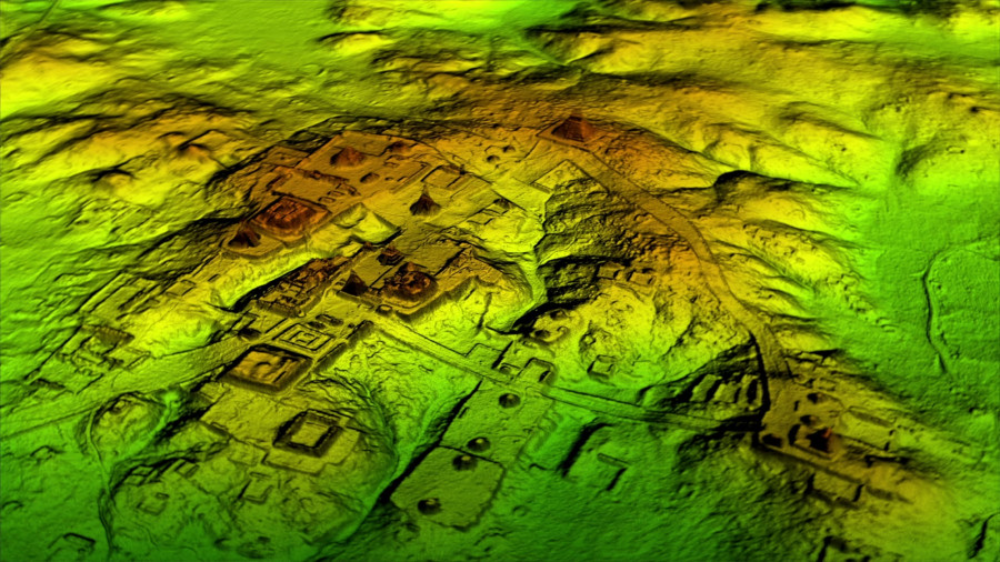
Laser technology known as LiDAR digitally removes the forest canopy to reveal ancient ruins below, showing that Maya cities such as Tikal were much larger than ground-based research had suggested. Courtesy Wild Blue Media/National Geographic. Click image for larger view.
On February 1, 2018, National Geographic broke a story about some incredible new discoveries in Mesoamerican archaeology using new technology. On subsequent days, the story was picked up by other major media outlets such as BBC, Washington Post, NPR, The New York Times, and Fox.
These reports are based on the recently released findings of the largest LiDAR survey ever attempted for archaeological research by the Fundación Patrimonio Cultural y Natural Maya (PACUNAM), led by Richard Hansen and Fernando Paiz. It mapped 10 tracts totaling 2,100 square kilometers in the Mirador Basin and other areas of northern Guatemala. The surveyed area is less than half the size of Utah County.
According to Parley P. Pratt, early critics dismissed the Book of Mormon, saying, “there were no antiquities in America, no ruined cities, buildings, monuments, inscriptions, mounds, or fortifications, to show the existence of such a people as the Book of Mormon described.”
Based on this new evidence from the Maya lowlands, these grandiose descriptions are not so far-fetched after all. The details in this story support dozens of verses in the Book of Mormon that describe dense populations, sophisticated economies, road networks, large-scale agriculture, intensive land use, disaster-prone landscapes, and prevalent warfare. Even statements about “the whole face of the land” being covered by people and buildings may have been more than just hyperbole.
Here’s why the story about LiDAR technology in Central America offers little support for Book of Mormon historicity, and why Parley P. Pratt’s statement is misleading:
LiDAR and the Book of Mormon: • Unidentified Civilizations: LiDAR reveals previously unknown structures, but it doesn’t tell us who built them or when. The Book of Mormon mentions specific civilizations (Nephites, Lamanites), and LiDAR doesn’t connect these finds to them. • Mesoamerica vs. Book of Mormon Setting: The Book of Mormon doesn’t definitively limit its setting to Mesoamerica. LiDAR discoveries in Guatemala don’t rule out other potential locations. • Focus on Large Structures: LiDAR excels at finding large-scale structures, but the Book of Mormon also describes smaller settlements. LiDAR might miss these entirely.
Parley P. Pratt’s Misleading Statement: • Early America Had Antiquities: Even in Pratt’s time, archaeologists were aware of pre-Columbian civilizations in the Americas. Mounds, cities, and artifacts were known, though not as extensively as today. • Book of Mormon Specificity: The Book of Mormon goes beyond basic features like cities and agriculture. It mentions specific materials, technologies, and writing systems not yet definitively linked to archaeological finds.
Overall: While LiDAR is a valuable tool for archaeologists, its discoveries in Mesoamerica don’t definitively support the Book of Mormon’s historical accuracy. The lack of specific identification of civilizations and the broader potential setting of the Book of Mormon weaken the connection. Additionally, Parley P. Pratt’s statement misrepresents the knowledge of pre-Columbian America in his time.
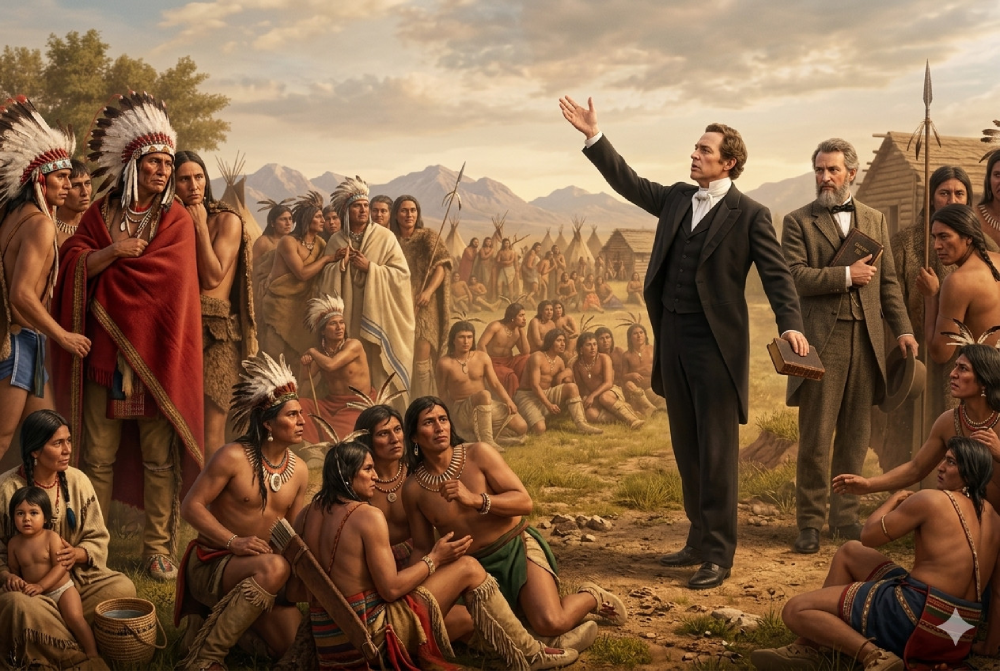
An AI-generated illustration brings to life a photo-realistic image, with lively characters, keeping the spirit of the original painting, which hung in the Salt Lake Temple of Mormon founder Joseph Smith, preaching to Native Americans in Illinois. Click image for a larger view.
The Book of Mormon describes the migration of three colonies from the Old World to the New. Two of these were small Israelite groups that migrated to an American land of promise around 600 BC. Many Latter-day Saint scholars interpret the Book of Mormon as a record of events that occurred in a relatively restricted region of ancient Mesoamerica. During and after those events, according to this view, peoples from this area—including some descendants of Book of Mormon peoples—may have spread to other parts of the Americas, carrying with them some elements of Mesoamerican culture. These Latter-day Saint scholars also believe that pre-Columbian populations of the Americas include within their ancestry many groups other than those small colonies mentioned in the Book of Mormon.
A recent critic of the Church of Jesus Christ of Latter-day Saints has complained that “some LDS scholars, especially those associated with FARMS, . . . reinterpret Lamanite identity in the later part of the twentieth century” and thereby “implicitly reject long-standing popular Mormon beliefs, including those held by Joseph Smith, about Lamanites being the ancestors of today’s American Indians.” Of course, popular beliefs, longstanding or otherwise, are not crucial to the foundations of the faith of Latter-day Saints, which are based on revealed scripture. In regard to the ancestry of the Amerindians, the central issue for Latter-day Saints is not whether Native Americans are in some measure descendants of Israel but whether their ancestors are exclusively Israelite. Latter-day scriptures speak of a remnant of those people described in the Book of Mormon and of their prophetic destiny, suggesting that this remnant may be found among Native American groups known perhaps to Joseph Smith and others.
The most accepted historical and archaeological record points to several key aspects regarding the origin of America’s Native American peoples:
• Migration from Asia: Overwhelming genetic and archaeological evidence suggests that the ancestors of Native Americans migrated from Siberia across a land bridge (Bering Land Bridge) that existed between Siberia and Alaska during the last Ice Age, roughly 15,000 to 20,000 years ago. • Multiple Waves of Migration: It wasn’t a single mass migration, but likely multiple waves of people over time. • Diversification and Adaptation: As these populations spread throughout the Americas, they adapted to various environments, leading to the development of distinct cultures and languages. • Long-Term Presence: Archaeological evidence shows continuous human presence in the Americas for thousands of years, with complex societies emerging in different regions.
Supporting Evidence:
• Genetics: Studies of DNA from ancient remains and modern Native American populations show clear connections to Asian populations. • Archaeology: Tools, weapons, and other artifacts found across the Americas share technological similarities with those found in Siberia, suggesting a common ancestry. • Linguistics: While there’s a great diversity of Native American languages, some linguists identify possible connections between them and certain Asian language families.
Unresolved Questions:
• Exact Timing and Routes: The precise timing and specific routes of migration are still being debated and refined with new discoveries. • The Pre-Clovis Debate revolves around archaeological evidence that some interpret as suggesting human presence in the Americas before the generally accepted timeframe of 15,000 to 20,000 years ago.
The discussion on Book of Mormon geography was getting heated. Scholars gathered in Provo, Utah, to discuss their theories about where the events described in the Book of Mormon took place. Some placed the Nephite capital city Zarahemla in Mesoamerica, others in South America. Others argued for a setting in the American heartland.
The Encyclopedia of Mormonism described how “Church leadership officially and consistently distances itself from issues regarding Book of Mormon geography.”
But the lack of an official position hasn’t squelched interest. The subject attracts highly trained archaeologists and scholars and informed — and not-so-informed — amateurs and enthusiasts. Books, lectures, and even Book of Mormon lands tours abound.
But something is rotten in Zarahemla — wherever it may be.
In the middle of what could be a fun and intellectually exciting pursuit similar to archaeologist Heinrich Schliemann’s famous search for the lost city of Troy, there are accusations of disloyalty tantamount to apostasy.
In one corner is the more-established idea of a Mesoamerican setting for the Book of Mormon. This theory places the events of the book in a limited geographic setting that is about the same size as ancient Israel. The location is in southern Mexico and Guatemala. The person most often associated with this theory is John L. Sorenson, a retired professor of anthropology at BYU, and the author of “An Ancient American Setting for the Book of Mormon” and a series of articles on Book of Mormon geography that ran in the Ensign magazine in September and October 1984. A new book, tentatively titled “Mormon’s Codex,” is in the process of being published.
In the other corner is the challenger, a new theory that places Book of Mormon events in a North American “heartland” setting. Like the Mesoamerican theory, it is also limited in area — but not quite as limited. Its symbolic head is Rod L. Meldrum and, more recently, Bruce H. Porter. Meldrum and Porter are the co-authors of the book “Prophecies and Promises,” which promotes the heartland setting.
It wouldn’t be hard to predict that some friction might come about from competing theories — that healthy sparring would occur with arguments and counter-arguments. But it has gone beyond that.
The source of the animosity comes from the heartland theory’s mantra: “Joseph knew.”
Joseph Smith made several statements that can be interpreted to have geographic implications. Proponents of a North American setting see these statements as authoritative and based on revelation. Mesoamerican theorists think that Joseph Smith’s ideas about geography expanded over time and included approval of at least some connection to Central America.
To the heartlander, Joseph’s knowledge about Book of Mormon locations is seen as proof of his divine calling and a testament to his being the chosen translator/expert of the book. Joseph didn’t just know; he knew everything. This position, however, leaves little room for other opinions — or for charity.
“The way I look at Joseph Smith’s statements is that he either knew or he didn’t know. If he knew, he knew by revelation. And if he didn’t know, you’ve got to ask yourself why he said the things that he said,” Porter said. “If he didn’t know, was he trying to show off? If he really didn’t know, why was he telling people?
“My feeling is that Joseph Smith did not lie,” Porter said.
If you don’t agree with this line of reasoning, by implication, you think that Joseph lied.
“My authority is Joseph Smith and the Book of Mormon,” Porter said. “Most of your Mesoamerican theorists, their authority is John Sorenson and Matthew Roper. They picked those as their authority at the neglect of Joseph Smith.”
The Church of Jesus Christ of Latter-day Saints (LDS Church) official stance of neutrality on Book of Mormon geography hasn’t stopped members from passionately pursuing their own theories. This disconnect between official policy and member enthusiasm can lead to frustration.
The article suggests that both sides rely heavily on interpreting statements by Joseph Smith, the founder of the LDS Church, to support their geographical arguments. This can lead to selective interpretation and a sense of one theory being the only “true” interpretation.
There exists a lack of charitable understanding between proponents of different theories. The “Joseph knew” mantra implies that those who disagree are questioning Joseph Smith’s prophetic abilities. There is also tension between viewing Joseph Smith’s statements as the ultimate authority and giving weight to scholarly research by archaeologists like John Sorenson and Matthew Roper.
While there is room for passionate exploration, there is also evidence of divisions and a lack of respectful discourse within the LDS community.
Differing opinions abound with each new shovel thrust into the ground.
BIG THINK: owned by Freethink Media, Inc. Mormon geography: Why some Latter-day Saints are digging for a “lost city” in southeastern Iowa.
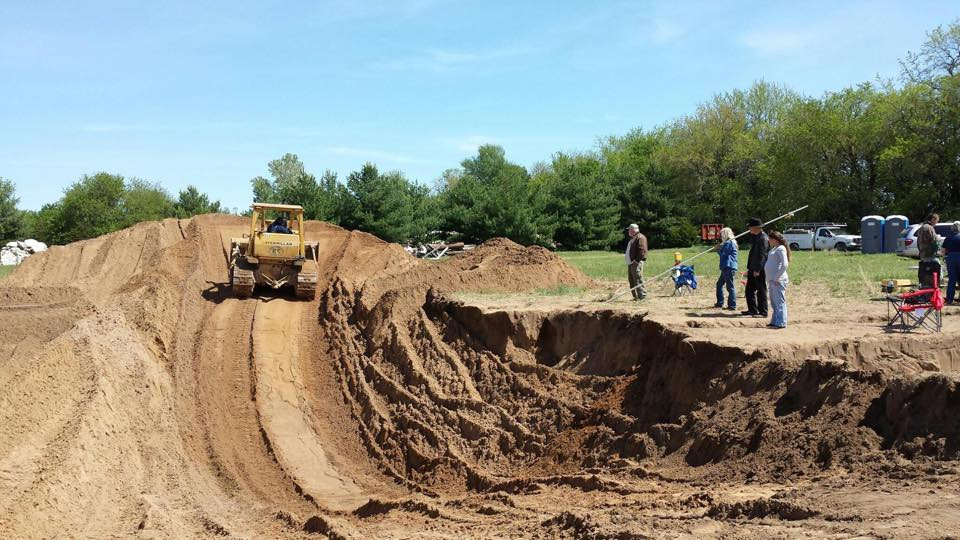
Andy White: “Excavation at the purported site of the Zarahemla Temple. Anyone with any serious archaeological background will immediately recognize this effort for what it is: an undisciplined treasure hunt. This effort begins by tunneling down by hand in the excavation blocks, but even eventually impatience wins here also and mechanical excavation equipment is desperately used to blow a big crater into the earth. And still there are no walls. And so the dirt is pushed back in the holes and everyone goes home.” (The photo is from Andy White’s blog post, which he obtained from a now-unpublished Facebook post, and does not have a copyright notice.). Click Image for a larger view.
Where is Zarahemla? Mormons, otherwise known as followers of the Church of Jesus Christ of Latter-day Saints, have been looking for that lost city for decades. Some think they are now close to finding it in southeastern Iowa. Using LiDAR (which is like radar but uses a different wavelength), the Heartland Research Group (HRG) has been scanning 100 acres of farmland outside Montrose, a small town on the bank of the Mississippi.
The trouble — topographical, theological, and otherwise — begins when you start to connect any of the locations mentioned in the book with the actual map of the Americas, using the scant geographic clues provided and then trying to make the rest of the puzzle fit. The results are, to say the least, quite divergent.
Is there an ancient Mormon metropolis buried beneath the soil of southeastern Iowa? It is hard to prove a negative. So, perhaps. However, for Mormon place-finders in the Americas, exhilaration followed by disappointment has been about as constant as it is for those looking for the philosopher’s stone.
But still, they go on — because if they can prove the existence of Zarahemla, the Book of Mormon itself will have been proven true. What motivates the diggers for a truth that may not be there? Faith. Or to translate that in more scientific terms: absence of evidence is not evidence of absence.
The foundational text of the Church of Latter-day Saints is rife with the names of those peoples, their cities, and other places of significance, but none has yet been positively identified by objective archaeological research.
Why? Perhaps because of the centuries that have elapsed between the demise of the civilization described in the book and the book’s rediscovery and translation by Joseph Smith, an ocean of time vast enough to erase virtually every trace of that past. Or perhaps the book’s inspiration was less than angelic (Mark Twain called it “a tedious plagiarism of the New Testament,” among other things), and its people and places were entirely made up.
Early Latter-day Saints (members of The Church of Jesus Christ of Latter-day Saints) in the 1820s and 1830s held a core belief that Native Americans were descendants of the Lamanites, a group described in the Book of Mormon. This concept was central to their early missionary efforts, particularly those focused on Missouri. In fact, a critical purpose of the Book of Mormon, as understood at the time, was the conversion of the Lamanites, considered a precondition for Christ’s imminent return.
Imagine transporting a believer from that era to the present. Hearing the Church’s current stance – that the Book of Mormon’s geographical location and Lamanite lineage hold little significance – they would likely perceive a significant shift in doctrine.
All nineteenth-century writers on Book of Mormon geography apparently assumed that the place where Joseph Smith found the plates and the hill where the Nephites met their destruction were identical. Aside from this one point, however, the diversity of nineteenth-century opinion is striking. Yet this fact has not been fully appreciated by students of the Book of Mormon or their critics. Did Lehi land in Chile? Cobiga, Bolivia? Lima, Peru? A little south of the Isthmus of Darien? Or “on the Pacific side of the southern part of Central America”? Where was the land of Nephi? Was it in South America? In Ecuador? Bolivia? Venezuela? Or was it in Central America? Guatemala? Was the land of Zarahemla in Colombia in South America? Further north in Honduras? Or in Mexico? Was the river Sidon the Magdalena in Colombia? Or was it the Usumacinta in Mexico? Was the narrow neck of land in Panama, at the Isthmus of Darien? By the Bay of Honduras? Or was it at the Isthmus of Tehuantepec in Mexico? Was the land of Desolation near the Isthmus of Darien? Honduras? Yucatán? Or in the United States between the Mississippi River and the Rocky Mountains? Were the Jaredites destroyed at the hill in New York or in Honduras in Central America? It is worth emphasizing that these points of disagreement are not over peripheral or insignificant matters but over key elements that are central to any discussion of Book of Mormon geography. The fact that there was such wide disagreement during the first fifty years after the publication of the Book of Mormon strongly suggests that no one view prevailed. It also indicates the absence of an authoritative stance on the subject.
Tell us more about that Deoxyribonucleic Acid Molecule (DNA).
The origin of Native American peoples has been a subject of intense study and debate, particularly in relation to the narratives presented in religious texts like the Book of Mormon by The Church of Jesus Christ of Latter-day Saints (LDS Church). The Book of Mormon claims that Native Americans descend from the Lamanites, who are described as descendants of ancient Israelites led by Lehi to the Americas around 600 B.C. However, contemporary DNA evidence presents a different narrative, highlighting significant conflicts with these religious claims.
DNA Evidence on Native American Origins: Extensive genetic research has primarily linked Native American populations to migrations from Asia, specifically through the Bering land bridge theory. This theory posits that ancient humans crossed from Siberia to Alaska during periods when sea levels were lower, allowing for land passage. Mitochondrial DNA studies, which trace maternal lineage, predominantly show that Native Americans share genetic markers with East Asian populations, not Middle Eastern or Israelite ones. This genetic evidence suggests that Native Americans are largely descendants of multiple waves of migration from Asia, dating back thousands of years before the claimed arrival of Lehi’s group.
Conflict with LDS Claims: The LDS Church has historically taught that Native Americans are direct descendants of the Lamanites, a narrative deeply embedded in the Book of Mormon’s account. However, as genetic science advanced, this claim came under scrutiny:
2006 Change in Book of Mormon Introduction: The LDS Church made adjustments to the introduction of the Book of Mormon in 2006, changing the assertion from “the Lamanites… are the principal ancestors of the American Indians” to “the Lamanites… are among the ancestors of the American Indians.” This alteration was likely influenced by mounting genetic evidence that did not support an exclusive Israelite ancestry for all Native Americans.
LDS Church’s Stance on DNA Studies (2014): In December 2014, the LDS Church published an essay titled “Book of Mormon and DNA Studies,” acknowledging the complexity of using DNA to affirm or refute the Book of Mormon’s historical narrative. The essay concedes that “nothing is known about the DNA of Book of Mormon peoples,” and even if it were known, there are “sound scientific reasons it might remain undetected.” It argues that DNA studies alone cannot decisively prove or disprove the historical authenticity of the Book of Mormon due to various factors like genetic drift, intermarriage with other groups, and the limitations of current DNA analysis techniques. The essay concludes by cautioning both critics and defenders against using DNA evidence conclusively, emphasizing that “the evidence is simply inconclusive.”
The Church of Jesus Christ of Latter-day Saints published an online essay entitled “Book of Mormon and DNA Studies” on January 31, 2014 that conceded the failure of DNA evidence to provide affirmative support for the scripture’s historical claims. Yet, the essay insists on a priority of scriptural over historical claims and offers possible reasons for the lack of genetic evidence of the ancient migrations from the Near East described in the Book of Mormon. This chapter summarizes the church’s essay, the historical context behind the issues it addresses, and offers constructive and critical analysis of its claims.
The Genetic Verdict:
The DNA evidence available today overwhelmingly supports an Asian origin for Native American peoples, which directly conflicts with the traditional LDS narrative of an Israelite origin via the Lamanites. The LDS Church has responded to these scientific findings by adjusting its claims, acknowledging the complexity of genetic evidence, and maintaining that the primary purpose of the Book of Mormon is spiritual rather than historical. This approach allows the Church to uphold its religious teachings while recognizing the limitations and insights provided by modern science. However, this leaves the debate open, with the reconciliation of faith and scientific evidence being a personal journey for believers, critics, and scholars alike.
Genetic studies indicate that Native American populations across the Americas, from Canada to the southern tip of Chile, originated from at least three distinct migrations. The majority of these populations share ancestry with a single group of early migrants who crossed the Bering Land Bridge, a landmass connecting Asia and America during the Ice Age, over 15,000 years ago. Image Credit: Emiliano Bellini
In a recent article, “Lamanite Genesis, Genealogy, and Genetics,” published in the anthology American Apocrypha, I summarized existing genetic research into Native American origins, concluding, “While DNA shows that ultimately all human populations are closely related, to date no intimate genetic link has been found between ancient Israelites and indigenous Americans, much less within the time frame suggested by the Book of Mormon.”Instead of lending support to an Israelite origin as posited by Mormon scripture, genetic data have confirmed already existing archaeological, cultural, linguistic, and biological data, pointing to migrations from Asia as “the primary source of American Indian origins.”
Researchers associated with the Foundation for Ancient Research and Mormon Studies (FARMS) have rejected hemispheric models of the Book of Mormon but still express “confidence in an Israelite genetic presence in Central America and perhaps as far away as Arizona to the north and Colombia to the south.” I have found no genetic research to support this expectation. Instead, studies of mtDNA (even ancient mtDNA), Y-chromosomes, and protein polymorphisms in Central American indigenous populations indicate the same Asian origins found elsewhere in the Americas. Given overwhelming genetic evidence against the Book of Mormon’s historical claims, I advised in my article “against confusing a spiritual witness [of the Book of Mormon] with scientific evidence.” As Mormons, it appears, we tend to place far too much trust in prayer as a valid means of historical and scientific investigation. Our tendency to confuse our answers to private prayers with valid historical and scientific information has produced a classic science vs. religion conflict, comparable to evolution vs. creationism.
A plausible conclusion.
Based on archaeological and historical evidence, most archaeologists and historians view the Book of Mormon’s accuracy as a historical record as unlikely. Here’s a breakdown of the key points:
Limited Archaeological Support: • Extensive archaeological research hasn’t unearthed definitive evidence for the specific civilizations, locations, or writing systems described in the Book of Mormon.
• While Mesoamerica has some cultural similarities (warfare, temple structures), these might be due to general patterns of human civilization rather than a direct connection to the Book of Mormon narrative. Anachronisms: • The Book of Mormon mentions technologies and animals not present in the Americas during the time period it covers (e.g., steel swords, barley). DNA Inconsistencies: • Genetic studies of indigenous populations in the Americas haven’t shown a clear connection to the lineages described in the Book of Mormon. Focus on Personal Revelation: • The emphasis on personal revelation in Mormon belief can lead to subjective interpretations of evidence that might not align with objective historical findings. However, it’s important to note: • Archaeology is a constantly evolving field, and discoveries can alter interpretations of the past.
• Some LDS scholars argue that the archaeological record is incomplete and might not capture everything mentioned in the Book of Mormon.
• The Book of Mormon holds significant religious and cultural value for Latter-day Saints, regardless of its historical accuracy.
Finally:
While some Latter-day Saint apologists creatively interpret select Mesoamerican artifacts, temple layouts, or name coincidences as faint echoes of Nephite civilization, mainstream archaeologists and historians—unburdened by doctrinal commitments—overwhelmingly reject these as confirmation bias stretched over unrelated indigenous cultures. After two centuries of digs, LiDAR scans piercing jungle canopies, DNA mapping Asian migrations, and glyph decipherments revealing polytheistic dynasties, not a single inscription, horse bone, steel blade, or Semitic name has surfaced to anchor the Book of Mormon’s sprawling cities, battles of millions, and Israelite transplants in the Americas. What began as 19th-century speculation from Joseph Smith’s upstate New York farmstead endures not through empirical validation, but through faith’s unyielding grip—cherished by believers as divine writ, yet standing as a towering anachronism against the granite bedrock of pre-Columbian history. The evidence does not whisper support; it shouts silence.