
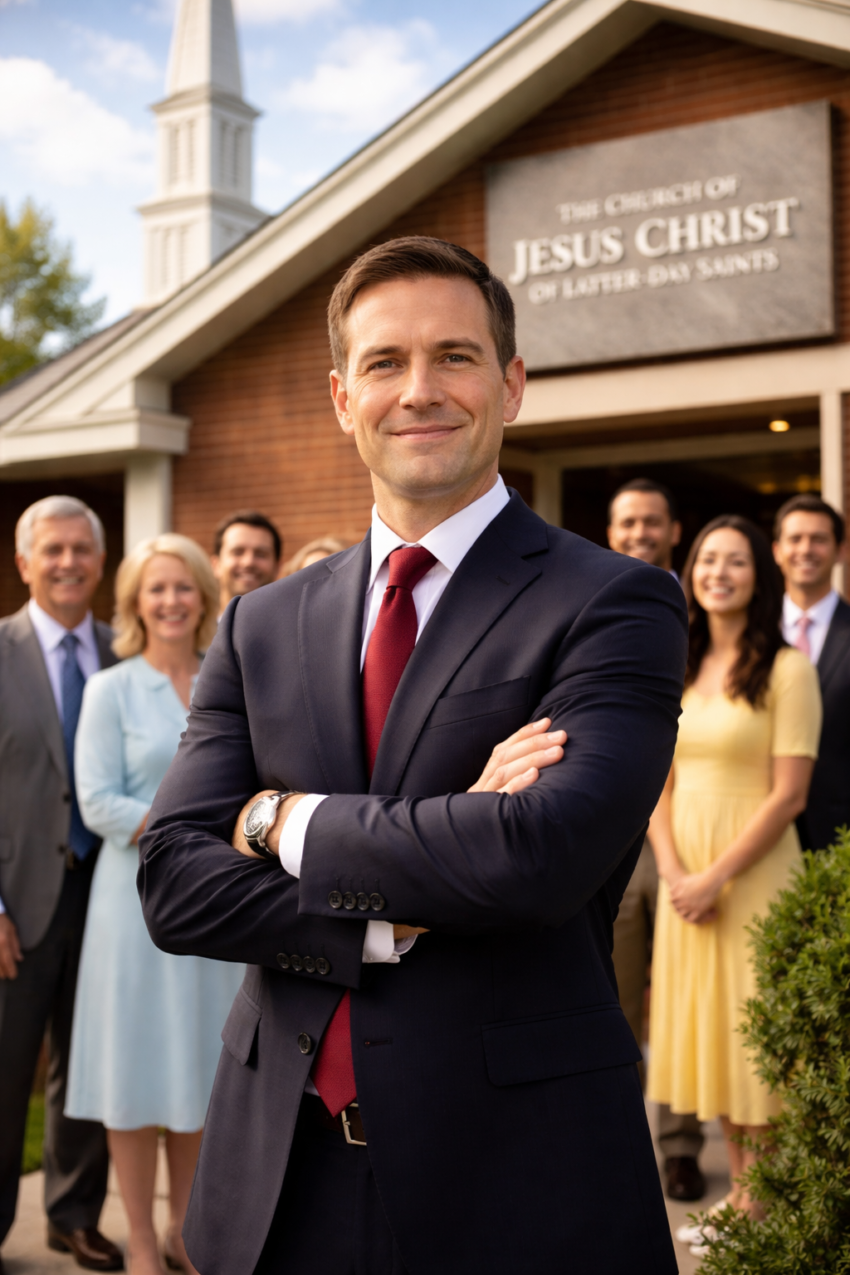
Image: An AI‑generated image imagines your neighborhood LDS Bishop standing proudly with some of his ward members, expressing confidence and unity, while the background details quietly suggest the institutional machinery that keeps the ward running—and the power concentrated in his hands.
The office of the LDS bishop is frequently misread by those outside the Mormon tradition—and occasionally by those within it. The title carries familiar ecclesiastical resonance: it sounds like a Catholic bishop or an evangelical pastor, and LDS members themselves speak of their bishop with the kind of personal deference typically reserved for ordained clergy. That familiarity, however, conceals a fundamental difference that this series intends to make plain.
An LDS bishop is not a trained minister. He may hold a college degree—perhaps from Brigham Young University or another institution—but that credential carries no bearing on his ecclesiastical role. He holds no seminary degree, no formal theological education, and no professional credential in pastoral care. Whatever academic accomplishments he brings to the calling were earned in service of a secular career, not in preparation for shepherding souls. He is a layman—called, not hired—who manages a congregation of several hundred people while maintaining that full-time secular career and family obligations. The Church of Jesus Christ of Latter-day Saints regards this as a feature, not a deficiency: priesthood authority, in LDS theology, flows through divine calling rather than academic preparation. But from the vantage point of historic Christian ecclesiology, this represents a significant departure from the biblical qualifications and vocational expectations attached to the office of overseer. A degree in accounting or engineering, however honestly earned, is not a substitute for the theological formation, doctrinal competence, and tested shepherding ability that Scripture and church history have consistently required of those who would oversee God’s people.
In this AI-generated summary, we examine how LDS bishops are selected, what their actual duties encompass, how they administer welfare and finances, what distinguishes them from other ward leaders, and the tension inherent in balancing compassion with institutional policy on long-term assistance. These are not merely administrative questions—they open a window into LDS assumptions about authority, priesthood, and the nature of spiritual oversight itself.
The Chain of Command
How LDS Authority Flows from Salt Lake City to Your Neighborhood Ward. The LDS Church operates as one of the most centralized religious organizations in the modern world. Authority does not bubble up from congregations — it descends from the top, and it descends with institutional precision.
At the apex sits the President of the Church, whom Latter-day Saints sustain as a living prophet, seer, and revelator. He is regarded as God’s sole mouthpiece on earth, holding all priesthood keys simultaneously. His word, in practice, functions as a binding doctrine for the entire Church. Flanking him are two Counselors, forming the First Presidency — the Church’s supreme governing body.
Directly beneath the First Presidency stands the Quorum of the Twelve Apostles, whose members are sustained as special witnesses of Christ and who govern the global Church when the First Presidency is dissolved upon a president’s death. Together, these fifteen men — the First Presidency and the Twelve — constitute what the LDS Church calls the General Authorities, the senior tier of ecclesiastical power.
Below them, additional layers of General Authorities include the First and Second Quorums of the Seventy and the Presiding Bishopric, who manage the Church’s worldwide administrative and welfare operations. These men are assigned to oversee geographic Areas — large international regions — and report upward to the Twelve.
Stepping down from the global to the regional, each geographic area is subdivided into Stakes, roughly analogous to a diocese in traditional Christianity. A Stake President — himself a layman with no professional ministry training — presides over a stake comprising several congregations. He holds significant authority over the bishops beneath him: he selects them, oversees their service, and can release them. He is, in effect, the bishop’s boss.
Each stake is composed of individual congregations called Wards, typically comprising 200 to 500 members drawn from a defined geographic boundary. Members do not choose their ward — geography assigns them. And presiding over each ward is the Bishop.
He is the endpoint of a very long chain. Every policy, handbook directive, welfare guideline, and doctrinal emphasis that originates in Salt Lake City travels through the Seventy, through the Stake President, and lands ultimately on his desk — or more accurately, in his lap. He did not write the rules. He did not vote on them. He administers them, in his spare time, without pay, to people who regard his office with the kind of deference the chain of command above him has carefully cultivated.
That is the structure. And understanding it reframes everything about what an LDS bishop actually is: not a pastor in the biblical sense, but a middle manager in a hierarchical corporation — one whose currency happens to be spiritual authority rather than a paycheck.
Isn’t a Mormon Bishop just an ordinary LDS member who has no outstanding theological training, background, or unique spiritual insights? Write a short description of how they become a Bishop and how this designation is unlike how traditional Christianity’s church pastors are promoted.
Yes, by ordinary‑member standards, an LDS bishop is just a lay member with no special theological degree or formal seminary training. He is typically a faithful, active ward member—often a professional, a father, and a volunteer—then suddenly called into one of the most demanding leadership roles in the church.
How an LDS bishop is chosen
In the LDS system, a bishop is selected by the local stake president, who recommends a name upward to the First Presidency for approval. The prospective bishop is then ordained a high priest (if he is not already) and set apart as bishop by the laying on of hands, with the stake president conferring priesthood “keys” for that ward. The congregation gives common‑consent approval, but the selection is top‑down, not by election or competition. Once released, he remains a bishop in the priesthood office for life, even though he returns to being an “ordinary” member.
How this differs from traditional pastors
In most traditional Christian churches, a pastor is expected to be a mature, spiritually and doctrinally trained leader, often with formal theological education, ordination exams, and confirmation by a local congregation or denominational body. The process is usually tied to public teaching gifts, doctrinal competence, and a tested track record of shepherding, not just general worthiness. In contrast, an LDS bishop is a lay administrator and judge‑in‑Israel first, with his doctrinal teaching constrained by handbooks and manuals; he is not a professionally trained theologian, but a faithful member temporarily elevated into a high‑pressure, unpaid leadership role.
What are the main duties and responsibilities of an LDS bishop?
An LDS bishop is officially described as the presiding high priest and “common judge” in a local ward, with both spiritual and practical responsibilities. His main duties and responsibilities include:
- Presiding high priest and spiritual leader
He presides over ward meetings, selects speakers, and oversees the ward’s doctrinal tone and worship environment. He is also the presiding authority over the Aaronic Priesthood in the ward, including the priests’ quorum, and helps prepare young men for missions and temple worthiness.- “Common judge” and discipline
As a “common judge in Israel,” he holds private worthiness interviews, offers spiritual counsel, and conducts church membership councils when members are struggling with serious sin or behavior issues. This can involve formal or informal membership restrictions, including withdrawal of membership in extreme cases.- Caring for the youth as first priority
Church leaders have repeatedly emphasized that the bishop’s primary responsibility is to the youth and young single adults of the ward. He works to help them live church standards, qualify for ordinances, and stay connected to the Church.- Temporal cares and welfare
The bishop oversees tithes and offerings, keeps accurate financial records, and authorizes use of fast‑offering funds and other assistance for members in need. He helps coordinate welfare and self‑reliance efforts, often drawing on local resources and church programs.- Administration and organization
He calls and sets apart leaders for ward organizations (Sunday School, Relief Society, Young Men, Young Women, Primary, priesthood quorums), and approves their counselors and teachers. He also oversees ward records, finances, and the use of the meetinghouse, often delegating day‑to‑day work to clerks and counselors while retaining final responsibility.In short, an LDS bishop functions as a volunteer, unpaid combination of judge, counselor, financial steward, and youth‑focused spiritual administrator, with authority derived from priesthood “keys” and accountability back to higher church leadership rather than a local congregation.
How do bishops handle welfare and financial assistance?
An LDS bishop handles welfare and financial assistance as the ward’s final authority over fast offerings and Church‑funded aid, but he is expected to do so according to strict principles and policies. Here’s how bishops typically manage it:
First line: assessment and self‑reliance
Before giving help, the bishop (or a Relief Society or elders quorum leader he assigns) reviews the member’s situation, including what resources they are already using—family help, personal savings, and sometimes government or community programs. The stated goal is to provide temporary help for basic needs while encouraging members to become self‑reliant, not to maintain a particular lifestyle.
How money and goods are given
Church assistance relies heavily on fast offerings and bishops’ orders, with strong guidance to avoid cash when possible. Bishops often issue orders for food, clothing, or services (such as medical care or utilities) through local storehouses or vendors, so the funds go directly to the provider instead of into the member’s pocket. When cash or bill‑paying is needed, fast offerings may temporarily cover essentials like housing, utilities, medicine, or other basic needs, but only for short‑term crises.
Who decides and how much
The bishop is taught that he bears the “sole” scriptural mandate to care for the poor in his ward and has discretion over who receives aid, when, and how much. He is expected to seek inspiration and use “good judgment,” balancing compassion to avoid long‑term dependence. If assistance exceeds normal limits or involves the bishop’s family, higher leaders (stake president, sometimes area presidencies) must review and approve the expenditures before payment.
Broader welfare role
Beyond direct checks or orders, the bishop is also responsible for teaching and encouraging self‑reliance, using local programs such as food storage, vocational training, and employment help when available. Relief Society and elders quorum leaders assist by identifying needs and ministering to members, but the bishop personally approves all fast‑offering expenditures and ensures that welfare follows Church policy.
What qualities does the stake president look for in selecting a bishop?
A stake president is expected to look for a certain “profile” of character and life when selecting a bishop, even though he also emphasizes that the final choice is meant to be guided by personal inspiration.
Spiritual and moral qualities
The stake president typically looks for a man who is
- Worthy in standing and in covenants: faithful in tithing, temple‑worthy, and active in church service.
- Like‑minded and loyal to Church leadership: someone who doctrinally and organizationally lines up with the teachings and policies of the First Presidency and Quorum of the Twelve.
- Spiritually grounded: described as someone who seeks the Spirit, prays and fasts, and is sensitive to the promptings of the Holy Ghost.
Life and character traits
Because a bishop is a full‑time volunteer leadership role, stake presidents often favor men who
- Have a stable family life: a supportive spouse, responsible children, and the ability to prioritize family while still serving the ward.
- Demonstrate maturity, good judgment, and emotional stability: calm under pressure, able to handle conflict fairly, and not prone to gossip or drama.
- Are available and flexible: usually a man whose job and schedule allow him to be reachable for counseling, emergencies, and meetings.
Leadership and practical skills
The stake president also weighs whether the candidate can
- Lead an organization: oversee a bishopric, auxiliaries, finances, and records without constant micromanaging or over‑reliance on the stake president.
- Delegate and empower others: trust counselors, clerks, and quorum presidents instead of trying to do everything himself.
- Be approachable and compassionate: accessible to youth, the struggling, and the “quiet” members, not just to the powerful or popular in the ward.
In practice, many insiders describe the process as a mix of “good‑member profile” plus the stake president’s personal sense of who will think and act like him, all wrapped in a claim that the final choice is confirmed by inspiration.
How does a bishopric function with counselors?
An LDS bishopric functions as a small presidency in which the bishop is the presiding leader, but his two counselors act as partners who help spread the workload, share insights, and support his decisions.
How they share the work
The bishop is the only one who holds priesthood “keys” for the ward, so final decisions on worthiness, discipline, fast‑offering approval, and certain interviews are his alone. However, he is encouraged to “delegate many assignments” and routinely assigns each counselor responsibility for specific areas—like the sacrament program, finances, youth organizations (Young Men, Young Women), or convert‑retention and activation work—while still remaining the overarching authority.
Counselors as advisors and ministers
Counselors are expected to give honest counsel: to speak up, share perspectives, and help the bishop see different angles before he makes a decision. Once the bishop decides, counselors are taught to support that decision “as if it were your own,” even if they had a different view privately. They also act as additional ministers: conducting some interviews, meeting with members, and participating in leadership meetings so the bishop is not the only one doing the heavy relational work.
Practical functioning as a team
In practice, the bishopric usually meets regularly to review finances, welfare cases, youth progress, and key callings, with the bishop setting the agenda and counselors handling much of the follow‑up and coordination with quorums and auxiliaries. Many counselors describe their role as both “lightening the bishop’s load” and guarding against isolation by ensuring no major decision lands on the bishop alone; the goal is a presidency that serves together, even though the bishop remains the final authority under the stake president.
What distinguishes a bishop from other ward leaders?
A bishop in the LDS Church is distinct from other ward leaders in three main ways: authority, scope of responsibility, and ecclesiastical role.
Priesthood keys and final authority
The bishop is the only one in the ward who holds priesthood “keys” for that congregation, which means he has final decision‑making authority over worthiness, membership status, and disciplinary councils (like membership restrictions or withdrawal of membership). Other ward leaders—such as Relief Society president, Young Men/Young Women presidents, or elders quorum leaders—serve under his direction and do not have this level of judicial or administrative authority.
Broad, all‑encompassing stewardship
The bishop is responsible for the entire ward, not just one organization. He oversees all priesthood quorums, auxiliaries, finances, records, welfare, and the use of the meetinghouse, while other ward leaders typically focus on a specific group (e.g., Relief Society for women, Primary for children). He also has the taxing and disbursing role for tithes and fast offerings, which no other ward leader is authorized to manage.
Unique spiritual‑judicial role
The bishop is both the presiding high priest and the “common judge in Israel” in the ward, meaning he conducts private worthiness interviews, evaluates readiness for ordinances, and presides over membership councils. Other ward leaders may counsel and minister, but they do not have the same explicit responsibility to judge worthiness or authorize church discipline; instead, they usually refer serious matters to the bishop.
In short, every ward leader has a service role, but the bishop is the only one who combines presiding authority, financial stewardship, and judicial‑like responsibility for the whole ward.
How long does an LDS bishop typically serve?
An LDS bishop typically serves for about five years, though the exact length can vary quite a bit by location and circumstance.
-
The informal “standard” in many areas is four to five years, with some bishops serving as short as about three years and others up to around seven years, depending on the stake president and local leadership needs.
-
There is no single hard‑and‑fast term; stake presidents have discretion and often receive reminders from Church headquarters when a bishop approaches the four‑and‑a‑half‑to‑five‑year range, at which point they consider a release or extension.newsroom.
-
Even after being released, a man retains the priesthood office of bishop for life, although he no longer functions as the acting bishop of a ward.
What is a bishop’s storehouse, and how does it operate?
A bishop’s storehouse is a local Church‑operated warehouse that supplies food and essential household goods to people in need, but it does not function like a free‑access food pantry. Instead, it operates under the bishop’s authority and according to welfare principles.
What a bishop’s storehouse is
A bishop’s storehouse is a physical facility stocked with basic groceries, hygiene products, and sometimes clothing or household items, funded largely by tithing and fast‑offering donations and often supplied by Church‑owned farms and production facilities. It may serve a single stake or a larger region, and its purpose is to provide temporary, orderly relief rather than long‑term charity.
How it operates
- Referral‑only access: Those in need receive a referral from their bishop (often coordinated with the Relief Society president), who assesses their situation and determines the appropriate type and level of assistance.
- Bishop’s orders: The bishop or an assigned clerk prepares an electronic or paper order listing needed items; the person then takes that order to the storehouse, where missionaries or volunteers help them “shop” within that pre‑approved list.
- Service and dignity: Many storehouses ask recipients to provide some service (sorting, stocking, cleaning, etc.) in return for the goods, in line with the Church’s emphasis on work, self‑reliance, and avoiding dependency.
Who it serves and why
Anyone in need—member or non‑member—can be referred to a bishop’s storehouse, though the bishop retains the right to limit or deny assistance based on circumstances. The storehouse is also a place where Church members, youth, and service missionaries can work or volunteer, turning material relief into a system of shared labor and stewardship.
What trade-offs do bishops face when balancing compassion with preventing welfare dependence in LDS wards?
Bishops in LDS wards constantly walk a tight line between showing Christ‑like compassion and upholding the Church’s strong emphasis on self‑reliance and avoiding welfare dependence. The trade‑offs they face include:
Compassion vs. strict criteria
When a member is genuinely struggling—job loss, medical crisis, or family fracture—the bishop feels pressure to “do something” quickly and generously. At the same time, welfare handbooks stress that help must be temporary, need‑based, and tied to effort, so the bishop must often say “no” to chronic requests, causing visible pain even when the decision is doctrinally defensible.
Short‑term relief vs. long‑term patterns
A bishop can ease a month’s bills, a missed rent, or a week of food, but the real trade‑off is whether repeated help teaches the member to call the bishop at every crisis or to make a sustained exit strategy. If he leans too hard on compassion, he risks dependency; if he leans too hard on boundaries, he risks hardened hearts and people leaving the Church entirely.
Confidentiality vs. accountability
Bishops are taught to keep members’ struggles private, yet welfare culture also expects them to push for personal accountability, work, and family‑support plans. This means the bishop often walks alone with the member’s full story, bearing the moral weight of each decision without being able to share the details widely, even with counselors or stake leaders.
Church identity vs. member perception
The LDS Church publicly emphasizes “no one who truly needs help will be turned away,” but in practice, the same system stresses that the Church is not a permanent social safety net. Bishops embody this tension: they want members to feel the Church is a refuge, yet they also send the message that long‑term dependence is not the goal, which can feel cold to the immediate sufferer.
In the end, every bishop’s decision is a balance between relieving present suffering and protecting long‑term spiritual and financial health, all carried out alone, without formal training, and under the watchful eyes of a ward that will judge him whichever way he leans.
A Note on Research Methods and Accuracy
This work represents a collaboration among the author’s theological and historical research, primary-source documentation, and the emerging capabilities of artificial intelligence research tools. AI assistance was employed throughout the investigative process—not as a ghostwriter or a substitute for scholarship, but as a rigorous research partner: surfacing sources, cross‑referencing claims, identifying scholarly consensus, and flagging potential errors before they could reach the page.
Every factual claim in this work has been subjected to active verification. Where AI‑generated content was used as a starting point, it was tested against primary sources, peer‑reviewed scholarship, official institutional documentation, and established historical records. Where discrepancies were found—and they were found—corrections were made. The author has made every reasonable effort to ensure that quotations are accurately attributed, historical details are precisely rendered, and theological claims fairly represent the positions they describe or critique.
That said, no work of this scope is immune to error, and the author has no interest in perpetuating inaccuracies in the service of an argument. If you are a reader—whether sympathetic, skeptical, or hostile to the conclusions drawn here—and you identify a factual error, a misattributed source, a misrepresented teaching, or a claim that cannot be substantiated, you are warmly and genuinely invited to say so. Reach out. The goal of this work is not to win a debate but to get the history right. Corrections offered in good faith will be received in the same spirit, and verified corrections will be incorporated into future editions without hesitation.
Truth, after all, has nothing to fear from scrutiny—and neither does this work.