
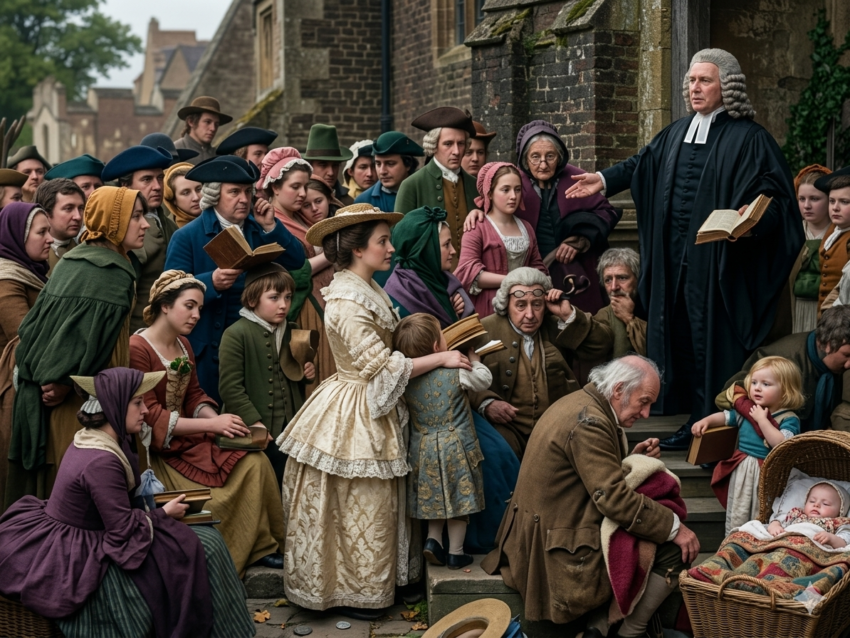
Image: An AI-generated, photo-realistic reimagined image depicting John Wesley preaching at an open-air meeting, the Anglican reformer who helped launch a network of small groups known as the Connexion in the early to mid-18th century. These groups emphasized disciplined study, mutual accountability, and an orderly pattern of Christian life. Because of their highly methodical habits, critics nicknamed them “Methodists,” and the label eventually stuck.
The Methodist Road To Rome: A Church in Search of Itself
Tracing Two Centuries of Glory, Drift, and Division
INTRODUCTION: A DENOMINATION AT THE CROSSROADS
In the spring of 2024, the most dramatic ecclesiastical divorce in American Protestant history was finalized. The United Methodist Church—once the largest mainline Protestant denomination in the nation, encompassing some 32,000 congregations and more than six million members in the United States—completed a rupture that had been building for more than half a century. Approximately one-quarter of American United Methodist churches departed the denomination, many joining the newly formed Global Methodist Church, which had formally launched in 2022. It was the culmination of a theological civil war, fought over the authority of Scripture, the definition of marriage, the ordination of clergy, and ultimately over the very nature of Christianity itself.
Yet to understand this earthquake, one must excavate the foundations. The fault lines did not appear overnight. They had been forming since at least the 1880s, when Sunday school editors quietly began substituting Enlightenment philosophy for Wesleyan orthodoxy. They widened through two World Wars, the social revolution of the 1960s, institutional mergers that diluted doctrinal identity, and the slow replacement of evangelistic fervor with progressive social activism. By the time the denomination’s General Conference gathered in 2024, the question was no longer whether the church would split, but how catastrophic the rupture would be—and what would survive it.
This essay traces that journey from the beginning: from the coal-smoke docks and Oxford quadrangles of 18th-century England, where two Anglican priests named John and Charles Wesley set the world on fire with a gospel of grace and holiness; through the thundering circuit riders of the American frontier; through the theological compromises of the 20th century; and into the fractured, identity-confused landscape of contemporary Methodism. It is a story of extraordinary courage and extraordinary cowardice. Of revival and retreat. Of institutional grandeur and institutional suicide. And, ultimately, it is a story still being written—because out of the ruins of one denomination, new ones are rising, and the people once called Methodists are being called, again, to choose who they are.
PART I: FIRE FROM ENGLAND — THE ORIGINS OF METHODISM
The Oxford Holy Club and the Birth of Method
The movement that would eventually reshape world Christianity began not with thunder and lightning but with a small, disciplined study group at Christ Church College, Oxford University, in the 1720s. John Wesley, a graduate of Christ Church and later a fellow of Lincoln College, joined with his younger brother Charles and a small circle of like-minded students in what their mocking peers dubbed the “Holy Club.” The students were derided for their regularity of devotional practice—daily Bible reading, prayer, fasting on Wednesdays and Fridays, weekly Communion, visits to prisons and the sick. The nickname that stuck, however, was “Methodists”—a term of ridicule at first, suggesting the group’s obsessive adherence to method and rule in spiritual formation. The Wesleys would eventually wear the label as a badge of honor.
John Wesley was born June 17, 1703, in Epworth, Lincolnshire, the fifteenth child of Anglican clergyman Samuel Wesley and his remarkable wife Susanna, who educated her children with an almost militaristic rigor in Scripture, catechism, and classical learning. Susanna Wesley herself held weekly household prayer meetings and Bible studies—a practice that would later be recognized as a prototype for the Methodist class meeting. John Wesley would later say that the faith he first learned at his mother’s knee was the faith he preached to the world.
“I am not afraid that the people called Methodists should ever cease to exist either in Europe or America. But I am afraid lest they should only exist as a dead sect, having the form of religion without the power.”
— John Wesley, Thoughts Upon Methodism — Source: umnews.org
The early Holy Club was a sincere, if sometimes overly rigorous, attempt to revive what its members saw as a moribund institutional church. The Church of England in the early 18th century was, by most accounts, spiritually enervated. Deism was ascendant among the educated classes; Calvinist fatalism had, in some quarters, created a theology of spiritual passivity; and the common people of England—the miners of Bristol, the factory workers of the emerging industrial towns, the rural poor—were largely untouched by any vital Christian presence. Into this vacuum, John Wesley would eventually pour the extraordinary energy of his life.
Aldersgate and the Heart Strangely Warmed
The decisive moment in John Wesley’s spiritual journey came not at Oxford but in a small meeting room on Aldersgate Street, London, on May 24, 1738. Wesley, who had already made an ill-fated missionary journey to the colony of Georgia (1735-1737), had returned to England spiritually frustrated and theologically unsettled. He had encountered Moravian pietists whose calm assurance of personal salvation contrasted painfully with his own lack of inner peace. On that May evening, while listening to someone read Luther’s preface to the Epistle to the Romans, Wesley experienced what he famously described in his journal:
“I felt my heart strangely warmed. I felt I did trust in Christ, Christ alone for salvation; and an assurance was given me that He had taken away my sins, even mine, and saved me from the law of sin and death.”
— John Wesley’s Journal, May 24, 1738 — Source: britannica.com/topic/Methodism
This assurance—the personal, felt conviction of justification by faith—would become the experiential cornerstone of Methodism. Wesley was not inventing a new theology but recovering a neglected dimension of Anglican theology, one grounded in the Reformation’s insistence on grace alone, through faith alone. But Wesley added to the Lutheran emphasis on justification an equally robust emphasis on sanctification—the ongoing process of being conformed to the holiness of Christ. For Wesley, it was not enough to be declared righteous; the believer must be made righteous, progressively transformed by the Holy Spirit into the image of Christ. This double emphasis on justification and sanctification, on the “porch” and the “house” of Christian experience, would become the hallmark of Wesleyan theology.
The Open Fields and the Methodist Movement
Barred from many Church of England pulpits because of his enthusiastic preaching style and his insistence on conversion, John Wesley took a dramatic step in 1739 when he joined his friend George Whitefield in preaching in the open fields of Bristol to crowds of coal miners. Wesley, a High Church Anglican who had always insisted that preaching must be done within the walls of a consecrated building, initially resisted. But the results were impossible to argue with. Thousands gathered. Hardened miners wept. Conversions multiplied.
Wesley became a tireless field preacher, eventually riding an estimated 250,000 miles on horseback across Britain, preaching more than 40,000 sermons over the course of his ministry, and organizing converts into a network of “societies,” “classes,” and “bands”—small accountability groups that provided the discipleship structure the institutional church was failing to offer. The “class meeting” of twelve to fifteen members, meeting weekly with a leader to examine their spiritual progress, give testimony, pray, and hold one another accountable, was the engine of Methodist growth. It was, in effect, a small-group discipleship model that many 21st-century church-growth experts have rediscovered and are still trying to replicate.
“The United Methodist Church in 2017 is a product of a worldwide mission that began some 300 years ago. It starts in England, travels to the American continent with the colonists and quickly spreads around the globe.”
— ResourceUMC — A Brief History of the People of The United Methodist Church — resourceumc.org
Wesley never intended to found a new denomination. He died in 1791 as he had lived—an ordained Anglican priest, insisting that Methodism was a renewal movement within the Church of England, not a replacement for it. But the institutional structures he built—the annual conference of preachers, the circuit system, the class meetings—had a life of their own, and the movement’s separation from Anglicanism in America preceded his death.
Methodism Crosses the Atlantic
The Methodist movement reached the American colonies primarily through lay immigrants, particularly Irish and English Methodists who settled in Maryland and Virginia in the 1760s. Among the most significant of these early messengers was Robert Strawbridge, an Irish Methodist who established the first Methodist society in North America at his home in Sam’s Creek, Maryland, around 1766. Wesley’s official emissaries followed: Francis Asbury and Thomas Coke, the two men Wesley appointed as co-superintendents of the American work.
At the Christmas Conference of 1784, held at Lovely Lane Chapel in Baltimore, the Methodist Episcopal Church was formally organized as an independent American denomination—the first step in the long process of institutional separation from the Church of England. Asbury, who accepted the title “bishop” over Wesley’s initial preference for “superintendent,” became one of the most remarkable figures in American religious history. A celibate itinerant who owned virtually nothing and traveled constantly, Asbury is estimated to have ridden more than 270,000 miles across the American continent, traversing mountain ranges and frontier settlements to plant Methodism wherever he could find people willing to listen.
The results were staggering. By 1840, as historian Nathan Hatch has documented, Methodism had become, according to the Firebrand Magazine’s account of Donald Haynes’s historical analysis, “the largest organization in America except the government.” Its circuit riders—young, poor, often self-educated men who rode into frontier communities with saddlebags full of Bibles and Methodist discipline books—were the primary evangelistic force in early American culture. Camp meetings, beginning with the famous Cane Ridge Revival of 1801 in Kentucky, became the defining feature of American evangelical piety, and Methodism was their primary organizational beneficiary. The revivals were emotional, loud, and controversial—but they changed lives, families, and communities.
PART II: THE DOCTRINAL FOUNDATIONS OF METHODISM
The Wesleyan Theological Core
Methodism’s theological identity was never simply a rehashing of generic Protestantism. It carried a distinctive doctrinal fingerprint shaped by John Wesley’s careful reading of Scripture, the early church fathers, Anglican theological tradition, and his own experience of grace. The Woodlands Methodist Church’s overview of Methodist identity aptly notes that Wesley’s theological vision was centered on what he called the “Scriptural Way of Salvation”—a holistic understanding of how God works in human souls from first awakening to final glorification.
Four theological pillars defined classical Wesleyan Christianity:
First, the doctrine of prevenient grace—the conviction that God’s grace goes before and precedes all human response, enabling even unregenerate persons to respond to the Gospel. This was Wesley’s answer to the Calvinist doctrine of total depravity and irresistible grace. For Wesley, God’s grace was genuinely universal in its offer, sufficient for all, even if efficient only for those who believe.
Second, justification by faith—the Reformation’s great recovery of the Pauline gospel, which Wesley embraced wholeheartedly at Aldersgate and preached without ceasing for the remainder of his life. Sinners are declared righteous before God, not based on their works but solely based on Christ’s atoning sacrifice, received through faith.
Third, the new birth and assurance—Wesley’s insistence that conversion was not merely an intellectual assent to doctrinal propositions but a genuine spiritual transformation, a new birth, accompanied by the inner witness of the Holy Spirit. The Methodist emphasis on felt assurance of salvation—the “heart strangely warmed”—distinguished it from the often colder, more intellectualized piety of established Anglicanism.
Fourth, and most distinctively, entire sanctification—the doctrine that the Holy Spirit can so thoroughly cleanse the human heart of willful sin that the believer lives in a state of “perfect love” toward God and neighbor. Wesley was careful to note this was not sinless perfection in an absolute metaphysical sense but a transformation of affection and motive. This doctrine fueled the Holiness Movement of the 19th century and eventually gave birth to Pentecostalism.
“Wesley’s emphasis on his definition of the Scriptural Way of Salvation faded and the Boards of Education editors wrote the script followed in most local churches.”
— Donald W. Haynes, “Methodism: How We Went Wrong” — Firebrand Magazine — firebrandmag.com
The Wesleyan Quadrilateral
John Wesley’s theological method was not a single source but a fourfold engagement with truth that theologian Albert Outler famously named the “Wesleyan Quadrilateral” in his work for the 1972 Book of Discipline. The four sources were Scripture, Tradition, Reason, and Experience, with Scripture holding primacy as the supreme rule of faith and practice. Wesley himself wrote that he was “homo unius libri”—a man of one book—though he was in reality one of the most widely read theologians of his age.
The problem, as the 20th century would demonstrate, was that the quadrilateral was far more easily abused than its creator intended. Without the clear primacy of Scripture, the quadrilateral could become a theological buffet from which any interpreter could select whatever ingredient best supported a predetermined conclusion. Experience, in particular, would prove to be the instrument through which progressive theology would eventually attempt to overturn the denomination’s traditional sexual ethics—arguing that the lived experience of LGBTQ+ persons must be weighed against what the text of Scripture actually says.
“In the theological statement for the 1972 Book of Discipline in the new United Methodist Church, Albert Outler invented the word “quadrilateral” that was a process, not a doctrinal statement. Yet it became the shibboleth used in Boards of Ordained Ministry and sermons.”
— Donald W. Haynes, “Methodism: How We Went Wrong” — Firebrand Magazine — firebrandmag.com
The Methodist Articles of Religion
The doctrinal standards of the Methodist Episcopal Church were established at the Christmas Conference of 1784 and formalized in the Twenty-Five Articles of Religion—Wesley’s abbreviation of the Thirty-Nine Articles of the Church of England, adapted for American use. These articles affirmed the classic doctrines of orthodox Protestant Christianity: the Trinity, the full deity and humanity of Christ, the inspiration and authority of Scripture, original sin, justification by faith, the resurrection of the dead, and the final judgment. They formed, together with Wesley’s Standard Sermons and Explanatory Notes Upon the New Testament, the doctrinal standards to which all Methodist clergy were historically held accountable.
The Global Methodist Church, formed in 2022 as the traditionalist alternative to the departing progressive UMC, would explicitly reclaim these doctrinal standards in its Transitional Discipline. As Chris Ritter observed in his analysis of the GMC’s formation, the church’s founding documents affirmed that “the Holy Scripture containeth all things necessary to salvation; so that whatsoever is not read therein, nor may be proved thereby, is not to be required of any man that it should be believed as an article of faith.” This was Wesley’s position. It had also, by the 21st century, become a minority position within the institutional structures of the United Methodist Church.
PART III: THE LONG DRIFT — HOW METHODISM LOST ITS WAY
The Sunday School Revolution Reversed
The seeds of Methodism’s theological unraveling were planted in the Sunday school rooms of the 1880s—long before the term “liberal theology” had become common parlance in American churches. The change was gradual, subtle, and devastating in its long-term consequences.
John Vincent became the Methodist Episcopal Church’s Sunday school editor from 1868 to 1888, wielding editorial influence over a publication with a circulation of 2.5 million. According to the historical analysis by retired UMC minister Donald Haynes in Firebrand Magazine, Vincent “was known to oppose the old-fashioned emotional revival.” His 1882 book, The Revival After the Revival, asserted his rejection of what he called “the morbid, self-centered religion of my childhood,” and he advanced the view that “sin was only a habit that could, with enough time, be bleached out of a person by right associations.” When Vincent was elected bishop in 1890, these ideas gained institutional authority.
The trajectory continued with George A. Coe, a Methodist who became the “theologian” of religious education and a disciple of John Dewey, the father of philosophical progressivism. Coe “sharply dissented from traditional theologies of sin and evil.” His widely read 1902 book, The Religion of a Mature Mind, successfully influenced editors of church school literature to delete references to original sin, the atonement, and Pentecost. Haynes documents that church school literature began portraying Jesus simply as “gentle Jesus, meek and mild”—moral example, not divine Savior.
“The theology of Sunday school literature that eroded the underpinnings of Wesleyan orthodoxy included Enlightenment philosophy that taught the innate goodness of humankind rather than original sin, the immanence of God rather than God’s transcendence, Horace Bushnell’s doctrine of gradualism rather than conversion, and stories of Jesus that depicted him as a wise and kind teacher without mentioning his being the Son of God, atonement on the cross, or the cost of discipleship.”
— Donald W. Haynes, “Methodism: How We Went Wrong” — Firebrand Magazine — firebrandmag.com
The Seminary Crisis and German Idealism
If the Sunday school was the foot soldier of Methodism’s theological revolution, the seminary was its general staff. From the inception of Methodist seminaries in the 19th century, faculty who earned doctoral degrees typically did so in German universities, where no scholar had any particular regard for John Wesley as a theologian and where the new disciplines of biblical higher criticism—the attempt to analyze Scripture through the same rationalistic, naturalistic methods applied to any other ancient text—were rapidly becoming standard.
Dr. James Heidinger, former president and publisher of Good News magazine, whose scholarly analysis of this period is foundational, documents that by the turn of the 20th century, a specific, identifiable movement—theological liberalism—had begun to hollow out Methodist doctrinal identity from the inside. Heidinger defines theological liberalism as “the movement that accommodated the Christian faith to the new, anti-supernatural axioms that had quickly become widely accepted in American intellectual circles. While denying tenets basic to historic Christianity, those embracing theological liberalism believed they were helping preserve traditional Christianity so that it could survive in the modern world.”
“When the UMC came into existence in 1968, with the Methodist Church merging with the Evangelical United Brethren church, we had a total of at least 10.7 million members. Today we have less than 6.9 million members, a loss of 3.8 million members. What has happened to us?”
— Dr. James V. Heidinger II, “Theological Liberalism and United Methodist Decline” — Firebrand Magazine — firebrandmag.com
The consequences were tangible. J. Gresham Machen, the Princeton Presbyterian scholar who wrote the definitive critique of theological liberalism in 1923, charged that what the liberal theologians had retained “after abandoning one Christian doctrine after another is not Christianity at all, but a religion which is so entirely different from Christianity as to belong in a distinct category.” A decade later, Edwin Lewis—a Methodist professor of theology at Drew School of Theology—agreed with Machen, charging that the new theology had produced a faith that deserved a new name, since it had so thoroughly abandoned the substance of the old one.
Perhaps most damning was the Spring 1969 issue of United Methodist Teacher I and II—an official denominational Sunday school teachers’ manual—which contained these astonishing words: “The drama of Jesus would be far stronger and make a far greater appeal to this post-Christian age without all this supernatural claptrap brought in at the end with a dead man suddenly brought back to life again.” A denominational publication was explicitly denying the bodily resurrection of Jesus Christ. John Wesley, who had preached the resurrection with unqualified confidence in 40,000 sermons, would have been appalled.
The 1968 Merger and Its Discontents
The formation of the United Methodist Church in 1968, through the union of The Methodist Church and the Evangelical United Brethren Church, was heralded as a triumphant ecumenical achievement. In retrospect, it accelerated the denomination’s institutional decline while papering over its theological tensions.
The two merging bodies brought incompatible theological cultures together under a single organizational roof. As Haynes documents, “the Methodist delegation was embarrassed when doctrine was on the agenda in the negotiations for the EUB-Methodist merger.” The 1968 General Conference adopted a theological statement that was deliberately vague on points of doctrinal contention. Albert Outler’s quadrilateral permitted everyone to do their own theology while claiming Wesleyan identity.
Meanwhile, the institutional structures that were merged—multiple general agencies, boards, and committees—created a massive, expensive bureaucracy that would increasingly reflect the progressive theological and political values of its staff rather than the beliefs of the laity in the pews. The historian’s verdict on the 1968 merger, rendered from the perspective of a half-century, is sobering: the merger that was supposed to unify and strengthen American Methodism instead diluted its doctrinal identity and supercharged its bureaucratic drift toward the political left.
“In 1968, the new United Methodist Church set sail on its highly touted adventure with the same blindness to reality as the Titanic. The UMC, like the Titanic, has ignored the icebergs as the bands played on. We have annually lost membership and attendance.”
— Donald W. Haynes, “Methodism: How We Went Wrong” — Firebrand Magazine — firebrandmag.com
The Decline of Rural Methodism and Suburban Captivity
Francis Asbury’s genius lay in “taking Methodism to the circumference”—planting churches wherever the American frontier moved. By 1840, Methodism was the largest organization in America outside the federal government, and its rural churches were the centers of communities across the continent. But the 20th century undid what the 19th had built.
The Great Depression, the Dust Bowl, and the post-World War II suburban migration all accelerated the decline of rural Methodist congregations. The denomination’s leadership, increasingly focused on denominational prestige and ecumenical positioning, failed to develop an effective strategy for maintaining its rural presence. By the late 1930s, Methodism had realized its rural base was eroding rapidly as people moved to cities, but its response—sociological analysis, “group ministries,” “larger parishes”—lacked the evangelical urgency that had originally built those rural communities.
By the second half of the 20th century, as Haynes observes, “Methodist growth became limited to the affluent, white suburbs.” Gibson Winters’ 1957 book The Suburban Captivity of the Church, published at the very height of American Methodism’s numerical strength, proved prophetic: a denomination that had once stood with coal miners and frontier farmers had become the spiritual home of the managerial class. When the cultural upheaval of the 1960s hit, those suburban congregations were poorly equipped—theologically and experientially—to offer an alternative. Many followed the culture rather than leading it.
PART IV: EARLY FRACTURES — THE 20TH CENTURY SCHISMS
The North-South Divide and the Racial Compromise of 1939
One of the most painful chapters in Methodist history is the racial compromise embedded in the 1939 Plan of Union that reunited the Methodist Episcopal Church (North), the Methodist Episcopal Church South, and the Methodist Protestant Church into The Methodist Church. In order to achieve reunion, the denominational architects created a racially segregated jurisdictional structure: the Central Jurisdiction, which grouped all African American Methodist congregations into a separate, racially defined administrative unit that cut across geographical lines.
As the Firebrand Magazine’s analysis of segregationism and Methodist discipline documents, this arrangement institutionalized racial discrimination within the polity of a denomination that simultaneously claimed to champion social justice. African American Methodists were excluded from the geographical jurisdictions to which their white counterparts belonged and were confined to a parallel structure with less institutional power and fewer resources. The Central Jurisdiction was not abolished until 1968, and its legacy of racial tension would continue to shape United Methodist politics for decades.
The Good News Movement, the Confessing Movement, and other evangelical renewal organizations within the UMC would later argue that the same institutional willingness to compromise biblical principles for the sake of organizational unity that had produced the Central Jurisdiction was at work in the 21st century debates over human sexuality—that the denomination had a long and troubling history of choosing institutional peace over moral clarity.
The Holiness Exodus and the Rise of Pentecostalism
Long before the 1939 racial compromise and the 1968 institutional merger, Methodism had already experienced a profound and consequential schism over the doctrine of sanctification. Wesley’s own distinctive emphasis on entire sanctification—the possibility of a “second work of grace” that cleansed the heart of willful sin—was increasingly marginalized within institutional Methodism as the 19th century wore on.
The result was the Holiness Movement, a large-scale reforming and eventually separating impulse that saw traditional Wesleyan teaching being suppressed by a denomination increasingly embarrassed by its revivalist heritage. By the end of the 19th century, dozens of Holiness denominations had been formed by those who felt they could no longer remain within a Methodist church that had abandoned its founder’s distinctive theological vision. The Church of the Nazarene, the Free Methodist Church, the Wesleyan Methodist Church, and many others trace their origins to this exodus.
The Holiness movement’s most unexpected offspring was Pentecostalism, born at the Azusa Street Revival in Los Angeles in 1906 and ultimately responsible for the largest Christian movement in world history. The global Pentecostal and Charismatic movements, numbering in the hundreds of millions by the 21st century, are in many respects the institutional heirs of what Wesley preached—experiential Christianity marked by genuine transformation, Spirit-empowered ministry, and unflinching confidence in the supernatural. The tragedy is that this explosive energy departed a Methodist Church that had grown too institutionally comfortable to contain it.
PART V: THE GREAT FRACTURING — METHODISM IN THE 21ST CENTURY
Membership Collapse and Institutional Dysfunction
By the dawn of the 21st century, the statistical picture of the United Methodist Church in America was alarming. Bob Phillips, writing for People Need Jesus, documented the trajectory with stark precision: “Membership in 1970 was 5.3% of the population of the US, whereas in 2020 it declined to 1.9%.” If the trend continued, he projected, the denomination would have fewer than 200,000 members in less than 50 years, given the rapidly aging median age of the membership—then approximately 56 and climbing.
“If this trend continues, the denomination will have fewer than 200,000 members in less than 50 years, given that the median age of today’s United Methodist (roughly 56 and climbing) will be long dead by 2050.”
— Bob Phillips, “Unexpected Gift: The Global Methodist Church and the Reformation of the UMC” — peopleneedjesus.net
The causes of decline were multiple and interrelated. An aging membership and clergy corps, worship facilities increasingly located in communities that had moved away from them, outdated and ineffective organizational structures, a deepening trust deficit between denominational leadership and local congregations, and a theological identity crisis that left many in the pews uncertain what, exactly, their denomination believed—all of these factors combined to create what Phillips aptly called “a perfect storm of woe.”
A 2010 denomination-wide study called “Call to Action” documented the trust deficit in clinical detail, but the denomination’s response was characteristic: committees were formed, reports were issued, and the glacial machinery of institutional self-preservation ground on. The Council of Bishops in 2021 issued a document titled “A Narrative for the Continuing United Methodist Church” that, in Phillips’s withering assessment, “gave no evidence of the reasons behind the travail of the denomination or any acknowledgment that, ‘Houston, we have a problem.'”
The Sexuality Crisis and the 2019 General Conference
Against this backdrop of institutional decline, the debate over human sexuality had been simmering in the United Methodist Church since at least 1972, when language was first inserted into the Book of Discipline describing homosexuality as “incompatible with Christian teaching.” For nearly five decades, the denomination had been divided between those who wished to maintain this language and those who wished to remove it—with bishops and annual conferences on both sides periodically defying the denominational standards they had sworn to uphold.
The tension came to a dramatic head at the February 2019 Special General Conference in St. Louis, called specifically to address the sexuality question. After years of commissions, plans, and negotiations, delegates voted to adopt the “Traditional Plan” by a 53 percent majority—affirming the existing language in the Book of Discipline, strengthening enforcement mechanisms, and explicitly reaffirming that the definition of marriage as between a man and a woman was not negotiable. The victory was possible, as Mark Tooley of the Institute on Religion and Democracy observed in The Gospel Coalition, only because of the denomination’s international character: “This was possible only because its membership is international, with nearly half in Africa at that time, where beliefs are very conservative.”
“Unlike most mainline denominations, United Methodism has never officially liberalized its teachings on sexuality and instead strengthened them at its last governing General Conference in 2019 by a 53 percent majority.”
— Mark Tooley, “Traditional Methodists Search for New Path Forward” — The Gospel Coalition — thegospelcoalition.org
But the 2019 vote, decisive as it was, did not settle the matter. Liberal bishops and annual conferences in the United States had made clear that they intended to continue ordaining LGBTQ+ clergy and performing same-sex weddings regardless of what the General Conference decided. The rule of law within the denomination had effectively broken down: those with institutional power simply declined to enforce standards they found objectionable. As Tooley observed, “Liberals control every position of power within the U.S. part of the church, and U.S. bishops increasingly refuse to uphold church law.”
The Birth of the Global Methodist Church
In May 2022, the Wesleyan Covenant Association—a coalition of traditionalist United Methodist congregations, clergy, and laypersons that had been building infrastructure for years in anticipation of a potential denominational split—formally launched the Global Methodist Church. The new denomination committed itself explicitly to orthodox Wesleyan theology, the authority of Scripture, and the historic Christian definition of marriage, while seeking to recapture the evangelistic and missional energy of early Methodism.
The Global Methodist Church’s founding documents explicitly grounded its doctrinal commitments in the Articles of Religion and the Confession of Faith—the historic doctrinal standards of both the Methodist tradition and the Evangelical United Brethren tradition. Chris Ritter, writing for People Need Jesus, noted that “reaching consensus on GMC doctrinal standards was easy enough”—the harder work was re-establishing a shared theological culture after decades of doctrinal drift within the UMC.
“The creation of the Global Methodist Church is one of the best things that will have happened to The United Methodist Church since its formation in 1968.”
— Bob Phillips, “Unexpected Gift: The Global Methodist Church” — peopleneedjesus.net
The formation of the GMC was met with varied reactions. Traditionalists saw it as a necessary and overdue rescue operation—a chance to build a denomination where the faith once delivered to the saints could actually be preached and practiced without institutional resistance. Critics, including the Boston University Marsh Chapel dean Robert Allan Hill, framed the departure through an entirely different lens, suggesting in a 2024 essay that those leaving were “fundamentalists” who had “not read the Bible—or at least have not read it carefully, faithfully, and fully.” This characterization was sharply contested by departing congregations, many of which were led by women clergy and included theologically sophisticated laypeople who objected not to biblical scholarship but to the denomination’s departure from its own stated standards.
The 2024 General Conference and the Final Rupture
The 2024 General Conference of the United Methodist Church, meeting in Charlotte, North Carolina, completed what the 2019 conference had failed to prevent. With the departure of thousands of traditionalist congregations already underway, the progressive majority remaining in the denomination moved swiftly to remove the long-standing language describing homosexual practice as “incompatible with Christian teaching,” to permit the ordination of openly LGBTQ+ clergy, and to authorize same-sex marriage ceremonies in United Methodist churches.
The demographic math behind the vote was stark. The African delegations, whose conservative majorities had provided the margin for the 2019 Traditional Plan victory, were now significantly reduced—in part because many African annual conferences had already begun the process of affiliating with the Global Methodist Church rather than the continuing UMC. The result was a General Conference whose American progressive majority could finally act without restraint.
By the time the dust settled, Robert Allan Hill’s Boston University essay captured the progressive perspective on the split: “Like other Protestant denominations (Episcopal, Presbyterian, Lutheran, etc.), the United Methodist Church has faced decades of conflict, largely over the full humanity of gay people.” As a result, Hill noted, “some 20 to 25 percent of churches and members have departed the denomination.”
“The schism, finally and fully ratified in April, has been fully present since at least 1970, and has been debated, avoided, postponed, and dreaded since before I entered the ministry in 1979.”
— Rev. Robert Allan Hill, “POV: Schism in the Methodist Church Explained” — Boston University — bu.edu
The Language of Marriage: Britain Leads the Way to Redefinition
Across the Atlantic, the British Methodist Church had been charting its own course toward doctrinal revision, and in several significant respects it moved earlier and more decisively than its American counterpart. In December 2023, reporting from PJ Media brought international attention to the British Methodist Church’s “Inclusive Language Guide”—updated every six months—which instructed ministers to avoid using the words “husband” and “wife” in wedding ceremonies and pastoral contexts, replacing these traditional designations with gender-neutral alternatives such as “partner.”
The PJ Media report, authored by Lincoln Brown, noted that ministers were also directed away from traditional language such as “brothers and sisters” in worship, to avoid inadvertently excluding “non-binary friends.” The church’s Inclusive Language Guide encouraged members to share their pronouns and directed those with further questions to consult GLAAD or Stonewall—secular advocacy organizations rather than theological resources. The guide noted that “using a person’s chosen pronouns is helpful as it honours their identity.”
Fr. Calvin Robinson, commenting on the development in his Substack, offered a sharply critical theological assessment:
“When the Methodist Church says ministers should no longer use the terms husband and wife, it is showing support for Marxism by partaking in the smashing of heteronormativity. To replace God’s order with the devil’s disorder. At the very least, the Methodist Church is saying it is more afraid of the world than it is of God.”
— Fr. Calvin Robinson, via Substack — quoted in PJ Media, December 2023 — pjmedia.com
The broader pattern was unmistakable: both British and American Methodism were following what Lincoln Brown called “ecclesiastical Darwinism”—the adaptation of the church to prevailing cultural norms rather than the transformation of culture by an unchanging gospel. The denominations that had accommodated culture most thoroughly were also the denominations experiencing the most precipitous membership decline.
The UMC and Transgender Advocacy: A 2026 Development
The acceleration of the United Methodist Church’s progressive social advocacy did not pause with the 2024 General Conference. On March 30, 2026, Protestia reported on a significant new development: Bishop Julius C. Trimble, the General Secretary of the denomination’s General Board of Church and Society—one of the official agencies of the United Methodist Church—released a formal statement titled “Protecting Transgender Civil and Human Rights.” The statement expressed the denomination’s full support for what the bishop termed “gender-affirming care” for minors, including puberty blockers, hormone treatments, and surgical intervention.
The statement, published on the denomination’s justice advocacy website, lamented that state and local governments had enacted “anti-transgender legislation,” which the bishop characterized as “discriminatory, harmful and unjust.” It endorsed a Transgender Bill of Rights introduced by Democratic members of Congress and included a call to action urging United Methodists to lobby their senators and representatives in support of the legislation.
“As United Methodists, we are called to stand with transgender people, rejecting laws that allow politicians to dictate their health care decisions, take away their basic freedoms like access to facilities, and pursue discriminatory practices against transgender and non-binary people in the workplace or places of business.”
— Bishop Julius C. Trimble, General Board of Church and Society — “Protecting Transgender Civil and Human Rights” — umcjustice.org (reported by Protestia, March 30, 2026 — protestia.com)
The statement represented a striking distance from the denomination’s Wesleyan roots. Wesley’s ministry had been characterized by social concern for the poor and marginalized—he opposed slavery, established free clinics and schools, and advocated for prison reform—but always within the framework of a theology that understood the primary human problem as sin, and the primary human need as redemption. The 2026 statement from the General Board of Church and Society reflected a social justice framework that had largely displaced that theological grounding, substituting the categories of progressive political discourse for the grammar of the gospel.
The Failed Vision of the Modernist Elite
The Juicy Ecumenism commentary platform, in an analysis of what it called “the failed vision of Methodism’s modernist elite,” has documented the consistent pattern: progressive Methodist leadership promised that by embracing the full inclusion of LGBTQ+ persons, the denomination would attract the young people and secular seekers it had been losing. The opposite occurred. As Mark Tooley observed in The Gospel Coalition, looking at comparable situations in other mainline denominations, “Churches offering only affirmation, without expectations or the possibility of transformation, haven’t commanded loyalty or made new converts.”
“Churches offering only affirmation, without expectations or the possibility of transformation, haven’t commanded loyalty or made new converts.”
— Mark Tooley, “Traditional Methodists Search for New Path Forward” — The Gospel Coalition — thegospelcoalition.org
The Presbyterian Church (USA), for example, after its 2013 affirmation of openly homosexual clergy, lost more than half a million members—approximately one-third of its total membership. The Evangelical Lutheran Church lost more than one million members—about one quarter of its membership—following its 2009 sexual liberalization. The Episcopal Church, since electing its first openly homosexual bishop in 2003, has lost over half a million members—about one-quarter of its membership. Liberalization did not produce growth. It produced an accelerated decline in every denomination that attempted the experiment.
The theological logic of this outcome is not difficult to trace. When a church’s primary offering to the culture is cultural affirmation—when it tells people that they are fine as they are, that their desires need not be challenged, that moral transformation is neither necessary nor possible—it has nothing distinctive to offer. It becomes, as Tooley observed, merely “a social gathering place without the possibility of transformation.” People seeking community without spiritual expectation have many options far more attractive than a declining institutional church.
PART VI: DIAGNOSIS AND PROGNOSIS — WHAT WENT WRONG AND WHAT REMAINS
The Aggregated Diagnosis
Looking across the full arc of Methodist history, from the Aldersgate warming to the 2024 doctrinal revolution, several clear themes emerge in the institutional failure of the United Methodist Church.
The first is the replacement of evangelism with institutional maintenance. As Donald Haynes wrote with haunting precision, “Evangelism and numerical church growth have not been a priority for Methodist leadership since the era when ‘gradualism’ replaced ‘conversion.'” The Methodist movement was born in revival and grew through conversion. When institutional Methodism abandoned the theology of conversion—replacing the cross with cultural uplift, the new birth with social improvement—it lost the engine of its own growth.
The second is the corrupting influence of seminary education disconnected from the Wesleyan tradition. Twelve of the thirteen United Methodist seminaries were, at the time of the split, theologically liberal—producing a clergy corps whose formation had been shaped more by German idealism and progressive social theory than by Wesley’s sermons and the Methodist Articles of Religion. As Tooley noted, “All general church agencies are liberal.” When a denomination’s institutional voice at every level speaks a language alien to its founding vision, the denomination has effectively changed its religion.
The third is the failure of episcopal leadership to enforce doctrinal accountability. The willingness of bishops to ignore or selectively enforce the Book of Discipline—particularly regarding sexuality—was not merely a symptom of the theological crisis but a cause of it. When those charged with shepherding a community’s doctrine choose to prioritize institutional peace over theological fidelity, they guarantee that every subsequent controversy will be adjudicated by power rather than principle.
The fourth, and perhaps deepest, cause is what Dr. William Abraham called “doctrinal amnesia”—the loss of the denomination’s living memory of what it believed and why. When no United Methodist family or pastor was inculcating in children what they believed as Wesleyans, the denomination’s future was already being mortgaged. A church that does not catechize its children in its distinctive convictions will produce adults who have no convictions distinctive enough to defend or to die for.
Wesley’s Challenge to Contemporary Methodism
David Watson, Academic Dean at United Theological Seminary in Dayton, Ohio, writing for UM News in 2019, posed the question of what John Wesley’s instructions for modern Methodists would be. His answer was sobering and clarifying:
“Wesley knew that the people called Methodists were themselves liable to spiritual slumber. In Thoughts Upon Methodism, he wrote: “I am not afraid that the people called Methodists should ever cease to exist either in Europe or America. But I am afraid lest they should only exist as a dead sect, having the form of religion without the power.””
— David F. Watson, “Wesley Would Call Modern Methodists to Return to Their Roots” — UM News — umnews.org
The phrase is devastatingly apt as a description of what institutional United Methodism had become by the early 21st century: a dead sect, possessing the form of religion—the buildings, the boards, the bishops, the bureaucracy—without the power. The power Wesley meant was the power of the Holy Spirit, producing genuine conversion, genuine holiness, and genuine love for God and neighbor. That power had not disappeared from Methodism altogether. It had migrated—into the pews of traditionalist congregations that continued to preach the full gospel; into the Holiness and Pentecostal movements that carried Wesley’s vision of sanctification into the world; and now, potentially, into the Global Methodist Church, if its founders have the wisdom and humility to build on Wesley’s foundation rather than merely invoking his name.
The Hope of the Global Methodist Church
The Global Methodist Church launched with approximately 3,000 congregations in 2022 and continued to grow through the disaffiliation period of 2023-2024. It faces formidable challenges: building from scratch the institutional infrastructure that the UMC had accumulated over two and a half centuries; navigating the theological and cultural diversity within its own traditionalist coalition; and maintaining the evangelical urgency that motivated its formation in the face of the inevitable pressures of institutional routine.
Mark Tooley articulated both the hope and the risk: “Methodist traditionalists hope, through the Global Methodist Church, to plant new congregations and replant Methodism where it has died. For the first time, church planters will have denominational support for evangelizing unreached peoples.” But he also acknowledged the peril: “Global Methodism could become just another small conservative American sect that’s generically evangelical.”
The question for the Global Methodist Church—and for every traditionalist congregation navigating this transition—is whether it will be content to be a smaller, more faithful version of the institution it left, or whether it will return to the radical, costly, transformative vision of its founder: a church that goes to the poor, that rides through the night to preach to miners, that holds its members accountable in small groups for the state of their souls, and that expects nothing less than entire consecration to the God who “strangely warmed” John Wesley’s heart on a May evening in London nearly three centuries ago.
CONCLUSION: FROM THE EMBERS, A FIRE?
The history of the Methodist Church is a history of extraordinary spiritual energy and equally extraordinary institutional failure. It is the story of a movement that conquered the American frontier with nothing but a Bible, a horse, and an unshakeable conviction that God could transform human hearts—and then slowly traded that conviction for institutional respectability, social prestige, and the approval of the culture it was supposed to be transforming.
The fracture of the United Methodist Church in the early 21st century is, from one perspective, a catastrophe: the loss of thousands of congregations, billions of dollars in property disputes, and the bewilderment of millions of ordinary church members caught in a denominational civil war they never asked for. From another perspective, it is a mercy: the painful but necessary separation of two incompatible visions of what the church is, what the gospel is, and what God asks of human beings.
John Wesley spent his life warning that the greatest danger to Methodism was not persecution from outside but corruption from within—the slow replacement of living faith with dead formalism, of genuine holiness with moral sentiment, of the power of the Holy Spirit with the prestige of institutional religion. The United Methodist Church, over the course of the 20th century, enacted precisely the warning Wesley had given. The Global Methodist Church has the opportunity—if it is courageous and humble enough to seize it—to enact the alternative.
The world around Methodism—in Britain, in America, wherever its churches stand—is as spiritually hungry as the coal miners of Bristol who wept under George Whitefield’s preaching in 1739. The questions have not changed. Sin still enslaves. Death still terrifies. Grace still astonishes. The gospel of a crucified and risen Lord is still the only word adequate to the human condition. The only question is whether those who bear the name “Methodist”—in whatever denominational form they now inhabit—will have the courage to preach it without remainder, without apology, and without end.
“I am not afraid that the people called Methodists should ever cease to exist either in Europe or America. But I am afraid lest they should only exist as a dead sect, having the form of religion without the power. And this undoubtedly will be the case unless they hold fast both the doctrine, spirit, and discipline with which they first set out.”
— John Wesley, Thoughts Upon Methodism
SOURCES AND REFERENCES
The following sources were consulted in the preparation of this essay. All URLs were fetched and verified at the time of writing.
Primary Online Sources
• PJ Media — UK Methodists Drop “Husband and Wife” From Marriage Vows:
https://pjmedia.com/lincolnbrown/2023/12/29/uk-methodists-drop-husband-and-wife-from-marriage-vows-n4925095
• The Gospel Coalition — Traditional Methodists Search for New Path Forward (Mark Tooley):
https://www.thegospelcoalition.org/article/methodists-path/
• Boston University Today — POV: Schism in the Methodist Church Explained (Rev. Robert Allan Hill):
• Protestia — United Methodist Church Releases Statement Supporting Sex-Changes for Children:
United Methodist Church Releases Statement Supporting Sex-Changes for Children
• Firebrand Magazine — Methodism: How We Went Wrong (Donald W. Haynes):
https://firebrandmag.com/articles/methodism-how-we-went-wrong
• Firebrand Magazine — Theological Liberalism and United Methodist Decline (Dr. James V. Heidinger II):
https://firebrandmag.com/articles/theological-liberalism-and-united-methodist-decline
• People Need Jesus — Unexpected Gift: The Global Methodist Church (Bob Phillips):
Unexpected Gift: The Global Methodist Church and the Reformation of The United Methodist Church
• People Need Jesus — Scriptural Authority and the Global Methodist Church (Chris Ritter):
• UM News — Wesley Would Call Modern Methodists to Return to Their Roots (David F. Watson):
https://www.umnews.org/en/news/wesley-would-call-modern-methodists-to-return-to-their-roots
• ResourceUMC — A Brief History of the People of The United Methodist Church:
https://www.resourceumc.org/en/content/a-brief-history-of-the-people-of-the-united-methodist-church
• Britannica — Methodism:
https://www.britannica.com/topic/Methodism
• The Woodlands Methodist — Revisiting the Roots of Methodism:
https://thewoodlandsmethodist.org/affiliation-overview/revisiting-the-roots-of-methodism
• Firebrand Magazine — Segregationism and the Corruption of Methodist Discipline:
https://firebrandmag.com/articles/segregationism-and-the-corruption-of-methodist-discipline
Additional Reference Sources
• Juicy Ecumenism — Why the United Methodist Church Is Splitting
Why the United Methodist Church is REALLY Splitting: The Big-Picture History
• Juicy Ecumenism — The Failed Vision of Methodism’s Modernist Elite
• Dalton Tomich — What Went Wrong with the United Methodist Church in 2022
https://daltontomich.com/what-went-wrong-with-the-united-methodist-church-in-2022/
• Church Leadership — The Future of the United Methodist Church
The Future of the United Methodist Church: An In-depth Interview with Doug Powe and Lovett Weems
• UM News — Why Our Church Is in Trouble
https://www.umnews.org/news/why-our-church-is-in-trouble
• Hacking Christianity — The UMC Quandary
• World Methodist Council — Camp Meeting and Revivals in 21st Century North American Methodism
Camp Meetings And Revivals In 21st Century North American Methodism by Elizabeth Glass Turner
• The Culture Crush — The Method to the Madness
https://www.theculturecrush.com/feature/the-method-to-the-madness
• GotQuestions.org — United Methodist Church
https://www.gotquestions.org/United-Methodist-Church.html
• Georgia Encyclopedia — Methodist Church Overview
https://www.georgiaencyclopedia.org/articles/arts-culture/methodist-church-overview/
• St Andrews Encyclopaedia of Theology — Methodist Theology
https://www.saet.ac.uk/Christianity/MethodistTheology
• UM Insight — Methodism Has a History of Splitting and Reforming
https://um-insight.net/perspectives/methodism-has-a-history-of-splitting-and-reforming/
• EBSCO Research — United Methodist Church Formed
https://www.ebsco.com/research-starters/history/united-methodist-church-formed
A Note on Research Methods and Accuracy
This work represents a collaboration among the author’s theological and historical research, primary-source documentation, and the emerging capabilities of artificial intelligence research tools. AI assistance was employed throughout the investigative process—not as a ghostwriter or a substitute for scholarship, but as a rigorous research partner: surfacing sources, cross‑referencing claims, identifying scholarly consensus, and flagging potential errors before they could reach the page.
Every factual claim in this work has been subjected to active verification. Where AI‑generated content was used as a starting point, it was tested against primary sources, peer‑reviewed scholarship, official institutional documentation, and established historical records. Where discrepancies were found—and they were found—corrections were made. The author has made every reasonable effort to ensure that quotations are accurately attributed, historical details are precisely rendered, and theological claims fairly represent the positions they describe or critique.
That said, no work of this scope is immune to error, and the author has no interest in perpetuating inaccuracies in the service of an argument. If you are a reader—whether sympathetic, skeptical, or hostile to the conclusions drawn here—and you identify a factual error, a misattributed source, a misrepresented teaching, or a claim that cannot be substantiated, you are warmly and genuinely invited to say so. Reach out. The goal of this work is not to win a debate but to get the history right. Corrections offered in good faith will be received in the same spirit, and verified corrections will be incorporated into future editions without hesitation.
Truth, after all, has nothing to fear from scrutiny—and neither does this work.