
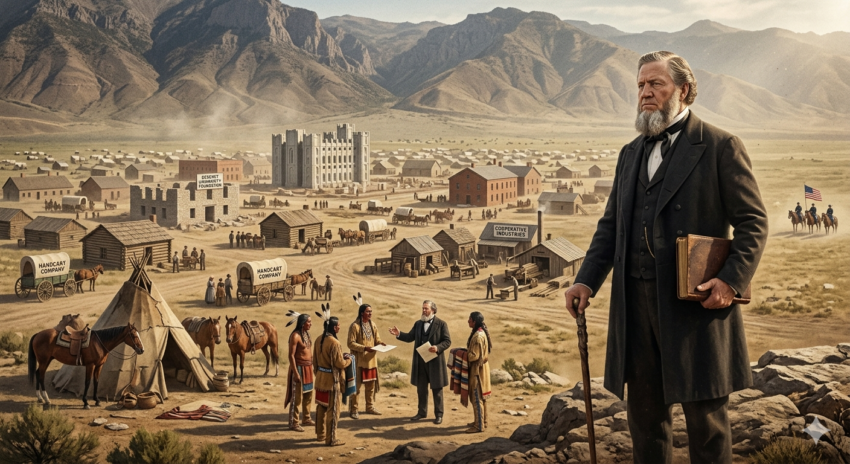
Image: An AI-generated image imagines an epic portrayal of pioneer city-buildings in the harsh American West. The composition contrasts the quiet, authoritative posture of the leader in the foreground with the intense labor of the settlers behind him. The settlement demonstrates a rapid transition from transient migration to permanent establishment. Temporary wagons share the landscape with foundational stone structures, early brick storefronts, and a massive, multi-story civic or religious edifice rising in the distance, illustrating the sheer organizational power required to tame the wind-scoured plains.
THE PROPHET WHO WASN’T: A Critical Examination of
Brigham Young’s Claim to Spiritual and Moral Leadership
Introduction: The Lion That Never Roared for God
He built a city in the desert. He led tens of thousands of pioneers across wind-scoured plains. He founded universities, established cooperative industries, negotiated with Indigenous peoples, and held a territory together through the turbulence of the Civil War era. By the metrics of sheer organizational power, Brigham Young — the second president of The Church of Jesus Christ of Latter-day Saints — was undeniably a towering figure in American history. The Latter-day Saint faithful call him the ‘American Moses.’ His portrait presides over Brigham Young University. His legacy is woven into the fabric of Utah’s very identity.
But there is another Brigham Young — one whose record is not celebrated in BYU commencements or commemorated in General Conference tributes. This is the Brigham Young who proclaimed that Adam was God the Father, a doctrine the modern LDS Church has been forced to formally repudiate. This is the man who declared from the pulpit that a Black man holding the priesthood violated ‘true eternal principles’ ordained by God Himself — a position so morally toxic that the church spent 126 years enforcing it and then quietly reversed it in 1978. This is the husband of at least 55 women, the architect of a theology that made plural marriage an eternal requirement for the highest celestial glory — a ‘revelation’ ultimately abandoned by his successors. This is the leader whom historian D. Michael Quinn described as having built a ‘religious theocracy employing the techniques of a modern totalitarian state,’ one that cultivated a ‘culture of violence’ in which murder was at times preached from the pulpit as a spiritual duty.
The standard LDS defense, offered reflexively whenever these uncomfortable facts arise, is that Brigham Young was ‘a product of his time.’ It is a phrase designed to disarm, to contextualize, and ultimately to excuse. But as we shall demonstrate at length, this defense fails on multiple levels — historically, theologically, morally, and above all, biblically. A prophet speaks in the name of God. When what he speaks contradicts God’s revealed Word, perpetuates documented evil, and fails the prophetic test Scripture itself sets forth in Deuteronomy 18:20–22, neither his organizational accomplishments nor his historical context can redeem the claim.
This essay is not written to mock or demean the sincere faith of individual Latter-day Saints, many of whom are earnest seekers of truth. It is written precisely because truth matters — because the stakes of following a false prophet are eternal, not merely historical. We will proceed systematically, examining Young’s racism, his polygamy, his false prophecies, his theology, his culture of violence, and the ongoing institutional effort to sanitize his legacy. We do so with primary sources in hand, with the testimony of respected historians — including LDS historians — and with the standard of Scripture as our ultimate court of appeal.
The Man and His World: Historical Context Without Excuse
Brigham Young was born on June 1, 1801, in Whitingham, Vermont. He grew up in poverty, receiving little formal education, and worked as a carpenter and glazier before encountering the Book of Mormon in 1830 and joining Joseph Smith’s movement in 1832. By April 14, 1832, the same day he was baptized, he was made an elder. Three years later, in 1835, he was ordained an apostle. Following Joseph Smith’s murder in 1844 in Carthage, Illinois, Young maneuvered skillfully to secure the presidency of the Quorum of the Twelve Apostles, effectively claiming succession over rival claimants. He served as the church’s second president — and, between 1851 and 1858, as governor of Utah Territory — until his death on August 29, 1877. No LDS president has served longer.
Understanding the historical context of Young’s leadership is not merely appropriate — it is necessary. The first half of the nineteenth century in America was saturated with racism, economic uncertainty, religious ferment, and the brutal machinery of chattel slavery. Polygamy had been practiced in various ancient cultures. Frontier violence was not unique to Mormonism. These facts are real, and a fair examination acknowledges them.
But historical context is not a moral blank check. It is precisely here that the ‘product of his time’ defense must be subjected to rigorous scrutiny rather than reflexive acceptance. There are three fundamental problems with this apologetic framework when applied to Brigham Young specifically:
First, Young was not merely reflecting his culture — he was claiming to transcend it by virtue of divine revelation. A man who insists that his pronouncements carry the authority of God, who declares that he has ‘never given counsel that is wrong,’ and who teaches that rejecting his leadership leads to damnation, has forfeited the right to claim the excuse of cultural limitation. He either speaks for God or he does not. There is no middle category in which a prophet is simultaneously infallible in his prophetic role and culturally conditioned into error in his most foundational public teachings.
If there is any elder here, or any member of the Church of Jesus Christ of Latter-day Saints, who can bring up the first idea, the first sentence that I have delivered to the people as counsel that is wrong, I really wish they would do it; but they cannot do it, for the simple reason that I have never given counsel that is wrong; this is the reason.
— Brigham Young, Journal of Discourses 16:161
Second, there were contemporaries of Brigham Young — Christian abolitionists, Quakers, evangelical reformers — who recognized racism and slavery as moral evils in the same cultural moment. The argument that no one in 1852 could have known that enslaving Black people was wrong is demonstrably false. Harriet Beecher Stowe published Uncle Tom’s Cabin in 1852, the very year Young formalized the priesthood ban. Frederick Douglass was speaking and writing with power across the nation. To invoke cultural determinism as the explanation for Young’s racism is to ignore the contemporaries who got it right without the benefit of claimed divine revelation.
Third, and most critically: if a prophet is truly called by God to speak His Word, that Word does not conform to the worst moral failures of its cultural moment — it challenges them. The Hebrew prophets consistently stood against the dominant culture of their day. Isaiah confronted idolatry. Amos thundered against economic injustice. Micah rebuked corrupt leadership. The prophetic tradition is not one of cultural assimilation; it is one of prophetic confrontation. By this standard, Brigham Young does not resemble a biblical prophet. He resembles a culturally embedded authoritarian whose theology justified his personal power and preferences.
The Architecture of Racism: Brigham Young’s Theology of Racial Hierarchy
Of all the charges leveled against Brigham Young, none is more thoroughly documented in primary sources — or more systematically minimized in LDS institutional memory — than his racism. This was not casual prejudice or unreflective bias. Young constructed a comprehensive theological architecture that assigned Black people to permanent spiritual inferiority, citing divine revelation as its foundation.
The Priesthood Ban and Its Rationale
In 1852, Brigham Young stood before the Utah Territorial Legislature and formally articulated what would become one of Mormonism’s most devastating institutional legacies: the ban on Black men and women holding the LDS priesthood, receiving temple ordinances, or participating in missionary work. His justification was explicitly theological, rooted in what he presented as revealed knowledge about the ‘curse of Cain.’
Now then, in the kingdom of God on the earth, a man who has the African blood in him cannot hold one jot nor tittle of Priesthood; Why? Because they are the true eternal principals the Lord Almighty has ordained, and who can help it — men cannot, the angels cannot, and all the powers of Earth and Hell cannot take it off.
— Brigham Young, The Teachings of President Brigham Young, Vol. 3, 1852–1854
Notice the absolute claims embedded in this declaration: the ban is not a policy matter subject to future revision. It is a ‘true eternal principle’ ordained by the Lord Almighty. Not men, not angels, not the combined powers of heaven and hell can remove it — except at God’s own sovereign pleasure. Young went even further, threatening spiritual destruction upon any white Mormon who intermarried with someone of African descent:
Shall I tell you the law of God in regard to the African race? If the white man who belongs to the chosen seed mixes his blood with the seed of Cain, the penalty, under the law of God, is death on the spot.
— Brigham Young, Journal of Discourses 10:110, March 8, 1863
Wilford Woodruff, who later became Mormonism’s fourth president, recorded Young’s February 1852 remarks in his private diary, confirming that Young’s racist declarations were not off-the-cuff improvisation:
Any man having one drop of the seed of Cane in him Cannot hold the priesthood & if no other Prophet ever spake it Before I will say it now in the name of Jesus Christ. I know it is true & they know it.
— Wilford Woodruff’s diary, recounting Brigham Young’s remarks, February 7, 1852
At the October 1859 General Conference, Young publicly elaborated his theological anthropology of race, describing Black people in terms whose contempt is unmistakable even after generations of LDS institutional hedging:
You see some classes of the human family that are black, uncouth, uncomely, disagreeable and low in their habits, wild, and seemingly deprived of nearly all the blessings of the intelligence that is generally bestowed upon mankind… The Lord put a mark upon him, which is the flat nose and black skin.
— Brigham Young, Journal of Discourses 7:290–291, October 1859
Slavery in Utah
Young’s racism was not confined to theological pronouncements. In 1852, as governor of Utah Territory, he signed legislation that made Utah one of the few territories outside the South to legally sanction African American slavery. He personally addressed the Utah legislature in support of the measure, arguing that servitude was the God-ordained condition of those bearing the ‘curse of Cain’ until the Lord Himself chose to lift it.
The modern LDS Church, in its 2013 Gospel Topics Essay on ‘Race and the Priesthood,’ formally acknowledged that the racial restrictions ‘originated decades after the Church’s founding’ and that ‘over time, Church leaders and members gave various explanations for withholding the priesthood and temple ordinances from people of black African descent.’ The essay further stated that the Church ‘disavows the theories advanced in the past that black skin is a sign of divine disfavor or curse.’ (LDS Gospel Topics Essays, ‘Race and the Priesthood,’ churchofjesuschrist.org)
This disavowal, though welcome, raises a devastating question: if these theories were false, if black skin was never a sign of divine disfavor, and if the restriction had no basis in scripture or revelation — then what does this say about the man who constructed this entire theological edifice and claimed God’s own authority for it? The Church’s answer, implicit in the Gospel Topics Essay, is that Young was simply wrong — a fallible man speaking from personal opinion rather than divine revelation. But this answer comes at a catastrophic cost to Young’s credibility as a prophet, because he himself claimed no such limitation.
The ‘Product of His Time’ Defense Dismantled
The FAIR LDS apologetics organization acknowledges on its website that many of Young’s most problematic teachings have been ‘apologized for, reinterpreted, repudiated, or simply denied to have ever been taught,’ noting that ‘much of this took place at the turn of the century when the church was trying to improve its public image.’
This is a significant admission. What we are witnessing is not organic theological development — it is institutional reputation management. And invoking cultural determinism to explain Young’s racism requires us to ignore at least three devastating counter-arguments:
First, Young’s racism was specifically theological, not merely cultural. He did not merely hold the views common to white American society; he declared them to be eternal divine truths that not even God’s angels could overturn. This is a categorical difference. A man who calls his prejudice a ‘revelation’ has placed it beyond the reach of cultural excuse.
Second, there were voices in Young’s own religious tradition who challenged racial hierarchy. The Book of Mormon itself contains the statement that God ‘denieth none that come unto him, black and white, bond and free, male and female’ (2 Nephi 26:33). Young’s theological racism required him to effectively override his own scripture.
Third, the 1978 reversal of the priesthood ban under President Spencer W. Kimball was itself framed not as a cultural update but as a new revelation. If God could reveal in 1978 that Black members were fully equal before Him, why could He not have revealed this to Young in 1852? The answer the evidence suggests is uncomfortable: because what Young was enforcing was not divine revelation but human prejudice elevated to prophetic authority.
The Practice of Polygamy: Private Preference as Eternal Principle
Brigham Young married at least 55 women — historical records vary, with some accounts placing the number at 56 — and fathered 57 children with 16 of those wives. At least 10 of his wives eventually sought and received a divorce from him. He built the Lion House in Salt Lake City specifically to accommodate his plural family. By any measure, Young was not merely a practitioner of polygamy; he was its most powerful and voluble champion, the figure who transformed what had been a carefully guarded secret of early Mormonism into an open, publicly defended institution.
The Public Defense of Plural Marriage
When the LDS Church publicly announced the doctrine of plural marriage in 1852 — the same year, notably, that Young formalized the priesthood ban against Black members — it was Young who became the doctrine’s primary theological defender. He framed plural marriage not as a cultural preference or even a religious practice but as an eternal divine commandment, essential to the highest celestial glory:
The only men who become Gods, even the Sons of God, are those who enter into polygamy. Others attain unto a glory and may even be permitted to come into the presence of the Father and the Son; but they cannot reign as kings in glory.
— Brigham Young, Journal of Discourses 11:269
According to JSTOR Daily, Young taught that polygamy was necessary ‘so that the noble spirits which are waiting for tabernacles might be brought forth,’ framing the practice in the language of celestial population management. He defended it as grounded in Old Testament precedent and in the ongoing flow of divine revelation through the living prophet. (daily.jstor.org/brigham-young-and-the-defense-of-mormon-polygamy)
The LDS Church’s own official newsroom acknowledges that plural marriage ‘was an important part of the teachings of The Church of Jesus Christ of Latter-day Saints for a half-century’ and that ‘the practice began during the lifetime of Joseph Smith.’ It further notes that the church formally ended the practice with the 1890 Manifesto issued by Wilford Woodruff.
What the official account minimizes is the theological absolutism with which Young defended the practice. He did not merely teach that polygamy was permissible or even desirable — he taught that it was the gateway to the highest divine status. To abandon it, in his theological framework, was to forfeit the highest rewards of eternal progression.
A Prophecy Overturned
This brings us to what is, from a biblical standpoint, one of the most straightforward pieces of evidence of Young’s false prophetic status. He taught repeatedly and emphatically that plural marriage would never be revoked — that it was an eternal, unchanging divine principle:
Now, if any of you will deny the plurality of wives, and continue to do so, I promise that you will be damned.
— Brigham Young, Journal of Discourses 3:266
And yet in 1890, the very institution Young declared eternal and non-negotiable was officially abandoned. The LDS Church teaches monogamy today. Brigham Young University, named after a man who proclaimed polygamy a divine requirement for godhood, operates under a strict honor code prohibiting it.
This is not a minor doctrinal refinement. This is a direct, documented, institutional repudiation of one of Young’s most emphatic prophetic claims. The question it raises is simple and devastating: if Young was speaking as a prophet of God when he declared polygamy eternal and irrevocable, and God’s own church later revoked it — either Young was not speaking for God, or God contradicted Himself. Neither conclusion leaves Young’s prophetic authority intact.
Polygamy and the Biblical Standard
The New Testament is clear regarding the moral standard for Christian leadership. The Apostle Paul writes in 1 Timothy 3:2 that an overseer ‘must be above reproach, the husband of one wife.’ Titus 1:6 repeats this requirement: ‘if anyone is above reproach, the husband of one wife.’ The Greek phrase mias gunaikos andra — literally ‘a one-woman man’ — establishes monogamy not merely as a cultural convention but as a character qualification for spiritual leadership.
Young’s extensive polygamy, whatever cultural or theological justifications are advanced, places him outside the qualifications for Christian leadership as Scripture defines them. This is not a peripheral issue. A Christian apologist is bound to apply the standard of Scripture consistently, and by that standard, the man who married 55 women and declared that failing to enter polygamy was grounds for damnation does not meet the New Testament’s basic requirements for spiritual office.
False Prophecy and the Prophetic Test
Deuteronomy 18:20–22 establishes the biblical test for distinguishing a true prophet from a false one with remarkable clarity:
But the prophet who presumes to speak a word in My name, which I have not commanded him to speak, or who speaks in the name of other gods, that prophet shall die. And if you say in your heart, ‘How shall we know the word which the LORD has not spoken?’ — when a prophet speaks in the name of the LORD, if the thing does not happen or come to pass, that is the thing which the LORD has not spoken; the prophet has spoken it presumptuously; you shall not be afraid of him.
— Deuteronomy 18:20–22
This standard requires no interpretive gymnastics. It is a straightforward functional test: does what the prophet declares in God’s name come to pass? If not, God did not send him.
The Standard LDS Defense — and Why It Fails
The most common LDS response to the documented record of Young’s failed prophecies is to invoke Joseph Smith’s own statement: ‘A prophet is only a prophet when he is acting as such.’ The Institute for Religious Research has documented this defense and identified its critical flaw:
A common LDS response to Joseph Smith and Brigham Young’s numerous false prophecies is to dodge the serious implications by quoting Joseph Smith’s own statement, ‘a prophet is only a prophet when he is acting as such.’ However, a careful examination of the following statements shows that LDS leaders were claiming prophetic authority when issuing these statements.
— Institute for Religious Research
The defense, in other words, requires a retroactive judgment about what Young was and was not claiming prophetic authority for — a judgment conveniently made after the fact, by the prophet’s defenders, based on whether the prophecy succeeded or failed. This is not a meaningful test; it is a self-sealing apologetic device that makes any claim unfalsifiable.
Robert Clifton Robinson, in a careful 2025 survey of Young’s prophetic record, documents the major predictions and their outcomes. The pattern is consistent: where Young spoke in authoritative, revelatory terms about specific future events, those events did not occur as described. (robertcliftonrobinson.com)
Young’s Major Failed Prophecies
1. The Destruction of the United States: Young repeatedly declared, in language claiming prophetic authority, that the United States government would be ‘swept away’ or ‘broken in pieces’ as divine judgment for its treatment of the Latter-day Saints. He cited these declarations in the Journal of Discourses (8:123–124; 7:15; 12:204–205) in contexts that left no ambiguity about their prophetic character. The United States was not destroyed, did not collapse, and continues as the world’s longest-surviving constitutional republic.
2. The Civil War Would Engulf All Nations: Young taught that the American Civil War, which Joseph Smith’s 1832 revelation (D&C 87) had predicted, would expand until all nations were ‘involved in war and terror.’ (Journal of Discourses 10:250) The Civil War remained an American conflict. Young’s expansion of Smith’s prophecy into a global conflagration did not come to pass.
3. The Literal Return of the Ten Tribes: Young taught as literal revealed knowledge that the Ten Lost Tribes of Israel were preserved in a specific northern geographic location and would return en masse with their own prophets. (Journal of Discourses 2:293; 4:219) No such physical return has occurred. Modern LDS scholarship has quietly moved toward symbolic interpretations — directly contradicting Young’s explicit literalism.
4. Polygamy Is Eternal and Will Never Be Revoked: As documented above, Young declared plural marriage to be an eternal divine principle impossible to revoke. The 1890 Manifesto directly refuted this claim. The modern LDS Church teaches and practices monogamy. By Young’s own standard — ‘Now, if any of you will deny the plurality of wives, and continue to do so, I promise that you will be damned’ — the current LDS Church stands in a deeply problematic relationship to his prophetic authority.
5. The Adam-God Doctrine: Perhaps Young’s most theologically catastrophic ‘revelation’ was the Adam-God doctrine, which he presented not as speculation but as revealed divine truth:
Now hear it, O inhabitants of the earth, Jew and Gentile, Saint and sinner! When our father Adam came into the garden of Eden, he came into it with a celestial body, and brought Eve, one of his wives, with him. He helped to make and organize this world. He is MICHAEL, the Archangel, the ANCIENT OF DAYS! about whom holy men have written and spoken — HE is our FATHER and our GOD, and the only God with whom WE have to do.
— Brigham Young, Journal of Discourses 1:50
Young did not teach this as an open question or theological speculation. He insisted on its revealed character:
How much unbelief exists in the minds of the Latter-day Saints in regard to one particular doctrine which is revealed to them, and which God revealed to me – namely that Adam is our father and God.
— Brigham Young, Deseret News, June 18, 1873, p. 308
In 1976, President Spencer W. Kimball formally and publicly disavowed this doctrine, saying explicitly: ‘We denounce that theory.’ The FAIR LDS apologetics organization acknowledges multiple competing LDS attempts to reconcile Young’s Adam-God teaching with mainstream Mormon thought — including the blunt ‘Approach #4: Brigham was wrong.’
What the Adam-God doctrine represents, from a Christian standpoint, is something far more serious than a doctrinal eccentricity. It identifies the first human man — Adam — as the God of this world and the physical father of Jesus Christ. This is a direct contradiction of the biblical revelation of God as the eternal, uncreated, self-existent Creator (Isaiah 43:10; 44:6–8; John 1:1–3). No true prophet of the God of the Bible could deliver this teaching as divine revelation.
6. Blacks Will Never Hold the Priesthood: Young declared with absolute prophetic confidence that the ‘seed of Cain’ would never hold the priesthood until the resurrection of all of Adam’s other descendants — effectively foreclosing the possibility of any change within human history. (Journal of Discourses 7:290–291) The 1978 revelation under President Kimball directly and categorically overturned this declaration. Once again, what Young presented as an eternal divine principle was reversed by those claiming the same prophetic authority.
7. The Infallibility of His Own Counsel: Young repeatedly taught that his sermons and counsel were equivalent to Scripture:
I have never yet preached a sermon and sent it out to the children of men, that they may not call Scripture. Let me have the privilege of correcting a sermon, and it is as good Scripture as they deserve.
— Brigham Young, Journal of Discourses 13:95
Given the documented record of his false prophecies, his repudiated doctrines, and his morally catastrophic racial theology, this claim to scriptural infallibility is not merely grandiose — it is a spiritual danger to every person who accepted it at face value.
The Theology of a False Prophet: Biblical Assessment
Beyond the specific failed prophecies, Brigham Young’s theological system — examined through the lens of Scripture — reveals a comprehensive departure from biblical Christianity at virtually every foundational point.
A God Made of Flesh
Young taught that God the Father is a physical being with ‘head, hair, eyes, ears, nose, mouth, cheekbones, forehead, chin, body, lower limbs; that he eats, drinks, talks, lives and has a being, and has a residence.’ (Journal of Discourses 16:30) He further taught that ‘it appears ridiculous to the world, under their darkened and erroneous traditions, that God has once been a finite being.’ (Deseret News, November 16, 1859)
Scripture is unambiguous on this point. God declares through Isaiah: ‘Before me no god was formed, nor shall there be any after me’ (Isaiah 43:10). Jesus states plainly in John 4:24: ‘God is spirit.’ The Apostle Paul, in 1 Timothy 6:15–16, describes God as ‘the blessed and only Sovereign, the King of kings and Lord of lords, who alone has immortality, who dwells in unapproachable light, whom no one has ever seen or can see.’ Young’s materially embodied, once-finite, ever-progressing deity is not the God of Scripture.
Man Becoming God
Young taught explicitly that human beings are created for the purpose of becoming gods:
The Lord created you and me for the purpose of becoming Gods like Himself; when we have been proved in our present capacity, and been faithful with all things He puts into our possession. We are created, we are born for the express purpose of growing up from the low estate of manhood, to become Gods like unto our Father in heaven.
— Brigham Young, Journal of Discourses 3:93
This teaching — that faithful Latter-day Saints would eventually become gods — led Young in 1863 to apply the title ‘King of kings and Lord of lords’ to human beings in embryonic form. Mormonism Research Ministry’s Sharon Lindbloom has documented this troubling appropriation of a title Scripture reserves exclusively for Jesus Christ (1 Timothy 6:15; Revelation 17:14; 19:16). Young taught: ‘man is the king of kings and lord of lords in embryo.’ (Journal of Discourses 10:223)
The biblical verdict on this claim is clear. Isaiah 43:10 records God’s own statement: ‘Before me no god was formed, nor shall there be any after me.’ The deification of man was the original lie of the Serpent in Genesis 3:5 — ‘You will be like God.’ Young’s theology does not transcend the biblical tradition; it replicates the most primordial of biblical temptations.
Blood Atonement
Young taught repeatedly, from the pulpit and in private councils, a doctrine that had no biblical warrant: that some sins were so grievous that Christ’s atonement was insufficient, and that the sinner’s own blood must be shed for salvation:
Will you love that man or woman well enough to shed their blood? He knew hundreds of people who could have been saved ‘if their lives had been taken and their blood spilled on the ground as a smoking incense to the Almighty, but who are now angels to the devil.’
— Brigham Young, cited in Will Bagley, ‘Brigham Young’s Culture of Violence,’ CESNUR 2002
The writer of Hebrews declares with absolute theological finality: ‘For by a single offering he has perfected for all time those who are being sanctified’ (Hebrews 10:14). And again: ‘The blood of Jesus his Son cleanses us from all sin’ (1 John 1:7). ‘All sin’ — without exception, without category, without supplementary human blood required. Young’s blood atonement doctrine is not merely a theological error; it is a denial of the sufficiency of Christ’s atoning work, which places it in the category of a different gospel (Galatians 1:8–9).
The Culture of Violence: D. Michael Quinn’s Assessment
Perhaps the most thoroughgoing scholarly examination of the connection between Brigham Young’s theology and actual violence in nineteenth-century Utah comes from historian D. Michael Quinn — himself a trained LDS historian who was ultimately excommunicated from the church for his candid historical scholarship. His assessment is not that of an outside critic predisposed to animus; it is the conclusion of a man who spent his career inside the tradition and could not reconcile what he found with the official narrative.
Will Bagley, presenting at the 2002 CESNUR International Conference in Salt Lake City, synthesized Quinn’s analysis in a paper examining what he called ‘Brigham Young’s Culture of Violence and the Murders at Mountain Meadows.’ Bagley’s documentation of Quinn’s conclusion is worth quoting at length:
During his first decade in the West he built a religious theocracy that employed the techniques of a modern totalitarian state to establish the Kingdom of God in the Great Basin. In the process, he created what historian D. Michael Quinn has called a culture of violence. The decision to do whatever was necessary to build the Kingdom ‘encouraged Mormons to consider it their religious right to kill antagonistic outsiders, common criminals, LDS apostates, and even faithful Mormons who committed sins worthy of death.’
— Will Bagley, citing D. Michael Quinn
The Oath of Vengeance
Following Joseph Smith’s murder, Brigham Young incorporated into the LDS temple ceremony what was called the Oath of Vengeance — a covenant in which participants promised to pray and never cease to pray for God to avenge the blood of the prophets upon the nation, and to teach this to their children and grandchildren. Bagley documents that John D. Lee, a participant in the Mountain Meadows Massacre, cited this oath as part of the theological rationale for what transpired:
This lot of people had men amongst them that were supposed to have helped kill the Prophets in the Carthage jail, the killing of all of them would be keeping our oaths and avenging the blood of the Prophets.
— John D. Lee, as cited in Will Bagley, CESNUR 2002
The Mountain Meadows Massacre
On September 11, 1857 — a date whose resonance with American violence was not lost on subsequent commentators — a wagon train of roughly 120 Arkansas emigrants was ambushed at Mountain Meadows in southern Utah and systematically slaughtered. The victims included men, women, and children. The perpetrators were a combination of local LDS militiamen and Paiute warriors, acting under the command of John D. Lee, a close associate of Brigham Young.
Young’s culpability in the massacre has been debated by historians for over a century. What is not in debate is what Young himself told Lee in May 1861, as recorded in Lee’s diary:
Pres. Young said that the company that was used up at the Mountain Meadows were the Fathers, Mothers, Brothers, Sisters & connections of those that Murdered the Prophets. They Merited their fate, & the only thing that ever troubled him was the lives of the Women & children, but that under the circumstances [this] could not be avoided.
— John D. Lee’s diary, May 1861
This statement — that the victims ‘merited their fate’ — is not the statement of a man who had no knowledge of the massacre and was horrified by it. It is the statement of a man who, four years after the event, expressed his primary concern not as the slaughter of 120 innocent human beings, but as the regrettable inclusion of women and children in the body count.
As Bagley notes with blunt historical precision: ‘In no place but theocratic Utah did political and religious leaders advocate holy murder.’ What made Utah’s violence distinctive in the American West was not that violence occurred — it occurred everywhere on the frontier — but that it was theologically legitimized, preached from pulpits, and protected by a leadership that had constructed a culture in which certain kinds of killing were not crimes but religious duties.
The Absolute Claim to Authority
Young’s culture of violence was sustained, in large measure, by his absolute claim to spiritual authority. When a leader teaches — as Young did, in multiple venues and multiple formulations — that his counsel carries the force of Scripture, that rejecting his leadership leads to spiritual damnation, and that certain categories of killing can serve the purposes of God, the conditions for religiously sanctioned violence are in place. Young’s famous statement to the Council of Fifty in March 1849 — ‘I want their cursed heads cut off that they may atone for their sins’ — is not an aberration; it is the logical expression of a theology that fused prophetic authority, blood atonement, and the Oath of Vengeance into a coherent, if horrifying, system.
Institutional Whitewashing: The LDS Church and Brigham Young’s Legacy
A comprehensive examination of Brigham Young would be incomplete without addressing the ongoing institutional effort to manage, mitigate, and in some cases simply erase the most problematic elements of his legacy. This effort takes several forms, each of which deserves careful analysis.
The ‘Product of His Time’ Narrative as Institutional Strategy
The Reddit community r/mormon, in a 2022 thread examining how the modern church views Brigham Young, surfaced a range of perspectives that illuminate the complexity of this institutional management. One participant summarized the dominant church approach: ‘The typical response is that he was a man of his time, that prophets are fallible, and that we should focus on his accomplishments rather than his controversies.’ Another observed: ‘The church has essentially performed a soft erasure — keeping his name on BYU while quietly abandoning his actual doctrines.’
The FAIR LDS organization — Mormonism’s primary apologetics body — acknowledges on its website that after Young died in 1877, many of his doctrines were apologized for, reinterpreted, repudiated, or simply denied to have ever been taught. Much of this took place at the turn of the century when the church was trying to improve its public image and refine its diverse doctrinal heritage into a more concise, harmonious theology.’ (citing Boyd Kirtland, Line Upon Line, p. 178)
This is institutional whitewashing of the most transparent variety. The doctrines were not gently ‘reinterpreted’ — they were formally disavowed. The Adam-God doctrine was declared heretical. The blood atonement doctrine was denied. The racial restrictions were reversed, and the theories that supported them were officially repudiated. And plural marriage — the practice Young declared was the gateway to the highest divine status — was abandoned in its entirety.
The Gospel Topics Essays and Their Limitations
Beginning in 2013, the LDS Church began publishing a series of Gospel Topics Essays addressing historically controversial subjects, including plural marriage, the priesthood ban, the Book of Mormon translation, and the First Vision accounts. These essays represent a genuine step toward transparency — they acknowledge facts that the church had previously minimized or obscured, and they do so under official imprimatur.
But as LDS apologist and educator Brad R. Wilcox demonstrated in a 2022 fireside that attracted national attention, the institutional instinct to deflect rather than confront remains powerful. Wilcox, a BYU professor serving as second counselor in the Young Men general presidency, was recorded responding to questions about the priesthood ban by reframing the question rather than engaging its substance: ‘Maybe instead of asking why didn’t the Blacks get the priesthood until 1978, we should be asking why didn’t everybody else get it before 1829?’
Mormonism Research Ministry’s Eric Johnson documents that Wilcox offered this same deflection at multiple events over at least two years, suggesting it was not an off-the-cuff misstep but a rehearsed apologetic strategy. The response Wilcox eventually offered — that the question of ‘Was Brigham Young a jerk?’ was the wrong question — exemplifies the institutional refusal to engage directly with what the primary sources actually show.
The ‘Brigham Young Was Visionary’ Narrative
The from-the-desk.org biography of Young, produced from a sympathetic LDS perspective, notes that ‘Brigham Young was a central figure in what was perhaps the second most contentious debate, after slavery, to inflame the American public of the nineteenth century.’ The site presents his organizational accomplishments — founding universities, establishing industries, leading the pioneer migration — in detail, while treating his theological controversies as peripheral biographical footnotes. (fromthedesk.org/brigham-young)
Even the Deseret News — the official LDS Church newspaper — published a defense of Young’s legacy in January 2025 in response to the Netflix series American Primeval, written by Matt Grow, Managing Director of the Church History Department. Grow argued that the series’ portrayal of Young as a ‘violent, authoritarian leader’ was ‘deeply misguided,’ while acknowledging that ‘Brigham Young has his flaws as a person and leader.’
Grow’s characterization is telling: ‘his flaws as a person and leader.’ Not his false prophecies. Not his documented racism. Not his construction of a theological system that the LDS Church itself has been forced to formally disavow on multiple fronts. The institutional instinct is consistently to acknowledge ‘flaws’ in the abstract while resisting the specific, devastating implications that follow from a clear-eyed examination of those flaws.
The BYU Connection: An Institutional Statement
Perhaps the most revealing aspect of the LDS Church’s ongoing relationship with Young’s legacy is the simple fact that its flagship university continues to bear his name. Brigham Young University, with its approximately 33,000 students, its international reputation, and its enormous institutional prestige, is named after a man whose primary theological claims have been formally repudiated, whose racial doctrines have been officially disavowed, and whose prophetic track record, examined against Scripture’s own test in Deuteronomy 18, disqualifies him as a true prophet of God.
The LDS apologist blog Scriptural Mormonism attempted, in a 2016 post, to respond to critics of Young by arguing that his failed prophecies and repudiated doctrines were either misunderstood or improperly contextualized. The argument, while earnest, faces an insurmountable problem: when the church’s own Gospel Topics Essays acknowledge that Young’s racial theories had no scriptural foundation, and when the church’s own prophets have formally disavowed doctrines that Young declared were revealed to him by God, no amount of contextual reframing restores the prophetic credibility of the man who delivered them.
The Character of a Leader: Historian Assessments
Setting aside the theological analysis for a moment, it is worth examining what secular and LDS-sympathetic historians have concluded about Young’s character as a leader — because the historical record does not support the hagiographical portrait the institutional church prefers.
Historian John G. Turner, whose 2012 biography Brigham Young: Pioneer Prophet remains the most comprehensive scholarly treatment of his life, describes Young as a ‘caustic’ and ‘vindictive’ man who functioned as an ‘absolute dictator’ within the church. Turner documents Young’s ‘foul mouth,’ his ‘grudges against fellow church leaders,’ and his willingness to use institutional power to punish perceived enemies. These characterizations come not from hostile anti-Mormon sources but from a historian who spent years with primary documents and who writes with evident respect for Young’s organizational accomplishments.
The Reddit community r/exmormon documented in 2018 an illuminating Young quotation about his own self-awareness:
I have never yet preached a sermon and sent it out to the children of men, that they may not call Scripture.
— Brigham Young, Journal of Discourses 13:95
The same thread noted Young’s remarkable admission — in a different context — about the nature of his authority: ‘I am not a visionary man, neither am I given much to prophesying. When I want any of that done I call on brother Heber — he is my Prophet, he loves to prophesy.’ (Journal of Discourses 1:132–133) This self-description, from a man who simultaneously claimed his every sermon deserved to be called Scripture, captures the fundamental incoherence at the heart of Young’s prophetic authority.
The addfaith.org community discussion on whether the church has ‘distanced itself from Brigham Young’ surfaced the observation that the modern LDS Church finds itself in an inherently paradoxical position: it cannot renounce Young without undermining the doctrine of prophetic succession that grounds its own authority claims, and it cannot fully embrace Young without endorsing doctrines it has formally repudiated. The result is the institutional middle path of selective commemoration — celebrating the pioneer legacy while quietly disavowing the theology.
The Christian Response: Compassion Without Compromise
Having laid out this case in full — from Young’s racism to his polygamy, from his failed prophecies to his repudiated theology, from his culture of violence to the ongoing institutional effort to sanitize his legacy — we must conclude with clarity about what this analysis is and what it is not.
This is not an argument that individual Latter-day Saints are beyond the reach of God’s grace, intellectually dishonest, or morally deficient. The vast majority of LDS members are sincere, thoughtful people who hold genuine faith in God and in Jesus Christ as they understand Him. Many of them are unaware of the depth of the historical and theological problems we have examined here, precisely because the institutional management of Young’s legacy has been so effective. The compassionate Christian response to LDS neighbors, colleagues, and family members is not contempt but honest engagement — the same honest engagement we would want offered to us if we were the ones following a tradition that had obscured uncomfortable truths.
But compassion without truth is not compassion — it is condescension. The stakes of following a false prophet are not merely historical or intellectual; they are eternal. If the God of Scripture is who He says He is — the eternal, self-existent Creator who has never been a finite being, who does not share His divine status with evolving human beings, whose Son’s atoning work is entirely sufficient for the forgiveness of all sin — then a theological system that contradicts these foundational realities at every turn is not a path to eternal life but a detour from it.
The biblical test is not harsh. It is merciful. It gives us a clear, verifiable method for evaluating prophetic claims so that we are not led astray. Apply it to Brigham Young, and the results are not ambiguous. His primary prophetic declarations were reversed by his own successors. His most emphatic theological ‘revelations’ were formally repudiated by the institution that claims his mantle. His racial doctrines were disavowed as having no scriptural foundation. His eternal principle of plural marriage was abandoned. His Adam-God teaching was declared heretical.
Deuteronomy 18:22 says of such a prophet: ‘You shall not be afraid of him.’ Not ‘honor him,’ not ‘name universities after him,’ not ‘focus on his organizational accomplishments’ — but ‘do not be afraid of him.’ The implied corollary is equally important: and do not follow him.
Conclusion: The Lion House Was Not Built for God
Brigham Young built a city. He led a migration. He built universities and industries and a community that survived extraordinary adversity. These accomplishments are real, and they deserve historical acknowledgment. But they do not make a prophet.
The biblical prophets were not celebrated primarily for their organizational skills. Moses was not remembered for administrative competence alone — he was remembered for faithfully conveying the word of God, even when that word was uncomfortable, even when it cost him dearly. Jeremiah did not build cities; he wept over them. Isaiah did not found universities; he confronted kings. The prophetic calling is not primarily organizational — it is revelatory, moral, and covenantal.
Brigham Young’s revelations, examined against Scripture, contradict the God of the Bible. His moral record — racism elevated to eternal principle, polygamy declared the gateway to godhood, violence theologically legitimated from the pulpit — does not conform to the character of a man called by the God who is love (1 John 4:8), who calls His people to justice and mercy and humility (Micah 6:8). His prophetic track record fails the explicit test that God Himself established in Deuteronomy 18.
The Lion House, with its row of beehive symbols over the doors — one for each of Young’s wives — stands today as a museum and event venue in Salt Lake City, steps from Temple Square. It is a remarkable building. But it was not built for God. It was built for a man who believed he was building the Kingdom of God in the desert, who wielded prophetic authority like a weapon, who declared eternal principles that his own successors were forced to repudiate, and who left behind a legacy so complicated that the institution bearing his name has spent a century and a half managing the damage.
The question the Christian apologist must ask — and must invite our LDS friends and neighbors to ask with us — is this: if the test of a prophet is whether his words come to pass, and if the test of a theology is whether it conforms to the Word of God already given, what does the historical and biblical record tell us about Brigham Young?
The record answers clearly. And the answer calls us not to contempt for those who have followed him in good faith, but to the honest, compassionate, persistent proclamation of the biblical Gospel — the Gospel that does not require plural marriage or racial hierarchy or blood atonement or the deification of man, but that declares what the Apostle Paul declared with joyful simplicity:
For by grace you have been saved through faith. And this is not your own doing; it is the gift of God, not a result of works, so that no one may boast.
— Ephesians 2:8–9
That Gospel — the Gospel of the God who has always been God, whose Son’s sacrifice was entirely sufficient, who saves by grace alone through faith alone — is the alternative to everything Brigham Young built. And it is a foundation that will not require repudiation by any successor.
Primary Sources and Reference Materials
The following sources were consulted and cited in the preparation of this essay:
• FAIR Latter-day Saints, ‘Brigham Young / Criticisms Related To’ — fairlatterdaysaints.org/answers/Brigham_Young/Criticisms_related_to
• From the Desk, ‘Who Was Brigham Young? Life, Wives, Teachings and Legacy’ — fromthedesk.org/brigham-young
• Mormonism Research Ministry, ‘The Faith of Brigham Young’ — mrm.org/brigham-young
• Mormonism Research Ministry, ‘Was Brigham Young a Jerk?’ — mrm.org/brigham-young-jerk
• Mormonism Research Ministry, ‘Brigham Young’s Kings of Kings’ — mrm.org/brigham-youngs-kings-of-kings
• Robert Clifton Robinson, ‘Is Brigham Young a True Prophet of God?’ (November 2025) — robertcliftonrobinson.com
• Institute for Religious Research, ‘False Prophecies’ — mit.irr.org/false-prophecies
• Will Bagley, ‘Brigham Young’s Culture of Violence and the Murders at Mountain Meadows,’ CESNUR International Conference (2002) — cesnur.org/2002/slc/bagley.htm
• JSTOR Daily, ‘Brigham Young and the Defense of Mormon Polygamy’ — daily.jstor.org/brigham-young-and-the-defense-of-mormon-polygamy
• LDS Newsroom, ‘Polygamy: Latter-day Saints and the Practice of Plural Marriage’ — newsroom.churchofjesuschrist.org/article/polygamy-latter-day-saints-and-the-practice-of-plural-marriage
• Deseret News / Matt Grow, ‘What American Primeval Gets Wrong About Brigham Young’ (January 2025) — deseret.com/faith/2025/01/17/what-american-primeval-gets-wrong-about-brigham-young
• LDS Gospel Topics Essays, ‘Race and the Priesthood’ — churchofjesuschrist.org
• D. Todd Christofferson, ‘The Faith of a Prophet: Brigham Young’s Life and Service,’ BYU Religious Studies Center (2001) — rsc.byu.edu
• Or So She Says, ‘Was Brigham Young a Bad Person?’ (April 2025) — oneshetwoshe.com/brigham-young-controversy
• Journal of Discourses (multiple volumes), The Church of Jesus Christ of Latter-day Saints
• Discourses of Brigham Young, compiled by John A. Widtsoe
• John G. Turner, Brigham Young: Pioneer Prophet (Harvard University Press, 2012)
A Note on Research Methods and Accuracy
This work represents a collaboration among the author’s theological and historical research, primary-source documentation, and the emerging capabilities of artificial intelligence research tools. AI assistance was employed throughout the investigative process—not as a ghostwriter or a substitute for scholarship, but as a rigorous research partner: surfacing sources, cross‑referencing claims, identifying scholarly consensus, and flagging potential errors before they could reach the page.
Every factual claim in this work has been subjected to active verification. Where AI‑generated content was used as a starting point, it was tested against primary sources, peer‑reviewed scholarship, official institutional documentation, and established historical records. Where discrepancies were found—and they were found—corrections were made. The author has made every reasonable effort to ensure that quotations are accurately attributed, historical details are precisely rendered, and theological claims fairly represent the positions they describe or critique.
That said, no work of this scope is immune to error, and the author has no interest in perpetuating inaccuracies in the service of an argument. If you are a reader—whether sympathetic, skeptical, or hostile to the conclusions drawn here—and you identify a factual error, a misattributed source, a misrepresented teaching, or a claim that cannot be substantiated, you are warmly and genuinely invited to say so. Reach out. The goal of this work is not to win a debate but to get the history right. Corrections offered in good faith will be received in the same spirit, and verified corrections will be incorporated into future editions without hesitation.
Truth, after all, has nothing to fear from scrutiny—and neither does this work.