
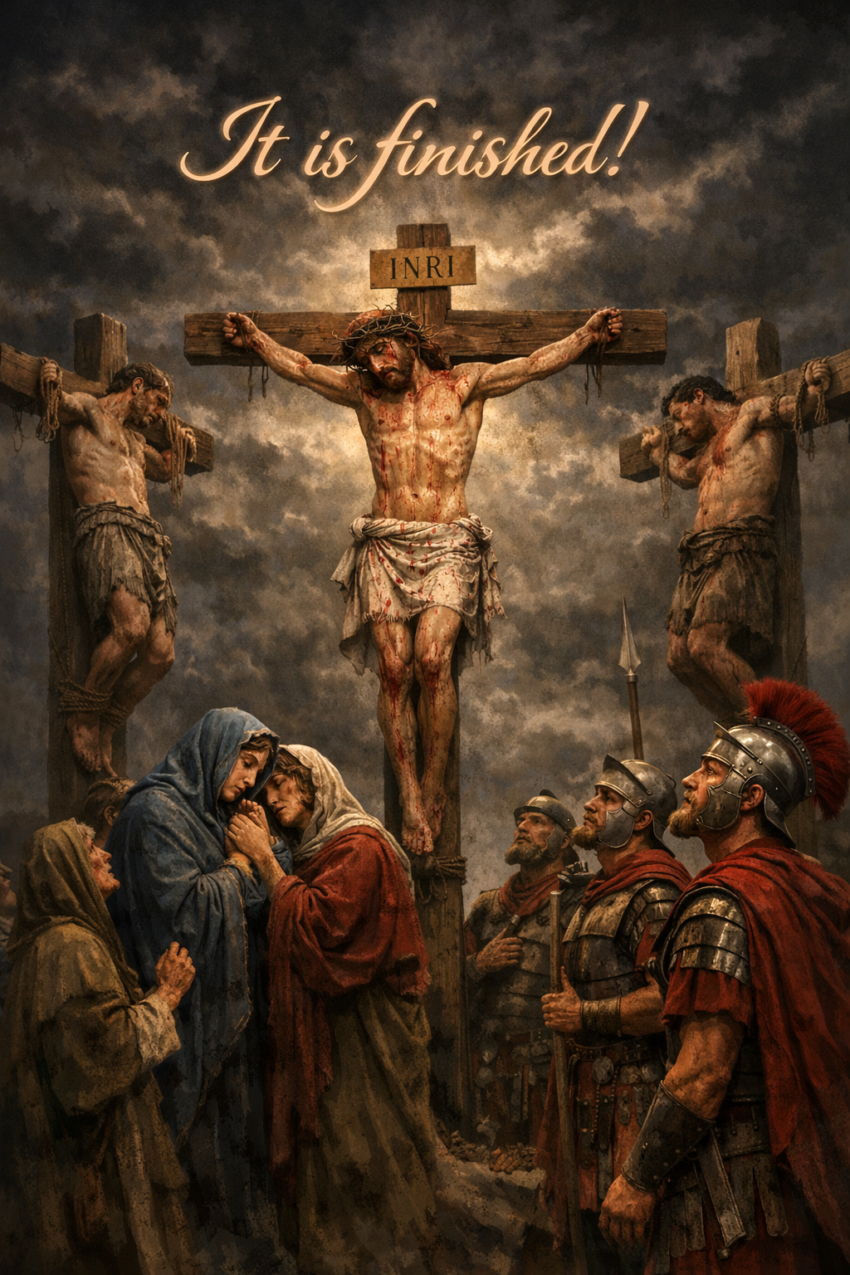
Image: An AI-generated image imagines Jesus on the Cross in the final moments of His suffering, the two thieves beside Him, a group of mourners below the cross, and several Roman centurians looking up at Jesus.
John 19:30 and the Completed Atonement of Jesus Christ
A Theological Examination from an Orthodox Christian Perspective
✦ ✦ ✦
Introduction: A Shout That Shook the Universe
There is a moment in human history so singular, so cosmically decisive, that every event before and after it is measured by its light. It is not the discovery of fire, the crossing of oceans, or the detonation of an atom. It is three words—one word in the original Greek—spoken by a dying man on a Roman cross outside the walls of Jerusalem, in a year most historians place around A.D. 30. “It is finished.” In that moment, the curtain of the Temple tore from top to bottom, the earth shook, rocks split, and the dead walked out of their tombs (Matthew 27:51–53). The universe itself registered what the crowd at Golgotha did not yet understand: a transaction of infinite magnitude had just been completed.
The Greek word is tetelestai (τετέλεσται), and it is one of the most freighted syllables in the vocabulary of Christian theology. It is a perfect tense verb—a grammatical form that in Greek describes a past action with continuing present results. Jesus was not simply announcing His impending death. He was proclaiming that a completed work now stood permanently accomplished, its effects enduring into eternity. He was declaring, in a word, that the mission the Father had sent Him to perform—the redemption of sinful humanity—was done. Finished. Not revisable. Not supplementable. Not ongoing.
And yet, despite the clarity of this declaration, significant theological debate surrounds its meaning—particularly in the context of The Church of Jesus Christ of Latter-day Saints, commonly known as the LDS Church or the Mormon Church. LDS theology advances a view of the Atonement that, while sharing some surface similarities with orthodox Christian soteriology, locates the primary locus of Christ’s atoning work not on the cross but in the Garden of Gethsemane. This essay examines that claim with care, respect, and scholarly rigor. It asks the simple but profound question: If the Atonement was substantially completed in Gethsemane, what precisely was accomplished at Calvary—and why would an omniscient God require His Son to endure the additional horror of crucifixion?
The argument that follows is not an attack on Latter-day Saint believers, many of whom express genuine devotion and moral seriousness. Rather, it is a defense of the historic, biblical, and exegetically grounded understanding of the Atonement—one in which the cross of Calvary stands as the singular, sufficient, and irreplaceable site of humanity’s redemption. And at the center of that defense is the word Jesus Himself chose to declare it: tetelestai.
The Grammar of Glory — A Deep Exegesis of John 19:30
The Immediate Context: John 19:28–30
The passage that contains the cry “It is finished” must be understood within its immediate narrative context. In John 19:28, the apostle records: “After this, Jesus, knowing that all was now finished, said (to fulfill the Scripture), ‘I thirst.'” John’s use of the word “finished” (Greek: tetelestai) here is not accidental; it is the same word Jesus will utter seconds later. John is alerting the reader that the episode as a whole is saturated with the theme of completion. Jesus is not passively suffering; He is actively, deliberately, and knowingly bringing a cosmic transaction to its intended conclusion.
A sponge soaked in sour wine (oxos, the common drink of Roman soldiers) was lifted to Jesus’ lips on a branch of hyssop—itself a detail laden with symbolic weight, since hyssop was the instrument used to apply the blood of the Passover lamb to the doorposts of Israelite homes in Egypt (Exodus 12:22). Then, “when Jesus had received the sour wine, he said, ‘It is finished,’ and he bowed his head and gave up his spirit” (John 19:30, ESV). The sequence matters: the reception of the drink, the cry of completion, the voluntary bowing of the head, and the deliberate surrender of the spirit. Nothing here is accidental. Everything is purposeful.
John presents Jesus’ declaration here using the Greek word tetelestai. Archaeologists have found this word inscribed on records to indicate debts which have been paid, or obligations which have been met. That which Jesus was sent to accomplish—an atonement for sin on behalf of mankind—is entirely and fully completed in this moment: “It is finished.” No further work needs to be done, nor can it be done. There is no room for other actions, rituals, sacraments, sacrifices, or payments to accomplish salvation.
— BibleRef.com, commentary on John 19:30 — https://www.bibleref.com/John/19/John-19-30.html
The Meaning of Tetelestai: Completing the Mission
The Greek verb tetelestai is the perfect passive indicative of teleō (τελέω), meaning “to complete, to finish, to bring to an end.” In the perfect tense, it carries the double force of a completed past action whose effects remain permanently in place. It is the grammatical equivalent of driving the last nail through a beam and standing back to say: “The work is done, and it stands done.”
GotQuestions.org offers a succinct summary of the scope of this completion:
Of the last sayings of Christ on the cross, none is more important or more poignant than, “It is finished.” Found only in the Gospel of John, the Greek word translated “it is finished” is tetelestai, an accounting term that means “paid in full.” When Jesus uttered those words, He was declaring the debt owed to His Father was wiped away completely and forever. Not that Jesus wiped away any debt that He owed to the Father; rather, Jesus eliminated the debt owed by mankind—the debt of sin.
— GotQuestions.org — https://www.gotquestions.org/it-is-finished.html
This statement encompasses several distinct layers of completion.
First, the mission of the Father was accomplished. In His high priestly prayer in John 17:4, Jesus had already declared: “I glorified you on earth, having accomplished the work that you gave me to do.” The task the Father assigned—the seeking and saving of the lost, the provision of atonement for all who believe, the reconciliation of sinful humanity to a holy God—was now complete.
Second, the entire prophetic architecture of the Old Testament was fulfilled. From Genesis 3:15, where the “seed of the woman” was promised to crush the serpent’s head, through the Suffering Servant of Isaiah 53, through the typological system of Levitical sacrifice, over three hundred specific Messianic prophecies were brought to their intended conclusion at the cross.
Third—and this is crucial to our engagement with LDS theology—the power of sin and death was definitively broken. Not partially broken. Not nearly broken. Broken.
Debunking the “Paid in Full” Papyri Claim: The Biola Scholarship
A popular, often-repeated assertion in evangelical preaching holds that tetelestai was a first-century commercial term stamped on receipts in antiquity to mean “paid in full.” This is a meaningful devotional image, and the theological point it conveys is sound—the debt of sin has been paid. But the most careful biblical scholarship requires us to handle the claim about the papyri with precision. Dr. Gary Manning Jr. of Biola University’s Talbot School of Theology conducted an exhaustive review of the relevant papyri and arrived at an important corrective:
It turns out that almost all of these receipts have the abbreviation tetel (tetel), not a complete word. What does that abbreviation stand for? On 17 of the receipts, the tax-collectors forgot to abbreviate, and every time, they wrote out the full word tetelōnētai (“paid as taxes”), not tetelestai. This makes much more sense, since all 315 receipts were for taxes… The purported meaning “paid in full” for tetelestai is not found in any other ancient Greek sources (literary works, papyri or inscriptions).
— Dr. Gary Manning Jr., Biola University Good Book Blog, April 20, 2022 — https://www.biola.edu/blogs/good-book-blog/2022/paid-in-full-the-meaning-of-tetelestai-in-jesus-final-words
This does not, however, diminish the theological meaning of the term. Manning’s own conclusion is that tetelestai in John 19:30 carries the double meaning of completion: Jesus’ assigned mission from the Father was finished, and the Scriptures were fulfilled. Both the fourth-century bishop Leo the Great and Martin Luther understood this double sense. In John’s Gospel itself, we have been building toward this moment through four prior references to Jesus “finishing” the work of the Father (John 4:34; 5:36; 17:4). The cry is not commercial but missional and prophetic.
A Word Spoken Loudly: The Character of the Cry
It is also significant that John records this final cry as one that would have been audible to all within earshot. Scripture scholar Murray J. Harris, in his work published by Lexham Press, makes this vivid observation:
This cry was spoken in a loud voice. This is not said explicitly, but it is an appropriate inference from the Gospel accounts. According to both Matthew (27:48–50) and Mark (15:36–37), it was only after Jesus had been given the wine that he cried out again “in a loud voice” and before he yielded up his spirit. Tetelestai, “It is finished!” was a cry of triumph, not the lament or complaint of a defeated foe. The victim had become the victor.
— Murray J. Harris, Navigating Tough Texts, adapted at Logos.com — https://www.logos.com/grow/what-did-jesus-mean-it-is-finished/
This is perhaps the most important contextual note for the Christian apologist: the cross was not a place of defeat. Jesus did not stumble toward death; He commanded it. John 10:17–18 records His own words: “For this reason the Father loves me, because I lay down my life that I may take it up again. No one takes it from me, but I lay it down of my own accord.” The “giving up of the spirit” described in John 19:30 was, as GotQuestions.org notes, a deliberate, volitional act—an act of sovereign authority, not helpless victimhood.
“He Bowed His Head and Gave Up His Spirit”: The Theology of Voluntary Death
The expression gave up (Gk. paredōken) means that Jesus “handed over” His spirit. The idea is that He died. But the expression is worded in such a way that implies Jesus was in control. His spirit did not just “depart”; He gave it up. That is, no one took His life from Him; He voluntarily laid it down.
— GotQuestions.org, “What does it mean that Jesus gave up His spirit?” — https://www.gotquestions.org/Jesus-gave-up-His-spirit.html
The theological implications are staggering. The death of Jesus Christ on the cross was not an unfortunate outcome of political circumstances, nor the tragic result of human wickedness run amok, nor the culminating chapter of a story that had already achieved its atoning purpose in a garden the night before. It was the predetermined, divinely ordained, and voluntarily embraced moment in which the Son of God completed the redemption of the world. The Father sent Him for precisely this. The cross was not Plan B.
The Unimaginable Suffering — From Garden to Golgotha
The Garden of Gethsemane: Anticipation, Not Atonement
To properly engage the LDS claim that Gethsemane was the primary site of the Atonement, we must first understand what the Gospels actually record about what took place in the Garden. Greg Stier, in his widely cited reflection on the physical and spiritual dimensions of Jesus’ passion, captures the texture of Gethsemane with appropriate gravity:
We’ll start in the Garden of Gethsemane, the night before His crucifixion. Underneath a black sky, Jesus prepared for His worst nightmare—feeling the wrath of God for the first time in all eternity. Again and again, He begged God for another way. In a sense, He was asking the Father to find a clause in the atonement contract.
— Greg Stier, “The Unimaginable Suffering of Jesus,” gregstier.org — https://gregstier.org/the-unimaginable-suffering-of-jesus/
Stier’s phrase—“asking the Father to find a clause in the atonement contract”—is theologically sharp. Jesus’ anguish in the Garden was real and profound. The hematidrosis (the sweating of blood described in Luke 22:44) was a genuine physiological response to extreme psychological and spiritual stress. But what was He dreading? What cup was He asking to have removed? Dave Mallinak offers a penetrating observation:
Christ’s agony in the garden was not the agony of atoning for us. His agony in the garden was caused by His understanding of the cross. We know this because when Jesus was in this agony, He was not thinking of what He was doing at that moment. He was thinking of what He would be called to do shortly… Jesus knew that the cup He was called to drink was not the same cup every other man is called to drink. His was unique, and only He could drink it.
— Dave Mallinak, “The True Gospel v. the False Gospel of Mormonism, Part 2: What Is the Gospel?” — https://davemallinak.com/2024/10/02/the-true-gospel-v-the-false-gospel-of-mormonism-2-what-is-the-gospel/
This distinction is critical. The Garden was a place of preparation, of submission, of the final steeling of the will before the ultimate act. The cry “nevertheless, not my will but Yours be done” (Luke 22:42) was the surrender of Jesus’ human preference to the Father’s redemptive design—a design that centered on the cross. The Joseph Smith Translation of Matthew 27:50, which LDS scholars cite, actually supports this reading: it renders Jesus’ final cry on the cross as “Father, it is finished, thy will is done”—explicitly connecting the completion of the Father’s will with the moment of death on Calvary, not the Garden the night before.
The Physical Horrors of the Road to Golgotha
Between the Garden and the cross lay a sequence of human cruelty so extreme that the prophet Isaiah had foreseen it: “His appearance was so marred, beyond human semblance, and his form beyond that of the children of mankind” (Isaiah 52:14). What followed Gethsemane was not a footnote to a completed atonement but the very mechanism by which atonement was accomplished. Stier describes the Roman scourging—a preliminary to crucifixion—in unsparing terms:
Roman soldiers—experts at torture and death—stripped Jesus of His clothes and likely chained Him to a stone pillar. They beat Him again and again with a Roman flagrum, a whip that would have had anywhere from three to twelve strands of leather. Metal balls were woven into the leather, and at the end of each strand were pieces of broken pottery, glass, nails, bone, or twisted metal, designed to grab flesh and rip. By the time the soldiers were done, His back and buttocks and legs would have been bloody, mangled ribbons of flesh and muscle and sinew. This beating was nicknamed “the half death,” because half the men who received it died from it.
— Greg Stier, “The Unimaginable Suffering of Jesus” — https://gregstier.org/the-unimaginable-suffering-of-jesus/
Gaye Strathearn, a professor of ancient scripture at BYU, writing from within the LDS tradition, acknowledges this grim reality with scholarly candor. Quoting the Jewish historian Josephus, she identifies crucifixion as “the most pitiable of deaths” and documents in meticulous historical detail the public, protracted, and deliberately humiliating nature of Roman execution by cross. Strathearn, to her credit, argues that LDS theology should give more weight to the cross than popular Latter-day Saint culture has tended to do:
If we fail to appreciate or if we minimize the importance of the cross and what it stands for, then we ignore a very significant part of our scriptural texts: both in the Bible and in our Restoration scriptures, the Book of Mormon and the Doctrine and Covenants.
— Gaye Strathearn, “Christ’s Crucifixion: Reclamation of the Cross,” BYU Religious Studies Center — https://rsc.byu.edu/healing-his-wings/christs-crucifixion-reclamation-cross
This is a remarkable concession from within the LDS scholarly community, and it deserves to be heard. Even from the perspective of LDS scripture and the teachings of Joseph Smith himself, the cross carries irreplaceable soteriological weight.
The LDS Claim — Gethsemane as the Primary Site of the Atonement
The Historical Development of the Gethsemane Emphasis
The LDS theological tradition has, at various points in its history, placed the Garden of Gethsemane at the center of the Atonement narrative in ways that distinguish it markedly from historic Christian orthodoxy. John Hilton III, a BYU scholar writing for the LDS Religious Studies Center, surveyed this tradition with remarkable transparency:
Curious to see which aspect of Christ’s Atonement his students would emphasize, a BYU professor asked his students this question: “Where would you say the Atonement mostly took place? A. In the Garden of Gethsemane. B. On the Cross at Calvary.” Approximately 750 students responded to this survey; 88 percent answered “In the Garden of Gethsemane,” and 12 percent indicated “On the Cross at Calvary.”
— John Hilton III, “Joseph Smith, Gethsemane, and the Crucifixion of Jesus Christ,” BYU Religious Studies Center — https://rsc.byu.edu/how-what-you-worship/joseph-smith-gethsemane-crucifixion-jesus-christ
This data point is theologically decisive. If the Atonement was substantially completed in the Garden, the cross becomes—at most—a public announcement of what had already been accomplished, or a physical requirement of Roman execution that bore no unique soteriological significance. And this appears to be how the tradition has, at times, been articulated by prominent LDS teachers. Elder Marion G. Romney, then a member of the Quorum of the Twelve, stated in 1953:
“Jesus then went into the Garden of Gethsemane. There he suffered most. He suffered greatly on the cross, of course, but other men had died by crucifixion; in fact, a man hung on either side of him as he died on the cross.”
— Marion G. Romney, Conference Report, October 1953, p. 35; cited in Hilton, “Joseph Smith, Gethsemane, and the Crucifixion of Jesus Christ.”
The non-canonical but influential Encyclopedia of Mormonism makes a similar claim, stating without qualification: “For Latter-day Saints, Gethsemane was the scene of Jesus’ greatest agony, even surpassing that which he suffered on the cross.”
The Logical Problem: If Gethsemane Completed the Work, Why the Cross?
This is the central analytical challenge that any proponent of the Gethsemane-primary atonement theory must confront, and it is a challenge that resists easy resolution. If the full weight of human sin was borne by Christ in the Garden—if the moral transaction of redemption was substantially completed there—then the subsequent events become deeply problematic at the level of basic theodicy.
Consider: Jesus was subjected, after Gethsemane, to six illegal trials (three religious, three civil), to repeated beatings, mockery, and humiliation, to the unspeakable brutality of Roman scourging, to the agony of having nails driven through his wrists and feet, and to approximately six hours of progressive asphyxiation on a cross. During those hours, he endured the further spiritual anguish of divine abandonment, crying out “My God, My God, why have You forsaken me?” (Matthew 27:46)—a moment Greg Stier rightly identifies as the culminating spiritual agony of the entire passion narrative:
Finally, after six hours of tortured breathing, the end was near. Jesus looked up to Heaven and said, “Eloi, Eloi, lema sabachthani” which means, “My God! My God! Why have you forsaken me?” Because in that moment, Jesus was enduring the ultimate agony. In that moment, there was a tremor in the Trinity, as God the Father turned His back on His only Son and poured out His wrath—His anger for all of the sin of humanity—on Jesus.
— Greg Stier, “The Unimaginable Suffering of Jesus” — https://gregstier.org/the-unimaginable-suffering-of-jesus/
This moment of divine abandonment—the “tremor in the Trinity” as Stier puts it—is not a postscript to a completed Atonement. It is the Atonement. It is precisely the moment in which the sinless Son bore the full judicial wrath of the Father against humanity’s sin. If the Atonement was finished in Gethsemane, what exactly was being poured out on the cross?
The theological problem intensifies when we consider the witness of the New Testament itself. Not once in Paul’s letters—the most sustained theological exposition of the Atonement in the entire biblical corpus—is Gethsemane cited as the locus of redemption. Paul’s entire argument turns on the death of Christ:
“He was wounded for our transgressions, he was bruised for our iniquities… Who was delivered for our offences, and was raised again for our justification… But God commendeth his love toward us, in that, while we were yet sinners, Christ died for us… For I delivered unto you first of all that which I also received, how that Christ died for our sins according to the scriptures.”
— Isaiah 53:5; Romans 4:25; 5:8; 1 Corinthians 15:3 — compiled in Dave Mallinak, “The True Gospel v. the False Gospel of Mormonism” — https://davemallinak.com/2024/10/02/the-true-gospel-v-the-false-gospel-of-mormonism-2-what-is-the-gospel/
In Greek, the word for “for” in these passages is predominantly hyper—a preposition denoting substitution: “in our place,” “in our stead.” Christ did not merely suffer alongside humanity in Gethsemane as an expression of solidarity. He died in our place on the cross. The substitutionary logic of the gospel is inseparable from the cross.
What Joseph Smith’s Own Teachings Reveal
Remarkably, John Hilton III’s exhaustive study of Joseph Smith’s recorded teachings and canonical revelations reveals a significant discrepancy between popular LDS emphasis on Gethsemane and what Joseph Smith himself actually taught. Of the Doctrine and Covenants passages addressing the Atonement, Hilton found one clear reference to Gethsemane and fifteen references to the Crucifixion. Among Joseph Smith’s own writings and sermons, there are thirty-four references to the Crucifixion, nine of which specifically identify it as salvifically central. Among the most significant is Joseph Smith’s own account of the First Vision:
“Joseph wrote, the Lord… said, ‘Joseph, my son, thy sins are forgiven thee… I was crucified for the world, that all those who believe on my name may have eternal life.'”
— Joseph Smith, 1832 account of the First Vision; cited in Hilton, “Joseph Smith, Gethsemane, and the Crucifixion of Jesus Christ” — https://rsc.byu.edu/how-what-you-worship/joseph-smith-gethsemane-crucifixion-jesus-christ
Furthermore, Joseph Smith declared what he termed the “fundamental principles” of the LDS religion as follows: “The testimony of the Apostles and Prophets, concerning Jesus Christ, that He died, was buried, and rose again the third day, and ascended into heaven; and all other things which pertain to our religion are only appendages to it.” This statement emphasizes the death of Christ—not the suffering in the Garden—as the foundational fact of salvation. Hilton’s conclusion is pointed: “The teachings and revelations of the Prophet Joseph Smith clearly teach the centrality of the Crucifixion in the Atonement of Jesus Christ.”
The popular LDS emphasis on Gethsemane appears to be a later development—intensified, as Hilton documents, particularly by the powerful prose of James E. Talmage’s Jesus the Christ and Elder Bruce R. McConkie’s famous conference address “The Purifying Power of Gethsemane”—rather than a teaching rooted in the foundational revelations of LDS scripture or the explicit teachings of Joseph Smith himself.
The Cross in Christian and LDS Scripture — A Convergence Often Overlooked
What LDS Scripture Says About the Cross
In the interest of intellectual honesty, it is worth noting that both the Book of Mormon and the Doctrine and Covenants contain numerous passages that ground redemption specifically in Christ’s death rather than His suffering in Gethsemane. Gaye Strathearn documents these with care:
When Alma the Elder was secretly preaching the words of Abinadi, he taught, “Yea, concerning that which was to come, and also concerning the resurrection of the dead, and the redemption of the people, which was to be brought to pass through the power, and sufferings, and death of Christ, and his resurrection and ascension into heaven” (Mosiah 18:2)… In the Doctrine and Covenants, sections 53 and 54, Jesus himself declares… “I was crucified for the sins of the world.”
— Gaye Strathearn, “Christ’s Crucifixion: Reclamation of the Cross” — https://rsc.byu.edu/healing-his-wings/christs-crucifixion-reclamation-cross
The LDS Church’s own New Testament Seminary Student Manual for 2023, in its treatment of John 19:26–30, frames Jesus’ final words with appropriate reverence: “After suffering several hours on the cross, the Savior uttered His final words… ‘It is finished’… What can these statements help us understand about the Savior and His mission?” This framing acknowledges the cross as the locus of the mission’s completion. The same curriculum cites President Russell M. Nelson’s teaching about Hebrews 12:2—“who for the joy that was set before him endured the cross”—emphasizing that Jesus focused on joy during his crucifixion, not merely in Gethsemane.
None of this should be taken as evidence that orthodox Christianity and LDS theology are essentially in agreement on the Atonement. They are not. But it does suggest that the most careful LDS scholars and leaders recognize a tension within their own tradition—a tension between popular piety that overemphasizes Gethsemane and the scriptural witness, both biblical and Restoration, that grounds salvation in the death of Christ on the cross.
Beyond the Atonement — Key Theological Departures from Orthodox Christianity
The question of where the Atonement was completed is the most theologically acute point of difference between historic Christian faith and LDS soteriology, but it is far from the only one. The NAMB comparison chart, authored by Tal Davis, provides a clear mapping of the principal doctrinal divergences. We examine several briefly, since they form the broader theological context in which the atonement question must be understood.
The Nature of God
Orthodox Christianity, following the Nicene and Chalcedonian councils and grounded in Scripture (Isaiah 43:10; John 4:24; Deuteronomy 6:4), holds that God is one eternal, uncreated, incorporeal Spirit—the necessary being upon whom all contingent existence depends, existing as three coequal, coeternal persons: Father, Son, and Holy Spirit. This doctrine, hammered out in the fires of early church controversy, is not a philosophical imposition on Scripture but an inference demanded by it.
LDS theology teaches something categorically different. Joseph Smith declared that if the veil were removed, God the Father would be seen “like a man in form.” The Doctrine and Covenants states explicitly: “The Father has a body of flesh and bones as tangible as man’s” (D&C 130:22). The commonly quoted aphorism attributed to Lorenzo Snow, fifth LDS president, summarizes the metaphysical aspiration: “As man is, God once was; as God is, man may become.” This is not a refinement of orthodox theism but a rejection of it. A God who was “once a man” is not eternal in the Christian sense; He is a contingent being who became divine through a process of exaltation—a concept alien to biblical theology.
The one God is a Spirit who is the personal, eternal, infinite Creator of all that exists. He is the only God and necessary for all other things to exist. He exists eternally as a Trinity: Father, Son, and Holy Spirit. [Christianity] | God (Heavenly Father) is an exalted man with a physical body of flesh and bone. [Mormonism]
— Tal Davis, “Comparison Chart: Mormonism and Christianity,” North American Mission Board — https://www.namb.net/apologetics/resource/comparison-chart-mormonism-and-christianity/
The Nature of Jesus Christ
For orthodox Christianity, Jesus Christ is the eternal second person of the Trinity, the uncreated Logos through whom all things were made (John 1:1–3; Colossians 1:16–17), who took on human flesh in the Incarnation. He is fully God and fully man—two natures, one person. His deity is not acquired but essential, eternal, and underived.
In LDS theology, Jesus Christ was the “firstborn spirit child” of Heavenly Father in the pre-existence. He is described as our “elder brother” in the spirit. His pathway to Godhood mirrors, at a higher level, the pathway available to all faithful Latter-day Saints who may eventually be “exalted” to divine status. The NAMB chart notes: “Jesus was the spiritual ‘firstborn’ Son of God in the preexistence… He is also the ‘only begotten’ physical offspring of God by procreation on earth.”
This is not a subtle theological nuance. It is a fundamental reconception of who Jesus is. An “elder brother” who progressed to Godhood is not the same being as the eternal God incarnate of Nicene Christianity. The soteriological implications are immediate: if Jesus is a contingent, progressing being rather than the eternal, immutable God of Scripture, then the question of whether His death has the infinite value required to atone for infinite moral debt becomes acutely problematic.
Scripture and Authority
Historic Christianity holds the Bible—Old and New Testaments—as the uniquely inspired, sufficient, and complete Word of God (2 Timothy 3:16–17; Revelation 22:18–19). While Christians differ on questions of canon, the principle of Sola Scriptura asserts that Scripture alone is the final and sufficient rule of faith and practice.
LDS theology operates with a fundamentally different architecture of authority. The Bible is accepted “as far as it is translated correctly” (Articles of Faith 1:8)—a qualification that effectively subordinates biblical authority to LDS interpretive tradition. The Book of Mormon, Doctrine and Covenants, and Pearl of Great Price are additional scriptures of equal or greater authority. The living prophet of the LDS Church can receive new revelation that supersedes prior teaching. This “open canon” approach makes the LDS theological framework structurally incommensurable with the Protestant principle of Sola Scriptura and with the Catholic and Orthodox traditions of Scripture-and-Tradition, since in LDS thought, living prophetic authority can override any prior revelation.
Salvation: Grace, Works, and Exaltation
Perhaps the most pastorally significant divergence concerns the nature of salvation itself. The biblical doctrine of justification by grace through faith alone (sola gratia, sola fide) is the cornerstone of the Reformation and, more importantly, of Paul’s sustained argument in Romans and Galatians. Ephesians 2:8–9 states with crystalline clarity: “For by grace you have been saved through faith. And this is not your own doing; it is the gift of God, not a result of works, so that no one may boast.”
LDS soteriology operates on a two-tiered model that distinguishes between “general salvation” (immortality and resurrection for all, made possible by Christ’s Atonement) and “exaltation” (becoming gods in the fullest sense, available only to faithful Latter-day Saints through obedience to LDS ordinances: faith, baptism, temple endowments, celestial marriage, and tithing). The NAMB chart summarizes the LDS position: “Exaltation (godhood) is available only to Mormons through obedience to LDS teachings.”
This is not a grace-plus-works model in the sense of adding minor human contribution to a predominantly grace-based salvation. It is a structurally different soteriological system in which human faithfulness to LDS covenant obligations is constitutive of the highest form of salvation. The word tetelestai—“it is finished”—stands in direct contradiction to any system in which salvation remains an ongoing human project requiring ordinances, temple work, and continued worthiness assessments.
The suggestion that individuals “cannot receive unconditional salvation simply by declaring a belief in Christ” is simply false, a denial of the saving power of Jesus Christ in the gospel. Faith doesn’t save us as a matter of merit or credit. Faith saves us because by faith we receive, on a personal level, the work Christ has done to grant us pardon and forgiveness.
— Dave Mallinak, “The True Gospel v. the False Gospel of Mormonism” — https://davemallinak.com/2024/10/02/the-true-gospel-v-the-false-gospel-of-mormonism-2-what-is-the-gospel/
The Pre-Existence of Souls and Human Deification
LDS theology teaches that human beings existed as spirit children of Heavenly Father and a Heavenly Mother before birth into mortality—the doctrine of pre-mortal existence. Orthodox Christianity, following the biblical witness, teaches that human beings are created beings, not eternally pre-existent ones. Furthermore, the LDS doctrine of exaltation holds that faithful members may ultimately become gods themselves—a view known in theological literature as apotheosis, and sometimes compared to the Eastern Orthodox teaching of theosis. However, the Orthodox Christian doctrine of theosis must be carefully distinguished from the LDS teaching: theosis in Orthodoxy refers to participation in God’s divine life and energies through grace—a union that preserves the ontological distinction between Creator and creature. LDS exaltation envisions the actual attainment of Godhood in the full metaphysical sense, including the ability to procreate spirit children. These are not the same doctrine.
Creation Ex Nihilo vs. Eternal Matter
The traditional Christian teaching of creatio ex nihilo—creation from nothing—is rooted in the absolute distinction between the eternal God and the contingent creation. It is implied by the opening verses of Genesis, reinforced by the New Testament (John 1:3; Colossians 1:16; Hebrews 11:3), and affirmed by the early church Fathers as a bulwark against Gnostic dualism. LDS theology, by contrast, teaches that matter is eternal and that God organized rather than created the universe. This has profound theological implications: if matter is eternal and uncreated, God is not the absolute originator of all things, and the absolute distinction between God and creation is dissolved.
Ordinances: Baptism for the Dead and Celestial Marriage
LDS practice includes proxy baptism on behalf of deceased individuals who did not receive LDS ordinances in life—a practice for which there is no orthodox Christian parallel, and which has generated significant controversy, particularly in the context of proxy baptisms performed for Holocaust victims and other deceased individuals without their prior consent. The practice is theologically grounded in a particular reading of 1 Corinthians 15:29 (“Now if there is no resurrection, what will those do who are baptized for the dead?”), though the vast majority of biblical scholars understand Paul in that passage to be engaging in a reductio ad absurdum argument about the resurrection rather than prescribing a practice. Eternal, or celestial, marriage—sealed in LDS temples—is likewise without parallel in orthodox Christianity, which reads Jesus’ statement in Matthew 22:30 (“in the resurrection they neither marry nor are given in marriage”) as precluding the eternal perpetuation of marital relationships.
The Finished Work and the Unfinished Saint — What the Christian Gospel Actually Teaches
Having examined what Jesus meant by “it is finished” and having identified the key points at which LDS soteriology diverges from orthodox Christianity, we must conclude with the positive statement of what historic Christian faith actually teaches about the relationship between the finished work of Christ and the ongoing life of the believer.
“It is finished” does not mean that the Christian life requires nothing of the believer. It means that the ground of the believer’s standing before God—the forgiveness of sins, the imputation of Christ’s righteousness, the reconciliation with the Father—is entirely, sufficiently, and irrevocably accomplished by Christ alone, received through faith alone. Good works, sanctification, moral growth, and obedience are not the means of salvation; they are the fruit of salvation. The difference is categorical.
The author of Hebrews captures this distinction with architectural precision:
Day after day every priest stands and performs his religious duties; again and again he offers the same sacrifices, which can never take away sins. But when this priest had offered for all time one sacrifice for sins, he sat down at the right hand of God, and since that time he waits for his enemies to be made his footstool. For by one sacrifice he has made perfect forever those who are being made holy.
— Hebrews 10:11–14, cited in GotQuestions.org — https://www.gotquestions.org/Jesus-gave-up-His-spirit.html
The Levitical priests stood—because their work was never finished. Jesus sat—because His work was eternally complete. The perfect tense of tetelestai is not a rhetorical flourish but a theological claim of the first order: the sacrifice of Christ cannot be supplemented, repeated, or improved upon. Temple ordinances, proxy baptisms, celestial marriages, and ongoing worthiness assessments cannot add to what Christ declared finished from the cross.
This is not a harsh indictment of sincere Latter-day Saint believers who love Jesus and seek to follow Him. It is an invitation—delivered with pastoral warmth and scholarly honesty—to examine whether the Jesus proclaimed in LDS soteriology is the same Jesus who uttered tetelestai at Golgotha. The Jesus of orthodox Christianity finished the work of redemption completely and finally on the cross. He rose three days later, not because something remained to be done, but as the divine vindication of the work already accomplished. He ascended, and He sits at the right hand of the Father—not standing, but seated, because the work is done.
The gospel is not a project. It is a proclamation.
THE JUST REQUIREMENT OF A HOLY GOD: Why the Death of Christ Was Not Optional
There is a sentence lodged in the center of the Christian gospel that modern sensibilities find deeply uncomfortable, and that no amount of therapeutic reframing can soften without destroying the message entirely: God’s righteous judgment demands the eternal condemnation of every unrepentant sinner. Not as a possibility. Not as a worst-case scenario. As a moral and judicial inevitability, rooted in the very nature of who God is.
To understand why the death of Jesus Christ was not merely moving, not merely exemplary, not merely the tragic end of a good man — but absolutely necessary — one must begin here, with the character of God and the gravity of human sin.
The Holiness of God and the Problem It Creates
The God of Scripture is not primarily a divine therapist whose chief attribute is the management of human emotional needs. He is, before all else, holy — transcendently, uncompromisingly, categorically separate from moral evil in every form. Isaiah encountered this God in the Temple and was undone: “Woe is me! For I am lost; for I am a man of unclean lips, and I dwell in the midst of a people of unclean lips; for my eyes have seen the King, the Lord of hosts!” (Isaiah 6:5). The seraphim covering their faces before Him cry not “loving, loving, loving” — but “Holy, holy, holy is the Lord of hosts; the whole earth is full of his glory” (Isaiah 6:3). The threefold repetition is not liturgical decoration. In Hebrew, intensification by repetition signals the superlative degree. God is not merely holy. He is the holy — holiness itself, in its absolute, unqualified, infinite expression.
This holiness is not one divine attribute among many that can be balanced or traded off against others. It is the moral foundation of God’s entire being, the lens through which every other attribute operates. His love is holy love. His mercy is holy mercy. And His justice is holy, which means it is not optional, not negotiable, and not capable of simply looking the other way when moral evil presents itself.
The prophet Habakkuk captures this with crystalline precision: “Your eyes are too pure to look on evil; you cannot tolerate wrongdoing” (Habakkuk 1:13). This is not a limitation in God. It is a perfection. A judge who tolerates injustice is not merciful — he is corrupt. A holy God who excuses sin without consequence would not be loving — He would be morally compromised, and therefore no longer God in any meaningful sense.
The Gravity of Sin and the Weight of Its Wage
Into this reality steps the human condition. The Apostle Paul, in the most sustained theological argument in the New Testament, establishes the universal scope of human moral failure before he introduces a single syllable of the solution: “For all have sinned and fall short of the glory of God” (Romans 3:23). The verb translated “fall short” (Greek: hystereō) describes a chronic, ongoing condition — not a single stumble but a constitutional deficit. Every human being, without exception, is born into a moral relationship with a holy God that is already broken, already disordered, already generating judicial consequences.
And what are those consequences? Scripture answers without equivocation: “For the wages of sin is death” (Romans 6:23). The word “wages” (opsōnia in Greek) refers to what is rightfully owed — not a punishment arbitrarily assigned, but a just payment earned by the nature of the offense. Sin is not a mistake requiring correction. It is not a weakness requiring therapy. It is a moral crime against an infinitely holy Being, and as such it incurs an infinite liability.
The death in view in Romans 6:23 is not merely biological. The second death — eternal separation from the presence and blessing of God — is the full judicial consequence that sin earns. Jesus Himself, the most authoritative voice on the subject, spoke of hell with greater frequency and specificity than any other New Testament figure. He described it as a place of “outer darkness” (Matthew 8:12), of “weeping and gnashing of teeth” (Matthew 13:42), and of unquenchable fire (Mark 9:43). The Apostle Paul describes the fate of those who do not obey the gospel as “everlasting destruction, shut out from the presence of the Lord” (2 Thessalonians 1:9). The Apostle John, the most tender voice in the New Testament, records the sobering conclusion of history: “Anyone whose name was not found written in the book of life was thrown into the lake of fire” (Revelation 20:15).
This is not peripheral apocalyptic imagery to be demythologized away. It is the consistent, multi-voiced testimony of Scripture to a reality that defines the stakes of the human condition: without resolution, without atonement, without a payment that satisfies the righteous demands of a holy God, every human being faces an eternity under the full weight of divine judgment. That is what sin earns. That is what holiness requires.
The Requirement: A Substitute Who Can Bear What We Cannot
Here is where the logic of substitutionary atonement becomes not merely plausible but necessary. If the wages of sin is death — specifically, the death of separation from God under His righteous judgment — then the only resolution that preserves both the holiness of God and the possibility of human salvation is one in which someone bears that death in the sinner’s place.
But the substitute cannot be merely human. A human being, himself a sinner, cannot atone for his own sin, let alone the sins of others. The entire Levitical sacrificial system — centuries of blood-soaked altars, of bulls and goats slaughtered in the Temple — was, as the author of Hebrews makes clear, incapable of actually removing sin: “For it is impossible for the blood of bulls and goats to take away sins” (Hebrews 10:4). These sacrifices were not ineffective theater. They were a divine object lesson — a millennia-long visual curriculum pointing forward to the one sacrifice that would actually accomplish what they only symbolized.
The substitute must be, in the language of theology, infinitely worthy — capable of absorbing an infinite debt. Only an infinite being can do that. Which means the substitute must be God. But the substitute must also be human — because it is humanity that sinned, and justice requires that the one who pays the penalty bear the nature of the one who incurred it. Hence the Incarnation: “The Word became flesh and dwelt among us” (John 1:14). The eternal Son of God took on human nature — not as a costume, but as a permanent, hypostatic union of two complete natures in one person — specifically so that He could serve as the one qualified substitute for human sin.
Isaiah 53 is the Old Testament’s most precise preview of this transaction:
“Surely he has borne our griefs and carried our sorrows… he was pierced for our transgressions; he was crushed for our iniquities; upon him was the chastisement that brought us peace, and with his wounds we are healed. All we like sheep have gone astray; we have turned — every one — to his own way; and the Lord has laid on him the iniquity of us all.”
— Isaiah 53:4–6
The theological term for this transaction is penal substitutionary atonement — “penal” because it involves the bearing of a legal penalty, “substitutionary” because it is borne by one in the place of another, and “atonement” because it achieves the reconciliation between the offending party and the offended one. It is not one theory of the atonement among several equally valid options. It is the load-bearing wall of the entire biblical soteriology. Remove it, and the structure collapses.
The Cross: Where Justice and Mercy Embrace
Paul, in what may be the most compressed and explosive theological statement in all of Scripture, identifies the mechanism precisely: “God made him who had no sin to be sin for us, so that in him we might become the righteousness of God” (2 Corinthians 5:21). The transaction is bilateral and total. Christ took our sin, not merely its consequences, but its full judicial identity before the bar of divine justice. And in exchange, His perfect righteousness is credited to the account of everyone who trusts in Him. This is what the Reformers called the “great exchange” — and it is transacted on the cross.
The moment of divine abandonment — “My God, My God, why have You forsaken Me?” (Matthew 27:46) — is the moment in which this transaction reaches its most acute expression. The Father does not literally cease to love the Son. But in that moment, the Son is bearing the full judicial consequence of human sin: separation from the presence and blessing of God. He is experiencing, in concentrated and infinite measure, what every unrepentant sinner would otherwise experience for eternity. He drains the cup of divine wrath — not for His own sin, for He had none, but for ours — to its final, bitter dregs.
And then He declares it finished.
Tetelestai.
The debt is not merely reduced. It is not placed on a payment plan. It is not deferred pending human cooperation. It is obliterated — absorbed into the person of the Son of God, paid in full by His blood, and declared discharged by the Father in the resurrection three days later. As Paul writes: “He was delivered over to death for our sins and was raised to life for our justification” (Romans 4:25). The resurrection is God’s public verdict: the payment was accepted. The sacrifice was sufficient. The justice of God is satisfied.
The Response It Demands
This is not a truth that can be received with detached intellectual appreciation. It demands a response. The holy God who could have condemned every human being without injustice chose instead to absorb His own judgment in the person of His Son — so that the unrighteous might be declared righteous, the condemned might go free, and the separated might be brought home.
There is only one appropriate human response to this: faith — the wholehearted, self-abandoning trust that throws itself entirely on the sufficiency of what Christ accomplished and rests there, without remainder, without supplement, and without turning back. Not faith plus works. Not faith plus ordinances. Not faith plus a worthy enough track record. Faith alone, in Christ alone, in the finished work of His cross alone.
“For by grace you have been saved through faith. And this is not your own doing; it is the gift of God, not a result of works, so that no one may boast.”
— Ephesians 2:8–9
The righteous judgment of God demanded a death. The love of God provided a substitute. The death of Christ satisfied both. And the only question that remains — the only question that has ever mattered — is whether you will receive it.
Conclusion: The Word That Changes Everything
In the final analysis, the cry of tetelestai is the fulcrum of Christian theology. Every doctrine pivots on it. If the work of redemption is truly finished—accomplished, completed, perfect—then the relationship between the believer and God rests on no foundation other than the shed blood and perfect righteousness of Jesus Christ, received by faith. The believer brings nothing to the transaction except the need that Christ’s death meets. This is the glory of the gospel: that where human effort fails, divine grace begins in triumph.
The LDS tradition, with its genuine reverence for Jesus Christ and its sincere moral seriousness, has much to commend it in terms of the quality of life it encourages among its adherents. But the theological framework within which that moral life is embedded differs from historic Christianity at points too foundational to be minimized. The nature of God, the identity of Jesus Christ, the mechanism and locus of the Atonement, the architecture of salvation, the sufficiency of Scripture—these are not peripheral disagreements about liturgical preference or denominational style. There are disagreements about who God is, who Jesus is, and how a human being can stand in right relationship with the holy God.
Tetelestai says: the standing is secured. It was secured on a cross at Golgotha, not in a garden the night before. It was secured by a death that was simultaneously historical and cosmic—the voluntary self-offering of the eternal Son of God, who took upon himself the full penal consequence of human sin, drank the cup of divine wrath to its final, bitter dregs, and declared the transaction complete.
For the street evangelist, the apologist, the pastor, and the average Christian who encounters Latter-day Saint neighbors and friends with love and truth, this is the message: the Jesus who says “it is finished” has already done everything that needs to be done for your salvation. Not mostly everything. Not everything up to the point where your temple attendance and ordinance compliance take over. Everything. Tetelestai.
There is nothing left to add. There is only something left to receive.
Bibliography and Primary Sources
The following sources were consulted and cited in the preparation of this essay:
• GotQuestions.org — “What did Jesus mean when He said, ‘It is finished’?”
https://www.gotquestions.org/it-is-finished.html
• GotQuestions.org — “What does it mean that Jesus gave up His spirit (John 19:30)?”
https://www.gotquestions.org/Jesus-gave-up-His-spirit.html
• Manning, Gary Jr. — “Paid in Full”? The Meaning of Tetelestai in Jesus’ Final Words”
Biola University Good Book Blog, April 20, 2022
https://www.biola.edu/blogs/good-book-blog/2022/paid-in-full-the-meaning-of-tetelestai-in-jesus-final-words
• Harris, Murray J. — “What Did Jesus Mean When He Cried Out ‘It Is Finished!’ in John 19:30?”
Lexham Press / Logos.com Word by Word Blog
https://www.logos.com/grow/what-did-jesus-mean-it-is-finished/
• BibleRef.com — “What does John 19:30 mean?”
https://www.bibleref.com/John/19/John-19-30.html
• Hilton, John III — “Joseph Smith, Gethsemane, and the Crucifixion of Jesus Christ.”
In: How and What You Worship, BYU Religious Studies Center
https://rsc.byu.edu/how-what-you-worship/joseph-smith-gethsemane-crucifixion-jesus-christ
• Strathearn, Gaye — “Christ’s Crucifixion: Reclamation of the Cross.”
In: With Healing in His Wings, BYU Religious Studies Center
https://rsc.byu.edu/healing-his-wings/christs-crucifixion-reclamation-cross
• Stier, Greg — “The Unimaginable Suffering of Jesus.”
https://gregstier.org/the-unimaginable-suffering-of-jesus/
• Mallinak, Dave — “The True Gospel v. the False Gospel of Mormonism 2: What Is the Gospel?”
https://davemallinak.com/2024/10/02/the-true-gospel-v-the-false-gospel-of-mormonism-2-what-is-the-gospel/
• Davis, Tal — “Comparison Chart: Mormonism and Christianity.”
North American Mission Board (NAMB) Apologetics
https://www.namb.net/apologetics/resource/comparison-chart-mormonism-and-christianity/
• Church of Jesus Christ of Latter-day Saints — New Testament Seminary Student Manual (2023)
“Luke 23:33–46; John 19:26–30”
https://www.churchofjesuschrist.org/study/manual/new-testament-seminary-student-manual-2023/luke-23-33-46-john-19-26-30?lang=eng
A Note on Research Methods and Accuracy
This work represents a collaboration among the author’s theological and historical research, primary-source documentation, and the emerging capabilities of artificial intelligence research tools. AI assistance was employed throughout the investigative process—not as a ghostwriter or a substitute for scholarship, but as a rigorous research partner: surfacing sources, cross‑referencing claims, identifying scholarly consensus, and flagging potential errors before they could reach the page.
Every factual claim in this work has been subjected to active verification. Where AI‑generated content was used as a starting point, it was tested against primary sources, peer‑reviewed scholarship, official institutional documentation, and established historical records. Where discrepancies were found—and they were found—corrections were made. The author has made every reasonable effort to ensure that quotations are accurately attributed, historical details are precisely rendered, and theological claims fairly represent the positions they describe or critique.
That said, no work of this scope is immune to error, and the author has no interest in perpetuating inaccuracies in the service of an argument. If you are a reader—whether sympathetic, skeptical, or hostile to the conclusions drawn here—and you identify a factual error, a misattributed source, a misrepresented teaching, or a claim that cannot be substantiated, you are warmly and genuinely invited to say so. Reach out. The goal of this work is not to win a debate but to get the history right. Corrections offered in good faith will be received in the same spirit, and verified corrections will be incorporated into future editions without hesitation.
Truth, after all, has nothing to fear from scrutiny—and neither does this work.