
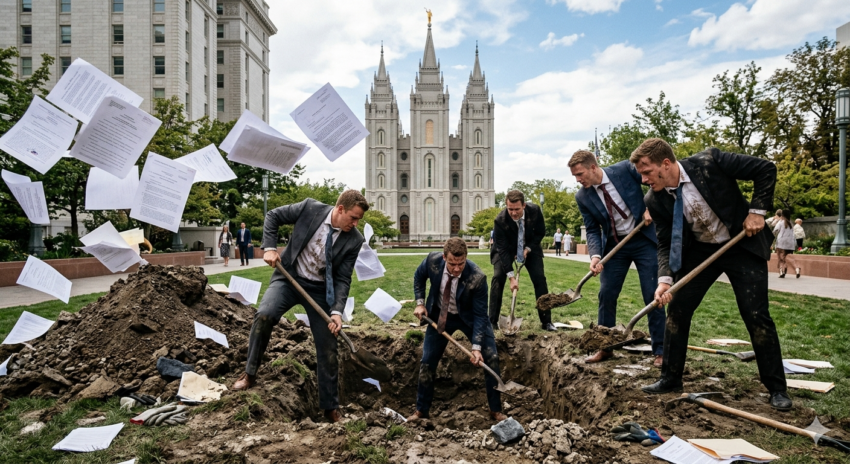
Image: An AI-generated image imagines a group of handsomely dressed lawyers frantically digging a hole near an LDS temple to find archeological evidence against brand infringement.
Friends of John Dehlin Want to Know. Furthermore, Was The Lawsuit Obtained By Revelation?
Twenty Years of Silence, the Manufacture of “Confusion,” and the LDS Church’s Case Against Mormon Stories
A Revised and Expanded Legal Analysis of Intellectual Reserve, Inc. and The Church of Jesus Christ of Latter-day Saints v. Open Stories Foundation and John P. Dehlin
Updated Through the August 2026 Filings
❦ ❖ ❦
I. Introduction: The Cost Is the Point
There is a species of lawsuit that is not built to be won. It is built to be survived — and only one side is expected to survive it.
American courts have a name for the phenomenon, though they apply it sparingly and with visible discomfort: vexatious litigation. The doctrine is deliberately narrow. Judges are reluctant to police motive; the Federal Rules presume good faith until the record forecloses it; and a plaintiff with a colorable claim is entitled to press it however unattractive the optics. But the underlying dynamic is not narrow at all, and every practicing intellectual-property lawyer in the country recognizes it on sight. A well-capitalized institution identifies a critic. It does not need a strong claim. It needs a plausible one. It files. And then it steps back and lets arithmetic finish the work that argument cannot.
The arithmetic is a matter of public record. According to the American Intellectual Property Law Association’s 2025 economic survey — cited by the Electronic Frontier Foundation in the amicus brief it filed in this very case — the median cost of carrying a trademark claim through trial and appeal runs somewhere between $250,000 and $1.1 million per party. Merely reaching the far side of discovery and motion practice costs between $100,000 and $375,000. Those are not the numbers of a contest between equals. They are the numbers of a siege.
On one side of this particular siege sits The Church of Jesus Christ of Latter-day Saints, together with its intellectual-property arm, Intellectual Reserve, Inc., represented by the Texas trademark specialists at Pirkey Barber. On the other sits a nonprofit called the Open Stories Foundation and a man the Church excommunicated eleven years ago for saying things it did not want said. The Church has the deeper bench, the longer clock, and the better balance sheet. What it does not have — and this is the burden of the pages that follow — is a coherent account of the injury it claims to have suffered.
On August 20, 2026, the Church filed its memorandum opposing the defendants’ motion to dismiss and, for the first time since April, sent a spokesman before the cameras in Salt Lake City. The appearance lasted roughly two minutes. Its purpose was to establish a single proposition, repeated in the filing, repeated on the Church’s own Newsroom page, and repeated in every headline that followed: this case is not about the word “Mormon,” and it is not about criticism. It is about confusion.
That word deserves a much harder look than it has received. Confusion is not a mood. In trademark law, it is a legal term of art with an evidentiary spine, a doctrinal test, and a set of factual predicates that a plaintiff must actually establish. When those predicates are laid alongside the Church’s own filings, its own published branding directives, its own chronology, and its own twenty-year silence, the confusion theory does not merely weaken. In several important places it collapses under the weight of documents the Church itself put into the record.
❦ ❖ ❦
II. The Record as It Now Stands: A 2026 Chronology
Before evaluating any argument, the sequence of events must be fixed, because in this case the sequence is itself the argument.
• 2005 — John Dehlin launches Mormon Stories. The podcast operates continuously under that name for more than two decades, publishing thousands of interviews with current and former members of the Church, historians, scholars, and other observers of the tradition.
• November 1, 2010 — The Church represents to the United States Patent and Trademark Office that it will use “Book of Mormon Stories” in connection with podcasts. Mormon Stories is by then five years old and unopposed.
• February 2015 — Dehlin is excommunicated for apostasy. Church leaders object at length to what he says. They do not object to what he calls it.
• August 2018 — President Russell M. Nelson announces the institutional retirement of “Mormon” and “LDS,” describing continued use of the nicknames as a major victory for Satan. Mormon.org and lds.org are redirected; the Mormon Tabernacle Choir is renamed; the Newsroom style guide is rewritten to discourage the term.
• December 2022 — Mormon Stories changes its logo from brown to blue and adopts a revised design treatment. This is the date on which every design element the Church now identifies as infringing first appears.
• November 2025 — The Church’s Intellectual Property Office contacts the Open Stories Foundation privately for the first time in the podcast’s twenty-year history.
• Winter–Spring 2026 — Mediation. Mormon Stories changes its logo color to orange, alters the design, removes Church-copyrighted photographs, and adds the Church’s own preferred disclaimer language to the podcast description on every platform. Mediation nonetheless fails.
• April 17, 2026 — Intellectual Reserve, Inc. and the Church file suit in the United States District Court for the District of Utah, alleging trademark infringement, unfair competition, and copyright infringement. The Church publishes “Getting It Right” on its Newsroom the same day.
• June 22, 2026 — The Open Stories Foundation and Dehlin file a Motion to Dismiss together with an Answer and Counterclaims, arguing abandonment of “Mormon” as a mark, misrepresentation to the USPTO, descriptive and nominative fair use, and First Amendment protection.
• August 7, 2026 — The American Civil Liberties Union of Utah and the Electronic Frontier Foundation file separate amicus curiae briefs. Both urge dismissal. Both ask that dismissal be with prejudice.
• August 20, 2026 — The Church files its memorandum in opposition to the motion to dismiss (Docket No. 71), updates its Newsroom post, and holds a short press availability. The motion remains pending before the court.
Read straight through, the chronology tells a story the Church’s brief does not: twenty years of unbroken silence, followed by a private letter, followed by a failed mediation, followed by a federal complaint — all of it arriving eight years after the plaintiff publicly instructed the world to stop using the word at the center of the dispute.
❦ ❖ ❦
III. What the Church Said on August 20 — Stated Fairly
Fairness requires that the Church’s position be set out at its strongest before it is answered. Its August 20 filing opens by disclaiming the two motives most often attributed to it. The case, it says, does not target the content of the defendants’ speech, and it does not concern ownership of the word “Mormon.” What it concerns is stated in a single clause:
… this case is about eliminating the confusion caused by Defendants’ mimicking the Church’s trademarks …
— Plaintiffs’ Memorandum in Opposition to Motion to Dismiss (Aug. 20, 2026), reproduced on the Church’s official Newsroom
The filing proceeds on four principal lines. First, it argues that Dehlin has committed what Lanham Act practice calls the “cardinal sin” of trademark law — confusing consumers about the source of a product. Second, it maintains that Dehlin uses “Mormon Stories” as a mark in its own right, registered or not, and that the Church holds a registration for “Book of Mormon Stories.” Third, it observes — accurately — that Dehlin has conceded using Church photographs without permission and conceded that some of his logos resembled the Church’s. Fourth, it argues that the disclaimers Dehlin added are functionally invisible: on the main website the disclaimer sits at the bottom, roughly four screens down, and on YouTube and Spotify it appears only after a listener clicks through to a secondary page.
The Church also invokes a principle no serious observer disputes: that religious institutions are entitled to the protection of the trademark laws to the same extent as commercial enterprises, and that names and symbols carry messages central to a religious mission. That is settled, and this analysis does not contest it.
Outside the courthouse, the Church’s spokesman put the same position in plainer language:
The Church has always acknowledged Mr. Dehlin’s First Amendment right to criticize the Church … this case is not about preventing people from using the word Mormon.
— Doug Andersen, Church spokesman, reported by Jeff Tavss, FOX 13 News Utah (KSTU), Aug. 20, 2026
That is the case as the plaintiff wishes it to be understood: a narrow, technical, brand-integrity action, regrettable but unavoidable, aimed at design elements rather than at speech. It is a well-constructed public posture. It is also, on the documents the Church has itself filed, unsustainable.
❦ ❖ ❦
IV. The Confusion Claim, Examined — and Refuted
IV.1 Confusion Is a Legal Standard, Not a Feeling
Under 15 U.S.C. § 1114, the question is never whether some person somewhere could conceivably be confused. Human beings are confusable about nearly everything. The statutory question is whether there exists a likelihood of confusion among an appreciable segment of relevant consumers as to source, sponsorship, or affiliation — a probability, not a possibility. Courts resolve it through fact-intensive multi-factor balancing: strength of the senior mark, similarity of the marks, similarity of the goods or services, evidence of actual confusion, defendant’s intent, marketing channels, consumer sophistication, and the likelihood that the parties will bridge the gap between their respective markets.
This matters because the Church’s public framing quietly performs a substitution. It treats “confusion” as a self-evident social fact — something people have reported, something the Church has heard about, something that exists in the world and must be eliminated. But the Church is not entitled to a remedy because confusion exists. It is entitled to a remedy only if confusion is likely, among relevant consumers, and attributable to the defendant’s use of protectable marks. Each of those three qualifiers is doing enormous work, and each of them is in serious trouble here.
IV.2 The 2016 Problem: The Church’s Own Dates Refute the Church’s Own Theory
This is the heart of the matter, and it deserves to be stated with precision.
The Church’s complaint asserts that the confusion it seeks to eliminate began in 2016. That date is not incidental; it establishes the temporal scope of the alleged injury and, by extension, the scope of any damages. But the Church’s August 20 position — stated in its filing, on its Newsroom, and by its spokesman before the cameras — is that the case is not about the word “Mormon” at all. It is about design: the blue palette, the light-rays motif, the fonts, the Christus imagery, the copyrighted photographs.
Those design elements did not exist in 2016. By the Church’s own account, and by the reporting of its own newspaper, Mormon Stories used a brown logo until December 2022, when it switched to blue. Every visual element the Church now describes as the true grievance postdates the alleged onset of confusion by roughly six years.
The consequence is unavoidable. If confusion began in 2016, it cannot have been caused by design elements introduced in 2022. And in 2016 there was exactly one thing distinguishing Mormon Stories that the Church could conceivably have objected to: the name. Which means one of two things is true. Either the Church’s 2016 confusion allegation is an assertion about the word “Mormon” — in which case its August 20 disclaimer is not accurate — or the 2016 allegation has no evidentiary basis at all, in which case the complaint overstates the injury by six years and the Church’s damages theory contracts accordingly.
There is no third option. A plaintiff cannot simultaneously date its injury to a period in which the only distinguishing feature was the name and then insist to the press that the name was never the issue. The observation was surfaced almost immediately by readers working through the filings on the r/mormon forum, and it survives scrutiny because it does not depend on any contested fact. It depends only on two dates the Church itself supplied.
If the confusion began in 2016, it cannot have been caused by design elements introduced in 2022.
— The arithmetic of the Church’s own complaint, first surfaced in community analysis of the August 20 opposition brief, r/mormon
IV.3 Criticism Is Not Confusable With Its Target
The second structural problem with the confusion theory is that Mormon Stories is not a lookalike. It is an adversary. For twenty years it has published sustained, documented, frequently devastating criticism of the institution now suing it — on Church finances, on the historicity of the Book of Mormon, on the treatment of sexual-abuse disclosures, on LGBTQ policy, on the mechanics of ecclesiastical discipline. A listener does not arrive at an episode and wonder for long whether it is official.
Federal courts have said so directly. The Fourth Circuit’s decision in Radiance Foundation v. NAACP — quoted by the ACLU of Utah in its amicus brief — disposes of the point in a sentence:
it is not immediately apparent how someone would confuse [a podcast] which is strongly critical of an organization with the organization itself.
— Radiance Foundation, Inc. v. NAACP, 786 F.3d 316 (4th Cir. 2015), as quoted in the ACLU of Utah amicus brief, Aug. 7, 2026
The Church’s answer is that confusion occurs at the moment of first encounter — a thumbnail, a search result, a social-media avatar — before the content is heard. That is a real doctrine, sometimes called initial-interest confusion, and it is not frivolous. But it is also disfavored in several circuits; it has never been adopted with enthusiasm in the Tenth, and it is at its weakest precisely where the parties do not compete. The Church does not produce excommunicant-led oral-history journalism. Mormon Stories does not produce sacrament-meeting curricula. A momentary glance that resolves the instant a listener presses play is not the injury the Lanham Act was written to redress.
IV.4 The Disclaimer Paradox
The Church’s most concrete complaint is that the disclaimers are hard to find: four screens down on the website, one click away on YouTube and Spotify. Taken alone, that is a fair criticism, and a court could reasonably order more prominent placement.
But the argument proves less than the Church needs, and it costs more than the Church seems to realize. Mormon Stories did not refuse to disclaim. It adopted the Church’s own preferred disclaimer language and placed it in the podcast description on every platform. What it refused was the Church’s escalated demand that a disclaimer be read or displayed at the beginning of every video and every episode — a compelled-speech requirement imposed on a critic, in perpetuity, at the front of thousands of hours of expressive work.
That refusal is the actual disagreement, and it is not a trademark disagreement. It is a dispute about how much of a critic’s expressive real estate an institution may commandeer as the price of naming the institution accurately. Framed that way — which is how it will be framed on the motion — the Church’s position is considerably less modest than “a brief disclaimer,” and considerably closer to the compelled endorsement of an adversary’s framing.
There is a further difficulty. A plaintiff who says confusion is severe enough to warrant federal injunctive relief, but curable by a sentence of boilerplate, has conceded that the confusion is shallow. Deep, source-level confusion is not fixed by a disclaimer. Shallow confusion is not worth a federal lawsuit. The Church cannot hold both ends of that rope.
IV.5 “Not About the Word” — Measured Against What Was Demanded in Mediation
The Church’s central public assurance is that Dehlin may keep using “Mormon.” Against that assurance stands Dehlin’s account of what the Church’s own attorneys asked for at the mediation table. He has stated publicly — without contradiction from Church counsel, who declined to respond when asked — that he was pressed to rename the program “Ex-Mormon Stories” or “Post-Mormon Stories,” and asked to sign declarations forswearing use of “Mormon” in future projects and forswearing any future trademark application for “Mormon Stories.”
If that account is accurate, the Church’s public position and its private negotiating position are not the same. A party that demands a permanent contractual surrender of a word is not indifferent to the word. And the demand that the podcast be retitled with the prefix “Ex-” or “Post-” is revealing in a second way: neither prefix does anything whatever to address blue palettes, light rays, fonts, or photographs. Both address only the speaker’s relationship to the institution — which is to say, the content of the speech.
This is the point at which the vexatious-litigation framing stops being rhetorical. When the relief sought in private is broader than the injury pleaded in public, the gap between them is where a court looks for motive.
IV.6 The Consistency Claim
The Church’s Newsroom FAQ asks whether it enforces its trademarks consistently and answers with a single word: yes. It adds that it reviews hundreds of potential trademark matters each year and that most are resolved amicably through private outreach.
The claim is testable, and it does not survive the test. The Electronic Frontier Foundation, which has been litigating against this plaintiff’s trademark theories for more than a decade, documents a pattern with a shape: enforcement lands on parties who cannot afford to fight. In 2014, the Church pursued Mormon Match, a dating service for Church members. In 2016 it threatened the Mormon Mental Health Association, a nonprofit of clinicians serving members of Mormon faiths. In 2023 it opposed Heather Gay’s application to register “Bad Mormon,” and she withdrew. In 2025 it pressed Burke Sorenson to rename his Mormon News Roundup podcast. In 2026 it sued Mormon Stories.
Now consider the uses that have gone entirely unchallenged across the same period: the Journal of Mormon History; the Mormon Studies Review; the Howard W. Hunter Chair of Mormon Studies at Utah State University; Mormon Land, a podcast published by The Salt Lake Tribune; the Mormonish Podcast; Mormon Coffee; and, on the entertainment side, FX’s Under the Banner of Heaven and TLC’s Sister Wives — both of which are marketed to the general public with the word “Mormon” in their promotional vocabulary and neither of which has any affiliation with the Church.
The variable that separates the two lists is not confusion. Under the Banner of Heaven reached a vastly larger audience than any independent podcast, and its subject matter was incomparably more damaging to the Church’s brand. The variable is the defendant’s capacity to absorb legal costs. An enforcement program that consistently spares Disney and consistently pursues nonprofits is not consistent. It is calibrated.
And calibration has a doctrinal price. Selective enforcement weakens a mark. A mark holder who tolerates widespread third-party use in the same commercial and cultural space cannot then claim that a single tolerated user is the source of consumer confusion. If the public has spent twenty years encountering “Mormon” in the titles of histories, journals, newspapers, podcasts, and prestige television without confusion, the public is not going to be confused by one more.
IV.7 Anecdote Is Not Evidence: The Missing Survey
Finally, there is the question of proof. The complaint’s evidence of actual confusion consists of selected comments harvested from Facebook and YouTube — unverified, self-selecting, and unquantified. Such comments are admissible. They are also, standing alone, among the weakest forms of proof in trademark practice, and federal courts routinely discount them absent a properly designed consumer survey or systematic data.
That is not a technicality. Survey evidence exists precisely because internet comments cannot distinguish between a person genuinely misled as to source and a person expressing surprise, irony, or disapproval. A commenter who writes that a channel looked official at first glance has not necessarily been deceived; a commenter asking whether a channel is run by Mormons or ex-Mormons has demonstrated awareness that the two are different, which is the opposite of source confusion.
If, after twenty years and a claimed decade of confusion, the plaintiff’s best evidence remains a handful of comment-thread screenshots, the plaintiff has an evidence problem that no amount of press-conference framing will repair.
❦ ❖ ❦
V. Twenty Years of Silence: The Doctrine the Church Cannot Outrun
If the confusion theory is the weakest part of the Church’s case on the evidence, the twenty-year delay is the weakest part on the law. This section is the center of gravity of the entire dispute, and it deserves to be developed at length, because the passage of time in trademark practice is not a public-relations embarrassment. It is a defense.
V.1 The Shape of the Silence
Mormon Stories began publishing in 2005. It has operated continuously under the same name ever since. During those two decades, it did not hide. It became one of the most visible independent voices in the Mormon information ecosystem, was covered by national outlets, was named in an internal Church presentation identifying influences said to be leading members away from the faith, and generated an excommunication proceeding against its founder that drew coverage from the Associated Press, NBC News, and CBS News.
The Church, in other words, knew. It knew in 2007, when the podcast was already established. It knew in 2013, when the first disciplinary inquiry began. It knew in 2015, when a stake presidency in Logan, Utah convened a council and excommunicated Dehlin for apostasy. It knew in 2017, when leaked internal materials placed him on a list of perceived threats. It knew in 2018, when it undertook the most extensive rebranding in its modern history and rewrote its own style guide around the very word at issue. It knew every year, in every one of those years, and it said nothing about the name.
The first formal objection to the branding arrived in a letter from the Church’s Intellectual Property Office in November 2025. That is a delay of approximately twenty years and two months from the podcast’s launch, and approximately ten years from the excommunication.
V.2 The 2015 Excommunication Is the Single Most Damaging Fact in the Record
It is worth pausing on 2015, because the significance of that year is easy to underrate.
In 2015 the Church convened a formal disciplinary council against John Dehlin. It made a considered institutional judgment about him. It produced a written decision. It issued public statements about that decision. Its representatives explained, at length and on the record, precisely what he had done that the Church found intolerable: disputing the nature of God and Christ, calling the Church’s foundational texts into question, and publicly teaching that the Church is not what it claims to be.
At no point in that proceeding — the single most deliberate, most documented, most legally attentive interaction between these two parties before 2025 — did the Church tell John Dehlin to stop calling his podcast Mormon Stories. Its own newspaper has since confirmed the point plainly: the Church did not seek to keep him from using the term, and its lawsuit does not now ask the court to do so either.
That is not neutral. In equity, silence in circumstances demanding speech is itself communicative. When a party undertakes a formal adjudication of another party’s conduct, catalogues its grievances in writing, imposes the harshest sanction available to it, and omits any mention of the name under which that conduct is published, it has communicated something about the name. What it communicated, for the next ten years, was that the name was not the problem.
V.3 The Seniority Inversion: Who Was First in Podcasting?
There is a further wrinkle in the chronology that has received almost no attention and ought to receive a great deal.
The Church’s asserted registration in this space is “Book of Mormon Stories.” According to the defendants’ filings, the Church first represented to the United States Patent and Trademark Office that it would use that mark in connection with podcasts on November 1, 2010.
Mormon Stories launched in 2005.
Whatever else is true, then, the podcast is the senior user in the podcasting channel by five years. Trademark rights in the United States flow from use in commerce, not from registration alone; registration creates a presumption of validity, but it cannot manufacture priority that use did not create. A plaintiff asserting a 2010 podcasting representation against a 2005 podcast is not asserting seniority. It is asserting that the junior user in the relevant channel may nonetheless police the senior one, on the strength of a registration obtained while the senior user published unopposed. That argument can be made. It cannot be made comfortably.
V.4 Laches: The Doctrine and the Presumption
Laches bars equitable relief where a plaintiff has unreasonably delayed asserting a known right and the defendant has been prejudiced by the delay. In federal trademark practice, because the Lanham Act contains no general limitations period, courts borrow the most analogous state statute of limitations as a presumptive trigger. Utah’s general limitations period for fraud and analogous commercial torts is four years; for written contracts, six.
Once the analogous period has run, the presumption inverts. Delay beyond it is presumptively unreasonable, and the burden shifts to the plaintiff to justify it. Here the delay is not four years, or six, or ten. It is twenty. There is no serious argument that a twenty-year silence in the face of open, notorious, commercially active, nationally covered use falls inside any borrowing period any court would apply.
Prejudice, the second element, is equally plain and comes in both recognized forms. Evidentiary prejudice: witnesses to the podcast’s founding and early branding decisions have aged, moved on, or died; contemporaneous documents from 2005 to 2012 are incomplete; and the Church’s own internal deliberations about whether to object during those years are now reconstructions rather than records. Economic prejudice: over twenty years the Open Stories Foundation built an audience, a donor base, a catalogue of thousands of episodes, a search-engine footprint, and an institutional identity entirely around the contested name. Every dollar of that goodwill was accumulated in reliance on the plaintiff’s silence. Requiring its abandonment now is not the removal of an infringing ornament. It is the confiscation of an enterprise.
V.5 Acquiescence: The Harder Doctrine
Laches punishes sleeping on rights. Acquiescence punishes something worse: conduct that affirmatively signals the rights will not be enforced. Where laches requires only unreasonable delay plus prejudice, acquiescence converts delay into something close to consent — and unlike laches, which in some circuits is unavailable against claims of intentional infringement, acquiescence goes to the plaintiff’s own conduct rather than the defendant’s state of mind.
The record here is unusually rich in potential acquiescence evidence, all of it available in discovery: whether Church employees, public-affairs personnel, or agents ever monitored, referenced, or internally discussed Mormon Stories without recommending enforcement; whether any Church representative or affiliated scholar ever appeared on the program or corresponded with it; whether the Intellectual Property Office ever opened and closed a file on the podcast in the years before 2025; and, most pointedly, what the Church’s own counsel concluded about the name during the 2013–2015 disciplinary process. A twenty-year internal record of noting the podcast and declining to act would be devastating.
It is worth noting what the Church’s own Newsroom says on this point: that its standard practice is private outreach and that most matters resolve amicably. If that is genuinely the institutional practice, and if it was applied hundreds of times a year for twenty years without once being applied to the best-known independent use of “Mormon” in American media, the omission is not oversight. It is a decision — repeated annually, for two decades.
V.6 Estoppel and the Mediation Record
Equitable estoppel completes the triad. It bars a plaintiff whose conduct has misled the defendant into a detrimental reliance. The relevant conduct here is not merely the silence but the affirmative institutional messaging that accompanied it. Between 2018 and 2025, the Church told the public, the press, and its own membership to stop using “Mormon.” Its style guide said so. Its president said so from the pulpit of General Conference. Its websites were redirected accordingly. Its choir was renamed.
A third party observing that campaign would reasonably conclude two things: that the Church did not wish to be identified by the term, and that the Church was therefore unlikely to sue anyone for using it. The second conclusion follows so naturally from the first that a reasonable person would be entitled to rely on it — and Mormon Stories did rely on it, continuing to invest in a brand the plaintiff was publicly disowning.
There is an additional estoppel dimension in the mediation itself. Mormon Stories responded to the November 2025 letter by making changes: recoloring the logo, altering the design, stripping the copyrighted photographs, and adopting the Church’s own disclaimer language. Those are the acts of a party attempting to comply. When a rights-holder’s demands are substantially met, and the rights-holder sues anyway over the residue, a court is entitled to ask what the demands were actually for.
V.7 The “New Infringement Resets the Clock” Rejoinder — and Its Limits
The Church’s answer to all of this is the doctrine of progressive encroachment: a senior user is not obliged to sue over a trivial or distant use, and the clock restarts when the junior user materially expands into infringing territory. On that theory, the December 2022 redesign is a new wrong, and the twenty years before it are legally irrelevant.
The argument has genuine force and should not be dismissed. But it carries two high costs the Church has not acknowledged.
The first is that it concedes the case away from the name. If the actionable conduct began in December 2022, then everything before December 2022 was lawful — including twenty years of publishing under the title “Mormon Stories.” The Church cannot invoke progressive encroachment to escape laches and simultaneously maintain that confusion dates to 2016. The two positions are mutually destructive, and the Church has now asserted both.
The second is that progressive encroachment shrinks the remedy to fit the wrong. If the new infringement is a palette and a design motif, the remedy is a palette and a design motif — both of which have already been changed. Mormon Stories moved its logo from blue to orange and removed the contested imagery before this brief was filed. A defendant who has voluntarily abated the only conduct that survives the laches analysis has substantially mooted the case, leaving a copyright claim over images already withdrawn and a trademark claim over a name that twenty years of silence has placed beyond reach.
V.8 What Twenty Years Means in Practice
Strip away the doctrine and the practical point remains. Trademark law protects the reliance interests of the public and the investment interests of the mark holder. It does not exist to give an institution a permanent option, exercisable at any moment of its choosing, to destroy a critic it has tolerated for a generation.
The Church had twenty years to object. It had a formal adjudication in 2015 in which objecting would have cost it nothing. It had a comprehensive rebranding in 2018 in which the topic was unavoidable. It said nothing, then said nothing, then said nothing again — and then, in the twenty-first year, sent a lawyer.
❦ ❖ ❦
VI. The Amici Arrive: Two Roads to the Same Conclusion
On August 7, 2026, two organizations with no stake in Mormonism and no history of defending its critics filed separate briefs in the District of Utah asking the court to throw this case out. Neither is a party. Neither had to appear. That they did so — and that they arrived at the same destination from different doctrinal directions — is the most significant development in the litigation since the complaint.
VI.1 The ACLU of Utah: A Word Is Not a Brand
The ACLU of Utah grounds its argument in trademark fair use, and it opens by placing the Church’s demand alongside the company it would have to keep. Trademark law has never prevented a band from titling a song after the doll it mocks, or a filmmaker from naming a picture after the dancers his characters imitate, or a critic from registering a domain that consists of the criticized company’s own name. The brief then asks the obvious question: why should a podcast about Mormon stories be the exception?
Its central legal proposition is that the word never functioned as a brand at all:
The word “Mormon” is not a source identifier … an entire ethnoreligious culture and people.
— ACLU of Utah amicus curiae brief, filed Aug. 7, 2026, U.S. District Court for the District of Utah
The brief then does the scholarly work required to make that assertion stick. It cites the Journal of Mormon History, whose subject matter is understood to encompass every tradition tracing its origins to Joseph Smith Jr. It cites Encyclopaedia Britannica, which distinguishes the LDS Church from other Mormon churches. It walks through the 1844 succession crisis and the denominations it produced — the Community of Christ, the Fundamentalist Church of Jesus Christ of Latter-Day Saints, the Apostolic United Brethren, whose leaders describe themselves as Fundamentalist Mormons. And it notes that the Supreme Court of the United States, in 1946, described FLDS petitioners as members of a Mormon sect and compared them to other Mormons.
The conclusion follows without strain. A word that names a religious movement of multiple denominations, an ethnic and cultural identity, an academic field, and a body of literature and entertainment — including television series with no institutional connection to the plaintiff — is not performing the function trademark law protects.
… nominative and descriptive fair use … protected speech under the Lanham Act.
— ACLU of Utah brief, as reported by Amelia Hobson, ABC4 (KTVX), Aug. 11, 2026
The brief closes with an argument that ought to trouble the Church more than it apparently does. The defendants’ continued use of “Mormon,” it says, is itself expressive — because they kept the word through the years when the Church was actively discouraging it and the term was unpopular. On that reading, the choice to say “Mormon” in 2019, 2021, and 2023 was a statement about who owns the vocabulary of a religious tradition. Suing over it is not a defense of a brand. It is a response to a message.
VI.2 The EFF: The Expense Is the Injury
The Electronic Frontier Foundation arrives from a different direction. Its brief, prepared with attorneys at Ballard Spahr, urges the court to apply the First Amendment test articulated in Rogers v. Grimaldi — a framework adopted in many circuits, though not yet in this one, for cases where a mark is used within an expressive work rather than as a brand.
The reason EFF wants that test is procedural, and it is the sharpest observation in either brief. Rogers permits meritless trademark claims against expression to be resolved early, before the ruinous phase of litigation begins. That timing is not a detail. It is the whole ballgame:
Individuals who use trademarks to critique their owners are regularly subject to legal threats they cannot afford to litigate.
— Electronic Frontier Foundation amicus curiae brief, filed Aug. 7, 2026, U.S. District Court for the District of Utah
The brief supplies the numbers cited at the opening of this analysis — $250,000 to $1.1 million per party through trial and appeal, $100,000 to $375,000 through discovery and motion practice — and pairs them with a finding from the leading trademark treatise: that a recipient of a cease-and-desist letter, facing expensive litigation over vague standards, will usually capitulate rather than fight. It goes further, citing survey research in which practitioners acknowledged asserting claims they themselves believed weak, precisely because demand letters work, and acknowledged targeting small actors unlikely to have the resources to resist.
That is the mechanism this essay opened with, described by the people who operate it. And it is why EFF asks not merely for dismissal but for dismissal now, with prejudice: because allowing the case into discovery imposes the punishment regardless of the verdict, and chills every other speaker watching.
On the merits, EFF makes the genericness argument in its strongest form. Trademark claims built on generic terms are especially offensive to First Amendment principles because they permit one entity to control a common word for its common meaning — and the offense compounds when the word names a religious tradition. There is, the brief observes, no other term that accurately describes both members of the LDS Church and the broader community that traces itself to the Book of Mormon. Locking the word up therefore erects a barrier to criticism and commentary not only about the Church, but about groups the Church does not control.
EFF also declines the Church’s framing that this is an isolated brand dispute, characterizing the suit instead as the latest instance of a documented pattern — Mormon Match in 2014, the Mormon Mental Health Association in 2016, Mormon News Roundup in 2025. And it closes with a line borrowed from this same district that answers the Church’s entire theory of the case: the Lanham Act regulates economic competition, not ideological or political competition.
In its public commentary on the filing, EFF put the principle in one sentence:
Trademark is supposed to be about helping consumers identify the sources … not controlling criticism.
— Cara Gagliano, Electronic Frontier Foundation, Deeplinks Blog, Aug. 10, 2026
The defendants summarized what unites the two briefs in a single sentence that will likely outlive this case:
… no institution, however rich or powerful, should be allowed to weaponize trademark law …
— Mormon Stories / Open Stories Foundation, announcement of the amicus filings, Aug. 8, 2026
❦ ❖ ❦
VII. When a Style Guide Becomes a Liability
The original version of this analysis argued that the most legally awkward document in the case is not anything Mormon Stories published. It is the plaintiff’s own style guide. Nothing in the August filings has changed that assessment; the amicus briefs have simply confirmed it from the outside.
The Church’s Newsroom directs the public, the press, and its own membership away from the word it is now enforcing:
… is not an authorized title, and the Church discourages its use.
— Newsroom Style Guide, The Church of Jesus Christ of Latter-day Saints, on the nickname “Mormon”
In a single clause, the plaintiff characterizes the contested term as an unauthorized nickname and asks the world to stop using it. Trademark law rests on the proposition that a mark functions in the marketplace as an identifier of source. A mark whose owner has spent eight years publicly instructing the marketplace not to apply it has a credibility problem the moment it walks into court asking that the same word be policed.
Defense counsel will offer the style guide, together with President Nelson’s 2018 General Conference address, as a party-opponent admission under Federal Rule of Evidence 801(d)(2). This does not establish abandonment as a technical matter — statutory abandonment requires three consecutive years of non-use with intent not to resume, and the Church has continued to use several composite marks. But it goes directly to the strength of the mark and to likelihood of confusion, which are the questions that decide this case. If the senior user has spent nearly a decade telling the public the word does not designate it, an ordinary consumer encountering “Mormon Stories” has less reason, not more, to assume official affiliation.
The Church’s best answer remains President Nelson’s own qualification, offered to Latter-day Saints in Canada in the same season as the rebranding:
We have to be careful to protect the name “Mormon.”
— President Russell M. Nelson, address in Canada, August 2018, reported by Tad Walch, Deseret News
Read together, the style guide and the Nelson address describe a posture of selective retention: abandon the word as a self-designation, retain the legal right to police it in the hands of others. Whether that two-track strategy is coherent under trademark doctrine is precisely what the District of Utah must now decide. What can be said already is that it is not a posture the public was ever told about, and it is not the posture on which twenty years of third-party reliance was built.
There is also the administrative record. The United States Patent and Trademark Office refused an application by the Church to register the bare word “Mormon” for religious services, concluding that the term was understood as designating a kind of church rather than a source of services — comparable to “Presbyterian” or “Methodist.” The application was abandoned in 2007. That determination is not preclusive here, but it is powerfully persuasive on exactly the question the amici now press.
The Electronic Frontier Foundation stated the underlying principle a decade ago, in a dispute with this same plaintiff:
Trademark law does not give one company the right to control language.
— Electronic Frontier Foundation, Not MORMON®, Still Mormon, February 2016
❦ ❖ ❦
VIII. The Counts Reassessed
VIII.1 Trademark Infringement and Unfair Competition
This count is weak and getting weaker. Five defenses converge on it. Descriptive fair use under 15 U.S.C. § 1115(b)(4) applies because “Mormon Stories” uses the word in its ordinary descriptive sense — stories about Mormons — and that defense is materially strengthened where the senior user has publicly disavowed the term as an authorized designation. Nominative fair use under New Kids on the Block v. News America Publishing permits use of a mark where the subject cannot be identified without it, and a podcast examining Mormonism cannot examine it anonymously. Genericness, supported by the USPTO’s own refusal, attaches to “Mormon” as applied to a tradition, a people, and their discourse. The equitable defenses of laches, acquiescence, and estoppel are addressed above and are, on this record, formidable. And the absence of competition between the parties drains the confusion factors of their force.
The Church’s strongest remaining trademark argument is narrow: that the specific post-2022 design stack — blue palette plus light-rays motif plus font treatment plus Christus imagery — crossed a line when assembled. That argument is respectable. It is also, by its own terms, an argument about design elements the defendants have already abandoned.
VIII.2 Copyright Infringement
Intellectual honesty requires saying plainly what the previous version of this analysis said: the copyright count is the Church’s strongest claim, and it is meaningfully stronger than the trademark count. Officially commissioned photographs of the First Presidency and other Church imagery fall squarely within valid registrations. Their use in podcast thumbnails, banners, and promotional graphics states a prima facie case.
The defense is fair use under 17 U.S.C. § 107, and it is a real defense rather than a reflexive one. The use is commentary, criticism, and journalism directed at the very institution depicted — the paradigm case for transformative purpose. Cutting the other way: the podcast generates revenue, the photographs are creative rather than purely factual, and entire images rather than excerpts were used.
We believe our use … qualifies as fair use.
— John P. Dehlin, statement to Tad Walch, Deseret News, Aug. 20, 2026
Two facts materially improve the defendants’ equitable position regardless of how the fair-use factors are scored. First, Brigham Young University’s own Religious Studies Center has published scholarship acknowledging substantial latitude under fair use for educational and critical engagement with Church-copyrighted materials. Second, the defendants removed the identified images on request and committed not to use them going forward. Voluntary abatement does not erase past infringement, but it bears directly on injunctive relief, on statutory damages, and on any claim that this is an exceptional case warranting fees.
VIII.3 The Demand for a Permanent Injunction
Permanent injunctive relief requires the four-factor showing of eBay Inc. v. MercExchange, L.L.C.: irreparable injury, inadequacy of legal remedies, a balance of hardships favoring the plaintiff, and — decisively here — the public interest.
In a dispute over religious discourse, the public-interest factor carries unusual weight. An injunction barring a critical podcast from using the ordinary name of the tradition it examines does not merely restrict commerce; it approaches prior restraint on speech about a powerful institution. Federal courts in Lanham Act cases touching commentary have consistently tailored relief narrowly to the specific source-confusing element — a logo, a color, a specific image — rather than issuing the sweeping relief this complaint requests. That is the ceiling on realistic outcomes here, and the defendants have already climbed most of the way to it voluntarily.
❦ ❖ ❦
IX. What “Vexatious” Would Actually Require — and What It Would Cost
This analysis opened with the word vexatious, and precision now demands that the word be defined rather than merely deployed.
In American federal practice, there is no free-floating cause of action for filing an aggressive lawsuit. The relevant mechanisms are four, and each has a threshold.
Rule 11
Federal Rule of Civil Procedure 11 sanctions filings unsupported by any reasonable factual or legal basis. The Church’s complaint is not that. It pleads registered marks, identifies specific images, and attaches exhibits. Whatever else may be said, this is not a Rule 11 case.
28 U.S.C. § 1927
Section 1927 reaches counsel who unreasonably and vexatiously multiply proceedings. It is directed at conduct during litigation rather than at the decision to sue, and it is applied sparingly. It would become relevant only if the plaintiff litigated the case in a manner disproportionate to its stakes — which is precisely what the EFF brief warns is the point of the exercise.
Lanham Act § 35(a), 15 U.S.C. § 1117(a)
This is the realistic vehicle. It permits a prevailing defendant to recover attorney’s fees in exceptional cases, a standard read broadly since Octane Fitness, LLC v. ICON Health & Fitness, Inc. (2014) to reach cases that stand out from others in the substantive strength of a litigating position or the unreasonable manner in which they were litigated. Courts have awarded fees against trademark plaintiffs whose enforcement appeared aimed at speech rather than commerce, and particularly where prior toleration of the same use undercut the asserted likelihood of confusion. Both features are present here. If the motion to dismiss is granted, a fee application is not merely available — it is close to indicated.
Malicious Prosecution
This doctrine, invoked by some commentators, remains a dead end. It requires proof of a claim filed without probable cause, malice, failure of the claim, injury, and — fatally in most civil cases — arrest or seizure of property plus a special injury beyond the ordinary burdens of being sued. Trademark suits produce neither arrest nor seizure. The doctrine is not the answer here and should not be advanced as though it were.
The honest conclusion is therefore twofold. The Church’s complaint is not sanctionable, and no responsible analyst should say otherwise. But sanctionability is not the measure of whether litigation functions as harassment. A suit can be perfectly well pleaded and still operate as a machine for converting a critic’s donations into legal fees. That is the phenomenon the EFF brief documents with survey data drawn from the practitioners who employ it, and it is the phenomenon a Rogers-style early exit exists to prevent.
❦ ❖ ❦
X. Conclusion: The Word Belongs to the People Who Carry It
Where does this leave the case?
On copyright, the Church retains a real claim, narrowed by voluntary compliance to a question of past use, modest damages, and a prospective bar on images the defendants have already withdrawn. On trademark, the Church’s position has deteriorated markedly since April. It is now opposed by two national civil-liberties organizations arguing from independent doctrinal premises; it is contradicted on its own dates by its own filings; it is undercut by its own style guide, its own president’s rebranding, and the USPTO’s own refusal to register the bare term; and it must survive twenty years of silence that no borrowing period in American law can absorb.
And on the public record — the record that outlasts dockets — the Church has already lost something it cannot recover by winning. It has spent eight years telling the world that “Mormon” is not its name. It has now spent four months in federal court insisting that the word is nonetheless its property. Those two positions can be reconciled in a brief. They cannot be reconciled in the mind of an ordinary person watching, and the ordinary person watching is the entire universe of consumers whose confusion the Church claims to be protecting.
There is a principle that has organized American trademark jurisprudence for more than a century, and it applies with particular force to a word that names a people. The law protects marks insofar as they identify sources. It does not protect institutional control over the vocabulary of a religious tradition. Where those two purposes diverge, courts have consistently sided with the public’s ability to speak about a tradition in the language the public actually uses.
The word “Mormon” was a slur before it was a badge, a badge before it was a brand, and a brand before it was renounced. It has been carried for two centuries by people the Church claims and by people the Church has expelled, by believers and by fundamentalists and by scholars and by novelists and by anyone who has ever tried to describe the thing honestly. That is not a trademark. That is a language. And no institution, however old, however wealthy, or however sincere, gets to take a language back from the people who speak it.
❦ ❖ ❦
Editorial Note
This analysis is offered as scholarly apologetics and public-interest legal commentary. It is not legal advice, and its author is not counsel to any party. The Church of Jesus Christ of Latter-day Saints and Intellectual Reserve, Inc. hold and are entitled to exercise legitimate intellectual-property interests; John P. Dehlin and the Open Stories Foundation are entitled to defend their work and their branding. The District of Utah will resolve these questions on a full factual record, and it may well resolve some of them differently than this analysis anticipates.
Where the Church’s position is strong — principally on copyright — this analysis says so plainly. Where its position is weak, this analysis says that plainly too. Readers who believe any characterization here is unfair to the plaintiff are invited to say so; corrections offered in good faith will be received in the same spirit.
— The Righteous Cause
❦ ❖ ❦
Sources and Further Reading
Primary Filings and Institutional Statements
The Church of Jesus Christ of Latter-day Saints, “Getting It Right: Clarifying Trademark and Branding Concerns,” Newsroom, April 17, 2026, updated August 20, 2026. https://newsroom.churchofjesuschrist.org/article/getting-it-right-clarifying-trademark-branding-concerns
Newsroom Style Guide, The Church of Jesus Christ of Latter-day Saints. https://newsroom.churchofjesuschrist.org/style-guide
ACLU of Utah, amicus curiae brief in support of defendants’ motion to dismiss, filed August 7, 2026 (PDF). https://www.mormonstories.org/wp-content/uploads/2026/08/gov.uscourts.utd_.163775.65.1.pdf
Electronic Frontier Foundation, amicus curiae brief, filed August 7, 2026 (PDF). https://www.eff.org/files/2026/08/10/70_eff_amicus_brief_0.pdf
Open Stories Foundation, Motion to Dismiss with exhibits, filed June 22, 2026 (PDF). https://www.mormonstories.org/wp-content/uploads/2026/08/2026-06-22no041-0-LDS-Church-v-Mormon-Stories-Motion-to-Dismiss-and-Exhibits.pdf
Open Stories Foundation, Answer and Counterclaims with exhibits, filed June 22, 2026 (PDF). https://www.mormonstories.org/wp-content/uploads/2026/08/2026-06-22no042-0-LDS-Church-v-Mormon-Stories-Answer-and-Counterclaim-and-Exhibits.pdf
Mormon Stories, “The LDS Church Lawsuit Against Mormon Stories: Timeline, Court Filings & FAQ.” https://www.mormonstories.org/lds-church-lawsuit/
News Coverage and Commentary
Jeff Tavss, “LDS Church argues against dismissing lawsuit filed against ‘Mormon Stories’ podcast,” FOX 13 News Utah (KSTU), August 20, 2026. https://www.fox13now.com/news/local-news/salt-lake-city/lds-church-argues-against-dismissing-lawsuit-filed-against-mormon-stories-podcast
Tad Walch, “Church says trademark lawsuit is about eliminating confusion caused by podcaster,” Deseret News, August 20, 2026. https://www.deseret.com/faith/2026/08/20/church-says-trademark-lawsuit-is-about-eliminating-confusion-caused-by-podcaster/
Amelia Hobson, “Organizations file in support of ‘Mormon Stories’ podcast in trademark infringement lawsuit from LDS Church,” ABC4 (KTVX), August 11, 2026. https://www.abc4.com/news/wasatch-front/organizations-file-in-support-of-mormon-stories-podcast-in-trademark-infringement-lawsuit-from-lds-church/
ABC4 (KTVX), “Church of Jesus Christ of Latter-day Saints speaks on legal action against ‘Mormon Stories’ podcast,” August 2026. https://www.abc4.com/news/wasatch-front/lds-church-mormon-stories-lawsuit/
John Dehlin, “ACLU and EFF File Amicus Briefs in Support of Mormon Stories Podcast and Free Speech,” Mormon Stories, August 8, 2026. https://www.mormonstories.org/aclu-and-eff-file-amicus-briefs-in-support-of-mormon-stories-podcast-and-free-speech/
Cara Gagliano, “Dismiss Church’s Trademark Lawsuit Against ‘Mormon Stories’ Podcast, EFF Urges Court,” Electronic Frontier Foundation Deeplinks, August 10, 2026. https://www.eff.org/deeplinks/2026/08/dismiss-churchs-trademark-lawsuit-against-mormon-stories-podcast-eff-urges-court
Emily Poler, “How the LDS Church’s Lawsuit Over ‘Mormon’ Could Bite Back,” LinkedIn, 2026 — a litigator’s assessment of the reputational and doctrinal blowback risk the suit creates for the plaintiff. https://www.linkedin.com/pulse/how-lds-church-lawsuit-over-mormon-could-bite-back-emily-poler-emfef
r/mormon, “The Church disproved its own argument in its own filing” — community analysis of the August 20 opposition brief and the 2016/2022 date conflict. https://www.reddit.com/r/mormon/comments/1vu3n10/the_church_disproved_its_own_argument_in_its/
Salon, “Mormons will regret suing an ex-member,” April 29, 2026. https://www.salon.com/2026/04/29/mormons-will-regret-suing-an-ex-member/
Slate, “The LDS Church Is Suing One of Its Most Vocal Critics for a Seemingly Silly Reason,” May 2026 — source for Dehlin’s account of the mediation demands. https://slate.com/life/2026/05/mormon-stories-church-lds-lawsuit-trademark.html
Brittany Ratelle, “Analysis: The Church of Jesus Christ isn’t suing Mormon Stories over the word ‘Mormon,’” Deseret News, April 23, 2026. https://www.deseret.com/opinion/2026/04/23/mormon-stories-lawsuit/
Tad Walch, “We’re correcting a name: President Russell M. Nelson tells Latter-day Saints in Canada,” Deseret News, August 19, 2018. https://www.deseret.com/2018/8/19/20651519/we-re-correcting-a-name-president-russell-m-nelson-tells-latter-day-saints-in-canada/
Background and Doctrinal Sources
Electronic Frontier Foundation, “Not MORMON®, Still Mormon,” February 2016. https://www.eff.org/deeplinks/2016/02/not-mormonr-still-mormon
“Mormon (word)” — history of the term, the 1990 Hinckley address, and the USPTO refusal and 2007 abandonment. https://en.wikipedia.org/wiki/Mormon_(word)
Brigham Young University Religious Studies Center, “‘We Believe in Being Honest’: Using Church Copyrighted Materials.” https://web.archive.org/web/20240422201108/https://rsc.byu.edu/vol-6-no-3-2005/we-believe-being-honest-using-church-copyrighted-materials
“When a Style Guide Becomes a Liability: The LDS Church’s Own Words in the Mormon Stories Case,” The Righteous Cause, April 27, 2026 — the earlier edition superseded by this analysis. https://novus2.com/righteouscause/2026/04/27/when-a-style-guide-becomes-a-liability-the-lds-churchs-own-words-in-the-mormon-stories-case/
Cases and Authorities Cited
Rogers v. Grimaldi, 875 F.2d 994 (2d Cir. 1989) • Radiance Foundation, Inc. v. NAACP, 786 F.3d 316 (4th Cir. 2015) • New Kids on the Block v. News America Publishing, Inc., 971 F.2d 302 (9th Cir. 1992) • KP Permanent Make-Up, Inc. v. Lasting Impression I, Inc., 543 U.S. 111 (2004) • Park ’N Fly, Inc. v. Dollar Park & Fly, Inc., 469 U.S. 189 (1985) • eBay Inc. v. MercExchange, L.L.C., 547 U.S. 388 (2006) • Octane Fitness, LLC v. ICON Health & Fitness, Inc., 572 U.S. 545 (2014) • Lanham Act, 15 U.S.C. §§ 1114, 1115(b)(4), 1117(a) • 17 U.S.C. § 107 • Fed. R. Civ. P. 11 • 28 U.S.C. § 1927 • Fed. R. Evid. 801(d)(2).
❦ ❖ ❦
A Note on Research Methods and Accuracy
In recent years, some have voiced concern that artificial intelligence may distort facts or introduce inaccuracies into serious research. That criticism deserves acknowledgment. However, AI has now evolved into the most powerful research instrument available to any dedicated scholar—capable of analyzing vast datasets, cross‑referencing historical records, and surfacing overlooked connections across sources. This work represents a collaboration between the author’s investigative inquiry, verified primary documentation, and the advanced analytic capabilities of AI research tools. Here, AI was not used as a ghostwriter or a shortcut for scholarship, but as a disciplined research partner devoted to rigor, accuracy, and transparency.
Every factual claim in this work has been subjected to active verification. Where AI‑generated content was used as a starting point, it was tested against primary sources, peer‑reviewed scholarship, official institutional documentation, and established historical records. Where discrepancies were found—and they were found—corrections were made. The author has made every reasonable effort to ensure that quotations are accurately attributed, historical details are precisely rendered, and theological claims fairly represent the positions they describe or critique.
That said, no work of this scope is immune to error, and the author has no interest in perpetuating inaccuracies in the service of an argument. If you are a reader—whether sympathetic, skeptical, or hostile to the conclusions drawn here—and you identify a factual error, a misattributed source, a misrepresented teaching, or a claim that cannot be substantiated, you are warmly and genuinely invited to say so. Reach out. The goal of this work is not to win a debate but to get the history right. Corrections offered in good faith will be received in the same spirit, and verified corrections will be incorporated into future editions without hesitation.
Truth, after all, has nothing to fear from scrutiny—and neither does this work.