
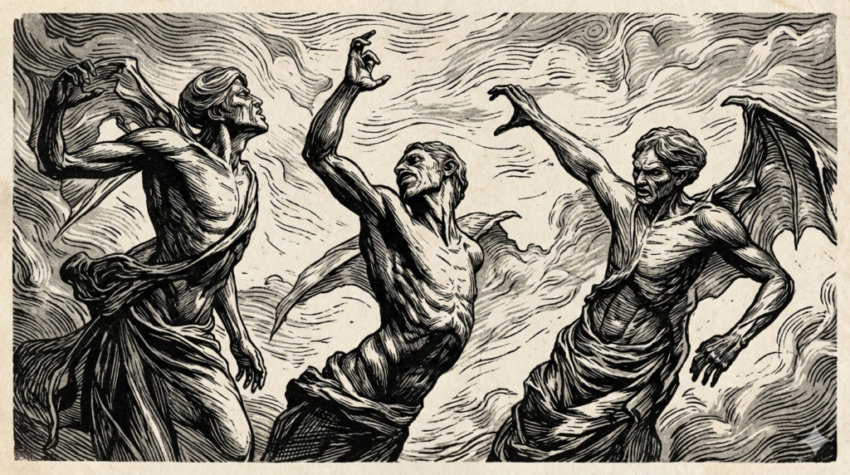
Origins, Development, and
Comparison with Orthodox Christianity
A Theological Analysis
1. Introduction to the LDS Belief in Demons
The Church of Jesus Christ of Latter-day Saints (LDS) holds distinctive theological positions regarding the nature, origin, and function of demons that significantly depart from historic Christian orthodoxy. Central to this belief system is the doctrine of premortal existence—the teaching that all human beings, Jesus Christ, and even Satan himself existed as spirit children of Heavenly Father before their earthly lives. This foundational premise shapes every aspect of LDS demonology and creates theological conclusions that orthodox Christianity has consistently rejected throughout church history.
According to LDS doctrine, demons are the disembodied spirit followers of Lucifer who rebelled against Heavenly Father’s plan of salvation during a premortal council in heaven. The official LDS Gospel Topics essay on Satan states: “Satan persuaded ‘a third part of the hosts of heaven’ to turn away from the Father. As a result of this rebellion, Satan and his followers were cut off from God’s presence and denied the blessing of receiving a physical body.” This teaching fundamentally redefines the biblical understanding of spiritual warfare, the nature of Christ, and the ontological status of evil spiritual beings.
The implications of this theology extend far beyond academic interest. If Jesus Christ and Satan are indeed “spirit brothers” as LDS doctrine teaches, this radically alters the Christian understanding of Christ’s deity, His role as Creator, and the fundamental distinction between the Creator and His creation. This paper will examine the historical origins of LDS demonology with Joseph Smith, trace its development through subsequent prophets, and provide a thorough comparison with the biblical and orthodox Christian position on these matters.
2. Historical Origins with Joseph Smith
2.1 The Foundational Texts: Book of Moses and Book of Abraham
Joseph Smith’s distinctive demonology finds its primary textual foundation in the Pearl of Great Price, specifically the Book of Moses (produced 1830–1831) and the Book of Abraham (1835). These texts, which Smith claimed were divinely revealed translations of ancient documents, introduce concepts absent from the biblical narrative, including the premortal council, Satan’s rival plan for human salvation, and the war in heaven that resulted in the casting out of Lucifer and his followers.
Moses 4:1–4 presents the foundational account:
And I, the Lord God, spake unto Moses, saying: That Satan, whom thou hast commanded in the name of mine Only Begotten, is the same which was from the beginning, and he came before me, saying—Behold, here am I, send me, I will be thy son, and I will redeem all mankind, that one soul shall not be lost, and surely I will do it; wherefore give me thine honor. But, behold, my Beloved Son, which was my Beloved and Chosen from the beginning, said unto me—Father, thy will be done, and the glory be thine forever. Wherefore, because that Satan rebelled against me, and sought to destroy the agency of man, which I, the Lord God, had given him, and also that I should give unto him mine own power; by the power of mine Only Begotten, I caused that he should be cast down; And he became Satan, yea, even the devil, the father of all lies, to deceive and to blind men, and to lead them captive at his will, even as many as would not hearken unto my voice.
Source: Pearl of Great Price, Moses 4:1–4
2.2 Joseph Smith’s Direct Teachings
Beyond the scriptural texts, Joseph Smith provided direct commentary on the nature of the premortal conflict. In the Teachings of the Prophet Joseph Smith (compiled by Joseph Fielding Smith), the founder of Mormonism states:
The contention in heaven was—Jesus said there would be certain souls that would not be saved; and the devil said he could save them all, and laid his plans before the grand council, who gave their vote in favor of Jesus Christ. So the devil rose up in rebellion against God, and was cast down, with all who put up their heads for him.
Source: Teachings of the Prophet Joseph Smith, p. 357
This teaching establishes several distinctive LDS doctrines: (1) that the plan of salvation was debated rather than decreed, (2) that Satan presented a legitimate alternative, (3) that a council voted on the competing plans, and (4) that Satan’s casting out was the result of losing this vote and subsequently rebelling. These concepts are absent from biblical Christianity and represent a fundamental reimagining of cosmic history.
2.3 The “Spirit Brother” Doctrine
Perhaps the most controversial aspect of LDS demonology is the explicit teaching that Jesus Christ and Satan are spirit brothers, both being offspring of Heavenly Father in the premortal existence. The official LDS magazine Ensign has addressed this doctrine directly:
On first hearing, the doctrine that Lucifer and our Lord, Jesus Christ, are brothers may seem surprising to some—especially to those unacquainted with latter-day revelations. But both the scriptures and the prophets affirm that Jesus Christ and Lucifer are indeed offspring of our Heavenly Father and, therefore, spirit brothers. Jesus Christ was with the Father from the beginning. Lucifer, too, was an angel ‘who was in authority in the presence of God,’ a ‘son of the morning.’ (See Isa. 14:12; D&C 76:25–27.) Both Jesus and Lucifer were strong leaders with great knowledge and influence. But as the Firstborn of the Father, Jesus was Lucifer’s older brother.
Source: Jill Mulvay Derr, “I Have a Question,” Ensign, June 1986
3. Later Teachings from Subsequent LDS Prophets
3.1 Brigham Young
Brigham Young, the second president of the LDS Church, affirmed and expanded upon Joseph Smith’s demonology. In the Discourses of Brigham Young, he stated regarding the spirits who followed Satan:
I do not think it took long to cast down one-third of the hosts of heaven, as it is written in the Bible. But let me tell you that it was one-third part of the spirits who were prepared to take tabernacles upon this earth, and who rebelled against the other two-thirds of the heavenly host.
Source: Discourses of Brigham Young, selected and arranged by John A. Widtsoe, pp. 54–55
Brigham Young also emphasized Satan’s real but limited power: “Satan never owned the earth; he never made a particle of it; his labor is not to create, but to destroy” (Journal of Discourses 10:320).
3.2 Joseph Fielding Smith
Joseph Fielding Smith, the tenth president of the LDS Church, elaborated on the premortal origins of demons:
Man, as a spirit, was begotten and born of heavenly parents, and reared to maturity in the eternal mansions of the Father, prior to coming upon the earth in a temporal [physical] body.
Source: Teachings of Presidents of the Church: Joseph F. Smith (1998), p. 335
3.3 Bruce R. McConkie
Bruce R. McConkie, an influential LDS apostle and theologian, provided extensive commentary on Satan and demons in his work Mormon Doctrine:
The appointment of Jesus to be the Savior of the world was contested by one of the other sons of God. He was called Lucifer, son of the morning. Haughty, ambitious, and covetous of power and glory, this spirit-brother of Jesus desperately tried to become the Savior of mankind.
Source: Bruce R. McConkie, Mormon Doctrine (1958), p. 193; see also Milton R. Hunter, The Gospel Through the Ages, p. 15
McConkie further stated: “Jesus Christ, Lucifer, and all of us were spirit children of God in the pre-mortal world” (Mormon Doctrine, pp. 193, 278).
3.4 Spencer W. Kimball
Spencer W. Kimball, the twelfth president of the LDS Church, explicitly described Jesus and Satan as brothers:
[W]hen Satan tempted Jesus in the wilderness, a momentous contest took place between two brothers, Jehovah and Lucifer, sons of Elohim… Satan, also a son of God, had rebelled and had been cast out of heaven and not permitted an earthly body as had his brother Jehovah.
Source: Teachings of Spencer W. Kimball (1982), p. 34
3.5 M. Russell Ballard
In more recent times, Elder M. Russell Ballard of the Quorum of the Twelve Apostles addressed this doctrine publicly during Mitt Romney’s 2008 presidential campaign. Speaking at Brigham Young University-Idaho, Ballard stated:
You remember Mr. (Mike) Huckabee, who among other things said that Mormons believe that Jesus and the devil were brothers? Remember that? It went all over the media. Well they are! But they (the media and nonmembers) don’t understand that, because they don’t have the (LDS gospel) restoration.
Source: BYU-Idaho fireside, reported in Rexburg Standard Journal and various news outlets (2007)
4. Comparison with Traditional Orthodox Christian Beliefs
4.1 The Biblical Doctrine of Christ as Creator
Orthodox Christianity maintains that Jesus Christ is not a created being but the eternal Son of God, fully divine and coequal with the Father as part of the Trinity. Scripture explicitly teaches that Christ created all things, including the angelic beings who later fell and became demons. This stands in direct contradiction to the LDS teaching that Jesus and Satan are both creatures of the same order—spirit children of Heavenly Father.
The Apostle Paul writes in Colossians 1:16–17 (ESV):
For by him all things were created, in heaven and on earth, visible and invisible, whether thrones or dominions or rulers or authorities—all things were created through him and for him. And he is before all things, and in him all things hold together.
The phrase “whether thrones or dominions or rulers or authorities” explicitly includes the angelic realm. If Christ created all spiritual powers, then He could not be of the same created order as Satan. John 1:3 (ESV) reinforces this: “All things were made through him, and without him was not any thing made that was made.” This leaves no room for Christ to be a creature alongside Satan.
4.2 The Orthodox Doctrine of Satan and Demons
Historic Christianity teaches that Satan and demons are fallen angels who were created good by God but rebelled through their own free will. Wayne Grudem, in his Systematic Theology, defines demons as “evil angels who sinned against God and who now continually work evil in the world.” He notes that “between the events of Gen 1:31 and 3:1, a rebellion in the angelic world must have taken place.”
The Eastern Orthodox Church teaches: “Satan (which means the enemy or the adversary) is one proper name for the devil, the leader of the evil spirits. He is identified in the serpent symbol of Gen 3 and as the tempter of both Job and Jesus. He is labelled by Christ as a deceiver and liar, the ‘father of lies’ (John 8:44) and the ‘prince of this world’ (John 12:31; 14:30; 16:11). He has ‘fallen from heaven’ together with his evil angels to do battle with God and his servants” (Orthodox Church in America, The Orthodox Faith).
4.3 Key Biblical Distinctions
Several biblical passages establish an unbridgeable distinction between Christ and all created beings, including angels and demons:
Hebrews 1:5—6 (ESV): “For to which of the angels did God ever say, ‘You are my Son, today I have begotten you’? Or again, ‘I will be to him a father, and he shall be to me a son’? And again, when he brings the firstborn into the world, he says, ‘Let all God’s angels worship him.’”
This passage explicitly denies that Jesus is merely an angel or spirit child among many. Unlike any angel, Jesus receives worship from all angels.
Hebrews 1:8 (ESV): “But of the Son he says, ‘Your throne, O God, is forever and ever, the scepter of uprightness is the scepter of your kingdom.’”
The Father addresses the Son as “Theos” (God), a title never given to any angel.
Isaiah 14:12–15 and Ezekiel 28:12–19 are commonly understood as describing Satan’s fall. Note the contrast: Satan “said in [his] heart, ‘I will ascend to heaven’” (Isaiah 14:13)—he desired to rise to a position he did not possess. Christ, by contrast, “though he was in the form of God, did not count equality with God a thing to be grasped” (Philippians 2:6, ESV)—He already possessed divine status.
4.4 Theological Assessments from Christian Scholars
The Christian Research Institute observes: “Contrary to Mormon teaching, therefore, Jesus is fully God and deserves to be worshiped as such (cf. Matthew 2:11; 28:17; Hebrews 1:6; Revelation 5:11–14). In sum, the distinction between the Jesus of Mormonism and the Jesus of the Bible makes all the difference in the world… The apostle Paul warned of a ‘different Jesus’ and ‘another gospel’—a counterfeit Christ and counterfeit Christianity that is impotent to save (see 2 Corinthians 11:4).”
David Jeremiah writes: “Evil entered our world when Satan and his angels determined in their hearts to oppose the plans of Almighty God. Allow me to state it plainly: demons are fallen angels. They are Satan’s servants committed to his plan to thwart the plan of God… In the year 610, the oppressive religion of Islam was born when Muhammad received the contents of the Koran in a series of visions from someone he believed to be the angel Gabriel. Twelve centuries later, the deceptive cult of Mormonism arose when an angelic being called Moroni supposedly connected Joseph Smith with the Book of Mormon.”
While I deeply respect Dr. Jeremiah’s ministry, I’d gently push back on labeling Mormonism a “cult.” By standard sociological criteria—coercive control, isolation from family, financial exploitation, authoritarian leadership preventing members from leaving—the mainstream LDS Church doesn’t qualify. Members freely associate with non-members, leave without physical restraint, and participate in broader society.
The more accurate term is “new religious movement” or, from an evangelical perspective, a “heterodox” or “non-Christian religion.” Their theology diverges substantially from historic Christianity on the nature of God, salvation, and scripture—legitimate grounds for theological distinction. But conflating doctrinal disagreement with cultic behavior muddles important categories and can actually hinder meaningful dialogue with LDS neighbors and friends.
We can firmly maintain that Mormon theology falls outside biblical orthodoxy without using terminology that implies something it isn’t.
Graham Cole, in Against the Darkness: The Doctrine of Angels, Satan, and Demons, argues that a proper understanding of angelology and demonology is essential to the gospel itself: “If Christ has suffered for our sins and risen for our justification, then Satan no longer has power and victory over us.” The fundamental question of whether Christ created Satan or is merely his spiritual sibling determines the very nature of salvation.
5. Conclusion: The Incompatibility of LDS Demonology with Biblical Christianity
As much as modern Mormonism would like to be considered “Christian,” its view of demonology—like many of its other doctrines—is fundamentally incompatible with biblical evidence. The differences are not peripheral matters of interpretation but strike at the heart of Christian theology:
First, the deity of Christ is compromised. If Jesus is a spirit child of Heavenly Father alongside Lucifer, He cannot be the eternal, uncreated God who existed “in the beginning” with the Father (John 1:1). The LDS Jesus is ontologically categorized with created beings rather than with the Creator.
Second, Christ’s role as Creator is denied. Colossians 1:16 states that Christ created “all things… whether thrones or dominions or rulers or authorities.” If Satan is Jesus’ spirit brother, then Jesus did not create him—a direct contradiction of Scripture.
Third, the Creator-creature distinction is blurred. Orthodox Christianity maintains an absolute distinction between the Creator and all created beings. LDS theology collapses this distinction by placing God, Christ, humans, angels, and demons all on a continuum of “spirit children” at various stages of eternal progression.
Fourth, the nature of evil is redefined. In LDS thought, Satan’s rebellion was essentially a political defeat—his plan lost a vote in a heavenly council. Biblical Christianity teaches that Satan’s rebellion was an act of cosmic treason against the sovereign Creator, not a disagreement among siblings.
The Apostle Paul warned the Corinthians about those who preach “another Jesus” and “a different gospel” (2 Corinthians 11:4). The Jesus of LDS theology—a spirit brother to Satan, a created being who progressed to godhood, one among many sons in the same sense that all humans are sons of God—is precisely such “another Jesus.”
GotQuestions.org summarizes the issue well: “Jesus is God the Son, and in Him the fullness of the Godhead dwelt bodily (Colossians 2:9). He created Satan, and one day He will cast Satan into the lake of fire as the just punishment for his rebellion against God. Sadly, on that Day of Judgment those who fall for Satan’s lies will also be cast into the lake of fire with Satan and His demons. The god of the Mormons and Jehovah’s Witnesses is not the God who revealed Himself in Scripture.”
While we approach this analysis with scholarly objectivity, the concern remains pastoral and evangelistic. The truth claims of LDS theology regarding demons, Christ, and the nature of spiritual reality differ so substantially from biblical Christianity that they represent a different religious system altogether. The invitation of the gospel remains: to know the true Christ, not a spirit brother of Satan, but the eternal Word who was with God and was God from the beginning (John 1:1), through whom all things were made (John 1:3), and in whom alone is salvation (Acts 4:12).
Bibliography
- Church of Jesus Christ of Latter-day Saints. “Satan.” Gospel Topics.
- Cole, Graham A. Against the Darkness: The Doctrine of Angels, Satan, and Demons. Wheaton, IL: Crossway, 2019.
- Grudem, Wayne. Systematic Theology: An Introduction to Biblical Doctrine. Grand Rapids: Zondervan, 1994.
- Hanegraaff, Hank. “Does Mormonism Really Teach That Jesus Is the Spirit Brother of Satan?” Christian Research Institute.
- Hunter, Milton R. The Gospel Through the Ages. Salt Lake City: Stevens and Wallis, 1945.
- Jeremiah, David. “What Does the Bible Say About the Origins of Angels, Demons, and Lucifer?” David Jeremiah Blog.
- Kimball, Spencer W. Teachings of Spencer W. Kimball. Salt Lake City: Bookcraft, 1982.
- McConkie, Bruce R. Mormon Doctrine. 2nd ed. Salt Lake City: Bookcraft, 1966.
- Orthodox Church in America. “Angels and Evil Spirits.” The Orthodox Faith.
- Pearl of Great Price (Book of Moses; Book of Abraham). Salt Lake City: Church of Jesus Christ of Latter-day Saints.
- Smith, Joseph Fielding, comp. Teachings of the Prophet Joseph Smith. Salt Lake City: Deseret Book, 1976.
- Widtsoe, John A., comp. Discourses of Brigham Young. Salt Lake City: Deseret Book, 1954.
A New Testament list of mentions about demons.
The New Testament contains numerous references to demons (often termed “unclean spirits” or “evil spirits”), primarily in the Gospels depicting Jesus’ exorcisms and authority over them, with additional mentions in Acts and epistles. Below is a compiled bullet-point list of key verses from the ESV, focusing on direct mentions of demons or their activities.
Matthew 4:24: “So his fame spread throughout all Syria, and they brought him all the sick, those afflicted with various diseases and pains, those oppressed by demons, those having seizures, and paralytics, and he healed them.”[crossway]
Matthew 7:22: “On that day many will say to me, ‘Lord, Lord, did we not prophesy in your name, and cast out demons in your name, and do many mighty works in your name?'”[esv]
Matthew 8:16: “That evening they brought to him many who were oppressed by demons, and he cast out the spirits with a word and healed all who were sick.”[openbible]
Matthew 8:28–31: “And when he came to the other side, to the country of the Gadarenes, two demon-possessed men met him, coming out of the tombs, so fierce that no one could pass that way. And behold, they cried out, ‘What have you to do with us, O Son of God? Have you come here to torment us before the time?’ Now a herd of many pigs was feeding at some distance from them. And the demons begged him, saying, ‘If you cast us out, send us away into the herd of pigs.'”[gotquestions]
Matthew 9:32–34: “As they were going away, behold, a demon-oppressed man who was mute was brought to him. And when the demon had been cast out, the mute man spoke. And the crowds marveled, saying, ‘Never was anything like this seen in Israel.'”[openbible]
Matthew 10:1: “And he called to him his twelve disciples and gave them authority over unclean spirits, to cast them out, and to heal every disease and every affliction.”[biblehub]
Matthew 12:24: “But when the Pharisees heard it they said, ‘It is only by Beelzebul, the prince of demons, that this man casts out demons.'”[bible]
Matthew 12:43–45: ““When the unclean spirit has gone out of a person, it passes through waterless places seeking rest, but finds none. Then it says, ‘I will return to my house from which I came.’ And when it comes, it finds the house empty, swept, and put in order. Then it goes and brings with it seven other spirits more evil than itself, and they enter and dwell there, and the last state of that person is worse than the first. So also will it be with this evil generation.””[biblegateway]
Matthew 17:18: “And Jesus rebuked the demon, and it came out of him, and the boy was healed instantly.”[facebook]
Mark 1:23–27: “And immediately there was in their synagogue a man with an unclean spirit. And he cried out, ‘What have you to do with us, Jesus of Nazareth? Have you come to destroy us? I know who you are—the Holy One of God.’ But Jesus rebuked him, saying, ‘Be silent, and come out of him!’ And the unclean spirit, convulsing him and crying out with a loud voice, came out of him. And they were all amazed, so that they questioned among themselves, saying, ‘What is this? A new teaching with authority! He commands even the unclean spirits, and they obey him.'”[gotquestions]
Mark 3:11: “And whenever the unclean spirits saw him, they fell down before him and cried out, ‘You are the Son of God.'”[gotquestions]
Mark 5:1–5: “They came to the other side of the sea, to the country of the Gerasenes. And when Jesus had stepped out of the boat, immediately there met him out of the tombs a man with an unclean spirit. He lived among the tombs. And no one could bind him anymore, not even with a chain, for he had often been bound with shackles and chains, and the chains he wrenched apart, and the shackles he broke in pieces; and no one had the strength to subdue him. Night and day among the tombs and on the mountains he was always crying out and cutting himself with stones.”[gotquestions]
Mark 5:12: “and they begged him, saying, ‘Send us to the pigs; let us enter them.'”[gotquestions]
Mark 16:17: “And these signs will accompany those who believe: in my name they will cast out demons; they will speak in new tongues.”[esv]
Luke 4:33–36: “And in the synagogue there was a man who had the spirit of an unclean demon, and he cried out with a loud voice, ‘Ha! What have you to do with us, Jesus of Nazareth? Have you come to destroy us? I know who you are—the Holy One of God.’ But Jesus rebuked him, saying, ‘Be silent and come out of him!’ And when the demon had thrown him down in their midst, he came out of him, having done him no harm. And they were all amazed and said to one another, ‘What is this word? For with authority and power he commands the unclean spirits, and they come out!'”[gotquestions]
Luke 8:2: “and also some women who had been healed of evil spirits and infirmities: Mary, called Magdalene, from whom seven demons had gone out.”[crossway]
Luke 8:30: “Jesus then asked him, ‘What is your name?’ And he said, ‘Legion,’ for many demons had entered him.”[gotquestions]
Luke 10:17: “The seventy-two returned with joy, saying, ‘Lord, even the demons are subject to us in your name!'”[esv]
Luke 11:14: “Now he was casting out a demon that was mute, so that the one who had a demon was mute and could speak. And the crowds marveled.”[openbible]
Acts 16:16–18: “As we were going to the place of prayer, we were met by a slave girl who had a spirit of divination and brought her owners much gain by fortune-telling. She followed Paul and us, crying out, ‘These men are servants of the Most High God, who proclaim to you the way of salvation.’ And this she kept doing for many days. Paul, having become greatly annoyed, turned and said to the spirit, ‘I command you in the name of Jesus Christ to come out of her.’ And it came out that very hour.”[facebook]
Acts 19:13–16: “Then some of the itinerant Jewish exorcists undertook to invoke the name of the Lord Jesus over those who had evil spirits, saying, ‘I adjure you by the Jesus whom Paul proclaims.’ Seven sons of a Jewish high priest named Sceva were doing this. But the evil spirit answered them, ‘Jesus I know, and Paul I recognize, but who are you?’ And the man in whom was the evil spirit leaped on them, mastered all of them and overpowered them, so that they fled out of that house naked and wounded.”[crossway]
1 Corinthians 10:20: “No, I imply that what pagans sacrifice they offer to demons and not to God. I do not want you to be participants with demons.”[crossway]
1 Timothy 4:1: “Now the Spirit expressly says that in later times some will depart from the faith by devoting themselves to deceitful spirits and teachings of demons.”[crossway]
James 2:19: “You believe that God is one; you do well. Even the demons believe—and shudder!”[crossway]
Revelation 16:14: “For they are demonic spirits, performing signs, who go abroad to the kings of the whole world, to assemble them for battle on the great day of God the Almighty.”[openbible]
Revelation 18:2: “And he called out with a mighty voice, ‘Fallen, fallen is Babylon the great! She has become a dwelling place for demons, a haunt for every unclean spirit, a haunt for every unclean bird, a haunt for every unclean and detestable beast.'”[crossway]
New Testament mentions of Satan or devils.
The New Testament explicitly names “Satan” or “the devil” (Greek: diabolos) over 50 times across the Gospels, Acts, epistles, and Revelation, portraying this figure as the adversary, tempter, accuser, and deceiver opposed to God and His people. Below is a comprehensive bullet-point list of key verses from the ESV where the name appears directly, grouped by book for clarity, drawing from the scriptural context established in prior exchanges on demons.
Matthew
Matthew 4:10: “Then Jesus said to him, ‘Be gone, Satan! For it is written, ‘You shall worship the Lord your God and him only shall you serve.””
Matthew 12:26: “And if Satan casts out Satan, he is divided against himself. How then will his kingdom stand?”
Matthew 16:23: “But he turned and said to Peter, ‘Get behind me, Satan! You are a hindrance to me. For you are not setting your mind on the things of God, but on the things of man.'”
Mark
Mark 1:13: “And he was in the wilderness forty days, being tempted by Satan. And he was with the wild animals, and the angels were ministering to him.”
Mark 3:23: “And he called them to him and said to them in parables, ‘How can Satan cast out Satan?'”
Mark 3:26: “And if Satan has risen up against himself and is divided, he cannot stand, but is coming to an end.”
Mark 4:15: “And these are the ones along the path where the word is sown: when they hear, Satan immediately comes and takes away the word that is sown in them.”
Mark 8:33: “But turning and seeing his disciples, he rebuked Peter and said, ‘Get behind me, Satan! For you are not setting your mind on the things of God, but on the things of man.'”
Luke
Luke 4:8: “And Jesus answered him, ‘It is written, “You shall worship the Lord your God, and him only shall you serve.”‘”
Luke 10:18: “And he said to them, ‘I saw Satan fall like lightning from heaven.'”
Luke 11:18: “If Satan also is divided against himself, how will his kingdom stand? For you say that I cast out demons by Beelzebul.”
Luke 13:16: “And ought not this woman, a daughter of Abraham whom Satan bound for eighteen years, be loosed from this bond on the Sabbath day?”
Luke 22:3: “Then Satan entered into Judas called Iscariot, who was of the number of the twelve.”
Luke 22:31: “Simon, Simon, behold, Satan demanded to have you, that he might sift you like wheat.”
John
John 6:70: “Jesus answered them, ‘Did I not choose you, the Twelve? And yet one of you is a devil.'”
John 8:44: “You are of your father the devil, and your will is to do your father’s desires. He was a murderer from the beginning, and does not stand in the truth, because there is no truth in him. When he lies, he speaks out of his own character, for he is a liar and the father of lies.”
John 12:31: “Now is the judgment of this world; now will the ruler of this world be cast out.”
John 13:2: “During supper, when the devil had already put it into the heart of Judas Iscariot, Simon’s son, to betray him.”
John 13:27: “Then after he had taken the morsel, Satan entered into him. Jesus said to him, ‘What you are going to do, do quickly.'”
John 17:12: “While I was with them, I kept them in your name, which you have given me. I have guarded them, and not one of them has been lost except the son of destruction, that the Scripture might be fulfilled.”
Acts
Acts 5:3: “But Peter said, ‘Ananias, why has Satan filled your heart to lie to the Holy Spirit and to keep back for yourself part of the proceeds of the land?'”
Acts 13:10: “You son of the devil, you enemy of all righteousness, full of all deceit and villainy, will you not stop making crooked the straight paths of the Lord?”
Acts 26:18: “To open their eyes, so that they may turn from darkness to light and from the power of Satan to God, that they may receive forgiveness of sins and a place among those who are sanctified by faith in me.”
Romans through Revelation (Epistles and Apocalypse)
Romans 16:20: “The God of peace will soon crush Satan under your feet. The grace of our Lord Jesus Christ be with you.”
1 Corinthians 5:5: “Deliver this man to Satan for the destruction of the flesh, so that his spirit may be saved in the day of the Lord.”
1 Corinthians 7:5: “Do not deprive one another, except perhaps by agreement for a limited time, that you may devote yourselves to prayer; but then come together again, so that Satan may not tempt you because of your lack of self-control.”
2 Corinthians 2:11: “So that we would not be outwitted by Satan; for we are not ignorant of his designs.”
2 Corinthians 11:14: “And no wonder, for even Satan disguises himself as an angel of light.”
2 Corinthians 12:7: “So to keep me from becoming conceited because of the surpassing greatness of the revelations, a thorn was given me in the flesh, a messenger of Satan to harass me, to keep me from becoming conceited.”
1 Thessalonians 2:18: “Because we wanted to come to you—I, Paul, again and again—but Satan hindered us.”
2 Thessalonians 2:9: “The coming of the lawless one is by the activity of Satan with all power and false signs and wonders.”
1 Timothy 1:20: “Among whom are Hymenaeus and Alexander, whom I have handed over to Satan that they may learn not to blaspheme.”
1 Timothy 5:15: “For some have already strayed after Satan.”
Revelation 2:9: “I know your tribulation and your poverty (but you are rich) and the slander of those who say that they are Jews and are not, but are a synagogue of Satan.”
Revelation 2:10: “‘Do not fear what you are about to suffer. Behold, the devil is about to throw some of you into prison, that you may be tested, and for ten days you will have tribulation. Be faithful unto death, and I will give you the crown of life.”
Revelation 2:13: “I know where you dwell, where Satan’s throne is. Yet you hold fast my name, and you did not deny my faith even in the days of Antipas my faithful witness, who was killed among you, where Satan dwells.”
Revelation 2:24: “But to the rest of you in Thyatira, who do not hold this teaching, who have not learned what some call the deep things of Satan, to you I say, I do not lay on you any other burden.”
Revelation 3:9: “Behold, I will make those of the synagogue of Satan who say that they are Jews and are not, but lie—behold, I will make them come and bow down before your feet, and they will learn that I have loved you.”
Revelation 12:9: “And the great dragon was thrown down, that ancient serpent, who is called the devil and Satan, the deceiver of the whole world—he was thrown down to the earth, and his angels were thrown down with him.”
Revelation 20:2: “And he seized the dragon, that ancient serpent, who is the devil and Satan, and bound him for a thousand years.”
Revelation 20:7: “And when the thousand years are ended, Satan will be released from his prison.”