
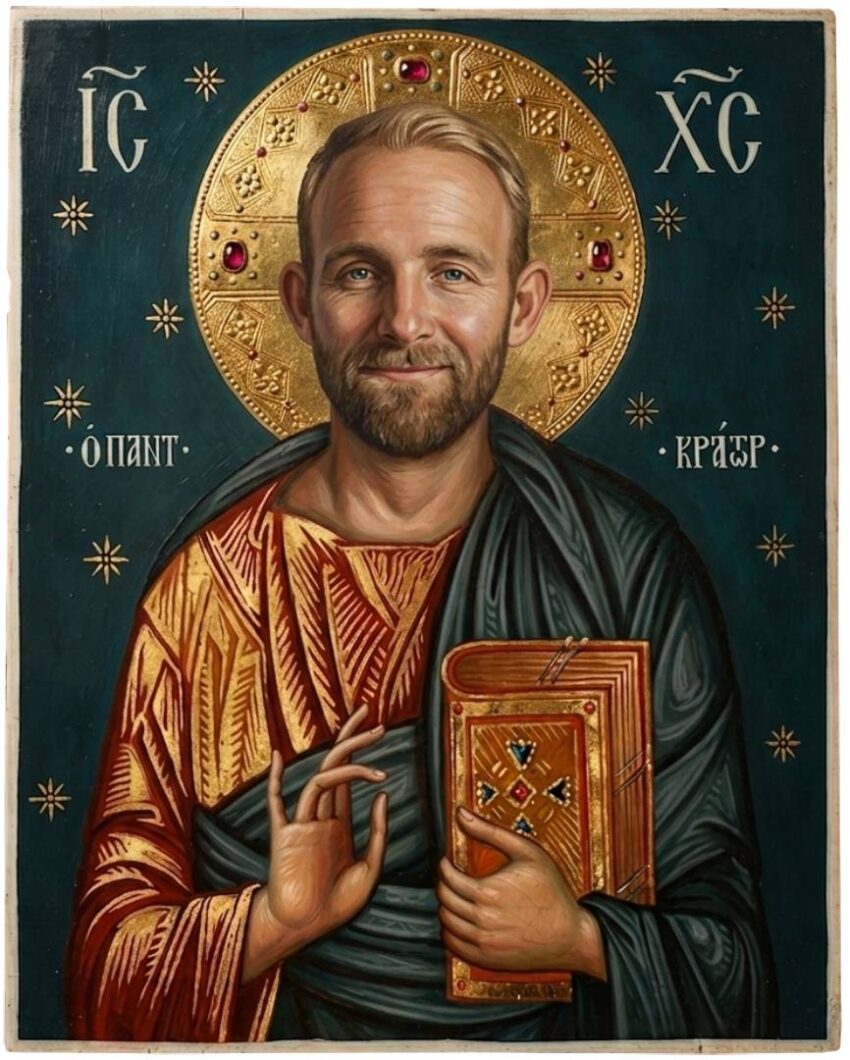
Photo: This image shows Jacob Hansen channeling his inner Justin Martyr, minus that whole beheading by the Roman prefect Rusticus. Hansen is a Latter-day Saint businessman, father of four, seminary teacher, youth-football coach, surfer, hunter, sailor, Jiu-Jitsu enthusiast, and operator of Thoughtful Faith—a channel apparently founded on the premise that a sufficiently busy man can refute atheism, Islam, and historical criticism somewhere between carpool pickup and a rear-naked choke.
Raised outside Sparks, Nevada, in a blue-collar LDS family of eight, Hansen served a mission in Argentina before confronting the horrifying realization that relatives can leave the Church without immediately being struck by doctrinal lightning. When all seven siblings and much of his extended family departed, he embarked on a decade-long intellectual journey—one that seems to have ended precisely where it began, except now furnished with YouTube lighting, clipped quotations from General Authorities, and a sturdy aversion to conclusions that fail ecclesiastical inspection.
His apologetic method is admirably efficient: identify a difficult question, cite a prophet, declare the matter eternally settled, and treat unresolved evidence as a spiritual character defect. If ice-cream sales and shark attacks both rise in July, Hansen’s worldview assures us there is no need to investigate temperature, tourism, or ocean access—just ask whether the correlation supports the approved conclusion.
In the end, the only apologetic claim Jacob Hansen can make is self-imposed: his defense of Mormonism is less an argument than a vow never to permit the evidence a meaningful rebuttal.
Claude AI summary of Radio Free Mormon • Episode 475
Recorded August 21, 2026 · Premiered August 22, 2026 · Approx. 1 hr 11 min
Overview
Episode 475 is a sustained critique of Latter-day Saint apologist Jacob Hansen and of what the host regards as an untenable position: that LDS prophets can be, and demonstrably have been, wrong about consequential doctrinal matters, and yet remain trustworthy guides whom members must follow. The host frames this not as bad reasoning but as deception — hence the title. The program proceeds through slides, video clips, scriptural tests, and historical case studies, closing with a satirical sketch offered as the most economical refutation of Hansen’s position.
◆ ◆ ◆
The Charge Stated
The host opens by defining precisely what he means by the accusation of lying. He grants that it would be no lie for an apologist who sincerely believed prophets do not err doctrinally to urge members to follow them. The charge attaches specifically because Hansen has publicly conceded, on multiple occasions, that LDS prophets have erred — and not on trivia, but on matters of first-order doctrinal importance. The example the host returns to throughout is the priesthood and temple ban on black members, which stood for 126 years until 1978.
Having conceded the unreliability, the host argues, Hansen nevertheless urges reliance. That combination, not the concession itself, constitutes the alleged deception.
We do not need to trust those who are not trustworthy.
— Radio Free Mormon, Episode 475
He distinguishes his own position from Hansen’s: he too criticizes the LDS leadership, but he is not a believing member, does not regard these men as prophets, and is not encouraging anyone to follow them — which Hansen does while acknowledging the grounds that make it unwise.
Why Hansen Concedes the Point
The host attributes Hansen’s position to strategic necessity rather than conviction. Hansen has said publicly that the strong claim — that prophets never err — cannot survive the historical record, and so has adopted the position that prophets do err but must be followed anyway. The host calls this an attempt to affirm two mutually exclusive propositions at once, producing titles like Hansen’s own “Can a prophet be wrong and still be a prophet?” The host’s answer is a flat no.
◆ ◆ ◆
The Widened Staircase
Much of the episode’s first half examines an illustration Hansen employs, drawn from a BYU professor’s presentation. It depicts a staircase to heaven with two lines: one wandering back and forth but remaining on the stairs, representing prophets who err without leading the Church astray; and one departing entirely off the path, representing something the apologist insists has never happened.
The host raises two objections. The illustration is unfalsifiable by design: no one can specify what magnitude of error counts as leaving the path, so the claim can never be tested. And the path has been drawn wide enough to accommodate every documented deviation — quietly abandoning the scriptural strait and narrow way, on which each of those wanderings is itself a departure.
Applied to the priesthood ban, the illustration fails outright. From the perspective of a black Latter-day Saint living under it, the ban was not a deviation within the path but exclusion from the path altogether — barred from the ordinances the Church deems necessary to exaltation.
◆ ◆ ◆
“We Will Always Teach the Truth”
The host next plays a BYU address by Russell M. Nelson, in which the late Church president describes prophets and apostles as appointed to teach God’s laws, states that they are commanded to teach truth, and concludes with an unqualified assertion.
Prophets are rarely popular, but we will always teach the truth.
— Russell M. Nelson, BYU address
The host treats this as decisive against Hansen’s framework. If the statement is true, the wandering line in the staircase diagram should be perfectly straight; there is no room in “always” for periodic doctrinal error. And if the statement is false, then a Church president speaking in his prophetic capacity has himself taught something untrue — which concedes the point by another route.
The Moral Corollary
The host presses further on Nelson’s claim that prophets are commanded to teach truth. If that is so, then every occasion on which Hansen concedes prophetic doctrinal error becomes an occasion on which the prophets violated a divine commandment. The consequence, as the host frames it, is not merely that the leaders were mistaken but that they were disobedient — and, by Nelson’s own logic that withholding revealed truth is uncaring, that they were also uncharitable toward the membership. Hansen’s position, on this reading, places him in the awkward posture of correcting the prophets he is defending.
◆ ◆ ◆
Motte and Bailey
The host identifies Hansen’s argument as a motte-and-bailey fallacy, explaining the medieval fortification behind the name: a small, easily defended stronghold atop a mound, paired with a larger, more useful but less defensible enclosure below. When the bailey is overrun, its inhabitants retreat to the motte.
Applied to apologetics, the bailey is the desirable, expansive claim: prophets always teach the truth. It is also the claim most vulnerable to attack, since a single documented counterexample overruns it. When that happens, the apologist withdraws to the motte: prophets do make doctrinal mistakes, but never enough to lead the Church astray.
The retreat is not the safe harbor Hansen imagines. Once doctrinal error is conceded, the member has no principled way to distinguish present teaching from future-acknowledged error — precisely the realization that has driven many out. The host also notes a shift: where defenders once conceded only trivial mistakes, they now concede moral and doctrinal ones, a change he credits to the information now freely available online.
Redefining “Astray”
The whole defense, the host contends, rests on a redefinition. Apologists now use “astray” to mean completely and irretrievably lost, rather than its ordinary sense of being led off the correct path, even temporarily. The redefinition has a cost he considers fatal: it leaves believers with no method whatsoever for determining whether the Church has ever been led astray, or ever could be.
A methodology that cannot in principle return a particular verdict is not inquiry but a device for guaranteeing a predetermined conclusion — like an experiment on the color of the sky that admits only evidence for redness, and thereby forecloses discovering that it is blue.
Lines in the Sand
A viewer comment notes that Hansen concedes the need to draw a personal line for how much prophetic fallibility is too much. Hansen’s line concerns same-sex marriage and transgender questions; the commenter’s was misrepresentation of the Book of Mormon translation. The implication is sharp: the line’s placement is preference, not principle — and Hansen’s tolerates 126 years of racial exclusion while treating a prospective policy change as disqualifying.
◆ ◆ ◆
The Deuteronomic Tests
The second half turns from Hansen’s reasoning to a scriptural standard. Does Scripture supply a means of testing a prophet? The host answers from Deuteronomy 18 — a passage that survives unaltered in the Joseph Smith Translation and therefore cannot be dismissed as corrupt. He observes that these tests are seldom taught in LDS Sunday School, and suggests the omission is not accidental.
But the prophet, which shall presume to speak a word in my name, which I have not commanded him to speak, or that shall speak in the name of other gods, even that prophet shall die. … When a prophet speaketh in the name of the LORD, if the thing follow not, nor come to pass, that is the thing which the LORD hath not spoken, but the prophet hath spoken it presumptuously: thou shalt not be afraid of him.
— Deuteronomy 18:20, 22 (KJV)
He is explicit that he is not invoking the capital penalty; he reads the death clause as Scripture’s way of saying such a person was not sent by God. What matters is the epistemic conclusion: such a figure need not be feared, followed, or trusted.
Test One: The Unfulfilled Prophecy
The host applies this test to the Jackson County, Missouri, temple site dedicated by Joseph Smith on August 3, 1831 — which today holds markers and a visitor center but no temple. Doctrine and Covenants 84, presented as the word of Jesus Christ, specifies both location and timeframe.
Verily this is the word of the Lord, that the city New Jerusalem shall be built by the gathering of the saints, beginning at this place, even the place of the temple, which temple shall be reared in this generation. For verily this generation shall not all pass away until an house shall be built unto the Lord.
— Doctrine and Covenants 84:4–5
Nearly two centuries have elapsed. Verse 5, the host argues, forecloses the escape of treating “generation” as indefinitely elastic, since the revelation defines the term by the lifespans of those then living. He adds a dictionary treatment showing the word’s ordinary senses are straightforward until apologetic necessity intervenes — and acknowledges candidly that he used the elastic reading himself during his own years as an apologist.
The Rule Against Surplusage
Drawing on legal training, the host introduces maxims of statutory construction as a parallel. Courts cannot interrogate a legislature; they must recover meaning from the enacted text. Legislatures are presumed not to use redundant words; every clause must be given distinct meaning; and a reading that renders any portion void should be rejected where another reasonable reading gives it purpose.
Applied to section 84, the point bites. If “in this generation” imposes no temporal limit, the phrase does no work at all — the apologetic meaning would be fully conveyed without it. Interpreters owe at least as much deference to words attributed to God as courts owe a legislature, and excising inconvenient clauses places the interpreter above the revelation he defends.
Test Two: Presuming to Speak in God’s Name
The other test poses an evidentiary difficulty: how can one show that God did not give a prophet something to say? The host proposes that reversals supply the proof — where one prophet declares X as God’s word and a successor declares not-X, both cannot have been speaking for God. In LDS ecclesiology, this is no small matter: the line of authority from Joseph Smith forward must be unbroken, since a false prophet anywhere in the chain disrupts the keys.
The 1949 First Presidency Statement
The first case is the First Presidency statement of 1949 on the priesthood restriction, which expressly disclaimed the language of policy.
It is not a matter of the declaration of a policy but of direct commandment from the Lord.
— First Presidency statement, 1949
The statement calls the restriction doctrine a commandment, not administrative practice — while the Church’s later Gospel Topics essay retroactively describes it as a policy leaders sought revelation to alter. The host puts the resulting choice starkly: if the ban was God’s commandment, God is a racist; if it was not, the men who declared it so failed the Deuteronomic test. He sees no third option.
The 2015 Policy of Exclusion and Its 2019 Reversal
The second case is the November 2015 handbook change — the policy of exclusion — which classified members in same-sex marriages as apostates and barred their children from baby blessings, baptism, ordination, and missionary service absent disavowal of their parents’ relationship. Though remembered as policy, it was presented as revelation. In January 2016, Russell M. Nelson described the process in explicitly revelatory terms.
The Lord inspired His prophet to declare the mind of the Lord and the will of the Lord.
— Russell M. Nelson, January 2016
The host counts five distinct claims to revelation in that passage. Three and a half years later, in April 2019, the policy was reversed — and the reversal was likewise attributed to divine direction.
We recently felt directed to adjust the policy.
— Russell M. Nelson, April 2019
This, the host argues, is the cleanest available demonstration. Either God reversed himself on a matter of grave moral consequence within forty-two months, or on at least one of those occasions the leaders spoke in God’s name what God had not given them to speak. He considers the second far more probable — and under Deuteronomy 18, decisive.
◆ ◆ ◆
Two Definitions of “Prophet”
The host closes by laying out the only two definitions he considers available. The first defines a prophet as one who does not err doctrinally and therefore ought to be followed — a definition the historical record destroys. The second defines a prophet as one who does err — accommodating history at the cost of producing someone who ought not be followed, because he is sometimes wrong and no one can tell when.
The concluding difficulty is epistemic. The prophets evidently do not know when they are mistaken, since they would presumably not attribute a teaching to God if they did. If they cannot identify their own errors, members cannot identify them in advance either — and nothing they teach can be trusted at the moment it is taught, which is the only moment that matters.
◆ ◆ ◆
The Closing Satire: “Infallible Electronics”
The episode ends with a stand-up routine by a comedian performing as the Holy Roast. A customer shops for a calculator at a store called Infallible Electronics. The salesman guarantees it will never lead him astray, then reveals that questions must be submitted in advance, that some are simply not answered, and that the device has been horribly wrong in the past.
Offered twelve more calculators to cross-check the first, he learns their consensus also changes over time — explained as a product of the culture of its era, or blamed on his own insufficient faith. He is directed to the president of the calculators, whose authority derives entirely from having outlived the others. Corrections, he is told, once took decades and sometimes 130 years. The device never announces an error; it goes silent on the question until customers forget the old answer.
The calculators will never be allowed to lead you astray.
— The Holy Roast, “Infallible Electronics”
The routine closes darkly. Assured that everything works out in the end — after death — and warned that refusal means eternal separation from family, the customer asks about those for whom it did not work. The salesman’s answer, delivered as though it were mitigating, is that the casualties were mostly gay teenagers. The customer walks out.
The host offers the sketch as his closing argument, contending that a position dismantled this efficiently by satire is a position in serious trouble.
◆ ◆ ◆
Concluding Assessment
The host ends on qualified acknowledgment. He credits Hansen for abandoning the indefensible claim that prophets do not err, reading the concession as evidence that apologists have been forced onto more honest ground by the availability of information. But Hansen has stopped one step short of the conclusion his own premises require: having granted colossal doctrinal error, the reasonable next move would be to loosen his hold on the Church’s exclusive truth claims. Instead, he has doubled down — choosing, in the host’s judgment, a hill on which he will die by a thousand cuts.
Prepared from the full episode transcript. Quotations reproduced in brief for commentary and review.
❦ ❦ ❦
A NOTE ON METHOD AND ARTIFICIAL INTELLIGENCE
This summary was drafted with the assistance of Claude, an AI research and writing system developed by Anthropic, working under the author’s direction and to the author’s specifications.