
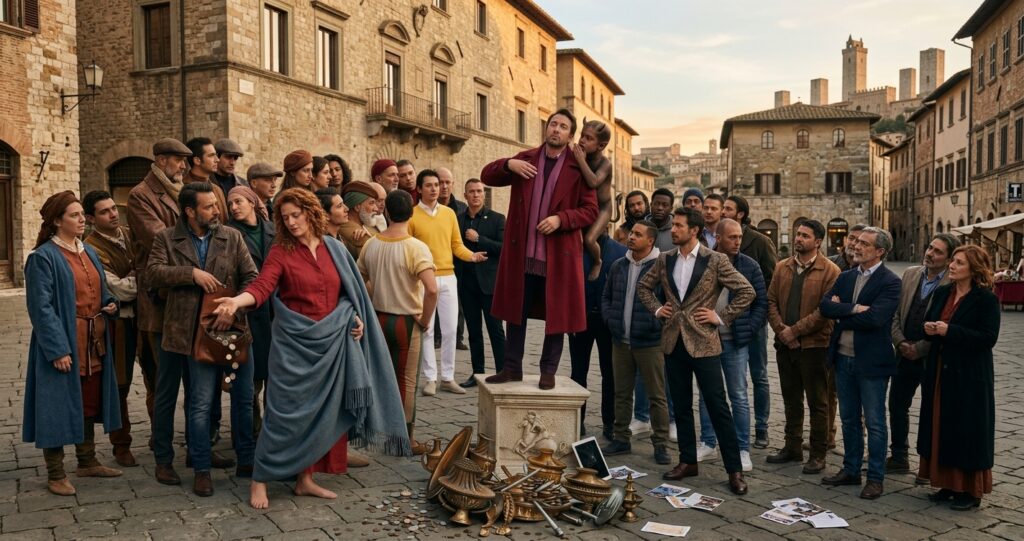
PHOTO: Google Gemini imagines an interesting interpretation of this quote by
Michael Christensen at Religion News Service: “This raises the unsettling question:
Is Thiel exposing the Antichrist, or announcing it?”
One might be tempted to ask, “Where is Thiel getting his information?”
When a Billionaire Reads the Apocalypse: Peter Thiel, the Antichrist,
and the Book That Was Written for Our Learning
❧ ✦ ❧
Introduction: The Theologian Nobody Ordained
There was a time when talk of the Antichrist belonged to the tent revival, the paperback prophecy chart, and the late-night radio preacher with a map of the Middle East and a sense of urgency. Few would have predicted that the most widely reported Christian lecturer on the subject in 2025 and 2026 would be a German-born, Stanford-trained venture capitalist worth some $27 billion, a man who co-founded PayPal, chairs the data-analytics giant Palantir, and wrote the first outside check to Facebook. Yet that is where we are. Peter Thiel has carried his warnings about the Antichrist from San Francisco to Cambridge, from Paris to the very doorstep of the Vatican, and the press has followed him at every stop.
Writing for The Verge, David Gibson framed the moment with a single, slightly incredulous sentence:
It’s an issue on which the billionaire techno-capitalist is a self-styled expert, and, somehow, Thiel has become America’s most provocative and visible Christian theologian.
— David Gibson, “The Gospel according to Peter (Thiel),” The Verge
That word somehow deserves our attention. Thiel holds no theological degree, belongs to no identifiable congregation, and has never submitted his exegesis to any church body or scholarly guild. His central claim, delivered in private lectures that were meant to stay off the record, is that the Antichrist of the twenty-first century will not arrive as a mad scientist or a horned tyrant, but as a smiling guardian of “peace and safety” who uses fear of nuclear war, climate collapse, and runaway artificial intelligence to build a one-world government. On this reading, the regulator, the environmental activist, and the AI-safety researcher become the forerunners of the Beast. As Gibson notes, Thiel believes that effective altruism, the utilitarian movement embedded across the AI industry, “will bring about the Antichrist.”
This essay takes Thiel seriously enough to test him. It asks who he is, what he believes, what training he brings to the most difficult book in the Bible, whether his technological reading of the Antichrist has real support in Scripture and in the church’s long tradition of interpretation, where his ideas come from, and why he keeps returning to the subject. It ends where every Christian conversation about the last things ought to end: with the text that God gave His people for their instruction, and with the call to test every voice, however wealthy or brilliant, against it.
❧ ✦ ❧
Who Is Peter Thiel?
From Frankfurt to Stanford
Peter Andreas Thiel was born in Frankfurt am Main, West Germany, on October 11, 1967 (author’s note: this was my second year of college as a Business Administration major). His family moved to the United States when he was one year old, and his father’s work as a chemical engineer for mining companies produced an itinerant childhood that included years in South Africa and South West Africa (modern Namibia) during apartheid. Thiel changed elementary schools seven times. He has said that a German-language school in Swakopmund, with its uniforms and corporal punishment, gave him a lasting distaste for regimentation. The family settled in Foster City, California, in 1977. Thiel was a gifted mathematics student, a rated chess master, and the valedictorian of San Mateo High School in 1985.
At Stanford University, he studied philosophy, earning a B.A. in 1989, and then a J.D. from Stanford Law School in 1992. As an undergraduate, he co-founded The Stanford Review, a conservative-libertarian newspaper that opposed the university’s turn toward multiculturalism. With David Sacks, he later co-wrote The Diversity Myth (1995), an attack on what the authors saw as political intolerance at Stanford. Passages in that book concerning rape drew renewed criticism decades later, and Thiel publicly apologized for them in 2016. It was also at Stanford that Thiel came to know the French literary theorist René Girard, whose ideas would shape his thinking for the rest of his life, and the campus minister Robert Hamerton-Kelly, who introduced the two men.
PayPal, Palantir, and the Fortune
After a clerkship on the Eleventh Circuit, a brief stint as a securities lawyer, work as a derivatives trader, and speechwriting for former Education Secretary William Bennett, Thiel returned to California. In 1998, he co-founded Confinity with Max Levchin and Luke Nosek. Britannica records that PayPal was designed to create “a new world currency,” an irony worth remembering when we come to Thiel’s fears of a one-world financial order. After the merger with Elon Musk’s X.com and an internal struggle that installed Thiel as chief executive, PayPal was sold to eBay in 2002 for $1.5 billion.
He then launched the hedge fund Clarium Capital, and in 2003 he incorporated Palantir Technologies, named after the “seeing stones” in Tolkien’s Lord of the Rings. Palantir analyzes vast stores of data for intelligence, defense, and law-enforcement clients; the CIA invested through its venture arm, and more recently the company signed an agreement with U.S. Immigration and Customs Enforcement to help identify people the agency is seeking to deport. In 2004, Thiel paid $500,000 for a 10.2 percent stake in Facebook. Through Founders Fund (2005), he backed SpaceX, Airbnb, Spotify, Stripe, and the defense-technology firm Anduril. He was also an early backer of OpenAI at its founding in 2015, and Founders Fund invested early in DeepMind, the artificial-intelligence laboratory Google later acquired. The New York Times estimated his net worth at $27.5 billion as of December 2025.
Politics and Patronage
Thiel describes himself as a libertarian and a conservative, though his political journey has taken him toward national conservatism. He spoke at the 2016 Republican National Convention, where he announced that he was proud to be gay, Republican, and American, and he became one of Donald Trump’s earliest Silicon Valley supporters. He served on Trump’s transition team. In 2022, he spent some $32 million on Republican campaigns, including the Senate races of two former employees, Blake Masters of Arizona and J.D. Vance of Ohio. Vance, now Vice President, once called Thiel “possibly the smartest person I’d ever met.” Ross Douthat of the New York Times has described Thiel as the “most influential right-wing intellectual of the last 20 years.” He married Matt Danzeisen in 2017.
❧ ✦ ❧
The Controversies That Follow Him
Few private citizens have attracted as much sustained controversy as Thiel, and a fair-minded account must name the most significant episodes without reducing the man to them.
Gawker. After the website Gawker publicly outed him in 2007, Thiel quietly financed some $10 million in litigation against the company, most notably Hulk Hogan’s invasion-of-privacy suit over a sex tape. The jury awarded Hogan $140 million, and Gawker closed. Thiel called his funding of the case one of the “greater philanthropic things that I’ve done.” Press-freedom advocates were alarmed that a billionaire could bankrupt a publication through proxy litigation.
Democracy. In a 2009 essay for the Cato Institute, “The Education of a Libertarian,” Thiel wrote, “I no longer believe that freedom and democracy are compatible.” The same essay’s remarks about the expansion of the franchise to women drew wide criticism; Thiel later said he had made a statistical observation about voting patterns and was not proposing to take the vote from anyone.
Surveillance. Palantir has been criticized for enabling state surveillance, a charge Thiel rejects by arguing that the software helps governments find threats without violating the law. The tension between Thiel’s libertarian rhetoric and his company’s role in government data integration has been noted by friends and critics alike.
Citizenship and refuge. Thiel received New Zealand citizenship in 2011, a fact that became controversial when it was made public in 2017. He has bought land there, including what Religion News Service describes as a 477-acre property.
Jeffrey Epstein. Emails released by the House Oversight Committee in 2026 showed that Valar Ventures, a firm Thiel co-founded, accepted $40 million from Epstein and that Thiel corresponded with him over a period of years. A spokesperson has said Thiel never visited Epstein’s island, and there is no record of social visits to Epstein’s homes.
Higher education. Through the Thiel Fellowship, he pays young people $200,000 to skip or leave college and build companies, a program that dramatizes his long-running critique of American universities. The Amherst Student’s Christopher Karmonik represents the hostile end of campus opinion, arguing that Thiel’s influence over American politics has been bought “with his capital.”
These controversies matter to our subject for a simple reason. A man who proposes to identify the Antichrist is making moral judgments of the highest order about other people, and readers are entitled to weigh the record of the person making them.
❧ ✦ ❧
Faith Without a Denomination
What does Peter Thiel actually believe? The honest answer is that he is a self-described Christian whose faith is sincere, intellectual, and unattached to any identifiable church. He grew up in an evangelical household. Wikipedia’s summary of the biographical literature notes that Girard’s Christian anthropology appealed to him because it “offered a basis for his Christian faith without the fundamentalism of his parents.” In 2011, he told The New Yorker that his beliefs were “somewhat heterodox,” adding:
I believe Christianity is true but I don’t sort of feel a compelling need to convince other people of that.
— Peter Thiel, quoted in The New Yorker (2011), via Wikipedia
Elsewhere he has offered a more theological formulation: “Christianity for me is the anti-identity. Your identity is in Christ.” He has appeared at Veritas Forum events alongside N.T. Wright, and his most recent writing has appeared in the ecumenical Catholic journal First Things. Yet no reliable source places him as a member of any Catholic parish, Orthodox church, or Protestant congregation. When asked about the biblical command to “fear not,” he told Peter Robinson of the Hoover Institution that, on Girard’s advice, he had “tried to go to church,” while confessing a preference for “the Christianity of Constantine” over the path of sainthood. At the 2023 NOVITATE conference at the Catholic University of America, he advised young people to “go to church.”
In short, Thiel is a theologically curious, philosophically trained layman who draws heavily on Catholic and Continental thinkers, who was formed in evangelical Protestantism, and who answers to no ecclesial authority. That last point will matter a great deal when we ask whether his interpretations are reliable.
❧ ✦ ❧
Credentials: What Training Does Thiel Bring to the Text?
The question is not meant as a cheap shot. Laypeople have contributed enormously to Christian thought, and formal credentials are no guarantee of faithful interpretation. But the Book of Revelation is, by common consent, the most demanding book in the canon. It is saturated with allusions to Daniel, Ezekiel, Zechariah, and Isaiah; it employs a genre, apocalyptic, with its own conventions of number, symbol, and vision; and it has generated four major interpretive frameworks (preterist, historicist, futurist, and idealist) that disagree on its most basic referents. Responsible interpretation ordinarily requires some competence in Greek, a working knowledge of Second Temple Jewish literature, and acquaintance with two thousand years of commentary.
Thiel’s documented training is in philosophy (B.A., Stanford, 1989) and law (J.D., Stanford, 1992). He has no seminary degree, no degree in religious studies, and no published work in biblical studies. There is no public evidence that he reads New Testament Greek or Hebrew. His formation in matters of faith came through his evangelical upbringing and, decisively, through personal study with Girard, who was himself a scholar of literature and anthropology rather than a biblical exegete. Thiel funds Imitatio, an organization that promotes Girard’s research, and he occasionally teaches at Stanford Law School on globalization and technology. He is extraordinarily well read. But wide reading is not the same as disciplined exegesis.
Thiel himself appears to know this. In the Hoover interview, he hedged his own literalism:
I don’t know how literally one should take these biblical accounts, but in the biblical accounts, the Antichrist comes first because people are more scared of Armageddon than the Antichrist, perhaps.
— Peter Thiel, Uncommon Knowledge with Peter Robinson (Hoover Institution), as reported by Ian M. Giatti, The Christian Post
His friend and Palantir co-founder Joe Lonsdale, his most articulate public defender, concedes that “Peter leaves it up in the air what he believes.” That is an unusual posture for someone the press has crowned a theologian. It is the posture of a political philosopher using biblical categories as models, which is a legitimate intellectual exercise, but it is not the same thing as interpreting Scripture on its own terms.
❧ ✦ ❧
The Thiel Thesis in His Own Words
The Lecture Circuit
Thiel’s apocalyptic interest is not new. In 2004 he organized a small Stanford symposium titled “Politics and the Apocalypse,” and his contribution, the essay “The Straussian Moment,” combined Hobbes, Locke, Leo Strauss, Carl Schmitt, and Girard into a diagnosis of the post–September 11 world. Anna Wiener, writing in The New Yorker, summarized its conclusion: the “destiny of the postmodern world,” Thiel wrote, would be either “the limitless violence of runaway mimesis, or the peace of the kingdom of God.”
The explicit Antichrist material began, as Gibson notes, with a 2023 talk at the Catholic University of America. It deepened in an October 2024 Hoover Institution interview with Peter Robinson and a June 2025 New York Times conversation with Ross Douthat, who asked what the Antichrist meant to him. Thiel replied, “How much time do we have?” In September 2025 came the four-part, eight-hour lecture series in San Francisco, hosted by the ACTS 17 Collective at the Commonwealth Club. Attendees were told the talks were off the record, but recordings and transcripts reached the Washington Post, the Guardian, and Reuters within weeks. A First Things essay co-written with Sam Wolfe followed in November 2025. There have been further lectures at the University of Austin, then closed-door talks in Paris in January 2026, in a Cambridge college in early 2026, and, most provocatively, in Rome in March 2026.
The Rome event drew a remarkable reaction. The Pontifical University of St. Thomas Aquinas, the Angelicum, where Pope Leo XIV wrote his doctoral thesis, issued a statement distancing itself, and the Catholic University of America told the Associated Press it was “not sponsoring or hosting” the event. An invitation circulating in Rome described the intellectual scaffolding of the talks:
His remarks will be anchored on science and technology, and will comment on the theology, history, literature and politics of the Antichrist. Religious thinkers upon whom Peter will draw include René Girard, Francis Bacon, Jonathan Swift, Carl Schmitt and John Henry Newman.
— Event invitation, quoted by Nicole Winfield, Associated Press, via PBS NewsHour
It is worth pausing on that list. It names a literary anthropologist, the father of modern scientific method, a satirist, a Nazi-era jurist, and a Victorian cardinal. It does not name a single biblical scholar.
“Peace and Safety”
The heart of Thiel’s argument rests on a phrase from 1 Thessalonians 5:3.
“For when they shall say, Peace and safety; then sudden destruction cometh upon them, as travail upon a woman with child; and they shall not escape.”
1 Thessalonians 5:3 (KJV)
In the Hoover interview, he laid out what he called his “speculative thesis”:
The slogan of the Antichrist is peace and safety, which is nothing wrong with peace and safety. But you have to sort of imagine that it resonates very differently in a world where the stakes are so absolute, where the stakes are so extreme, where the alternative to peace and safety is Armageddon and the destruction of all things.
— Peter Thiel, Uncommon Knowledge (Hoover Institution), via The Christian Post
Thiel’s reasoning runs as follows. Early twentieth-century novels about the Antichrist, Vladimir Solovyov’s Short Tale of the Antichrist (1900) and Robert Hugh Benson’s Lord of the World (1907), imagined a charismatic world ruler but could not explain how he would actually seize power. Thiel calls this a “plot hole.” After 1945, he argues, the hole was filled: nuclear weapons, engineered pandemics, and now artificial intelligence give the world a genuine fear of total destruction, and that fear makes a global government look like salvation. “The way the Antichrist would take over the world,” he told Douthat, “is you talk about Armageddon nonstop. You talk about existential risk nonstop, and this is what you need to regulate.”
He frames the choice in two ways. The secular slogan of 1946, “One World or None,” leaves only two options: world government or extinction. The biblical framing, “Antichrist or Armageddon,” sounds stranger, Thiel says, but it is “actually more hopeful” because it opens the possibility of a third way. He also offers a striking description of the Antichrist’s character:
In some ways, the Antichrist copies Christ, the Antichrist pretends to be greater than Christ, hyper Christian, ultra Christian, and then maybe only ultimately, deeply anti-Christian.
— Peter Thiel, Uncommon Knowledge (Hoover Institution), via The Christian Post
“Legionnaires of the Antichrist”
It was the San Francisco lectures that made headlines, because Thiel attached names to his theory. According to recordings obtained by The Washington Post, he said:
In the 21st century, the Antichrist is a Luddite who wants to stop all science. It’s someone like Greta or Eliezer.
— Peter Thiel, San Francisco lectures (2025), as reported by Nitasha Tiku, The Washington Post, and quoted in The Righteous Cause
The references were to Greta Thunberg, the Swedish climate activist, and Eliezer Yudkowsky, an AI-safety researcher whom Thiel once funded. He dismissed Joe Biden and Xi Jinping as too bland for the role and Bill Gates as “a very, very awful person” but not “remotely able to be the Antichrist,” because, as he later told an audience at Cambridge, the Antichrist must be “at minimum someone popular.” He mused about Donald Trump: “Do you think Trump is the Antichrist? I will give you a hearing. And we should consider that.” His spokesman later clarified that Thiel does not believe Trump is the Antichrist.
Other details from the lectures reveal how tightly Thiel’s eschatology is bound to money. Reuters reported that he urged Elon Musk to abandon the Giving Pledge, warning that Musk’s fortune would otherwise go “to left-wing nonprofits that will be chosen by Bill Gates.” Thiel suggested that great fortunes could help counter an Antichrist, if global tax and sanctions machinery did not seize the money first. In one recording, he lamented that “it’s become quite difficult to hide one’s money,” treating the decline of financial secrecy as evidence that a world government is already taking shape. He named the “godless” and “liberal” city of San Francisco as a possible restrainer. Later, in Cambridge, he worried aloud that Pope Leo XIV, if aligned with a progressive American president, might help the forces of the Antichrist prevail.
In my October 2025 essay for The Righteous Cause, I put the matter bluntly: this is faith weaponized, not to save souls, but to immunize markets from oversight. A year of further lectures has not changed that assessment, though it has added important nuance, to which we now turn.
❧ ✦ ❧
Is Thiel Qualified to Interpret Revelation?
We should distinguish between two kinds of qualification. The first is the right to speak. Every Christian may read Revelation, and the book itself pronounces a blessing on all who read, hear, and keep it (Revelation 1:3). Thiel has every right to his reflections, and his willingness to take the Bible seriously in a culture that mostly ignores it is not nothing.
The second kind of qualification is the competence to interpret reliably, in a way the church should trust. Here the answer must be no, and the reasons are methodological rather than personal. Reliable exegesis begins with the text in its literary and historical setting and moves outward. Thiel begins with a contemporary political problem, the threat of global regulation, and moves backward into the text to find a framework for it. The authors of the Revelation commentary hosted at The Righteous Cause describe this danger precisely:
If our hermeneutic is controlled by our preconceived theology, then the Bible can be twisted to say whatever our theology would have it say – which, of course, is what often happens in the study of the end times.
— Robert Van Kampen, Charles Cooper, et al., Revelation Commentary (Sola Scriptura)
Thiel’s use of the Bible is selective in a revealing way. He draws heavily on 2 Thessalonians and on one phrase from 1 Thessalonians, gestures toward Daniel and Revelation, and largely ignores the Johannine epistles, the only place in Scripture where the word antichrist actually appears. He relies on two novels to describe the Antichrist’s character. And he admits he does not know how literally to take any of it. Philip C. Almond, an Australian historian of religion, was blunt:
Thiel’s amateur riffing identifies the Antichrist with anyone or any institution that he dislikes – from environmental activist Greta Thunberg to governmental attempts to regulate artificial intelligence.
— Philip C. Almond, The Conversation
Adrian Daub, a professor of German and comparative literature at Stanford, called them “amateurish talks.” Corine Lesnes of Le Monde was more generous, crediting Thiel with real erudition as he moves from Daniel to Francis Bacon, “while also indulging in a primitive anti-‘woke’ ideology, one worthy of the conservative channel Fox News.” Both judgments can be true at once. Thiel is learned. He is not trained, and his learning is put to work for conclusions he reached on other grounds.
❧ ✦ ❧
Weighing the Thesis Against Scripture
What John Actually Calls “Antichrist”
The word antichristos occurs only five times in the Bible, all in the letters of John and not even in the Book of Revelation. Its first appearance should immediately complicate any attempt to fix the Antichrist as a single future technocrat:
Little children, it is the last time: and as ye have heard that antichrist shall come, even now are there many antichrists; whereby we know that it is the last time.
— 1 John 2:18 (KJV)
John acknowledges that his readers expected a coming antichrist, but he immediately applies the term to present realities, and his definition is doctrinal, not political: “Who is a liar but he that denieth that Jesus is the Christ? He is antichrist, that denieth the Father and the Son” (1 John 2:22). Again: “every spirit that confesseth not that Jesus Christ is come in the flesh is not of God: and this is that spirit of antichrist” (1 John 4:3; compare 2 John 7). For John, the mark of antichrist is the denial of the incarnate Son. Nothing in his letters concerns regulation, technology, or world government. A reading of the Antichrist that has nothing to say about Christology has missed the one thing the apostle who coined the word thought essential.
Paul’s Man of Lawlessness and the Restrainer
Thiel’s richest biblical material comes from 2 Thessalonians 2, where Paul warns of a “man of sin” who will exalt himself above every object of worship and sit in the temple of God, and of something that currently holds him back:
For the mystery of iniquity doth already work: only he who now letteth will let, until he be taken out of the way. And then shall that Wicked be revealed, whom the Lord shall consume with the spirit of his mouth, and shall destroy with the brightness of his coming.
— 2 Thessalonians 2:7–8 (KJV)
The Greek behind “letteth” is the verb katechō, “to hold back,” which Paul uses both as a neuter participle (to katechon, “what restrains,” v. 6) and a masculine one (ho katechōn, “he who restrains,” v. 7). This is the katechon that Carl Schmitt turned into a category of political theology and that Thiel has adopted. The trouble is that Paul never says what or who the restrainer is. He assumes the Thessalonians already know (“ye know what withholdeth,” v. 6), and we do not. Michael Christensen, writing for Religion News Service, made the point well:
Paul never explains what the restraining force is, leaving it open to interpretation. Thiel’s reading reveals less about Paul and more about how Silicon Valley elites are reinterpreting apocalyptic language for their own purposes.
— Michael Christensen, Religion News Service, via USC Center for Religion and Civic Culture
The church has offered many answers. Tertullian and John Chrysostom identified the restrainer with the Roman Empire, and early Christians prayed for the empire’s continuance for that reason. Others have proposed the rule of law, the preaching of the gospel, the archangel Michael, or the Holy Spirit working through the church, the view favored by most modern dispensationalists. Augustine, surveying the options in The City of God (20.19), candidly confessed that he did not know what Paul meant. That confession should give pause to anyone who builds a political program on this verse. Notice, too, what the passage does say clearly: it is the Lord Jesus, not any human restrainer, who destroys the lawless one “with the spirit of his mouth” and “the brightness of his coming.”
“Peace and Safety” in Context
Thiel’s signature phrase comes from a different letter and a different context:
For when they shall say, Peace and safety; then sudden destruction cometh upon them, as travail upon a woman with child; and they shall not escape.
— 1 Thessalonians 5:3 (KJV)
Paul does not call “peace and safety” the slogan of the Antichrist. The phrase describes the complacency of people who are unprepared for the Day of the Lord, and many scholars hear in it an echo of Roman imperial propaganda (pax et securitas). The point of the passage is not that peace-seekers are agents of evil, but that believers should not be lulled to sleep: “let us watch and be sober” (5:6). Paul Chu, writing at Where Peter Is, observed that Thiel “reformulates the argument through a conjugation (some might say conflation) of passages from First and Second Thessalonians.” That is a fair description. Thiel has taken a phrase about spiritual drowsiness from one letter and fused it with a prophecy about a lawless ruler from another, producing a doctrine neither text teaches on its own.
Daniel’s Beasts and Revelation’s Mark
Thiel is on firmer ground when he speaks of a world empire. Daniel 7 envisions a fourth beast that “shall devour the whole earth,” and Revelation 13 portrays a beast given authority “over all kindreds, and tongues, and nations” (13:7), with a second beast enforcing an economic system in which “no man might buy or sell, save he that had the mark” (13:17). Futurist interpreters, from popular writers such as Tim LaHaye to more careful scholars, have long read these passages as predicting a literal global ruler and a centralized economic order. Thiel’s fear of a one-world state therefore has a real biblical hook. Indeed, the hosts of Dissent magazine’s Know Your Enemy podcast noted “the curious similarities between Thiel’s understanding of the Antichrist and that found in the work of Timothy LaHaye.” The Silicon Valley philosopher and the Left Behind novelist share more than either’s admirers might like to admit.
But two cautions apply. First, Revelation’s beast is defined above all by its demand for worship (13:8, 15) and its war against the saints (13:7). The issue is idolatry and persecution, not regulation as such. Second, if the mark of the beast concerns a system of total economic surveillance in which no one can buy or sell without the state’s permission, then the man who built a company to integrate government data, and whose first company aimed at “a new world currency,” is an odd candidate to warn us. One need not accuse Thiel of anything to observe that Revelation 13 cuts in more than one direction.
Where Thiel Has a Point
Fairness requires acknowledging what Thiel gets right. Scripture does warn that deception at the end will be subtle enough to mislead, “if it were possible,” even the elect (Matthew 24:24). The beast of Revelation is a counterfeit that parodies Christ, with its mortal wound healed (13:3), and the tradition has long held that evil comes disguised as good (2 Corinthians 11:14). Thiel’s observation that the Antichrist will look “ultra Christian” draws on a genuine biblical and patristic theme. His warning that frightened people will trade freedom for promises of security is wise political counsel, whatever its eschatological status. Paul Chu’s verdict strikes the right balance: “Perhaps we would do well neither to scoff at Peter Thiel’s concerns nor to follow his prescriptions.”
What does not follow, by any recognized method of interpretation, is that climate activists, AI-safety researchers, or regulators are “legionnaires of the Antichrist.” That leap is not exegesis. It is a political judgment dressed in biblical language.
❧ ✦ ❧
What the Church’s Interpreters Have Said
Does Thiel’s technological reading of the Antichrist have substantive support among the best-known modern apologists and Bible teachers? The short answer is that it has partial support from one stream and none from the rest.
Dispensational futurists (John Walvoord, Charles Ryrie, Tim LaHaye, and their many heirs) do expect a literal Antichrist ruling a global political and economic system, and since the 1970s many have speculated about computers, barcodes, and digital currency as enabling technologies. To that extent, Thiel stands in a recognizable popular tradition. But these writers almost universally identified the restrainer of 2 Thessalonians 2 as the Holy Spirit, not a nation or a billionaire, and they located the Antichrist’s rise after God’s intervention, not as something human beings could forestall.
Amillennial and idealist interpreters, including many Reformed and Catholic scholars, read Revelation’s beast as the recurring pattern of state power that demands idolatrous allegiance, embodied in Rome in John’s day and in every totalitarian regime since. Their framework can accommodate a warning against overreaching global institutions, but it gives no warrant for singling out particular living activists as the Antichrist’s agents.
Historicist Protestants of the Reformation era identified the Antichrist with the papacy, a conviction written into confessional documents of the period. English preachers later cast Napoleon in the role, as Jack Nicholson reminds us in Seen & Unseen. This history is itself the most important lesson. As Fortune’s editors observed, “the Antichrist” has always been “a fluid, contested symbol within Christian traditions,” and every generation has been tempted to cast its enemies in the role. Every one of those confident identifications has so far proved premature.
The broader consensus of serious Christian scholarship, across these traditions, is restraint: the Antichrist is real; his spirit is already at work; the precise identity of the final figure is not ours to fix in advance; and believers should be watchful rather than speculative. Thiel’s reading draws freely from the dispensational expectation of a world ruler while discarding the dispensational account of who restrains him. That is not a tradition. It is a composite.
❧ ✦ ❧
Thiel’s Sources: Are They Reliable?
René Girard
Girard (1923–2015), a Catholic and a member of the Académie française, argued that human desire is imitative, that imitation breeds rivalry, and that societies resolve their violence by uniting against a scapegoat. The Gospels, he believed, expose this mechanism by telling the story from the side of the innocent victim. His work is a serious and influential contribution to anthropology and literary theory. But two qualifications matter. Girard was not a biblical exegete, and, as Paul Chu observes, “Unlike Thiel, Girard is employing this Biblical language metaphorically.” Girard’s own Antichrist, in I See Satan Fall Like Lightning, is a cultural mood that “boasts of bringing human beings the peace and tolerance that Christianity promised but has failed to deliver.” Thiel has turned that metaphor into a political forecast.
There is a further irony. According to Laura Bullard’s reporting in Wired, Girard concluded that the sound path forward is to imitate Jesus, “the one model who will never become a ‘fascinating rival’—in leading lives of Christian non-violence.” Thiel, whose Founders Fund describes Palantir, Anduril, and a uranium-enrichment start-up as a defense “trilogy,” has drawn very different lessons from the same teacher.
Carl Schmitt
Schmitt was a brilliant German legal theorist and, as the New Yorker reminds readers, “a member of the Nazi Party.” He defined politics as the distinction between friend and enemy and made the katechon a category of political theology. Theologians can learn from Schmitt’s diagnosis of liberalism’s weaknesses, but he is hardly a trustworthy guide to the meaning of Paul. When an interpreter borrows Schmitt’s friend-enemy logic and applies it to the end times, the result tends to divide the world into the righteous and the damned along political lines, which is exactly what critics hear in Thiel’s lectures.
John Henry Newman
Newman’s Advent sermons on the Antichrist (1835), later published as “The Patristical Idea of Antichrist,” are the most reliable source on Thiel’s list. Newman carefully reported what the church fathers believed and urged Christians to watch for the signs of the end as a duty. But Newman’s purpose was to call the church to vigilance and holiness, not to identify contemporary political opponents.
Solovyov, Benson, Bacon, and Swift
Solovyov’s and Benson’s Antichrists are literary creations. Solovyov’s is a philanthropist, pacifist, and ecumenist who writes a best-selling book promising universal peace and prosperity. These novels are morally insightful, but they are fiction, and Thiel’s method of identifying a “plot hole” in them and then filling it from current events treats imaginative literature as though it were prophecy. Francis Bacon’s New Atlantis, with its scientific “House of Salomon,” and Jonathan Swift’s satire of the Royal Society serve Thiel as lenses on modern science, not as biblical authorities.
Taken together, Thiel’s sources are learned, interesting, and almost entirely extra-biblical. A theology of the last things built primarily on a French anthropologist, a Nazi-era jurist, and two Edwardian-era novelists may be stimulating political philosophy. It cannot claim the authority of Scripture.
❧ ✦ ❧
Why Does He Keep Talking? The Question of Motive
Motive cannot be proven, and charity requires us to begin with what Thiel says about himself. But the prompt for this essay asks a legitimate question: why does one of the most private billionaires in America keep returning, very publicly, to the Antichrist? The evidence points to several mutually reinforcing explanations.
The Economic Thread
The most consistent feature of Thiel’s Antichrist is that it threatens the things Thiel values: unregulated technology, private wealth, and freedom from global tax enforcement. His candidates for the Antichrist’s legions are critics of technology. His proposed restrainers include great private fortunes. His lament that it has become “difficult to hide one’s money” sits uneasily beside his warnings about tyranny. Fortune reported that in January 2026 Thiel made one of his largest political donations in years to defeat California’s proposed billionaire wealth tax. Matthew Avery Sutton, a historian at Washington State University who accepts that Thiel’s faith is sincere, nevertheless warned that dressing political theories in apocalyptic clothing will “raise anxieties, delegitimize compromise and insinuate that democratic deliberation is spiritually suspect.” The Jesuit theologian Antonio Spadaro, a Vatican official, declined to dismiss the lectures as “capitalist propaganda disguised as theology,” but concluded they are “political theology at the service of a power project.”
The Marketing of Mystery
Thiel has long understood the power of provocation. According to Marc Andreessen, as summarized on Wikipedia, Thiel’s career-long strategy has been to use provocative verbal cues to attract capable people to his projects. Secrecy amplifies the effect. Gibson called the closed-door format “rather savvy,” and one ACTS 17 attendee told the Washington Post, “It’s a pretty good marketing shtick if you want everyone to hear about something—don’t let anyone into the room.” Nothing guarantees press coverage like an off-the-record lecture on the Antichrist.
Sincerity
Yet the most careful observers report that Thiel believes what he says. The Spectator journalists who attended his Cambridge lectures arrived suspecting a distraction or a grand unifying narrative for his political grievances, and left with a different impression: “perhaps the most surprising thing is how sincerely Thiel and the people around him really do believe in it.” The economic motive and the sincere conviction are not mutually exclusive. The human heart is quite capable of sincerely believing that what serves its interests is also what serves God, which is precisely why Scripture warns that “the heart is deceitful above all things” (Jeremiah 17:9).
A Modern Nostradamus?
The comparison to Nostradamus is tempting but needs refining. Thiel does not set dates, and he does not claim private revelation. He presents himself as a reader of texts and trends, not a seer. In that respect, he is more cautious than many popular prophecy teachers. But he shares with Nostradamus the habit of speaking in suggestive, elastic categories that can be fitted to almost any event, and he has accumulated a following that treats his speculation as insight. Joe Lonsdale argues that because Thiel spotted Facebook and Donald Trump early, “one should keep an open mind” when he “focuses this much on something.” One commenter on Lonsdale’s post answered with a single question: because he invested early in Facebook, should we take his predictions on the end of the world seriously? The question answers itself. Skill at venture investing is not a spiritual gift of prophecy.
❧ ✦ ❧
“I Want to Stop the Antichrist”
Does Peter Thiel believe he is in a position to prevent the arrival of the Antichrist? On this point we need not speculate, because he has said so. Speaking in Cambridge, he told his audience:
I am just a humble classical liberal. I want to stop the Antichrist.
— Peter Thiel, as reported by Lara Brown and John Power, The Spectator
The Spectator’s reporters explained that Thiel regards the most important use of his money as identifying and defeating the Antichrist. He reproved Christians who regard the Antichrist’s reign as a necessary precondition to Christ’s return. He is, he said, not a Calvinist; to wait for God to banish evil is to subject one’s children to tyranny, or worse, to stagnation. And then came the observation that ought to trouble every believer:
Unusually for a self-described Christian, Thiel at no point proposes piety or prayer as the solution to the Antichrist’s threat.
— Lara Brown and John Power, The Spectator
Instead, Thiel looks to technology. “I don’t know whether I’m going to live for ever because of life extension technology or the resurrection,” he quipped, “but I’m hedging my bets.”
Is this the effort of an egomaniac? The word is strong, and we cannot see into another man’s soul. But the theological problem is plain, whatever the psychology behind it. Scripture assigns the defeat of the lawless one to Christ alone, who will consume him “with the spirit of his mouth” (2 Thessalonians 2:8). Revelation shows the beast and the false prophet cast into the lake of fire not by a human coalition but by the Rider whose name is the Word of God (Revelation 19:11–21). No passage invites believers to forestall the end-times scenario by deploying capital. To set out to stop what God has said will come, by means God has not commanded, is to cast oneself in the role Scripture reserves for the Lord.
There is a deeper irony here, and Thiel’s own friends have noticed it. Joe Lonsdale concedes that a katechon, a would-be restrainer, “can morph into an Antichrist if we are not careful.” Thiel himself warns that the Antichrist will present as more Christian than Christ: “in practice, if you think you’re more Christian than Christ, you’re in trouble.” Christensen put the question that hangs over the whole enterprise:
This raises the unsettling question: Is Thiel exposing the Antichrist, or announcing it?
— Michael Christensen, Religion News Service
We need not answer that question with an accusation to feel its force. A man of vast wealth, controlling surveillance technology, with allies at the highest levels of government, who announces that he alone is willing to name and defeat the enemy of mankind, is at the very least a man who should hear the warnings of his own lectures. Jack Nicholson, writing in Seen & Unseen and recalling C.S. Lewis’s 1948 essay “On Living in an Atomic Age,” offered the gentlest and wisest rebuke: “We should not assume that we alone can save the world.”
❧ ✦ ❧
Conclusion: Back to the Book
The ACTS 17 Collective that hosted Thiel’s San Francisco lectures took its name from the chapter in which Paul preached to the philosophers of Athens. It is worth reading a few verses earlier in that same chapter. After leaving Thessalonica, the very church to which he would later write about the man of lawlessness and the cry of “peace and safety,” Paul came to Berea:
These were more noble than those in Thessalonica, in that they received the word with all readiness of mind, and searched the scriptures daily, whether those things were so.
— Acts 17:11 (KJV)
The Bereans did not ask whether Paul was brilliant, wealthy, or influential. They asked whether what he said was in the Scriptures. That is the standard to which every claim about the last things must be held, whether it comes from a street-corner preacher, a best-selling novelist, a Vatican theologian, or a Silicon Valley billionaire.
Held to that standard, Peter Thiel’s theory of the Antichrist fails as exegesis even where it succeeds as social commentary. It fuses texts that Scripture keeps distinct. It ignores the apostle who defined the term. It rests on novelists and political theorists more than on prophets and apostles. It identifies the Antichrist’s servants with the speaker’s political opponents. And it proposes a human solution, technology and capital, to a conflict that Scripture says Christ alone will end.
None of this means the Christian should be indifferent to the dangers Thiel names. Concentrated power, total surveillance, and frightened populations willing to trade liberty for safety are real dangers, and the believer who knows Revelation 13 has every reason to watch them closely. But the Bible’s counsel for the last days is not to identify the Antichrist by name, nor to stockpile resources against him, nor to follow anyone who promises to restrain him. It is to watch, to be sober, to hold fast to the confession that Jesus Christ has come in the flesh, to endure, and to look for “that blessed hope, and the glorious appearing of the great God and our Saviour Jesus Christ” (Titus 2:13).
Our Lord was explicit that “of that day and hour knoweth no man, no, not the angels of heaven, but my Father only” (Matthew 24:36). The Revelation commentary hosted on these pages draws the right conclusion from that verse: John himself could not say how soon the Lord might return. If an apostle who received the Revelation directly from Christ would not presume to fix the time, no investor, however gifted, should presume to fix the cast.
So let every prediction about the end times, including this one, be weighed in the balance of the book God gave for our learning. “All scripture is given by inspiration of God, and is profitable for doctrine, for reproof, for correction, for instruction in righteousness: that the man of God may be perfect, throughly furnished unto all good works” (2 Timothy 3:16–17). Read it. Test the spirits by it (1 John 4:1). And remember the promise with which the book of Revelation begins:
Blessed is he that readeth, and they that hear the words of this prophecy, and keep those things which are written therein: for the time is at hand.
— Revelation 1:3 (KJV)
❧ ✦ ❧
SOURCES
Almond, Philip C. “Peter Thiel Thinks Greta Thunberg Could Be the Antichrist. What Actually Is the Antichrist?” The Conversation, 2025.
https://theconversation.com/peter-thiel-thinks-greta-thunberg-could-be-the-antichrist-what-actually-is-the-antichrist-267439
Brown, Lara, and John Power. “Can Peter Thiel Stop the Antichrist?” The Spectator, February 7, 2026.
https://spectator.com/article/i-want-to-stop-the-antichrist-can-peter-thiel-succeed/?edition=us
Bullard, Laura. “The Real Stakes, and Real Story, of Peter Thiel’s Antichrist Obsession.” Wired, 2025.
https://www.wired.com/story/the-real-stakes-real-story-peter-thiels-antichrist-obsession/
Christensen, Michael. “Antichrist or Armageddon? Peter Thiel Rethinks Apocalypse from Silicon Valley.” Religion News Service, September 9, 2025. Republished by the USC Dornsife Center for Religion and Civic Culture.
https://dornsife.usc.edu/crcc/antichrist-or-armageddon-peter-thiel-rethinks-apocalypse-from-silicon-valley/
Chu, Paul. “Peter Thiel and the New Antichrist.” Where Peter Is, July 27, 2026.
https://wherepeteris.com/peter-thiel-and-the-new-antichrist/
Dastin, Jeffrey. “Exclusive: Peter Thiel in Talk on ‘Antichrist’ Says He Told Elon Musk Not to Give Wealth to Charity.” Reuters, October 9, 2025.
https://www.reuters.com/world/us/peter-thiel-talk-antichrist-says-he-told-elon-musk-not-give-wealth-charity-2025-10-09/
Editors of Encyclopaedia Britannica. “Peter Thiel.” Britannica Money. Updated September 24, 2026.
https://www.britannica.com/money/Peter-Thiel
Giatti, Ian M. “Palantir Founder, Trump Ally Peter Thiel Talks Antichrist, Coming ‘Totalitarian’ System in Resurfaced Interview.” The Christian Post, June 6, 2025.
https://www.christianpost.com/news/palantir-founder-peter-thiel-talks-antichrist-armageddon.html
Gibson, David. “The Gospel According to Peter (Thiel).” The Verge.
https://www.theverge.com/tech/1014252/peter-thiel-antichrist-lectures-analysis
Karmonik, Christopher. “Who Is Peter Thiel?” The Amherst Student, October 22, 2025.
https://amherststudent.com/article/who-is-peter-thiel/
Lesnes, Corine. “According to Peter Thiel, the 21st-Century Antichrist Uses Fear of Climate Change.” Le Monde, October 30, 2025.
https://www.lemonde.fr/en/opinion/article/2025/10/30/according-to-peter-thiel-the-21st-century-antichrist-uses-fear-of-climate-change_6746932_23.html
Lichtenberg, Nick. “Peter Thiel Warns the Antichrist and Apocalypse Are Linked to the ‘End of Modernity’ Currently Happening.” Fortune, February 4, 2026.
https://fortune.com/2026/02/04/peter-thiel-antichrist-greta-thunberg-end-of-modernity-billionaires/
Lonsdale, Joe. “Taking Thiel Seriously on the Antichrist.” Joe Lonsdale (Substack), December 2, 2025.
https://blog.joelonsdale.com/p/taking-thiel-seriously-on-the-antichrist
Nicholson, Jack. “Peter Thiel and the Antichrist.” Seen & Unseen, October 6, 2025.
https://www.seenandunseen.com/peter-thiel-and-antichrist
“Peter Thiel.” Artificial Intelligence Blog, People in AI.
https://www.artificial-intelligence.blog/people-in-ai/peter-thiel
“Peter Thiel.” Speaker biography, Tate Lecture Series, Southern Methodist University, 2014–15.
https://www.smu.edu/tateseries/~/media/site/tateseries/speakers/1415/bios/peter-thiel
“Peter Thiel.” Wikipedia. Accessed October 20, 2026.
https://en.wikipedia.org/wiki/Peter_Thiel
The Righteous Cause. “Apocalypse Now? Peter Thiel on Ancient Prophecies, Modern Tech, and the Anti-Christ.” September 25, 2025.
https://novus2.com/righteouscause/2025/09/25/apocalypse-now-peter-thiel-on-ancient-prophecies-modern-tech-and-the-anti-christ/
The Righteous Cause. “Peter Thiel’s Apocalypse: Why a Silicon Valley Billionaire Sees AI Critics as Servants of the Antichrist.” October 10, 2025.
https://novus2.com/righteouscause/2025/10/10/peter-thiels-apocalypse-why-a-silicon-valley-billionaire-sees-ai-critics-as-servants-of-the-antichrist/
Sitman, Matthew, and Sam Adler-Bell. “Know Your Enemy: Peter Thiel and the Antichrist.” Dissent, April 28, 2026.
https://dissentmagazine.org/online_articles/know-your-enemy-peter-thiel-antichrist/
Van Kampen, Robert, Bill Lee-Warner, Charles Cooper, and Gary Vaterlaus. Revelation Commentary. Sola Scriptura / revelationcommentary.org. PDF hosted by The Righteous Cause.
https://novus2.com/righteouscause/wp-content/uploads/2026/10/Commentary-on-Revelation-1.pdf
Wiener, Anna. “What Is It About Peter Thiel?” The New Yorker, 2021.
https://www.newyorker.com/news/letter-from-silicon-valley/what-is-it-about-peter-thiel
Winfield, Nicole. “Peter Thiel Brings His Lectures on the Antichrist to the Vatican’s Doorstep.” Associated Press, via PBS NewsHour, March 13, 2026.
https://www.pbs.org/newshour/nation/peter-thiel-brings-his-lectures-on-the-antichrist-to-the-vaticans-doorstep
Scripture quotations are from the King James Version (public domain).
❧ ✦ ❧
Colophon: Researched and drafted with the assistance of Claude (Anthropic), serving as a research collaborator. All editorial judgments and final content remain the responsibility of the author, The Righteous Cause.