
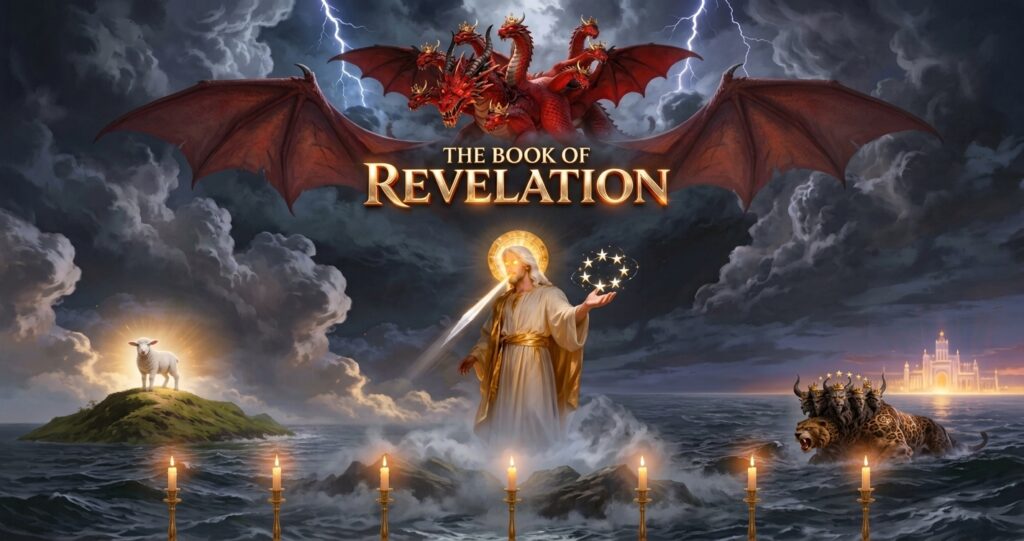
The Lamb, the Scroll, and the Day of Wrath
Revelation Without the Fog: A CliffsNotes Walk Through the Apocalypse
❧ ✦ ❧
Introduction: A Book That Refuses to Stay Sealed
Few books provoke as much fascination, and as much confusion, as the last book of the Bible. Readers open Revelation expecting answers and close it with a head full of horsemen, beasts, trumpets, and bowls, unsure how any of it fits together. Is the church raptured before the trouble begins? Is the great tribulation the same thing as the wrath of God? Who is the harlot riding the scarlet beast? And why does it matter to a believer sitting in a pew on a Sunday morning?
The online commentary produced by Sola Scriptura at revelationcommentary.org, written by Robert Van Kampen, Bill Lee-Warner, Charles Cooper, and Gary Vaterlaus, answers those questions from one clearly defined position: the premillennial prewrath return of Christ. Its thesis is simple to state and far-reaching in its consequences. The church will face the persecution of Antichrist, but it will never face the wrath of God. Between those two realities stands a cosmic sign in the sun, moon, and stars, and then the rescue of God’s faithful just before the Day of the Lord falls on a rebellious world.
Write the things which you have seen, and the things which are, and the things which will take place after these things.
— Revelation 1:19 (NASB)
This guide walks through the commentary the way a CliffsNotes study guide walks through a novel: in order, in the present tense, from the outside looking in. Each major section receives a brief summary and a detailed summary with commentary. Character analyses and a glossary of key terms follow. The goal is not to replace the commentary, which runs to more than one hundred thousand words, but to give the reader a map before entering the territory.
❧ ✦ ❧
Background: The Commentary and Its Method
Who Wrote It and Why
The authors call their work a “dynamic” commentary, meaning they intend to keep revising it as study continues. They openly describe it as a stopgap: prewrath readers have asked for a full commentary on Revelation, and none existed. The introduction declines to argue background matters at length. It assumes the Apostle John as the recipient, a date near AD 96, and a book that is at once a letter, a prophecy, and an apocalypse. For deeper background, the authors point readers to David Aune’s three-volume Word Biblical Commentary.
The Face-Value Hermeneutic
Before the commentary touches chapter one, it lays down its method in a section titled “A Simple, Face Value Understanding of Prophetic Scriptures.” The authors insist that interpretation must be consistent, free of contradiction, and never governed by a preconceived theological system. Face value does not mean wooden literalism; it means seeking the author’s intended meaning. Jesus’ words about eating His flesh in John 6 are the authors’ own example of a text whose simple sense differs from its intended sense. After invoking A. W. Tozer’s warning that we never stand in judgment of biblical truth, the section closes with a summary that leaves no room for hedging:
God says what He means and means what He says!
— Sola Scriptura, “A Simple, Face Value Understanding of Prophetic Scriptures”
The Structural Key: Daniel 7 and Matthew 24
The commentary’s most important interpretive move is structural. The authors argue that Daniel 7, the Olivet Discourse of Matthew 24:4-31, and Revelation 4-21 all follow the same four-part pattern:
- A general overview of the end times
- A focused look at the unparalleled persecution of the saints
- The destruction of the persecuting beast
- The coming of the kingdom to the saints of the Most High
Applied to Revelation, chapters 4-11 form the general overview, chapters 12-13 zoom in on the persecution, chapters 14-19 record the destruction of the beast and his kingdom, and chapter 20 introduces the kingdom. The authors also note that Revelation 1:19 is commonly read as an outline, but they argue it cannot be the master key because chapters 4-21 receive such disproportionate weight.
The Timeline in Brief
The commentary works within Daniel’s Seventieth Week, a final seven-year period. Satan’s persecution through Antichrist dominates the second half of that week. The persecution is “cut short” by the cosmic sign of the sixth seal and the rapture of the faithful. The seventh seal opens the Day of the Lord, expressed in the trumpet judgments. The Seventieth Week ends after the sixth trumpet, and a further seventy-five days follow, drawn from Daniel 12, during which the bowl judgments fall, Armageddon is fought, and the kingdom is established.
❧ ✦ ❧
Part One: “Revelation Begins” (Chapters 1-6)
Chapter 1 – Prologue
Brief Summary. John introduces the book as “the Revelation of Jesus Christ,” delivered from the Father to the Son, through a specific angel, to John, and on to the churches. He sees the glorified Son of Man standing among seven golden lampstands.
Detailed Summary and Commentary. The commentary begins with the Greek word apokalupsis, an “uncovering.” What is uncovered, the authors argue, is Jesus Christ in His role as eschatological Judge. Revelation becomes the fullest statement in Scripture of how and why Jesus judges Israel, the church, the wicked, and Satan. The commentary pays close attention to the chain of communication, noting that the definite article marks “the” angel as a figure John’s readers would have known. The first of seven beatitudes blesses the public reader, the hearer, and the doer alike. The authors stress that, although the book is apocalyptic in style, John calls it “prophecy,” and figurative imagery still points to real, knowable referents.
Blessed is he who reads and those who hear the words of the prophecy, and heed the things which are written in it; for the time is near.
— Revelation 1:3 (NASB)
Chapters 2-3 – The Seven Churches
Brief Summary. Christ dictates seven messages to seven real congregations in Asia Minor. Each receives His assessment, a warning, and a promise to “the one who overcomes.”
Detailed Summary and Commentary. The commentary sorts the churches into groups. Ephesus, Pergamum, Thyatira, and Laodicea compromise; Sardis is dead; Smyrna and Philadelphia are faithful, the first physically persecuted and the second physically protected. The authors firmly reject the popular view that the seven churches represent seven ages of church history, calling it “woefully inadequate” because it lacks scriptural support, depends on subjective dating, and robs the first-century churches of their own message. Following Henry M. Morris, the authors trace a seven-part pattern in each letter, from salutation to promised blessing. The letters carry both immediate warnings and consequences tied to Christ’s coming, or parousia, which makes them relevant to every generation.
The commentary’s handling of Philadelphia is pivotal. Because the believers there “have kept” Christ’s word of perseverance, He promises to “keep [them] from the hour of testing.” The authors read “keep from” in its plain sense, “keep out,” illustrated by a “Keep Out, No Trespassing” sign on a country gate. The hour of testing is future, worldwide, and aimed at “those who dwell on the earth,” a technical phrase the commentary consistently applies to the wicked. The authors also challenge the pretribulational use of “I am coming quickly” as proof of imminence, arguing that Jesus taught His return becomes imminent only after a season of suffering has begun.
Because you have kept the word of My perseverance, I also will keep you from the hour of testing, that hour which is about to come upon the whole world, to test those who dwell on the earth.
— Revelation 3:10 (NASB)
Chapter 4 – Heaven
Brief Summary. A door opens in heaven, and John is summoned to “come up here.” He sees the throne of God, the twenty-four elders, the four living creatures, and unceasing worship.
Detailed Summary and Commentary. The commentary refuses to treat “come up here” as a coded rapture of the church. The phrase “after these things” marks a new unit of vision, not a jump in time, and the same marker appears in 7:9, 15:5, and 18:1. The authors directly critique Robert L. Thomas, a pretribulational commentator, for claiming that chapters 4-19 describe events after the “church age” has run its course. Their verdict on that reading is blunt: “Thomas’ exegesis is clearly biased.” The throne room is the courtroom from which the Judge’s verdicts will proceed.
Chapter 5 – The Large Scroll
Brief Summary. The Father holds a scroll sealed with seven seals. No one is found worthy to open it until the Lion of the tribe of Judah, who appears as a Lamb standing as if slain, takes the scroll.
Detailed Summary and Commentary. The authors insist all seven seals sit on the outside of the scroll, so every seal must be broken before the contents can be read or carried out. This detail drives the whole commentary: the seals are not the wrath of God but the preconditions that must be met before the scroll’s judgment can be executed. The Lamb’s seven horns and seven eyes signify absolute power and complete sovereignty. When He “takes” the scroll, the verb implies no force; the Father holds it out, waiting.
Worthy are You to take the book and to break its seals; for You were slain, and purchased for God with Your blood men from every tribe and tongue and people and nation.
— Revelation 5:9 (NASB)
Chapter 6 – The First Six Seals
Brief Summary. The Lamb breaks six seals. Four horsemen ride out, martyrs cry for justice under the altar, and the sun, moon, and stars go dark as the earth-dwellers hide from “the wrath of the Lamb.”
Detailed Summary and Commentary. This chapter is the hinge of the prewrath argument. The rider on the white horse is not Christ; the commentary notes that the Lamb cannot simultaneously open the seal and ride out of it, and that a shared white horse is “hardly a basis to claim equality” with Revelation 19. The crown “was given” to him, showing derived authority. The first four seals parallel the “beginning birth pangs” of Matthew 24. With the fourth seal, Death and Hades receive authority over a fourth of the earth; the overview identifies this as Satan’s wrath working through Antichrist.
The last three seals form a distinct group bound together by the wrath of God: the fifth seal asks for it, the sixth seal announces it, and the seventh seal delivers it. The sixth-seal darkening of the heavens is the sign that Joel, Isaiah, and Jesus Himself said would precede the Day of the Lord.
For the great day of their wrath has come, and who is able to stand?
— Revelation 6:17 (NASB)
❧ ✦ ❧
Parenthesis I: “Rescued” (Chapter 7)
Chapter 7 – Deliverance
Brief Summary. Four angels hold back the winds of harm while 144,000 from the tribes of Israel are sealed. Then John sees an innumerable multitude from every nation, clothed in white, standing before the throne.
Detailed Summary and Commentary. The commentary makes two bold identifications. First, the 144,000 are a literal number of physical Jews, and they are not yet believers. The seal is protection, not salvation; the authors warn against importing Paul’s language of sealing from Ephesians 1:13. Their main argument is that God would not protect only a limited number of believers while leaving others exposed. These Jews are preserved through the coming wrath so that they may later be saved as the firstfruits of Israel’s national restoration.
Second, the great multitude is the raptured church, the faithful of every nation who “come out of the great tribulation.” The authors stress that “the great tribulation” is a specific time, not a place, matching Jesus’ use of the phrase in Matthew 24:21. Their sudden arrival in heaven, right after the cosmic sign and right before the seventh seal, is the rescue the whole book has been anticipating.
These are the ones who come out of the great tribulation, and they have washed their robes and made them white in the blood of the Lamb.
— Revelation 7:14 (NASB)
❧ ✦ ❧
Part Two: “The Day of the Lord” (Chapters 8-9)
Chapter 8 – Seventh Seal Events (Trumpets 1-4)
Brief Summary. Heaven falls silent for half an hour. Seven angels receive trumpets, an angel offers incense with the prayers of the saints, and four trumpets strike a third of the land, sea, fresh waters, and heavenly lights.
Detailed Summary and Commentary. The commentary treats the seventh seal as the actual beginning of God’s wrath. The fire thrown from the altar answers the martyrs’ prayers of the fifth seal. The authors argue that the recurring “one-third” is a defining trait that keeps the trumpets distinct from the seals and the bowls; equating the three series, they say, ignores textual detail in favor of generalities. They see no reason not to take the sea turning to blood literally, comparing it to the plagues on the Nile.
Chapter 9 – Completion of the Seventieth Week (Trumpets 5-6)
Brief Summary. A star-angel opens the abyss, releasing locust-like creatures that torment for five months everyone without God’s seal. The sixth trumpet unleashes an enormous army that kills a third of mankind, yet the survivors refuse to repent.
Detailed Summary and Commentary. The final three trumpets are the three “woes,” an intensified wrath now aimed at humanity rather than nature. The authors carefully note that the locusts must not harm vegetation but only “the men who do not have the seal of God on their foreheads.” For the commentary, this detail clinches its reading of chapter 7: the seal protects the 144,000, and everyone else, Jew and Gentile alike, suffers. The commentary places the end of Daniel’s Seventieth Week at the close of the sixth trumpet.
❧ ✦ ❧
Part Three: “Post-Seventieth Week Events” (Chapters 10-11)
Chapter 10 – The Little Scroll
Brief Summary. A mighty angel descends with an open little scroll, plants one foot on the sea and one on the land, and swears there will be no more delay. John eats the scroll and is commissioned to prophesy again.
Detailed Summary and Commentary. The commentary contrasts the two scrolls: the large scroll was sealed and in God’s hand; the little scroll is open and in an angel’s hand. The authors resist identifying the angel as Christ, since the text calls him an angel. They argue that John’s personal role in this scene happened when he received the vision and will not be repeated in the future. The little scroll concerns the final seventy-five days after the Seventieth Week. The angel’s announcement that “the mystery of God is finished” ties to Paul’s teaching on the Gentiles and to the completion of “the times of the Gentiles.”
But in the days of the voice of the seventh angel, when he is about to sound, then the mystery of God is finished.
— Revelation 10:7 (NASB)
Chapter 11 – Daniel 9:24 Completed (Trumpet 7)
Brief Summary. John measures the temple while the nations trample Jerusalem for forty-two months. Two witnesses prophesy, are killed by the beast, lie dead in the street, rise, and ascend. The seventh trumpet sounds, and heaven declares that the kingdom of the world now belongs to the Lord and His Christ.
Detailed Summary and Commentary. The commentary reads the temple, the outer court, and “the holy city” as the literal earthly Jerusalem, explaining that critics of this reading betray “a bias against a literal interpretation.” The forty-two months correspond to Daniel’s “time, times, and half a time.” The two witnesses are Jewish prophets in the Old Testament mold; because they die, the authors argue they cannot be Moses and Elijah or angels. Jerusalem is the “great city” spiritually called Sodom and Egypt. With the seventh trumpet, Daniel 9:24 is fulfilled, Israel is saved, and God physically reclaims rule over the earth.
The kingdom of the world has become the kingdom of our Lord and of His Christ; and He will reign forever and ever.
— Revelation 11:15 (NASB)
❧ ✦ ❧
Parenthesis II: “Cosmic Conflict Highlighted” (Chapters 12-14)
Chapter 12 – The Beginning
Brief Summary. A woman clothed with the sun gives birth to a male child whom a great red dragon seeks to devour. The child is caught up to God, war breaks out in heaven, and the dragon, cast down, persecutes the woman and her offspring.
Detailed Summary and Commentary. The commentary steps back to explain the cause behind the persecution described in chapter 6. The woman represents Israel, and her offspring represent the church. The dragon is a “composite dragon” whose seven heads are seven satanically inspired kingdoms that sought to prevent the reign of the Son: Egypt, Assyria, Babylon, Media, Persia, Greece, and Rome. Once the Child ascends, that strategy fails, and Satan, restricted to earth for a short time, turns his rage on God’s people. The woman’s flight “on the two wings of the great eagle” echoes God’s rescue of Israel from Egypt in Exodus 19:4.
Chapter 13 – The Beginning of the End
Brief Summary. The dragon stands on the seashore as a beast rises from the sea, suffers a fatal wound that is healed, and receives the world’s worship. A second beast, the false prophet, enforces worship of the beast’s image and imposes the mark.
Detailed Summary and Commentary. The sea beast is a composite, the sum of all prior kingdoms hostile to God, combining leopard, bear, and lion features from Daniel 7. The authors argue that the head “as if it had been slain” uses the same language as the Lamb “as if slain” in 5:6, so a real death and real return to life are in view. The three agents of death are the beast, the false prophet, and the image of the beast. Here the “unparalleled persecution” of the saints reaches its full expression.
It was also given to him to make war with the saints and to overcome them.
— Revelation 13:7 (NASB)
Chapter 14 – The End of the Beginning
Brief Summary. The Lamb stands on Mount Zion with the 144,000. Three angels proclaim the gospel, the fall of Babylon, and the doom of those who take the mark. Two harvests follow: a reaping of the earth and the treading of the winepress of God’s wrath.
Detailed Summary and Commentary. The commentary arranges the chapter as deliverance of the elect, decree to the wicked, and destruction of the wicked. This is the first time the Lamb appears physically on earth in Revelation. The 144,000 who were sealed for protection in chapter 7 now appear redeemed, “purchased from the earth,” the firstfruits of Israel’s national salvation. The commentary explains that the seal on their foreheads is the name of the Lamb and His Father, which, written in Hebrew without vowels, would be brief.
❧ ✦ ❧
Part Four: “The Destruction of Antichrist” (Chapters 15-16)
Chapter 15 – Prelude to the Bowl Judgments
Brief Summary. Seven angels with the seven last plagues appear. On a sea of glass mixed with fire, the overcomers sing the song of Moses and the song of the Lamb.
Detailed Summary and Commentary. The word “last” is decisive for the commentary. It links the bowls with the trumpets that precede them as one continuous expression of God’s wrath, and it excludes the seals. The authors reject any reading that treats the bowls as wrath but not the trumpets. The singers are victorious over the beast, his image, and the number of his name, the three great obstacles to faithfulness in this period.
Great and marvelous are Your works, O Lord God, the Almighty; righteous and true are Your ways, King of the nations!
— Revelation 15:3 (NASB)
Chapter 16 – The Bowl Judgments
Brief Summary. Seven bowls are poured out in rapid succession: sores, blood in the sea and rivers, scorching sun, darkness on the beast’s throne, the drying of the Euphrates, and a final earthquake that splits the great city into three parts.
Detailed Summary and Commentary. The targets are narrow and specific: “the people who had the mark of the beast and who worshiped his image.” The angel of the waters declares the justice of giving blood to those who shed the blood of saints. The commentary identifies “the great city” split in three as Jerusalem, linking it to Zechariah 13:8, and contrasts it with “the cities of the nations,” whose punishment is more severe. The bowls conclude within thirty days after the Seventieth Week and culminate in Armageddon.
❧ ✦ ❧
Parenthesis III: “Destruction Highlighted” (Chapters 17-19)
Chapter 17 – The Great Harlot
Brief Summary. An angel shows John a woman, “Babylon the Great, the Mother of Harlots,” riding a scarlet beast with seven heads and ten horns, drunk with the blood of the saints. The beast and its ten kings eventually turn on her and burn her.
Detailed Summary and Commentary. The commentator admits candidly that this is “the most difficult chapter” in the book and that his conclusions will likely change. He surveys the three historic candidates for Babylon: Rome, Jerusalem, and the literal city of Babylon. Because “harlot” in Scripture describes one who once had a right relationship with God and violated it, and because she is called “the mother of harlots,” the commentary concludes she is Jerusalem, functioning as the capital of the beast’s empire during the great persecution. The beast that “is himself also an eighth and is one of the seven” is a king who appears twice on the stage of history.
Chapter 18 – The Great City
Brief Summary. A glorious angel announces, “Fallen, fallen is Babylon the great!” A voice calls God’s people to come out of her. Kings, merchants, and mariners mourn as her wealth is destroyed “in one hour.”
Detailed Summary and Commentary. The commentary reads “Come out of her, my people” literally, as a summons to flee the city before its destruction, connecting it with Zechariah 14:5. The authors give two reasons for the warning: to escape intensified temptation and to escape her plagues. Her sins “piled up as high as heaven” reveal both her guilt and God’s long patience. The authors acknowledge that the statement that the city “will not be found any longer” poses a challenge for identifying it with Jerusalem, which reappears in 20:9, and they address it rather than avoid it.
Come out of her, my people, so that you will not participate in her sins and receive of her plagues.
— Revelation 18:4 (NASB)
Chapter 19 – The Great Army
Brief Summary. Heaven erupts in four hallelujahs. The marriage supper of the Lamb is announced. Heaven opens, and a rider on a white horse, called Faithful and True, defeats the beast and the false prophet, who are thrown alive into the lake of fire.
Detailed Summary and Commentary. The hallelujahs celebrate two things: God has judged the harlot, and He has avenged the blood of His servants, answering the fifth-seal martyrs’ cry. The commentary insists that “the Lord our God, the Almighty, reigns” describes God’s physical reign on earth. Unlike the rider of 6:2, this rider is plainly Jesus, “Faithful and True,” and the authors draw the contrast explicitly. The armies of Antichrist fall by the word from His mouth.
Hallelujah! For the Lord our God, the Almighty, reigns.
— Revelation 19:6 (NASB)
❧ ✦ ❧
Part Five: “The Millennial Reign of Christ” (Chapter 20)
Chapter 20 – The Beginning and End of the Millennium
Brief Summary. An angel binds Satan in the abyss for a thousand years. Thrones are set up, the beheaded martyrs come to life, and they reign with Christ. Satan is released, deceives the nations one final time, and is thrown into the lake of fire. The dead stand before the great white throne.
Detailed Summary and Commentary. The commentary defends a literal thousand years and a real binding, noting that the same terms “arrested” and “bound” describe John the Baptist’s imprisonment in Mark 6:17. The authors distinguish two groups: the raptured saints seated on thrones and the beheaded martyrs who refused the beast’s mark. They resist merging the beheaded of 20:4 with the slain souls of 6:9, calling that a case of overlooking differences. “The first resurrection” belongs only to the righteous, which logically requires a later resurrection of the unholy.
Blessed and holy is the one who has a part in the first resurrection; over these the second death has no power.
— Revelation 20:6 (NASB)
❧ ✦ ❧
Part Six: “The Conclusion” (Chapters 21-22)
Chapter 21 – New Heavens, New Earth, New Jerusalem
Brief Summary. The first heaven and earth pass away. The New Jerusalem descends from God, and a voice declares that God’s dwelling is now with His people. Death, mourning, and pain end.
Detailed Summary and Commentary. The commentary emphasizes that “new” (kainos) signals re-creation, not mere restoration; the first creation goes “out of existence.” The voice from the throne announces that God’s long-promised presence among men is fulfilled. To help readers grasp the city’s scale, the authors picture a footprint stretching from Seattle to San Diego to Little Rock and beyond, a city of some three billion cubic miles. Eternal life is offered “without cost” to the thirsty, and progressive sanctification becomes complete glorification.
Behold, the tabernacle of God is among men, and He will dwell among them, and they shall be His people.
— Revelation 21:3 (NASB)
Chapter 22 – Epilogue
Brief Summary. A river of living water flows from the throne of God and the Lamb, with trees of life on either side. The curse is lifted. Jesus promises, “I am coming quickly,” and the book closes with an invitation and a warning.
Detailed Summary and Commentary. The commentary notes that the throne belongs jointly to God and the Lamb and uses that point to explain the Trinity: the Father and Son share one essence, but Christ alone takes on human, physical form, and He remains God’s visible manifestation for eternity. The curse of Genesis 3 is removed from nature and humanity alike. The authors suggest that the trees yielding fruit each month may mark time in a city with no sun. The book ends where it began, with blessing for those who heed its words.
And there will no longer be any curse; and the throne of God and of the Lamb will be in it, and His bond-servants will serve Him.
— Revelation 22:3 (NASB)
❧ ✦ ❧
Character Analyses
Jesus Christ, the Lamb and Judge
The central figure of the commentary is Christ uncovered as Judge. He walks among the churches in chapter 1, takes the scroll in chapter 5, opens the seals in chapter 6, stands on Mount Zion in chapter 14, and rides out as Faithful and True in chapter 19. The commentary stresses that the same Lamb who was slain is the one who executes judgment.
God the Father, the One on the Throne
The Father holds the sealed scroll and offers it to the Son. In the commentary’s theology, He never takes human form; His presence is known, but Christ is His visible manifestation forever.
John the Apostle
John is both witness and participant. He sees, hears, eats the little scroll, measures the temple, and receives a renewed prophetic commission against “peoples, nations, tongues, and kings.”
The Dragon (Satan)
A composite figure whose seven heads represent the kingdoms that tried to destroy the Messiah. Thrown down to earth, he wages his final war against Israel and the church through Antichrist, is bound for a thousand years, briefly released, and finally consigned to the lake of fire.
The Beast (Antichrist)
The beast rises from the sea and from the abyss, survives a fatal wound, demands worship, and makes war on the saints. He is “an eighth” yet “one of the seven,” a king who appears twice in history.
The False Prophet
The second beast enforces worship of the first beast’s image and imposes the mark. He shares the beast’s fate at Armageddon.
The 144,000
Twelve thousand from each tribe of Israel: physical Jews sealed for protection before God’s wrath falls, unsaved at the time of sealing, and later seen redeemed on Mount Zion as the firstfruits of Israel’s salvation.
The Great Multitude
An innumerable company from every nation who “come out of the great tribulation.” For the commentary, they are the raptured faithful of the church, removed just before the Day of the Lord.
The Two Witnesses
Two Jewish prophets who minister in Jerusalem for 1,260 days, are killed by the beast, and are raised and taken to heaven. Because they die, the commentary does not identify them as Moses and Elijah.
The Woman Clothed with the Sun
A figure representing Israel, who gives birth to the Messiah and is supernaturally protected in the wilderness.
The Great Harlot (Babylon the Great)
A religious and political “harlot/city” that corrupts the kings of the earth. The commentary identifies her as Jerusalem serving as the capital of the beast’s empire.
❧ ✦ ❧
Glossary and Thematic Notes
Key Terms
- Prewrath: The view that the church will endure Antichrist’s persecution but will be raptured before God’s wrath, which begins with the seventh seal.
- Daniel’s Seventieth Week: The final seven-year period of Daniel 9:24-27, the time frame of Revelation 6-9.
- Day of the Lord: The period of God’s direct wrath on the wicked, expressed in the trumpet and bowl judgments.
- Great tribulation: Antichrist’s persecution of the saints, the wrath of Satan and man rather than the wrath of God, cut short by Christ’s return.
- Earth-dwellers: A technical phrase in Revelation for the wicked who are hostile to God and His people.
- Parousia: The coming or arrival of Christ.
- Face-value hermeneutic: Interpreting Scripture by its author’s intended meaning, without allegorizing or imposing a theological system.
- The seventy-five days: The interval after the Seventieth Week, drawn from Daniel 12, in which the bowl judgments, Armageddon, and the kingdom’s establishment occur.
- Composite beast: The beast as the sum of the earlier empires hostile to God.
Core Motifs
Wrath versus tribulation. The commentary’s main theme is the distinction between persecution of the saints by Satan and the wrath of God on the wicked. The church endures the first and is delivered from the second.
Patterns of seven. Seals, trumpets, and bowls each divide into a group of four and a group of three. The commentary uses these divisions to argue that the seals are not God’s wrath, while the trumpets and bowls are.
Parenthesis and pause. Three interludes, chapters 7, 12-14, and 17-18, pause the timeline to explain rescue, conflict, and destruction.
Israel’s restoration. From the sealed 144,000 to the completion of Daniel 9:24, the commentary keeps God’s promises to ethnic Israel at the center of the story.
Reading the Commentary Critically
Students should remember that this commentary is openly committed to one interpretive position. Pretribulational, posttribulational, amillennial, preterist, and idealist readers would challenge several of its central moves, especially the reading of the 144,000 as unbelievers, the placement of the rapture between the sixth and seventh seals, and the identification of Babylon with Jerusalem. The authors themselves invite correction and call their work provisional. Readers will get the most from it by checking each claim against the text and asking whether the Daniel 7 and Matthew 24 pattern truly governs Revelation’s structure as the commentary argues.
❧ ✦ ❧
Conclusion: The Hope Under the Altar
The voice from under the altar in the fifth seal asks, “How long?” The commentary’s answer, developed across twenty-two chapters, is that God’s patience has an end, and His justice is certain. For the prewrath interpreter, the hope of the church is not escape from every hardship but rescue from wrath. Believers may face the beast, but they will never face the Lamb’s anger. Whatever one decides about the timeline, the commentary puts a demanding question to every reader: if the church is called to endure until the end, is it preparing to do so? The blessing of Revelation 1:3 still belongs to those who read, hear, and heed.
❧ ✦ ❧
Questions That Deserve Answers
Discussion Questions for the Book of Revelation
These chapter-by-chapter questions follow your study’s prewrath framework while inviting participants to examine its reasoning rather than simply accept its conclusions. They combine close reading, interpretive challenges, and personal application, especially around the study’s distinction between persecution by Antichrist and the wrath of God.
Chapter 1 — Prologue: The Revelation of Jesus Christ
- What changes when we approach Revelation primarily as an unveiling of Jesus Christ rather than as a timetable of future disasters?
- The study emphasizes Jesus’ role as Judge. How does that emphasis deepen—or challenge—our understanding of the Jesus revealed in the Gospels?
- What does the chain of communication—from God through Jesus and the angel to John and the churches—suggest about the authority and purpose of this book?
- Revelation blesses those who read, hear, and heed its message. What would “heeding” Revelation look like beyond understanding its symbols?
- The study distinguishes a “face-value” reading from wooden literalism. What principles should help us recognize when an image is symbolic and determine what it represents?
Chapter 2 — The Churches: Love, Suffering, and Compromise
- How can a church defend correct teaching yet lose the love that should give its teaching meaning?
- What does Smyrna’s suffering suggest about the relationship between faithfulness and physical safety?
- Where is the line between engaging the surrounding culture and compromising with it?
- How should a congregation respond when influential teachers encourage practices that conflict with its professed faith?
- The study rejects the idea that the seven churches represent successive ages of church history. What evidence would such an interpretation need, and what might it obscure about the original congregations?
Chapter 3 — The Churches: Spiritual Death, Perseverance, and Self-Deception
- How might a congregation acquire a reputation for spiritual vitality while being spiritually dead?
- What makes prosperity and self-sufficiency potential obstacles to recognizing spiritual need?
- The study interprets Philadelphia’s promise of being kept “from the hour of testing” as exclusion from that period. What in the wording supports this reading, and what questions remain?
- How should we relate Philadelphia’s promised protection to Smyrna’s experience of persecution without treating one congregation as less faithful?
- The study challenges the claim that “I am coming quickly” necessarily means a return without preceding signs. What assumptions about timing are we bringing to that phrase?
Chapter 4 — Heaven: The Throne Before the Judgments
- Why might John’s vision of the throne room come before the opening of the seals?
- How does this scene redirect attention from threatening earthly powers to the authority behind history?
- The study rejects identifying “come up here” with the church’s rapture. What would distinguish a convincing textual argument from an attractive analogy?
- Does “after these things” necessarily indicate the chronological order of future events, or could it describe the order in which John receives his visions?
- What might worship centered on God’s holiness and sovereignty contribute to a community facing fear or persecution?
Chapter 5 — The Scroll: The Lion Who Appears as a Lamb
- Why is the victorious Lion revealed as a Lamb who has been slain? What does this suggest about the nature of Christ’s victory?
- What makes the Lamb worthy to open the scroll, and how does His worthiness differ from ordinary ideas of power or status?
- The study argues that all seven seals must be broken before the scroll’s contents can be executed. How much of this argument is explicit in the text, and how much depends on reconstructing the scroll’s physical arrangement?
- Even if the scroll cannot be opened until every seal is broken, does that necessarily establish that the events accompanying the seals are not divine wrath?
- How does the worship of people redeemed from every tribe, language, people, and nation challenge narrow understandings of God’s people?
Chapter 6 — The First Six Seals: Suffering and the Approach of Wrath
- What evidence should determine the identity of the white-horse rider? How much weight should similarities to—or differences from—the rider in chapter 19 carry?
- The study distinguishes Satan’s persecution from God’s wrath. How can we distinguish the source, permission, and purpose of suffering when the Lamb opens the seals?
- What does the martyrs’ question, “How long?” reveal about faithful lament and the desire for justice?
- The study reads the fifth seal as asking for wrath, the sixth as announcing it, and the seventh as beginning it. How persuasive is that sequence?
- When the earth-dwellers declare that the day of wrath “has come,” does their statement establish precisely when wrath begins? How should their perspective affect our interpretation?
Chapter 7 — Deliverance: The Sealed and the Great Multitude
- What textual evidence supports the study’s identification of the 144,000 as a literal number of ethnic Israelites?
- The study argues that the 144,000 are protected but not yet saved. Does the chapter establish their unbelief, or is that conclusion inferred from the larger interpretive framework?
- What does the contrast between a numbered group and an innumerable multitude contribute to the chapter’s message?
- What evidence supports identifying the great multitude as the raptured church rather than another group of redeemed people?
- What can this chapter say about God’s protection without implying that faithful believers will never suffer or die?
Chapter 8 — The Seventh Seal: Silence, Prayer, and Judgment
- What effect does the silence in heaven have after the worship and dramatic events of the preceding chapters?
- How does the connection between the saints’ prayers and the fire from the altar shape our understanding of prayer?
- Why is the seventh seal, rather than the first or sixth, the decisive beginning of wrath in the study’s interpretation?
- The study emphasizes the recurring destruction of “one-third.” Does this establish that the trumpet judgments are separate events from the seals and bowls, or could distinct details serve another literary purpose?
- What principles should govern reading the environmental judgments literally, symbolically, or as a combination of both?
Chapter 9 — The Fifth and Sixth Trumpets: Judgment Without Repentance
- What do the limits placed on the locust-like creatures suggest about the relationship between terrifying power and divine control?
- Does the exemption of those bearing God’s seal resolve the identity and spiritual condition of the 144,000, as the study argues?
- Why might severe suffering fail to produce repentance?
- What does the survivors’ continued attachment to their sins suggest about the difference between fearing consequences and genuinely changing?
- The study places the end of Daniel’s Seventieth Week after the sixth trumpet. What evidence is necessary to establish that chronological connection?
Chapter 10 — The Little Scroll: A Sweet and Bitter Commission
- Why might receiving God’s message be sweet while communicating or fully grasping it becomes bitter?
- What distinguishes the little scroll from the sealed scroll in chapter 5, and how much can we infer from those differences?
- The study resists identifying the mighty angel as Christ because the text calls him an angel. What should determine whether impressive imagery indicates identity or delegated authority?
- What does the announcement of “no more delay” suggest about the relationship between God’s patience and His eventual action?
- The study connects this scene with an additional seventy-five days after Daniel’s Seventieth Week. How clearly does Revelation itself establish that connection?
Chapter 11 — The Witnesses and the Seventh Trumpet
- What evidence favors reading the temple and holy city as literal earthly locations? What evidence would a symbolic interpretation need to address?
- How does the witnesses’ apparent defeat complicate the assumption that divine protection always means survival?
- The study rules out Moses and Elijah because the witnesses die. Does that reasoning establish their identity, or does it depend on additional theological assumptions?
- What does the public sequence of death, resurrection, and vindication communicate to both the witnesses’ enemies and John’s readers?
- The study associates the seventh trumpet with Israel’s salvation and the fulfillment of Daniel 9:24. Which parts of that conclusion are stated here, and which depend on connections with other passages?
Chapter 12 — The Woman and the Dragon: The Conflict Behind History
- What evidence supports identifying the woman as Israel and her other offspring as the church?
- How does stepping backward in the story change our understanding of the persecution already described?
- The study assigns the dragon’s seven heads to particular historical kingdoms. What controls should govern identifying symbolic heads with named empires?
- What does Satan’s rage after his expulsion suggest about the difference between ultimate defeat and immediate harmlessness?
- How can readers take spiritual conflict seriously without attributing every hardship or political disagreement to a specific prophetic event?
Chapter 13 — The Beasts: Worship, Deception, and Coercion
- Why does the beast seek worship rather than merely political obedience? What does that reveal about the conflict’s central issue?
- The study interprets the beast’s healed fatal wound as a real death and return to life. Does the parallel with the slain Lamb require that conclusion?
- How does the second beast’s apparently lamb-like appearance complicate the task of recognizing deception?
- What pressures arise when religious allegiance determines whether someone can buy or sell?
- How should a discussion of the mark distinguish the chapter’s explicit connection to worship and allegiance from speculation about contemporary technologies?
Chapter 14 — The Lamb, the Warnings, and the Harvests
- What changes between the presentation of the 144,000 in chapter 7 and their appearance with the Lamb here?
- Does their description as redeemed establish that they were previously unbelievers, or could it describe a status they already possessed?
- How do the angelic proclamations bring together invitation, warning, accountability, and judgment?
- What textual clues should determine whether the two harvest scenes portray different groups or different aspects of judgment?
- How does the call for perseverance keep this chapter from becoming merely a description of what will happen to other people?
Chapter 15 — The Last Plagues: Victory and Worship
- How can those who suffer under the beast nevertheless be described as victorious over him?
- What does joining the song of Moses with the song of the Lamb contribute to the study’s themes of deliverance and continuity?
- The study treats “last” as evidence that the bowls complete the wrath begun by the trumpets. How much does that word establish about the preceding sequence?
- What does it mean to praise God’s judgments as righteous and true rather than merely celebrate an enemy’s defeat?
- How should this scene shape our understanding of victory when faithfulness carries a severe personal cost?
Chapter 16 — The Bowls: Justice and Persistent Defiance
- How does the angel’s explanation connect the punishment of the wicked with their treatment of the saints?
- What distinguishes a judgment presented as just recompense from revenge driven by personal hatred?
- Why do the people continue to blaspheme rather than repent? What does that repetition add to the narrative?
- The study identifies the great city divided into three parts as Jerusalem. What supports that identification, and what competing readings would need consideration?
- The study places the bowls within thirty days after Daniel’s Seventieth Week. How should readers evaluate a precise timeline when its details depend on combining multiple passages?
Chapter 17 — Babylon the Great: Power, Corruption, and Uncertainty
- The study acknowledges that this is its most difficult chapter. How should that admission influence the confidence with which a discussion group adopts its conclusions?
- What is the strongest evidence for identifying Babylon with Jerusalem? What presents the greatest difficulty?
- Does the imagery of a harlot necessarily require a city that once had a covenant relationship with God?
- What does the woman’s relationship with the beast reveal about alliances between religious influence and coercive political power?
- Why might the beast and the kings destroy a system from which they previously benefited? What does this suggest about the instability of corrupt alliances?
Chapter 18 — Babylon’s Fall: Wealth, Complicity, and Departure
- What do the mourners’ reactions reveal about what they valued most in Babylon?
- How does the chapter connect economic prosperity with exploitation and moral responsibility?
- The study reads “Come out of her, my people” as a literal command to flee. What evidence supports that reading, and does the command also carry implications for complicity?
- How should the statement that Babylon will never be found again be reconciled with the study’s identification of Babylon as Jerusalem and Jerusalem’s later appearance?
- What questions should this chapter prompt about benefiting from institutions or commercial systems whose wrongdoing we prefer not to examine?
Chapter 19 — The Rider: The Lamb’s Marriage and the Defeat of Evil
- How do the marriage celebration and the defeat of the beast belong to the same vision of Christ’s victory?
- In what ways does this chapter answer the martyrs’ cry for justice in chapter 6?
- What makes the white-horse rider here unmistakably Christ, and how does that help evaluate the rider in chapter 6?
- What is the significance of victory coming through the word from Christ’s mouth?
- How can readers welcome the end of persecution and injustice without turning the chapter into a justification for their own violence or hostility?
Chapter 20 — The Millennium: Reign, Rebellion, and Final Judgment
- What evidence supports the study’s literal reading of the thousand years? What consistent interpretive principles should govern that decision?
- Why distinguish the saints seated on thrones from the beheaded martyrs? What difference does that distinction make to the proposed sequence of resurrection and reign?
- How does the study relate “the first resurrection” to the rapture it places earlier in Revelation?
- What does the final rebellion suggest about the relationship between favorable circumstances and genuine allegiance to God?
- How does the great white throne scene bring together individual accountability, the record of deeds, and the book of life?
Chapter 21 — New Creation: God Dwelling With His People
- Why is God’s dwelling with humanity central to the vision, rather than simply humanity’s escape from the earth?
- The study interprets the new heaven and earth as re-creation rather than restoration. What evidence is needed to establish that the first creation goes out of existence?
- What do the city’s extraordinary dimensions contribute to its meaning? How should readers decide whether those dimensions function literally, symbolically, or both?
- How do the promises of an end to death, mourning, and pain address the suffering described throughout the book?
- What tension—or harmony—do you see between the free offer of living water and the chapter’s warnings about exclusion?
Chapter 22 — Epilogue: Invitation, Warning, and Readiness
- How do the river, the tree of life, and the removal of the curse bring the study’s story to completion?
- What does the shared throne of God and the Lamb establish, and how far can that image support the study’s additional claims about God’s eternal visible manifestation?
- How should readers understand “I am coming quickly” within the study’s framework of preceding persecution and signs?
- How can the warning against adding to or taking away from the prophecy encourage interpretive care without being used to silence legitimate disagreement?
- After studying Revelation, what should change most: our ability to construct a timeline, our readiness to endure, our worship, or our conduct? What in the book supports your answer?