Copycat productions:
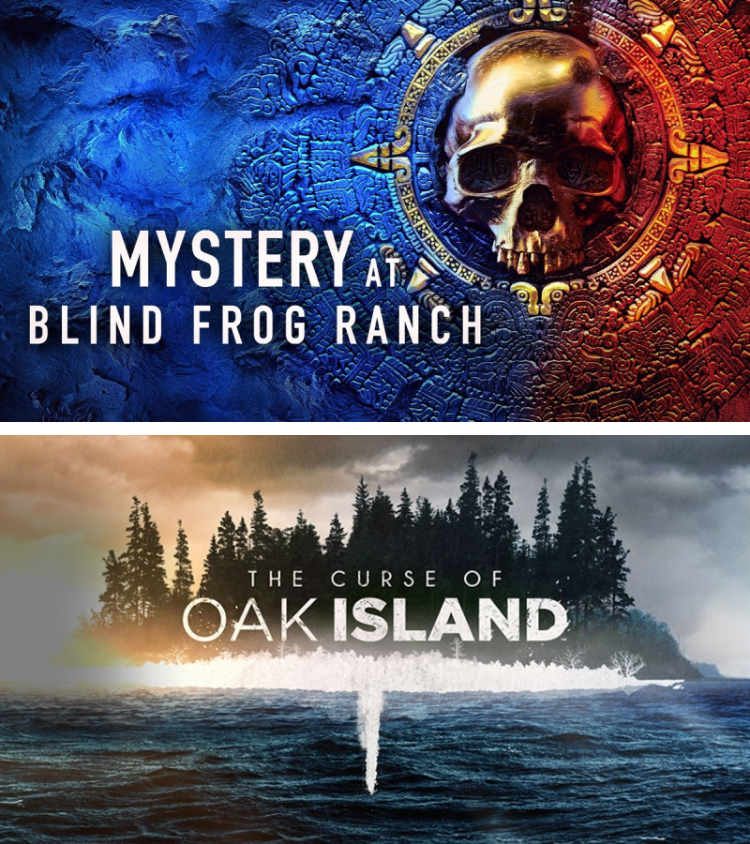
Blind Frog Ranch vs The Curse of Oak Island.
Rotten Tomatoes: Mystery at Blind Frog Ranch
There are some places on Earth where the land just seems different, and Blind Frog Ranch in eastern Utah is one of those places. Locals say the land is cursed and holding on to treasures. Landowner Duane Ollinger is determined to find what is hidden in the seven underground caves on the 160-acre ranch. Duane has sunk everything he has into hunting for what he believes is a vast fortune of gold on his property. However, as he gets closer to finding the treasure, the land seems to hold on tighter, stopping him in his tracks.
Is “Mystery at Blind Frog Ranch” fake?
Yes — Blind Frog Ranch, as presented on the Discovery Channel’s Mystery at Blind Frog Ranch, follows a production model strikingly similar to the History Channel’s The Curse of Oak Island. The structure, tone, and pacing of both shows strongly indicate they are designed primarily as entertainment, rather than genuine documentary-style investigations. Here’s how:
🔁 Parallels Between Blind Frog Ranch and Oak Island
1. Ever-elusive treasure narrative
- Both shows center on legendary buried treasure (Aztec gold at Blind Frog Ranch vs. Knights Templar/Spanish/Masonic treasure at Oak Island).
- Each episode promises breakthrough discoveries, but consistently avoids full resolution — drawing out suspense over multiple seasons.
2. Dramatic cliffhangers and repetition
- The shows often end with a tease of a new find (“We found metal!” or “This could change everything…”) that turns out to be ambiguous or inconclusive in the following episode.
- Both use repetitive voiceover recaps, dramatic music, and reenactments to boost tension, not necessarily to advance real discovery.
3. “Experts” and techno-babble
- Like Oak Island, Blind Frog Ranch heavily features metal detectors, sonar, LiDAR scans, drilling rigs, and magnetic sensors—but rarely provides hard scientific data or peer-reviewed analysis.
- “Experts” are often presented as authority figures but with vague credentials or no independent corroboration.
4. Speculative leaps presented as plausible
- Theories such as “Aztec gold hidden by Spanish explorers” or “ceremonial sacrificial tunnels linked to pre-Columbian tribes” are floated without archaeological vetting.
- As in Oak Island, speculation becomes the driving force, with real evidence secondary to narrative momentum.
🎭 Entertainment First, Facts Later?
Despite airing on a factual network, Mystery at Blind Frog Ranch fits the mold of “scripted reality television”—a hybrid genre where:
- Real locations and personalities are involved.
- Events are heavily produced, selectively edited, and sometimes scripted for dramatic effect.
- Viewership retention takes precedence over academic or historical accuracy.
🎬 Production Clues Supporting This
- Cast/crew often rehearse scenes. Behind-the-scenes leaks and Reddit discussions suggest scenes are re-shot and re-staged to “get the right take.”
- Lack of third-party verification: Discoveries shown are not submitted to universities, museums, or peer-reviewed journals.
- No public access to the most promising discoveries (e.g., the gold smelting slag, alleged iridium vein, or LiDAR maps).
🔍 Final Verdict
Yes — Blind Frog Ranch is presented in a format closely mirroring The Curse of Oak Island, structured to maximize audience intrigue and retention, not necessarily archaeological credibility.
While there may be real elements to the property and discoveries, the heavy-handed production tactics suggest that attracting TV viewership is the dominant goal—not solving historical mysteries in an academically rigorous way.
Episode comparisons…
Here are two episodes from Mystery at Blind Frog Ranch and two from The Curse of Oak Island that strongly illustrate how each show leans into suspense-driven storytelling rather than fact‑based or academically rigorous investigation.
🎥 Mystery at Blind Frog Ranch (Discovery Channel)
Season 3, Episode 2: “Underground Tsunami” (Nov 22, 2023)
- Plot setup: Team searches for entrance to a cavern system. They uncover an “ancient vent shaft” above the so‑called “Energy Zone,” followed by an explosion and what’s described as an “underground tsunami.”(TheTVDB)
- Suspense toolkit:
- Dramatic sound effects and visuals: The explosion and “tsunami” moment dominate the narrative, emphasizing peril over scientific assessments.
- Cliffhanger pacing: Episode ends with flooded caverns and uncertainty, leaving conclusions for later and prolonging tension.
Season 3, Episode 8: “Into the Cavern” (Jan 3, 2024)
- Plot setup: After allegedly drilling into a meteorite, the team is forced to find an alternate route. Chad discovers a “clue” that might lead to a breakthrough—but no actual treasure is revealed.(TheTVDB)
- Suspense toolkit:
- “Meteorite hit” reveal: Presented as dramatic discovery, but leads to ambiguous follow‑up.
- Clue tease: Rather than concrete evidence, the “breakthrough” is an alleged clue, setting up speculation for next episode rather than resolved findings.
🏝️ The Curse of Oak Island (History Channel)
Season 12, Episode 16: “Open Sesame”
- Plot setup: After small finds like a brick fragment or a single nail, the team debates whether these point to a treasure chest. They ramp up drilling into “Aladdin’s Cave,” even though nothing of substance has yet been found.(25YL, Monsters and Critics)
- Suspense toolkit:
- War Room drama: Lab results (e.g. “medieval nail”) spark speculative debate—no peer‑reviewed archaeology.
- Tease of vault: Episode suggests a vault is imminent but stops short, keeping viewers invested for the next reveal.
Season 12, Episode 17 (“Boots on the Ground”) Preview
- Plot setup: Preview teases “stunning clues” that could finally identify who hid the treasure, but the actual episode again delays any major resolution.(Monsters and Critics, Reddit, Reddit)
- Suspense toolkit:
- Preview hype: Headlines like “Are these remnants of a treasure chest?” build anticipation, even though deliverables remain uncertain.
- Underwhelming payoff: In typical format, small metal finds or structural hints are elevated in narrative importance without concrete proof.
YouTube – Fool’s Gold: There’s No Treasure on Oak Island (Part 1)
I’m gonna leave this one right here:
Incredible Discovery Unearthed! “Handle of an old pair of scissors.”😜
🔍 Side‑by‑Side Analysis
| Element | Blind Frog Ranch | Oak Island |
|---|---|---|
| Discoveries | Gold specks, meteor strike, ambiguous clues | Nails, bricks, wood, small metal fragments |
| Episode pacing | Big dramatic events with no real payoff | War room reveals → repeated cliffhangers |
| Evidence presentation | Sensory-heavy, unclear provenance | Small finds exaggerated as major breakthroughs |
| Scientific validation | Rarely shown; independent experts absent | Custom lab claims dominate; peer review absent |
| Narrative structure | Teasing real danger or discovery | Ongoing suspense across seasons |
Looper.net: The Curse Of Oak Island’s Controversial ‘Hoax’ Theory, Explained
The question for fans of “The Curse of Oak Island” has long been where the Lagina brothers’ treasure hunt lands on the channel’s vast sliding scale between entertainment and reality. Though the actual science and discovery seen on the show appear at face value to be perfectly plausible, they’re mixed in with mysteries, conspiracy theories, and the specter of a deadly history that some may feel borders on pure dramatization. Numerous online publications have dismissed the series –- which entered its 11th season on November 7 — as an out-and-out bad-faith hoax in the same vein (allegedly) as “Alone” and “Bigfoot Captured.”
On the r/OakIsland subreddit (where redditors can share posts about the series and the legend in general), posts questioning the show are regularly met with jokes and a consensus that the show is at least partly fake. Academics, meanwhile, have denounced the entire Oak Island mystery quite decisively. Harvard professor Richard Joltes called it “just one tale in a long-running mania for treasure legends all along the eastern seaboard,” while Halifax maritime historian and instructor Dan Conlin dubbed it “classic pseudohistory.”
One fact that should arguably soften certain hoax theories is that Rick and Marty Lagina had already been hunting the Oak Island treasure for several years before the History Channel discovered them and came along to finance the endeavor. Unless they were playing the long game, this would indicate that the brothers’ intentions for the series were at least good when it began. This aligns with statements they’ve made to the media asserting the show’s reality. Though it’s not likely they’d say otherwise, regardless.
The tempting middle-ground-conclusion to draw between absolute fact and absolute fiction is that Rick, Marty, and at least some portion of their team are genuinely trying to find treasure –- even if its existence seems doubtful at this point. Whether or not the treasure exists is probably less concerning to the History Channel than the audience “The Curse of Oak Island” draws in.
Under these circumstances, the network would likely continue to finance the expedition and produce further seasons of the show regardless of the treasure’s existence. As for the alleged planting of artifacts, however, there’s no evidence to indicate this occurring as of writing. In other words, it’s certainly possible that “The Curse of Oak Island” depicts real people having real reactions to environments and events that may be varyingly “real” –- as is the case for a majority of reality television.
✅ Conclusion
Both series deliberately adopt a “suspense-first” structure, using dramatic suspense, speculative cliffhangers, and emotion-driven editing to sustain viewer interest. They emphasize promise over proof, repeatedly highlighting potential breakthroughs without providing definitive archaeological or scientific validation.
Updated Content 11/25/2025
The Origin Story: How Blind Frog Ranch Got Its Name
One of the most intriguing aspects of the property is how it acquired its unusual name. According to the ranch’s official website and multiple sources, when the Ollingers came into the property, their exploration of the caves was frustrated by flooding from a water plate. With the water came hundreds of frogs from the underground cavern system — frogs that had spent their entire lives away from sunlight. Brought to the surface, the frogs couldn’t see the humans in their midst and would only move on touch. Duane Ollinger found the discovery so remarkable that he named the property after these sightless amphibians, and the ranch’s mascot, “Benny the Blind Frog,” now adorns signs and merchandise.
However, this founding story doesn’t hold up under scientific scrutiny. While it is true that many frog species spend some time underground or in caves, no known frog species spends its entire life away from the sun (per a 2013 study published in Subterranean Biology). If the frogs the Ollingers encountered on the day of their story really were blind, it likely wasn’t because they had never encountered sunlight.
The Authenticity Debate: What Reddit and Critics Are Saying
The question of whether Mystery at Blind Frog Ranch is authentic has sparked extensive online debate. The debate over whether or not the events depicted in Mystery at Blind Frog Ranch are real or not has even been the catalyst for an entire thread on Reddit, where there are currently over 240 different comments from fans debating the topic.
Viewer Skepticism
Reddit users have been particularly vocal about their suspicions. One Reddit user cited an episode where the Ollingers found a gold nugget and a Spanish gold coin as particularly suspicious, writing: “Does anyone else think this show is stupid and all set up. The nugget they pull and a Spanish coin they pull out of the same hole seem sooo fake.” Other viewers have pointed out that the Ollingers and additional cast members in the series come off as actors, with one user writing: “God, that was so scripted and fake. All seemed like just actors doing interviews. Not going to last.”
The criticism extends beyond just the discoveries. The fact that the credits refer to the treasure hunters as “talent” has many fans convinced the Discovery Channel knows this is fake and is just playing along.
The Satire Theory
Some fans have developed an interesting alternative interpretation. Fans took to Reddit to discuss whether it is real or a satire, with one writing: “I’m convinced ‘Blind Frog Ranch’ is just satire. Spoofing treasure hunting shows. Nothing ever adds up or makes any sense.” This perspective suggests the show may be intentionally leaning into absurdity as a form of self-aware entertainment.
Many fans feel that Blind Frog Ranch’s paranormal aspects indicate that the show never takes itself seriously. They feel that the show’s entire purpose is to spoof things like The Curse of Oak Island, which takes itself overly seriously at times.
The Cast’s Defense and Discovery’s Silence
Despite the criticism, the show’s principals maintain the treasure hunt is genuine. Duane, Chad, and several members of their team, including Eric Drummond, have all defended the show and their methods over the year,s and Discovery has never mentioned that the show is fake in any way.
Geologist Eric Drummond, brought on to add scientific credibility, has explained his involvement. Drummond later explained that the natural occurrence of minerals, gold, and iridium is what intrigued him about Mystery at Blind Frog Ranch and is what has made him believe that there is “a great potential for treasure in the area.” However, he sounded much less sure about the paranormal phenomena on the show, stating: “As I’m concerned, the verdict is still out, but we’re investigating it.”
What Academic Experts Say About Aztec Gold in Utah
Perhaps the most fundamental question is whether there’s any historical basis for buried Aztec treasure in Utah. Associate professor of anthropology at Utah University, Richard Paine, confirmed that there were large quantities of gold in the Aztec empire, saying: “The Aztecs, when the Spanish arrived, had a lot of gold. One of the main, big motivators for the Spanish conquest of the Aztecs was that they were just enthralled by the amount of gold.”
However, he offered a more skeptical interpretation of the treasure legends. Richard revealed: “My personal suspicion is that most of these stories were local people trying to get the Spanish to go someplace else. But the idea that there was gold to be captured and hidden away is certainly possible.”
According to Gregory Smoak, the University of Utah’s American West Center director, the Spanish also contributed significantly to these fictional legends and myths — one of the most popular is the Seven Cities of Cibola, which captivated Spanish Conquistadores in the 16th century. As Grunge summarized the academic skepticism: “Aztecs in Utah? Come on.”
The Strange Discoveries: Fact or Fiction?
The show has featured several eyebrow-raising finds that fuel both interest and skepticism.
The Mysterious Box
Arguably, the show’s breakthrough is discovering a strange box in the caves that became the focal point of the show. The crew is confident that the box dates to the time of Montezuma, the last Aztec ruler who, according to legend, hid the gold from the Conquistadores in the area of Utah.
Unusual Elements
The show’s geologist, Eric, made several interesting discoveries; he determined that the large rocks inside the box are bored and hold cylinders of gallium that liquefy at room temperature, adding that it was done by a human hand. Eric described the find: “Gallium is a scarce element, and it has some relatively modern-day uses. There are many questions surrounding that: how did it get there? Who put it there? What uses was it for, and how did they even make it?”
Even more unusual was the discovery of iridium. Eric disclosed: “The strangest discovery for me was iridium in the soil, and in pretty decent concentrations. Iridium is a relatively rare element that’s more common in space than it is on Earth, so there is that sort of extraterrestrial aspect to that.”
The “Gold” Coins
Not all discoveries have panned out. During the first season, while searching for treasure at the ranch, Chad found nine “gold” coins allegedly dating to 1849. Following the expert’s assessment, these were initially thought to be remnants of the Mormon gold, estimated at $1 million per piece. However, further inspection determined that they were not actually made of gold.
Why They Haven’t Just Drained the Caves
One question that consistently frustrates viewers is why the team doesn’t simply pump out the flooded cave system. Chad cleared the air in an interview, saying: “There are three main reasons; if we drain the water from the pond into a creek, that is actually illegal, we can’t mix the water. The second reason is that if we take all the water out of this cave, it might collapse. The last reason is the spring, there’s constant water filling up that.”
The Bigger Picture: Reality TV’s Authenticity Problem
The skepticism around Mystery at Blind Frog Ranch reflects a broader issue in reality television. One of the buyers on the “reality” show Storage Wars, David Hester, accused the show of being fake. He sued the show, contending that they rigged the auctions, but the court dismissed the case. A&E successfully argued that, because it wasn’t a game show, Storage Wars could stage what it wanted on the grounds of free speech. In short, they came just short of outright admitting that they rigged and scripted the show.
A Time Warner spokesperson once explained their policies for TruTV, saying, “TruTV’s series feature real people and are based on real situations.” This carefully worded statement — notably absent of claims that events are unscripted or unstaged — captures the gray area in which many reality shows operate.
A Balanced Assessment
The evidence suggests a nuanced reality. The location, land, and treasure hunt are real. But much of the show is heavily produced and scripted, making it reality-adventure TV rather than pure documentary.
Verified facts are modest and clear. There is a real flooded cave system. There are small gold indications in sediments. Some artefacts fit a pattern of past human presence. Large claims remain large claims. No Aztec hoard has been demonstrated. No paranormal mechanism has been measured and documented. What makes the story compelling is not certainty but possibility, plus the very human urge to keep looking.
As one assessment concluded: If something economically meaningful or historically important lies underground, the path to it will be through careful science and patient engineering, not the grace of a curse or the wink of a night-vision camera.