
The Spectacular Collapse of Trevor Milton: How a Utah Entrepreneur
Built a Billion-Dollar Fraud on a Foundation of Lies
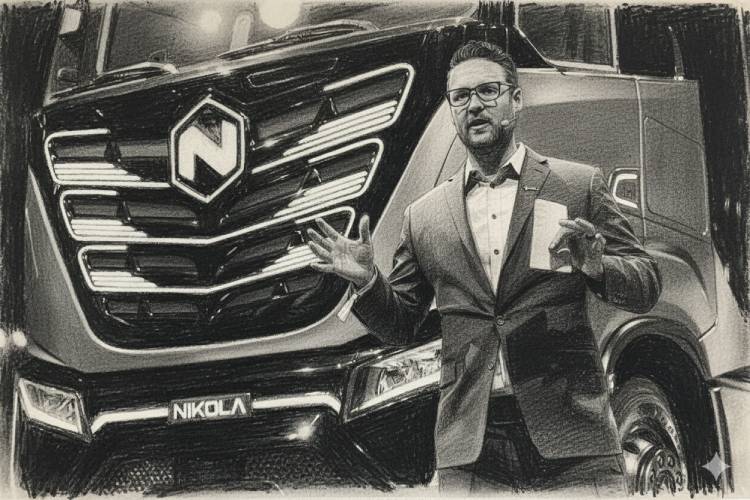
When Trevor Milton strode onto the stage at a Salt Lake City convention hall on December 1, 2016, he promised to revolutionize the trucking industry. Behind him sat an enormous hydrogen-powered semi-truck draped in white fabric, waiting to be unveiled as the future of zero-emission transportation. What investors and the public didn’t know was that the impressive-looking Nikola One prototype wasn’t functional at all—it was literally plugged into a wall outlet through a power cord snaking beneath the stage.
This moment of theatrical deception would become emblematic of one of the most brazen corporate frauds in recent American history, ultimately resulting in Milton’s 2022 conviction on securities and wire fraud charges, a four-year prison sentence, and investor losses exceeding $660 million. Yet in a stunning twist that encapsulates the troubling intersection of money and political influence, President Donald Trump pardoned Milton in March 2025—just weeks after Milton and his wife donated $1.8 million to Trump’s reelection campaign. A member of The Church of Jesus Christ of Latter-day Saints (LDS Church), Milton’s background raises questions about how his faith’s emphasis on integrity clashed with his pattern of deception.justice+1
Early Life and LDS Roots
Born in 1982 in Layton, Utah, to a Union Pacific manager father and realtor mother, Milton grew up in a devout LDS family, moving between Las Vegas and Kanab, Utah. After high school, he served an 18-month LDS mission in Brazil, cut short by health issues, before briefly attending Utah Valley University and dropping out. LDS doctrine stresses “honesty is the best policy” and transparency in dealings, yet Milton’s career launched with St. George Security and Alarm, followed by dHybrid, a natural gas vehicle firm dissolved amid investor disputes—early red flags ignored in his rise.wikipedia
In December 2020, amid a scandal, Milton donated 1.5 million Nikola shares worth $20 million to the LDS Church, a move some viewed as image rehabilitation rather than genuine repentance. No evidence ties relatives directly to Nikola fraud; his brother, Travis, and three sisters appear peripheral, though a cousin accused Milton of 1999 sexual assault post-grandfather’s funeral, alleging groping during a massage—claims he denied, with no charges filed due to statutes of limitations. Family presence at his 2022 trial underscored personal stakes, but prosecutors focused solely on Milton’s actions.businessinsider+2
The Genesis of Deception
Trevor Robert Milton, born April 6, 1982, grew up in a working-class Mormon family that moved from Las Vegas to Kanab, Utah, when he was eight years old. His mother died of cancer when he was 15. Despite having no formal engineering education—prosecutors would later describe him as “a serial entrepreneur from Utah with no formal background in engineering”—Milton founded Nikola Motor Company in 2015 with $2 million from Worthington Industries.
Named after Nikola Tesla, the company promised to develop hydrogen-electric and battery-electric semi-trucks that would provide zero-emission alternatives to diesel-powered vehicles. Milton positioned himself as a visionary who would transform the commercial trucking industry and build a nationwide network of hydrogen fueling stations. The reality, according to federal prosecutors, was dramatically different.
A Catalog of Lies
The Department of Justice’s investigation revealed that Milton engaged in a systematic fraud scheme from November 2019 through September 2020, making false and misleading statements about virtually every aspect of Nikola’s business. According to court documents and trial testimony, Milton’s deceptions included:
The Nikola One: A Truck That Couldn’t Drive
Milton repeatedly claimed the Nikola One prototype was “fully functioning” and operational. At the December 2016 unveiling, he told the audience: “For every doubter out there that said there’s no way this is true, how can that be possible? We’ve done it.”
The truth was far different. According to prosecutors, the prototype was missing critical components, including gears, motors, and a functional control system. Just weeks before the unveiling, Nikola’s chief engineer had warned Milton that the truck wouldn’t be functional and recommended postponing the event. Milton pushed ahead anyway, ordering his team to plug the truck into the wall power to ensure it had electricity.
Perhaps most egregiously, in January 2018, Milton posted a video on social media titled “Nikola One Electric Semi Truck In Motion” showing the massive truck gliding smoothly down a desert highway. The video garnered over 260,000 views and became a centerpiece of Nikola’s marketing efforts. What viewers didn’t know was that the truck had been towed to the top of a hill and rolled downhill with its brakes released, while the camera angle was tilted to make the road appear flat.
When confronted, Nikola issued a remarkably evasive statement: “Nikola never stated its truck was driving under its own propulsion in the video, although the truck was designed to do just that.” This semantic hair-splitting became a recurring pattern in Milton’s defense—technically avoiding explicit lies while creating profoundly misleading impressions.
The Badger: Built on Ford’s Foundation
Milton made bold claims about the Nikola Badger pickup truck, stating in press releases and interviews that Nikola had “engineered and built” the vehicle “from the ground up” using Nikola’s own parts and technology. He compared it favorably to the popular Ford F-150 and positioned it as proof of Nikola’s engineering prowess.
The reality? Nikola had purchased several Ford F-150 Raptor trucks and used their chassis and bodies as the foundation for Badger prototypes. At Milton’s direction, engineers working on the prototypes took deliberate steps to hide the fact that Ford “donor vehicles” were being used. The Badger prototypes lacked basic features like airbags and functional powertrains.
Hydrogen Production: All Smoke, No Fuel
Milton repeatedly claimed that Nikola was producing hydrogen at significantly reduced costs compared to industry standards—an achievement that would have been revolutionary if true. In presentations to hundreds of people and in multiple media interviews, he boasted of cutting hydrogen costs by approximately 81% compared to competitors.
Federal prosecutors proved that Nikola was producing no hydrogen whatsoever during this period—not at reduced cost, not at any cost. The company had plans and partnerships but no actual production capability.
The Nepotism Factor: Family Over Qualification
Perhaps one of the most troubling revelations in the Hindenburg Research report that eventually triggered federal investigations was Milton’s appointment of his brother, Travis Milton, as Director of Hydrogen Production/Infrastructure—a position Travis had held since January 2015.
Given the critical importance of hydrogen technology to Nikola’s entire business model, one might expect this position to be filled by a scientist or engineer with extensive experience in hydrogen production and fuel cell technology. Instead, Travis Milton’s LinkedIn profile revealed his previous role as “President” of “Self-Employed” in Maui, Hawaii, where he worked as a construction contractor pouring concrete driveways, laying flooring, and performing home renovation subcontracting work.
Hindenburg researchers uncovered photos and testimonials of Travis’s construction work, including applying epoxy flakes to staircases. As one damning testimonial stated: “Mr. Milton poured two long and challenging driveways (one driveway was the world’s steepest), and extensive walkways with elaborate embossed Hawaiian leaves.”
One former Nikola employee told Hindenburg that Travis didn’t have a formal operational role and was someone Trevor “kept around” if they “needed someone to hold a rope, or something like that” while working on vehicles. Despite his apparent lack of relevant expertise, Travis and other family members received stock grants worth over $110 million.
Fabricated Orders and Phantom Technology
Milton claimed that Nikola had secured “billions and billions and billions and billions” of dollars in binding truck orders. The truth was that, except for one reservation for approximately 800 trucks (binding only if Nikola met certain conditions), the 14,000 reservations Nikola touted were non-binding and could be cancelled at any time for any reason.
He also falsely claimed that Nikola had developed critical components like inverters and batteries in-house. Investigators found that Nikola was purchasing these components from established suppliers like Bosch and Cascadia, with some employees even placing tape over supplier names to hide their origin during video tours of prototypes.
Targeting Vulnerable Investors
What made Milton’s fraud particularly reprehensible was his deliberate targeting of retail investors—everyday people with little or no experience in securities markets. According to the DOJ indictment, many of Milton’s victims were individuals who had begun trading stocks during the COVID-19 pandemic to replace or supplement lost income or to occupy their time during lockdown.
U.S. Attorney Audrey Strauss emphasized this aspect when announcing the charges: “Among the retail investors who ultimately invested in Nikola were investors who had no prior experience in the stock market and had begun trading during the COVID-19 pandemic to replace or supplement lost income or to occupy their time while in lockdown.”
The financial devastation was severe. Prosecutors documented that some victims lost tens or even hundreds of thousands of dollars, including their retirement savings or funds they had borrowed to invest in Nikola. While institutional investors with access to complete information about Nikola’s actual capabilities were able to sell their shares for significant profits, retail investors who relied on Milton’s public statements suffered catastrophic losses.
Milton’s motivation was transparently self-serving. According to prosecutors, he sought to “enrich himself and elevate his stature as an entrepreneur.” At the scheme’s peak, Milton’s Nikola holdings were valued at approximately $12 billion, briefly making him one of the world’s wealthiest individuals. He explicitly aspired to be listed among Forbes’s 100 richest people.
The SPAC Advantage: Exploiting Regulatory Loopholes
Milton took deliberate advantage of Nikola’s path to becoming a publicly traded company through a Special Purpose Acquisition Company (SPAC) merger with VectoIQ, rather than through a traditional Initial Public Offering (IPO). This route allowed him to make numerous false and misleading claims during a period when traditional IPO rules would have prohibited such public statements.
When Nikola went public in June 2020, the stock price soared. At its peak, Nikola’s market capitalization reached nearly $30 billion—briefly surpassing Ford Motor Company. The enthusiasm was fueled by Milton’s relentless promotional campaign on social media, podcasts, television interviews, and industry events.
Just two days after Nikola announced a $2 billion partnership with General Motors in September 2020, short-selling firm Hindenburg Research released its devastating report titled “Nikola: How to Parlay An Ocean of Lies Into a Partnership With the Largest Auto OEM in America.” The report called Nikola “an intricate fraud” and detailed extensive evidence of Milton’s deceptions.
Nikola’s stock price collapsed. The SEC and Department of Justice launched investigations. Milton resigned as executive chairman on September 20, 2020, though he walked away with 91.6 million shares valued at approximately $3.1 billion.
Justice Delayed, Justice Denied
In July 2021, a federal grand jury indicted Milton on three counts of securities fraud and wire fraud. He pleaded not guilty and was released on $100 million bail secured by two Utah properties, including one recently appraised at $36 million—itself purchased through fraud, prosecutors would later prove.
The trial in October 2022 lasted approximately one month. Prosecutors presented testimony from more than a dozen witnesses, including former Nikola employees, contractors, and the Hindenburg Research analyst whose investigation had blown the lid off the fraud. The evidence was overwhelming.
Paul Lackey, a former contractor from EVDrive whose allegations helped trigger the criminal probe, testified about Milton’s misrepresentations. Brendan Babiarz, a former Nikola designer, confirmed that the Badger prototype was built using Ford F-150 Raptor components. CEO Mark Russell testified that he only learned after joining the company that the Nikola One prototype unveiled in 2016 had neither a natural gas turbine nor a fuel cell. CFO Kim Brady described Milton as so “hyper-focused” on stock price that he thought something was wrong with the Nasdaq when shares fell $5 on their first day of trading.
The jury took only a few hours to convict Milton on one count of securities fraud and two counts of wire fraud. In December 2023, U.S. District Judge Edgardo Ramos sentenced Milton to four years in prison, a $1 million fine, forfeiture of his Utah ranch, and eventual restitution. Prosecutors had sought 11 years, comparable to the sentence Elizabeth Holmes received for her Theranos fraud.
At sentencing, Milton sobbed and pleaded for leniency, claiming he stepped down from Nikola not because of fraud allegations but to care for his sick wife. “My intent was not to harm others,” Milton told Judge Ramos. “Let me have probation.”
Judge Ramos was unmoved. “As difficult as it may be for you or your family to hear, I believe the jury got it right,” he stated.
U.S. Attorney Damian Williams issued a clear warning: “Trevor Milton lied to investors again and again—on social media, on television, on podcasts, and in print. But today’s sentence should be a warning to start-up founders and corporate executives everywhere—’fake it till you make it’ is not an excuse for fraud, and if you mislead your investors, you will pay a stiff price.”
The Pardon: Political Influence Trumps Justice
Milton never spent a day in prison. While free on bail pending appeal, he and his wife made strategic political calculations. In October 2024—less than a month before the presidential election—they donated more than $1.8 million to Donald Trump’s reelection campaign.
The investment paid off spectacularly. On March 27, 2025, President Trump personally called Milton to inform him he was receiving a “full and unconditional pardon of innocence.” Milton posted an ecstatic video on Instagram: “I just got a call from the president of the United States, on my phone, and he signed my full and unconditional pardon of innocence. I am free. The prosecutors can no longer hurt me.”
At a press conference, Trump suggested—without providing any evidence—that Milton was prosecuted for political reasons. “They say the thing that he did wrong was that he was one of the first people who supported a gentleman named Donald Trump for president. He supported Trump. He liked Trump. I didn’t know him, but he liked him,” Trump claimed. “There are many people like that. They support Trump, and they went after him.”
The pardon eliminated Milton’s obligation to pay hundreds of millions of dollars in restitution to his victims. Federal prosecutors had been seeking approximately $680 million for Nikola shareholders and $15.2 million for Peter Hicks, a victim of Milton’s wire fraud scheme who had sold him a Utah ranch in exchange for cash and inflated Nikola stock options.
The SEC subsequently dropped civil enforcement actions against Milton in September 2025.
The Broader Pattern: Character, Culture, and Consequences
While this investigation has focused exclusively on the documented facts of Milton’s corporate fraud, the case reveals broader patterns worth examining. Sexual assault allegations from multiple women—including Milton’s cousin, who says he assaulted her when she was 15 and he was 17—surfaced during the fraud investigations, though criminal charges were precluded by statutes of limitations.
Milton’s cousin, Aubrey Ferrin Smith, told The Salt Lake Tribune and The Wall Street Journal that she reported the alleged assault to her LDS bishop, who advised her to tell her parents and Milton’s parents. “Their answer was, ‘He is going to repent, you need to forgive him and move on,'” Smith recounted. “I didn’t get support.” No one contacted the police, and the statute of limitations expired in 2005.
Two other women from St. George, Utah, made similar allegations to police, also barred by statutes of limitations. Two of Milton’s former friends told investigators that Milton had bragged to them about the incidents. One friend, Tyler Winona, said Milton tried to “glamorize the situation, make it sound like it was hot.”
Milton has consistently denied all sexual misconduct allegations through his representatives.
Separately, FOX 13 News’ investigation revealed that when one of Milton’s friends attempted to report allegations to police, Utah Attorney General Sean Reyes instead charged the friend with extortion. Shortly before taking over the case, Reyes received a $15,000 campaign contribution from Milton—the first time Milton had ever donated to Reyes. When questioned by FOX 13 about this apparent conflict of interest, Reyes’ campaign refunded the donation the next day. Reyes’ office claimed no one knew about sexual assault allegations prior to investigating the extortion case, though the timeline raised troubling questions about political influence and selective prosecution.
Nikola’s Aftermath: A Company Built on Sand
Nikola Corporation, stripped of its charismatic founder and exposed as having far less technological capability than claimed, struggled to survive. The company paid $125 million in 2021 to settle SEC civil charges, though it did not admit wrongdoing. An arbitration panel later ordered Milton to reimburse Nikola $165 million for this settlement—an obligation erased by Trump’s pardon.
The company attempted to produce actual trucks in subsequent years but faced massive recalls due to defects, chronic cash flow problems, and inability to retain executives. In February 2025—just one month before Milton received his pardon—Nikola filed for Chapter 11 bankruptcy protection. The company that once boasted a market capitalization exceeding Ford had been reduced to pennies per share, its ambitious promises exposed as hollow marketing.
LDS Faith and Ethical Lapses
Milton’s LDS membership spotlights a tension: Church teachings demand “absolute honesty” in business, with leaders decrying affinity fraud—scams exploiting religious trust, prevalent in Utah’s Mormon-heavy finance scene.
Federal law-enforcement statistics and case studies show that members of tightly knit religious communities like the Latter-day Saints are disproportionately targeted in fraud schemes, in part because social trust and shared belief can lower skepticism toward financial pitches. Drawing on that dynamic, con artists often cloak themselves in LDS culture—using mission-style door-to-door enthusiasm, church-centered social networks, and spiritualized “promptings” about investments—to create the illusion of divine endorsement and to pressure fellow believers into quick decisions.
In many Utah and LDS-heavy markets, investigators have repeatedly documented “affinity fraud” patterns where scammers fuse high-pressure, testimony-like sales spiels with a soft prosperity narrative that implies faithful, covenant-keeping people will be specially blessed financially. These operators exploit the community’s deference to perceived spiritual strength—quoting scripture, invoking temple worthiness, or boasting of donations and callings—as a kind of counterfeit righteousness that discourages due diligence and silences critics.internationalinsurance+2
Did faith enable deceit? Milton leveraged Utah’s LDS business networks for early funding, invoking communal trust while prior ventures like dHybrid soured on lies. No direct church endorsement, but his $20 million share gift amid probes suggests performative piety, contrasting the doctrine’s call for restitution and transparency. Critics note LDS emphasis on success might rationalize ends-over-means, as in broader Utah fraud waves, though most members uphold ethics. Milton’s path—from mission to fraud—exposes personal hypocrisy, not institutional fault, undermining faith-based credibility in cutthroat markets.discussmormonism+5
Lessons Unlearned
The Trevor Milton case represents far more than one man’s criminal conduct. It exposes critical vulnerabilities in American capital markets, particularly the SPAC boom that allowed companies to bypass traditional IPO scrutiny. It demonstrates how charismatic founders can weaponize social media to deceive unsophisticated investors an unprecedented scale. It reveals the devastating human cost when people’s retirement savings become collateral damage in a billionaire’s ego-driven quest for wealth and fame.
Most troublingly, Milton’s presidential pardon sends a chilling message: massive fraud that destroys hundreds of millions of dollars in ordinary Americans’ savings can be forgiven through political connections and campaign contributions. The investors who lost their retirement accounts received no such relief. The retail traders who borrowed money to invest based on Milton’s lies got no pardons. The workers whose jobs evaporated when Nikola collapsed faced no presidential intervention.
Judge Ramos, in sentencing Milton, noted that “real people were hurt by your actions.” He distinguished Milton from some defendants he’d sentenced who “looked their victims in the eye as they took their last dollar,” suggesting Milton wasn’t that kind of person. But the financial devastation was just as real, the retirement accounts just as empty, the borrowed funds just as due.
Trevor Milton built nothing revolutionary. He created no breakthrough technology, produced no functioning trucks, and developed no hydrogen infrastructure. What he excelled at was selling a compelling story—and when the story collapsed under the weight of its own impossibilities, he left ordinary investors holding the bag while he walked away a billionaire.
The only thing fully functional about Nikola was its fraud.
Reuters: US SEC to dismiss case against former Nikola CEO
Sept 11 (Reuters) – The U.S. Securities and Exchange Commission moved on Thursday to dismiss its case againt Trevor Milton, the founder and former CEO of Nikola, a company that sought to make electric and hydrogen-powered trucks.
In the case, filed in 2021, U.S. prosecutors accused Milton of falsely claiming that Nikola had built an electric- and hydrogen-powered pickup from scratch and developed batteries in-house while knowingly sourcing them externally.
In a document filed with the United States District Court for the Southern District of New York on Thursday, the SEC stated that it believes dismissing the case is appropriate.
Milton, who received a pardon from U.S. President Donald Trump this year, also waived his right to seek legal costs and released all claims against the agency, the document showed.
Nikola’s stock plummeted after Hindenburg Research, a former high-profile short-seller, targeted the company in 2020, accusing it of deceiving investors about its technological advancements.
It challenged a video Nikola produced showing its electric truck cruising at high speed, when in fact the vehicle was rolled down a hill.
Key Sources and Further Reading
Department of Justice Documents:
- https://www.justice.gov/usao-sdny/pr/trevor-milton-sentenced-four-years-prison-securities-fraud-scheme
- https://www.justice.gov/usao-sdny/pr/former-nikola-corporation-ceo-trevor-milton-charged-securities-fraud-scheme
Hindenburg Research Report:
- https://hindenburgresearch.com/nikola/
Court Proceedings and Sentencing:
- https://www.cnbc.com/2023/12/18/nikola-founder-trevor-milton-sentencing-fraud-charges.html
- https://techcrunch.com/2023/12/18/nikola-founder-trevor-milton-sentenced-to-4-years-for-securities-fraud/
Presidential Pardon Coverage:
- https://www.cnn.com/2025/03/28/politics/trump-pardon-trevor-milton-nikola
- https://www.cnbc.com/2025/03/28/trump-pardons-nikola-trevor-milton-ceo-securities-fraud-electric-vehicle.html
- https://www.axios.com/local/salt-lake-city/2025/04/01/trump-pardon-nikola-trevor-milton-utah-fraud
Sexual Assault Allegations:
- https://www.sltrib.com/news/2020/09/25/former-utahn-who-became/
- https://www.fox13now.com/news/fox-13-investigates/fox-13-investigates-utah-ag-did-not-investigate-billionaire-future-campaign-donor-for-sex-assault
Additional Analysis:
- https://www.thedrive.com/tech/36403/electric-truck-startup-nikola-rejects-fraud-allegations-but-this-fight-is-just-getting-started
- https://melmagazine.com/en-us/story/nikola-founder-trevor-milton
- https://fortune.com/2022/10/14/nikola-founder-trevor-milton-convicted-fraud-misleading-investors/